Prof.Farhat Hussain
UZAIR AHMAD
MUHAMMAD UMAR
Presented to:
Presented By:
LIMITS
LIMITS
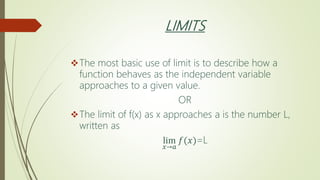
The most basic use of limit is to describe how a
function behaves as the independent variable
approaches to a given value.
OR
The limit of f(x) as x approaches a is the number L,
written as
lim
𝑥→𝑎
𝑓(𝑥)=L
1. lim
𝑥→𝑎
𝑓(𝑥)=lim
𝑥→𝑎
𝑐=c where c is a constant
2. lim
𝑥→𝑎
𝑥 𝑛=𝑎 𝑛 where n is a positive integer
3. lim
𝑥→𝑎
[𝑓 𝑥 ± 𝑔 𝑥 ]=lim
𝑥→𝑎
𝑓(𝑥)+lim
𝑥→𝑎
𝑔(𝑥)
4. lim
𝑥→𝑎
[𝑓 𝑥 . 𝑔 𝑥 ]=lim
𝑥→𝑎
𝑓(𝑥).lim
𝑥→𝑎
𝑔(𝑥)
5. lim
𝑥→𝑎
𝑐𝑓(𝑥)=c.lim
𝑥→𝑎
𝑓(𝑥)
6. lim
𝑥→𝑎
𝑓(𝑥)
𝑔(𝑥)
=lim
𝑥→𝑎
𝑓(𝑥)
𝑔(𝑥)
if lim
𝑥→𝑎
𝑔 𝑥 ≠0
7. lim
𝑥→𝑎
𝑛
𝑓(𝑥)= 𝑛
lim
𝑥→𝑎
𝑓(𝑥)
PROPETIES OF LIMITS
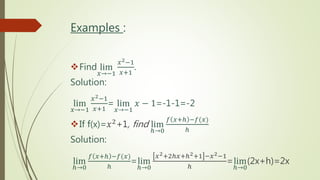
Examples :
Find lim
𝑥→−1
𝑥2−1
𝑥+1
.
Solution:
lim
𝑥→−1
𝑥2−1
𝑥+1
= lim
𝑥→−1
𝑥 − 1=-1-1=-2
If f(x)=𝑥2+1, find lim
ℎ→0
𝑓 𝑥+ℎ −𝑓(𝑥)
ℎ
Solution:
lim
ℎ→0
𝑓 𝑥+ℎ −𝑓(𝑥)
ℎ
=lim
ℎ→0
𝑥2+2ℎ𝑥+ℎ2+1 −𝑥2−1
ℎ
=lim
ℎ→0
(2x+h)=2x
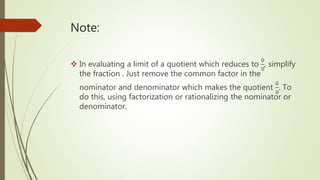
Note:
 In evaluating a limit of a quotient which reduces to
0
0
, simplify
the fraction . Just remove the common factor in the
nominator and denominator which makes the quotient
0
0
. To
do this, using factorization or rationalizing the nominator or
denominator.
Daily Life Example
Daily Life Example
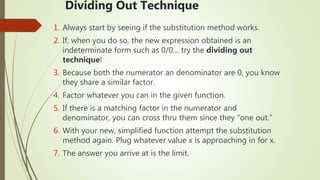
Dividing Out Technique
1. Always start by seeing if the substitution method works.
2. If, when you do so, the new expression obtained is an
indeterminate form such as 0/0… try the dividing out
technique!
3. Because both the numerator an denominator are 0, you know
they share a similar factor.
4. Factor whatever you can in the given function.
5. If there is a matching factor in the numerator and
denominator, you can cross thru them since they “one out.”
6. With your new, simplified function attempt the substitution
method again. Plug whatever value x is approaching in for x.
7. The answer you arrive at is the limit.
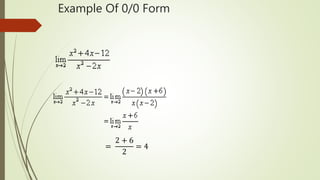
Example Of 0/0 Form
=
2 + 6
2
= 4
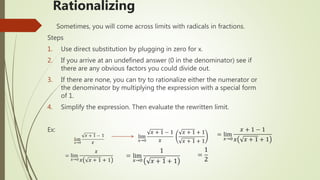
Rationalizing
Sometimes, you will come across limits with radicals in fractions.
Steps
1. Use direct substitution by plugging in zero for x.
2. If you arrive at an undefined answer (0 in the denominator) see if
there are any obvious factors you could divide out.
3. If there are none, you can try to rationalize either the numerator or
the denominator by multiplying the expression with a special form
of 1.
4. Simplify the expression. Then evaluate the rewritten limit.
Ex:
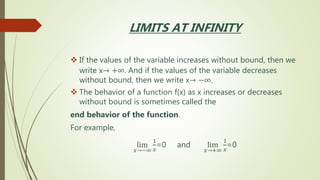
LIMITS AT INFINITY
 If the values of the variable increases without bound, then we
write x→ +∞. And if the values of the variable decreases
without bound, then we write x→ −∞.
 The behavior of a function f(x) as x increases or decreases
without bound is sometimes called the
end behavior of the function.
For example,
lim
𝑥→−∞
1
𝑥
=0 and lim
𝑥→+∞
1
𝑥
=0
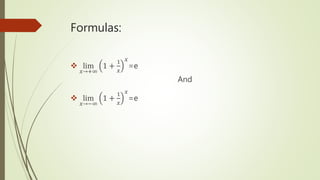
Formulas:
 lim
𝑥→+∞
1 +
1
𝑥
𝑥
=e
And
 lim
𝑥→−∞
1 +
1
𝑥
𝑥
=e
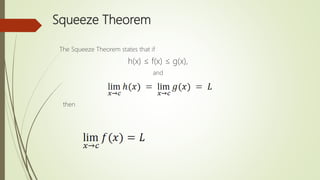
Squeeze Theorem
The Squeeze Theorem states that if
h(x) ≤ f(x) ≤ g(x),
and
then
Limits and its theorem  In Calculus

Limits and its theorem In Calculus

  • 2.
    Prof.Farhat Hussain UZAIR AHMAD MUHAMMADUMAR Presented to: Presented By:
  • 3.
  • 4.
    LIMITS The most basicuse of limit is to describe how a function behaves as the independent variable approaches to a given value. OR The limit of f(x) as x approaches a is the number L, written as lim 𝑥→𝑎 𝑓(𝑥)=L
  • 5.
    1. lim 𝑥→𝑎 𝑓(𝑥)=lim 𝑥→𝑎 𝑐=c wherec is a constant 2. lim 𝑥→𝑎 𝑥 𝑛=𝑎 𝑛 where n is a positive integer 3. lim 𝑥→𝑎 [𝑓 𝑥 ± 𝑔 𝑥 ]=lim 𝑥→𝑎 𝑓(𝑥)+lim 𝑥→𝑎 𝑔(𝑥) 4. lim 𝑥→𝑎 [𝑓 𝑥 . 𝑔 𝑥 ]=lim 𝑥→𝑎 𝑓(𝑥).lim 𝑥→𝑎 𝑔(𝑥) 5. lim 𝑥→𝑎 𝑐𝑓(𝑥)=c.lim 𝑥→𝑎 𝑓(𝑥) 6. lim 𝑥→𝑎 𝑓(𝑥) 𝑔(𝑥) =lim 𝑥→𝑎 𝑓(𝑥) 𝑔(𝑥) if lim 𝑥→𝑎 𝑔 𝑥 ≠0 7. lim 𝑥→𝑎 𝑛 𝑓(𝑥)= 𝑛 lim 𝑥→𝑎 𝑓(𝑥) PROPETIES OF LIMITS
  • 6.
    Examples : Find lim 𝑥→−1 𝑥2−1 𝑥+1 . Solution: lim 𝑥→−1 𝑥2−1 𝑥+1 =lim 𝑥→−1 𝑥 − 1=-1-1=-2 If f(x)=𝑥2+1, find lim ℎ→0 𝑓 𝑥+ℎ −𝑓(𝑥) ℎ Solution: lim ℎ→0 𝑓 𝑥+ℎ −𝑓(𝑥) ℎ =lim ℎ→0 𝑥2+2ℎ𝑥+ℎ2+1 −𝑥2−1 ℎ =lim ℎ→0 (2x+h)=2x
  • 7.
    Note:  In evaluatinga limit of a quotient which reduces to 0 0 , simplify the fraction . Just remove the common factor in the nominator and denominator which makes the quotient 0 0 . To do this, using factorization or rationalizing the nominator or denominator.
  • 9.
  • 10.
  • 11.
    Dividing Out Technique 1.Always start by seeing if the substitution method works. 2. If, when you do so, the new expression obtained is an indeterminate form such as 0/0… try the dividing out technique! 3. Because both the numerator an denominator are 0, you know they share a similar factor. 4. Factor whatever you can in the given function. 5. If there is a matching factor in the numerator and denominator, you can cross thru them since they “one out.” 6. With your new, simplified function attempt the substitution method again. Plug whatever value x is approaching in for x. 7. The answer you arrive at is the limit.
  • 12.
    Example Of 0/0Form = 2 + 6 2 = 4
  • 13.
    Rationalizing Sometimes, you willcome across limits with radicals in fractions. Steps 1. Use direct substitution by plugging in zero for x. 2. If you arrive at an undefined answer (0 in the denominator) see if there are any obvious factors you could divide out. 3. If there are none, you can try to rationalize either the numerator or the denominator by multiplying the expression with a special form of 1. 4. Simplify the expression. Then evaluate the rewritten limit. Ex:
  • 14.
    LIMITS AT INFINITY If the values of the variable increases without bound, then we write x→ +∞. And if the values of the variable decreases without bound, then we write x→ −∞.  The behavior of a function f(x) as x increases or decreases without bound is sometimes called the end behavior of the function. For example, lim 𝑥→−∞ 1 𝑥 =0 and lim 𝑥→+∞ 1 𝑥 =0
  • 15.
  • 16.
    Squeeze Theorem The SqueezeTheorem states that if h(x) ≤ f(x) ≤ g(x), and then