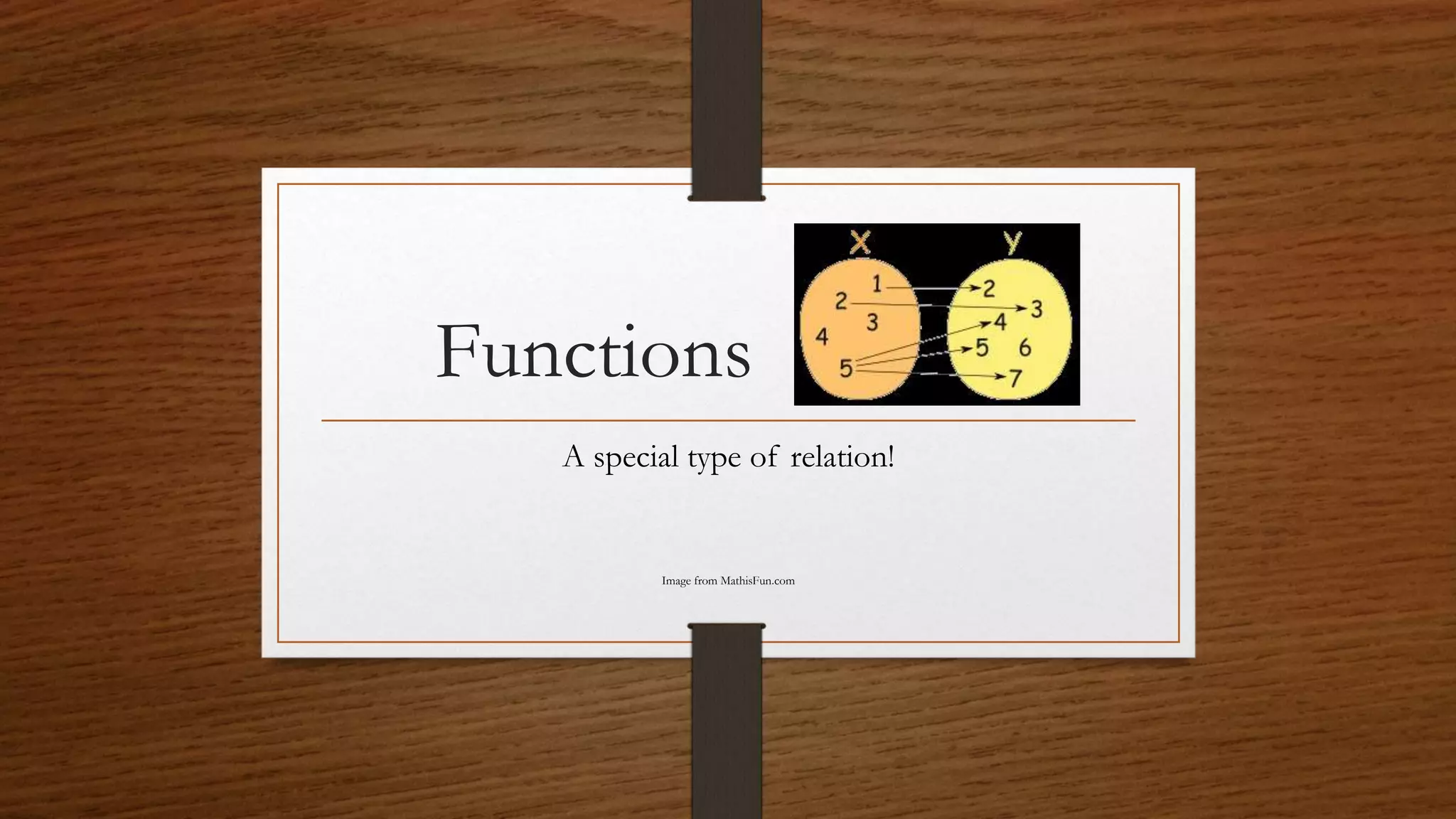
Functions
A special type of relation!

Image from MathisFun.com
Let’s review relations!
• A relation is a set of ordered pairs. {(1,2), (2,-3), (-2,4), (-1,0)} is an example
of a relation.

• The x-values in each coordinate make up what is referred to as the domain.
{-2, -1, 1, 2} is the domain of the relation.

• The y-values in each coordinate make up what is referred to as the range.
{-3, 0, 2, 4} is the range of the relation.
So What Are Functions?
•
•
•
•
•

Functions are relations, so they are sets of ordered pairs!
What makes them special is that the x-values don’t repeat!

Each x-value is paired with exactly one y-value.
There are many ways to express functions.
They can be expressed as ordered pairs, in tables, in a graph, or as a mapping.
Let’s take a closer look at how
functions can be expressed.
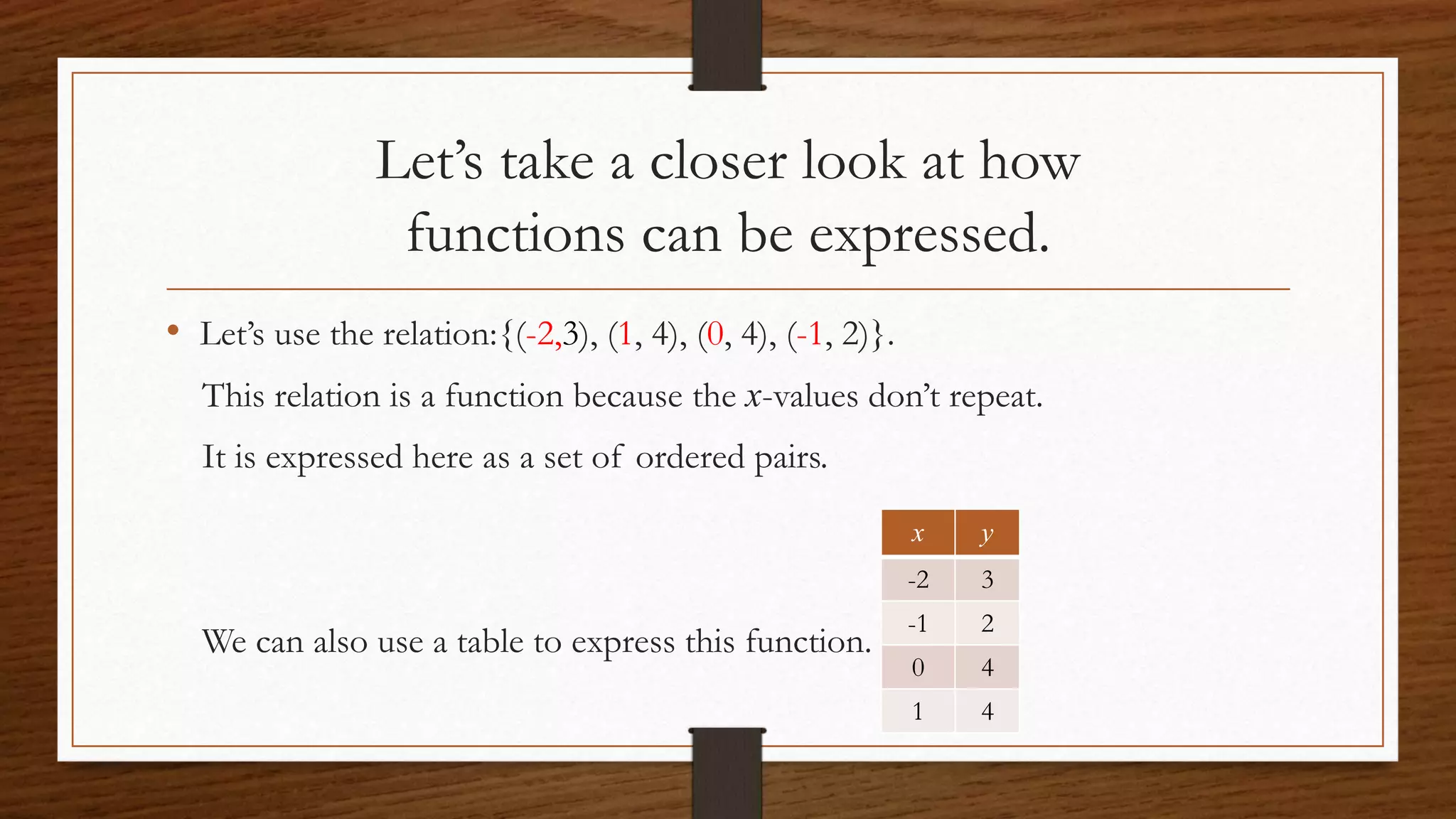
• Let’s use the relation:{(-2,3), (1, 4), (0, 4), (-1, 2)}.
This relation is a function because the x-values don’t repeat.

It is expressed here as a set of ordered pairs.
x
-2

We can also use a table to express this function.

y
3

-1

2

0

4

1

4
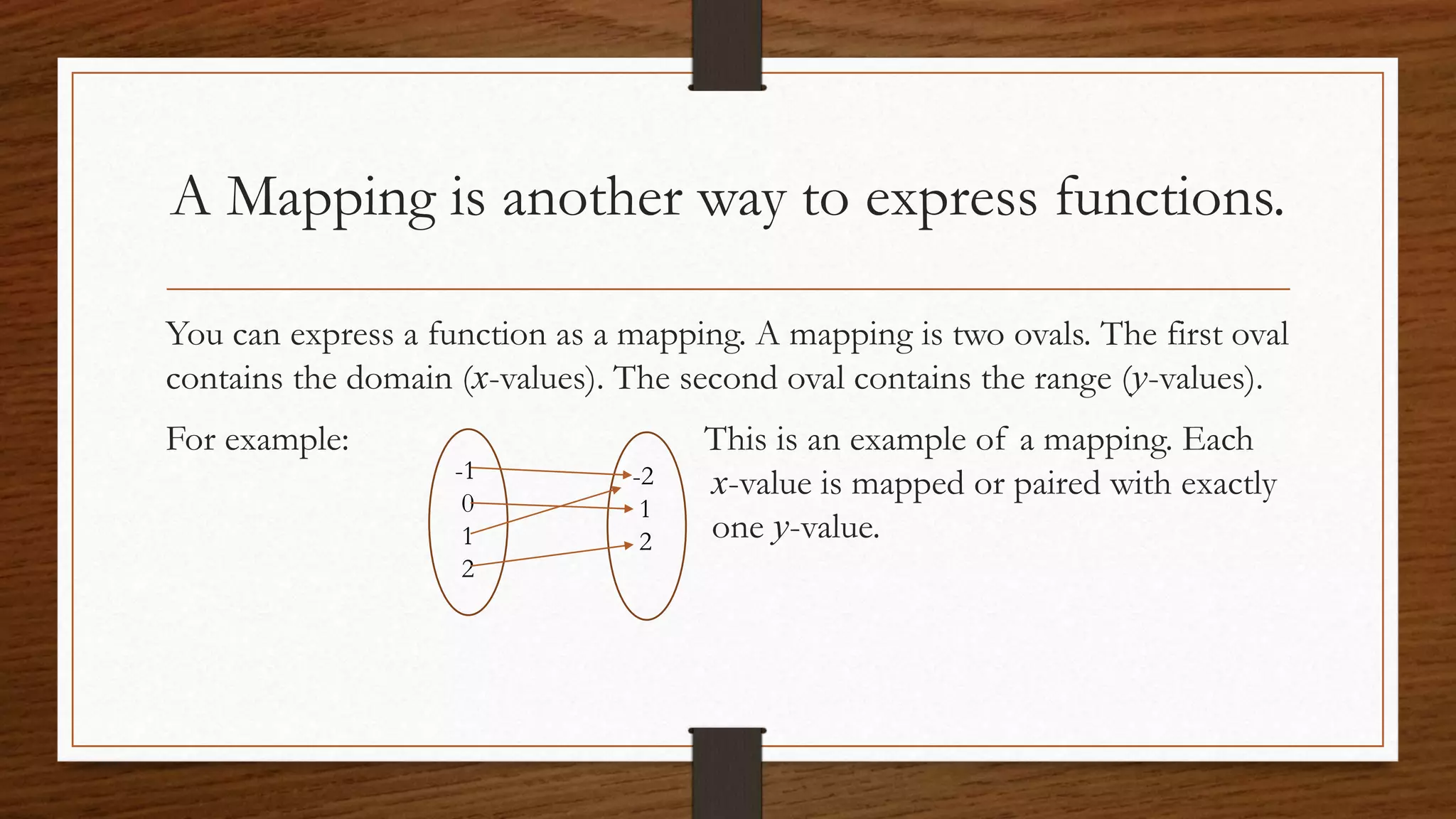
A Mapping is another way to express functions.
You can express a function as a mapping. A mapping is two ovals. The first oval
contains the domain (x-values). The second oval contains the range (y-values).

For example:

-1
0
1
2

-2
1
2

This is an example of a mapping. Each
x-value is mapped or paired with exactly
one y-value.
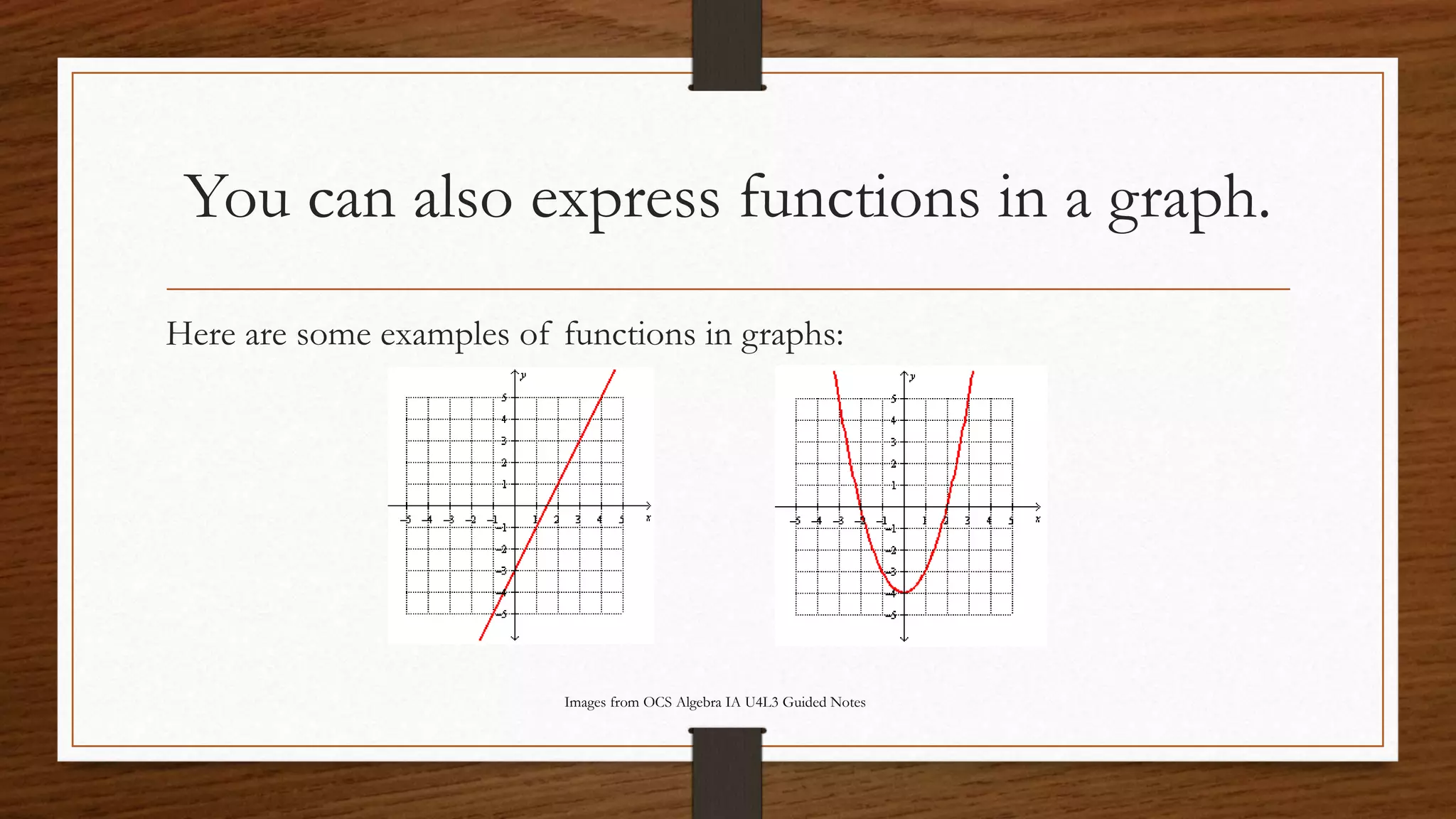
You can also express functions in a graph.
Here are some examples of functions in graphs:

Images from OCS Algebra IA U4L3 Guided Notes
Graphs of Functions
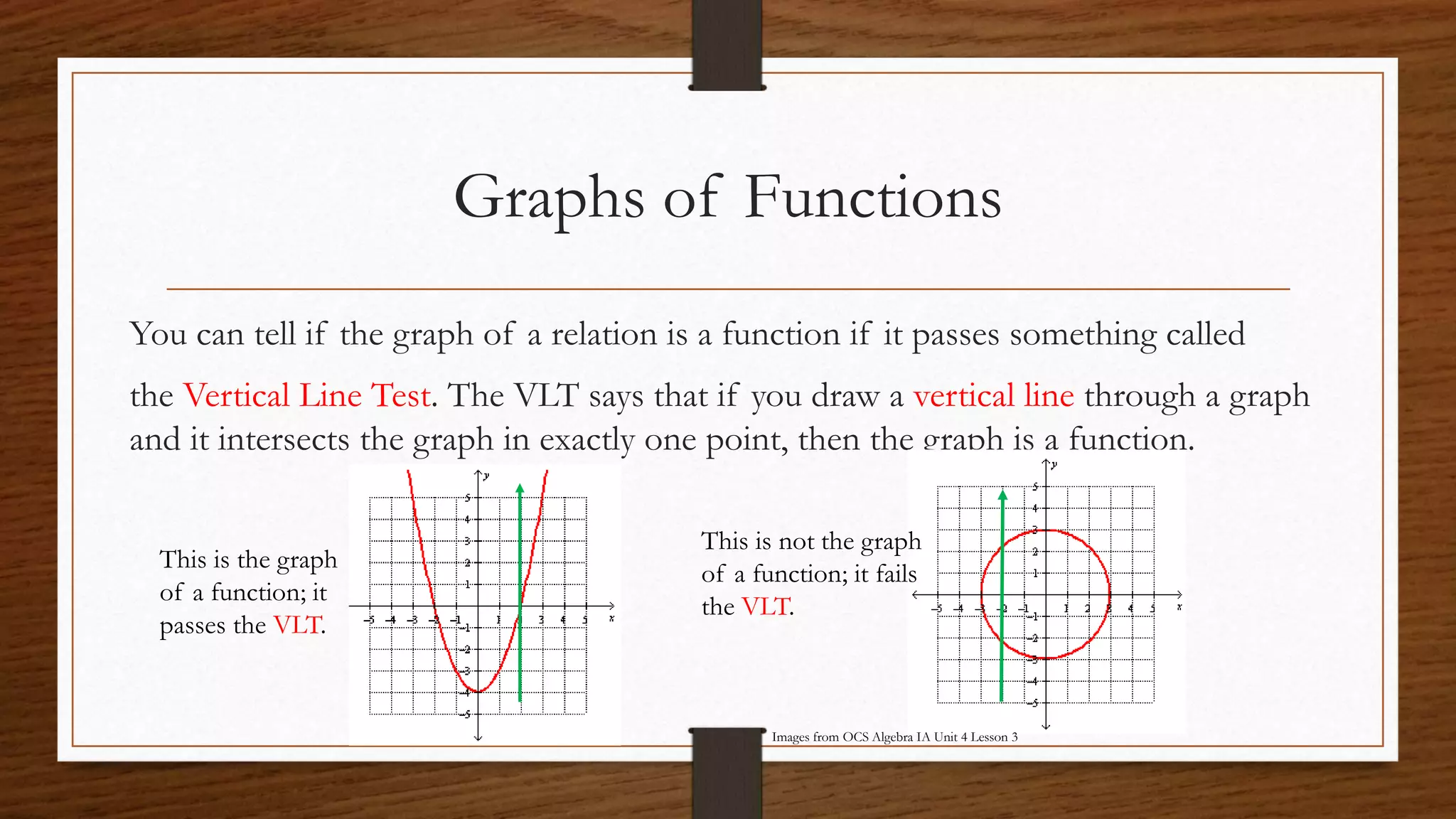
You can tell if the graph of a relation is a function if it passes something called
the Vertical Line Test. The VLT says that if you draw a vertical line through a graph
and it intersects the graph in exactly one point, then the graph is a function.
This is the graph
of a function; it
passes the VLT.

This is not the graph
of a function; it fails
the VLT.

Images from OCS Algebra IA Unit 4 Lesson 3

Functions

  • 1.
    Functions A special typeof relation! Image from MathisFun.com
  • 2.
    Let’s review relations! •A relation is a set of ordered pairs. {(1,2), (2,-3), (-2,4), (-1,0)} is an example of a relation. • The x-values in each coordinate make up what is referred to as the domain. {-2, -1, 1, 2} is the domain of the relation. • The y-values in each coordinate make up what is referred to as the range. {-3, 0, 2, 4} is the range of the relation.
  • 3.
    So What AreFunctions? • • • • • Functions are relations, so they are sets of ordered pairs! What makes them special is that the x-values don’t repeat! Each x-value is paired with exactly one y-value. There are many ways to express functions. They can be expressed as ordered pairs, in tables, in a graph, or as a mapping.
  • 4.
    Let’s take acloser look at how functions can be expressed. • Let’s use the relation:{(-2,3), (1, 4), (0, 4), (-1, 2)}. This relation is a function because the x-values don’t repeat. It is expressed here as a set of ordered pairs. x -2 We can also use a table to express this function. y 3 -1 2 0 4 1 4
  • 5.
    A Mapping isanother way to express functions. You can express a function as a mapping. A mapping is two ovals. The first oval contains the domain (x-values). The second oval contains the range (y-values). For example: -1 0 1 2 -2 1 2 This is an example of a mapping. Each x-value is mapped or paired with exactly one y-value.
  • 6.
    You can alsoexpress functions in a graph. Here are some examples of functions in graphs: Images from OCS Algebra IA U4L3 Guided Notes
  • 7.
    Graphs of Functions Youcan tell if the graph of a relation is a function if it passes something called the Vertical Line Test. The VLT says that if you draw a vertical line through a graph and it intersects the graph in exactly one point, then the graph is a function. This is the graph of a function; it passes the VLT. This is not the graph of a function; it fails the VLT. Images from OCS Algebra IA Unit 4 Lesson 3