TOPICS
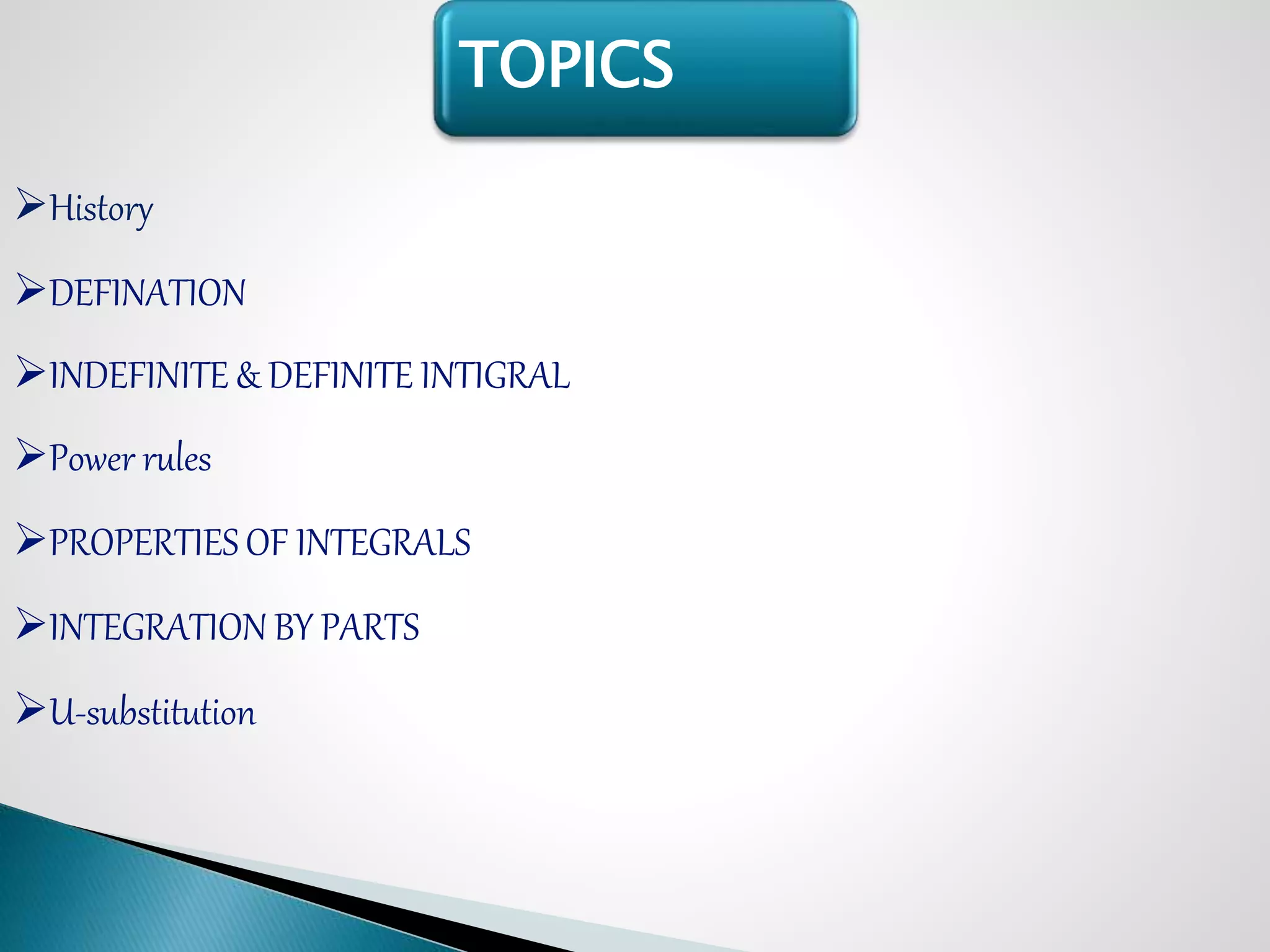
INDEFINITE & DEFINITE INTIGRAL
Power rules
PROPERTIES OF INTEGRALS
INTEGRATION BY PARTS
U-substitution
DEFINATION
History
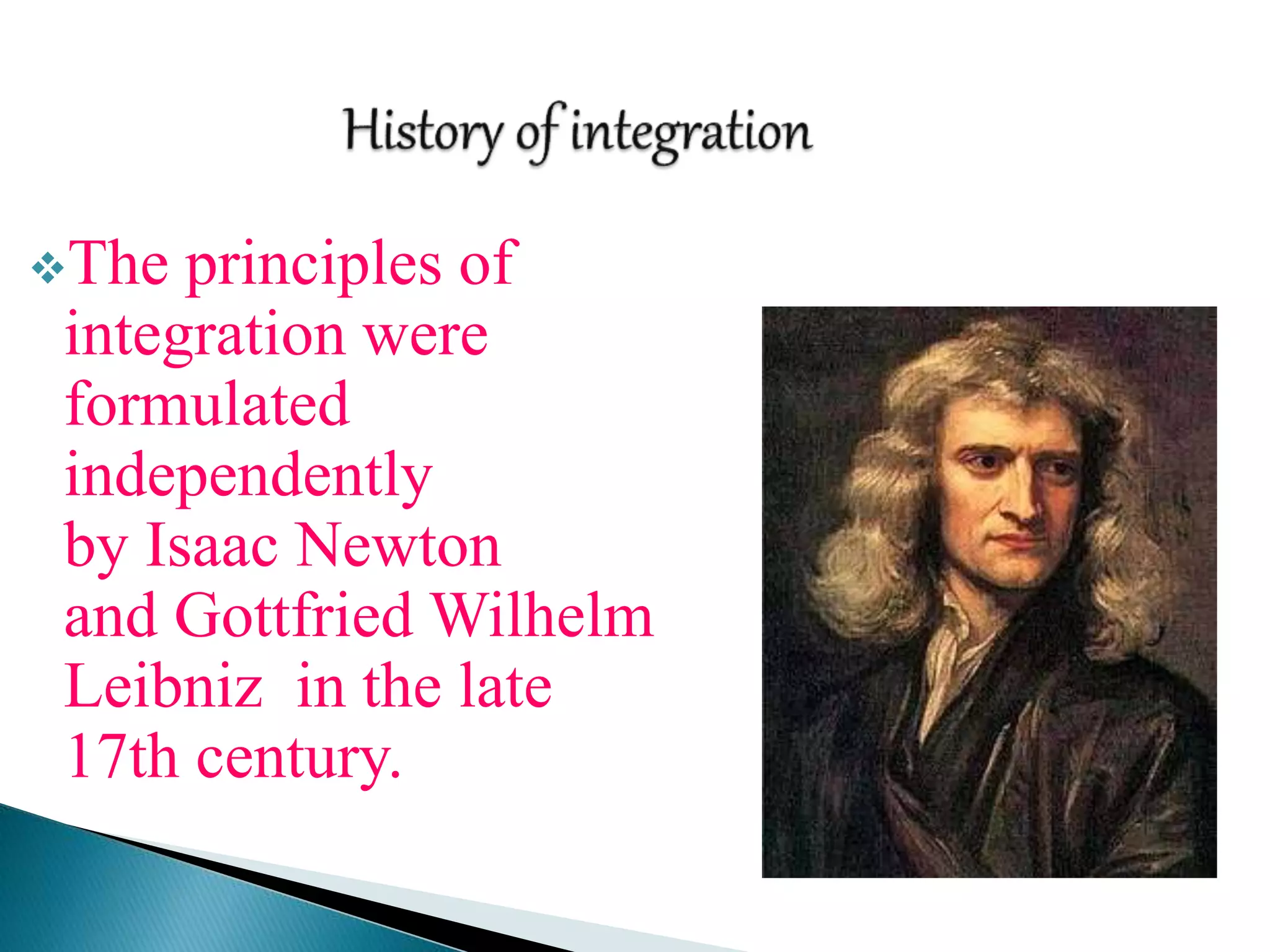
The principles of
integration were
formulated
independently
by Isaac Newton
and Gottfried Wilhelm
Leibniz in the late
17th century.
DEFINATION:
The process of
evaluating an
indefinite integral or a
definite
Integral.
 The indefinite integral ∫f(x)dx is defined as a
function g such as its derivative
D.[g(x)]=f(x).
 The definite integral is a number whose
value depends on the function f and the numbers a
and b, and it is defined as the limit of Riemann
sum.
 he arbitrary constant c is
called a constant of integration .
The derivative of a constant is 0. However, when
you integrate, you should consider that there is a
possible constant involved, but we don’t know what
it is for a particular problem. Therefore, you can
just use C to represent value.
To solve for C, you will be given a problem that
gives you the y(0) value. Then you can plug the 0
in for x and the y(0) value for y.
Where,
C = Constant of integration
u = Function
n = Power
du = Derivative
The equation is
∫ (u^(n)) du = {(u^(n+1)) / (n+1)} +C
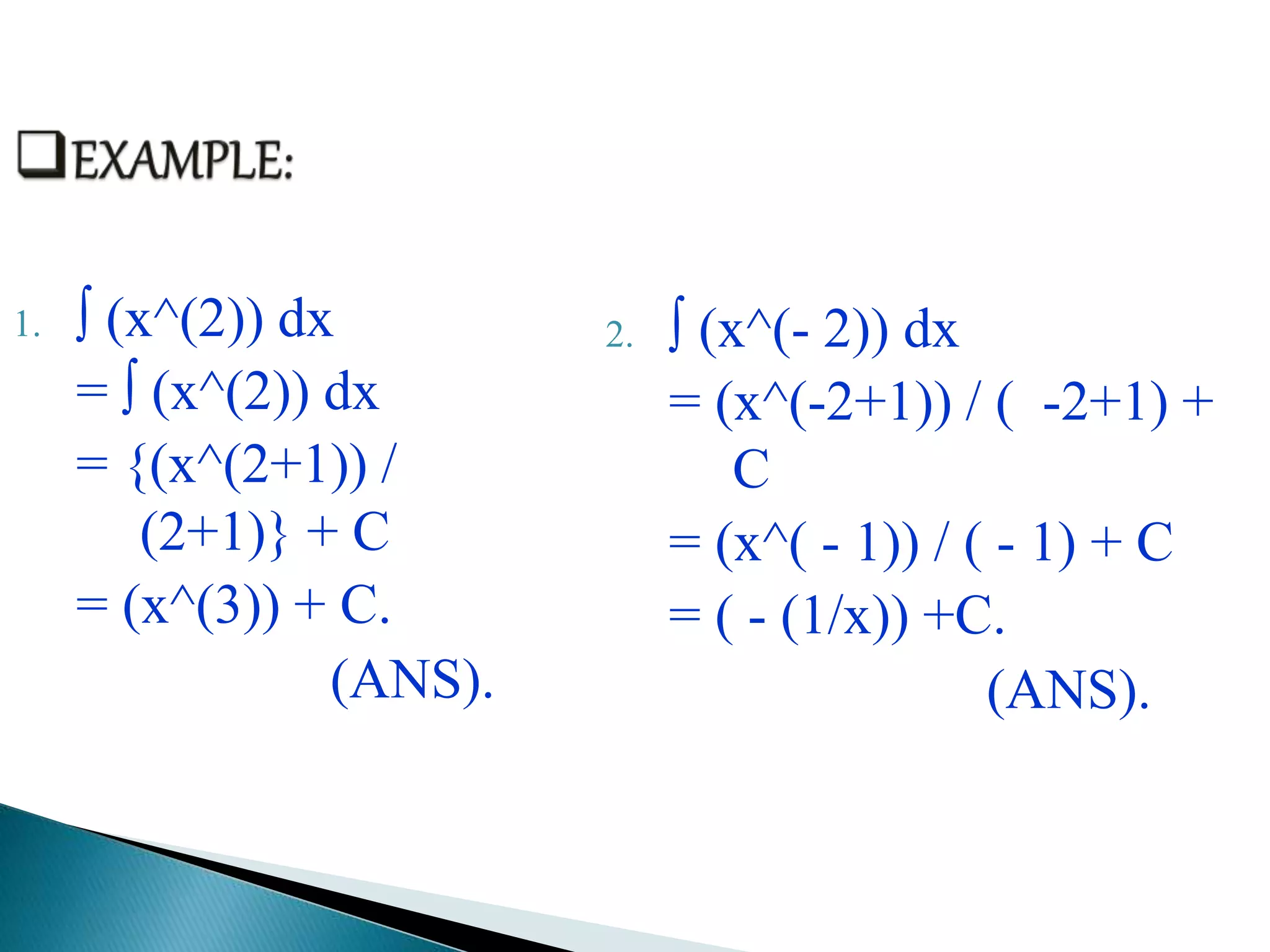
1. ∫ (x^(2)) dx
= ∫ (x^(2)) dx
= {(x^(2+1)) /
(2+1)} + C
= (x^(3)) + C.
(ANS).
2. ∫ (x^(- 2)) dx
= (x^(-2+1)) / ( -2+1) +
C
= (x^( - 1)) / ( - 1) + C
= ( - (1/x)) +C.
(ANS).
∫ [ f (x) + - g (x)] dx =
∫ f (x) dx + - ∫ g (x) dx.
∫ kf (x) dx = k ∫ f(x) dx.
Where k is constant.
1. ∫ ( - 2x^(6) dx
= [- 2 ∫ (x^(6))] dx
= [- 2 {(x^(6+1)) /
(6+1)}] + C
= {- 2 {x^(7) / 7} + C
= {-(2 / 7) x^(7)} + C.
(ANS).
2. ∫ {x (5 – 3x) dx
= ∫ (5x – 3 x^(2)) dx
= {5 ∫ x dx – 3 ∫ (x^(2))}
dx
= {5 ((x^(1+1)) / (1+1)) –
3 ((x^(2+1)) / (2+1))} +
C
= {5 ((x^(2)) / 2) – 3
((x^(3) / 3)} + C
= {(5 x^(2) / 2) – (x^(3))}
+ C.
(ANS).
If the functions are not related then use integration
by parts.
Is a rule that transforms the integral of products of
function into other functions .
The equation is ∫ u dv = uv -∫ u du . .
1. ∫ x e^(x) dx
Let, x = u
.‧. dx = du
e^(x) dx = dv
.‧. ∫ dv = ∫ e^(x) dx
= e^(x) + c
Now,
we know,
∫ u dv = uv - ∫ u du
= x * e^(x) - ∫ e^(x) dx
= x e^(x) – e^(x) + c
= e^(x) {x-1} + c.
(ANS)
2. ∫ x sin(x) dx
Let, x = u
.‧. du = dx
sin(x) dx = dv
.‧. v = { - cos(x)}
Now,
we know,
∫ u dv = uv - ∫ u du
= x*{ - cos(x)} - ∫ { - cos(x)} dx
= - x cos(x) + ∫ cos(x) dx
= - x cos(x) + sin(x )+ c.
(ANS)
oThe method of substitution can be motivated by
examining the chain rule from the view point of anti-
differentiation.
o This is used when there are two algebraic functions and
one of them is not the derivative of the other.
1. ∫{(x^(2) +1)^50 * 2x} dx
Let, u = x^(2) + 1
.‧. du = 2x dx
Now,
∫{((x^(2) + 1)^50) *
2x} dx
= ∫ (u^50) du
= (u^51) / 51 + C
= (x^(2) + 1)^51 /51
+C.
(ANS)
2. ∫ cos 5x dx
Let, u = 5x
.‧. du = 5 dx
.‧. dx = (1/5) du
Now,
∫ cos 5x dx
= ∫ (cos u) * (1/5) du
= (1/5) ∫ cos u du
= (1/5) sin u + C
=(1/5) sin 5x + C.
(ANS)
Integration

Integration

  • 2.
    TOPICS INDEFINITE & DEFINITEINTIGRAL Power rules PROPERTIES OF INTEGRALS INTEGRATION BY PARTS U-substitution DEFINATION History
  • 3.
    The principles of integrationwere formulated independently by Isaac Newton and Gottfried Wilhelm Leibniz in the late 17th century.
  • 4.
    DEFINATION: The process of evaluatingan indefinite integral or a definite Integral.
  • 5.
     The indefiniteintegral ∫f(x)dx is defined as a function g such as its derivative D.[g(x)]=f(x).  The definite integral is a number whose value depends on the function f and the numbers a and b, and it is defined as the limit of Riemann sum.  he arbitrary constant c is called a constant of integration .
  • 6.
    The derivative ofa constant is 0. However, when you integrate, you should consider that there is a possible constant involved, but we don’t know what it is for a particular problem. Therefore, you can just use C to represent value. To solve for C, you will be given a problem that gives you the y(0) value. Then you can plug the 0 in for x and the y(0) value for y.
  • 7.
    Where, C = Constantof integration u = Function n = Power du = Derivative The equation is ∫ (u^(n)) du = {(u^(n+1)) / (n+1)} +C
  • 8.
    1. ∫ (x^(2))dx = ∫ (x^(2)) dx = {(x^(2+1)) / (2+1)} + C = (x^(3)) + C. (ANS). 2. ∫ (x^(- 2)) dx = (x^(-2+1)) / ( -2+1) + C = (x^( - 1)) / ( - 1) + C = ( - (1/x)) +C. (ANS).
  • 9.
    ∫ [ f(x) + - g (x)] dx = ∫ f (x) dx + - ∫ g (x) dx. ∫ kf (x) dx = k ∫ f(x) dx. Where k is constant.
  • 10.
    1. ∫ (- 2x^(6) dx = [- 2 ∫ (x^(6))] dx = [- 2 {(x^(6+1)) / (6+1)}] + C = {- 2 {x^(7) / 7} + C = {-(2 / 7) x^(7)} + C. (ANS). 2. ∫ {x (5 – 3x) dx = ∫ (5x – 3 x^(2)) dx = {5 ∫ x dx – 3 ∫ (x^(2))} dx = {5 ((x^(1+1)) / (1+1)) – 3 ((x^(2+1)) / (2+1))} + C = {5 ((x^(2)) / 2) – 3 ((x^(3) / 3)} + C = {(5 x^(2) / 2) – (x^(3))} + C. (ANS).
  • 11.
    If the functionsare not related then use integration by parts. Is a rule that transforms the integral of products of function into other functions . The equation is ∫ u dv = uv -∫ u du . .
  • 12.
    1. ∫ xe^(x) dx Let, x = u .‧. dx = du e^(x) dx = dv .‧. ∫ dv = ∫ e^(x) dx = e^(x) + c Now, we know, ∫ u dv = uv - ∫ u du = x * e^(x) - ∫ e^(x) dx = x e^(x) – e^(x) + c = e^(x) {x-1} + c. (ANS) 2. ∫ x sin(x) dx Let, x = u .‧. du = dx sin(x) dx = dv .‧. v = { - cos(x)} Now, we know, ∫ u dv = uv - ∫ u du = x*{ - cos(x)} - ∫ { - cos(x)} dx = - x cos(x) + ∫ cos(x) dx = - x cos(x) + sin(x )+ c. (ANS)
  • 13.
    oThe method ofsubstitution can be motivated by examining the chain rule from the view point of anti- differentiation. o This is used when there are two algebraic functions and one of them is not the derivative of the other.
  • 14.
    1. ∫{(x^(2) +1)^50* 2x} dx Let, u = x^(2) + 1 .‧. du = 2x dx Now, ∫{((x^(2) + 1)^50) * 2x} dx = ∫ (u^50) du = (u^51) / 51 + C = (x^(2) + 1)^51 /51 +C. (ANS) 2. ∫ cos 5x dx Let, u = 5x .‧. du = 5 dx .‧. dx = (1/5) du Now, ∫ cos 5x dx = ∫ (cos u) * (1/5) du = (1/5) ∫ cos u du = (1/5) sin u + C =(1/5) sin 5x + C. (ANS)