arXiv:1008.0549v1 [math.OC] 3 Aug 2010 
Test Problems in Optimization 
Xin-She Yang 
Department of Engineering, University of Cambridge, 
Cambridge CB2 1PZ, UK 
Abstract 
Test functions are important to validate new optimization algorithms 
and to compare the performance of various algorithms. There are many 
test functions in the literature, but there is no standard list or set of test 
functions one has to follow. New optimization algorithms should be tested 
using at least a subset of functions with diverse properties so as to make 
sure whether or not the tested algorithm can solve certain type of opti-mization 
efficiently. Here we provide a selected list of test problems for 
unconstrained optimization. 
Citation detail: 
X.-S. Yang, Test problems in optimization, in: Engineering Optimization: An Introduc-tion 
with Metaheuristic Applications (Eds Xin-She Yang), John Wiley & Sons, (2010).
In order to validate any new optimization algorithm, we have to validate it against 
standard test functions so as to compare its performance with well-established or existing 
algorithms. There are many test functions, so there is no standard list or set of test functions 
one has to follow. However, various test functions do exist, so new algorithms should be 
tested using at least a subset of functions with diverse properties so as to make sure whether 
or not the tested algorithm can solve certain type of optimization efficiently. 
In this appendix, we will provide a subset of commonly used test functions with simple 
bounds as constraints, though they are often listed as unconstrained problems in literature. 
We will list the function form f(x), its search domain, optimal solutions x and/or optimal 
objective value f. Here, we use x = (x1, ..., xn)T where n is the dimension. 
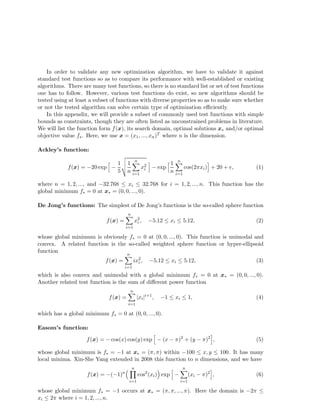
Ackley’s function: 
f(x) = −20 exp h − 
1 
5 
vuut 
1 
n 
n 
Xi 
=1 
x2i 
i − exp h 1 
n 
n 
Xi 
=1 
cos(2xi)i + 20 + e, (1) 
where n = 1, 2, ..., and −32.768  xi  32.768 for i = 1, 2, ..., n. This function has the 
global minimum f = 0 at x = (0, 0, ..., 0). 
De Jong’s functions: The simplest of De Jong’s functions is the so-called sphere function 
f(x) = 
n 
Xi 
=1 
x2i 
, −5.12  xi  5.12, (2) 
whose global minimum is obviously f = 0 at (0, 0, ..., 0). This function is unimodal and 
convex. A related function is the so-called weighted sphere function or hyper-ellipsoid 
function 
f(x) = 
n 
Xi 
=1 
ix2i 
, −5.12  xi  5.12, (3) 
which is also convex and unimodal with a global minimum f = 0 at x = (0, 0, ..., 0). 
Another related test function is the sum of different power function 
f(x) = 
n 
=1 |xi|i+1, −1  xi  1, (4) 
Xi 
which has a global minimum f = 0 at (0, 0, ..., 0). 
Easom’s function: 
f(x) = −cos(x) cos(y) exp h − (x − )2 + (y − )2i, (5) 
whose global minimum is f = −1 at x = (, ) within −100  x, y  100. It has many 
local minima. Xin-She Yang extended in 2008 this function to n dimensions, and we have 
f(x) = −(−1)n 
n 
Y 
i=1 
cos2(xi) exp h − 
n 
Xi 
=1 
(xi − )2i, (6) 
whose global minimum f = −1 occurs at x = (, , ..., ). Here the domain is −2  
xi  2 where i = 1, 2, ..., n.
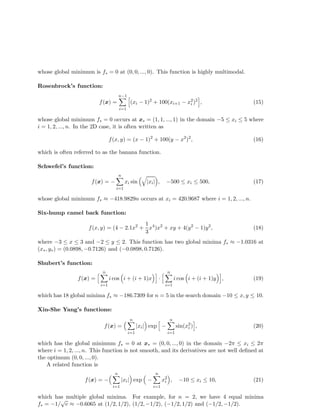
Equality-Constrained Function: 
f(x) = −(pn)n 
n 
Y 
i=1 
xi, (7) 
subject to an equality constraint (a hyper-sphere) 
n 
Xi 
=1 
x2i 
= 1. (8) 
The global minimum f = −1 of f(x) occurs at x(1/pn, ..., 1/pn) within the domain 
0  xi  1 for i = 1, 2, ..., n. 
Griewank’s function: 
f(x) = 
1 
4000 
n 
Xi 
=1 
x2i 
− 
n 
Y 
i=1 
cos( 
xi pi 
) + 1, −600  xi  600, (9) 
whose global minimum is f = 0 at x = (0, 0, ..., 0). This function is highly multimodal. 
Michaelwicz’s function: 
f(x) = − 
n 
Xi 
=1 
sin(xi) · h sin( 
ix2i 
 
)i2m 
, (10) 
where m = 10, and 0  xi   for i = 1, 2, ..., n. In 2D case, we have 
f(x, y) = −sin(x) sin20( 
x2 
 
) − sin(y) sin20( 
2y2 
 
), (11) 
where (x, y) 2 [0, 5] × [0, 5]. This function has a global minimum f  −1.8013 at 
x = (x, y) = (2.20319, 1.57049). 
Perm Functions: 
f(x) = 
n 
X 
j=1 
n 
n 
Xi 
=1 
(ij +
)h( 
xi 
i 
)j − 1io, (
0), (12) 
which has the global minimum f = 0 at x = (1, 2, ..., n) in the search domain −n  xi  n 
for i = 1, ..., n. A related function 
f(x) = 
n 
X 
j=1 
n 
n 
Xi 
=1 
(i +
)hxj 
i − ( 
1 
i 
)jio2 
, (13) 
has the global minimum f = 0 at (1, 1/2, 1/3, ..., 1/n) within the bounds −1  xi  1 for 
all i = 1, 2, ..., n. As

Test Problems in Optimization

  • 1.
    arXiv:1008.0549v1 [math.OC] 3Aug 2010 Test Problems in Optimization Xin-She Yang Department of Engineering, University of Cambridge, Cambridge CB2 1PZ, UK Abstract Test functions are important to validate new optimization algorithms and to compare the performance of various algorithms. There are many test functions in the literature, but there is no standard list or set of test functions one has to follow. New optimization algorithms should be tested using at least a subset of functions with diverse properties so as to make sure whether or not the tested algorithm can solve certain type of opti-mization efficiently. Here we provide a selected list of test problems for unconstrained optimization. Citation detail: X.-S. Yang, Test problems in optimization, in: Engineering Optimization: An Introduc-tion with Metaheuristic Applications (Eds Xin-She Yang), John Wiley & Sons, (2010).
  • 2.
    In order tovalidate any new optimization algorithm, we have to validate it against standard test functions so as to compare its performance with well-established or existing algorithms. There are many test functions, so there is no standard list or set of test functions one has to follow. However, various test functions do exist, so new algorithms should be tested using at least a subset of functions with diverse properties so as to make sure whether or not the tested algorithm can solve certain type of optimization efficiently. In this appendix, we will provide a subset of commonly used test functions with simple bounds as constraints, though they are often listed as unconstrained problems in literature. We will list the function form f(x), its search domain, optimal solutions x and/or optimal objective value f. Here, we use x = (x1, ..., xn)T where n is the dimension. Ackley’s function: f(x) = −20 exp h − 1 5 vuut 1 n n Xi =1 x2i i − exp h 1 n n Xi =1 cos(2xi)i + 20 + e, (1) where n = 1, 2, ..., and −32.768 xi 32.768 for i = 1, 2, ..., n. This function has the global minimum f = 0 at x = (0, 0, ..., 0). De Jong’s functions: The simplest of De Jong’s functions is the so-called sphere function f(x) = n Xi =1 x2i , −5.12 xi 5.12, (2) whose global minimum is obviously f = 0 at (0, 0, ..., 0). This function is unimodal and convex. A related function is the so-called weighted sphere function or hyper-ellipsoid function f(x) = n Xi =1 ix2i , −5.12 xi 5.12, (3) which is also convex and unimodal with a global minimum f = 0 at x = (0, 0, ..., 0). Another related test function is the sum of different power function f(x) = n =1 |xi|i+1, −1 xi 1, (4) Xi which has a global minimum f = 0 at (0, 0, ..., 0). Easom’s function: f(x) = −cos(x) cos(y) exp h − (x − )2 + (y − )2i, (5) whose global minimum is f = −1 at x = (, ) within −100 x, y 100. It has many local minima. Xin-She Yang extended in 2008 this function to n dimensions, and we have f(x) = −(−1)n n Y i=1 cos2(xi) exp h − n Xi =1 (xi − )2i, (6) whose global minimum f = −1 occurs at x = (, , ..., ). Here the domain is −2 xi 2 where i = 1, 2, ..., n.
  • 3.
    Equality-Constrained Function: f(x)= −(pn)n n Y i=1 xi, (7) subject to an equality constraint (a hyper-sphere) n Xi =1 x2i = 1. (8) The global minimum f = −1 of f(x) occurs at x(1/pn, ..., 1/pn) within the domain 0 xi 1 for i = 1, 2, ..., n. Griewank’s function: f(x) = 1 4000 n Xi =1 x2i − n Y i=1 cos( xi pi ) + 1, −600 xi 600, (9) whose global minimum is f = 0 at x = (0, 0, ..., 0). This function is highly multimodal. Michaelwicz’s function: f(x) = − n Xi =1 sin(xi) · h sin( ix2i )i2m , (10) where m = 10, and 0 xi for i = 1, 2, ..., n. In 2D case, we have f(x, y) = −sin(x) sin20( x2 ) − sin(y) sin20( 2y2 ), (11) where (x, y) 2 [0, 5] × [0, 5]. This function has a global minimum f −1.8013 at x = (x, y) = (2.20319, 1.57049). Perm Functions: f(x) = n X j=1 n n Xi =1 (ij +
  • 4.
    )h( xi i )j − 1io, (
  • 5.
    0), (12) whichhas the global minimum f = 0 at x = (1, 2, ..., n) in the search domain −n xi n for i = 1, ..., n. A related function f(x) = n X j=1 n n Xi =1 (i +
  • 6.
    )hxj i −( 1 i )jio2 , (13) has the global minimum f = 0 at (1, 1/2, 1/3, ..., 1/n) within the bounds −1 xi 1 for all i = 1, 2, ..., n. As