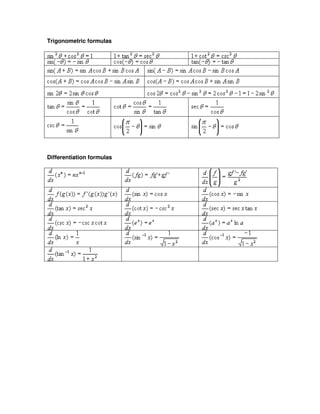
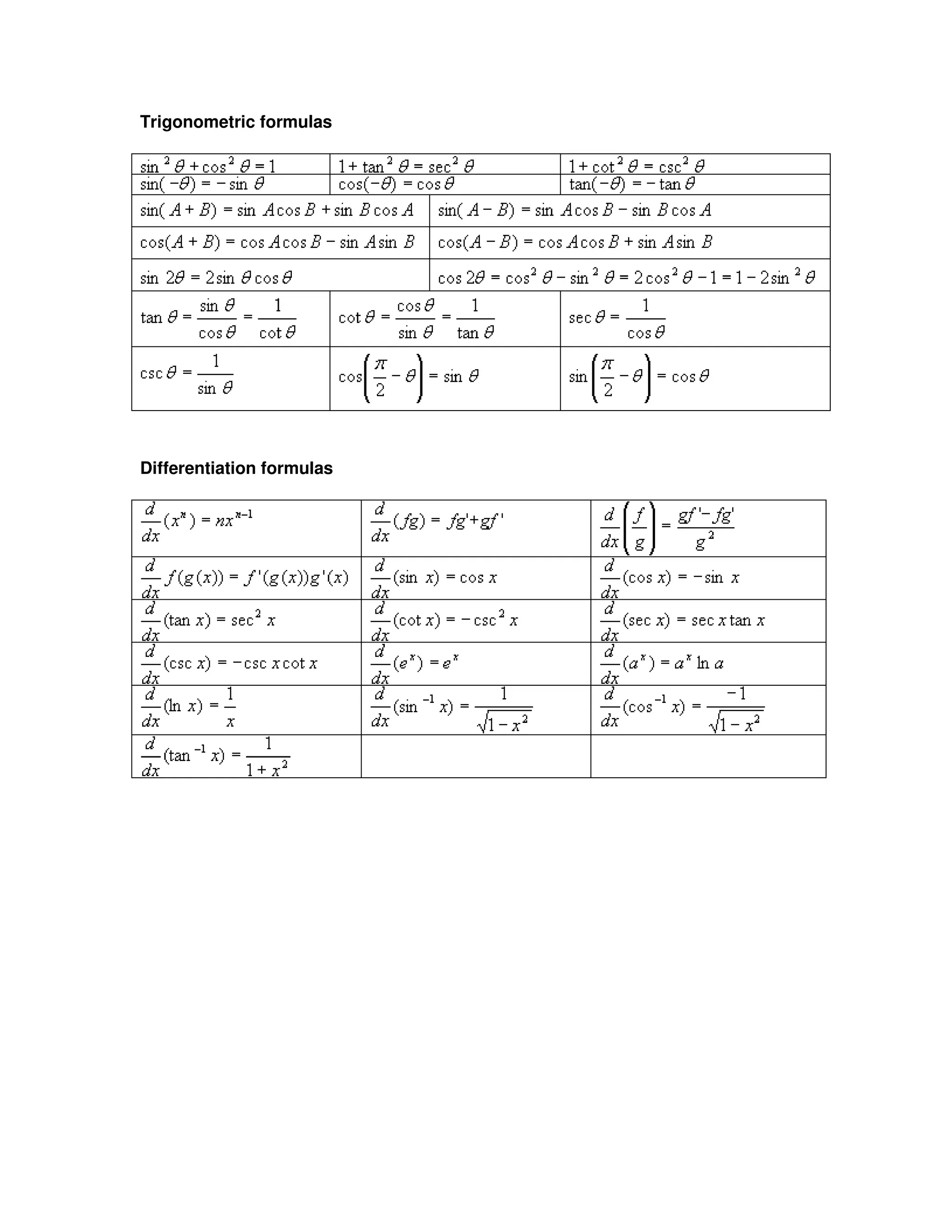
Trigonometric formulas
Differentiation formulas
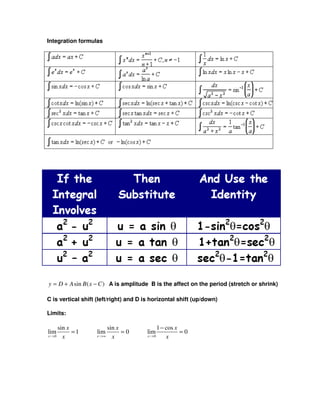
Integration formulas
sin ( )y D A B x C= + − A is amplitude B is the affect on the period (stretch or shrink)
C is vertical shift (left/right) and D is horizontal shift (up/down)
Limits:
0 0
sin sin 1 cos
lim 1 lim 0 lim 0
x x x
x x x
x x x−> −>∞ −>
−
= = =
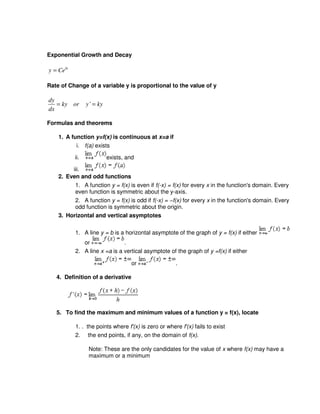
Exponential Growth and Decay
kt
y Ce=
Rate of Change of a variable y is proportional to the value of y
'
dy
ky or y ky
dx
= =
Formulas and theorems
1. A function y=f(x) is continuous at x=a if
i. f(a) exists
ii. exists, and
iii.
2. Even and odd functions
1. A function y = f(x) is even if f(-x) = f(x) for every x in the function's domain. Every
even function is symmetric about the y-axis.
2. A function y = f(x) is odd if f(-x) = −f(x) for every x in the function's domain. Every
odd function is symmetric about the origin.
3. Horizontal and vertical asymptotes
1. A line y = b is a horizontal asymptote of the graph of y = f(x) if either
or .
2. A line x =a is a vertical asymptote of the graph of y =f(x) if either
or .
4. Definition of a derivative
5. To find the maximum and minimum values of a function y = f(x), locate
1. . the points where f'(x) is zero or where f'(x) fails to exist
2. the end points, if any, on the domain of f(x).
Note: These are the only candidates for the value of x where f(x) may have a
maximum or a minimum
6. Let f be differentiable for a < x < b and continuous for a ≤ x ≤ b.
a. If f'(x) > 0 for every x in (a,b), then f is increasing on [a,b].
b. If f'(x) < 0 for every x in (a,b), then f is decreasing on [a,b].
7. Suppose that f''(x) exists on the interval (a,b).
a. If f''(x) > 0 in (a,b), then f is concave upward in (a,b).
b. If f''(x) < 0 in (a,b), then f is concave downward in (a,b).
To locate the points of inflection of y = f(x), find the points where f''(x) = 0 or
where f''(x) fails to exist. These are the only candidates where f(x) may have a
point of inflection. Then test these points to make sure that f''(x) < 0 on one side
and f''(x) > 0 on the other.
8. Mean value theorem
If f is continuous on [a,b] and differentiable on (a,b), then there is at least one number c
in (a,b) such that .
9. Continuity
If a function is differentiable at a point x = a, it is continuous at that point. The converse is
false, i.e. continuity does not imply differentiability.
10. L'Hôpital's rule
If is of the form or , and if exists, then .
11. Area between curves
If f and g are continuous functions such that f(x) ≥ g(x) on [a,b], then the area between
the curves is .
12. Inverse functions
a.If f and g are two functions such that f(g(x)) = x for every x in the domain of g,
and, g(f(x)) = x, for every x in the domain of f, then, f and g are inverse functions
of each other.
b.A function f has an inverse if and only if no horizontal line intersects its graph
more than once.
c. If f is either increasing or decreasing in an interval, then f has an inverse.
d.If f is differentiable at every point on an interval I, and f'(x) ≠ 0 on I, then g = f-1
(x)
is differentiable at every point of the interior of the interval f(I) and
.
13. Properties of y = ex
a.The exponential function y = ex
is the inverse function of y = ln x.
b.The domain is the set of all real numbers, −∞ < x < ∞.
c. The range is the set of all positive numbers, y > 0.
d.
e.
14. Properties of y = ln x
a.The domain of y = ln x is the set of all positive numbers, x > 0.
b.The range of y = ln x is the set of all real numbers, −∞ < y < ∞.
c. y = ln x is continuous and increasing everywhere on its domain.
d.ln(ab) = ln a + ln b.
e.ln(a / b) = ln a − ln b.
f. ln ar
= r ln a.
15. Fundamental theorem of calculus
, where F'(x) = f(x), or .
16. Volumes of solids of revolution
a.Let f be nonnegative and continuous on [a,b], and let R be the region bounded
above by y = f(x), below by the x-axis, and the sides by the lines x = a and x =
b.
b.When this region R is revolved about the x-axis, it generates a solid (having
circular cross sections) whose volume .
c. When R is revolved about the y-axis, it generates a solid whose volume
.
17. Particles moving along a line
a.If a particle moving along a straight line has a positive function x(t), then its
instantaneous velocity v(t) = x'(t) and its acceleration a(t) = v'(t).
b.v(t) = ∫ a(t)dt and x(t) = ∫ v(t)dt.
18. Average y-value
The average value of f(x) on [a,b] is .
Manyformulas
Manyformulas
Manyformulas
Manyformulas
Manyformulas
Manyformulas

Manyformulas

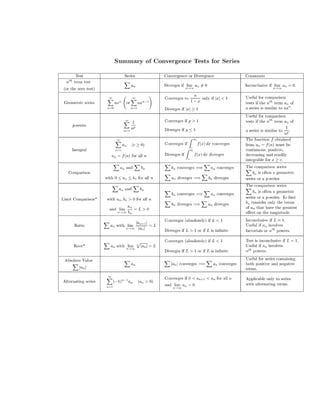
  • 1.
  • 2.
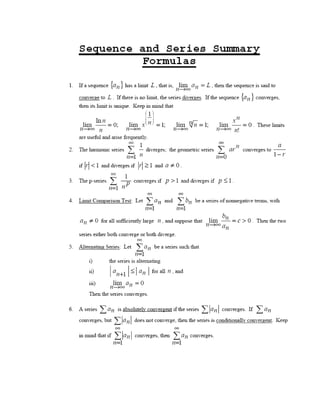
    Integration formulas sin ()y D A B x C= + − A is amplitude B is the affect on the period (stretch or shrink) C is vertical shift (left/right) and D is horizontal shift (up/down) Limits: 0 0 sin sin 1 cos lim 1 lim 0 lim 0 x x x x x x x x x−> −>∞ −> − = = =
  • 3.
    Exponential Growth andDecay kt y Ce= Rate of Change of a variable y is proportional to the value of y ' dy ky or y ky dx = = Formulas and theorems 1. A function y=f(x) is continuous at x=a if i. f(a) exists ii. exists, and iii. 2. Even and odd functions 1. A function y = f(x) is even if f(-x) = f(x) for every x in the function's domain. Every even function is symmetric about the y-axis. 2. A function y = f(x) is odd if f(-x) = −f(x) for every x in the function's domain. Every odd function is symmetric about the origin. 3. Horizontal and vertical asymptotes 1. A line y = b is a horizontal asymptote of the graph of y = f(x) if either or . 2. A line x =a is a vertical asymptote of the graph of y =f(x) if either or . 4. Definition of a derivative 5. To find the maximum and minimum values of a function y = f(x), locate 1. . the points where f'(x) is zero or where f'(x) fails to exist 2. the end points, if any, on the domain of f(x). Note: These are the only candidates for the value of x where f(x) may have a maximum or a minimum
  • 4.
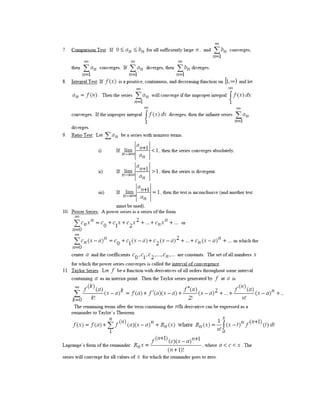
    6. Let fbe differentiable for a < x < b and continuous for a ≤ x ≤ b. a. If f'(x) > 0 for every x in (a,b), then f is increasing on [a,b]. b. If f'(x) < 0 for every x in (a,b), then f is decreasing on [a,b]. 7. Suppose that f''(x) exists on the interval (a,b). a. If f''(x) > 0 in (a,b), then f is concave upward in (a,b). b. If f''(x) < 0 in (a,b), then f is concave downward in (a,b). To locate the points of inflection of y = f(x), find the points where f''(x) = 0 or where f''(x) fails to exist. These are the only candidates where f(x) may have a point of inflection. Then test these points to make sure that f''(x) < 0 on one side and f''(x) > 0 on the other. 8. Mean value theorem If f is continuous on [a,b] and differentiable on (a,b), then there is at least one number c in (a,b) such that . 9. Continuity If a function is differentiable at a point x = a, it is continuous at that point. The converse is false, i.e. continuity does not imply differentiability. 10. L'Hôpital's rule If is of the form or , and if exists, then . 11. Area between curves If f and g are continuous functions such that f(x) ≥ g(x) on [a,b], then the area between the curves is . 12. Inverse functions a.If f and g are two functions such that f(g(x)) = x for every x in the domain of g, and, g(f(x)) = x, for every x in the domain of f, then, f and g are inverse functions of each other. b.A function f has an inverse if and only if no horizontal line intersects its graph more than once. c. If f is either increasing or decreasing in an interval, then f has an inverse. d.If f is differentiable at every point on an interval I, and f'(x) ≠ 0 on I, then g = f-1 (x) is differentiable at every point of the interior of the interval f(I) and .
  • 5.
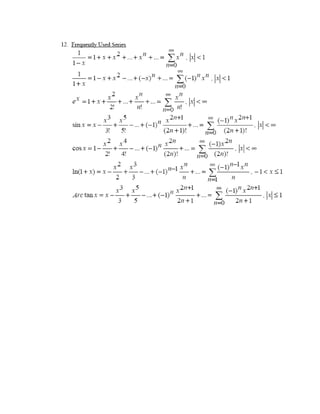
    13. Properties ofy = ex a.The exponential function y = ex is the inverse function of y = ln x. b.The domain is the set of all real numbers, −∞ < x < ∞. c. The range is the set of all positive numbers, y > 0. d. e. 14. Properties of y = ln x a.The domain of y = ln x is the set of all positive numbers, x > 0. b.The range of y = ln x is the set of all real numbers, −∞ < y < ∞. c. y = ln x is continuous and increasing everywhere on its domain. d.ln(ab) = ln a + ln b. e.ln(a / b) = ln a − ln b. f. ln ar = r ln a. 15. Fundamental theorem of calculus , where F'(x) = f(x), or . 16. Volumes of solids of revolution a.Let f be nonnegative and continuous on [a,b], and let R be the region bounded above by y = f(x), below by the x-axis, and the sides by the lines x = a and x = b. b.When this region R is revolved about the x-axis, it generates a solid (having circular cross sections) whose volume . c. When R is revolved about the y-axis, it generates a solid whose volume . 17. Particles moving along a line a.If a particle moving along a straight line has a positive function x(t), then its instantaneous velocity v(t) = x'(t) and its acceleration a(t) = v'(t). b.v(t) = ∫ a(t)dt and x(t) = ∫ v(t)dt. 18. Average y-value The average value of f(x) on [a,b] is .