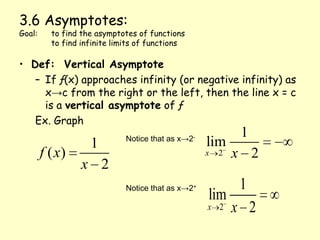
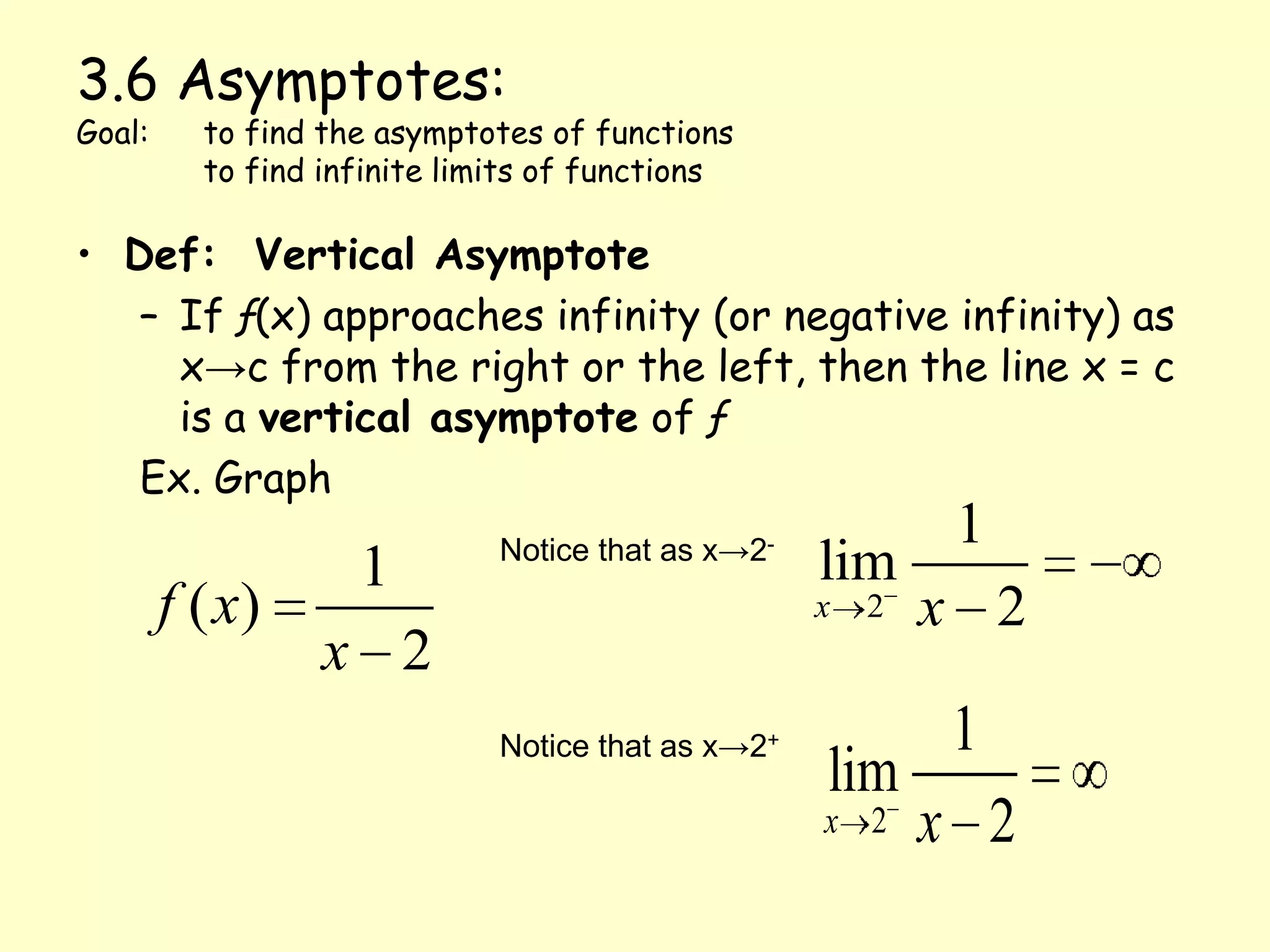
3.6 Asymptotes:Goal: 	to find the asymptotes of functions	to find infinite limits of functionsDef:  Vertical AsymptoteIf ƒ(x) approaches infinity (or negative infinity) as x->c from the right or the left, then the line x = c is a vertical asymptote of ƒEx. Graph Notice that as x->2-Notice that as x->2+
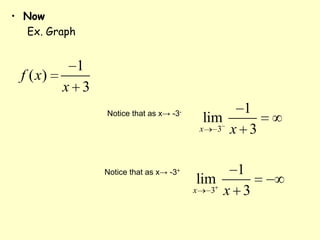
Now Ex. Graph Notice that as x-> -3-Notice that as x-> -3+
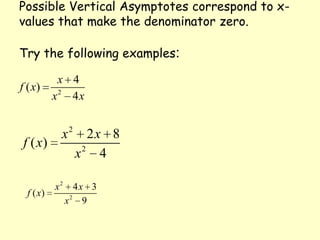
Possible Vertical Asymptotes correspond to x-values that make the denominator zero.Try the following examples:
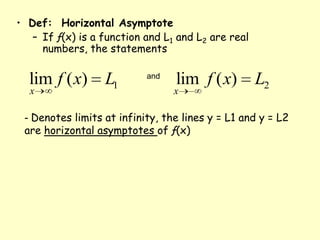
Def:  Horizontal AsymptoteIf ƒ(x) is a function and L1 and L2 are real numbers, the statementsand- Denotes limits at infinity, the lines y = L1 and y = L2 are horizontal asymptotes of ƒ(x)
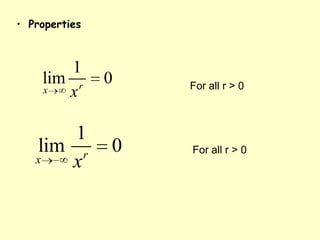
PropertiesFor all r > 0For all r > 0
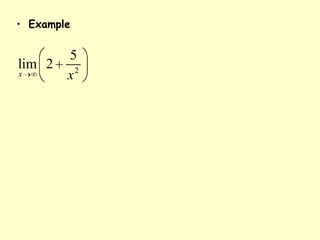
Example
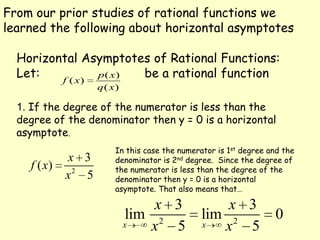
From our prior studies of rational functionswe learned the following about horizontal asymptotesHorizontal Asymptotes of Rational Functions:Let:				be a rational function1. If the degree of the numerator is less than the degree of the denominator then y = 0 is a horizontal asymptote.In this case the numerator is 1st degree and the denominator is 2nd degree.  Since the degree of the numerator is less than the degree of the denominator then y = 0 is a horizontal asymptote. That also means that…
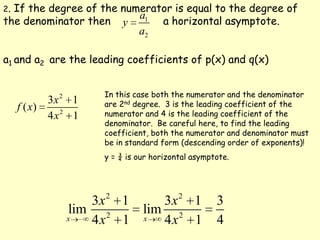
2. If the degree of the numerator is equal to the degree of the denominator then 		a horizontal asymptote.a1 and a2 are the leading coefficients of p(x) and q(x)In this case both the numerator and the denominator are 2nd degree.  3 is the leading coefficient of the numerator and 4 is the leading coefficient of the denominator.  Be careful here, to find the leading coefficient, both the numerator and denominator must be in standard form (descending order of exponents)!y = ¾ is our horizontal asymptote.
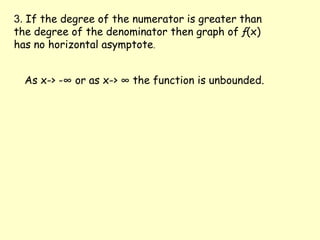
3. If the degree of the numerator is greater than the degree of the denominator then graph of ƒ(x) has no horizontal asymptote.As x-> -∞ or as x-> ∞ the function is unbounded.

3.6 notes

  • 1.
    3.6 Asymptotes:Goal: tofind the asymptotes of functions to find infinite limits of functionsDef: Vertical AsymptoteIf ƒ(x) approaches infinity (or negative infinity) as x->c from the right or the left, then the line x = c is a vertical asymptote of ƒEx. Graph Notice that as x->2-Notice that as x->2+
  • 2.
    Now Ex. GraphNotice that as x-> -3-Notice that as x-> -3+
  • 3.
    Possible Vertical Asymptotescorrespond to x-values that make the denominator zero.Try the following examples:
  • 4.
    Def: HorizontalAsymptoteIf ƒ(x) is a function and L1 and L2 are real numbers, the statementsand- Denotes limits at infinity, the lines y = L1 and y = L2 are horizontal asymptotes of ƒ(x)
  • 5.
    PropertiesFor all r> 0For all r > 0
  • 6.
  • 7.
    From our priorstudies of rational functionswe learned the following about horizontal asymptotesHorizontal Asymptotes of Rational Functions:Let: be a rational function1. If the degree of the numerator is less than the degree of the denominator then y = 0 is a horizontal asymptote.In this case the numerator is 1st degree and the denominator is 2nd degree. Since the degree of the numerator is less than the degree of the denominator then y = 0 is a horizontal asymptote. That also means that…
  • 8.
    2. If thedegree of the numerator is equal to the degree of the denominator then a horizontal asymptote.a1 and a2 are the leading coefficients of p(x) and q(x)In this case both the numerator and the denominator are 2nd degree. 3 is the leading coefficient of the numerator and 4 is the leading coefficient of the denominator. Be careful here, to find the leading coefficient, both the numerator and denominator must be in standard form (descending order of exponents)!y = ¾ is our horizontal asymptote.
  • 9.
    3. If thedegree of the numerator is greater than the degree of the denominator then graph of ƒ(x) has no horizontal asymptote.As x-> -∞ or as x-> ∞ the function is unbounded.