

Trigeminal Nerve Anatomy
And Significance
By
Mohamed Kharabish
Is the fifth cranial nerve also it is the
largest and most complex of the 12
cranial nerves (CNs). It supplies
sensations to the face, mucous
membranes, and other structures of
the head. It is the motor nerve for
the muscles of mastication and
contains proprioceptive fibers.
Trigeminal Nerve
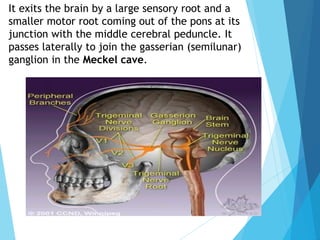
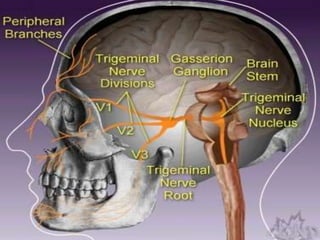
It exits the brain by a large sensory root and a
smaller motor root coming out of the pons at its
junction with the middle cerebral peduncle. It
passes laterally to join the gasserian (semilunar)
ganglion in the Meckel cave.
trigeminal nerve (one on each side
of the pons) has three major
branches: the ophthalmic nerve
(V1), the maxillary nerve (V2), and
the mandibular nerve (V3). The
ophthalmic and maxillary nerves
are purely sensory, and the
mandibular nerve has sensory (or
"cutaneous") and motor functions.
*Ophthalmic branch is sensory
* Maxillary branch is sensory
*Mandibular branch is mixed
Mnemonic for the exit of
trigeminal nerve branches
standing: superior orbital fissure
(frontal branch of trigeminal
nerve)
Room: foramen Rotundum
(maxillary branch of trigeminal
nerve)
Only: foramen Ovale (mandibular
branch of trigeminal nerve)
Clinical
significance of
trigeminal nerve
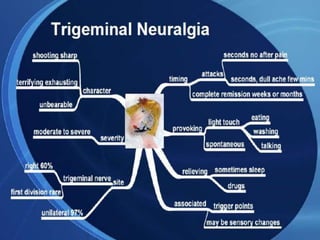
Trigeminal neuralgia (TN)
Trigeminal neuralgia (TN), also known as
tic douloureux, is a distinctive facial pain
syndrome that may become recurrent
and chronic. It is characterized by
unilateral pain following the sensory
distribution of cranial nerve V (typically
radiating to the maxillary or mandibular
area in 35% of affected patients) and is
often accompanied by a brief facial
spasm or tic..
Signs and symptoms
TN presents as attacks of stabbing unilateral
facial pain, most often on the right side of the
face. The number of attacks may vary from less
than 1 per day to 12 or more per hour and up to
hundreds per day.
Triggers of pain attacks include the
following:
 Chewing, talking, or smiling .
 Drinking cold or hot fluids .
 Touching, shaving, brushing teeth, blowing
the nose .
 Encountering cold air from an open
Pain localization is as follows:
Patients can localize their pain precisely
The pain commonly runs along the line dividing
either the mandibular and maxillary nerves or
the maxillary and ophthalmic portions of the
nerve
In 60% of cases, the pain shoots from the corner
of the mouth to the angle of the jaw
In 30%, pain jolts from the upper lip or canine
teeth to the eye and eyebrow, sparing the orbit
itself
In less than 5% of cases, pain involves the
ophthalmic branch of the facial nerve
The pain has the following qualities:
Characteristically severe, paroxysmal, and lancinating
Commences with a sensation of electrical shocks in the
affected area
Crescendos in less than 20 seconds to an excruciating
discomfort felt deep in the face, often contorting the
patient's expression
Begins to fade within seconds, only to give way to a burning
ache lasting seconds to minutes
Pain fully abates between attacks, even when they are
severe and frequent
Attacks may provoke patients to grimace, wince, or make an
aversive head movement, as if trying to escape the pain,
thus producing an obvious movement, or tic; hence the term
"tic douloureux"
Other diagnostic clues are as
follows:
Patients carefully avoid rubbing the face or
shaving a trigger area, in contrast to other facial
pain syndromes, in which they massage the face
or apply heat or ice
Many patients try to hold their face still while
talking, to avoid precipitating an attack
In contrast to migrainous pain, attacks of TN
rarely occur during sleep
Not TN pain
Etiology
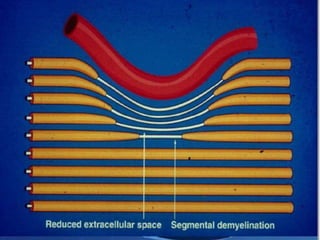
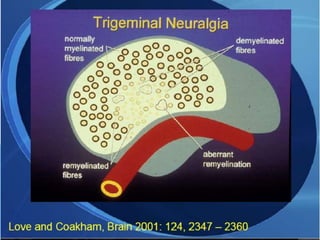
Trigeminal neuralgia (TN) is most likely
multifactorial.
Most cases of trigeminal neuralgia are
idiopathic, but compression of the
trigeminal roots by tumors or vascular
anomalies may cause similar pain,
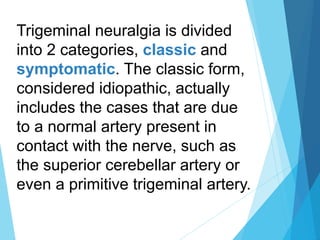
Trigeminal neuralgia is divided
into 2 categories, classic and
symptomatic. The classic form,
considered idiopathic, actually
includes the cases that are due
to a normal artery present in
contact with the nerve, such as
the superior cerebellar artery or
even a primitive trigeminal artery.
To summarize the causes
inflammatory
Vascular
Neoplastic
Idiopathic
Vascular
• AV malformation
• Aneurysms
• abnormal vascular
course of the superior
cerebellar artery
Inflammatory
• Meningeal irritation
• Multiple sclerosis
• Lyme Disease
• Sarcoidosis
Neoplastic
cerebellopontine angle tumors
Pharmacological :
 Anticonvulsant Agents
 Skeletal Muscle Relaxants
((Baclofen (Lioresal, Gablofen))
 Tricyclic Antidepressants
((Amitriptyline))
 Toxins ((BOTOX))
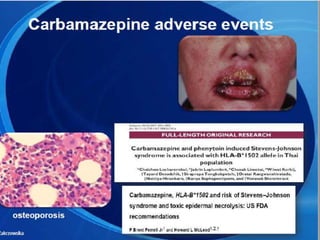
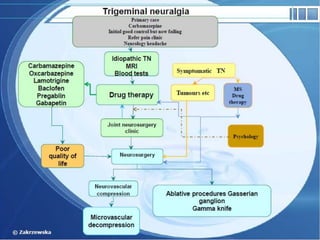
Carbamazepine (Tegretol)
Carbamazepine is the criterion standard in the medical
management of trigeminal neuralgia. A 100-mg tablet may
produce significant and complete relief within 2 hours, and,
for this reason, a 100 mg twice a day (bid) prescription is
suitable to start.
If this initial dose fails, one may push the dose to 1200 mg
daily (qd), as the patient will tolerate, for initial relief;
maintenance doses generally are lower, 100-800 mg daily
bid. If using the extended-release caplet, begin with 200 mg
qd and increase as needed to a maximum dose of 1200 mg/d
bid. Titrating slowly improves tolerance.
Oxcarbazepine (Trileptal)
Oxcarbazepine is a close cousin of
carbamazepine and presumably works
on similar mechanisms. This agent
offers a better tolerance and is easier
to manage.
Other anti convulsant agents
 Gabapentin (Neurontin)
 Lamotrigine (Lamictal,
Lamictal ODT, Lamictal XR)
 Phenytoin (Dilantin,
Phenytek)
 Topiramate (Topamax)
Non pharmacological
ttt
Tg neuralgia
Tg neuralgia
Tg neuralgia
Tg neuralgia
Tg neuralgia
Tg neuralgia

Tg neuralgia

  • 2.
    Trigeminal Nerve Anatomy AndSignificance By Mohamed Kharabish
  • 3.
    Is the fifthcranial nerve also it is the largest and most complex of the 12 cranial nerves (CNs). It supplies sensations to the face, mucous membranes, and other structures of the head. It is the motor nerve for the muscles of mastication and contains proprioceptive fibers. Trigeminal Nerve
  • 4.
    It exits thebrain by a large sensory root and a smaller motor root coming out of the pons at its junction with the middle cerebral peduncle. It passes laterally to join the gasserian (semilunar) ganglion in the Meckel cave.
  • 6.
    trigeminal nerve (oneon each side of the pons) has three major branches: the ophthalmic nerve (V1), the maxillary nerve (V2), and the mandibular nerve (V3). The ophthalmic and maxillary nerves are purely sensory, and the mandibular nerve has sensory (or "cutaneous") and motor functions.
  • 7.
    *Ophthalmic branch issensory * Maxillary branch is sensory *Mandibular branch is mixed
  • 9.
    Mnemonic for theexit of trigeminal nerve branches standing: superior orbital fissure (frontal branch of trigeminal nerve) Room: foramen Rotundum (maxillary branch of trigeminal nerve) Only: foramen Ovale (mandibular branch of trigeminal nerve)
  • 11.
  • 12.
    Trigeminal neuralgia (TN) Trigeminalneuralgia (TN), also known as tic douloureux, is a distinctive facial pain syndrome that may become recurrent and chronic. It is characterized by unilateral pain following the sensory distribution of cranial nerve V (typically radiating to the maxillary or mandibular area in 35% of affected patients) and is often accompanied by a brief facial spasm or tic..
  • 13.
    Signs and symptoms TNpresents as attacks of stabbing unilateral facial pain, most often on the right side of the face. The number of attacks may vary from less than 1 per day to 12 or more per hour and up to hundreds per day. Triggers of pain attacks include the following:  Chewing, talking, or smiling .  Drinking cold or hot fluids .  Touching, shaving, brushing teeth, blowing the nose .  Encountering cold air from an open
  • 14.
    Pain localization isas follows: Patients can localize their pain precisely The pain commonly runs along the line dividing either the mandibular and maxillary nerves or the maxillary and ophthalmic portions of the nerve In 60% of cases, the pain shoots from the corner of the mouth to the angle of the jaw In 30%, pain jolts from the upper lip or canine teeth to the eye and eyebrow, sparing the orbit itself In less than 5% of cases, pain involves the ophthalmic branch of the facial nerve
  • 15.
    The pain hasthe following qualities: Characteristically severe, paroxysmal, and lancinating Commences with a sensation of electrical shocks in the affected area Crescendos in less than 20 seconds to an excruciating discomfort felt deep in the face, often contorting the patient's expression Begins to fade within seconds, only to give way to a burning ache lasting seconds to minutes Pain fully abates between attacks, even when they are severe and frequent Attacks may provoke patients to grimace, wince, or make an aversive head movement, as if trying to escape the pain, thus producing an obvious movement, or tic; hence the term "tic douloureux"
  • 17.
    Other diagnostic cluesare as follows: Patients carefully avoid rubbing the face or shaving a trigger area, in contrast to other facial pain syndromes, in which they massage the face or apply heat or ice Many patients try to hold their face still while talking, to avoid precipitating an attack In contrast to migrainous pain, attacks of TN rarely occur during sleep
  • 18.
  • 21.
  • 22.
    Trigeminal neuralgia (TN)is most likely multifactorial. Most cases of trigeminal neuralgia are idiopathic, but compression of the trigeminal roots by tumors or vascular anomalies may cause similar pain,
  • 25.
    Trigeminal neuralgia isdivided into 2 categories, classic and symptomatic. The classic form, considered idiopathic, actually includes the cases that are due to a normal artery present in contact with the nerve, such as the superior cerebellar artery or even a primitive trigeminal artery.
  • 26.
  • 27.
  • 28.
    Vascular • AV malformation •Aneurysms • abnormal vascular course of the superior cerebellar artery
  • 29.
    Inflammatory • Meningeal irritation •Multiple sclerosis • Lyme Disease • Sarcoidosis
  • 30.
  • 33.
    Pharmacological :  AnticonvulsantAgents  Skeletal Muscle Relaxants ((Baclofen (Lioresal, Gablofen))  Tricyclic Antidepressants ((Amitriptyline))  Toxins ((BOTOX))
  • 34.
    Carbamazepine (Tegretol) Carbamazepine isthe criterion standard in the medical management of trigeminal neuralgia. A 100-mg tablet may produce significant and complete relief within 2 hours, and, for this reason, a 100 mg twice a day (bid) prescription is suitable to start. If this initial dose fails, one may push the dose to 1200 mg daily (qd), as the patient will tolerate, for initial relief; maintenance doses generally are lower, 100-800 mg daily bid. If using the extended-release caplet, begin with 200 mg qd and increase as needed to a maximum dose of 1200 mg/d bid. Titrating slowly improves tolerance.
  • 36.
    Oxcarbazepine (Trileptal) Oxcarbazepine isa close cousin of carbamazepine and presumably works on similar mechanisms. This agent offers a better tolerance and is easier to manage.
  • 38.
    Other anti convulsantagents  Gabapentin (Neurontin)  Lamotrigine (Lamictal, Lamictal ODT, Lamictal XR)  Phenytoin (Dilantin, Phenytek)  Topiramate (Topamax)
  • 40.