Matter Very Simple Up, Up and Away
Gas Behaviour So far, we have found out: Volume  is proportional to absolute temperature –  Charles’ Law P ressure  is proportional to absolute temperature –  Pressure Law For a fixed amount of gas, the product of   Pressure x Volume is constant –  Boyle’s Law This may be written as P    1/V
The Gas Laws We will find out: Why gases provide buoyancy How all of the gas laws can be combined to give the ideal gas relationship
Buoyancy Things are said to be buoyant when they float… This may be a boat in water The force keeping it up is called ‘upthrust’ It is due to the weight of the displaced medium (in this case water) and is equal to weight for a floating object
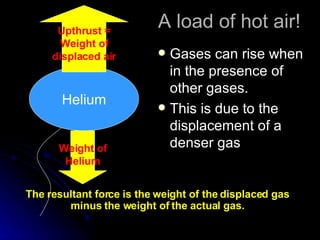
A load of hot air! Gases can rise when in the presence of other gases. This is due to the displacement of a denser gas Helium Weight of Helium Upthrust = Weight of displaced air The resultant force is the weight of the displaced gas minus the weight of the actual gas.
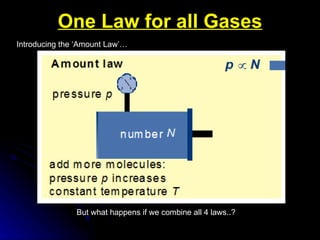
One Law for all Gases But what happens if we combine all 4 laws..? Introducing the ‘Amount Law’…
 
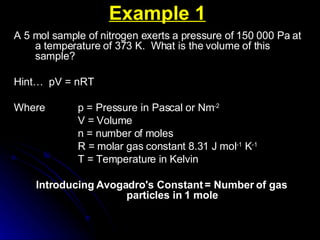
Example 1 A 5 mol sample of nitrogen exerts a pressure of 150 000 Pa at a temperature of 373 K.  What is the volume of this sample? Hint…  pV = nRT Where  p = Pressure in Pascal or Nm -2 V = Volume n = number of moles R = molar gas constant 8.31 J mol -1  K -1 T = Temperature in Kelvin Introducing Avogadro's Constant = Number of gas particles in 1 mole
 
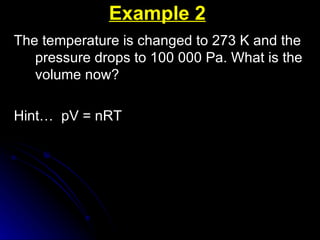
Example 2 The temperature is changed to 273 K and the pressure drops to 100 000 Pa. What is the volume now? Hint…  pV = nRT
 
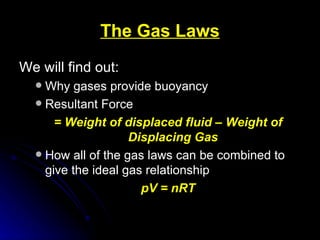
The Gas Laws We will find out: Why gases provide buoyancy Resultant Force = Weight of displaced fluid – Weight of Displacing Gas How all of the gas laws can be combined to give the ideal gas relationship pV = nRT

13.3 Up Up And Away

  • 1.
    Matter Very SimpleUp, Up and Away
  • 2.
    Gas Behaviour Sofar, we have found out: Volume is proportional to absolute temperature – Charles’ Law P ressure is proportional to absolute temperature – Pressure Law For a fixed amount of gas, the product of Pressure x Volume is constant – Boyle’s Law This may be written as P  1/V
  • 3.
    The Gas LawsWe will find out: Why gases provide buoyancy How all of the gas laws can be combined to give the ideal gas relationship
  • 4.
    Buoyancy Things aresaid to be buoyant when they float… This may be a boat in water The force keeping it up is called ‘upthrust’ It is due to the weight of the displaced medium (in this case water) and is equal to weight for a floating object
  • 5.
    A load ofhot air! Gases can rise when in the presence of other gases. This is due to the displacement of a denser gas Helium Weight of Helium Upthrust = Weight of displaced air The resultant force is the weight of the displaced gas minus the weight of the actual gas.
  • 6.
    One Law forall Gases But what happens if we combine all 4 laws..? Introducing the ‘Amount Law’…
  • 7.
  • 8.
    Example 1 A5 mol sample of nitrogen exerts a pressure of 150 000 Pa at a temperature of 373 K. What is the volume of this sample? Hint… pV = nRT Where p = Pressure in Pascal or Nm -2 V = Volume n = number of moles R = molar gas constant 8.31 J mol -1 K -1 T = Temperature in Kelvin Introducing Avogadro's Constant = Number of gas particles in 1 mole
  • 9.
  • 10.
    Example 2 Thetemperature is changed to 273 K and the pressure drops to 100 000 Pa. What is the volume now? Hint… pV = nRT
  • 11.
  • 12.
    The Gas LawsWe will find out: Why gases provide buoyancy Resultant Force = Weight of displaced fluid – Weight of Displacing Gas How all of the gas laws can be combined to give the ideal gas relationship pV = nRT