Work and Energy Changes How do we do work and how does it affect energy?
We will find out How to calculate changes in energy types in different scenarios How Newton’s Laws of Motion can be used to calculate the braking forces and distances (work done in stopping a vehicle) Newton's Laws of Motion Objects continue at the same velocity unless acted on by a resultant force Force = Mass x Acceleration Every Action has an equal and opposite reaction
Falling Masses - Acceleration Why do 2 different masses fall at the same rate? Think about Newton’s 2 nd  Law!!! Force = Mass x Acceleration
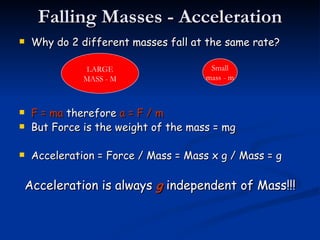
Falling Masses - Acceleration Why do 2 different masses fall at the same rate? F = ma  therefore  a = F / m But Force is the weight of the mass = mg Acceleration = Force / Mass = Mass x g / Mass = g Acceleration is always  g  independent of Mass!!! LARGE MASS - M Small mass - m
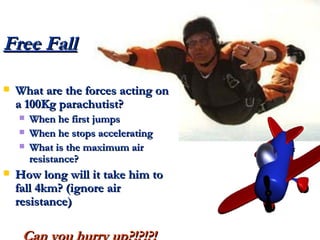
Free Fall What are the forces acting on a 100Kg parachutist? When he first jumps When he stops accelerating What is the maximum air resistance? How long will it take him to fall 4km? (ignore air resistance) Can you hurry up?!?!?!
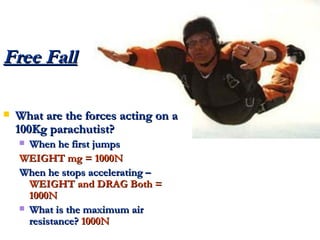
Free Fall What are the forces acting on a 100Kg parachutist? When he first jumps WEIGHT mg = 1000N When he stops accelerating –  WEIGHT and DRAG Both = 1000N What is the maximum air resistance?  1000N
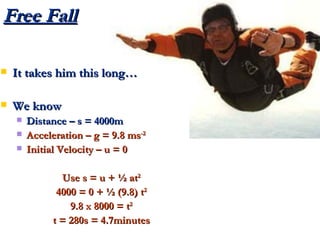
Free Fall It takes him this long… We know Distance – s = 4000m Acceleration – g = 9.8 ms -2 Initial Velocity – u = 0 Use s = u + ½ at 2 4000 = 0 + ½ (9.8) t 2 9.8 x 8000 = t 2 t = 280s = 4.7minutes
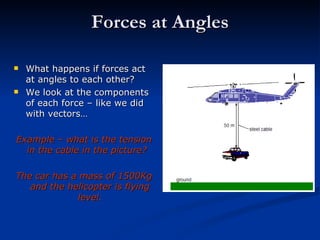
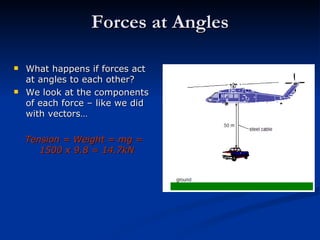
Forces at Angles What happens if forces act at angles to each other? We look at the components of each force – like we did with vectors… Example – what is the tension in the cable in the picture?  The car has a mass of 1500Kg and the helicopter is flying level.
Forces at Angles What happens if forces act at angles to each other? We look at the components of each force – like we did with vectors… Tension = Weight = mg = 1500 x 9.8 = 14.7kN
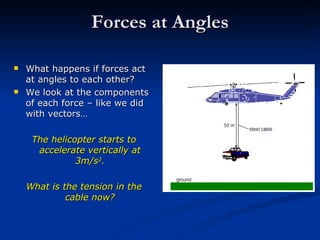
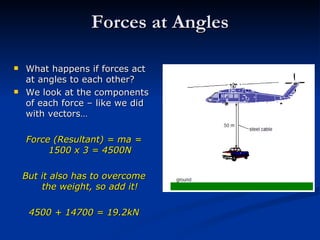
Forces at Angles What happens if forces act at angles to each other? We look at the components of each force – like we did with vectors… The helicopter starts to accelerate vertically at 3m/s 2 . What is the tension in the cable now?
Forces at Angles What happens if forces act at angles to each other? We look at the components of each force – like we did with vectors… Force (Resultant) = ma = 1500 x 3 = 4500N But it also has to overcome the weight, so add it! 4500 + 14700 = 19.2kN
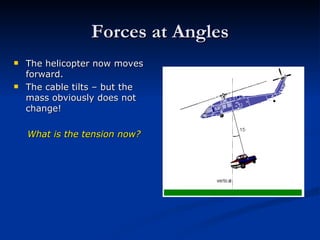
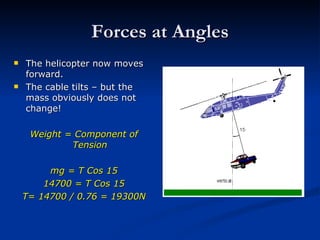
Forces at Angles The helicopter now moves forward. The cable tilts – but the mass obviously does not change! What is the tension now?
Forces at Angles The helicopter now moves forward. The cable tilts – but the mass obviously does not change! Weight = Component of Tension mg = T Cos 15 14700 = T Cos 15 T= 14700 / 0.76 = 19300N
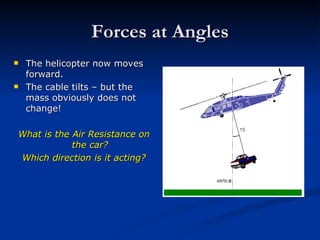
Forces at Angles The helicopter now moves forward. The cable tilts – but the mass obviously does not change! What is the Air Resistance on the car? Which direction is it acting?
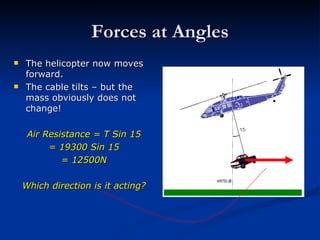
Forces at Angles The helicopter now moves forward. The cable tilts – but the mass obviously does not change! Air Resistance = T Sin 15 = 19300 Sin 15 = 12500N Which direction is it acting?
Gravitational Field Gravity is proportional to mass It acts on all masses ‘ Gravitational field Strength’ and ‘Acceleration due to Gravity’ are the same thing! The units are either m/s 2  or N/Kg Can you derive it from the equation: F = ma ? N = Kg  x  a therefore a = N/Kg
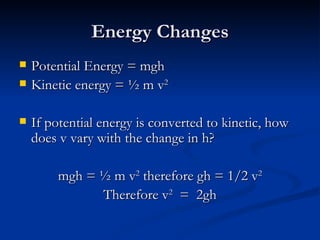
Energy Changes Potential Energy = mgh Kinetic energy = ½ m v 2 If potential energy is converted to kinetic, how does v vary with the change in h? mgh = ½ m v 2  therefore gh = 1/2 v 2 Therefore v 2   =  2gh
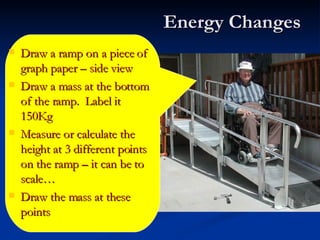
Energy Changes Draw a ramp on a piece of graph paper – side view Draw a mass at the bottom of the ramp.  Label it 150Kg Measure or calculate the height at 3 different points on the ramp – it can be to scale… Draw the mass at these points
Skateboard Worksheet
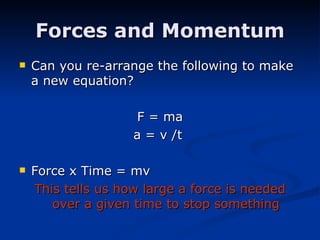
Forces and Momentum Can you re-arrange the following to make a new equation? F = ma a = v /t  Force x Time = mv This tells us how large a force is needed over a given time to stop something
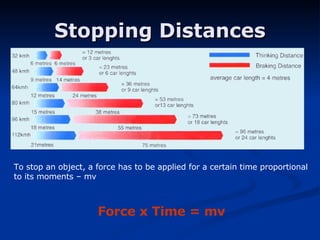
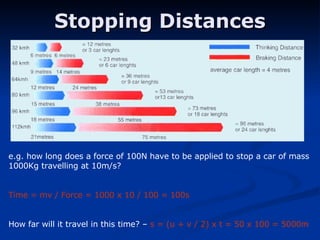
Stopping Distances To stop an object, a force has to be applied for a certain time proportional to its moments – mv Force x Time = mv
Stopping Distances e.g. how long does a force of 100N have to be applied to stop a car of mass 1000Kg travelling at 10m/s? Time = mv / Force = 1000 x 10 / 100 = 100s How far will it travel in this time? –  s = (u + v / 2) x t = 50 x 100 = 5000m

Chapter 9

  • 1.
    Work and EnergyChanges How do we do work and how does it affect energy?
  • 2.
    We will findout How to calculate changes in energy types in different scenarios How Newton’s Laws of Motion can be used to calculate the braking forces and distances (work done in stopping a vehicle) Newton's Laws of Motion Objects continue at the same velocity unless acted on by a resultant force Force = Mass x Acceleration Every Action has an equal and opposite reaction
  • 3.
    Falling Masses -Acceleration Why do 2 different masses fall at the same rate? Think about Newton’s 2 nd Law!!! Force = Mass x Acceleration
  • 4.
    Falling Masses -Acceleration Why do 2 different masses fall at the same rate? F = ma therefore a = F / m But Force is the weight of the mass = mg Acceleration = Force / Mass = Mass x g / Mass = g Acceleration is always g independent of Mass!!! LARGE MASS - M Small mass - m
  • 5.
    Free Fall Whatare the forces acting on a 100Kg parachutist? When he first jumps When he stops accelerating What is the maximum air resistance? How long will it take him to fall 4km? (ignore air resistance) Can you hurry up?!?!?!
  • 6.
    Free Fall Whatare the forces acting on a 100Kg parachutist? When he first jumps WEIGHT mg = 1000N When he stops accelerating – WEIGHT and DRAG Both = 1000N What is the maximum air resistance? 1000N
  • 7.
    Free Fall Ittakes him this long… We know Distance – s = 4000m Acceleration – g = 9.8 ms -2 Initial Velocity – u = 0 Use s = u + ½ at 2 4000 = 0 + ½ (9.8) t 2 9.8 x 8000 = t 2 t = 280s = 4.7minutes
  • 8.
    Forces at AnglesWhat happens if forces act at angles to each other? We look at the components of each force – like we did with vectors… Example – what is the tension in the cable in the picture? The car has a mass of 1500Kg and the helicopter is flying level.
  • 9.
    Forces at AnglesWhat happens if forces act at angles to each other? We look at the components of each force – like we did with vectors… Tension = Weight = mg = 1500 x 9.8 = 14.7kN
  • 10.
    Forces at AnglesWhat happens if forces act at angles to each other? We look at the components of each force – like we did with vectors… The helicopter starts to accelerate vertically at 3m/s 2 . What is the tension in the cable now?
  • 11.
    Forces at AnglesWhat happens if forces act at angles to each other? We look at the components of each force – like we did with vectors… Force (Resultant) = ma = 1500 x 3 = 4500N But it also has to overcome the weight, so add it! 4500 + 14700 = 19.2kN
  • 12.
    Forces at AnglesThe helicopter now moves forward. The cable tilts – but the mass obviously does not change! What is the tension now?
  • 13.
    Forces at AnglesThe helicopter now moves forward. The cable tilts – but the mass obviously does not change! Weight = Component of Tension mg = T Cos 15 14700 = T Cos 15 T= 14700 / 0.76 = 19300N
  • 14.
    Forces at AnglesThe helicopter now moves forward. The cable tilts – but the mass obviously does not change! What is the Air Resistance on the car? Which direction is it acting?
  • 15.
    Forces at AnglesThe helicopter now moves forward. The cable tilts – but the mass obviously does not change! Air Resistance = T Sin 15 = 19300 Sin 15 = 12500N Which direction is it acting?
  • 16.
    Gravitational Field Gravityis proportional to mass It acts on all masses ‘ Gravitational field Strength’ and ‘Acceleration due to Gravity’ are the same thing! The units are either m/s 2 or N/Kg Can you derive it from the equation: F = ma ? N = Kg x a therefore a = N/Kg
  • 17.
    Energy Changes PotentialEnergy = mgh Kinetic energy = ½ m v 2 If potential energy is converted to kinetic, how does v vary with the change in h? mgh = ½ m v 2 therefore gh = 1/2 v 2 Therefore v 2 = 2gh
  • 18.
    Energy Changes Drawa ramp on a piece of graph paper – side view Draw a mass at the bottom of the ramp. Label it 150Kg Measure or calculate the height at 3 different points on the ramp – it can be to scale… Draw the mass at these points
  • 19.
  • 20.
    Forces and MomentumCan you re-arrange the following to make a new equation? F = ma a = v /t Force x Time = mv This tells us how large a force is needed over a given time to stop something
  • 21.
    Stopping Distances Tostop an object, a force has to be applied for a certain time proportional to its moments – mv Force x Time = mv
  • 22.
    Stopping Distances e.g.how long does a force of 100N have to be applied to stop a car of mass 1000Kg travelling at 10m/s? Time = mv / Force = 1000 x 10 / 100 = 100s How far will it travel in this time? – s = (u + v / 2) x t = 50 x 100 = 5000m