Speeding Up, Slowing down What happens to objects when they move?
Acceleration Define to the person next to you, the terms: Velocity Displacement Acceleration
Acceleration Acceleration is Change in Velocity / Time Taken Some definitions: S  = displacement U  = initial velocity V  = final velocity A  = acceleration T  = time taken Therefore acceleration is written: a = (v – u) / t Can we sketch a graph of this?
In this example a = (20 – 0) / 11 = 1.8 ms -2  followed by zero acceleration (constant velocity)
v = u + at This is the  first equation of motion  where acceleration is uniform…
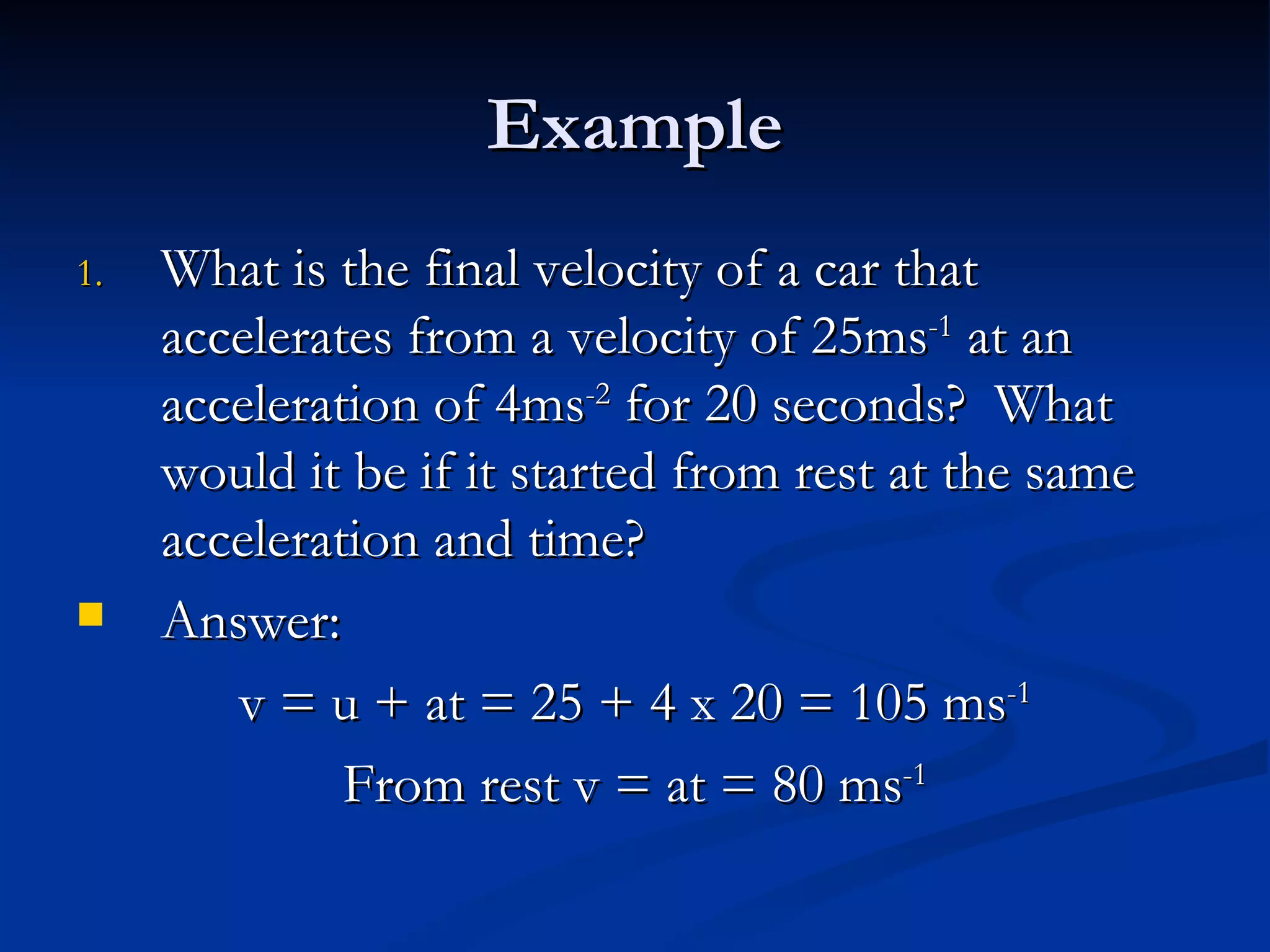
Example What is the final velocity of a car that accelerates from a velocity of 25ms -1  at an acceleration of 4ms -2  for 20 seconds?  What would it be if it started from rest at the same acceleration and time? Answer: v = u + at = 25 + 4 x 20 = 105 ms -1 From rest v = at = 80 ms -1
How far would something travel..? Using the SUVAT terms, can you express displacement? Think about Speed = ..?
These are the other 3 equations that you need to know how to use…
Exercises Answer Question on sheet Questions 1, 2, 4 and 6
Vertical and Horizontal Motion http://www.rmutphysics.com/charud/virtualexperiment/virtual2/monkey-hunter/index.html
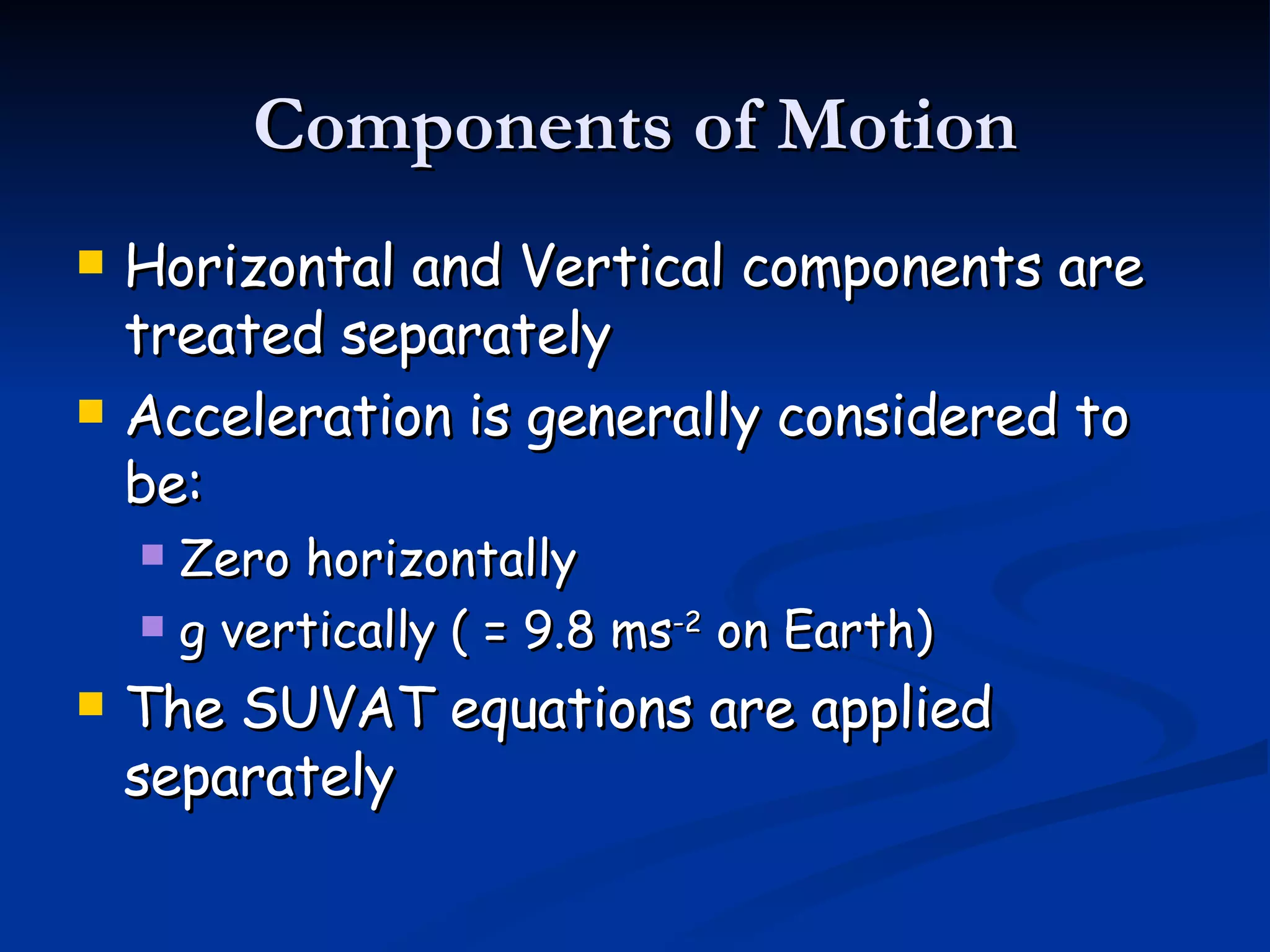
Components of Motion Horizontal and Vertical components are treated separately Acceleration is generally considered to be: Zero horizontally g vertically ( = 9.8 ms -2  on Earth) The SUVAT equations are applied separately
Components of Motion

Chapter 9

  • 1.
    Speeding Up, Slowingdown What happens to objects when they move?
  • 2.
    Acceleration Define tothe person next to you, the terms: Velocity Displacement Acceleration
  • 3.
    Acceleration Acceleration isChange in Velocity / Time Taken Some definitions: S = displacement U = initial velocity V = final velocity A = acceleration T = time taken Therefore acceleration is written: a = (v – u) / t Can we sketch a graph of this?
  • 4.
    In this examplea = (20 – 0) / 11 = 1.8 ms -2 followed by zero acceleration (constant velocity)
  • 5.
    v = u+ at This is the first equation of motion where acceleration is uniform…
  • 6.
    Example What isthe final velocity of a car that accelerates from a velocity of 25ms -1 at an acceleration of 4ms -2 for 20 seconds? What would it be if it started from rest at the same acceleration and time? Answer: v = u + at = 25 + 4 x 20 = 105 ms -1 From rest v = at = 80 ms -1
  • 7.
    How far wouldsomething travel..? Using the SUVAT terms, can you express displacement? Think about Speed = ..?
  • 8.
    These are theother 3 equations that you need to know how to use…
  • 9.
    Exercises Answer Questionon sheet Questions 1, 2, 4 and 6
  • 10.
    Vertical and HorizontalMotion http://www.rmutphysics.com/charud/virtualexperiment/virtual2/monkey-hunter/index.html
  • 11.
    Components of MotionHorizontal and Vertical components are treated separately Acceleration is generally considered to be: Zero horizontally g vertically ( = 9.8 ms -2 on Earth) The SUVAT equations are applied separately
  • 12.