Forces Change Velocities How do forces affect the velocity of objects?
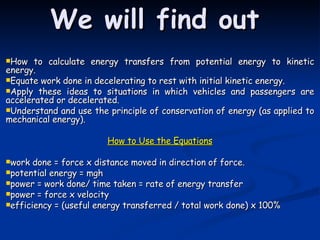
We will find out How to calculate energy transfers from potential energy to kinetic energy.  Equate work done in decelerating to rest with initial kinetic energy.  Apply these ideas to situations in which vehicles and passengers are accelerated or decelerated.  Understand and use the principle of conservation of energy (as applied to mechanical energy). How to Use the Equations work done = force x distance moved in direction of force.  potential energy = mgh  power = work done/ time taken = rate of energy transfer  power = force x velocity  efficiency = (useful energy transferred / total work done) x 100%
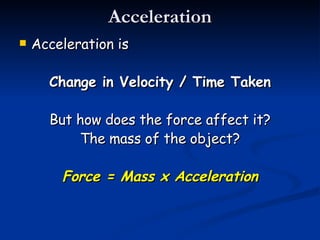
Acceleration Acceleration is Change in Velocity / Time Taken But how does the force affect it? The mass of the object? Force = Mass x Acceleration
Energy changes Use the equations below to work through the questions on sheet TAP 214-2: Along the Flat and up the Hill
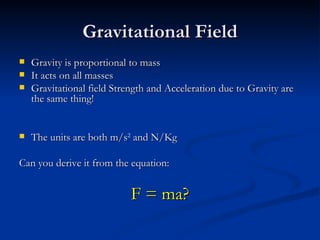
Gravitational Field Gravity is proportional to mass It acts on all masses Gravitational field Strength and Acceleration due to Gravity are the same thing! The units are both m/s 2  and N/Kg Can you derive it from the equation: F = ma?
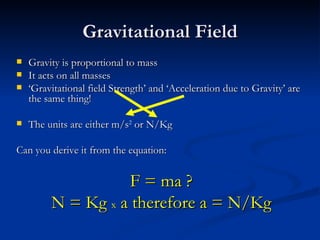
Gravitational Field Gravity is proportional to mass It acts on all masses ‘ Gravitational field Strength’ and ‘Acceleration due to Gravity’ are the same thing! The units are either m/s 2  or N/Kg Can you derive it from the equation: F = ma ? N = Kg  x  a therefore a = N/Kg
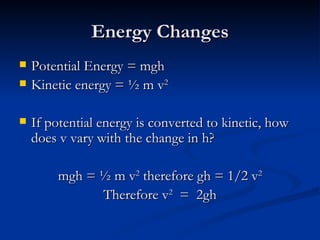
Energy Changes Potential Energy = mgh Kinetic energy = ½ m v 2 If potential energy is converted to kinetic, how does v vary with the change in h? mgh = ½ m v 2  therefore gh = 1/2 v 2 Therefore v 2   =  2gh

Chapter 9

  • 1.
    Forces Change VelocitiesHow do forces affect the velocity of objects?
  • 2.
    We will findout How to calculate energy transfers from potential energy to kinetic energy. Equate work done in decelerating to rest with initial kinetic energy. Apply these ideas to situations in which vehicles and passengers are accelerated or decelerated. Understand and use the principle of conservation of energy (as applied to mechanical energy). How to Use the Equations work done = force x distance moved in direction of force. potential energy = mgh power = work done/ time taken = rate of energy transfer power = force x velocity efficiency = (useful energy transferred / total work done) x 100%
  • 3.
    Acceleration Acceleration isChange in Velocity / Time Taken But how does the force affect it? The mass of the object? Force = Mass x Acceleration
  • 4.
    Energy changes Usethe equations below to work through the questions on sheet TAP 214-2: Along the Flat and up the Hill
  • 5.
    Gravitational Field Gravityis proportional to mass It acts on all masses Gravitational field Strength and Acceleration due to Gravity are the same thing! The units are both m/s 2 and N/Kg Can you derive it from the equation: F = ma?
  • 6.
    Gravitational Field Gravityis proportional to mass It acts on all masses ‘ Gravitational field Strength’ and ‘Acceleration due to Gravity’ are the same thing! The units are either m/s 2 or N/Kg Can you derive it from the equation: F = ma ? N = Kg x a therefore a = N/Kg
  • 7.
    Energy Changes PotentialEnergy = mgh Kinetic energy = ½ m v 2 If potential energy is converted to kinetic, how does v vary with the change in h? mgh = ½ m v 2 therefore gh = 1/2 v 2 Therefore v 2 = 2gh