Chapter 8 – Mapping Space and Time 8.1 - Journeys We will find out:  that speed is distance over time;  v = s / t ;  that speed can be calculated from the gradient of a distance–time graph;  the meanings of average and instantaneous speeds and how these are calculated from speed–time graphs;  the meaning of the area under a speed–time graph and how to estimate this.
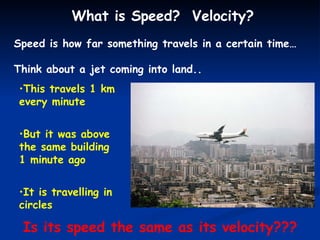
What is Speed?  Velocity? Speed is how far something travels in a certain time… Think about a jet coming into land.. This travels 1 km every minute But it was above the same building 1 minute ago It is travelling in circles Is its speed the same as its velocity???
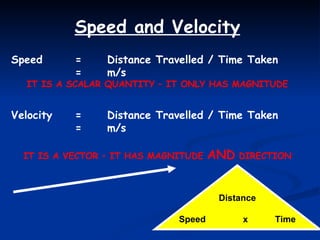
Speed and Velocity Speed =  Distance Travelled / Time Taken = m/s IT IS A SCALAR QUANTITY – IT ONLY HAS MAGNITUDE Velocity =  Distance Travelled / Time Taken = m/s IT IS A VECTOR – IT HAS MAGNITUDE  AND  DIRECTION Distance Speed x Time
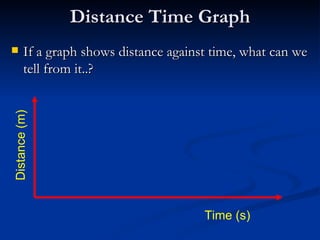
Distance Time Graph If a graph shows distance against time, what can we tell from it..? Time (s) Distance (m)
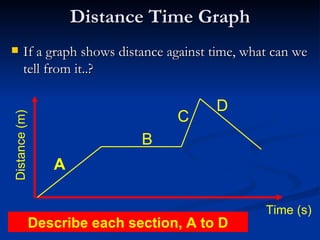
Distance Time Graph If a graph shows distance against time, what can we tell from it..? Time (s) Distance (m) A B C D Describe each section, A to D
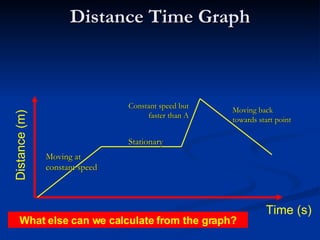
Distance Time Graph Time (s) Distance (m) Moving at constant speed Stationary Constant speed but faster than A Moving back towards start point What else can we calculate from the graph?
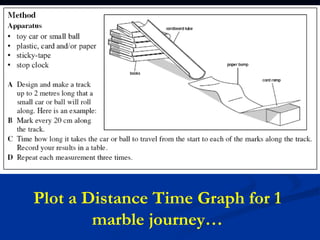
Plot a Distance Time Graph for 1 marble journey…
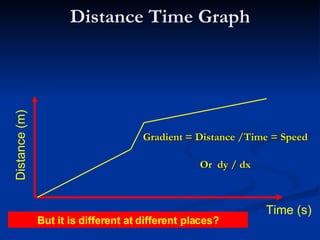
Distance Time Graph Time (s) Distance (m) Gradient = Distance /Time = Speed Or  dy / dx But it is different at different places?
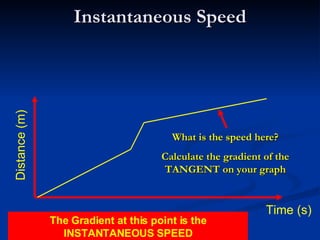
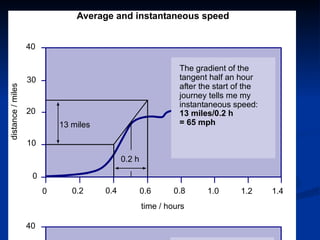
Instantaneous Speed Time (s) Distance (m) What is the speed here? Calculate the gradient of the TANGENT on your graph The Gradient at this point is the INSTANTANEOUS SPEED
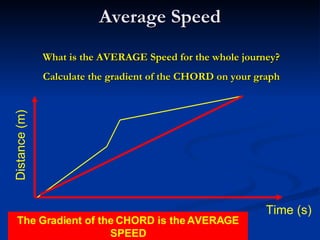
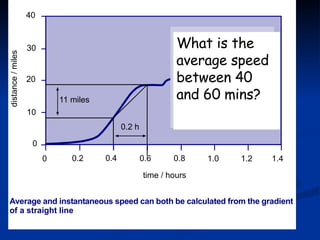
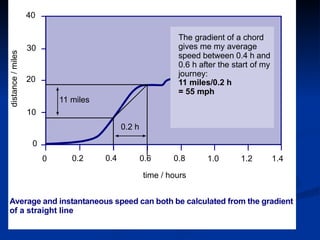
Average Speed Time (s) Distance (m) What is the AVERAGE Speed for the whole journey? Calculate the gradient of the CHORD on your graph The Gradient of the CHORD is the AVERAGE SPEED
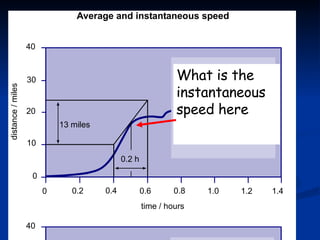
Try this What is the instantaneous speed here
Try this
Try this What is the average speed between 40 and 60 mins?
Try this
Using the speed triangle, try these… 1. You are watching a batsman hit a cricket ball. If 0.375 seconds passes between the time you see him strike the ball and the time you hear the sound of this, how far from the batsman are you sitting? The speed of sound in air is 340 m s–1. (The speed of light is nearly a million times bigger than this, so you see the bat hit the ball more or less at the instant it occurs.) 2. A girl diving from a 15 m platform wishes to know how fast she enters the water. She is in the air for 1.75 s and dives from rest (with an initial speed of zero). What can you tell her about her entry speed? 3. An experiment performed on the Moon finds that a feather falls 20.75 m from rest in 5 s. What is its speed as it hits the Moon's surface?
Using the speed triangle, try these… 1. Distance = speed x Time = 340 x 0.375 = 127.5m 2. Average Speed = Distance / Time = 15 / 1.75 = 8.57m/s As started at zero, must be at twice average when enters water = 17.1m/s 3. Average Speed = Distance / Time = 20.75 / 5 = 4.15m/s Hence maximum Speed = 8.30m/s
Velocity Time Graphs Different to Distance Time – y axis is Velocity not Distance!!!! Be careful not to get them mixed up!
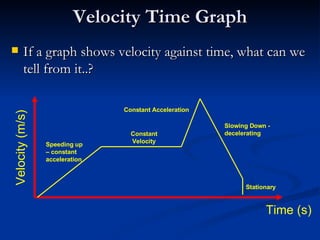
Velocity Time Graph If a graph shows velocity against time, what can we tell from it..? Time (s) Velocity (m/s) Speeding up – constant acceleration Constant Velocity Constant Acceleration Slowing Down - decelerating Stationary
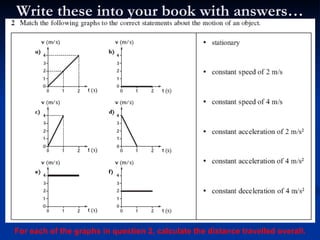
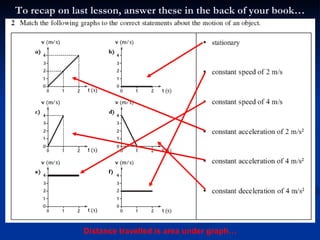
Write these into your book with answers… For each of the graphs in question 2, calculate the distance travelled overall.
To recap on last lesson, answer these in the back of your book… Distance travelled is area under graph…
Making a Velocity Time Graph…
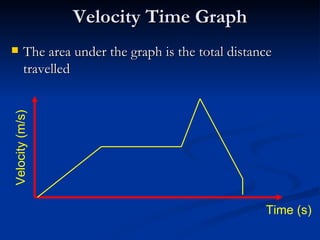
Velocity Time Graph The area under the graph is the total distance travelled Time (s) Velocity (m/s)
Questions to Try Page 181 – show working to get the answer at the bottom: 1, 2, 3, 4,  5 (note there are 1.6 km per mile) 6,7
 

Chapter 8

  • 1.
    Chapter 8 –Mapping Space and Time 8.1 - Journeys We will find out:  that speed is distance over time; v = s / t ;  that speed can be calculated from the gradient of a distance–time graph;  the meanings of average and instantaneous speeds and how these are calculated from speed–time graphs;  the meaning of the area under a speed–time graph and how to estimate this.
  • 2.
    What is Speed? Velocity? Speed is how far something travels in a certain time… Think about a jet coming into land.. This travels 1 km every minute But it was above the same building 1 minute ago It is travelling in circles Is its speed the same as its velocity???
  • 3.
    Speed and VelocitySpeed = Distance Travelled / Time Taken = m/s IT IS A SCALAR QUANTITY – IT ONLY HAS MAGNITUDE Velocity = Distance Travelled / Time Taken = m/s IT IS A VECTOR – IT HAS MAGNITUDE AND DIRECTION Distance Speed x Time
  • 4.
    Distance Time GraphIf a graph shows distance against time, what can we tell from it..? Time (s) Distance (m)
  • 5.
    Distance Time GraphIf a graph shows distance against time, what can we tell from it..? Time (s) Distance (m) A B C D Describe each section, A to D
  • 6.
    Distance Time GraphTime (s) Distance (m) Moving at constant speed Stationary Constant speed but faster than A Moving back towards start point What else can we calculate from the graph?
  • 7.
    Plot a DistanceTime Graph for 1 marble journey…
  • 8.
    Distance Time GraphTime (s) Distance (m) Gradient = Distance /Time = Speed Or dy / dx But it is different at different places?
  • 9.
    Instantaneous Speed Time(s) Distance (m) What is the speed here? Calculate the gradient of the TANGENT on your graph The Gradient at this point is the INSTANTANEOUS SPEED
  • 10.
    Average Speed Time(s) Distance (m) What is the AVERAGE Speed for the whole journey? Calculate the gradient of the CHORD on your graph The Gradient of the CHORD is the AVERAGE SPEED
  • 11.
    Try this Whatis the instantaneous speed here
  • 12.
  • 13.
    Try this Whatis the average speed between 40 and 60 mins?
  • 14.
  • 15.
    Using the speedtriangle, try these… 1. You are watching a batsman hit a cricket ball. If 0.375 seconds passes between the time you see him strike the ball and the time you hear the sound of this, how far from the batsman are you sitting? The speed of sound in air is 340 m s–1. (The speed of light is nearly a million times bigger than this, so you see the bat hit the ball more or less at the instant it occurs.) 2. A girl diving from a 15 m platform wishes to know how fast she enters the water. She is in the air for 1.75 s and dives from rest (with an initial speed of zero). What can you tell her about her entry speed? 3. An experiment performed on the Moon finds that a feather falls 20.75 m from rest in 5 s. What is its speed as it hits the Moon's surface?
  • 16.
    Using the speedtriangle, try these… 1. Distance = speed x Time = 340 x 0.375 = 127.5m 2. Average Speed = Distance / Time = 15 / 1.75 = 8.57m/s As started at zero, must be at twice average when enters water = 17.1m/s 3. Average Speed = Distance / Time = 20.75 / 5 = 4.15m/s Hence maximum Speed = 8.30m/s
  • 17.
    Velocity Time GraphsDifferent to Distance Time – y axis is Velocity not Distance!!!! Be careful not to get them mixed up!
  • 18.
    Velocity Time GraphIf a graph shows velocity against time, what can we tell from it..? Time (s) Velocity (m/s) Speeding up – constant acceleration Constant Velocity Constant Acceleration Slowing Down - decelerating Stationary
  • 19.
    Write these intoyour book with answers… For each of the graphs in question 2, calculate the distance travelled overall.
  • 20.
    To recap onlast lesson, answer these in the back of your book… Distance travelled is area under graph…
  • 21.
    Making a VelocityTime Graph…
  • 22.
    Velocity Time GraphThe area under the graph is the total distance travelled Time (s) Velocity (m/s)
  • 23.
    Questions to TryPage 181 – show working to get the answer at the bottom: 1, 2, 3, 4, 5 (note there are 1.6 km per mile) 6,7
  • 24.