WARMUP
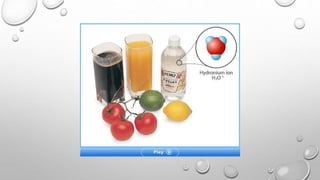
Both lemons and tomatoes both contain citric acid,
which gives them a tangy flavor.
Can you think of other foods whose tanginess may be
due to the presence of acids?
CHEMICAL COMPOUNDS
PHYSICAL SCIENCE: BOOK L, CHAPTER 3
SECTION 2: ACIDS & BASES
By the end of this section, you should be able to:
• Describe four properties of acids.
• Identify four uses of acids.
• Describe four properties of bases.
• Identify four uses of bases.
ACIDS & THEIR PROPERTIES
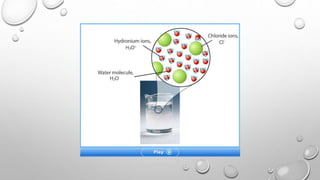
• An acid is any compound that increases the number of
hydronium ions, H3O+, when dissolved in water.
• Hydronium ions form when a hydrogen ion, H+, separates
from the acid and bonds with a water molecule, H2O, to
form a hydronium ion, H3O+.
• The sour taste of lemons, limes, and other citrus fruits is a
result of citric acid.
ACIDS & THEIR PROPERTIES
• Taste, touch, or smell should NEVER be used to identify an
unknown chemical. Many acids are corrosive, which means
that they destroy body tissue, clothing, and many other
things.
• Most acids are also poisonous.
ACIDS & THEIR PROPERTIES
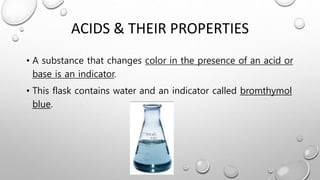
• A substance that changes color in the presence of an acid or
base is an indicator.
• This flask contains water and an indicator called bromthymol
blue.
ACIDS & THEIR PROPERTIES
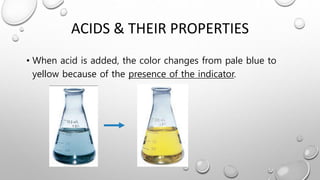
• When acid is added, the color changes from pale blue to
yellow because of the presence of the indicator.
ACIDS & THEIR PROPERTIES
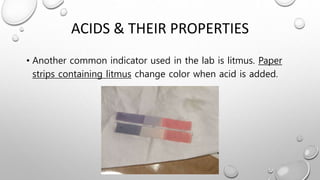
• Another common indicator used in the lab is litmus. Paper
strips containing litmus change color when acid is added.
ACIDS & THEIR PROPERTIES
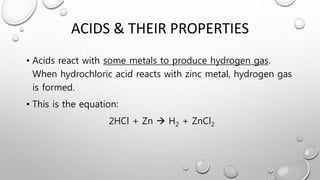
• Acids react with some metals to produce hydrogen gas.
When hydrochloric acid reacts with zinc metal, hydrogen gas
is formed.
• This is the equation:
2HCl + Zn  H2 + ZnCl2
ACIDS & THEIR PROPERTIES
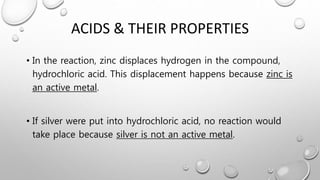
• In the reaction, zinc displaces hydrogen in the compound,
hydrochloric acid. This displacement happens because zinc is
an active metal.
• If silver were put into hydrochloric acid, no reaction would
take place because silver is not an active metal.
ACIDS & THEIR PROPERTIES
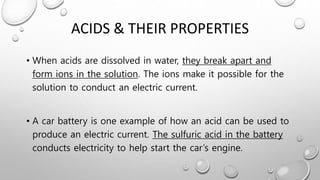
• When acids are dissolved in water, they break apart and
form ions in the solution. The ions make it possible for the
solution to conduct an electric current.
• A car battery is one example of how an acid can be used to
produce an electric current. The sulfuric acid in the battery
conducts electricity to help start the car’s engine.
USES OF ACIDS
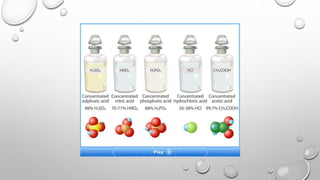
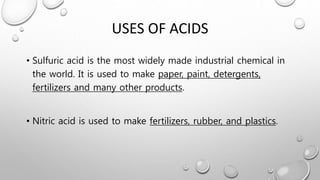
• Sulfuric acid is the most widely made industrial chemical in
the world. It is used to make paper, paint, detergents,
fertilizers and many other products.
• Nitric acid is used to make fertilizers, rubber, and plastics.
USES OF ACIDS
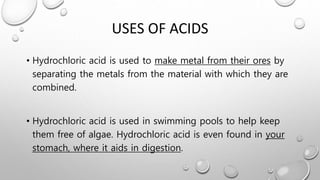
• Hydrochloric acid is used to make metal from their ores by
separating the metals from the material with which they are
combined.
• Hydrochloric acid is used in swimming pools to help keep
them free of algae. Hydrochloric acid is even found in your
stomach, where it aids in digestion.
USES OF ACIDS
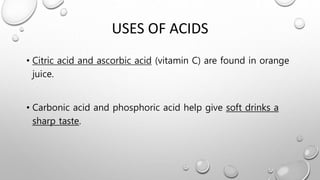
• Citric acid and ascorbic acid (vitamin C) are found in orange
juice.
• Carbonic acid and phosphoric acid help give soft drinks a
sharp taste.
BASES AND THEIR PROPERTIES
• A base is any compound that increases the number of
hydroxide ions, OH-, when dissolved in water.
• For example, sodium hydroxide breaks apart to form sodium
ions and hydroxide ions, as shown in this formula:
NaOH  Na+ + OH-
BASES AND THEIR PROPERTIES
 Hydroxide ions give bases their properties. Some examples
of bases include soaps, ammonia, baking soda, bleach, and
detergents.
 If you have ever tasted soap, you know the bitter taste of a
base. Soap will also have the slippery feel of a base.
BASES AND THEIR PROPERTIES
• Taste, touch, or smell should NEVER be used to identify an
unknown chemical. Like acids, many bases are corrosive.
• Like acids, bases change the color of an indicator. Most
indicators turn a different color in the presence of bases
than they do in the presence of acids.
BASES AND THEIR PROPERTIES
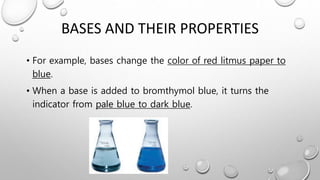
• For example, bases change the color of red litmus paper to
blue.
• When a base is added to bromthymol blue, it turns the
indicator from pale blue to dark blue.
BASES AND THEIR PROPERTIES
• Solutions of bases conduct electricity because bases increase
the number of hydroxide ions, OH-, in a solution.
• A hydroxide ion is actually a hydrogen atom and an oxygen
atom bonded together. The extra electron gives the
hydroxide ion a negative charge.
USES OF BASES
• Sodium hydroxide is a base used to make soap and paper. It
is also used in oven cleaners and products that unclog
drains.
• Calcium hydroxide, Ca(OH)2, is used to make cement and
plaster.
USES OF BASES
• Ammonia is found in many household cleaners and is used
to make fertilizers. Magnesium hydroxide and aluminum
hydroxide are used in antacids.
SECTION 2 REVIEW
p.67 #2-8
WARMUP
Write down as many acids and bases as you can
think of without looking at your notes.
SECTION 3: SOLUTIONS OF ACIDS & BASES
By the end of this section, you should be able to:
• Explain the difference between strong acids and bases and
weak acids and bases.
• Identify acids and bases by using the pH scale.
• Describe the formation and uses of salts.
STRENGTHS OF ACIDS & BASES
• Acids and bases can be strong or weak. Strength of an acid
or a base is not the same as the concentration of an acid or
a base.
• The concentration of an acid or a base is the amount of
acid or base dissolved in water.
STRENGTHS OF ACIDS & BASES
• The strength of an acid or a base depends on the number of
molecules that break apart when the acid or base is
dissolved in water.
STRONG VERSUS WEAK ACIDS
• As an acid dissolves in water, the acid’s molecules break
apart and produce hydrogen ions, H+.
• If all the molecules break apart, the acid is called a strong
acid. Strong acids include sulfuric acid, nitric acid, and
hydrochloric acid.
STRONG VERSUS WEAK ACIDS
• If only a few molecules break apart, the acid is a weak acid.
Weak acids include acetic acid, citric acid, and carbonic acid.
STRONG VERSUS WEAK BASES
• When all molecules of a base break apart in water to
produce hydroxide ions, OH-, the base is a strong base.
• Strong bases include sodium hydroxide, calcium hydroxide,
and potassium hydroxide.
STRONG VERSUS WEAK BASES
• When only a few molecules of a base break apart, the base
is a weak base, such as ammonium hydroxide and aluminum
hydroxide.
ACIDS, BASES, & NEUTRALIZATION
• The reaction between acids and bases is called a
neutralization reaction.
• Acids and bases neutralize one another because the
hydrogen ions (H+) in an acid and the hydroxide ions (OH-)
in a base react to form water, H2O.
ACIDS, BASES, & NEUTRALIZATION
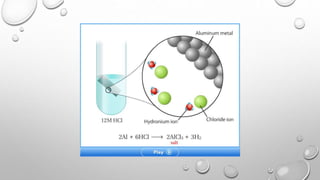
• Other ions from the acid and base dissolve in the water. If
the water evaporates, these ions join to form the compound
called a salt.
• An indicator, such as litmus, can identify whether a solution
contains an acid or base.
ACIDS, BASES, & NEUTRALIZATION
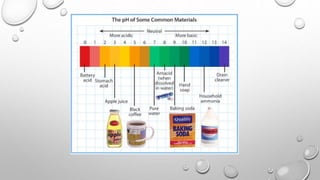
• To describe how acidic or basic a solution is, the pH scale is
used. The pH of a solution is a measure of the hydronium
ion concentration in the solution.
• A combination of indicators can be used to find out how
basic or how acidic a solution is. This can be done if the
colors of the indicators are known at different pH values.
ACIDS, BASES, & NEUTRALIZATION
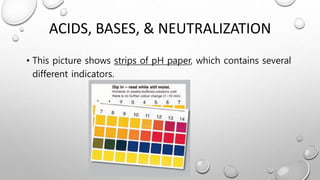
• This picture shows strips of pH paper, which contains several
different indicators.
ACIDS, BASES, & NEUTRALIZATION
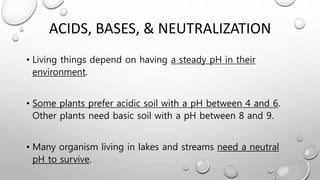
• Living things depend on having a steady pH in their
environment.
• Some plants prefer acidic soil with a pH between 4 and 6.
Other plants need basic soil with a pH between 8 and 9.
• Many organism living in lakes and streams need a neutral
pH to survive.
SALTS
• When an acid neutralizes a base, a salt and water are
produced. A salt is an ionic compound formed from the
positive ion of a base and the negative ion of an acid.
• Sodium chloride, commonly known as table salt, is one
example of a large group of compounds called salts.
SALTS
• Sodium chloride is used to season foods. It is also used to
make other compounds, including lye (sodium hydroxide)
and baking soda.
SALTS
• Sodium nitrate is a salt that is used to preserve foods.
Calcium sulfate is used to make materials used in
construction.
• In some regions, salt is used to keep roads free of ice by
decreasing the freezing point of water.
SECTION 3 REVIEW
p.71 #2-7

Chemical Compounds

  • 1.
    WARMUP Both lemons andtomatoes both contain citric acid, which gives them a tangy flavor. Can you think of other foods whose tanginess may be due to the presence of acids?
  • 2.
  • 3.
    SECTION 2: ACIDS& BASES By the end of this section, you should be able to: • Describe four properties of acids. • Identify four uses of acids. • Describe four properties of bases. • Identify four uses of bases.
  • 4.
    ACIDS & THEIRPROPERTIES • An acid is any compound that increases the number of hydronium ions, H3O+, when dissolved in water. • Hydronium ions form when a hydrogen ion, H+, separates from the acid and bonds with a water molecule, H2O, to form a hydronium ion, H3O+. • The sour taste of lemons, limes, and other citrus fruits is a result of citric acid.
  • 6.
    ACIDS & THEIRPROPERTIES • Taste, touch, or smell should NEVER be used to identify an unknown chemical. Many acids are corrosive, which means that they destroy body tissue, clothing, and many other things. • Most acids are also poisonous.
  • 7.
    ACIDS & THEIRPROPERTIES • A substance that changes color in the presence of an acid or base is an indicator. • This flask contains water and an indicator called bromthymol blue.
  • 8.
    ACIDS & THEIRPROPERTIES • When acid is added, the color changes from pale blue to yellow because of the presence of the indicator.
  • 9.
    ACIDS & THEIRPROPERTIES • Another common indicator used in the lab is litmus. Paper strips containing litmus change color when acid is added.
  • 10.
    ACIDS & THEIRPROPERTIES • Acids react with some metals to produce hydrogen gas. When hydrochloric acid reacts with zinc metal, hydrogen gas is formed. • This is the equation: 2HCl + Zn  H2 + ZnCl2
  • 11.
    ACIDS & THEIRPROPERTIES • In the reaction, zinc displaces hydrogen in the compound, hydrochloric acid. This displacement happens because zinc is an active metal. • If silver were put into hydrochloric acid, no reaction would take place because silver is not an active metal.
  • 12.
    ACIDS & THEIRPROPERTIES • When acids are dissolved in water, they break apart and form ions in the solution. The ions make it possible for the solution to conduct an electric current. • A car battery is one example of how an acid can be used to produce an electric current. The sulfuric acid in the battery conducts electricity to help start the car’s engine.
  • 14.
    USES OF ACIDS •Sulfuric acid is the most widely made industrial chemical in the world. It is used to make paper, paint, detergents, fertilizers and many other products. • Nitric acid is used to make fertilizers, rubber, and plastics.
  • 15.
    USES OF ACIDS •Hydrochloric acid is used to make metal from their ores by separating the metals from the material with which they are combined. • Hydrochloric acid is used in swimming pools to help keep them free of algae. Hydrochloric acid is even found in your stomach, where it aids in digestion.
  • 16.
    USES OF ACIDS •Citric acid and ascorbic acid (vitamin C) are found in orange juice. • Carbonic acid and phosphoric acid help give soft drinks a sharp taste.
  • 17.
    BASES AND THEIRPROPERTIES • A base is any compound that increases the number of hydroxide ions, OH-, when dissolved in water. • For example, sodium hydroxide breaks apart to form sodium ions and hydroxide ions, as shown in this formula: NaOH  Na+ + OH-
  • 18.
    BASES AND THEIRPROPERTIES  Hydroxide ions give bases their properties. Some examples of bases include soaps, ammonia, baking soda, bleach, and detergents.  If you have ever tasted soap, you know the bitter taste of a base. Soap will also have the slippery feel of a base.
  • 19.
    BASES AND THEIRPROPERTIES • Taste, touch, or smell should NEVER be used to identify an unknown chemical. Like acids, many bases are corrosive. • Like acids, bases change the color of an indicator. Most indicators turn a different color in the presence of bases than they do in the presence of acids.
  • 20.
    BASES AND THEIRPROPERTIES • For example, bases change the color of red litmus paper to blue. • When a base is added to bromthymol blue, it turns the indicator from pale blue to dark blue.
  • 21.
    BASES AND THEIRPROPERTIES • Solutions of bases conduct electricity because bases increase the number of hydroxide ions, OH-, in a solution. • A hydroxide ion is actually a hydrogen atom and an oxygen atom bonded together. The extra electron gives the hydroxide ion a negative charge.
  • 22.
    USES OF BASES •Sodium hydroxide is a base used to make soap and paper. It is also used in oven cleaners and products that unclog drains. • Calcium hydroxide, Ca(OH)2, is used to make cement and plaster.
  • 23.
    USES OF BASES •Ammonia is found in many household cleaners and is used to make fertilizers. Magnesium hydroxide and aluminum hydroxide are used in antacids.
  • 24.
  • 25.
    WARMUP Write down asmany acids and bases as you can think of without looking at your notes.
  • 26.
    SECTION 3: SOLUTIONSOF ACIDS & BASES By the end of this section, you should be able to: • Explain the difference between strong acids and bases and weak acids and bases. • Identify acids and bases by using the pH scale. • Describe the formation and uses of salts.
  • 27.
    STRENGTHS OF ACIDS& BASES • Acids and bases can be strong or weak. Strength of an acid or a base is not the same as the concentration of an acid or a base. • The concentration of an acid or a base is the amount of acid or base dissolved in water.
  • 28.
    STRENGTHS OF ACIDS& BASES • The strength of an acid or a base depends on the number of molecules that break apart when the acid or base is dissolved in water.
  • 29.
    STRONG VERSUS WEAKACIDS • As an acid dissolves in water, the acid’s molecules break apart and produce hydrogen ions, H+. • If all the molecules break apart, the acid is called a strong acid. Strong acids include sulfuric acid, nitric acid, and hydrochloric acid.
  • 30.
    STRONG VERSUS WEAKACIDS • If only a few molecules break apart, the acid is a weak acid. Weak acids include acetic acid, citric acid, and carbonic acid.
  • 31.
    STRONG VERSUS WEAKBASES • When all molecules of a base break apart in water to produce hydroxide ions, OH-, the base is a strong base. • Strong bases include sodium hydroxide, calcium hydroxide, and potassium hydroxide.
  • 32.
    STRONG VERSUS WEAKBASES • When only a few molecules of a base break apart, the base is a weak base, such as ammonium hydroxide and aluminum hydroxide.
  • 33.
    ACIDS, BASES, &NEUTRALIZATION • The reaction between acids and bases is called a neutralization reaction. • Acids and bases neutralize one another because the hydrogen ions (H+) in an acid and the hydroxide ions (OH-) in a base react to form water, H2O.
  • 34.
    ACIDS, BASES, &NEUTRALIZATION • Other ions from the acid and base dissolve in the water. If the water evaporates, these ions join to form the compound called a salt. • An indicator, such as litmus, can identify whether a solution contains an acid or base.
  • 35.
    ACIDS, BASES, &NEUTRALIZATION • To describe how acidic or basic a solution is, the pH scale is used. The pH of a solution is a measure of the hydronium ion concentration in the solution. • A combination of indicators can be used to find out how basic or how acidic a solution is. This can be done if the colors of the indicators are known at different pH values.
  • 37.
    ACIDS, BASES, &NEUTRALIZATION • This picture shows strips of pH paper, which contains several different indicators.
  • 38.
    ACIDS, BASES, &NEUTRALIZATION • Living things depend on having a steady pH in their environment. • Some plants prefer acidic soil with a pH between 4 and 6. Other plants need basic soil with a pH between 8 and 9. • Many organism living in lakes and streams need a neutral pH to survive.
  • 40.
    SALTS • When anacid neutralizes a base, a salt and water are produced. A salt is an ionic compound formed from the positive ion of a base and the negative ion of an acid. • Sodium chloride, commonly known as table salt, is one example of a large group of compounds called salts.
  • 42.
    SALTS • Sodium chlorideis used to season foods. It is also used to make other compounds, including lye (sodium hydroxide) and baking soda.
  • 43.
    SALTS • Sodium nitrateis a salt that is used to preserve foods. Calcium sulfate is used to make materials used in construction. • In some regions, salt is used to keep roads free of ice by decreasing the freezing point of water.
  • 44.