NOTCH PATHWAY
GROUP 1.2.6
GROUP MEMBERS
NAME REGISTRATION NUMBER
KAALE SHARON 2019-08-07612
WAJAMBUKA FAISAL 2020-08-00012
EDYEGU CHRISTOPHER 2020-08-00025
Introduction.
• The notch pathway is a cell signaling system that relies on protein –
protein interactions to transduce signals.
• It regulates cell proliferation, cell fate, differentiation and cell death in
all metazoans.
• The notch pathway is a highly conserved cell signaling pathway
Aim of studying NOTCH pathway.
• NOTCH signaling is dysregulated in many cancers and faulty NOTCH
signaling is implicated in many diseases forexample CADASIL, Alagille
syndrome.
Importance of the NOTCH pathway.
• Promotes proliferative signaling during neurogenesis.
• Stabilization of arterial endothelial fate and angiogenesis.
• Determination of fate of cells in the immune system
• Plays a major role in regulation of embryonic development.
Components of the notch pathway
a. Notch receptors; NOTCH 1, NOTCH 2, NOTCH 3, NOTCH 4
These are hetero-oligomers made of three components
-notch extracellular domain (NECD).
-notch intracellular domain (NICD).
-transmembrane component.
b. Ligands which include the jagged protein family (JAG 1 and JAG 2)
and the delta like protein family (DLL 1, DLL 3, DLL 4).
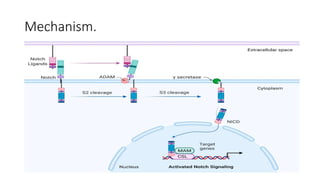
Mechanism.
Mechanism.
• The notch pathway requires two cells; a sending cell which has more
ligands than notch receptors and a receiving cell which has more
notch receptors than ligands.
• For notch signaling to be activated, the ligand has to bind to the
NECD.
• The ligands is activated first by a protein(Neur or Mib) within the
sending cell that ubiquinates the ligand in order to activate it.
• In the golgi apparatus (S1 cleavage), furin in its future extracellular
domain converts it into heterodimer and its then transported to the
cell surface receptor consisting of three domains, signalling starts
when the ligand interacts with the receptor leading to further
cleavages.
• Endocytosis of the ligand promotes exposure of the NRR domain
(negative regulatory region domain) of the receptor for S2 cleavage.
• Once activated the ligand can then bind on the NECD.
• A protease(ADAM) then cleaves the NECD dislodging it from the receiving
cell, a process known as S2 cleavage.
• Secretase gamma cleaves the NICD off the receptor, a process known as S3
cleavage.
• Once NICD is free in the cytosol it can bind to a complex of proteins that
then translocate into the nucleus .
• This leads to transcription of NOTCH target genes eg; Myc, P21, Cyclin D3.
• Once target genes have been expressed, NICD can be be down-
regulated via an E3 ubiquinine ligase(FBW 7).
• FBW 7 ubiquinates the NICD which leads to degradation of the NICD
shutting down the pathway.
Regulation of the pathway
• Signal down regulation.
During transcription activation, NICD is phosphorylated on its PEST
domain by kinases such as CDK8 and targeted for proteasomal degradation
by E3 ubiquitin ligases such as sel10/Fbw7. This terminates the notch signal
and resets the cell for the next round of signaling.
Transcriptional switch and target gene expression.
In the absence of NICD, the DNA binding protein is bound to a
ubiquitous co repressor protein and histone deacetylases to repress
transcription of target genes and when NICD enters the nucleus and binds to
CSL, it triggers a conformational change which causes displacement of
repressors.
Inhibitors of the NOTCH pathway.
• The NOTCH pathway inhibitors can act as cancer treatments since
they can prevent over expression of NOTCH receptors and ligands
during cancer.
• Examples include;
• gamma secretase inhibitors AL101 and AL102.
• Anti-notch 1 or anti delta like monoclonal antibodies. These prevent
over expression of the NOTCH receptors and ligands.
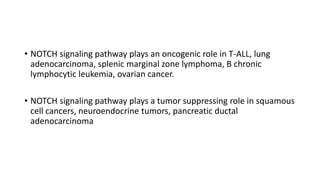
• NOTCH signaling pathway plays an oncogenic role in T-ALL, lung
adenocarcinoma, splenic marginal zone lymphoma, B chronic
lymphocytic leukemia, ovarian cancer.
• NOTCH signaling pathway plays a tumor suppressing role in squamous
cell cancers, neuroendocrine tumors, pancreatic ductal
adenocarcinoma
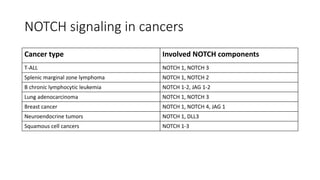
NOTCH signaling in cancers
Cancer type Involved NOTCH components
T-ALL NOTCH 1, NOTCH 3
Splenic marginal zone lymphoma NOTCH 1, NOTCH 2
B chronic lymphocytic leukemia NOTCH 1-2, JAG 1-2
Lung adenocarcinoma NOTCH 1, NOTCH 3
Breast cancer NOTCH 1, NOTCH 4, JAG 1
Neuroendocrine tumors NOTCH 1, DLL3
Squamous cell cancers NOTCH 1-3
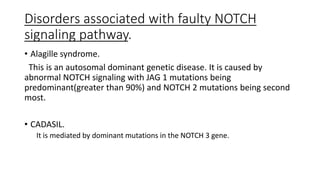
Disorders associated with faulty NOTCH
signaling pathway.
• Alagille syndrome.
This is an autosomal dominant genetic disease. It is caused by
abnormal NOTCH signaling with JAG 1 mutations being
predominant(greater than 90%) and NOTCH 2 mutations being second
most.
• CADASIL.
It is mediated by dominant mutations in the NOTCH 3 gene.
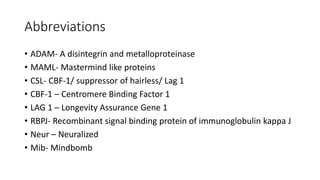
Abbreviations
• ADAM- A disintegrin and metalloproteinase
• MAML- Mastermind like proteins
• CSL- CBF-1/ suppressor of hairless/ Lag 1
• CBF-1 – Centromere Binding Factor 1
• LAG 1 – Longevity Assurance Gene 1
• RBPJ- Recombinant signal binding protein of immunoglobulin kappa J
• Neur – Neuralized
• Mib- Mindbomb
Abbreviations
• CADASIL – Cerebral Autosomal Dominant Arteriopathy with Subcortical
Infarcts and Leukoencepthalopathy.
• T-ALL – T cell Acute Lymphoblastic Leukemia.
• PEST domain is a sequence motif found in some proteins that are targeted
for rapid degradation within the cell. (PEST is P- proline, E- glutamic acid, S-
serine, T- threonine)
Corrections
• Who was Alagille?
Daniel Alagille was a French physician who specialized in paediatric
hepatology, the study of childhood liver diseases.
How breast cancer and lung adenocarcinoma is related to NOTCH
signaling?
In lung adenocarcinoma, there is high expression of NOTCH 1 and
NOTCH 3. This alteration involves loss of NUMB expression( a negative
modulator of NOTCH signaling) which increases NOTCH activity and gain of
function mutations of NOTCH 1 gene.
in breast cancer, upregulation of non mutated JAG 1 and NOTCH 1 is
associated with poor regulation of breast cancer. The mutations of NOTCH 1
and NOTCH 4 promote epithelial mammary tumorigenesis.
• How does NOTCH signaling pathway play an oncogenic role?
The NOTCH signaing pathway is a regulator of self renewal and differentiation in
several tissues and cell types. Hyperactivity of the NOTCH signaling pathway
brings about excessive uncontrolled cellular proliferation leading to tumors.
For example mutations that abolish FBW 7 function in the pathway can lead to
cancers since there will be no stopping of the pathway.
References.
• Robbins and Cotran Pathological basis of disease 9th edition.
• Binghan Zhou, Wanling Lin, Yaling long, Yunkai yang, Huan Zhang,
Kongming Wu, Qian Chu. Notch signaling pathway: architecture,
disease, and therapeutics. 2022

1.2.6_NOTCH_signaling_pathway._corrected[1].pptx

  • 1.
  • 2.
    GROUP MEMBERS NAME REGISTRATIONNUMBER KAALE SHARON 2019-08-07612 WAJAMBUKA FAISAL 2020-08-00012 EDYEGU CHRISTOPHER 2020-08-00025
  • 3.
    Introduction. • The notchpathway is a cell signaling system that relies on protein – protein interactions to transduce signals. • It regulates cell proliferation, cell fate, differentiation and cell death in all metazoans. • The notch pathway is a highly conserved cell signaling pathway
  • 4.
    Aim of studyingNOTCH pathway. • NOTCH signaling is dysregulated in many cancers and faulty NOTCH signaling is implicated in many diseases forexample CADASIL, Alagille syndrome.
  • 5.
    Importance of theNOTCH pathway. • Promotes proliferative signaling during neurogenesis. • Stabilization of arterial endothelial fate and angiogenesis. • Determination of fate of cells in the immune system • Plays a major role in regulation of embryonic development.
  • 6.
    Components of thenotch pathway a. Notch receptors; NOTCH 1, NOTCH 2, NOTCH 3, NOTCH 4 These are hetero-oligomers made of three components -notch extracellular domain (NECD). -notch intracellular domain (NICD). -transmembrane component. b. Ligands which include the jagged protein family (JAG 1 and JAG 2) and the delta like protein family (DLL 1, DLL 3, DLL 4).
  • 7.
  • 8.
    Mechanism. • The notchpathway requires two cells; a sending cell which has more ligands than notch receptors and a receiving cell which has more notch receptors than ligands. • For notch signaling to be activated, the ligand has to bind to the NECD. • The ligands is activated first by a protein(Neur or Mib) within the sending cell that ubiquinates the ligand in order to activate it.
  • 9.
    • In thegolgi apparatus (S1 cleavage), furin in its future extracellular domain converts it into heterodimer and its then transported to the cell surface receptor consisting of three domains, signalling starts when the ligand interacts with the receptor leading to further cleavages. • Endocytosis of the ligand promotes exposure of the NRR domain (negative regulatory region domain) of the receptor for S2 cleavage. • Once activated the ligand can then bind on the NECD.
  • 10.
    • A protease(ADAM)then cleaves the NECD dislodging it from the receiving cell, a process known as S2 cleavage. • Secretase gamma cleaves the NICD off the receptor, a process known as S3 cleavage. • Once NICD is free in the cytosol it can bind to a complex of proteins that then translocate into the nucleus . • This leads to transcription of NOTCH target genes eg; Myc, P21, Cyclin D3.
  • 11.
    • Once targetgenes have been expressed, NICD can be be down- regulated via an E3 ubiquinine ligase(FBW 7). • FBW 7 ubiquinates the NICD which leads to degradation of the NICD shutting down the pathway.
  • 12.
    Regulation of thepathway • Signal down regulation. During transcription activation, NICD is phosphorylated on its PEST domain by kinases such as CDK8 and targeted for proteasomal degradation by E3 ubiquitin ligases such as sel10/Fbw7. This terminates the notch signal and resets the cell for the next round of signaling. Transcriptional switch and target gene expression. In the absence of NICD, the DNA binding protein is bound to a ubiquitous co repressor protein and histone deacetylases to repress transcription of target genes and when NICD enters the nucleus and binds to CSL, it triggers a conformational change which causes displacement of repressors.
  • 13.
    Inhibitors of theNOTCH pathway. • The NOTCH pathway inhibitors can act as cancer treatments since they can prevent over expression of NOTCH receptors and ligands during cancer. • Examples include; • gamma secretase inhibitors AL101 and AL102. • Anti-notch 1 or anti delta like monoclonal antibodies. These prevent over expression of the NOTCH receptors and ligands.
  • 14.
    • NOTCH signalingpathway plays an oncogenic role in T-ALL, lung adenocarcinoma, splenic marginal zone lymphoma, B chronic lymphocytic leukemia, ovarian cancer. • NOTCH signaling pathway plays a tumor suppressing role in squamous cell cancers, neuroendocrine tumors, pancreatic ductal adenocarcinoma
  • 15.
    NOTCH signaling incancers Cancer type Involved NOTCH components T-ALL NOTCH 1, NOTCH 3 Splenic marginal zone lymphoma NOTCH 1, NOTCH 2 B chronic lymphocytic leukemia NOTCH 1-2, JAG 1-2 Lung adenocarcinoma NOTCH 1, NOTCH 3 Breast cancer NOTCH 1, NOTCH 4, JAG 1 Neuroendocrine tumors NOTCH 1, DLL3 Squamous cell cancers NOTCH 1-3
  • 16.
    Disorders associated withfaulty NOTCH signaling pathway. • Alagille syndrome. This is an autosomal dominant genetic disease. It is caused by abnormal NOTCH signaling with JAG 1 mutations being predominant(greater than 90%) and NOTCH 2 mutations being second most. • CADASIL. It is mediated by dominant mutations in the NOTCH 3 gene.
  • 17.
    Abbreviations • ADAM- Adisintegrin and metalloproteinase • MAML- Mastermind like proteins • CSL- CBF-1/ suppressor of hairless/ Lag 1 • CBF-1 – Centromere Binding Factor 1 • LAG 1 – Longevity Assurance Gene 1 • RBPJ- Recombinant signal binding protein of immunoglobulin kappa J • Neur – Neuralized • Mib- Mindbomb
  • 18.
    Abbreviations • CADASIL –Cerebral Autosomal Dominant Arteriopathy with Subcortical Infarcts and Leukoencepthalopathy. • T-ALL – T cell Acute Lymphoblastic Leukemia. • PEST domain is a sequence motif found in some proteins that are targeted for rapid degradation within the cell. (PEST is P- proline, E- glutamic acid, S- serine, T- threonine)
  • 19.
    Corrections • Who wasAlagille? Daniel Alagille was a French physician who specialized in paediatric hepatology, the study of childhood liver diseases. How breast cancer and lung adenocarcinoma is related to NOTCH signaling? In lung adenocarcinoma, there is high expression of NOTCH 1 and NOTCH 3. This alteration involves loss of NUMB expression( a negative modulator of NOTCH signaling) which increases NOTCH activity and gain of function mutations of NOTCH 1 gene. in breast cancer, upregulation of non mutated JAG 1 and NOTCH 1 is associated with poor regulation of breast cancer. The mutations of NOTCH 1 and NOTCH 4 promote epithelial mammary tumorigenesis.
  • 20.
    • How doesNOTCH signaling pathway play an oncogenic role? The NOTCH signaing pathway is a regulator of self renewal and differentiation in several tissues and cell types. Hyperactivity of the NOTCH signaling pathway brings about excessive uncontrolled cellular proliferation leading to tumors. For example mutations that abolish FBW 7 function in the pathway can lead to cancers since there will be no stopping of the pathway.
  • 21.
    References. • Robbins andCotran Pathological basis of disease 9th edition. • Binghan Zhou, Wanling Lin, Yaling long, Yunkai yang, Huan Zhang, Kongming Wu, Qian Chu. Notch signaling pathway: architecture, disease, and therapeutics. 2022