ASSIGNMENT # 03
NOTCH SIGNALLING PATHWAY
Submitted To: Dr. Jamshaid Hussain
Submitted By: Nazal Gul (SP19-BTY-007)
Date of Submission: 2nd June, 2022
Contents:
 Introduction to Notch Signalling
 Notch Receptors
 Ligands
 Notch Signalling Pathway
 Functions of Notch Signalling Pathway
 Notch Pathway and Diseases
Introduction
 Notch Signalling is an “Evolutionary Conserved Signalling Pathway”.
 Important in development and homeostasis.
 It regulates cellular proliferation, differentiation and apoptosis.
 It is unique from other signalling pathways due to its ligands.
 Signalling is restricted to neighboring cells.
 This pathway is associated with tissue growth and cancer.
 Also, it is involved in cell death and tumor suppression.
Discovery
 In 1914, John S. Dexter noticed the appearance of a notch in the wings of
the fruit fly Drosophila melanogaster.
 The alleles of the gene were identified in 1917 by Thomas Hunt Morgan.
 Its molecular analysis and sequencing was done in the 1980s by Spyros
Artavanis-Tsakonas and Michael W. Young.
Notch Receptors
 Notch Signalling is the most widely used intercellular communication pathway.
 There are 4 NOTCH Receptors found in mammals.
 These are: NOTCH1, NOTCH2, NOTCH3 AND NOTCH4.
 This receptor is a single-pass transmembrane receptor protein.
 It is a heterodimer of 2 sub-units.
 The first subunit is an extracellular segment with EGF repeats.
 The second subunit consists of;
- A short extracellular domain
- A transmembrane domain
- And an intracellular domain.
STRUCTURE OF NOTCH RECEPTORS
Source:
https://www.researchgate.net/publication/308993039_Targeting_Notch_as_a_Therapeutic_Ap
proach_for_Human_Malignancies
Notch Ligands
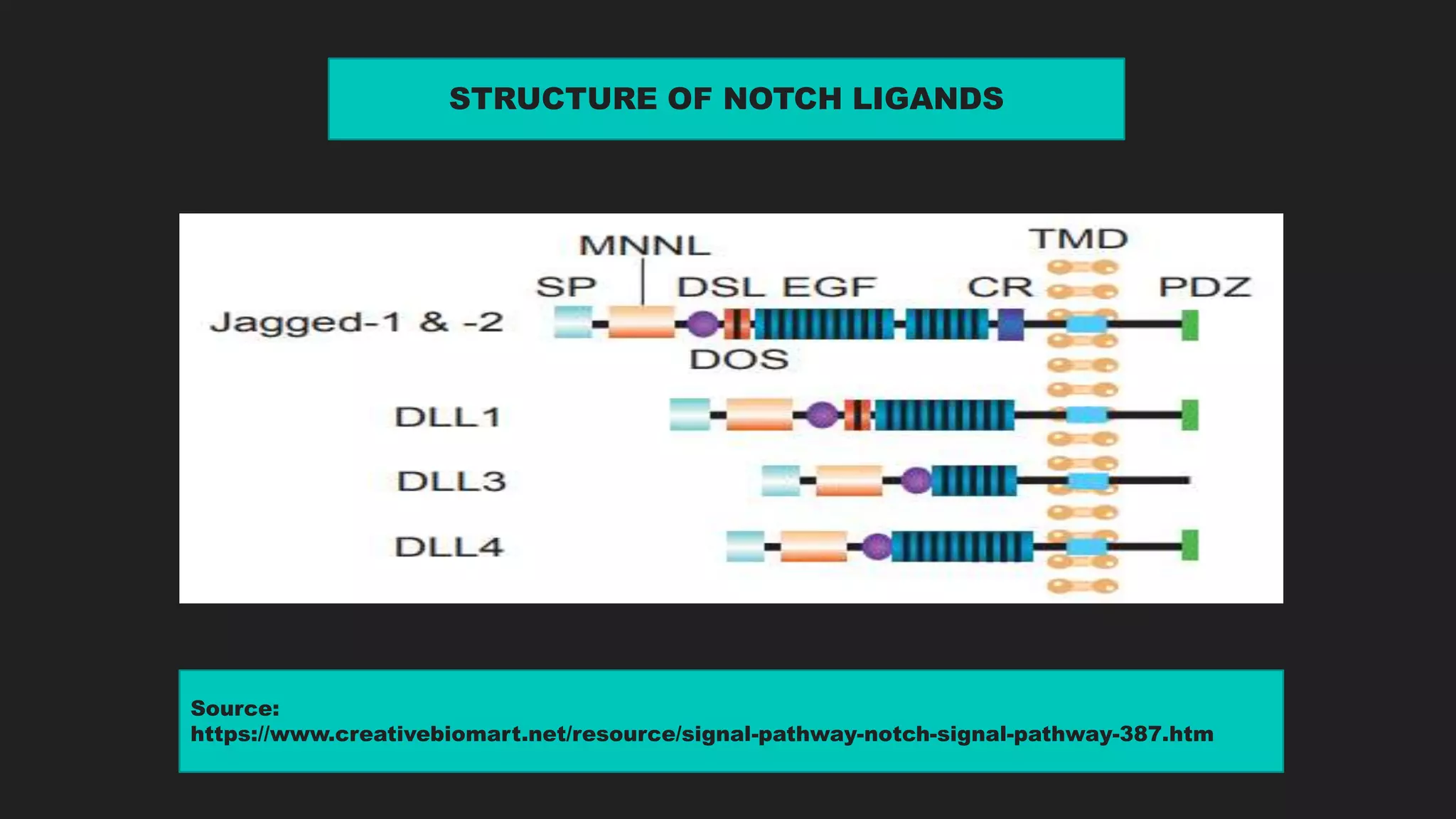
 Notch ligands are type I transmembrane proteins.
 The ligands of the Notch receptors are characterized into 2 families;
 1. Jagged Protein Family (includes JAG 1 and JAG 2)
 2. Delta-like Protein Family (includes DLL1, DLL3, and DLL4)
 Ligand Extracellular domains are highly conserved in evolution.
 They are essential for ligand-receptor binding to activate Notch signaling.
 Intracellular domain of Notch ligands is short, only contains 70 amino acid
residues.
STRUCTURE OF NOTCH LIGANDS
Source:
https://www.creativebiomart.net/resource/signal-pathway-notch-signal-pathway-387.htm
NOTCH SIGNALLING
 Notch Signalling Pathway involves inter-cellular signalling interactions.
 Two cells are involved: sending cell and receiving cell
 Sending has more ligands than Notch receptors.
 Receiving cell has more Notch receptors than ligands.
 The ligand-receptor crosstalk controls cell fate decisions through which neuronal,
cardiac, immune, and endocrine development are regulated.
 Binding of the Delta/Jagged ligand on one cell to the Notch receptor on another cell
results in two Proteolytic Cleavages of the receptor.
 The ADAM10 or TACE metalloprotease catalyzes the S2 cleavage.
Source:
https://www.creativebiomart.net/resource/signal-pathway-notch-signal-pathway-387.htm
NOTCH SIGNALLING PATHWAY
Continued…
 This generates a substrate for S3 cleavage by the γ-secretase complex.
 This proteolytic processing mediates release of the Notch intracellular domain
(NICD).
 NICD enters the nucleus and interacts with the DNA-binding CSL (CBF1, Su(H) and
LAG-1) protein.
 The co-activator Mastermind (Mam) and other transcription factors are recruited to
the CSL complex.
 At the same time, co-repressors (Co-R) are released.
 The co-activators carry out the transcription of target genes e:g P21, CyclinD1 and
cMYC.
 These are crucial for cell division and cell cycle progression.
 This leads to cellular proliferation.
Source:
https://www.creativebiomart.net/resource/signal-pathway-notch-signal-pathway-387.htm
NOTCH SIGNALLING PATHWAY
Functions of Notch Signal Pathway
 Neuronal function and development
 Stabilization of arterial endothelial fate and angiogenesis
 Regulation of crucial cell communication events
 Cardiac valve homeostasis
 Timely cell lineage specification of both endocrine and exocrine pancreas
 Influencing of binary fate decisions of cells that must choose between the secretory
and absorptive lineages in the gut
 Expansion of the hematopoietic stem cell compartment during bone development
Continued…
 T cell lineage commitment from common lymphoid precursor
 Regulation of cell-fate decision in mammary glands at several distinct development
stages
 Regulation of the mitotic/meiotic decision in the C. elegans germline
Notch Signal Pathway and Diseases
 The abnormality of this regulatory signalling mechanism often leads to congenital
genetic diseases.
 It has been confirmed that the mutations of related genes in the Notch signaling
pathway are associated with genetic diseases such as CADASIL, Aligile's syndrome
and hypogastric hypoplasia.
 Delta 3 gene mutations can cause autosomal recessive diseases.
 A study found that Notch signaling disorders associated with certain cardiovascular
diseases.
 Animal model experiments show that it may affect the cardiovascular system from
four aspects, including vascular remodeling, vascular stability, choice of
arteriovenous and heart development.
Continued…
 Recent studies have found that the cleavage of amyloid precursor protein and Notch
receptor are all dependent on γ-secretase.
 So it is speculated that Notch signaling pathway may have some connection with
the occurrence and development of Alzheimer's disease.
Conclusion
 Notch signal is in a complex multi-dimensional regulatory network that provides a basis
for multiple functions in development.
 For example, endocytic transport of Notch receptors and ligands plays an important role
in the activation of Notch signaling.
 Ubiquitin-mediated protein degradation is crucial for preventing the continuous
activation of Notch signaling, yet its regulatory mechanism remains to be elucidated.
 The main task of future research is to unveil the mechanisms of the complex regulatory
networks of Notch signaling.
 Also, recognizing the basis for the diversity of functions of Notch signaling that will allow
us to design more specific approaches.
 And developing treatment programs to specific pathologies resulting from aberrant Notch
signaling.
References
 https://www.researchgate.net/publication/308993039_Targeting_Notch_as_a_Therape
utic_Approach_for_Human_Malignancies
 https://www.sciencedirect.com/science/article/abs/pii/B9780123852335000076
 https://www.frontiersin.org/articles/10.3389/fphys.2020.00929/full
 Yamamoto S, Schulze KL, Bellen HJ. Introduction to Notch signaling. Methods Mol
Biol. 2014;1187:1-14. doi: 10.1007/978-1-4939-1139-4_1. PMID: 25053477.

Notch signalling pathway.pptx

  • 1.
    ASSIGNMENT # 03 NOTCHSIGNALLING PATHWAY Submitted To: Dr. Jamshaid Hussain Submitted By: Nazal Gul (SP19-BTY-007) Date of Submission: 2nd June, 2022
  • 2.
    Contents:  Introduction toNotch Signalling  Notch Receptors  Ligands  Notch Signalling Pathway  Functions of Notch Signalling Pathway  Notch Pathway and Diseases
  • 3.
    Introduction  Notch Signallingis an “Evolutionary Conserved Signalling Pathway”.  Important in development and homeostasis.  It regulates cellular proliferation, differentiation and apoptosis.  It is unique from other signalling pathways due to its ligands.  Signalling is restricted to neighboring cells.  This pathway is associated with tissue growth and cancer.  Also, it is involved in cell death and tumor suppression.
  • 4.
    Discovery  In 1914,John S. Dexter noticed the appearance of a notch in the wings of the fruit fly Drosophila melanogaster.  The alleles of the gene were identified in 1917 by Thomas Hunt Morgan.  Its molecular analysis and sequencing was done in the 1980s by Spyros Artavanis-Tsakonas and Michael W. Young.
  • 5.
    Notch Receptors  NotchSignalling is the most widely used intercellular communication pathway.  There are 4 NOTCH Receptors found in mammals.  These are: NOTCH1, NOTCH2, NOTCH3 AND NOTCH4.  This receptor is a single-pass transmembrane receptor protein.  It is a heterodimer of 2 sub-units.  The first subunit is an extracellular segment with EGF repeats.  The second subunit consists of; - A short extracellular domain - A transmembrane domain - And an intracellular domain.
  • 6.
    STRUCTURE OF NOTCHRECEPTORS Source: https://www.researchgate.net/publication/308993039_Targeting_Notch_as_a_Therapeutic_Ap proach_for_Human_Malignancies
  • 7.
    Notch Ligands  Notchligands are type I transmembrane proteins.  The ligands of the Notch receptors are characterized into 2 families;  1. Jagged Protein Family (includes JAG 1 and JAG 2)  2. Delta-like Protein Family (includes DLL1, DLL3, and DLL4)  Ligand Extracellular domains are highly conserved in evolution.  They are essential for ligand-receptor binding to activate Notch signaling.  Intracellular domain of Notch ligands is short, only contains 70 amino acid residues.
  • 8.
    STRUCTURE OF NOTCHLIGANDS Source: https://www.creativebiomart.net/resource/signal-pathway-notch-signal-pathway-387.htm
  • 9.
    NOTCH SIGNALLING  NotchSignalling Pathway involves inter-cellular signalling interactions.  Two cells are involved: sending cell and receiving cell  Sending has more ligands than Notch receptors.  Receiving cell has more Notch receptors than ligands.  The ligand-receptor crosstalk controls cell fate decisions through which neuronal, cardiac, immune, and endocrine development are regulated.  Binding of the Delta/Jagged ligand on one cell to the Notch receptor on another cell results in two Proteolytic Cleavages of the receptor.  The ADAM10 or TACE metalloprotease catalyzes the S2 cleavage.
  • 10.
  • 11.
    Continued…  This generatesa substrate for S3 cleavage by the γ-secretase complex.  This proteolytic processing mediates release of the Notch intracellular domain (NICD).  NICD enters the nucleus and interacts with the DNA-binding CSL (CBF1, Su(H) and LAG-1) protein.  The co-activator Mastermind (Mam) and other transcription factors are recruited to the CSL complex.  At the same time, co-repressors (Co-R) are released.  The co-activators carry out the transcription of target genes e:g P21, CyclinD1 and cMYC.  These are crucial for cell division and cell cycle progression.  This leads to cellular proliferation.
  • 12.
  • 13.
    Functions of NotchSignal Pathway  Neuronal function and development  Stabilization of arterial endothelial fate and angiogenesis  Regulation of crucial cell communication events  Cardiac valve homeostasis  Timely cell lineage specification of both endocrine and exocrine pancreas  Influencing of binary fate decisions of cells that must choose between the secretory and absorptive lineages in the gut  Expansion of the hematopoietic stem cell compartment during bone development
  • 14.
    Continued…  T celllineage commitment from common lymphoid precursor  Regulation of cell-fate decision in mammary glands at several distinct development stages  Regulation of the mitotic/meiotic decision in the C. elegans germline
  • 15.
    Notch Signal Pathwayand Diseases  The abnormality of this regulatory signalling mechanism often leads to congenital genetic diseases.  It has been confirmed that the mutations of related genes in the Notch signaling pathway are associated with genetic diseases such as CADASIL, Aligile's syndrome and hypogastric hypoplasia.  Delta 3 gene mutations can cause autosomal recessive diseases.  A study found that Notch signaling disorders associated with certain cardiovascular diseases.  Animal model experiments show that it may affect the cardiovascular system from four aspects, including vascular remodeling, vascular stability, choice of arteriovenous and heart development.
  • 16.
    Continued…  Recent studieshave found that the cleavage of amyloid precursor protein and Notch receptor are all dependent on γ-secretase.  So it is speculated that Notch signaling pathway may have some connection with the occurrence and development of Alzheimer's disease.
  • 17.
    Conclusion  Notch signalis in a complex multi-dimensional regulatory network that provides a basis for multiple functions in development.  For example, endocytic transport of Notch receptors and ligands plays an important role in the activation of Notch signaling.  Ubiquitin-mediated protein degradation is crucial for preventing the continuous activation of Notch signaling, yet its regulatory mechanism remains to be elucidated.  The main task of future research is to unveil the mechanisms of the complex regulatory networks of Notch signaling.  Also, recognizing the basis for the diversity of functions of Notch signaling that will allow us to design more specific approaches.  And developing treatment programs to specific pathologies resulting from aberrant Notch signaling.
  • 18.
    References  https://www.researchgate.net/publication/308993039_Targeting_Notch_as_a_Therape utic_Approach_for_Human_Malignancies  https://www.sciencedirect.com/science/article/abs/pii/B9780123852335000076 https://www.frontiersin.org/articles/10.3389/fphys.2020.00929/full  Yamamoto S, Schulze KL, Bellen HJ. Introduction to Notch signaling. Methods Mol Biol. 2014;1187:1-14. doi: 10.1007/978-1-4939-1139-4_1. PMID: 25053477.