Notch signaling Pathway
And associated
Syndromes/disorders
Signaling Pathways That Depend on Regulated Proteolysis
Signaling Pathways That Depend on Regulated
Proteolysis
The need for intercellular signaling is never greater than
during animal development.
 Each cell in the embryo has to be guided along one
developmental pathway or another according to its history, its
position, and the character of its neighbors.
At each step in the pathway, it must exchange signals with its
neighbors to coordinate its behavior with theirs.
Ensuring the coordination which leads to the correct number
on a tissue and organ.
2
 Most of the signaling pathways already discussed are widely used for these purposes.
 But there are also others that relay signals in other ways from cell-surface receptors to the
interior of the cell.
 These additional signaling pathways all depend, in part at least, on regulated proteolysis.
 Following are the pathways that are dependent on regulated proteolysis
 the pathway activated by secreted Wnt proteins
 the pathway activated by secreted Hedgehog proteins
 the pathway mediated by the receptor protein Notch
 the pathway that depends on activation of the latent gene regulatory protein NF-κB.
 Most of these pathways were discovered in drosophila
 Highly conserved in Evolution
 Used over and over again during development
 Have crucial role in many developmental processes
3
Signaling through Notch receptor
pathway
HISTORY
 Signalling through notch receptor pathway may be the most
widely used signaling pathway in animal development.
• Notch protein discovered in Fruit fly by 1917 by T.H Morgan.
• Involved in epithelial differentiation and proliferation
• Also involved in human development
• D F pulson 1985 was first one to link genes with development
• Spyros Artavanis-Tsakonas worked on drosophila and discovered
this pathway
• Phenotype of notch became more important
4
Involved in5
• Multiple tissues
• Multiple development process • Differentiation
• Proliferation
• Movement
• Apoptosis
• Cell fate choices
The development logic of notch : CELL TO
CELL SIGNALING
6
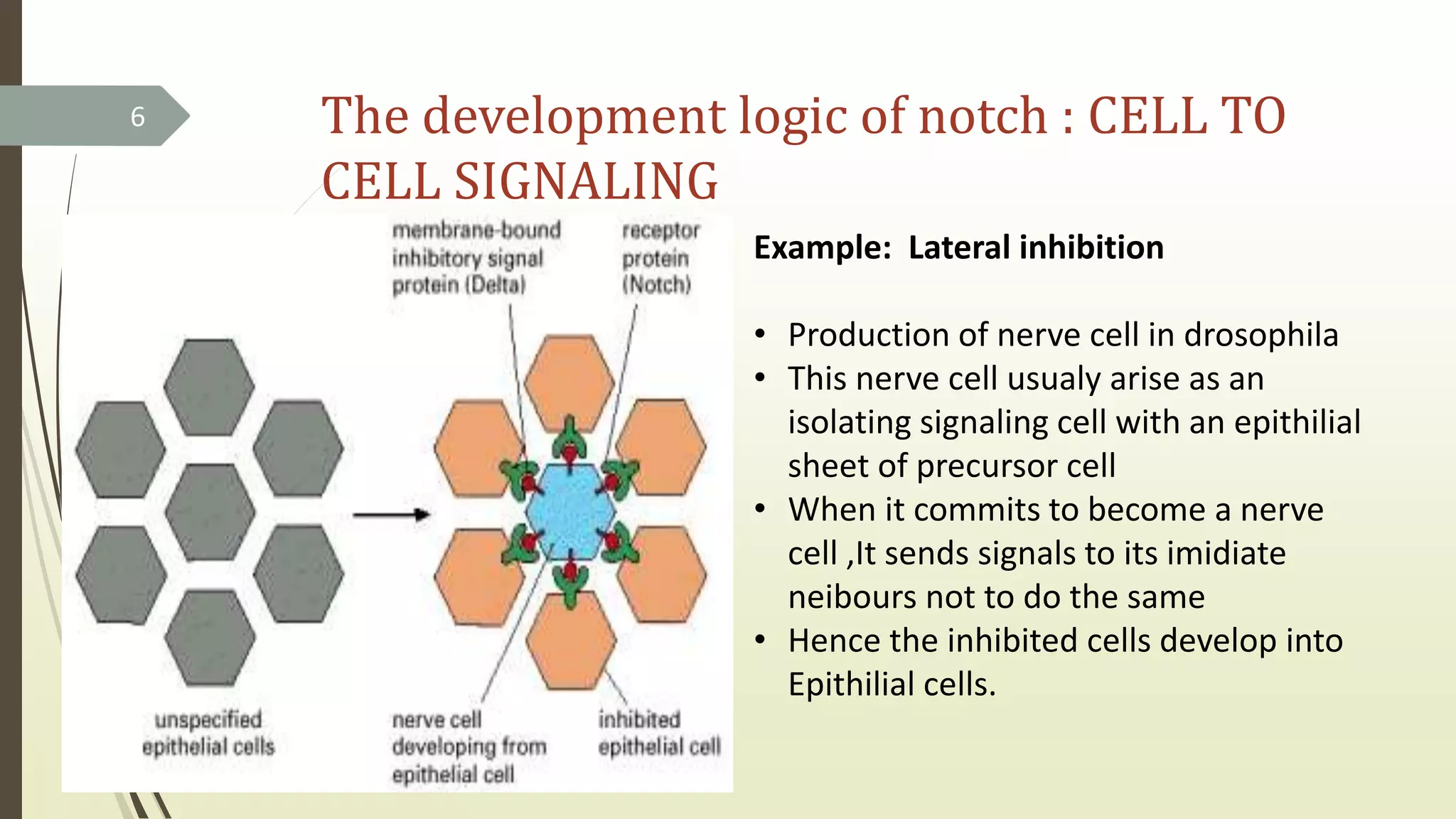
Example: Lateral inhibition
• Production of nerve cell in drosophila
• This nerve cell usualy arise as an
isolating signaling cell with an epithilial
sheet of precursor cell
• When it commits to become a nerve
cell ,It sends signals to its imidiate
neibours not to do the same
• Hence the inhibited cells develop into
Epithilial cells.
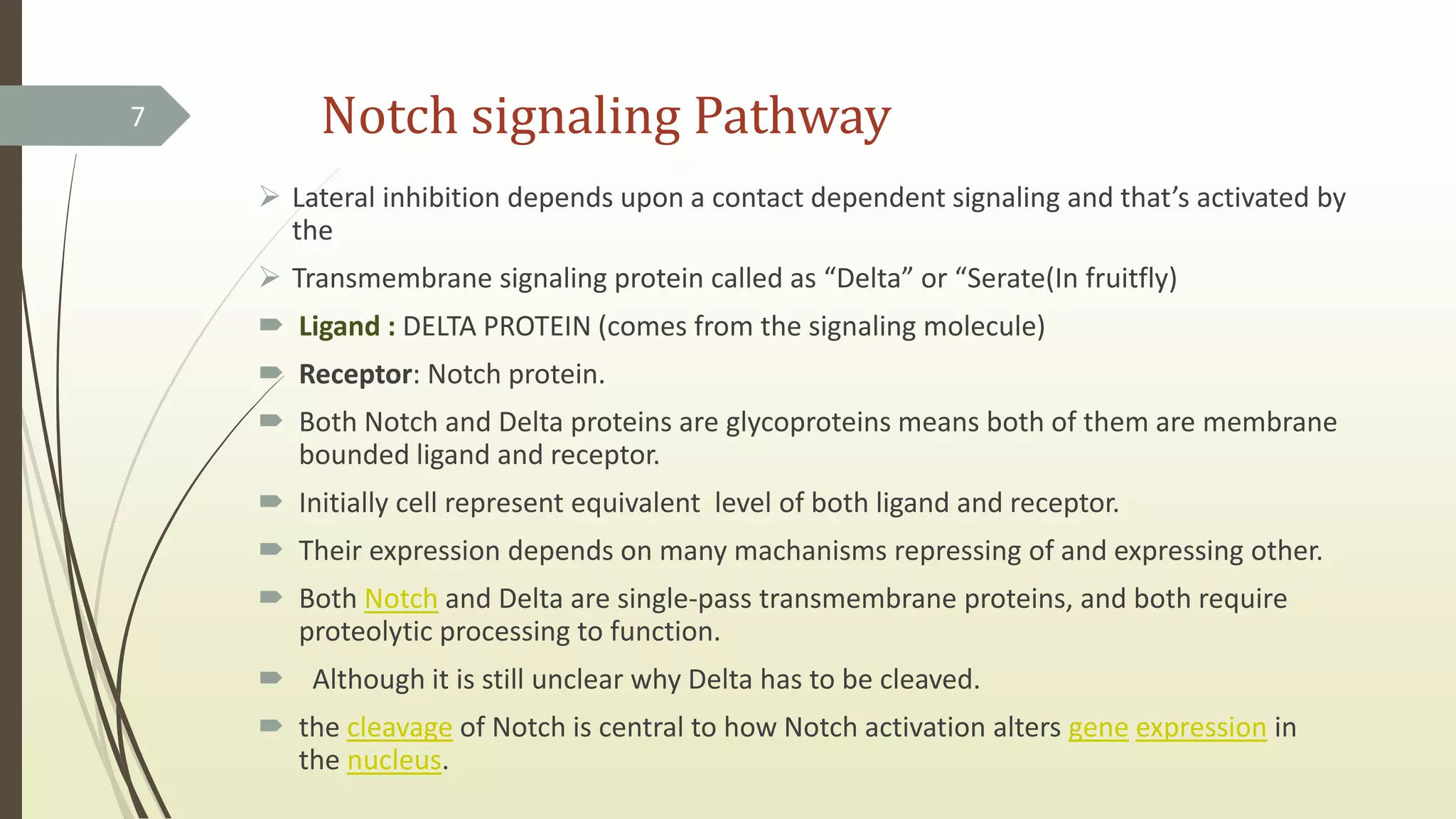
Notch signaling Pathway
 Lateral inhibition depends upon a contact dependent signaling and that’s activated by
the
 Transmembrane signaling protein called as “Delta” or “Serate(In fruitfly)
 Ligand : DELTA PROTEIN (comes from the signaling molecule)
 Receptor: Notch protein.
 Both Notch and Delta proteins are glycoproteins means both of them are membrane
bounded ligand and receptor.
 Initially cell represent equivalent level of both ligand and receptor.
 Their expression depends on many machanisms repressing of and expressing other.
 Both Notch and Delta are single-pass transmembrane proteins, and both require
proteolytic processing to function.
 Although it is still unclear why Delta has to be cleaved.
 the cleavage of Notch is central to how Notch activation alters gene expression in
the nucleus.
7
8
The cleavage of notch receptor and
signaling
 Notch gene encodes a receptor within a sigle transmembrane domain.
 Initially notch is synthsized as a single protein.
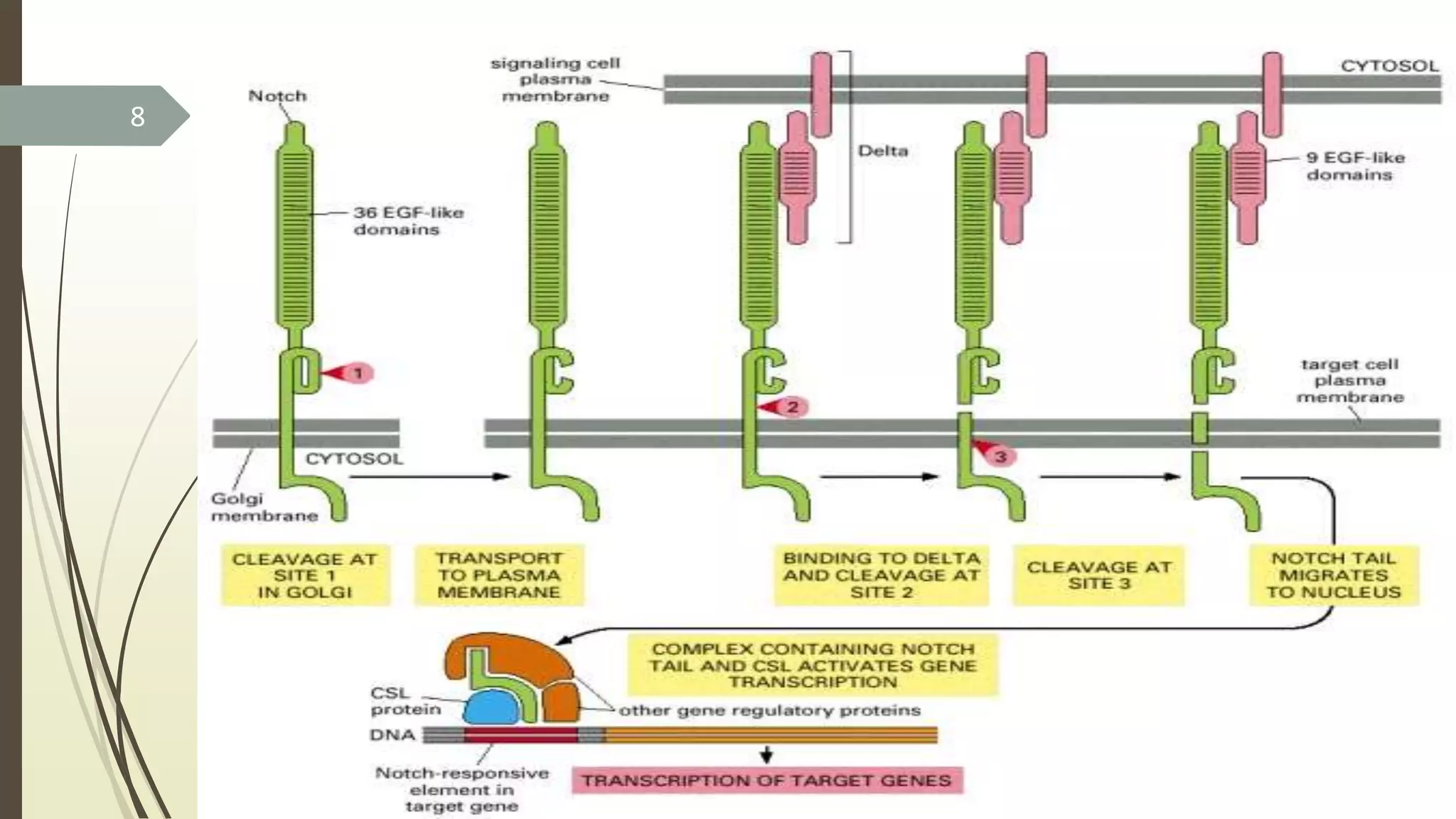
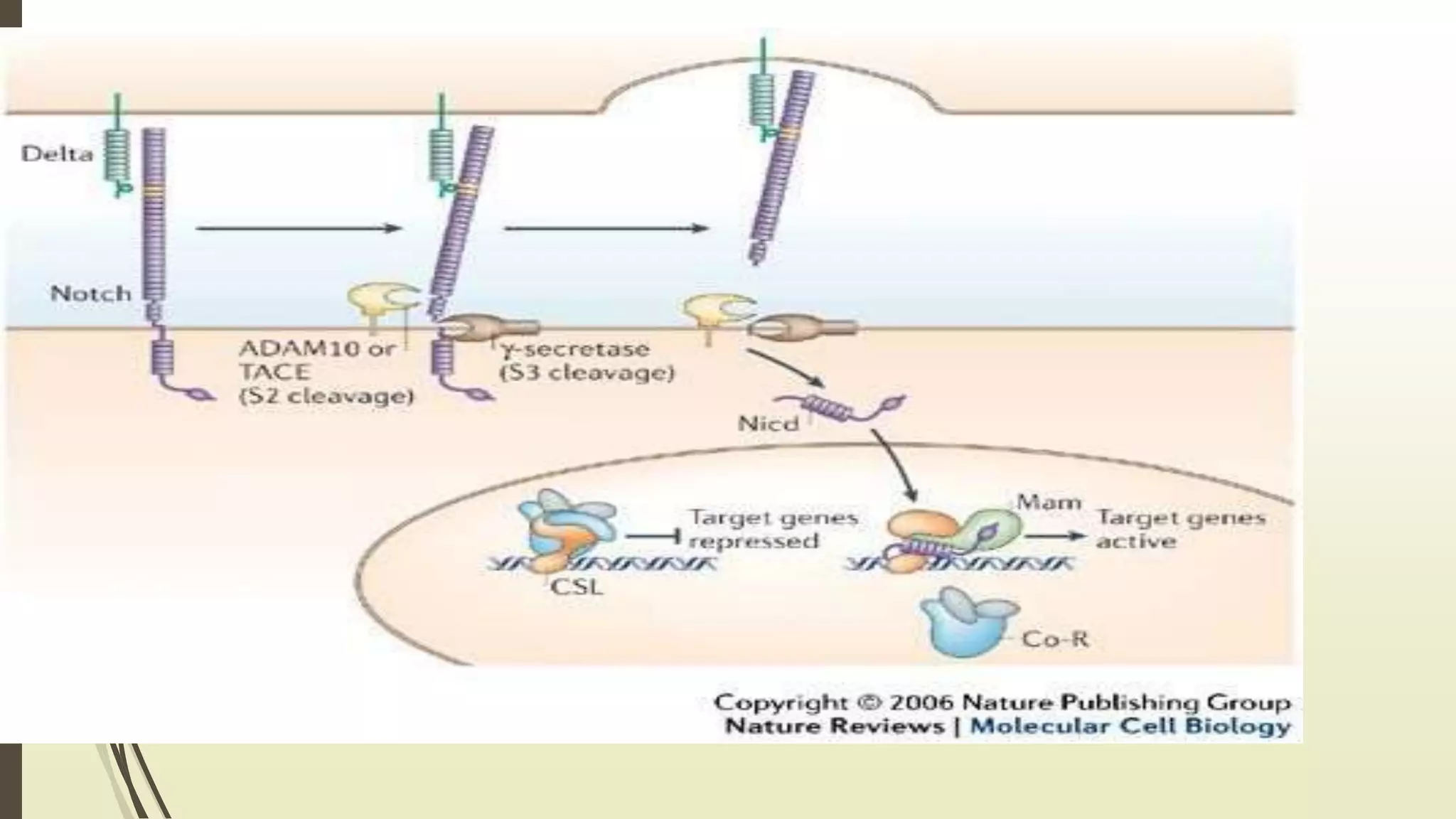
 The Notch receptor undergoes three proteolytic cleavages.
1_The cleavage of notch receptor into Golgi apparatus(S1 clevage)
 As part of its normal biosynthesis, a protease called furin acts in the Golgi
apparatus to cleave the newly synthesized Notch protein in its future
extracellular domain.
 This cleavage converts Notch into a heterodimer, which is then
transported to the cell surface as the mature receptor.
9
The cleavage of notch receptor and
signaling
 The Mature receptor now is consisting of three domains ( NECB,TM,NICD)
 Signaling starts when notch interact with the ligand
 Now this interaction further triggers two cleavages.
 Cleavage after binding to delta (S2 Clevage)
 The binding of delta to notch induces cleavage in the extra cellular
domain(NECD) mediated by an extracellular protease.
 Final Cleavage (S3 Clevage)
 Final cleavage quicly follows cutting free the cytoplasmic tail of activated
receptor.
 The cleavage of the Notch tail occurs very close to the plasma membrane,
just within the transmembrane segment,By Secretase.
10
Translocation of the Nucleus
 The free intracellular fragment then gets translocated to the
nucleus
 Where it binds to the transcription regulator (CSL) ,resulting in the
displacement of co repressor previously bound to CSL.
 Co-Activator then induces the expression related proteins.
11
12
Notch pathway and Disorders
 There are different types of Notch receptors
 Notch1, Notch2, Notch3, Notch4
 Many kind of mutation, stress,
 Somatic mutations in certain Notch pathway genes are increasingly
being shown to contribute to various cancerous conditions.
 Shizopherenia
 Algile
 Casdail
 Brain tumors
13
14

Notch signaling pathway

  • 1.
    Notch signaling Pathway Andassociated Syndromes/disorders Signaling Pathways That Depend on Regulated Proteolysis
  • 2.
    Signaling Pathways ThatDepend on Regulated Proteolysis The need for intercellular signaling is never greater than during animal development.  Each cell in the embryo has to be guided along one developmental pathway or another according to its history, its position, and the character of its neighbors. At each step in the pathway, it must exchange signals with its neighbors to coordinate its behavior with theirs. Ensuring the coordination which leads to the correct number on a tissue and organ. 2
  • 3.
     Most ofthe signaling pathways already discussed are widely used for these purposes.  But there are also others that relay signals in other ways from cell-surface receptors to the interior of the cell.  These additional signaling pathways all depend, in part at least, on regulated proteolysis.  Following are the pathways that are dependent on regulated proteolysis  the pathway activated by secreted Wnt proteins  the pathway activated by secreted Hedgehog proteins  the pathway mediated by the receptor protein Notch  the pathway that depends on activation of the latent gene regulatory protein NF-κB.  Most of these pathways were discovered in drosophila  Highly conserved in Evolution  Used over and over again during development  Have crucial role in many developmental processes 3
  • 4.
    Signaling through Notchreceptor pathway HISTORY  Signalling through notch receptor pathway may be the most widely used signaling pathway in animal development. • Notch protein discovered in Fruit fly by 1917 by T.H Morgan. • Involved in epithelial differentiation and proliferation • Also involved in human development • D F pulson 1985 was first one to link genes with development • Spyros Artavanis-Tsakonas worked on drosophila and discovered this pathway • Phenotype of notch became more important 4
  • 5.
    Involved in5 • Multipletissues • Multiple development process • Differentiation • Proliferation • Movement • Apoptosis • Cell fate choices
  • 6.
    The development logicof notch : CELL TO CELL SIGNALING 6 Example: Lateral inhibition • Production of nerve cell in drosophila • This nerve cell usualy arise as an isolating signaling cell with an epithilial sheet of precursor cell • When it commits to become a nerve cell ,It sends signals to its imidiate neibours not to do the same • Hence the inhibited cells develop into Epithilial cells.
  • 7.
    Notch signaling Pathway Lateral inhibition depends upon a contact dependent signaling and that’s activated by the  Transmembrane signaling protein called as “Delta” or “Serate(In fruitfly)  Ligand : DELTA PROTEIN (comes from the signaling molecule)  Receptor: Notch protein.  Both Notch and Delta proteins are glycoproteins means both of them are membrane bounded ligand and receptor.  Initially cell represent equivalent level of both ligand and receptor.  Their expression depends on many machanisms repressing of and expressing other.  Both Notch and Delta are single-pass transmembrane proteins, and both require proteolytic processing to function.  Although it is still unclear why Delta has to be cleaved.  the cleavage of Notch is central to how Notch activation alters gene expression in the nucleus. 7
  • 8.
  • 9.
    The cleavage ofnotch receptor and signaling  Notch gene encodes a receptor within a sigle transmembrane domain.  Initially notch is synthsized as a single protein.  The Notch receptor undergoes three proteolytic cleavages. 1_The cleavage of notch receptor into Golgi apparatus(S1 clevage)  As part of its normal biosynthesis, a protease called furin acts in the Golgi apparatus to cleave the newly synthesized Notch protein in its future extracellular domain.  This cleavage converts Notch into a heterodimer, which is then transported to the cell surface as the mature receptor. 9
  • 10.
    The cleavage ofnotch receptor and signaling  The Mature receptor now is consisting of three domains ( NECB,TM,NICD)  Signaling starts when notch interact with the ligand  Now this interaction further triggers two cleavages.  Cleavage after binding to delta (S2 Clevage)  The binding of delta to notch induces cleavage in the extra cellular domain(NECD) mediated by an extracellular protease.  Final Cleavage (S3 Clevage)  Final cleavage quicly follows cutting free the cytoplasmic tail of activated receptor.  The cleavage of the Notch tail occurs very close to the plasma membrane, just within the transmembrane segment,By Secretase. 10
  • 11.
    Translocation of theNucleus  The free intracellular fragment then gets translocated to the nucleus  Where it binds to the transcription regulator (CSL) ,resulting in the displacement of co repressor previously bound to CSL.  Co-Activator then induces the expression related proteins. 11
  • 12.
  • 13.
    Notch pathway andDisorders  There are different types of Notch receptors  Notch1, Notch2, Notch3, Notch4  Many kind of mutation, stress,  Somatic mutations in certain Notch pathway genes are increasingly being shown to contribute to various cancerous conditions.  Shizopherenia  Algile  Casdail  Brain tumors 13
  • 14.