UBIQUITINATION
Ubiquitination : An enzymatic Post Transitional Modification
(PTM) in that Ubiquitin protein is attached to a substrate
protein
Definitions
Monoubiquitination: The addition of a single ubiquitin molecule to one substrate
protein residue.
Polyubiquitination: Refers to the formation of a ubiquitin chain on a single lysine
residue on the substrate, further ubiquitin molecules are added to the first
ubiquitin molecule
Ubiquitination affects proteins in many ways including…
 Marking them for degradation via the proteasome
 Altering cellular location
 Can also promote or prevent protein interactions
Points to note on the Ubiquitin protein
• A small regulatory protein of molecular mass of 8.6 Kda
• Exists ubiquitously in most tissues of eukaryotic organisms
• In addition to being small ubiquitin is made up of 76 Amino Acids
• During ubiquitination, the glycine residue on the carboxyl end of the
ubiquitin molecule is attached to the lysine residue of the target
protein thus the formation of an isopeptide bond
• The formation of the isopeptide bond is dependent on the hydrolysis
of an ATP molecule
STEPS OF UBIQUITINATION
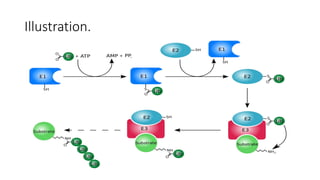
1. ACTIVATION
• The activation step is catalyzed by Ubiquitin activating enzymes(E1)
upon ATP hydrolysis
• During the activation the ubiquitin molecule carboxyl glycine residue
is linked to the E2 enzyme cysteine residue via a thio-ester bond
(cysteine residue being the active site of the enzyme)
• Finally the step gives off a pyrophosphate (PPi) as a bi-product
GENES RESPONSIBLE FOR UBIQUITINATION
Genes activating ubiquitin)
• UBA1 (Ubiquitin like Modifier Activating Enzyme )– Provides instructions
for making E1
• UBA 6
Genes Encoding ubiquitin
• UBB (Ubiquitin B )
• UBC (Ubiquitin C )
• UBA52
• RPS27A (Ribosomal Protein S27a)
2.CONJUGATION
• This step is catalyzed by Ubiquitin Conjugating Enzyme (E2)
• The E2 enzyme catalyzes the transfer of Ubiquitin from E1 to the
reactive cysteine site of E2 via a thio-esterification reaction
• The E2 enzyme binds both the activated Ubiquitin and the E1 enzyme.
3.LIGATION
• Catalyzed by ubiquitin ligases (E3)
• This enzyme shuttles the ubiquitin to the target protein thus the substrate
recognition Module of the system
• It’s the enzyme that catalyzes the formation of an isopeptide bond
between the lysine of the target protein and the c-terminal glycine residue
of Ubiquitin Protein
• The substrate recognition module interacts with both E2 and the substrate
for the ubiquitin transfer
• Once the complex has been made E3 detaches releasing the Ubiquitin-
substrate protein complex and the E2 enzyme
• E4 enzymes (Ubiquitin Chain Elongation Factors ) are capable of adding
preformed polyubiquitin chains to substrate proteins
POINT TO NOTE
• Degradation of the targeted protein does not happen until there’s at
least 4 ubiquitin molecules attached to the target protein
• Its then that the proteasome complex comes in to degrade the
protein into its constituent amino acids.
Illustration.
Functions of Ubiquitination
Functions in cell signaling and immune response
 Ubiquitination signal regulates activation of IKB-α in the inflammatory
signaling pathway
 Where degradation of IKB-α results in the release of NFKB to the nucleus to
cause an inflammatory response
Functioning in protein processing and DNA repair
 Polyubiquitinization is recognizable as a processing signal rather than a
degradation through the recruitment of BRCA1 to the damaged site. BRCA1
is crucial for cell survival since it has a role in repair of double stranded
DNA breaks
 Mutations of BRCA1 can lead to ovarian and breast cancers
Functions continued
Genomic Maintenance
• Proliferating Cell Nuclear Antigen (PCNA) is a protein involved in DNA
synthesis. Under normal physiological conditions PCNA is
SUMOylated (A post transitional Modification similar Ubiquitination)
• When DNA is damaged by ultra violent radiation/chemicals, the
SUMO (Small Ubiquitin Like Modifier )that’s attached to the lysine
residue is replaced by Ubiquitin
• Monoubiquitinated PCNA recruits polymerase that can carry out DNA
synthesis with damaged DNA though, very prone to error as it can
also result into the synthesis of mutated DNA
Other Functions
• Antigen Processing
• Cell cycle and division
• DNA transcription and repair
• Biogenesis of organelles
• Differentiation and Development
DISEASES ASOCIATED TO UBIQUITINATIO
Neurodegeneration
• Ubiquitin is implicated in neurodegenerative disease associated with
proteostasis dysfunction including Alzheimer's disease, Hunington’s
Disease, and Parkinson's Disease
• A frameshift mutation in Ubiquitin B can result into a truncated peptide
missing the c-terminal glycine
• Transcript variants encoding different isoforms of Ubiquitin 1 are found in
lesions associated with Hunington’s disease and Parkinson’s disease
• Low levels of Ubiquitin 1 in the brain have associated with increased
malformation of Amyloid Precursor Protein (AMP)
• AMP is an integral protein many tissues especially nervous tissue acting as
a receptor and also regulating synapse formation, Antimicrobial ctivity and
renal plasticity
Cont`d
Infection and Immunity
 Ubiquitin and Ubiquitin like molecules extensively regulate immune
cell transduction pathways at virtually all stages. Without this
regulation immune activation would be defective resulting in chronic
disease or death
 Alternatively the immune system may become hyperactivated and
organs and tissues may be subjected to Autoimmune damage
 On the other hand viruses must block or redirect cellular process
including ubiquitination alongside immunity in order for them to
effectively replicate causing infection
UBIQUITINATION LINK TO CANCER
• Ubiquitin regulates cellular levels of cyclins and hence mis-regulation
can lead to cancer via uncontrolled cell cycles'
• Direct loss of function mutation of E3 ubiquitin ligase can lead to
renal cell carcinoma, breast cancer.
• Decreased Ubiquitination can lead to colorectal cancer that’s mis-
regulation of the APC pathway
• Von Hippel Lindow disease results due to lose of function mutation in
the VHL tumor suppressor results in hemangioblastoma formation in
multiple organs, renal cells, carcinoma and pheomocytoma
References..
• Robbins and Cotran Pathologic Basis of Disease 9th Edition
• https://en.m.Wikipedia.org/wiki/Ubiquitin#/editor22
• https://www.ncni.nlm.nihgov/books/NBK556052/#:~:text=ubiquitinat
ion%20form%20of,%2Dprtein%2oligase%20(E3)

12.UBIQUITINATION.pptx

  • 1.
    UBIQUITINATION Ubiquitination : Anenzymatic Post Transitional Modification (PTM) in that Ubiquitin protein is attached to a substrate protein
  • 2.
    Definitions Monoubiquitination: The additionof a single ubiquitin molecule to one substrate protein residue. Polyubiquitination: Refers to the formation of a ubiquitin chain on a single lysine residue on the substrate, further ubiquitin molecules are added to the first ubiquitin molecule Ubiquitination affects proteins in many ways including…  Marking them for degradation via the proteasome  Altering cellular location  Can also promote or prevent protein interactions
  • 3.
    Points to noteon the Ubiquitin protein • A small regulatory protein of molecular mass of 8.6 Kda • Exists ubiquitously in most tissues of eukaryotic organisms • In addition to being small ubiquitin is made up of 76 Amino Acids • During ubiquitination, the glycine residue on the carboxyl end of the ubiquitin molecule is attached to the lysine residue of the target protein thus the formation of an isopeptide bond • The formation of the isopeptide bond is dependent on the hydrolysis of an ATP molecule
  • 4.
    STEPS OF UBIQUITINATION 1.ACTIVATION • The activation step is catalyzed by Ubiquitin activating enzymes(E1) upon ATP hydrolysis • During the activation the ubiquitin molecule carboxyl glycine residue is linked to the E2 enzyme cysteine residue via a thio-ester bond (cysteine residue being the active site of the enzyme) • Finally the step gives off a pyrophosphate (PPi) as a bi-product
  • 5.
    GENES RESPONSIBLE FORUBIQUITINATION Genes activating ubiquitin) • UBA1 (Ubiquitin like Modifier Activating Enzyme )– Provides instructions for making E1 • UBA 6 Genes Encoding ubiquitin • UBB (Ubiquitin B ) • UBC (Ubiquitin C ) • UBA52 • RPS27A (Ribosomal Protein S27a)
  • 6.
    2.CONJUGATION • This stepis catalyzed by Ubiquitin Conjugating Enzyme (E2) • The E2 enzyme catalyzes the transfer of Ubiquitin from E1 to the reactive cysteine site of E2 via a thio-esterification reaction • The E2 enzyme binds both the activated Ubiquitin and the E1 enzyme.
  • 7.
    3.LIGATION • Catalyzed byubiquitin ligases (E3) • This enzyme shuttles the ubiquitin to the target protein thus the substrate recognition Module of the system • It’s the enzyme that catalyzes the formation of an isopeptide bond between the lysine of the target protein and the c-terminal glycine residue of Ubiquitin Protein • The substrate recognition module interacts with both E2 and the substrate for the ubiquitin transfer • Once the complex has been made E3 detaches releasing the Ubiquitin- substrate protein complex and the E2 enzyme • E4 enzymes (Ubiquitin Chain Elongation Factors ) are capable of adding preformed polyubiquitin chains to substrate proteins
  • 8.
    POINT TO NOTE •Degradation of the targeted protein does not happen until there’s at least 4 ubiquitin molecules attached to the target protein • Its then that the proteasome complex comes in to degrade the protein into its constituent amino acids.
  • 9.
  • 10.
    Functions of Ubiquitination Functionsin cell signaling and immune response  Ubiquitination signal regulates activation of IKB-α in the inflammatory signaling pathway  Where degradation of IKB-α results in the release of NFKB to the nucleus to cause an inflammatory response Functioning in protein processing and DNA repair  Polyubiquitinization is recognizable as a processing signal rather than a degradation through the recruitment of BRCA1 to the damaged site. BRCA1 is crucial for cell survival since it has a role in repair of double stranded DNA breaks  Mutations of BRCA1 can lead to ovarian and breast cancers
  • 11.
    Functions continued Genomic Maintenance •Proliferating Cell Nuclear Antigen (PCNA) is a protein involved in DNA synthesis. Under normal physiological conditions PCNA is SUMOylated (A post transitional Modification similar Ubiquitination) • When DNA is damaged by ultra violent radiation/chemicals, the SUMO (Small Ubiquitin Like Modifier )that’s attached to the lysine residue is replaced by Ubiquitin • Monoubiquitinated PCNA recruits polymerase that can carry out DNA synthesis with damaged DNA though, very prone to error as it can also result into the synthesis of mutated DNA
  • 12.
    Other Functions • AntigenProcessing • Cell cycle and division • DNA transcription and repair • Biogenesis of organelles • Differentiation and Development
  • 13.
    DISEASES ASOCIATED TOUBIQUITINATIO Neurodegeneration • Ubiquitin is implicated in neurodegenerative disease associated with proteostasis dysfunction including Alzheimer's disease, Hunington’s Disease, and Parkinson's Disease • A frameshift mutation in Ubiquitin B can result into a truncated peptide missing the c-terminal glycine • Transcript variants encoding different isoforms of Ubiquitin 1 are found in lesions associated with Hunington’s disease and Parkinson’s disease • Low levels of Ubiquitin 1 in the brain have associated with increased malformation of Amyloid Precursor Protein (AMP) • AMP is an integral protein many tissues especially nervous tissue acting as a receptor and also regulating synapse formation, Antimicrobial ctivity and renal plasticity
  • 14.
    Cont`d Infection and Immunity Ubiquitin and Ubiquitin like molecules extensively regulate immune cell transduction pathways at virtually all stages. Without this regulation immune activation would be defective resulting in chronic disease or death  Alternatively the immune system may become hyperactivated and organs and tissues may be subjected to Autoimmune damage  On the other hand viruses must block or redirect cellular process including ubiquitination alongside immunity in order for them to effectively replicate causing infection
  • 15.
    UBIQUITINATION LINK TOCANCER • Ubiquitin regulates cellular levels of cyclins and hence mis-regulation can lead to cancer via uncontrolled cell cycles' • Direct loss of function mutation of E3 ubiquitin ligase can lead to renal cell carcinoma, breast cancer. • Decreased Ubiquitination can lead to colorectal cancer that’s mis- regulation of the APC pathway • Von Hippel Lindow disease results due to lose of function mutation in the VHL tumor suppressor results in hemangioblastoma formation in multiple organs, renal cells, carcinoma and pheomocytoma
  • 16.
    References.. • Robbins andCotran Pathologic Basis of Disease 9th Edition • https://en.m.Wikipedia.org/wiki/Ubiquitin#/editor22 • https://www.ncni.nlm.nihgov/books/NBK556052/#:~:text=ubiquitinat ion%20form%20of,%2Dprtein%2oligase%20(E3)