Hardness and Water Softening
Hardness
• Hardness: multivalent metal ions (di or multivalent cations) that
form precipitates with soaps
• Based on the hardness waters are classified as
– Soft water (0-70 mg/L),
– Moderately hard water (70-150 mg/L),
– Hard water (>150 mg/L) – water with hardness >300 is often known as
very hard water
• Cations causing hardness: Ca2+, Mg2+, Sr2+, Fe2+, Mn2+, Al
• Hardness is associated with: HCO3
-, SO4
2-, Cl-, NO3
-, SiO3
2- , PO4
3-
• Hardness categories
– Calcium Hardness (Ca2+H), Magnesium Hardness (Mg2+) and Total
Hardness (TH) based on the responsible cations
• Mg2+ H = T H - Ca2+ H
– Carbonate Hardness (CH) and Non-carbonate Hardness (NCH) based
on the associated anions
• CH is also known as temporary hardness (bicarbonates) and it can
be removed by boiling and by lime (CaO or Ca(OH)2)
• NCH (also known as permanent hardness) is associated with SO4
2-
and Cl-- can be removed by soda ash &lime –unaffected by boiling
Hardness
• If Alkalinity < TH, then CH = Alkalinity
– If Alkalinity ≥ TH, then CH = TH
– NCH = TH – Total Alkalinity
– Sodium Alkalinity = Total Alkalinity – Total Hardness (TH)
• Method used for hardness measurement: EDTA (Ethylene-diamine-
tetra-acetic acid) method
– Eriochrome Black T is indicator – forms complex with free EDTA and
change colour from red to blue
– Boiling off and filtering removes temporary hardness and permanent
hardness can be used
– Calcium hardness is also measured by EDTA method but after
precipitating the Mg at 13 pH and using different indicator (calcon)
– Hardness is expressed in mg/L as CaCO3 and at times in meq/L
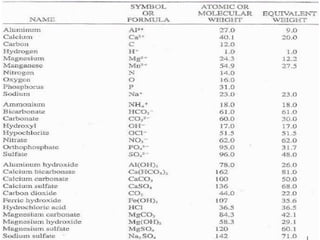
• Concentrations in mg/L can be converted into meq/L by dividing
with equivalent weight of the species
– X mg/L of Ca2+ = X/20 meq/L of Ca2+ (20 is equi. wgt. of Ca2+)
– X mg/L of Mg2+ = X/12.2 meq/L of Mg2+ (12.2 is equi. wgt. of Mg2+)
– X mg/L of TH as CaCO3 = X/50 meq/L of TH (50 is equi. wgt. of CaCO3)
– X mg/L of CO2 = X/22 meq of CO2 (22 is equi. wgt. of CO2)
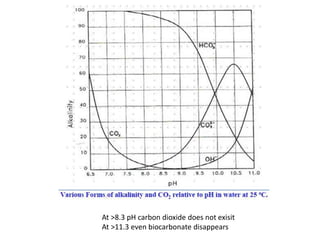
At >8.3 pH carbon dioxide does not exisit
At >11.3 even biocarbonate disappears
Measurement of Calcium hardness
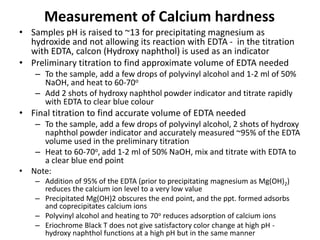
• Samples pH is raised to ~13 for precipitating magnesium as
hydroxide and not allowing its reaction with EDTA - in the titration
with EDTA, calcon (Hydroxy naphthol) is used as an indicator
• Preliminary titration to find approximate volume of EDTA needed
– To the sample, add a few drops of polyvinyl alcohol and 1-2 ml of 50%
NaOH, and heat to 60-70o
– Add 2 shots of hydroxy naphthol powder indicator and titrate rapidly
with EDTA to clear blue colour
• Final titration to find accurate volume of EDTA needed
– To the sample, add a few drops of polyvinyl alcohol, 2 shots of hydroxy
naphthol powder indicator and accurately measured ~95% of the EDTA
volume used in the preliminary titration
– Heat to 60-70o, add 1-2 ml of 50% NaOH, mix and titrate with EDTA to
a clear blue end point
• Note:
– Addition of 95% of the EDTA (prior to precipitating magnesium as Mg(OH)2)
reduces the calcium ion level to a very low value
– Precipitated Mg(OH)2 obscures the end point, and the ppt. formed adsorbs
and coprecipitates calcium ions
– Polyvinyl alcohol and heating to 70o reduces adsorption of calcium ions
– Eriochrome Black T does not give satisfactory color change at high pH -
hydroxy naphthol functions at a high pH but in the same manner
Why to soften water and by what methods?
• Hard water forms scales in water heating systems like boilers
• Forms foam/leather with soap and increase the soap consumption
• Water softening processes
– Ion-exchange process
– Lime-soda ash process
• Advantages (and disadvantages) of the lime – soda ash process
– The lime added to water in the process is totally removed.
– TDS (total dissolved solids) of the water is significantly reduced
– Lime also precipitates the soluble Fe and Mn
– Excess lime treatment can provide disinfection (through raising
the water pH!) and aid in the coagulation process
– Removal of non-carbonate hardness requires soda ash and
when soda ash is applied, Na+ remains in the finished water
• Schemes of water softening by lime-soda ash process
– Excess lime treatment
– Selective calcium removal
– Split treatment
Indices
(describing behavior of CaCO3 in water)
Langelier Saturation Index (LSI) and Ryznar Stability Index (RSI)
Langelier Saturation Index (LSI)
• A calculated number developed by Wilfred Langelier (1936)
• It predicts the CaCO3 stability of water (whether the carbonate will
precipitate, dissolve, or remain in equilibrium) and stated as
LSI = pH - pHs
• pHs (the pH at which water is saturated in CaCO3) is calculated by
pHs = (9.3 + A + B) - (C + D)
A = (Log10[TDS] - 1)/10
B = -13.12 x Log10(oC + 273) + 34.55 – (2.09 at 25°C)
C = Log10[Ca2+ as CaCO3] - 0.4 - - (2.5(Ca2+)
D = Log10[alkalinity as CaCO3]
• LSI is temp. sensitive (increasing temp. increases the LSI value)
Indices
(describing behavior of CaCO3 in water)
• Water with an LSI between -0.5 and +0.5 will not display any
mineral dissolving or scale forming properties
– LSI > 0 indicates super-saturation of water with CaCO3 and tendency of
precipitation of CaCO3 scale layer - LSI < 0 indicates under-saturated
and dissolution of solid CaCO3
Ryznar Stability Index (RSI)
• Developed from empirical observations of corrosion rates and film
formation in steel mains
• Defines as RSI = 2 pHs – pH (measured)
• RSI between 6.5 and 7.0 indicates that the water is at saturation
equilibrium with calcium carbonate
– RSI > 8 indicates water is under saturated and tends to dissolve any
existing solid CaCO3
– RSI < 6.5 indicates super-saturation of water with CaCO3 and tendency
to form CaCO3 scale
Example: find LSI and RSI for the water with pH = 7.5; TDS = 320
mg/L; Calcium = 150 mg/L (or ppm) as CaCO3; Alkalinity = 34
mg/L (or ppm) as CaCO3
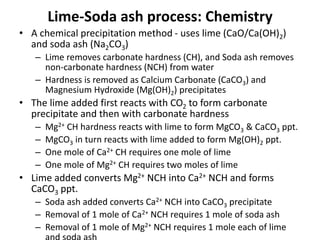
Lime-Soda ash process: Chemistry
• A chemical precipitation method - uses lime (CaO/Ca(OH)2)
and soda ash (Na2CO3)
– Lime removes carbonate hardness (CH), and Soda ash removes
non-carbonate hardness (NCH) from water
– Hardness is removed as Calcium Carbonate (CaCO3) and
Magnesium Hydroxide (Mg(OH)2) precipitates
• The lime added first reacts with CO2 to form carbonate
precipitate and then with carbonate hardness
– Mg2+ CH hardness reacts with lime to form MgCO3 & CaCO3 ppt.
– MgCO3 in turn reacts with lime added to form Mg(OH)2 ppt.
– One mole of Ca2+ CH requires one mole of lime
– One mole of Mg2+ CH requires two moles of lime
• Lime added converts Mg2+ NCH into Ca2+ NCH and forms
CaCO3 ppt.
– Soda ash added converts Ca2+ NCH into CaCO3 precipitate
– Removal of 1 mole of Ca2+ NCH requires 1 mole of soda ash
– Removal of 1 mole of Mg2+ NCH requires 1 mole each of lime
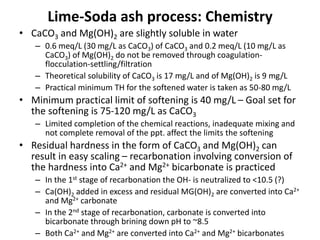
Lime-Soda ash process: Chemistry
• CaCO3 and Mg(OH)2 are slightly soluble in water
– 0.6 meq/L (30 mg/L as CaCO3) of CaCO3 and 0.2 meq/L (10 mg/L as
CaCO3) of Mg(OH)2 do not be removed through coagulation-
flocculation-settling/filtration
– Theoretical solubility of CaCO3 is 17 mg/L and of Mg(OH)2 is 9 mg/L
– Practical minimum TH for the softened water is taken as 50-80 mg/L
• Minimum practical limit of softening is 40 mg/L – Goal set for
the softening is 75-120 mg/L as CaCO3
– Limited completion of the chemical reactions, inadequate mixing and
not complete removal of the ppt. affect the limits the softening
• Residual hardness in the form of CaCO3 and Mg(OH)2 can
result in easy scaling – recarbonation involving conversion of
the hardness into Ca2+ and Mg2+ bicarbonate is practiced
– In the 1st stage of recarbonation the OH- is neutralized to <10.5 (?)
– Ca(OH)2 added in excess and residual MG(OH)2 are converted into Ca2+
and Mg2+ carbonate
– In the 2nd stage of recarbonation, carbonate is converted into
bicarbonate through brining down pH to ~8.5
– Both Ca2+ and Mg2+ are converted into Ca2+ and Mg2+ bicarbonates
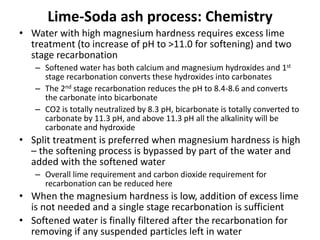
Lime-Soda ash process: Chemistry
• Water with high magnesium hardness requires excess lime
treatment (to increase of pH to >11.0 for softening) and two
stage recarbonation
– Softened water has both calcium and magnesium hydroxides and 1st
stage recarbonation converts these hydroxides into carbonates
– The 2nd stage recarbonation reduces the pH to 8.4-8.6 and converts
the carbonate into bicarbonate
– CO2 is totally neutralized by 8.3 pH, bicarbonate is totally converted to
carbonate by 11.3 pH, and above 11.3 pH all the alkalinity will be
carbonate and hydroxide
• Split treatment is preferred when magnesium hardness is high
– the softening process is bypassed by part of the water and
added with the softened water
– Overall lime requirement and carbon dioxide requirement for
recarbonation can be reduced here
• When the magnesium hardness is low, addition of excess lime
is not needed and a single stage recarbonation is sufficient
• Softened water is finally filtered after the recarbonation for
removing if any suspended particles left in water
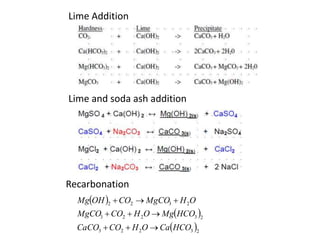
Lime Addition
Lime and soda ash addition
 
 
 23223
23223
2322
HCOCaOHCOCaCO
HCOMgOHCOMgCO
OHMgCOCOOHMg



Recarbonation
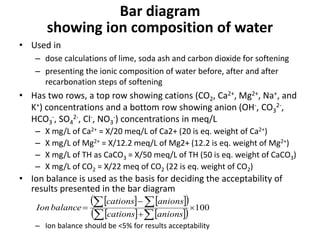
Bar diagram
showing ion composition of water
• Used in
– dose calculations of lime, soda ash and carbon dioxide for softening
– presenting the ionic composition of water before, after and after
recarbonation steps of softening
• Has two rows, a top row showing cations (CO2, Ca2+, Mg2+, Na+, and
K+) concentrations and a bottom row showing anion (OH-, CO3
2-,
HCO3
-, SO4
2-, Cl-, NO3
-) concentrations in meq/L
– X mg/L of Ca2+ = X/20 meq/L of Ca2+ (20 is eq. weight of Ca2+)
– X mg/L of Mg2+ = X/12.2 meq/L of Mg2+ (12.2 is eq. weight of Mg2+)
– X mg/L of TH as CaCO3 = X/50 meq/L of TH (50 is eq. weight of CaCO3)
– X mg/L of CO2 = X/22 meq of CO2 (22 is eq. weight of CO2)
• Ion balance is used as the basis for deciding the acceptability of
results presented in the bar diagram
– Ion balance should be <5% for results acceptability
    
     100





anionscations
anionscations
balanceIon
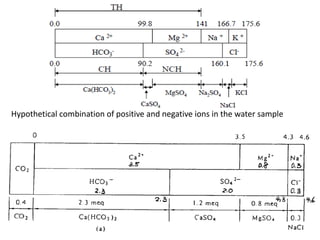
Hypothetical combination of positive and negative ions in the water sample
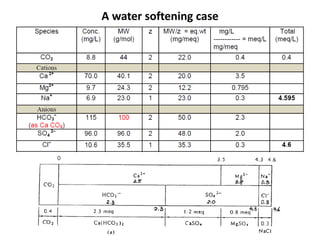
A water softening case
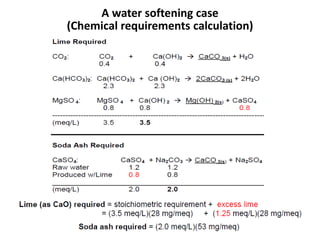
(Chemical requirements calculation)
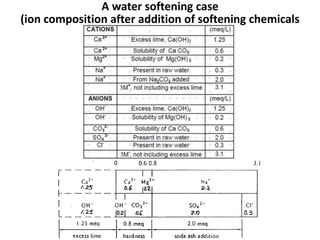
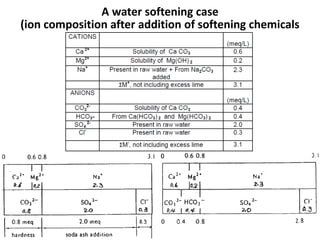
A water softening case
(ion composition after addition of softening chemicals
A water softening case
(ion composition after addition of softening chemicals
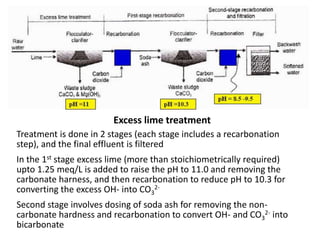
Excess lime treatment
Treatment is done in 2 stages (each stage includes a recarbonation
step), and the final effluent is filtered
In the 1st stage excess lime (more than stoichiometrically required)
upto 1.25 meq/L is added to raise the pH to 11.0 and removing the
carbonate harness, and then recarbonation to reduce pH to 10.3 for
converting the excess OH- into CO3
2-
Second stage involves dosing of soda ash for removing the non-
carbonate hardness and recarbonation to convert OH- and CO3
2- into
bicarbonate
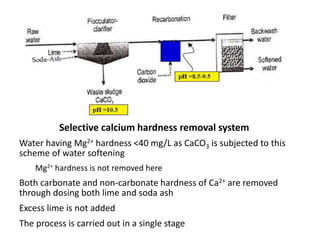
Selective calcium hardness removal system
Water having Mg2+ hardness <40 mg/L as CaCO3 is subjected to this
scheme of water softening
Mg2+ hardness is not removed here
Both carbonate and non-carbonate hardness of Ca2+ are removed
through dosing both lime and soda ash
Excess lime is not added
The process is carried out in a single stage
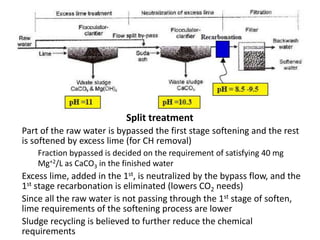
Split treatment
Part of the raw water is bypassed the first stage softening and the rest
is softened by excess lime (for CH removal)
Fraction bypassed is decided on the requirement of satisfying 40 mg
Mg+2/L as CaCO3 in the finished water
Excess lime, added in the 1st, is neutralized by the bypass flow, and the
1st stage recarbonation is eliminated (lowers CO2 needs)
Since all the raw water is not passing through the 1st stage of soften,
lime requirements of the softening process are lower
Sludge recycling is believed to further reduce the chemical
requirements

12 water softening

  • 1.
  • 2.
    Hardness • Hardness: multivalentmetal ions (di or multivalent cations) that form precipitates with soaps • Based on the hardness waters are classified as – Soft water (0-70 mg/L), – Moderately hard water (70-150 mg/L), – Hard water (>150 mg/L) – water with hardness >300 is often known as very hard water • Cations causing hardness: Ca2+, Mg2+, Sr2+, Fe2+, Mn2+, Al • Hardness is associated with: HCO3 -, SO4 2-, Cl-, NO3 -, SiO3 2- , PO4 3- • Hardness categories – Calcium Hardness (Ca2+H), Magnesium Hardness (Mg2+) and Total Hardness (TH) based on the responsible cations • Mg2+ H = T H - Ca2+ H – Carbonate Hardness (CH) and Non-carbonate Hardness (NCH) based on the associated anions • CH is also known as temporary hardness (bicarbonates) and it can be removed by boiling and by lime (CaO or Ca(OH)2) • NCH (also known as permanent hardness) is associated with SO4 2- and Cl-- can be removed by soda ash &lime –unaffected by boiling
  • 3.
    Hardness • If Alkalinity< TH, then CH = Alkalinity – If Alkalinity ≥ TH, then CH = TH – NCH = TH – Total Alkalinity – Sodium Alkalinity = Total Alkalinity – Total Hardness (TH) • Method used for hardness measurement: EDTA (Ethylene-diamine- tetra-acetic acid) method – Eriochrome Black T is indicator – forms complex with free EDTA and change colour from red to blue – Boiling off and filtering removes temporary hardness and permanent hardness can be used – Calcium hardness is also measured by EDTA method but after precipitating the Mg at 13 pH and using different indicator (calcon) – Hardness is expressed in mg/L as CaCO3 and at times in meq/L • Concentrations in mg/L can be converted into meq/L by dividing with equivalent weight of the species – X mg/L of Ca2+ = X/20 meq/L of Ca2+ (20 is equi. wgt. of Ca2+) – X mg/L of Mg2+ = X/12.2 meq/L of Mg2+ (12.2 is equi. wgt. of Mg2+) – X mg/L of TH as CaCO3 = X/50 meq/L of TH (50 is equi. wgt. of CaCO3) – X mg/L of CO2 = X/22 meq of CO2 (22 is equi. wgt. of CO2)
  • 4.
    At >8.3 pHcarbon dioxide does not exisit At >11.3 even biocarbonate disappears
  • 6.
    Measurement of Calciumhardness • Samples pH is raised to ~13 for precipitating magnesium as hydroxide and not allowing its reaction with EDTA - in the titration with EDTA, calcon (Hydroxy naphthol) is used as an indicator • Preliminary titration to find approximate volume of EDTA needed – To the sample, add a few drops of polyvinyl alcohol and 1-2 ml of 50% NaOH, and heat to 60-70o – Add 2 shots of hydroxy naphthol powder indicator and titrate rapidly with EDTA to clear blue colour • Final titration to find accurate volume of EDTA needed – To the sample, add a few drops of polyvinyl alcohol, 2 shots of hydroxy naphthol powder indicator and accurately measured ~95% of the EDTA volume used in the preliminary titration – Heat to 60-70o, add 1-2 ml of 50% NaOH, mix and titrate with EDTA to a clear blue end point • Note: – Addition of 95% of the EDTA (prior to precipitating magnesium as Mg(OH)2) reduces the calcium ion level to a very low value – Precipitated Mg(OH)2 obscures the end point, and the ppt. formed adsorbs and coprecipitates calcium ions – Polyvinyl alcohol and heating to 70o reduces adsorption of calcium ions – Eriochrome Black T does not give satisfactory color change at high pH - hydroxy naphthol functions at a high pH but in the same manner
  • 7.
    Why to softenwater and by what methods? • Hard water forms scales in water heating systems like boilers • Forms foam/leather with soap and increase the soap consumption • Water softening processes – Ion-exchange process – Lime-soda ash process • Advantages (and disadvantages) of the lime – soda ash process – The lime added to water in the process is totally removed. – TDS (total dissolved solids) of the water is significantly reduced – Lime also precipitates the soluble Fe and Mn – Excess lime treatment can provide disinfection (through raising the water pH!) and aid in the coagulation process – Removal of non-carbonate hardness requires soda ash and when soda ash is applied, Na+ remains in the finished water • Schemes of water softening by lime-soda ash process – Excess lime treatment – Selective calcium removal – Split treatment
  • 8.
    Indices (describing behavior ofCaCO3 in water) Langelier Saturation Index (LSI) and Ryznar Stability Index (RSI) Langelier Saturation Index (LSI) • A calculated number developed by Wilfred Langelier (1936) • It predicts the CaCO3 stability of water (whether the carbonate will precipitate, dissolve, or remain in equilibrium) and stated as LSI = pH - pHs • pHs (the pH at which water is saturated in CaCO3) is calculated by pHs = (9.3 + A + B) - (C + D) A = (Log10[TDS] - 1)/10 B = -13.12 x Log10(oC + 273) + 34.55 – (2.09 at 25°C) C = Log10[Ca2+ as CaCO3] - 0.4 - - (2.5(Ca2+) D = Log10[alkalinity as CaCO3] • LSI is temp. sensitive (increasing temp. increases the LSI value)
  • 9.
    Indices (describing behavior ofCaCO3 in water) • Water with an LSI between -0.5 and +0.5 will not display any mineral dissolving or scale forming properties – LSI > 0 indicates super-saturation of water with CaCO3 and tendency of precipitation of CaCO3 scale layer - LSI < 0 indicates under-saturated and dissolution of solid CaCO3 Ryznar Stability Index (RSI) • Developed from empirical observations of corrosion rates and film formation in steel mains • Defines as RSI = 2 pHs – pH (measured) • RSI between 6.5 and 7.0 indicates that the water is at saturation equilibrium with calcium carbonate – RSI > 8 indicates water is under saturated and tends to dissolve any existing solid CaCO3 – RSI < 6.5 indicates super-saturation of water with CaCO3 and tendency to form CaCO3 scale Example: find LSI and RSI for the water with pH = 7.5; TDS = 320 mg/L; Calcium = 150 mg/L (or ppm) as CaCO3; Alkalinity = 34 mg/L (or ppm) as CaCO3
  • 10.
    Lime-Soda ash process:Chemistry • A chemical precipitation method - uses lime (CaO/Ca(OH)2) and soda ash (Na2CO3) – Lime removes carbonate hardness (CH), and Soda ash removes non-carbonate hardness (NCH) from water – Hardness is removed as Calcium Carbonate (CaCO3) and Magnesium Hydroxide (Mg(OH)2) precipitates • The lime added first reacts with CO2 to form carbonate precipitate and then with carbonate hardness – Mg2+ CH hardness reacts with lime to form MgCO3 & CaCO3 ppt. – MgCO3 in turn reacts with lime added to form Mg(OH)2 ppt. – One mole of Ca2+ CH requires one mole of lime – One mole of Mg2+ CH requires two moles of lime • Lime added converts Mg2+ NCH into Ca2+ NCH and forms CaCO3 ppt. – Soda ash added converts Ca2+ NCH into CaCO3 precipitate – Removal of 1 mole of Ca2+ NCH requires 1 mole of soda ash – Removal of 1 mole of Mg2+ NCH requires 1 mole each of lime
  • 11.
    Lime-Soda ash process:Chemistry • CaCO3 and Mg(OH)2 are slightly soluble in water – 0.6 meq/L (30 mg/L as CaCO3) of CaCO3 and 0.2 meq/L (10 mg/L as CaCO3) of Mg(OH)2 do not be removed through coagulation- flocculation-settling/filtration – Theoretical solubility of CaCO3 is 17 mg/L and of Mg(OH)2 is 9 mg/L – Practical minimum TH for the softened water is taken as 50-80 mg/L • Minimum practical limit of softening is 40 mg/L – Goal set for the softening is 75-120 mg/L as CaCO3 – Limited completion of the chemical reactions, inadequate mixing and not complete removal of the ppt. affect the limits the softening • Residual hardness in the form of CaCO3 and Mg(OH)2 can result in easy scaling – recarbonation involving conversion of the hardness into Ca2+ and Mg2+ bicarbonate is practiced – In the 1st stage of recarbonation the OH- is neutralized to <10.5 (?) – Ca(OH)2 added in excess and residual MG(OH)2 are converted into Ca2+ and Mg2+ carbonate – In the 2nd stage of recarbonation, carbonate is converted into bicarbonate through brining down pH to ~8.5 – Both Ca2+ and Mg2+ are converted into Ca2+ and Mg2+ bicarbonates
  • 12.
    Lime-Soda ash process:Chemistry • Water with high magnesium hardness requires excess lime treatment (to increase of pH to >11.0 for softening) and two stage recarbonation – Softened water has both calcium and magnesium hydroxides and 1st stage recarbonation converts these hydroxides into carbonates – The 2nd stage recarbonation reduces the pH to 8.4-8.6 and converts the carbonate into bicarbonate – CO2 is totally neutralized by 8.3 pH, bicarbonate is totally converted to carbonate by 11.3 pH, and above 11.3 pH all the alkalinity will be carbonate and hydroxide • Split treatment is preferred when magnesium hardness is high – the softening process is bypassed by part of the water and added with the softened water – Overall lime requirement and carbon dioxide requirement for recarbonation can be reduced here • When the magnesium hardness is low, addition of excess lime is not needed and a single stage recarbonation is sufficient • Softened water is finally filtered after the recarbonation for removing if any suspended particles left in water
  • 13.
    Lime Addition Lime andsoda ash addition      23223 23223 2322 HCOCaOHCOCaCO HCOMgOHCOMgCO OHMgCOCOOHMg    Recarbonation
  • 14.
    Bar diagram showing ioncomposition of water • Used in – dose calculations of lime, soda ash and carbon dioxide for softening – presenting the ionic composition of water before, after and after recarbonation steps of softening • Has two rows, a top row showing cations (CO2, Ca2+, Mg2+, Na+, and K+) concentrations and a bottom row showing anion (OH-, CO3 2-, HCO3 -, SO4 2-, Cl-, NO3 -) concentrations in meq/L – X mg/L of Ca2+ = X/20 meq/L of Ca2+ (20 is eq. weight of Ca2+) – X mg/L of Mg2+ = X/12.2 meq/L of Mg2+ (12.2 is eq. weight of Mg2+) – X mg/L of TH as CaCO3 = X/50 meq/L of TH (50 is eq. weight of CaCO3) – X mg/L of CO2 = X/22 meq of CO2 (22 is eq. weight of CO2) • Ion balance is used as the basis for deciding the acceptability of results presented in the bar diagram – Ion balance should be <5% for results acceptability           100      anionscations anionscations balanceIon
  • 15.
    Hypothetical combination ofpositive and negative ions in the water sample
  • 16.
  • 17.
    A water softeningcase (Chemical requirements calculation)
  • 18.
    A water softeningcase (ion composition after addition of softening chemicals
  • 19.
    A water softeningcase (ion composition after addition of softening chemicals
  • 20.
    Excess lime treatment Treatmentis done in 2 stages (each stage includes a recarbonation step), and the final effluent is filtered In the 1st stage excess lime (more than stoichiometrically required) upto 1.25 meq/L is added to raise the pH to 11.0 and removing the carbonate harness, and then recarbonation to reduce pH to 10.3 for converting the excess OH- into CO3 2- Second stage involves dosing of soda ash for removing the non- carbonate hardness and recarbonation to convert OH- and CO3 2- into bicarbonate
  • 21.
    Selective calcium hardnessremoval system Water having Mg2+ hardness <40 mg/L as CaCO3 is subjected to this scheme of water softening Mg2+ hardness is not removed here Both carbonate and non-carbonate hardness of Ca2+ are removed through dosing both lime and soda ash Excess lime is not added The process is carried out in a single stage
  • 22.
    Split treatment Part ofthe raw water is bypassed the first stage softening and the rest is softened by excess lime (for CH removal) Fraction bypassed is decided on the requirement of satisfying 40 mg Mg+2/L as CaCO3 in the finished water Excess lime, added in the 1st, is neutralized by the bypass flow, and the 1st stage recarbonation is eliminated (lowers CO2 needs) Since all the raw water is not passing through the 1st stage of soften, lime requirements of the softening process are lower Sludge recycling is believed to further reduce the chemical requirements