Topic to becovered :
➔ Water Treatment Processes
● Softening
● Coagulation and Flocculation
● Settling
● Filtration
● Disinfection
● Other Treatment Processes
➔ Distribution of Water
Certain aquifers andisolated surface waters are of exceptional quality, allowing
them to be used directly for various purposes, such as drinking, irrigation, industrial
processes, and fire control. However, such high-quality water sources are rare,
particularly in densely populated areas or regions dominated by agricultural
activities. In these cases, water requires treatment before distribution to ensure it
meets the necessary quality standards.
Water treatment plants are designed to address this need by employing a
series of reactors or unit operations. Each unit is specifically designed to perform a
unique function, and the sequence of operations is carefully planned to achieve the
desired level of water quality. These processes collectively ensure that the treated
water is safe and suitable for its intended applications, meeting the needs of
communities and industries alike.
Water Treatment
6.
Water Treatment
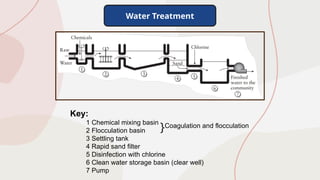
Key:
1 Chemicalmixing basin
2 Flocculation basin
3 Settling tank
4 Rapid sand filter
5 Disinfection with chlorine
6 Clean water storage basin (clear well)
7 Pump
}Coagulation and flocculation
Softening
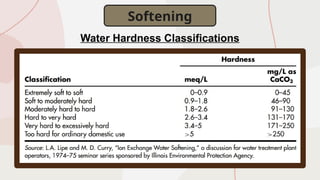
Water hardness, ameasure of the concentration of dissolved minerals (mainly
calcium, magnesium, and iron), often needs to be reduced to make water suitable
for drinking. These minerals, originating from rocks like limestone, do not pose
health risks but interfere with soap efficiency, form scale, and cause other
inconveniences.
When hardness ions interact with soap, they create soap scum, a residue that
leaves stains (e.g., bathtub rings), irritates skin by altering its pH, and dulls hair.
Similarly, in laundry, this residue stiffens clothes, dulls colors, and accelerates fabric
wear. Heat-induced precipitation of calcium carbonate forms scale, which reduces
efficiency in devices like water heaters and clogs pipes. Hard water can also impart
undesirable tastes.
9.
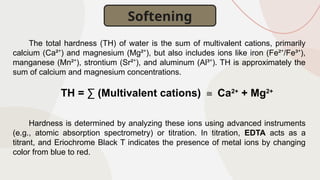
The total hardness(TH) of water is the sum of multivalent cations, primarily
calcium (Ca² ) and magnesium (Mg² ), but also includes ions like iron (Fe² /Fe³ ),
⁺ ⁺ ⁺ ⁺
manganese (Mn² ), strontium (Sr² ), and aluminum (Al³ ). TH is approximately the
⁺ ⁺ ⁺
sum of calcium and magnesium concentrations.
TH = ∑ (Multivalent cations) Ca
≅ 2+
+ Mg2+
Hardness is determined by analyzing these ions using advanced instruments
(e.g., atomic absorption spectrometry) or titration. In titration, EDTA acts as a
titrant, and Eriochrome Black T indicates the presence of metal ions by changing
color from blue to red.
Softening
10.
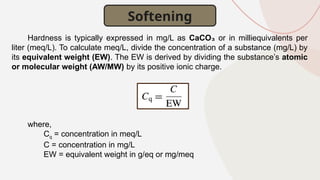
Hardness is typicallyexpressed in mg/L as CaCO₃ or in milliequivalents per
liter (meq/L). To calculate meq/L, divide the concentration of a substance (mg/L) by
its equivalent weight (EW). The EW is derived by dividing the substance’s atomic
or molecular weight (AW/MW) by its positive ionic charge.
where,
Cq = concentration in meq/L
C = concentration in mg/L
EW = equivalent weight in g/eq or mg/meq
Softening
11.
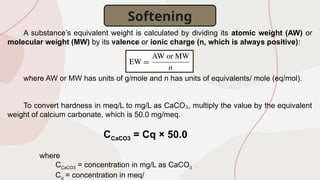
A substance’s equivalentweight is calculated by dividing its atomic weight (AW) or
molecular weight (MW) by its valence or ionic charge (n, which is always positive):
where AW or MW has units of g/mole and n has units of equivalents/ mole (eq/mol).
To convert hardness in meq/L to mg/L as CaCO , multiply the value by the equivalent
₃
weight of calcium carbonate, which is 50.0 mg/meq.
CCaCO3 = Cq × 50.0
where
CCaCO3 = concentration in mg/L as CaCO3
Cq = concentration in meq/
Softening
12.
Softening
Problem 01: Theconcentration of calcium in a water sample is 100 mg/L. What is the
concentration in (a) meq/L and (b) mg/L as CaCO3?
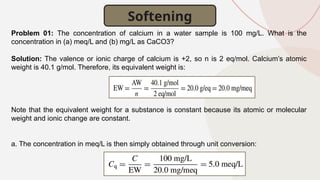
Solution: The valence or ionic charge of calcium is +2, so n is 2 eq/mol. Calcium’s atomic
weight is 40.1 g/mol. Therefore, its equivalent weight is:
Note that the equivalent weight for a substance is constant because its atomic or molecular
weight and ionic change are constant.
a. The concentration in meq/L is then simply obtained through unit conversion:
13.
Softening
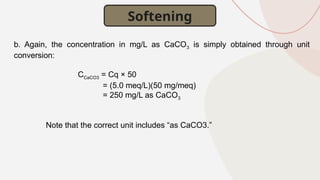
b. Again, theconcentration in mg/L as CaCO3 is simply obtained through unit
conversion:
CCaCO3 = Cq × 50
= (5.0 meq/L)(50 mg/meq)
= 250 mg/L as CaCO3
Note that the correct unit includes “as CaCO3.”
14.
Softening
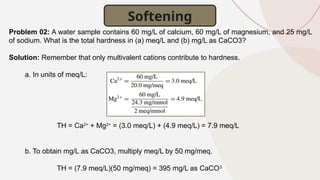
Problem 02: Awater sample contains 60 mg/L of calcium, 60 mg/L of magnesium, and 25 mg/L
of sodium. What is the total hardness in (a) meq/L and (b) mg/L as CaCO3?
Solution: Remember that only multivalent cations contribute to hardness.
a. In units of meq/L:
TH = Ca2+
+ Mg2+
= (3.0 meq/L) + (4.9 meq/L) = 7.9 meq/L
b. To obtain mg/L as CaCO3, multiply meq/L by 50 mg/meq.
TH = (7.9 meq/L)(50 mg/meq) = 395 mg/L as CaCO3
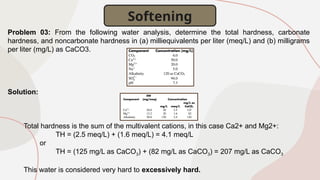
Problem 03: Fromthe following water analysis, determine the total hardness, carbonate
hardness, and noncarbonate hardness in (a) milliequivalents per liter (meq/L) and (b) milligrams
per liter (mg/L) as CaCO3.
Solution:
Total hardness is the sum of the multivalent cations, in this case Ca2+ and Mg2+:
TH = (2.5 meq/L) + (1.6 meq/L) = 4.1 meq/L
or
TH = (125 mg/L as CaCO3) + (82 mg/L as CaCO3) = 207 mg/L as CaCO3
This water is considered very hard to excessively hard.
Softening
17.
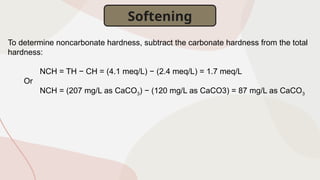
To determine noncarbonatehardness, subtract the carbonate hardness from the total
hardness:
NCH = TH − CH = (4.1 meq/L) − (2.4 meq/L) = 1.7 meq/L
Or
NCH = (207 mg/L as CaCO3) − (120 mg/L as CaCO3) = 87 mg/L as CaCO3
Softening
18.
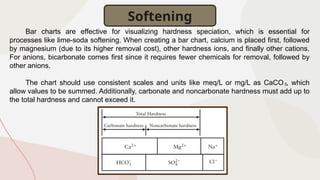
Bar charts areeffective for visualizing hardness speciation, which is essential for
processes like lime-soda softening. When creating a bar chart, calcium is placed first, followed
by magnesium (due to its higher removal cost), other hardness ions, and finally other cations.
For anions, bicarbonate comes first since it requires fewer chemicals for removal, followed by
other anions.
The chart should use consistent scales and units like meq/L or mg/L as CaCO , which
₃
allow values to be summed. Additionally, carbonate and noncarbonate hardness must add up to
the total hardness and cannot exceed it.
Softening
19.
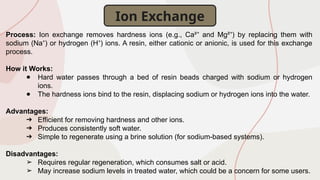
Ion Exchange
Process: Ionexchange removes hardness ions (e.g., Ca² and Mg² ) by replacing them with
⁺ ⁺
sodium (Na ) or hydrogen (H ) ions. A resin, either cationic or anionic, is used for this exchange
⁺ ⁺
process.
How it Works:
● Hard water passes through a bed of resin beads charged with sodium or hydrogen
ions.
● The hardness ions bind to the resin, displacing sodium or hydrogen ions into the water.
Advantages:
➔ Efficient for removing hardness and other ions.
➔ Produces consistently soft water.
➔ Simple to regenerate using a brine solution (for sodium-based systems).
Disadvantages:
➢ Requires regular regeneration, which consumes salt or acid.
➢ May increase sodium levels in treated water, which could be a concern for some users.
20.
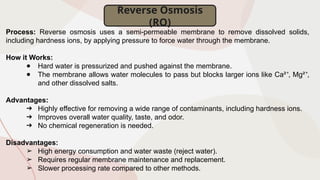
Reverse Osmosis
(RO)
Process: Reverseosmosis uses a semi-permeable membrane to remove dissolved solids,
including hardness ions, by applying pressure to force water through the membrane.
How it Works:
● Hard water is pressurized and pushed against the membrane.
● The membrane allows water molecules to pass but blocks larger ions like Ca² , Mg² ,
⁺ ⁺
and other dissolved salts.
Advantages:
➔ Highly effective for removing a wide range of contaminants, including hardness ions.
➔ Improves overall water quality, taste, and odor.
➔ No chemical regeneration is needed.
Disadvantages:
➢ High energy consumption and water waste (reject water).
➢ Requires regular membrane maintenance and replacement.
➢ Slower processing rate compared to other methods.
21.
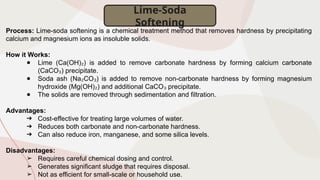
Process: Lime-soda softeningis a chemical treatment method that removes hardness by precipitating
calcium and magnesium ions as insoluble solids.
How it Works:
● Lime (Ca(OH) ) is added to remove carbonate hardness by forming calcium carbonate
₂
(CaCO ) precipitate.
₃
● Soda ash (Na CO ) is added to remove non-carbonate hardness by forming magnesium
₂ ₃
hydroxide (Mg(OH) ) and additional CaCO precipitate.
₂ ₃
● The solids are removed through sedimentation and filtration.
Advantages:
➔ Cost-effective for treating large volumes of water.
➔ Reduces both carbonate and non-carbonate hardness.
➔ Can also reduce iron, manganese, and some silica levels.
Disadvantages:
➢ Requires careful chemical dosing and control.
➢ Generates significant sludge that requires disposal.
➢ Not as efficient for small-scale or household use.
Lime-Soda
Softening
22.
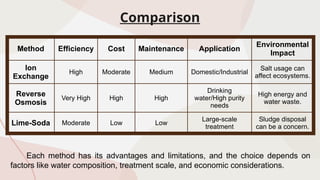
Method Efficiency CostMaintenance Application
Environmental
Impact
Ion
Exchange
High Moderate Medium Domestic/Industrial
Salt usage can
affect ecosystems.
Reverse
Osmosis
Very High High High
Drinking
water/High purity
needs
High energy and
water waste.
Lime-Soda Moderate Low Low
Large-scale
treatment
Sludge disposal
can be a concern.
Each method has its advantages and limitations, and the choice depends on
factors like water composition, treatment scale, and economic considerations.
Comparison
Coagulation &
Flocculation
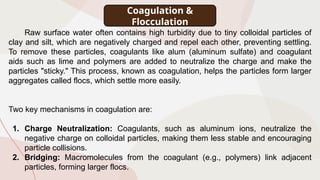
Raw surfacewater often contains high turbidity due to tiny colloidal particles of
clay and silt, which are negatively charged and repel each other, preventing settling.
To remove these particles, coagulants like alum (aluminum sulfate) and coagulant
aids such as lime and polymers are added to neutralize the charge and make the
particles "sticky." This process, known as coagulation, helps the particles form larger
aggregates called flocs, which settle more easily.
Two key mechanisms in coagulation are:
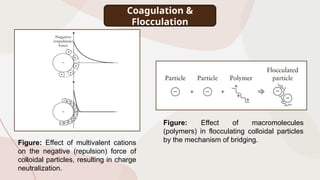
1. Charge Neutralization: Coagulants, such as aluminum ions, neutralize the
negative charge on colloidal particles, making them less stable and encouraging
particle collisions.
2. Bridging: Macromolecules from the coagulant (e.g., polymers) link adjacent
particles, forming larger flocs.
25.
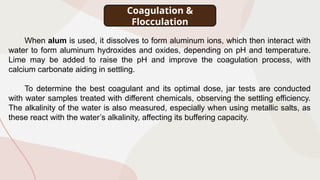
When alum isused, it dissolves to form aluminum ions, which then interact with
water to form aluminum hydroxides and oxides, depending on pH and temperature.
Lime may be added to raise the pH and improve the coagulation process, with
calcium carbonate aiding in settling.
To determine the best coagulant and its optimal dose, jar tests are conducted
with water samples treated with different chemicals, observing the settling efficiency.
The alkalinity of the water is also measured, especially when using metallic salts, as
these react with the water’s alkalinity, affecting its buffering capacity.
Coagulation &
Flocculation
26.
Figure: Effect ofmultivalent cations
on the negative (repulsion) force of
colloidal particles, resulting in charge
neutralization.
Figure: Effect of macromolecules
(polymers) in flocculating colloidal particles
by the mechanism of bridging.
Coagulation &
Flocculation
27.
Coagulation &
Flocculation
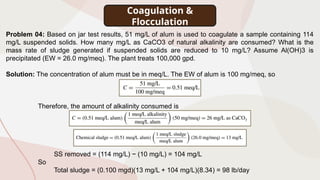
Problem 04:Based on jar test results, 51 mg/L of alum is used to coagulate a sample containing 114
mg/L suspended solids. How many mg/L as CaCO3 of natural alkalinity are consumed? What is the
mass rate of sludge generated if suspended solids are reduced to 10 mg/L? Assume Al(OH)3 is
precipitated (EW = 26.0 mg/meq). The plant treats 100,000 gpd.
Solution: The concentration of alum must be in meq/L. The EW of alum is 100 mg/meq, so
Therefore, the amount of alkalinity consumed is
SS removed = (114 mg/L) − (10 mg/L) = 104 mg/L
So
Total sludge = (0.100 mgd)(13 mg/L + 104 mg/L)(8.34) = 98 lb/day
28.
Coagulation &
Flocculation
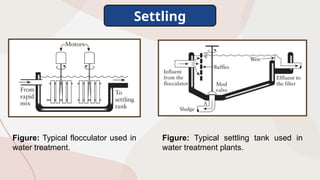
Flocculation isa physical process that helps form larger particles, called flocs,
by ensuring they collide and stick together. After coagulation, where particles are
made sticky, flocculation ensures these particles move at different velocities, allowing
them to come into contact. Think of cars on a highway: if they all moved at the same
speed, collisions wouldn't happen, but with varying speeds, some cars will catch up
and collide. In water treatment, this is done by gently stirring the water with slow-
speed paddles, which create the necessary movement for particles to collide and
form larger flocs.
Once the flocs are formed, they are removed through settling, where their larger
size and density allow them to sink to the bottom. This reduces turbidity and
suspended solids in the water, preparing it for further treatment. In summary,
flocculation helps create larger particles that can be easily removed, improving water
quality.
Settling
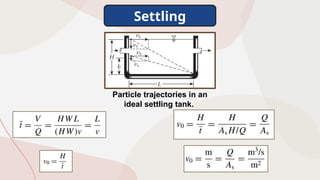
Settling tanks aredesigned to approximate a plug-flow reactor, meaning that water flows
through the tank in a manner that minimizes mixing, ensuring that particles have sufficient time to
settle as they move through the tank. Here's an overview of how settling tanks work and their design
principles
1. Purpose and Function:
● Settling tanks separate heavier-than-water particles (flocs) using gravity.
● Designed to approximate a **plug-flow reactor**, minimizing turbulence to ensure efficient
particle settling.
1. Design Elements:
● Entrance and exit configurations are critical to maintain plug flow and avoid turbulence.
● The tank allows particles to settle due to their higher density compared to the fluid.
1. Sludge Characteristics:
● Composed of aluminum hydroxides, calcium carbonates, and clays.
● Not biodegradable; removed periodically via a mud valve and directed to a sewer or drying
pond.
Settling
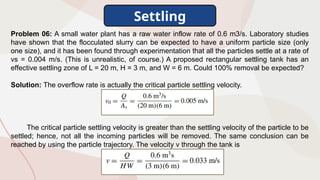
Problem 05: Awater treatment plant settling tank has an overflow rate of 600
gal/day-ft2
and a depth of 6 ft. What is its retention time?
Solution:
34.
Settling
Problem 06: Asmall water plant has a raw water inflow rate of 0.6 m3/s. Laboratory studies
have shown that the flocculated slurry can be expected to have a uniform particle size (only
one size), and it has been found through experimentation that all the particles settle at a rate of
vs = 0.004 m/s. (This is unrealistic, of course.) A proposed rectangular settling tank has an
effective settling zone of L = 20 m, H = 3 m, and W = 6 m. Could 100% removal be expected?
Solution: The overflow rate is actually the critical particle settling velocity.
The critical particle settling velocity is greater than the settling velocity of the particle to be
settled; hence, not all the incoming particles will be removed. The same conclusion can be
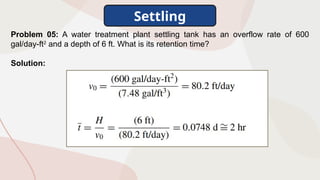
reached by using the particle trajectory. The velocity v through the tank is
35.
Settling
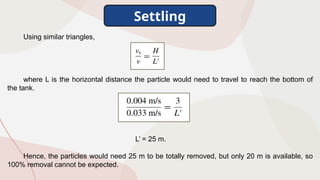
Using similar triangles,
whereL is the horizontal distance the particle would need to travel to reach the bottom of
the tank.
L’ = 25 m.
Hence, the particles would need 25 m to be totally removed, but only 20 m is available, so
100% removal cannot be expected.
36.
Settling
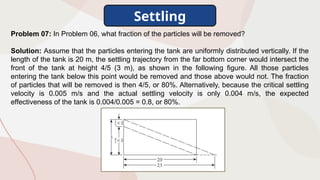
Problem 07: InProblem 06, what fraction of the particles will be removed?
Solution: Assume that the particles entering the tank are uniformly distributed vertically. If the
length of the tank is 20 m, the settling trajectory from the far bottom corner would intersect the
front of the tank at height 4/5 (3 m), as shown in the following figure. All those particles
entering the tank below this point would be removed and those above would not. The fraction
of particles that will be removed is then 4/5, or 80%. Alternatively, because the critical settling
velocity is 0.005 m/s and the actual settling velocity is only 0.004 m/s, the expected
effectiveness of the tank is 0.004/0.005 = 0.8, or 80%.