1
Water Softening
2
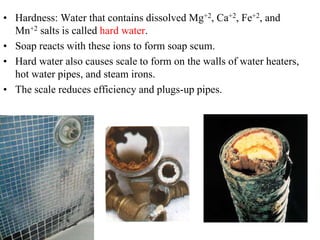
• Hardness: Water that contains dissolved Mg+2, Ca+2, Fe+2, and
Mn+2 salts is called hard water.
• Soap reacts with these ions to form soap scum.
• Hard water also causes scale to form on the walls of water heaters,
hot water pipes, and steam irons.
• The scale reduces efficiency and plugs-up pipes.
3
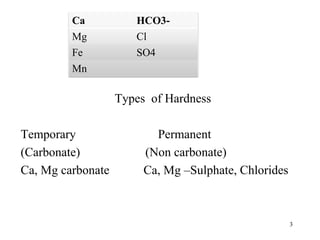
Types of Hardness
Temporary Permanent
(Carbonate) (Non carbonate)
Ca, Mg carbonate Ca, Mg –Sulphate, Chlorides
Ca HCO3-
Mg Cl
Fe SO4
Mn
Hardness Removal / Water Softening
I) Temporary hardness
A) By Boiling
Ca.(HCO3)2 Heat CaCO3ꜜ + H2O +CO2ꜛ
Mg.(HCO3)2 Heat CaCO3ꜜ + H2O +CO2ꜛ
B) By Addition of Lime [Ca(OH)2 ]
Ca(HCO3)2 + Ca(OH)2  2CaCO3ꜜ +2 H2O
Mg(HCO3)2 + Ca(OH)2  CaCO3ꜜ + MgCO3ꜜ + 2H2O 4
Hardness Removal
II) Permanent hardness
A) Lime Soda
B) Zeolite (Base/Cation Exchange)
5
6
Water Softening
I) Lime-Soda Method:
Ca+2 and Mg+2 ions are precipitated from
hard water by adding lime and sodium
carbonate
The insoluble solids are removed by
sedimentation or commercially by filtration.
I) Lime-Soda Method:
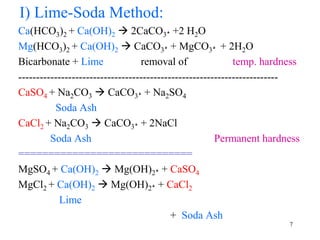
Ca(HCO3)2 + Ca(OH)2  2CaCO3ꜜ +2 H2O
Mg(HCO3)2 + Ca(OH)2  CaCO3ꜜ + MgCO3ꜜ + 2H2O
Bicarbonate + Lime removal of temp. hardness
-------------------------------------------------------------------------
CaSO4 + Na2CO3  CaCO3ꜜ + Na2SO4
Soda Ash
CaCl2 + Na2CO3  CaCO3ꜜ + 2NaCl
Soda Ash Permanent hardness
=============================
MgSO4 + Ca(OH)2  Mg(OH)2ꜜ + CaSO4
MgCl2 + Ca(OH)2  Mg(OH)2ꜜ + CaCl2
Lime
+ Soda Ash
7
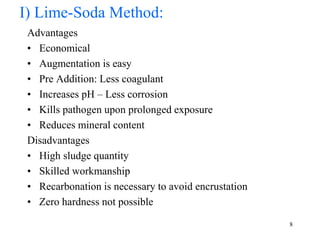
Advantages
• Economical
• Augmentation is easy
• Pre Addition: Less coagulant
• Increases pH – Less corrosion
• Kills pathogen upon prolonged exposure
• Reduces mineral content
Disadvantages
• High sludge quantity
• Skilled workmanship
• Recarbonation is necessary to avoid encrustation
• Zero hardness not possible
8
I) Lime-Soda Method:
9
Water Softening
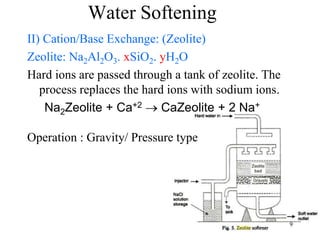
II) Cation/Base Exchange: (Zeolite)
Zeolite: Na2Al2O3. xSiO2. yH2O
Hard ions are passed through a tank of zeolite. The
process replaces the hard ions with sodium ions.
Na2Zeolite + Ca+2  CaZeolite + 2 Na+
Operation : Gravity/ Pressure type
10
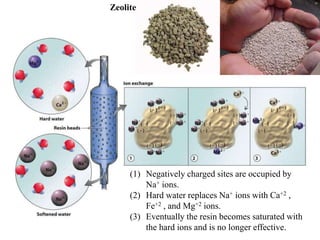
(1) Negatively charged sites are occupied by
Na+ ions.
(2) Hard water replaces Na+ ions with Ca+2 ,
Fe+2 , and Mg+2 ions.
(3) Eventually the resin becomes saturated with
the hard ions and is no longer effective.
Zeolite
Zeolite/Base Exchange/
Advantage
• Zero hardness (Good for Industrial use)
• Compact, automatic, easy to operate
• No sludge
• O & M cost is less
Disadvantage
• Not suitable for turbid water
• Sodium carbonate left in water causes foaming
• Zero hardness
11
12
• Charcoal is carbon.
Activated charcoal
is charcoal that has been treated with oxygen
to open up millions of tiny pores between
the carbon atoms. This results in highly
porous charcoals that have surface areas of
300-2,000 square meters per gram. These
so-called active, or activated, charcoals are
widely used to adsorb odorous or colored
substances from gases or liquids.
13
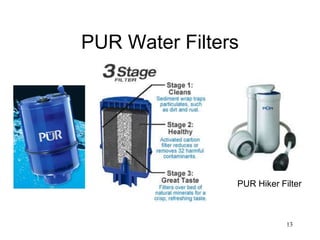
PUR Water Filters
PUR Hiker Filter
14
Demineralization /
Desalinization
Evaporation & Distillation
Electro dialysis
Reverse Osmosis
15
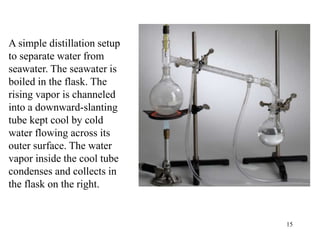
A simple distillation setup
to separate water from
seawater. The seawater is
boiled in the flask. The
rising vapor is channeled
into a downward-slanting
tube kept cool by cold
water flowing across its
outer surface. The water
vapor inside the cool tube
condenses and collects in
the flask on the right.
16
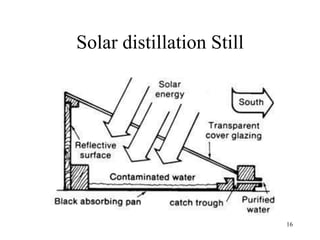
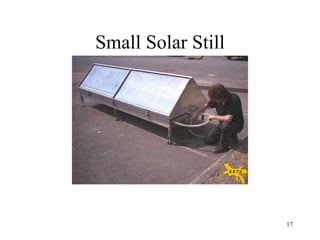
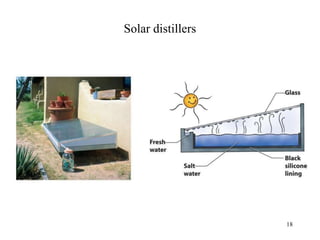
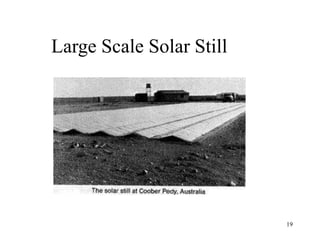
Solar distillation Still
17
Small Solar Still
18
Solar distillers
19
Large Scale Solar Still
20
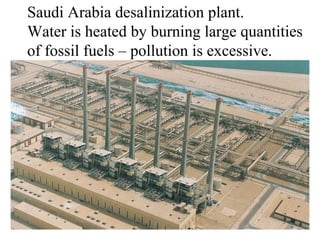
Saudi Arabia desalinization plant.
Water is heated by burning large quantities
of fossil fuels – pollution is excessive.
21
Reverse Osmosis
22
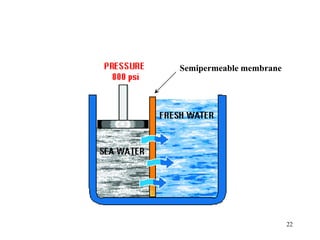
Semipermeable membrane
23
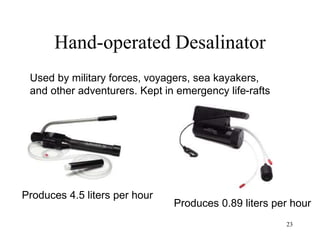
Hand-operated Desalinator
Used by military forces, voyagers, sea kayakers,
and other adventurers. Kept in emergency life-rafts
Produces 4.5 liters per hour
Produces 0.89 liters per hour
24
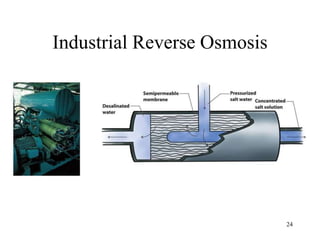
Industrial Reverse Osmosis
25
Ion Exchange
26
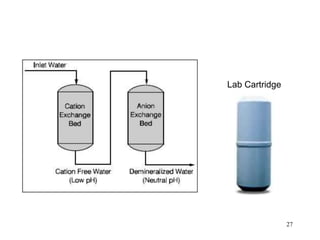
Two-stage Ion-Exchange System
• This process removes both cations and anions.
• Special synthetic organic resins are used in the
beds.
• In the first stage cations are replaced by H+ ions.
• In the second stage anions are replaced by OH–
ions.
• The H+ and OH– ions react to form mineral-free
water.
27
Lab Cartridge

Softening demineralization

  • 1.
  • 2.
    2 • Hardness: Waterthat contains dissolved Mg+2, Ca+2, Fe+2, and Mn+2 salts is called hard water. • Soap reacts with these ions to form soap scum. • Hard water also causes scale to form on the walls of water heaters, hot water pipes, and steam irons. • The scale reduces efficiency and plugs-up pipes.
  • 3.
    3 Types of Hardness TemporaryPermanent (Carbonate) (Non carbonate) Ca, Mg carbonate Ca, Mg –Sulphate, Chlorides Ca HCO3- Mg Cl Fe SO4 Mn
  • 4.
    Hardness Removal /Water Softening I) Temporary hardness A) By Boiling Ca.(HCO3)2 Heat CaCO3ꜜ + H2O +CO2ꜛ Mg.(HCO3)2 Heat CaCO3ꜜ + H2O +CO2ꜛ B) By Addition of Lime [Ca(OH)2 ] Ca(HCO3)2 + Ca(OH)2  2CaCO3ꜜ +2 H2O Mg(HCO3)2 + Ca(OH)2  CaCO3ꜜ + MgCO3ꜜ + 2H2O 4
  • 5.
    Hardness Removal II) Permanenthardness A) Lime Soda B) Zeolite (Base/Cation Exchange) 5
  • 6.
    6 Water Softening I) Lime-SodaMethod: Ca+2 and Mg+2 ions are precipitated from hard water by adding lime and sodium carbonate The insoluble solids are removed by sedimentation or commercially by filtration.
  • 7.
    I) Lime-Soda Method: Ca(HCO3)2+ Ca(OH)2  2CaCO3ꜜ +2 H2O Mg(HCO3)2 + Ca(OH)2  CaCO3ꜜ + MgCO3ꜜ + 2H2O Bicarbonate + Lime removal of temp. hardness ------------------------------------------------------------------------- CaSO4 + Na2CO3  CaCO3ꜜ + Na2SO4 Soda Ash CaCl2 + Na2CO3  CaCO3ꜜ + 2NaCl Soda Ash Permanent hardness ============================= MgSO4 + Ca(OH)2  Mg(OH)2ꜜ + CaSO4 MgCl2 + Ca(OH)2  Mg(OH)2ꜜ + CaCl2 Lime + Soda Ash 7
  • 8.
    Advantages • Economical • Augmentationis easy • Pre Addition: Less coagulant • Increases pH – Less corrosion • Kills pathogen upon prolonged exposure • Reduces mineral content Disadvantages • High sludge quantity • Skilled workmanship • Recarbonation is necessary to avoid encrustation • Zero hardness not possible 8 I) Lime-Soda Method:
  • 9.
    9 Water Softening II) Cation/BaseExchange: (Zeolite) Zeolite: Na2Al2O3. xSiO2. yH2O Hard ions are passed through a tank of zeolite. The process replaces the hard ions with sodium ions. Na2Zeolite + Ca+2  CaZeolite + 2 Na+ Operation : Gravity/ Pressure type
  • 10.
    10 (1) Negatively chargedsites are occupied by Na+ ions. (2) Hard water replaces Na+ ions with Ca+2 , Fe+2 , and Mg+2 ions. (3) Eventually the resin becomes saturated with the hard ions and is no longer effective. Zeolite
  • 11.
    Zeolite/Base Exchange/ Advantage • Zerohardness (Good for Industrial use) • Compact, automatic, easy to operate • No sludge • O & M cost is less Disadvantage • Not suitable for turbid water • Sodium carbonate left in water causes foaming • Zero hardness 11
  • 12.
    12 • Charcoal iscarbon. Activated charcoal is charcoal that has been treated with oxygen to open up millions of tiny pores between the carbon atoms. This results in highly porous charcoals that have surface areas of 300-2,000 square meters per gram. These so-called active, or activated, charcoals are widely used to adsorb odorous or colored substances from gases or liquids.
  • 13.
  • 14.
    14 Demineralization / Desalinization Evaporation &Distillation Electro dialysis Reverse Osmosis
  • 15.
    15 A simple distillationsetup to separate water from seawater. The seawater is boiled in the flask. The rising vapor is channeled into a downward-slanting tube kept cool by cold water flowing across its outer surface. The water vapor inside the cool tube condenses and collects in the flask on the right.
  • 16.
  • 17.
  • 18.
  • 19.
  • 20.
    20 Saudi Arabia desalinizationplant. Water is heated by burning large quantities of fossil fuels – pollution is excessive.
  • 21.
  • 22.
  • 23.
    23 Hand-operated Desalinator Used bymilitary forces, voyagers, sea kayakers, and other adventurers. Kept in emergency life-rafts Produces 4.5 liters per hour Produces 0.89 liters per hour
  • 24.
  • 25.
  • 26.
    26 Two-stage Ion-Exchange System •This process removes both cations and anions. • Special synthetic organic resins are used in the beds. • In the first stage cations are replaced by H+ ions. • In the second stage anions are replaced by OH– ions. • The H+ and OH– ions react to form mineral-free water.
  • 27.