WATER
SOFTENING
ENVIRONMENTAL ENGINEERING.
Courtesy: dupont.com
RGU IIIT NUZVID 2
Contents
• Introduction
• Why softening?
• Removal of temporary hardness
• Boiling
• Addition of lime
• Removal of permanent hardness
• Chemical precipitation
• Ion exchange
• Demineralization
• Stages of softening
• Split treatment
• Softening operations
• Problems
Introduction
• Softening is reduction or removal of hardness.
• Hardness is due to divalent metallic ions like − 𝐶𝑎+2
, 𝑀𝑔+2
, 𝐹𝑒+2
, 𝑀𝑛+2
, 𝑆𝑟+2
etc.
• Two types of hardness.
• Temporary or carbonate hardness
• Permanent or non-carbonate hardness
• Permissible hardness: 75 – 115 mg/l
• Softening may be done by the water utility at the treatment plant or by the
consumer at the point of use.
3RGU IIIT NUZVID
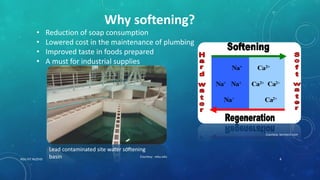
Why softening?
• Reduction of soap consumption
• Lowered cost in the maintenance of plumbing
• Improved taste in foods prepared
• A must for industrial supplies
4RGU IIIT NUZVID
Courtesy: lenntech.com
Courtesy: ndsu.edu
Lead contaminated site water softening
basin
Removal of temporary hardness
• Temporary hardness is due to carbonates and bicarbonates of calcium and
magnesium.
• Can be removed either by boiling or by adding lime to the water.
Boiling
• 𝐶𝑎𝐶𝑂3 is slightly soluble in water.
• So it usually exists in water as a bicarbonate.
• Boiling will lead to the precipitation of 𝐶𝑎𝐶𝑂3 and release of 𝐶𝑂2.
• 𝐶𝑎(𝐻𝐶𝑂3)2 + Heat 𝐶𝑎𝐶𝑂3 + 𝐶𝑂2 + 𝐻2O
• 𝐶𝑎𝐶𝑂3 is precipitated.
• Magnesium carbonates and bicarbonates are not satisfactorily removed.
• 𝑀𝑔𝐶𝑂3 is fairly soluble.
6RGU IIIT NUZVID
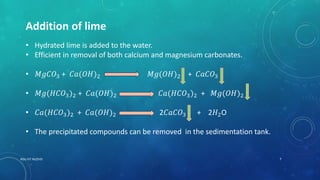
Addition of lime
• Hydrated lime is added to the water.
• Efficient in removal of both calcium and magnesium carbonates.
• 𝑀𝑔𝐶𝑂3 + 𝐶𝑎(𝑂𝐻)2 𝑀𝑔(𝑂𝐻)2 + 𝐶𝑎𝐶𝑂3
• 𝑀𝑔(𝐻𝐶𝑂3)2 + 𝐶𝑎(𝑂𝐻)2 𝐶𝑎(𝐻𝐶𝑂3)2 + 𝑀𝑔(𝑂𝐻)2
• 𝐶𝑎(𝐻𝐶𝑂3)2 + 𝐶𝑎(𝑂𝐻)2 2𝐶𝑎𝐶𝑂3 + 2𝐻2O
• The precipitated compounds can be removed in the sedimentation tank.
7RGU IIIT NUZVID
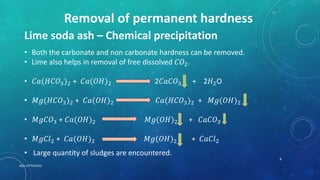
Removal of permanent hardness
Lime soda ash – Chemical precipitation
• Both the carbonate and non carbonate hardness can be removed.
• Lime also helps in removal of free dissolved 𝐶𝑂2.
• 𝐶𝑎(𝐻𝐶𝑂3)2 + 𝐶𝑎(𝑂𝐻)2 2𝐶𝑎𝐶𝑂3 + 2𝐻2O
• 𝑀𝑔(𝐻𝐶𝑂3)2 + 𝐶𝑎(𝑂𝐻)2 𝐶𝑎(𝐻𝐶𝑂3)2 + 𝑀𝑔(𝑂𝐻)2
• 𝑀𝑔𝐶𝑂3 + 𝐶𝑎(𝑂𝐻)2 𝑀𝑔(𝑂𝐻)2 + 𝐶𝑎𝐶𝑂3
• 𝑀𝑔𝐶𝑙2 + 𝐶𝑎(𝑂𝐻)2 𝑀𝑔(𝑂𝐻)2 + 𝐶𝑎𝐶𝑙2
• Large quantity of sludges are encountered.
8
RGU IIIT NUZVID
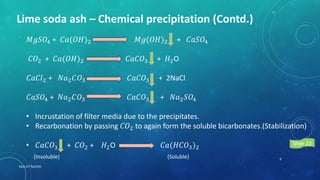
Lime soda ash – Chemical precipitation (Contd.)
𝑀𝑔𝑆𝑂4 + 𝐶𝑎(𝑂𝐻)2 𝑀𝑔(𝑂𝐻)2 + 𝐶𝑎𝑆𝑂4
𝐶𝑂2 + 𝐶𝑎(𝑂𝐻)2 𝐶𝑎𝐶𝑂3 + 𝐻2O
𝐶𝑎𝐶𝑙2 + 𝑁𝑎2 𝐶𝑂3 𝐶𝑎𝐶𝑂3 + 2NaCl
𝐶𝑎𝑆𝑂4 + 𝑁𝑎2 𝐶𝑂3 𝐶𝑎𝐶𝑂3 + 𝑁𝑎2 𝑆𝑂4
• Incrustation of filter media due to the precipitates.
• Recarbonation by passing 𝐶𝑂2 to again form the soluble bicarbonates.(Stabilization)
• 𝐶𝑎𝐶𝑂3 + 𝐶𝑂2 + 𝐻2O 𝐶𝑎(𝐻𝐶𝑂3)2
(Soluble)(Insoluble) 9
RGU IIIT NUZVID
Slide 22
RGU IIIT NUZVID 10
0
20
40
60
80
100
120
140
160
180
200
7 8 9 10 11 12 13 14
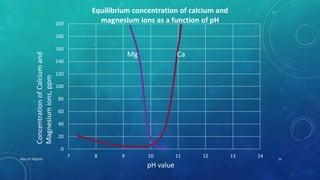
Mg
Equilibrium concentration of calcium and
magnesium ions as a function of pH
pH value
ConcentrationofCalciumand
Magnesiumions,ppm
Ca
RGU IIIT NUZVID 11
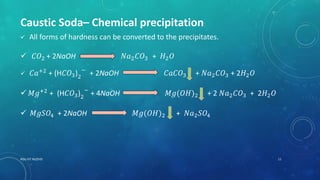
Caustic Soda– Chemical precipitation
 All forms of hardness can be converted to the precipitates.
 𝐶𝑂2 + 2NaOH 𝑁𝑎2 𝐶𝑂3 + 𝐻2 𝑂
 𝐶𝑎+2
+ (H𝐶𝑂3)2
−
+ 2NaOH 𝐶𝑎𝐶𝑂3 + 𝑁𝑎2 𝐶𝑂3 + 2𝐻2 𝑂
 𝑀𝑔+2
+ (H𝐶𝑂3)2
−
+ 4NaOH 𝑀𝑔(𝑂𝐻)2 + 2 𝑁𝑎2 𝐶𝑂3 + 2𝐻2 𝑂
 𝑀𝑔𝑆𝑂4 + 2NaOH 𝑀𝑔(𝑂𝐻)2 + 𝑁𝑎2 𝑆𝑂4
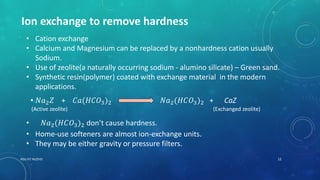
Ion exchange to remove hardness
• Cation exchange
• Calcium and Magnesium can be replaced by a nonhardness cation usually
Sodium.
• Use of zeolite(a naturally occurring sodium - alumino silicate) – Green sand.
• Synthetic resin(polymer) coated with exchange material in the modern
applications.
• 𝑁𝑎2 𝑍 + 𝐶𝑎(𝐻𝐶𝑂3)2 𝑁𝑎2(𝐻𝐶𝑂3)2 + CaZ
• 𝑁𝑎2(𝐻𝐶𝑂3)2 don’t cause hardness.
• Home-use softeners are almost ion-exchange units.
• They may be either gravity or pressure filters.
(Active zeolite) (Exchanged zeolite)
12RGU IIIT NUZVID
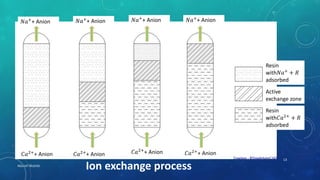
13
Resin
with𝑁𝑎+
+ 𝑅
adsorbed
Resin
with𝐶𝑎2+
+ 𝑅
adsorbed
Active
exchange zone
𝑁𝑎+
+ Anion 𝑁𝑎+
+ Anion 𝑁𝑎+
+ Anion 𝑁𝑎+
+ Anion
𝐶𝑎2+
+ Anion 𝐶𝑎2+
+ Anion 𝐶𝑎2+
+ Anion 𝐶𝑎2+
+ Anion
Ion exchange processRGU IIIT NUZVID
RGU IIIT NUZVID 14
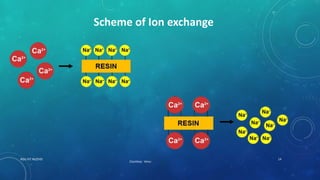
Scheme of Ion exchange
Courtesy: Venu
RGU IIIT NUZVID 15
Advantages of Ion exchange
 No problem of incrustation of pipes as there in lime soda process.
 𝐹𝑒+2
, 𝑀𝑛+2
can also be removed.
 The RMO cost is relatively less.
 Water of varying quality can also be treated.
 Very useful in textile industries, boilers etc. as zero hardness can be
achieved.
RGU IIIT NUZVID 16
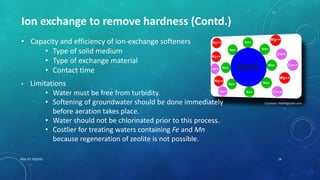
Ion exchange to remove hardness (Contd.)
Courtesy: healthgoods.com
• Capacity and efficiency of ion-exchange softeners
• Type of solid medium
• Type of exchange material
• Contact time
• Limitations
• Water must be free from turbidity.
• Softening of groundwater should be done immediately
before aeration takes place.
• Water should not be chlorinated prior to this process.
• Costlier for treating waters containing Fe and Mn
because regeneration of zeolite is not possible.
Demineralization to remove hardness
• Removal of minerals from water.
• Even to obtain mineral free water which is as pure as distilled water.
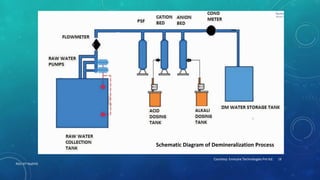
• Achieved by passing water through a bed of cation exchange resins, and
then through a bed of anion exchange resins.
• 𝐶𝑎(𝐻𝐶𝑂3)2 + 𝐻2 𝑅 CaR + 2𝐻2 𝑂 + 2 𝐶𝑂2
• ROH + HCl RCl + HOH
• 2ROH + 𝐻2 𝑆𝑂4 𝑅2 𝑆𝑂4 + 2HOH
17RGU IIIT NUZVID
RGU IIIT NUZVID
18
Schematic Diagram of Demineralization Process
Courtesy: Envicare Technologies Pvt ltd.
RGU IIIT NUZVID 19
Single – stage softening
• Water is to be softened to the minimum calcium hardness by the lime-
soda ash process.
• Magnesium removal is not conveyed necessary.
Two – stage softening
• Water is softened to the minimum possible hardness by lime-soda-ash-
excess-lime process.
Split treatment
RGU IIIT NUZVID 20
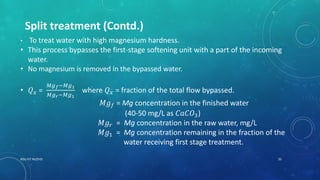
Split treatment (Contd.)
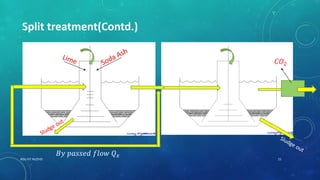
• To treat water with high magnesium hardness.
• This process bypasses the first-stage softening unit with a part of the incoming
water.
• No magnesium is removed in the bypassed water.
• 𝑄 𝑥 =
𝑀𝑔 𝑓−𝑀𝑔1
𝑀𝑔 𝑟−𝑀𝑔1
where 𝑄 𝑥 = fraction of the total flow bypassed.
𝑀𝑔 𝑓 = Mg concentration in the finished water
(40-50 mg/L as 𝐶𝑎𝐶𝑂3)
𝑀𝑔 𝑟 = Mg concentration in the raw water, mg/L
𝑀𝑔1 = Mg concentration remaining in the fraction of the
water receiving first stage treatment.
RGU IIIT NUZVID 21
Split treatment(Contd.)
𝐶𝑂2
𝐵𝑦 𝑝𝑎𝑠𝑠𝑒𝑑 𝑓𝑙𝑜𝑤 𝑄 𝑥
RGU IIIT NUZVID 22
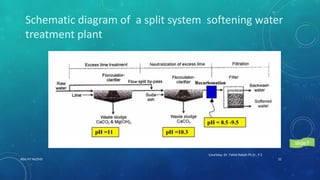
Schematic diagram of a split system softening water
treatment plant
Courtesy: Dr. Fahid Rabah Ph.D., P.E
slide7
RGU IIIT NUZVID 23
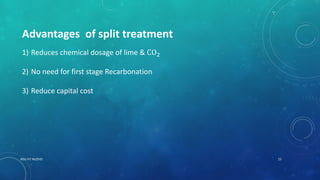
Advantages of split treatment
1) Reduces chemical dosage of lime & CO2
2) No need for first stage Recarbonation
3) Reduce capital cost
RGU IIIT NUZVID 24
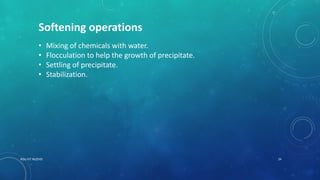
Softening operations
• Mixing of chemicals with water.
• Flocculation to help the growth of precipitate.
• Settling of precipitate.
• Stabilization.
RGU IIIT NUZVID
25
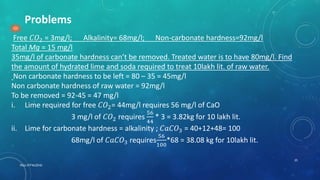
Problems
Free 𝐶𝑂2 = 3mg/l; Alkalinity= 68mg/l; Non-carbonate hardness=92mg/l
Total Mg = 15 mg/l
35mg/l of carbonate hardness can’t be removed. Treated water is to have 80mg/l. Find
the amount of hydrated lime and soda required to treat 10lakh lit. of raw water.
Non carbonate hardness to be left = 80 – 35 = 45mg/l
Non carbonate hardness of raw water = 92mg/l
To be removed = 92-45 = 47 mg/l
i. Lime required for free 𝐶𝑂2= 44mg/l requires 56 mg/l of CaO
3 mg/l of 𝐶𝑂2 requires
56
44
* 3 = 3.82kg for 10 lakh lit.
ii. Lime for carbonate hardness = alkalinity ; 𝐶𝑎𝐶𝑂3 = 40+12+48= 100
68mg/l of 𝐶𝑎𝐶𝑂3 requires
56
100
*68 = 38.08 kg for 10lakh lit.
RGU IIIT NUZVID 26
Problems(Contd.)
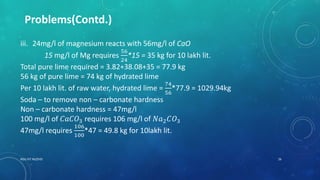
iii. 24mg/l of magnesium reacts with 56mg/l of CaO
15 mg/l of Mg requires
56
24
*15 = 35 kg for 10 lakh lit.
Total pure lime required = 3.82+38.08+35 = 77.9 kg
56 kg of pure lime = 74 kg of hydrated lime
Per 10 lakh lit. of raw water, hydrated lime =
74
56
*77.9 = 1029.94kg
Soda – to remove non – carbonate hardness
Non – carbonate hardness = 47mg/l
100 mg/l of 𝐶𝑎𝐶𝑂3 requires 106 mg/l of 𝑁𝑎2 𝐶𝑂3
47mg/l requires
106
100
*47 = 49.8 kg for 10lakh lit.
RGU IIIT NUZVID
27
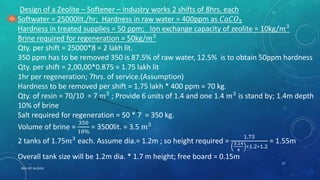
Design of a Zeolite – Softener – Industry works 2 shifts of 8hrs. each
Softwater = 25000lit./hr; Hardness in raw water = 400ppm as 𝐶𝑎𝐶𝑂3
Hardness in treated supplies = 50 ppm; Ion exchange capacity of zeolite = 10kg/𝑚3
Brine required for regeneration = 50kg/𝑚3
Qty. per shift = 25000*8 = 2 lakh lit.
350 ppm has to be removed 350 is 87.5% of raw water, 12.5% is to obtain 50ppm hardness
Qty. per shift = 2,00,00*0.875 = 1.75 lakh lit
1hr per regeneration; 7hrs. of service.(Assumption)
Hardness to be removed per shift = 1.75 lakh * 400 ppm = 70 kg.
Qty. of resin = 70/10 = 7 𝑚3
; Provide 6 units of 1.4 and one 1.4 𝑚3
is stand by; 1.4m depth
10% of brine
Salt required for regeneration = 50 * 7 = 350 kg.
Volume of brine =
350
10%
= 3500lit. = 3.5 𝑚3
2 tanks of 1.75𝑚3
each. Assume dia.= 1.2m ; so height required =
1.75
3.14
4
∗1.2∗1.2
= 1.55m
Overall tank size will be 1.2m dia. * 1.7 m height; free board = 0.15m
Ravi Teja Mullapudi
Venu Matta
CE3
Email: mullapudi.civil@gmail.com
RGUKT IIIT NUZVID
- Indira Gandhi

Water softening ce3

  • 1.
  • 2.
    RGU IIIT NUZVID2 Contents • Introduction • Why softening? • Removal of temporary hardness • Boiling • Addition of lime • Removal of permanent hardness • Chemical precipitation • Ion exchange • Demineralization • Stages of softening • Split treatment • Softening operations • Problems
  • 3.
    Introduction • Softening isreduction or removal of hardness. • Hardness is due to divalent metallic ions like − 𝐶𝑎+2 , 𝑀𝑔+2 , 𝐹𝑒+2 , 𝑀𝑛+2 , 𝑆𝑟+2 etc. • Two types of hardness. • Temporary or carbonate hardness • Permanent or non-carbonate hardness • Permissible hardness: 75 – 115 mg/l • Softening may be done by the water utility at the treatment plant or by the consumer at the point of use. 3RGU IIIT NUZVID
  • 4.
    Why softening? • Reductionof soap consumption • Lowered cost in the maintenance of plumbing • Improved taste in foods prepared • A must for industrial supplies 4RGU IIIT NUZVID Courtesy: lenntech.com Courtesy: ndsu.edu Lead contaminated site water softening basin
  • 5.
    Removal of temporaryhardness • Temporary hardness is due to carbonates and bicarbonates of calcium and magnesium. • Can be removed either by boiling or by adding lime to the water.
  • 6.
    Boiling • 𝐶𝑎𝐶𝑂3 isslightly soluble in water. • So it usually exists in water as a bicarbonate. • Boiling will lead to the precipitation of 𝐶𝑎𝐶𝑂3 and release of 𝐶𝑂2. • 𝐶𝑎(𝐻𝐶𝑂3)2 + Heat 𝐶𝑎𝐶𝑂3 + 𝐶𝑂2 + 𝐻2O • 𝐶𝑎𝐶𝑂3 is precipitated. • Magnesium carbonates and bicarbonates are not satisfactorily removed. • 𝑀𝑔𝐶𝑂3 is fairly soluble. 6RGU IIIT NUZVID
  • 7.
    Addition of lime •Hydrated lime is added to the water. • Efficient in removal of both calcium and magnesium carbonates. • 𝑀𝑔𝐶𝑂3 + 𝐶𝑎(𝑂𝐻)2 𝑀𝑔(𝑂𝐻)2 + 𝐶𝑎𝐶𝑂3 • 𝑀𝑔(𝐻𝐶𝑂3)2 + 𝐶𝑎(𝑂𝐻)2 𝐶𝑎(𝐻𝐶𝑂3)2 + 𝑀𝑔(𝑂𝐻)2 • 𝐶𝑎(𝐻𝐶𝑂3)2 + 𝐶𝑎(𝑂𝐻)2 2𝐶𝑎𝐶𝑂3 + 2𝐻2O • The precipitated compounds can be removed in the sedimentation tank. 7RGU IIIT NUZVID
  • 8.
    Removal of permanenthardness Lime soda ash – Chemical precipitation • Both the carbonate and non carbonate hardness can be removed. • Lime also helps in removal of free dissolved 𝐶𝑂2. • 𝐶𝑎(𝐻𝐶𝑂3)2 + 𝐶𝑎(𝑂𝐻)2 2𝐶𝑎𝐶𝑂3 + 2𝐻2O • 𝑀𝑔(𝐻𝐶𝑂3)2 + 𝐶𝑎(𝑂𝐻)2 𝐶𝑎(𝐻𝐶𝑂3)2 + 𝑀𝑔(𝑂𝐻)2 • 𝑀𝑔𝐶𝑂3 + 𝐶𝑎(𝑂𝐻)2 𝑀𝑔(𝑂𝐻)2 + 𝐶𝑎𝐶𝑂3 • 𝑀𝑔𝐶𝑙2 + 𝐶𝑎(𝑂𝐻)2 𝑀𝑔(𝑂𝐻)2 + 𝐶𝑎𝐶𝑙2 • Large quantity of sludges are encountered. 8 RGU IIIT NUZVID
  • 9.
    Lime soda ash– Chemical precipitation (Contd.) 𝑀𝑔𝑆𝑂4 + 𝐶𝑎(𝑂𝐻)2 𝑀𝑔(𝑂𝐻)2 + 𝐶𝑎𝑆𝑂4 𝐶𝑂2 + 𝐶𝑎(𝑂𝐻)2 𝐶𝑎𝐶𝑂3 + 𝐻2O 𝐶𝑎𝐶𝑙2 + 𝑁𝑎2 𝐶𝑂3 𝐶𝑎𝐶𝑂3 + 2NaCl 𝐶𝑎𝑆𝑂4 + 𝑁𝑎2 𝐶𝑂3 𝐶𝑎𝐶𝑂3 + 𝑁𝑎2 𝑆𝑂4 • Incrustation of filter media due to the precipitates. • Recarbonation by passing 𝐶𝑂2 to again form the soluble bicarbonates.(Stabilization) • 𝐶𝑎𝐶𝑂3 + 𝐶𝑂2 + 𝐻2O 𝐶𝑎(𝐻𝐶𝑂3)2 (Soluble)(Insoluble) 9 RGU IIIT NUZVID Slide 22
  • 10.
    RGU IIIT NUZVID10 0 20 40 60 80 100 120 140 160 180 200 7 8 9 10 11 12 13 14 Mg Equilibrium concentration of calcium and magnesium ions as a function of pH pH value ConcentrationofCalciumand Magnesiumions,ppm Ca
  • 11.
    RGU IIIT NUZVID11 Caustic Soda– Chemical precipitation  All forms of hardness can be converted to the precipitates.  𝐶𝑂2 + 2NaOH 𝑁𝑎2 𝐶𝑂3 + 𝐻2 𝑂  𝐶𝑎+2 + (H𝐶𝑂3)2 − + 2NaOH 𝐶𝑎𝐶𝑂3 + 𝑁𝑎2 𝐶𝑂3 + 2𝐻2 𝑂  𝑀𝑔+2 + (H𝐶𝑂3)2 − + 4NaOH 𝑀𝑔(𝑂𝐻)2 + 2 𝑁𝑎2 𝐶𝑂3 + 2𝐻2 𝑂  𝑀𝑔𝑆𝑂4 + 2NaOH 𝑀𝑔(𝑂𝐻)2 + 𝑁𝑎2 𝑆𝑂4
  • 12.
    Ion exchange toremove hardness • Cation exchange • Calcium and Magnesium can be replaced by a nonhardness cation usually Sodium. • Use of zeolite(a naturally occurring sodium - alumino silicate) – Green sand. • Synthetic resin(polymer) coated with exchange material in the modern applications. • 𝑁𝑎2 𝑍 + 𝐶𝑎(𝐻𝐶𝑂3)2 𝑁𝑎2(𝐻𝐶𝑂3)2 + CaZ • 𝑁𝑎2(𝐻𝐶𝑂3)2 don’t cause hardness. • Home-use softeners are almost ion-exchange units. • They may be either gravity or pressure filters. (Active zeolite) (Exchanged zeolite) 12RGU IIIT NUZVID
  • 13.
    13 Resin with𝑁𝑎+ + 𝑅 adsorbed Resin with𝐶𝑎2+ + 𝑅 adsorbed Active exchangezone 𝑁𝑎+ + Anion 𝑁𝑎+ + Anion 𝑁𝑎+ + Anion 𝑁𝑎+ + Anion 𝐶𝑎2+ + Anion 𝐶𝑎2+ + Anion 𝐶𝑎2+ + Anion 𝐶𝑎2+ + Anion Ion exchange processRGU IIIT NUZVID
  • 14.
    RGU IIIT NUZVID14 Scheme of Ion exchange Courtesy: Venu
  • 15.
    RGU IIIT NUZVID15 Advantages of Ion exchange  No problem of incrustation of pipes as there in lime soda process.  𝐹𝑒+2 , 𝑀𝑛+2 can also be removed.  The RMO cost is relatively less.  Water of varying quality can also be treated.  Very useful in textile industries, boilers etc. as zero hardness can be achieved.
  • 16.
    RGU IIIT NUZVID16 Ion exchange to remove hardness (Contd.) Courtesy: healthgoods.com • Capacity and efficiency of ion-exchange softeners • Type of solid medium • Type of exchange material • Contact time • Limitations • Water must be free from turbidity. • Softening of groundwater should be done immediately before aeration takes place. • Water should not be chlorinated prior to this process. • Costlier for treating waters containing Fe and Mn because regeneration of zeolite is not possible.
  • 17.
    Demineralization to removehardness • Removal of minerals from water. • Even to obtain mineral free water which is as pure as distilled water. • Achieved by passing water through a bed of cation exchange resins, and then through a bed of anion exchange resins. • 𝐶𝑎(𝐻𝐶𝑂3)2 + 𝐻2 𝑅 CaR + 2𝐻2 𝑂 + 2 𝐶𝑂2 • ROH + HCl RCl + HOH • 2ROH + 𝐻2 𝑆𝑂4 𝑅2 𝑆𝑂4 + 2HOH 17RGU IIIT NUZVID
  • 18.
    RGU IIIT NUZVID 18 SchematicDiagram of Demineralization Process Courtesy: Envicare Technologies Pvt ltd.
  • 19.
    RGU IIIT NUZVID19 Single – stage softening • Water is to be softened to the minimum calcium hardness by the lime- soda ash process. • Magnesium removal is not conveyed necessary. Two – stage softening • Water is softened to the minimum possible hardness by lime-soda-ash- excess-lime process. Split treatment
  • 20.
    RGU IIIT NUZVID20 Split treatment (Contd.) • To treat water with high magnesium hardness. • This process bypasses the first-stage softening unit with a part of the incoming water. • No magnesium is removed in the bypassed water. • 𝑄 𝑥 = 𝑀𝑔 𝑓−𝑀𝑔1 𝑀𝑔 𝑟−𝑀𝑔1 where 𝑄 𝑥 = fraction of the total flow bypassed. 𝑀𝑔 𝑓 = Mg concentration in the finished water (40-50 mg/L as 𝐶𝑎𝐶𝑂3) 𝑀𝑔 𝑟 = Mg concentration in the raw water, mg/L 𝑀𝑔1 = Mg concentration remaining in the fraction of the water receiving first stage treatment.
  • 21.
    RGU IIIT NUZVID21 Split treatment(Contd.) 𝐶𝑂2 𝐵𝑦 𝑝𝑎𝑠𝑠𝑒𝑑 𝑓𝑙𝑜𝑤 𝑄 𝑥
  • 22.
    RGU IIIT NUZVID22 Schematic diagram of a split system softening water treatment plant Courtesy: Dr. Fahid Rabah Ph.D., P.E slide7
  • 23.
    RGU IIIT NUZVID23 Advantages of split treatment 1) Reduces chemical dosage of lime & CO2 2) No need for first stage Recarbonation 3) Reduce capital cost
  • 24.
    RGU IIIT NUZVID24 Softening operations • Mixing of chemicals with water. • Flocculation to help the growth of precipitate. • Settling of precipitate. • Stabilization.
  • 25.
    RGU IIIT NUZVID 25 Problems Free𝐶𝑂2 = 3mg/l; Alkalinity= 68mg/l; Non-carbonate hardness=92mg/l Total Mg = 15 mg/l 35mg/l of carbonate hardness can’t be removed. Treated water is to have 80mg/l. Find the amount of hydrated lime and soda required to treat 10lakh lit. of raw water. Non carbonate hardness to be left = 80 – 35 = 45mg/l Non carbonate hardness of raw water = 92mg/l To be removed = 92-45 = 47 mg/l i. Lime required for free 𝐶𝑂2= 44mg/l requires 56 mg/l of CaO 3 mg/l of 𝐶𝑂2 requires 56 44 * 3 = 3.82kg for 10 lakh lit. ii. Lime for carbonate hardness = alkalinity ; 𝐶𝑎𝐶𝑂3 = 40+12+48= 100 68mg/l of 𝐶𝑎𝐶𝑂3 requires 56 100 *68 = 38.08 kg for 10lakh lit.
  • 26.
    RGU IIIT NUZVID26 Problems(Contd.) iii. 24mg/l of magnesium reacts with 56mg/l of CaO 15 mg/l of Mg requires 56 24 *15 = 35 kg for 10 lakh lit. Total pure lime required = 3.82+38.08+35 = 77.9 kg 56 kg of pure lime = 74 kg of hydrated lime Per 10 lakh lit. of raw water, hydrated lime = 74 56 *77.9 = 1029.94kg Soda – to remove non – carbonate hardness Non – carbonate hardness = 47mg/l 100 mg/l of 𝐶𝑎𝐶𝑂3 requires 106 mg/l of 𝑁𝑎2 𝐶𝑂3 47mg/l requires 106 100 *47 = 49.8 kg for 10lakh lit.
  • 27.
    RGU IIIT NUZVID 27 Designof a Zeolite – Softener – Industry works 2 shifts of 8hrs. each Softwater = 25000lit./hr; Hardness in raw water = 400ppm as 𝐶𝑎𝐶𝑂3 Hardness in treated supplies = 50 ppm; Ion exchange capacity of zeolite = 10kg/𝑚3 Brine required for regeneration = 50kg/𝑚3 Qty. per shift = 25000*8 = 2 lakh lit. 350 ppm has to be removed 350 is 87.5% of raw water, 12.5% is to obtain 50ppm hardness Qty. per shift = 2,00,00*0.875 = 1.75 lakh lit 1hr per regeneration; 7hrs. of service.(Assumption) Hardness to be removed per shift = 1.75 lakh * 400 ppm = 70 kg. Qty. of resin = 70/10 = 7 𝑚3 ; Provide 6 units of 1.4 and one 1.4 𝑚3 is stand by; 1.4m depth 10% of brine Salt required for regeneration = 50 * 7 = 350 kg. Volume of brine = 350 10% = 3500lit. = 3.5 𝑚3 2 tanks of 1.75𝑚3 each. Assume dia.= 1.2m ; so height required = 1.75 3.14 4 ∗1.2∗1.2 = 1.55m Overall tank size will be 1.2m dia. * 1.7 m height; free board = 0.15m
  • 28.
    Ravi Teja Mullapudi VenuMatta CE3 Email: mullapudi.civil@gmail.com RGUKT IIIT NUZVID - Indira Gandhi