UNIT - I
WATER TECHNOLOGY


             Dr. RupamSingh
           CY101 ENGG. CHEM.
                           1
“Without food, human can survive for number of
days, but water is such an essential that without it
one cannot survive”.
“Although water is nature’s most wonderful,
abundant and useful compound yet is also the
most misused one”.

                                                 2
Distribution of water


                        3
Sources of Water
A) Surface Waters
   Rain Water - Pure but contaminated with gases
   River Water - High dissolved salts moderate organics
   Lake Water - Const. composition but high organics
   Sea Water - High salinity, pathogens, organics

B) Underground Waters
   Spring/Well Water - Crystal clear but high dissolved
   salts and high purity from organics


                                                     4
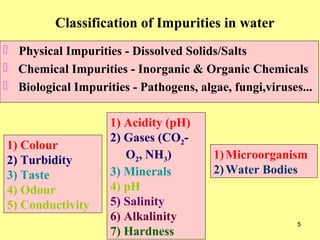
Classification of Impurities in water
 Physical Impurities - Dissolved Solids/Salts
 Chemical Impurities - Inorganic & Organic Chemicals
 Biological Impurities - Pathogens, algae, fungi,viruses...

                    1) Acidity (pH)
                    2) Gases (CO2-
1) Colour
2) Turbidity           O2, NH3)         1) Microorganism
3) Taste            3) Minerals         2) Water Bodies
4) Odour            4) pH
5) Conductivity     5) Salinity
                    6) Alkalinity                        5
                    7) Hardness
Colour
• Colour in water is due to metallic salts of Fe, Mn and due to organic

  substances like humus, peat, algae, weed …
• Industrial activities such as textile, paper & pulp, dyeing, tanneries
• Colour intensities of water sample can be measured using
  tintometer using Platinum cobalt standard colour complex
Turbidity
• It is due to colloidal, extremely fine suspension such as clay, slit,
  finely divided matters, sometimes microorganisms…
• It reflects the optical properties of water in terms of light scattering

 ability instead of transmitting in straight lines.
Conductivity
• The ability of water to conduct electricity, indicates the amount
  of dissolved minerals and gases in water.
• Conductivity measured in micro mhos/cm or MicroSiemns/cm3
                                                                             6
Taste
• Presence of dissolved salts and gases imparts bitter, soapy, brackish
  and palatable taste which normally co-related with odour but it is
  not applicable always the case
• Bitter (Fe, Al, Mn, SO4, Ca(OH)2)
• Soapy (NaHCO3)
• Brackish (High salt content - NaCl)
• Palatable (CO2 and NO3)


Odour
• Domestic and industries activities cause undesirable odour to water
• Industrial effluent of organics, sewage discharge, presence of N, S
  and P contains compounds, metal ion pollution like Fe
• Substances like algae, peat, bacterias
• Grassy odour, peaty odour, offensive odour, tarry and faint odour
                                                                        7
pH

• pH a measure of hydrogen ion activity is used to
express the intensity of acidic or alkaline condition of a
solution.

• The pH scale runs to 0 from 14 with 0 representing
maximum acidity and 14 maximum basicity


                   pH = -log [H+]

                                                             8
Acidity of Water

Acidity is a measure of the effects of combination of
compounds and conditions in water.
It is the power of water to neutralize hydroxyl ions and
is expressed in ppm interms of CaCO3 equivalence.

• Acidity - - - - Free Mineral Acidity
          - - - - CO2 Acidity


                                                       9
MAJOR IMPURITIES OF WATER

  Ionic and dissolved
Cationic                 Anionic       Nonionic and undissolved         Gases
            Alkalinity

Calcium                  Bicarbonate   Turbidity, silt, mud, dirt and    CO2
Magnesium                Carbonate     other suspended matter            H 2S
                         Hydroxide                                       NH3
Sodium                                 Color, Plankton                   CH4
Potassium                Sulfate       Organic matter,                    O2
Ammonium                 Chloride      Colloidal silica,
Iron                     Nitrate       Microorganisms,
Manganese                Phosphate     Bacteria


                                                                            10
Hard Water
 What’s hard water?

 Practically speaking, measurement of:
    •Calcium (Ca) ions
    •Magnesium (Mg) ions

Hardness as calcium carbonate
                                mg/L (ppm)

Soft                             0-17
Moderately hard (Medium)        60-120
Hard                            120-180
Very hard                       180 & over


                                             11
Why be concerned about Hard Water?


• Originally, water hardness was defined as the measure of
  the capacity of the water to precipitate soap

• Hard water does cause soap scum, clogs pipes and clogs
  boilers as lime scale

                                                             12
Hardness of Water

• Hardness  in Water is characteristic that prevents the
‘lathering of soap’ thus water which does not produce lather
with soap solution readily, but forms a white curd is called
hard water.

• Type of Hardness

– Temporary or Carbonate Hardness
– Permanent Hardness or non-carbonate Hardness.


                                                          13
Temporary Hardness

– Temporary Hardness is caused by the presence of dissolved bicarbonate
of calcium, magnesium and other heavy metals and the carbonate of iron.
It is mostly destroyed by more boiling of water, when bicarbonates are
decomposed yielding insoluble carbonates.

Ca(HCO 3 ) 2            Heat       CaCO 3 + H2O + CO2
Calcium bicarbonate            Calcium Carbonate


Mg(HCO 3 ) 2            Heat       Mg(OH) 2          + 2CO2
Magnesium Bicarbonate          Magnesium hydroxide


– Calcium/Magnesium Carbonates thus formed being almost insoluble, are
deposited as a scale at the bottom of vessel, while carbon dioxide escapes
out.


                                                                        14
Permanent Hardness

Non Carbonate Hardness is due to the presence of
chlorides, sulfates of calcium, Magnesium, iron and other
heavy metals
    2C17H35COONa + CaCl2        (C17H35COO)2Ca + 2NaCl
     Sodium          Hardness    Calcium stearate
     stearate
                                 (Insoluble)
     (sodium soap)
    2C17H35COONa + MgSO4         (C17H35COO)2Mg + 2Na2SO4
     Sodium          Hardness     Magnesium stearate
     stearate
                                  (Insoluble)
     (sodium soap)


                                                            15
Units of Hardness
Most Commonly used
• Parts per million (ppm)
1ppm=1 part of CaCO3 equivalence hardness causing substance present in 10 6
parts of water

• Milligrams per liter (mg/litre)
 1mg/L=1mg of CaCO3 equivalence hardness causing substance present in one
liter of water

1mg/L=1ppm
Relationship; 1L water = 1Kg = 1000 g = 1000 X 1000 mg = 106 mg
                   1mg/L = 1mg of CaCO3 eq per 106 mg of water
                        = 1 part of CaCO3 eq per 106 parts of water = 1ppm

• Clare's Degree(oCl)
1o Clarke= 1part of CaCO3 equivalent hardness in 70000 parts of water

• Degrees French (oFr)                                                  16
1o Fr = 1 part of CaCO3 eq per 105 parts of water
CaCO3 equivalent hardness

                                       Mass of hardness          Molecular weight
                                       producing
                                                            X    of CaCO 3
Calcium carbonate equivalent =         substance
                                       Molecular weight of hardness producing
                                       substances
Problem 1
Calculate the calcium carbonate equivalent hardness of a water sample
containing 204mg of CaSO4 per litre

 Solution
 :                                         204       X    100
   Calcium carbonate equivalent hardness =                      = 150 mg of
                                                    136         CaCO 3 /L
                                                                  = 150 ppm


  Note : Mol. Weight of CaCO 3 = 100
        Mol. Weight of CaSO 4   =
  136
                                                                                    17
Calcium carbonate equivalence conversion during
             hardness calculation

     Hardness    Molecular    Multiplication factor
     producing    weight      (in terms of CaCO3
     substance                    equivalence)
    Ca(HCO3)2    162         100/162 or 50/81
    Mg(HCO3)2    146         100/146 or 50/73
    CaSO4        136         100/136 or 50/68
    CaCl2        111         100/111 or 50/55.5
                 120         100/120 or 50/60
    MgSO4
                  95         100/95 or 50/47.5
    MgCl2
                 100         100/100 or 50/50
    CaCO3         84         100/84 or 50/42
    MgCO3         44         100/44 or 50/22
    CO2           61         100/61 or 50/61
    HCO-3         17         100/17 or 50/17
    OH-           60         100/60 or 50/30
    CO32-
                                                      18
Problems
 1. A water sample from an industry in Bombay had the following data
  Mg(HCO3)2 = 16.8mg/L, MgCl2 = 19 mg/L, CaCO3 = 20 ppm, MgSO4 =24.0mg/L
 and KOH = 1 ppm. Calculate the temporary, permanent and total hardness of
 the water sample.

  Solution
   Step 1 conversion in to CaCO 3
   equivalent

   Constituent            quantity           Conversion            Hardness
    present                                    factor
Mg(HCO3)2            16.8 mg/L           100/146              16.8 *100/146 =   11.5ppm
                     19.0 mg/L           100/95               19.0*100/95 =      20ppm
MgCl2
                                                              20.0*100/100 =    20 ppm
CaCO3                20 ppm              100/100
                                                              24.0*100/120 =     20 ppm
MgSO4                24.0 mg/L           100/120


Calculatio
n
 Temp. Hardness = 31.5 ppm            P. Hardness = 40 ppm


                       Tot. Hardness =71.5 ppm
                                                                                     19
Draw backs (or) Disadvantages of Hard Water

Domestic Use                            Industrial Use

 1. Washing                         1. Textile Industry
 2. Bathing                         2. Sugar Industry
 3. Drinking                        3. Dyeing Industry
 4. Cooking                         4. Paper Industry
                                    5. Pharmaceutical Industry
The sticky precipitate adheres
on the fabric/cloth and gives
spots and streaks. Fe salts stain   6. In Steam generation in
the cloths.                            Boilers
Produces sticky scum on the
bath tub and the body


Bad to the digestive system
and calcium oxalate formation
is possible in urinary tracts

 Requires more fuel and time.
 Certains food don’t cook soft
 and also gives unpleasant
 taste                                                          20
Boiler troubles due to Hard Water

   1. Scale and                      1.
   Sludge                            Sludge               Slimy loose precipitate
                                                          called sludge
   2. Caustic                                             suspended in water
   embitterment
   3. Priming and
   Foaming
   4. Boiler                                                   water
   corrosion
                                                           Boiler
                                                           wall
 Sludge is a soft, loose and slimy precipitate formed within the
 boiler. It can be easily scrapped off with a wire brush.
 It is formed at comparatively colder portions of the boiler and
 collects in areas of the system, where the flow rate is slow or at
 bends.
 It is formed by substances which have greater solubility's in hot
 water than in cold water, e.g. MgCO 3 , MgCl 2 , CaCl 2 , MgSO 4 etc.,
                                                                          21
Remedy: Sludges can be removed using wire brush or mild acid
1. Scale
                                         Hard adherent coating
                                         on inner walls of boiler


                                       water

     Boiler
     wall

Scales are hard substances which sticks very firmly to the
inner surfaces of the boiler wall.
Scales are difficult to remove even with the help of a hammer
and chisel.
Examples: CaSO 4 , CaCO 3 , Mg(OH) 2                                22
23
Reasons for formation of scale


  1. Presence of Ca(HCO 3 ) 2 in low pressure boilers


  Ca(HCO 3 ) 2                   CaCO 3 + H2O + CO2            Low pressure boilers but in high
                                                               pressure boilers it is soluble by
  Calcium bicarbonate             Calcium Carbonate (scale)    forming Ca(OH) 2

   2. Presence of CaSO 4 in high pressure boilers

   T oC                 Solubility of CaSO 4
                                                              4. Presence of SiO 2
   15                         3200 ppm
   230                        15 ppm                          It forms insoluble hard adherent
   320                        27 ppm                          CaSiO 3 and MgSiO 3 as scales
   Cold water                  soluble
   Super heated water        Insoluble
   (scale)
3. Presence of MgCl 2 in high temperature boilers


 MgCl 2 + 2 H 2 O                  Mg (OH)2 + 2HCl
 Magnesium chloride                scale

Mg(OH) 2 can also be generated by thermally decomposing Mg(HCO 3 ) 2
                                                                                            24
Disadvantages of scale formation

1. Fuel wastage – scales have low thermal conductivity
2. Degradation of boiler material and increases of risk of
   accident
3. Reduces the efficiency of the boiler and- deposit on the valves
   and condensers
4. The boiler may explode – if crack occurs in scale


                      Remedies: Removal of scale

1. Using scrapper, wire brush often
2. By thermal shock- heating and cooling suddenly with cold water
3. Using chemicals – 5-10% HCl and by adding EDTA


                                                                 25
Prevention of scale
                         formation
  Scale formation can be prevented by two methods
  1.    Internal conditioning or Internal Treatment
  2.    External conditioning or External treatment- will be discussed later

1. Internal conditioning methods - of boiler water to prevent scale formation

   1.    Phosphate conditioning – addition of phosphate compound
   2.    Carbonate conditioning – addition of carbonate compound
   3.    Calgon conditioning – addition of sodium hexa meta phosphate
   4.    Colloidal conditioning – spreading of organic compounds like tannin, agar
         gel
   5.    Sodium Aluminate – removes oil and silica
   6.    Complexometric method – using EDTA (refer expt. 1 chemistry lab manual)
1. Phosphate conditioning

Scale formation can be prevented by adding sodium phosphate to the boiler water which
reacts with the hardness producing ions and forms easily removable phosphate salts of
respective ions
  3CaCl 2 (Boiler water) + 2 Na 3 PO 4                Ca 3 (PO 4 ) 2 + 6 NaCl
        Calcium                  Sodium          calcium phosphate
        chloride                 phosphat        (non adherent and
                                 e               can be removed by                      26
                                                 blow down method)
Selection of Phosphate compound

Calcium can not be precipitated below a pH = 9.5, hence the selection of
phosphate has to be based on the pH of the boiler feed water.

 NaH 2 PO 4 (acidic in nature) ,
 Na 2 HPO 4 (weakly alkaline in
 nature),
 Na 3 PO 4 (Alkaline in nature)


2. Carbonate conditioning

CaSO 4 (Boiler water) + Na 2 CO 3           CaCO 3 +
Na 2 SO 4
Calcium                 Sodium         calcium carbonate
 sulfate                   carbonate
                                       (non adherent loose
                                       sludge and can be
                                       removed by blow
                                       down method)


Caution: Excess Na 2 CO 3 can result in caustic embrittlement


                                                                           27
3. Calgon conditioning

  Na 2 [Na 4 (PO 3 ) 6                  2Na+   +
  [Na 4 P 6 O 18 ] 2-
  Calgon – sodium
  hexa meta
  phosphate


2CaSO 4 (Boiler water) + [Na 4 P 6 O 18 ] 2-           [Ca 2 P 6 O 18 ] 2- + 2Na 2 SO 4
Calcium
                                                   Soluble complex ion
sulfate
                                                   of calcium - can be
                                                   removed easily


Calgon tablets are used in the cleaning of washing machine
drums


                                                                                          28
II. Caustic embitterment

 Excess sodium carbonate used up for removing hardness can also
result in the formation of NaOH in high pressure boilers.

NaOH has better mobility and can percolate into fine cracks present
in boiler walls.
                     Na2CO3 + H2O → 2 NaOH + CO2

 NaOH gets concentrated in the fine cracks present in the boiler
walls.

 A concentration cell corrosion is established between the conc.
NaOH and dilute NaOH solution in contact with boiler walls.

 Concentrated NaOH region behaves as anode thus resulting in
corrosion of boiler leading to the formation of sodium ferroate.
Remedies: (i) Use phosphate salts instead of sodium carbonate
(ii) use Na 2 SO 4 or agar-agar gel compounds to fill the fine cracks.

                                                                         29
III. Priming and foaming

                                       Foaming
                                       It is the production of continuous foam
                                       or hard bubblers in boilers. Foaming is
                                       due to the presence of substance like
                                       oil in boiling water.


                                       Priming
   Foamin                              It is the process in which some
   g                   Normal bubble   particles in water are carried along
                                       with the steam. The resulting process
                                       is called as wet steam or carry over.
                                       The process of formation of wet steam
                                       in boilers is called as priming.

                                       Causes of Priming,
                                       1.   Presence of dissolved salts
   Priming                             2.   High velocity steam due to sudden
                        Carry over          boiling
                        bubble
                                       3.   Improper boiler design

  Disadvantages of Priming and
  foaming – refer Jain and Jain Text                                            30
  book
IV. Boiler
 corrosion
Degradation or destruction of boiler materials (Fe) due to the
chemical or electrochemical attack of dissolved gases or salts is
called boiler corrosion

Boiler corrosion is of three types

1. Corrosion due to dissolved O 2
2. Corrosion due to dissolved CO 2
3. Corrosion due to acids formed by dissolved
   salts

1. Corrosion due to dissolved oxygen
(DO)
 2 Fe + 2 H2O + O2               2 Fe(OH)2

   4 Fe(OH)2 + O2          2 [Fe2O3.2H2O]
    Ferrous                        Rust
    hydroxide

                                                                    31
Removal of Dissolved Oxygen (DO)

     1. By the addition of chemicals
     The dissolved oxygen present in the boiler feed water can be removed by the
     addition of sodium sulphite or hydrazine and the reactions can be written as below

      2 Na2SO3       + O2                  2 Na2SO4
       Sodium             DO                Sodium
       sulphite                             sulphate               Water feed


      Na2S        + 2O2              Na2SO4

        N2H4 + O2                N2 + 2H2O
                                                                   O2                 To vacuum
      Hydrazine                 Nitrogen


                                                                                Steam jacket
    2. By mechanical deaeration

It comprises of a tall stainless tower with different
layers capped with baffles to facilitate multiple                                      Perforated
                                                                                       plate
equilibration.

The entire chamber is vacuumized and also maintained
at high tempt using perforated heating plates on the
walls.                                                                             Deaerate     32
                                                                                   d water
2. Corrosion due to dissolved
CO 2
Presence of bicarbonate salts of either magnesium or calcium also causes the release
of CO 2 inside the boiler apart from the dissolved CO 2

  Mg(HCO 3 ) 2            MgCO 3 + H 2 O +
  CO 2

 CO 2 + H 2 O            H 2 CO 3 (causes slow
 corrosion)
Removal
1.   It can be removed by the addition of ammonia
     2 NH 4 OH + CO 2              (NH 4 ) 2 CO 3   +
     H 2O
 3. Corrosion due to dissolved
 salts
 MgCl2 + 2 H2O           Mg(OH)2 + 2HCl

 Fe + 2 HCl              FeCl2 + H2

 FeCl2 + 2 H2O            Fe(OH)2 + 2HCl


                                                                                  33
Softening of hard water –
   External treatment


     Attn: Part B Question


                             34
II External treatment of water – External Conditioning of water
 Softening of hard water can be done by the following
    methods
 1.   Lime soda process
 2.   Zeolite methods
 3.   Ion exchange resin method
 4.   Mixed bed deionizer method


1. Lime soda process
It is a process in which Lime (Ca(OH) 2 ) and soda (Na 2 CO 3 ) are added to the hard
water to convert the soluble calcium and magnesium salts to insoluble compounds
by a chemical reaction. The CaCO 3 and Mg(OH) 2 so precipitated are filtered off
and removed easily.

It is further divided in to two types
1. Cold lime soda process
2. Hot lime soda process


                                                                                 35
1. Cold lime soda process


Step 1
 In this process a calculated quantity of Ca(OH)2 (lime) and Na2CO3 (soda) are
 mixed with water at room temperature and added to the hard water. The following
 reactions takes place depending on the nature of hardness

 Chemical reactions

           If it is permanent hardness and due to calcium salt
           Ca2+ + Na2CO3                CaCO3 + 2Na+ (soda)
                              slimy suspended precipitate


           If it is due to Magnesium salt
           Mg2+ + Ca(OH)2               Mg(OH)2 + Ca2+ (lime)
                              slimy suspended precipitate


           Ca2+ + Na2CO3               CaCO3 + 2Na+ (soda)
                            slimy suspended precipitate
                                                                               36
Chemical reactions contd..

         If it is Temporary hardness and due to calcium salt
         Ca(HCO3)2 + Ca(OH)2                          2CaCO3 + 2H2O
                                           slimy suspended precipitate


         If it is due to Magnesium salt
         Mg(HCO3)2 + 2Ca(OH)2                           2CaCO3 + Mg(OH)2 + 2H2O
                                                   slimy suspended precipitates
Step 2

    The precipitates CaCO3 and Mg(OH)2 are very fine and forms sludge like
    precipitates in the boiler water and are difficult to remove because it does not
    settle easily making it difficult to filter and the removal process. Finally reduces
    the efficiency of the boiler.

    Therefore, it is essential to add small amount of coagulant (such as Alum,
    Aluminium sulfate, sodium aluminate etc) which hydrolyses to flocculent
    precipitate of Al(OH)3 which entraps the fine precipitates.

  NOTE:     Particles finer than 0.1 µm (10-7m) in water remain continuously in motion due to electrostatic charge
  (often negative) which causes them to repel each other. Once their electrostatic charge is neutralized by the use of
  coagulant chemical, the finer particles start to collide and agglomerate (combine together) under the influence of
                                                                                                                 37
  Van der Waals's forces. These larger and heavier particles are called flocs.
When coagulants are added flocculation takes place followed by the
formation of flocculants.

NaAlO2 + 2H2O            NaOH + Al(OH)3
Coagulant                      Flocculent- Gelatinous
                                  precipitate which
                                   entraps the fine
                               precipitates of CaCO3
                                    and Mg(OH)2


 Al2(SO4)3   + 3 Ca(HCO3)2           2Al(OH)3           + CaSO4 + CO2
 Aluminium      Hard water
 sulfate        sample             Flocculent- Gelatinous
                                      precipitate which
                                       entraps the fine
                                   precipitates of CaCO3
                                        and Mg(OH)2


The Al(OH)3 formed by the addition of coagulants initiates the process of
flocculation and entraps the fine precipitates and becomes heavy. The
heavier flocs then settles at the bottom and filtered off easily.


                                                                        38
Continuous cold lime soda softener


      Chemicals
                                                      Hard water
      (soda+lime
                                                      feed
      +coagulant)
      feed
                                                         Softened
                                                         water
Wood fiber
filter


 Stirrer
 paddles


                                   Sedimented sludge (CaCO3,
                                   Mg(OH)2
                                                                    39
2. Hot lime soda Process

In this process a calculated quantity of Ca(OH)2 (lime) and Na2CO3 (soda) are
mixed with hot water at a temperature range of 80 to 150oC and added to the hard
water. The following reactions takes place depending on the nature of hardness

 Advantages of Hot Lime Soda Process

1.    The reaction between hardness producing substance and lime soda proceeds at a faster
      rate
2.    The precipitates and sludges formed are settled at the bottom easily and hence No
      coagulants are required
3.    The dissolved gases such as CO2 escapes and the water becomes free from dissolved
      gases
4.    It produces soft water with the residual hardness of 15-30ppm in contrast to the cold lime
      soda process which produces soft water with 50-60ppm of residual hardness

 Hot lime soda Plant consists of three parts

     1. Reaction tank: water, chemicals and steam are mixed
     2. Conical sedimentation tank : sludge settles down
     3. Sand filter : complete removal of sludge from the soft water is ensured              40
Continuous Hot Lime soda Process


         Hard water feed


          Super heated steam
                                                      Chemicals feed (lime
                                                      and soda)

          Reaction tank
                                                              Soft water
                                                                                         r
                                                                                dl   aye
Conical sedimentation                                                       san
                                                                     Fine                 yer
tank
                                                                                  a nd la
                                                                            r se s
                                                                      Coa
                                                  n
      Precipitated sludge                    a tio                   Gravellayer
      (CaCO3, Mg(OH)2                       ltr
                                 Sludge
                                          Fi nk
                                            ta
                                 outlet


                                                                             Filtered soft
                                                                             water


                                                                                      41
Advantages of Lime soda process


1. It is very economical compared to other methods
2. Iron and manganese salts are also removed by this process
3. It increases the pH of the softened water hence corrosion is minimized
   also pathogenic bacteria

Disadvantages of Lime soda process


1. Disposal of large amount of sludge (insoluble precipitates) poses a
   problem
2. This can remove hardness to the extent of 15ppm which is not good for
   boilers


                                                                            42
Calculation of lime and soda required for the softening of hard water by
the lime soda process

    Hardness producing              Chemical reaction with lime and soda                  Need
        substance
   Permanent Hardness
   Ca Salts              CaCl2 + Na2CO3         CaCO3 + 2NaCl                       S

   Mg salts              MgSO4 + Ca(OH)2          Mg(OH)2    + CaSO4                L+S
                         CaSO4 + Na2CO3           CaCO3      +Na2SO4


   Temp. Hardness
   Ca(HCO3)2             Ca(HCO3)2 + Ca(OH)2            2CaCO3    + 2H2O             L
   Mg(HCO3)2                                                                        2L
                         Mg(HCO3)2 + 2Ca(OH)2           2CaCO3   + Mg(OH)2 + 2H2O

   Acids
   HCl                                                                              L+S
                         2H+ + Ca(OH)2           Ca2+       + 2H2O
   H2SO4
                         Ca2+ + Na2CO3           CaCO3 + 2Na+
                                                                                    L-S

   HCO3-
                         HCO3- + Ca(OH)2         CaCO3 + H2O + CO32-

                                                                                    L+S
   FeSO4
                         Fe2+ + Ca(OH)2            Fe(OH)2     + Ca2+
                         Ca2+ + Na2CO3             CaCO3      + 2Na+                L/2
                                                                                                 43
   NaAlO2
                         NaAlO2 + H2O              Al(OH)3    + NaOH
Rules
1.     If Ca(HCO3)2 and Mg(HCO3)2 are considered as ions (Ca2+ + 2HCO3-) and (Mg2+ + 2HCO3-)
       respectively then the calculation result will be the same based on the ability of the ions to
       take up bicarbonate ions
2.     If treated water found to contain excess of OH - and CO32- ions these are formed from excess
       equivalent each of Ca(OH)2 and Na2CO3 and hence these excess amounts should be added
       to the calculation (in temp. hardness and perm. hardness)
3.     When the impurities are given as CaCO3 and MgCO3 present in water it should be
       considered as due to bicarbonates of calcium and magnesium respectively
4.     Substances like NaCl, KCl, Na2SO4, SiO2, Fe2O3 etc do not contribute to hardness and
       therefore, they do not consume any soda or lime and hence if these present need not be
       taken in to consideration during calculation.
5.     Soda (Na2CO3) neutralizes only permanent hardness

     Molecular weight of lime = 74
     Molecular weight of soda = 106
     Molecular weight of CaCO3 = 100

     Therefore, 100 parts by mass of CaCO3 are equivalent to
     (i)   74 parts by mass of Ca(OH)2
                                                                                                       44
     (ii) 106 parts by mass of Na2CO3
Therefore, Lime requirement for softenening


=            74       T.H of Ca2++ 2 x T.H of Mg2+ + P.H of (Mg2+ + Fe2+ + Al3+) + CO2 + H+ +
             100      HCO3- - NaAlO2/2
                                                                            X Vol .of water (L)

                   T.H = temporary hardness
                   P.H = Permanent Hardness

llIly, Soda requirement for softenening


=            106       P.H of (Ca2+ + Mg2+ + Fe2+ + Al3+) + H+ - HCO3-   X Vol .of water (L)
             100


    Problem 1
    Calculate the amount of lime required for softening 5,000 litres of hard water
    containing 72 ppm of MgSO4 (mol wt = 120) Ans = 222g


                                                                                                  45
Solution
Step 1 List out the given data
Given data : Hardness 72 ppm due to MgSO4; water qty = 5000 litres; mol. wt. MgSO4 = 120

Step 2 calculate the CaCO3 equivalent

Hardness producing       Quantity (ppm)         Multiplication factor   CaCO3 equivalent
substance                                                               hardness (ppm or
                                                                        mg/L)
MgSO4                    72                     100/120                 72 X (100/120) = 60


 Step 3 calculation of lime requirement


  Lime required = 74/100 (hardness due to MgSO4) x vol. of water

                  = 74/100 (60 mg/L) x 5000 L
                  = 222,000 mg
                   = 222 g


                                                                                              46
Problem 2
 Calculate the amount of lime and soda required for softening 50,000 litres of hard water containing:
 Mg(HCO3)2 = 144 ppm, CaCO3 = 25 ppm, MgCl2 = 95ppm, CaCl2 = 111ppm, Fe2O3 = 25ppm and
 Na2SO4 = 15ppm
 Solution

Step 1 List out the given data
Given data : MgCO3 = 144 ppm, CaCO3 = 25 ppm, MgCl2 = 95ppm, CaCl2 = 111ppm, Fe2O3 =
             25ppm and Na2SO4 = 15ppm

Step 2 calculate the CaCO3 equivalent


 Hardness producing        Quantity (ppm)                  Multiplication factor    CaCO3 equivalent
 substance                                                                          hardness (ppm or
                                                                                    mg/L)
 Mg(HCO3)2                 144                             100/84                   144 x(100/84) = 171.4
 CaCO3                     025                             100/100                  25 x (100/100) = 25.0
 MgCl2                     095                             100/95                   95 x (100/95) = 100.0
 CaCl2                     111                             100/111                  111 x (100/111) = 100.0
                           025 (does not cause hardness)
 Fe2O3
                           015 (does not cause hardness)
 Na2SO4
Ca(HCO3)2 + Ca(OH)2           2CaCO3      + 2H2O;     Mg(HCO3)2 + 2Ca(OH)2         2CaCO3     + Mg(OH)2 + 2H2O

 MgCl2 + Ca(OH)2          Mg(OH)2     + CaCl2 ; CaCl2 + Na2CO3           CaCO3     + Na2SO4
                                                                                                              47
What happens when lime is treated with CaCl 2?
Step 3 calculation of lime requirement


Lime required = 74/100 ( {2 x MgHCO3} + CaCO3 + MgCl2 in terms of CaCO3 eq) x vol. of water


               = 74/100 (2 x 171.4 + 25.0 +100.0) mg/L x 50,000 L
               = 74/100 (467.8) mg x 50,000
                = 17, 309,000 mg
  Answer       = 17. 31 kg

  Step 4 calculation of soda requirement

  soda required = 106/100 ( MgCl 2 + CaCl2 in terms of CaCO3 eq) x vol. of water


                = 106/100 (100 +100.0) mg/L x 50,000 L
                = 106/100 (200) mg x 50,000
                 = 10, 6,00,000 mg
   Answer        = 10. 6 kg


                                                                                              48
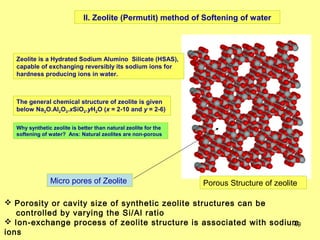
II. Zeolite (Permutit) method of Softening of water


  Zeolite is a Hydrated Sodium Alumino Silicate (HSAS),
  capable of exchanging reversibly its sodium ions for
  hardness producing ions in water.


  The general chemical structure of zeolite is given
  below Na2O.Al2O3.xSiO2.yH2O (x = 2-10 and y = 2-6)

  Why synthetic zeolite is better than natural zeolite for the
  softening of water? Ans: Natural zeolites are non-porous


               Micro pores of Zeolite                            Porous Structure of zeolite

 Porosity or cavity size of synthetic zeolite structures can be
   controlled by varying the Si/Al ratio
 Ion-exchange process of zeolite structure is associated with sodium
                                                                    49
ions
Zeolite softener


 Hard water in


                                            Hard water spray


                        Zeolite bed
                            Gravel


Injector


                                               Softened water
NaCl storage     To
                 sink


                                                                50
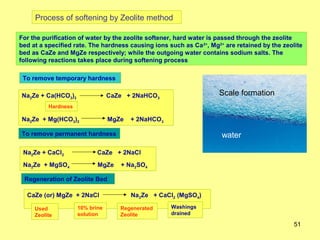
Process of softening by Zeolite method

For the purification of water by the zeolite softener, hard water is passed through the zeolite
bed at a specified rate. The hardness causing ions such as Ca 2+, Mg2+ are retained by the zeolite
bed as CaZe and MgZe respectively; while the outgoing water contains sodium salts. The
following reactions takes place during softening process

 To remove temporary hardness

Na2Ze + Ca(HCO3)2                CaZe + 2NaHCO3                      Scale formation
          Hardness

Na2Ze + Mg(HCO3)2                MgZe   + 2NaHCO3

To remove permanent hardness                                          water

 Na2Ze + CaCl2              CaZe + 2NaCl
 Na2Ze + MgSO4              MgZe    + Na2SO4

 Regeneration of Zeolite Bed

  CaZe (or) MgZe + 2NaCl                Na2Ze + CaCl2 (MgSO4)

     Used            10% brine      Regenerated     Washings
     Zeolite         solution       Zeolite         drained

                                                                                               51
Limitations of Zeolite process


1.   If the water is turbid ---- then the turbidity causing particles clogs the pores of the Zeolite
     and making it inactive
2.   The ions such as Mn2+ and Fe2+ forms stable complex Zeolite which can not be regenerated
     that easily as both metal ions bind strongly and irreversibly to the zeolite structure.
3.   Any acid present in water (acidic water) should be neutralized with soda before admitting
     the water to the plant, since acid will hydrolyze SiO 2 forming silicic acid

Advantages of Zeolite process

1.   Soft water of 10-15 ppm can be produced by this method
2.   The equipment occupies less space
3.   No impurities are precipitated, hence no danger of sludge formation in the treated water
4.   It does not require more time and more skill

Disadvantages of Zeolite process

1.   Soft water contains more sodium salts than in lime soda process
2.   It replaces only Ca2+ and Mg2+ with Na+ but leaves all the other ions like HCO3- and CO32-
     in the softened water (then it may form NaHCO 3 and Na2CO3 which releases CO2 when
     the water is boiled and causes corrosion)
3.   It also causes caustic embitterment when sodium carbonate hydrolyses to give NaOH            52
How abo
                                 ut
                         taking a
                      few of th
                               ese.

    Sorry- I’m
     Loaded –
see the n
          ext guy
                         Tak
                      thes e
                           eM
                     &C       g
                         a
                    as y ions
                        ou g
                             o


                        53
III. Ion-Exchange resin (or) deionization (or) demineralization process


                                               Ion exchange resin

                                       Ion exchange resins are insoluble, cross linked,
                                       long chain organic polymers with a microporous
                                       structure, and the functional groups attached to
                                       the chain is responsible for the “ion-exchange”
                                       properties.

Cation            Resin after
exchange Resin    treatment                                                        54
In general the resins containing acidic functional groups (-COOH, -SO 3H etc) are capable of
exchanging their H+ ions with other cations, which comes in their contact; whereas those
containing basic functional groups ( -NH 2, =NH as hydrochlorides) are capable of exchanging
their anions with other ions, which comes in their contact.

Based on the above fact the resins are classified into two types
1.   Cation exchange resin (RH+) –
     Strongly acidic (SO3-H+) and weakly acidic (COO-H+) cation exchange resins
2.   Anion Exchange resin (ROH-) –

     Strongly basic (R4N+OH-) and weakly basic (RNH2+OH-) anion exchange resins


                               Continued… next slide


                                                                                       55
Structure of Cation and Anoin exchange resins

Cation exchange resin           Anion exchange resin


                                            R = CH3


                                                       56
Ion exchange purifier or softener


       Hard
       water


                                                                                                     Gravel
                         Cation exchange Resin                  Anion exchange Resin                 bed


Injector
                                                                                                        Injector


   Acid
   solution for   Wastages to
   regeneratio    sink                                                                 Alkaline solution for
   n of resin                                           Wastages to
                                                                                       regeneration of resin
                                                        sink
                                                 pump


                                                                                                         57
                                                                                        Soft water
Process or Ion-exchange mechanism
                   involved in water softening

 Reactions occurring at Cation exchange resin


 2 RH+ + Ca2+ (hard water)    R2Ca2+ + 2 H+
 2 RH+ + Mg2+ (hard water)     R2Mg2+ + 2 H+


Reactions occurring at Anion exchange resin

2 ROH- + SO42- (hard water)    R2SO42+ + 2 OH-
2 ROH- + Cl-   (hard water)    R 2Cl- + 2 OH-


At the end of the process

H+ + OH-          H 2O


                                                   58
Regeneration of ion exchange resins

Regeneration of Cation exchange resin

R2Ca2+ + 2H+ (dil. HCl (or) H2SO4)       2 RH+ + Ca2+ (CaCl2, washings)

Regeneration of Anion exchange resin

R2SO42- + 2OH- (dil. NaOH)              2 ROH- + SO42- (Na2SO4, washings)

Advantages
1. The process can be used to soften highly acidic or alkaline waters
2. It produces water of very low hardness of 1-2ppm. So the treated
   waters by this method can be used in high pressure boilers


Disadvantages
1. The setup is costly and it uses costly chemicals
2. The water should not be turbid and the turbidity level should not be
   more than 10ppm                                                        59
IV. Softening of water by Mixed Bed deioniser

  Description and process of mixed bed deionizer

   1.   It is a single cylindrical chamber containing a mixture of anion and cation exchange
        resins bed
   2.   When the hard water is passed through this bed slowly the cations and anioins of the
        hard water comes in to contact with the two kind of resins many number of times
   3.   Hence, it is equivalent to passing the hard water many number of times through a series
        of cation and anion exchange resins.
   4.   The soft water from this method contains less than 1ppm of dissolved salts and hence
        more suitable for boilers

Hard water


                     c a c a                             Anion exchange
                                                         resin
                     c Mixed bed                                              Mixed
                    a deionizer a                                             resin bed
                                 a
                      c a cc                                Cation exchange
                                                            resin


                                         Demineralised
                                         water
                                                                                                  60
Regeneration of mixed bed deionizer


1.   When the bed (resins) are exhausted or cease to soften the water, the mixed bed is back washed
     by forcing the water from the bottom in the upward direction
2.   Then the light weight anion exchanger move to the top and forms a upper layer above the
     heavier cation exchanger
3.   Then the anion exchanger is regenerated by passing caustic soda solution (NaOH) from the top
     and then rinsed with pure water
4.   The lower cation exchanger bed is then washed with dil.H 2SO4 solution and then rinsed.
5.   The two beds are then mixed again by forcing compressed air to mix both and the resins are now
     ready for use
                                                                                         Low
                                                             NaOH
                                                                                         density
                                                                                         resin


       c a c a                  c a c a                                                     c aa c
                                                          aa a a a a                       cRegenerated a
       c Mixed bed              c Exhausted                                                             a


                                                                         H2
                                                           Back washed
      a deionizer a            a Mixed bed a
                                                                                            Mixed bed


                                                                          SO
                                                                                                        a


                                                                             4
                                                                                            deionizer
                   a                        a             ccccc c
        c a cc                   c a cc                                                     c   a c c


                           Back                                             Compressed
                           wash                 High                        air                             61
                           water                density
                                                resin
Treatment of Municipal Drinking Water

• Screening – to remove floating matters
• Aeration – to remove dissolved gas and
  improve taste of water
• Sedimentation & Coagulation – this is done
  after chemical treatment (L-S)
• Filtration – Gravity (or) Pressure sand filters
• Sterilization and disinfection
• Storage and distribution

               Attn: Part B Question                62
63
Desalination of seawater
• Desalination, refers to any process that
  removes some amount of salt and
  other minerals from water.

 Technologies for desalination process
• Reverse Osmosis (Pressure membrane process)
• Electrodialysis membrane process


           Attn: Part B Question                64
Pressure Membrane
                          Processes
• Microfiltration (MF), which can remove particles ranging in size
  from 10-100 μm. It is operated in the pressure range of 10 psig.

• Ultrafiltration (UF), which can remove particles ranging in size
  from 0.01 to 10 μm. It is operated in the pressure range of 15 psig.

• Nanofiltration (NF), which can remove particles size from 0.001
  μm to 0.01 μm. It is operated in the pressure range of 75-250 psig.

• Reverse osmosis (RO), which can remove particles in the size
  range of 0.1-1.0 nm. It operates in the pressure range of 200-1200
  psig.
                                                                   65
Principle - Reverse osmosis
 When two solutions of unequal concentration are separated by a
  semi-permeable membrane, flow of solvent takes place from
  dilute to concentration side, due to increase in osmostic pressure,
  which is termed as osmosis.
 However, when a hydrostatic pressure in excess of osmotic
  pressure is applied on the concentrated side, the solvent flow is
  reversed from concentrated side to dilute side, across the
  membrane. This principle is termed as reverse osmosis.
 The semi-permeable membrane (in reverse osmosis) is selective
  in not permitting the passage of dissolved solute particles such as
  molecules, ions, etc.) It permits only the flow of water molecules
  (solvent) from the concentrated to dilute side.
 Cellulose acetate, polyamide, etc., are used as membrane
 Reverse osmosis process requires only mechanical force to
  generate the required hydrostatic pressure.
 Hydrostatic pressure generated is in the order of 15-40 Kg m-266
Reverse Osmosis


                  67
Principle -Electrodialysis
 Electrodialysis is an electrochemical process whereby electrically charged
  particles, ions, are transported from a raw solution (retentate, diluate) into a
  more concentrated solution (permeate, concentrate) through ion-selective
  membranes by applying an electric field.


                                                                              68
Theory of Electrodialysis
• Electrodialysis chamber comprises of sheet like barriers made
  out of high-capacity, highly cross-linked ion exchange resins that
  allow passage of ions but not of water.
• There are two types : (a) Cation exchange and (b) Anion
  exchange membranes
• Cation exchange membranes consists of an insoluble matrix and
  mobile cation reside in the pore space that allows the pass
  through of only cations.
• Anion exchange membranes consists of an insoluble matrix and
  mobile anion reside in the pore space that allows the pass
  through of only anions.
• Cation- and Anion- exchange membranes are installed
  alternatively in the tank.
• By impressing electricity on the electrodes, the positive anode
  attracts negative ions in solution, while the negative cathode
  attracts positive ions in the solution.                        69

Unit 1 water_technology

  • 1.
    UNIT - I WATERTECHNOLOGY Dr. RupamSingh CY101 ENGG. CHEM. 1
  • 2.
    “Without food, humancan survive for number of days, but water is such an essential that without it one cannot survive”. “Although water is nature’s most wonderful, abundant and useful compound yet is also the most misused one”. 2
  • 3.
  • 4.
    Sources of Water A)Surface Waters Rain Water - Pure but contaminated with gases River Water - High dissolved salts moderate organics Lake Water - Const. composition but high organics Sea Water - High salinity, pathogens, organics B) Underground Waters Spring/Well Water - Crystal clear but high dissolved salts and high purity from organics 4
  • 5.
    Classification of Impuritiesin water  Physical Impurities - Dissolved Solids/Salts  Chemical Impurities - Inorganic & Organic Chemicals  Biological Impurities - Pathogens, algae, fungi,viruses... 1) Acidity (pH) 2) Gases (CO2- 1) Colour 2) Turbidity O2, NH3) 1) Microorganism 3) Taste 3) Minerals 2) Water Bodies 4) Odour 4) pH 5) Conductivity 5) Salinity 6) Alkalinity 5 7) Hardness
  • 6.
    Colour • Colour inwater is due to metallic salts of Fe, Mn and due to organic substances like humus, peat, algae, weed … • Industrial activities such as textile, paper & pulp, dyeing, tanneries • Colour intensities of water sample can be measured using tintometer using Platinum cobalt standard colour complex Turbidity • It is due to colloidal, extremely fine suspension such as clay, slit, finely divided matters, sometimes microorganisms… • It reflects the optical properties of water in terms of light scattering ability instead of transmitting in straight lines. Conductivity • The ability of water to conduct electricity, indicates the amount of dissolved minerals and gases in water. • Conductivity measured in micro mhos/cm or MicroSiemns/cm3 6
  • 7.
    Taste • Presence ofdissolved salts and gases imparts bitter, soapy, brackish and palatable taste which normally co-related with odour but it is not applicable always the case • Bitter (Fe, Al, Mn, SO4, Ca(OH)2) • Soapy (NaHCO3) • Brackish (High salt content - NaCl) • Palatable (CO2 and NO3) Odour • Domestic and industries activities cause undesirable odour to water • Industrial effluent of organics, sewage discharge, presence of N, S and P contains compounds, metal ion pollution like Fe • Substances like algae, peat, bacterias • Grassy odour, peaty odour, offensive odour, tarry and faint odour 7
  • 8.
    pH • pH ameasure of hydrogen ion activity is used to express the intensity of acidic or alkaline condition of a solution. • The pH scale runs to 0 from 14 with 0 representing maximum acidity and 14 maximum basicity pH = -log [H+] 8
  • 9.
    Acidity of Water Acidityis a measure of the effects of combination of compounds and conditions in water. It is the power of water to neutralize hydroxyl ions and is expressed in ppm interms of CaCO3 equivalence. • Acidity - - - - Free Mineral Acidity - - - - CO2 Acidity 9
  • 10.
    MAJOR IMPURITIES OFWATER Ionic and dissolved Cationic Anionic Nonionic and undissolved Gases Alkalinity Calcium Bicarbonate Turbidity, silt, mud, dirt and CO2 Magnesium Carbonate other suspended matter H 2S Hydroxide NH3 Sodium Color, Plankton CH4 Potassium Sulfate Organic matter, O2 Ammonium Chloride Colloidal silica, Iron Nitrate Microorganisms, Manganese Phosphate Bacteria 10
  • 11.
    Hard Water What’shard water? Practically speaking, measurement of: •Calcium (Ca) ions •Magnesium (Mg) ions Hardness as calcium carbonate mg/L (ppm) Soft 0-17 Moderately hard (Medium) 60-120 Hard 120-180 Very hard 180 & over 11
  • 12.
    Why be concernedabout Hard Water? • Originally, water hardness was defined as the measure of the capacity of the water to precipitate soap • Hard water does cause soap scum, clogs pipes and clogs boilers as lime scale 12
  • 13.
    Hardness of Water •Hardness in Water is characteristic that prevents the ‘lathering of soap’ thus water which does not produce lather with soap solution readily, but forms a white curd is called hard water. • Type of Hardness – Temporary or Carbonate Hardness – Permanent Hardness or non-carbonate Hardness. 13
  • 14.
    Temporary Hardness – TemporaryHardness is caused by the presence of dissolved bicarbonate of calcium, magnesium and other heavy metals and the carbonate of iron. It is mostly destroyed by more boiling of water, when bicarbonates are decomposed yielding insoluble carbonates. Ca(HCO 3 ) 2 Heat CaCO 3 + H2O + CO2 Calcium bicarbonate Calcium Carbonate Mg(HCO 3 ) 2 Heat Mg(OH) 2 + 2CO2 Magnesium Bicarbonate Magnesium hydroxide – Calcium/Magnesium Carbonates thus formed being almost insoluble, are deposited as a scale at the bottom of vessel, while carbon dioxide escapes out. 14
  • 15.
    Permanent Hardness Non CarbonateHardness is due to the presence of chlorides, sulfates of calcium, Magnesium, iron and other heavy metals 2C17H35COONa + CaCl2 (C17H35COO)2Ca + 2NaCl Sodium Hardness Calcium stearate stearate (Insoluble) (sodium soap) 2C17H35COONa + MgSO4 (C17H35COO)2Mg + 2Na2SO4 Sodium Hardness Magnesium stearate stearate (Insoluble) (sodium soap) 15
  • 16.
    Units of Hardness MostCommonly used • Parts per million (ppm) 1ppm=1 part of CaCO3 equivalence hardness causing substance present in 10 6 parts of water • Milligrams per liter (mg/litre) 1mg/L=1mg of CaCO3 equivalence hardness causing substance present in one liter of water 1mg/L=1ppm Relationship; 1L water = 1Kg = 1000 g = 1000 X 1000 mg = 106 mg 1mg/L = 1mg of CaCO3 eq per 106 mg of water = 1 part of CaCO3 eq per 106 parts of water = 1ppm • Clare's Degree(oCl) 1o Clarke= 1part of CaCO3 equivalent hardness in 70000 parts of water • Degrees French (oFr) 16 1o Fr = 1 part of CaCO3 eq per 105 parts of water
  • 17.
    CaCO3 equivalent hardness Mass of hardness Molecular weight producing X of CaCO 3 Calcium carbonate equivalent = substance Molecular weight of hardness producing substances Problem 1 Calculate the calcium carbonate equivalent hardness of a water sample containing 204mg of CaSO4 per litre Solution : 204 X 100 Calcium carbonate equivalent hardness = = 150 mg of 136 CaCO 3 /L = 150 ppm Note : Mol. Weight of CaCO 3 = 100 Mol. Weight of CaSO 4 = 136 17
  • 18.
    Calcium carbonate equivalenceconversion during hardness calculation Hardness Molecular Multiplication factor producing weight (in terms of CaCO3 substance equivalence) Ca(HCO3)2 162 100/162 or 50/81 Mg(HCO3)2 146 100/146 or 50/73 CaSO4 136 100/136 or 50/68 CaCl2 111 100/111 or 50/55.5 120 100/120 or 50/60 MgSO4 95 100/95 or 50/47.5 MgCl2 100 100/100 or 50/50 CaCO3 84 100/84 or 50/42 MgCO3 44 100/44 or 50/22 CO2 61 100/61 or 50/61 HCO-3 17 100/17 or 50/17 OH- 60 100/60 or 50/30 CO32- 18
  • 19.
    Problems 1. Awater sample from an industry in Bombay had the following data Mg(HCO3)2 = 16.8mg/L, MgCl2 = 19 mg/L, CaCO3 = 20 ppm, MgSO4 =24.0mg/L and KOH = 1 ppm. Calculate the temporary, permanent and total hardness of the water sample. Solution Step 1 conversion in to CaCO 3 equivalent Constituent quantity Conversion Hardness present factor Mg(HCO3)2 16.8 mg/L 100/146 16.8 *100/146 = 11.5ppm 19.0 mg/L 100/95 19.0*100/95 = 20ppm MgCl2 20.0*100/100 = 20 ppm CaCO3 20 ppm 100/100 24.0*100/120 = 20 ppm MgSO4 24.0 mg/L 100/120 Calculatio n Temp. Hardness = 31.5 ppm P. Hardness = 40 ppm Tot. Hardness =71.5 ppm 19
  • 20.
    Draw backs (or)Disadvantages of Hard Water Domestic Use Industrial Use 1. Washing 1. Textile Industry 2. Bathing 2. Sugar Industry 3. Drinking 3. Dyeing Industry 4. Cooking 4. Paper Industry 5. Pharmaceutical Industry The sticky precipitate adheres on the fabric/cloth and gives spots and streaks. Fe salts stain 6. In Steam generation in the cloths. Boilers Produces sticky scum on the bath tub and the body Bad to the digestive system and calcium oxalate formation is possible in urinary tracts Requires more fuel and time. Certains food don’t cook soft and also gives unpleasant taste 20
  • 21.
    Boiler troubles dueto Hard Water 1. Scale and 1. Sludge Sludge Slimy loose precipitate called sludge 2. Caustic suspended in water embitterment 3. Priming and Foaming 4. Boiler water corrosion Boiler wall Sludge is a soft, loose and slimy precipitate formed within the boiler. It can be easily scrapped off with a wire brush. It is formed at comparatively colder portions of the boiler and collects in areas of the system, where the flow rate is slow or at bends. It is formed by substances which have greater solubility's in hot water than in cold water, e.g. MgCO 3 , MgCl 2 , CaCl 2 , MgSO 4 etc., 21 Remedy: Sludges can be removed using wire brush or mild acid
  • 22.
    1. Scale Hard adherent coating on inner walls of boiler water Boiler wall Scales are hard substances which sticks very firmly to the inner surfaces of the boiler wall. Scales are difficult to remove even with the help of a hammer and chisel. Examples: CaSO 4 , CaCO 3 , Mg(OH) 2 22
  • 23.
  • 24.
    Reasons for formationof scale 1. Presence of Ca(HCO 3 ) 2 in low pressure boilers Ca(HCO 3 ) 2 CaCO 3 + H2O + CO2 Low pressure boilers but in high pressure boilers it is soluble by Calcium bicarbonate Calcium Carbonate (scale) forming Ca(OH) 2 2. Presence of CaSO 4 in high pressure boilers T oC Solubility of CaSO 4 4. Presence of SiO 2 15 3200 ppm 230 15 ppm It forms insoluble hard adherent 320 27 ppm CaSiO 3 and MgSiO 3 as scales Cold water soluble Super heated water Insoluble (scale) 3. Presence of MgCl 2 in high temperature boilers MgCl 2 + 2 H 2 O Mg (OH)2 + 2HCl Magnesium chloride scale Mg(OH) 2 can also be generated by thermally decomposing Mg(HCO 3 ) 2 24
  • 25.
    Disadvantages of scaleformation 1. Fuel wastage – scales have low thermal conductivity 2. Degradation of boiler material and increases of risk of accident 3. Reduces the efficiency of the boiler and- deposit on the valves and condensers 4. The boiler may explode – if crack occurs in scale Remedies: Removal of scale 1. Using scrapper, wire brush often 2. By thermal shock- heating and cooling suddenly with cold water 3. Using chemicals – 5-10% HCl and by adding EDTA 25
  • 26.
    Prevention of scale formation Scale formation can be prevented by two methods 1. Internal conditioning or Internal Treatment 2. External conditioning or External treatment- will be discussed later 1. Internal conditioning methods - of boiler water to prevent scale formation 1. Phosphate conditioning – addition of phosphate compound 2. Carbonate conditioning – addition of carbonate compound 3. Calgon conditioning – addition of sodium hexa meta phosphate 4. Colloidal conditioning – spreading of organic compounds like tannin, agar gel 5. Sodium Aluminate – removes oil and silica 6. Complexometric method – using EDTA (refer expt. 1 chemistry lab manual) 1. Phosphate conditioning Scale formation can be prevented by adding sodium phosphate to the boiler water which reacts with the hardness producing ions and forms easily removable phosphate salts of respective ions 3CaCl 2 (Boiler water) + 2 Na 3 PO 4 Ca 3 (PO 4 ) 2 + 6 NaCl Calcium Sodium calcium phosphate chloride phosphat (non adherent and e can be removed by 26 blow down method)
  • 27.
    Selection of Phosphatecompound Calcium can not be precipitated below a pH = 9.5, hence the selection of phosphate has to be based on the pH of the boiler feed water. NaH 2 PO 4 (acidic in nature) , Na 2 HPO 4 (weakly alkaline in nature), Na 3 PO 4 (Alkaline in nature) 2. Carbonate conditioning CaSO 4 (Boiler water) + Na 2 CO 3 CaCO 3 + Na 2 SO 4 Calcium Sodium calcium carbonate sulfate carbonate (non adherent loose sludge and can be removed by blow down method) Caution: Excess Na 2 CO 3 can result in caustic embrittlement 27
  • 28.
    3. Calgon conditioning Na 2 [Na 4 (PO 3 ) 6 2Na+ + [Na 4 P 6 O 18 ] 2- Calgon – sodium hexa meta phosphate 2CaSO 4 (Boiler water) + [Na 4 P 6 O 18 ] 2- [Ca 2 P 6 O 18 ] 2- + 2Na 2 SO 4 Calcium Soluble complex ion sulfate of calcium - can be removed easily Calgon tablets are used in the cleaning of washing machine drums 28
  • 29.
    II. Caustic embitterment Excess sodium carbonate used up for removing hardness can also result in the formation of NaOH in high pressure boilers. NaOH has better mobility and can percolate into fine cracks present in boiler walls. Na2CO3 + H2O → 2 NaOH + CO2  NaOH gets concentrated in the fine cracks present in the boiler walls.  A concentration cell corrosion is established between the conc. NaOH and dilute NaOH solution in contact with boiler walls.  Concentrated NaOH region behaves as anode thus resulting in corrosion of boiler leading to the formation of sodium ferroate. Remedies: (i) Use phosphate salts instead of sodium carbonate (ii) use Na 2 SO 4 or agar-agar gel compounds to fill the fine cracks. 29
  • 30.
    III. Priming andfoaming Foaming It is the production of continuous foam or hard bubblers in boilers. Foaming is due to the presence of substance like oil in boiling water. Priming Foamin It is the process in which some g Normal bubble particles in water are carried along with the steam. The resulting process is called as wet steam or carry over. The process of formation of wet steam in boilers is called as priming. Causes of Priming, 1. Presence of dissolved salts Priming 2. High velocity steam due to sudden Carry over boiling bubble 3. Improper boiler design Disadvantages of Priming and foaming – refer Jain and Jain Text 30 book
  • 31.
    IV. Boiler corrosion Degradationor destruction of boiler materials (Fe) due to the chemical or electrochemical attack of dissolved gases or salts is called boiler corrosion Boiler corrosion is of three types 1. Corrosion due to dissolved O 2 2. Corrosion due to dissolved CO 2 3. Corrosion due to acids formed by dissolved salts 1. Corrosion due to dissolved oxygen (DO) 2 Fe + 2 H2O + O2 2 Fe(OH)2 4 Fe(OH)2 + O2 2 [Fe2O3.2H2O] Ferrous Rust hydroxide 31
  • 32.
    Removal of DissolvedOxygen (DO) 1. By the addition of chemicals The dissolved oxygen present in the boiler feed water can be removed by the addition of sodium sulphite or hydrazine and the reactions can be written as below 2 Na2SO3 + O2 2 Na2SO4 Sodium DO Sodium sulphite sulphate Water feed Na2S + 2O2 Na2SO4 N2H4 + O2 N2 + 2H2O O2 To vacuum Hydrazine Nitrogen Steam jacket 2. By mechanical deaeration It comprises of a tall stainless tower with different layers capped with baffles to facilitate multiple Perforated plate equilibration. The entire chamber is vacuumized and also maintained at high tempt using perforated heating plates on the walls. Deaerate 32 d water
  • 33.
    2. Corrosion dueto dissolved CO 2 Presence of bicarbonate salts of either magnesium or calcium also causes the release of CO 2 inside the boiler apart from the dissolved CO 2 Mg(HCO 3 ) 2 MgCO 3 + H 2 O + CO 2 CO 2 + H 2 O H 2 CO 3 (causes slow corrosion) Removal 1. It can be removed by the addition of ammonia 2 NH 4 OH + CO 2 (NH 4 ) 2 CO 3 + H 2O 3. Corrosion due to dissolved salts MgCl2 + 2 H2O Mg(OH)2 + 2HCl Fe + 2 HCl FeCl2 + H2 FeCl2 + 2 H2O Fe(OH)2 + 2HCl 33
  • 34.
    Softening of hardwater – External treatment Attn: Part B Question 34
  • 35.
    II External treatmentof water – External Conditioning of water Softening of hard water can be done by the following methods 1. Lime soda process 2. Zeolite methods 3. Ion exchange resin method 4. Mixed bed deionizer method 1. Lime soda process It is a process in which Lime (Ca(OH) 2 ) and soda (Na 2 CO 3 ) are added to the hard water to convert the soluble calcium and magnesium salts to insoluble compounds by a chemical reaction. The CaCO 3 and Mg(OH) 2 so precipitated are filtered off and removed easily. It is further divided in to two types 1. Cold lime soda process 2. Hot lime soda process 35
  • 36.
    1. Cold limesoda process Step 1 In this process a calculated quantity of Ca(OH)2 (lime) and Na2CO3 (soda) are mixed with water at room temperature and added to the hard water. The following reactions takes place depending on the nature of hardness Chemical reactions If it is permanent hardness and due to calcium salt Ca2+ + Na2CO3 CaCO3 + 2Na+ (soda) slimy suspended precipitate If it is due to Magnesium salt Mg2+ + Ca(OH)2 Mg(OH)2 + Ca2+ (lime) slimy suspended precipitate Ca2+ + Na2CO3 CaCO3 + 2Na+ (soda) slimy suspended precipitate 36
  • 37.
    Chemical reactions contd.. If it is Temporary hardness and due to calcium salt Ca(HCO3)2 + Ca(OH)2 2CaCO3 + 2H2O slimy suspended precipitate If it is due to Magnesium salt Mg(HCO3)2 + 2Ca(OH)2 2CaCO3 + Mg(OH)2 + 2H2O slimy suspended precipitates Step 2 The precipitates CaCO3 and Mg(OH)2 are very fine and forms sludge like precipitates in the boiler water and are difficult to remove because it does not settle easily making it difficult to filter and the removal process. Finally reduces the efficiency of the boiler. Therefore, it is essential to add small amount of coagulant (such as Alum, Aluminium sulfate, sodium aluminate etc) which hydrolyses to flocculent precipitate of Al(OH)3 which entraps the fine precipitates. NOTE: Particles finer than 0.1 µm (10-7m) in water remain continuously in motion due to electrostatic charge (often negative) which causes them to repel each other. Once their electrostatic charge is neutralized by the use of coagulant chemical, the finer particles start to collide and agglomerate (combine together) under the influence of 37 Van der Waals's forces. These larger and heavier particles are called flocs.
  • 38.
    When coagulants areadded flocculation takes place followed by the formation of flocculants. NaAlO2 + 2H2O NaOH + Al(OH)3 Coagulant Flocculent- Gelatinous precipitate which entraps the fine precipitates of CaCO3 and Mg(OH)2 Al2(SO4)3 + 3 Ca(HCO3)2 2Al(OH)3 + CaSO4 + CO2 Aluminium Hard water sulfate sample Flocculent- Gelatinous precipitate which entraps the fine precipitates of CaCO3 and Mg(OH)2 The Al(OH)3 formed by the addition of coagulants initiates the process of flocculation and entraps the fine precipitates and becomes heavy. The heavier flocs then settles at the bottom and filtered off easily. 38
  • 39.
    Continuous cold limesoda softener Chemicals Hard water (soda+lime feed +coagulant) feed Softened water Wood fiber filter Stirrer paddles Sedimented sludge (CaCO3, Mg(OH)2 39
  • 40.
    2. Hot limesoda Process In this process a calculated quantity of Ca(OH)2 (lime) and Na2CO3 (soda) are mixed with hot water at a temperature range of 80 to 150oC and added to the hard water. The following reactions takes place depending on the nature of hardness Advantages of Hot Lime Soda Process 1. The reaction between hardness producing substance and lime soda proceeds at a faster rate 2. The precipitates and sludges formed are settled at the bottom easily and hence No coagulants are required 3. The dissolved gases such as CO2 escapes and the water becomes free from dissolved gases 4. It produces soft water with the residual hardness of 15-30ppm in contrast to the cold lime soda process which produces soft water with 50-60ppm of residual hardness Hot lime soda Plant consists of three parts 1. Reaction tank: water, chemicals and steam are mixed 2. Conical sedimentation tank : sludge settles down 3. Sand filter : complete removal of sludge from the soft water is ensured 40
  • 41.
    Continuous Hot Limesoda Process Hard water feed Super heated steam Chemicals feed (lime and soda) Reaction tank Soft water r dl aye Conical sedimentation san Fine yer tank a nd la r se s Coa n Precipitated sludge a tio Gravellayer (CaCO3, Mg(OH)2 ltr Sludge Fi nk ta outlet Filtered soft water 41
  • 42.
    Advantages of Limesoda process 1. It is very economical compared to other methods 2. Iron and manganese salts are also removed by this process 3. It increases the pH of the softened water hence corrosion is minimized also pathogenic bacteria Disadvantages of Lime soda process 1. Disposal of large amount of sludge (insoluble precipitates) poses a problem 2. This can remove hardness to the extent of 15ppm which is not good for boilers 42
  • 43.
    Calculation of limeand soda required for the softening of hard water by the lime soda process Hardness producing Chemical reaction with lime and soda Need substance Permanent Hardness Ca Salts CaCl2 + Na2CO3 CaCO3 + 2NaCl S Mg salts MgSO4 + Ca(OH)2 Mg(OH)2 + CaSO4 L+S CaSO4 + Na2CO3 CaCO3 +Na2SO4 Temp. Hardness Ca(HCO3)2 Ca(HCO3)2 + Ca(OH)2 2CaCO3 + 2H2O L Mg(HCO3)2 2L Mg(HCO3)2 + 2Ca(OH)2 2CaCO3 + Mg(OH)2 + 2H2O Acids HCl L+S 2H+ + Ca(OH)2 Ca2+ + 2H2O H2SO4 Ca2+ + Na2CO3 CaCO3 + 2Na+ L-S HCO3- HCO3- + Ca(OH)2 CaCO3 + H2O + CO32- L+S FeSO4 Fe2+ + Ca(OH)2 Fe(OH)2 + Ca2+ Ca2+ + Na2CO3 CaCO3 + 2Na+ L/2 43 NaAlO2 NaAlO2 + H2O Al(OH)3 + NaOH
  • 44.
    Rules 1. If Ca(HCO3)2 and Mg(HCO3)2 are considered as ions (Ca2+ + 2HCO3-) and (Mg2+ + 2HCO3-) respectively then the calculation result will be the same based on the ability of the ions to take up bicarbonate ions 2. If treated water found to contain excess of OH - and CO32- ions these are formed from excess equivalent each of Ca(OH)2 and Na2CO3 and hence these excess amounts should be added to the calculation (in temp. hardness and perm. hardness) 3. When the impurities are given as CaCO3 and MgCO3 present in water it should be considered as due to bicarbonates of calcium and magnesium respectively 4. Substances like NaCl, KCl, Na2SO4, SiO2, Fe2O3 etc do not contribute to hardness and therefore, they do not consume any soda or lime and hence if these present need not be taken in to consideration during calculation. 5. Soda (Na2CO3) neutralizes only permanent hardness Molecular weight of lime = 74 Molecular weight of soda = 106 Molecular weight of CaCO3 = 100 Therefore, 100 parts by mass of CaCO3 are equivalent to (i) 74 parts by mass of Ca(OH)2 44 (ii) 106 parts by mass of Na2CO3
  • 45.
    Therefore, Lime requirementfor softenening = 74 T.H of Ca2++ 2 x T.H of Mg2+ + P.H of (Mg2+ + Fe2+ + Al3+) + CO2 + H+ + 100 HCO3- - NaAlO2/2 X Vol .of water (L) T.H = temporary hardness P.H = Permanent Hardness llIly, Soda requirement for softenening = 106 P.H of (Ca2+ + Mg2+ + Fe2+ + Al3+) + H+ - HCO3- X Vol .of water (L) 100 Problem 1 Calculate the amount of lime required for softening 5,000 litres of hard water containing 72 ppm of MgSO4 (mol wt = 120) Ans = 222g 45
  • 46.
    Solution Step 1 Listout the given data Given data : Hardness 72 ppm due to MgSO4; water qty = 5000 litres; mol. wt. MgSO4 = 120 Step 2 calculate the CaCO3 equivalent Hardness producing Quantity (ppm) Multiplication factor CaCO3 equivalent substance hardness (ppm or mg/L) MgSO4 72 100/120 72 X (100/120) = 60 Step 3 calculation of lime requirement Lime required = 74/100 (hardness due to MgSO4) x vol. of water = 74/100 (60 mg/L) x 5000 L = 222,000 mg = 222 g 46
  • 47.
    Problem 2 Calculatethe amount of lime and soda required for softening 50,000 litres of hard water containing: Mg(HCO3)2 = 144 ppm, CaCO3 = 25 ppm, MgCl2 = 95ppm, CaCl2 = 111ppm, Fe2O3 = 25ppm and Na2SO4 = 15ppm Solution Step 1 List out the given data Given data : MgCO3 = 144 ppm, CaCO3 = 25 ppm, MgCl2 = 95ppm, CaCl2 = 111ppm, Fe2O3 = 25ppm and Na2SO4 = 15ppm Step 2 calculate the CaCO3 equivalent Hardness producing Quantity (ppm) Multiplication factor CaCO3 equivalent substance hardness (ppm or mg/L) Mg(HCO3)2 144 100/84 144 x(100/84) = 171.4 CaCO3 025 100/100 25 x (100/100) = 25.0 MgCl2 095 100/95 95 x (100/95) = 100.0 CaCl2 111 100/111 111 x (100/111) = 100.0 025 (does not cause hardness) Fe2O3 015 (does not cause hardness) Na2SO4 Ca(HCO3)2 + Ca(OH)2 2CaCO3 + 2H2O; Mg(HCO3)2 + 2Ca(OH)2 2CaCO3 + Mg(OH)2 + 2H2O MgCl2 + Ca(OH)2 Mg(OH)2 + CaCl2 ; CaCl2 + Na2CO3 CaCO3 + Na2SO4 47 What happens when lime is treated with CaCl 2?
  • 48.
    Step 3 calculationof lime requirement Lime required = 74/100 ( {2 x MgHCO3} + CaCO3 + MgCl2 in terms of CaCO3 eq) x vol. of water = 74/100 (2 x 171.4 + 25.0 +100.0) mg/L x 50,000 L = 74/100 (467.8) mg x 50,000 = 17, 309,000 mg Answer = 17. 31 kg Step 4 calculation of soda requirement soda required = 106/100 ( MgCl 2 + CaCl2 in terms of CaCO3 eq) x vol. of water = 106/100 (100 +100.0) mg/L x 50,000 L = 106/100 (200) mg x 50,000 = 10, 6,00,000 mg Answer = 10. 6 kg 48
  • 49.
    II. Zeolite (Permutit)method of Softening of water Zeolite is a Hydrated Sodium Alumino Silicate (HSAS), capable of exchanging reversibly its sodium ions for hardness producing ions in water. The general chemical structure of zeolite is given below Na2O.Al2O3.xSiO2.yH2O (x = 2-10 and y = 2-6) Why synthetic zeolite is better than natural zeolite for the softening of water? Ans: Natural zeolites are non-porous Micro pores of Zeolite Porous Structure of zeolite  Porosity or cavity size of synthetic zeolite structures can be controlled by varying the Si/Al ratio  Ion-exchange process of zeolite structure is associated with sodium 49 ions
  • 50.
    Zeolite softener Hardwater in Hard water spray Zeolite bed Gravel Injector Softened water NaCl storage To sink 50
  • 51.
    Process of softeningby Zeolite method For the purification of water by the zeolite softener, hard water is passed through the zeolite bed at a specified rate. The hardness causing ions such as Ca 2+, Mg2+ are retained by the zeolite bed as CaZe and MgZe respectively; while the outgoing water contains sodium salts. The following reactions takes place during softening process To remove temporary hardness Na2Ze + Ca(HCO3)2 CaZe + 2NaHCO3 Scale formation Hardness Na2Ze + Mg(HCO3)2 MgZe + 2NaHCO3 To remove permanent hardness water Na2Ze + CaCl2 CaZe + 2NaCl Na2Ze + MgSO4 MgZe + Na2SO4 Regeneration of Zeolite Bed CaZe (or) MgZe + 2NaCl Na2Ze + CaCl2 (MgSO4) Used 10% brine Regenerated Washings Zeolite solution Zeolite drained 51
  • 52.
    Limitations of Zeoliteprocess 1. If the water is turbid ---- then the turbidity causing particles clogs the pores of the Zeolite and making it inactive 2. The ions such as Mn2+ and Fe2+ forms stable complex Zeolite which can not be regenerated that easily as both metal ions bind strongly and irreversibly to the zeolite structure. 3. Any acid present in water (acidic water) should be neutralized with soda before admitting the water to the plant, since acid will hydrolyze SiO 2 forming silicic acid Advantages of Zeolite process 1. Soft water of 10-15 ppm can be produced by this method 2. The equipment occupies less space 3. No impurities are precipitated, hence no danger of sludge formation in the treated water 4. It does not require more time and more skill Disadvantages of Zeolite process 1. Soft water contains more sodium salts than in lime soda process 2. It replaces only Ca2+ and Mg2+ with Na+ but leaves all the other ions like HCO3- and CO32- in the softened water (then it may form NaHCO 3 and Na2CO3 which releases CO2 when the water is boiled and causes corrosion) 3. It also causes caustic embitterment when sodium carbonate hydrolyses to give NaOH 52
  • 53.
    How abo ut taking a few of th ese. Sorry- I’m Loaded – see the n ext guy Tak thes e eM &C g a as y ions ou g o 53
  • 54.
    III. Ion-Exchange resin(or) deionization (or) demineralization process Ion exchange resin Ion exchange resins are insoluble, cross linked, long chain organic polymers with a microporous structure, and the functional groups attached to the chain is responsible for the “ion-exchange” properties. Cation Resin after exchange Resin treatment 54
  • 55.
    In general theresins containing acidic functional groups (-COOH, -SO 3H etc) are capable of exchanging their H+ ions with other cations, which comes in their contact; whereas those containing basic functional groups ( -NH 2, =NH as hydrochlorides) are capable of exchanging their anions with other ions, which comes in their contact. Based on the above fact the resins are classified into two types 1. Cation exchange resin (RH+) – Strongly acidic (SO3-H+) and weakly acidic (COO-H+) cation exchange resins 2. Anion Exchange resin (ROH-) – Strongly basic (R4N+OH-) and weakly basic (RNH2+OH-) anion exchange resins Continued… next slide 55
  • 56.
    Structure of Cationand Anoin exchange resins Cation exchange resin Anion exchange resin R = CH3 56
  • 57.
    Ion exchange purifieror softener Hard water Gravel Cation exchange Resin Anion exchange Resin bed Injector Injector Acid solution for Wastages to regeneratio sink Alkaline solution for n of resin Wastages to regeneration of resin sink pump 57 Soft water
  • 58.
    Process or Ion-exchangemechanism involved in water softening Reactions occurring at Cation exchange resin 2 RH+ + Ca2+ (hard water) R2Ca2+ + 2 H+ 2 RH+ + Mg2+ (hard water) R2Mg2+ + 2 H+ Reactions occurring at Anion exchange resin 2 ROH- + SO42- (hard water) R2SO42+ + 2 OH- 2 ROH- + Cl- (hard water) R 2Cl- + 2 OH- At the end of the process H+ + OH- H 2O 58
  • 59.
    Regeneration of ionexchange resins Regeneration of Cation exchange resin R2Ca2+ + 2H+ (dil. HCl (or) H2SO4) 2 RH+ + Ca2+ (CaCl2, washings) Regeneration of Anion exchange resin R2SO42- + 2OH- (dil. NaOH) 2 ROH- + SO42- (Na2SO4, washings) Advantages 1. The process can be used to soften highly acidic or alkaline waters 2. It produces water of very low hardness of 1-2ppm. So the treated waters by this method can be used in high pressure boilers Disadvantages 1. The setup is costly and it uses costly chemicals 2. The water should not be turbid and the turbidity level should not be more than 10ppm 59
  • 60.
    IV. Softening ofwater by Mixed Bed deioniser Description and process of mixed bed deionizer 1. It is a single cylindrical chamber containing a mixture of anion and cation exchange resins bed 2. When the hard water is passed through this bed slowly the cations and anioins of the hard water comes in to contact with the two kind of resins many number of times 3. Hence, it is equivalent to passing the hard water many number of times through a series of cation and anion exchange resins. 4. The soft water from this method contains less than 1ppm of dissolved salts and hence more suitable for boilers Hard water c a c a Anion exchange resin c Mixed bed Mixed a deionizer a resin bed a c a cc Cation exchange resin Demineralised water 60
  • 61.
    Regeneration of mixedbed deionizer 1. When the bed (resins) are exhausted or cease to soften the water, the mixed bed is back washed by forcing the water from the bottom in the upward direction 2. Then the light weight anion exchanger move to the top and forms a upper layer above the heavier cation exchanger 3. Then the anion exchanger is regenerated by passing caustic soda solution (NaOH) from the top and then rinsed with pure water 4. The lower cation exchanger bed is then washed with dil.H 2SO4 solution and then rinsed. 5. The two beds are then mixed again by forcing compressed air to mix both and the resins are now ready for use Low NaOH density resin c a c a c a c a c aa c aa a a a a cRegenerated a c Mixed bed c Exhausted a H2 Back washed a deionizer a a Mixed bed a Mixed bed SO a 4 deionizer a a ccccc c c a cc c a cc c a c c Back Compressed wash High air 61 water density resin
  • 62.
    Treatment of MunicipalDrinking Water • Screening – to remove floating matters • Aeration – to remove dissolved gas and improve taste of water • Sedimentation & Coagulation – this is done after chemical treatment (L-S) • Filtration – Gravity (or) Pressure sand filters • Sterilization and disinfection • Storage and distribution Attn: Part B Question 62
  • 63.
  • 64.
    Desalination of seawater •Desalination, refers to any process that removes some amount of salt and other minerals from water. Technologies for desalination process • Reverse Osmosis (Pressure membrane process) • Electrodialysis membrane process Attn: Part B Question 64
  • 65.
    Pressure Membrane Processes • Microfiltration (MF), which can remove particles ranging in size from 10-100 μm. It is operated in the pressure range of 10 psig. • Ultrafiltration (UF), which can remove particles ranging in size from 0.01 to 10 μm. It is operated in the pressure range of 15 psig. • Nanofiltration (NF), which can remove particles size from 0.001 μm to 0.01 μm. It is operated in the pressure range of 75-250 psig. • Reverse osmosis (RO), which can remove particles in the size range of 0.1-1.0 nm. It operates in the pressure range of 200-1200 psig. 65
  • 66.
    Principle - Reverseosmosis  When two solutions of unequal concentration are separated by a semi-permeable membrane, flow of solvent takes place from dilute to concentration side, due to increase in osmostic pressure, which is termed as osmosis.  However, when a hydrostatic pressure in excess of osmotic pressure is applied on the concentrated side, the solvent flow is reversed from concentrated side to dilute side, across the membrane. This principle is termed as reverse osmosis.  The semi-permeable membrane (in reverse osmosis) is selective in not permitting the passage of dissolved solute particles such as molecules, ions, etc.) It permits only the flow of water molecules (solvent) from the concentrated to dilute side.  Cellulose acetate, polyamide, etc., are used as membrane  Reverse osmosis process requires only mechanical force to generate the required hydrostatic pressure.  Hydrostatic pressure generated is in the order of 15-40 Kg m-266
  • 67.
  • 68.
    Principle -Electrodialysis  Electrodialysisis an electrochemical process whereby electrically charged particles, ions, are transported from a raw solution (retentate, diluate) into a more concentrated solution (permeate, concentrate) through ion-selective membranes by applying an electric field. 68
  • 69.
    Theory of Electrodialysis •Electrodialysis chamber comprises of sheet like barriers made out of high-capacity, highly cross-linked ion exchange resins that allow passage of ions but not of water. • There are two types : (a) Cation exchange and (b) Anion exchange membranes • Cation exchange membranes consists of an insoluble matrix and mobile cation reside in the pore space that allows the pass through of only cations. • Anion exchange membranes consists of an insoluble matrix and mobile anion reside in the pore space that allows the pass through of only anions. • Cation- and Anion- exchange membranes are installed alternatively in the tank. • By impressing electricity on the electrodes, the positive anode attracts negative ions in solution, while the negative cathode attracts positive ions in the solution. 69

Editor's Notes

  • #7 Platinum Cobalt Colour std: Dissolve 1.246 g of K2PtCl6 (equivalent to 0.5g of Pt) and 1 g of CoCl2.H2O in 1litre of distilled water containing 100 mL HCl. It corresponds to 500 colour units. Calibration range: 5 – 70 CPU (chloroplatinate unit). This method is used to measure the color of natural water and not industrial samples particularly colored ones.
  • #31 Oil reduces the surface tension of the water greatly