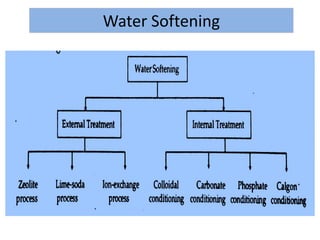
Water Softening
External Treatment
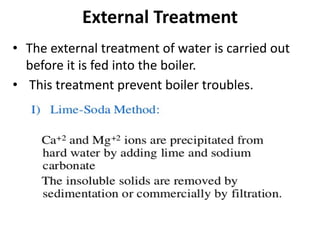
• The external treatment of water is carried out
before it is fed into the boiler.
• This treatment prevent boiler troubles.
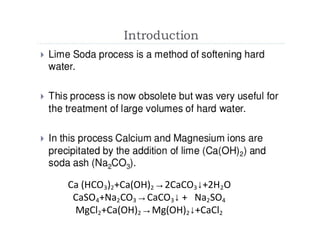
Ca (HCO3)2+Ca(OH)2→2CaCO3↓+2H2O
CaSO4+Na2CO3→CaCO3↓ + Na2SO4
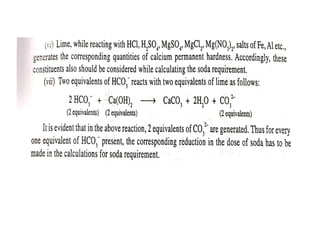
MgCl2+Ca(OH)2→Mg(OH)2↓+CaCl2
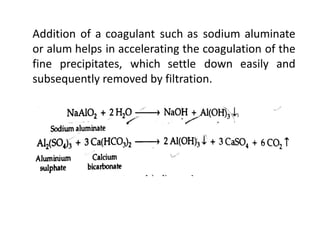
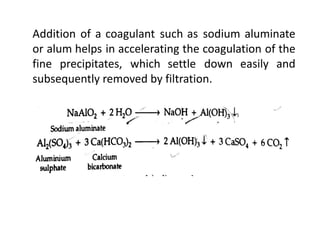
Addition of a coagulant such as sodium aluminate
or alum helps in accelerating the coagulation of the
fine precipitates, which settle down easily and
subsequently removed by filtration.
There are two types of Lime Soda Process
• Cold Lime Soda Process (RT)
• Hot Lime Soda Process (94 to 100 Deg C)
• Cold Lime Soda Process: in this process water is
treated with Lime & Soda at room temp in presence of
coagulant.
• Types of cold lime-soda softeners
• There are four basic types of cold lime soda softeners:
(1) The intermittent type (batch process)
(2) The conventional type
(3) The catalyst or spiractor type continuous process
(4) The sludge blanket type
Intermittent or batch process
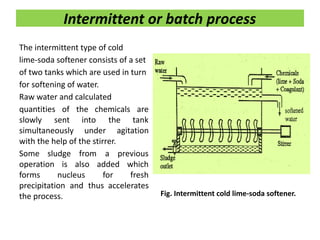
The intermittent type of cold
lime-soda softener consists of a set
of two tanks which are used in turn
for softening of water.
Raw water and calculated
quantities of the chemicals are
slowly sent into the tank
simultaneously under agitation
with the help of the stirrer.
Some sludge from a previous
operation is also added which
forms nucleus for fresh
precipitation and thus accelerates
the process. Fig. Intermittent cold lime-soda softener.
Conventional type
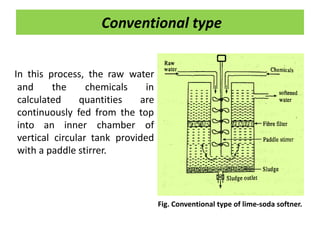
In this process, the raw water
and the chemicals in
calculated quantities are
continuously fed from the top
into an inner chamber of
vertical circular tank provided
with a paddle stirrer.
Fig. Conventional type of lime-soda softner.
Catalyst or spiractor type
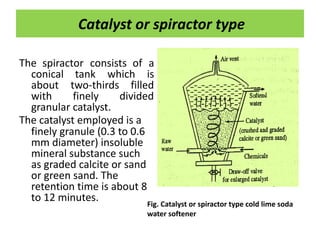
The spiractor consists of a
conical tank which is
about two-thirds filled
with finely divided
granular catalyst.
The catalyst employed is a
finely granule (0.3 to 0.6
mm diameter) insoluble
mineral substance such
as graded calcite or sand
or green sand. The
retention time is about 8
to 12 minutes. Fig. Catalyst or spiractor type cold lime soda
water softener
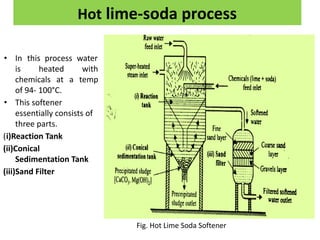
Hot lime-soda process
• In this process water
is heated with
chemicals at a temp
of 94- 100°C.
• This softener
essentially consists of
three parts.
(i)Reaction Tank
(ii)Conical
Sedimentation Tank
(iii)Sand Filter
Fig. Hot Lime Soda Softener
Hot Lime Soda Process is better than cold process as:
• Elevated temperatures
not only accelerate the
actual chemical reactions
but also reduce the
viscosity of the water and
increase the rate of
aggregation of the
particles.
• Thus, both the settling
rates and filtration rates
are increased.
• Water treated by the cold
lime-soda process
generally produces
softened water
containing about 50 – 60
ppm of residual hardness.
• Water treated by hot
lime-soda process
generally produces
softened water
containing about 15 – 30
ppm of residual hardness.
Advantages of Hot Lime Soda Process (94-100°C)
• Softening reactions are completed within 15
minutes. It appreciably increases the capacity of
the plant. Plant is compact.
• Viscosity of water is reduced at elevated
temperature which accelerates the aggregation,
setting and filtration of particles.
• Coagulant is not required.
• Dissolved gases are driven out.
• Residual hardness is 15-30% where as in cold
process it remains 50-60 ppm.
• Less excess chemicals are required than the cold
process.
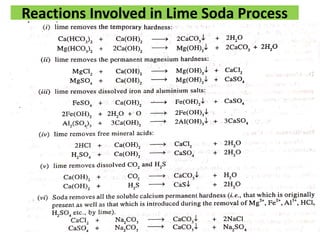
Reactions Involved in Lime Soda Process
Addition of a coagulant such as sodium aluminate
or alum helps in accelerating the coagulation of the
fine precipitates, which settle down easily and
subsequently removed by filtration.
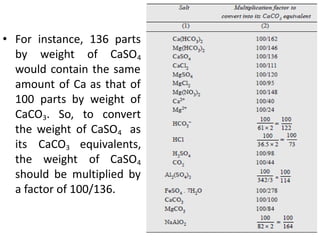
• For instance, 136 parts
by weight of CaSO4
would contain the same
amount of Ca as that of
100 parts by weight of
CaCO3. So, to convert
the weight of CaSO4 as
its CaCO3 equivalents,
the weight of CaSO4
should be multiplied by
a factor of 100/136.
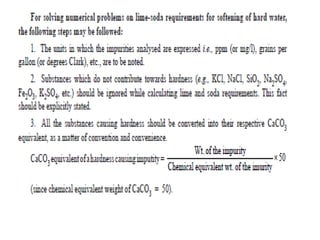
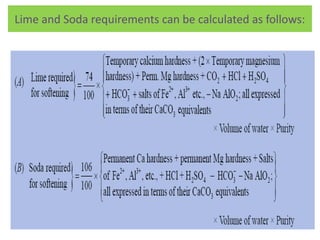
Lime and Soda requirements can be calculated as follows:

5_Lime Soda Process.pdf

  • 1.
  • 2.
    External Treatment • Theexternal treatment of water is carried out before it is fed into the boiler. • This treatment prevent boiler troubles.
  • 3.
  • 4.
    Addition of acoagulant such as sodium aluminate or alum helps in accelerating the coagulation of the fine precipitates, which settle down easily and subsequently removed by filtration.
  • 5.
    There are twotypes of Lime Soda Process • Cold Lime Soda Process (RT) • Hot Lime Soda Process (94 to 100 Deg C) • Cold Lime Soda Process: in this process water is treated with Lime & Soda at room temp in presence of coagulant. • Types of cold lime-soda softeners • There are four basic types of cold lime soda softeners: (1) The intermittent type (batch process) (2) The conventional type (3) The catalyst or spiractor type continuous process (4) The sludge blanket type
  • 6.
    Intermittent or batchprocess The intermittent type of cold lime-soda softener consists of a set of two tanks which are used in turn for softening of water. Raw water and calculated quantities of the chemicals are slowly sent into the tank simultaneously under agitation with the help of the stirrer. Some sludge from a previous operation is also added which forms nucleus for fresh precipitation and thus accelerates the process. Fig. Intermittent cold lime-soda softener.
  • 7.
    Conventional type In thisprocess, the raw water and the chemicals in calculated quantities are continuously fed from the top into an inner chamber of vertical circular tank provided with a paddle stirrer. Fig. Conventional type of lime-soda softner.
  • 8.
    Catalyst or spiractortype The spiractor consists of a conical tank which is about two-thirds filled with finely divided granular catalyst. The catalyst employed is a finely granule (0.3 to 0.6 mm diameter) insoluble mineral substance such as graded calcite or sand or green sand. The retention time is about 8 to 12 minutes. Fig. Catalyst or spiractor type cold lime soda water softener
  • 9.
    Hot lime-soda process •In this process water is heated with chemicals at a temp of 94- 100°C. • This softener essentially consists of three parts. (i)Reaction Tank (ii)Conical Sedimentation Tank (iii)Sand Filter Fig. Hot Lime Soda Softener
  • 10.
    Hot Lime SodaProcess is better than cold process as: • Elevated temperatures not only accelerate the actual chemical reactions but also reduce the viscosity of the water and increase the rate of aggregation of the particles. • Thus, both the settling rates and filtration rates are increased. • Water treated by the cold lime-soda process generally produces softened water containing about 50 – 60 ppm of residual hardness. • Water treated by hot lime-soda process generally produces softened water containing about 15 – 30 ppm of residual hardness.
  • 11.
    Advantages of HotLime Soda Process (94-100°C) • Softening reactions are completed within 15 minutes. It appreciably increases the capacity of the plant. Plant is compact. • Viscosity of water is reduced at elevated temperature which accelerates the aggregation, setting and filtration of particles. • Coagulant is not required. • Dissolved gases are driven out. • Residual hardness is 15-30% where as in cold process it remains 50-60 ppm. • Less excess chemicals are required than the cold process.
  • 12.
    Reactions Involved inLime Soda Process
  • 14.
    Addition of acoagulant such as sodium aluminate or alum helps in accelerating the coagulation of the fine precipitates, which settle down easily and subsequently removed by filtration.
  • 16.
    • For instance,136 parts by weight of CaSO4 would contain the same amount of Ca as that of 100 parts by weight of CaCO3. So, to convert the weight of CaSO4 as its CaCO3 equivalents, the weight of CaSO4 should be multiplied by a factor of 100/136.
  • 17.
    Lime and Sodarequirements can be calculated as follows: