UNIT- II
WATER
2.0 INTRODUCTION
Water is a natural gift on the earth. It is essential for humans, animals and plants. Human being use
water for drinking, cooking, bathing and washing. It has a wide role in industries also.
Chemically water has two atoms of hydrogen and one atom of oxygen having the molecular formula
H2O. In several chemical reactions, water is formed along with the main product.
Ex: 1. Acid reacts with base to give salt and water
HCl + NaOH ---------------- NaCl + H2O
2. Alcohol and organic acid react to give ester and water.
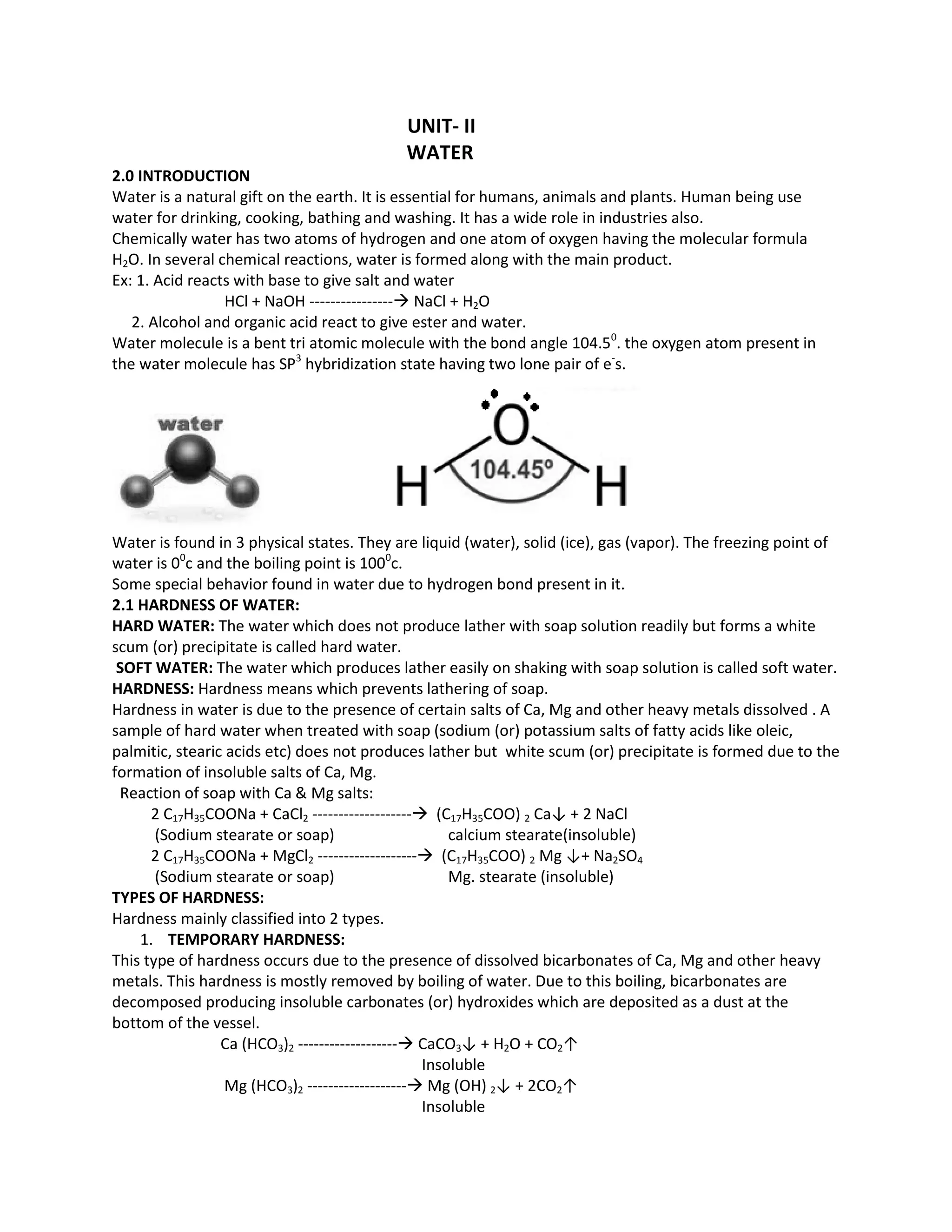
Water molecule is a bent tri atomic molecule with the bond angle 104.50
. the oxygen atom present in
the water molecule has SP3
hybridization state having two lone pair of e-
s.
Water is found in 3 physical states. They are liquid (water), solid (ice), gas (vapor). The freezing point of
water is 00
c and the boiling point is 1000
c.
Some special behavior found in water due to hydrogen bond present in it.
2.1 HARDNESS OF WATER:
HARD WATER: The water which does not produce lather with soap solution readily but forms a white
scum (or) precipitate is called hard water.
SOFT WATER: The water which produces lather easily on shaking with soap solution is called soft water.
HARDNESS: Hardness means which prevents lathering of soap.
Hardness in water is due to the presence of certain salts of Ca, Mg and other heavy metals dissolved . A
sample of hard water when treated with soap (sodium (or) potassium salts of fatty acids like oleic,
palmitic, stearic acids etc) does not produces lather but white scum (or) precipitate is formed due to the
formation of insoluble salts of Ca, Mg.
Reaction of soap with Ca & Mg salts:
2 C17H35COONa + CaCl2 ------------------- (C17H35COO) 2 Ca↓ + 2 NaCl
(Sodium stearate or soap) calcium stearate(insoluble)
2 C17H35COONa + MgCl2 ------------------- (C17H35COO) 2 Mg ↓+ Na2SO4
(Sodium stearate or soap) Mg. stearate (insoluble)
TYPES OF HARDNESS:
Hardness mainly classified into 2 types.
1. TEMPORARY HARDNESS:
This type of hardness occurs due to the presence of dissolved bicarbonates of Ca, Mg and other heavy
metals. This hardness is mostly removed by boiling of water. Due to this boiling, bicarbonates are
decomposed producing insoluble carbonates (or) hydroxides which are deposited as a dust at the
bottom of the vessel.
Ca (HCO3)2 ------------------- CaCO3↓ + H2O + CO2↑
Insoluble
Mg (HCO3)2 ------------------- Mg (OH) 2↓ + 2CO2↑
Insoluble
2. PERMANENT HARDNESS:
This type of hardness occurs due to the presence of chlorides, sulphides of Ca, Mg, Fe and other heavy
metals. This hardness cannot be removed by boiling like in temporary hardness.
UNITS OF HARDNESS: Generally the hardness is expressed in terms of equivalent amount of CaCO3.
 Parts per million (PPM): It is the parts of CaCO3 equivalent hardness per 106
parts of water.
1 PPM = 1 part of CaCO3 equivalent hardness in 106
parts of water.
 Milligrams per liter (mg/lit): Number of milligrams of CaCO3 equivalent hardness present per liter of
water.
1 mg/l =1mg of CaCO3 equivalent hardness in 1 lit of water
1 lit of water weight, 1kg =1000g =1000 Χ1000 = 106
mg
1 mg/lit = 1mg of CaCO3 Equivalent hardness per 106
mg of water
= 1part of CaCO3 Equivalent hardness per 106
parts of water =1 PPM
 Degree Clarkes (0
Cl) : Number of Grains of CaCO3 Equivalent Hardness per Gallon of Water
1 grain = 68.4 mg
1 gallon = 3.78541lit ≈ 4 lit
It is part of CaCO3 equivalent hardness per 70,000 parts of water.
10
Clarke = 1 grain of CaCO3 equivalent hardness per gallon of water.
= 1 part of CaCO3 equivalent hardness per 70000 parts of water.
 Degree French (0
Fr): It is the parts of CaCO3equivalent hardness per 105
parts of water.
10
Fr = 1 part of CaCO3 equivalent hardness per 105
parts of water.
RELATIONSHIP BETWEEN VARIOUS UNITS OF HARDNESS:
1PPM = 1 mg/lit = 0.10
Fr = 0.02 meq/lit
2.2 DETERMINATION OF HARDNESS OF WATER
ESTIMATION OF HARDNESS:
The estimation of hardness of water is very essential for its use in boilers for steam generation as well as
Industrial uses.
EDTA METHOD:
Di sodium salt of Ethylene Diamine Tetra Acetic acid (EDTA) is used as the permanent complexing agent
with the Ca2+
& Mg2+
ions of hard water in the EDTA method.
STRUCTURE OF EDTA:
Before starting the titration to the hard water, ammonia buffer (to maintain pH = 9 - 10) and Eriochrome
Black – T indicator are added, which forms an unstable complex of wine red coloured.
Ca2+
+ EBT ---------------- [Ca - EBT]
Blue unstable, wine red coloured complex
Mg2+
+ EBT ---------------- [Mg - EBT]
Blue unstable, wine red coloured complex
After the titration, the sodium salt of EDTA forms stable complex with water containing Ca2+
& Mg2+
ions
replacing the unstable complex.
The completion of the complex formation is indicated by Eriochrome black – T indicator at a pH range
9 – 10 giving a blue colour solution.
[Ca - EBT] ------------------- [Ca - EDTA] + EBT
Unstable stable, colourless blue
[Mg - EBT] ---------------- [Mg - EDTA] + EBT
Unstable stable, colourless blue
STANDARDIZATION OF EDTA:
20ml of standard hard water (standard ZnSO4 solution) is pipette out into a clean conical flask; add 4 – 5
ml buffer solution & 2 – 3 drops of EBT indicator. The wine red colour solution in the conical flask is
titrated with EDTA till pale blue colour appears which indicates the end point of the titration.
ZnSO4 EDTA
M1V1/n1 = M2V2/n2
M1 = molarity of hard water (zinc sulphate)
V1 = volume of hard water (zinc sulphate)
M2 = molarity of EDTA
V2 = volume of EDTA
ESTIMATION OF TOTAL HARDNESS:
50 ml of sample hard water is in clean conical flask and add 4 – 5 ml of buffer & 2 – 3 drops of EBT
indicator. The wine red colour solution in the conical flask is titrated with EDTA till pale blue colour
appears which indicates the end point of the titration.
Total hardness =
C = volume of EDTA (burette reading).
D = 1 ml 0.01 M EDTA = 1 mg of CaCO3
1 ml -- ---M EDTA =?
ESTIMATION OF PERMANENT HARDNESS:
Take 100 ml of water sample into a beaker and boil the water till the volume reduces to 50 ml. filter the
solution and add the 4 -5 ml of buffer solution and 2 – 3 drops of EBT indicator. The wine red colour
solution in the conical flask is titrated with EDTA till pale blue colour appears which indicates the end
point of the titration.
TOTAL HARDNESS =
C = volume of EDTA (burette reading).
D = 1 ml 0.01 M EDTA = 1 mg of CaCO3
1 ml -- ---M EDTA =?
Temporary hardness = total hardness – permanent hardness
SOAP TITRATION METHOD:
Hardness of water is determined by this method without using any indicator. Known volume of water
sample is taken and titrated against soap solution (standard). Initially, lather is not formed due to the
hardness but at point lather is formed which persists for 2 minutes. By this method total hardness of
water is measured.
On boiling the known volume of water sample for halfenhour, temporary hardness removed as
precipitate of (Ca2+
/Mg2+
) carbonates. This sample is further titrated to find the permanent hardness.
Temporary Hardness = Total Hardness – Permanent Hardness
The standard soap solution of soap can be obtained from the market or otherwise it can be prepared
and then standardized in the laboratory with standard CaCl2 solution.
2 C17H35COONa + Ca2+
------------------- (C17H35COO) 2Ca↓+2 Na+
Soap calcium stearate
2 C17H35COONa + Mg2+
------------------- (C17H35COO) 2Mg↓+2 Na+
Magnesium stearate
Hehner’s alkali metric method is also used to estimate hardness of water.
2.3 BOILER TROUBLES: SCALE AND SLUDGE FORMATION IN THE BOILERS
WATER FOR STEAM MAKING:
In very big boilers the soft water is used for producing steam. The boilers are heated with fuels such as
coal and the steam produced rotates the blades of the turbines in a fast manner. The turbine is a
magnet wounded by coil wire. Any magnet wounded by coil wire will produce electricity. This electricity
uses water in the boilers followed by heating to produce steam.
BOILER TROUBLES:
Boiler troubles are mainly of 3 types:
 Corrosion & caustic embrittlement.
 Scale formation & sludge formation.
 Carry over priming & foaming.
Generally priming, foaming occurs together in the boilers. Scale & sludge formation depends on the
nature of the dissolved salts.
The following are the boiler troubles in detail.
SCALE AND SLUDGE FORMATION IN THE BOILERS:
When water is evaporated in boilers to produce steam continuously the concentration of the salts
present in the water increases progressively. As the concentration reaches a saturation point the salts
are thrown out of water as precipitates either as sludges or as scales adhering to the walls of the boiler.
If the precipitates are loose and slimy, it is called sludge. On the other hand if the precipitate produced
adheres very strongly to the walls of the boilers it is known as Boiler scale.
The main reasons for the boiler scale or sludge formation are due to
 The solubility product of the salt must be exceeding by the product of concentration of constituent
ions.
 The solubility of the salt decreases with rise of temperature.
 The increase in the temperature can lead to reactions that result in the formation of insoluble
products.
Sludges are loose and slimy precipitates which can be easily scraped off. Salts like MgCO3, MgCl2, MgSO4,
CaCl2 etc., are responsible for sludge formation in boilers. By frequent blow down operation formation
of sludge in boilers can be prevented.
Scale and Sludge formation in boilers
Scales are hard deposits formed by the evaporation of hard water in boilers. Due to the scale formation
in boilers more amount of heat has to be supplies for heating since the scales produced on the walls of
boilers acts as insulators of heat.
Due to the overheating of the boiler certain areas of the boiler weaken causing distortion and even lead
to breaking in high pressure boilers.
Some of the salts mainly responsible for scale formation are CaSiO3, CaSO4 and Mg (OH)2.
Ca (HCO3)2 present in hard water decomposes at higher temperature producing CaCO3.
Ca (HCO3)2 CaCO3 + H2O + CO2
CaCO3 and Mg (OH)2 can form loose sludges as well as scales.
These are mainly formed as scales in low pressure boilers.
Calcium sulphate get deposited in the boilers as scales since the solubility of the salt decreases with
increase in temperature. CaSO4 get deposited on the heated position of the boiler.
Mg(OH)2 is produces in the boiler by the hydrolysis of MgCl2 salt.
MgCl2 + H2O Mg (OH)2 + 2HCl
CaSiO3 and SiO2 can form very hard scales in turbine blades due to their tendency to mix with the steam
produces. The silica content can be removed by the solution of very small amount of mgO to the
permanent hard water (after the removal CaCO3 precipitate) which produces magnesia silica sludge that
can be removed easily. By using small amount of ferrous sulphate or sodium aluminate coagulants, silica
can be covered with the colloidal Al(OH)3 or Fe(OH)2 and the colloidal sludge can be easily removed from
the boilers.
REMOVAL OF SCALES:
 Scales can be removed by applying thermal shocks (sudden heating and cooling).
 Using scrapers, wire brush etc., scales can be removed.
 Using certain chemicals scales can be removed.
Ex: using 5 – 10% HCl, CaCO3 scales can be removed.
Using EDTA, CaSO4 scales can be removed.
By “blow down operation” (removing the bottom portion of salt concentrated water of the boiler) the
scales formation can be avoided
2.4 INTERNAL TREATMENT OF BOILER FEED WATER
PREVENTION OF SCALE FORMATION BY INTERNAL TREATMENT:
The following are the internal conditioning methods used in boilers:
1. CARBONATE CONDITIONING:
In low pressure boilers scale formation can be avoided by treating the boiler water with sodium
carbonate. The scale forming salts like CaSO4 are partially removed.
CaSO4 + Na2CO3 CaCO3 + Na2SO4
CaCO3 is precipitated in the boiler as loose sludge which can be scraped off. For the precipitation of
CaCO3 the carbonate ions added should exceed the sulphate ions present in the water.
2. COLLOIDAL CONDITIONING:
Scale formation in boilers is mainly due to crystalline precipitate. When certain chemicals like tannin or
agar gel are added to water, these substances get coated on the outer surface of crystalline precipitates
and forms colloidal, non sticky and sludge like precipitates which can be easily removed by mechanical
methods of blow down operation.
3. CALGON CONDITIONING :
In this process calgon or sodium hexa meta phosphate [Na(PO3)]6 is added to the boiler feed water
which forms soluble complex with the CaSO4 scales.
Na2 [Na4 (PO3)6] 2Na+
+ [Na4 (PO3)6]2-
2 CaSO4 + [Na4 (PO3)6]2-
[Ca2 (PO3)6]2-
+ 2Na2SO4
Soluble complex
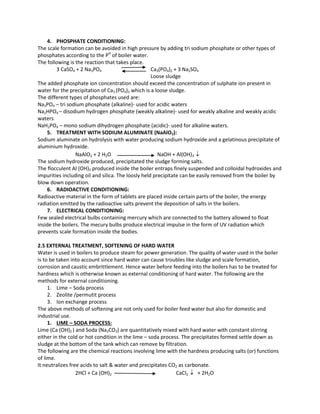
4. PHOSPHATE CONDITIONING:
The scale formation can be avoided in high pressure by adding tri sodium phosphate or other types of
phosphates according to the PH
of boiler water.
The following is the reaction that takes place.
3 CaSO4 + 2 Na3PO4 Ca3(PO4)2 + 3 Na2SO4
Loose sludge
The added phosphate ion concentration should exceed the concentration of sulphate ion present in
water for the precipitation of Ca3 (PO4)2 which is a loose sludge.
The different types of phosphates used are:
Na3PO4 – tri sodium phosphate (alkaline)- used for acidic waters
Na2HPO4 – disodium hydrogen phosphate (weakly alkaline)- used for weakly alkaline and weakly acidic
waters
NaH2PO4 – mono sodium dihydrogen phosphate (acidic)- used for alkaline waters.
5. TREATMENT WITH SODIUM ALUMINATE (NaAlO2):
Sodium aluminate on hydrolysis with water producing sodium hydroxide and a gelatinous precipitate of
aluminium hydroxide.
NaAlO2 + 2 H2O NaOH + Al(OH)3 
The sodium hydroxide produced, precipitated the sludge forming salts.
The flocculent Al (OH)3 produced inside the boiler entraps finely suspended and colloidal hydroxides and
impurities including oil and silica. The loosly held precipitate can be easily removed from the boiler by
blow down operation.
6. RADIOACTIVE CONDITIONING:
Radioactive material in the form of tablets are placed inside certain parts of the boiler, the energy
radiation emitted by the radioactive salts prevent the deposition of salts in the boilers.
7. ELECTRICAL CONDITIONING:
Few sealed electrical bulbs containing mercury which are connected to the battery allowed to float
inside the boilers. The mecury bulbs produce electrical impulse in the form of UV radiation which
prevents scale formation inside the bodies.
2.5 EXTERNAL TREATMENT, SOFTENING OF HARD WATER
Water is used in boilers to produce steam for power generation. The quality of water used in the boiler
is to be taken into account since hard water can cause troubles like sludge and scale formation,
corrosion and caustic embrittlement. Hence water before feeding into the boilers has to be treated for
hardness which is otherwise known as external conditioning of hard water. The following are the
methods for external conditioning.
1. Lime – Soda process
2. Zeolite /permutit process
3. Ion exchange process
The above methods of softening are not only used for boiler feed water but also for domestic and
industrial use.
1. LIME – SODA PROCESS:
Lime (Ca (OH)2 ) and Soda (Na2CO3) are quantitatively mixed with hard water with constant stirring
either in the cold or hot condition in the lime – soda process. The precipitates formed settle down as
sludge at the bottom of the tank which can remove by filtration.
The following are the chemical reactions involving lime with the hardness producing salts (or) functions
of lime.
It neutralizes free acids to salt & water and precipitates CO2 as carbonate.
2HCl + Ca (OH)2 CaCl2  + 2H2O
H2SO4 + Ca (OH)2 CaSO4  + 2H2O
CO2 + Ca (OH)2 CaCO3  + H2O
It precipitates the bicarbonates of calcium and magnesium as carbonates.
Ca (HCO3)2 + Ca (OH)2 2CaCO3  +2H2O
Mg (HCO3)2 + Ca(OH)2 2CaCO3  + Mg(OH)2 +2H2O
It precipitates the bicarbonate ions (NaHCO3/KHCO3) into carbonates.
2NaHCO3 + Ca (OH)2 CaCO3  + 2H2O + Na2CO3
It can react only with magnesium permanent hard salts (MgCl2 and MgSO4) producing precipitates.
MgCl2 + Ca (OH)2 Mg (OH)2  + CaCl2
MgSO4 + Ca (OH)2 Mg (OH)2  + CaSO4
It also precipitates the iron and aluminium salts
FeSO4 + Ca (OH)2 Fe (OH)2  + CaSo4
Al2 (SO4)3 +3Ca (OH)2 Al (OH)3  + 3 CaSo4
Neglecting traces of iron and aluminum salts present in water and considering the other salts and their
reaction with lime we can see that only Mg(HCO3)3 consumes 2 ca(OH)2 i.e. double the amount of lime.
Hence the final equation for the quantitative requirement of lime for the above mentioned hard salt is
given below
Lime required =
74
100
[Temp Ca 2+
+2Temp Mg 2+
+perm(Mg2+
+Fe2+
+Al3+
) +CO2 +
1
2
HCl +H2SO4 +
1
2
HCO3
-
]
all in terms of CaCO3 eq
Molecular weight of lime = 74
Molecular weight of CaCO3 = 100
The following are the chemical reactions involving soda with the hardness producing salts (or) functions
of soda.
Neutralization of free acids
2HCl + Na2CO3 2NaCl + H2O + CO2 
H2SO4 + Na2CO3 Na2SO4 + H2O + CO2 
Precipitation in permanent hard salts of calcium and magnesium
CaCl2+ Na2CO3 CaCO3  + 2NaCl
CaSO4 +Na2CO3 CaCO3  + Na2SO4
MgCl2+ Na2CO3 MgCO3  + 2NaCl
MgSO4 + Na2CO3 MgCO3  + Na2SO4
The sodium bicarbonate present in the hard water reacts with soda producing more sodium carbonate.
Hence in the formula for the quantitative requirement of soda the value of bicarbonate ions have to be
subtracted.
Soda requirement =
106
100
[perm (Ca 2+
+Mg2+
+Fe2+
)+3permAl3+
+
1
2
HCl +H2SO4 -
1
2
HCO3
-
]
all in terms of CaCO3 eq
Molecular weight of soda = 106
Molecular weight of CaCO3 = 100
The following are the methods adopted for the efficiency of the process.
 Through stirring of chemicals and water using stirrers.
 Proper time for completion of reaction.
 Accelerators are added for quick precipitation.
 Coagulants (alum) are added to produce coarse precipitates.
After the reactions are over the water is passed to the settling chambers before the filtration process.
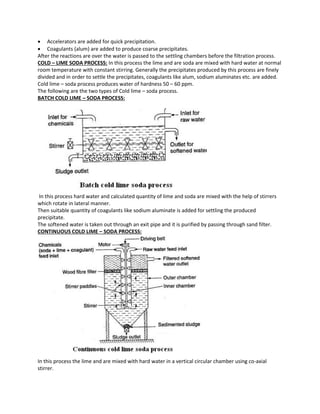
COLD – LIME SODA PROCESS: In this process the lime and are soda are mixed with hard water at normal
room temperature with constant stirring. Generally the precipitates produced by this process are finely
divided and in order to settle the precipitates, coagulants like alum, sodium aluminates etc. are added.
Cold lime – soda process produces water of hardness 50 – 60 ppm.
The following are the two types of Cold lime – soda process.
BATCH COLD LIME – SODA PROCESS:
In this process hard water and calculated quantity of lime and soda are mixed with the help of stirrers
which rotate in lateral manner.
Then suitable quantity of coagulants like sodium aluminate is added for settling the produced
precipitate.
The softened water is taken out through an exit pipe and it is purified by passing through sand filter.
CONTINUOUS COLD LIME – SODA PROCESS:
In this process the lime and are mixed with hard water in a vertical circular chamber using co-axial
stirrer.
In the middle chamber severe stirring of chemicals with water takes place and softening takes place. The
softened water comes out into the outer co- axial chamber and rises up and passes through the filtering
media. As the water flow and stirring with chemicals continue, softened water is allowed to pass out
through the exit nearly at the top of the chamber. The process can be carried out continuously.
HOT LIME – SODA PROCESS:
In this process the lime and soda chemicals are mixed with hard water maintain high temperature (80 –
150o
c) using steam.
The main advantages of this process are
 The reaction takes place at a faster rate and softening of hard water is completed within 15 minutes.
 The precipitate produced is granular and settle down quickly.
 The dissolved gasses (CO2) in hard water are driven out.
 The hardness of softened water is very less (15 – 30 ppm).
ADVANTAGES:
 The process is economical.
 Iron and manganese salts are also removed by this process.
 The pathogenic bacteria are also killed by the hot alkaline medium of this process.
 No or very less amount of coagulants is used.
DISADVANTAGES:
 Large amount of sludge is produced which posses disposal problems.
 The softened water has sodium salts which are not suitable for boilers producing steam.
 This process can reduce hardness to between 15 – 30 ppm only.
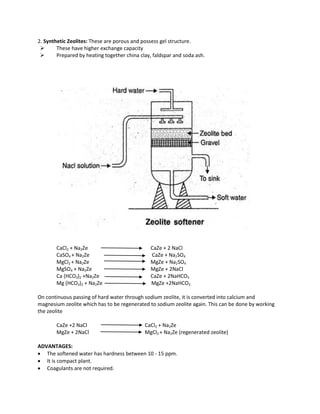
2. ZEOLITE(PERMUTIT) PROCESS:
In this process the hard water is allowed to percolate through sodium zeolite. The sodium ions which are
loosely held in this compound are replaced by the Ca2+
and Mg2+
ions.
The chemical formula of sodium zeolite is Na2O.Al2O3.x SiO2.yH2O
Zeolite is hydrated sodium alumino silicate. The following are the reactions involved in the softening
process.
Zeolites are two types
1. Natural Zeolites: These are non-porous.
Ex.: Na2O.Al2O3.4SiO2.2H2O
2. Synthetic Zeolites: These are porous and possess gel structure.
 These have higher exchange capacity
 Prepared by heating together china clay, faldspar and soda ash.
CaCl2 + Na2Ze CaZe + 2 NaCl
CaSO4 + Na2Ze CaZe + Na2SO4
MgCl2 + Na2Ze MgZe + Na2SO4
MgSO4 + Na2Ze MgZe + 2NaCl
Ca (HCO3)2 +Na2Ze CaZe + 2NaHCO3
Mg (HCO3)2 + Na2Ze MgZe +2NaHCO3
On continuous passing of hard water through sodium zeolite, it is converted into calcium and
magnesium zeolite which has to be regenerated to sodium zeolite again. This can be done by working
the zeolite
CaZe +2 NaCl CaCl2 + Na2Ze
MgZe + 2NaCl MgCl2 + Na2Ze (regenerated zeolite)
ADVANTAGES:
 The softened water has hardness between 10 - 15 ppm.
 It is compact plant.
 Coagulants are not required.
DISADVANTAGES:
 Cost of the plant and zeolite resin is costlier.
 It cannot be operated for more acidic waters.
 In this process colloidal or suspended impurities present in water cannot be treated.
 High turbidity water cannot be treated.
COMPARISON OF LIME SODA PROCESS WITH PERMUTIT (ZEOLITE) PROCESS:
S.No Lime soda process Zeolite process
1.
2.
3.
4.
5.
6.
The softened water has hardness between
15 – 50 ppm
Cost of plant and chemicals used are
cheaper.
Plant occupies more space.
It can be used for softening acidic waters.
There is problem in settling the
precipitates using co- agulants.
In this process colloidal or suspended
impurities present in water can be
treated.
The softened water has hardness
between 10 - 15 ppm
Cost of the plant and zeolite resin is
costlier.
It is compact plant.
It cannot be operated for more acidic
waters.
No such problems are there.
In this process colloidal or suspended
impurities present in water cannot be
treated.
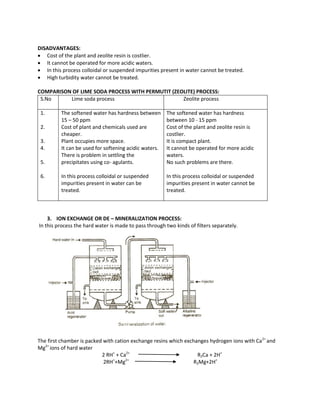
3. ION EXCHANGE OR DE – MINERALIZATION PROCESS:
In this process the hard water is made to pass through two kinds of filters separately.
The first chamber is packed with cation exchange resins which exchanges hydrogen ions with Ca2+
and
Mg2+
ions of hard water
2 RH+
+ Ca2+
R2Ca + 2H+
2RH+
+Mg2+
R2Mg+2H+
Like the above reactions resin can replace its hydrogen ion with any of the metal cations. The cation
exchange resins are mainly sulphonated styrene co polymer.
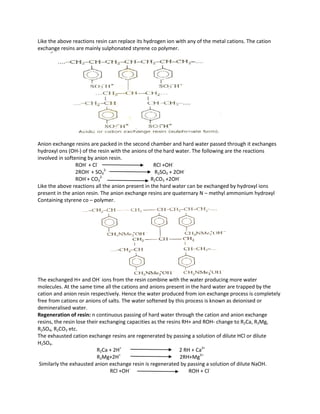
Anion exchange resins are packed in the second chamber and hard water passed through it exchanges
hydroxyl ons (OH-) of the resin with the anions of the hard water. The following are the reactions
involved in softening by anion resin.
ROH-
+ Cl-
RCl +OH-
2ROH-
+ SO4
2-
R2SO4 + 2OH-
ROH-
+ CO3
2-
R2CO3 +2OH-
Like the above reactions all the anion present in the hard water can be exchanged by hydroxyl ions
present in the anion resin. The anion exchange resins are quaternary N – methyl ammonium hydroxyl
Containing styrene co – polymer.
The exchanged H+ and OH-
ions from the resin combine with the water producing more water
molecules. At the same time all the cations and anions present in the hard water are trapped by the
cation and anion resin respectively. Hence the water produced from ion exchange process is completely
free from cations or anions of salts. The water softened by this process is known as deionised or
demineralised water.
Regeneration of resin: n continuous passing of hard water through the cation and anion exchange
resins, the resin lose their exchanging capacities as the resins RH+ and ROH- change to R2Ca, R2Mg,
R2SO4, R2CO3 etc.
The exhausted cation exchange resins are regenerated by passing a solution of dilute HCl or dilute
H2SO4.
R2Ca + 2H+
2 RH + Ca2+
R2Mg+2H+
2RH+Mg2+
Similarly the exhausted anion exchange resin is regenerated by passing a solution of dilute NaOH.
RCl +OH-
ROH + Cl-
R2SO4 + 2OH-
2ROH + SO4
2-
R2CO3 +2OH-
2ROH+ CO3
2-
ADVANTAGES:
 It produces very pure water of hardness nearly 2 -0 ppm.
 Highly acidic or alkaline Water can be treated by this process.
 The softened water is completely free from any salts unfit for use as boiler feed water.
DISADVANTAGES:
 The equipment is little expensive.
 Highly turbid water cannot be treated by this process.
2.6 DESALINATION OF BRAKISH WATER
The process of removing common salt from the water is known as DESALATION. The water containing
dissolved salts with a peculiar (or brackish) taste is called BRACKISH WATER.
BRACKISH WATER is totally unfit for drinking commonly used methods for desalination of brackish
water are
1. ELECTRODIALYSIS
2. REVERSE OSMOSIS.
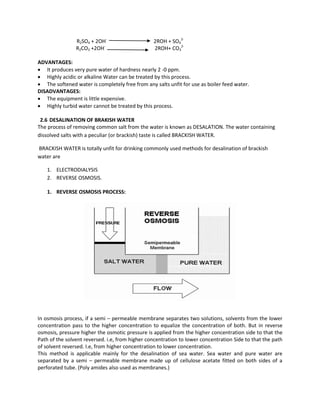
1. REVERSE OSMOSIS PROCESS:
In osmosis process, if a semi – permeable membrane separates two solutions, solvents from the lower
concentration pass to the higher concentration to equalize the concentration of both. But in reverse
osmosis, pressure higher the osmotic pressure is applied from the higher concentration side to that the
Path of the solvent reversed. i.e, from higher concentration to lower concentration Side to that the path
of solvent reversed. I.e, from higher concentration to lower concentration.
This method is applicable mainly for the desalination of sea water. Sea water and pure water are
separated by a semi – permeable membrane made up of cellulose acetate fitted on both sides of a
perforated tube. (Poly amides also used as membranes.)
ADVANTAGES:
 The process is very easy; it is to make pure water.
 It removes the ionic & non ionic substances in the water.
 It also can remove suspended colloidal particles.
 By this process, sea water made fit for drinking.
 Water obtained after being treated by this process is used in boilers.
2. ELECTRO DIALYSIS:
Dialysis is a process in which diffusion of smaller particles takes place through semi – permeable
membrane. Sea water is called brackish water (salty). It has 3.5%salt. Dialysis removes salt from sea
water, through membrane.
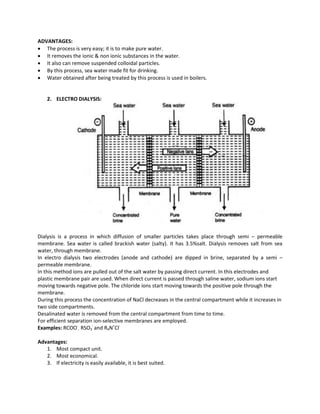
In electro dialysis two electrodes (anode and cathode) are dipped in brine, separated by a semi –
permeable membrane.
In this method ions are pulled out of the salt water by passing direct current. In this electrodes and
plastic membrane pair are used. When direct current is passed through saline water, sodium ions start
moving towards negative pole. The chloride ions start moving towards the positive pole through the
membrane.
During this process the concentration of NaCl decreases in the central compartment while it increases in
two side compartments.
Desalinated water is removed from the central compartment from time to time.
For efficient separation ion-selective membranes are employed.
Examples: RCOO-
, RSO3
-
and R4N+
Cl-
Advantages:
1. Most compact unit.
2. Most economical.
3. If electricity is easily available, it is best suited.

Water by aluru jaideep reddy

  • 1.
    UNIT- II WATER 2.0 INTRODUCTION Wateris a natural gift on the earth. It is essential for humans, animals and plants. Human being use water for drinking, cooking, bathing and washing. It has a wide role in industries also. Chemically water has two atoms of hydrogen and one atom of oxygen having the molecular formula H2O. In several chemical reactions, water is formed along with the main product. Ex: 1. Acid reacts with base to give salt and water HCl + NaOH ---------------- NaCl + H2O 2. Alcohol and organic acid react to give ester and water. Water molecule is a bent tri atomic molecule with the bond angle 104.50 . the oxygen atom present in the water molecule has SP3 hybridization state having two lone pair of e- s. Water is found in 3 physical states. They are liquid (water), solid (ice), gas (vapor). The freezing point of water is 00 c and the boiling point is 1000 c. Some special behavior found in water due to hydrogen bond present in it. 2.1 HARDNESS OF WATER: HARD WATER: The water which does not produce lather with soap solution readily but forms a white scum (or) precipitate is called hard water. SOFT WATER: The water which produces lather easily on shaking with soap solution is called soft water. HARDNESS: Hardness means which prevents lathering of soap. Hardness in water is due to the presence of certain salts of Ca, Mg and other heavy metals dissolved . A sample of hard water when treated with soap (sodium (or) potassium salts of fatty acids like oleic, palmitic, stearic acids etc) does not produces lather but white scum (or) precipitate is formed due to the formation of insoluble salts of Ca, Mg. Reaction of soap with Ca & Mg salts: 2 C17H35COONa + CaCl2 ------------------- (C17H35COO) 2 Ca↓ + 2 NaCl (Sodium stearate or soap) calcium stearate(insoluble) 2 C17H35COONa + MgCl2 ------------------- (C17H35COO) 2 Mg ↓+ Na2SO4 (Sodium stearate or soap) Mg. stearate (insoluble) TYPES OF HARDNESS: Hardness mainly classified into 2 types. 1. TEMPORARY HARDNESS: This type of hardness occurs due to the presence of dissolved bicarbonates of Ca, Mg and other heavy metals. This hardness is mostly removed by boiling of water. Due to this boiling, bicarbonates are decomposed producing insoluble carbonates (or) hydroxides which are deposited as a dust at the bottom of the vessel. Ca (HCO3)2 ------------------- CaCO3↓ + H2O + CO2↑ Insoluble Mg (HCO3)2 ------------------- Mg (OH) 2↓ + 2CO2↑ Insoluble
  • 2.
    2. PERMANENT HARDNESS: Thistype of hardness occurs due to the presence of chlorides, sulphides of Ca, Mg, Fe and other heavy metals. This hardness cannot be removed by boiling like in temporary hardness. UNITS OF HARDNESS: Generally the hardness is expressed in terms of equivalent amount of CaCO3.  Parts per million (PPM): It is the parts of CaCO3 equivalent hardness per 106 parts of water. 1 PPM = 1 part of CaCO3 equivalent hardness in 106 parts of water.  Milligrams per liter (mg/lit): Number of milligrams of CaCO3 equivalent hardness present per liter of water. 1 mg/l =1mg of CaCO3 equivalent hardness in 1 lit of water 1 lit of water weight, 1kg =1000g =1000 Χ1000 = 106 mg 1 mg/lit = 1mg of CaCO3 Equivalent hardness per 106 mg of water = 1part of CaCO3 Equivalent hardness per 106 parts of water =1 PPM  Degree Clarkes (0 Cl) : Number of Grains of CaCO3 Equivalent Hardness per Gallon of Water 1 grain = 68.4 mg 1 gallon = 3.78541lit ≈ 4 lit It is part of CaCO3 equivalent hardness per 70,000 parts of water. 10 Clarke = 1 grain of CaCO3 equivalent hardness per gallon of water. = 1 part of CaCO3 equivalent hardness per 70000 parts of water.  Degree French (0 Fr): It is the parts of CaCO3equivalent hardness per 105 parts of water. 10 Fr = 1 part of CaCO3 equivalent hardness per 105 parts of water. RELATIONSHIP BETWEEN VARIOUS UNITS OF HARDNESS: 1PPM = 1 mg/lit = 0.10 Fr = 0.02 meq/lit 2.2 DETERMINATION OF HARDNESS OF WATER ESTIMATION OF HARDNESS: The estimation of hardness of water is very essential for its use in boilers for steam generation as well as Industrial uses. EDTA METHOD: Di sodium salt of Ethylene Diamine Tetra Acetic acid (EDTA) is used as the permanent complexing agent with the Ca2+ & Mg2+ ions of hard water in the EDTA method. STRUCTURE OF EDTA: Before starting the titration to the hard water, ammonia buffer (to maintain pH = 9 - 10) and Eriochrome Black – T indicator are added, which forms an unstable complex of wine red coloured. Ca2+ + EBT ---------------- [Ca - EBT] Blue unstable, wine red coloured complex Mg2+ + EBT ---------------- [Mg - EBT] Blue unstable, wine red coloured complex After the titration, the sodium salt of EDTA forms stable complex with water containing Ca2+ & Mg2+ ions replacing the unstable complex.
  • 3.
    The completion ofthe complex formation is indicated by Eriochrome black – T indicator at a pH range 9 – 10 giving a blue colour solution. [Ca - EBT] ------------------- [Ca - EDTA] + EBT Unstable stable, colourless blue [Mg - EBT] ---------------- [Mg - EDTA] + EBT Unstable stable, colourless blue STANDARDIZATION OF EDTA: 20ml of standard hard water (standard ZnSO4 solution) is pipette out into a clean conical flask; add 4 – 5 ml buffer solution & 2 – 3 drops of EBT indicator. The wine red colour solution in the conical flask is titrated with EDTA till pale blue colour appears which indicates the end point of the titration. ZnSO4 EDTA M1V1/n1 = M2V2/n2 M1 = molarity of hard water (zinc sulphate) V1 = volume of hard water (zinc sulphate) M2 = molarity of EDTA V2 = volume of EDTA ESTIMATION OF TOTAL HARDNESS: 50 ml of sample hard water is in clean conical flask and add 4 – 5 ml of buffer & 2 – 3 drops of EBT indicator. The wine red colour solution in the conical flask is titrated with EDTA till pale blue colour appears which indicates the end point of the titration. Total hardness = C = volume of EDTA (burette reading). D = 1 ml 0.01 M EDTA = 1 mg of CaCO3 1 ml -- ---M EDTA =? ESTIMATION OF PERMANENT HARDNESS: Take 100 ml of water sample into a beaker and boil the water till the volume reduces to 50 ml. filter the solution and add the 4 -5 ml of buffer solution and 2 – 3 drops of EBT indicator. The wine red colour solution in the conical flask is titrated with EDTA till pale blue colour appears which indicates the end point of the titration. TOTAL HARDNESS = C = volume of EDTA (burette reading). D = 1 ml 0.01 M EDTA = 1 mg of CaCO3 1 ml -- ---M EDTA =? Temporary hardness = total hardness – permanent hardness SOAP TITRATION METHOD: Hardness of water is determined by this method without using any indicator. Known volume of water sample is taken and titrated against soap solution (standard). Initially, lather is not formed due to the hardness but at point lather is formed which persists for 2 minutes. By this method total hardness of water is measured. On boiling the known volume of water sample for halfenhour, temporary hardness removed as precipitate of (Ca2+ /Mg2+ ) carbonates. This sample is further titrated to find the permanent hardness. Temporary Hardness = Total Hardness – Permanent Hardness The standard soap solution of soap can be obtained from the market or otherwise it can be prepared and then standardized in the laboratory with standard CaCl2 solution. 2 C17H35COONa + Ca2+ ------------------- (C17H35COO) 2Ca↓+2 Na+ Soap calcium stearate
  • 4.
    2 C17H35COONa +Mg2+ ------------------- (C17H35COO) 2Mg↓+2 Na+ Magnesium stearate Hehner’s alkali metric method is also used to estimate hardness of water. 2.3 BOILER TROUBLES: SCALE AND SLUDGE FORMATION IN THE BOILERS WATER FOR STEAM MAKING: In very big boilers the soft water is used for producing steam. The boilers are heated with fuels such as coal and the steam produced rotates the blades of the turbines in a fast manner. The turbine is a magnet wounded by coil wire. Any magnet wounded by coil wire will produce electricity. This electricity uses water in the boilers followed by heating to produce steam. BOILER TROUBLES: Boiler troubles are mainly of 3 types:  Corrosion & caustic embrittlement.  Scale formation & sludge formation.  Carry over priming & foaming. Generally priming, foaming occurs together in the boilers. Scale & sludge formation depends on the nature of the dissolved salts. The following are the boiler troubles in detail. SCALE AND SLUDGE FORMATION IN THE BOILERS: When water is evaporated in boilers to produce steam continuously the concentration of the salts present in the water increases progressively. As the concentration reaches a saturation point the salts are thrown out of water as precipitates either as sludges or as scales adhering to the walls of the boiler. If the precipitates are loose and slimy, it is called sludge. On the other hand if the precipitate produced adheres very strongly to the walls of the boilers it is known as Boiler scale. The main reasons for the boiler scale or sludge formation are due to  The solubility product of the salt must be exceeding by the product of concentration of constituent ions.  The solubility of the salt decreases with rise of temperature.  The increase in the temperature can lead to reactions that result in the formation of insoluble products. Sludges are loose and slimy precipitates which can be easily scraped off. Salts like MgCO3, MgCl2, MgSO4, CaCl2 etc., are responsible for sludge formation in boilers. By frequent blow down operation formation of sludge in boilers can be prevented. Scale and Sludge formation in boilers
  • 5.
    Scales are harddeposits formed by the evaporation of hard water in boilers. Due to the scale formation in boilers more amount of heat has to be supplies for heating since the scales produced on the walls of boilers acts as insulators of heat. Due to the overheating of the boiler certain areas of the boiler weaken causing distortion and even lead to breaking in high pressure boilers. Some of the salts mainly responsible for scale formation are CaSiO3, CaSO4 and Mg (OH)2. Ca (HCO3)2 present in hard water decomposes at higher temperature producing CaCO3. Ca (HCO3)2 CaCO3 + H2O + CO2 CaCO3 and Mg (OH)2 can form loose sludges as well as scales. These are mainly formed as scales in low pressure boilers. Calcium sulphate get deposited in the boilers as scales since the solubility of the salt decreases with increase in temperature. CaSO4 get deposited on the heated position of the boiler. Mg(OH)2 is produces in the boiler by the hydrolysis of MgCl2 salt. MgCl2 + H2O Mg (OH)2 + 2HCl CaSiO3 and SiO2 can form very hard scales in turbine blades due to their tendency to mix with the steam produces. The silica content can be removed by the solution of very small amount of mgO to the permanent hard water (after the removal CaCO3 precipitate) which produces magnesia silica sludge that can be removed easily. By using small amount of ferrous sulphate or sodium aluminate coagulants, silica can be covered with the colloidal Al(OH)3 or Fe(OH)2 and the colloidal sludge can be easily removed from the boilers. REMOVAL OF SCALES:  Scales can be removed by applying thermal shocks (sudden heating and cooling).  Using scrapers, wire brush etc., scales can be removed.  Using certain chemicals scales can be removed. Ex: using 5 – 10% HCl, CaCO3 scales can be removed. Using EDTA, CaSO4 scales can be removed. By “blow down operation” (removing the bottom portion of salt concentrated water of the boiler) the scales formation can be avoided 2.4 INTERNAL TREATMENT OF BOILER FEED WATER PREVENTION OF SCALE FORMATION BY INTERNAL TREATMENT: The following are the internal conditioning methods used in boilers: 1. CARBONATE CONDITIONING: In low pressure boilers scale formation can be avoided by treating the boiler water with sodium carbonate. The scale forming salts like CaSO4 are partially removed. CaSO4 + Na2CO3 CaCO3 + Na2SO4 CaCO3 is precipitated in the boiler as loose sludge which can be scraped off. For the precipitation of CaCO3 the carbonate ions added should exceed the sulphate ions present in the water. 2. COLLOIDAL CONDITIONING: Scale formation in boilers is mainly due to crystalline precipitate. When certain chemicals like tannin or agar gel are added to water, these substances get coated on the outer surface of crystalline precipitates and forms colloidal, non sticky and sludge like precipitates which can be easily removed by mechanical methods of blow down operation. 3. CALGON CONDITIONING : In this process calgon or sodium hexa meta phosphate [Na(PO3)]6 is added to the boiler feed water which forms soluble complex with the CaSO4 scales. Na2 [Na4 (PO3)6] 2Na+ + [Na4 (PO3)6]2- 2 CaSO4 + [Na4 (PO3)6]2- [Ca2 (PO3)6]2- + 2Na2SO4 Soluble complex
  • 6.
    4. PHOSPHATE CONDITIONING: Thescale formation can be avoided in high pressure by adding tri sodium phosphate or other types of phosphates according to the PH of boiler water. The following is the reaction that takes place. 3 CaSO4 + 2 Na3PO4 Ca3(PO4)2 + 3 Na2SO4 Loose sludge The added phosphate ion concentration should exceed the concentration of sulphate ion present in water for the precipitation of Ca3 (PO4)2 which is a loose sludge. The different types of phosphates used are: Na3PO4 – tri sodium phosphate (alkaline)- used for acidic waters Na2HPO4 – disodium hydrogen phosphate (weakly alkaline)- used for weakly alkaline and weakly acidic waters NaH2PO4 – mono sodium dihydrogen phosphate (acidic)- used for alkaline waters. 5. TREATMENT WITH SODIUM ALUMINATE (NaAlO2): Sodium aluminate on hydrolysis with water producing sodium hydroxide and a gelatinous precipitate of aluminium hydroxide. NaAlO2 + 2 H2O NaOH + Al(OH)3  The sodium hydroxide produced, precipitated the sludge forming salts. The flocculent Al (OH)3 produced inside the boiler entraps finely suspended and colloidal hydroxides and impurities including oil and silica. The loosly held precipitate can be easily removed from the boiler by blow down operation. 6. RADIOACTIVE CONDITIONING: Radioactive material in the form of tablets are placed inside certain parts of the boiler, the energy radiation emitted by the radioactive salts prevent the deposition of salts in the boilers. 7. ELECTRICAL CONDITIONING: Few sealed electrical bulbs containing mercury which are connected to the battery allowed to float inside the boilers. The mecury bulbs produce electrical impulse in the form of UV radiation which prevents scale formation inside the bodies. 2.5 EXTERNAL TREATMENT, SOFTENING OF HARD WATER Water is used in boilers to produce steam for power generation. The quality of water used in the boiler is to be taken into account since hard water can cause troubles like sludge and scale formation, corrosion and caustic embrittlement. Hence water before feeding into the boilers has to be treated for hardness which is otherwise known as external conditioning of hard water. The following are the methods for external conditioning. 1. Lime – Soda process 2. Zeolite /permutit process 3. Ion exchange process The above methods of softening are not only used for boiler feed water but also for domestic and industrial use. 1. LIME – SODA PROCESS: Lime (Ca (OH)2 ) and Soda (Na2CO3) are quantitatively mixed with hard water with constant stirring either in the cold or hot condition in the lime – soda process. The precipitates formed settle down as sludge at the bottom of the tank which can remove by filtration. The following are the chemical reactions involving lime with the hardness producing salts (or) functions of lime. It neutralizes free acids to salt & water and precipitates CO2 as carbonate. 2HCl + Ca (OH)2 CaCl2  + 2H2O
  • 7.
    H2SO4 + Ca(OH)2 CaSO4  + 2H2O CO2 + Ca (OH)2 CaCO3  + H2O It precipitates the bicarbonates of calcium and magnesium as carbonates. Ca (HCO3)2 + Ca (OH)2 2CaCO3  +2H2O Mg (HCO3)2 + Ca(OH)2 2CaCO3  + Mg(OH)2 +2H2O It precipitates the bicarbonate ions (NaHCO3/KHCO3) into carbonates. 2NaHCO3 + Ca (OH)2 CaCO3  + 2H2O + Na2CO3 It can react only with magnesium permanent hard salts (MgCl2 and MgSO4) producing precipitates. MgCl2 + Ca (OH)2 Mg (OH)2  + CaCl2 MgSO4 + Ca (OH)2 Mg (OH)2  + CaSO4 It also precipitates the iron and aluminium salts FeSO4 + Ca (OH)2 Fe (OH)2  + CaSo4 Al2 (SO4)3 +3Ca (OH)2 Al (OH)3  + 3 CaSo4 Neglecting traces of iron and aluminum salts present in water and considering the other salts and their reaction with lime we can see that only Mg(HCO3)3 consumes 2 ca(OH)2 i.e. double the amount of lime. Hence the final equation for the quantitative requirement of lime for the above mentioned hard salt is given below Lime required = 74 100 [Temp Ca 2+ +2Temp Mg 2+ +perm(Mg2+ +Fe2+ +Al3+ ) +CO2 + 1 2 HCl +H2SO4 + 1 2 HCO3 - ] all in terms of CaCO3 eq Molecular weight of lime = 74 Molecular weight of CaCO3 = 100 The following are the chemical reactions involving soda with the hardness producing salts (or) functions of soda. Neutralization of free acids 2HCl + Na2CO3 2NaCl + H2O + CO2  H2SO4 + Na2CO3 Na2SO4 + H2O + CO2  Precipitation in permanent hard salts of calcium and magnesium CaCl2+ Na2CO3 CaCO3  + 2NaCl CaSO4 +Na2CO3 CaCO3  + Na2SO4 MgCl2+ Na2CO3 MgCO3  + 2NaCl MgSO4 + Na2CO3 MgCO3  + Na2SO4 The sodium bicarbonate present in the hard water reacts with soda producing more sodium carbonate. Hence in the formula for the quantitative requirement of soda the value of bicarbonate ions have to be subtracted. Soda requirement = 106 100 [perm (Ca 2+ +Mg2+ +Fe2+ )+3permAl3+ + 1 2 HCl +H2SO4 - 1 2 HCO3 - ] all in terms of CaCO3 eq Molecular weight of soda = 106 Molecular weight of CaCO3 = 100 The following are the methods adopted for the efficiency of the process.  Through stirring of chemicals and water using stirrers.  Proper time for completion of reaction.
  • 8.
     Accelerators areadded for quick precipitation.  Coagulants (alum) are added to produce coarse precipitates. After the reactions are over the water is passed to the settling chambers before the filtration process. COLD – LIME SODA PROCESS: In this process the lime and are soda are mixed with hard water at normal room temperature with constant stirring. Generally the precipitates produced by this process are finely divided and in order to settle the precipitates, coagulants like alum, sodium aluminates etc. are added. Cold lime – soda process produces water of hardness 50 – 60 ppm. The following are the two types of Cold lime – soda process. BATCH COLD LIME – SODA PROCESS: In this process hard water and calculated quantity of lime and soda are mixed with the help of stirrers which rotate in lateral manner. Then suitable quantity of coagulants like sodium aluminate is added for settling the produced precipitate. The softened water is taken out through an exit pipe and it is purified by passing through sand filter. CONTINUOUS COLD LIME – SODA PROCESS: In this process the lime and are mixed with hard water in a vertical circular chamber using co-axial stirrer.
  • 9.
    In the middlechamber severe stirring of chemicals with water takes place and softening takes place. The softened water comes out into the outer co- axial chamber and rises up and passes through the filtering media. As the water flow and stirring with chemicals continue, softened water is allowed to pass out through the exit nearly at the top of the chamber. The process can be carried out continuously. HOT LIME – SODA PROCESS: In this process the lime and soda chemicals are mixed with hard water maintain high temperature (80 – 150o c) using steam. The main advantages of this process are  The reaction takes place at a faster rate and softening of hard water is completed within 15 minutes.  The precipitate produced is granular and settle down quickly.  The dissolved gasses (CO2) in hard water are driven out.  The hardness of softened water is very less (15 – 30 ppm). ADVANTAGES:  The process is economical.  Iron and manganese salts are also removed by this process.  The pathogenic bacteria are also killed by the hot alkaline medium of this process.  No or very less amount of coagulants is used. DISADVANTAGES:  Large amount of sludge is produced which posses disposal problems.  The softened water has sodium salts which are not suitable for boilers producing steam.  This process can reduce hardness to between 15 – 30 ppm only. 2. ZEOLITE(PERMUTIT) PROCESS: In this process the hard water is allowed to percolate through sodium zeolite. The sodium ions which are loosely held in this compound are replaced by the Ca2+ and Mg2+ ions. The chemical formula of sodium zeolite is Na2O.Al2O3.x SiO2.yH2O Zeolite is hydrated sodium alumino silicate. The following are the reactions involved in the softening process. Zeolites are two types 1. Natural Zeolites: These are non-porous. Ex.: Na2O.Al2O3.4SiO2.2H2O
  • 10.
    2. Synthetic Zeolites:These are porous and possess gel structure.  These have higher exchange capacity  Prepared by heating together china clay, faldspar and soda ash. CaCl2 + Na2Ze CaZe + 2 NaCl CaSO4 + Na2Ze CaZe + Na2SO4 MgCl2 + Na2Ze MgZe + Na2SO4 MgSO4 + Na2Ze MgZe + 2NaCl Ca (HCO3)2 +Na2Ze CaZe + 2NaHCO3 Mg (HCO3)2 + Na2Ze MgZe +2NaHCO3 On continuous passing of hard water through sodium zeolite, it is converted into calcium and magnesium zeolite which has to be regenerated to sodium zeolite again. This can be done by working the zeolite CaZe +2 NaCl CaCl2 + Na2Ze MgZe + 2NaCl MgCl2 + Na2Ze (regenerated zeolite) ADVANTAGES:  The softened water has hardness between 10 - 15 ppm.  It is compact plant.  Coagulants are not required.
  • 11.
    DISADVANTAGES:  Cost ofthe plant and zeolite resin is costlier.  It cannot be operated for more acidic waters.  In this process colloidal or suspended impurities present in water cannot be treated.  High turbidity water cannot be treated. COMPARISON OF LIME SODA PROCESS WITH PERMUTIT (ZEOLITE) PROCESS: S.No Lime soda process Zeolite process 1. 2. 3. 4. 5. 6. The softened water has hardness between 15 – 50 ppm Cost of plant and chemicals used are cheaper. Plant occupies more space. It can be used for softening acidic waters. There is problem in settling the precipitates using co- agulants. In this process colloidal or suspended impurities present in water can be treated. The softened water has hardness between 10 - 15 ppm Cost of the plant and zeolite resin is costlier. It is compact plant. It cannot be operated for more acidic waters. No such problems are there. In this process colloidal or suspended impurities present in water cannot be treated. 3. ION EXCHANGE OR DE – MINERALIZATION PROCESS: In this process the hard water is made to pass through two kinds of filters separately. The first chamber is packed with cation exchange resins which exchanges hydrogen ions with Ca2+ and Mg2+ ions of hard water 2 RH+ + Ca2+ R2Ca + 2H+ 2RH+ +Mg2+ R2Mg+2H+
  • 12.
    Like the abovereactions resin can replace its hydrogen ion with any of the metal cations. The cation exchange resins are mainly sulphonated styrene co polymer. Anion exchange resins are packed in the second chamber and hard water passed through it exchanges hydroxyl ons (OH-) of the resin with the anions of the hard water. The following are the reactions involved in softening by anion resin. ROH- + Cl- RCl +OH- 2ROH- + SO4 2- R2SO4 + 2OH- ROH- + CO3 2- R2CO3 +2OH- Like the above reactions all the anion present in the hard water can be exchanged by hydroxyl ions present in the anion resin. The anion exchange resins are quaternary N – methyl ammonium hydroxyl Containing styrene co – polymer. The exchanged H+ and OH- ions from the resin combine with the water producing more water molecules. At the same time all the cations and anions present in the hard water are trapped by the cation and anion resin respectively. Hence the water produced from ion exchange process is completely free from cations or anions of salts. The water softened by this process is known as deionised or demineralised water. Regeneration of resin: n continuous passing of hard water through the cation and anion exchange resins, the resin lose their exchanging capacities as the resins RH+ and ROH- change to R2Ca, R2Mg, R2SO4, R2CO3 etc. The exhausted cation exchange resins are regenerated by passing a solution of dilute HCl or dilute H2SO4. R2Ca + 2H+ 2 RH + Ca2+ R2Mg+2H+ 2RH+Mg2+ Similarly the exhausted anion exchange resin is regenerated by passing a solution of dilute NaOH. RCl +OH- ROH + Cl-
  • 13.
    R2SO4 + 2OH- 2ROH+ SO4 2- R2CO3 +2OH- 2ROH+ CO3 2- ADVANTAGES:  It produces very pure water of hardness nearly 2 -0 ppm.  Highly acidic or alkaline Water can be treated by this process.  The softened water is completely free from any salts unfit for use as boiler feed water. DISADVANTAGES:  The equipment is little expensive.  Highly turbid water cannot be treated by this process. 2.6 DESALINATION OF BRAKISH WATER The process of removing common salt from the water is known as DESALATION. The water containing dissolved salts with a peculiar (or brackish) taste is called BRACKISH WATER. BRACKISH WATER is totally unfit for drinking commonly used methods for desalination of brackish water are 1. ELECTRODIALYSIS 2. REVERSE OSMOSIS. 1. REVERSE OSMOSIS PROCESS: In osmosis process, if a semi – permeable membrane separates two solutions, solvents from the lower concentration pass to the higher concentration to equalize the concentration of both. But in reverse osmosis, pressure higher the osmotic pressure is applied from the higher concentration side to that the Path of the solvent reversed. i.e, from higher concentration to lower concentration Side to that the path of solvent reversed. I.e, from higher concentration to lower concentration. This method is applicable mainly for the desalination of sea water. Sea water and pure water are separated by a semi – permeable membrane made up of cellulose acetate fitted on both sides of a perforated tube. (Poly amides also used as membranes.)
  • 14.
    ADVANTAGES:  The processis very easy; it is to make pure water.  It removes the ionic & non ionic substances in the water.  It also can remove suspended colloidal particles.  By this process, sea water made fit for drinking.  Water obtained after being treated by this process is used in boilers. 2. ELECTRO DIALYSIS: Dialysis is a process in which diffusion of smaller particles takes place through semi – permeable membrane. Sea water is called brackish water (salty). It has 3.5%salt. Dialysis removes salt from sea water, through membrane. In electro dialysis two electrodes (anode and cathode) are dipped in brine, separated by a semi – permeable membrane. In this method ions are pulled out of the salt water by passing direct current. In this electrodes and plastic membrane pair are used. When direct current is passed through saline water, sodium ions start moving towards negative pole. The chloride ions start moving towards the positive pole through the membrane. During this process the concentration of NaCl decreases in the central compartment while it increases in two side compartments. Desalinated water is removed from the central compartment from time to time. For efficient separation ion-selective membranes are employed. Examples: RCOO- , RSO3 - and R4N+ Cl- Advantages: 1. Most compact unit. 2. Most economical. 3. If electricity is easily available, it is best suited.