
PRESENTED BY:-
SHIVANI GUPTA
Water
 Water scarcity is the major problem that is
faced all across the world. Although 2/3rd of
the earths crust is made up of water but all this
water is not available for drinking
 the major part of water that can be consumed
is getting polluted because of human activities
2
Wastewater Treatment
Plant
 Most treatment plants were built to
clean wastewater for discharge into streams
or other receiving waters, or for reuse
 The basic function of wastewater treatment is
to speed up the natural processes by
which water is purified
3
Types of Wastewater
Treatment Plants
There are three types of Wastewater Treatment Plants :-
 Effluent Treatment Plants (ETP)
 Sewage Treatment Plants (STP)
 Common and Combined Effluent
Treatment Plants (CETP)
4
Management of CETP
schemes
The following aspects of management is to be
consider
 Classification of industries
 Ownership
 Operation and Maintenance
 Financial aspects
5
Technical aspects for
establishment of CETP
schemes
Numbers of technical aspects can be listed
below:-
 Collection and conveyance system
 Design and treatment alternatives
 Disposal of treated effluent
 Cost estimation and cost benefit analysis
6
Basis of CETP designed
CETP is designed on the basis of:
 Quality and flow rate of the wastewater
 Effluent standard required by CETP
 Possibility of recycle and reuse of treated
wastewater
 Availability of land, manpower, energy and expertise
in specific treatment methods
7
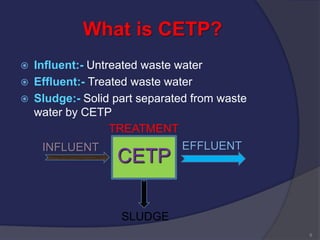
What is CETP?
 Influent:- Untreated waste water
 Effluent:- Treated waste water
 Sludge:- Solid part separated from waste
water by CETP
8
INFLUENT
CETP
TREATMENT
EFFLUENT
SLUDGE
Commom Effluent
Treatment Plant(CETP)
 The concept of common effluent treatment plant
has been accepted as a solution for collecting,
conveying, treating, and disposing of the effluents
from the industrial estates
 This CETP concept helps small and medium scale
industries to dispose of their effluents
 The effluent include industrial wastewaters and
domestic sewage generated from the estate
9
CETP categories
 Homogenous: Industries producing similar goods
in that industrial area are contributing.
E.g.- tanneries, paper etc.
 Heterogenous: Industries producing widely
divergent goods are placed together.
E.g.- chemical, dairy, soft drink, canneries,
pharmaceuticals etc.
10
What is Effluent ?
 Liquid waste out of a factory, farm, commercial
establishment, or a household into a water body
such as a river, lake, or lagoon, or a sewer system
or reservoir
 Industrial Effluent:- Those materials which
generally discarded from industrial operations or
derived from manufacturing process
11
Wastewater Treatment
It has been done in 4 major steps:-
 Preliminary Treatment
 Primary Treatment
 Secondary treatment
 Tertiary Treatment
12
Preliminary Treatment
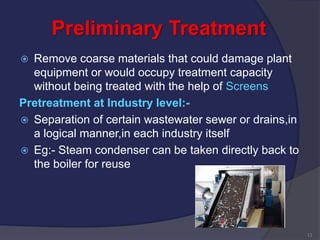
 Remove coarse materials that could damage plant
equipment or would occupy treatment capacity
without being treated with the help of Screens
Pretreatment at Industry level:-
 Separation of certain wastewater sewer or drains,in
a logical manner,in each industry itself
 Eg:- Steam condenser can be taken directly back to
the boiler for reuse
13
Primary Treatment
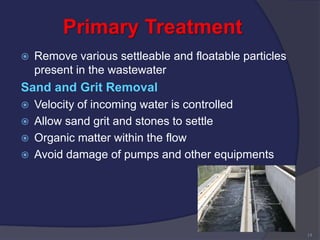
 Remove various settleable and floatable particles
present in the wastewater
Sand and Grit Removal
 Velocity of incoming water is controlled
 Allow sand grit and stones to settle
 Organic matter within the flow
 Avoid damage of pumps and other equipments
14
Secondary treatment
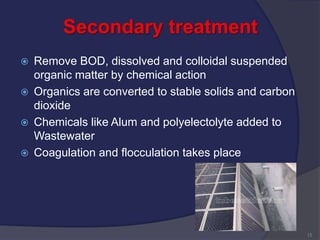
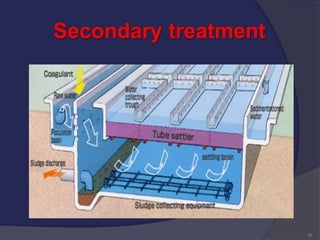
 Remove BOD, dissolved and colloidal suspended
organic matter by chemical action
 Organics are converted to stable solids and carbon
dioxide
 Chemicals like Alum and polyelectolyte added to
Wastewater
 Coagulation and flocculation takes place
15
Secondary treatment
16
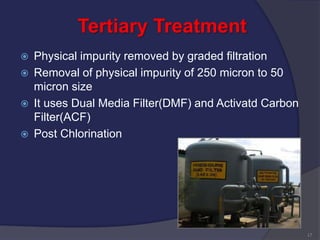
Tertiary Treatment
 Physical impurity removed by graded filtration
 Removal of physical impurity of 250 micron to 50
micron size
 It uses Dual Media Filter(DMF) and Activatd Carbon
Filter(ACF)
 Post Chlorination
17
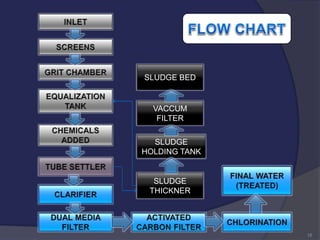
18
SLUDGE
THICKNER
SLUDGE
HOLDING TANK
VACCUM
FILTER
SLUDGE BED
Tests in CETPs
Various tests conducted in CETPs:-
 pH test
 TDS test
 TSS test
 BOD test
 COD test
 Jar test
19
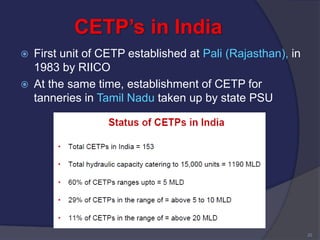
CETP’s in India
 First unit of CETP established at Pali (Rajasthan), in
1983 by RIICO
 At the same time, establishment of CETP for
tanneries in Tamil Nadu taken up by state PSU
20
Advantages of CETP
 Small and medium scale industries are not required
to treat their wastewater separately
 Investment at personal level is not requirement
 Technical expertise is not required
 As many industries waste water is coming in CETP
dilution is achieved
 Treatment cost is reduced
 Assured wastewater treatment hence better control
over pollution.
21
Limitations of CETPs
 CETPs that serve heterogeneous industrial units
will always have to face fluctuations in quantity and
quality of cocktail of effluent
 Occupy too much space
 Only control 5 parameters(pH,BOD,COD,TDS,TSS)
 The mixing of highly complex waste streams, some
of which may be hot and contain chemically active
compounds
 Many of the most toxic and persistent components
of chemical waste streams may simply pass
through the CETP unmodified.
22
THANK YOU
23

Common Effluent Treatment Plant.ppt

  • 1.
  • 2.
    Water  Water scarcityis the major problem that is faced all across the world. Although 2/3rd of the earths crust is made up of water but all this water is not available for drinking  the major part of water that can be consumed is getting polluted because of human activities 2
  • 3.
    Wastewater Treatment Plant  Mosttreatment plants were built to clean wastewater for discharge into streams or other receiving waters, or for reuse  The basic function of wastewater treatment is to speed up the natural processes by which water is purified 3
  • 4.
    Types of Wastewater TreatmentPlants There are three types of Wastewater Treatment Plants :-  Effluent Treatment Plants (ETP)  Sewage Treatment Plants (STP)  Common and Combined Effluent Treatment Plants (CETP) 4
  • 5.
    Management of CETP schemes Thefollowing aspects of management is to be consider  Classification of industries  Ownership  Operation and Maintenance  Financial aspects 5
  • 6.
    Technical aspects for establishmentof CETP schemes Numbers of technical aspects can be listed below:-  Collection and conveyance system  Design and treatment alternatives  Disposal of treated effluent  Cost estimation and cost benefit analysis 6
  • 7.
    Basis of CETPdesigned CETP is designed on the basis of:  Quality and flow rate of the wastewater  Effluent standard required by CETP  Possibility of recycle and reuse of treated wastewater  Availability of land, manpower, energy and expertise in specific treatment methods 7
  • 8.
    What is CETP? Influent:- Untreated waste water  Effluent:- Treated waste water  Sludge:- Solid part separated from waste water by CETP 8 INFLUENT CETP TREATMENT EFFLUENT SLUDGE
  • 9.
    Commom Effluent Treatment Plant(CETP) The concept of common effluent treatment plant has been accepted as a solution for collecting, conveying, treating, and disposing of the effluents from the industrial estates  This CETP concept helps small and medium scale industries to dispose of their effluents  The effluent include industrial wastewaters and domestic sewage generated from the estate 9
  • 10.
    CETP categories  Homogenous:Industries producing similar goods in that industrial area are contributing. E.g.- tanneries, paper etc.  Heterogenous: Industries producing widely divergent goods are placed together. E.g.- chemical, dairy, soft drink, canneries, pharmaceuticals etc. 10
  • 11.
    What is Effluent?  Liquid waste out of a factory, farm, commercial establishment, or a household into a water body such as a river, lake, or lagoon, or a sewer system or reservoir  Industrial Effluent:- Those materials which generally discarded from industrial operations or derived from manufacturing process 11
  • 12.
    Wastewater Treatment It hasbeen done in 4 major steps:-  Preliminary Treatment  Primary Treatment  Secondary treatment  Tertiary Treatment 12
  • 13.
    Preliminary Treatment  Removecoarse materials that could damage plant equipment or would occupy treatment capacity without being treated with the help of Screens Pretreatment at Industry level:-  Separation of certain wastewater sewer or drains,in a logical manner,in each industry itself  Eg:- Steam condenser can be taken directly back to the boiler for reuse 13
  • 14.
    Primary Treatment  Removevarious settleable and floatable particles present in the wastewater Sand and Grit Removal  Velocity of incoming water is controlled  Allow sand grit and stones to settle  Organic matter within the flow  Avoid damage of pumps and other equipments 14
  • 15.
    Secondary treatment  RemoveBOD, dissolved and colloidal suspended organic matter by chemical action  Organics are converted to stable solids and carbon dioxide  Chemicals like Alum and polyelectolyte added to Wastewater  Coagulation and flocculation takes place 15
  • 16.
  • 17.
    Tertiary Treatment  Physicalimpurity removed by graded filtration  Removal of physical impurity of 250 micron to 50 micron size  It uses Dual Media Filter(DMF) and Activatd Carbon Filter(ACF)  Post Chlorination 17
  • 18.
  • 19.
    Tests in CETPs Varioustests conducted in CETPs:-  pH test  TDS test  TSS test  BOD test  COD test  Jar test 19
  • 20.
    CETP’s in India First unit of CETP established at Pali (Rajasthan), in 1983 by RIICO  At the same time, establishment of CETP for tanneries in Tamil Nadu taken up by state PSU 20
  • 21.
    Advantages of CETP Small and medium scale industries are not required to treat their wastewater separately  Investment at personal level is not requirement  Technical expertise is not required  As many industries waste water is coming in CETP dilution is achieved  Treatment cost is reduced  Assured wastewater treatment hence better control over pollution. 21
  • 22.
    Limitations of CETPs CETPs that serve heterogeneous industrial units will always have to face fluctuations in quantity and quality of cocktail of effluent  Occupy too much space  Only control 5 parameters(pH,BOD,COD,TDS,TSS)  The mixing of highly complex waste streams, some of which may be hot and contain chemically active compounds  Many of the most toxic and persistent components of chemical waste streams may simply pass through the CETP unmodified. 22
  • 23.