Rational Expressions
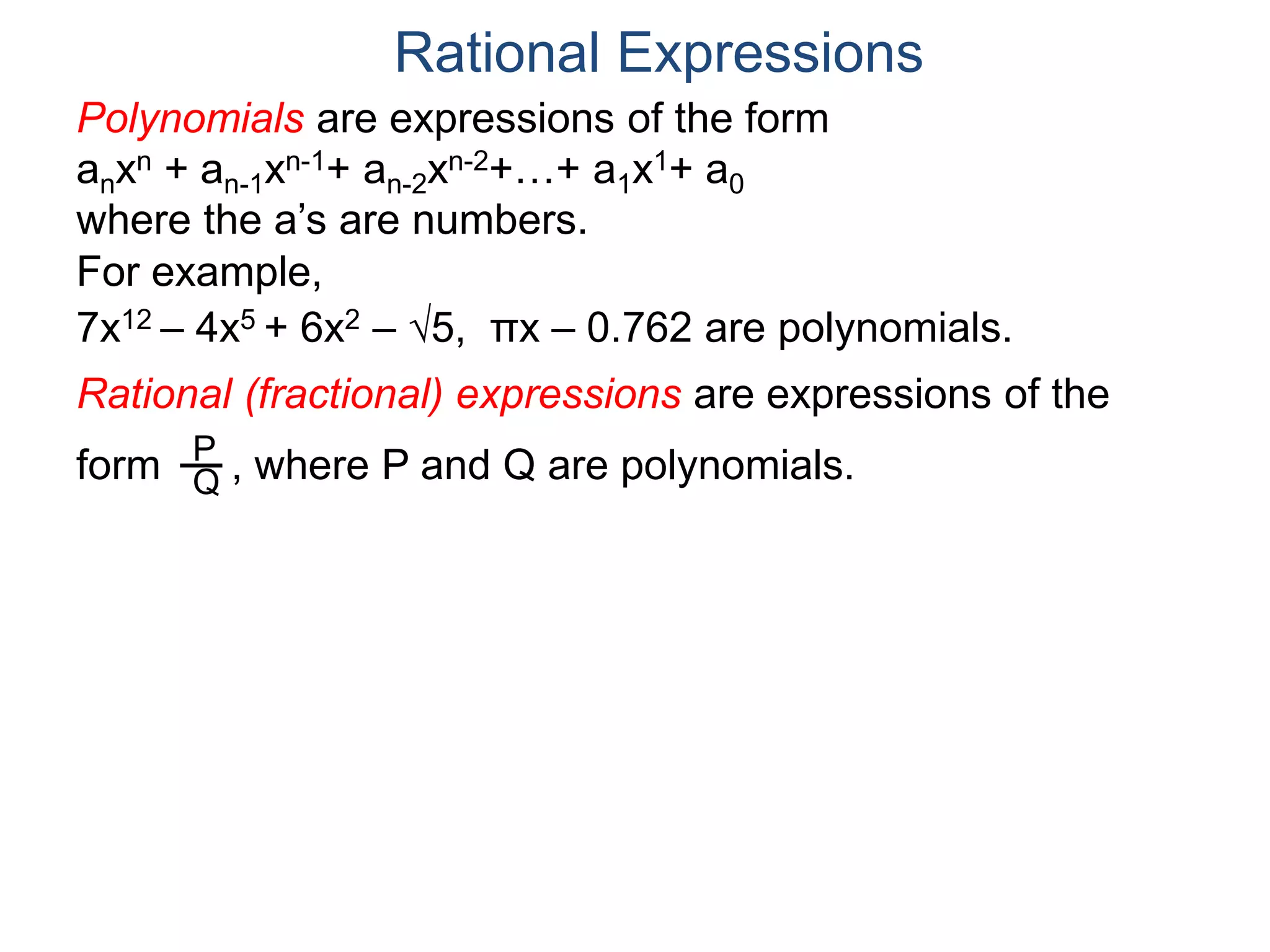
Polynomials are expressions of the form
anxn + an-1xn-1+ an-2xn-2+…+ a1x1+ a0
where the a’s are numbers.
Rational Expressions
For example,
7x12 – 4x5 + 6x2 – 5,
Polynomials are expressions of the form
anxn + an-1xn-1+ an-2xn-2+…+ a1x1+ a0
where the a’s are numbers.
Rational Expressions
For example,
7x12 – 4x5 + 6x2 – 5, πx – 0.762 are polynomials.
Polynomials are expressions of the form
anxn + an-1xn-1+ an-2xn-2+…+ a1x1+ a0
where the a’s are numbers.
Rational Expressions
For example,
7x12 – 4x5 + 6x2 – 5, πx – 0.762 are polynomials.
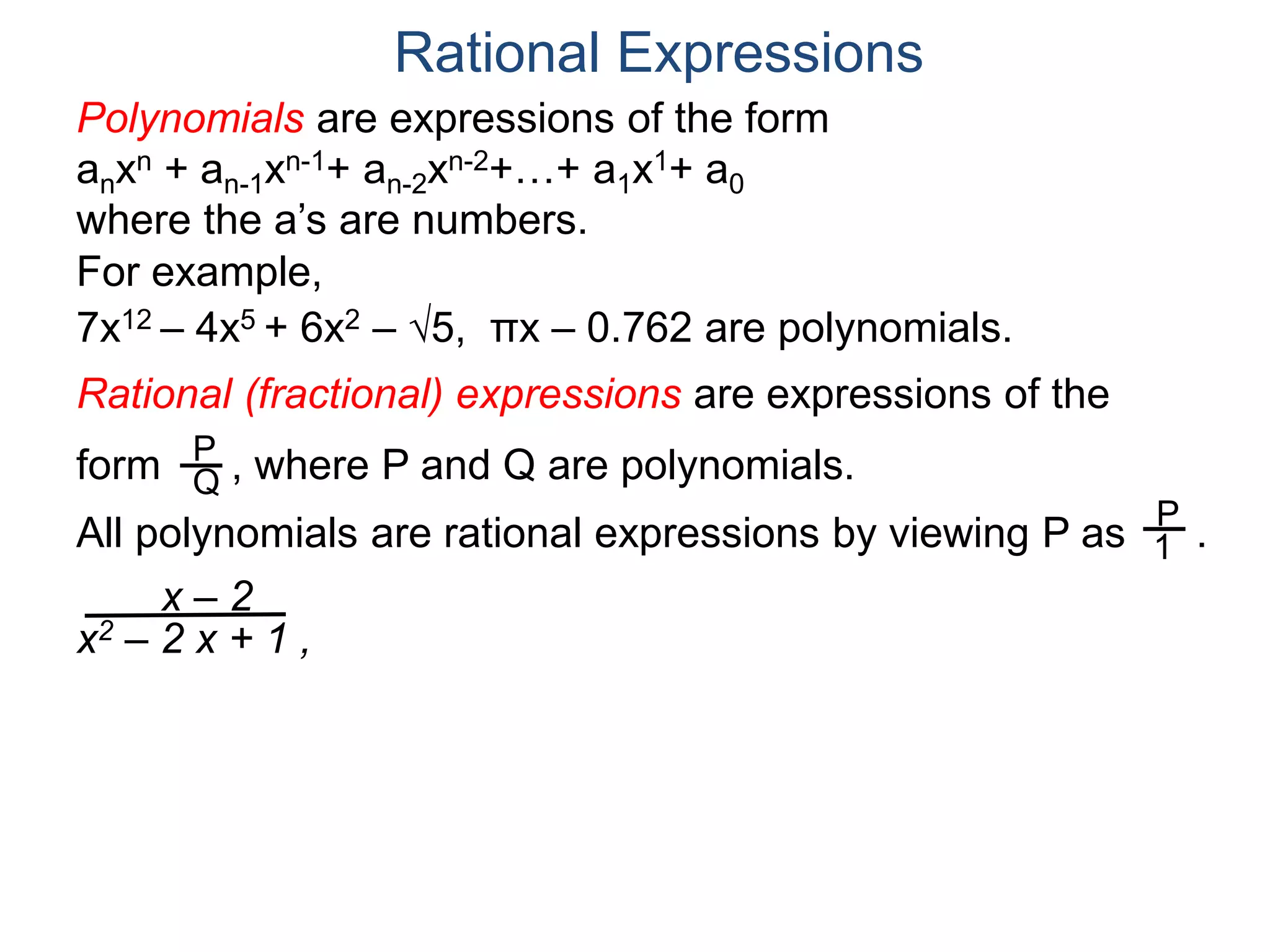
Rational (fractional) expressions are expressions of the
form , where P and Q are polynomials.P
Q
Polynomials are expressions of the form
anxn + an-1xn-1+ an-2xn-2+…+ a1x1+ a0
where the a’s are numbers.
Rational Expressions
For example,
7x12 – 4x5 + 6x2 – 5, πx – 0.762 are polynomials.
Rational (fractional) expressions are expressions of the
form , where P and Q are polynomials.P
Q
Polynomials are expressions of the form
anxn + an-1xn-1+ an-2xn-2+…+ a1x1+ a0
where the a’s are numbers.
All polynomials are rational expressions by viewing P as .
P
1
Rational Expressions
For example,
7x12 – 4x5 + 6x2 – 5, πx – 0.762 are polynomials.
Rational (fractional) expressions are expressions of the
form , where P and Q are polynomials.P
Q
Polynomials are expressions of the form
anxn + an-1xn-1+ an-2xn-2+…+ a1x1+ a0
where the a’s are numbers.
All polynomials are rational expressions by viewing P as .
P
1
x – 2
x2 – 2 x + 1 ,
Rational Expressions
For example,
7x12 – 4x5 + 6x2 – 5, πx – 0.762 are polynomials.
Rational (fractional) expressions are expressions of the
form , where P and Q are polynomials.P
Q
Polynomials are expressions of the form
anxn + an-1xn-1+ an-2xn-2+…+ a1x1+ a0
where the a’s are numbers.
All polynomials are rational expressions by viewing P as .
P
1
x – 2
x2 – 2 x + 1 ,
x(x – 2)
(x + 1) (2x + 1) are rational expressions.
Rational Expressions
For example,
7x12 – 4x5 + 6x2 – 5, πx – 0.762 are polynomials.
Rational (fractional) expressions are expressions of the
form , where P and Q are polynomials.P
Q
Polynomials are expressions of the form
anxn + an-1xn-1+ an-2xn-2+…+ a1x1+ a0
where the a’s are numbers.
All polynomials are rational expressions by viewing P as .
P
1
x – 2
x2 – 2 x + 1 ,
x(x – 2)
(x + 1) (2x + 1) are rational expressions.
x – 2
 2 x + 1
is not a rational expression because the
denominator is not a polynomial.
Rational Expressions
For example,
7x12 – 4x5 + 6x2 – 5, πx – 0.762 are polynomials.
Rational (fractional) expressions are expressions of the
form , where P and Q are polynomials.P
Q
Polynomials are expressions of the form
anxn + an-1xn-1+ an-2xn-2+…+ a1x1+ a0
where the a’s are numbers.
All polynomials are rational expressions by viewing P as .
P
1
x – 2
x2 – 2 x + 1 ,
x(x – 2)
(x + 1) (2x + 1) are rational expressions.
x – 2
 2 x + 1
is not a rational expression because the
denominator is not a polynomial.
Rational expressions are expressions that describe
calculation procedures that involve division (of polynomials).
Rational Expressions
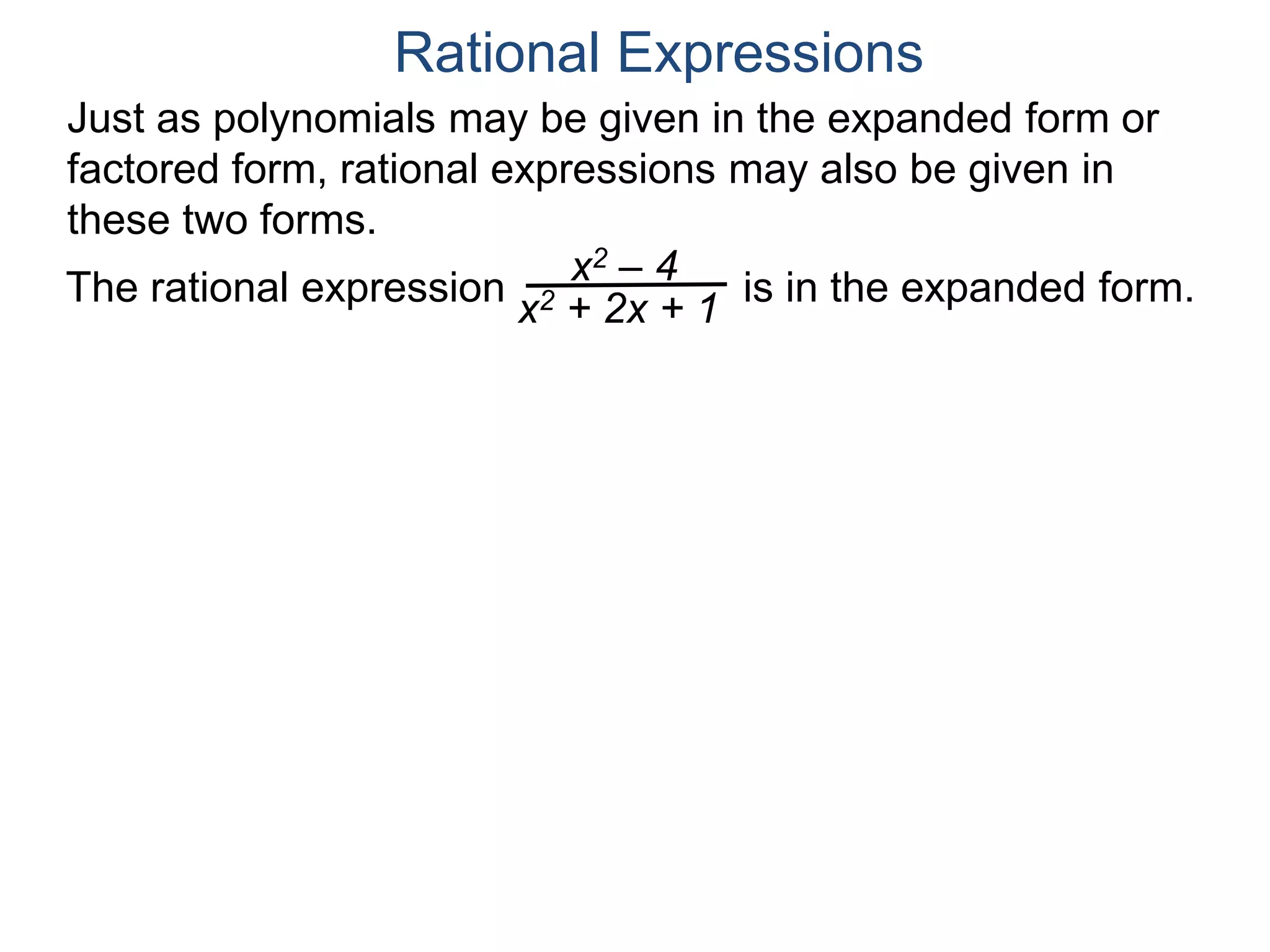
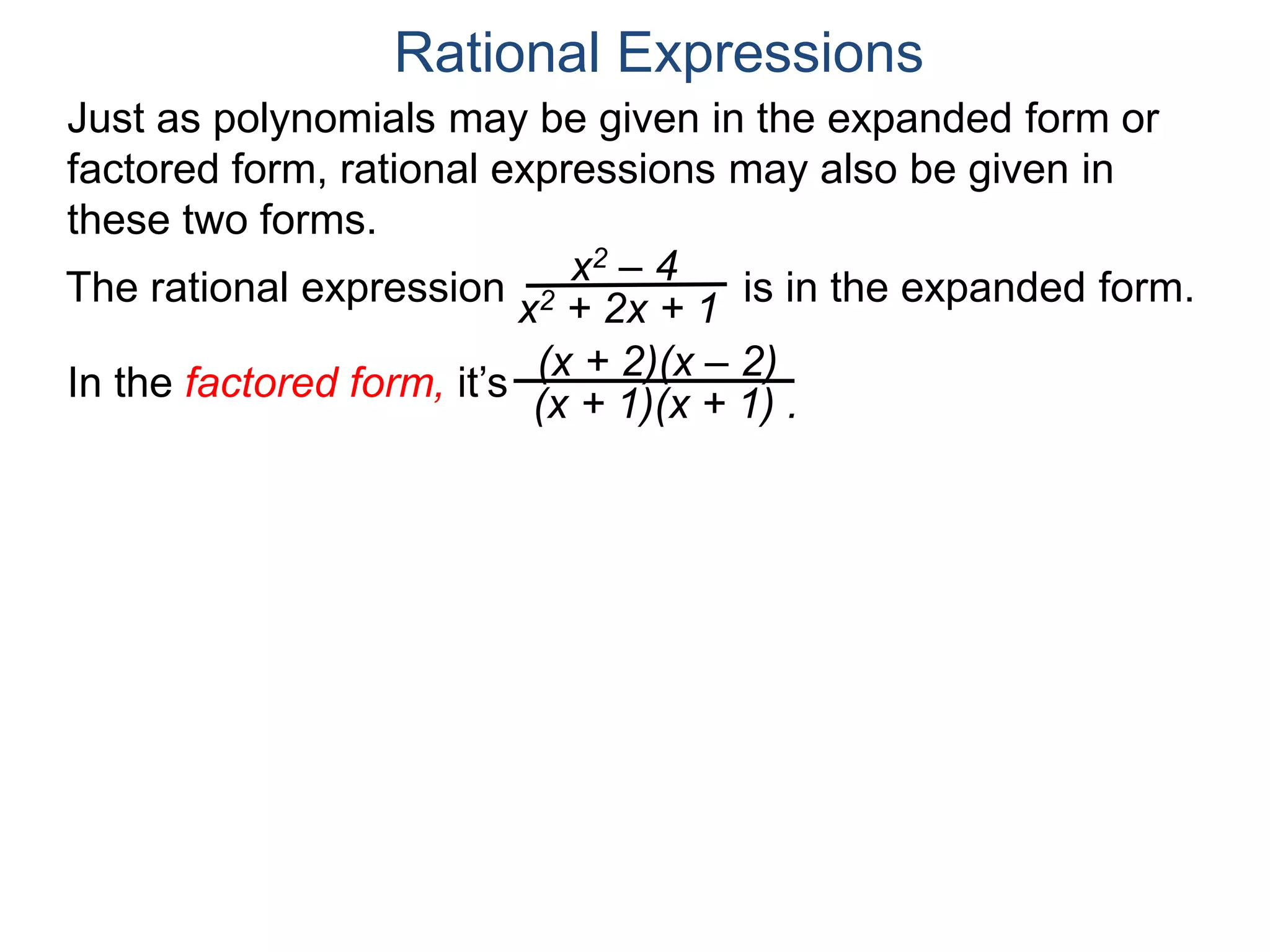
Just as polynomials may be given in the expanded form or
factored form, rational expressions may also be given in
these two forms.
Rational Expressions
Just as polynomials may be given in the expanded form or
factored form, rational expressions may also be given in
these two forms.
The rational expression
x2 – 4
x2 + 2x + 1
is in the expanded form.
Rational Expressions
Just as polynomials may be given in the expanded form or
factored form, rational expressions may also be given in
these two forms.
The rational expression
x2 – 4
(x + 2)(x – 2)
(x + 1)(x + 1) .
is in the expanded form.
In the factored form, it’s
x2 + 2x + 1
Rational Expressions
Just as polynomials may be given in the expanded form or
factored form, rational expressions may also be given in
these two forms.
The rational expression
x2 – 4
x2 + 2x + 1
(x + 2)(x – 2)
(x + 1)(x + 1) .
x – 2
x2 + 1The expression is in both forms.
is in the expanded form.
In the factored form, it’s
Example A. Put the following expressions in the factored form.
a. x2 – 3x – 10
x2 – 3x
b. x2 – 3x + 10
x2 – 3
Rational Expressions
Just as polynomials may be given in the expanded form or
factored form, rational expressions may also be given in
these two forms.
The rational expression
x2 – 4
x2 + 2x + 1
(x + 2)(x – 2)
(x + 1)(x + 1) .
x – 2
x2 + 1The expression is in both forms.
is in the expanded form.
Example A. Put the following expressions in the factored form.
(x – 5)(x + 2)a.
x(x – 3)
x2 – 3x – 10
x2 – 3x
=
b. x2 – 3x + 10
x2 – 3
In the factored form, it’s
Rational Expressions
Just as polynomials may be given in the expanded form or
factored form, rational expressions may also be given in
these two forms.
The rational expression
x2 – 4
x2 + 2x + 1
(x + 2)(x – 2)
(x + 1)(x + 1) .
x – 2
x2 + 1The expression is in both forms.
is in the expanded form.
Example A. Put the following expressions in the factored form.
(x – 5)(x + 2)a.
x(x – 3)
x2 – 3x – 10
x2 – 3x
=
b. x2 – 3x + 10
x2 – 3
is in the factored form
In the factored form, it’s
Rational Expressions
Just as polynomials may be given in the expanded form or
factored form, rational expressions may also be given in
these two forms.
The rational expression
x2 – 4
x2 + 2x + 1
(x + 2)(x – 2)
(x + 1)(x + 1) .
x – 2
x2 + 1The expression is in both forms.
is in the expanded form.
Example A. Put the following expressions in the factored form.
(x – 5)(x + 2)a.
x(x – 3)
x2 – 3x – 10
x2 – 3x
=
b. x2 – 3x + 10
x2 – 3
is in the factored form
Note that in b. the entire (x2 – 3x + 10) or (x2 – 3) are viewed
as a single factors because they can’t be factored further.
In the factored form, it’s
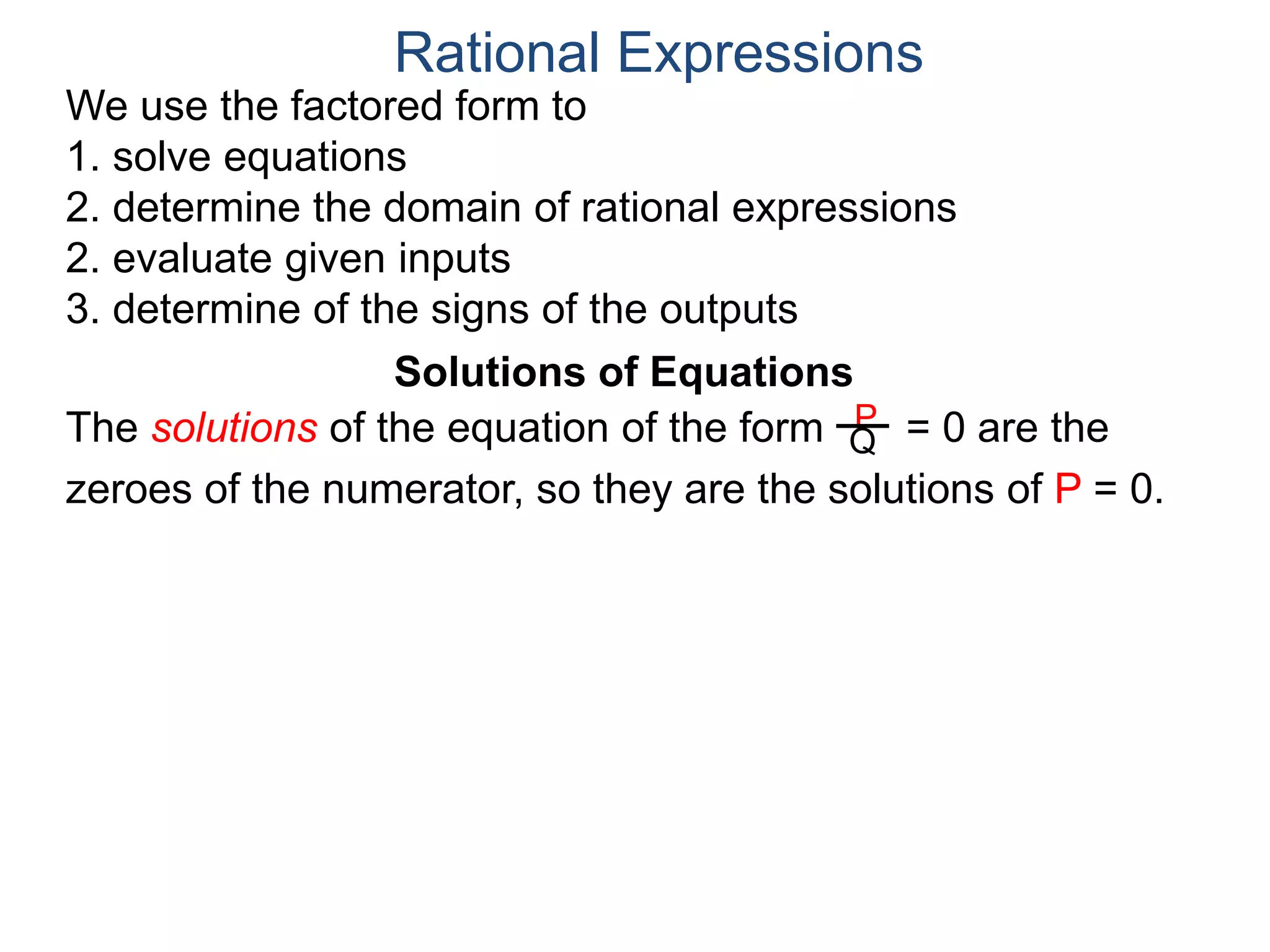
We use the factored form to
1. solve equations
Rational Expressions
We use the factored form to
1. solve equations
2. determine the domain of rational expressions
Rational Expressions
We use the factored form to
1. solve equations
2. determine the domain of rational expressions
2. evaluate given inputs
Rational Expressions
We use the factored form to
1. solve equations
2. determine the domain of rational expressions
2. evaluate given inputs
3. determine of the signs of the outputs
Rational Expressions
We use the factored form to
1. solve equations
2. determine the domain of rational expressions
2. evaluate given inputs
3. determine of the signs of the outputs
Solutions of Equations
Rational Expressions
We use the factored form to
1. solve equations
2. determine the domain of rational expressions
2. evaluate given inputs
3. determine of the signs of the outputs
Solutions of Equations
The solutions of the equation of the form = 0 are the
zeroes of the numerator, so they are the solutions of P = 0.
Rational Expressions
P
Q
We use the factored form to
1. solve equations
2. determine the domain of rational expressions
2. evaluate given inputs
3. determine of the signs of the outputs
Solutions of Equations
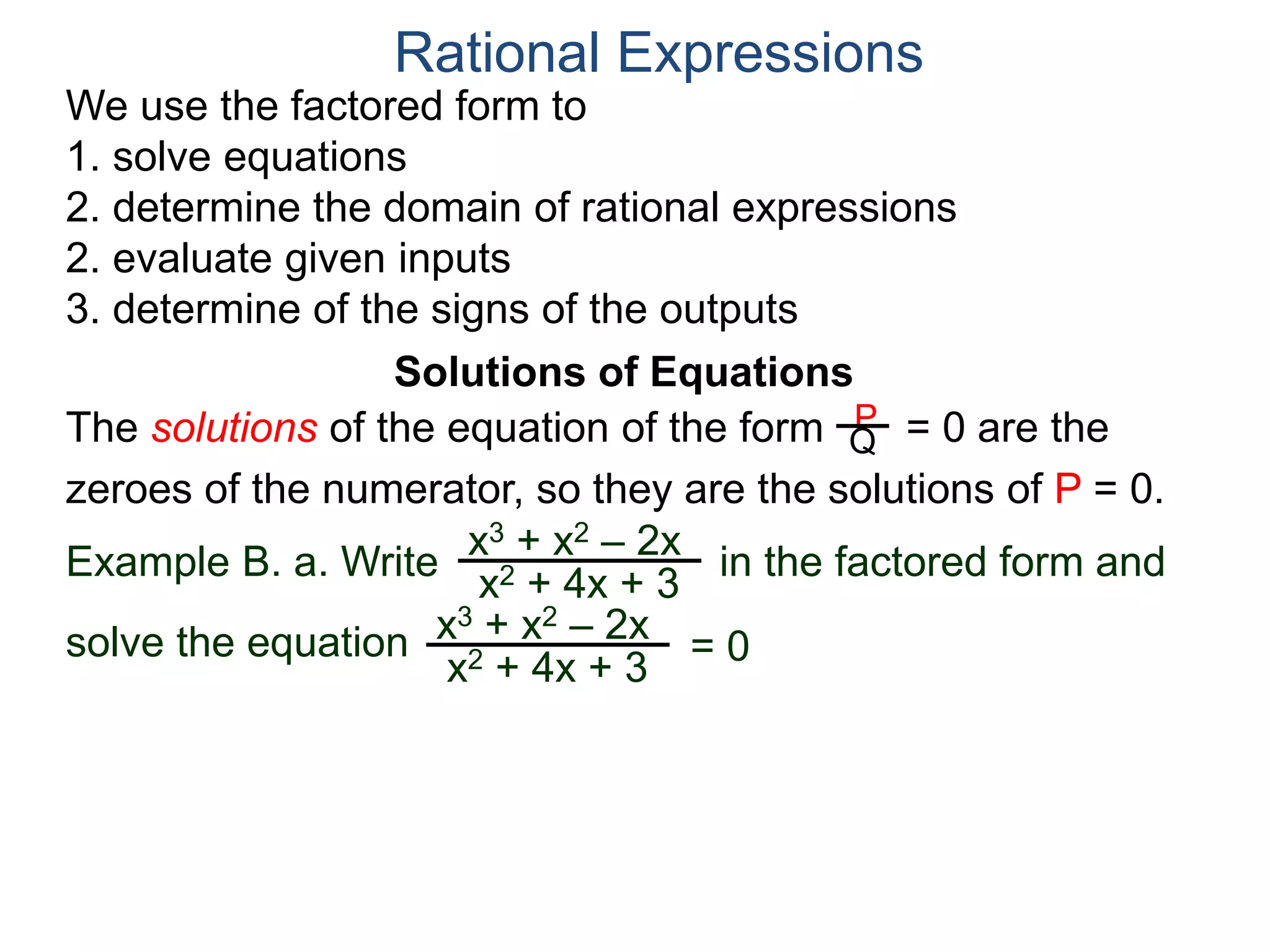
Example B. a. Write in the factored form and
solve the equation
The solutions of the equation of the form = 0 are the
zeroes of the numerator, so they are the solutions of P = 0.
Rational Expressions
x3 + x2 – 2x
x2 + 4x + 3
x3 + x2 – 2x
x2 + 4x + 3
= 0
P
Q
We use the factored form to
1. solve equations
2. determine the domain of rational expressions
2. evaluate given inputs
3. determine of the signs of the outputs
Solutions of Equations
Example B. a. Write in the factored form and
solve the equation
The solutions of the equation of the form = 0 are the
zeroes of the numerator, so they are the solutions of P = 0.
Rational Expressions
x3 + x2 – 2x
x2 + 4x + 3
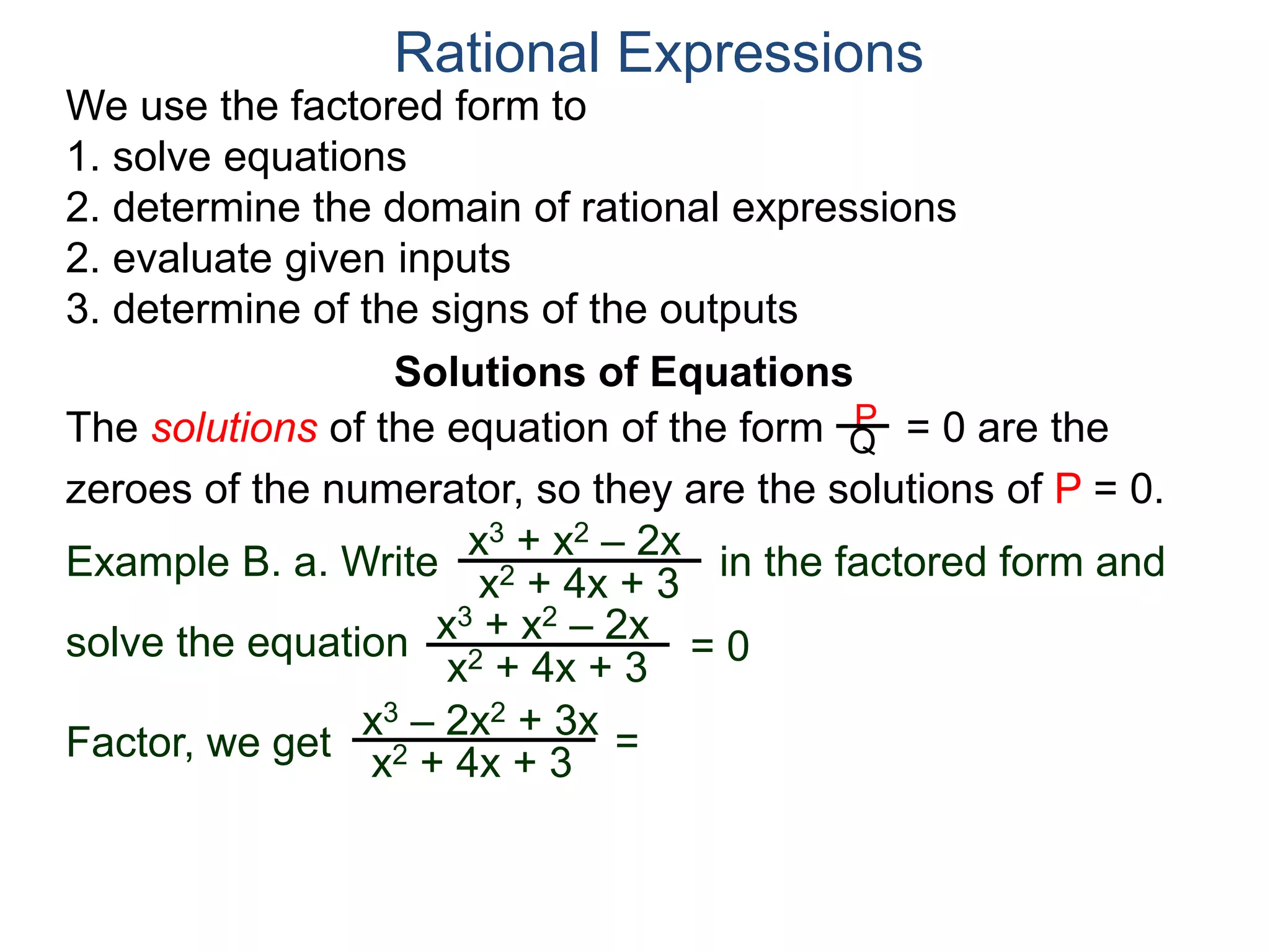
x3 – 2x2 + 3x
x2 + 4x + 3
x3 + x2 – 2x
x2 + 4x + 3
= 0
Factor, we get
P
Q
=
We use the factored form to
1. solve equations
2. determine the domain of rational expressions
2. evaluate given inputs
3. determine of the signs of the outputs
Solutions of Equations
Example B. a. Write in the factored form and
solve the equation
The solutions of the equation of the form = 0 are the
zeroes of the numerator, so they are the solutions of P = 0.
Rational Expressions
x3 + x2 – 2x
x2 + 4x + 3
x3 – 2x2 + 3x
x2 + 4x + 3
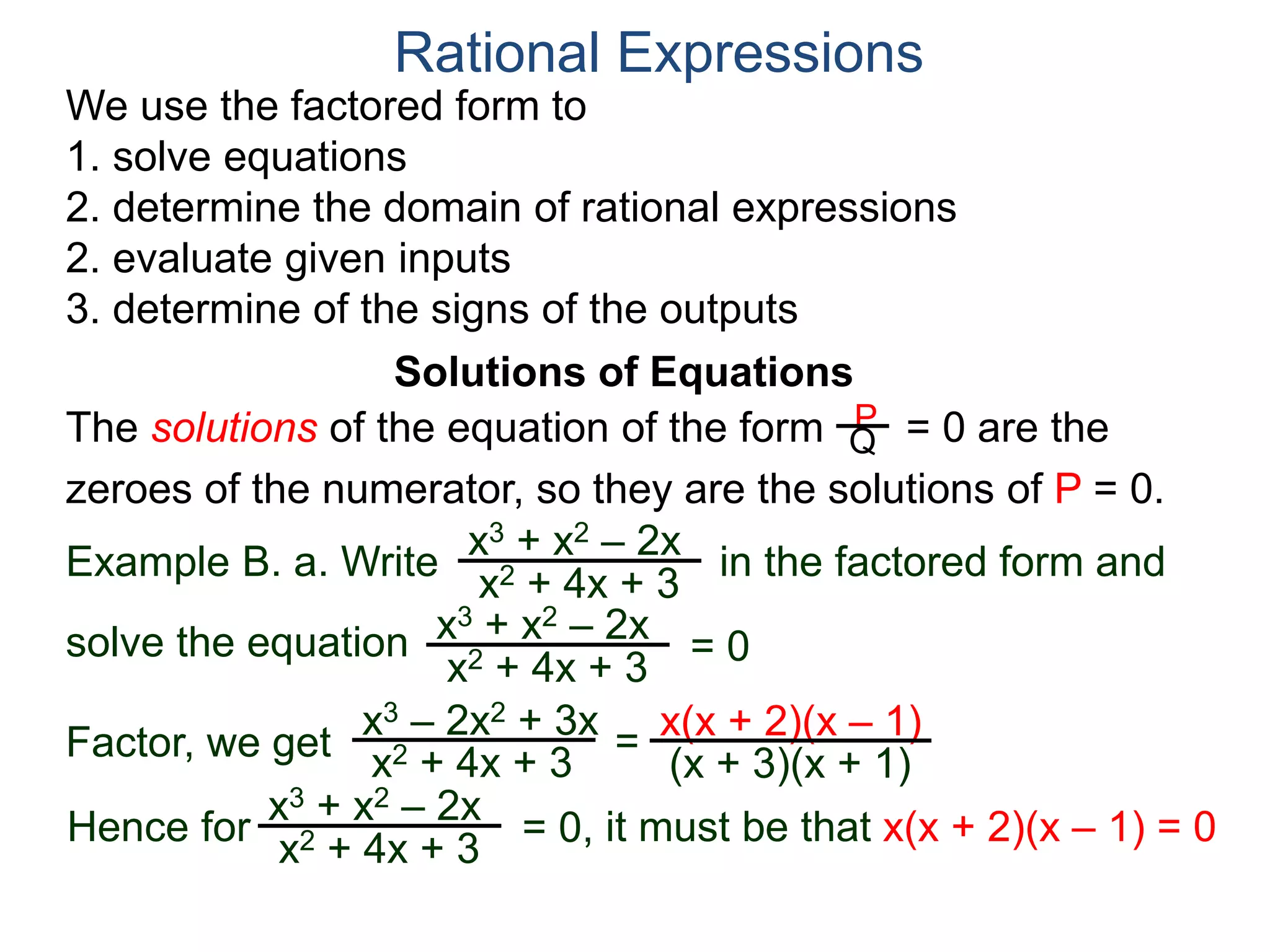
= x(x + 2)(x – 1)
(x + 3)(x + 1)
x3 + x2 – 2x
x2 + 4x + 3
= 0
Factor, we get
P
Q
We use the factored form to
1. solve equations
2. determine the domain of rational expressions
2. evaluate given inputs
3. determine of the signs of the outputs
Solutions of Equations
Example B. a. Write in the factored form and
solve the equation
The solutions of the equation of the form = 0 are the
zeroes of the numerator, so they are the solutions of P = 0.
Rational Expressions
x3 + x2 – 2x
x2 + 4x + 3
x3 – 2x2 + 3x
x2 + 4x + 3
= x(x + 2)(x – 1)
(x + 3)(x + 1)
x3 + x2 – 2x
x2 + 4x + 3
= 0
Factor, we get
Hence for
x3 + x2 – 2x
x2 + 4x + 3
= 0, it must be that x(x + 2)(x – 1) = 0
P
Q
We use the factored form to
1. solve equations
2. determine the domain of rational expressions
2. evaluate given inputs
3. determine of the signs of the outputs
Solutions of Equations
Example B. a. Write in the factored form and
solve the equation
The solutions of the equation of the form = 0 are the
zeroes of the numerator, so they are the solutions of P = 0.
Rational Expressions
x3 + x2 – 2x
x2 + 4x + 3
x3 – 2x2 + 3x
x2 + 4x + 3
= x(x + 2)(x – 1)
(x + 3)(x + 1)
x3 + x2 – 2x
x2 + 4x + 3
= 0
Factor, we get
Hence for
x3 + x2 – 2x
x2 + 4x + 3
= 0, it must be that x(x + 2)(x – 1) = 0
or that x = 0, –2, 1.
P
Q
Domain
The domain of a formula is the set of all the numbers that we
may use as input values for x.
Rational Expressions
Domain
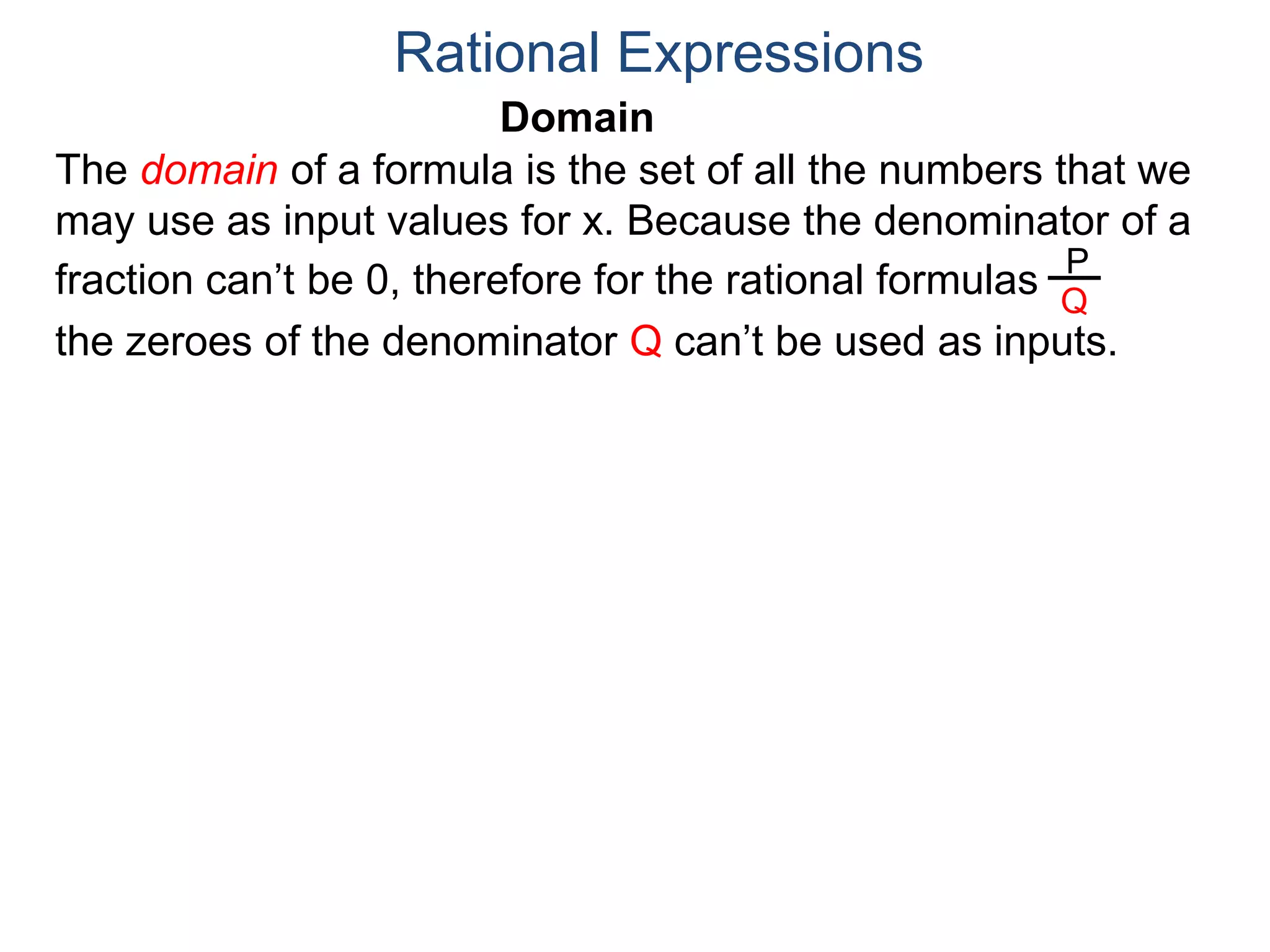
The domain of a formula is the set of all the numbers that we
may use as input values for x. Because the denominator of a
fraction can’t be 0, therefore for the rational formulas
the zeroes of the denominator Q can’t be used as inputs.
Rational Expressions
P
Q
Domain
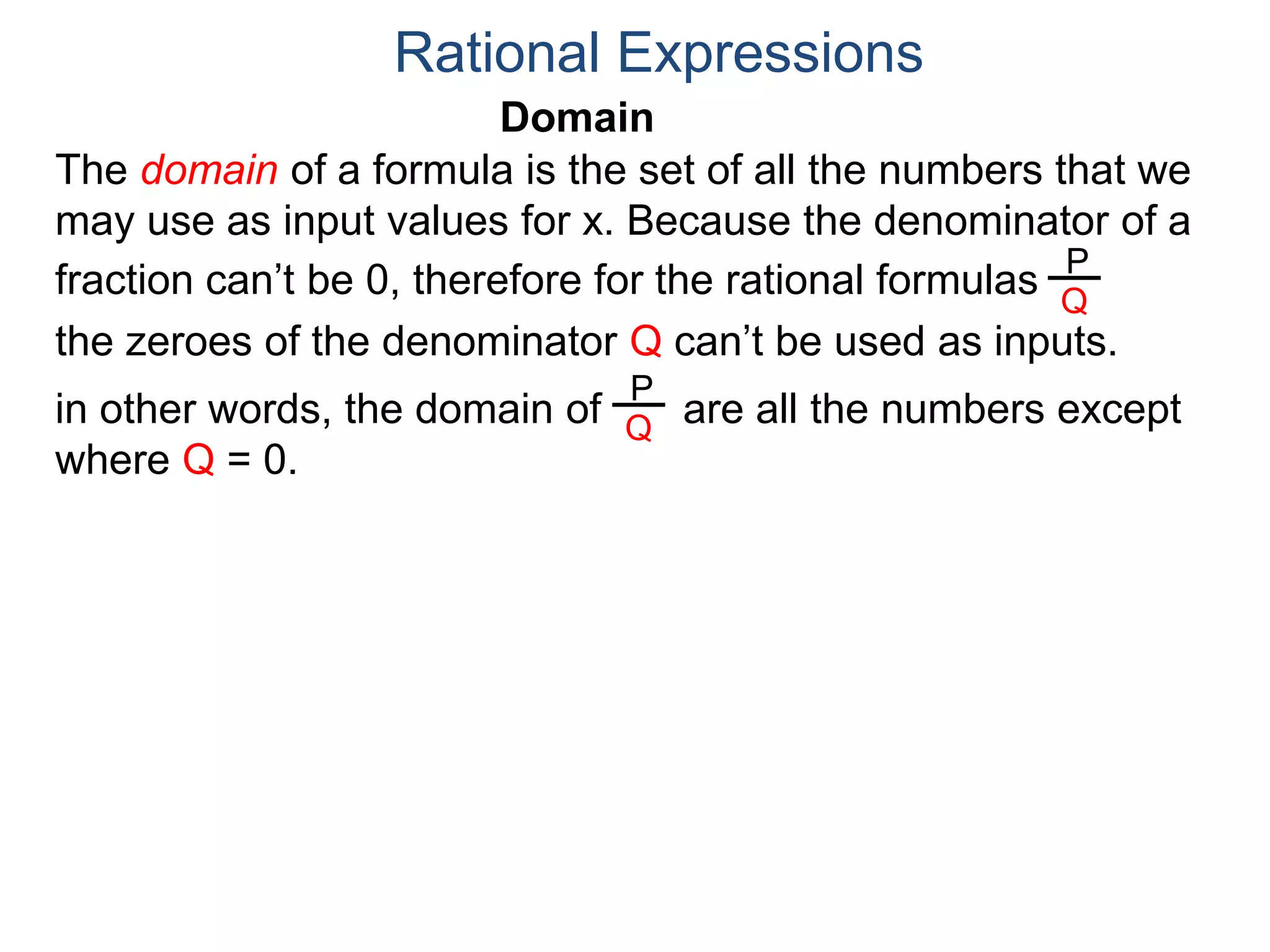
The domain of a formula is the set of all the numbers that we
may use as input values for x. Because the denominator of a
fraction can’t be 0, therefore for the rational formulas
the zeroes of the denominator Q can’t be used as inputs.
in other words, the domain of are all the numbers except
where Q = 0.
Rational Expressions
P
Q
P
Q
Domain
b. Determine the domain of the formula
The domain of a formula is the set of all the numbers that we
may use as input values for x. Because the denominator of a
fraction can’t be 0, therefore for the rational formulas
the zeroes of the denominator Q can’t be used as inputs.
in other words, the domain of are all the numbers except
where Q = 0.
Rational Expressions
x3 + x2 – 2x
x2 + 4x + 3
P
Q
P
Q
Domain
b. Determine the domain of the formula
The domain of a formula is the set of all the numbers that we
may use as input values for x. Because the denominator of a
fraction can’t be 0, therefore for the rational formulas
the zeroes of the denominator Q can’t be used as inputs.
in other words, the domain of are all the numbers except
where Q = 0.
Rational Expressions
x3 + x2 – 2x
x2 + 4x + 3
x3 – 2x2 + 3x
x2 + 4x + 3
Factor expression first.
= x(x + 2)(x – 1)
(x + 3)(x + 1)
P
Q
P
Q
Domain
b. Determine the domain of the formula
The domain of a formula is the set of all the numbers that we
may use as input values for x. Because the denominator of a
fraction can’t be 0, therefore for the rational formulas
the zeroes of the denominator Q can’t be used as inputs.
in other words, the domain of are all the numbers except
where Q = 0.
Rational Expressions
x3 + x2 – 2x
x2 + 4x + 3
x3 – 2x2 + 3x
x2 + 4x + 3
Factor expression first.
= x(x + 2)(x – 1)
(x + 3)(x + 1)
Hence we can’t have
P
Q
P
Q
(x + 3)(x + 1) = 0
Domain
b. Determine the domain of the formula
The domain of a formula is the set of all the numbers that we
may use as input values for x. Because the denominator of a
fraction can’t be 0, therefore for the rational formulas
the zeroes of the denominator Q can’t be used as inputs.
in other words, the domain of are all the numbers except
where Q = 0.
Rational Expressions
x3 + x2 – 2x
x2 + 4x + 3
x3 – 2x2 + 3x
x2 + 4x + 3
Factor expression first.
= x(x + 2)(x – 1)
(x + 3)(x + 1)
Hence we can’t have
P
Q
P
Q
(x + 3)(x + 1) = 0
so that the domain is the set of all the numbers except
–1 and –3.
Evaluation
It is often easier to evaluate expressions in the factored form.
Rational Expressions
Evaluation
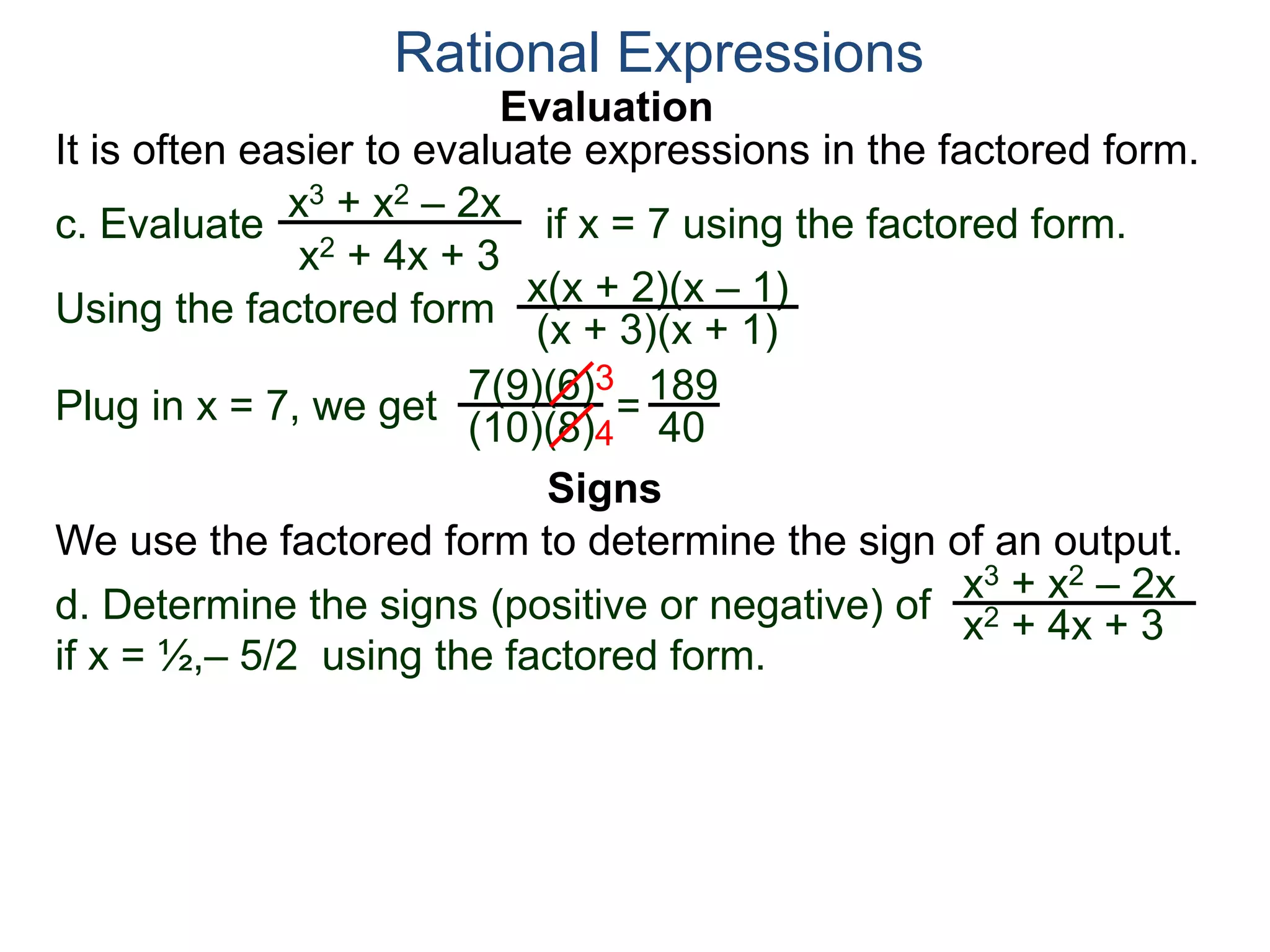
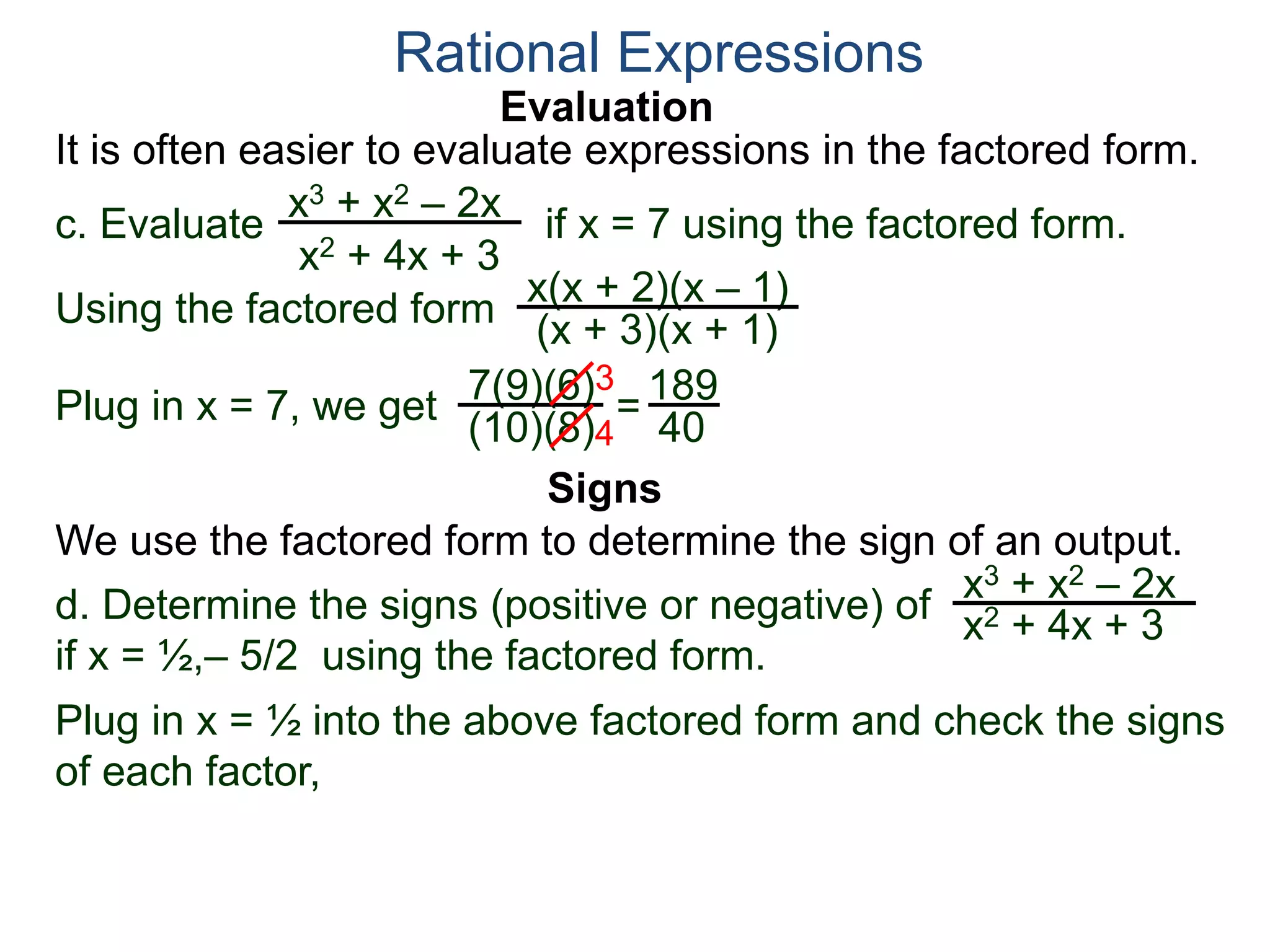
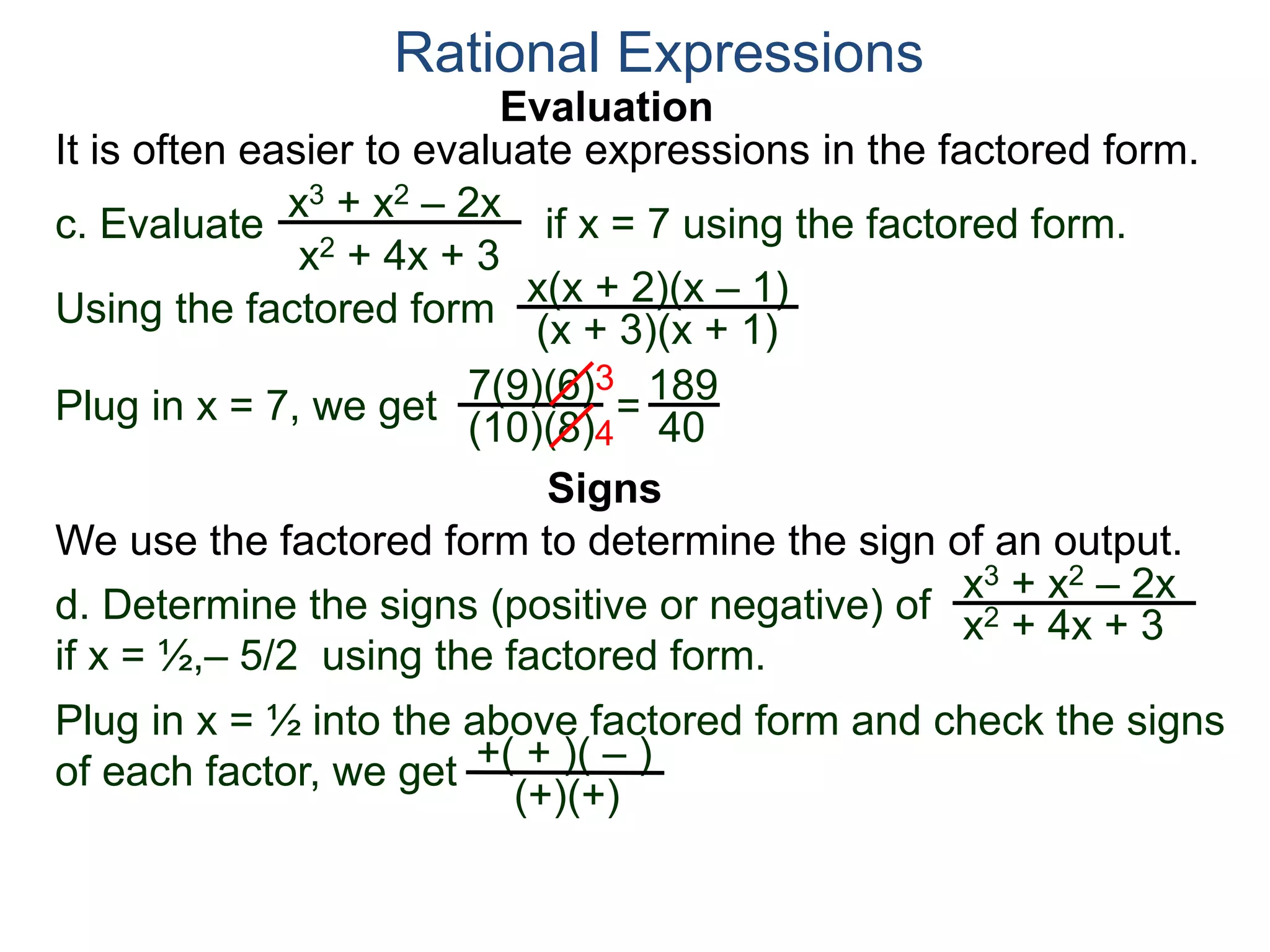
c. Evaluate if x = 7 using the factored form.
It is often easier to evaluate expressions in the factored form.
Rational Expressions
x3 + x2 – 2x
x2 + 4x + 3
Evaluation
c. Evaluate if x = 7 using the factored form.
It is often easier to evaluate expressions in the factored form.
Rational Expressions
x3 + x2 – 2x
x2 + 4x + 3
Using the factored form
x(x + 2)(x – 1)
(x + 3)(x + 1)
Plug in x = 7,
Evaluation
c. Evaluate if x = 7 using the factored form.
It is often easier to evaluate expressions in the factored form.
Rational Expressions
x3 + x2 – 2x
x2 + 4x + 3
Using the factored form
x(x + 2)(x – 1)
(x + 3)(x + 1)
Plug in x = 7, we get 7(9)(6)
(10)(8)
Evaluation
c. Evaluate if x = 7 using the factored form.
It is often easier to evaluate expressions in the factored form.
Rational Expressions
x3 + x2 – 2x
x2 + 4x + 3
Using the factored form
x(x + 2)(x – 1)
(x + 3)(x + 1)
Plug in x = 7, we get 7(9)(6)
(10)(8)
3
4
Evaluation
c. Evaluate if x = 7 using the factored form.
It is often easier to evaluate expressions in the factored form.
Rational Expressions
x3 + x2 – 2x
x2 + 4x + 3
Using the factored form
x(x + 2)(x – 1)
(x + 3)(x + 1)
Plug in x = 7, we get 7(9)(6)
(10)(8)
=
3
4
189
40
Evaluation
c. Evaluate if x = 7 using the factored form.
It is often easier to evaluate expressions in the factored form.
Rational Expressions
x3 + x2 – 2x
x2 + 4x + 3
Using the factored form
x(x + 2)(x – 1)
(x + 3)(x + 1)
Plug in x = 7, we get 7(9)(6)
(10)(8)
=
3
4
189
40
Signs
Evaluation
c. Evaluate if x = 7 using the factored form.
It is often easier to evaluate expressions in the factored form.
Rational Expressions
x3 + x2 – 2x
x2 + 4x + 3
Using the factored form
x(x + 2)(x – 1)
(x + 3)(x + 1)
Plug in x = 7, we get 7(9)(6)
(10)(8)
=
3
4
189
40
We use the factored form to determine the sign of an output.
Signs
Evaluation
c. Evaluate if x = 7 using the factored form.
It is often easier to evaluate expressions in the factored form.
Rational Expressions
x3 + x2 – 2x
x2 + 4x + 3
Using the factored form
x(x + 2)(x – 1)
(x + 3)(x + 1)
Plug in x = 7, we get 7(9)(6)
(10)(8)
=
3
4
189
40
We use the factored form to determine the sign of an output.
Signs
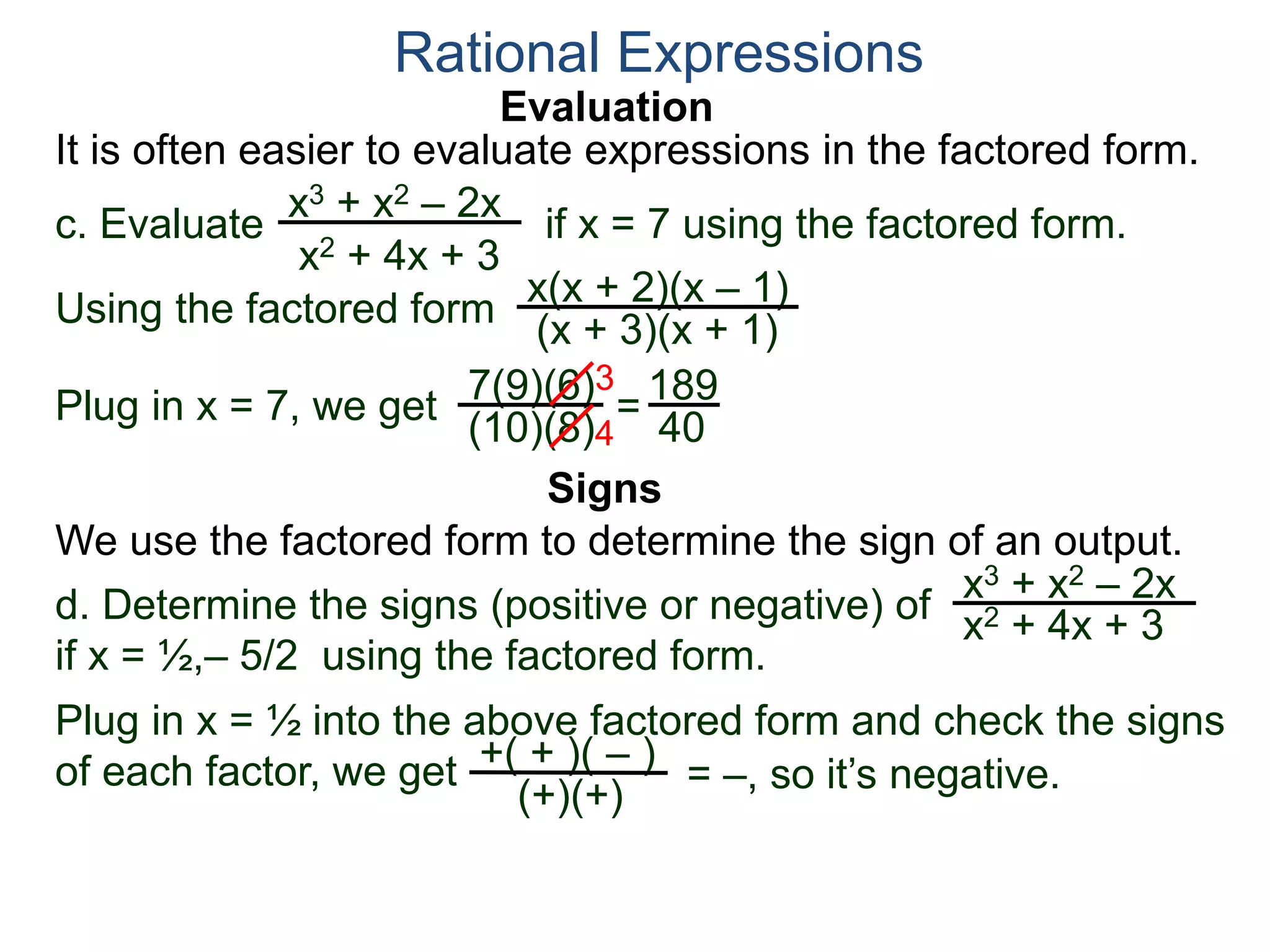
d. Determine the signs (positive or negative) of
if x = ½,– 5/2 using the factored form.
x3 + x2 – 2x
x2 + 4x + 3
Evaluation
c. Evaluate if x = 7 using the factored form.
It is often easier to evaluate expressions in the factored form.
Rational Expressions
x3 + x2 – 2x
x2 + 4x + 3
Using the factored form
x(x + 2)(x – 1)
(x + 3)(x + 1)
Plug in x = 7, we get 7(9)(6)
(10)(8)
=
3
4
189
40
We use the factored form to determine the sign of an output.
Signs
d. Determine the signs (positive or negative) of
if x = ½,– 5/2 using the factored form.
x3 + x2 – 2x
x2 + 4x + 3
Plug in x = ½ into the above factored form and check the signs
of each factor,
Evaluation
c. Evaluate if x = 7 using the factored form.
It is often easier to evaluate expressions in the factored form.
Rational Expressions
x3 + x2 – 2x
x2 + 4x + 3
Using the factored form
x(x + 2)(x – 1)
(x + 3)(x + 1)
Plug in x = 7, we get 7(9)(6)
(10)(8)
=
3
4
189
40
We use the factored form to determine the sign of an output.
Signs
d. Determine the signs (positive or negative) of
if x = ½,– 5/2 using the factored form.
x3 + x2 – 2x
x2 + 4x + 3
Plug in x = ½ into the above factored form and check the signs
of each factor, we get +( + )( – )
(+)(+)
Evaluation
c. Evaluate if x = 7 using the factored form.
It is often easier to evaluate expressions in the factored form.
Rational Expressions
x3 + x2 – 2x
x2 + 4x + 3
Using the factored form
x(x + 2)(x – 1)
(x + 3)(x + 1)
Plug in x = 7, we get 7(9)(6)
(10)(8)
=
3
4
189
40
We use the factored form to determine the sign of an output.
Signs
d. Determine the signs (positive or negative) of
if x = ½,– 5/2 using the factored form.
x3 + x2 – 2x
x2 + 4x + 3
Plug in x = ½ into the above factored form and check the signs
of each factor, we get = –, so it’s negative.+( + )( – )
(+)(+)
Evaluation
c. Evaluate if x = 7 using the factored form.
It is often easier to evaluate expressions in the factored form.
Rational Expressions
x3 + x2 – 2x
x2 + 4x + 3
Using the factored form
x(x + 2)(x – 1)
(x + 3)(x + 1)
Plug in x = 7, we get 7(9)(6)
(10)(8)
=
3
4
189
40
We use the factored form to determine the sign of an output.
Signs
d. Determine the signs (positive or negative) of
if x = ½,– 5/2 using the factored form.
x3 + x2 – 2x
x2 + 4x + 3
Plug in x = ½ into the above factored form and check the signs
of each factor, we get
Plug in x = –5/2 into the factored form we get –( – )( – )
(+)( – )
= –, so it’s negative.+( + )( – )
(+)(+)
Evaluation
c. Evaluate if x = 7 using the factored form.
It is often easier to evaluate expressions in the factored form.
Rational Expressions
x3 + x2 – 2x
x2 + 4x + 3
Using the factored form
x(x + 2)(x – 1)
(x + 3)(x + 1)
Plug in x = 7, we get 7(9)(6)
(10)(8)
=
3
4
189
40
We use the factored form to determine the sign of an output.
Signs
d. Determine the signs (positive or negative) of
if x = ½,– 5/2 using the factored form.
x3 + x2 – 2x
x2 + 4x + 3
Plug in x = ½ into the above factored form and check the signs
of each factor, we get = –, so it’s negative.+( + )( – )
(+)(+)
Plug in x = –5/2 into the factored form we get –( – )( – )
(+)( – ) = +
so that the output is positive.
PN
QN
= =
1
Rational Expressions
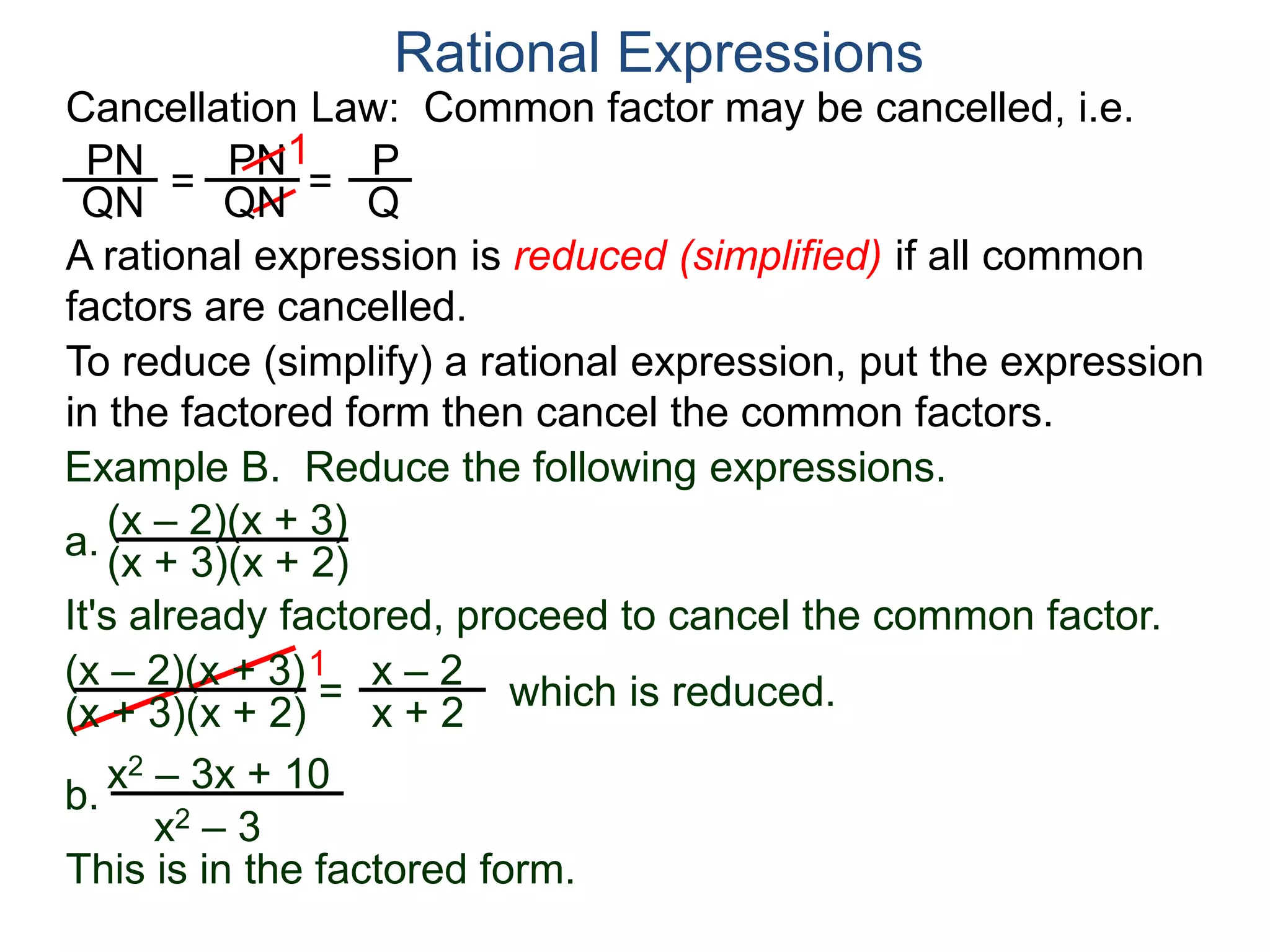
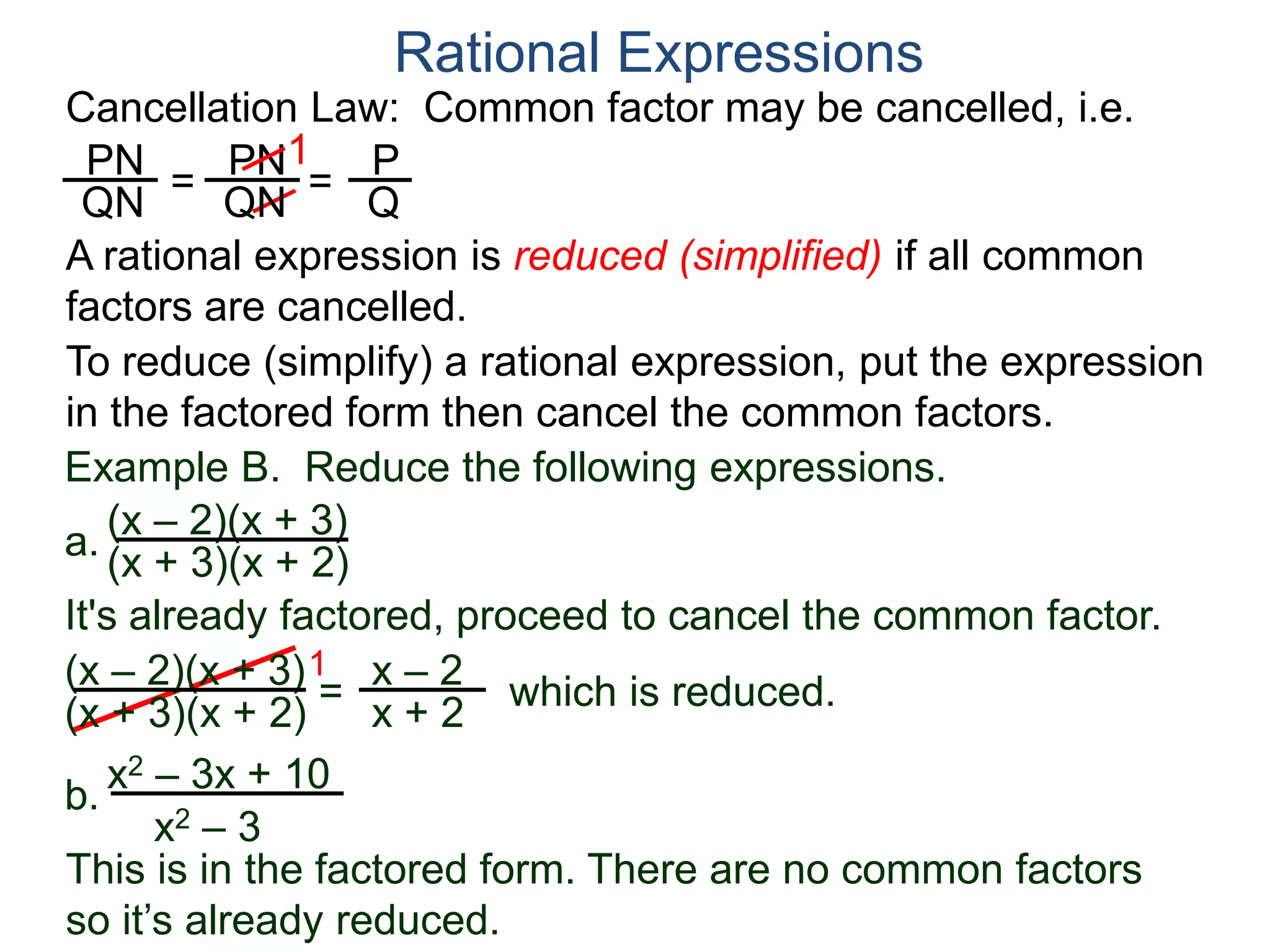
Cancellation Law: Common factor may be cancelled, i.e.
PN
QN
P
Q
PN
QN
= =
1
Rational Expressions
Cancellation Law: Common factor may be cancelled, i.e.
PN
QN
P
Q
A rational expression is reduced (simplified) if all common
factors are cancelled.
PN
QN
= =
1
Rational Expressions
Cancellation Law: Common factor may be cancelled, i.e.
PN
QN
P
Q
A rational expression is reduced (simplified) if all common
factors are cancelled.
To reduce (simplify) a rational expression, put the expression
in the factored form then cancel the common factors.
PN
QN
= =
1
Rational Expressions
Cancellation Law: Common factor may be cancelled, i.e.
PN
QN
P
Q
A rational expression is reduced (simplified) if all common
factors are cancelled.
To reduce (simplify) a rational expression, put the expression
in the factored form then cancel the common factors.
Example B. Reduce the following expressions.
(x – 2)(x + 3)
(x + 3)(x + 2)
a.
b.
x2 – 3x + 10
x2 – 3
PN
QN
= =
1
Rational Expressions
Cancellation Law: Common factor may be cancelled, i.e.
PN
QN
P
Q
A rational expression is reduced (simplified) if all common
factors are cancelled.
To reduce (simplify) a rational expression, put the expression
in the factored form then cancel the common factors.
Example B. Reduce the following expressions.
(x – 2)(x + 3)
It's already factored, proceed to cancel the common factor.
(x + 3)(x + 2)
(x – 2)(x + 3)
(x + 3)(x + 2)
a.
b.
x2 – 3x + 10
x2 – 3
PN
QN
= =
1
Rational Expressions
Cancellation Law: Common factor may be cancelled, i.e.
PN
QN
P
Q
A rational expression is reduced (simplified) if all common
factors are cancelled.
To reduce (simplify) a rational expression, put the expression
in the factored form then cancel the common factors.
Example B. Reduce the following expressions.
(x – 2)(x + 3)
1
=
x – 2
x + 2
It's already factored, proceed to cancel the common factor.
(x + 3)(x + 2)
(x – 2)(x + 3)
(x + 3)(x + 2)
which is reduced.
a.
b.
x2 – 3x + 10
x2 – 3
PN
QN
= =
1
Rational Expressions
Cancellation Law: Common factor may be cancelled, i.e.
PN
QN
P
Q
A rational expression is reduced (simplified) if all common
factors are cancelled.
To reduce (simplify) a rational expression, put the expression
in the factored form then cancel the common factors.
Example B. Reduce the following expressions.
(x – 2)(x + 3)
1
=
x – 2
x + 2
It's already factored, proceed to cancel the common factor.
(x + 3)(x + 2)
(x – 2)(x + 3)
(x + 3)(x + 2)
which is reduced.
a.
b.
x2 – 3x + 10
x2 – 3
This is in the factored form.
PN
QN
= =
1
Rational Expressions
Cancellation Law: Common factor may be cancelled, i.e.
PN
QN
P
Q
A rational expression is reduced (simplified) if all common
factors are cancelled.
To reduce (simplify) a rational expression, put the expression
in the factored form then cancel the common factors.
Example B. Reduce the following expressions.
(x – 2)(x + 3)
1
=
x – 2
x + 2
It's already factored, proceed to cancel the common factor.
(x + 3)(x + 2)
(x – 2)(x + 3)
(x + 3)(x + 2)
which is reduced.
a.
b.
x2 – 3x + 10
x2 – 3
This is in the factored form. There are no common factors
so it’s already reduced.
Rational Expressions
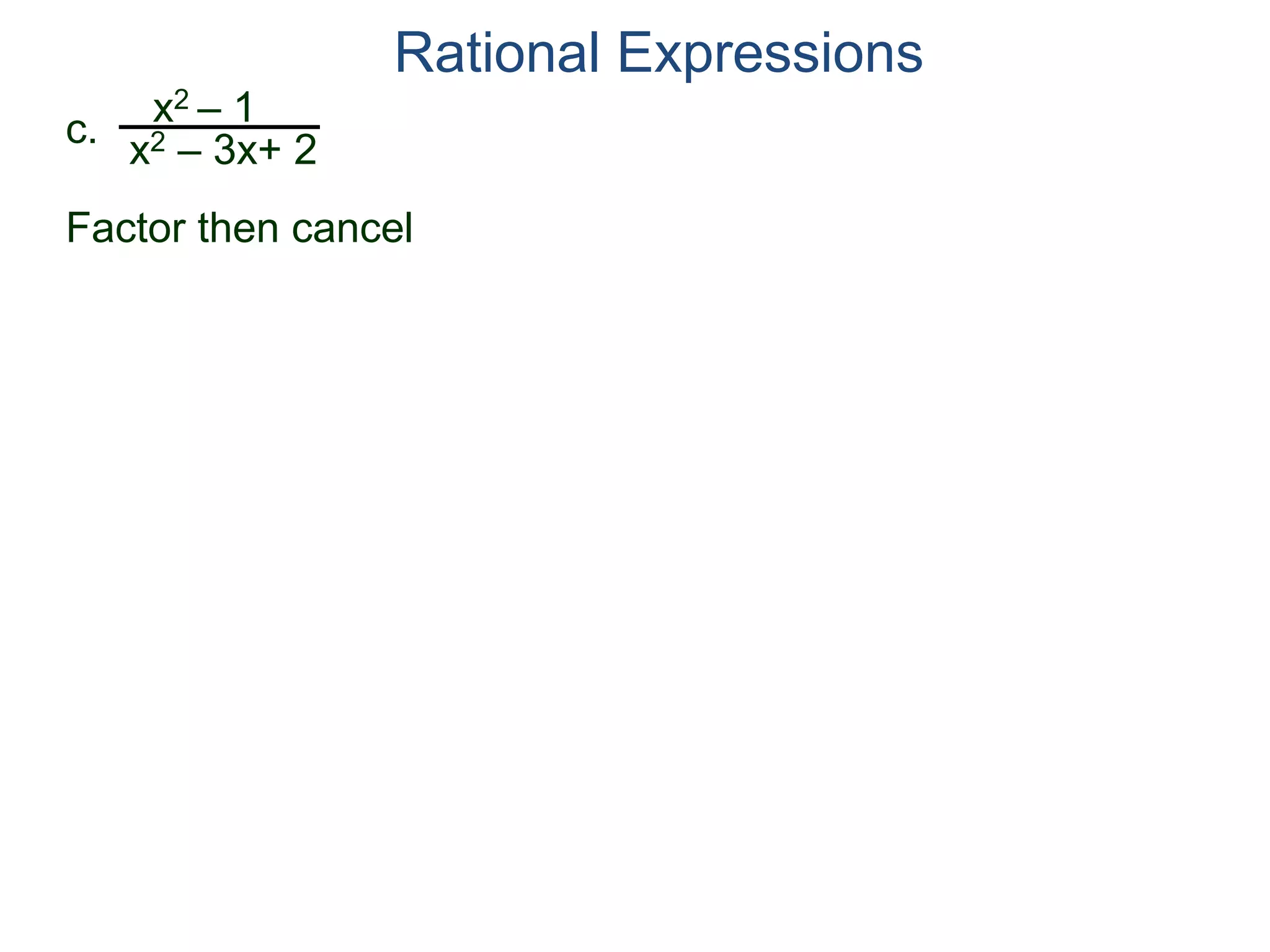
c.
x2 – 1
x2 – 3x+ 2
Rational Expressions
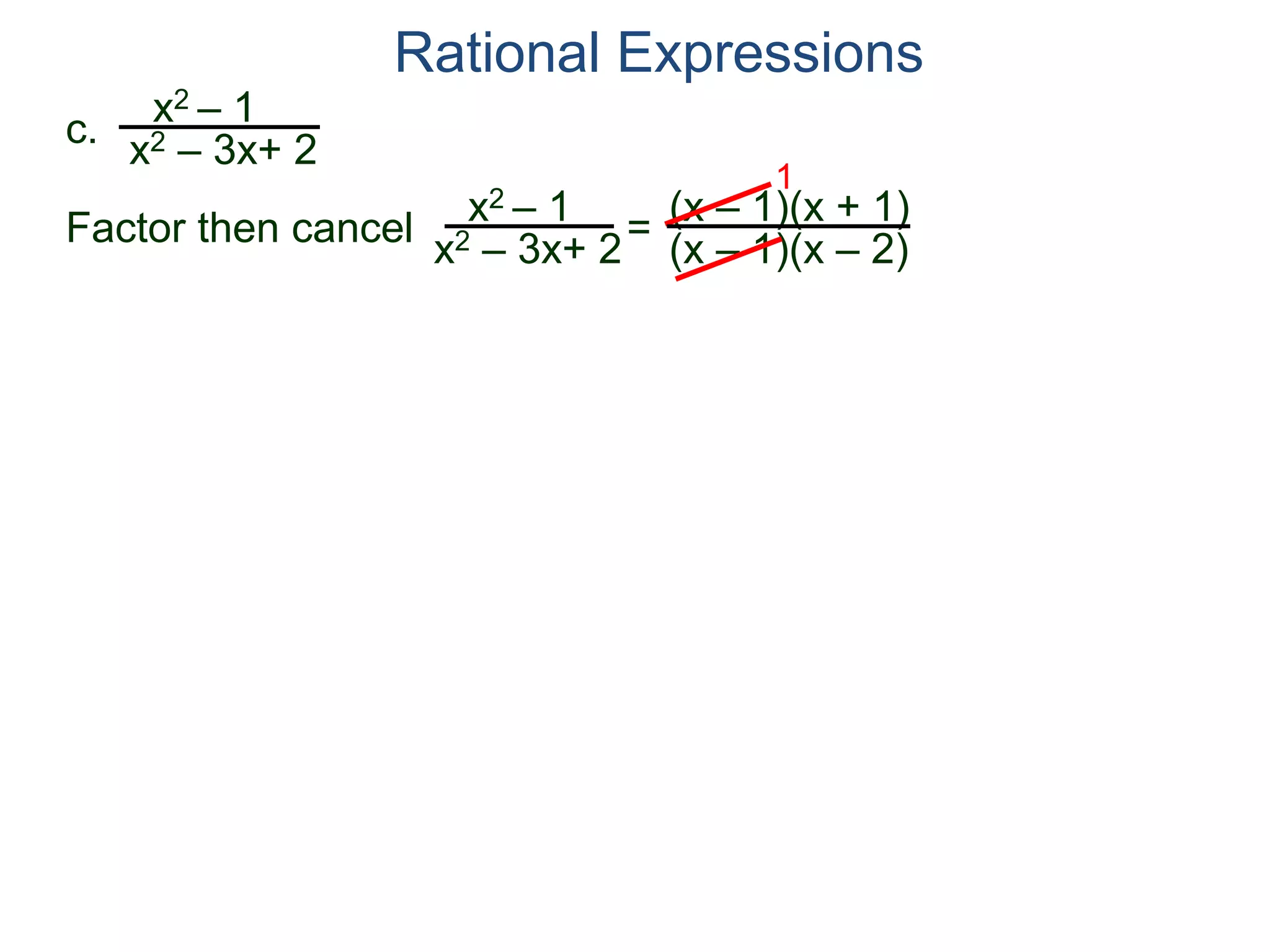
c.
x2 – 1
x2 – 3x+ 2
Factor then cancel
Rational Expressions
c.
x2 – 1
x2 – 3x+ 2
x2 – 1
x2 – 3x+ 2
=
(x – 1)(x + 1)
(x – 1)(x – 2)
Factor then cancel
Rational Expressions
c.
x2 – 1
x2 – 3x+ 2
x2 – 1
x2 – 3x+ 2
=
(x – 1)(x + 1)
(x – 1)(x – 2)
1
Factor then cancel
Rational Expressions
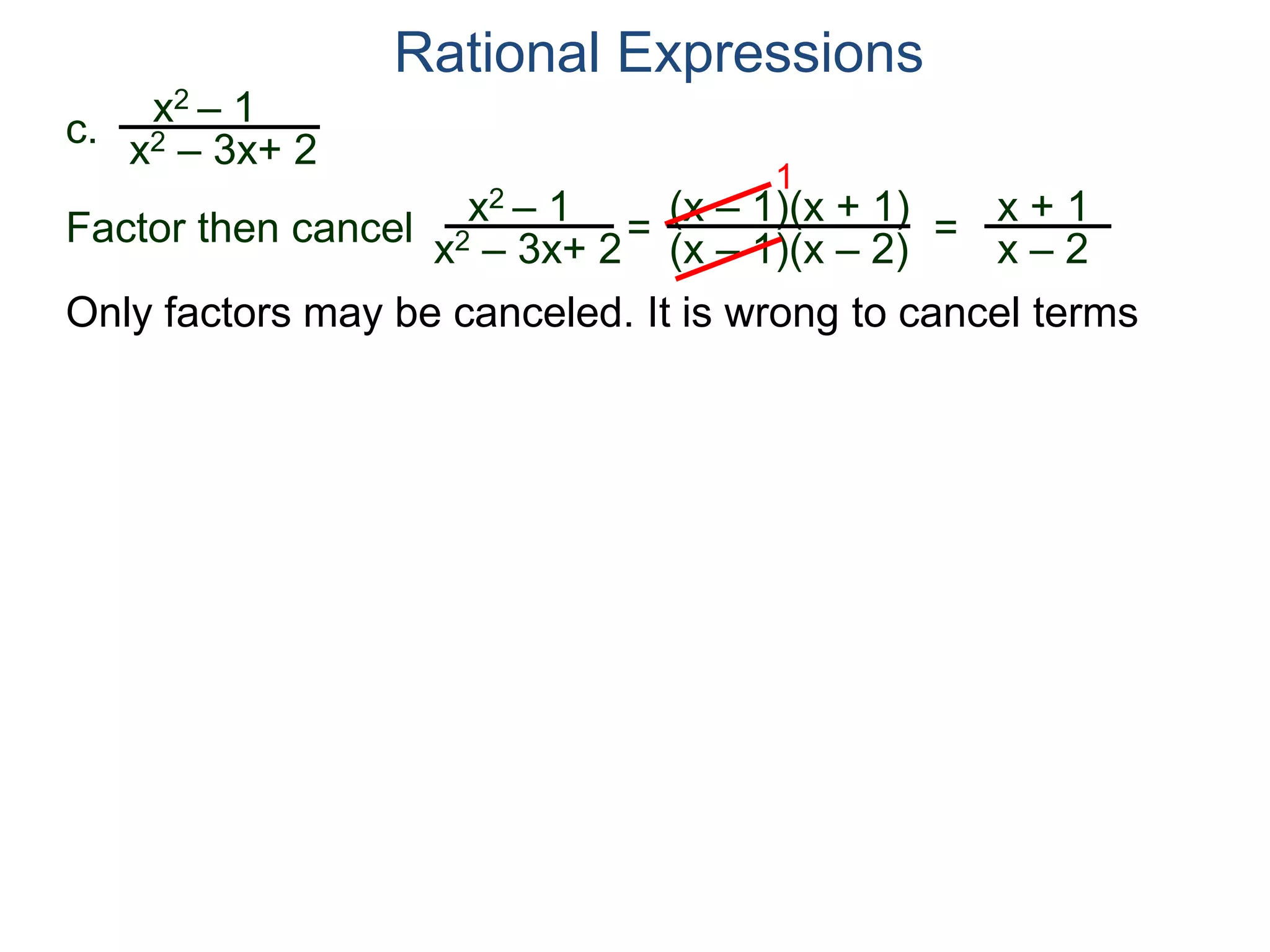
c.
x2 – 1
x2 – 3x+ 2
x2 – 1
x2 – 3x+ 2
=
(x – 1)(x + 1)
(x – 1)(x – 2)
1
=
x + 1
x – 2
Factor then cancel
Rational Expressions
Only factors may be canceled.
c.
x2 – 1
x2 – 3x+ 2
x2 – 1
x2 – 3x+ 2
=
(x – 1)(x + 1)
(x – 1)(x – 2)
1
=
x + 1
x – 2
Factor then cancel
Rational Expressions
Only factors may be canceled. It is wrong to cancel terms
c.
x2 – 1
x2 – 3x+ 2
x2 – 1
x2 – 3x+ 2
=
(x – 1)(x + 1)
(x – 1)(x – 2)
1
=
x + 1
x – 2
Factor then cancel
Rational Expressions
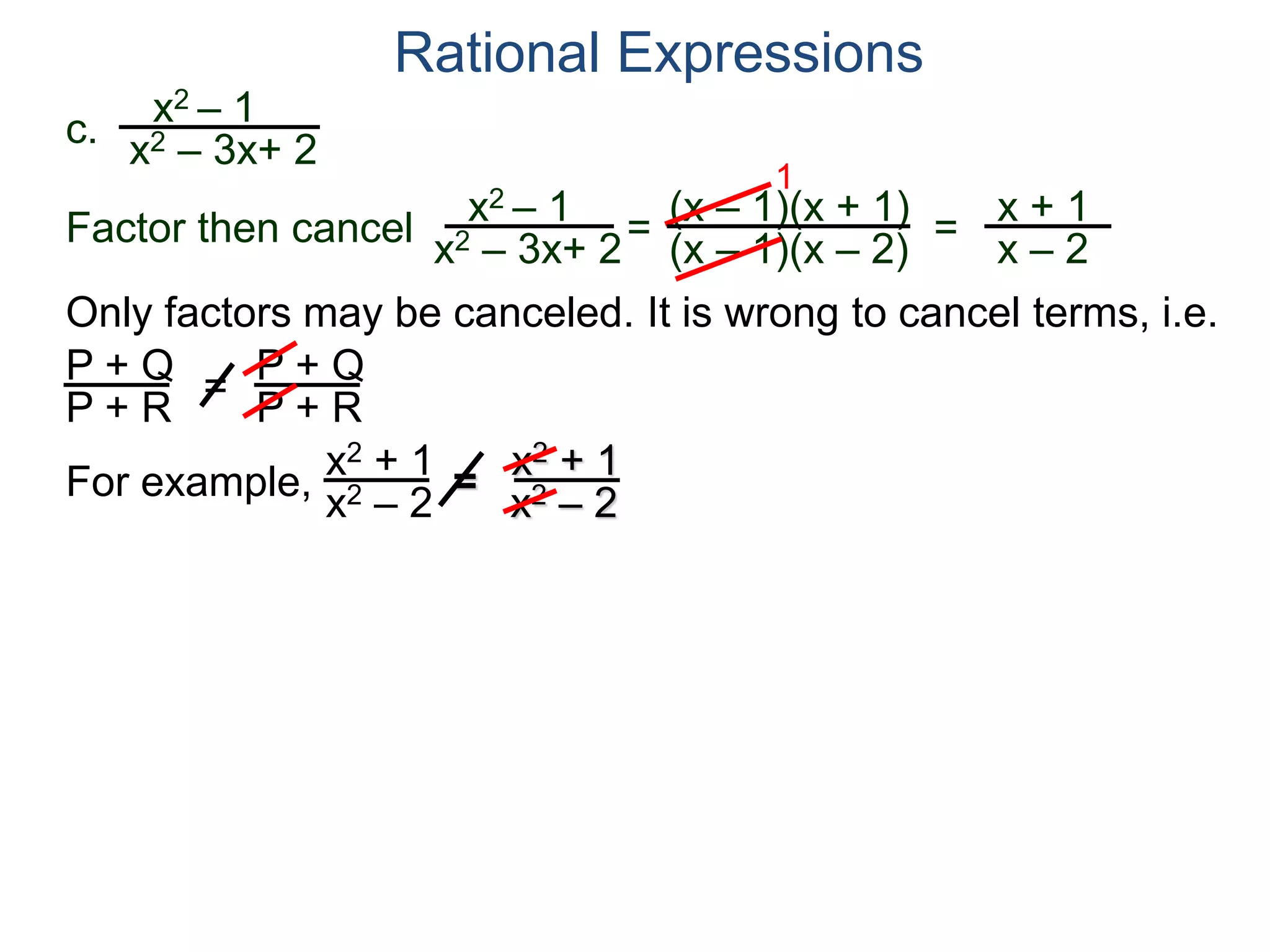
Only factors may be canceled. It is wrong to cancel terms, i.e.
P + Q
P + R
=
P + Q
P + R
c.
x2 – 1
x2 – 3x+ 2
x2 – 1
x2 – 3x+ 2
=
(x – 1)(x + 1)
(x – 1)(x – 2)
1
=
x + 1
x – 2
Factor then cancel
Rational Expressions
Only factors may be canceled. It is wrong to cancel terms, i.e.
P + Q
P + R
=
P + Q
P + R
For example,
x2 + 1
x2 – 2 =
x2 + 1
x2 – 2
c.
x2 – 1
x2 – 3x+ 2
x2 – 1
x2 – 3x+ 2
=
(x – 1)(x + 1)
(x – 1)(x – 2)
1
=
x + 1
x – 2
Factor then cancel
Rational Expressions
Only factors may be canceled. It is wrong to cancel terms, i.e.
P + Q
P + R
=
P + Q
P + R
For example,
x2 + 1
x2 – 2 =
x2 + 1
x2 – 2
c.
x2 – 1
x2 – 3x+ 2
x2 – 1
x2 – 3x+ 2
=
(x – 1)(x + 1)
(x – 1)(x – 2)
1
=
x + 1
x – 2
Factor then cancel
Cancellation of Opposite Factors
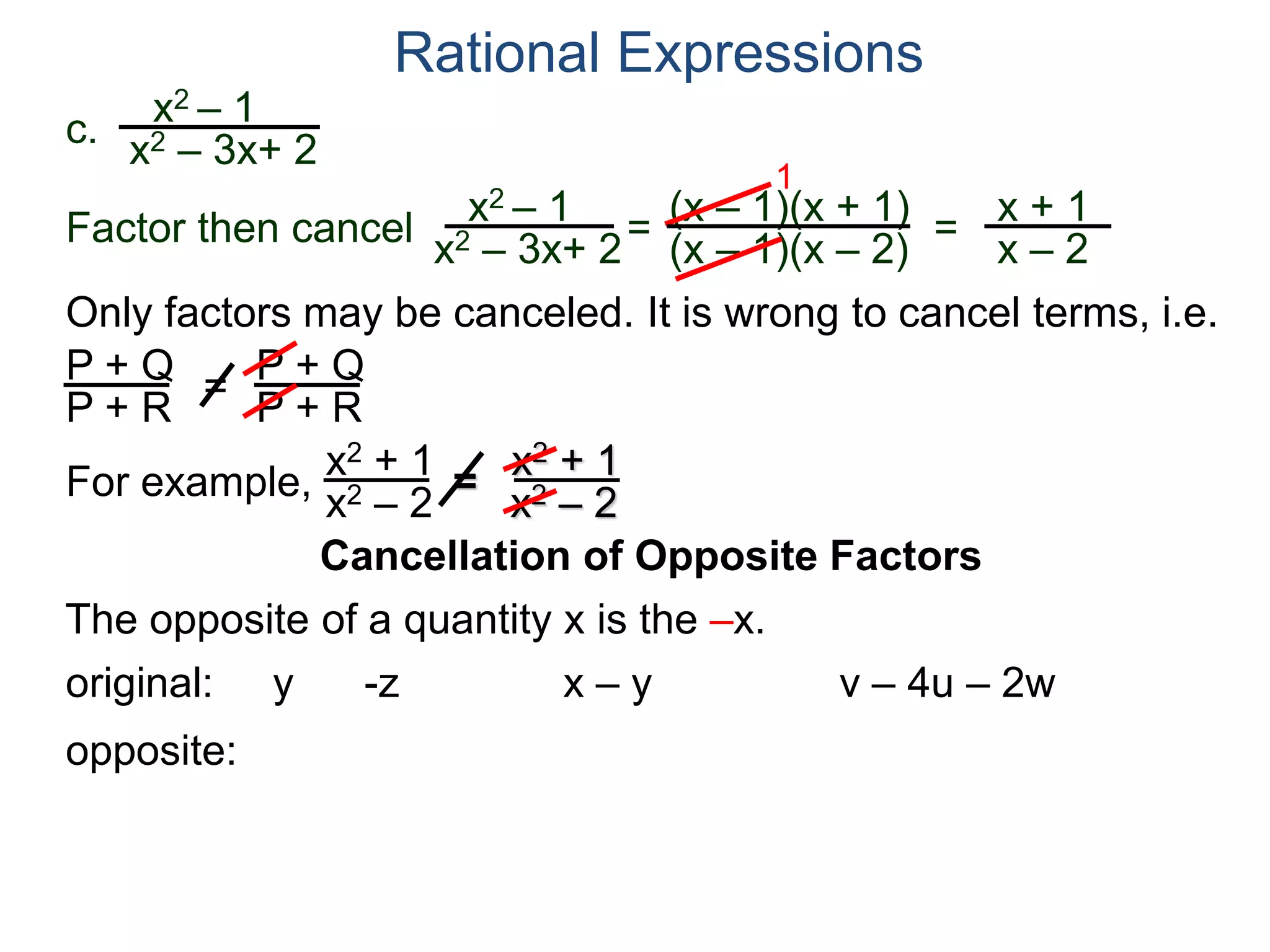
Rational Expressions
Only factors may be canceled. It is wrong to cancel terms, i.e.
P + Q
P + R
=
P + Q
P + R
For example,
x2 + 1
x2 – 2 =
x2 + 1
x2 – 2
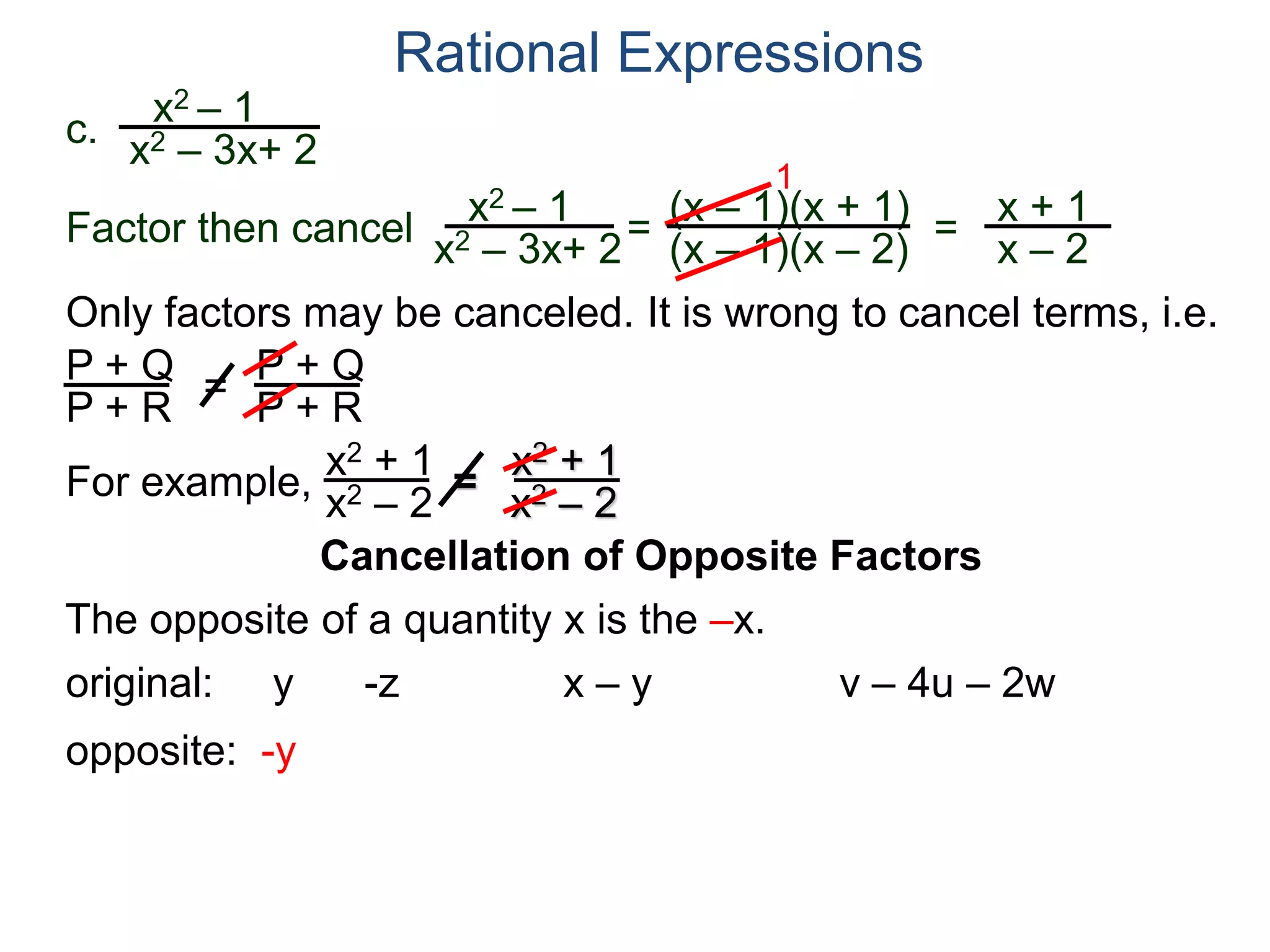
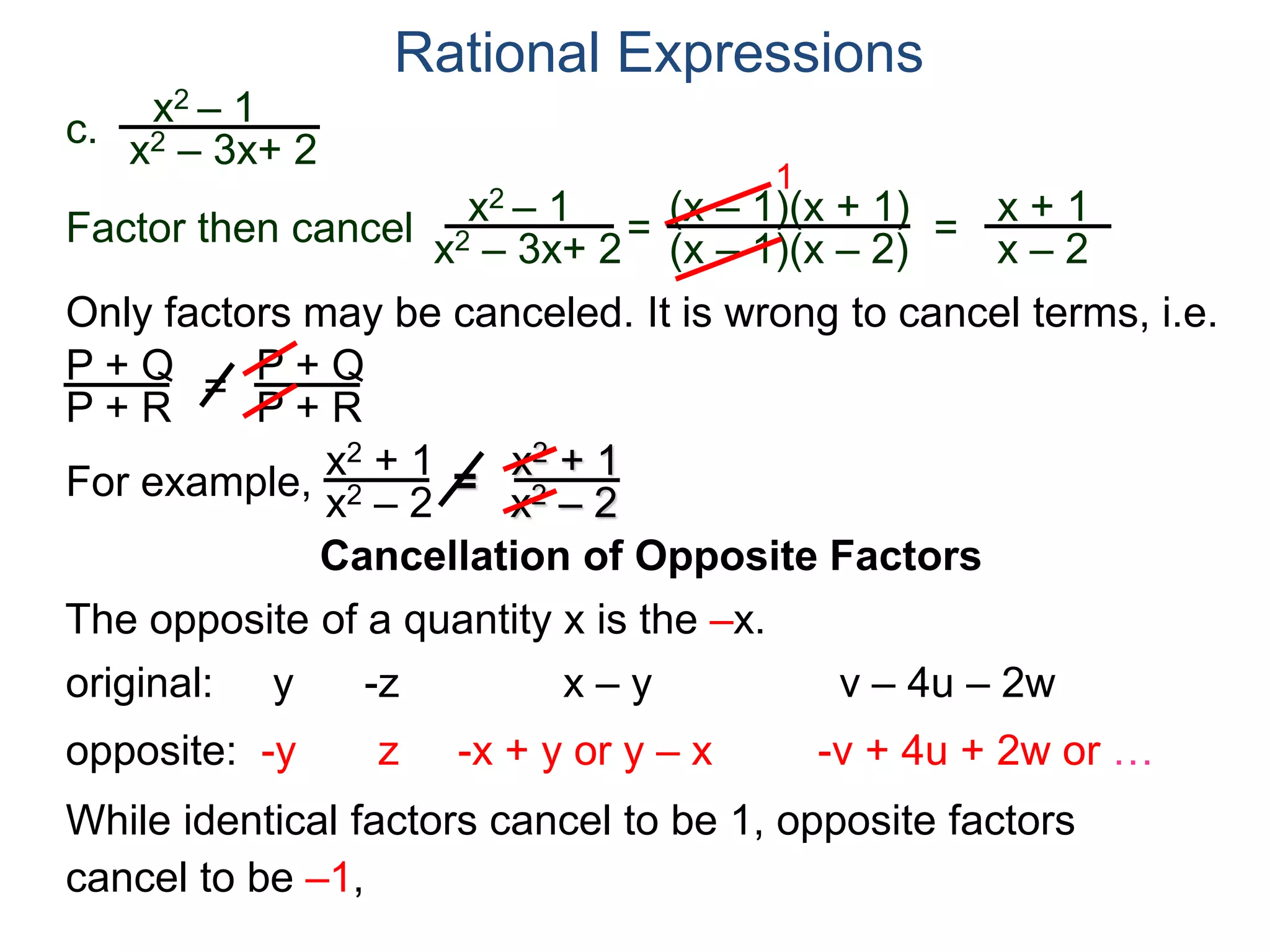
The opposite of a quantity x is the –x.
c.
x2 – 1
x2 – 3x+ 2
x2 – 1
x2 – 3x+ 2
=
(x – 1)(x + 1)
(x – 1)(x – 2)
1
=
x + 1
x – 2
Factor then cancel
Cancellation of Opposite Factors
Rational Expressions
Only factors may be canceled. It is wrong to cancel terms, i.e.
P + Q
P + R
=
P + Q
P + R
For example,
x2 + 1
x2 – 2 =
x2 + 1
x2 – 2
The opposite of a quantity x is the –x.
original: y -z x – y v – 4u – 2w
opposite:
c.
x2 – 1
x2 – 3x+ 2
x2 – 1
x2 – 3x+ 2
=
(x – 1)(x + 1)
(x – 1)(x – 2)
1
=
x + 1
x – 2
Factor then cancel
Cancellation of Opposite Factors
Rational Expressions
Only factors may be canceled. It is wrong to cancel terms, i.e.
P + Q
P + R
=
P + Q
P + R
For example,
x2 + 1
x2 – 2 =
x2 + 1
x2 – 2
The opposite of a quantity x is the –x.
original: y -z x – y v – 4u – 2w
opposite: -y
c.
x2 – 1
x2 – 3x+ 2
x2 – 1
x2 – 3x+ 2
=
(x – 1)(x + 1)
(x – 1)(x – 2)
1
=
x + 1
x – 2
Factor then cancel
Cancellation of Opposite Factors
Rational Expressions
Only factors may be canceled. It is wrong to cancel terms, i.e.
P + Q
P + R
=
P + Q
P + R
For example,
x2 + 1
x2 – 2 =
x2 + 1
x2 – 2
The opposite of a quantity x is the –x.
original: y -z x – y v – 4u – 2w
opposite: -y z
c.
x2 – 1
x2 – 3x+ 2
x2 – 1
x2 – 3x+ 2
=
(x – 1)(x + 1)
(x – 1)(x – 2)
1
=
x + 1
x – 2
Factor then cancel
Cancellation of Opposite Factors
Rational Expressions
Only factors may be canceled. It is wrong to cancel terms, i.e.
P + Q
P + R
=
P + Q
P + R
For example,
x2 + 1
x2 – 2 =
x2 + 1
x2 – 2
The opposite of a quantity x is the –x.
original: y -z x – y v – 4u – 2w
opposite: -y z -x + y or y – x
c.
x2 – 1
x2 – 3x+ 2
x2 – 1
x2 – 3x+ 2
=
(x – 1)(x + 1)
(x – 1)(x – 2)
1
=
x + 1
x – 2
Factor then cancel
Cancellation of Opposite Factors
Rational Expressions
Only factors may be canceled. It is wrong to cancel terms, i.e.
P + Q
P + R
=
P + Q
P + R
For example,
x2 + 1
x2 – 2 =
x2 + 1
x2 – 2
The opposite of a quantity x is the –x.
original: y -z x – y v – 4u – 2w
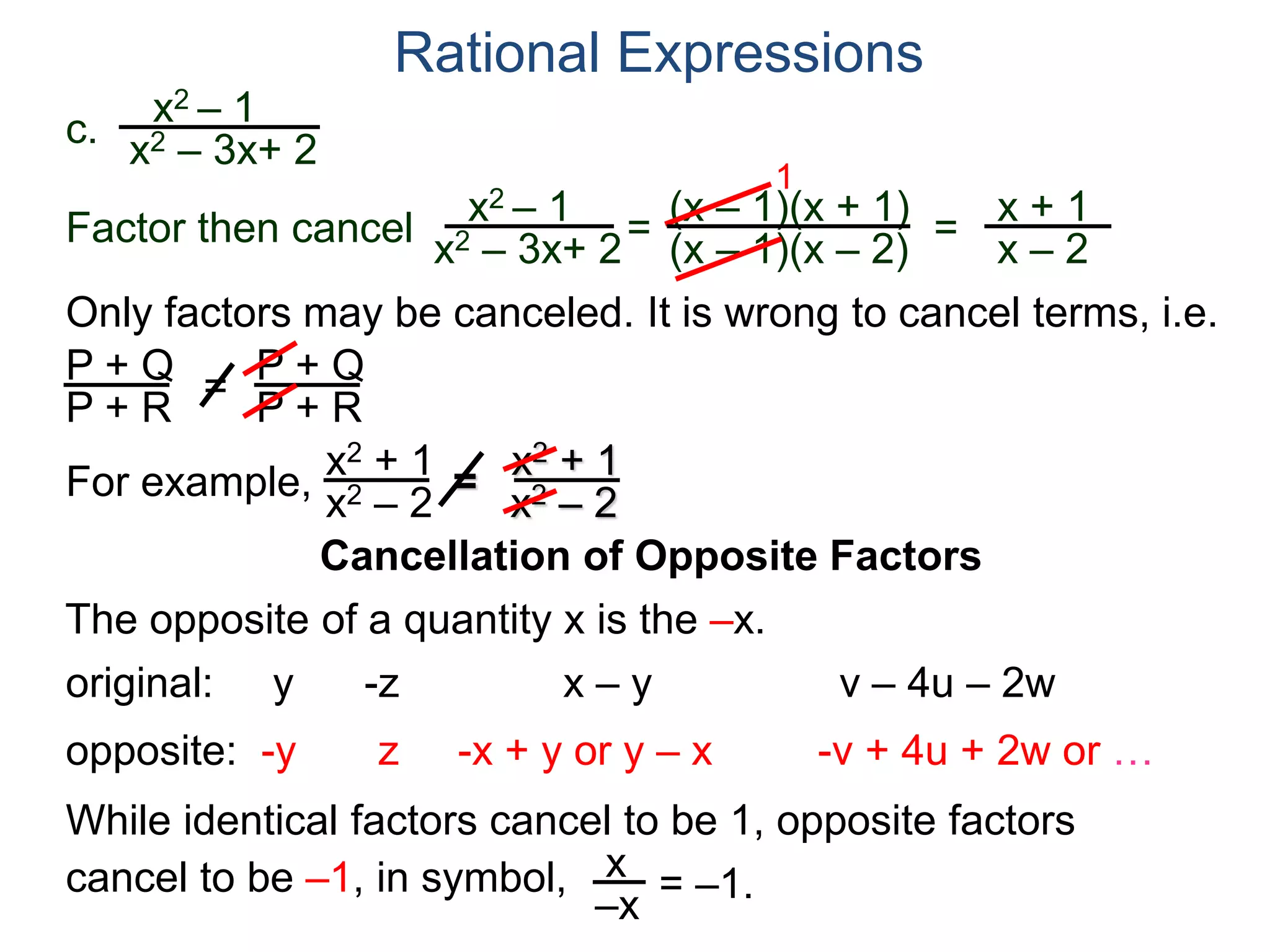
opposite: -y z -x + y or y – x -v + 4u + 2w or …
c.
x2 – 1
x2 – 3x+ 2
x2 – 1
x2 – 3x+ 2
=
(x – 1)(x + 1)
(x – 1)(x – 2)
1
=
x + 1
x – 2
Factor then cancel
Cancellation of Opposite Factors
Rational Expressions
Only factors may be canceled. It is wrong to cancel terms, i.e.
P + Q
P + R
=
P + Q
P + R
For example,
x2 + 1
x2 – 2 =
x2 + 1
x2 – 2
Cancellation of Opposite Factors
The opposite of a quantity x is the –x.
While identical factors cancel to be 1, opposite factors
cancel to be –1,
original: y -z x – y v – 4u – 2w
opposite: -y z -x + y or y – x -v + 4u + 2w or …
c.
x2 – 1
x2 – 3x+ 2
x2 – 1
x2 – 3x+ 2
=
(x – 1)(x + 1)
(x – 1)(x – 2)
1
=
x + 1
x – 2
Factor then cancel
Rational Expressions
Only factors may be canceled. It is wrong to cancel terms, i.e.
P + Q
P + R
=
P + Q
P + R
For example,
x2 + 1
x2 – 2 =
x2 + 1
x2 – 2
The opposite of a quantity x is the –x.
While identical factors cancel to be 1, opposite factors
cancel to be –1, in symbol,
original: y -z x – y v – 4u – 2w
opposite: -y z -x + y or y – x -v + 4u + 2w or …
x
–x = –1.
c.
x2 – 1
x2 – 3x+ 2
x2 – 1
x2 – 3x+ 2
=
(x – 1)(x + 1)
(x – 1)(x – 2)
1
=
x + 1
x – 2
Factor then cancel
Cancellation of Opposite Factors
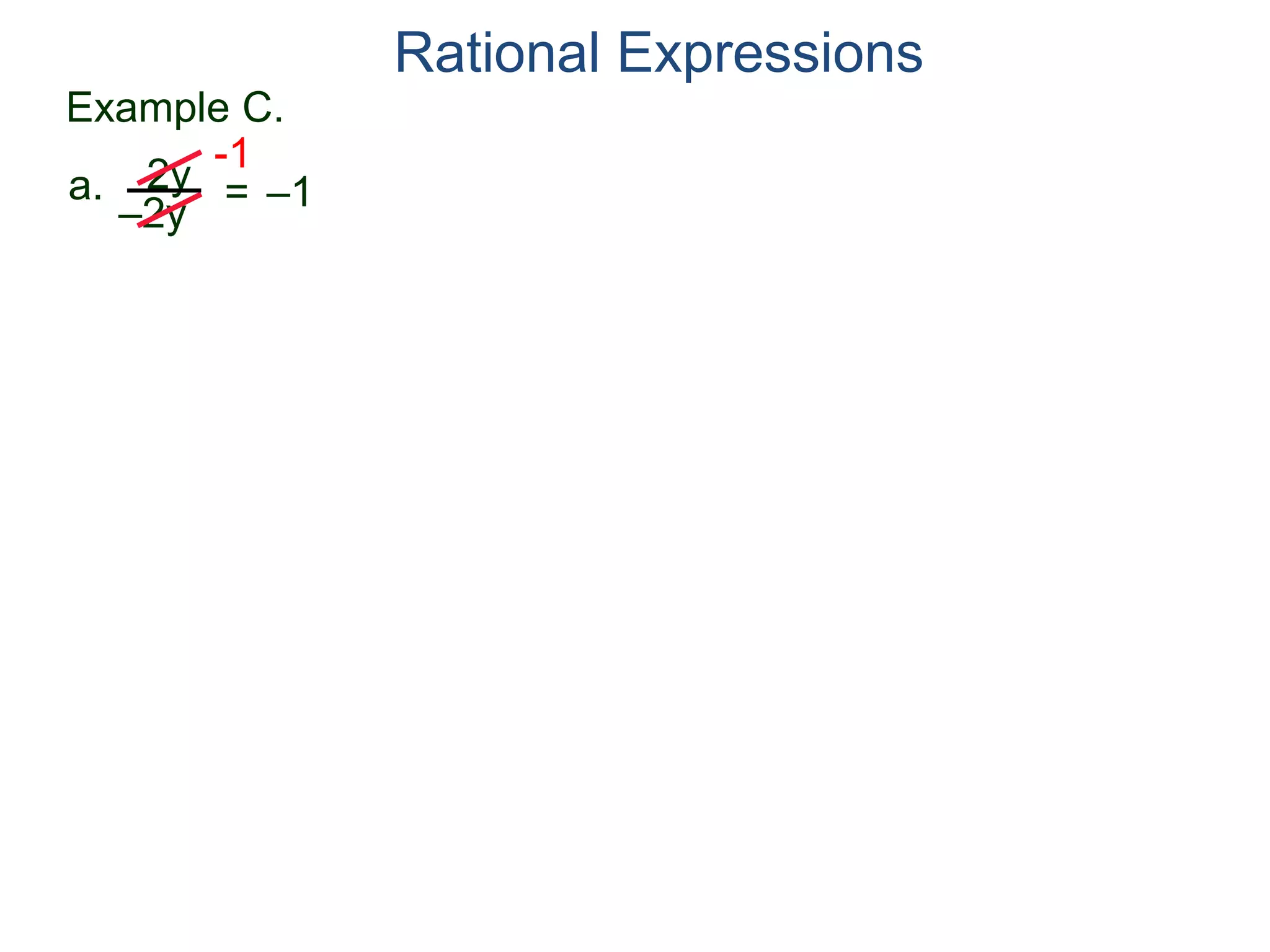
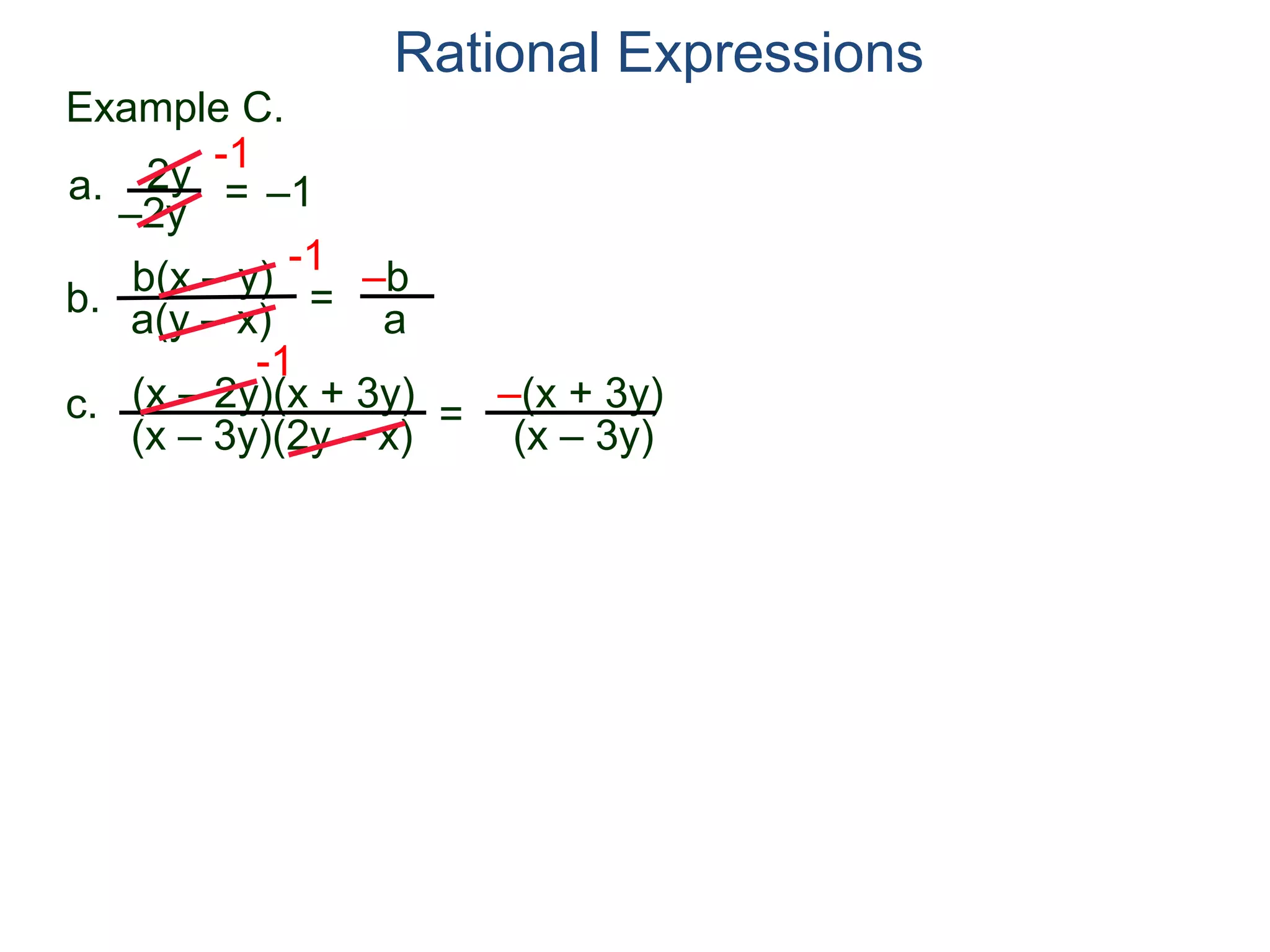
Example C.
2y
–2y
a.
Rational Expressions
Example C.
2y
–2y
=
-1
–1a.
Rational Expressions
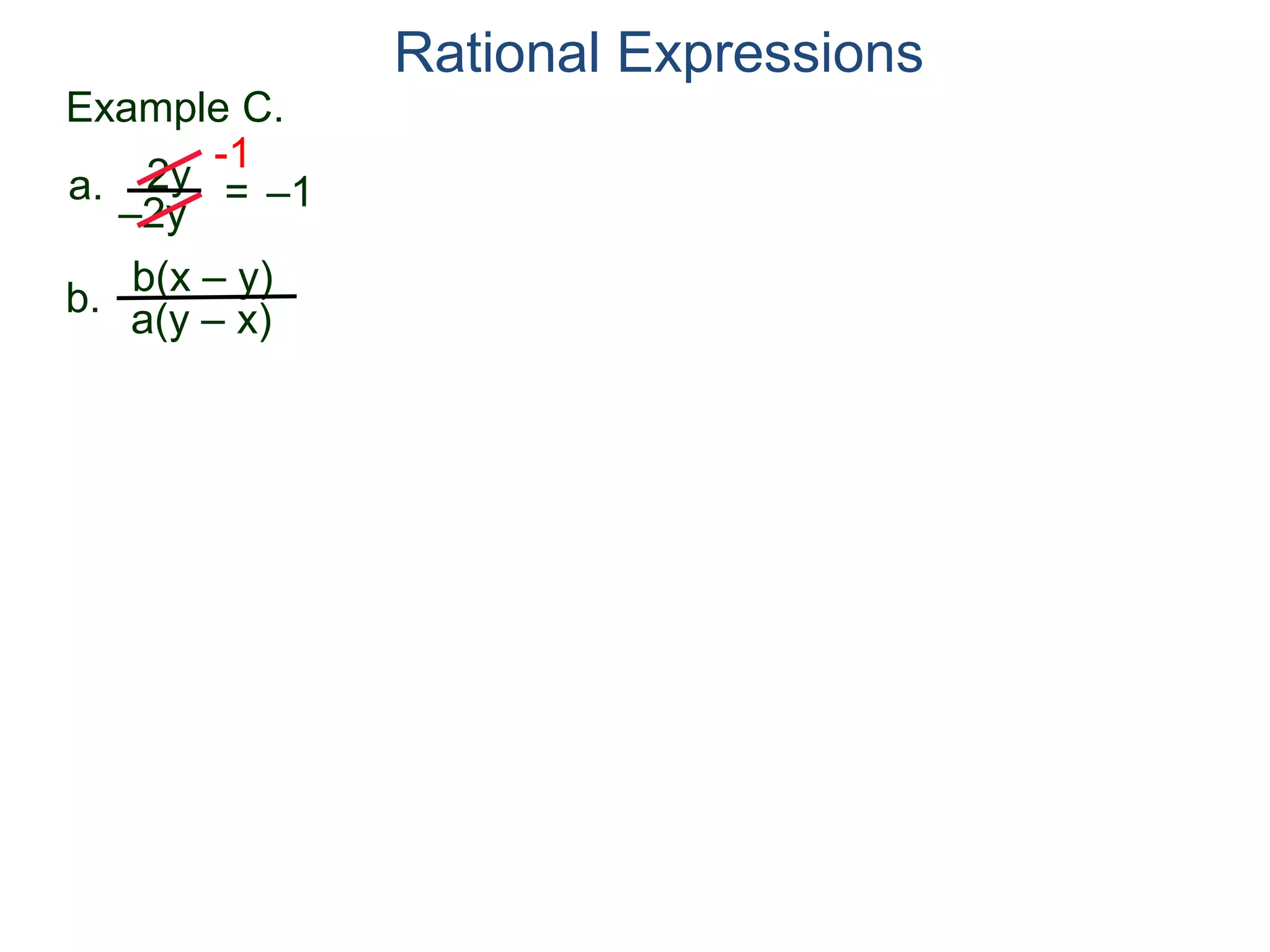
b(x – y)
a(y – x)
Example C.
2y
–2y
=
-1
–1a.
b.
Rational Expressions
b(x – y)
a(y – x)
Example C.
2y
–2y
=
-1
–1
-1
a.
b.
Rational Expressions
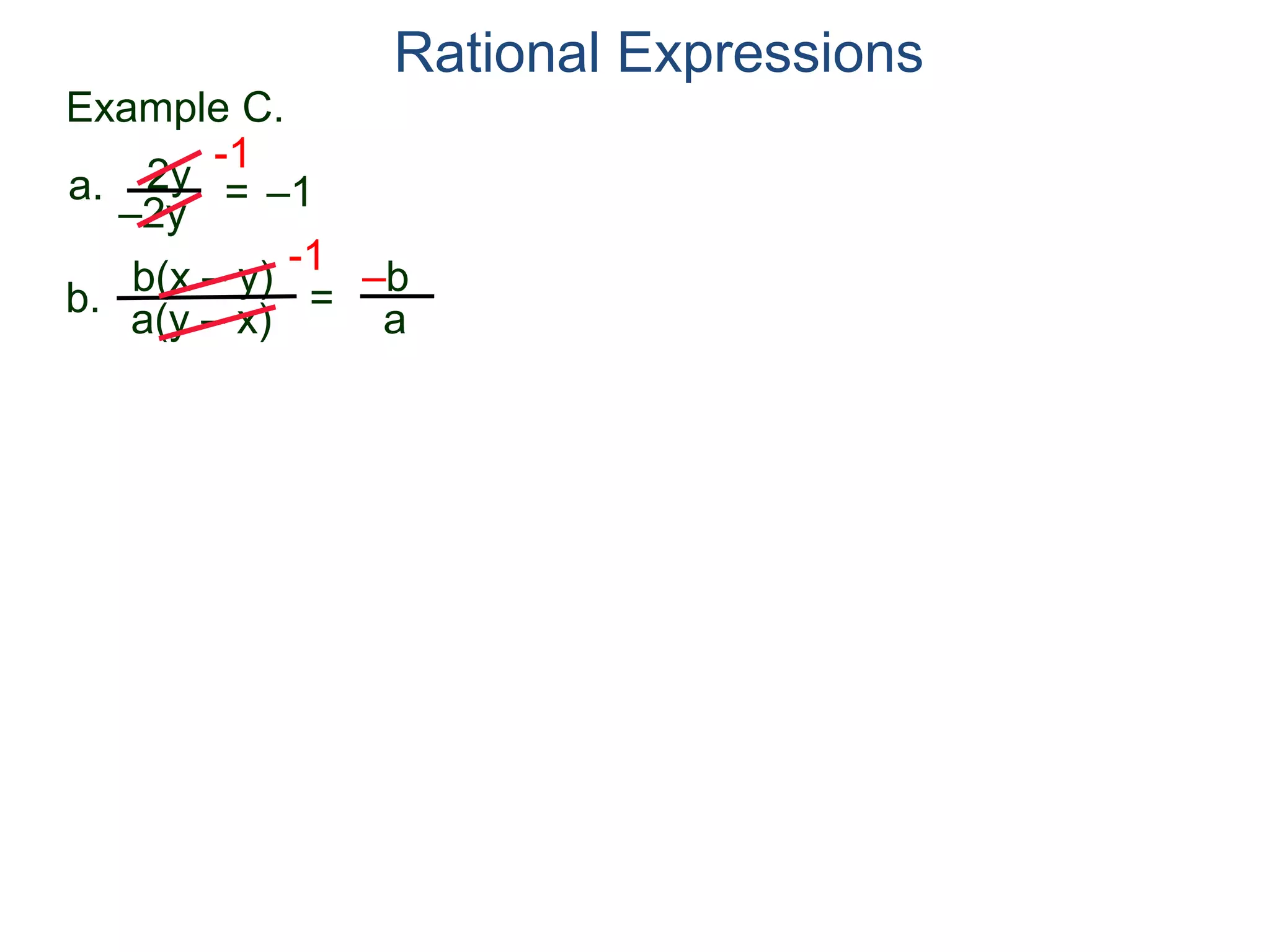
b(x – y)
a(y – x)
Example C.
2y
–2y
=
-1
–1
-1
=
–b
a
a.
b.
Rational Expressions
b(x – y)
a(y – x)
Example C.
2y
–2y
=
-1
–1
-1
=
–b
a
a.
b.
Rational Expressions
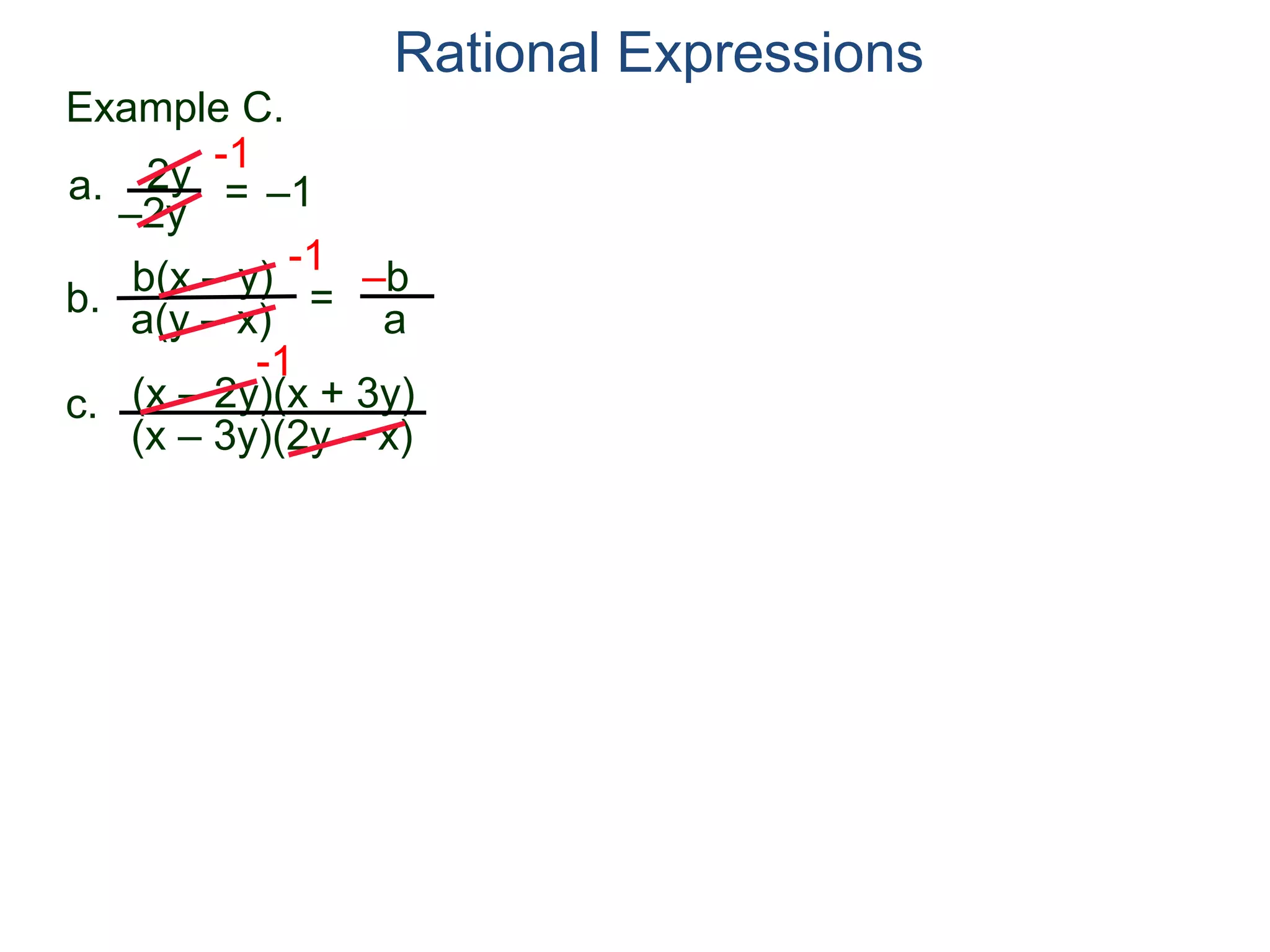
(x – 2y)(x + 3y)
(x – 3y)(2y – x)
c.
b(x – y)
a(y – x)
Example C.
2y
–2y
=
-1
–1
-1
=
–b
a
a.
b.
Rational Expressions
(x – 2y)(x + 3y)
(x – 3y)(2y – x)
c.
-1
b(x – y)
a(y – x)
Example C.
2y
–2y
=
-1
–1
-1
=
–b
a
a.
b.
Rational Expressions
(x – 2y)(x + 3y)
(x – 3y)(2y – x)
c.
-1
=
–(x + 3y)
(x – 3y)
b(x – y)
a(y – x)
Example C.
2y
–2y
=
-1
–1
-1
=
–b
a
a.
b.
Rational Expressions
(x – 2y)(x + 3y)
(x – 3y)(2y – x)
c.
-1
=
–(x + 3y)
(x – 3y)
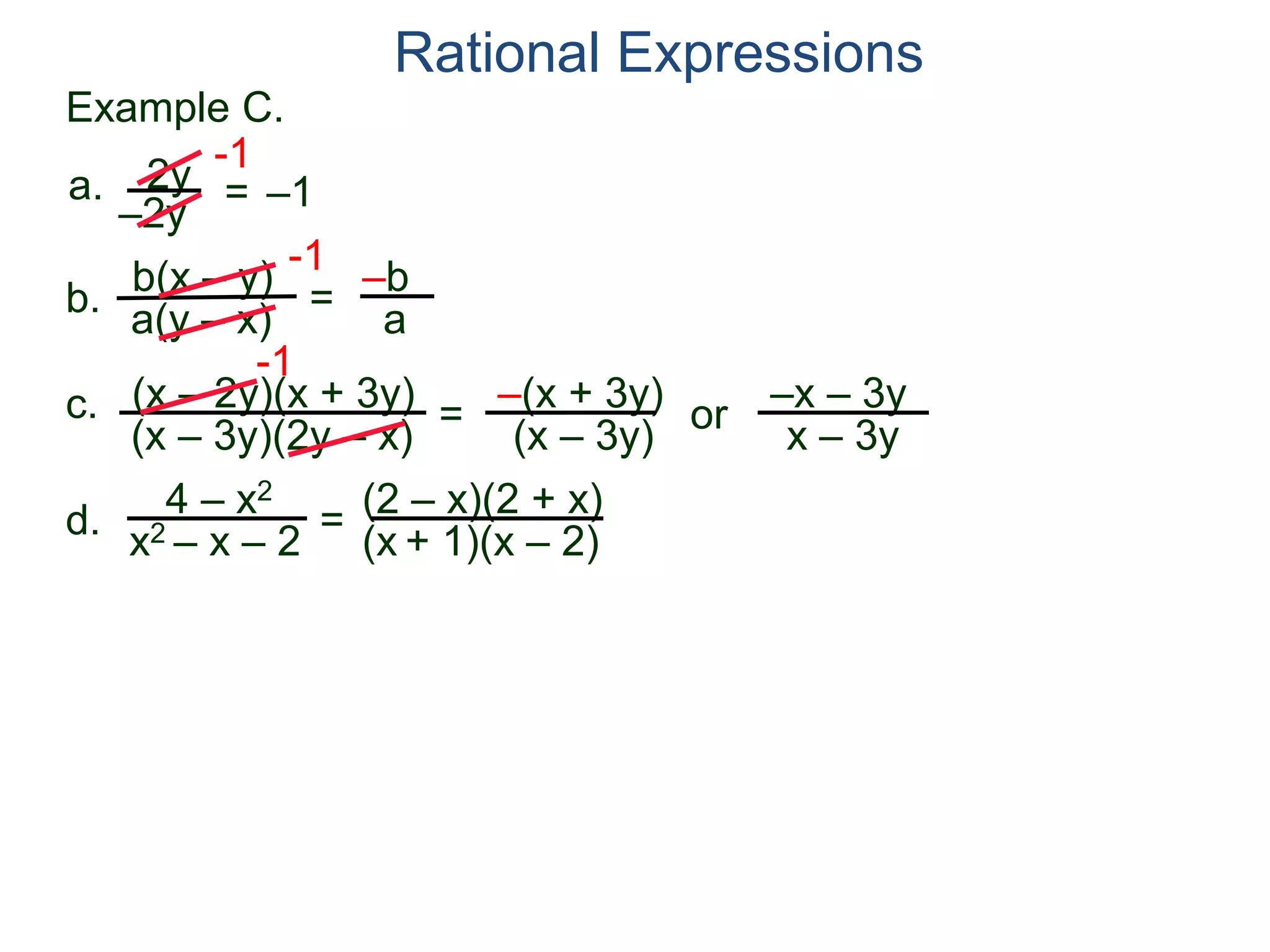
or
–x – 3y
x – 3y
b(x – y)
a(y – x)
Example C.
2y
–2y
=
-1
–1
-1
=
–b
a
a.
b.
Rational Expressions
(x – 2y)(x + 3y)
(x – 3y)(2y – x)
c.
-1
=
–(x + 3y)
(x – 3y)
or
–x – 3y
x – 3y
d.
4 – x2
x2 – x – 2
b(x – y)
a(y – x)
Example C.
2y
–2y
=
-1
–1
-1
=
–b
a
a.
b.
Rational Expressions
(x – 2y)(x + 3y)
(x – 3y)(2y – x)
c.
-1
=
–(x + 3y)
(x – 3y)
or
–x – 3y
x – 3y
d.
4 – x2
x2 – x – 2
=
(2 – x)(2 + x)
(x + 1)(x – 2)
b(x – y)
a(y – x)
Example C.
2y
–2y
=
-1
–1
-1
=
–b
a
a.
b.
Rational Expressions
(x – 2y)(x + 3y)
(x – 3y)(2y – x)
c.
-1
=
–(x + 3y)
(x – 3y)
or
–x – 3y
x – 3y
d.
4 – x2
x2 – x – 2
=
(2 – x)(2 + x)
(x + 1)(x – 2)
-1
b(x – y)
a(y – x)
Example C.
2y
–2y
=
-1
–1
-1
=
–b
a
a.
b.
Rational Expressions
(x – 2y)(x + 3y)
(x – 3y)(2y – x)
c.
-1
=
–(x + 3y)
(x – 3y)
or
–x – 3y
x – 3y
d.
4 – x2
x2 – x – 2
=
(2 – x)(2 + x)
(x + 1)(x – 2)
-1
=
–(2 + x)
x + 1
or
–2 – x
x + 1
b(x – y)
a(y – x)
Example C.
2y
–2y
=
-1
–1
-1
=
–b
a
a.
b.
Rational Expressions
(x – 2y)(x + 3y)
(x – 3y)(2y – x)
c.
-1
=
–(x + 3y)
(x – 3y)
or
–x – 3y
x – 3y
d.
4 – x2
x2 – x – 2
=
(2 – x)(2 + x)
(x + 1)(x – 2)
-1
=
–(2 + x)
x + 1
or
–2 – x
x + 1
In the case of polynomials in one variable x, if the highest
degree term is negative, we may factor out the negative sign
then factor the expressions.
b(x – y)
a(y – x)
Example C.
2y
–2y
=
-1
–1
-1
=
–b
a
a.
b.
Rational Expressions
(x – 2y)(x + 3y)
(x – 3y)(2y – x)
c.
-1
=
–(x + 3y)
(x – 3y)
or
–x – 3y
x – 3y
d.
4 – x2
x2 – x – 2
=
(2 – x)(2 + x)
(x + 1)(x – 2)
-1
=
–(2 + x)
x + 1
or
–2 – x
x + 1
–x2 + 4
–x2 + x + 2
Example D. Pull out the “–” first then reduce.
In the case of polynomials in one variable x, if the highest
degree term is negative, we may factor out the negative sign
then factor the expressions.
b(x – y)
a(y – x)
Example C.
2y
–2y
=
-1
–1
-1
=
–b
a
a.
b.
Rational Expressions
(x – 2y)(x + 3y)
(x – 3y)(2y – x)
c.
-1
=
–(x + 3y)
(x – 3y)
or
–x – 3y
x – 3y
d.
4 – x2
x2 – x – 2
=
(2 – x)(2 + x)
(x + 1)(x – 2)
-1
=
–(2 + x)
x + 1
or
–2 – x
x + 1
In the case of polynomials in one variable x, if the highest
degree term is negative, we may factor out the negative sign
then factor the expressions.
–x2 + 4
–x2 + x + 2
=
Example D. Pull out the “–” first then reduce.
–(x2 – 4)
–(x2 – x – 2)
b(x – y)
a(y – x)
Example C.
2y
–2y
=
-1
–1
-1
=
–b
a
a.
b.
Rational Expressions
(x – 2y)(x + 3y)
(x – 3y)(2y – x)
c.
-1
=
–(x + 3y)
(x – 3y)
or
–x – 3y
x – 3y
d.
4 – x2
x2 – x – 2
=
(2 – x)(2 + x)
(x + 1)(x – 2)
-1
=
–(2 + x)
x + 1
or
–2 – x
x + 1
–x2 + 4
–x2 + x + 2
=
(x – 2)(x + 2)
(x + 1)(x – 2)
=
Example D. Pull out the “–” first then reduce.
–(x2 – 4)
–(x2 – x – 2)
In the case of polynomials in one variable x, if the highest
degree term is negative, we may factor out the negative sign
then factor the expressions.
b(x – y)
a(y – x)
Example C.
2y
–2y
=
-1
–1
-1
=
–b
a
a.
b.
Rational Expressions
(x – 2y)(x + 3y)
(x – 3y)(2y – x)
c.
-1
=
–(x + 3y)
(x – 3y)
or
–x – 3y
x – 3y
d.
4 – x2
x2 – x – 2
=
(2 – x)(2 + x)
(x + 1)(x – 2)
-1
=
–(2 + x)
x + 1
or
–2 – x
x + 1
–x2 + 4
–x2 + x + 2
=
(x – 2)(x + 2)
(x + 1)(x – 2)
=
Example D. Pull out the “–” first then reduce.
–(x2 – 4)
–(x2 – x – 2)
=
x + 2
x + 1
In the case of polynomials in one variable x, if the highest
degree term is negative, we may factor out the negative sign
then factor the expressions.
Rational Expressions
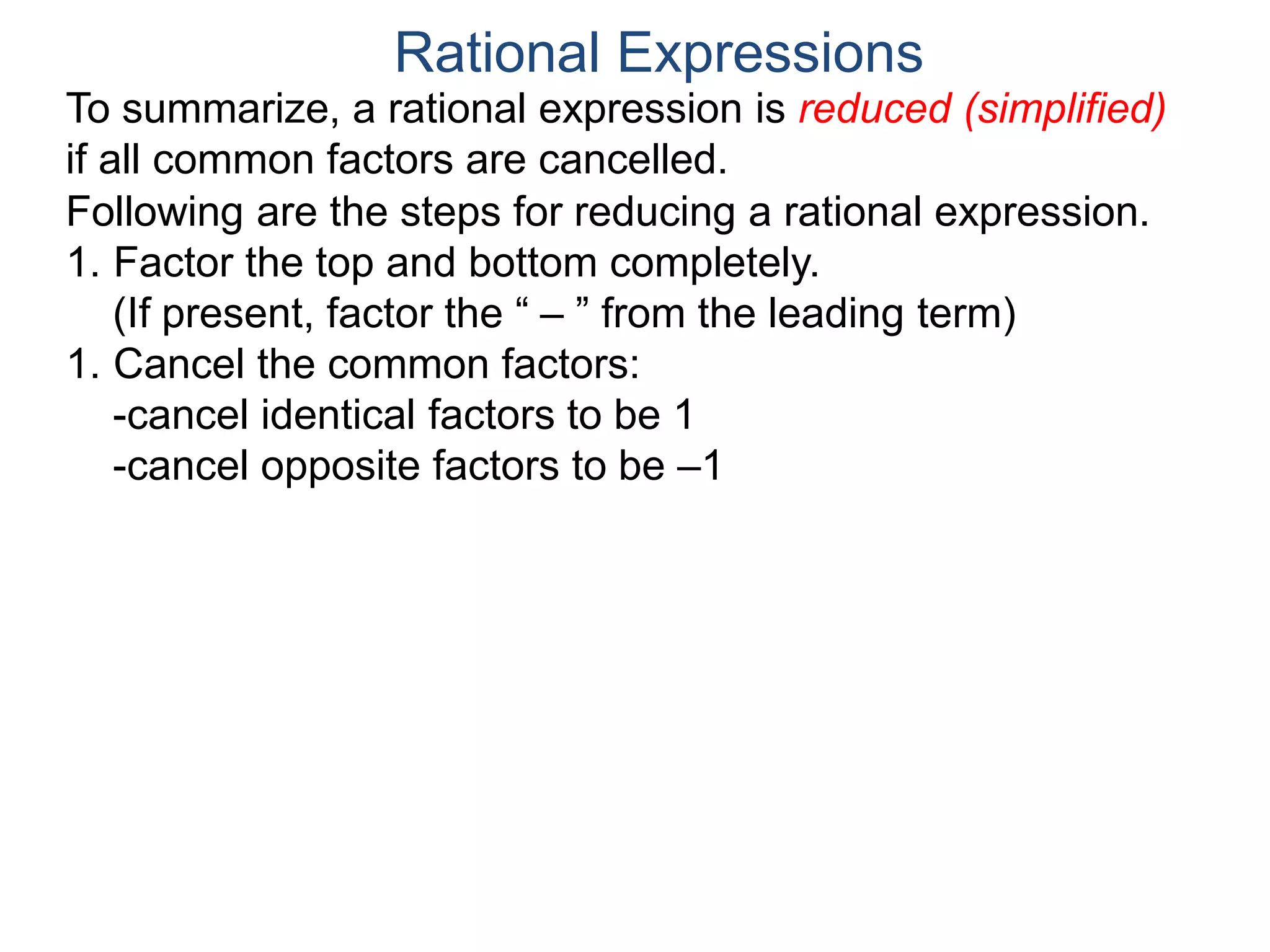
To summarize, a rational expression is reduced (simplified)
if all common factors are cancelled.
Following are the steps for reducing a rational expression.
1. Factor the top and bottom completely.
(If present, factor the “ – ” from the leading term)
1. Cancel the common factors:
-cancel identical factors to be 1
-cancel opposite factors to be –1
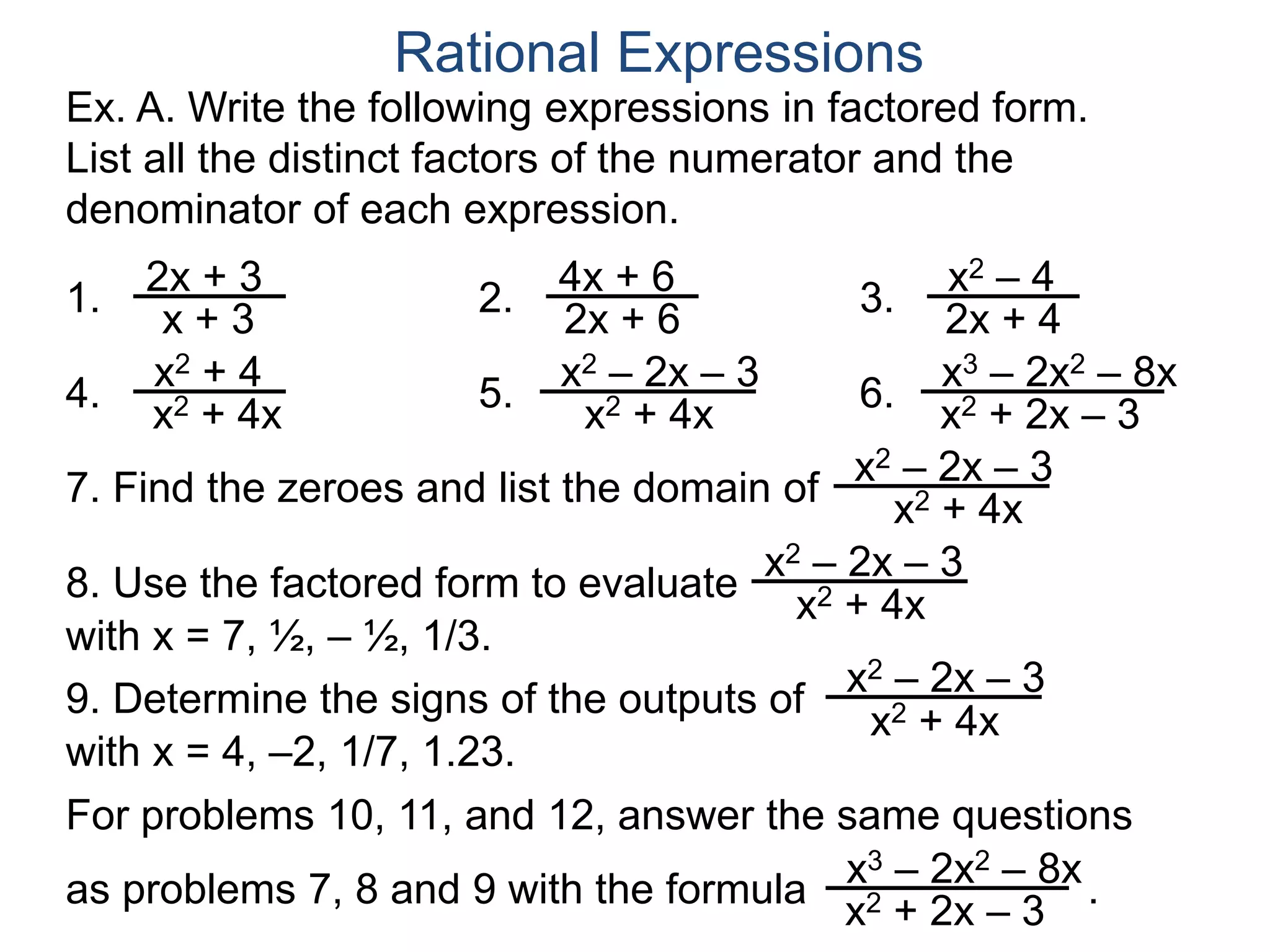
Ex. A. Write the following expressions in factored form.
List all the distinct factors of the numerator and the
denominator of each expression.
1.
Rational Expressions
2x + 3
x + 3
2.
4x + 6
2x + 6
3.
x2 – 4
2x + 4
4.
x2 + 4
x2 + 4x
5.
x2 – 2x – 3
x2 + 4x
6.
x3 – 2x2 – 8x
x2 + 2x – 3
7. Find the zeroes and list the domain of
x2 – 2x – 3
x2 + 4x
8. Use the factored form to evaluate x2 – 2x – 3
x2 + 4x
with x = 7, ½, – ½, 1/3.
9. Determine the signs of the outputs of
x2 – 2x – 3
x2 + 4x
with x = 4, –2, 1/7, 1.23.
For problems 10, 11, and 12, answer the same questions
as problems 7, 8 and 9 with the formula .x3 – 2x2 – 8x
x2 + 2x – 3
Ex. B. Reduce the following expressions. If it’s already
reduced, state this. Make sure you do not cancel any terms
and make sure that you look for the opposite cancellation.
13.
Rational Expressions
2x + 3
x + 3
20.
4x + 6
2x + 3
22. 23. 24.
21.
3x – 12
x – 4
12 – 3x
x – 4
4x + 6
–2x – 3
3x + 12
x – 4
25. 4x – 6
–2x – 3
14.
x + 3
x – 3
15.
x + 3
–x – 3
16.
x + 3
x – 3
17.
x – 3
3 – x
18.
2x – 1
1 + 2x
19. 2x – 1
1 – 2x
26. (2x – y)(x – 2y)
(2y + x)(y – 2x)
27. (3y + x)(3x –y)
(y – 3x)(–x – 3y)
28. (2u + v – w)(2v – u – 2w)
(u – 2v + 2w)(–2u – v – w)
29.(a + 4b – c)(a – b – c)
(c – a – 4b)(a + b + c)
30.
Rational Expressions
37.
x2 – 1
x2 + 2x – 3
36. 38.
x – x2
39.
x2 – 3x – 4
31. 32.
33. 34. 35.
40. 41. x3 – 16x
x2 + 4
2x + 4
x2 – 4x + 4
x2 – 4
x2– 2x
x2 – 9
x2 + 4x + 3
x2 – 4
2x + 4
x2 + 3x + 2
x2 – x – 2 x2 + x – 2
x2 – x – 6
x2 – 5x + 6
x2 – x – 2
x2 + x – 2
x2 – 5x – 6
x2 + 5x – 6
x2 + 5x + 6
x3 – 8x2 – 20x
46.45. 47. 9 – x2
42. 43. 44.
x2 – 2x
9 – x2
x2 + 4x + 3
– x2 – x + 2
x3 – x2 – 6x
–1 + x2
–x2 + x + 2
x2 – x – 2
– x2 + 5x – 6
1 – x2
x2 + 5x – 6
49.48. 50.
xy – 2y + x2 – 2x
x2 – y2x3 – 100x
x2 – 4xy + x – 4y
x2 – 3xy – 4y2
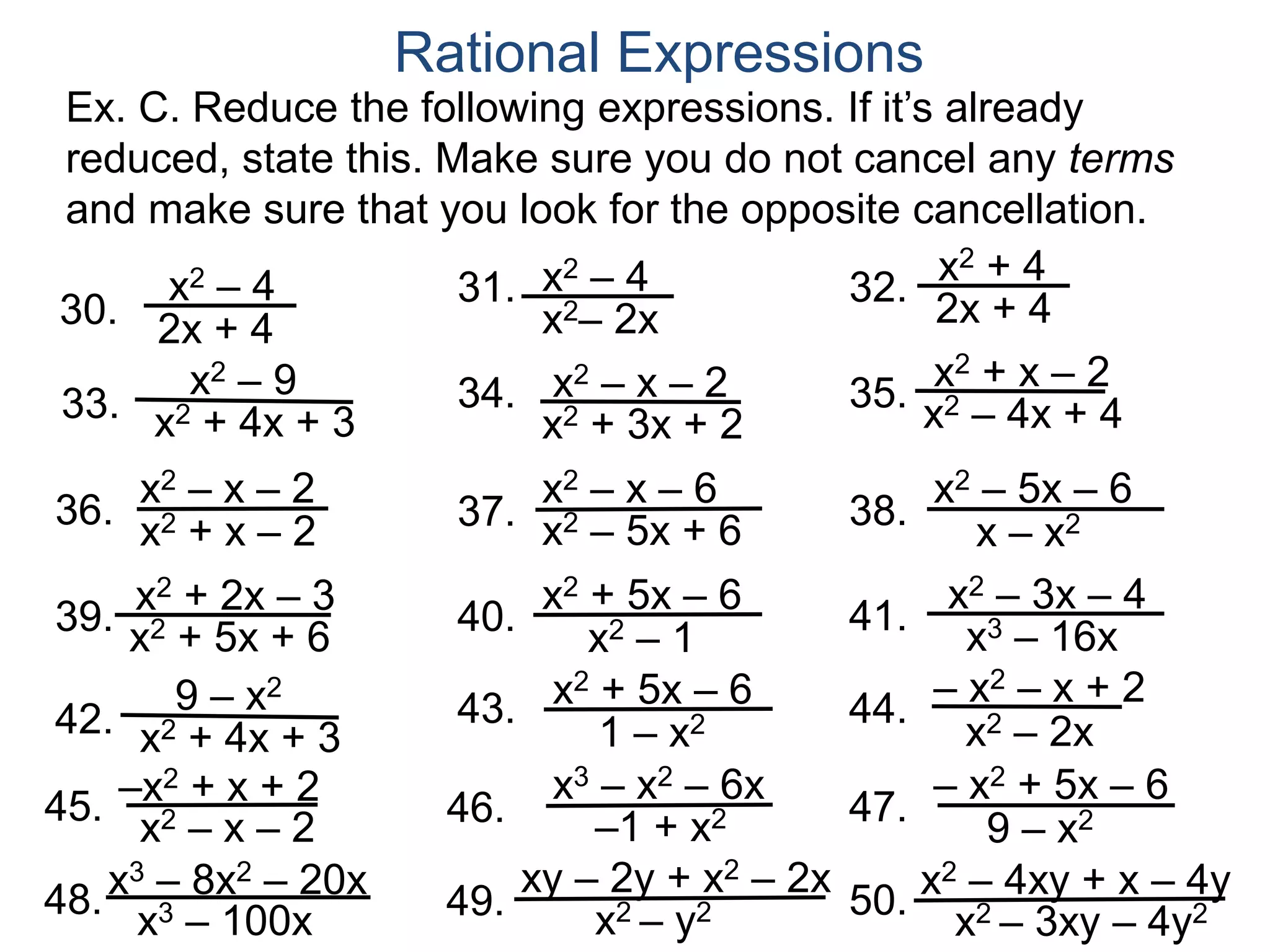
Ex. C. Reduce the following expressions. If it’s already
reduced, state this. Make sure you do not cancel any terms
and make sure that you look for the opposite cancellation.

12 rational expressions

  • 1.
  • 2.
    Rational Expressions Polynomials areexpressions of the form anxn + an-1xn-1+ an-2xn-2+…+ a1x1+ a0 where the a’s are numbers.
  • 3.
    Rational Expressions For example, 7x12– 4x5 + 6x2 – 5, Polynomials are expressions of the form anxn + an-1xn-1+ an-2xn-2+…+ a1x1+ a0 where the a’s are numbers.
  • 4.
    Rational Expressions For example, 7x12– 4x5 + 6x2 – 5, πx – 0.762 are polynomials. Polynomials are expressions of the form anxn + an-1xn-1+ an-2xn-2+…+ a1x1+ a0 where the a’s are numbers.
  • 5.
    Rational Expressions For example, 7x12– 4x5 + 6x2 – 5, πx – 0.762 are polynomials. Rational (fractional) expressions are expressions of the form , where P and Q are polynomials.P Q Polynomials are expressions of the form anxn + an-1xn-1+ an-2xn-2+…+ a1x1+ a0 where the a’s are numbers.
  • 6.
    Rational Expressions For example, 7x12– 4x5 + 6x2 – 5, πx – 0.762 are polynomials. Rational (fractional) expressions are expressions of the form , where P and Q are polynomials.P Q Polynomials are expressions of the form anxn + an-1xn-1+ an-2xn-2+…+ a1x1+ a0 where the a’s are numbers. All polynomials are rational expressions by viewing P as . P 1
  • 7.
    Rational Expressions For example, 7x12– 4x5 + 6x2 – 5, πx – 0.762 are polynomials. Rational (fractional) expressions are expressions of the form , where P and Q are polynomials.P Q Polynomials are expressions of the form anxn + an-1xn-1+ an-2xn-2+…+ a1x1+ a0 where the a’s are numbers. All polynomials are rational expressions by viewing P as . P 1 x – 2 x2 – 2 x + 1 ,
  • 8.
    Rational Expressions For example, 7x12– 4x5 + 6x2 – 5, πx – 0.762 are polynomials. Rational (fractional) expressions are expressions of the form , where P and Q are polynomials.P Q Polynomials are expressions of the form anxn + an-1xn-1+ an-2xn-2+…+ a1x1+ a0 where the a’s are numbers. All polynomials are rational expressions by viewing P as . P 1 x – 2 x2 – 2 x + 1 , x(x – 2) (x + 1) (2x + 1) are rational expressions.
  • 9.
    Rational Expressions For example, 7x12– 4x5 + 6x2 – 5, πx – 0.762 are polynomials. Rational (fractional) expressions are expressions of the form , where P and Q are polynomials.P Q Polynomials are expressions of the form anxn + an-1xn-1+ an-2xn-2+…+ a1x1+ a0 where the a’s are numbers. All polynomials are rational expressions by viewing P as . P 1 x – 2 x2 – 2 x + 1 , x(x – 2) (x + 1) (2x + 1) are rational expressions. x – 2  2 x + 1 is not a rational expression because the denominator is not a polynomial.
  • 10.
    Rational Expressions For example, 7x12– 4x5 + 6x2 – 5, πx – 0.762 are polynomials. Rational (fractional) expressions are expressions of the form , where P and Q are polynomials.P Q Polynomials are expressions of the form anxn + an-1xn-1+ an-2xn-2+…+ a1x1+ a0 where the a’s are numbers. All polynomials are rational expressions by viewing P as . P 1 x – 2 x2 – 2 x + 1 , x(x – 2) (x + 1) (2x + 1) are rational expressions. x – 2  2 x + 1 is not a rational expression because the denominator is not a polynomial. Rational expressions are expressions that describe calculation procedures that involve division (of polynomials).
  • 11.
    Rational Expressions Just aspolynomials may be given in the expanded form or factored form, rational expressions may also be given in these two forms.
  • 12.
    Rational Expressions Just aspolynomials may be given in the expanded form or factored form, rational expressions may also be given in these two forms. The rational expression x2 – 4 x2 + 2x + 1 is in the expanded form.
  • 13.
    Rational Expressions Just aspolynomials may be given in the expanded form or factored form, rational expressions may also be given in these two forms. The rational expression x2 – 4 (x + 2)(x – 2) (x + 1)(x + 1) . is in the expanded form. In the factored form, it’s x2 + 2x + 1
  • 14.
    Rational Expressions Just aspolynomials may be given in the expanded form or factored form, rational expressions may also be given in these two forms. The rational expression x2 – 4 x2 + 2x + 1 (x + 2)(x – 2) (x + 1)(x + 1) . x – 2 x2 + 1The expression is in both forms. is in the expanded form. In the factored form, it’s Example A. Put the following expressions in the factored form. a. x2 – 3x – 10 x2 – 3x b. x2 – 3x + 10 x2 – 3
  • 15.
    Rational Expressions Just aspolynomials may be given in the expanded form or factored form, rational expressions may also be given in these two forms. The rational expression x2 – 4 x2 + 2x + 1 (x + 2)(x – 2) (x + 1)(x + 1) . x – 2 x2 + 1The expression is in both forms. is in the expanded form. Example A. Put the following expressions in the factored form. (x – 5)(x + 2)a. x(x – 3) x2 – 3x – 10 x2 – 3x = b. x2 – 3x + 10 x2 – 3 In the factored form, it’s
  • 16.
    Rational Expressions Just aspolynomials may be given in the expanded form or factored form, rational expressions may also be given in these two forms. The rational expression x2 – 4 x2 + 2x + 1 (x + 2)(x – 2) (x + 1)(x + 1) . x – 2 x2 + 1The expression is in both forms. is in the expanded form. Example A. Put the following expressions in the factored form. (x – 5)(x + 2)a. x(x – 3) x2 – 3x – 10 x2 – 3x = b. x2 – 3x + 10 x2 – 3 is in the factored form In the factored form, it’s
  • 17.
    Rational Expressions Just aspolynomials may be given in the expanded form or factored form, rational expressions may also be given in these two forms. The rational expression x2 – 4 x2 + 2x + 1 (x + 2)(x – 2) (x + 1)(x + 1) . x – 2 x2 + 1The expression is in both forms. is in the expanded form. Example A. Put the following expressions in the factored form. (x – 5)(x + 2)a. x(x – 3) x2 – 3x – 10 x2 – 3x = b. x2 – 3x + 10 x2 – 3 is in the factored form Note that in b. the entire (x2 – 3x + 10) or (x2 – 3) are viewed as a single factors because they can’t be factored further. In the factored form, it’s
  • 18.
    We use thefactored form to 1. solve equations Rational Expressions
  • 19.
    We use thefactored form to 1. solve equations 2. determine the domain of rational expressions Rational Expressions
  • 20.
    We use thefactored form to 1. solve equations 2. determine the domain of rational expressions 2. evaluate given inputs Rational Expressions
  • 21.
    We use thefactored form to 1. solve equations 2. determine the domain of rational expressions 2. evaluate given inputs 3. determine of the signs of the outputs Rational Expressions
  • 22.
    We use thefactored form to 1. solve equations 2. determine the domain of rational expressions 2. evaluate given inputs 3. determine of the signs of the outputs Solutions of Equations Rational Expressions
  • 23.
    We use thefactored form to 1. solve equations 2. determine the domain of rational expressions 2. evaluate given inputs 3. determine of the signs of the outputs Solutions of Equations The solutions of the equation of the form = 0 are the zeroes of the numerator, so they are the solutions of P = 0. Rational Expressions P Q
  • 24.
    We use thefactored form to 1. solve equations 2. determine the domain of rational expressions 2. evaluate given inputs 3. determine of the signs of the outputs Solutions of Equations Example B. a. Write in the factored form and solve the equation The solutions of the equation of the form = 0 are the zeroes of the numerator, so they are the solutions of P = 0. Rational Expressions x3 + x2 – 2x x2 + 4x + 3 x3 + x2 – 2x x2 + 4x + 3 = 0 P Q
  • 25.
    We use thefactored form to 1. solve equations 2. determine the domain of rational expressions 2. evaluate given inputs 3. determine of the signs of the outputs Solutions of Equations Example B. a. Write in the factored form and solve the equation The solutions of the equation of the form = 0 are the zeroes of the numerator, so they are the solutions of P = 0. Rational Expressions x3 + x2 – 2x x2 + 4x + 3 x3 – 2x2 + 3x x2 + 4x + 3 x3 + x2 – 2x x2 + 4x + 3 = 0 Factor, we get P Q =
  • 26.
    We use thefactored form to 1. solve equations 2. determine the domain of rational expressions 2. evaluate given inputs 3. determine of the signs of the outputs Solutions of Equations Example B. a. Write in the factored form and solve the equation The solutions of the equation of the form = 0 are the zeroes of the numerator, so they are the solutions of P = 0. Rational Expressions x3 + x2 – 2x x2 + 4x + 3 x3 – 2x2 + 3x x2 + 4x + 3 = x(x + 2)(x – 1) (x + 3)(x + 1) x3 + x2 – 2x x2 + 4x + 3 = 0 Factor, we get P Q
  • 27.
    We use thefactored form to 1. solve equations 2. determine the domain of rational expressions 2. evaluate given inputs 3. determine of the signs of the outputs Solutions of Equations Example B. a. Write in the factored form and solve the equation The solutions of the equation of the form = 0 are the zeroes of the numerator, so they are the solutions of P = 0. Rational Expressions x3 + x2 – 2x x2 + 4x + 3 x3 – 2x2 + 3x x2 + 4x + 3 = x(x + 2)(x – 1) (x + 3)(x + 1) x3 + x2 – 2x x2 + 4x + 3 = 0 Factor, we get Hence for x3 + x2 – 2x x2 + 4x + 3 = 0, it must be that x(x + 2)(x – 1) = 0 P Q
  • 28.
    We use thefactored form to 1. solve equations 2. determine the domain of rational expressions 2. evaluate given inputs 3. determine of the signs of the outputs Solutions of Equations Example B. a. Write in the factored form and solve the equation The solutions of the equation of the form = 0 are the zeroes of the numerator, so they are the solutions of P = 0. Rational Expressions x3 + x2 – 2x x2 + 4x + 3 x3 – 2x2 + 3x x2 + 4x + 3 = x(x + 2)(x – 1) (x + 3)(x + 1) x3 + x2 – 2x x2 + 4x + 3 = 0 Factor, we get Hence for x3 + x2 – 2x x2 + 4x + 3 = 0, it must be that x(x + 2)(x – 1) = 0 or that x = 0, –2, 1. P Q
  • 29.
    Domain The domain ofa formula is the set of all the numbers that we may use as input values for x. Rational Expressions
  • 30.
    Domain The domain ofa formula is the set of all the numbers that we may use as input values for x. Because the denominator of a fraction can’t be 0, therefore for the rational formulas the zeroes of the denominator Q can’t be used as inputs. Rational Expressions P Q
  • 31.
    Domain The domain ofa formula is the set of all the numbers that we may use as input values for x. Because the denominator of a fraction can’t be 0, therefore for the rational formulas the zeroes of the denominator Q can’t be used as inputs. in other words, the domain of are all the numbers except where Q = 0. Rational Expressions P Q P Q
  • 32.
    Domain b. Determine thedomain of the formula The domain of a formula is the set of all the numbers that we may use as input values for x. Because the denominator of a fraction can’t be 0, therefore for the rational formulas the zeroes of the denominator Q can’t be used as inputs. in other words, the domain of are all the numbers except where Q = 0. Rational Expressions x3 + x2 – 2x x2 + 4x + 3 P Q P Q
  • 33.
    Domain b. Determine thedomain of the formula The domain of a formula is the set of all the numbers that we may use as input values for x. Because the denominator of a fraction can’t be 0, therefore for the rational formulas the zeroes of the denominator Q can’t be used as inputs. in other words, the domain of are all the numbers except where Q = 0. Rational Expressions x3 + x2 – 2x x2 + 4x + 3 x3 – 2x2 + 3x x2 + 4x + 3 Factor expression first. = x(x + 2)(x – 1) (x + 3)(x + 1) P Q P Q
  • 34.
    Domain b. Determine thedomain of the formula The domain of a formula is the set of all the numbers that we may use as input values for x. Because the denominator of a fraction can’t be 0, therefore for the rational formulas the zeroes of the denominator Q can’t be used as inputs. in other words, the domain of are all the numbers except where Q = 0. Rational Expressions x3 + x2 – 2x x2 + 4x + 3 x3 – 2x2 + 3x x2 + 4x + 3 Factor expression first. = x(x + 2)(x – 1) (x + 3)(x + 1) Hence we can’t have P Q P Q (x + 3)(x + 1) = 0
  • 35.
    Domain b. Determine thedomain of the formula The domain of a formula is the set of all the numbers that we may use as input values for x. Because the denominator of a fraction can’t be 0, therefore for the rational formulas the zeroes of the denominator Q can’t be used as inputs. in other words, the domain of are all the numbers except where Q = 0. Rational Expressions x3 + x2 – 2x x2 + 4x + 3 x3 – 2x2 + 3x x2 + 4x + 3 Factor expression first. = x(x + 2)(x – 1) (x + 3)(x + 1) Hence we can’t have P Q P Q (x + 3)(x + 1) = 0 so that the domain is the set of all the numbers except –1 and –3.
  • 36.
    Evaluation It is ofteneasier to evaluate expressions in the factored form. Rational Expressions
  • 37.
    Evaluation c. Evaluate ifx = 7 using the factored form. It is often easier to evaluate expressions in the factored form. Rational Expressions x3 + x2 – 2x x2 + 4x + 3
  • 38.
    Evaluation c. Evaluate ifx = 7 using the factored form. It is often easier to evaluate expressions in the factored form. Rational Expressions x3 + x2 – 2x x2 + 4x + 3 Using the factored form x(x + 2)(x – 1) (x + 3)(x + 1) Plug in x = 7,
  • 39.
    Evaluation c. Evaluate ifx = 7 using the factored form. It is often easier to evaluate expressions in the factored form. Rational Expressions x3 + x2 – 2x x2 + 4x + 3 Using the factored form x(x + 2)(x – 1) (x + 3)(x + 1) Plug in x = 7, we get 7(9)(6) (10)(8)
  • 40.
    Evaluation c. Evaluate ifx = 7 using the factored form. It is often easier to evaluate expressions in the factored form. Rational Expressions x3 + x2 – 2x x2 + 4x + 3 Using the factored form x(x + 2)(x – 1) (x + 3)(x + 1) Plug in x = 7, we get 7(9)(6) (10)(8) 3 4
  • 41.
    Evaluation c. Evaluate ifx = 7 using the factored form. It is often easier to evaluate expressions in the factored form. Rational Expressions x3 + x2 – 2x x2 + 4x + 3 Using the factored form x(x + 2)(x – 1) (x + 3)(x + 1) Plug in x = 7, we get 7(9)(6) (10)(8) = 3 4 189 40
  • 42.
    Evaluation c. Evaluate ifx = 7 using the factored form. It is often easier to evaluate expressions in the factored form. Rational Expressions x3 + x2 – 2x x2 + 4x + 3 Using the factored form x(x + 2)(x – 1) (x + 3)(x + 1) Plug in x = 7, we get 7(9)(6) (10)(8) = 3 4 189 40 Signs
  • 43.
    Evaluation c. Evaluate ifx = 7 using the factored form. It is often easier to evaluate expressions in the factored form. Rational Expressions x3 + x2 – 2x x2 + 4x + 3 Using the factored form x(x + 2)(x – 1) (x + 3)(x + 1) Plug in x = 7, we get 7(9)(6) (10)(8) = 3 4 189 40 We use the factored form to determine the sign of an output. Signs
  • 44.
    Evaluation c. Evaluate ifx = 7 using the factored form. It is often easier to evaluate expressions in the factored form. Rational Expressions x3 + x2 – 2x x2 + 4x + 3 Using the factored form x(x + 2)(x – 1) (x + 3)(x + 1) Plug in x = 7, we get 7(9)(6) (10)(8) = 3 4 189 40 We use the factored form to determine the sign of an output. Signs d. Determine the signs (positive or negative) of if x = ½,– 5/2 using the factored form. x3 + x2 – 2x x2 + 4x + 3
  • 45.
    Evaluation c. Evaluate ifx = 7 using the factored form. It is often easier to evaluate expressions in the factored form. Rational Expressions x3 + x2 – 2x x2 + 4x + 3 Using the factored form x(x + 2)(x – 1) (x + 3)(x + 1) Plug in x = 7, we get 7(9)(6) (10)(8) = 3 4 189 40 We use the factored form to determine the sign of an output. Signs d. Determine the signs (positive or negative) of if x = ½,– 5/2 using the factored form. x3 + x2 – 2x x2 + 4x + 3 Plug in x = ½ into the above factored form and check the signs of each factor,
  • 46.
    Evaluation c. Evaluate ifx = 7 using the factored form. It is often easier to evaluate expressions in the factored form. Rational Expressions x3 + x2 – 2x x2 + 4x + 3 Using the factored form x(x + 2)(x – 1) (x + 3)(x + 1) Plug in x = 7, we get 7(9)(6) (10)(8) = 3 4 189 40 We use the factored form to determine the sign of an output. Signs d. Determine the signs (positive or negative) of if x = ½,– 5/2 using the factored form. x3 + x2 – 2x x2 + 4x + 3 Plug in x = ½ into the above factored form and check the signs of each factor, we get +( + )( – ) (+)(+)
  • 47.
    Evaluation c. Evaluate ifx = 7 using the factored form. It is often easier to evaluate expressions in the factored form. Rational Expressions x3 + x2 – 2x x2 + 4x + 3 Using the factored form x(x + 2)(x – 1) (x + 3)(x + 1) Plug in x = 7, we get 7(9)(6) (10)(8) = 3 4 189 40 We use the factored form to determine the sign of an output. Signs d. Determine the signs (positive or negative) of if x = ½,– 5/2 using the factored form. x3 + x2 – 2x x2 + 4x + 3 Plug in x = ½ into the above factored form and check the signs of each factor, we get = –, so it’s negative.+( + )( – ) (+)(+)
  • 48.
    Evaluation c. Evaluate ifx = 7 using the factored form. It is often easier to evaluate expressions in the factored form. Rational Expressions x3 + x2 – 2x x2 + 4x + 3 Using the factored form x(x + 2)(x – 1) (x + 3)(x + 1) Plug in x = 7, we get 7(9)(6) (10)(8) = 3 4 189 40 We use the factored form to determine the sign of an output. Signs d. Determine the signs (positive or negative) of if x = ½,– 5/2 using the factored form. x3 + x2 – 2x x2 + 4x + 3 Plug in x = ½ into the above factored form and check the signs of each factor, we get Plug in x = –5/2 into the factored form we get –( – )( – ) (+)( – ) = –, so it’s negative.+( + )( – ) (+)(+)
  • 49.
    Evaluation c. Evaluate ifx = 7 using the factored form. It is often easier to evaluate expressions in the factored form. Rational Expressions x3 + x2 – 2x x2 + 4x + 3 Using the factored form x(x + 2)(x – 1) (x + 3)(x + 1) Plug in x = 7, we get 7(9)(6) (10)(8) = 3 4 189 40 We use the factored form to determine the sign of an output. Signs d. Determine the signs (positive or negative) of if x = ½,– 5/2 using the factored form. x3 + x2 – 2x x2 + 4x + 3 Plug in x = ½ into the above factored form and check the signs of each factor, we get = –, so it’s negative.+( + )( – ) (+)(+) Plug in x = –5/2 into the factored form we get –( – )( – ) (+)( – ) = + so that the output is positive.
  • 50.
    PN QN = = 1 Rational Expressions CancellationLaw: Common factor may be cancelled, i.e. PN QN P Q
  • 51.
    PN QN = = 1 Rational Expressions CancellationLaw: Common factor may be cancelled, i.e. PN QN P Q A rational expression is reduced (simplified) if all common factors are cancelled.
  • 52.
    PN QN = = 1 Rational Expressions CancellationLaw: Common factor may be cancelled, i.e. PN QN P Q A rational expression is reduced (simplified) if all common factors are cancelled. To reduce (simplify) a rational expression, put the expression in the factored form then cancel the common factors.
  • 53.
    PN QN = = 1 Rational Expressions CancellationLaw: Common factor may be cancelled, i.e. PN QN P Q A rational expression is reduced (simplified) if all common factors are cancelled. To reduce (simplify) a rational expression, put the expression in the factored form then cancel the common factors. Example B. Reduce the following expressions. (x – 2)(x + 3) (x + 3)(x + 2) a. b. x2 – 3x + 10 x2 – 3
  • 54.
    PN QN = = 1 Rational Expressions CancellationLaw: Common factor may be cancelled, i.e. PN QN P Q A rational expression is reduced (simplified) if all common factors are cancelled. To reduce (simplify) a rational expression, put the expression in the factored form then cancel the common factors. Example B. Reduce the following expressions. (x – 2)(x + 3) It's already factored, proceed to cancel the common factor. (x + 3)(x + 2) (x – 2)(x + 3) (x + 3)(x + 2) a. b. x2 – 3x + 10 x2 – 3
  • 55.
    PN QN = = 1 Rational Expressions CancellationLaw: Common factor may be cancelled, i.e. PN QN P Q A rational expression is reduced (simplified) if all common factors are cancelled. To reduce (simplify) a rational expression, put the expression in the factored form then cancel the common factors. Example B. Reduce the following expressions. (x – 2)(x + 3) 1 = x – 2 x + 2 It's already factored, proceed to cancel the common factor. (x + 3)(x + 2) (x – 2)(x + 3) (x + 3)(x + 2) which is reduced. a. b. x2 – 3x + 10 x2 – 3
  • 56.
    PN QN = = 1 Rational Expressions CancellationLaw: Common factor may be cancelled, i.e. PN QN P Q A rational expression is reduced (simplified) if all common factors are cancelled. To reduce (simplify) a rational expression, put the expression in the factored form then cancel the common factors. Example B. Reduce the following expressions. (x – 2)(x + 3) 1 = x – 2 x + 2 It's already factored, proceed to cancel the common factor. (x + 3)(x + 2) (x – 2)(x + 3) (x + 3)(x + 2) which is reduced. a. b. x2 – 3x + 10 x2 – 3 This is in the factored form.
  • 57.
    PN QN = = 1 Rational Expressions CancellationLaw: Common factor may be cancelled, i.e. PN QN P Q A rational expression is reduced (simplified) if all common factors are cancelled. To reduce (simplify) a rational expression, put the expression in the factored form then cancel the common factors. Example B. Reduce the following expressions. (x – 2)(x + 3) 1 = x – 2 x + 2 It's already factored, proceed to cancel the common factor. (x + 3)(x + 2) (x – 2)(x + 3) (x + 3)(x + 2) which is reduced. a. b. x2 – 3x + 10 x2 – 3 This is in the factored form. There are no common factors so it’s already reduced.
  • 58.
  • 59.
    Rational Expressions c. x2 –1 x2 – 3x+ 2 Factor then cancel
  • 60.
    Rational Expressions c. x2 –1 x2 – 3x+ 2 x2 – 1 x2 – 3x+ 2 = (x – 1)(x + 1) (x – 1)(x – 2) Factor then cancel
  • 61.
    Rational Expressions c. x2 –1 x2 – 3x+ 2 x2 – 1 x2 – 3x+ 2 = (x – 1)(x + 1) (x – 1)(x – 2) 1 Factor then cancel
  • 62.
    Rational Expressions c. x2 –1 x2 – 3x+ 2 x2 – 1 x2 – 3x+ 2 = (x – 1)(x + 1) (x – 1)(x – 2) 1 = x + 1 x – 2 Factor then cancel
  • 63.
    Rational Expressions Only factorsmay be canceled. c. x2 – 1 x2 – 3x+ 2 x2 – 1 x2 – 3x+ 2 = (x – 1)(x + 1) (x – 1)(x – 2) 1 = x + 1 x – 2 Factor then cancel
  • 64.
    Rational Expressions Only factorsmay be canceled. It is wrong to cancel terms c. x2 – 1 x2 – 3x+ 2 x2 – 1 x2 – 3x+ 2 = (x – 1)(x + 1) (x – 1)(x – 2) 1 = x + 1 x – 2 Factor then cancel
  • 65.
    Rational Expressions Only factorsmay be canceled. It is wrong to cancel terms, i.e. P + Q P + R = P + Q P + R c. x2 – 1 x2 – 3x+ 2 x2 – 1 x2 – 3x+ 2 = (x – 1)(x + 1) (x – 1)(x – 2) 1 = x + 1 x – 2 Factor then cancel
  • 66.
    Rational Expressions Only factorsmay be canceled. It is wrong to cancel terms, i.e. P + Q P + R = P + Q P + R For example, x2 + 1 x2 – 2 = x2 + 1 x2 – 2 c. x2 – 1 x2 – 3x+ 2 x2 – 1 x2 – 3x+ 2 = (x – 1)(x + 1) (x – 1)(x – 2) 1 = x + 1 x – 2 Factor then cancel
  • 67.
    Rational Expressions Only factorsmay be canceled. It is wrong to cancel terms, i.e. P + Q P + R = P + Q P + R For example, x2 + 1 x2 – 2 = x2 + 1 x2 – 2 c. x2 – 1 x2 – 3x+ 2 x2 – 1 x2 – 3x+ 2 = (x – 1)(x + 1) (x – 1)(x – 2) 1 = x + 1 x – 2 Factor then cancel Cancellation of Opposite Factors
  • 68.
    Rational Expressions Only factorsmay be canceled. It is wrong to cancel terms, i.e. P + Q P + R = P + Q P + R For example, x2 + 1 x2 – 2 = x2 + 1 x2 – 2 The opposite of a quantity x is the –x. c. x2 – 1 x2 – 3x+ 2 x2 – 1 x2 – 3x+ 2 = (x – 1)(x + 1) (x – 1)(x – 2) 1 = x + 1 x – 2 Factor then cancel Cancellation of Opposite Factors
  • 69.
    Rational Expressions Only factorsmay be canceled. It is wrong to cancel terms, i.e. P + Q P + R = P + Q P + R For example, x2 + 1 x2 – 2 = x2 + 1 x2 – 2 The opposite of a quantity x is the –x. original: y -z x – y v – 4u – 2w opposite: c. x2 – 1 x2 – 3x+ 2 x2 – 1 x2 – 3x+ 2 = (x – 1)(x + 1) (x – 1)(x – 2) 1 = x + 1 x – 2 Factor then cancel Cancellation of Opposite Factors
  • 70.
    Rational Expressions Only factorsmay be canceled. It is wrong to cancel terms, i.e. P + Q P + R = P + Q P + R For example, x2 + 1 x2 – 2 = x2 + 1 x2 – 2 The opposite of a quantity x is the –x. original: y -z x – y v – 4u – 2w opposite: -y c. x2 – 1 x2 – 3x+ 2 x2 – 1 x2 – 3x+ 2 = (x – 1)(x + 1) (x – 1)(x – 2) 1 = x + 1 x – 2 Factor then cancel Cancellation of Opposite Factors
  • 71.
    Rational Expressions Only factorsmay be canceled. It is wrong to cancel terms, i.e. P + Q P + R = P + Q P + R For example, x2 + 1 x2 – 2 = x2 + 1 x2 – 2 The opposite of a quantity x is the –x. original: y -z x – y v – 4u – 2w opposite: -y z c. x2 – 1 x2 – 3x+ 2 x2 – 1 x2 – 3x+ 2 = (x – 1)(x + 1) (x – 1)(x – 2) 1 = x + 1 x – 2 Factor then cancel Cancellation of Opposite Factors
  • 72.
    Rational Expressions Only factorsmay be canceled. It is wrong to cancel terms, i.e. P + Q P + R = P + Q P + R For example, x2 + 1 x2 – 2 = x2 + 1 x2 – 2 The opposite of a quantity x is the –x. original: y -z x – y v – 4u – 2w opposite: -y z -x + y or y – x c. x2 – 1 x2 – 3x+ 2 x2 – 1 x2 – 3x+ 2 = (x – 1)(x + 1) (x – 1)(x – 2) 1 = x + 1 x – 2 Factor then cancel Cancellation of Opposite Factors
  • 73.
    Rational Expressions Only factorsmay be canceled. It is wrong to cancel terms, i.e. P + Q P + R = P + Q P + R For example, x2 + 1 x2 – 2 = x2 + 1 x2 – 2 The opposite of a quantity x is the –x. original: y -z x – y v – 4u – 2w opposite: -y z -x + y or y – x -v + 4u + 2w or … c. x2 – 1 x2 – 3x+ 2 x2 – 1 x2 – 3x+ 2 = (x – 1)(x + 1) (x – 1)(x – 2) 1 = x + 1 x – 2 Factor then cancel Cancellation of Opposite Factors
  • 74.
    Rational Expressions Only factorsmay be canceled. It is wrong to cancel terms, i.e. P + Q P + R = P + Q P + R For example, x2 + 1 x2 – 2 = x2 + 1 x2 – 2 Cancellation of Opposite Factors The opposite of a quantity x is the –x. While identical factors cancel to be 1, opposite factors cancel to be –1, original: y -z x – y v – 4u – 2w opposite: -y z -x + y or y – x -v + 4u + 2w or … c. x2 – 1 x2 – 3x+ 2 x2 – 1 x2 – 3x+ 2 = (x – 1)(x + 1) (x – 1)(x – 2) 1 = x + 1 x – 2 Factor then cancel
  • 75.
    Rational Expressions Only factorsmay be canceled. It is wrong to cancel terms, i.e. P + Q P + R = P + Q P + R For example, x2 + 1 x2 – 2 = x2 + 1 x2 – 2 The opposite of a quantity x is the –x. While identical factors cancel to be 1, opposite factors cancel to be –1, in symbol, original: y -z x – y v – 4u – 2w opposite: -y z -x + y or y – x -v + 4u + 2w or … x –x = –1. c. x2 – 1 x2 – 3x+ 2 x2 – 1 x2 – 3x+ 2 = (x – 1)(x + 1) (x – 1)(x – 2) 1 = x + 1 x – 2 Factor then cancel Cancellation of Opposite Factors
  • 76.
  • 77.
  • 78.
    b(x – y) a(y– x) Example C. 2y –2y = -1 –1a. b. Rational Expressions
  • 79.
    b(x – y) a(y– x) Example C. 2y –2y = -1 –1 -1 a. b. Rational Expressions
  • 80.
    b(x – y) a(y– x) Example C. 2y –2y = -1 –1 -1 = –b a a. b. Rational Expressions
  • 81.
    b(x – y) a(y– x) Example C. 2y –2y = -1 –1 -1 = –b a a. b. Rational Expressions (x – 2y)(x + 3y) (x – 3y)(2y – x) c.
  • 82.
    b(x – y) a(y– x) Example C. 2y –2y = -1 –1 -1 = –b a a. b. Rational Expressions (x – 2y)(x + 3y) (x – 3y)(2y – x) c. -1
  • 83.
    b(x – y) a(y– x) Example C. 2y –2y = -1 –1 -1 = –b a a. b. Rational Expressions (x – 2y)(x + 3y) (x – 3y)(2y – x) c. -1 = –(x + 3y) (x – 3y)
  • 84.
    b(x – y) a(y– x) Example C. 2y –2y = -1 –1 -1 = –b a a. b. Rational Expressions (x – 2y)(x + 3y) (x – 3y)(2y – x) c. -1 = –(x + 3y) (x – 3y) or –x – 3y x – 3y
  • 85.
    b(x – y) a(y– x) Example C. 2y –2y = -1 –1 -1 = –b a a. b. Rational Expressions (x – 2y)(x + 3y) (x – 3y)(2y – x) c. -1 = –(x + 3y) (x – 3y) or –x – 3y x – 3y d. 4 – x2 x2 – x – 2
  • 86.
    b(x – y) a(y– x) Example C. 2y –2y = -1 –1 -1 = –b a a. b. Rational Expressions (x – 2y)(x + 3y) (x – 3y)(2y – x) c. -1 = –(x + 3y) (x – 3y) or –x – 3y x – 3y d. 4 – x2 x2 – x – 2 = (2 – x)(2 + x) (x + 1)(x – 2)
  • 87.
    b(x – y) a(y– x) Example C. 2y –2y = -1 –1 -1 = –b a a. b. Rational Expressions (x – 2y)(x + 3y) (x – 3y)(2y – x) c. -1 = –(x + 3y) (x – 3y) or –x – 3y x – 3y d. 4 – x2 x2 – x – 2 = (2 – x)(2 + x) (x + 1)(x – 2) -1
  • 88.
    b(x – y) a(y– x) Example C. 2y –2y = -1 –1 -1 = –b a a. b. Rational Expressions (x – 2y)(x + 3y) (x – 3y)(2y – x) c. -1 = –(x + 3y) (x – 3y) or –x – 3y x – 3y d. 4 – x2 x2 – x – 2 = (2 – x)(2 + x) (x + 1)(x – 2) -1 = –(2 + x) x + 1 or –2 – x x + 1
  • 89.
    b(x – y) a(y– x) Example C. 2y –2y = -1 –1 -1 = –b a a. b. Rational Expressions (x – 2y)(x + 3y) (x – 3y)(2y – x) c. -1 = –(x + 3y) (x – 3y) or –x – 3y x – 3y d. 4 – x2 x2 – x – 2 = (2 – x)(2 + x) (x + 1)(x – 2) -1 = –(2 + x) x + 1 or –2 – x x + 1 In the case of polynomials in one variable x, if the highest degree term is negative, we may factor out the negative sign then factor the expressions.
  • 90.
    b(x – y) a(y– x) Example C. 2y –2y = -1 –1 -1 = –b a a. b. Rational Expressions (x – 2y)(x + 3y) (x – 3y)(2y – x) c. -1 = –(x + 3y) (x – 3y) or –x – 3y x – 3y d. 4 – x2 x2 – x – 2 = (2 – x)(2 + x) (x + 1)(x – 2) -1 = –(2 + x) x + 1 or –2 – x x + 1 –x2 + 4 –x2 + x + 2 Example D. Pull out the “–” first then reduce. In the case of polynomials in one variable x, if the highest degree term is negative, we may factor out the negative sign then factor the expressions.
  • 91.
    b(x – y) a(y– x) Example C. 2y –2y = -1 –1 -1 = –b a a. b. Rational Expressions (x – 2y)(x + 3y) (x – 3y)(2y – x) c. -1 = –(x + 3y) (x – 3y) or –x – 3y x – 3y d. 4 – x2 x2 – x – 2 = (2 – x)(2 + x) (x + 1)(x – 2) -1 = –(2 + x) x + 1 or –2 – x x + 1 In the case of polynomials in one variable x, if the highest degree term is negative, we may factor out the negative sign then factor the expressions. –x2 + 4 –x2 + x + 2 = Example D. Pull out the “–” first then reduce. –(x2 – 4) –(x2 – x – 2)
  • 92.
    b(x – y) a(y– x) Example C. 2y –2y = -1 –1 -1 = –b a a. b. Rational Expressions (x – 2y)(x + 3y) (x – 3y)(2y – x) c. -1 = –(x + 3y) (x – 3y) or –x – 3y x – 3y d. 4 – x2 x2 – x – 2 = (2 – x)(2 + x) (x + 1)(x – 2) -1 = –(2 + x) x + 1 or –2 – x x + 1 –x2 + 4 –x2 + x + 2 = (x – 2)(x + 2) (x + 1)(x – 2) = Example D. Pull out the “–” first then reduce. –(x2 – 4) –(x2 – x – 2) In the case of polynomials in one variable x, if the highest degree term is negative, we may factor out the negative sign then factor the expressions.
  • 93.
    b(x – y) a(y– x) Example C. 2y –2y = -1 –1 -1 = –b a a. b. Rational Expressions (x – 2y)(x + 3y) (x – 3y)(2y – x) c. -1 = –(x + 3y) (x – 3y) or –x – 3y x – 3y d. 4 – x2 x2 – x – 2 = (2 – x)(2 + x) (x + 1)(x – 2) -1 = –(2 + x) x + 1 or –2 – x x + 1 –x2 + 4 –x2 + x + 2 = (x – 2)(x + 2) (x + 1)(x – 2) = Example D. Pull out the “–” first then reduce. –(x2 – 4) –(x2 – x – 2) = x + 2 x + 1 In the case of polynomials in one variable x, if the highest degree term is negative, we may factor out the negative sign then factor the expressions.
  • 94.
    Rational Expressions To summarize,a rational expression is reduced (simplified) if all common factors are cancelled. Following are the steps for reducing a rational expression. 1. Factor the top and bottom completely. (If present, factor the “ – ” from the leading term) 1. Cancel the common factors: -cancel identical factors to be 1 -cancel opposite factors to be –1
  • 95.
    Ex. A. Writethe following expressions in factored form. List all the distinct factors of the numerator and the denominator of each expression. 1. Rational Expressions 2x + 3 x + 3 2. 4x + 6 2x + 6 3. x2 – 4 2x + 4 4. x2 + 4 x2 + 4x 5. x2 – 2x – 3 x2 + 4x 6. x3 – 2x2 – 8x x2 + 2x – 3 7. Find the zeroes and list the domain of x2 – 2x – 3 x2 + 4x 8. Use the factored form to evaluate x2 – 2x – 3 x2 + 4x with x = 7, ½, – ½, 1/3. 9. Determine the signs of the outputs of x2 – 2x – 3 x2 + 4x with x = 4, –2, 1/7, 1.23. For problems 10, 11, and 12, answer the same questions as problems 7, 8 and 9 with the formula .x3 – 2x2 – 8x x2 + 2x – 3
  • 96.
    Ex. B. Reducethe following expressions. If it’s already reduced, state this. Make sure you do not cancel any terms and make sure that you look for the opposite cancellation. 13. Rational Expressions 2x + 3 x + 3 20. 4x + 6 2x + 3 22. 23. 24. 21. 3x – 12 x – 4 12 – 3x x – 4 4x + 6 –2x – 3 3x + 12 x – 4 25. 4x – 6 –2x – 3 14. x + 3 x – 3 15. x + 3 –x – 3 16. x + 3 x – 3 17. x – 3 3 – x 18. 2x – 1 1 + 2x 19. 2x – 1 1 – 2x 26. (2x – y)(x – 2y) (2y + x)(y – 2x) 27. (3y + x)(3x –y) (y – 3x)(–x – 3y) 28. (2u + v – w)(2v – u – 2w) (u – 2v + 2w)(–2u – v – w) 29.(a + 4b – c)(a – b – c) (c – a – 4b)(a + b + c)
  • 97.
    30. Rational Expressions 37. x2 –1 x2 + 2x – 3 36. 38. x – x2 39. x2 – 3x – 4 31. 32. 33. 34. 35. 40. 41. x3 – 16x x2 + 4 2x + 4 x2 – 4x + 4 x2 – 4 x2– 2x x2 – 9 x2 + 4x + 3 x2 – 4 2x + 4 x2 + 3x + 2 x2 – x – 2 x2 + x – 2 x2 – x – 6 x2 – 5x + 6 x2 – x – 2 x2 + x – 2 x2 – 5x – 6 x2 + 5x – 6 x2 + 5x + 6 x3 – 8x2 – 20x 46.45. 47. 9 – x2 42. 43. 44. x2 – 2x 9 – x2 x2 + 4x + 3 – x2 – x + 2 x3 – x2 – 6x –1 + x2 –x2 + x + 2 x2 – x – 2 – x2 + 5x – 6 1 – x2 x2 + 5x – 6 49.48. 50. xy – 2y + x2 – 2x x2 – y2x3 – 100x x2 – 4xy + x – 4y x2 – 3xy – 4y2 Ex. C. Reduce the following expressions. If it’s already reduced, state this. Make sure you do not cancel any terms and make sure that you look for the opposite cancellation.