Table Of Contents -
• Introduction
• History
1. History Of Notation
• Terms
• Types Of Polynomials
• Uses
• Zeroes Of Polynomial
• Degree
• Graphs Of Polynomial Function
• Table
• Algebraic Identities
• Arithmetic Of Polynomials
• Think Tanker ? ?
Introduction…..
~ What Is a Polynomial ??
In mathematics, a polynomial is an expression
consisting of variables and coefficients, that
involves only the operations of addition,
subtraction, multiplication, and non-negative
integer-exponents.
Example : x2 − 3x + 6, which is a quadratic
polynomial.
History Of Notation
• He popularized the use of letters from the
beginning of the alphabet to denote constants and
letters from the end of the alphabet to denote
variables.
• As can be seen above, in the general formula for a
polynomial in one variable, where the a's denote
constants and x denotes a variable.
• Descartes introduced the use of superscripts to
denote exponents as well.
NEXT
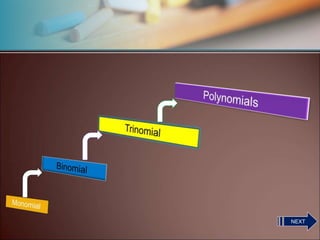
Types Of Polynomials...
Monomial
In mathematics,
A monomial is a
polynomial with
just one term.
For Example:
3x,4xy is a
monomial.
Binomial
In algebra, A
binomial is a
polynomial, which
is the sum of two
monomials.
For Example:
2x+5 is a
Binomial.
Trinomial
In elementary
algebra, A
trinomial is a
polynomial
consisting of three
terms or
monomials.
For Example :
3x+5y+7z is a
Trinomial.
Binomial TrinomialMonomial
Uses...
• Polynomials appear in a wide variety of areas of
mathematics and science.
~ For example, they are used to form “Polynomial”
equations, which encode a wide range of problems, from
elementary word problems to complicated problems in the
sciences.
• They are used to define “Polynomial Functions”, which
appear in settings ranging from basic chemistry and
physics to economics and social science.
• They are used in calculus and numerical analysis to
approximate other functions.
Zeroes Of Polynomial
• Consider the polynomial p(x) = 5x3 – 2x3+ 3x – 2.
If we replace x by 1 everywhere in p(x), we get
p(1) = 5 × (1)3 – 2 × (1)2 + 3 × (1) – 2
= 5 – 2 + 3 –2
= 4
So, we say that the value of p(x) at x = 1 is 4.
Similarly,
p(0) = 5(0)3 – 2(0)2 + 3(0) –2
= –2
Degree
• The degree of a polynomial is the highest
degree of its terms, when the polynomial is
expressed in canonical form (i.e., as a linear
combination of monomials). The degree of a
term is the sum of the exponents of the
variables that appear in it.
DEGREE OF POLYNOMIAL
• Degree 0 – constant
• Degree 1 – linear
• Degree 2 – quadratic
• Degree 3 – cubic
• Degree 4 – quartic (or, less
commonly, biquadratic)
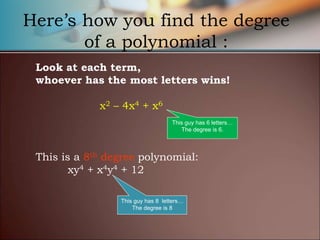
Look at each term,
whoever has the most letters wins!
x2 – 4x4 + x6
This is a 8th degree polynomial:
xy4 + x4y4 + 12
This guy has 6 letters…
The degree is 6.
This guy has 8 letters…
The degree is 8
Here’s how you find the degree
of a polynomial :
The graph of the zero polynomial
f(x) = 0 is the x-axis.
Graphs Of Polynomial
Functions ..
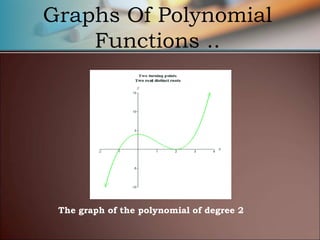
The graph of the polynomial of degree 2
Graphs Of Polynomial
Functions ..
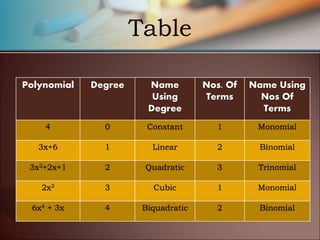
Table
Polynomial Degree Name
Using
Degree
Nos. Of
Terms
Name Using
Nos Of
Terms
4 0 Constant 1 Monomial
3x+6 1 Linear 2 Binomial
3x2+2x+1 2 Quadratic 3 Trinomial
2x3 3 Cubic 1 Monomial
6x4 + 3x 4 Biquadratic 2 Binomial
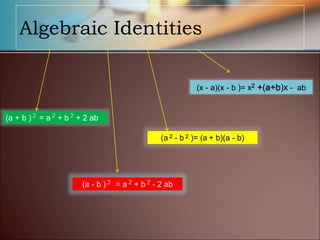
Algebraic Identities
(a + b ) 2 = a 2 + b 2 + 2 ab
(a - b ) 2 = a 2 + b 2 - 2 ab
(a 2 - b 2 )= (a + b)(a - b)
(x - a)(x - b )= x2 +(a+b)x - ab
Arithmetic Of Polynomials
• Addition ( + )
• Subtraction( - )
• Division ( / )
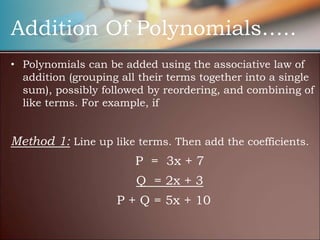
Addition Of Polynomials…..
• Polynomials can be added using the associative law of
addition (grouping all their terms together into a single
sum), possibly followed by reordering, and combining of
like terms. For example, if
Method 1: Line up like terms. Then add the coefficients.
P = 3x + 7
Q = 2x + 3
P + Q = 5x + 10
Addition Of Polynomials…..
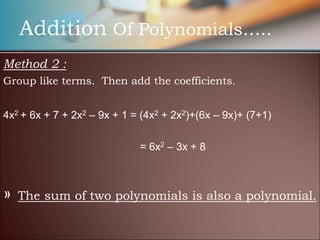
Method 2 :
Group like terms. Then add the coefficients.
4x2 + 6x + 7 + 2x2 – 9x + 1 = (4x2 + 2x2)+(6x – 9x)+ (7+1)
= 6x2 – 3x + 8
» The sum of two polynomials is also a polynomial.
Subtraction Of Polynomials
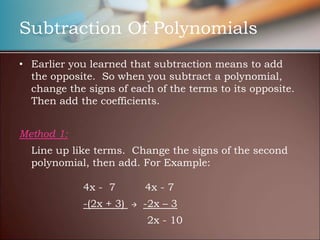
• Earlier you learned that subtraction means to add
the opposite. So when you subtract a polynomial,
change the signs of each of the terms to its opposite.
Then add the coefficients.
Method 1:
Line up like terms. Change the signs of the second
polynomial, then add. For Example:
4x - 7 4x - 7
-(2x + 3)  -2x – 3
2x - 10
Subtraction Of Polynomials
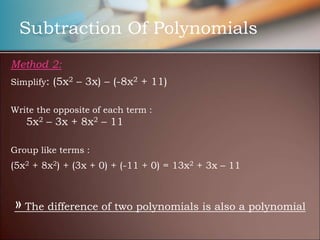
Method 2:
Simplify: (5x2 – 3x) – (-8x2 + 11)
Write the opposite of each term :
5x2 – 3x + 8x2 – 11
Group like terms :
(5x2 + 8x2) + (3x + 0) + (-11 + 0) = 13x2 + 3x – 11
»The difference of two polynomials is also a polynomial
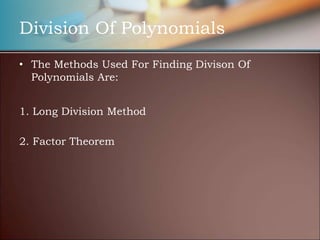
Division Of Polynomials
• The Methods Used For Finding Divison Of
Polynomials Are:
1. Long Division Method
2. Factor Theorem
Long- Division Method
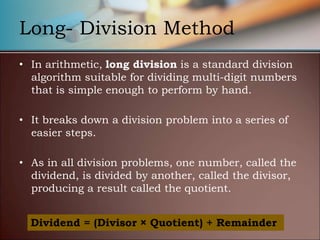
• In arithmetic, long division is a standard division
algorithm suitable for dividing multi-digit numbers
that is simple enough to perform by hand.
• It breaks down a division problem into a series of
easier steps.
• As in all division problems, one number, called the
dividend, is divided by another, called the divisor,
producing a result called the quotient.
Dividend = (Divisor × Quotient) + Remainder
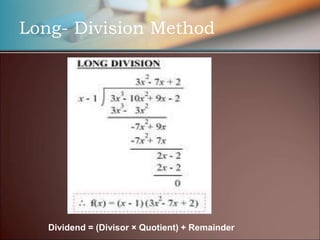
Long- Division Method
Dividend = (Divisor × Quotient) + Remainder
Factorisation
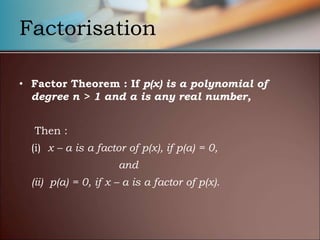
• Factor Theorem : If p(x) is a polynomial of
degree n > 1 and a is any real number,
Then :
(i) x – a is a factor of p(x), if p(a) = 0,
and
(ii) p(a) = 0, if x – a is a factor of p(x).
Q.1 What is the simplified form of :
2x-3x+2??
A. -x+2
B. -5x+2
C. -10x+2
D. -2x+2
Q.2 What is the value of x when x+3=10 ??
A. 7
B. 4
C. 2
D. 9
Q 3. Solve 2x+4=108 ??
A. 32
B. 56
C. 52
D. 23
Polynomials

Polynomials

  • 2.
    Table Of Contents- • Introduction • History 1. History Of Notation • Terms • Types Of Polynomials • Uses • Zeroes Of Polynomial • Degree • Graphs Of Polynomial Function • Table • Algebraic Identities • Arithmetic Of Polynomials • Think Tanker ? ?
  • 3.
    Introduction….. ~ What Isa Polynomial ?? In mathematics, a polynomial is an expression consisting of variables and coefficients, that involves only the operations of addition, subtraction, multiplication, and non-negative integer-exponents. Example : x2 − 3x + 6, which is a quadratic polynomial.
  • 4.
    History Of Notation •He popularized the use of letters from the beginning of the alphabet to denote constants and letters from the end of the alphabet to denote variables. • As can be seen above, in the general formula for a polynomial in one variable, where the a's denote constants and x denotes a variable. • Descartes introduced the use of superscripts to denote exponents as well.
  • 5.
  • 6.
    Types Of Polynomials... Monomial Inmathematics, A monomial is a polynomial with just one term. For Example: 3x,4xy is a monomial. Binomial In algebra, A binomial is a polynomial, which is the sum of two monomials. For Example: 2x+5 is a Binomial. Trinomial In elementary algebra, A trinomial is a polynomial consisting of three terms or monomials. For Example : 3x+5y+7z is a Trinomial.
  • 7.
  • 8.
    Uses... • Polynomials appearin a wide variety of areas of mathematics and science. ~ For example, they are used to form “Polynomial” equations, which encode a wide range of problems, from elementary word problems to complicated problems in the sciences. • They are used to define “Polynomial Functions”, which appear in settings ranging from basic chemistry and physics to economics and social science. • They are used in calculus and numerical analysis to approximate other functions.
  • 9.
    Zeroes Of Polynomial •Consider the polynomial p(x) = 5x3 – 2x3+ 3x – 2. If we replace x by 1 everywhere in p(x), we get p(1) = 5 × (1)3 – 2 × (1)2 + 3 × (1) – 2 = 5 – 2 + 3 –2 = 4 So, we say that the value of p(x) at x = 1 is 4. Similarly, p(0) = 5(0)3 – 2(0)2 + 3(0) –2 = –2
  • 10.
    Degree • The degreeof a polynomial is the highest degree of its terms, when the polynomial is expressed in canonical form (i.e., as a linear combination of monomials). The degree of a term is the sum of the exponents of the variables that appear in it.
  • 11.
    DEGREE OF POLYNOMIAL •Degree 0 – constant • Degree 1 – linear • Degree 2 – quadratic • Degree 3 – cubic • Degree 4 – quartic (or, less commonly, biquadratic)
  • 13.
    Look at eachterm, whoever has the most letters wins! x2 – 4x4 + x6 This is a 8th degree polynomial: xy4 + x4y4 + 12 This guy has 6 letters… The degree is 6. This guy has 8 letters… The degree is 8 Here’s how you find the degree of a polynomial :
  • 14.
    The graph ofthe zero polynomial f(x) = 0 is the x-axis. Graphs Of Polynomial Functions ..
  • 15.
    The graph ofthe polynomial of degree 2 Graphs Of Polynomial Functions ..
  • 16.
    Table Polynomial Degree Name Using Degree Nos.Of Terms Name Using Nos Of Terms 4 0 Constant 1 Monomial 3x+6 1 Linear 2 Binomial 3x2+2x+1 2 Quadratic 3 Trinomial 2x3 3 Cubic 1 Monomial 6x4 + 3x 4 Biquadratic 2 Binomial
  • 17.
    Algebraic Identities (a +b ) 2 = a 2 + b 2 + 2 ab (a - b ) 2 = a 2 + b 2 - 2 ab (a 2 - b 2 )= (a + b)(a - b) (x - a)(x - b )= x2 +(a+b)x - ab
  • 18.
    Arithmetic Of Polynomials •Addition ( + ) • Subtraction( - ) • Division ( / )
  • 19.
    Addition Of Polynomials….. •Polynomials can be added using the associative law of addition (grouping all their terms together into a single sum), possibly followed by reordering, and combining of like terms. For example, if Method 1: Line up like terms. Then add the coefficients. P = 3x + 7 Q = 2x + 3 P + Q = 5x + 10
  • 20.
    Addition Of Polynomials….. Method2 : Group like terms. Then add the coefficients. 4x2 + 6x + 7 + 2x2 – 9x + 1 = (4x2 + 2x2)+(6x – 9x)+ (7+1) = 6x2 – 3x + 8 » The sum of two polynomials is also a polynomial.
  • 21.
    Subtraction Of Polynomials •Earlier you learned that subtraction means to add the opposite. So when you subtract a polynomial, change the signs of each of the terms to its opposite. Then add the coefficients. Method 1: Line up like terms. Change the signs of the second polynomial, then add. For Example: 4x - 7 4x - 7 -(2x + 3)  -2x – 3 2x - 10
  • 22.
    Subtraction Of Polynomials Method2: Simplify: (5x2 – 3x) – (-8x2 + 11) Write the opposite of each term : 5x2 – 3x + 8x2 – 11 Group like terms : (5x2 + 8x2) + (3x + 0) + (-11 + 0) = 13x2 + 3x – 11 »The difference of two polynomials is also a polynomial
  • 23.
    Division Of Polynomials •The Methods Used For Finding Divison Of Polynomials Are: 1. Long Division Method 2. Factor Theorem
  • 24.
    Long- Division Method •In arithmetic, long division is a standard division algorithm suitable for dividing multi-digit numbers that is simple enough to perform by hand. • It breaks down a division problem into a series of easier steps. • As in all division problems, one number, called the dividend, is divided by another, called the divisor, producing a result called the quotient. Dividend = (Divisor × Quotient) + Remainder
  • 25.
    Long- Division Method Dividend= (Divisor × Quotient) + Remainder
  • 26.
    Factorisation • Factor Theorem: If p(x) is a polynomial of degree n > 1 and a is any real number, Then : (i) x – a is a factor of p(x), if p(a) = 0, and (ii) p(a) = 0, if x – a is a factor of p(x).
  • 28.
    Q.1 What isthe simplified form of : 2x-3x+2?? A. -x+2 B. -5x+2 C. -10x+2 D. -2x+2
  • 29.
    Q.2 What isthe value of x when x+3=10 ?? A. 7 B. 4 C. 2 D. 9
  • 30.
    Q 3. Solve2x+4=108 ?? A. 32 B. 56 C. 52 D. 23