Complex Fractions
Frank Ma © 2011
Complex Fractions
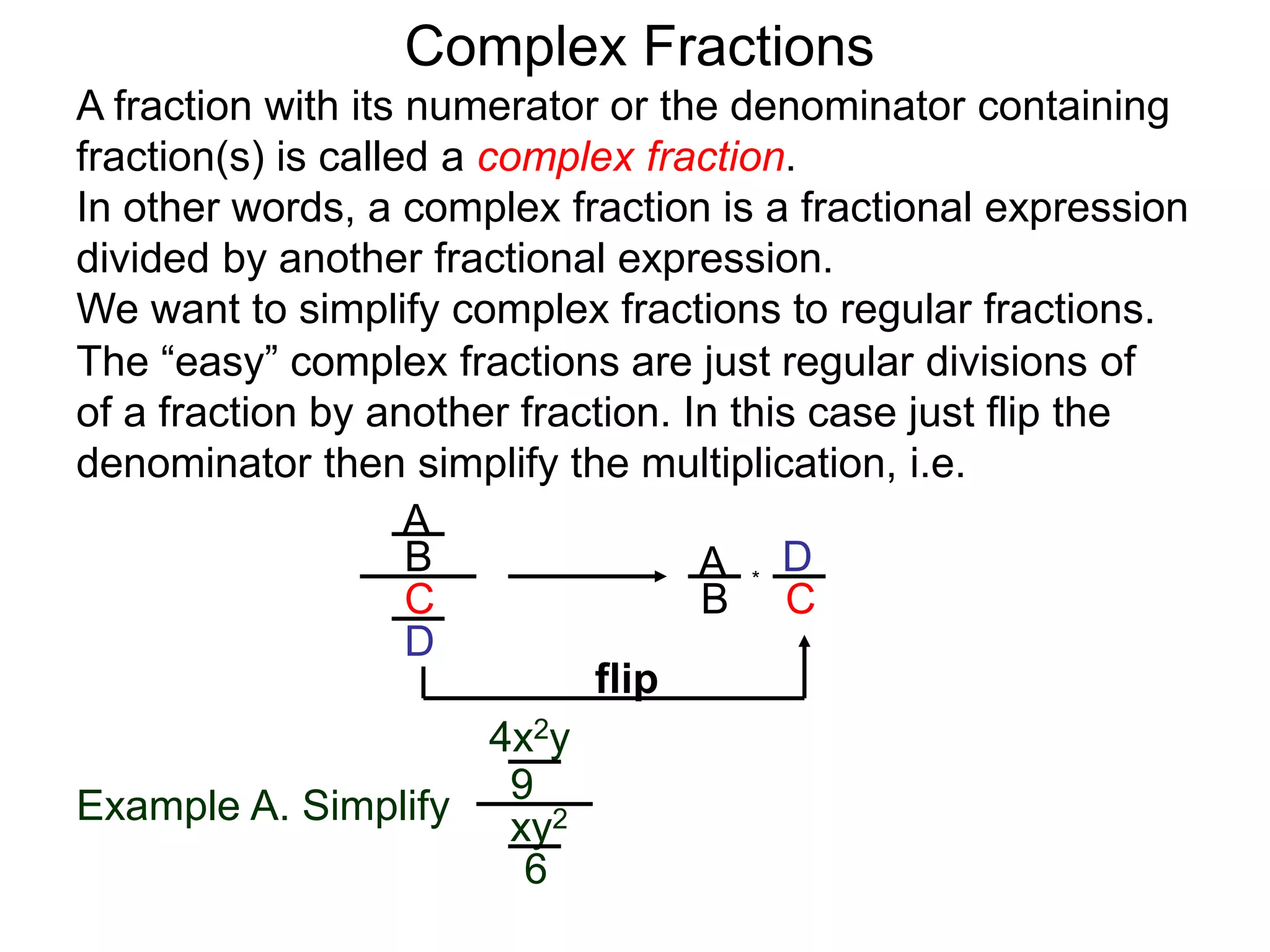
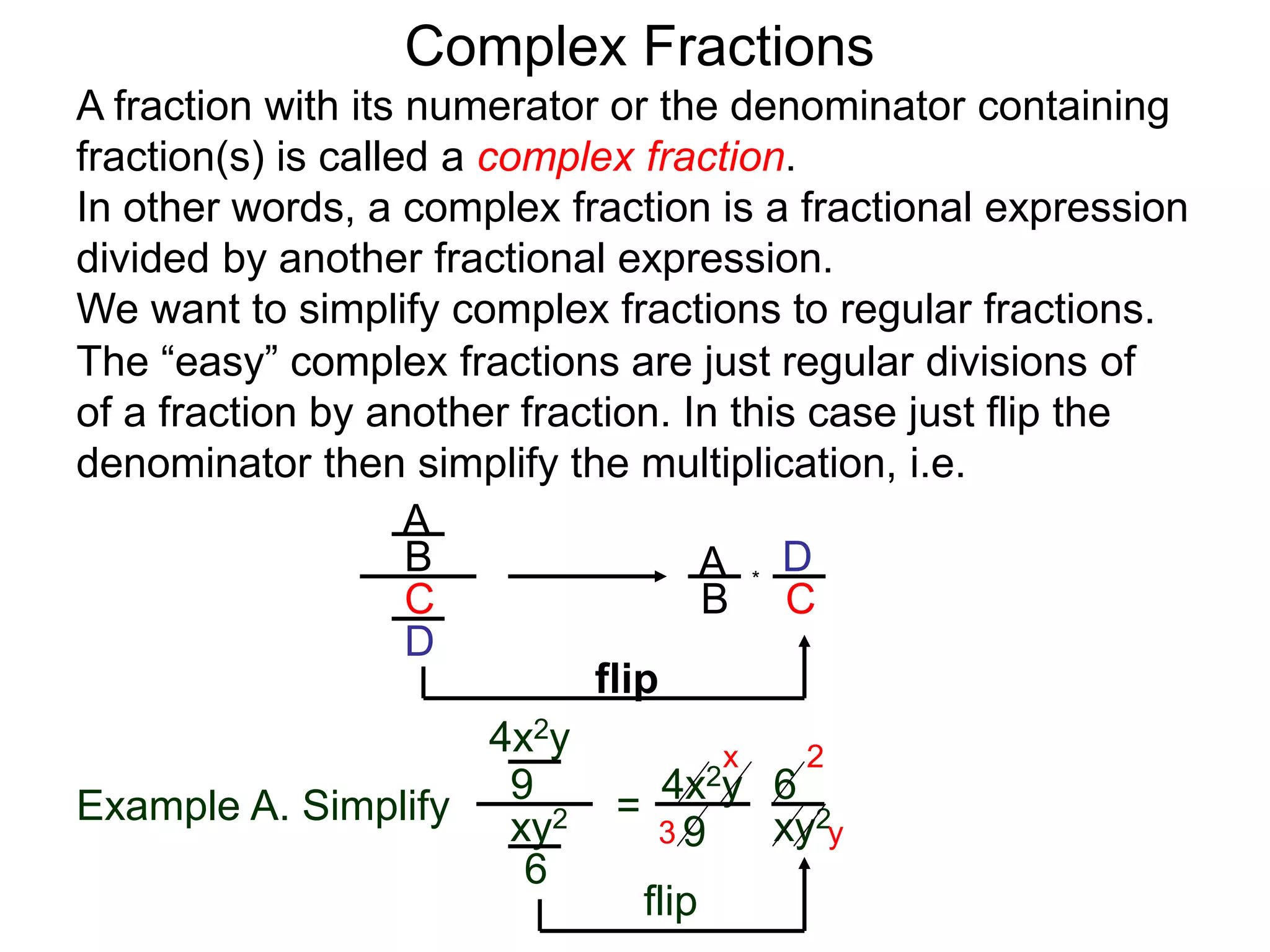
A fraction with its numerator or the denominator containing
fraction(s) is called a complex fraction.
Complex Fractions
A fraction with its numerator or the denominator containing
fraction(s) is called a complex fraction.
In other words, a complex fraction is a fractional expression
divided by another fractional expression.
Complex Fractions
A fraction with its numerator or the denominator containing
fraction(s) is called a complex fraction.
In other words, a complex fraction is a fractional expression
divided by another fractional expression.
We want to simplify complex fractions to regular fractions.
Complex Fractions
A fraction with its numerator or the denominator containing
fraction(s) is called a complex fraction.
In other words, a complex fraction is a fractional expression
divided by another fractional expression.
We want to simplify complex fractions to regular fractions.
The “easy” complex fractions are just regular divisions of
of a fraction by another fraction.
Complex Fractions
A fraction with its numerator or the denominator containing
fraction(s) is called a complex fraction.
In other words, a complex fraction is a fractional expression
divided by another fractional expression.
We want to simplify complex fractions to regular fractions.
The “easy” complex fractions are just regular divisions of
of a fraction by another fraction. In this case just flip the
denominator then simplify the multiplication,
Complex Fractions
A fraction with its numerator or the denominator containing
fraction(s) is called a complex fraction.
In other words, a complex fraction is a fractional expression
divided by another fractional expression.
We want to simplify complex fractions to regular fractions.
The “easy” complex fractions are just regular divisions of
of a fraction by another fraction. In this case just flip the
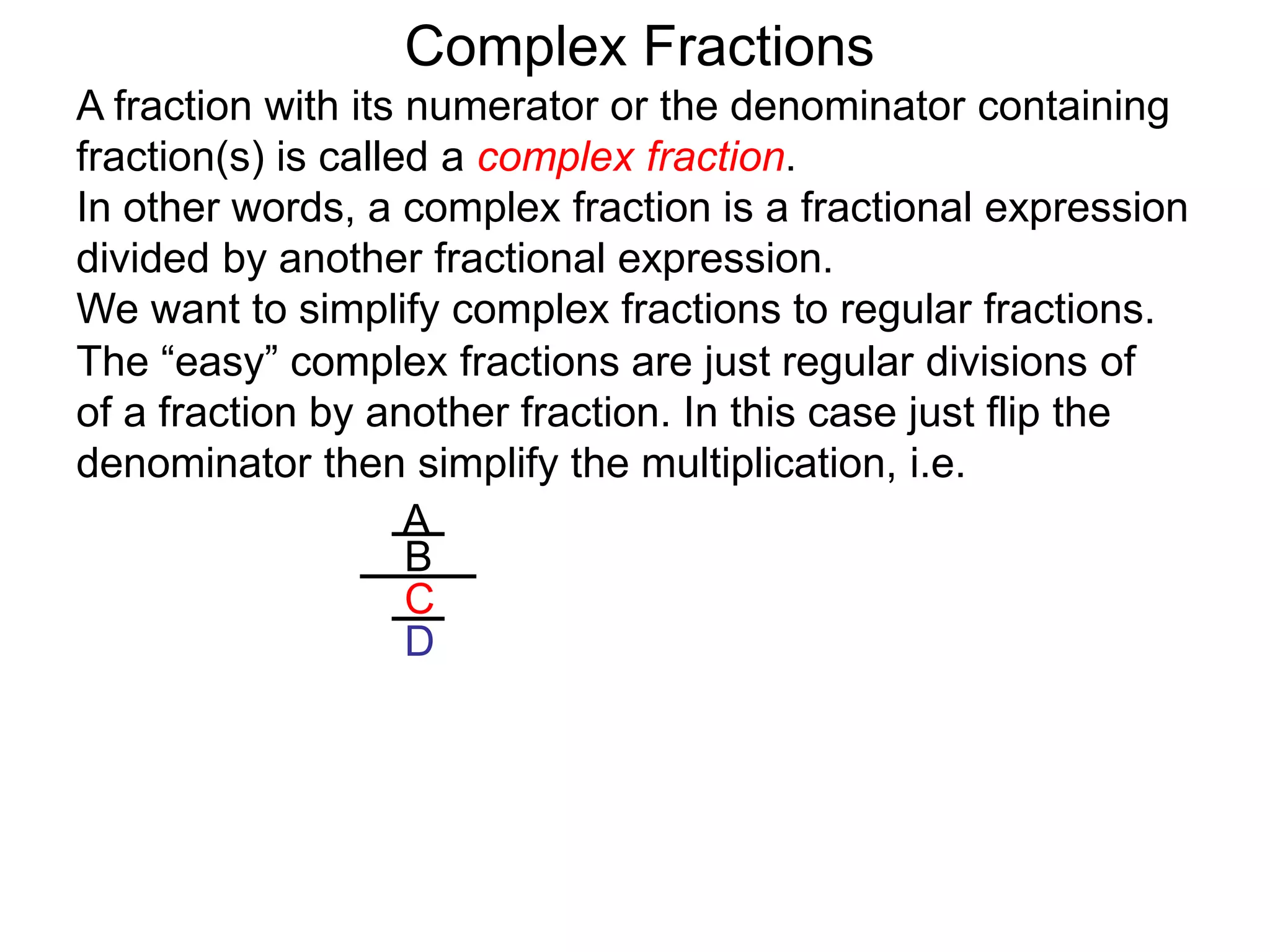
denominator then simplify the multiplication, i.e.
A
B
C
D
Complex Fractions
A fraction with its numerator or the denominator containing
fraction(s) is called a complex fraction.
In other words, a complex fraction is a fractional expression
divided by another fractional expression.
We want to simplify complex fractions to regular fractions.
The “easy” complex fractions are just regular divisions of
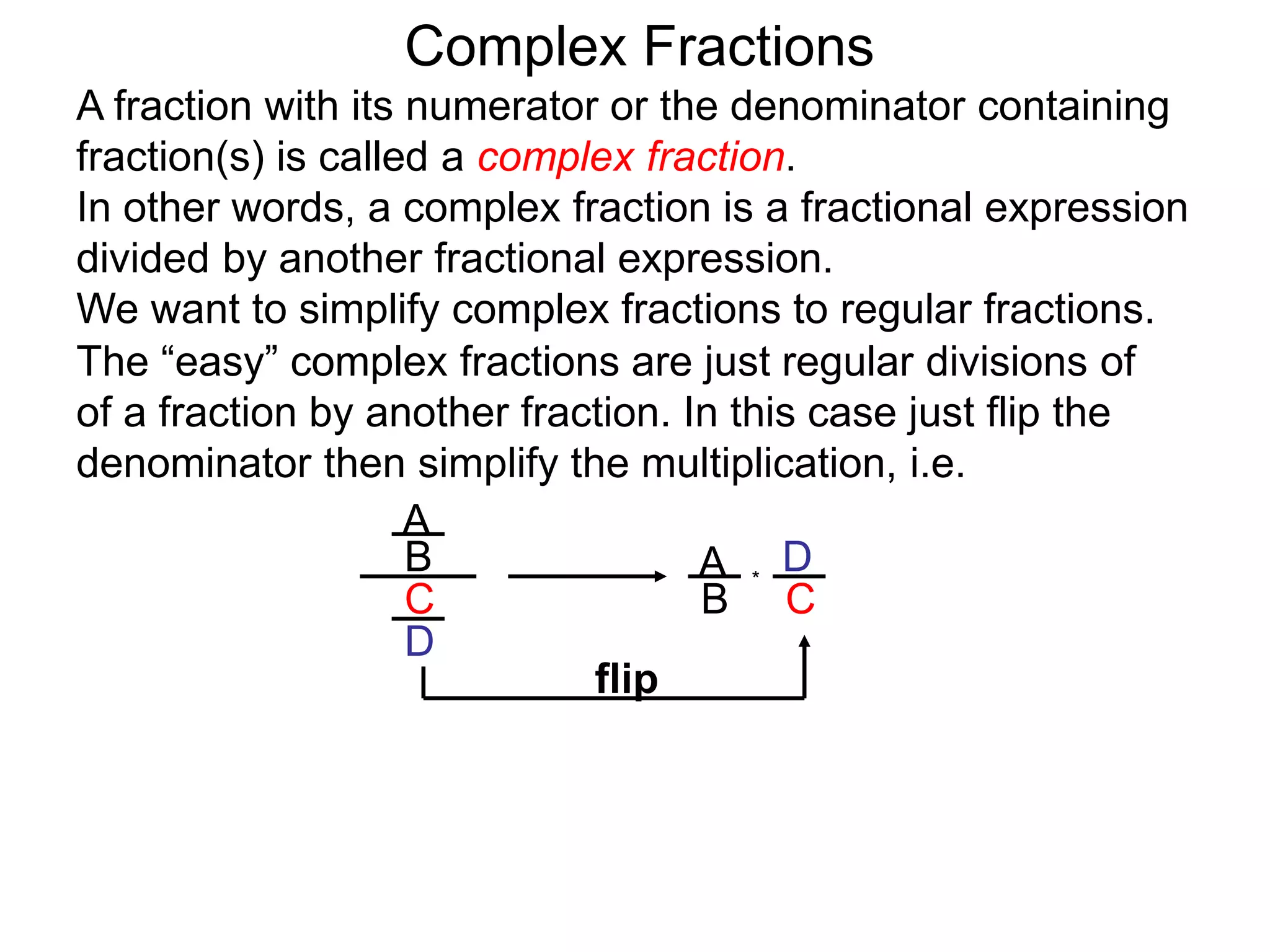
of a fraction by another fraction. In this case just flip the
denominator then simplify the multiplication, i.e.
A
B
C
D
A
B C
D*
flip
Complex Fractions
A fraction with its numerator or the denominator containing
fraction(s) is called a complex fraction.
In other words, a complex fraction is a fractional expression
divided by another fractional expression.
We want to simplify complex fractions to regular fractions.
The “easy” complex fractions are just regular divisions of
of a fraction by another fraction. In this case just flip the
denominator then simplify the multiplication, i.e.
A
B
C
D
A
B C
D*
flip
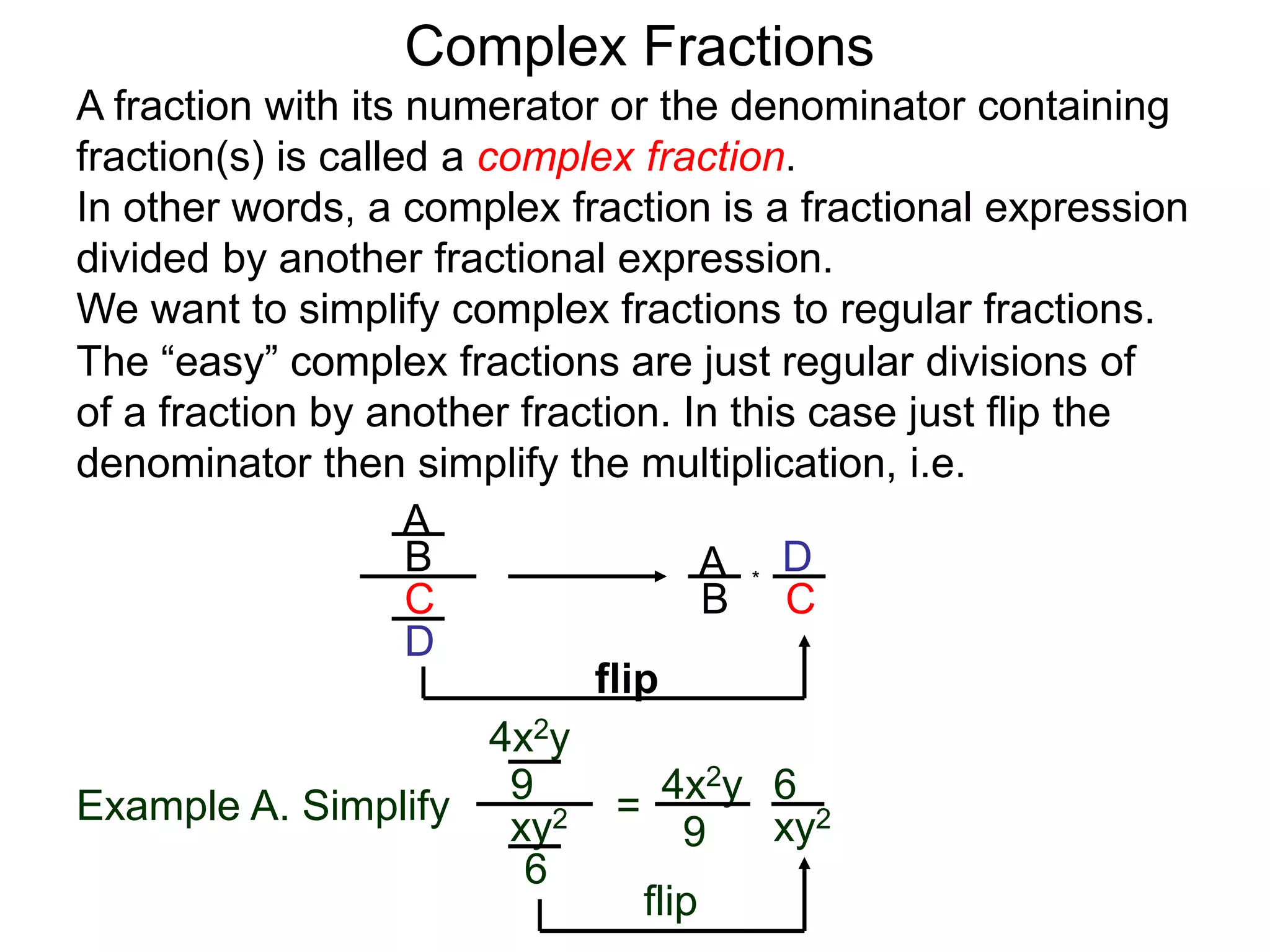
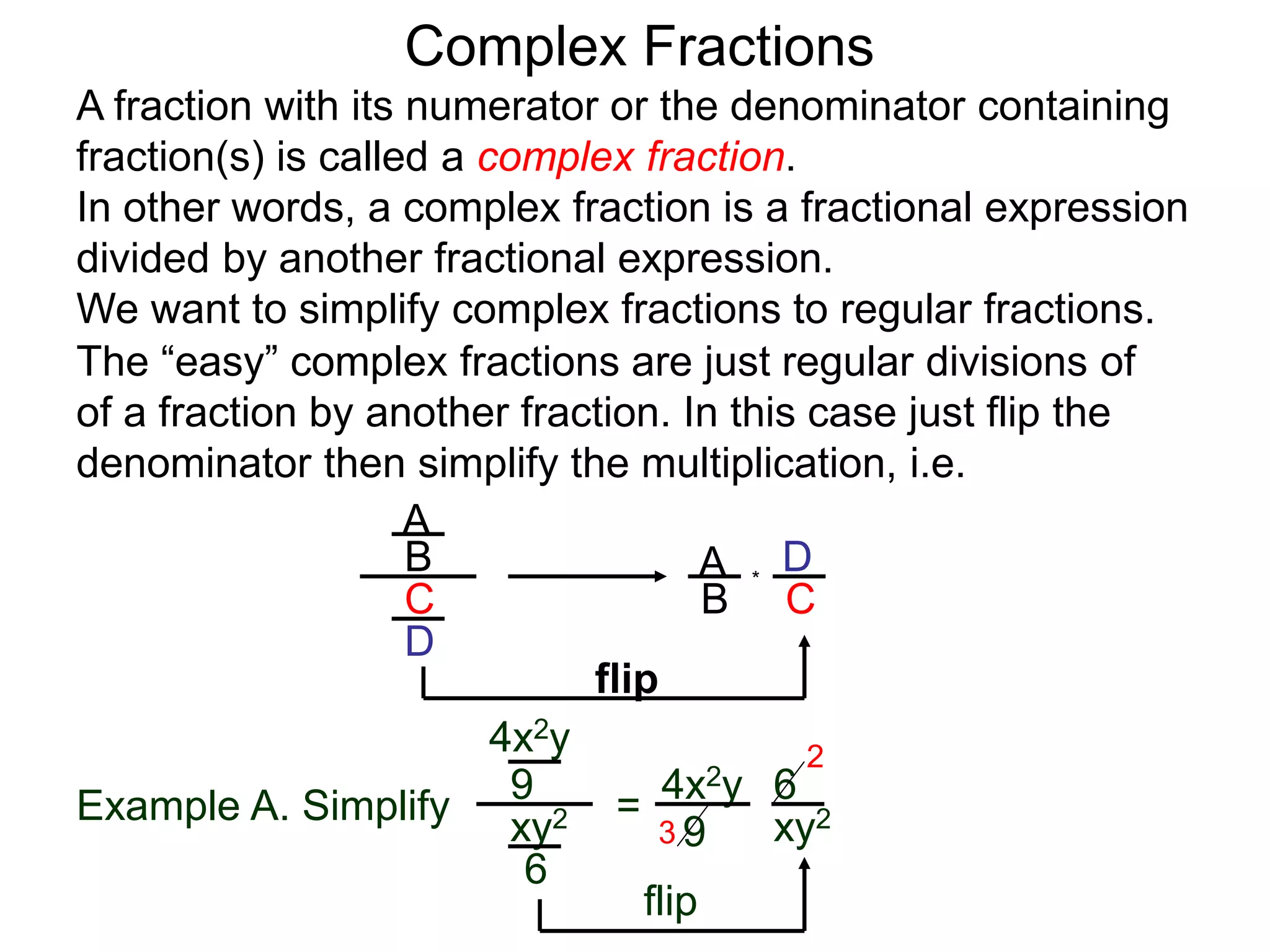
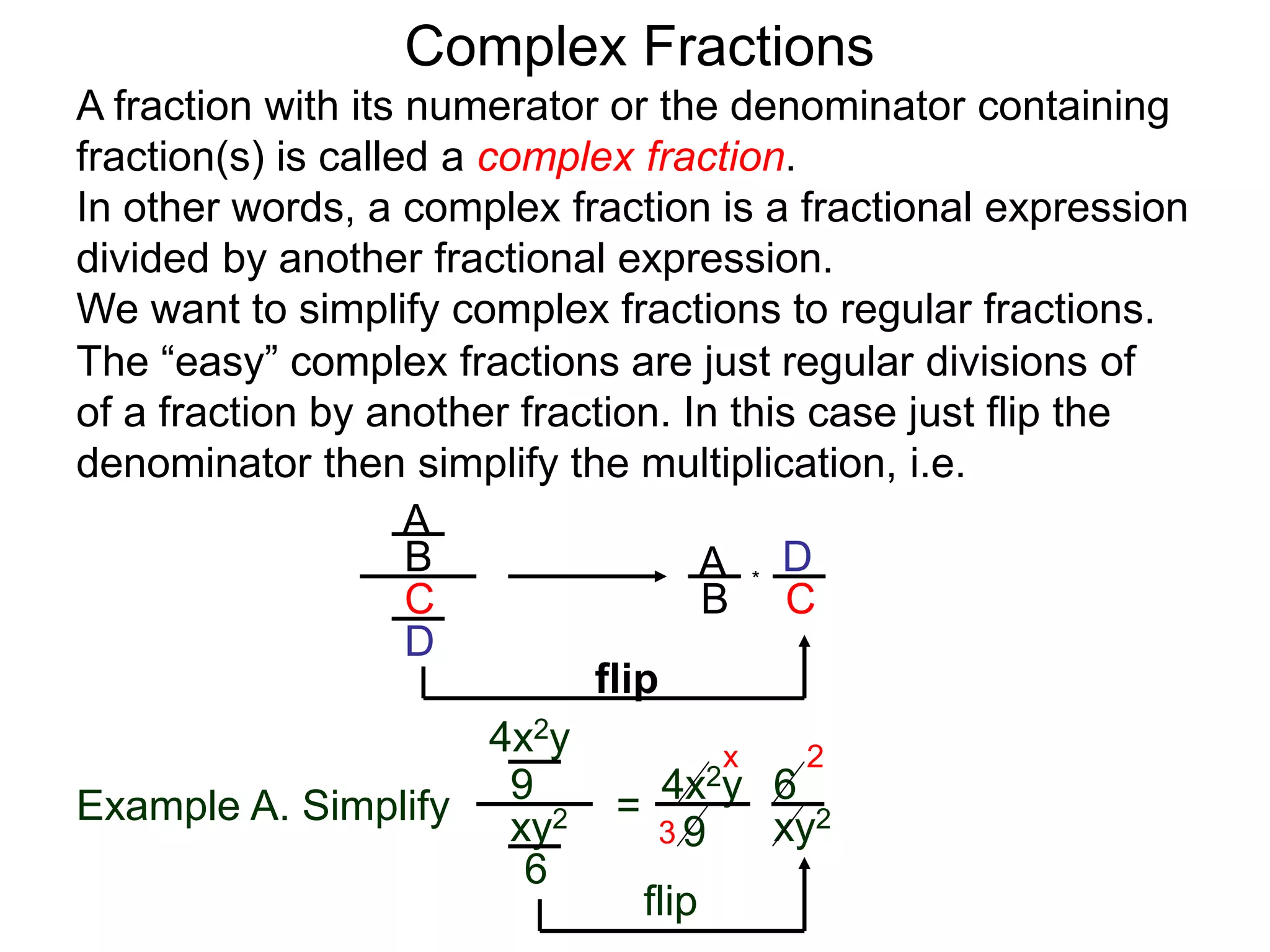
Example A. Simplify
4x2y
9
xy2
6
Complex Fractions
A fraction with its numerator or the denominator containing
fraction(s) is called a complex fraction.
In other words, a complex fraction is a fractional expression
divided by another fractional expression.
We want to simplify complex fractions to regular fractions.
The “easy” complex fractions are just regular divisions of
of a fraction by another fraction. In this case just flip the
denominator then simplify the multiplication, i.e.
A
B
C
D
A
B C
D*
flip
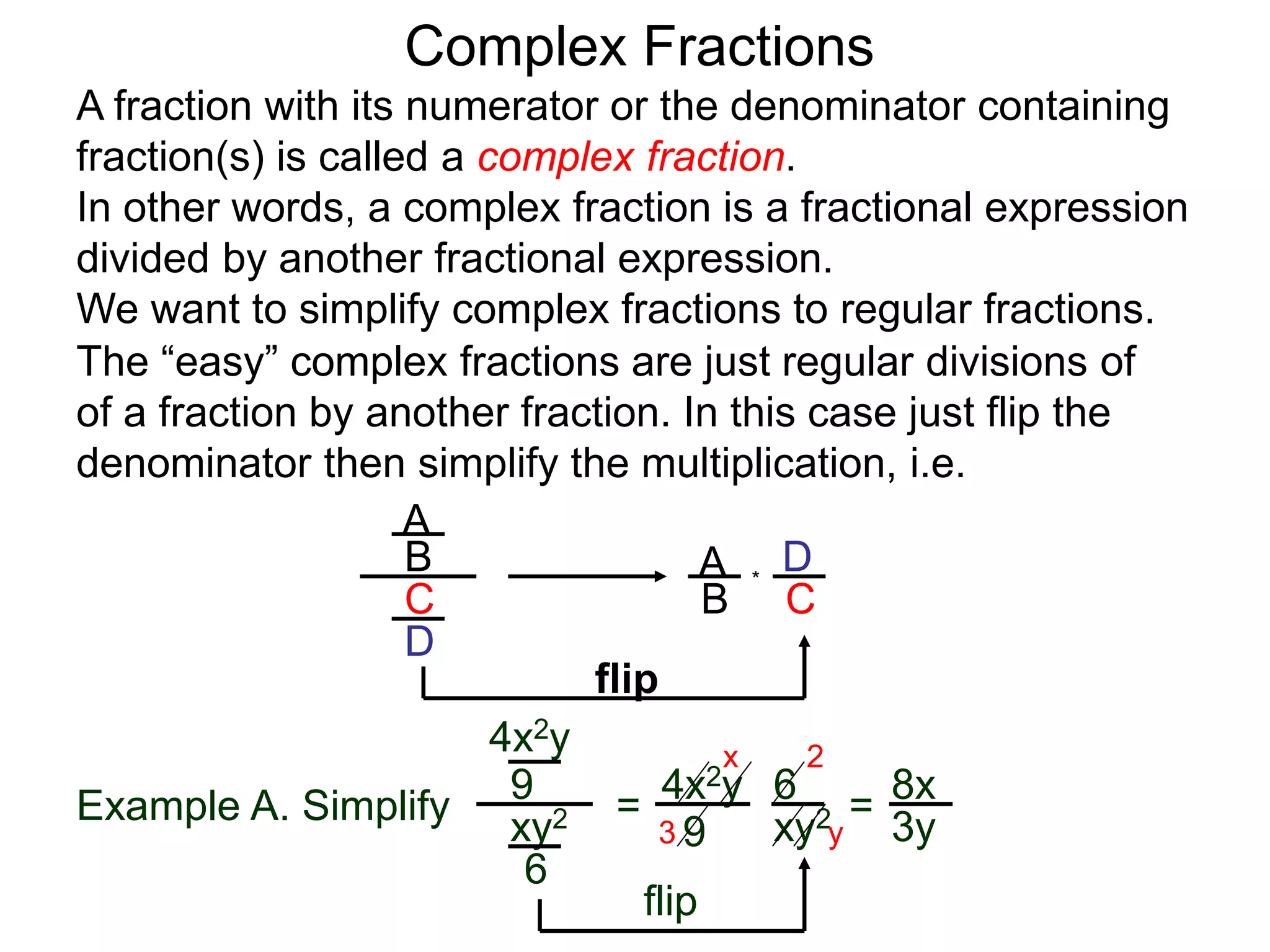
Example A. Simplify
4x2y
9
xy2
6
=
flip
4x2y
9 xy2
6
Complex Fractions
A fraction with its numerator or the denominator containing
fraction(s) is called a complex fraction.
In other words, a complex fraction is a fractional expression
divided by another fractional expression.
We want to simplify complex fractions to regular fractions.
The “easy” complex fractions are just regular divisions of
of a fraction by another fraction. In this case just flip the
denominator then simplify the multiplication, i.e.
A
B
C
D
A
B C
D*
flip
Example A. Simplify
4x2y
9
xy2
6
=
flip
4x2y
9 xy2
6
3
2
Complex Fractions
A fraction with its numerator or the denominator containing
fraction(s) is called a complex fraction.
In other words, a complex fraction is a fractional expression
divided by another fractional expression.
We want to simplify complex fractions to regular fractions.
The “easy” complex fractions are just regular divisions of
of a fraction by another fraction. In this case just flip the
denominator then simplify the multiplication, i.e.
A
B
C
D
A
B C
D*
flip
Example A. Simplify
4x2y
9
xy2
6
=
flip
4x2y
9 xy2
6
3
2x
Complex Fractions
A fraction with its numerator or the denominator containing
fraction(s) is called a complex fraction.
In other words, a complex fraction is a fractional expression
divided by another fractional expression.
We want to simplify complex fractions to regular fractions.
The “easy” complex fractions are just regular divisions of
of a fraction by another fraction. In this case just flip the
denominator then simplify the multiplication, i.e.
A
B
C
D
A
B C
D*
flip
Example A. Simplify
4x2y
9
xy2
6
=
flip
4x2y
9 xy2
6
3
2x
y
Complex Fractions
A fraction with its numerator or the denominator containing
fraction(s) is called a complex fraction.
In other words, a complex fraction is a fractional expression
divided by another fractional expression.
We want to simplify complex fractions to regular fractions.
The “easy” complex fractions are just regular divisions of
of a fraction by another fraction. In this case just flip the
denominator then simplify the multiplication, i.e.
A
B
C
D
A
B C
D*
flip
Example A. Simplify
4x2y
9
xy2
6
=
flip
4x2y
9 xy2
6
=
3
2x
y
8x
3y
Complex Fractions
We give two methods for simplifying general complex
fractions.
Complex Fractions
We give two methods for simplifying general complex
fractions. The first method is to reduce the problem to an
“easy” problem.
Complex Fractions
We give two methods for simplifying general complex
fractions. The first method is to reduce the problem to an
“easy” problem. We do this by combining the numerator
into one fraction and the denominator into one fraction.
Complex Fractions
We give two methods for simplifying general complex
fractions. The first method is to reduce the problem to an
“easy” problem. We do this by combining the numerator
into one fraction and the denominator into one fraction.
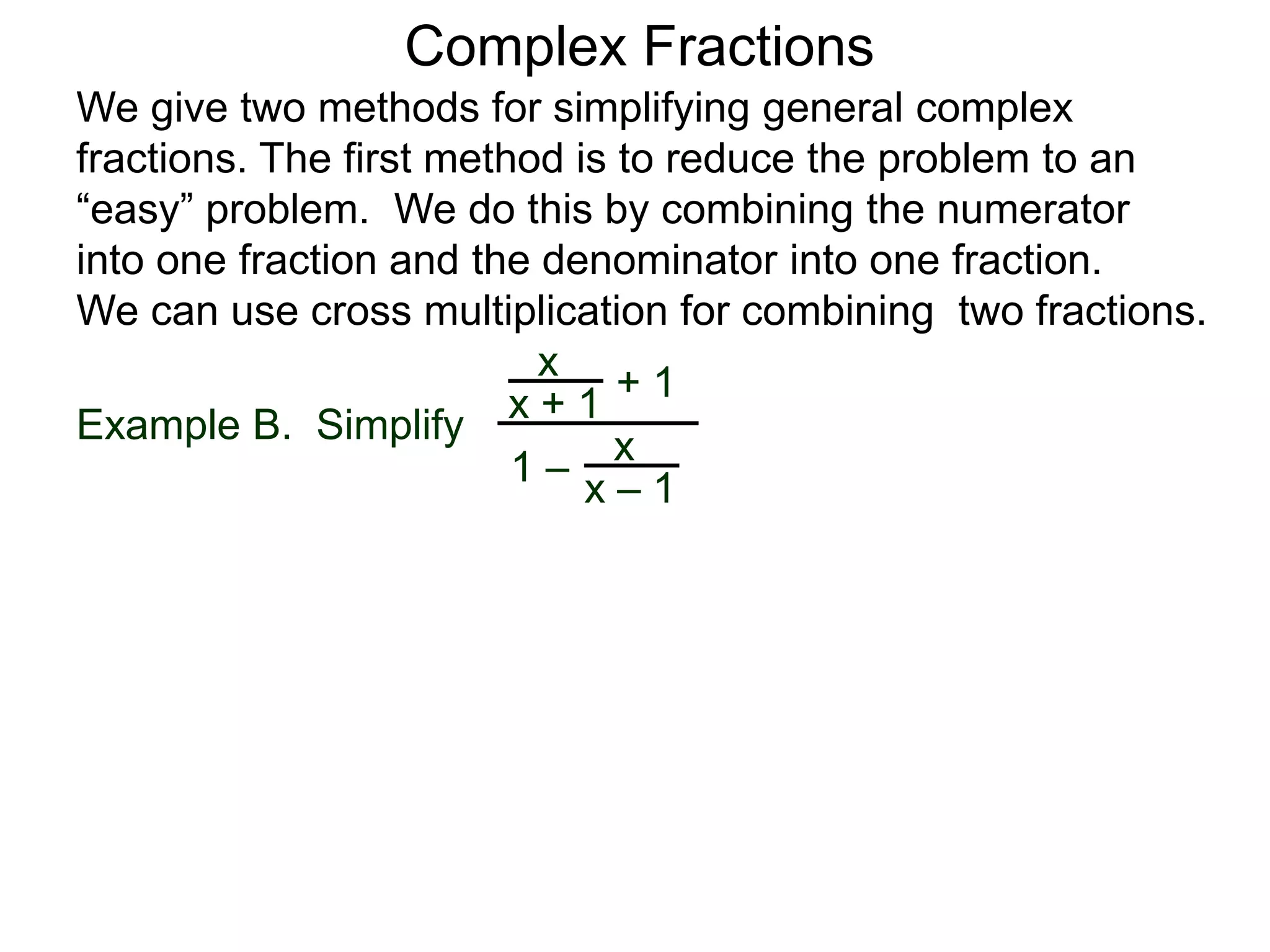
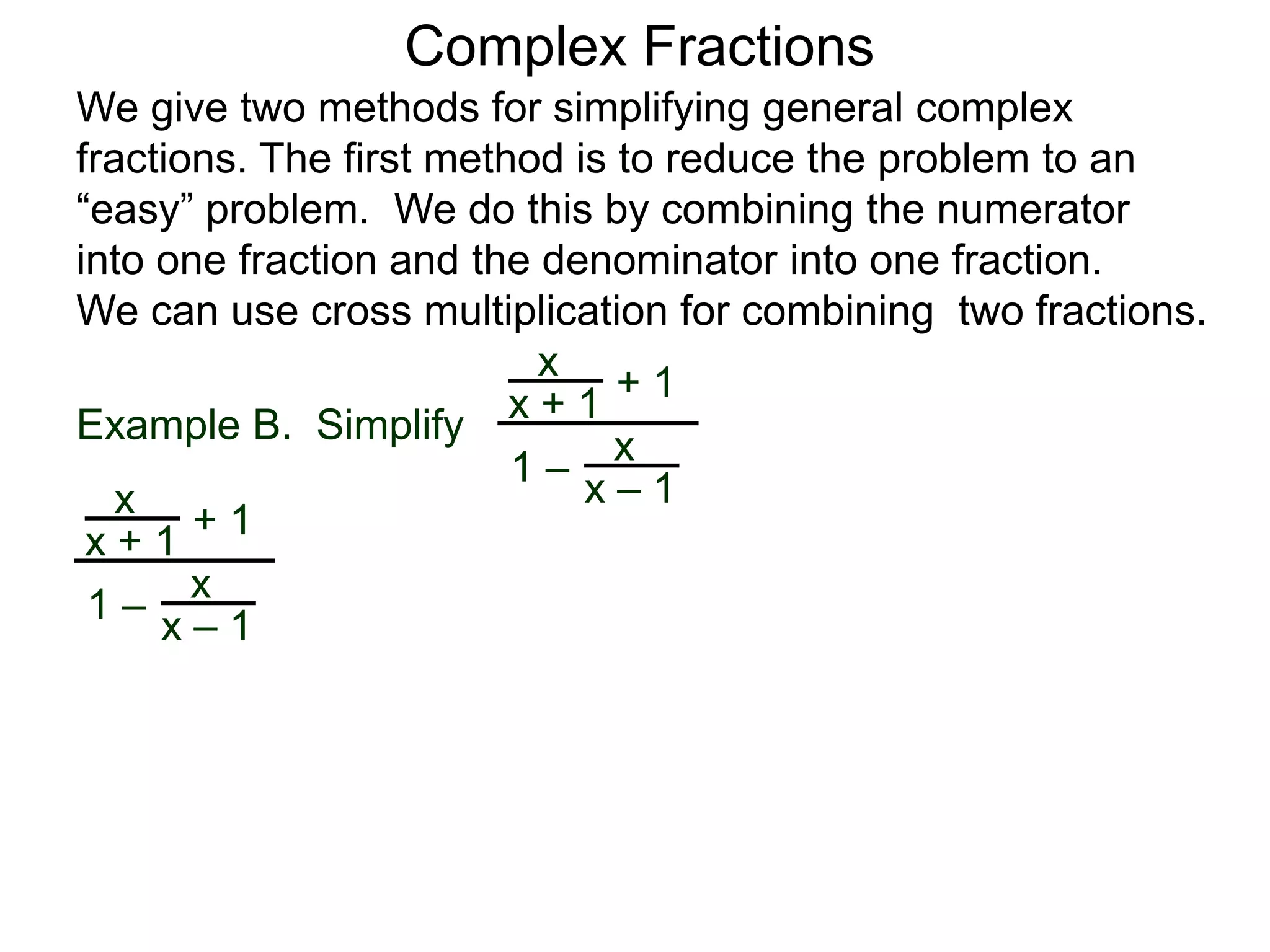
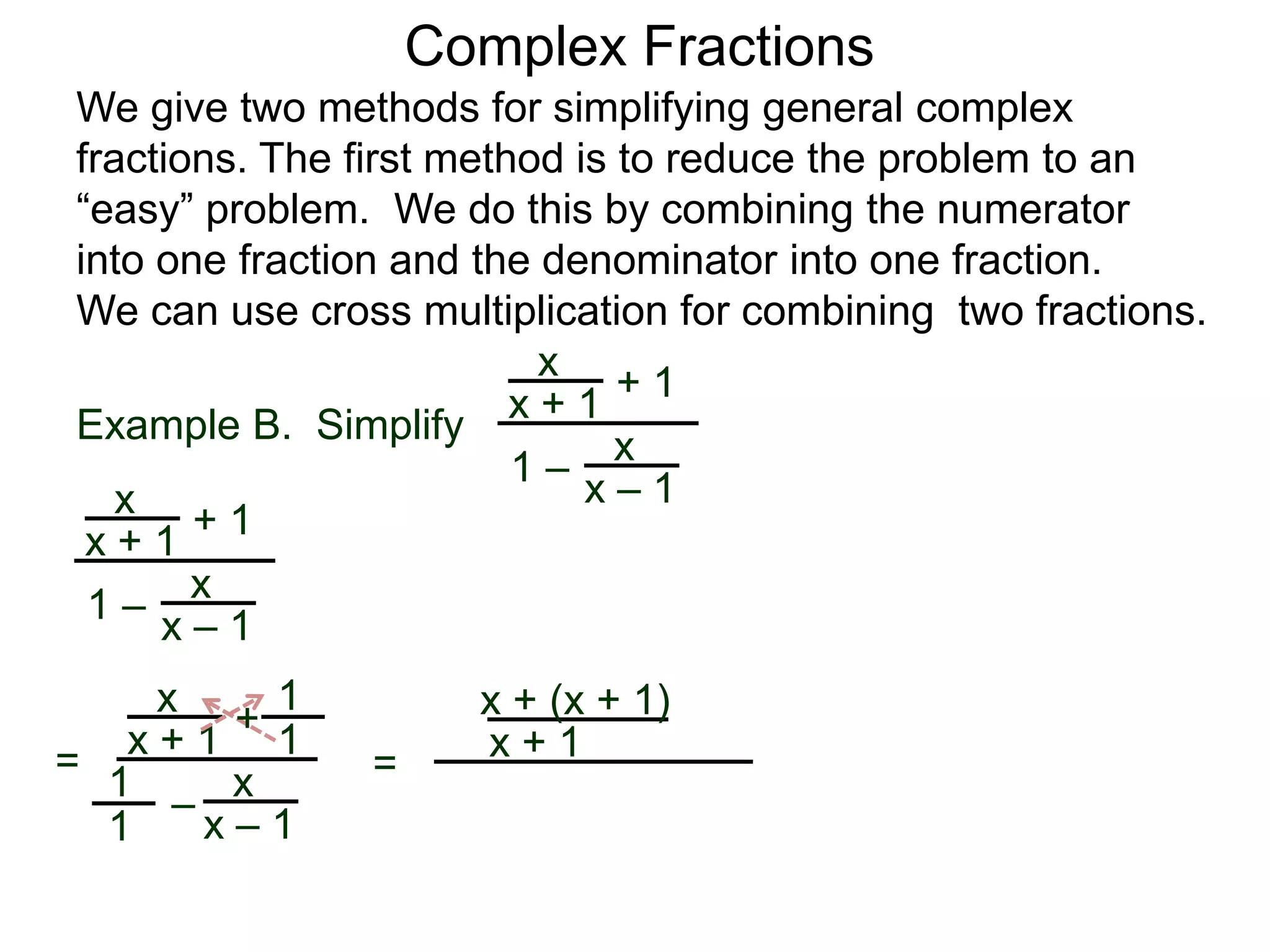
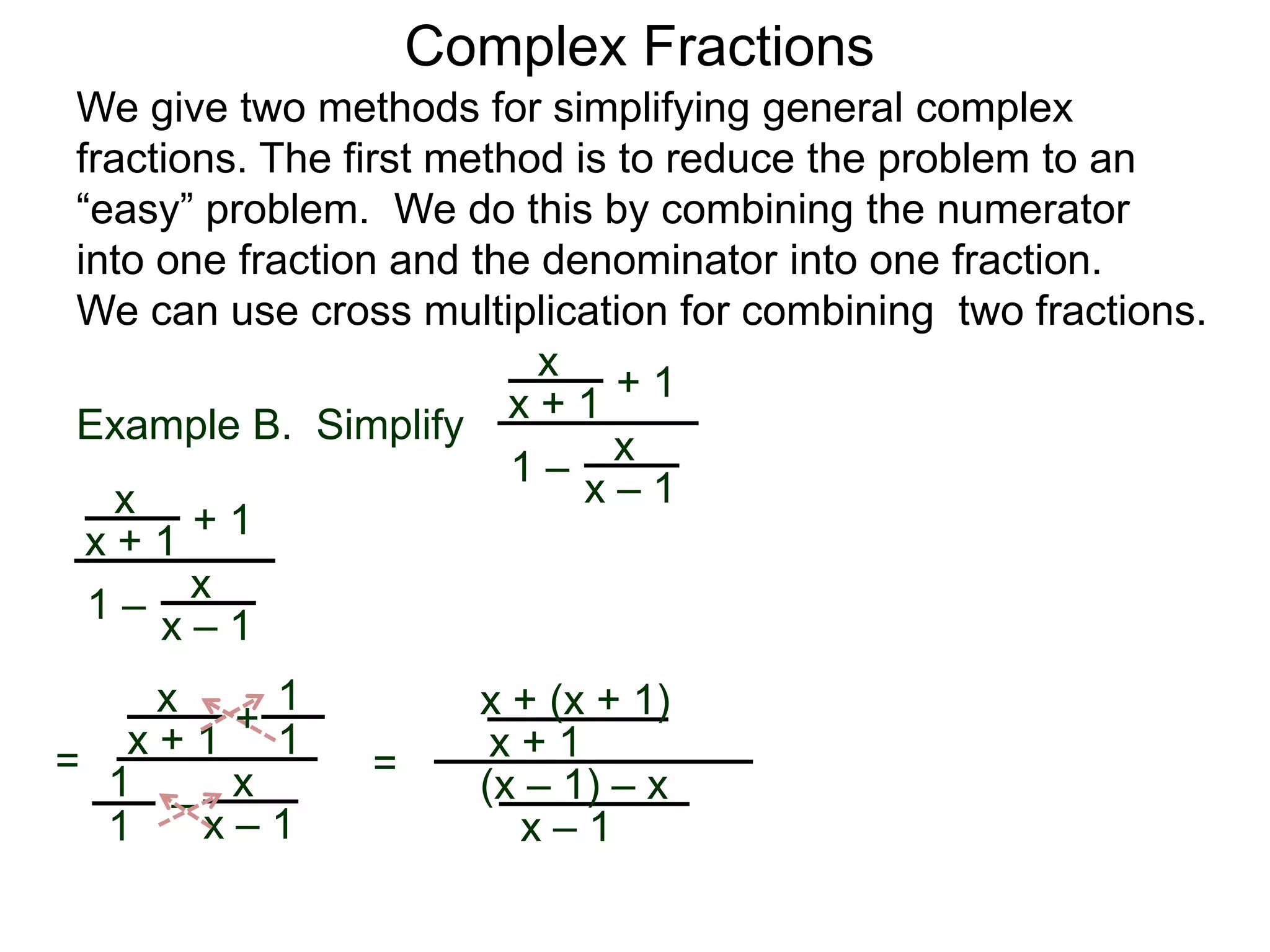
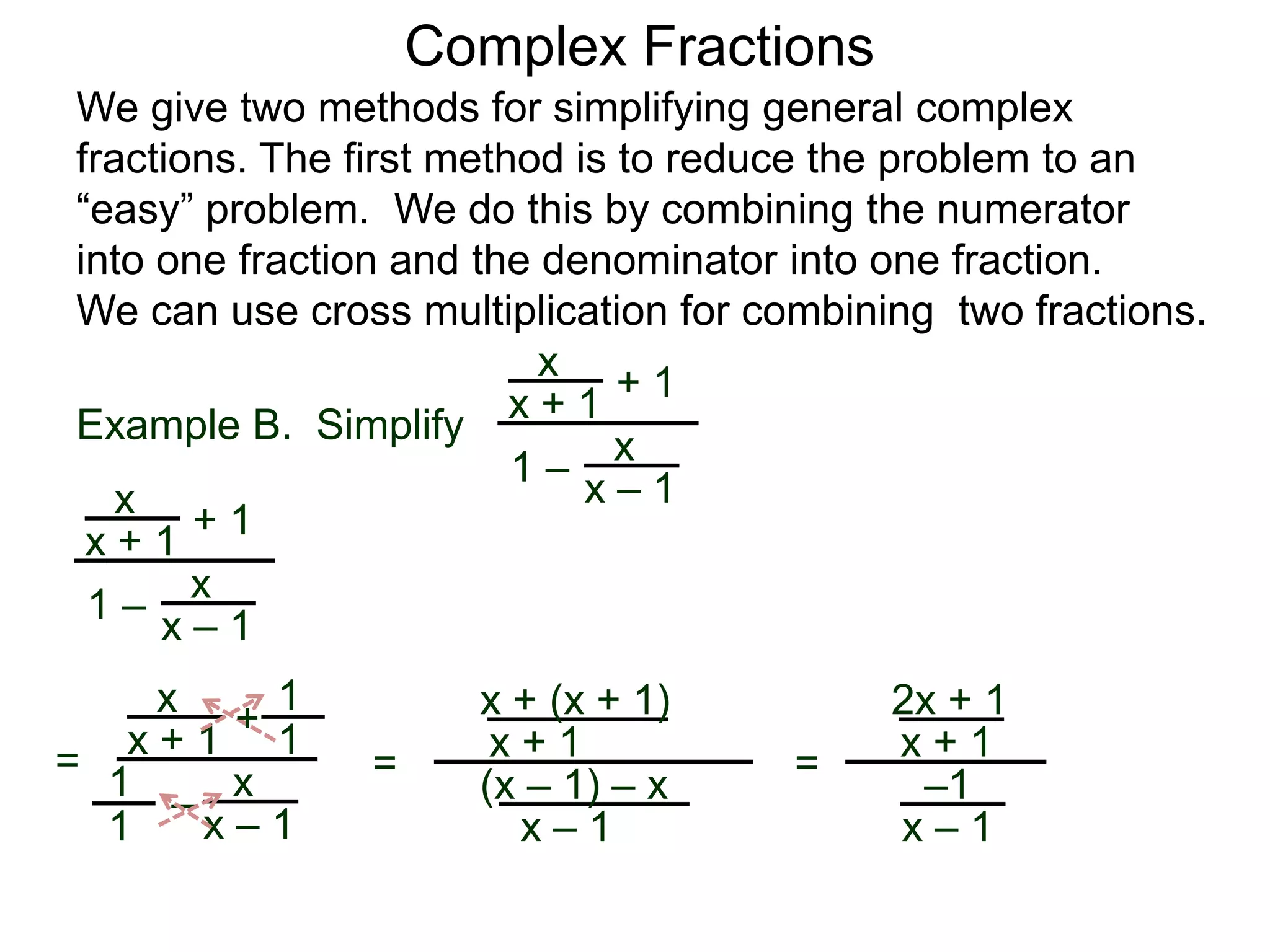
We can use cross multiplication for combining two fractions.
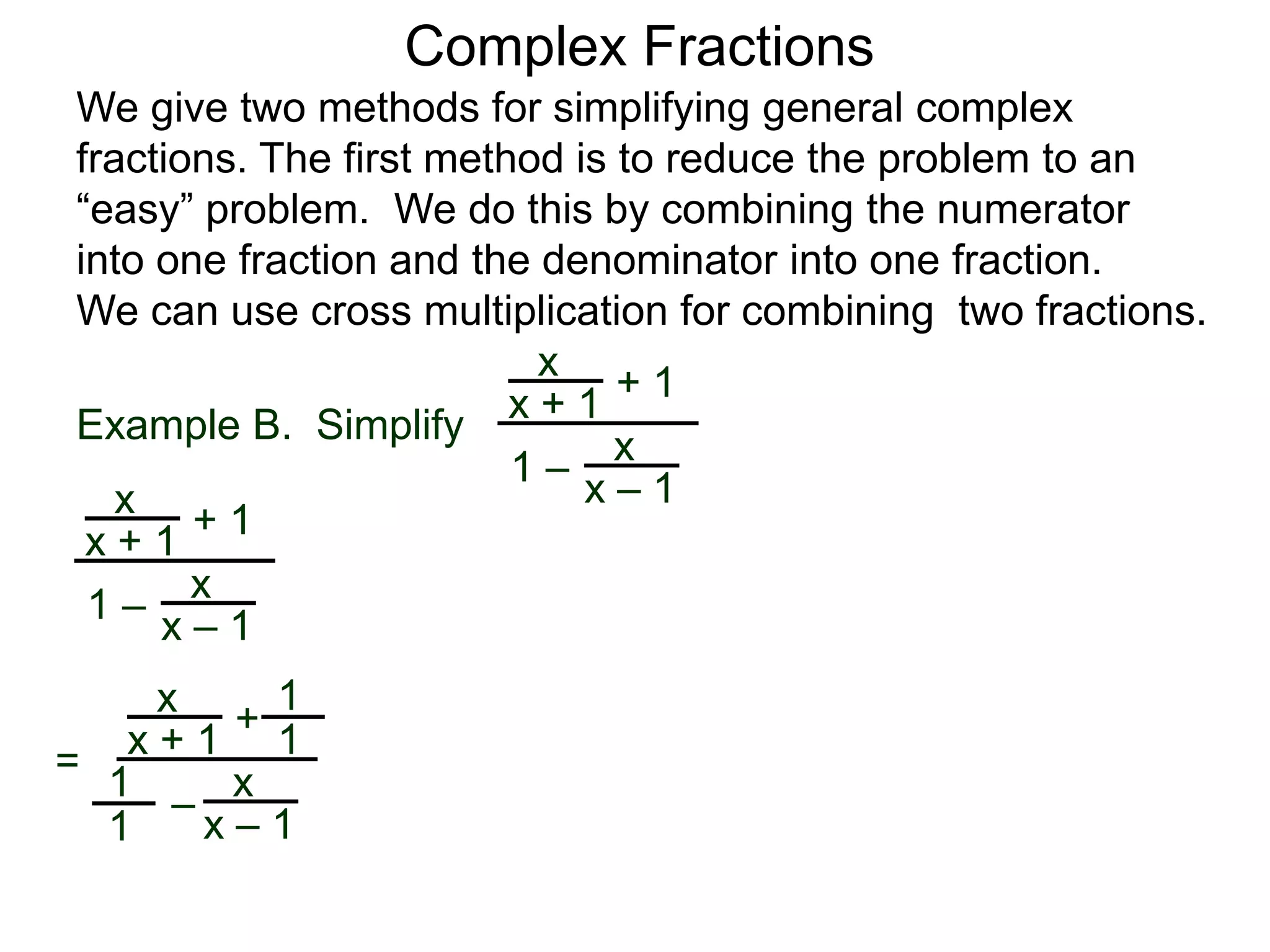
Example B. Simplify
Complex Fractions
We give two methods for simplifying general complex
fractions. The first method is to reduce the problem to an
“easy” problem. We do this by combining the numerator
into one fraction and the denominator into one fraction.
We can use cross multiplication for combining two fractions.
x
x + 1
+ 1
1 – x
x – 1
Example B. Simplify
Complex Fractions
We give two methods for simplifying general complex
fractions. The first method is to reduce the problem to an
“easy” problem. We do this by combining the numerator
into one fraction and the denominator into one fraction.
We can use cross multiplication for combining two fractions.
x
x + 1
+ 1
1 – x
x – 1x
x + 1
+ 1
1 –
x
x – 1
Example B. Simplify
Complex Fractions
We give two methods for simplifying general complex
fractions. The first method is to reduce the problem to an
“easy” problem. We do this by combining the numerator
into one fraction and the denominator into one fraction.
We can use cross multiplication for combining two fractions.
x
x + 1
+ 1
1 – x
x – 1x
x + 1
+ 1
1 –
x
x – 1
=
x
x + 1 +
–
x
x – 1
1
1
1
1
Example B. Simplify
Complex Fractions
We give two methods for simplifying general complex
fractions. The first method is to reduce the problem to an
“easy” problem. We do this by combining the numerator
into one fraction and the denominator into one fraction.
We can use cross multiplication for combining two fractions.
x
x + 1
+ 1
1 – x
x – 1x
x + 1
+ 1
1 –
x
x – 1
=
x
x + 1 +
–
x
x – 1
1
1
1
1
=
x + (x + 1)
x + 1
Example B. Simplify
Complex Fractions
We give two methods for simplifying general complex
fractions. The first method is to reduce the problem to an
“easy” problem. We do this by combining the numerator
into one fraction and the denominator into one fraction.
We can use cross multiplication for combining two fractions.
x
x + 1
+ 1
1 – x
x – 1x
x + 1
+ 1
1 –
x
x – 1
=
x
x + 1 +
–
x
x – 1
1
1
1
1
=
x + (x + 1)
x + 1
(x – 1) – x
x – 1
Example B. Simplify
Complex Fractions
We give two methods for simplifying general complex
fractions. The first method is to reduce the problem to an
“easy” problem. We do this by combining the numerator
into one fraction and the denominator into one fraction.
We can use cross multiplication for combining two fractions.
x
x + 1
+ 1
1 – x
x – 1x
x + 1
+ 1
1 –
x
x – 1
=
x
x + 1 +
–
x
x – 1
1
1
1
1
=
x + (x + 1)
x + 1
(x – 1) – x
x – 1
=
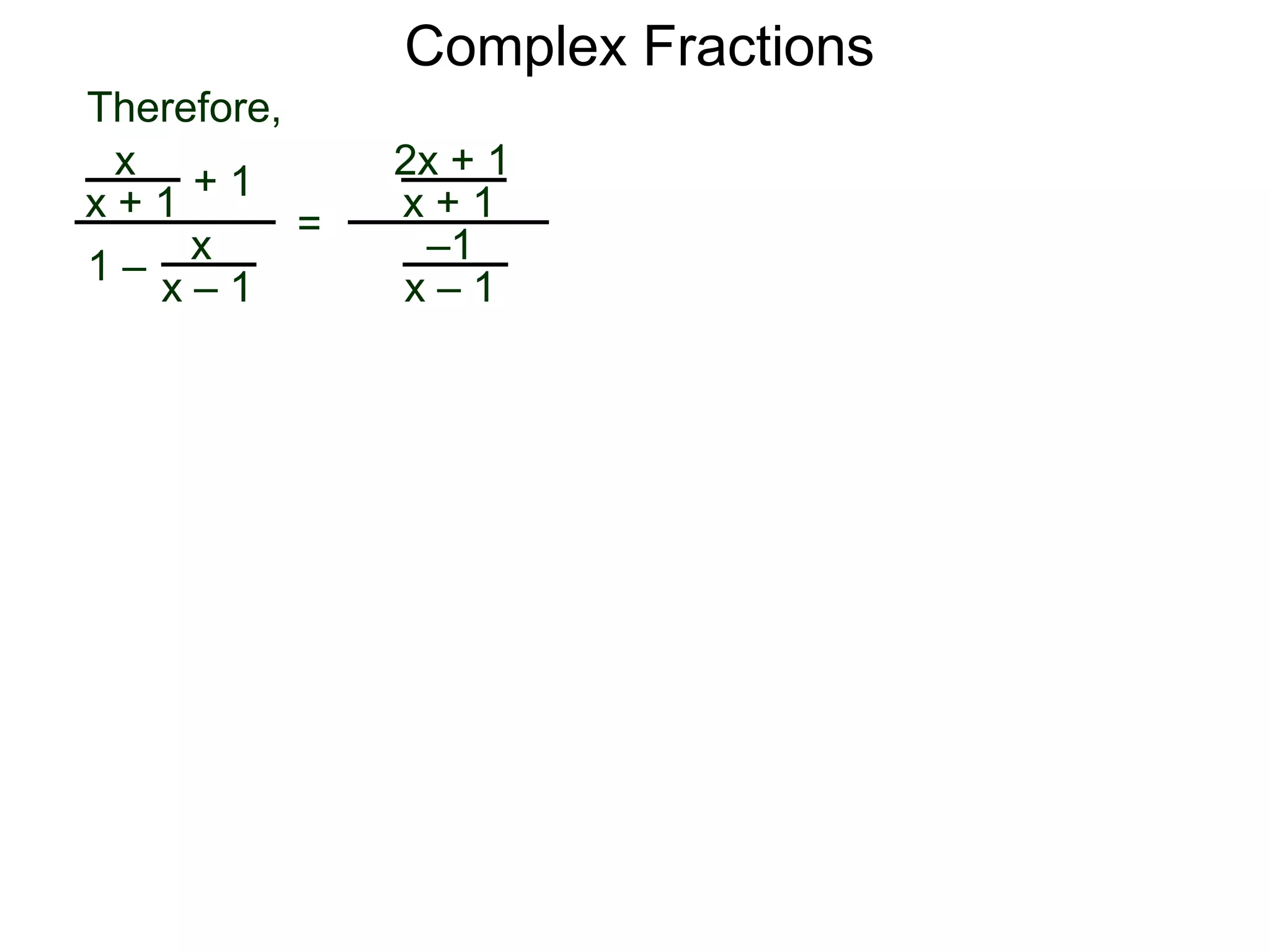
2x + 1
x + 1
–1
x – 1
Complex Fractions
x
x + 1
+ 1
1 – x
x – 1
=
2x + 1
x + 1
–1
x – 1
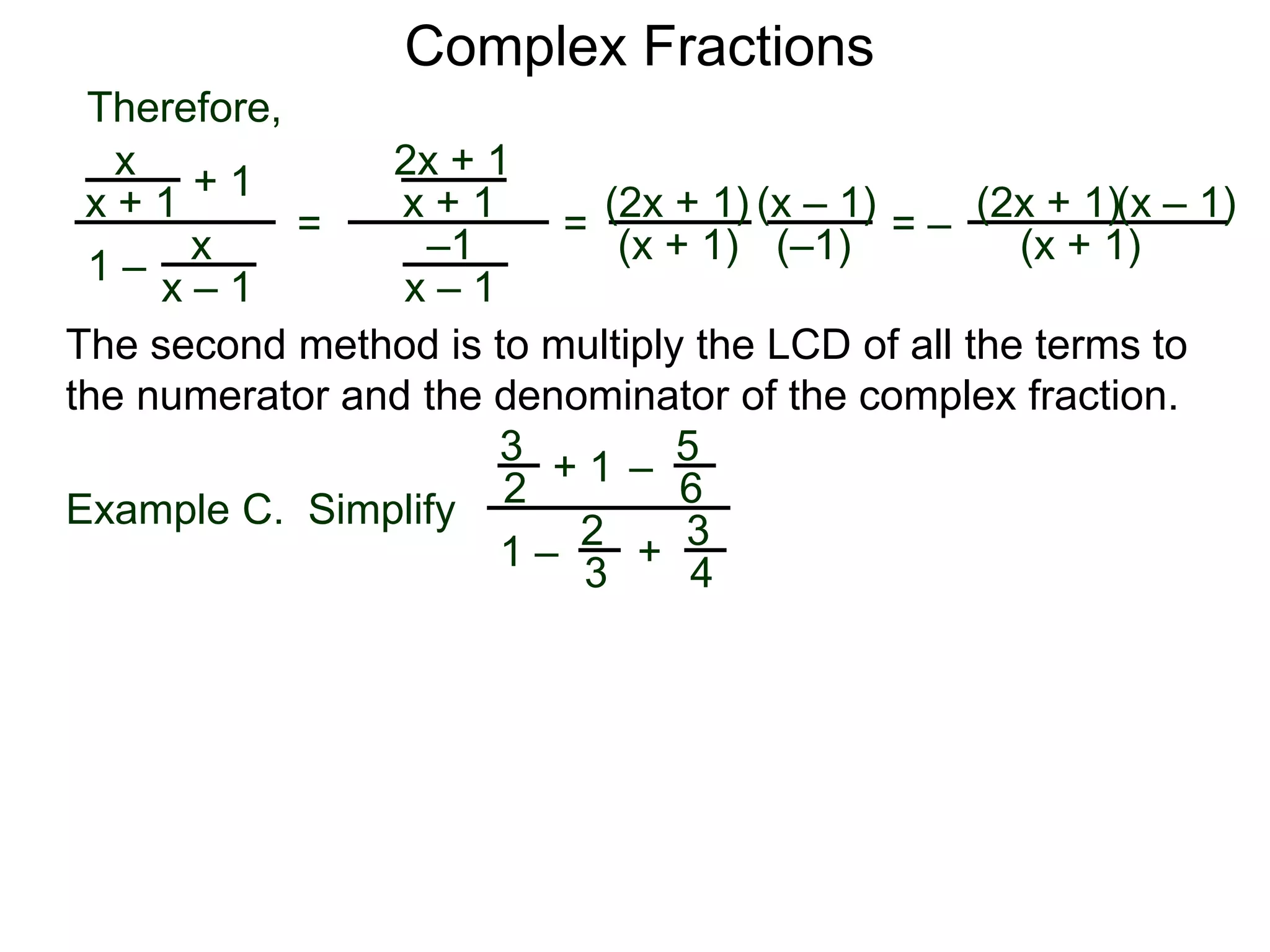
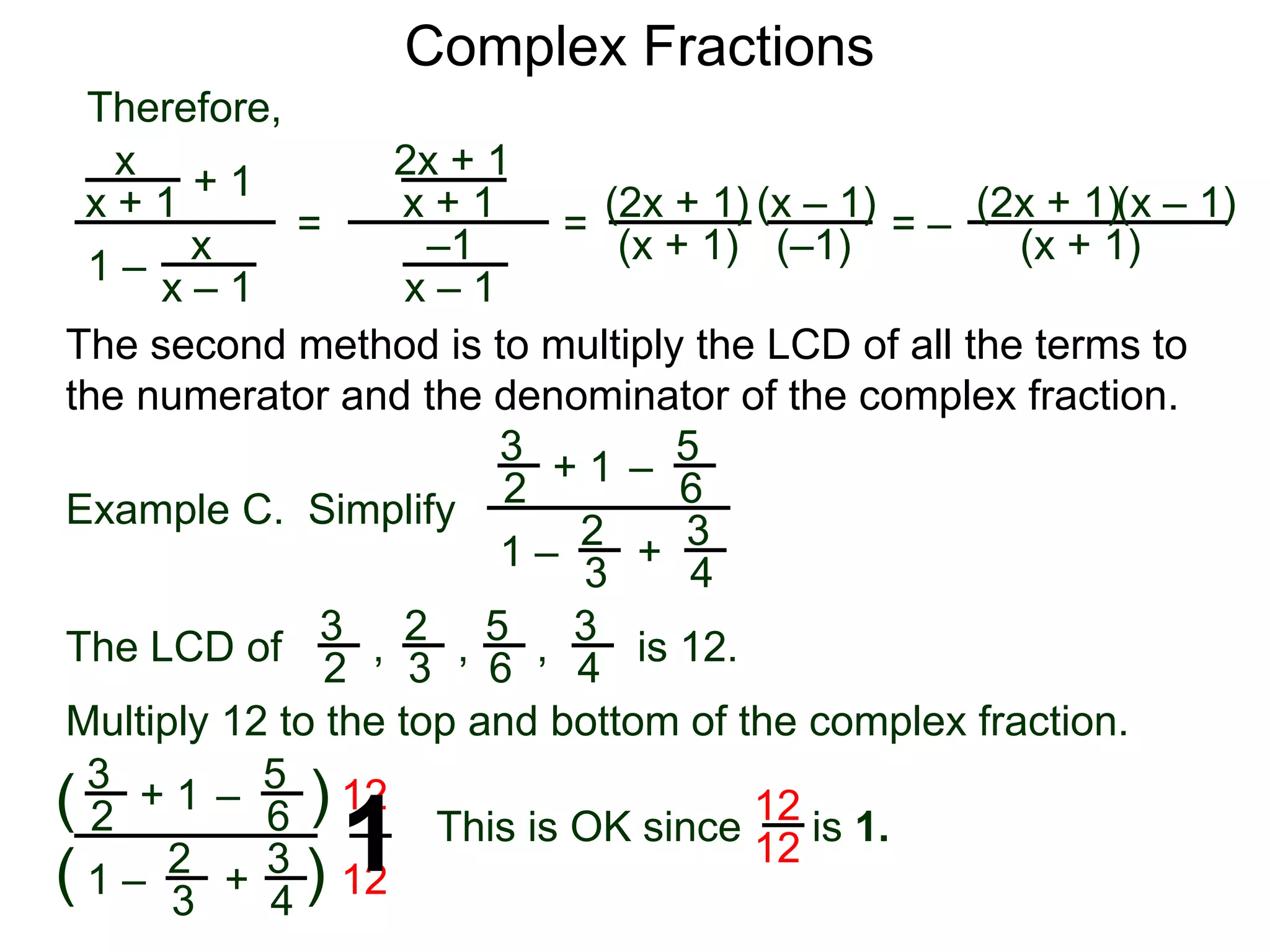
Therefore,
Complex Fractions
x
x + 1
+ 1
1 – x
x – 1
=
2x + 1
x + 1
–1
x – 1
Therefore,
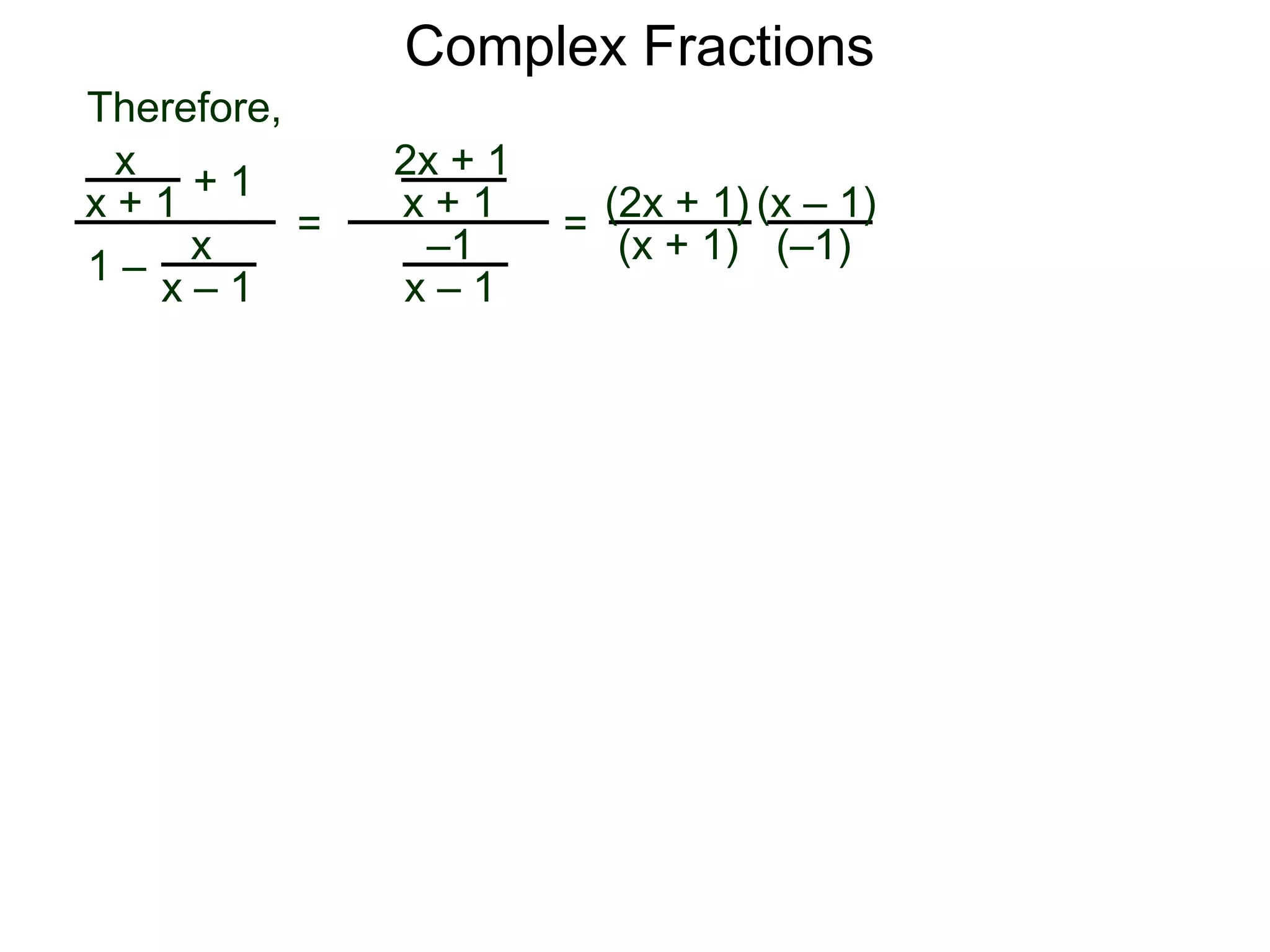
=
(2x + 1)
(x + 1)
(x – 1)
(–1)
Complex Fractions
x
x + 1
+ 1
1 – x
x – 1
=
2x + 1
x + 1
–1
x – 1
Therefore,
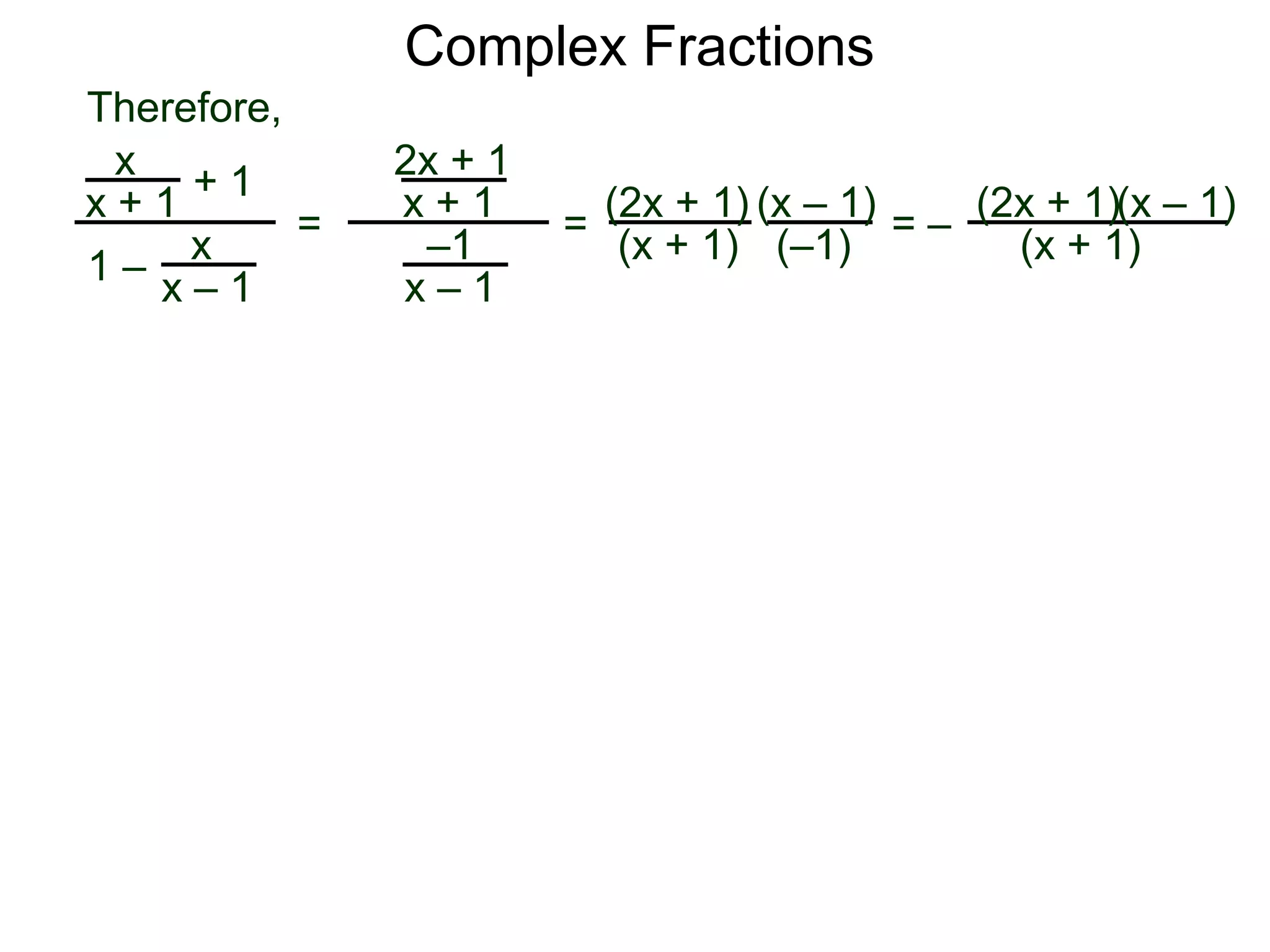
=
(2x + 1)
(x + 1)
(x – 1)
= –
(2x + 1)
(x + 1)
(x – 1)
(–1)
Complex Fractions
x
x + 1
+ 1
1 – x
x – 1
=
Therefore,
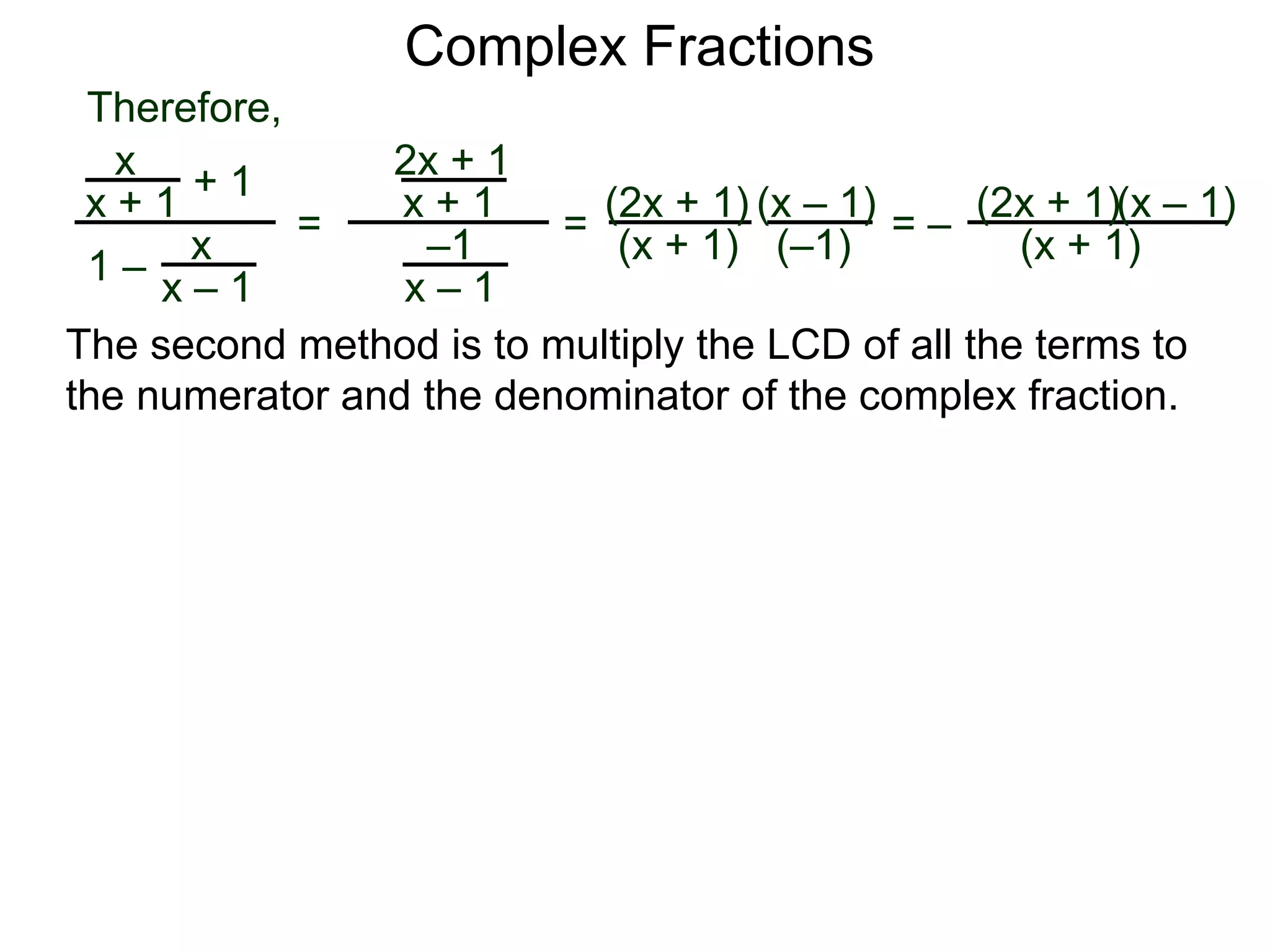
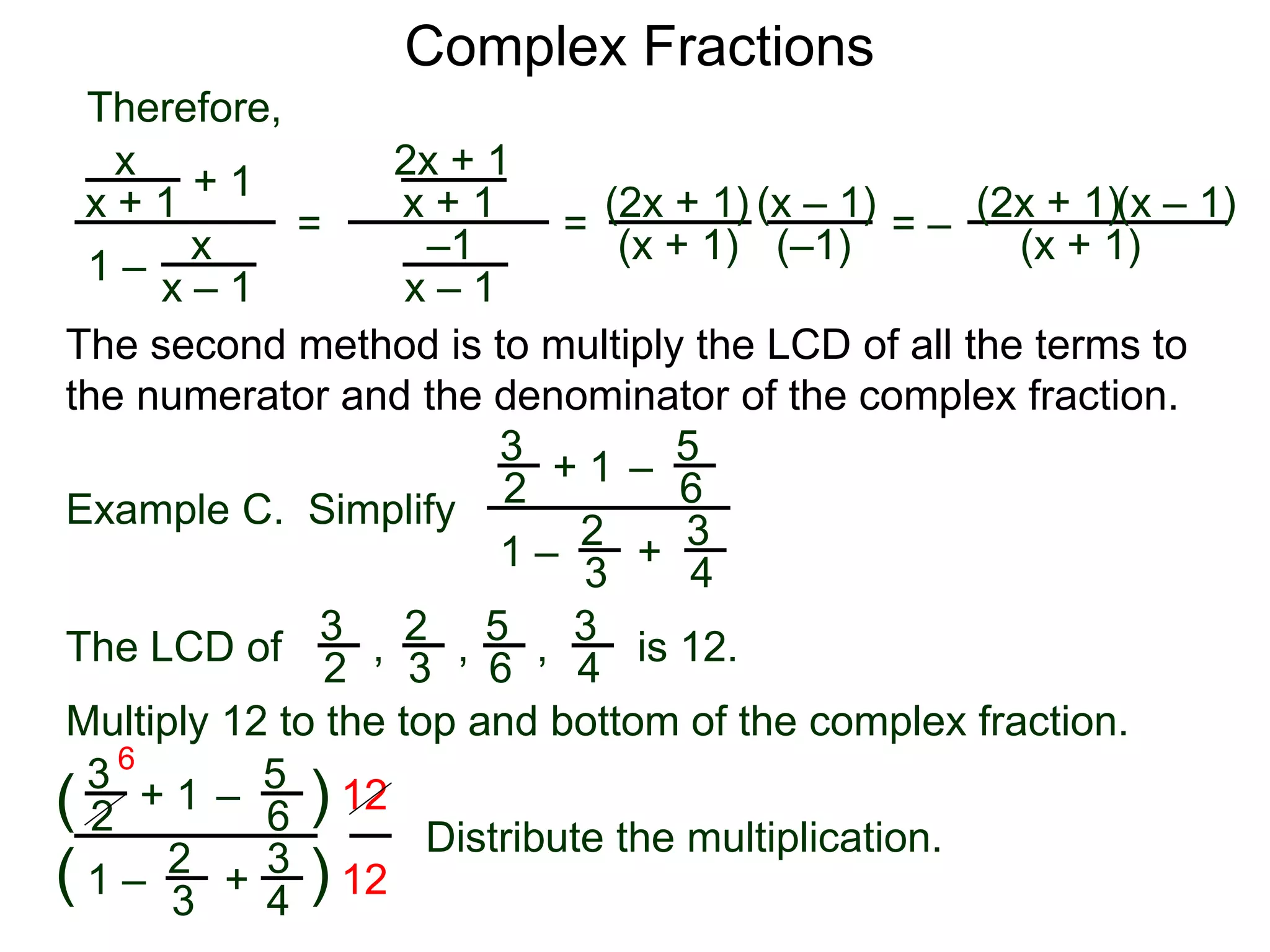
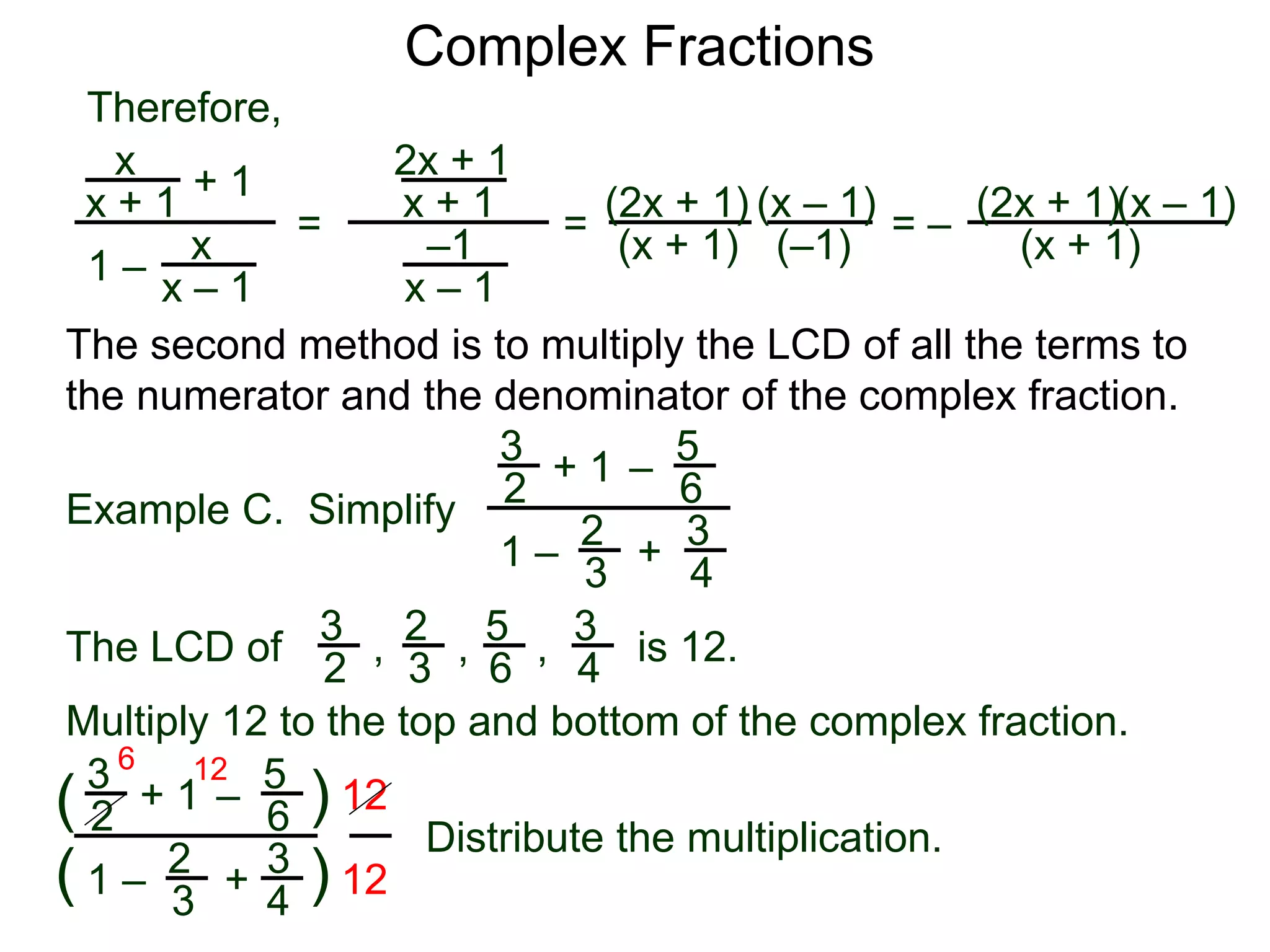
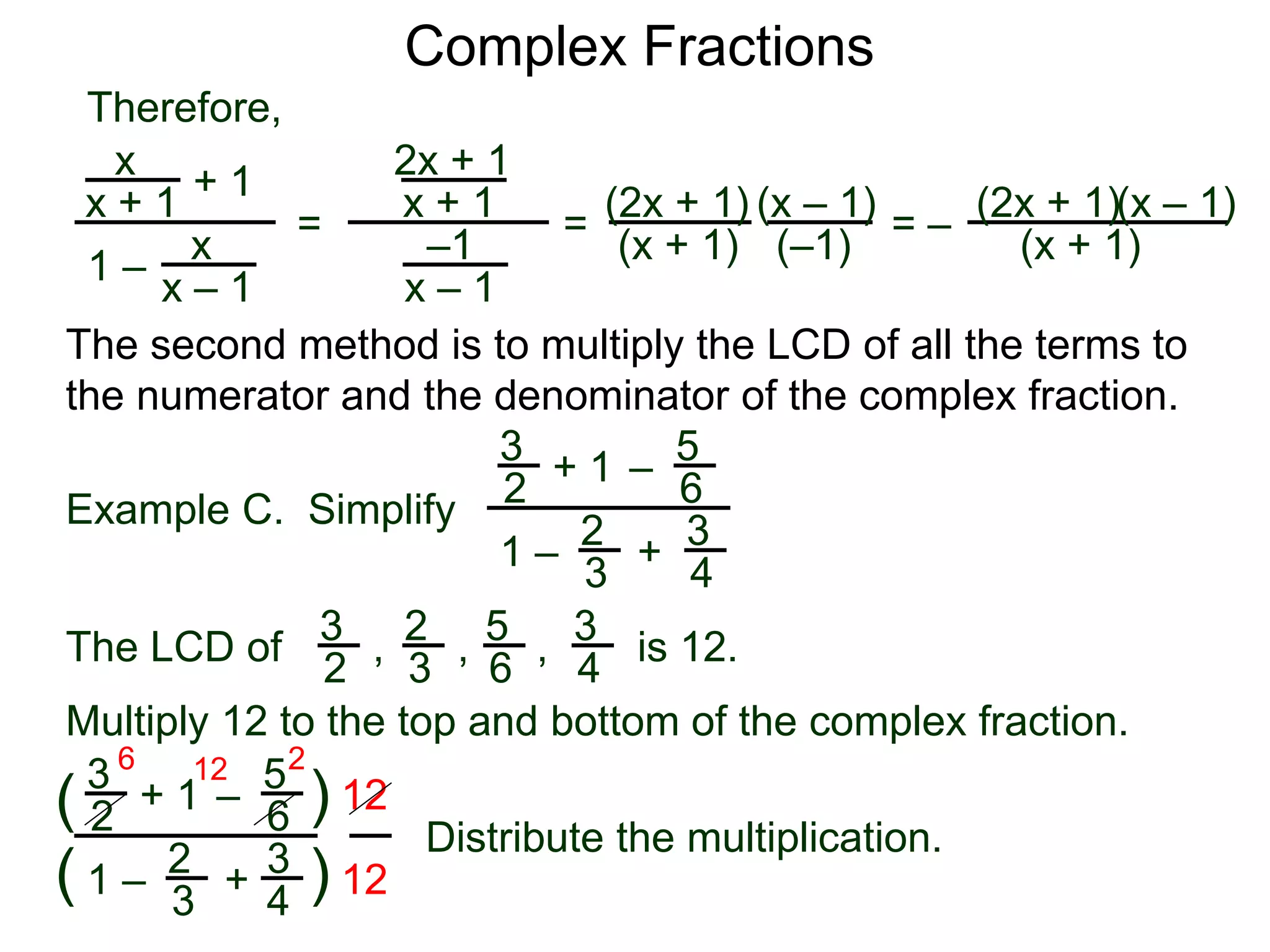
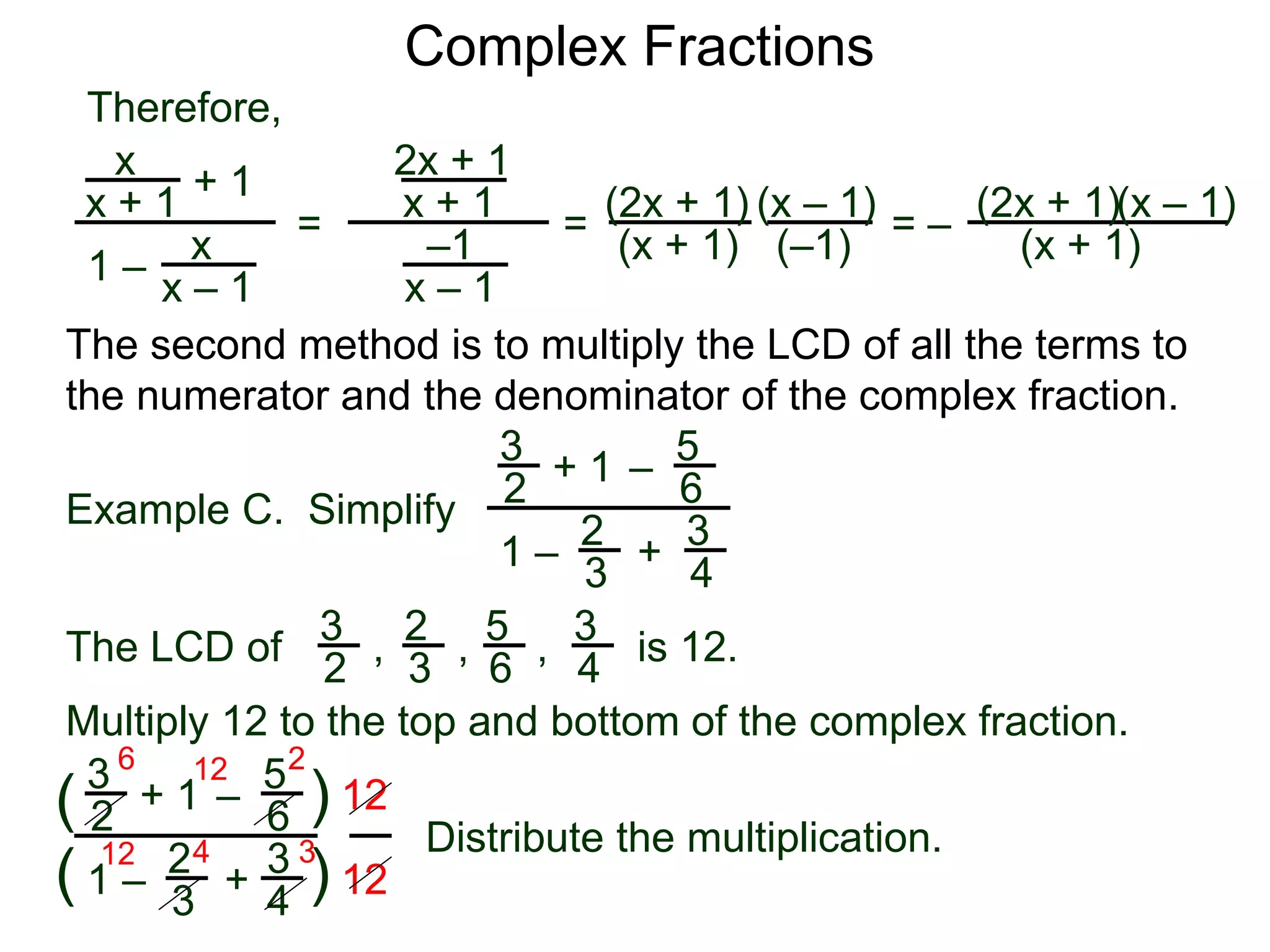
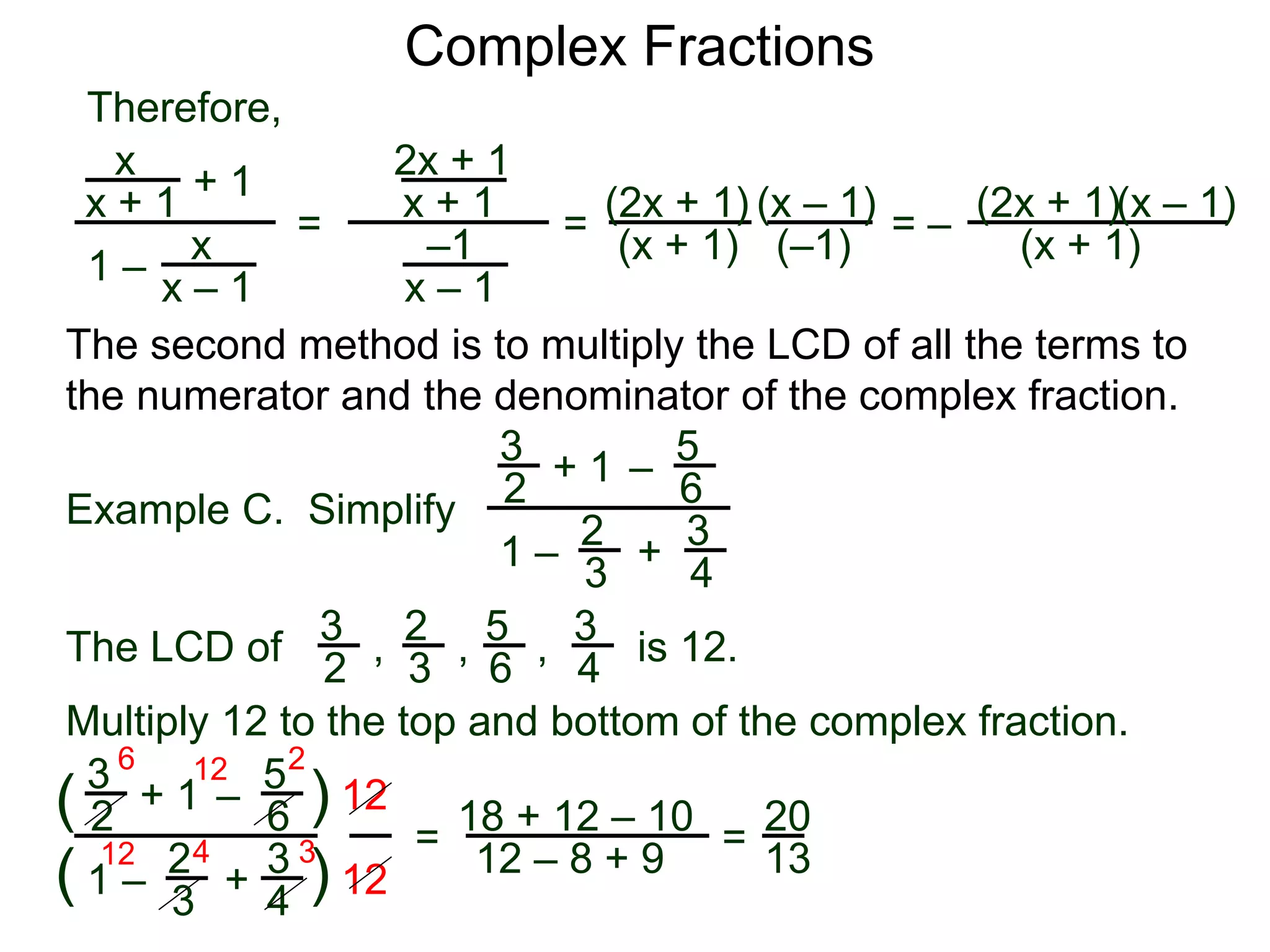
The second method is to multiply the LCD of all the terms to
the numerator and the denominator of the complex fraction.
2x + 1
x + 1
–1
x – 1
=
(2x + 1)
(x + 1)
(x – 1)
= –
(2x + 1)
(x + 1)
(x – 1)
(–1)
Complex Fractions
x
x + 1
+ 1
1 – x
x – 1
=
Therefore,
The second method is to multiply the LCD of all the terms to
the numerator and the denominator of the complex fraction.
Example C. Simplify
3
2
+ 1
1 –
– 5
6
2
3
3
4
+
2x + 1
x + 1
–1
x – 1
=
(2x + 1)
(x + 1)
(x – 1)
= –
(2x + 1)
(x + 1)
(x – 1)
(–1)
Complex Fractions
x
x + 1
+ 1
1 – x
x – 1
=
Therefore,
The second method is to multiply the LCD of all the terms to
the numerator and the denominator of the complex fraction.
Example C. Simplify
3
2
+ 1
1 –
– 5
6
2
3
3
4
+
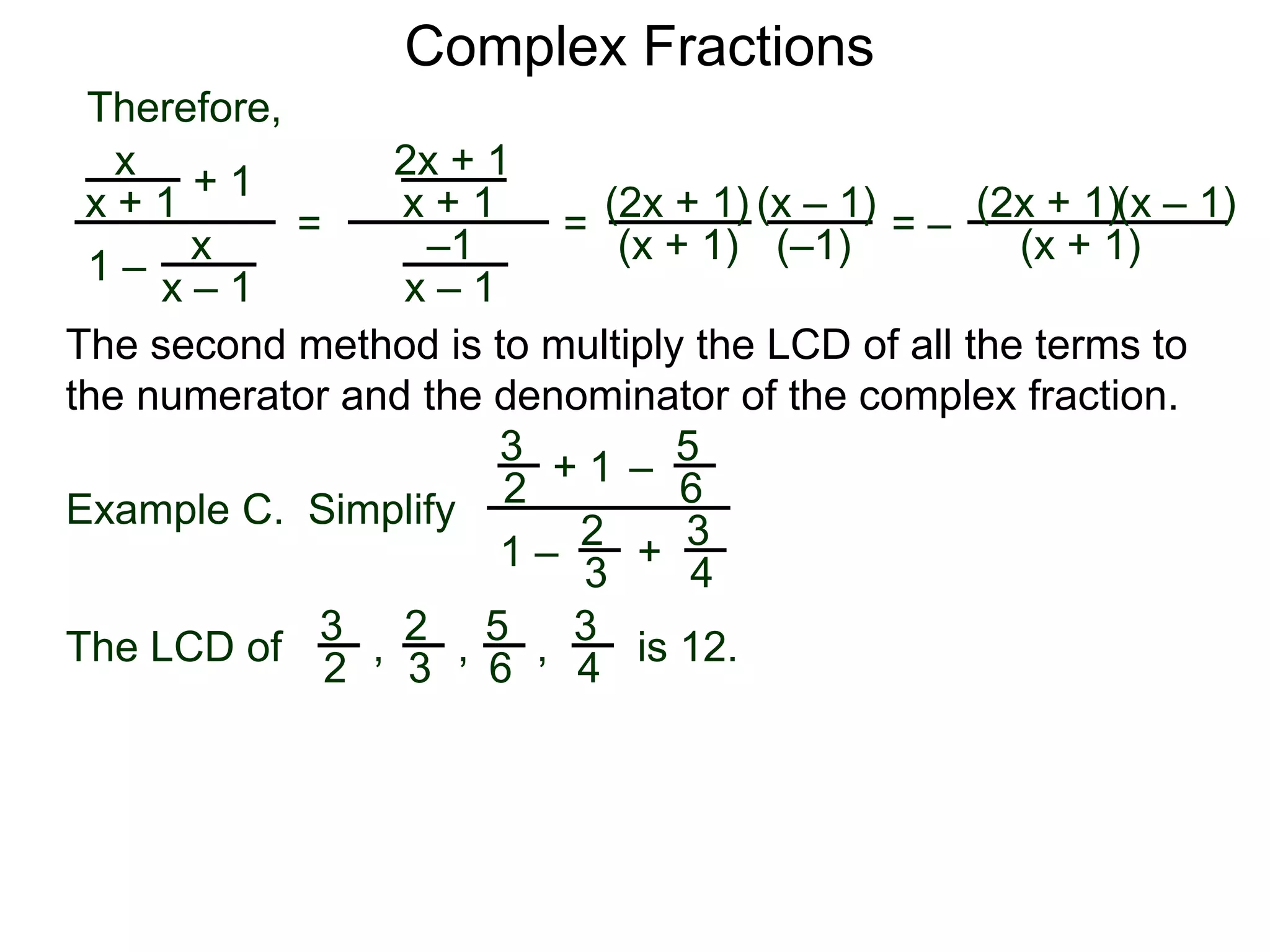
The LCD of
2
3
3
2
5
6
3
4, , , is 12.
2x + 1
x + 1
–1
x – 1
=
(2x + 1)
(x + 1)
(x – 1)
= –
(2x + 1)
(x + 1)
(x – 1)
(–1)
Complex Fractions
x
x + 1
+ 1
1 – x
x – 1
=
Therefore,
The second method is to multiply the LCD of all the terms to
the numerator and the denominator of the complex fraction.
Example C. Simplify
3
2
+ 1
1 –
– 5
6
2
3
3
4
+
The LCD of
2
3
3
2
5
6
3
4, , , is 12.
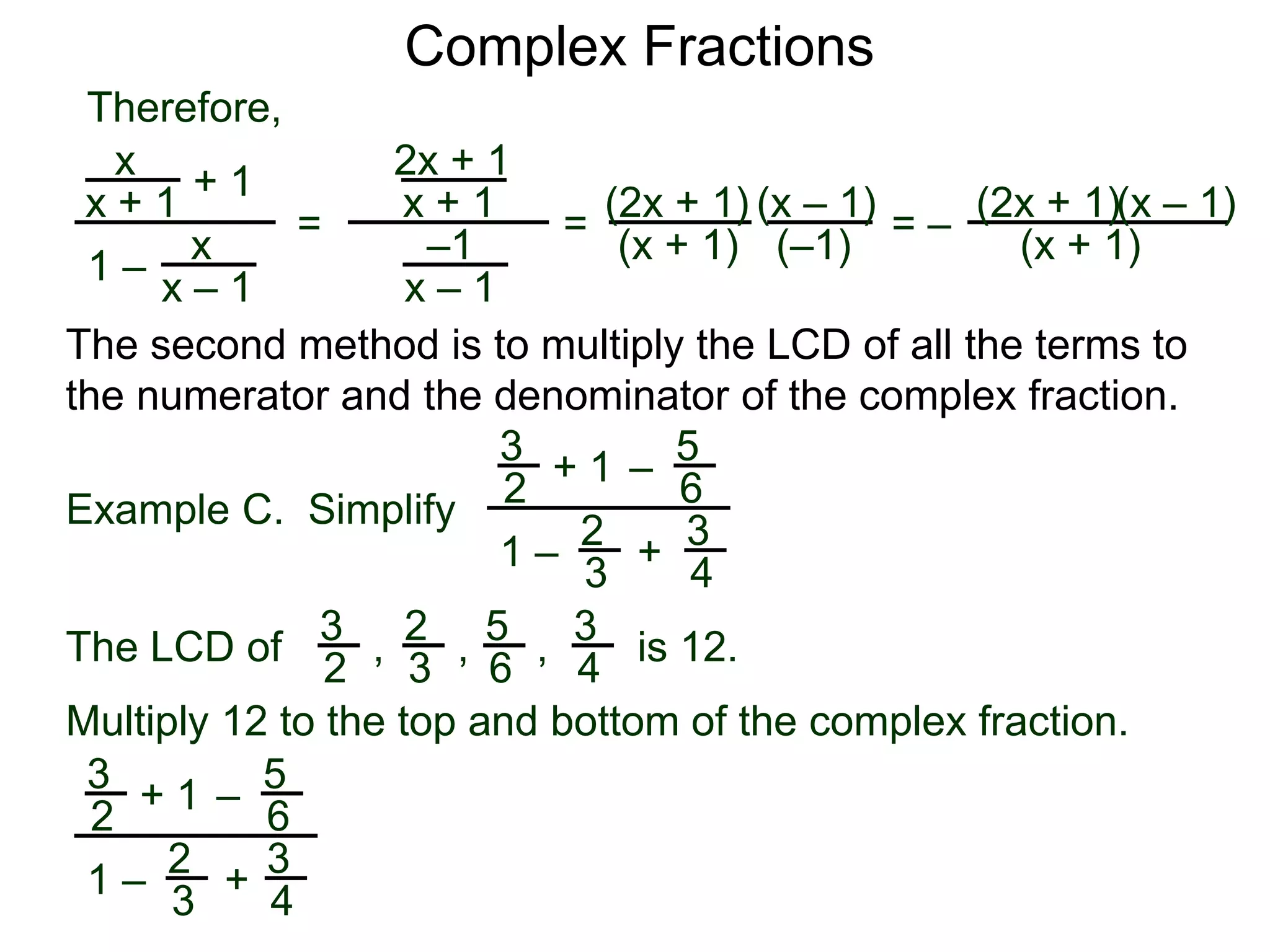
Multiply 12 to the top and bottom of the complex fraction.
3
2
+ 1
1 –
–
5
6
2
3
3
4
+
2x + 1
x + 1
–1
x – 1
=
(2x + 1)
(x + 1) (–1)
(x – 1)
= –
(2x + 1)
(x + 1)
(x – 1)
Complex Fractions
x
x + 1
+ 1
1 – x
x – 1
=
Therefore,
The second method is to multiply the LCD of all the terms to
the numerator and the denominator of the complex fraction.
Example C. Simplify
3
2
+ 1
1 –
– 5
6
2
3
3
4
+
The LCD of
2
3
3
2
5
6
3
4, , , is 12.
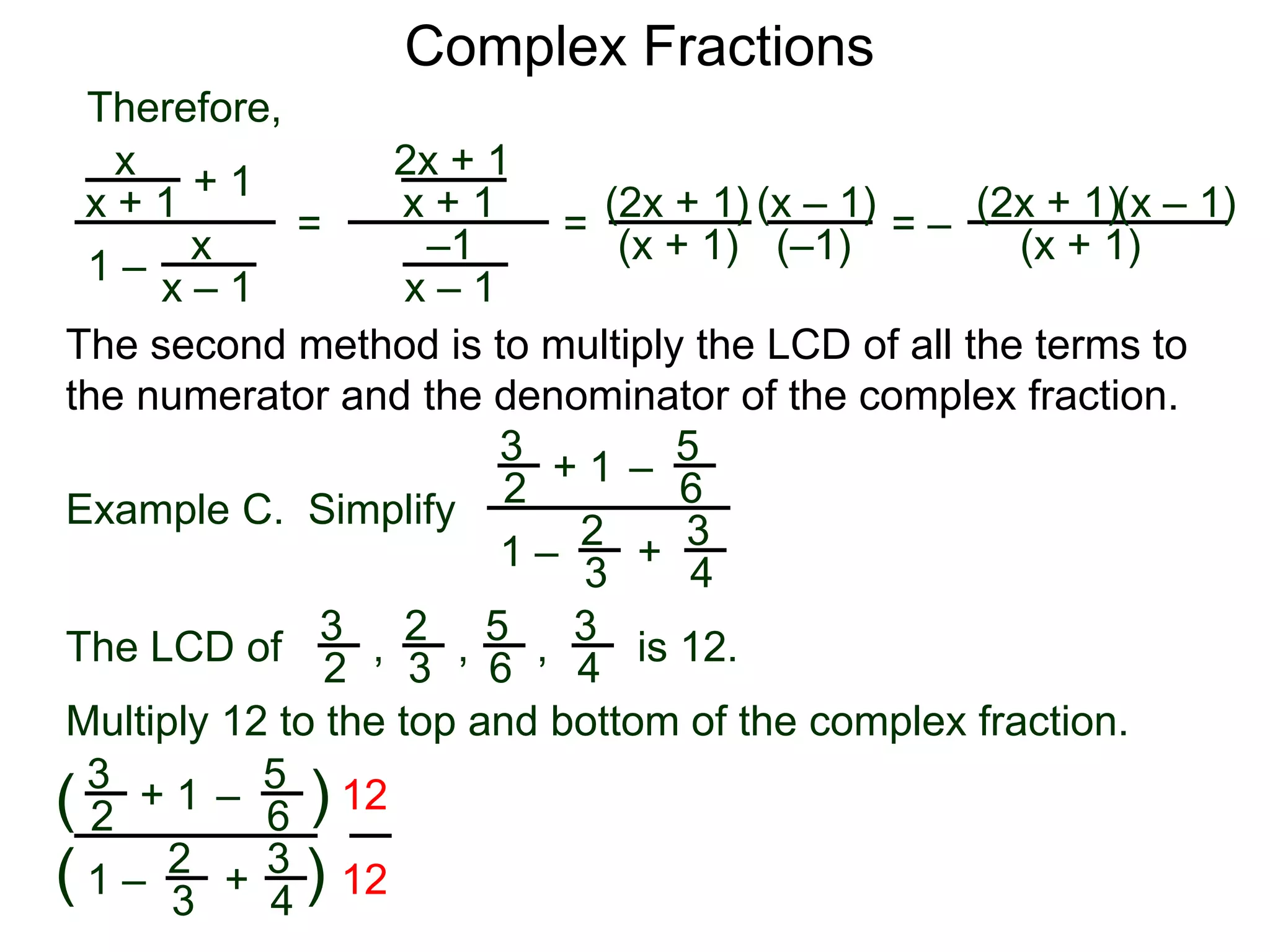
Multiply 12 to the top and bottom of the complex fraction.
3
2
+ 1
1 –
–
5
6
2
3
3
4
+(
( )
)
12
12
2x + 1
x + 1
–1
x – 1
=
(2x + 1)
(x + 1) (–1)
(x – 1)
= –
(2x + 1)
(x + 1)
(x – 1)
Complex Fractions
x
x + 1
+ 1
1 – x
x – 1
=
Therefore,
The second method is to multiply the LCD of all the terms to
the numerator and the denominator of the complex fraction.
Example C. Simplify
3
2
+ 1
1 –
– 5
6
2
3
3
4
+
The LCD of
2
3
3
2
5
6
3
4, , , is 12.
Multiply 12 to the top and bottom of the complex fraction.
3
2
+ 1
1 –
–
5
6
2
3
3
4
+(
( )
)
12
12
2x + 1
x + 1
–1
x – 1
=
(2x + 1)
(x + 1)
(x – 1)
= –
(2x + 1)
(x + 1)
(x – 1)
This is OK since is 1.
12
121
(–1)
Complex Fractions
x
x + 1
+ 1
1 – x
x – 1
=
Therefore,
The second method is to multiply the LCD of all the terms to
the numerator and the denominator of the complex fraction.
Example C. Simplify
3
2
+ 1
1 –
– 5
6
2
3
3
4
+
The LCD of
2
3
3
2
5
6
3
4, , , is 12.
Multiply 12 to the top and bottom of the complex fraction.
3
2
+ 1
1 –
–
5
6
2
3
3
4
+(
( )
)
12
12
6
2x + 1
x + 1
–1
x – 1
=
(2x + 1)
(x + 1)
(x – 1)
= –
(2x + 1)
(x + 1)
(x – 1)
Distribute the multiplication.
(–1)
Complex Fractions
x
x + 1
+ 1
1 – x
x – 1
=
Therefore,
The second method is to multiply the LCD of all the terms to
the numerator and the denominator of the complex fraction.
Example C. Simplify
3
2
+ 1
1 –
– 5
6
2
3
3
4
+
The LCD of
2
3
3
2
5
6
3
4, , , is 12.
Multiply 12 to the top and bottom of the complex fraction.
3
2
+ 1
1 –
–
5
6
2
3
3
4
+(
( )
)
12
12
6 12
2x + 1
x + 1
–1
x – 1
=
(2x + 1)
(x + 1)
(x – 1)
= –
(2x + 1)
(x + 1)
(x – 1)
Distribute the multiplication.
(–1)
Complex Fractions
x
x + 1
+ 1
1 – x
x – 1
=
Therefore,
The second method is to multiply the LCD of all the terms to
the numerator and the denominator of the complex fraction.
Example C. Simplify
3
2
+ 1
1 –
– 5
6
2
3
3
4
+
The LCD of
2
3
3
2
5
6
3
4, , , is 12.
Multiply 12 to the top and bottom of the complex fraction.
3
2
+ 1
1 –
–
5
6
2
3
3
4
+(
( )
)
12
12
6 12 2
2x + 1
x + 1
–1
x – 1
=
(2x + 1)
(x + 1)
(x – 1)
= –
(2x + 1)
(x + 1)
(x – 1)
Distribute the multiplication.
(–1)
Complex Fractions
x
x + 1
+ 1
1 – x
x – 1
=
Therefore,
The second method is to multiply the LCD of all the terms to
the numerator and the denominator of the complex fraction.
Example C. Simplify
3
2
+ 1
1 –
– 5
6
2
3
3
4
+
The LCD of
2
3
3
2
5
6
3
4, , , is 12.
Multiply 12 to the top and bottom of the complex fraction.
3
2
+ 1
1 –
–
5
6
2
3
3
4
+(
( )
)
12
12
6 12 2
12 4 3
2x + 1
x + 1
–1
x – 1
=
(2x + 1)
(x + 1)
(x – 1)
= –
(2x + 1)
(x + 1)
(x – 1)
Distribute the multiplication.
(–1)
Complex Fractions
x
x + 1
+ 1
1 – x
x – 1
=
Therefore,
The second method is to multiply the LCD of all the terms to
the numerator and the denominator of the complex fraction.
Example C. Simplify
3
2
+ 1
1 –
– 5
6
2
3
3
4
+
The LCD of
2
3
3
2
5
6
3
4, , , is 12.
Multiply 12 to the top and bottom of the complex fraction.
3
2
+ 1
1 –
–
5
6
2
3
3
4
+(
( )
)
12
12
=
6 12 2
12 4 3
18 + 12 – 10
12 – 8 + 9
2x + 1
x + 1
–1
x – 1
=
(2x + 1)
(x + 1)
(x – 1)
= –
(2x + 1)
(x + 1)
(x – 1)
(–1)
Complex Fractions
x
x + 1
+ 1
1 – x
x – 1
=
Therefore,
The second method is to multiply the LCD of all the terms to
the numerator and the denominator of the complex fraction.
Example C. Simplify
3
2
+ 1
1 –
– 5
6
2
3
3
4
+
The LCD of
2
3
3
2
5
6
3
4, , , is 12.
Multiply 12 to the top and bottom of the complex fraction.
3
2
+ 1
1 –
–
5
6
2
3
3
4
+(
( )
)
12
12
=
6 12 2
12 4 3
18 + 12 – 10
12 – 8 + 9 =
20
13
2x + 1
x + 1
–1
x – 1
=
(2x + 1)
(x + 1)
(x – 1)
= –
(2x + 1)
(x + 1)
(x – 1)
(–1)
Complex Fractions
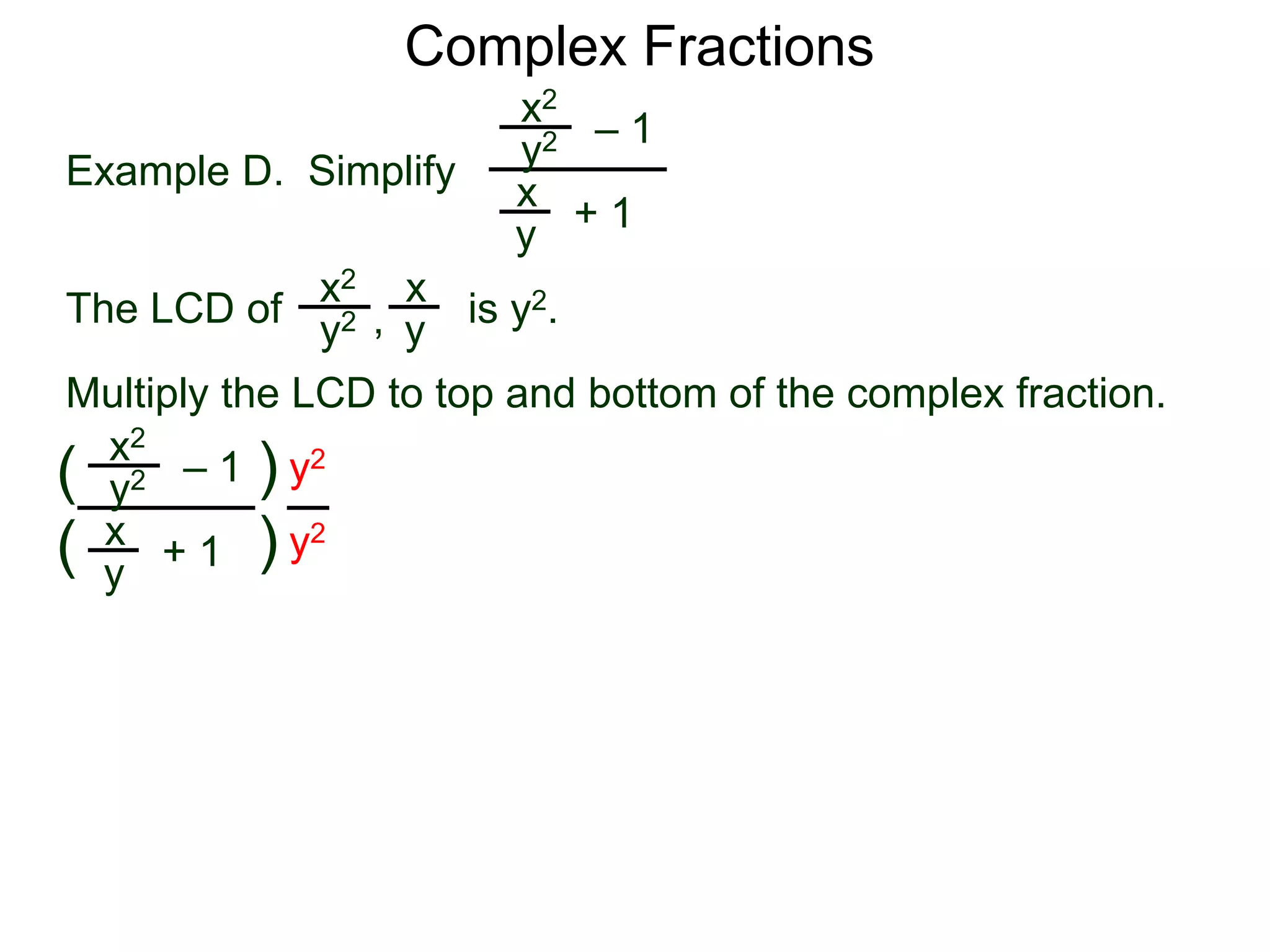
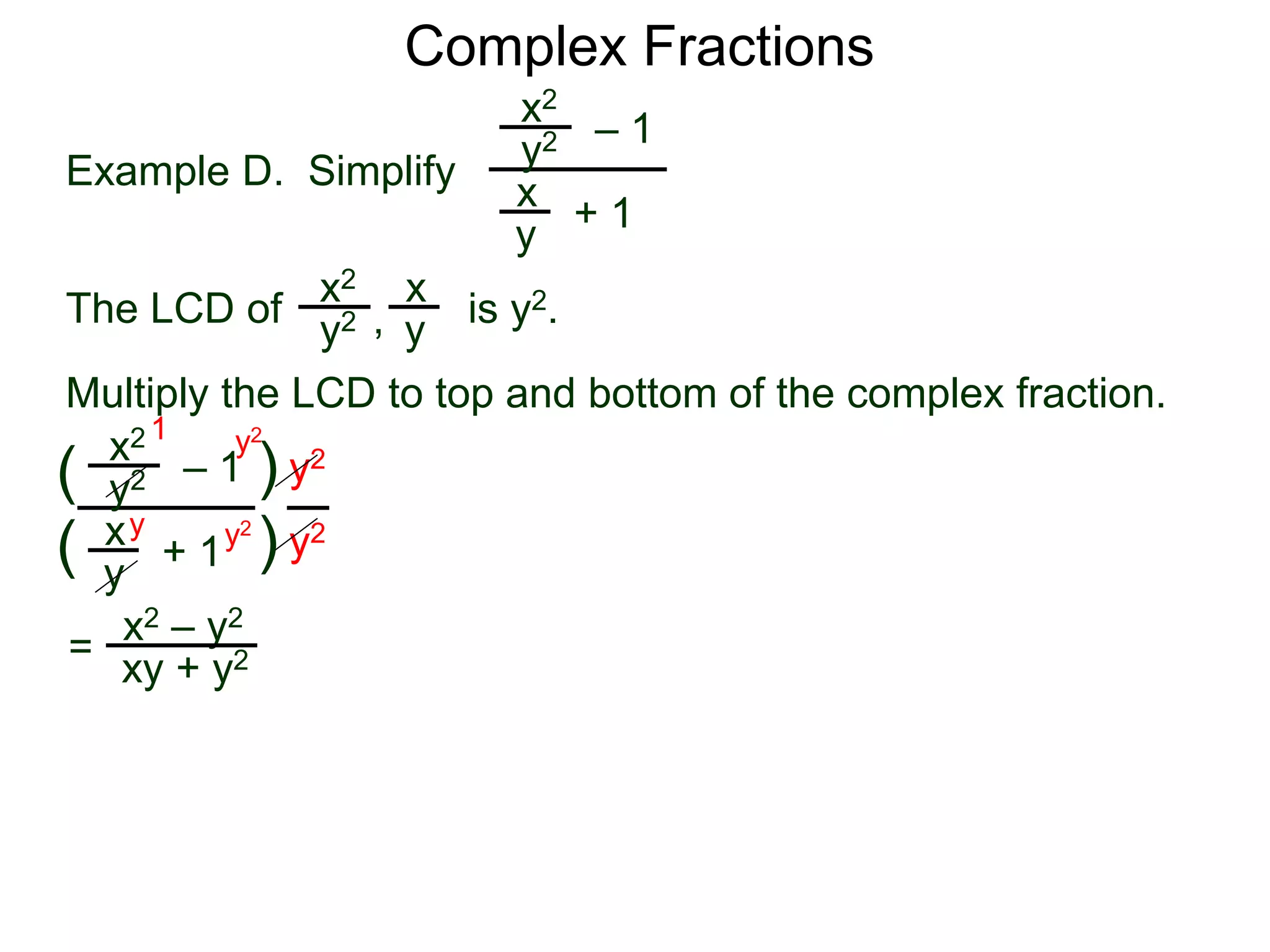
x2
+ 1
– 1
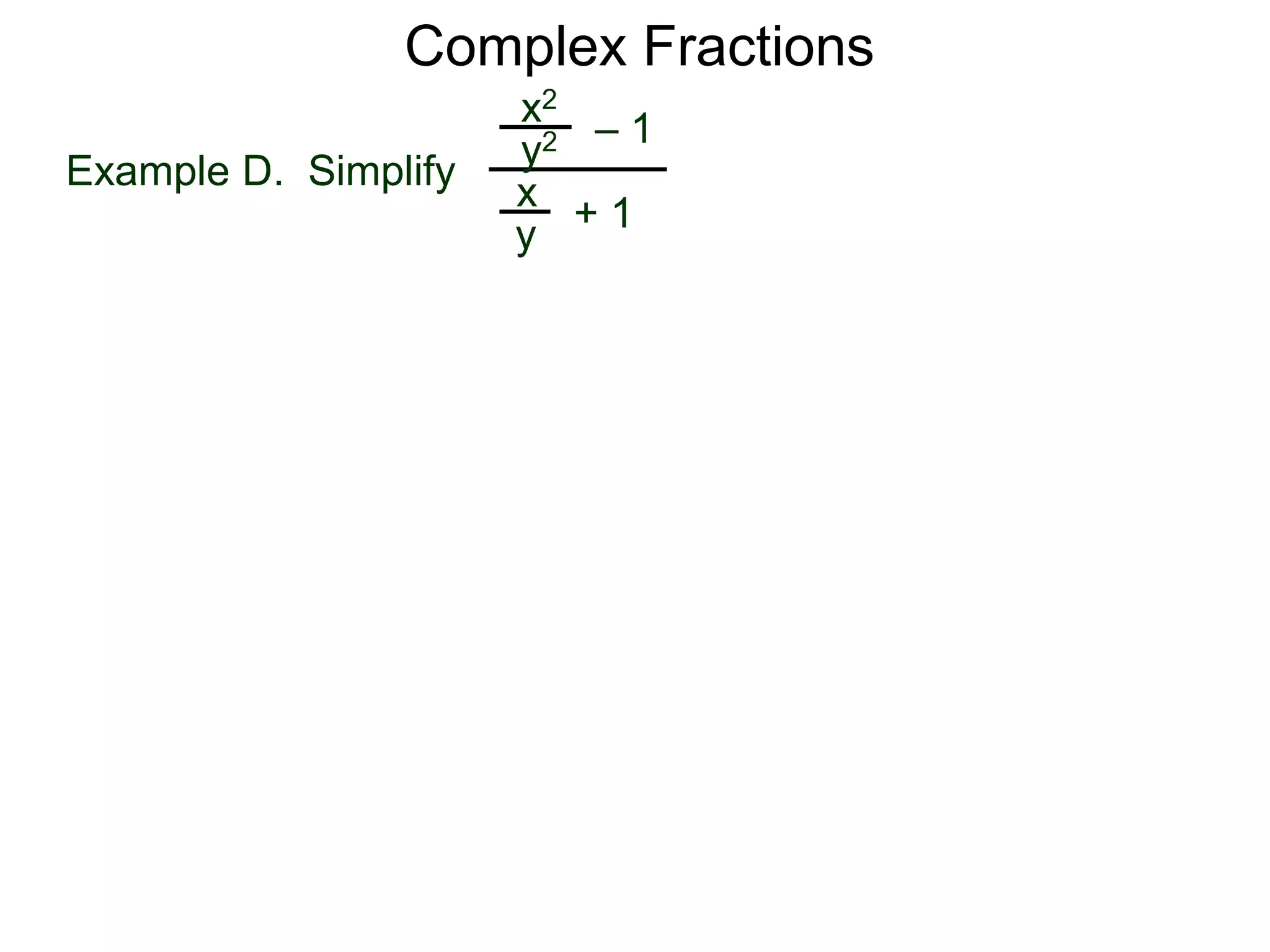
Example D. Simplify
x
y
y2
Complex Fractions
x2
+ 1
– 1
Example D. Simplify
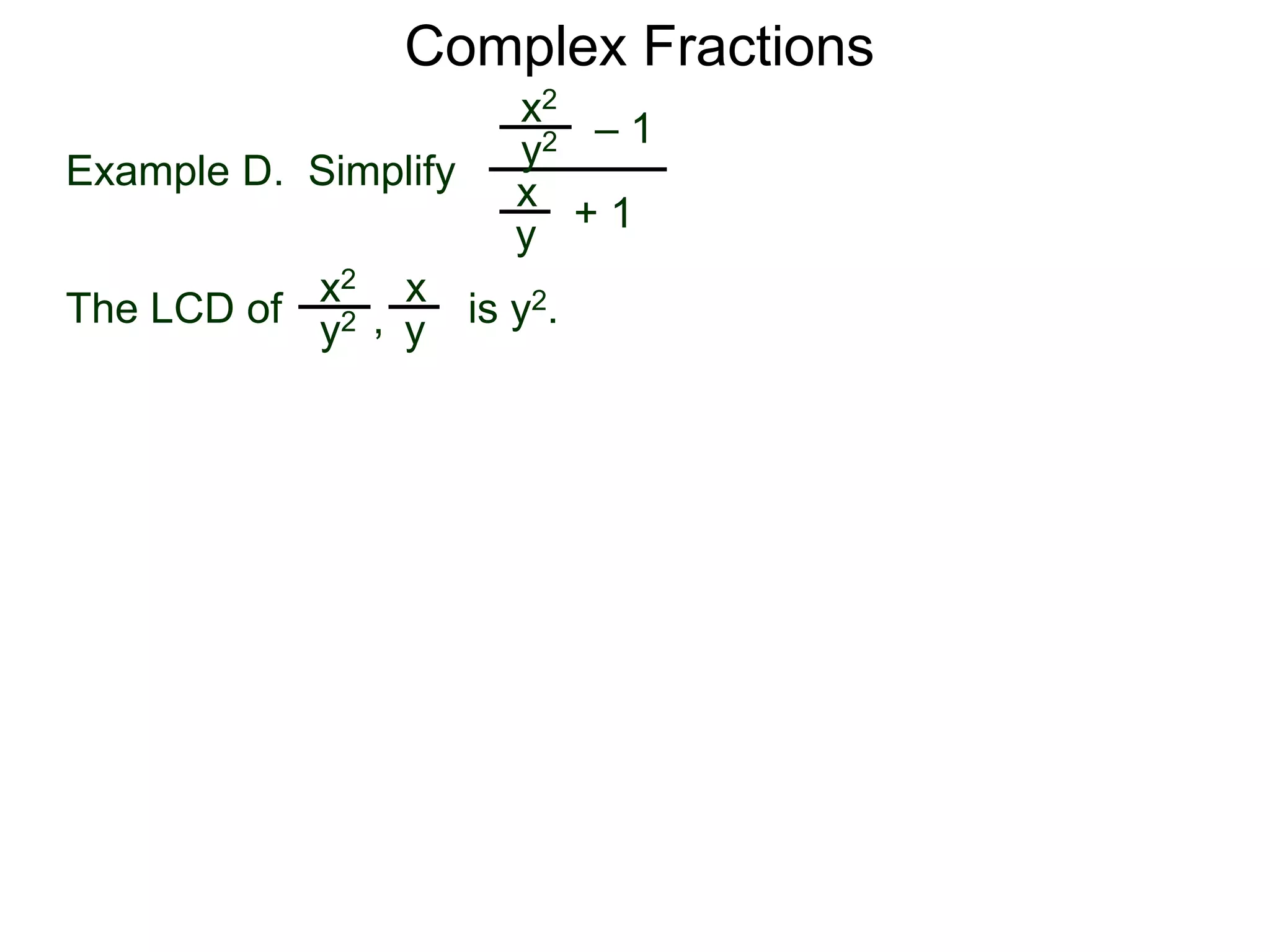
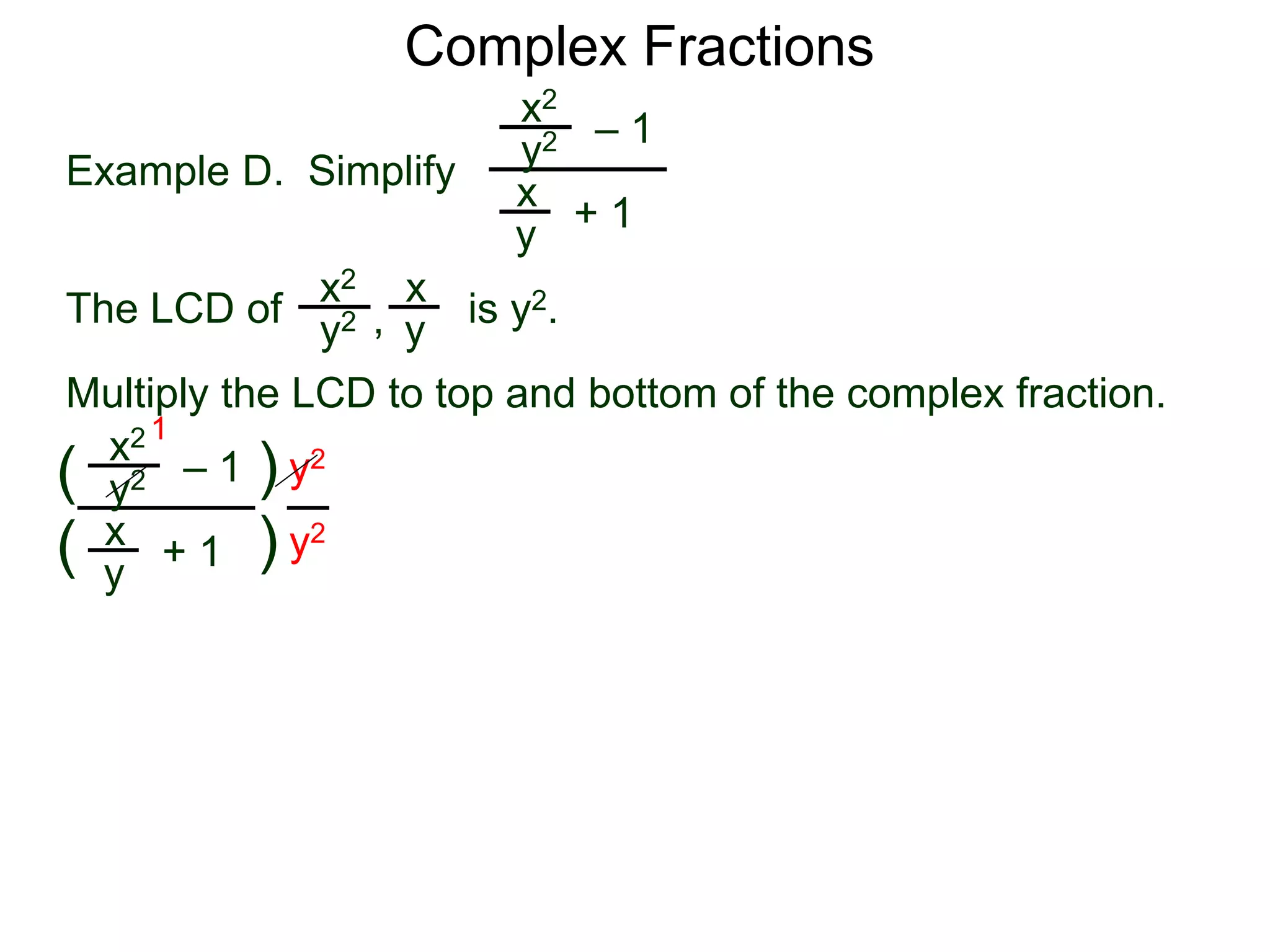
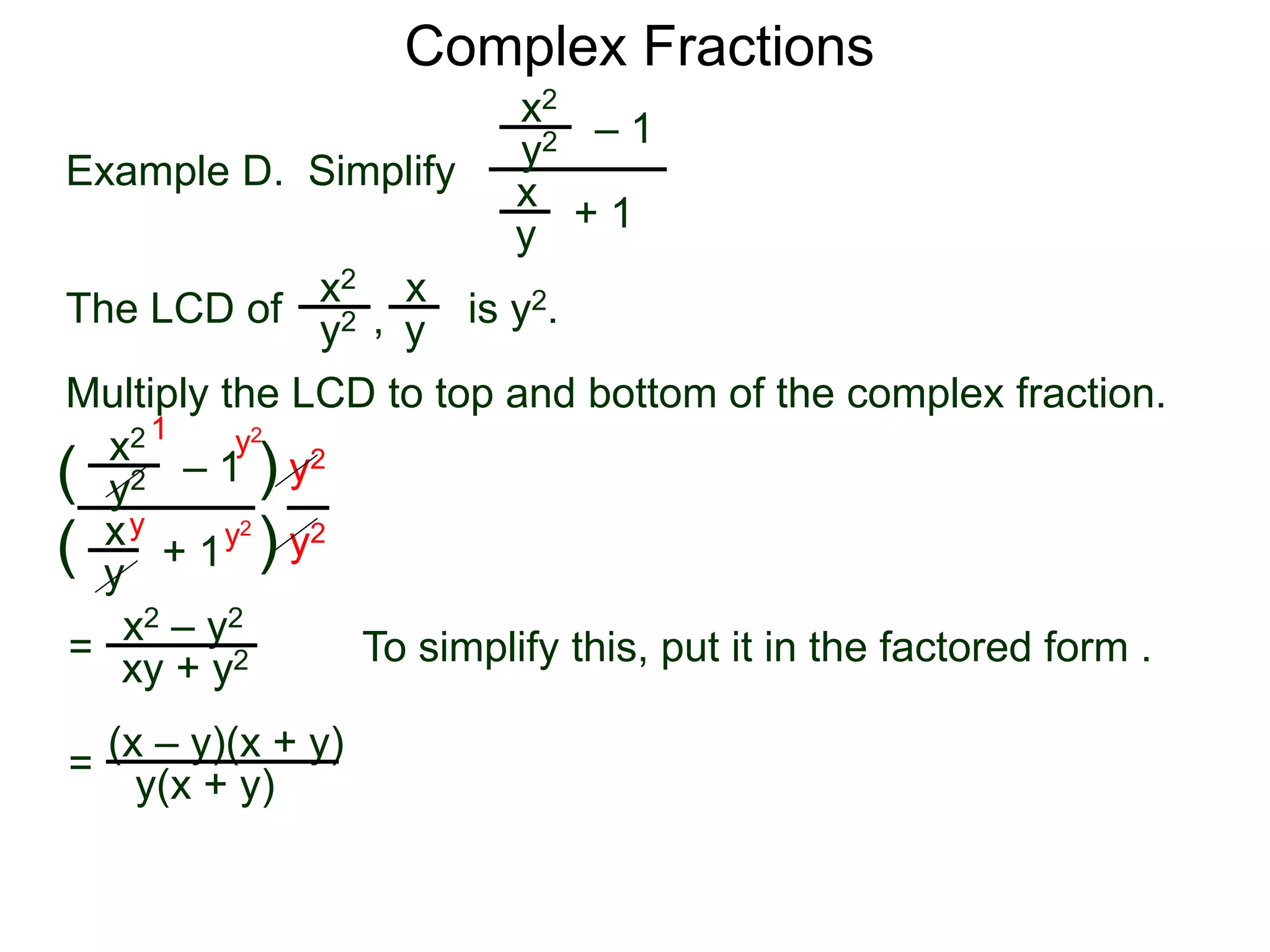
The LCD of
x
y
is y2.
y2
x2 x
yy2 ,
Complex Fractions
x2
+ 1
– 1
Example D. Simplify
The LCD of
x
y
is y2.
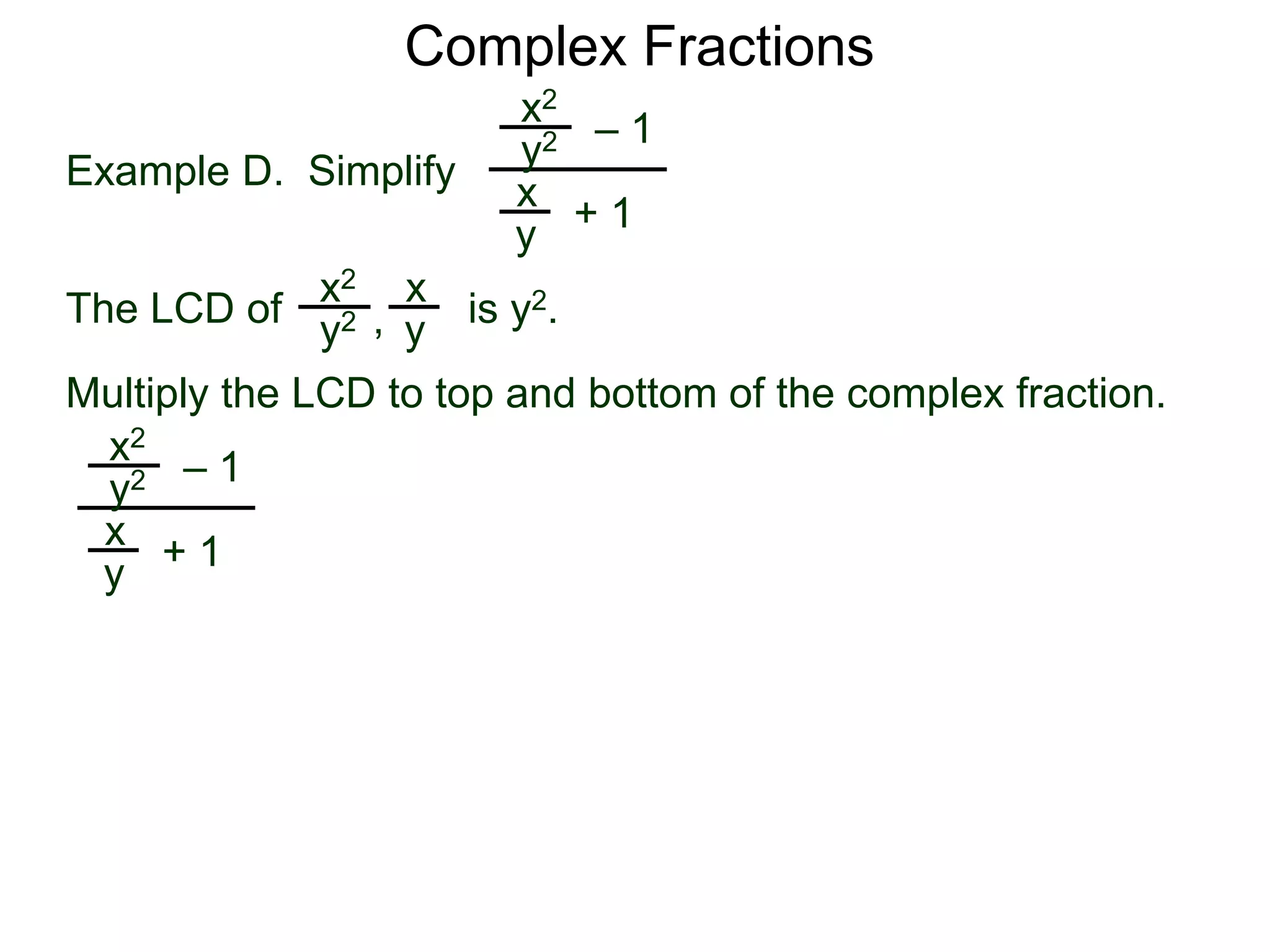
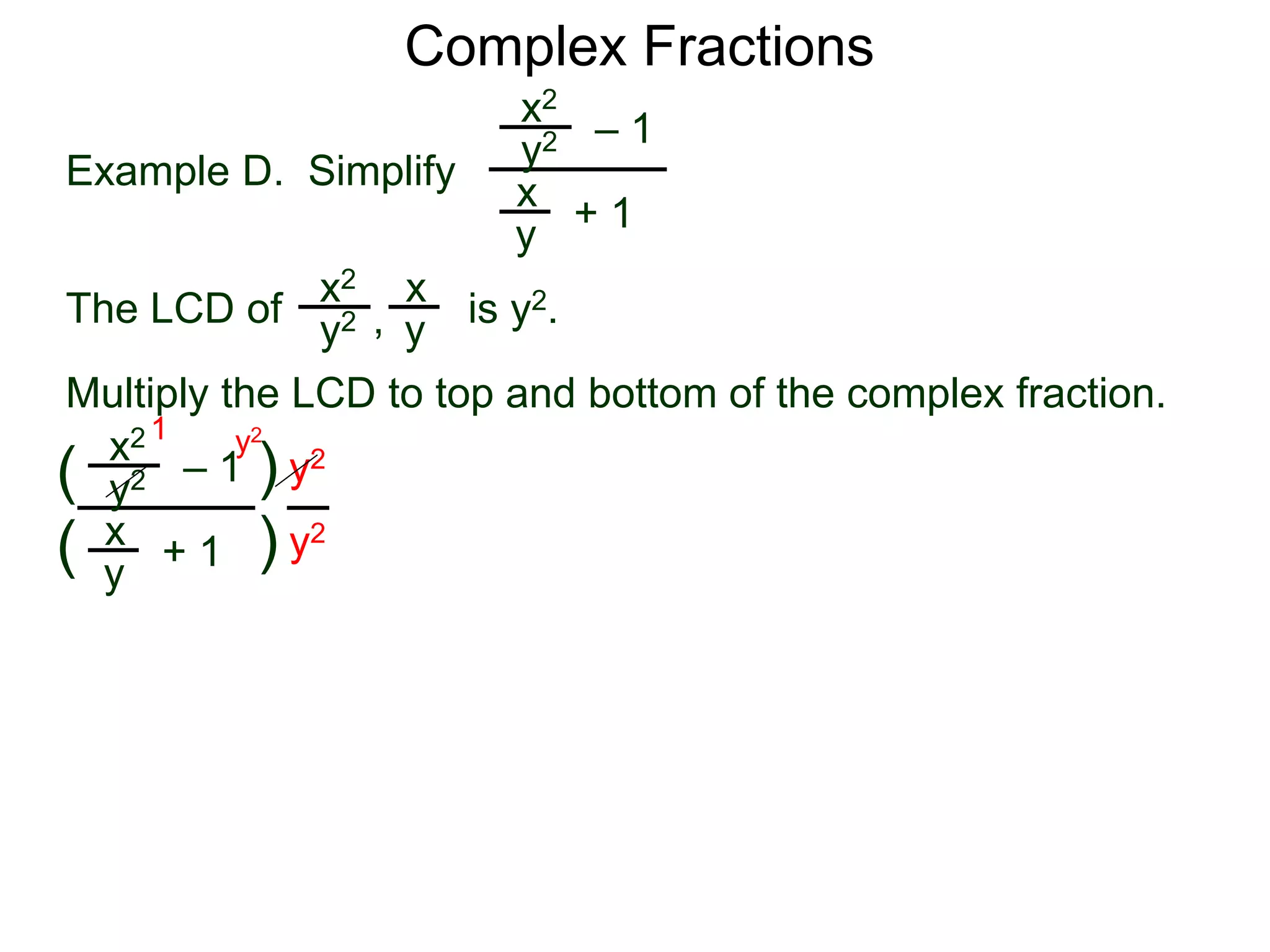
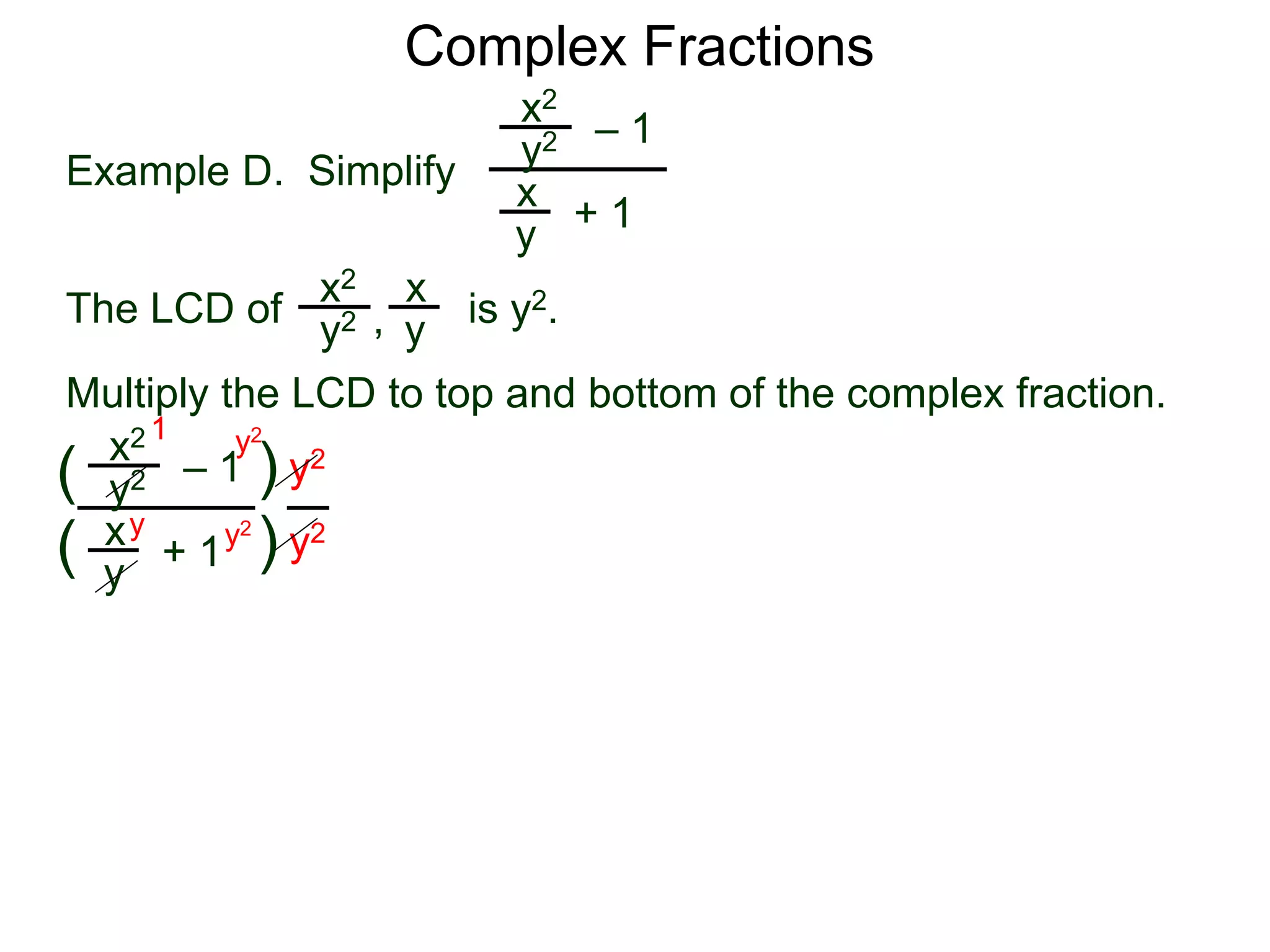
Multiply the LCD to top and bottom of the complex fraction.
y2
x2 x
yy2 ,
x2
+ 1
– 1
x
y
y2
Complex Fractions
x2
+ 1
– 1
Example D. Simplify
The LCD of
x
y
is y2.
Multiply the LCD to top and bottom of the complex fraction.
y2
x2 x
yy2 ,
x2
+ 1
– 1
x
y
y2
(
(
)
) y2
y2
Complex Fractions
x2
+ 1
– 1
Example D. Simplify
The LCD of
x
y
is y2.
Multiply the LCD to top and bottom of the complex fraction.
y2
x2 x
yy2 ,
x2
+ 1
– 1
x
y
y2
(
(
)
) y2
y2
1
Complex Fractions
x2
+ 1
– 1
Example D. Simplify
The LCD of
x
y
is y2.
Multiply the LCD to top and bottom of the complex fraction.
y2
x2 x
yy2 ,
x2
+ 1
– 1
x
y
y2
(
(
)
) y2
y2
y21
Complex Fractions
x2
+ 1
– 1
Example D. Simplify
The LCD of
x
y
is y2.
Multiply the LCD to top and bottom of the complex fraction.
y2
x2 x
yy2 ,
x2
+ 1
– 1
x
y
y2
(
(
)
) y2
y2
y2
y2y
1
Complex Fractions
x2
+ 1
– 1
Example D. Simplify
The LCD of
x
y
is y2.
Multiply the LCD to top and bottom of the complex fraction.
y2
x2 x
yy2 ,
x2
+ 1
– 1
x
y
y2
(
(
)
) y2
y2
=
y2
y2y
1
x2 – y2
xy + y2
Complex Fractions
x2
+ 1
– 1
Example D. Simplify
The LCD of
x
y
is y2.
Multiply the LCD to top and bottom of the complex fraction.
y2
x2 x
yy2 ,
x2
+ 1
– 1
x
y
y2
(
(
)
) y2
y2
=
y2
y2y
1
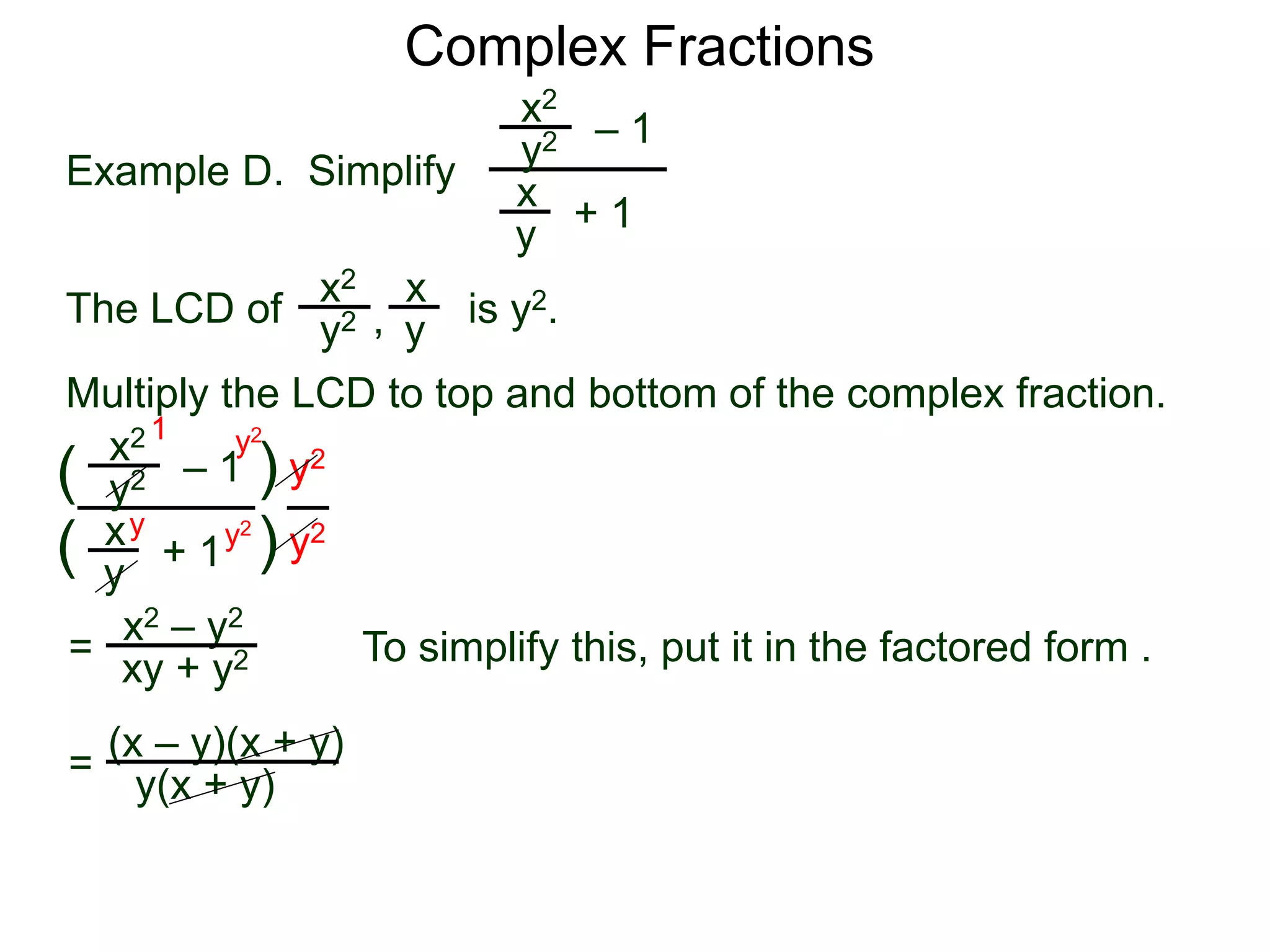
x2 – y2
xy + y2
= (x – y)(x + y)
y(x + y)
To simplify this, put it in the factored form .
Complex Fractions
x2
+ 1
– 1
Example D. Simplify
The LCD of
x
y
is y2.
Multiply the LCD to top and bottom of the complex fraction.
y2
x2 x
yy2 ,
x2
+ 1
– 1
x
y
y2
(
(
)
) y2
y2
=
y2
y2y
1
x2 – y2
xy + y2 To simplify this, put it in the factored form .
= (x – y)(x + y)
y(x + y)
Complex Fractions
x2
+ 1
– 1
Example D. Simplify
The LCD of
x
y
is y2.
Multiply the LCD to top and bottom of the complex fraction.
y2
x2 x
yy2 ,
x2
+ 1
– 1
x
y
y2
(
(
)
) y2
y2
=
y2
y2y
1
x2 – y2
xy + y2 To simplify this, put it in the factored form .
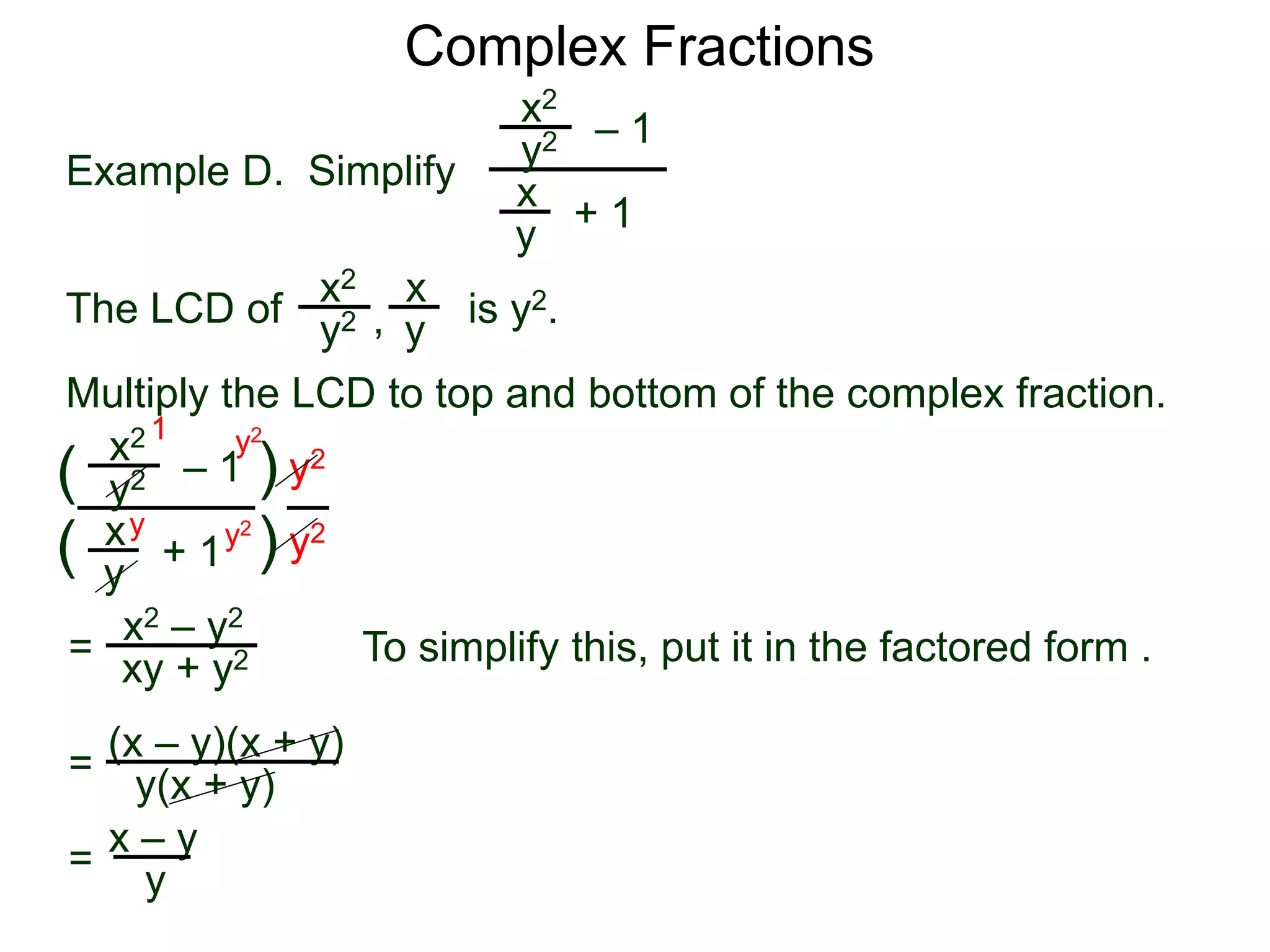
= (x – y)(x + y)
y(x + y)
= x – y
y
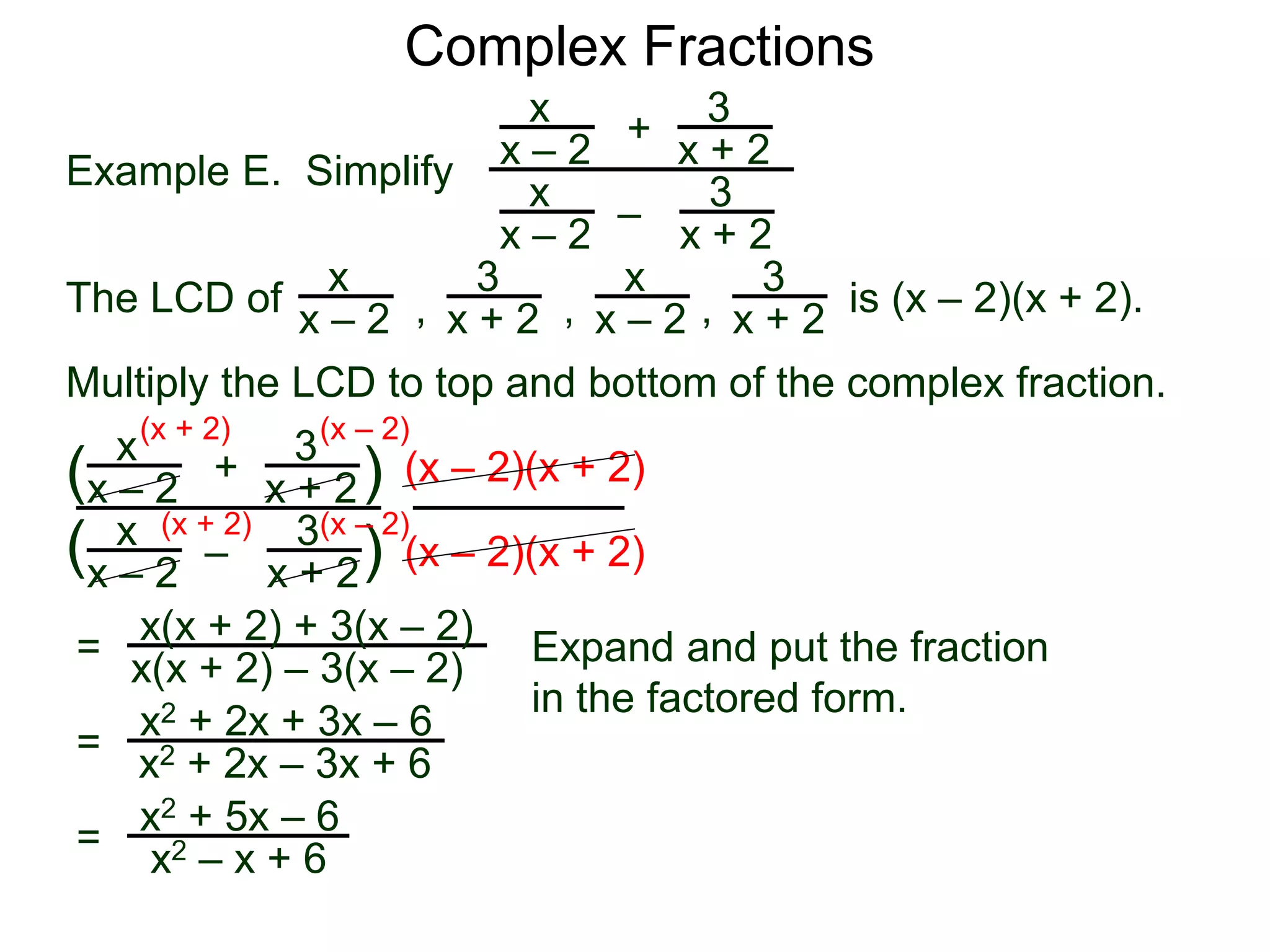
Complex Fractions
x
x – 2
–
+
3
x + 2
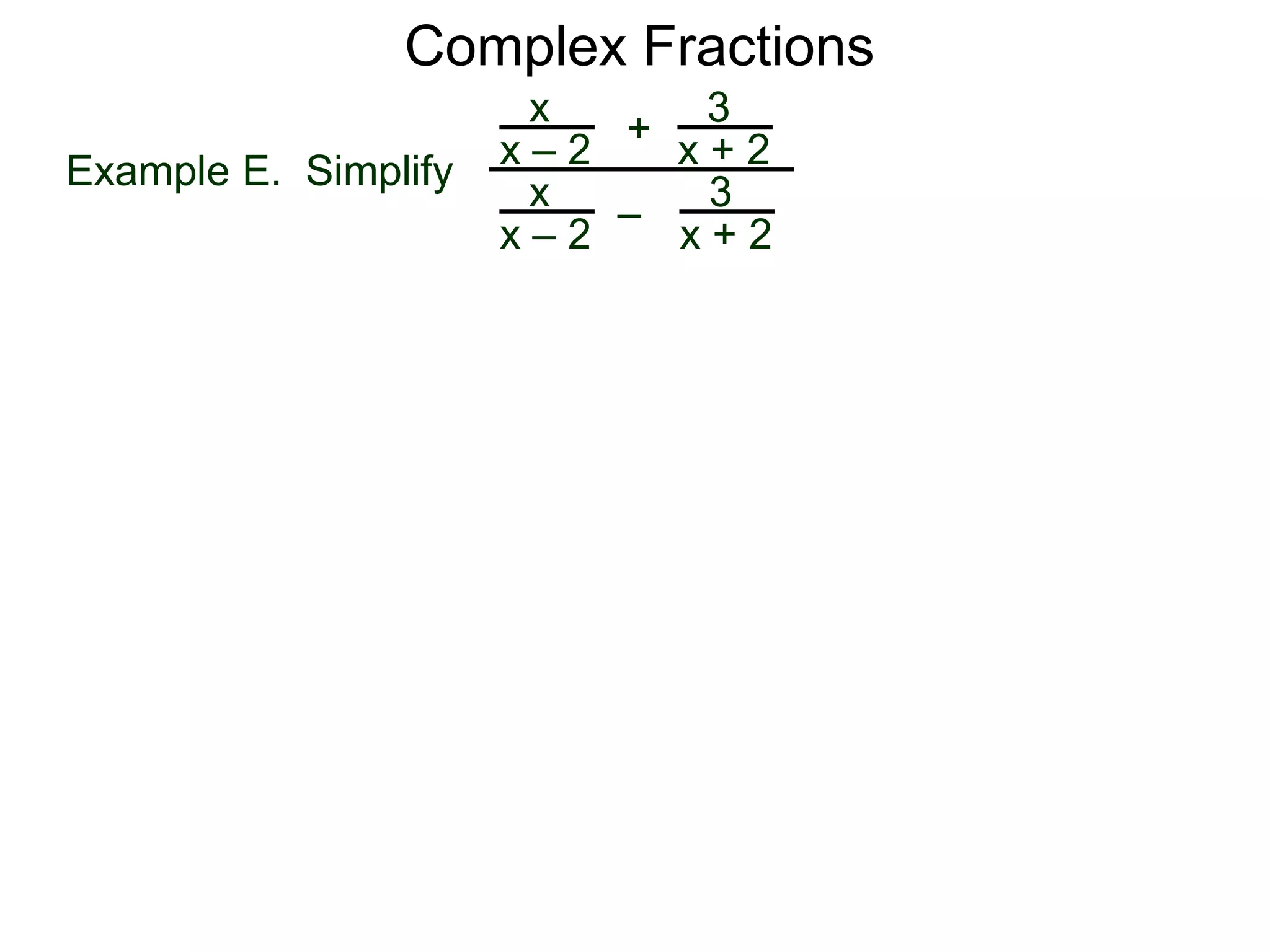
Example E. Simplify
3
x + 2
x
x – 2
Complex Fractions
x
x – 2
–
+
3
x + 2
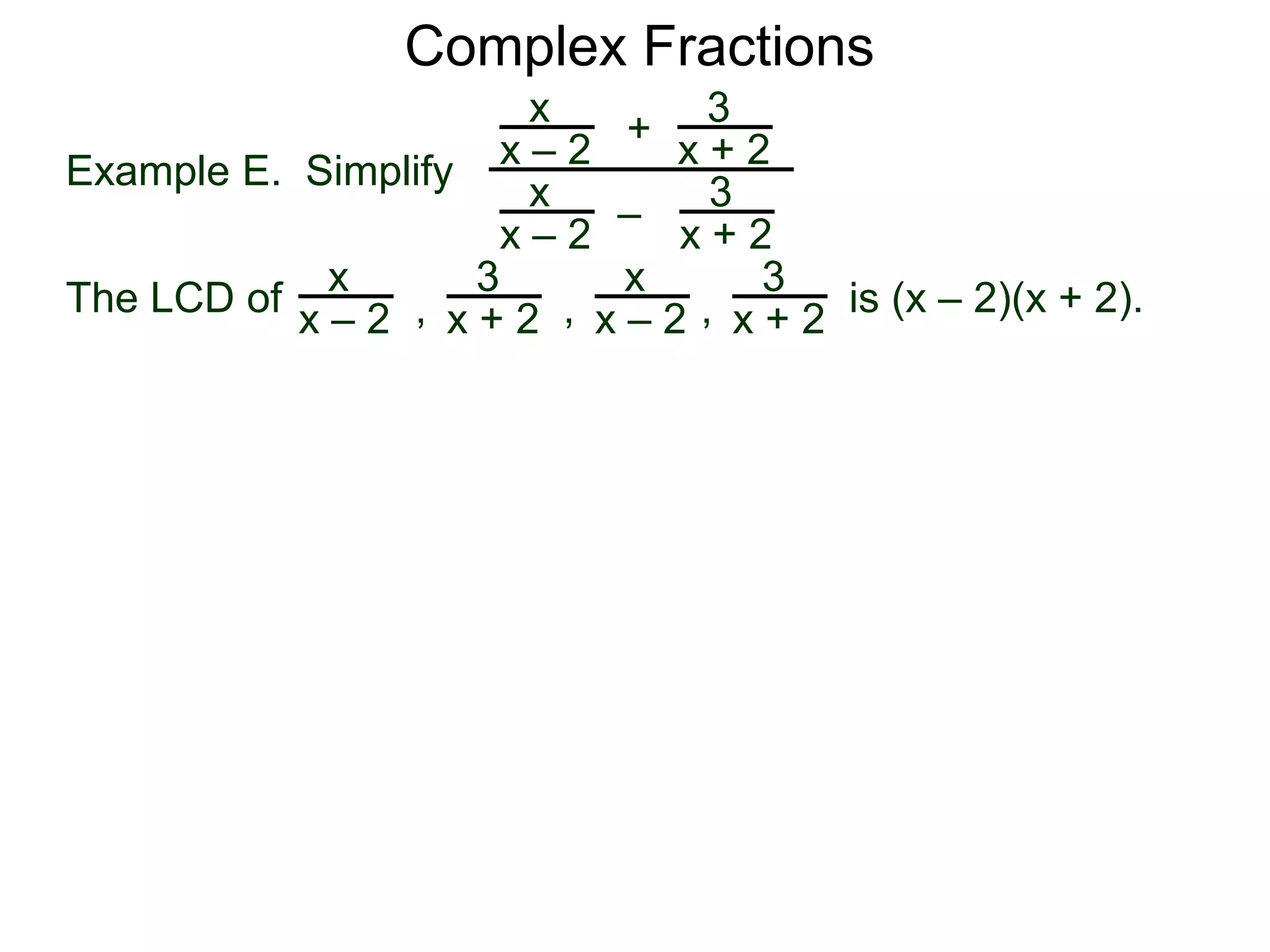
Example E. Simplify
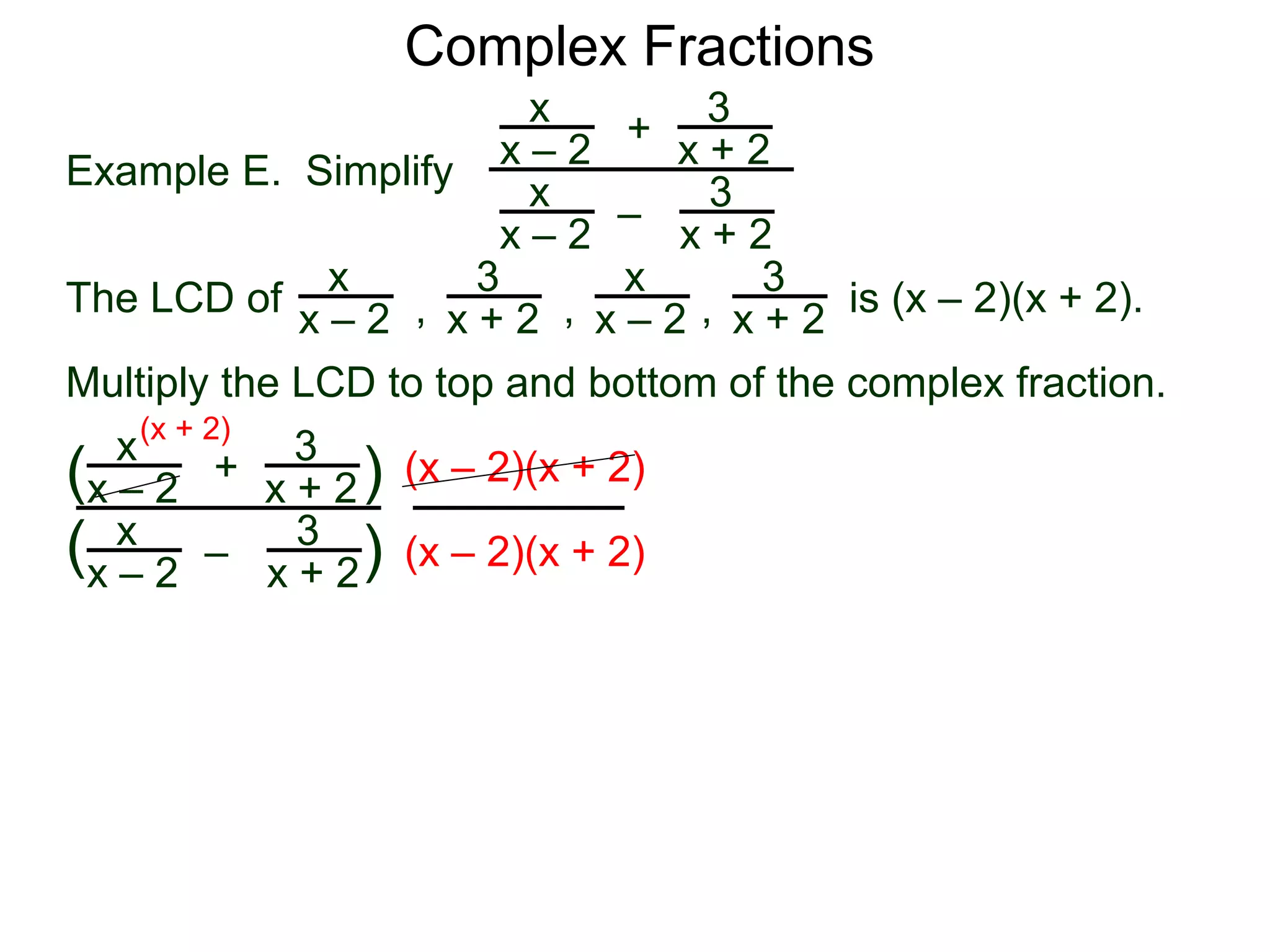
The LCD of
3
x + 2
x
x – 2
x
x – 2
x
x – 2
3
x + 2
3
x + 2, , , is (x – 2)(x + 2).
Complex Fractions
x
x – 2
–
+
3
x + 2
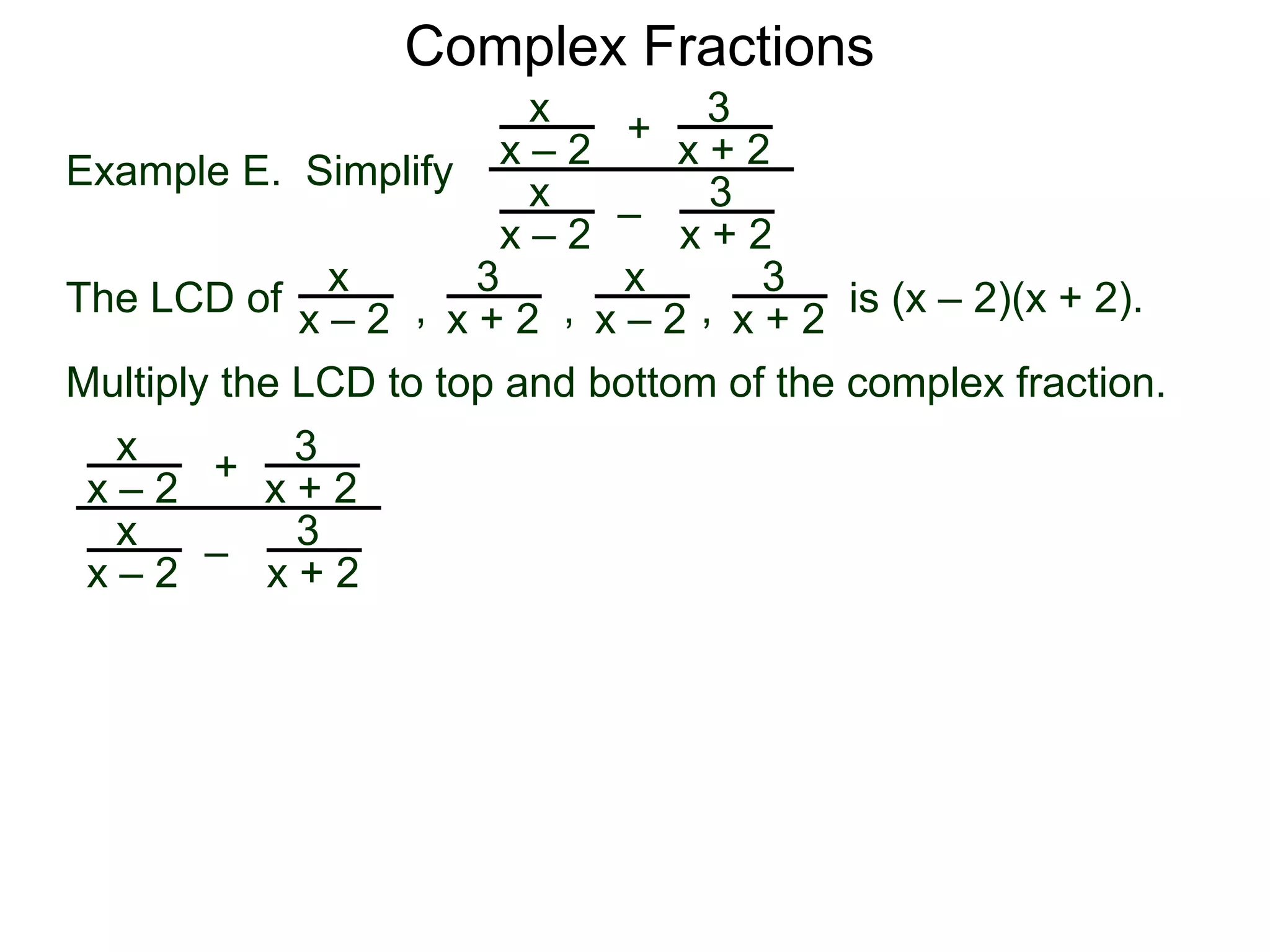
Example E. Simplify
The LCD of
3
x + 2
x
x – 2
x
x – 2
x
x – 2
3
x + 2
3
x + 2, , , is (x – 2)(x + 2).
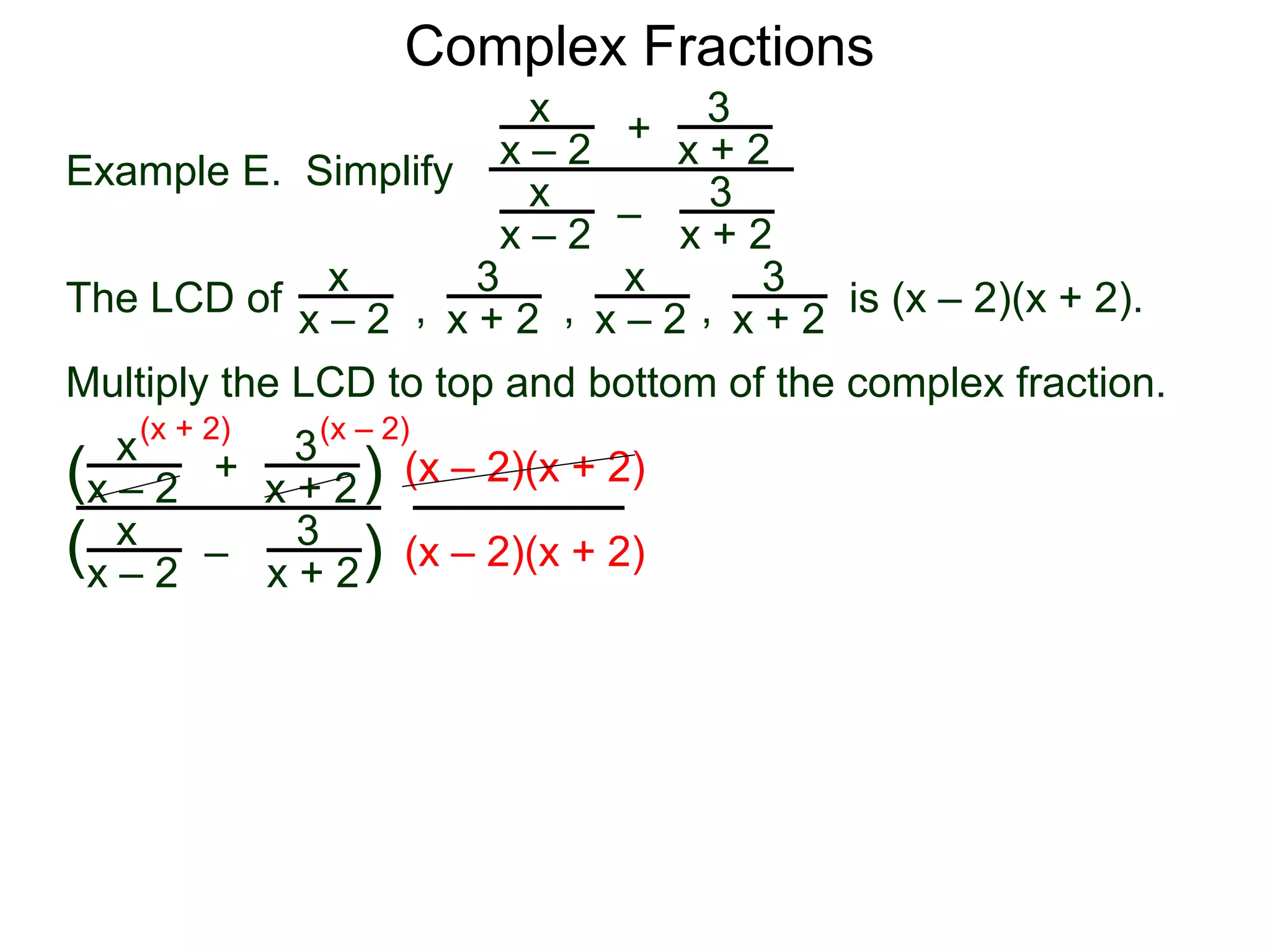
Multiply the LCD to top and bottom of the complex fraction.
x
x – 2
–
+
3
x + 2
3
x + 2
x
x – 2
Complex Fractions
x
x – 2
–
+
3
x + 2
Example E. Simplify
The LCD of
3
x + 2
x
x – 2
x
x – 2
x
x – 2
3
x + 2
3
x + 2, , , is (x – 2)(x + 2).
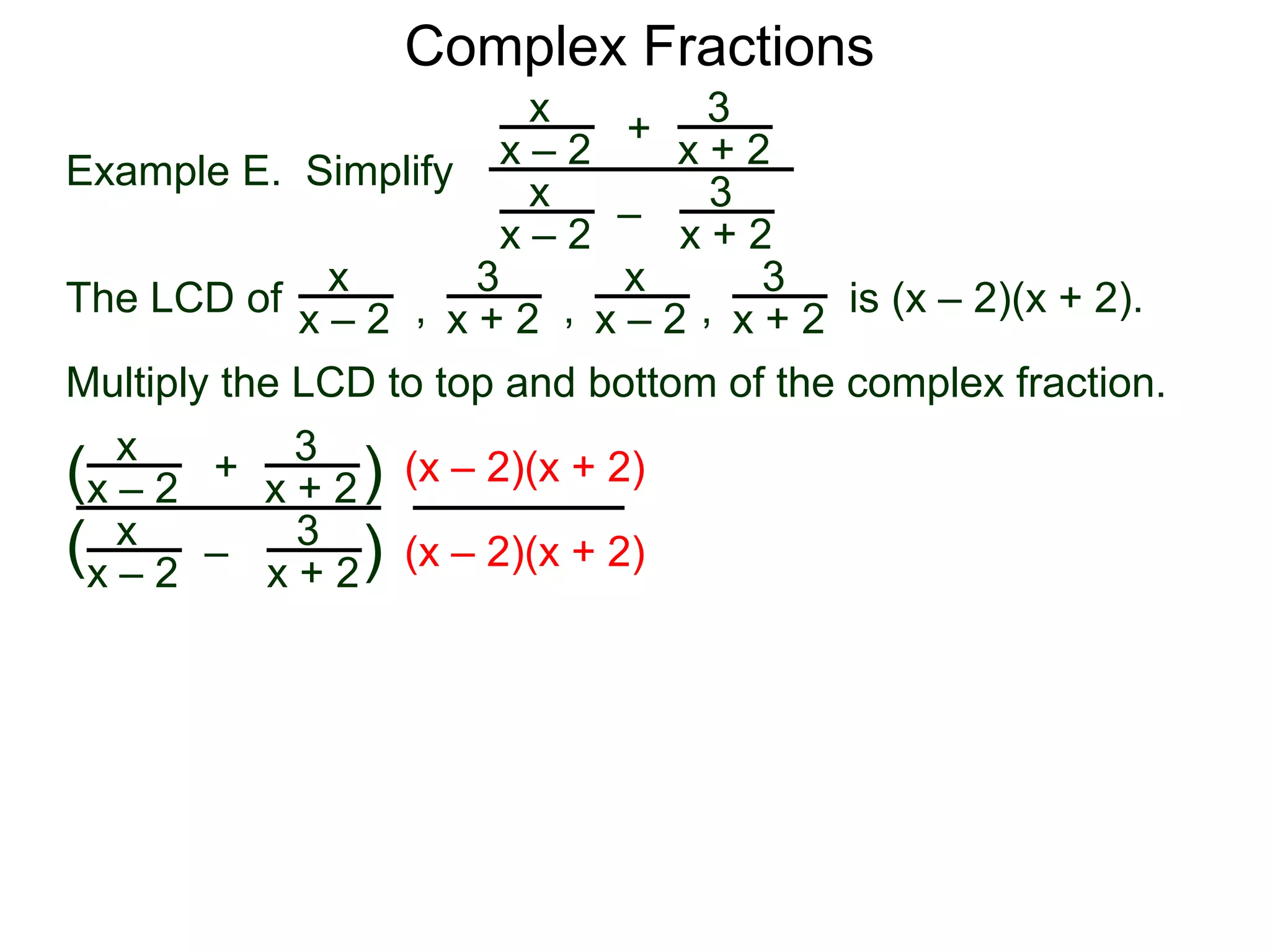
Multiply the LCD to top and bottom of the complex fraction.
x
x – 2
–
+
3
x + 2
3
x + 2
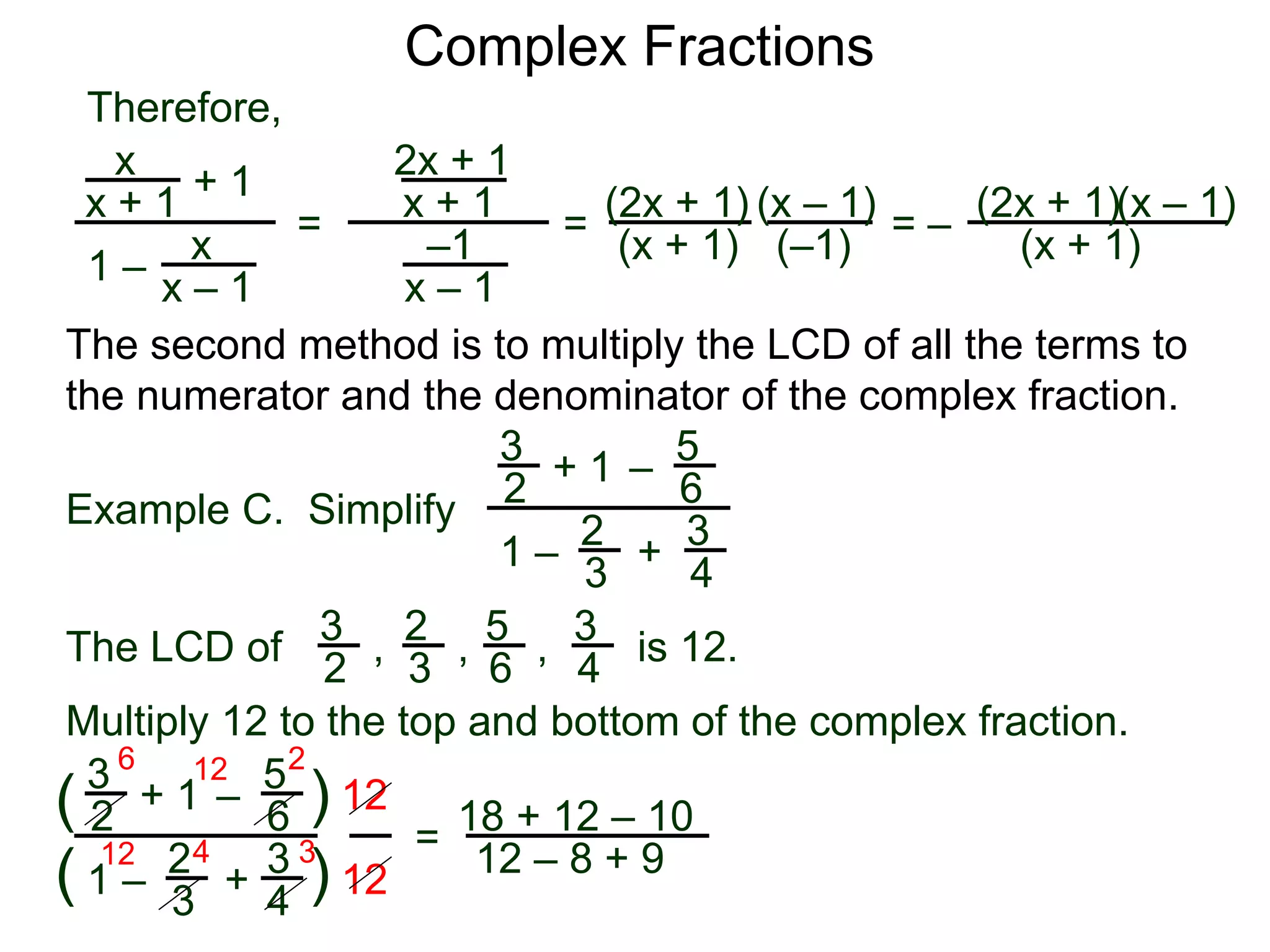
x
x – 2
(
( )
)
(x – 2)(x + 2)
(x – 2)(x + 2)
Complex Fractions
x
x – 2
–
+
3
x + 2
Example E. Simplify
The LCD of
3
x + 2
x
x – 2
x
x – 2
x
x – 2
3
x + 2
3
x + 2, , , is (x – 2)(x + 2).
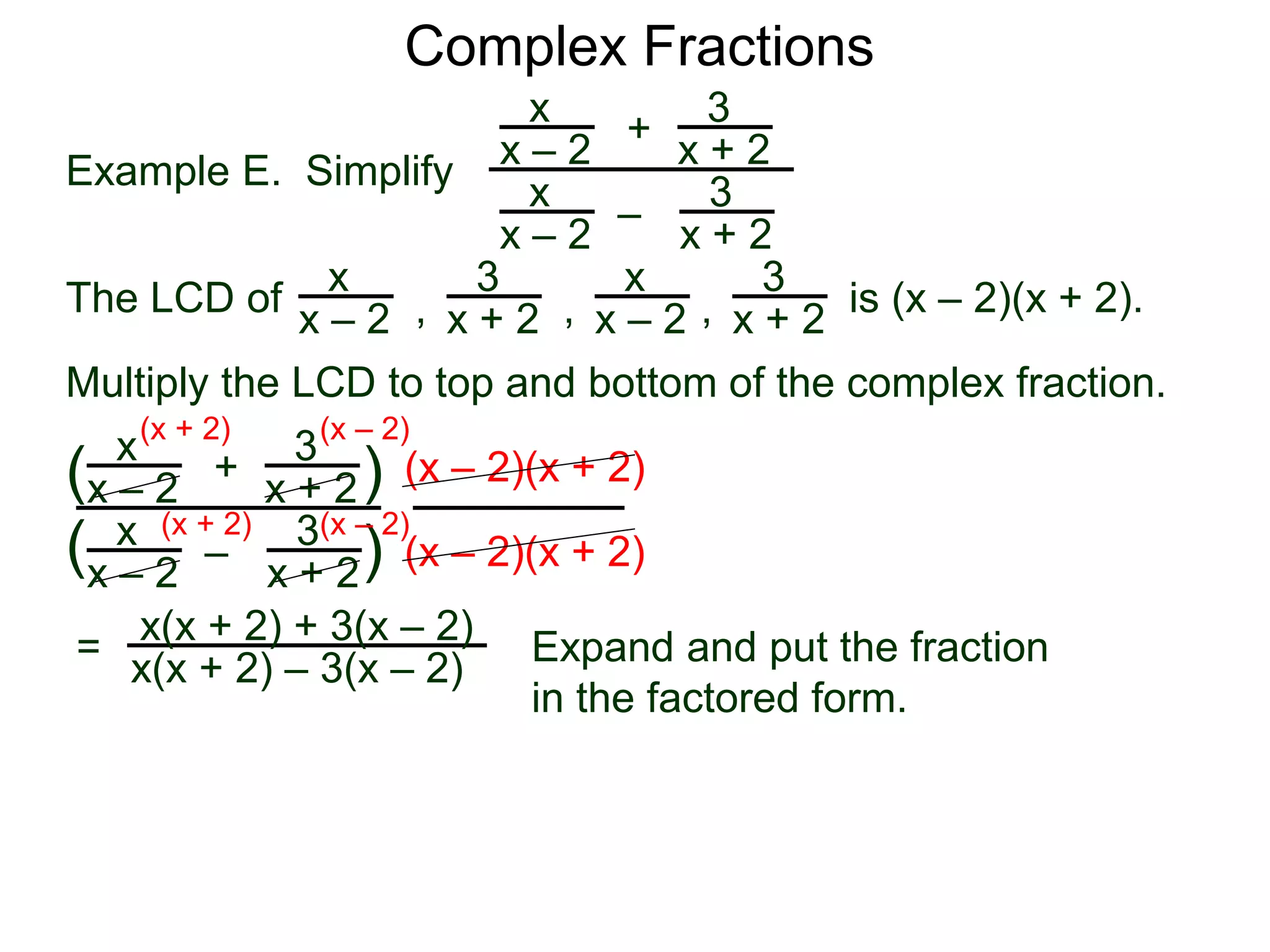
Multiply the LCD to top and bottom of the complex fraction.
x
x – 2
–
+
3
x + 2
3
x + 2
x
x – 2
(
( )
)
(x – 2)(x + 2)
(x – 2)(x + 2)
(x + 2)
Complex Fractions
x
x – 2
–
+
3
x + 2
Example E. Simplify
The LCD of
3
x + 2
x
x – 2
x
x – 2
x
x – 2
3
x + 2
3
x + 2, , , is (x – 2)(x + 2).
Multiply the LCD to top and bottom of the complex fraction.
x
x – 2
–
+
3
x + 2
3
x + 2
x
x – 2
(
( )
)
(x – 2)(x + 2)
(x – 2)(x + 2)
(x + 2) (x – 2)
Complex Fractions
x
x – 2
–
+
3
x + 2
Example E. Simplify
The LCD of
3
x + 2
x
x – 2
x
x – 2
x
x – 2
3
x + 2
3
x + 2, , , is (x – 2)(x + 2).
Multiply the LCD to top and bottom of the complex fraction.
x
x – 2
–
+
3
x + 2
3
x + 2
x
x – 2
(
( )
)
(x – 2)(x + 2)
(x – 2)(x + 2)
=
(x + 2)
(x + 2)
(x – 2)
(x – 2)
x(x + 2) + 3(x – 2)
x(x + 2) – 3(x – 2) Expand and put the fraction
in the factored form.
Complex Fractions
x
x – 2
–
+
3
x + 2
Example E. Simplify
The LCD of
3
x + 2
x
x – 2
x
x – 2
x
x – 2
3
x + 2
3
x + 2, , , is (x – 2)(x + 2).
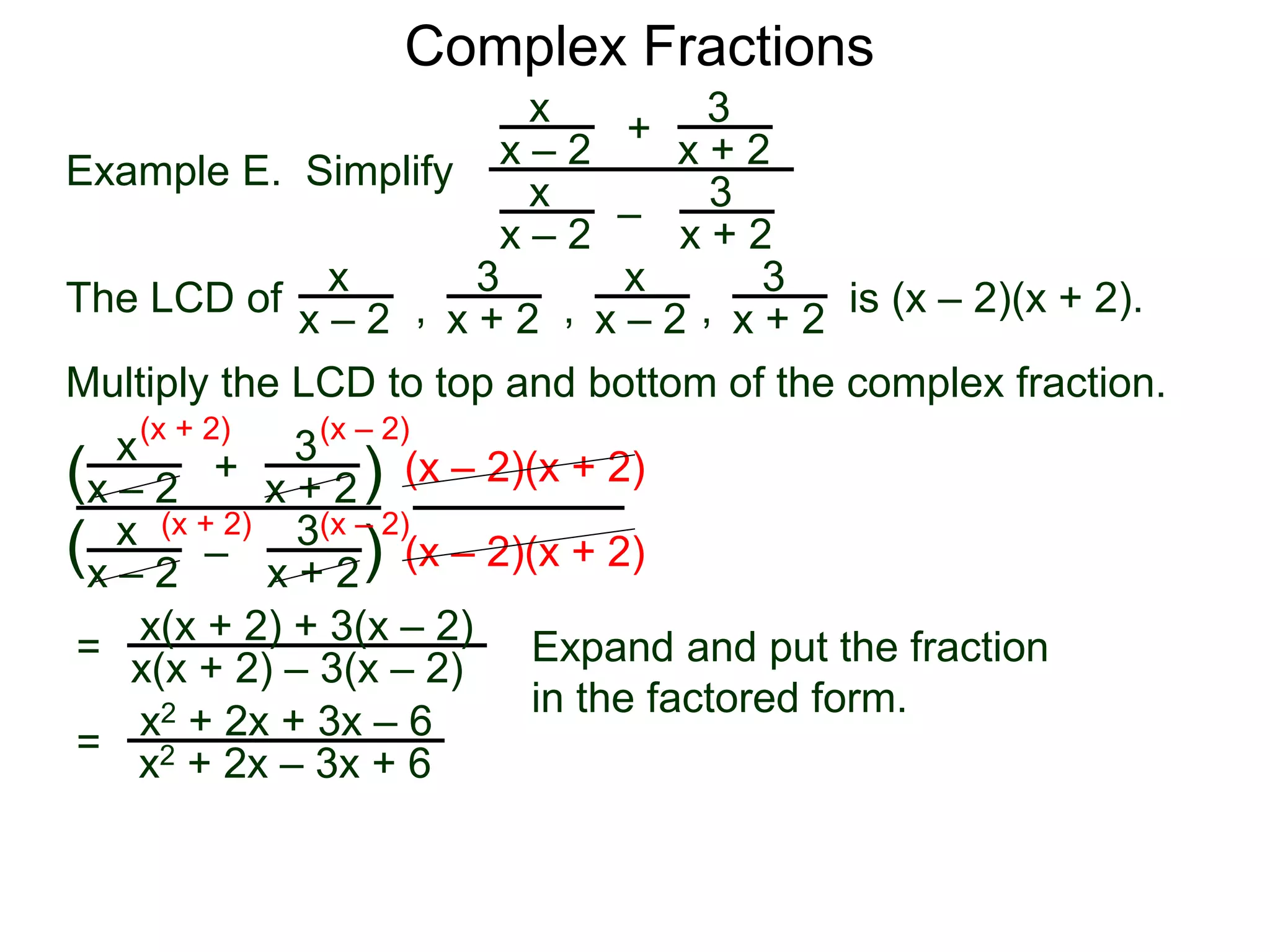
Multiply the LCD to top and bottom of the complex fraction.
x
x – 2
–
+
3
x + 2
3
x + 2
x
x – 2
(
( )
)
(x – 2)(x + 2)
(x – 2)(x + 2)
=
(x + 2)
(x + 2)
(x – 2)
(x – 2)
x(x + 2) + 3(x – 2)
x(x + 2) – 3(x – 2) Expand and put the fraction
in the factored form.
=
x2 + 2x + 3x – 6
x2 + 2x – 3x + 6
Complex Fractions
x
x – 2
–
+
3
x + 2
Example E. Simplify
The LCD of
3
x + 2
x
x – 2
x
x – 2
x
x – 2
3
x + 2
3
x + 2, , , is (x – 2)(x + 2).
Multiply the LCD to top and bottom of the complex fraction.
x
x – 2
–
+
3
x + 2
3
x + 2
x
x – 2
(
( )
)
(x – 2)(x + 2)
(x – 2)(x + 2)
=
(x + 2)
(x + 2)
(x – 2)
(x – 2)
x(x + 2) + 3(x – 2)
x(x + 2) – 3(x – 2) Expand and put the fraction
in the factored form.
=
x2 + 2x + 3x – 6
x2 + 2x – 3x + 6
=
x2 + 5x – 6
x2 – x + 6
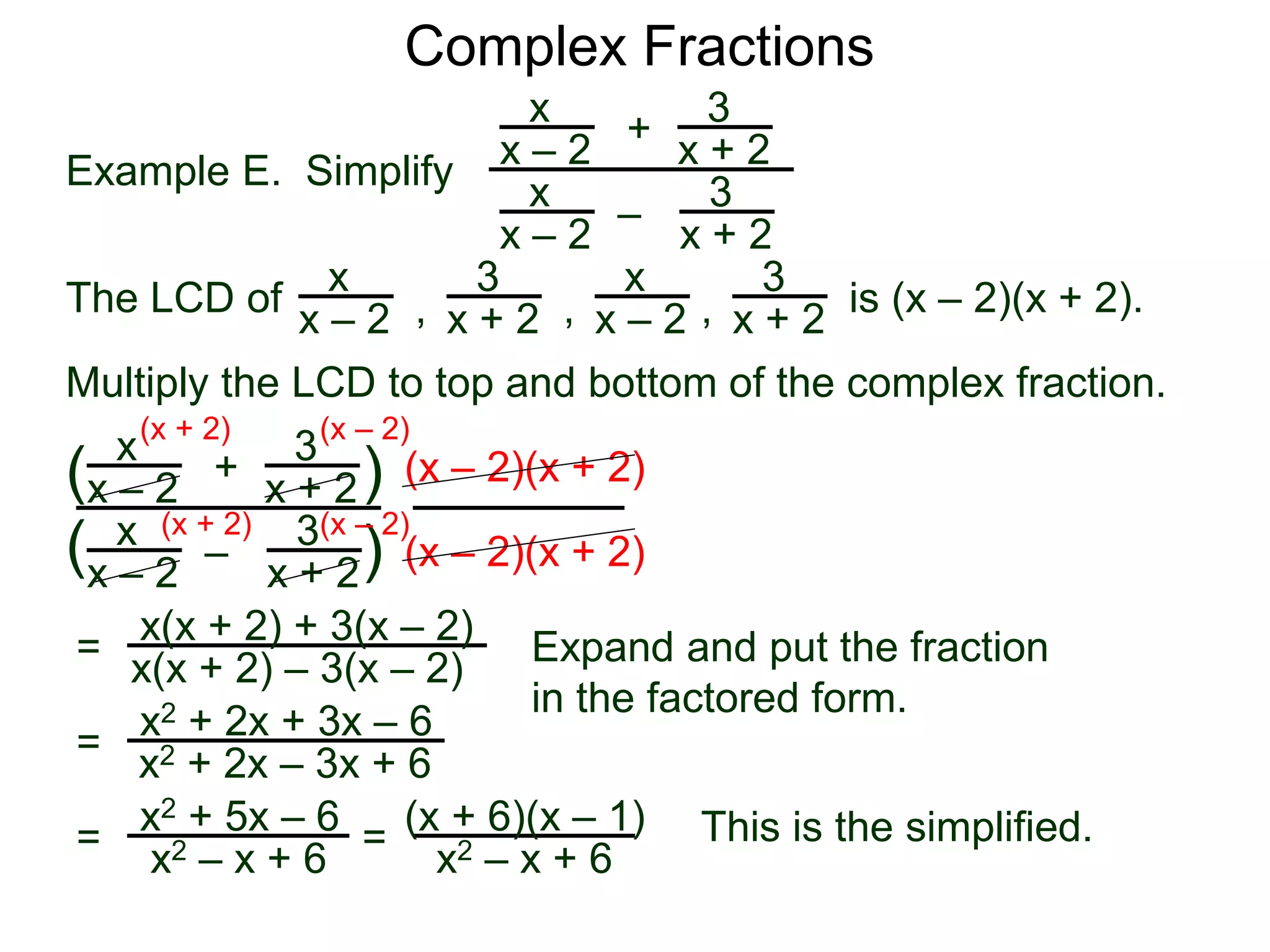
Complex Fractions
x
x – 2
–
+
3
x + 2
Example E. Simplify
The LCD of
3
x + 2
x
x – 2
x
x – 2
x
x – 2
3
x + 2
3
x + 2, , , is (x – 2)(x + 2).
Multiply the LCD to top and bottom of the complex fraction.
x
x – 2
–
+
3
x + 2
3
x + 2
x
x – 2
(
( )
)
(x – 2)(x + 2)
(x – 2)(x + 2)
=
(x + 2)
(x + 2)
(x – 2)
(x – 2)
x(x + 2) + 3(x – 2)
x(x + 2) – 3(x – 2) Expand and put the fraction
in the factored form.
=
x2 + 2x + 3x – 6
x2 + 2x – 3x + 6
=
x2 + 5x – 6
x2 – x + 6
This is the simplified.=
(x + 6)(x – 1)
x2 – x + 6
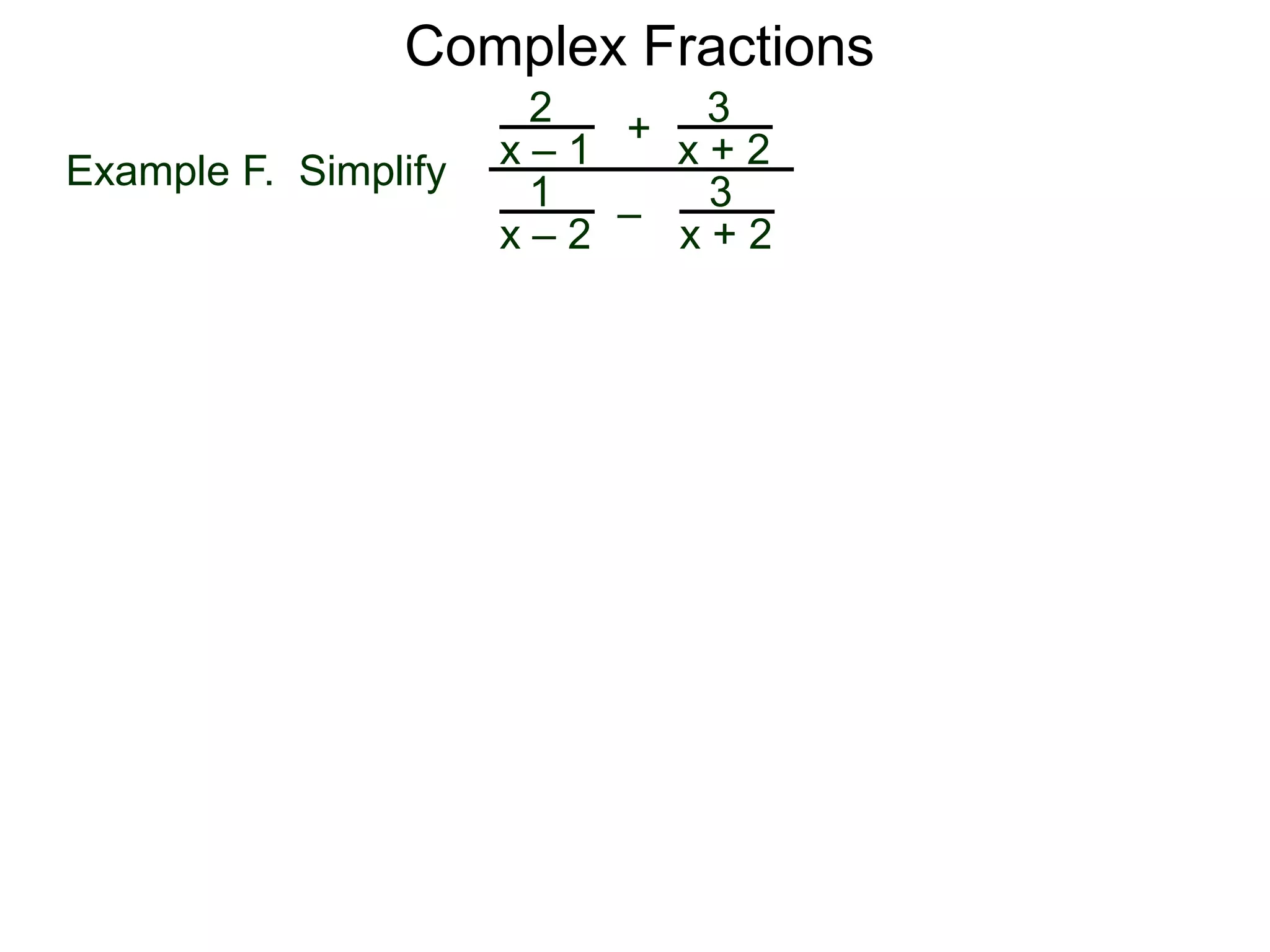
Complex Fractions
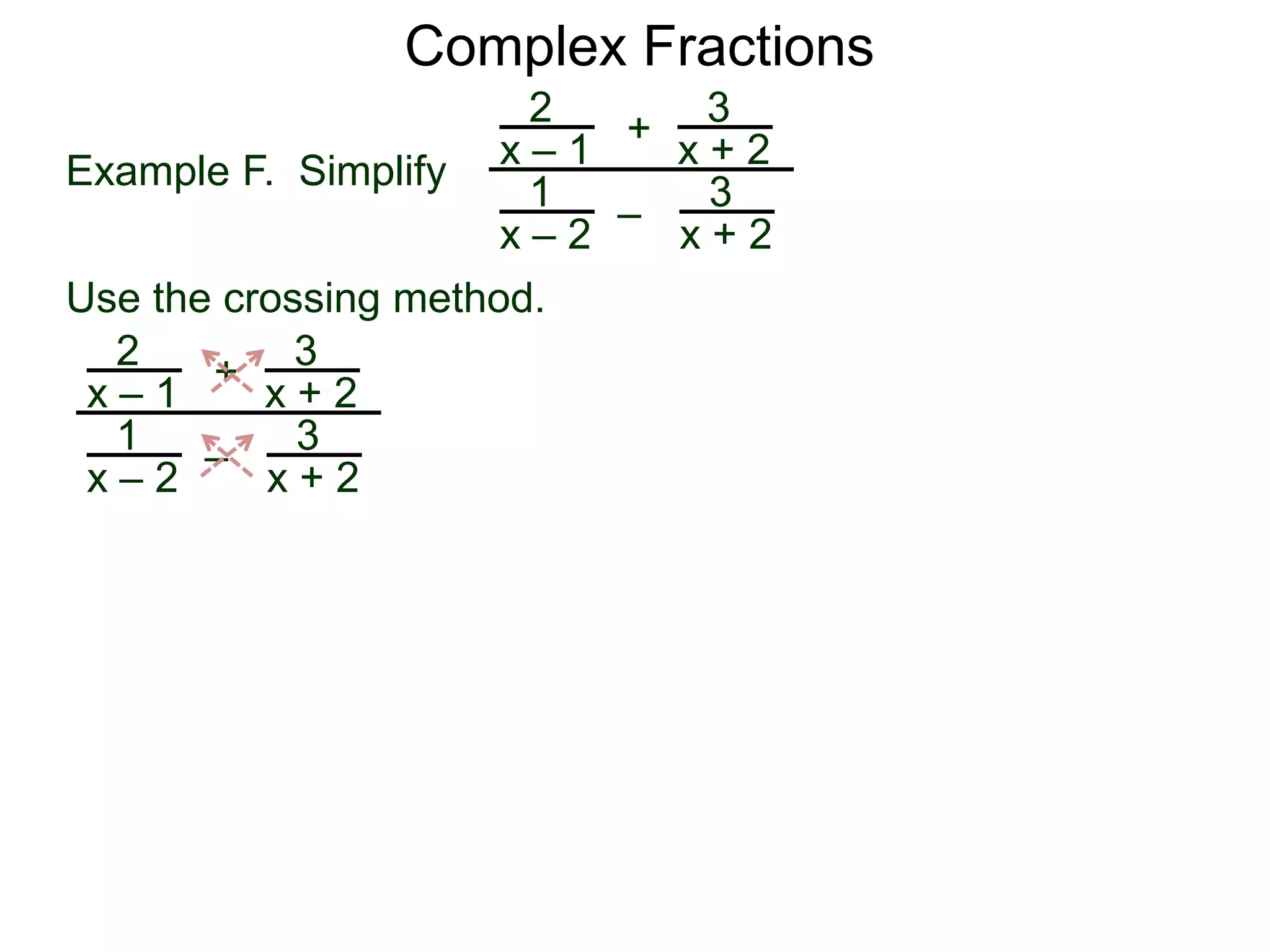
2
x – 1
–
+
3
x + 2
Example F. Simplify
3
x + 2
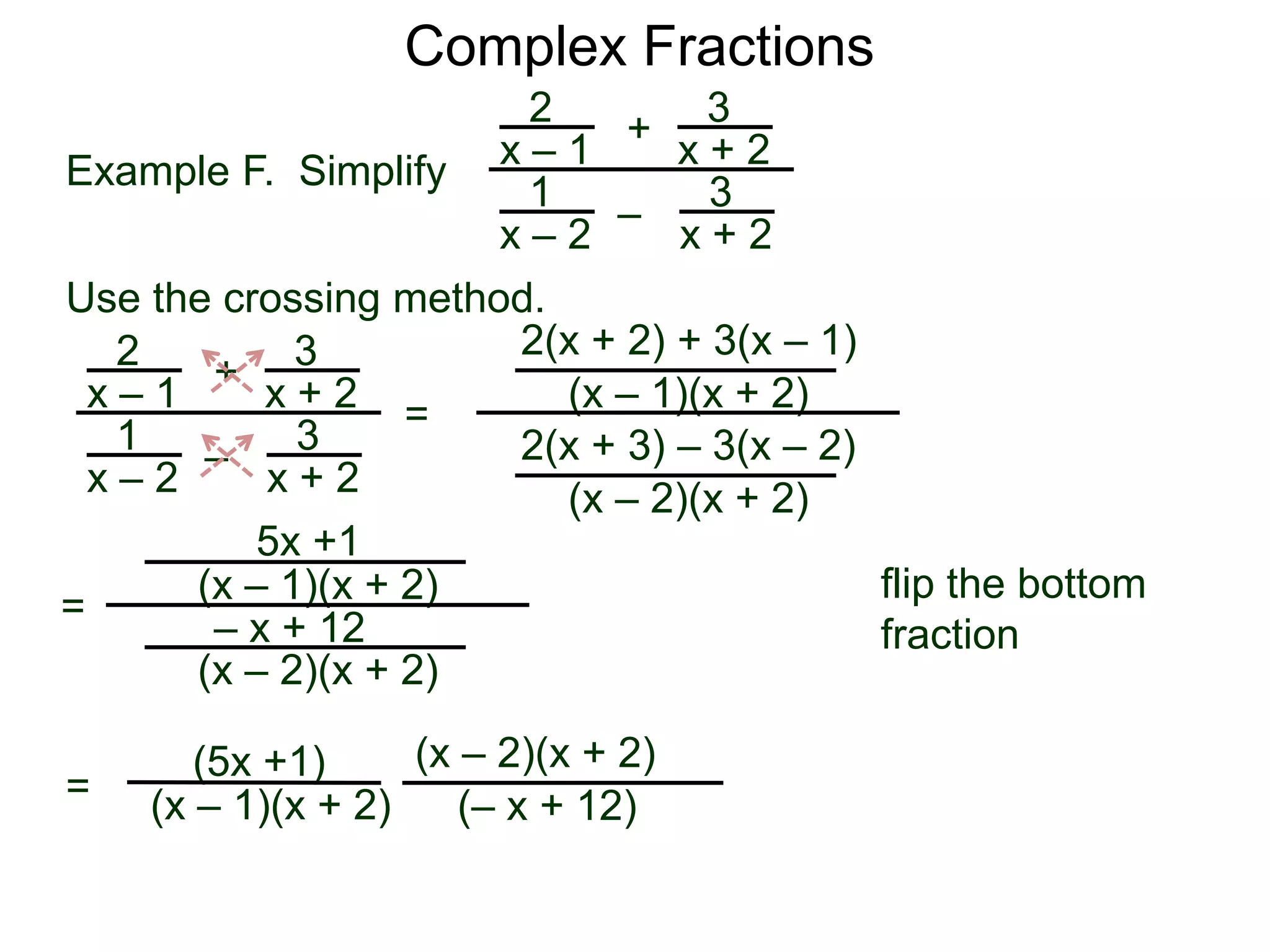
1
x – 2
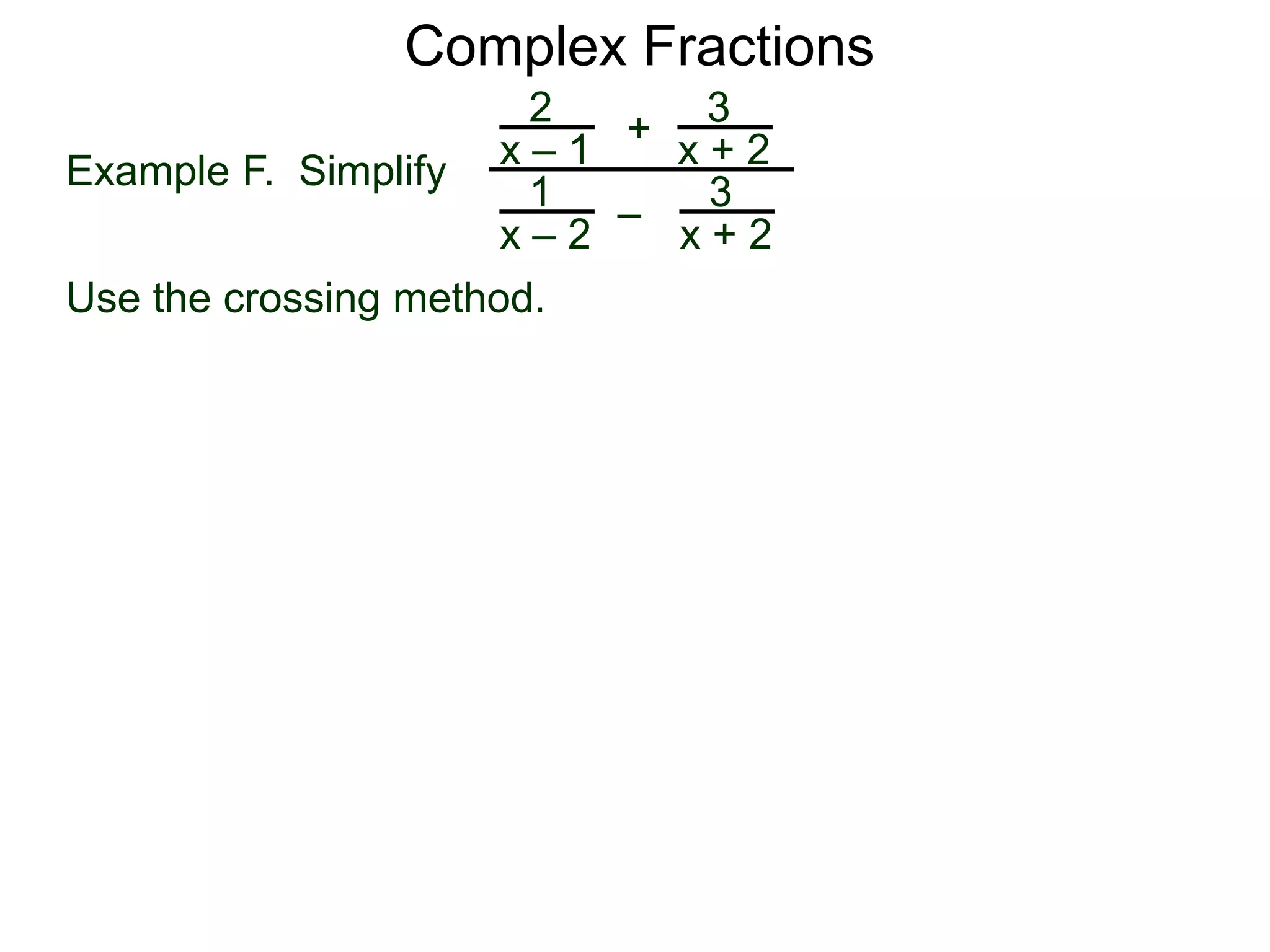
Complex Fractions
2
x – 1
–
+
3
x + 2
Example F. Simplify
3
x + 2
1
x – 2
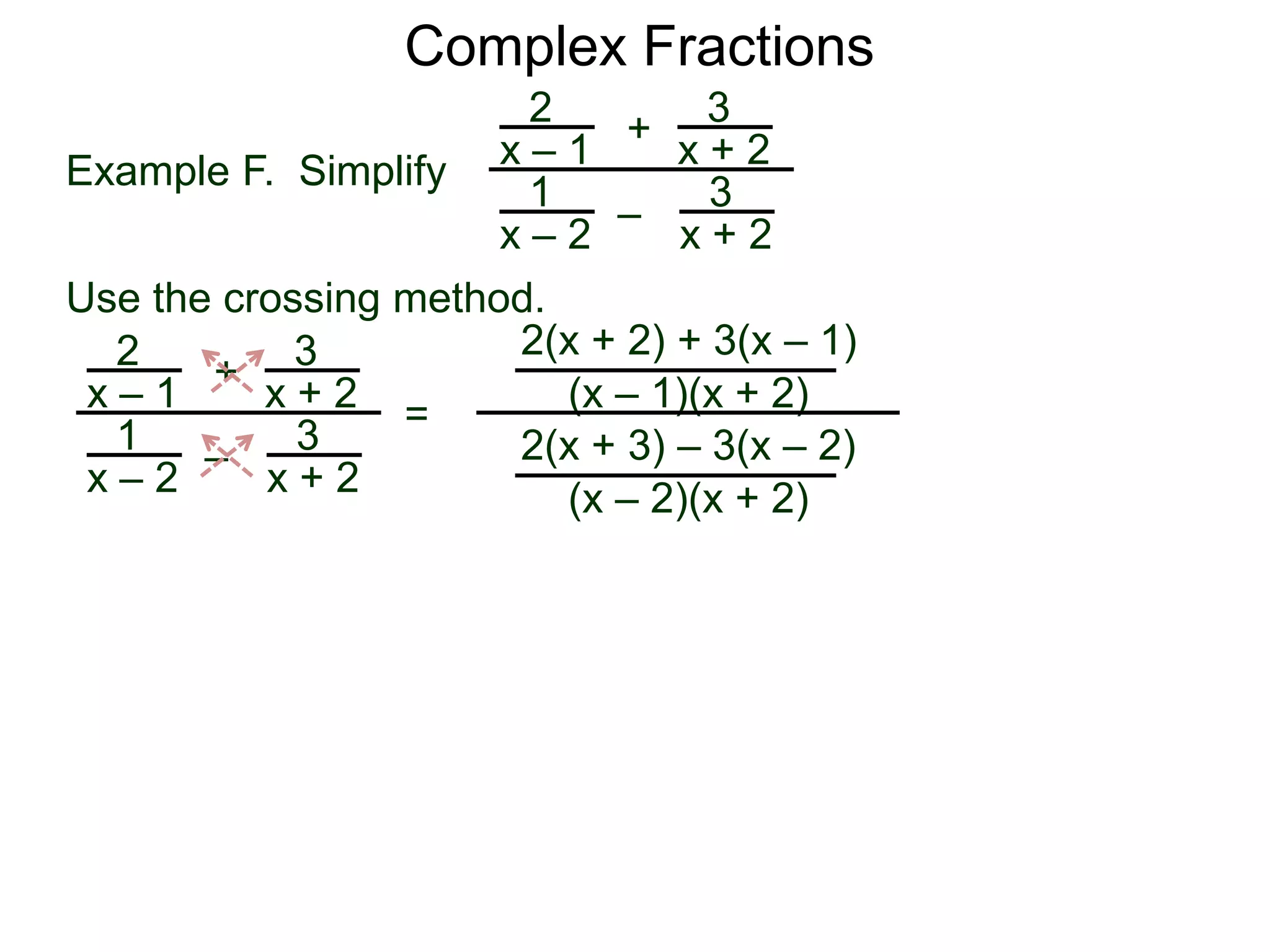
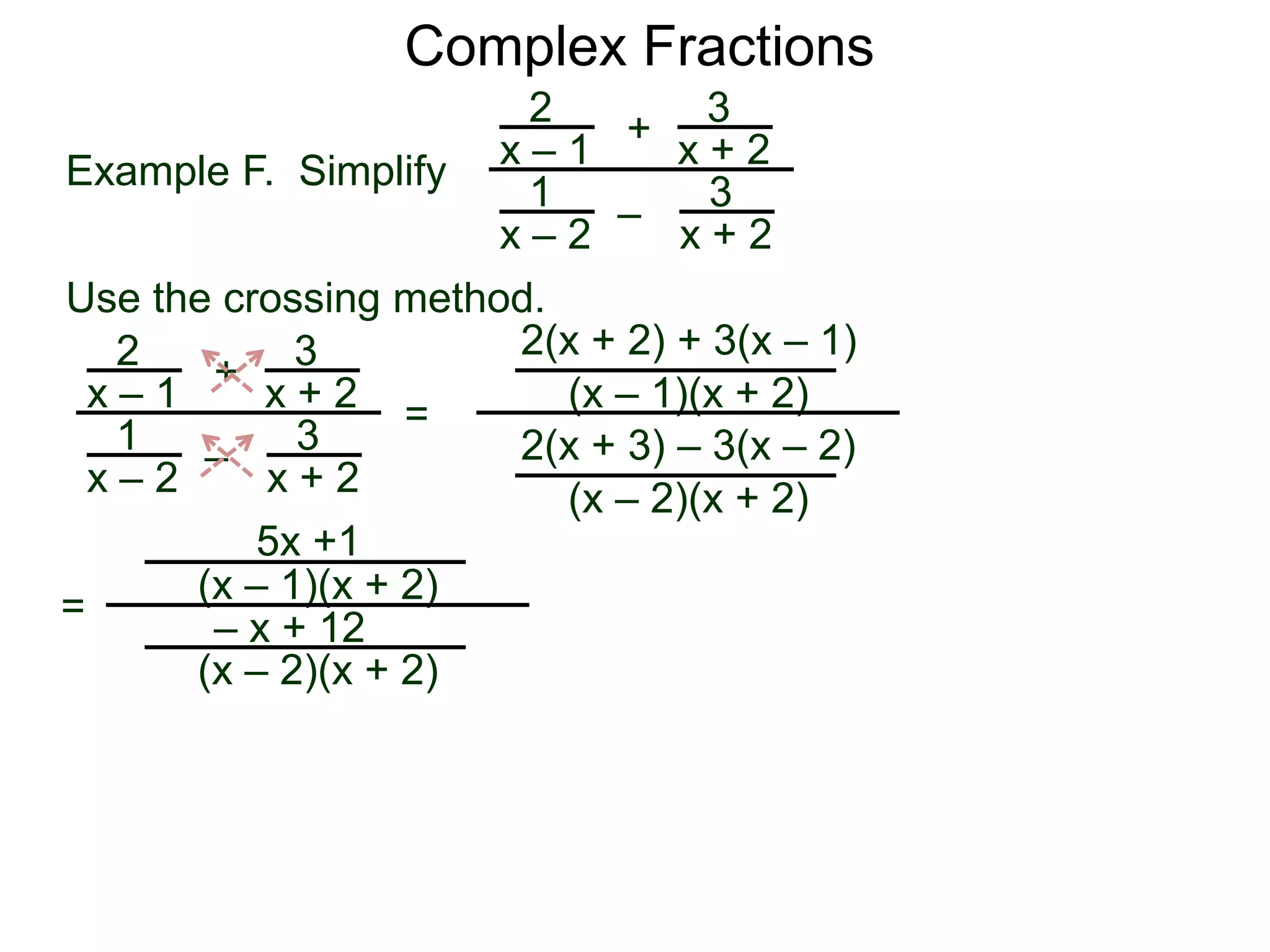
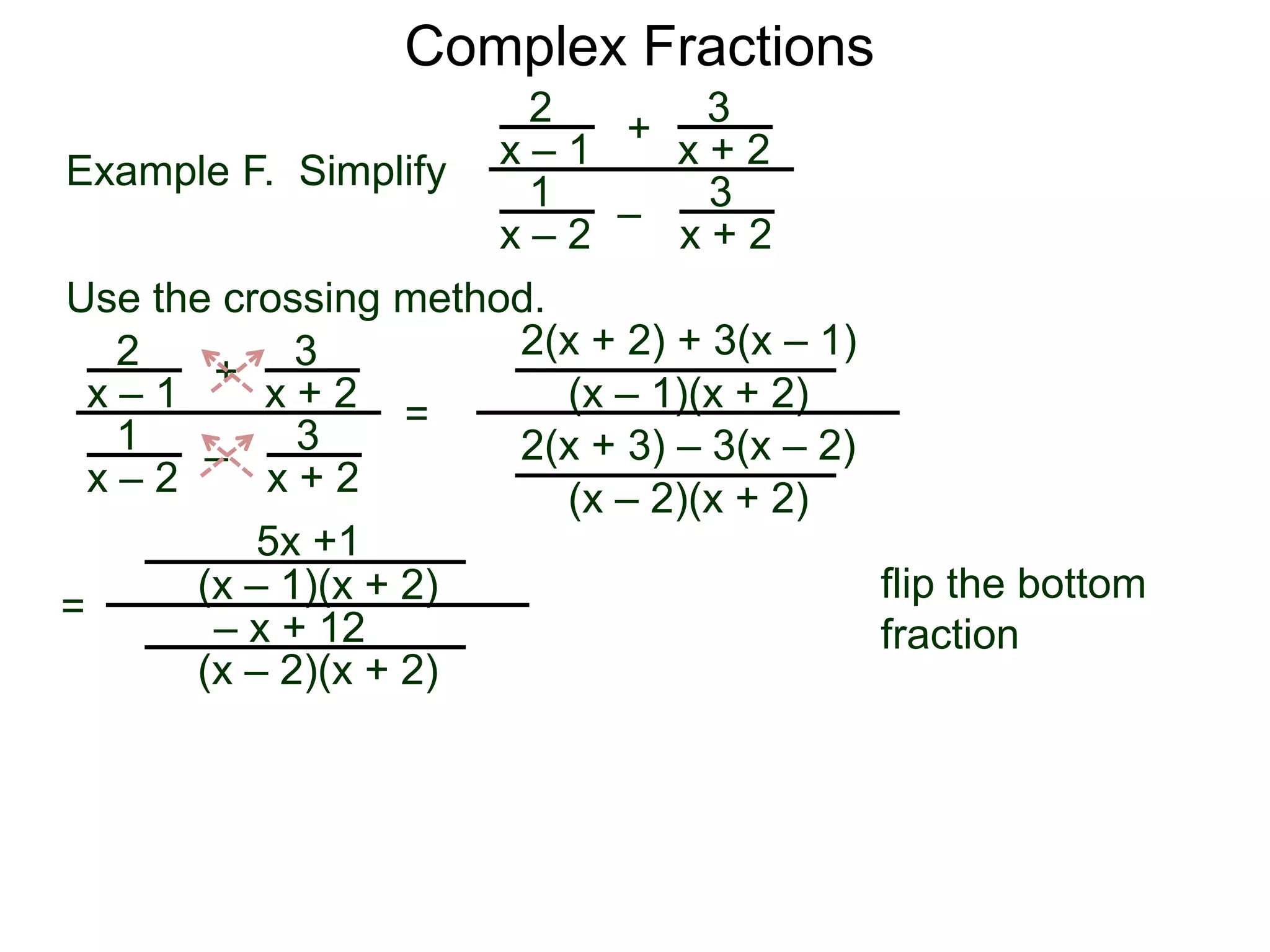
Use the crossing method.
Complex Fractions
2
x – 1
–
+
3
x + 2
Example F. Simplify
3
x + 2
1
x – 2
Use the crossing method.
2
x – 1
–
+
3
x + 2
3
x + 2
1
x – 2
Complex Fractions
2
x – 1
–
+
3
x + 2
Example F. Simplify
3
x + 2
1
x – 2
Use the crossing method.
2
x – 1
–
+
3
x + 2
3
x + 2
1
x – 2
=
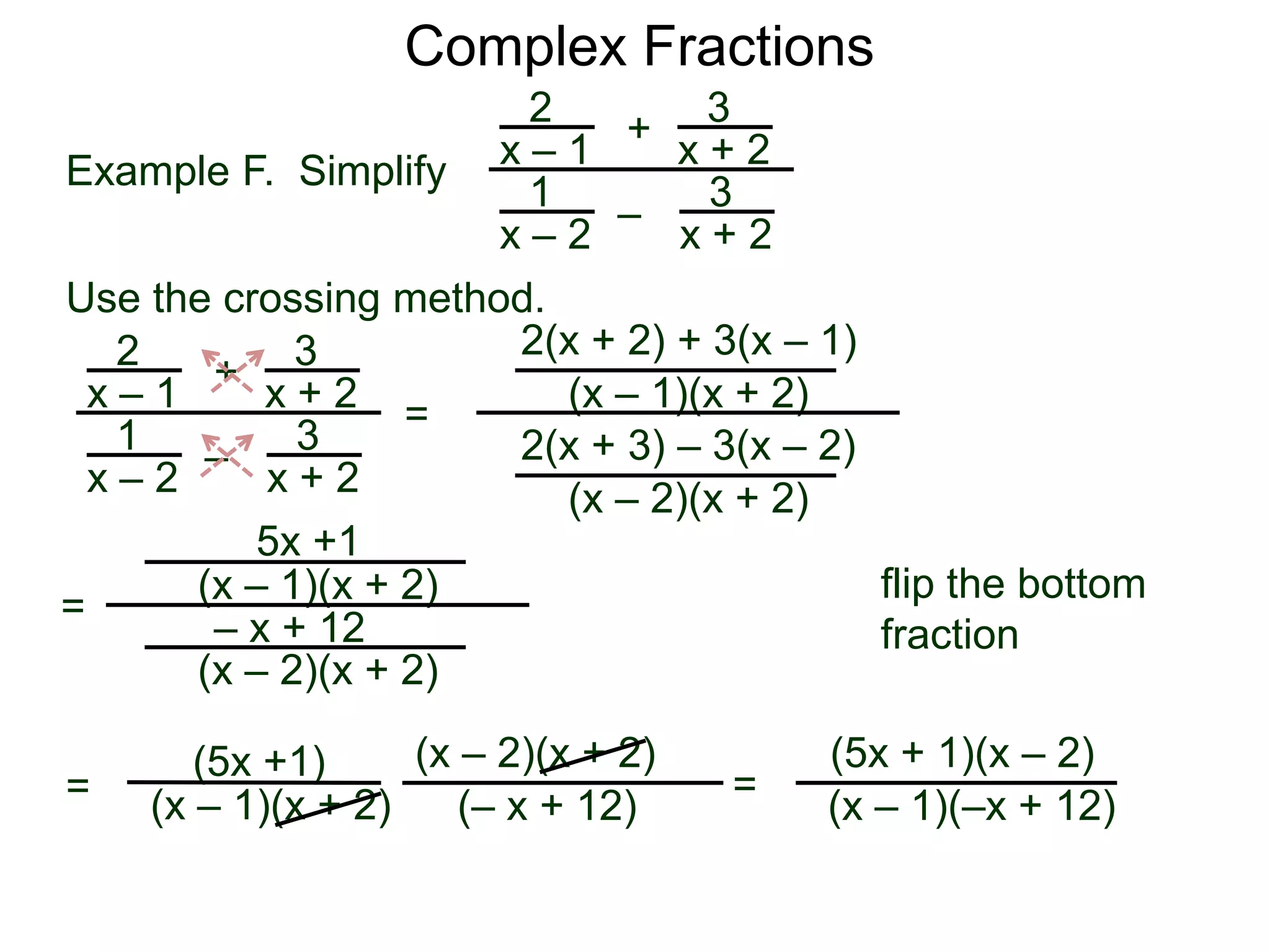
2(x + 2) + 3(x – 1)
(x – 1)(x + 2)
2(x + 3) – 3(x – 2)
(x – 2)(x + 2)
Complex Fractions
2
x – 1
–
+
3
x + 2
Example F. Simplify
3
x + 2
1
x – 2
Use the crossing method.
2
x – 1
–
+
3
x + 2
3
x + 2
1
x – 2
=
2(x + 2) + 3(x – 1)
(x – 1)(x + 2)
2(x + 3) – 3(x – 2)
(x – 2)(x + 2)
=
5x +1
(x – 1)(x + 2)
– x + 12
(x – 2)(x + 2)
Complex Fractions
2
x – 1
–
+
3
x + 2
Example F. Simplify
3
x + 2
1
x – 2
Use the crossing method.
2
x – 1
–
+
3
x + 2
3
x + 2
1
x – 2
=
2(x + 2) + 3(x – 1)
(x – 1)(x + 2)
2(x + 3) – 3(x – 2)
(x – 2)(x + 2)
flip the bottom
fraction
=
5x +1
(x – 1)(x + 2)
– x + 12
(x – 2)(x + 2)
Complex Fractions
2
x – 1
–
+
3
x + 2
Example F. Simplify
3
x + 2
1
x – 2
Use the crossing method.
2
x – 1
–
+
3
x + 2
3
x + 2
1
x – 2
=
2(x + 2) + 3(x – 1)
(x – 1)(x + 2)
2(x + 3) – 3(x – 2)
(x – 2)(x + 2)
flip the bottom
fraction
=
5x +1
(x – 1)(x + 2)
– x + 12
(x – 2)(x + 2)
=
(5x +1)
(x – 1)(x + 2) (– x + 12)
(x – 2)(x + 2)
Complex Fractions
2
x – 1
–
+
3
x + 2
Example F. Simplify
3
x + 2
1
x – 2
Use the crossing method.
2
x – 1
–
+
3
x + 2
3
x + 2
1
x – 2
=
2(x + 2) + 3(x – 1)
(x – 1)(x + 2)
2(x + 3) – 3(x – 2)
(x – 2)(x + 2)
flip the bottom
fraction
=
5x +1
(x – 1)(x + 2)
– x + 12
(x – 2)(x + 2)
=
(5x +1)
(x – 1)(x + 2) (– x + 12)
(x – 2)(x + 2)
=
(5x + 1)(x – 2)
(x – 1)(–x + 12)
Complex Fractions
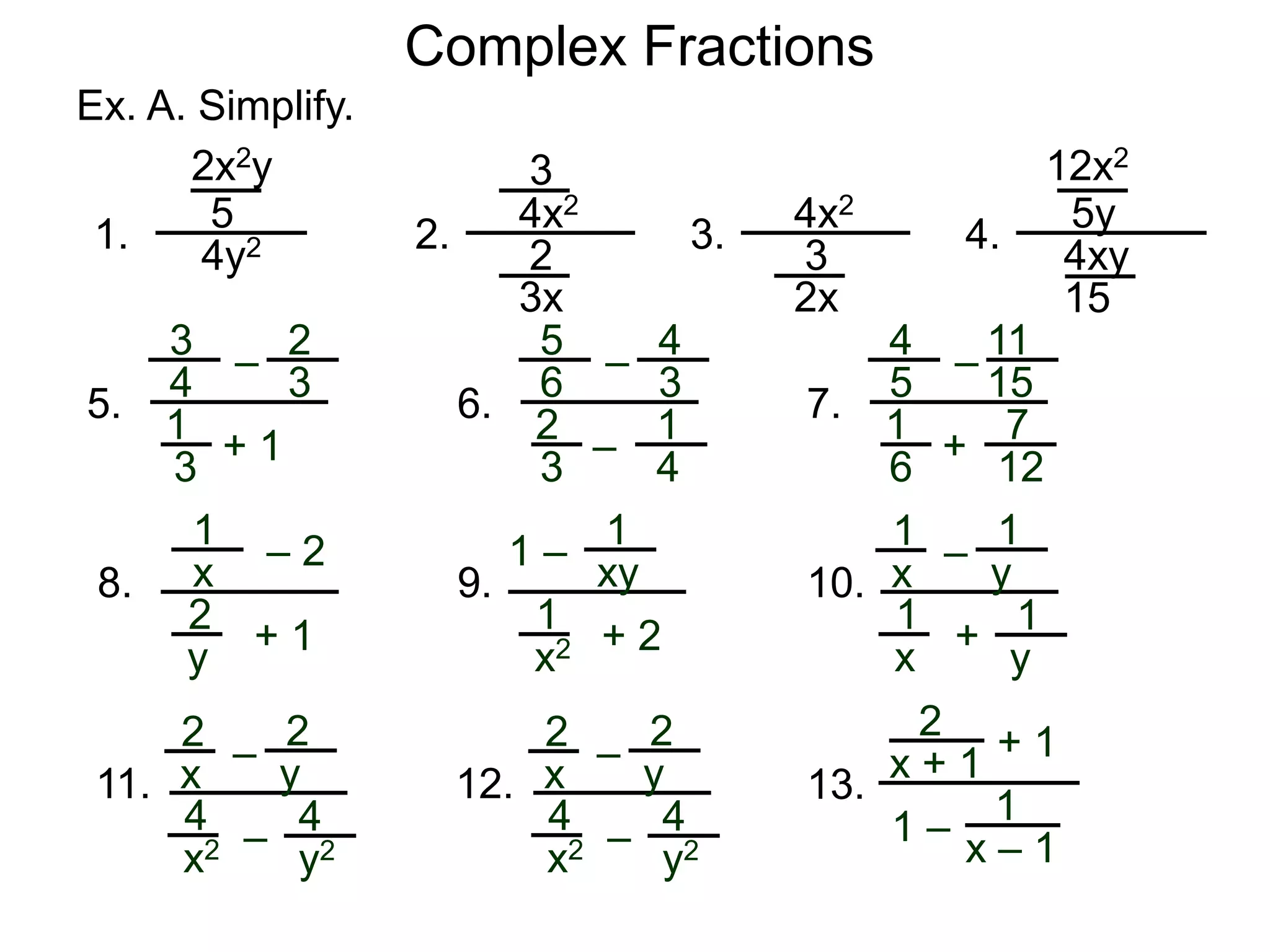
Ex. A. Simplify.
1.
2x2y
5
4y2 2.
3
4x2
3x
2 3.
4x2
2x
3 4.
12x2
5y
4xy
15
3
+ 1
–
1
3
4
5.
2
3
5
–
–
2
3
6
6.
4
3
1
4
4
+
–
1
6
5
7.
11
15
7
12
1
+ 1
– 2
2
y
x8.
1
+ 2
1 –
1
x2
xy9.
1
+
–
1
x
y10.
1
x
1
y
2
–
–
4
x2
y11.
2
x
4
y2
2
–
–
4
x2
y12.
2
x
4
y2
2
x + 1 + 1
1 –
1
x – 1
13.
Complex Fractions
1
2x + 1
– 2
3 –
1
x + 2
14.
2
x – 3
– 1
2 –
1
2x + 1
15.
2
x + 3
–
+
1
x + 3
16.
3
x + 2
3
x + 2
–2
2x + 1
–
+
3
x + 4
17.
1
x + 4
2
2x + 1
2
x + 2
–
+ 2
x + 5
18.
1
3x – 1
3
x + 2
4
2x + 3
–
+
3
x + 4
19.
3
3x – 2
5
3x – 2
–5
2x + 5
–
+ 3
–x + 4
20.
2
2x – 3
6
2x – 3
2
3
+ 2
2 –
–
1
6
2
3
1
2
+
21.
1
2
– +
5
6
2
3
1
4
–
22.
3
4
3
2
+
Complex Fractions
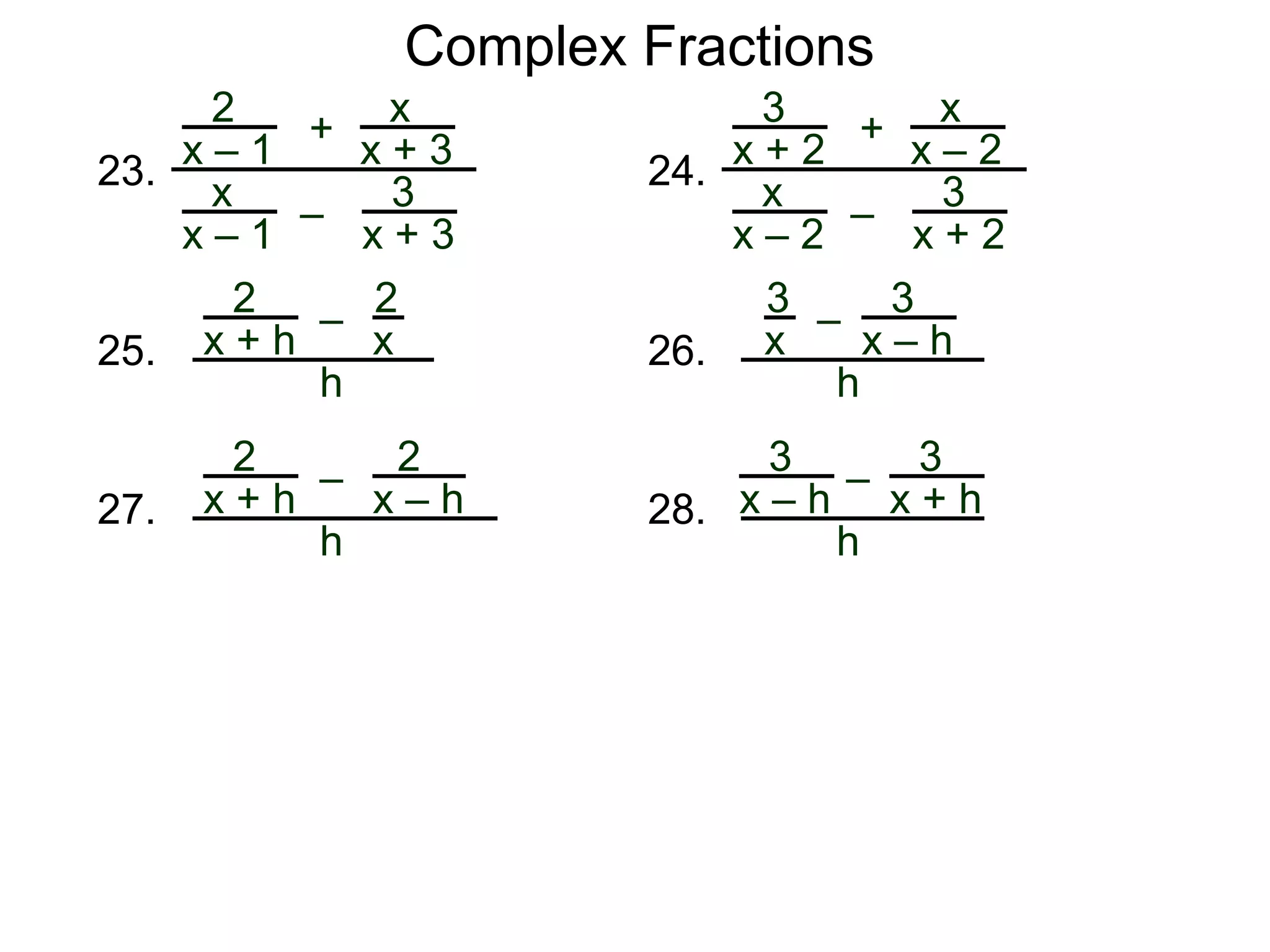
23.
2
x – 1
–
+
3
x + 3
x
x + 3
x
x – 1
24.
3
x + 2
–
+
3
x + 2
x
x – 2
x
x – 2
25.
2
x + h
–
2
x
h
26.
3
x – h
–
3
x
h
27.
2
x + h
– 2
x – h
h
28.
3
x + h
–
h
3
x – h

16 the multiplier method for simplifying complex fractions

  • 1.
  • 2.
    Complex Fractions A fractionwith its numerator or the denominator containing fraction(s) is called a complex fraction.
  • 3.
    Complex Fractions A fractionwith its numerator or the denominator containing fraction(s) is called a complex fraction. In other words, a complex fraction is a fractional expression divided by another fractional expression.
  • 4.
    Complex Fractions A fractionwith its numerator or the denominator containing fraction(s) is called a complex fraction. In other words, a complex fraction is a fractional expression divided by another fractional expression. We want to simplify complex fractions to regular fractions.
  • 5.
    Complex Fractions A fractionwith its numerator or the denominator containing fraction(s) is called a complex fraction. In other words, a complex fraction is a fractional expression divided by another fractional expression. We want to simplify complex fractions to regular fractions. The “easy” complex fractions are just regular divisions of of a fraction by another fraction.
  • 6.
    Complex Fractions A fractionwith its numerator or the denominator containing fraction(s) is called a complex fraction. In other words, a complex fraction is a fractional expression divided by another fractional expression. We want to simplify complex fractions to regular fractions. The “easy” complex fractions are just regular divisions of of a fraction by another fraction. In this case just flip the denominator then simplify the multiplication,
  • 7.
    Complex Fractions A fractionwith its numerator or the denominator containing fraction(s) is called a complex fraction. In other words, a complex fraction is a fractional expression divided by another fractional expression. We want to simplify complex fractions to regular fractions. The “easy” complex fractions are just regular divisions of of a fraction by another fraction. In this case just flip the denominator then simplify the multiplication, i.e. A B C D
  • 8.
    Complex Fractions A fractionwith its numerator or the denominator containing fraction(s) is called a complex fraction. In other words, a complex fraction is a fractional expression divided by another fractional expression. We want to simplify complex fractions to regular fractions. The “easy” complex fractions are just regular divisions of of a fraction by another fraction. In this case just flip the denominator then simplify the multiplication, i.e. A B C D A B C D* flip
  • 9.
    Complex Fractions A fractionwith its numerator or the denominator containing fraction(s) is called a complex fraction. In other words, a complex fraction is a fractional expression divided by another fractional expression. We want to simplify complex fractions to regular fractions. The “easy” complex fractions are just regular divisions of of a fraction by another fraction. In this case just flip the denominator then simplify the multiplication, i.e. A B C D A B C D* flip Example A. Simplify 4x2y 9 xy2 6
  • 10.
    Complex Fractions A fractionwith its numerator or the denominator containing fraction(s) is called a complex fraction. In other words, a complex fraction is a fractional expression divided by another fractional expression. We want to simplify complex fractions to regular fractions. The “easy” complex fractions are just regular divisions of of a fraction by another fraction. In this case just flip the denominator then simplify the multiplication, i.e. A B C D A B C D* flip Example A. Simplify 4x2y 9 xy2 6 = flip 4x2y 9 xy2 6
  • 11.
    Complex Fractions A fractionwith its numerator or the denominator containing fraction(s) is called a complex fraction. In other words, a complex fraction is a fractional expression divided by another fractional expression. We want to simplify complex fractions to regular fractions. The “easy” complex fractions are just regular divisions of of a fraction by another fraction. In this case just flip the denominator then simplify the multiplication, i.e. A B C D A B C D* flip Example A. Simplify 4x2y 9 xy2 6 = flip 4x2y 9 xy2 6 3 2
  • 12.
    Complex Fractions A fractionwith its numerator or the denominator containing fraction(s) is called a complex fraction. In other words, a complex fraction is a fractional expression divided by another fractional expression. We want to simplify complex fractions to regular fractions. The “easy” complex fractions are just regular divisions of of a fraction by another fraction. In this case just flip the denominator then simplify the multiplication, i.e. A B C D A B C D* flip Example A. Simplify 4x2y 9 xy2 6 = flip 4x2y 9 xy2 6 3 2x
  • 13.
    Complex Fractions A fractionwith its numerator or the denominator containing fraction(s) is called a complex fraction. In other words, a complex fraction is a fractional expression divided by another fractional expression. We want to simplify complex fractions to regular fractions. The “easy” complex fractions are just regular divisions of of a fraction by another fraction. In this case just flip the denominator then simplify the multiplication, i.e. A B C D A B C D* flip Example A. Simplify 4x2y 9 xy2 6 = flip 4x2y 9 xy2 6 3 2x y
  • 14.
    Complex Fractions A fractionwith its numerator or the denominator containing fraction(s) is called a complex fraction. In other words, a complex fraction is a fractional expression divided by another fractional expression. We want to simplify complex fractions to regular fractions. The “easy” complex fractions are just regular divisions of of a fraction by another fraction. In this case just flip the denominator then simplify the multiplication, i.e. A B C D A B C D* flip Example A. Simplify 4x2y 9 xy2 6 = flip 4x2y 9 xy2 6 = 3 2x y 8x 3y
  • 15.
    Complex Fractions We givetwo methods for simplifying general complex fractions.
  • 16.
    Complex Fractions We givetwo methods for simplifying general complex fractions. The first method is to reduce the problem to an “easy” problem.
  • 17.
    Complex Fractions We givetwo methods for simplifying general complex fractions. The first method is to reduce the problem to an “easy” problem. We do this by combining the numerator into one fraction and the denominator into one fraction.
  • 18.
    Complex Fractions We givetwo methods for simplifying general complex fractions. The first method is to reduce the problem to an “easy” problem. We do this by combining the numerator into one fraction and the denominator into one fraction. We can use cross multiplication for combining two fractions.
  • 19.
    Example B. Simplify ComplexFractions We give two methods for simplifying general complex fractions. The first method is to reduce the problem to an “easy” problem. We do this by combining the numerator into one fraction and the denominator into one fraction. We can use cross multiplication for combining two fractions. x x + 1 + 1 1 – x x – 1
  • 20.
    Example B. Simplify ComplexFractions We give two methods for simplifying general complex fractions. The first method is to reduce the problem to an “easy” problem. We do this by combining the numerator into one fraction and the denominator into one fraction. We can use cross multiplication for combining two fractions. x x + 1 + 1 1 – x x – 1x x + 1 + 1 1 – x x – 1
  • 21.
    Example B. Simplify ComplexFractions We give two methods for simplifying general complex fractions. The first method is to reduce the problem to an “easy” problem. We do this by combining the numerator into one fraction and the denominator into one fraction. We can use cross multiplication for combining two fractions. x x + 1 + 1 1 – x x – 1x x + 1 + 1 1 – x x – 1 = x x + 1 + – x x – 1 1 1 1 1
  • 22.
    Example B. Simplify ComplexFractions We give two methods for simplifying general complex fractions. The first method is to reduce the problem to an “easy” problem. We do this by combining the numerator into one fraction and the denominator into one fraction. We can use cross multiplication for combining two fractions. x x + 1 + 1 1 – x x – 1x x + 1 + 1 1 – x x – 1 = x x + 1 + – x x – 1 1 1 1 1 = x + (x + 1) x + 1
  • 23.
    Example B. Simplify ComplexFractions We give two methods for simplifying general complex fractions. The first method is to reduce the problem to an “easy” problem. We do this by combining the numerator into one fraction and the denominator into one fraction. We can use cross multiplication for combining two fractions. x x + 1 + 1 1 – x x – 1x x + 1 + 1 1 – x x – 1 = x x + 1 + – x x – 1 1 1 1 1 = x + (x + 1) x + 1 (x – 1) – x x – 1
  • 24.
    Example B. Simplify ComplexFractions We give two methods for simplifying general complex fractions. The first method is to reduce the problem to an “easy” problem. We do this by combining the numerator into one fraction and the denominator into one fraction. We can use cross multiplication for combining two fractions. x x + 1 + 1 1 – x x – 1x x + 1 + 1 1 – x x – 1 = x x + 1 + – x x – 1 1 1 1 1 = x + (x + 1) x + 1 (x – 1) – x x – 1 = 2x + 1 x + 1 –1 x – 1
  • 25.
    Complex Fractions x x +1 + 1 1 – x x – 1 = 2x + 1 x + 1 –1 x – 1 Therefore,
  • 26.
    Complex Fractions x x +1 + 1 1 – x x – 1 = 2x + 1 x + 1 –1 x – 1 Therefore, = (2x + 1) (x + 1) (x – 1) (–1)
  • 27.
    Complex Fractions x x +1 + 1 1 – x x – 1 = 2x + 1 x + 1 –1 x – 1 Therefore, = (2x + 1) (x + 1) (x – 1) = – (2x + 1) (x + 1) (x – 1) (–1)
  • 28.
    Complex Fractions x x +1 + 1 1 – x x – 1 = Therefore, The second method is to multiply the LCD of all the terms to the numerator and the denominator of the complex fraction. 2x + 1 x + 1 –1 x – 1 = (2x + 1) (x + 1) (x – 1) = – (2x + 1) (x + 1) (x – 1) (–1)
  • 29.
    Complex Fractions x x +1 + 1 1 – x x – 1 = Therefore, The second method is to multiply the LCD of all the terms to the numerator and the denominator of the complex fraction. Example C. Simplify 3 2 + 1 1 – – 5 6 2 3 3 4 + 2x + 1 x + 1 –1 x – 1 = (2x + 1) (x + 1) (x – 1) = – (2x + 1) (x + 1) (x – 1) (–1)
  • 30.
    Complex Fractions x x +1 + 1 1 – x x – 1 = Therefore, The second method is to multiply the LCD of all the terms to the numerator and the denominator of the complex fraction. Example C. Simplify 3 2 + 1 1 – – 5 6 2 3 3 4 + The LCD of 2 3 3 2 5 6 3 4, , , is 12. 2x + 1 x + 1 –1 x – 1 = (2x + 1) (x + 1) (x – 1) = – (2x + 1) (x + 1) (x – 1) (–1)
  • 31.
    Complex Fractions x x +1 + 1 1 – x x – 1 = Therefore, The second method is to multiply the LCD of all the terms to the numerator and the denominator of the complex fraction. Example C. Simplify 3 2 + 1 1 – – 5 6 2 3 3 4 + The LCD of 2 3 3 2 5 6 3 4, , , is 12. Multiply 12 to the top and bottom of the complex fraction. 3 2 + 1 1 – – 5 6 2 3 3 4 + 2x + 1 x + 1 –1 x – 1 = (2x + 1) (x + 1) (–1) (x – 1) = – (2x + 1) (x + 1) (x – 1)
  • 32.
    Complex Fractions x x +1 + 1 1 – x x – 1 = Therefore, The second method is to multiply the LCD of all the terms to the numerator and the denominator of the complex fraction. Example C. Simplify 3 2 + 1 1 – – 5 6 2 3 3 4 + The LCD of 2 3 3 2 5 6 3 4, , , is 12. Multiply 12 to the top and bottom of the complex fraction. 3 2 + 1 1 – – 5 6 2 3 3 4 +( ( ) ) 12 12 2x + 1 x + 1 –1 x – 1 = (2x + 1) (x + 1) (–1) (x – 1) = – (2x + 1) (x + 1) (x – 1)
  • 33.
    Complex Fractions x x +1 + 1 1 – x x – 1 = Therefore, The second method is to multiply the LCD of all the terms to the numerator and the denominator of the complex fraction. Example C. Simplify 3 2 + 1 1 – – 5 6 2 3 3 4 + The LCD of 2 3 3 2 5 6 3 4, , , is 12. Multiply 12 to the top and bottom of the complex fraction. 3 2 + 1 1 – – 5 6 2 3 3 4 +( ( ) ) 12 12 2x + 1 x + 1 –1 x – 1 = (2x + 1) (x + 1) (x – 1) = – (2x + 1) (x + 1) (x – 1) This is OK since is 1. 12 121 (–1)
  • 34.
    Complex Fractions x x +1 + 1 1 – x x – 1 = Therefore, The second method is to multiply the LCD of all the terms to the numerator and the denominator of the complex fraction. Example C. Simplify 3 2 + 1 1 – – 5 6 2 3 3 4 + The LCD of 2 3 3 2 5 6 3 4, , , is 12. Multiply 12 to the top and bottom of the complex fraction. 3 2 + 1 1 – – 5 6 2 3 3 4 +( ( ) ) 12 12 6 2x + 1 x + 1 –1 x – 1 = (2x + 1) (x + 1) (x – 1) = – (2x + 1) (x + 1) (x – 1) Distribute the multiplication. (–1)
  • 35.
    Complex Fractions x x +1 + 1 1 – x x – 1 = Therefore, The second method is to multiply the LCD of all the terms to the numerator and the denominator of the complex fraction. Example C. Simplify 3 2 + 1 1 – – 5 6 2 3 3 4 + The LCD of 2 3 3 2 5 6 3 4, , , is 12. Multiply 12 to the top and bottom of the complex fraction. 3 2 + 1 1 – – 5 6 2 3 3 4 +( ( ) ) 12 12 6 12 2x + 1 x + 1 –1 x – 1 = (2x + 1) (x + 1) (x – 1) = – (2x + 1) (x + 1) (x – 1) Distribute the multiplication. (–1)
  • 36.
    Complex Fractions x x +1 + 1 1 – x x – 1 = Therefore, The second method is to multiply the LCD of all the terms to the numerator and the denominator of the complex fraction. Example C. Simplify 3 2 + 1 1 – – 5 6 2 3 3 4 + The LCD of 2 3 3 2 5 6 3 4, , , is 12. Multiply 12 to the top and bottom of the complex fraction. 3 2 + 1 1 – – 5 6 2 3 3 4 +( ( ) ) 12 12 6 12 2 2x + 1 x + 1 –1 x – 1 = (2x + 1) (x + 1) (x – 1) = – (2x + 1) (x + 1) (x – 1) Distribute the multiplication. (–1)
  • 37.
    Complex Fractions x x +1 + 1 1 – x x – 1 = Therefore, The second method is to multiply the LCD of all the terms to the numerator and the denominator of the complex fraction. Example C. Simplify 3 2 + 1 1 – – 5 6 2 3 3 4 + The LCD of 2 3 3 2 5 6 3 4, , , is 12. Multiply 12 to the top and bottom of the complex fraction. 3 2 + 1 1 – – 5 6 2 3 3 4 +( ( ) ) 12 12 6 12 2 12 4 3 2x + 1 x + 1 –1 x – 1 = (2x + 1) (x + 1) (x – 1) = – (2x + 1) (x + 1) (x – 1) Distribute the multiplication. (–1)
  • 38.
    Complex Fractions x x +1 + 1 1 – x x – 1 = Therefore, The second method is to multiply the LCD of all the terms to the numerator and the denominator of the complex fraction. Example C. Simplify 3 2 + 1 1 – – 5 6 2 3 3 4 + The LCD of 2 3 3 2 5 6 3 4, , , is 12. Multiply 12 to the top and bottom of the complex fraction. 3 2 + 1 1 – – 5 6 2 3 3 4 +( ( ) ) 12 12 = 6 12 2 12 4 3 18 + 12 – 10 12 – 8 + 9 2x + 1 x + 1 –1 x – 1 = (2x + 1) (x + 1) (x – 1) = – (2x + 1) (x + 1) (x – 1) (–1)
  • 39.
    Complex Fractions x x +1 + 1 1 – x x – 1 = Therefore, The second method is to multiply the LCD of all the terms to the numerator and the denominator of the complex fraction. Example C. Simplify 3 2 + 1 1 – – 5 6 2 3 3 4 + The LCD of 2 3 3 2 5 6 3 4, , , is 12. Multiply 12 to the top and bottom of the complex fraction. 3 2 + 1 1 – – 5 6 2 3 3 4 +( ( ) ) 12 12 = 6 12 2 12 4 3 18 + 12 – 10 12 – 8 + 9 = 20 13 2x + 1 x + 1 –1 x – 1 = (2x + 1) (x + 1) (x – 1) = – (2x + 1) (x + 1) (x – 1) (–1)
  • 40.
    Complex Fractions x2 + 1 –1 Example D. Simplify x y y2
  • 41.
    Complex Fractions x2 + 1 –1 Example D. Simplify The LCD of x y is y2. y2 x2 x yy2 ,
  • 42.
    Complex Fractions x2 + 1 –1 Example D. Simplify The LCD of x y is y2. Multiply the LCD to top and bottom of the complex fraction. y2 x2 x yy2 , x2 + 1 – 1 x y y2
  • 43.
    Complex Fractions x2 + 1 –1 Example D. Simplify The LCD of x y is y2. Multiply the LCD to top and bottom of the complex fraction. y2 x2 x yy2 , x2 + 1 – 1 x y y2 ( ( ) ) y2 y2
  • 44.
    Complex Fractions x2 + 1 –1 Example D. Simplify The LCD of x y is y2. Multiply the LCD to top and bottom of the complex fraction. y2 x2 x yy2 , x2 + 1 – 1 x y y2 ( ( ) ) y2 y2 1
  • 45.
    Complex Fractions x2 + 1 –1 Example D. Simplify The LCD of x y is y2. Multiply the LCD to top and bottom of the complex fraction. y2 x2 x yy2 , x2 + 1 – 1 x y y2 ( ( ) ) y2 y2 y21
  • 46.
    Complex Fractions x2 + 1 –1 Example D. Simplify The LCD of x y is y2. Multiply the LCD to top and bottom of the complex fraction. y2 x2 x yy2 , x2 + 1 – 1 x y y2 ( ( ) ) y2 y2 y2 y2y 1
  • 47.
    Complex Fractions x2 + 1 –1 Example D. Simplify The LCD of x y is y2. Multiply the LCD to top and bottom of the complex fraction. y2 x2 x yy2 , x2 + 1 – 1 x y y2 ( ( ) ) y2 y2 = y2 y2y 1 x2 – y2 xy + y2
  • 48.
    Complex Fractions x2 + 1 –1 Example D. Simplify The LCD of x y is y2. Multiply the LCD to top and bottom of the complex fraction. y2 x2 x yy2 , x2 + 1 – 1 x y y2 ( ( ) ) y2 y2 = y2 y2y 1 x2 – y2 xy + y2 = (x – y)(x + y) y(x + y) To simplify this, put it in the factored form .
  • 49.
    Complex Fractions x2 + 1 –1 Example D. Simplify The LCD of x y is y2. Multiply the LCD to top and bottom of the complex fraction. y2 x2 x yy2 , x2 + 1 – 1 x y y2 ( ( ) ) y2 y2 = y2 y2y 1 x2 – y2 xy + y2 To simplify this, put it in the factored form . = (x – y)(x + y) y(x + y)
  • 50.
    Complex Fractions x2 + 1 –1 Example D. Simplify The LCD of x y is y2. Multiply the LCD to top and bottom of the complex fraction. y2 x2 x yy2 , x2 + 1 – 1 x y y2 ( ( ) ) y2 y2 = y2 y2y 1 x2 – y2 xy + y2 To simplify this, put it in the factored form . = (x – y)(x + y) y(x + y) = x – y y
  • 51.
    Complex Fractions x x –2 – + 3 x + 2 Example E. Simplify 3 x + 2 x x – 2
  • 52.
    Complex Fractions x x –2 – + 3 x + 2 Example E. Simplify The LCD of 3 x + 2 x x – 2 x x – 2 x x – 2 3 x + 2 3 x + 2, , , is (x – 2)(x + 2).
  • 53.
    Complex Fractions x x –2 – + 3 x + 2 Example E. Simplify The LCD of 3 x + 2 x x – 2 x x – 2 x x – 2 3 x + 2 3 x + 2, , , is (x – 2)(x + 2). Multiply the LCD to top and bottom of the complex fraction. x x – 2 – + 3 x + 2 3 x + 2 x x – 2
  • 54.
    Complex Fractions x x –2 – + 3 x + 2 Example E. Simplify The LCD of 3 x + 2 x x – 2 x x – 2 x x – 2 3 x + 2 3 x + 2, , , is (x – 2)(x + 2). Multiply the LCD to top and bottom of the complex fraction. x x – 2 – + 3 x + 2 3 x + 2 x x – 2 ( ( ) ) (x – 2)(x + 2) (x – 2)(x + 2)
  • 55.
    Complex Fractions x x –2 – + 3 x + 2 Example E. Simplify The LCD of 3 x + 2 x x – 2 x x – 2 x x – 2 3 x + 2 3 x + 2, , , is (x – 2)(x + 2). Multiply the LCD to top and bottom of the complex fraction. x x – 2 – + 3 x + 2 3 x + 2 x x – 2 ( ( ) ) (x – 2)(x + 2) (x – 2)(x + 2) (x + 2)
  • 56.
    Complex Fractions x x –2 – + 3 x + 2 Example E. Simplify The LCD of 3 x + 2 x x – 2 x x – 2 x x – 2 3 x + 2 3 x + 2, , , is (x – 2)(x + 2). Multiply the LCD to top and bottom of the complex fraction. x x – 2 – + 3 x + 2 3 x + 2 x x – 2 ( ( ) ) (x – 2)(x + 2) (x – 2)(x + 2) (x + 2) (x – 2)
  • 57.
    Complex Fractions x x –2 – + 3 x + 2 Example E. Simplify The LCD of 3 x + 2 x x – 2 x x – 2 x x – 2 3 x + 2 3 x + 2, , , is (x – 2)(x + 2). Multiply the LCD to top and bottom of the complex fraction. x x – 2 – + 3 x + 2 3 x + 2 x x – 2 ( ( ) ) (x – 2)(x + 2) (x – 2)(x + 2) = (x + 2) (x + 2) (x – 2) (x – 2) x(x + 2) + 3(x – 2) x(x + 2) – 3(x – 2) Expand and put the fraction in the factored form.
  • 58.
    Complex Fractions x x –2 – + 3 x + 2 Example E. Simplify The LCD of 3 x + 2 x x – 2 x x – 2 x x – 2 3 x + 2 3 x + 2, , , is (x – 2)(x + 2). Multiply the LCD to top and bottom of the complex fraction. x x – 2 – + 3 x + 2 3 x + 2 x x – 2 ( ( ) ) (x – 2)(x + 2) (x – 2)(x + 2) = (x + 2) (x + 2) (x – 2) (x – 2) x(x + 2) + 3(x – 2) x(x + 2) – 3(x – 2) Expand and put the fraction in the factored form. = x2 + 2x + 3x – 6 x2 + 2x – 3x + 6
  • 59.
    Complex Fractions x x –2 – + 3 x + 2 Example E. Simplify The LCD of 3 x + 2 x x – 2 x x – 2 x x – 2 3 x + 2 3 x + 2, , , is (x – 2)(x + 2). Multiply the LCD to top and bottom of the complex fraction. x x – 2 – + 3 x + 2 3 x + 2 x x – 2 ( ( ) ) (x – 2)(x + 2) (x – 2)(x + 2) = (x + 2) (x + 2) (x – 2) (x – 2) x(x + 2) + 3(x – 2) x(x + 2) – 3(x – 2) Expand and put the fraction in the factored form. = x2 + 2x + 3x – 6 x2 + 2x – 3x + 6 = x2 + 5x – 6 x2 – x + 6
  • 60.
    Complex Fractions x x –2 – + 3 x + 2 Example E. Simplify The LCD of 3 x + 2 x x – 2 x x – 2 x x – 2 3 x + 2 3 x + 2, , , is (x – 2)(x + 2). Multiply the LCD to top and bottom of the complex fraction. x x – 2 – + 3 x + 2 3 x + 2 x x – 2 ( ( ) ) (x – 2)(x + 2) (x – 2)(x + 2) = (x + 2) (x + 2) (x – 2) (x – 2) x(x + 2) + 3(x – 2) x(x + 2) – 3(x – 2) Expand and put the fraction in the factored form. = x2 + 2x + 3x – 6 x2 + 2x – 3x + 6 = x2 + 5x – 6 x2 – x + 6 This is the simplified.= (x + 6)(x – 1) x2 – x + 6
  • 61.
    Complex Fractions 2 x –1 – + 3 x + 2 Example F. Simplify 3 x + 2 1 x – 2
  • 62.
    Complex Fractions 2 x –1 – + 3 x + 2 Example F. Simplify 3 x + 2 1 x – 2 Use the crossing method.
  • 63.
    Complex Fractions 2 x –1 – + 3 x + 2 Example F. Simplify 3 x + 2 1 x – 2 Use the crossing method. 2 x – 1 – + 3 x + 2 3 x + 2 1 x – 2
  • 64.
    Complex Fractions 2 x –1 – + 3 x + 2 Example F. Simplify 3 x + 2 1 x – 2 Use the crossing method. 2 x – 1 – + 3 x + 2 3 x + 2 1 x – 2 = 2(x + 2) + 3(x – 1) (x – 1)(x + 2) 2(x + 3) – 3(x – 2) (x – 2)(x + 2)
  • 65.
    Complex Fractions 2 x –1 – + 3 x + 2 Example F. Simplify 3 x + 2 1 x – 2 Use the crossing method. 2 x – 1 – + 3 x + 2 3 x + 2 1 x – 2 = 2(x + 2) + 3(x – 1) (x – 1)(x + 2) 2(x + 3) – 3(x – 2) (x – 2)(x + 2) = 5x +1 (x – 1)(x + 2) – x + 12 (x – 2)(x + 2)
  • 66.
    Complex Fractions 2 x –1 – + 3 x + 2 Example F. Simplify 3 x + 2 1 x – 2 Use the crossing method. 2 x – 1 – + 3 x + 2 3 x + 2 1 x – 2 = 2(x + 2) + 3(x – 1) (x – 1)(x + 2) 2(x + 3) – 3(x – 2) (x – 2)(x + 2) flip the bottom fraction = 5x +1 (x – 1)(x + 2) – x + 12 (x – 2)(x + 2)
  • 67.
    Complex Fractions 2 x –1 – + 3 x + 2 Example F. Simplify 3 x + 2 1 x – 2 Use the crossing method. 2 x – 1 – + 3 x + 2 3 x + 2 1 x – 2 = 2(x + 2) + 3(x – 1) (x – 1)(x + 2) 2(x + 3) – 3(x – 2) (x – 2)(x + 2) flip the bottom fraction = 5x +1 (x – 1)(x + 2) – x + 12 (x – 2)(x + 2) = (5x +1) (x – 1)(x + 2) (– x + 12) (x – 2)(x + 2)
  • 68.
    Complex Fractions 2 x –1 – + 3 x + 2 Example F. Simplify 3 x + 2 1 x – 2 Use the crossing method. 2 x – 1 – + 3 x + 2 3 x + 2 1 x – 2 = 2(x + 2) + 3(x – 1) (x – 1)(x + 2) 2(x + 3) – 3(x – 2) (x – 2)(x + 2) flip the bottom fraction = 5x +1 (x – 1)(x + 2) – x + 12 (x – 2)(x + 2) = (5x +1) (x – 1)(x + 2) (– x + 12) (x – 2)(x + 2) = (5x + 1)(x – 2) (x – 1)(–x + 12)
  • 69.
    Complex Fractions Ex. A.Simplify. 1. 2x2y 5 4y2 2. 3 4x2 3x 2 3. 4x2 2x 3 4. 12x2 5y 4xy 15 3 + 1 – 1 3 4 5. 2 3 5 – – 2 3 6 6. 4 3 1 4 4 + – 1 6 5 7. 11 15 7 12 1 + 1 – 2 2 y x8. 1 + 2 1 – 1 x2 xy9. 1 + – 1 x y10. 1 x 1 y 2 – – 4 x2 y11. 2 x 4 y2 2 – – 4 x2 y12. 2 x 4 y2 2 x + 1 + 1 1 – 1 x – 1 13.
  • 70.
    Complex Fractions 1 2x +1 – 2 3 – 1 x + 2 14. 2 x – 3 – 1 2 – 1 2x + 1 15. 2 x + 3 – + 1 x + 3 16. 3 x + 2 3 x + 2 –2 2x + 1 – + 3 x + 4 17. 1 x + 4 2 2x + 1 2 x + 2 – + 2 x + 5 18. 1 3x – 1 3 x + 2 4 2x + 3 – + 3 x + 4 19. 3 3x – 2 5 3x – 2 –5 2x + 5 – + 3 –x + 4 20. 2 2x – 3 6 2x – 3 2 3 + 2 2 – – 1 6 2 3 1 2 + 21. 1 2 – + 5 6 2 3 1 4 – 22. 3 4 3 2 +
  • 71.
    Complex Fractions 23. 2 x –1 – + 3 x + 3 x x + 3 x x – 1 24. 3 x + 2 – + 3 x + 2 x x – 2 x x – 2 25. 2 x + h – 2 x h 26. 3 x – h – 3 x h 27. 2 x + h – 2 x – h h 28. 3 x + h – h 3 x – h