The document discusses expressions in mathematics. It defines expressions as calculation procedures written with numbers, variables, and operation symbols that calculate outcomes. Expressions can be combined by collecting like terms. Linear expressions take the form of ax + b, where terms can be combined by adding or subtracting the coefficients of the same variable. The example shows combining the terms of the expression 2x - 4 + 9 - 5x.
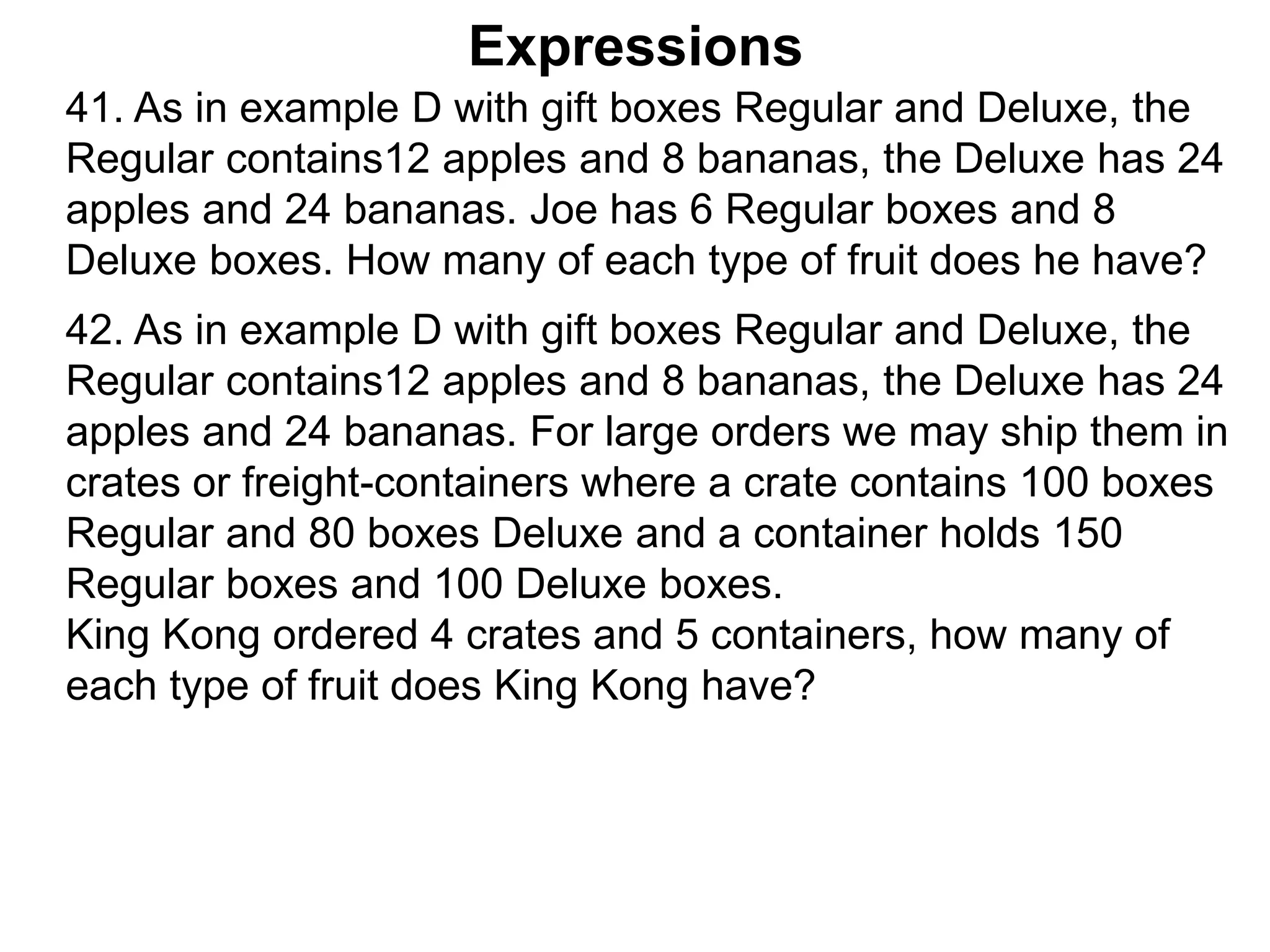
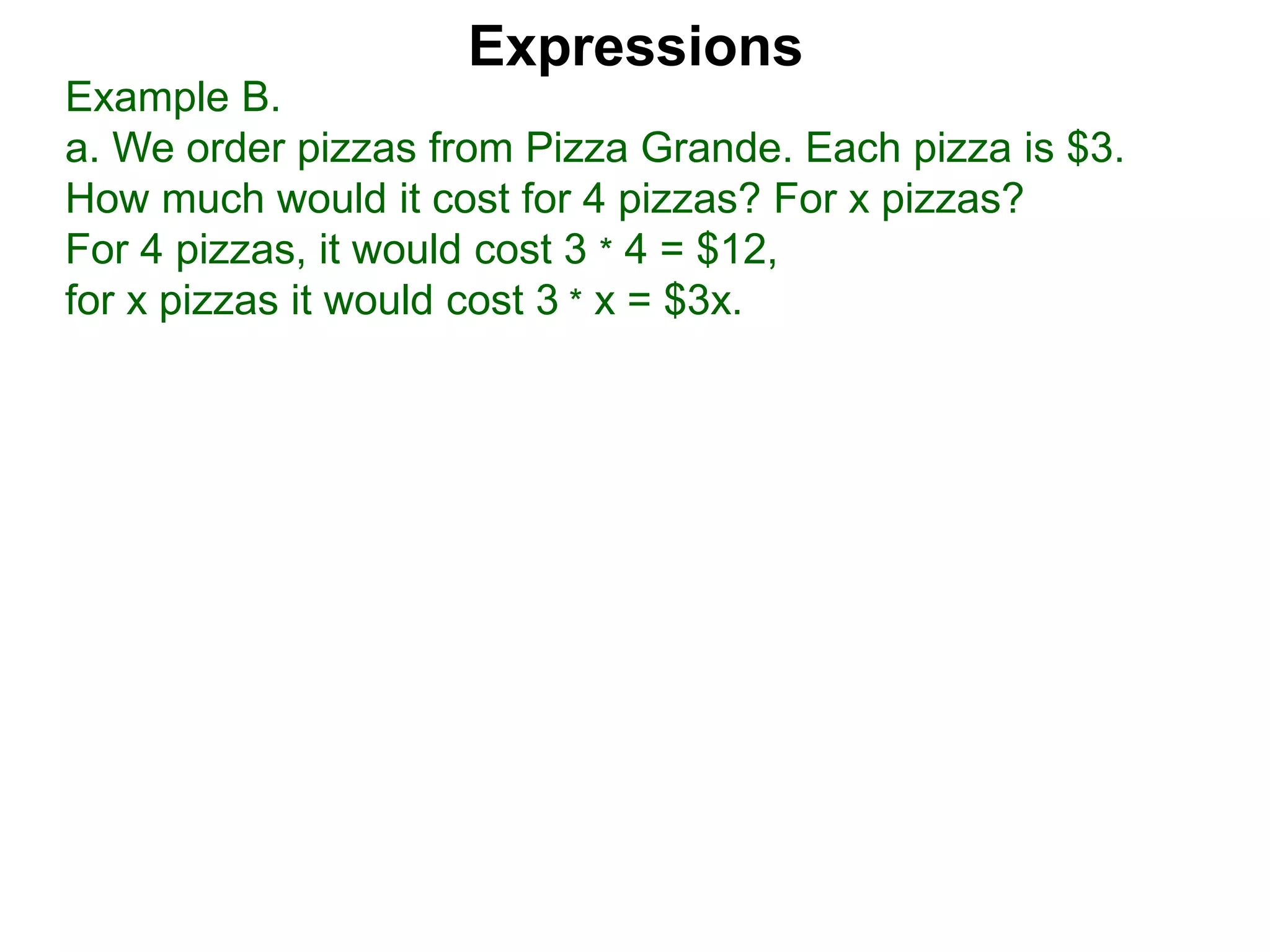
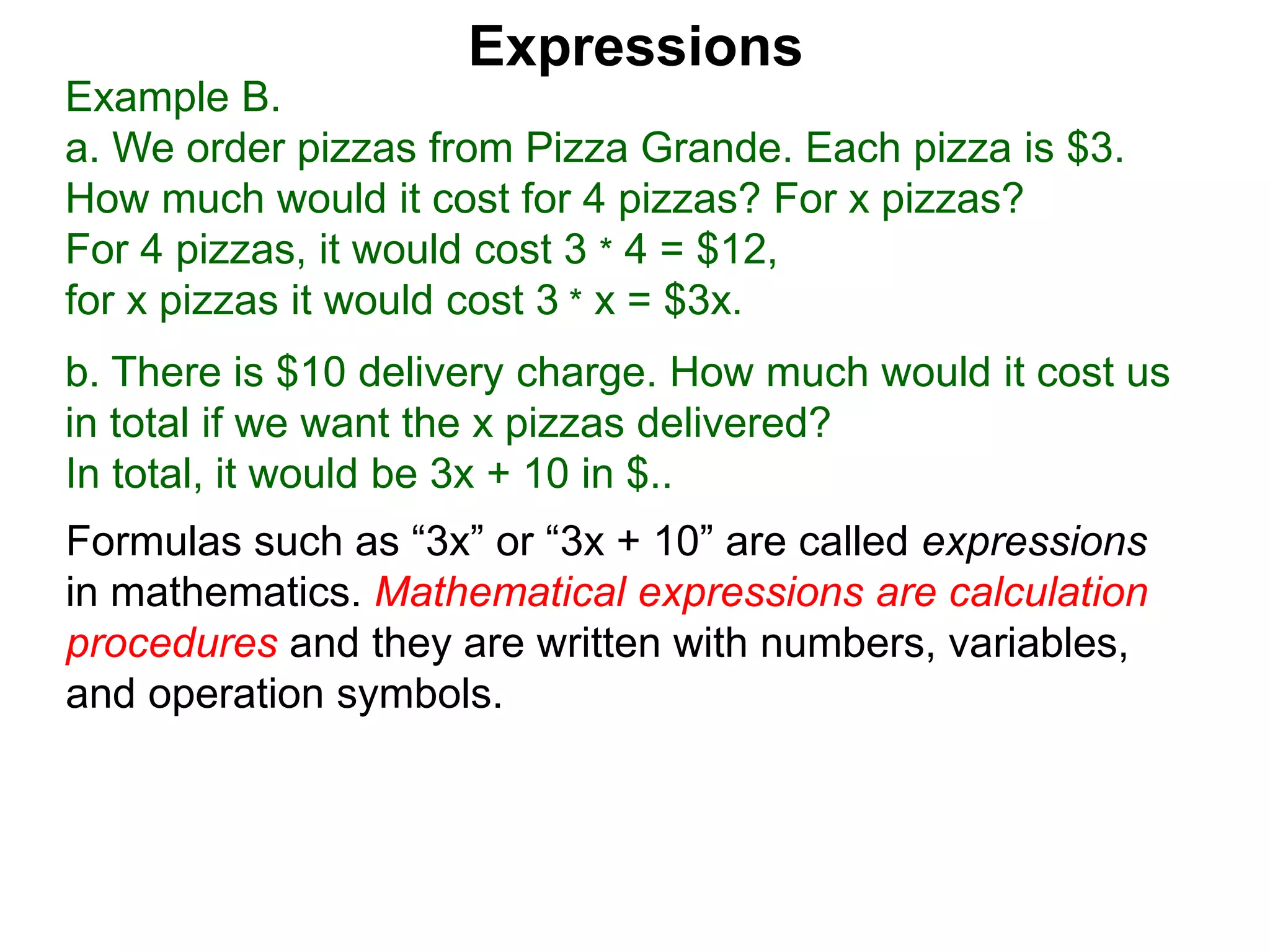
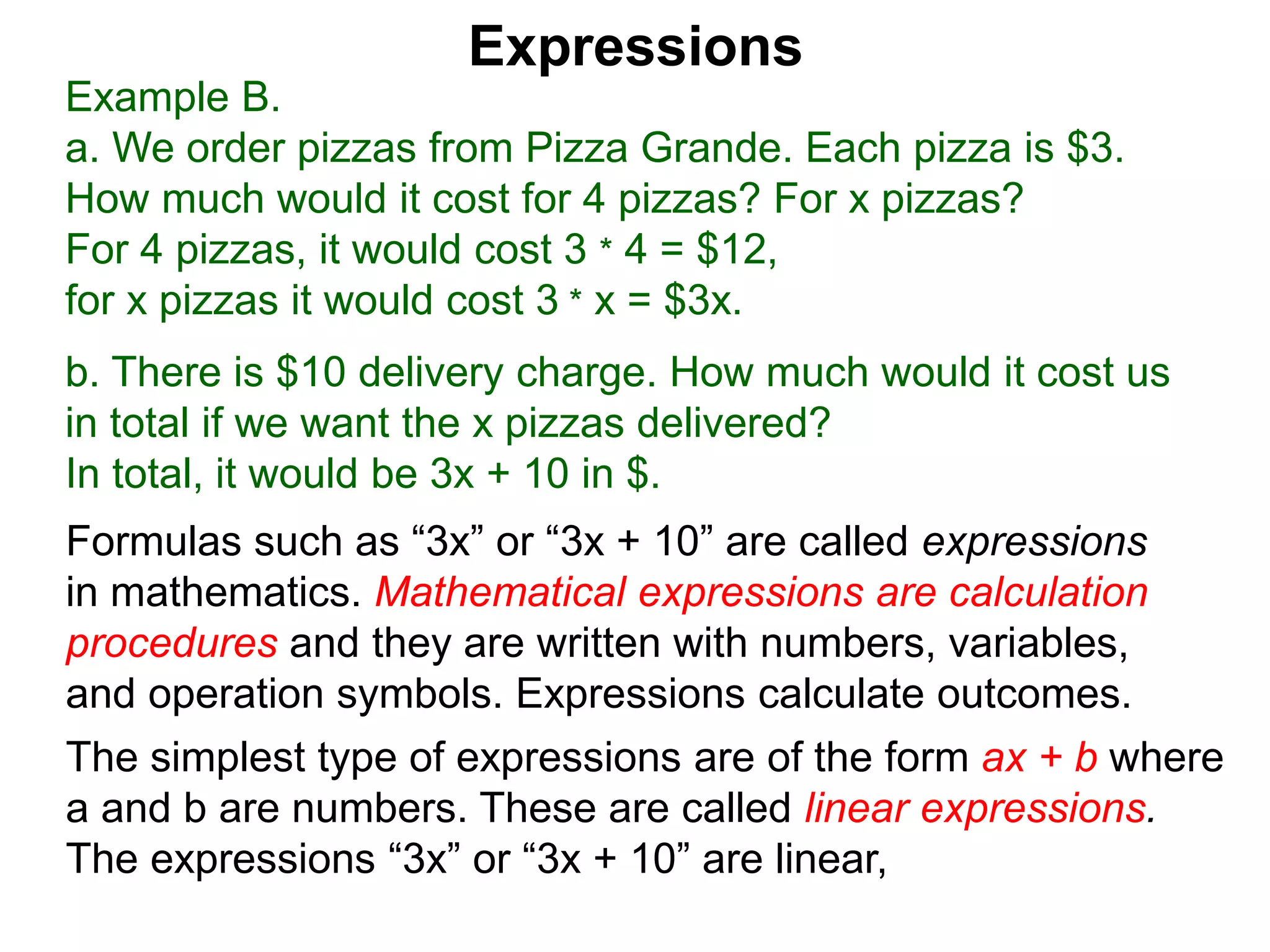
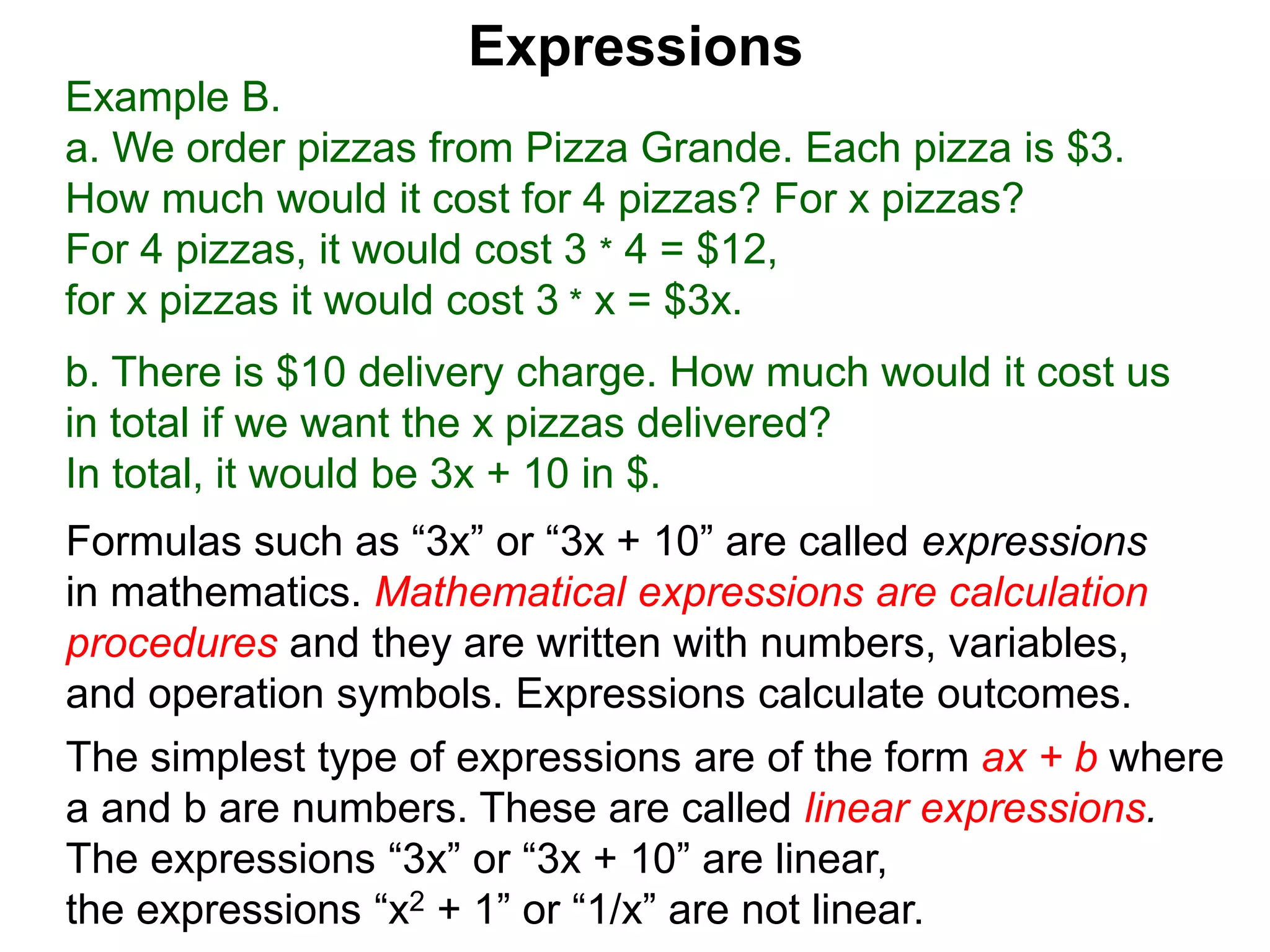
Example B.
a. Weorder pizzas from Pizza Grande. Each pizza is $3.
How much would it cost for 4 pizzas? For x pizzas?
Expressions
3.
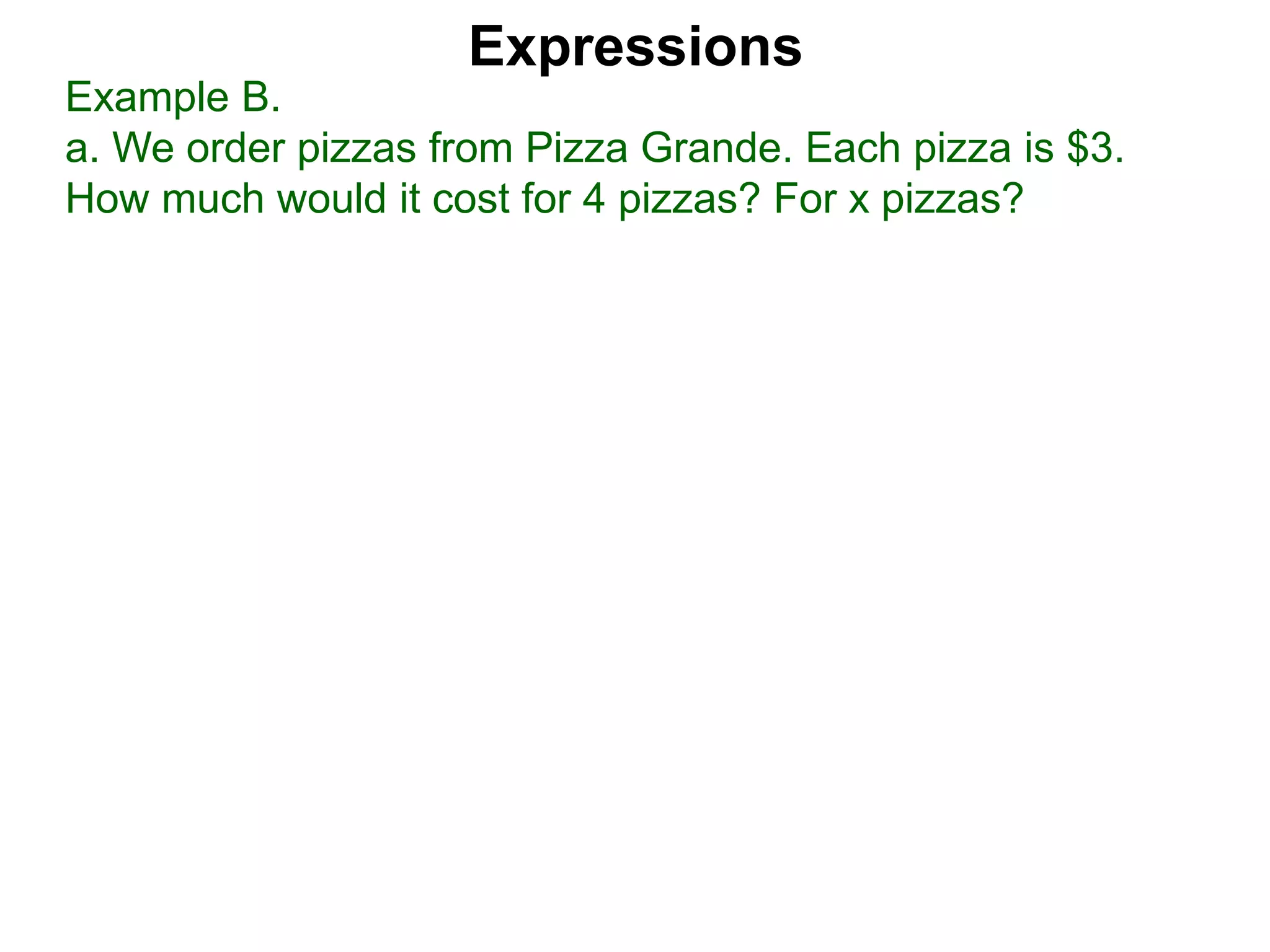
Example B.
a. Weorder pizzas from Pizza Grande. Each pizza is $3.
How much would it cost for 4 pizzas? For x pizzas?
For 4 pizzas, it would cost 3 * 4 = $12,
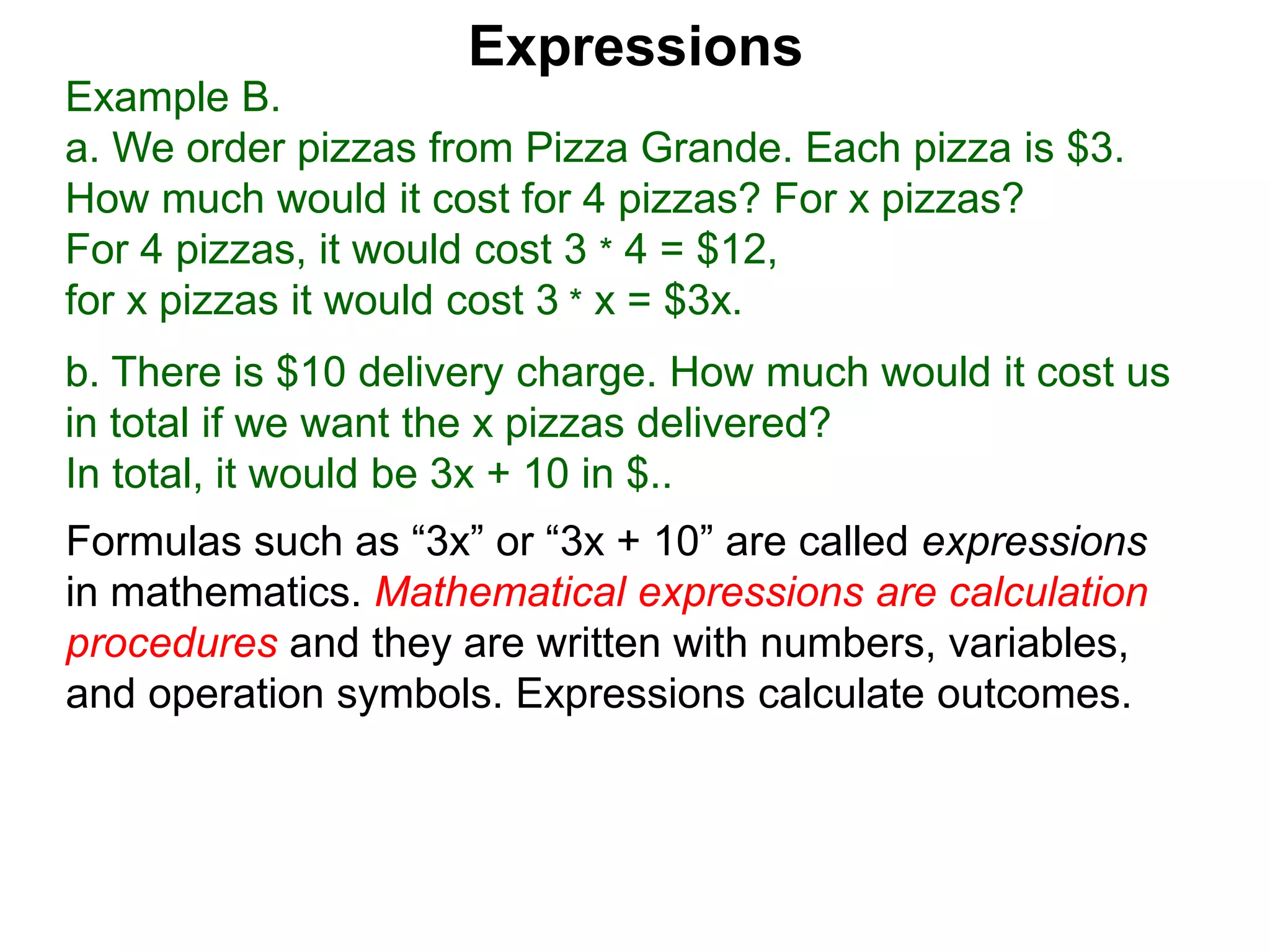
Expressions
4.
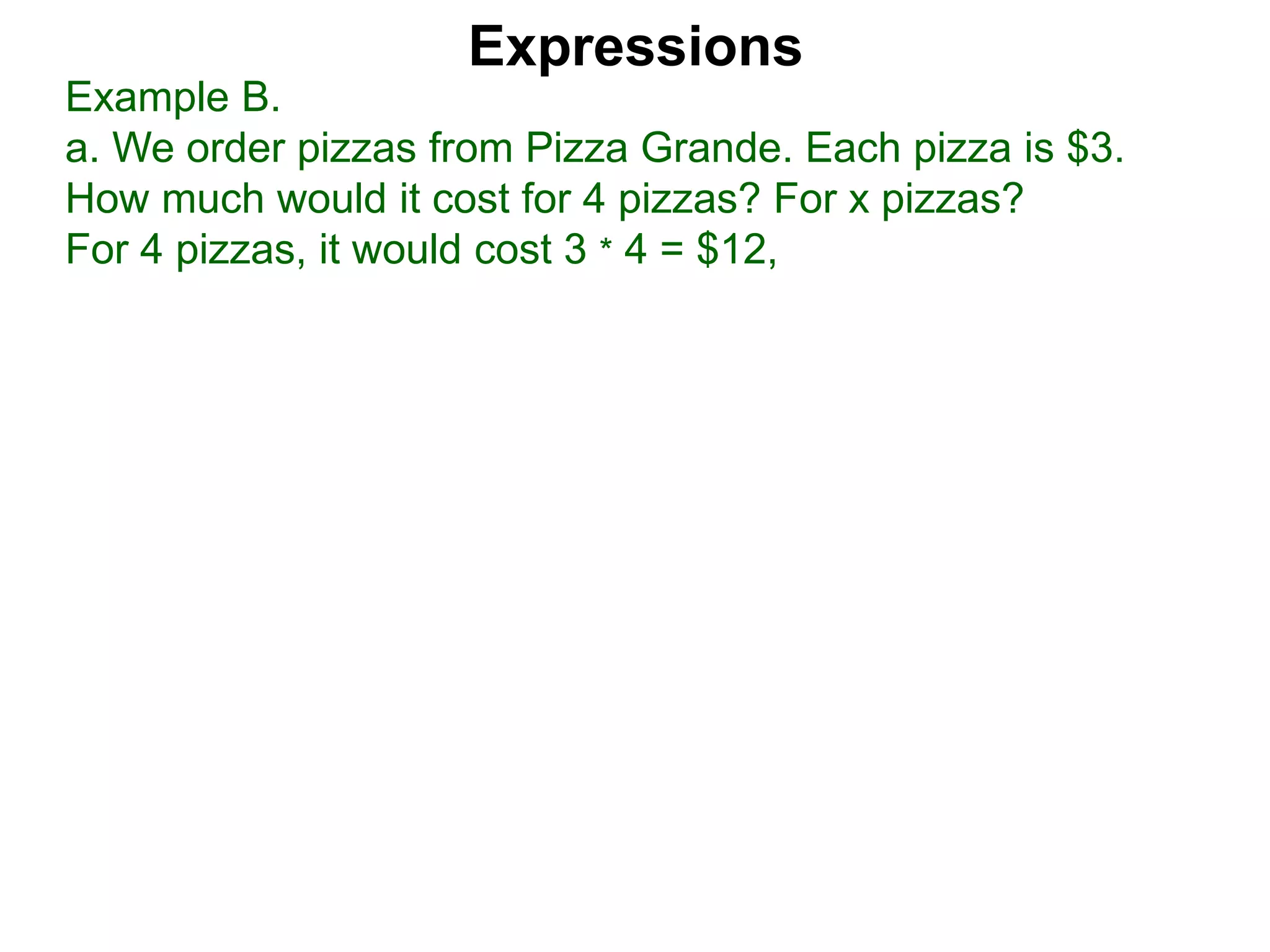
Example B.
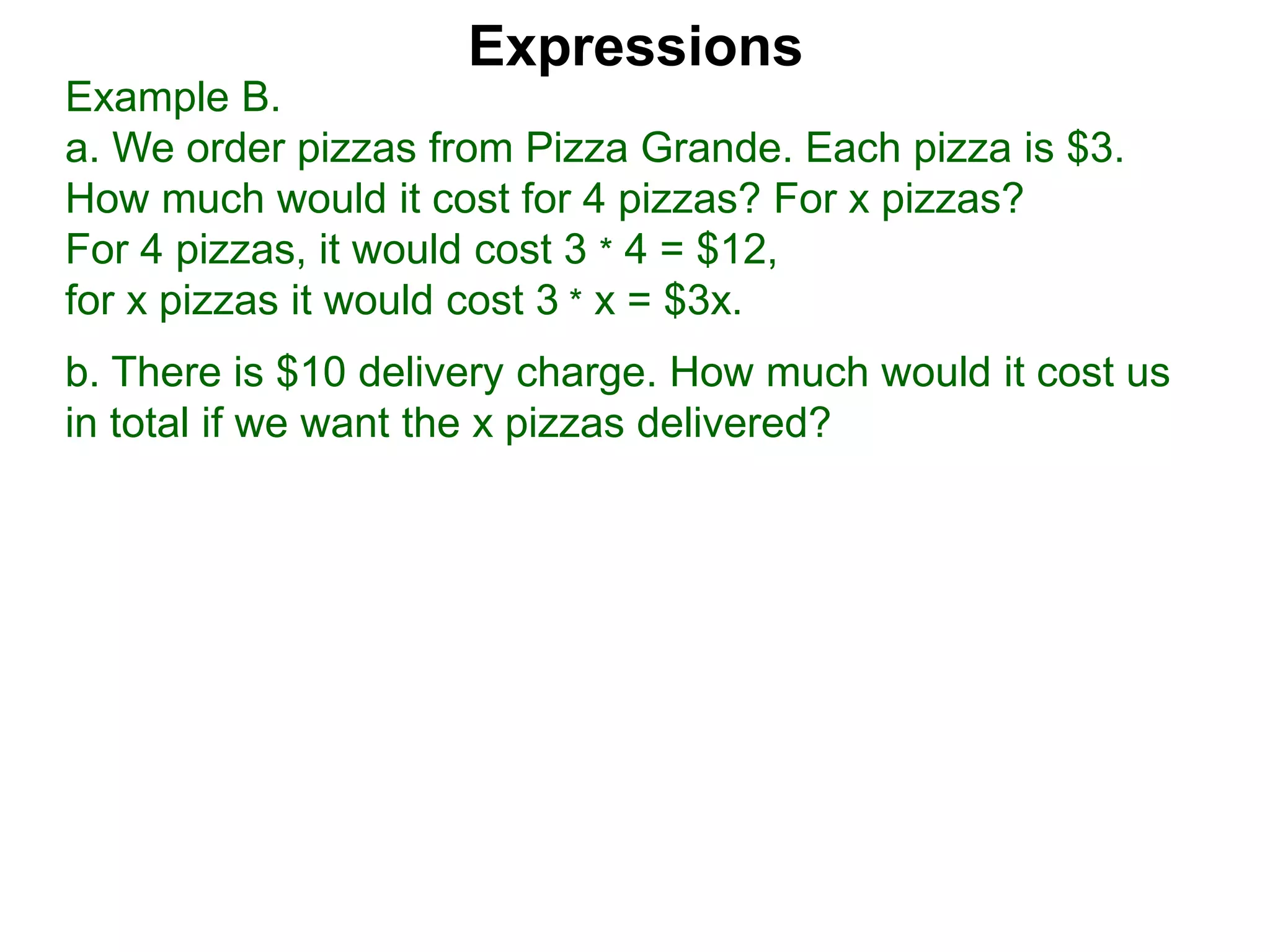
a. Weorder pizzas from Pizza Grande. Each pizza is $3.
How much would it cost for 4 pizzas? For x pizzas?
For 4 pizzas, it would cost 3 * 4 = $12,
for x pizzas it would cost 3 * x = $3x.
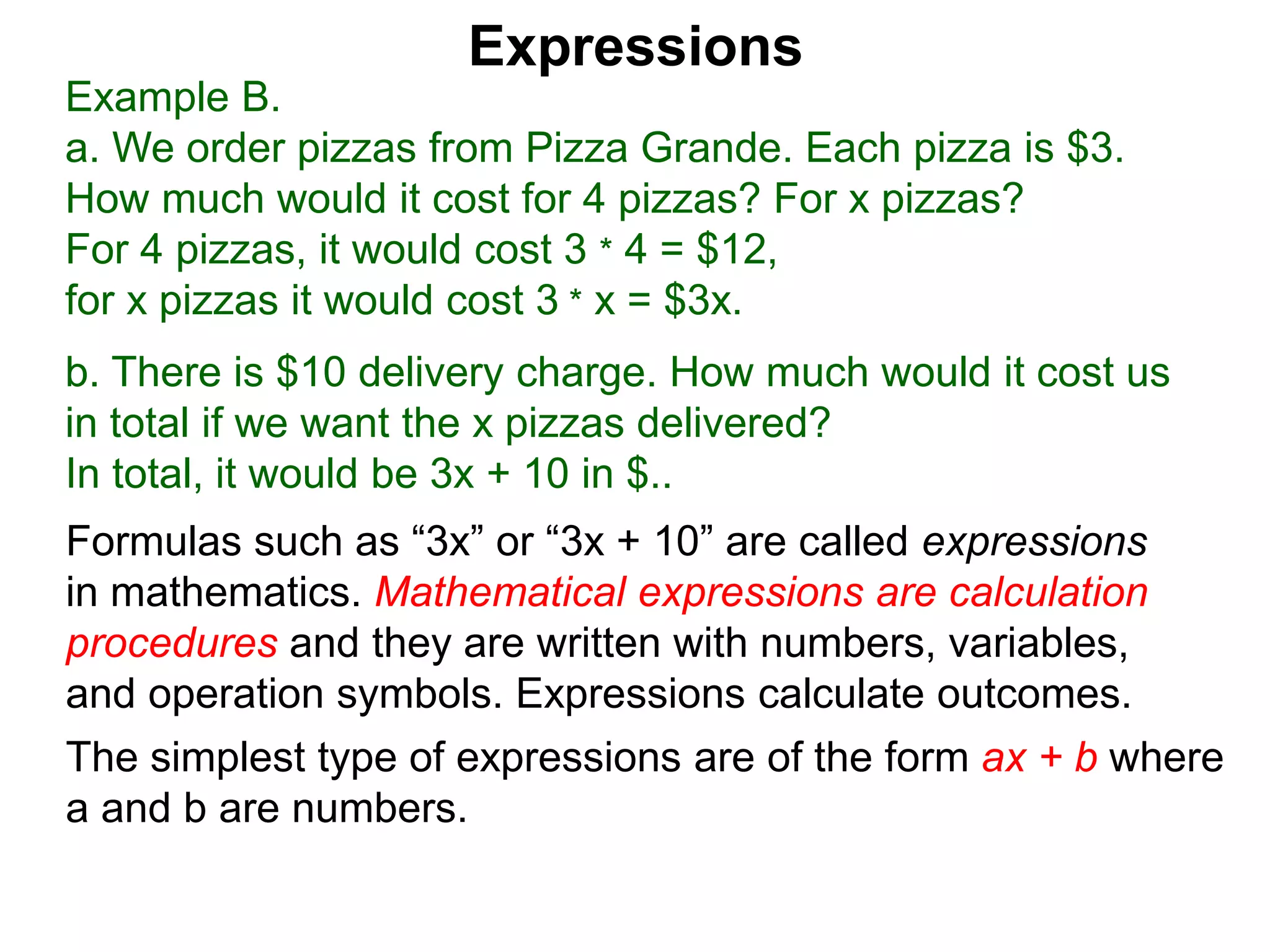
Expressions
5.
Example B.
a. Weorder pizzas from Pizza Grande. Each pizza is $3.
How much would it cost for 4 pizzas? For x pizzas?
For 4 pizzas, it would cost 3 * 4 = $12,
for x pizzas it would cost 3 * x = $3x.
b. There is $10 delivery charge. How much would it cost us
in total if we want the x pizzas delivered?
Expressions
6.
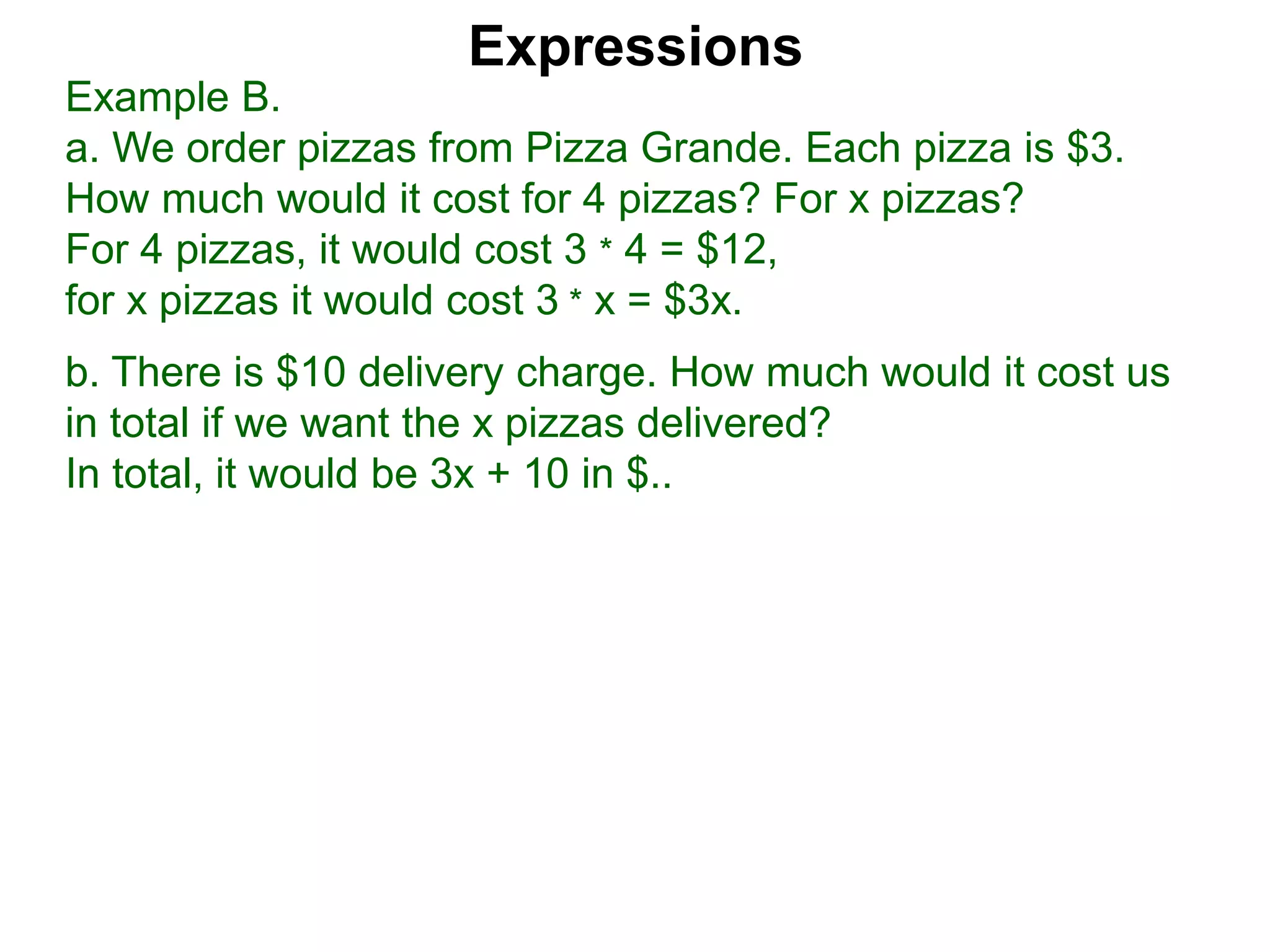
Example B.
a. Weorder pizzas from Pizza Grande. Each pizza is $3.
How much would it cost for 4 pizzas? For x pizzas?
For 4 pizzas, it would cost 3 * 4 = $12,
for x pizzas it would cost 3 * x = $3x.
b. There is $10 delivery charge. How much would it cost us
in total if we want the x pizzas delivered?
In total, it would be 3x + 10 in $..
Expressions
7.
Example B.
a. Weorder pizzas from Pizza Grande. Each pizza is $3.
How much would it cost for 4 pizzas? For x pizzas?
For 4 pizzas, it would cost 3 * 4 = $12,
for x pizzas it would cost 3 * x = $3x.
b. There is $10 delivery charge. How much would it cost us
in total if we want the x pizzas delivered?
In total, it would be 3x + 10 in $..
Expressions
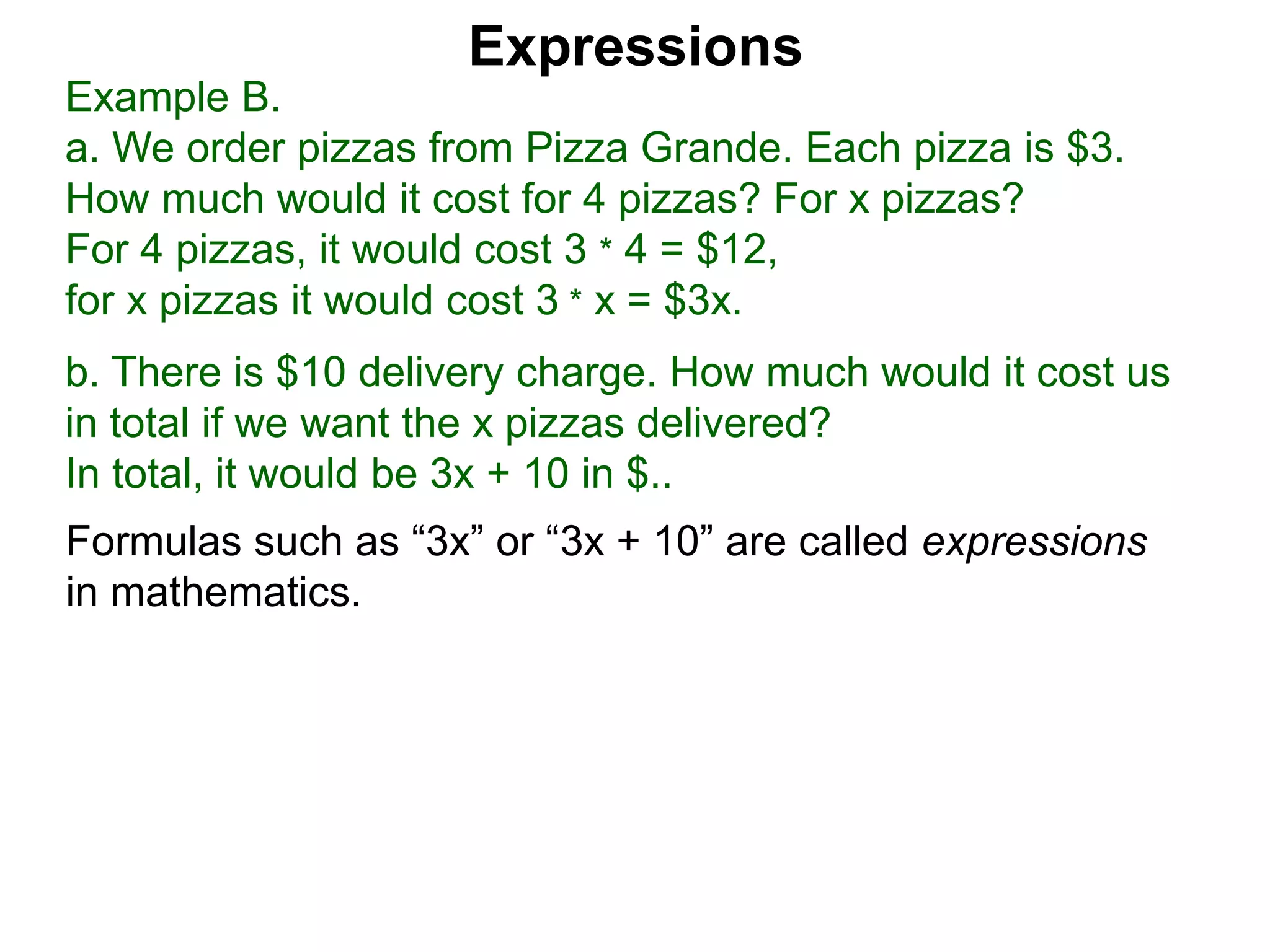
Formulas such as “3x” or “3x + 10” are called expressions
in mathematics.
8.
Example B.
a. Weorder pizzas from Pizza Grande. Each pizza is $3.
How much would it cost for 4 pizzas? For x pizzas?
For 4 pizzas, it would cost 3 * 4 = $12,
for x pizzas it would cost 3 * x = $3x.
b. There is $10 delivery charge. How much would it cost us
in total if we want the x pizzas delivered?
In total, it would be 3x + 10 in $..
Expressions
Formulas such as “3x” or “3x + 10” are called expressions
in mathematics. Mathematical expressions are calculation
procedures and they are written with numbers, variables,
and operation symbols.
9.
Example B.
a. Weorder pizzas from Pizza Grande. Each pizza is $3.
How much would it cost for 4 pizzas? For x pizzas?
For 4 pizzas, it would cost 3 * 4 = $12,
for x pizzas it would cost 3 * x = $3x.
b. There is $10 delivery charge. How much would it cost us
in total if we want the x pizzas delivered?
In total, it would be 3x + 10 in $..
Expressions
Formulas such as “3x” or “3x + 10” are called expressions
in mathematics. Mathematical expressions are calculation
procedures and they are written with numbers, variables,
and operation symbols. Expressions calculate outcomes.
10.
Example B.
a. Weorder pizzas from Pizza Grande. Each pizza is $3.
How much would it cost for 4 pizzas? For x pizzas?
For 4 pizzas, it would cost 3 * 4 = $12,
for x pizzas it would cost 3 * x = $3x.
b. There is $10 delivery charge. How much would it cost us
in total if we want the x pizzas delivered?
In total, it would be 3x + 10 in $..
Expressions
Formulas such as “3x” or “3x + 10” are called expressions
in mathematics. Mathematical expressions are calculation
procedures and they are written with numbers, variables,
and operation symbols. Expressions calculate outcomes.
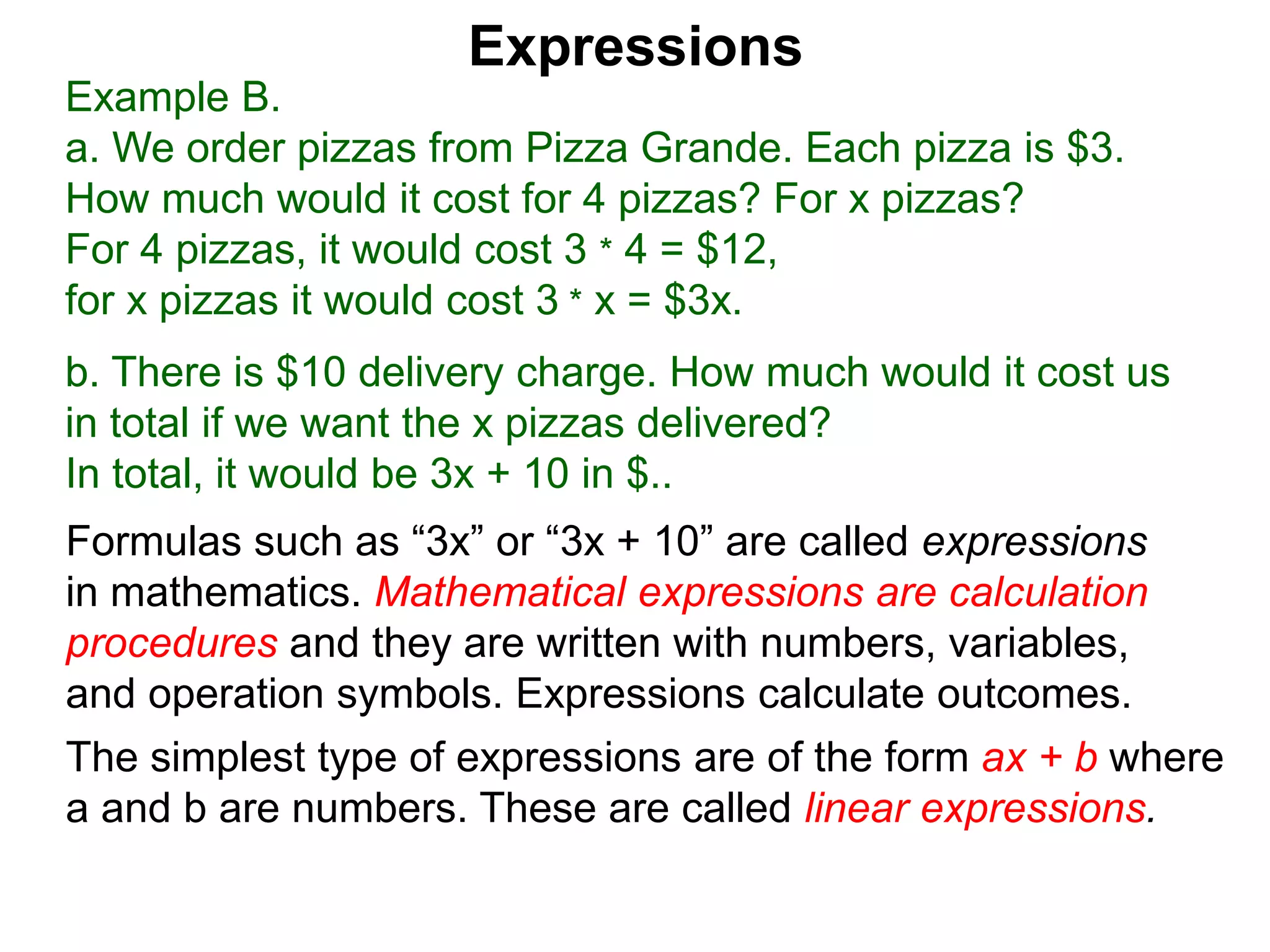
The simplest type of expressions are of the form ax + b where
a and b are numbers.
11.
Example B.
a. Weorder pizzas from Pizza Grande. Each pizza is $3.
How much would it cost for 4 pizzas? For x pizzas?
For 4 pizzas, it would cost 3 * 4 = $12,
for x pizzas it would cost 3 * x = $3x.
b. There is $10 delivery charge. How much would it cost us
in total if we want the x pizzas delivered?
In total, it would be 3x + 10 in $..
Expressions
Formulas such as “3x” or “3x + 10” are called expressions
in mathematics. Mathematical expressions are calculation
procedures and they are written with numbers, variables,
and operation symbols. Expressions calculate outcomes.
The simplest type of expressions are of the form ax + b where
a and b are numbers. These are called linear expressions.
12.
Example B.
a. Weorder pizzas from Pizza Grande. Each pizza is $3.
How much would it cost for 4 pizzas? For x pizzas?
For 4 pizzas, it would cost 3 * 4 = $12,
for x pizzas it would cost 3 * x = $3x.
b. There is $10 delivery charge. How much would it cost us
in total if we want the x pizzas delivered?
In total, it would be 3x + 10 in $.
Expressions
Formulas such as “3x” or “3x + 10” are called expressions
in mathematics. Mathematical expressions are calculation
procedures and they are written with numbers, variables,
and operation symbols. Expressions calculate outcomes.
The simplest type of expressions are of the form ax + b where
a and b are numbers. These are called linear expressions.
The expressions “3x” or “3x + 10” are linear,
13.
Example B.
a. Weorder pizzas from Pizza Grande. Each pizza is $3.
How much would it cost for 4 pizzas? For x pizzas?
For 4 pizzas, it would cost 3 * 4 = $12,
for x pizzas it would cost 3 * x = $3x.
b. There is $10 delivery charge. How much would it cost us
in total if we want the x pizzas delivered?
In total, it would be 3x + 10 in $.
Expressions
Formulas such as “3x” or “3x + 10” are called expressions
in mathematics. Mathematical expressions are calculation
procedures and they are written with numbers, variables,
and operation symbols. Expressions calculate outcomes.
The simplest type of expressions are of the form ax + b where
a and b are numbers. These are called linear expressions.
The expressions “3x” or “3x + 10” are linear,
the expressions “x2 + 1” or “1/x” are not linear.
Expressions
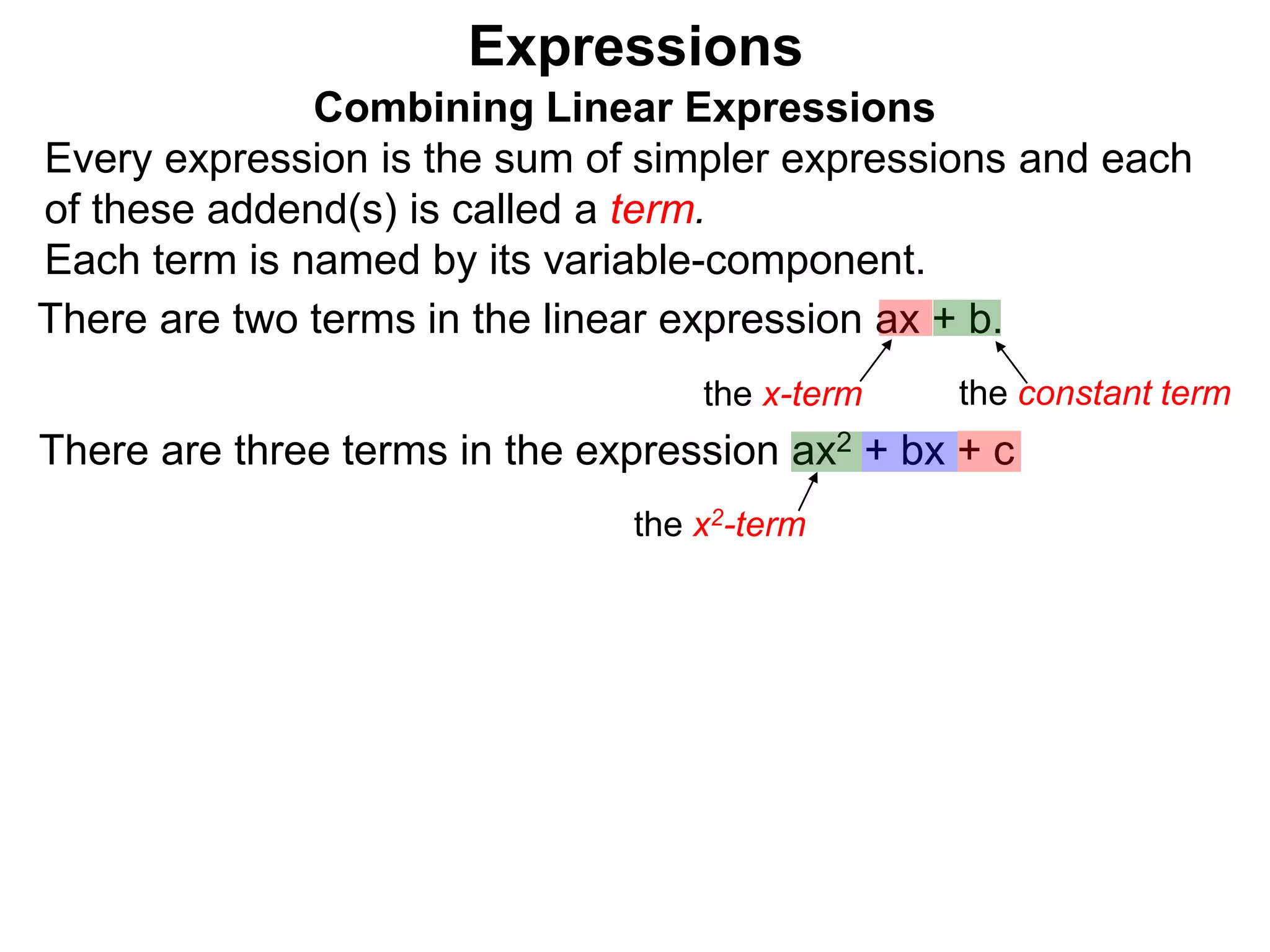
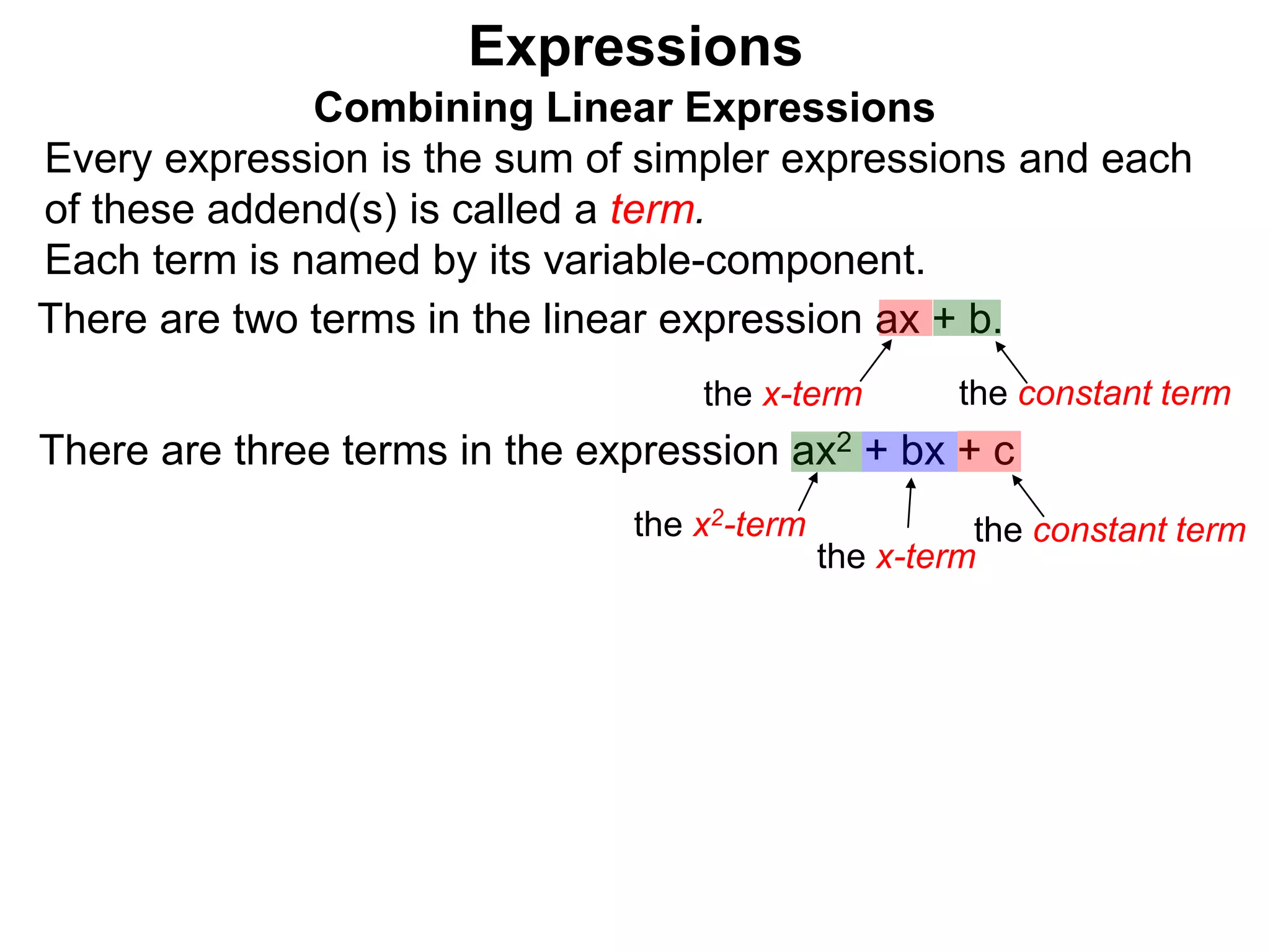
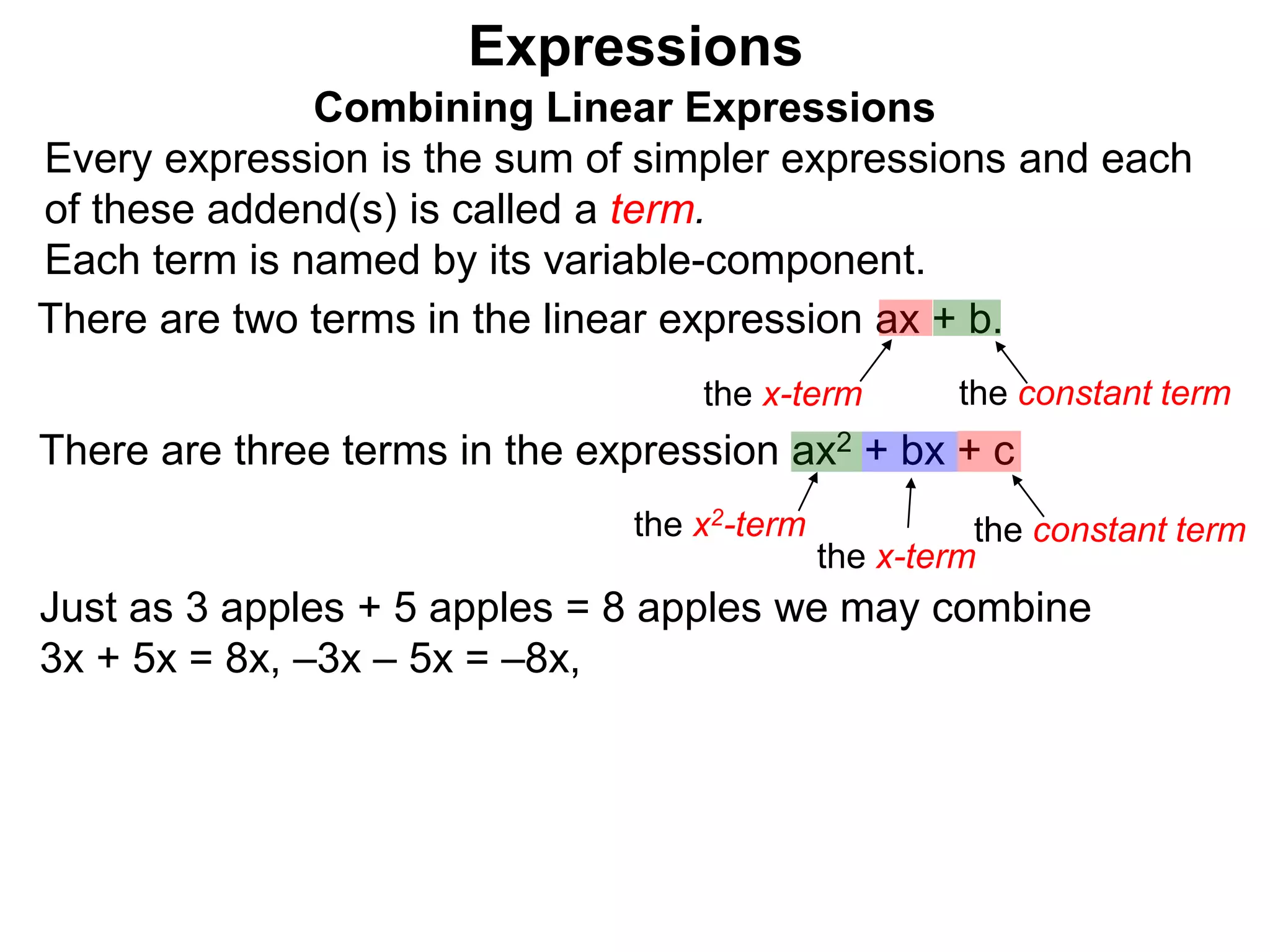
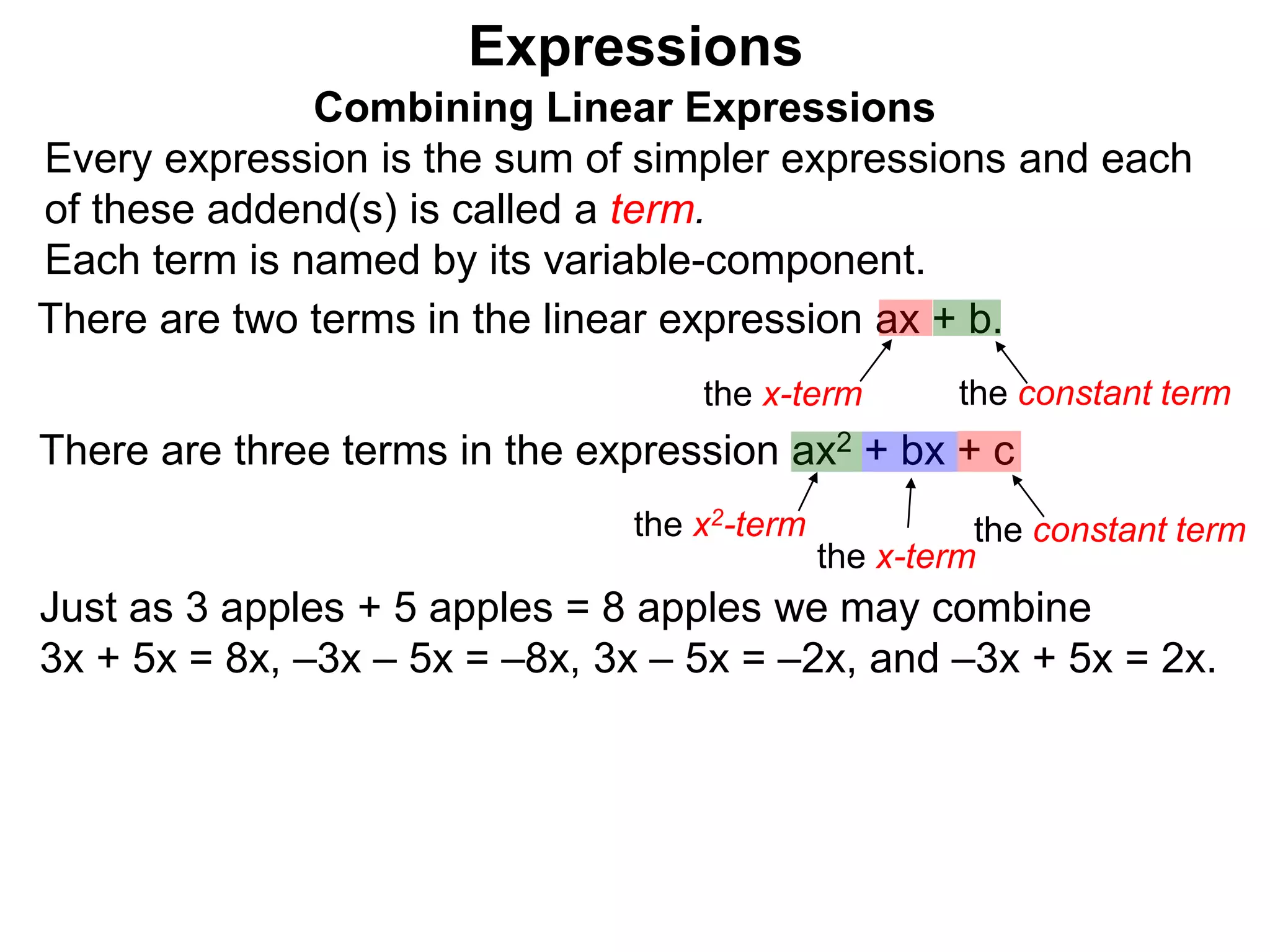
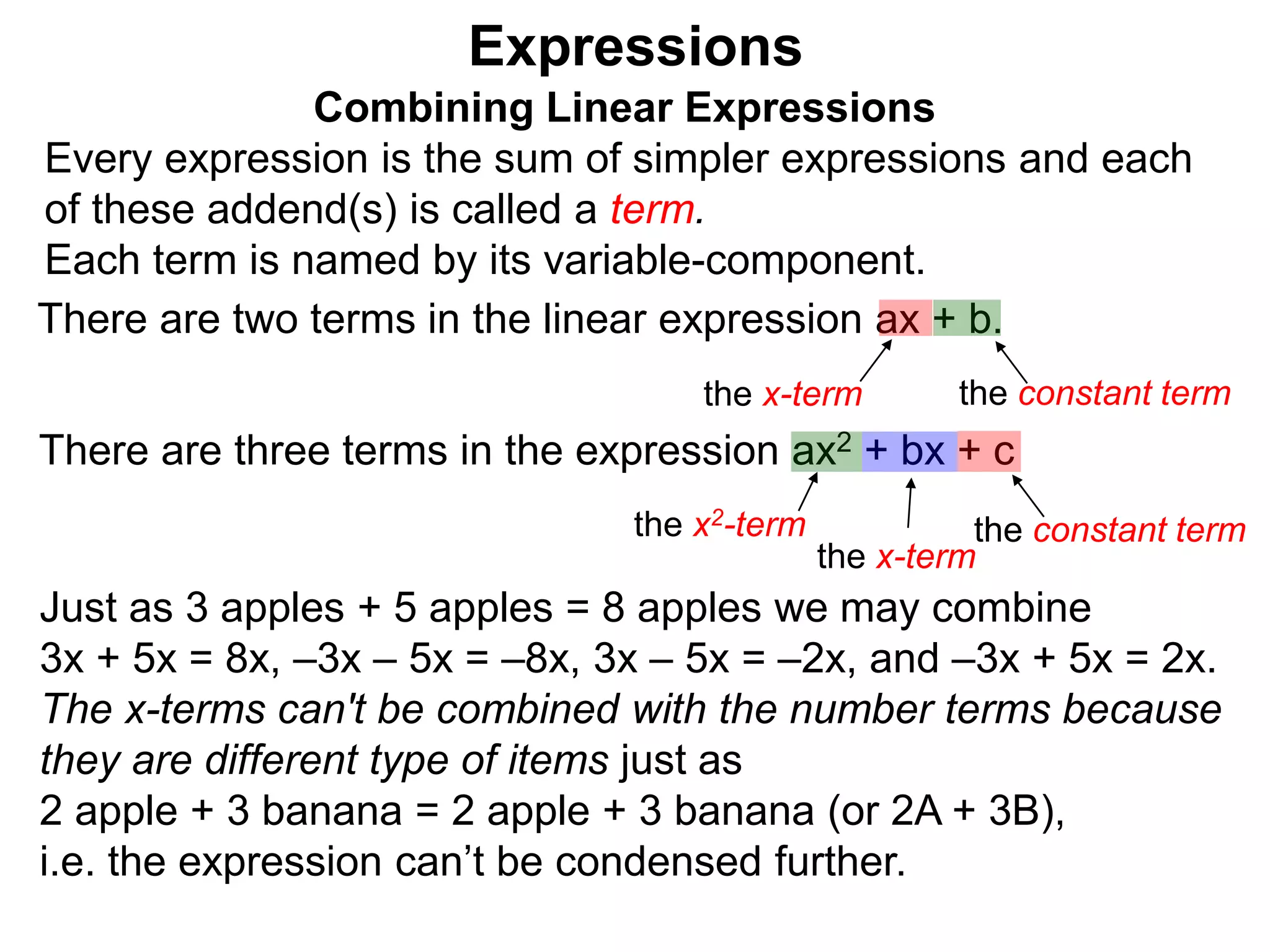
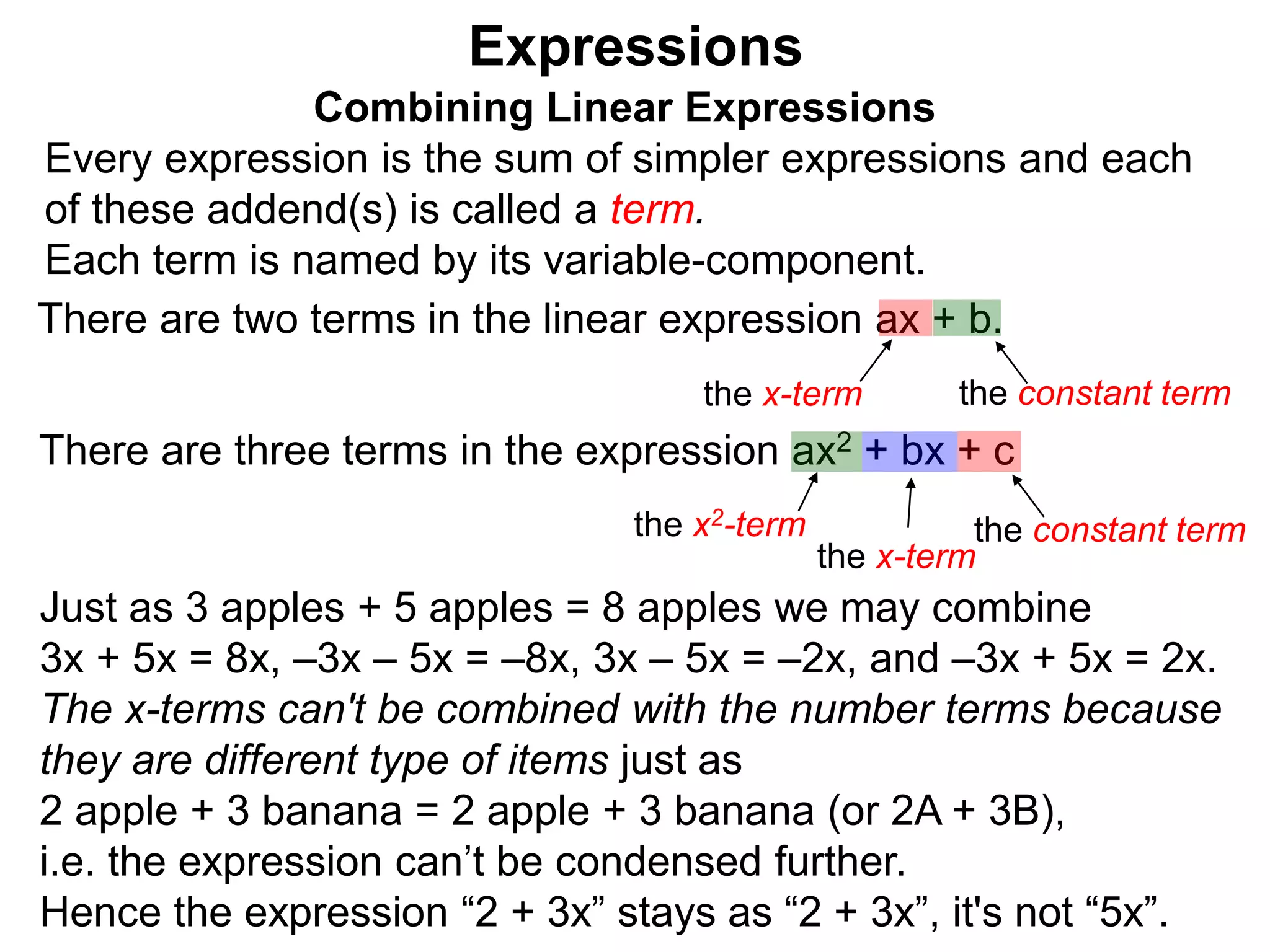
Combining Linear Expressions
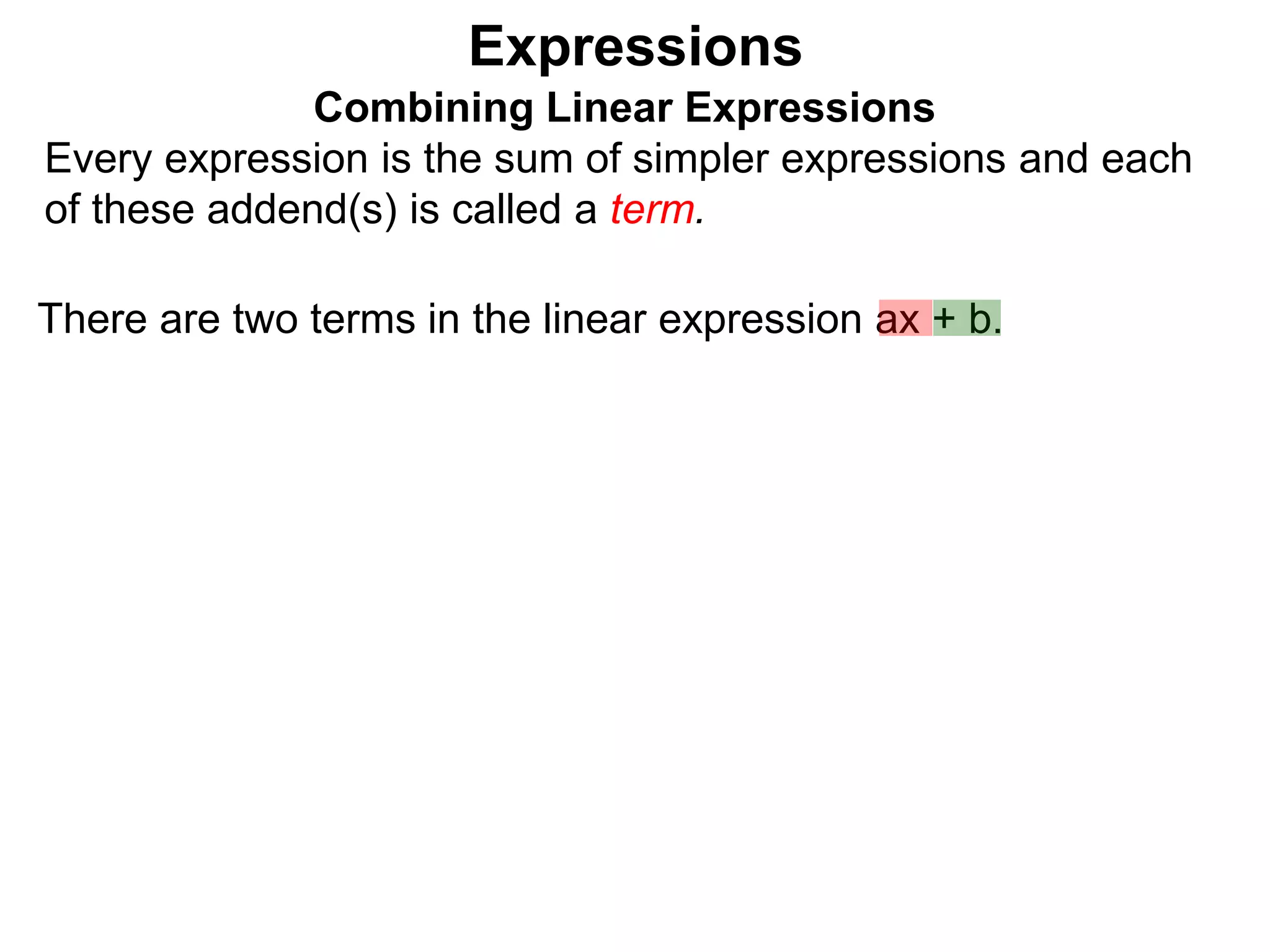
Everyexpression is the sum of simpler expressions and each
of these addend(s) is called a term.
There are two terms in the linear expression ax + b.
17.
Expressions
Combining Linear Expressions
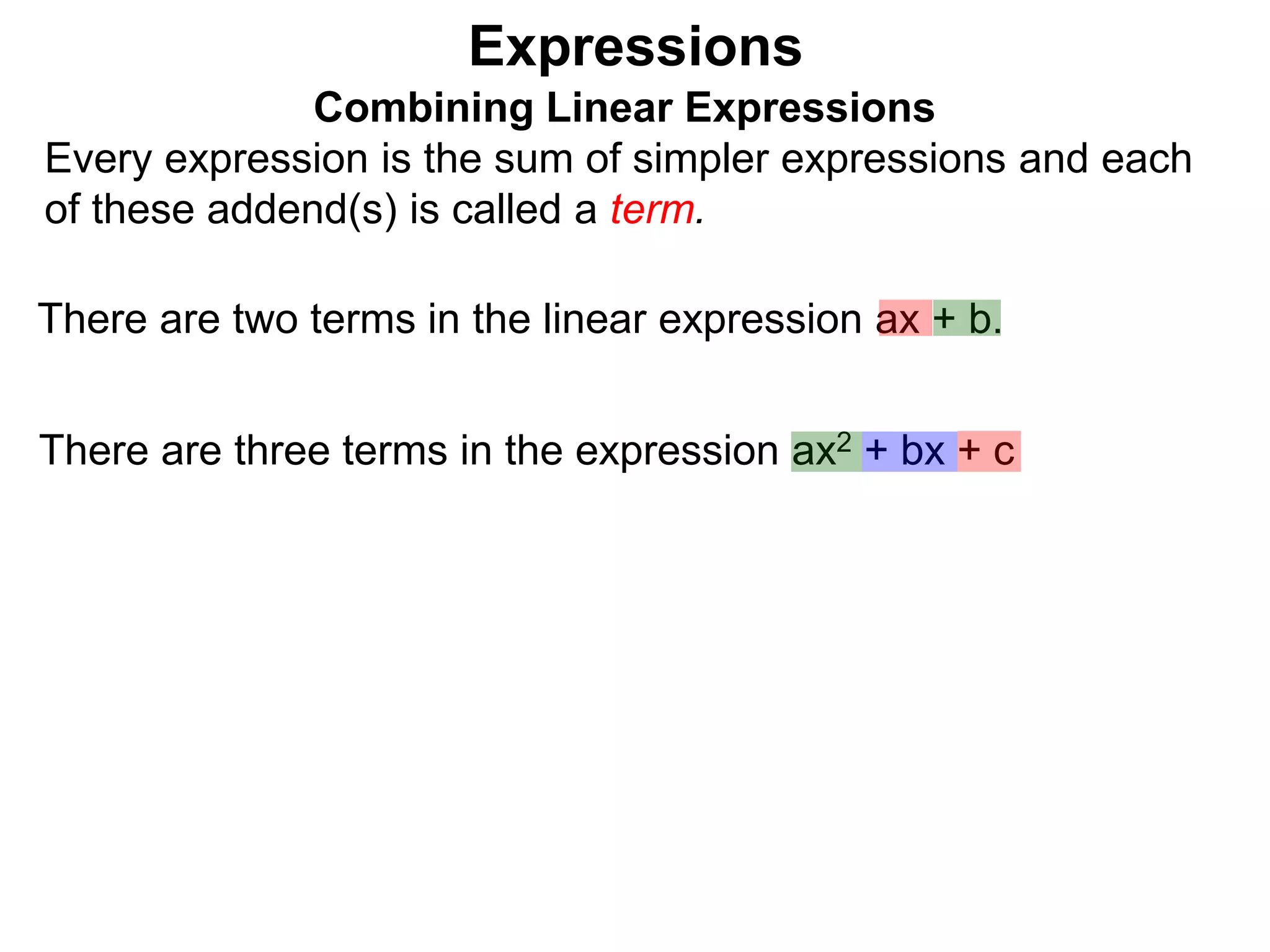
Everyexpression is the sum of simpler expressions and each
of these addend(s) is called a term.
There are two terms in the linear expression ax + b.
There are three terms in the expression ax2 + bx + c
18.
Expressions
Combining Linear Expressions
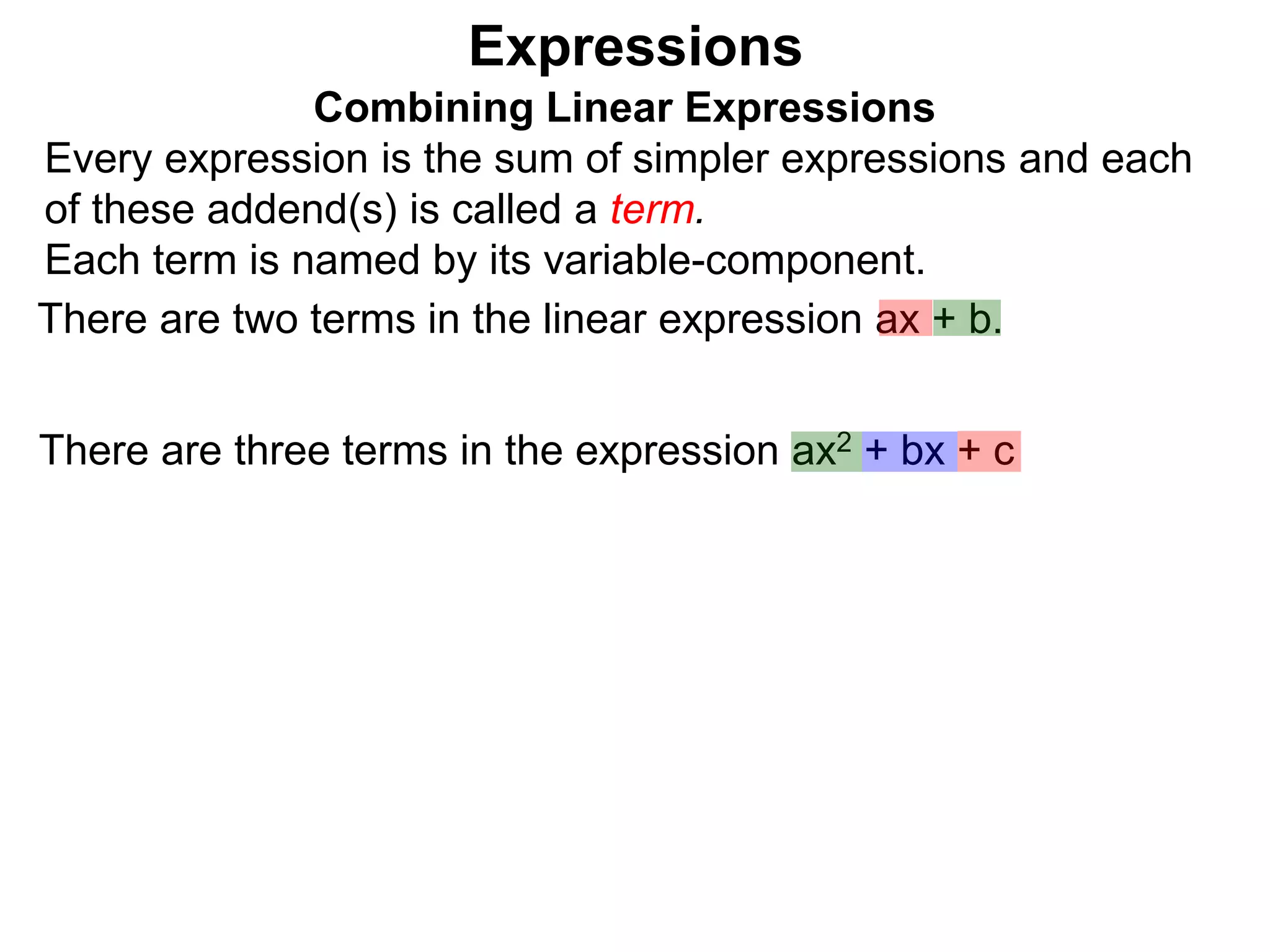
Everyexpression is the sum of simpler expressions and each
of these addend(s) is called a term.
Each term is named by its variable-component.
There are two terms in the linear expression ax + b.
There are three terms in the expression ax2 + bx + c
19.
Expressions
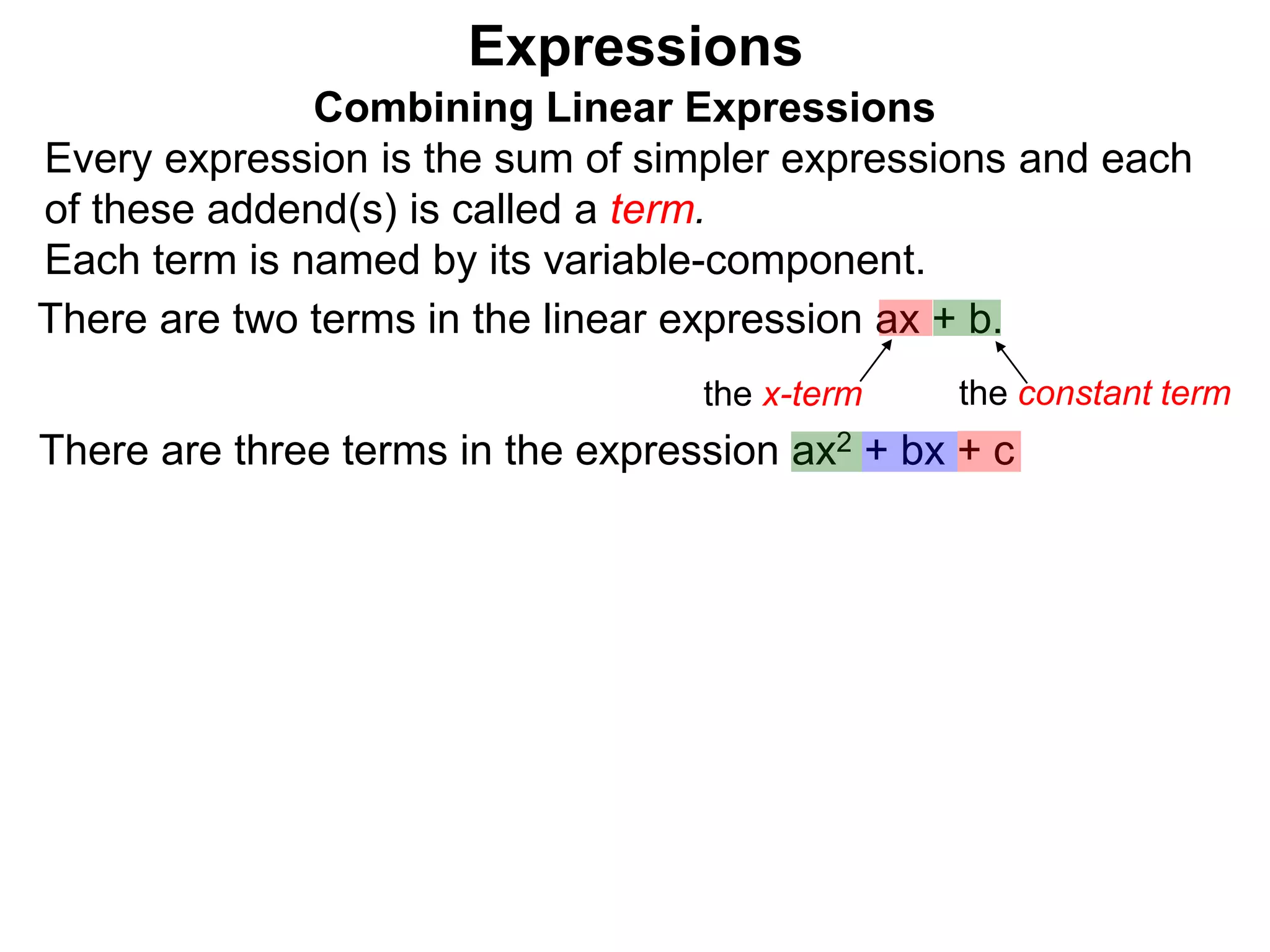
Combining Linear Expressions
Everyexpression is the sum of simpler expressions and each
of these addend(s) is called a term.
Each term is named by its variable-component.
There are two terms in the linear expression ax + b.
the x-term the constant term
There are three terms in the expression ax2 + bx + c
20.
Expressions
Combining Linear Expressions
Everyexpression is the sum of simpler expressions and each
of these addend(s) is called a term.
Each term is named by its variable-component.
There are two terms in the linear expression ax + b.
the x-term the constant term
There are three terms in the expression ax2 + bx + c
the x2-term
21.
Expressions
Combining Linear Expressions
Everyexpression is the sum of simpler expressions and each
of these addend(s) is called a term.
Each term is named by its variable-component.
There are two terms in the linear expression ax + b.
the x-term the constant term
There are three terms in the expression ax2 + bx + c
the x2-term the constant term
the x-term
22.
Just as 3apples + 5 apples = 8 apples we may combine
3x + 5x = 8x, –3x – 5x = –8x,
Expressions
Combining Linear Expressions
Every expression is the sum of simpler expressions and each
of these addend(s) is called a term.
Each term is named by its variable-component.
There are two terms in the linear expression ax + b.
the x-term the constant term
There are three terms in the expression ax2 + bx + c
the x2-term the constant term
the x-term
23.
Just as 3apples + 5 apples = 8 apples we may combine
3x + 5x = 8x, –3x – 5x = –8x, 3x – 5x = –2x, and –3x + 5x = 2x.
Expressions
Combining Linear Expressions
Every expression is the sum of simpler expressions and each
of these addend(s) is called a term.
Each term is named by its variable-component.
There are two terms in the linear expression ax + b.
the x-term the constant term
There are three terms in the expression ax2 + bx + c
the x2-term the constant term
the x-term
24.
Just as 3apples + 5 apples = 8 apples we may combine
3x + 5x = 8x, –3x – 5x = –8x, 3x – 5x = –2x, and –3x + 5x = 2x.
The x-terms can't be combined with the number terms because
they are different type of items just as
2 apple + 3 banana = 2 apple + 3 banana (or 2A + 3B),
i.e. the expression can’t be condensed further.
Expressions
Combining Linear Expressions
Every expression is the sum of simpler expressions and each
of these addend(s) is called a term.
Each term is named by its variable-component.
There are two terms in the linear expression ax + b.
the x-term the constant term
There are three terms in the expression ax2 + bx + c
the x2-term the constant term
the x-term
25.
Just as 3apples + 5 apples = 8 apples we may combine
3x + 5x = 8x, –3x – 5x = –8x, 3x – 5x = –2x, and –3x + 5x = 2x.
The x-terms can't be combined with the number terms because
they are different type of items just as
2 apple + 3 banana = 2 apple + 3 banana (or 2A + 3B),
i.e. the expression can’t be condensed further.
Hence the expression “2 + 3x” stays as “2 + 3x”, it's not “5x”.
Expressions
Combining Linear Expressions
Every expression is the sum of simpler expressions and each
of these addend(s) is called a term.
Each term is named by its variable-component.
There are two terms in the linear expression ax + b.
the x-term the constant term
There are three terms in the expression ax2 + bx + c
the x2-term the constant term
the x-term
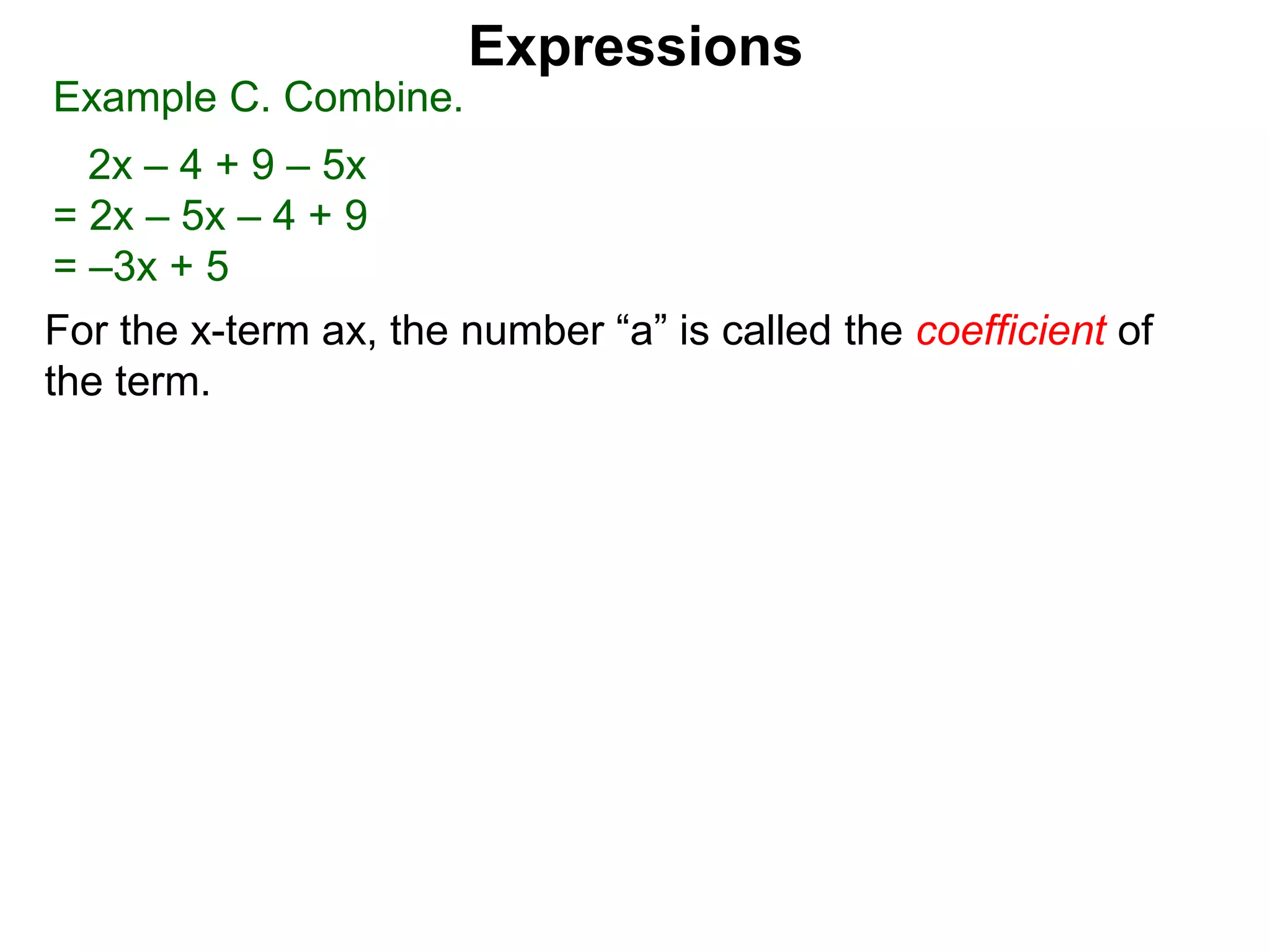
For the x-termax, the number “a” is called the coefficient of
the term.
Expressions
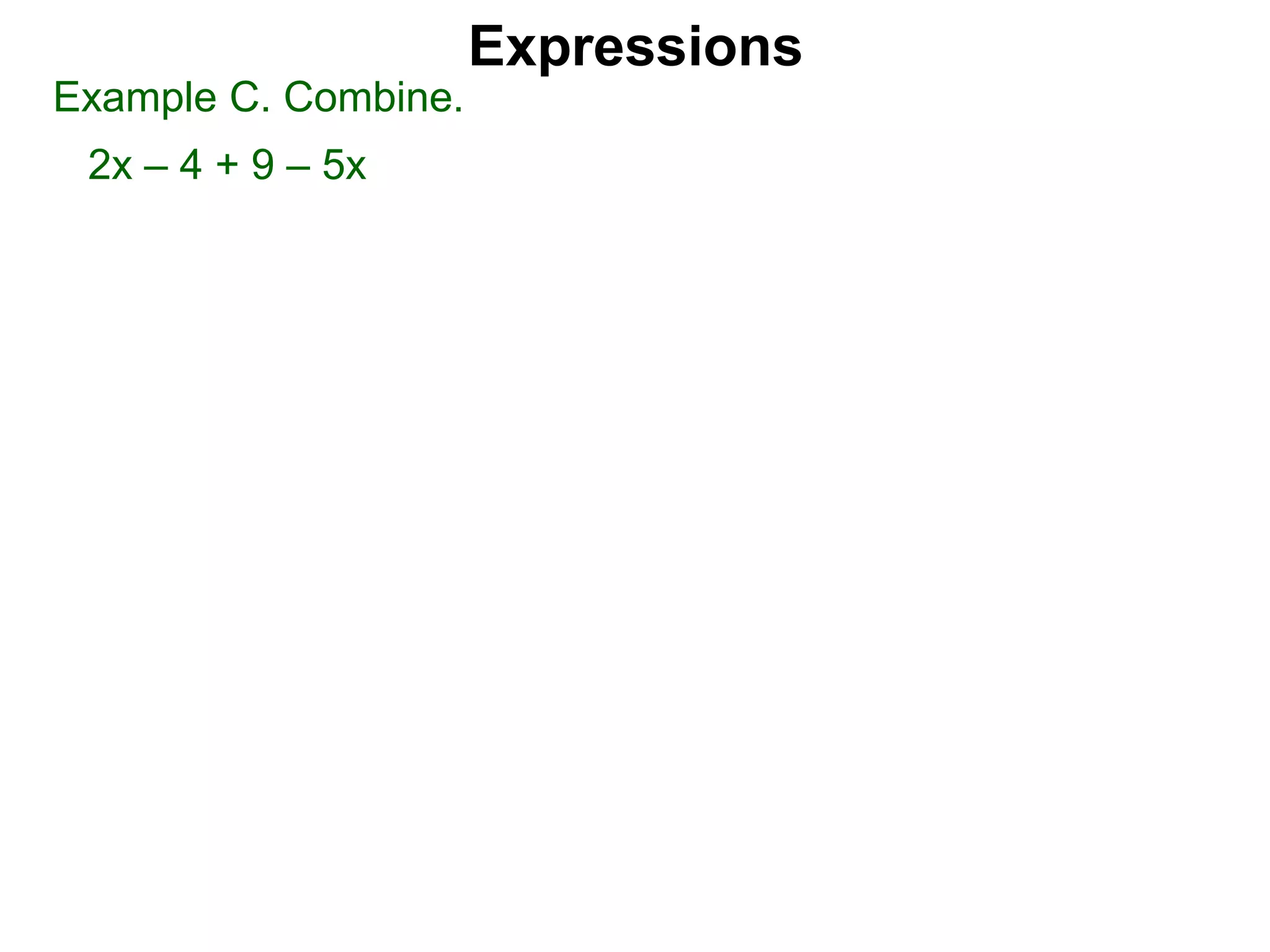
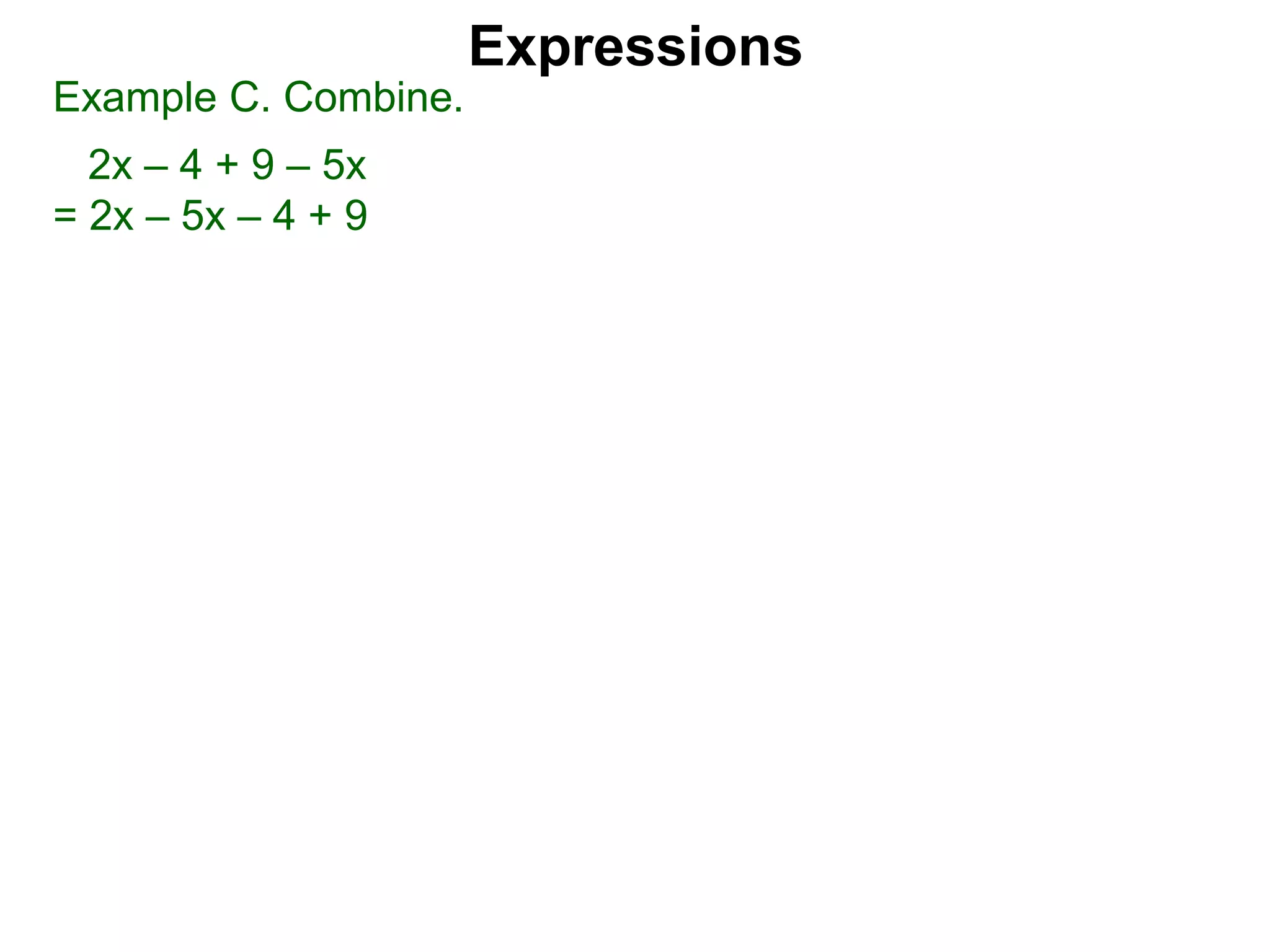
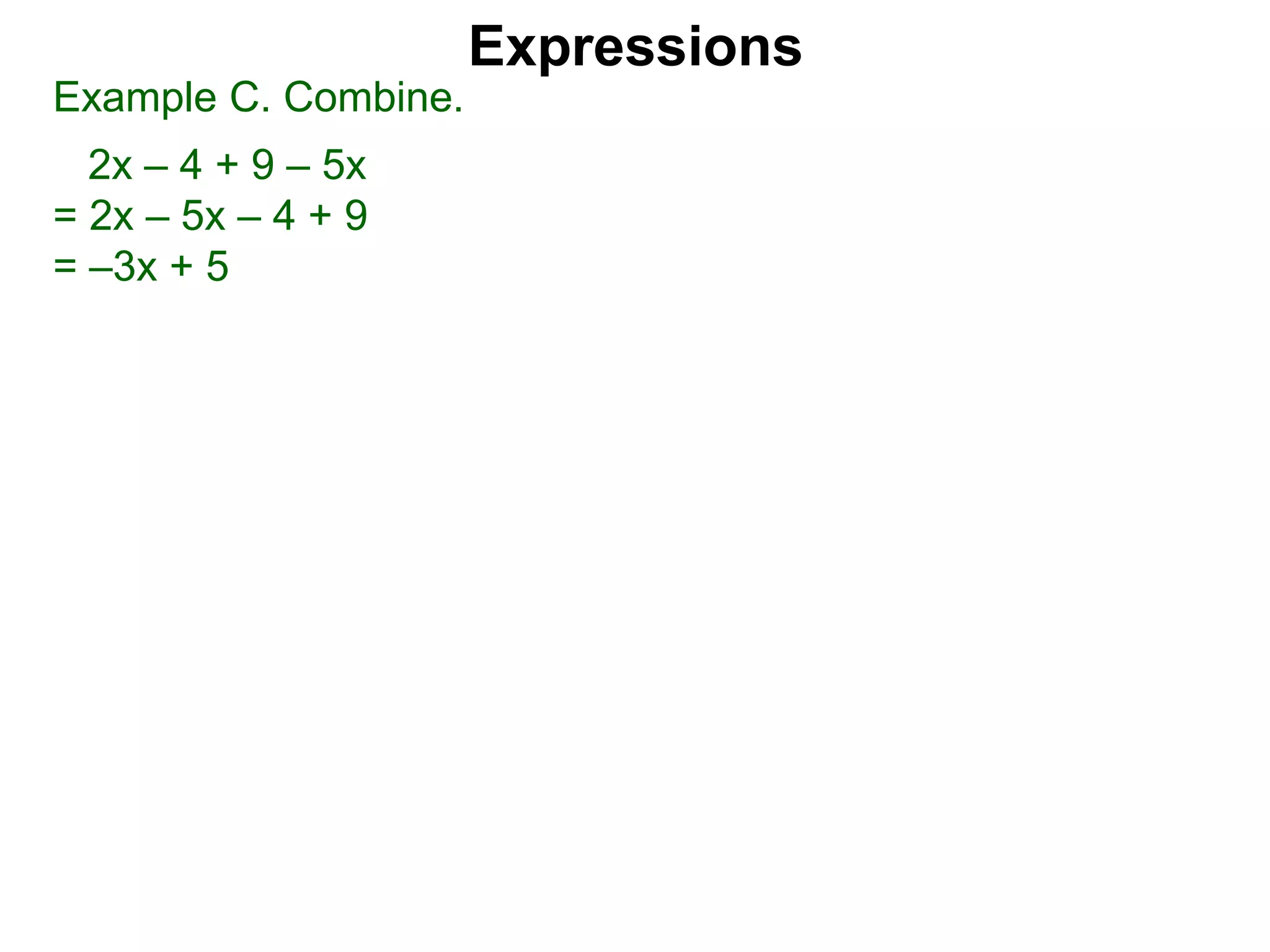
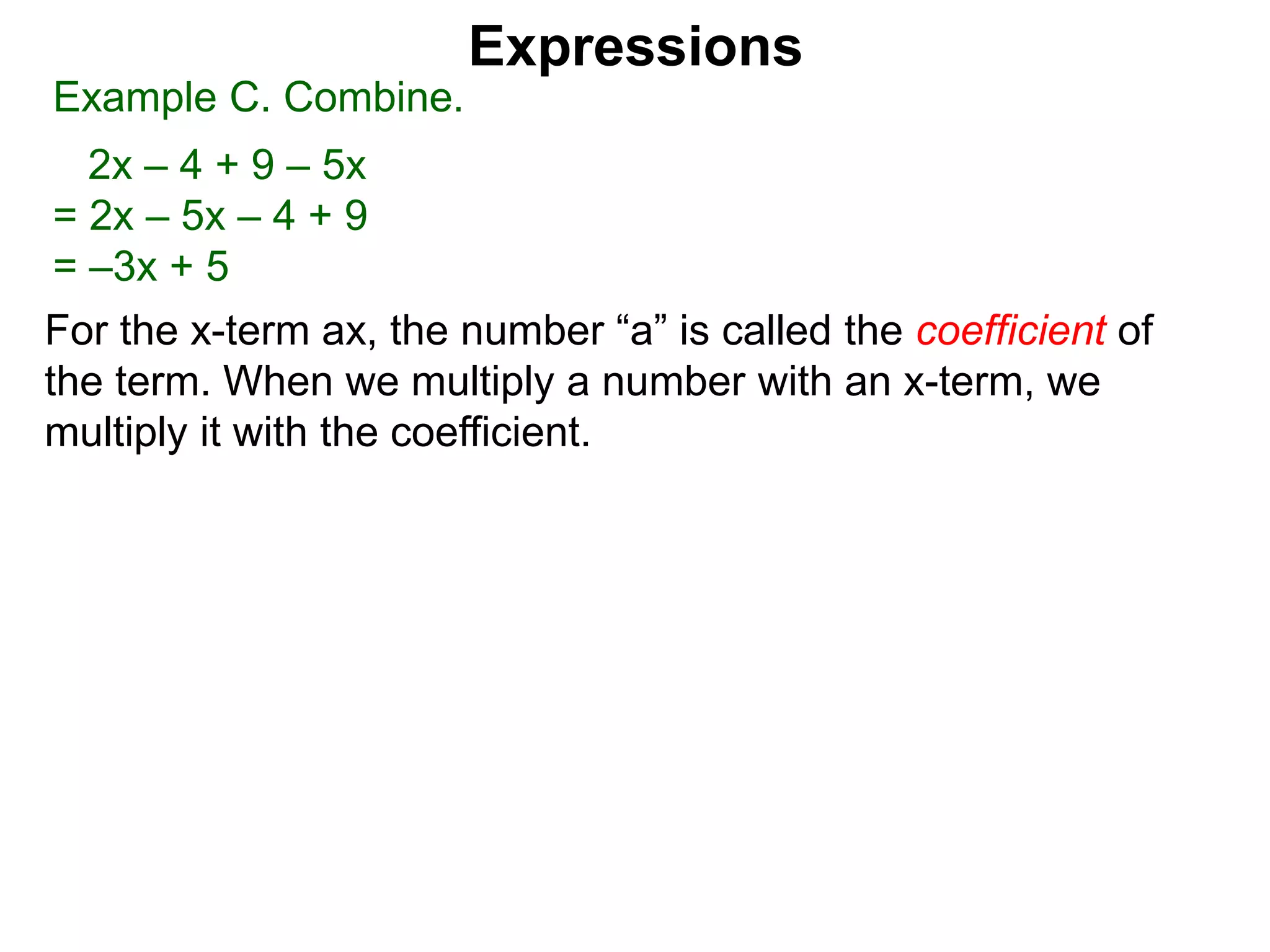
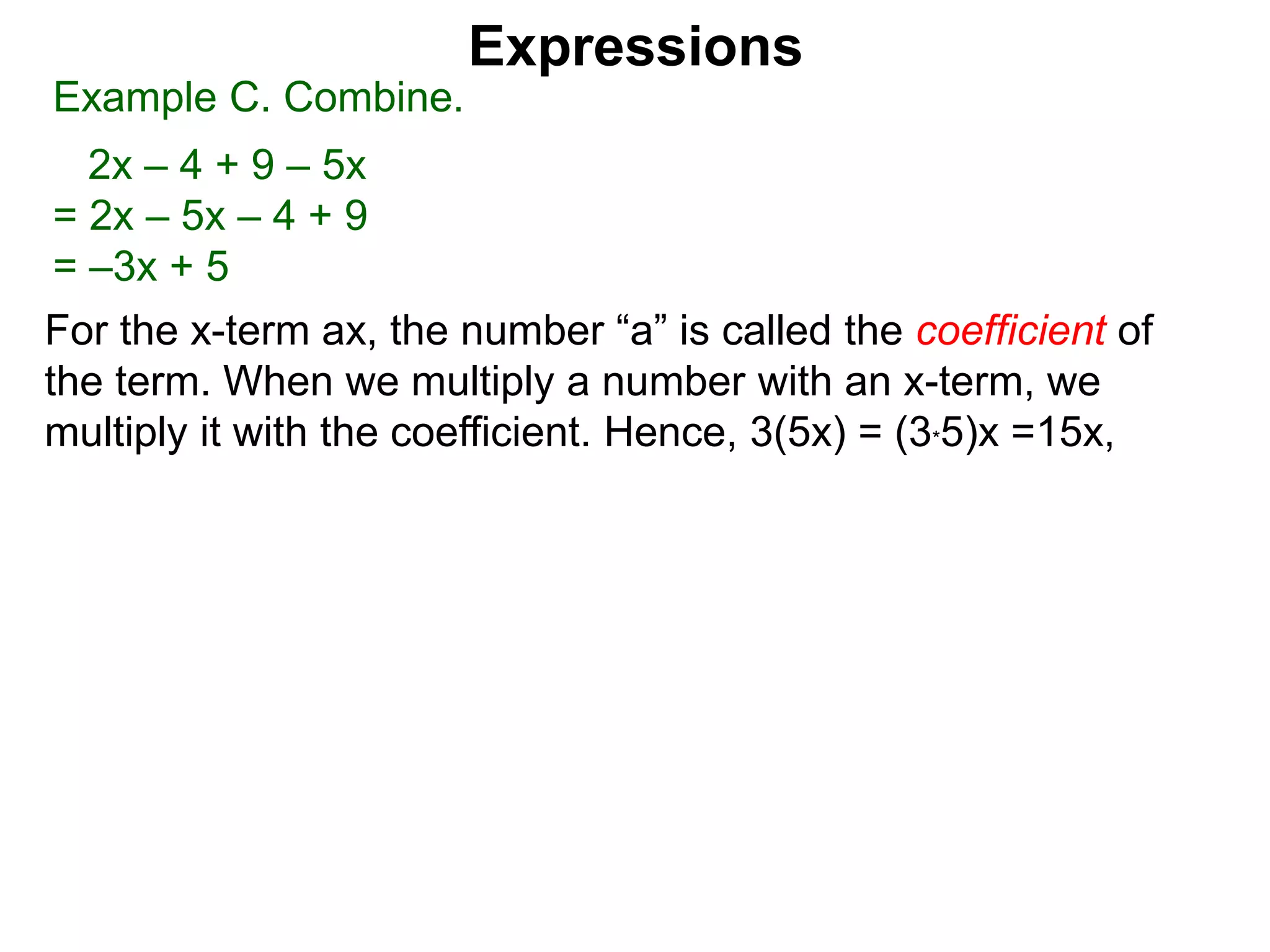
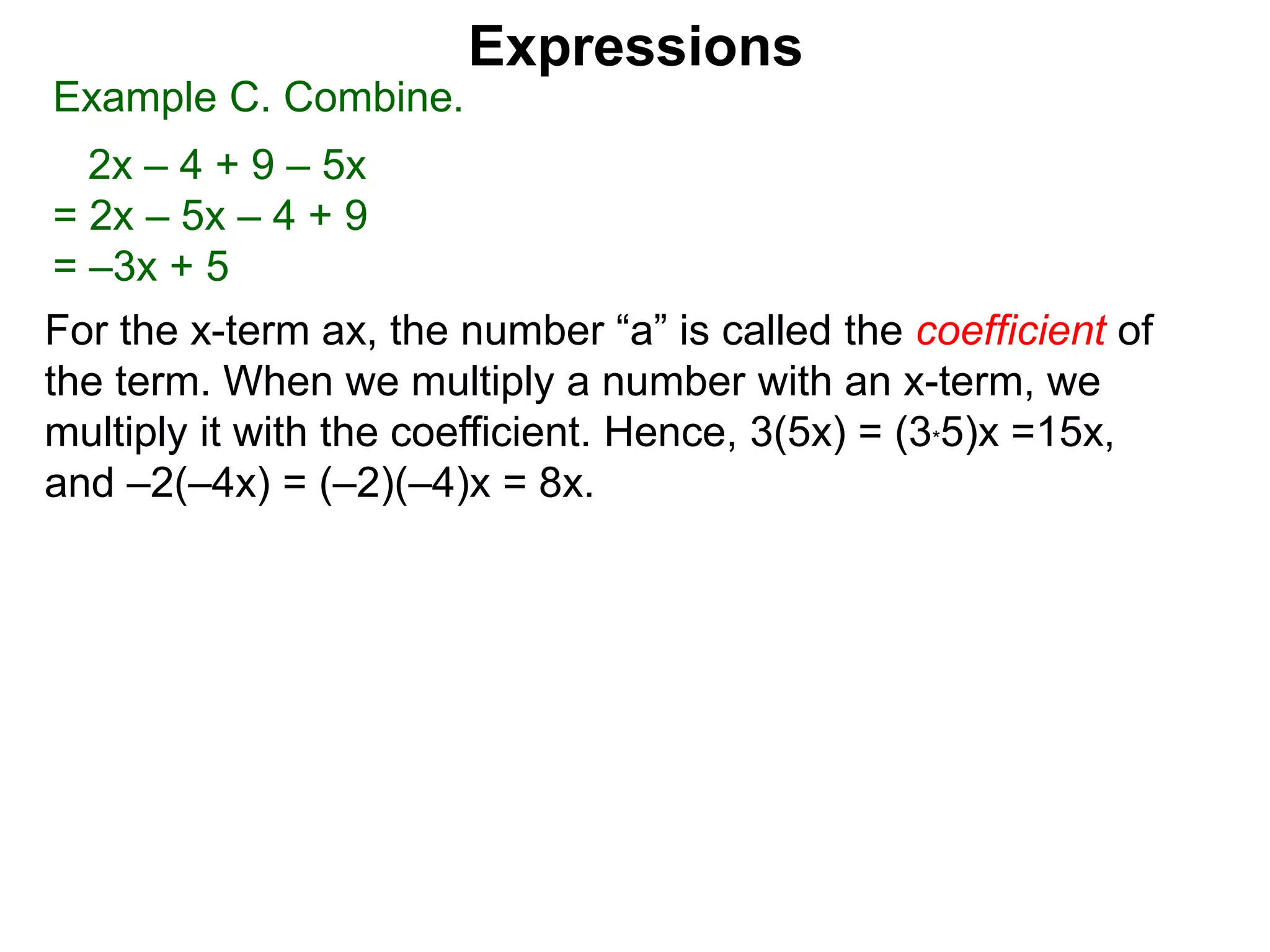
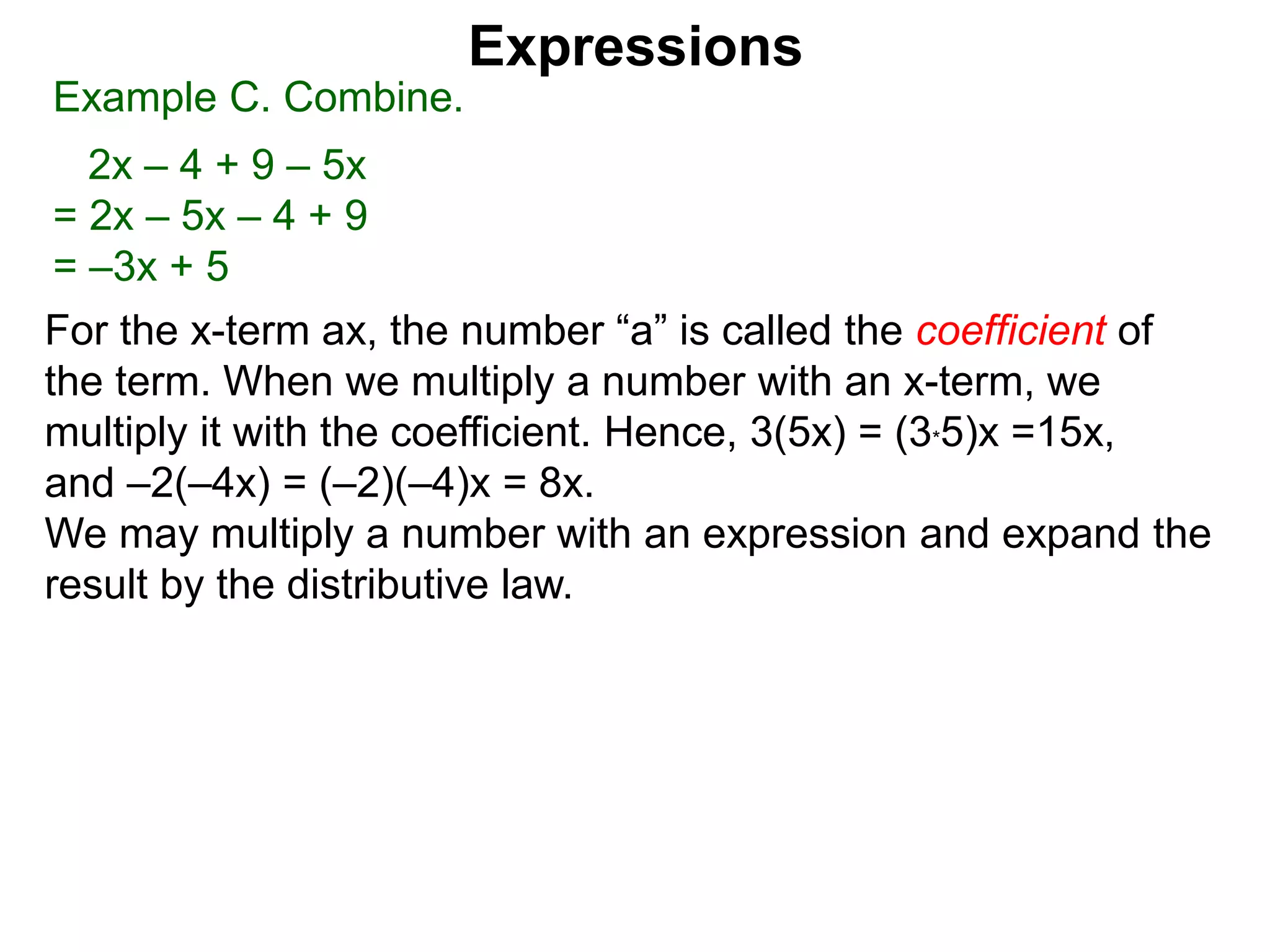
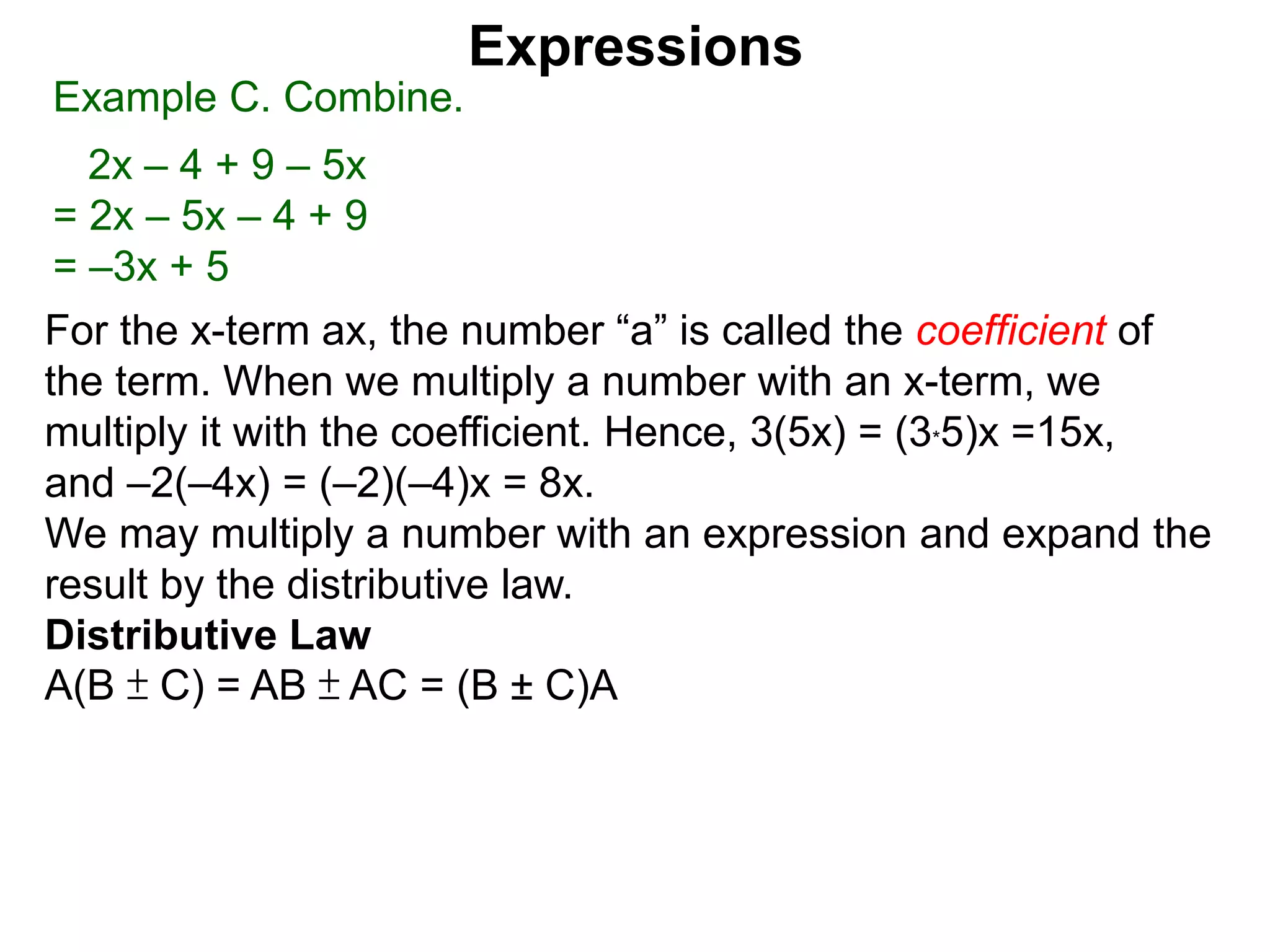
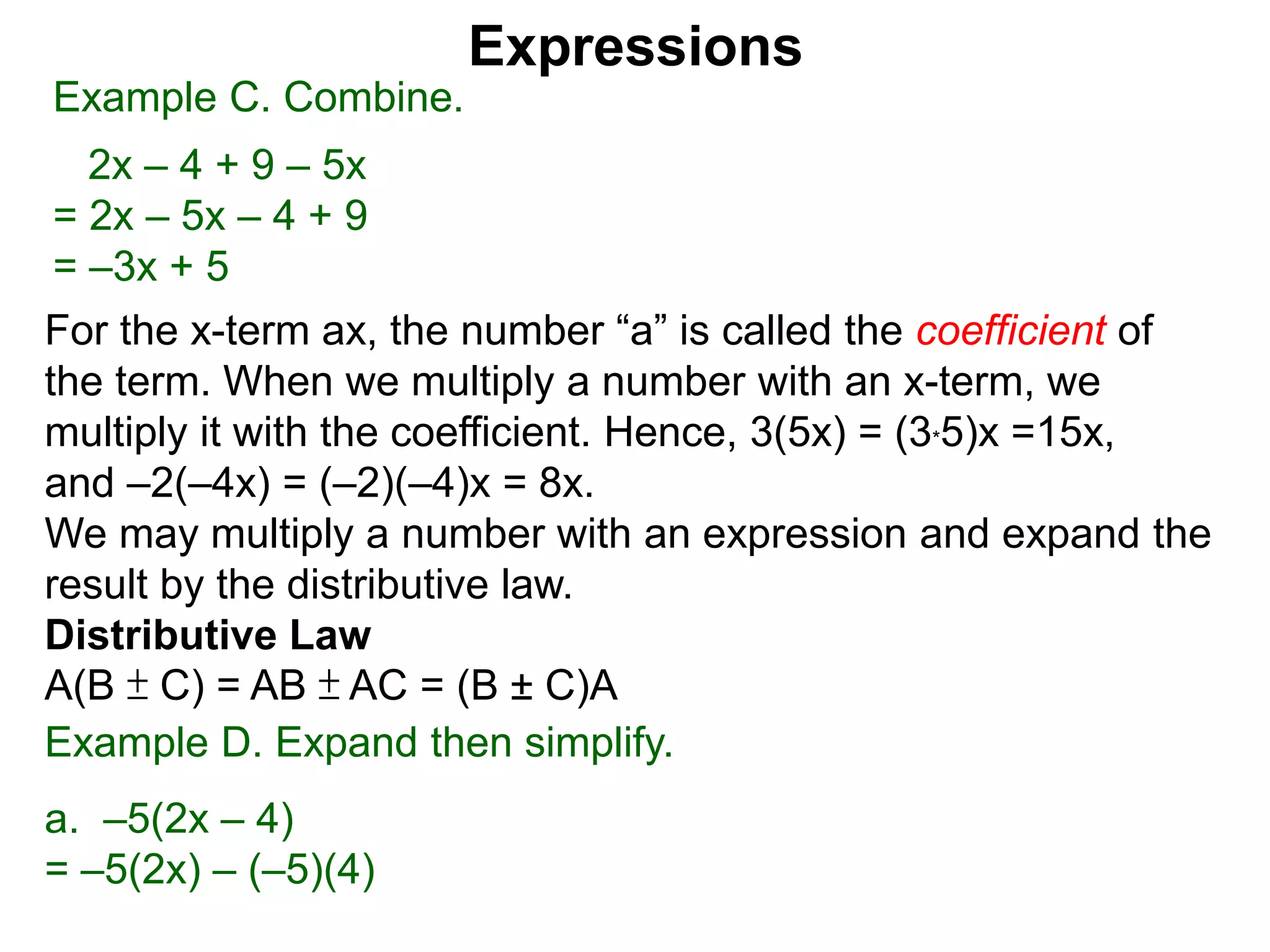
Example C. Combine.
2x – 4 + 9 – 5x
= 2x – 5x – 4 + 9
= –3x + 5
30.
For the x-termax, the number “a” is called the coefficient of
the term. When we multiply a number with an x-term, we
multiply it with the coefficient.
Expressions
Example C. Combine.
2x – 4 + 9 – 5x
= 2x – 5x – 4 + 9
= –3x + 5
31.
For the x-termax, the number “a” is called the coefficient of
the term. When we multiply a number with an x-term, we
multiply it with the coefficient. Hence, 3(5x) = (3*5)x =15x,
Expressions
Example C. Combine.
2x – 4 + 9 – 5x
= 2x – 5x – 4 + 9
= –3x + 5
32.
For the x-termax, the number “a” is called the coefficient of
the term. When we multiply a number with an x-term, we
multiply it with the coefficient. Hence, 3(5x) = (3*5)x =15x,
and –2(–4x) = (–2)(–4)x = 8x.
Expressions
Example C. Combine.
2x – 4 + 9 – 5x
= 2x – 5x – 4 + 9
= –3x + 5
33.
For the x-termax, the number “a” is called the coefficient of
the term. When we multiply a number with an x-term, we
multiply it with the coefficient. Hence, 3(5x) = (3*5)x =15x,
and –2(–4x) = (–2)(–4)x = 8x.
We may multiply a number with an expression and expand the
result by the distributive law.
Expressions
Example C. Combine.
2x – 4 + 9 – 5x
= 2x – 5x – 4 + 9
= –3x + 5
34.
For the x-termax, the number “a” is called the coefficient of
the term. When we multiply a number with an x-term, we
multiply it with the coefficient. Hence, 3(5x) = (3*5)x =15x,
and –2(–4x) = (–2)(–4)x = 8x.
We may multiply a number with an expression and expand the
result by the distributive law.
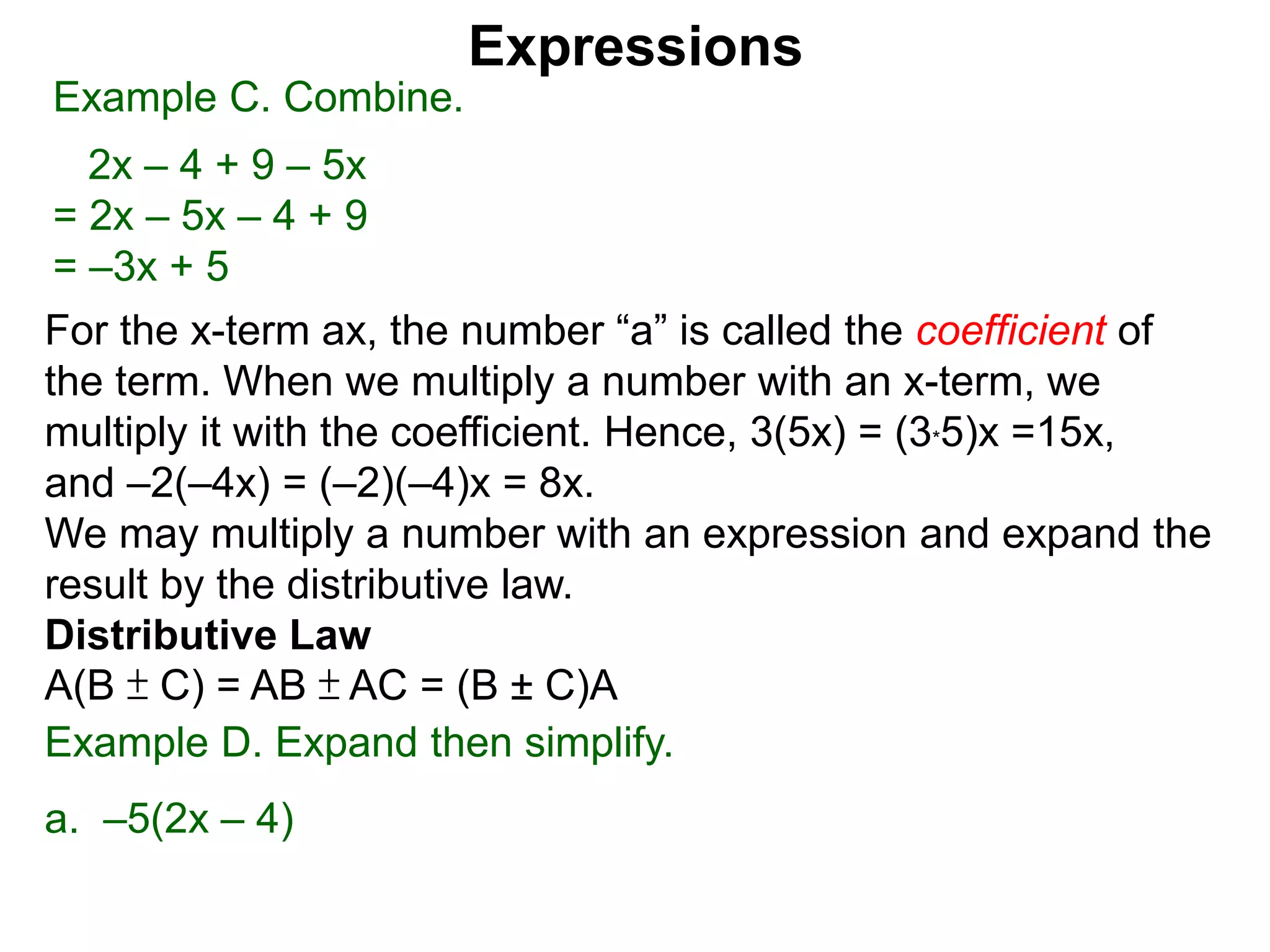
Distributive Law
A(B ± C) = AB ± AC = (B ± C)A
Expressions
Example C. Combine.
2x – 4 + 9 – 5x
= 2x – 5x – 4 + 9
= –3x + 5
35.
For the x-termax, the number “a” is called the coefficient of
the term. When we multiply a number with an x-term, we
multiply it with the coefficient. Hence, 3(5x) = (3*5)x =15x,
and –2(–4x) = (–2)(–4)x = 8x.
We may multiply a number with an expression and expand the
result by the distributive law.
Distributive Law
A(B ± C) = AB ± AC = (B ± C)A
Expressions
Example C. Combine.
2x – 4 + 9 – 5x
= 2x – 5x – 4 + 9
= –3x + 5
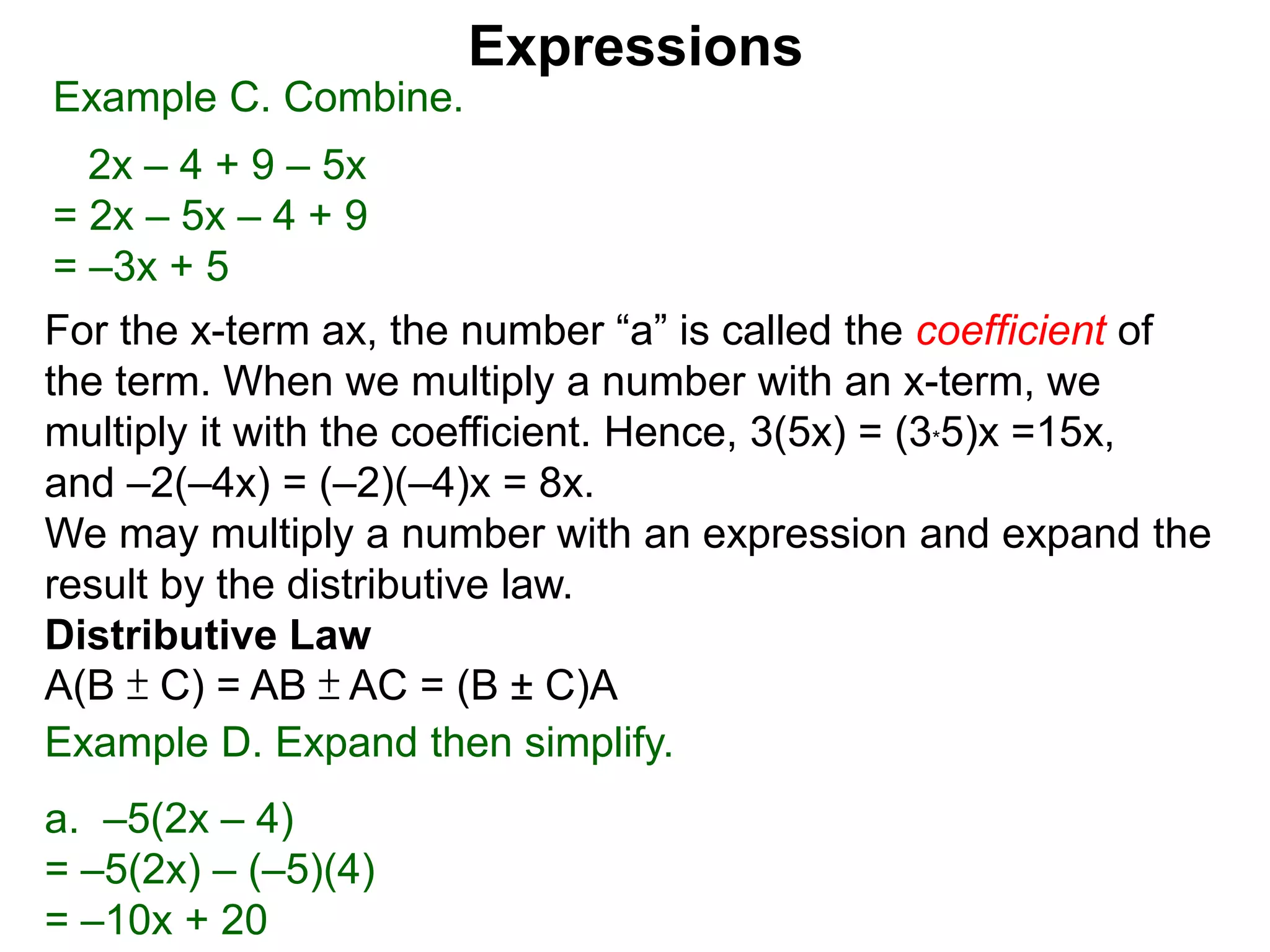
Example D. Expand then simplify.
a. –5(2x – 4)
36.
For the x-termax, the number “a” is called the coefficient of
the term. When we multiply a number with an x-term, we
multiply it with the coefficient. Hence, 3(5x) = (3*5)x =15x,
and –2(–4x) = (–2)(–4)x = 8x.
We may multiply a number with an expression and expand the
result by the distributive law.
Distributive Law
A(B ± C) = AB ± AC = (B ± C)A
Expressions
Example C. Combine.
2x – 4 + 9 – 5x
= 2x – 5x – 4 + 9
= –3x + 5
Example D. Expand then simplify.
a. –5(2x – 4)
= –5(2x) – (–5)(4)
37.
For the x-termax, the number “a” is called the coefficient of
the term. When we multiply a number with an x-term, we
multiply it with the coefficient. Hence, 3(5x) = (3*5)x =15x,
and –2(–4x) = (–2)(–4)x = 8x.
We may multiply a number with an expression and expand the
result by the distributive law.
Distributive Law
A(B ± C) = AB ± AC = (B ± C)A
Expressions
Example C. Combine.
2x – 4 + 9 – 5x
= 2x – 5x – 4 + 9
= –3x + 5
Example D. Expand then simplify.
a. –5(2x – 4)
= –5(2x) – (–5)(4)
= –10x + 20
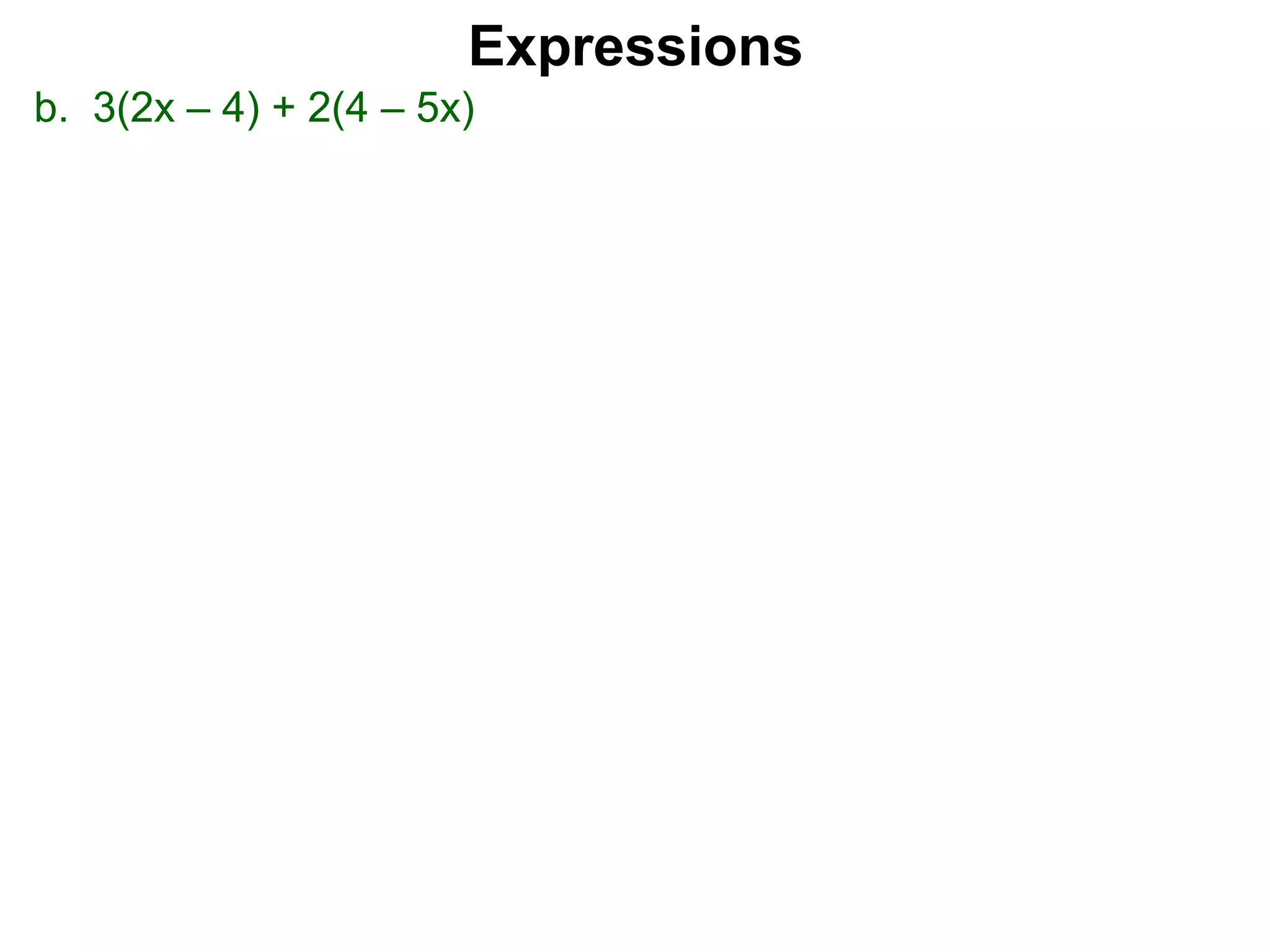
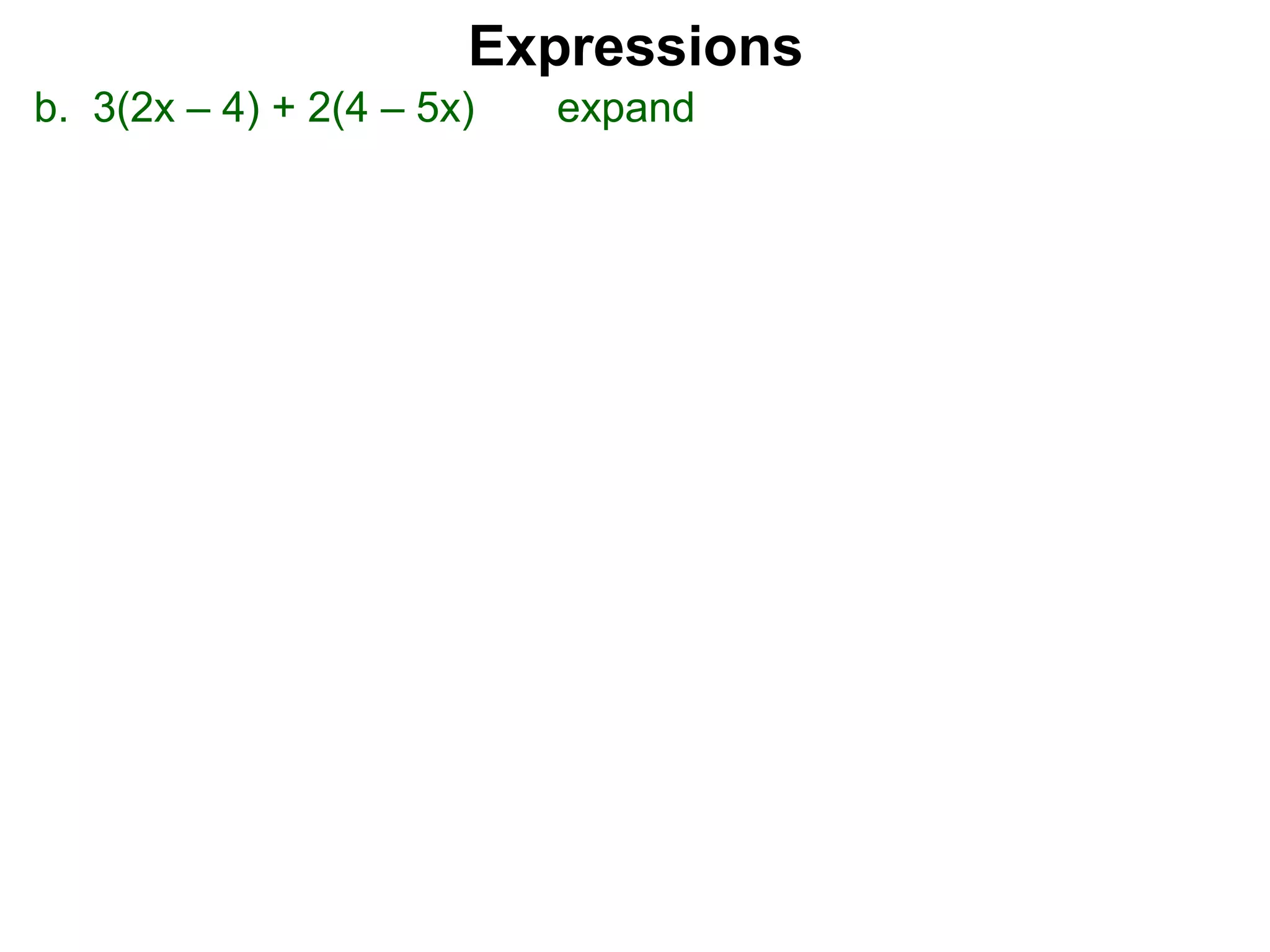
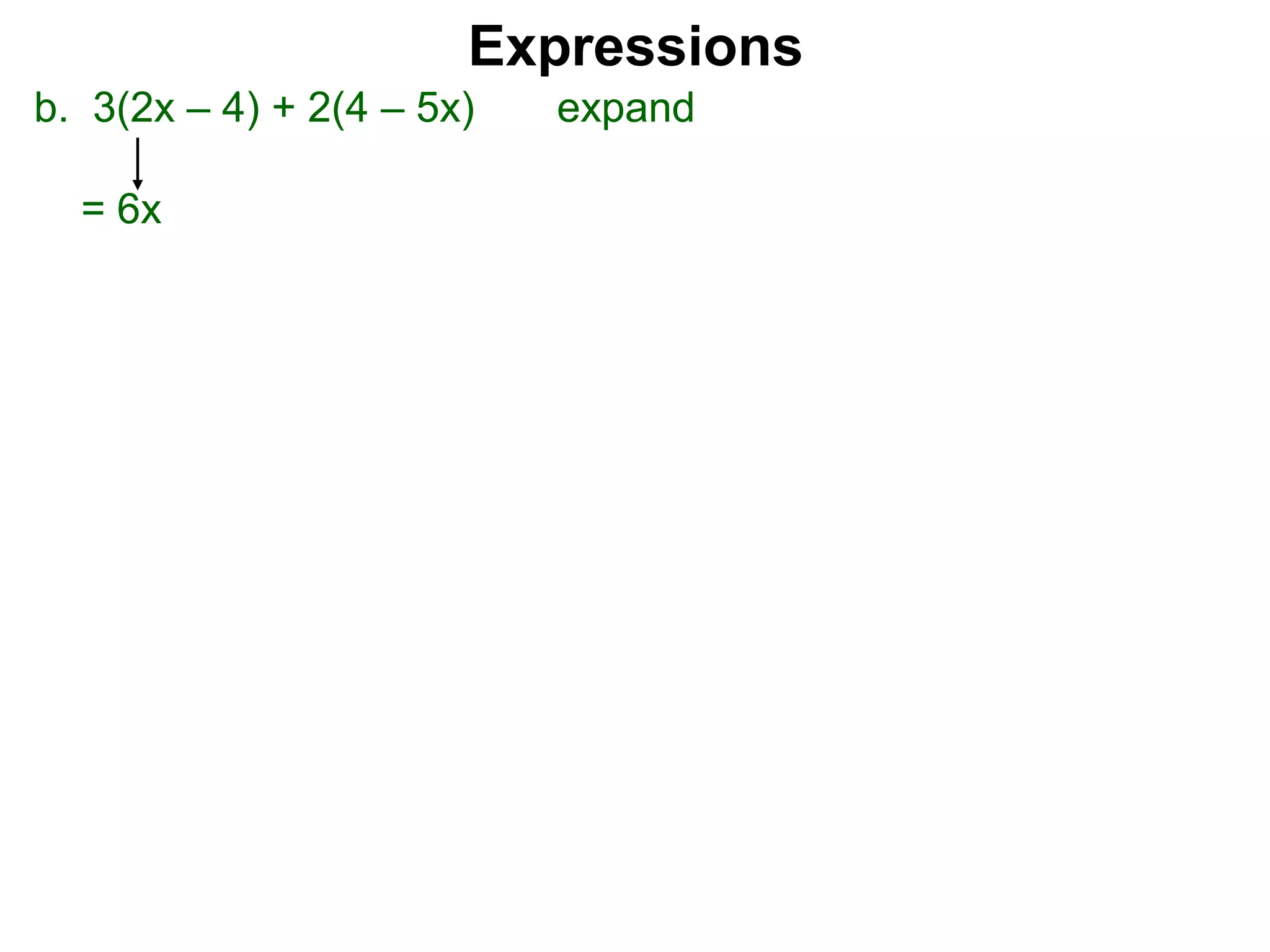
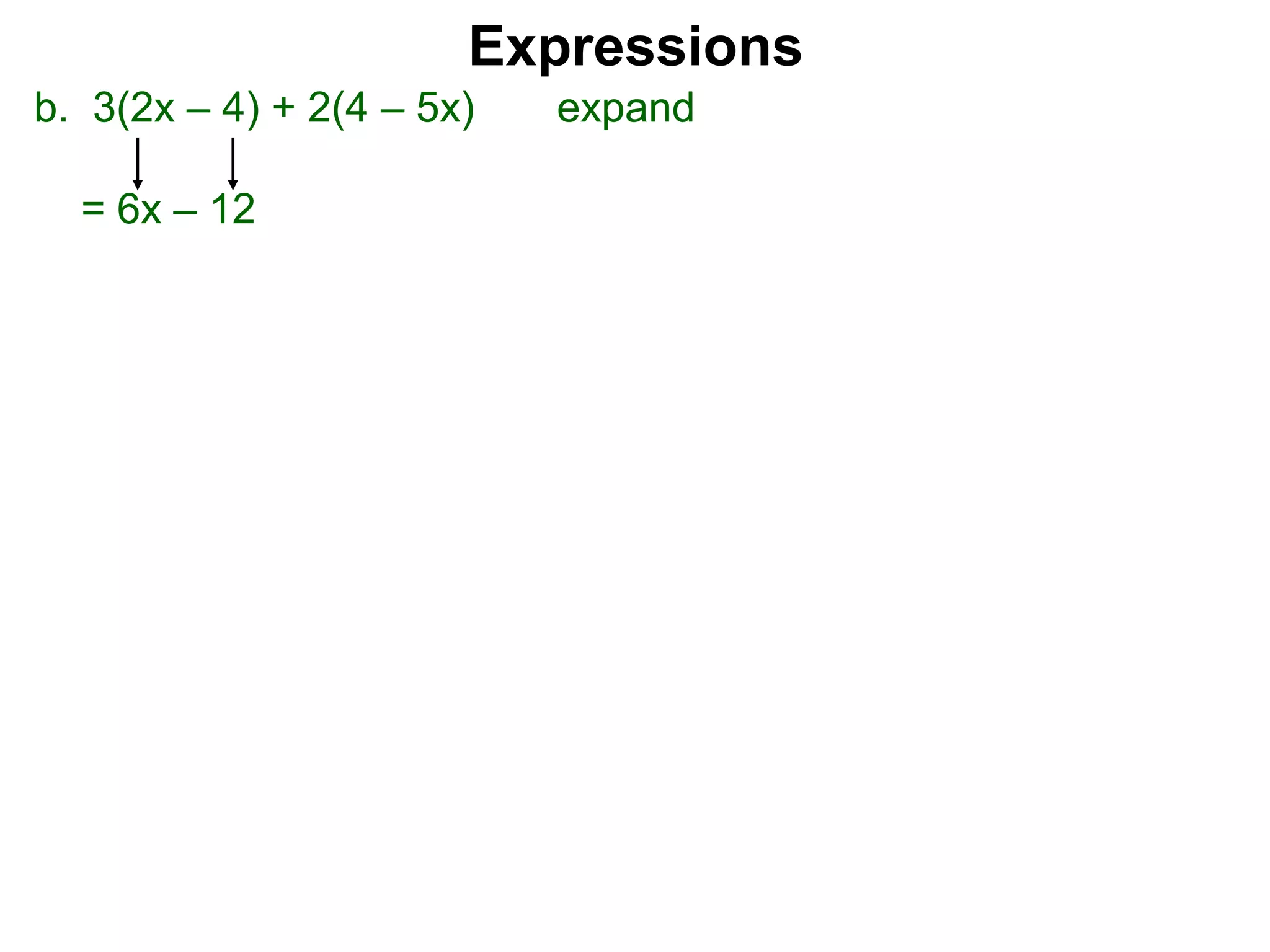
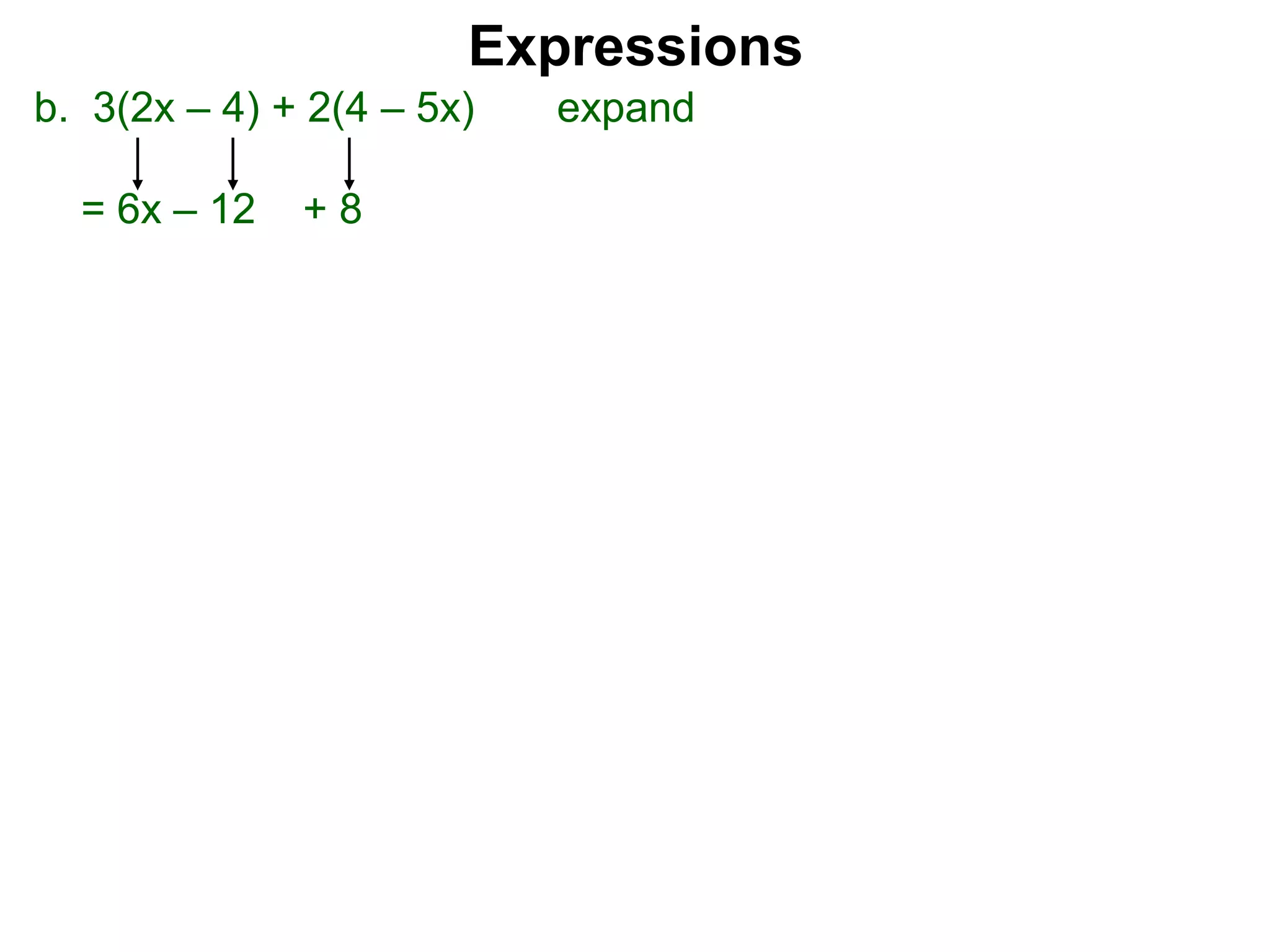
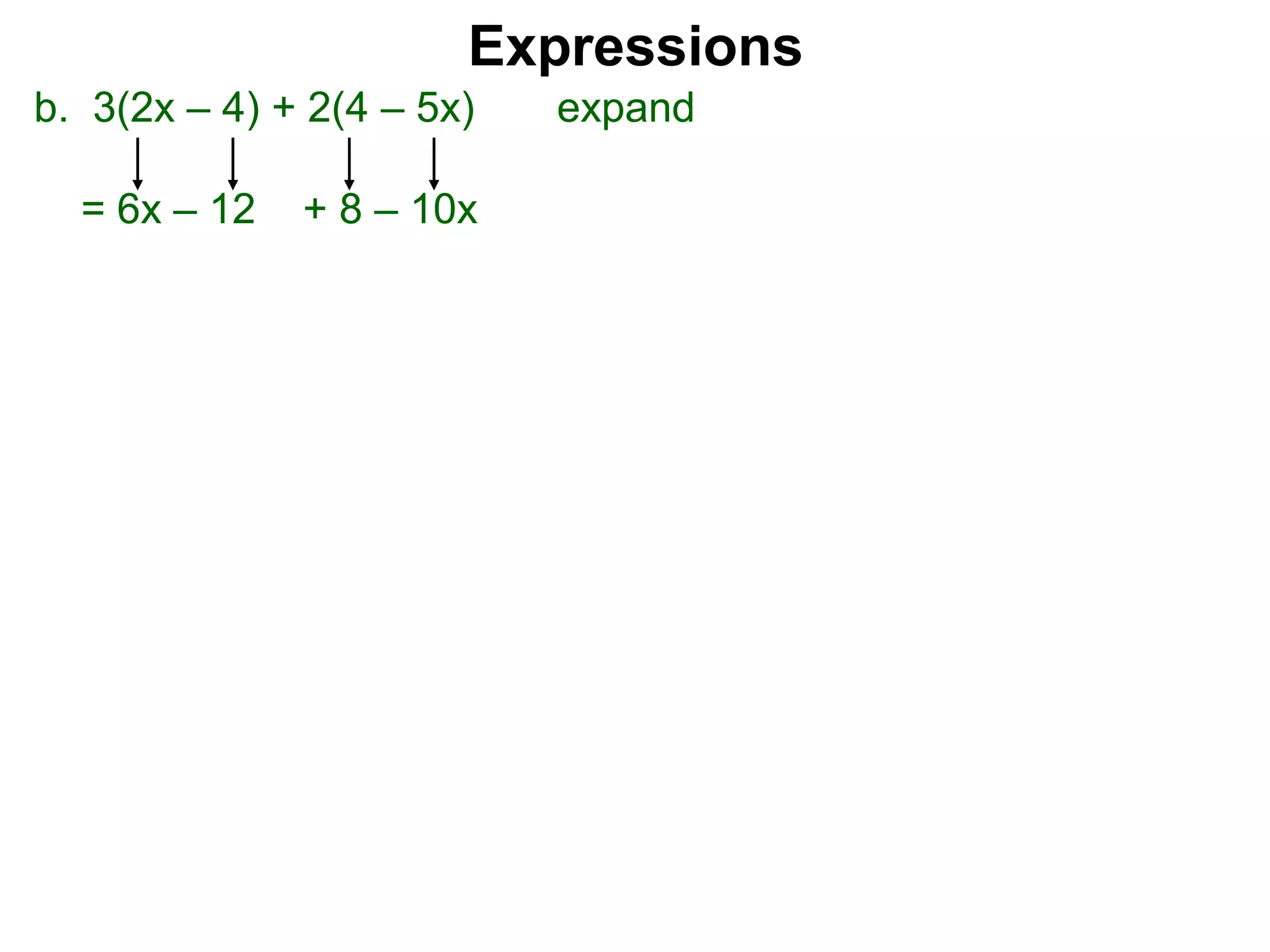
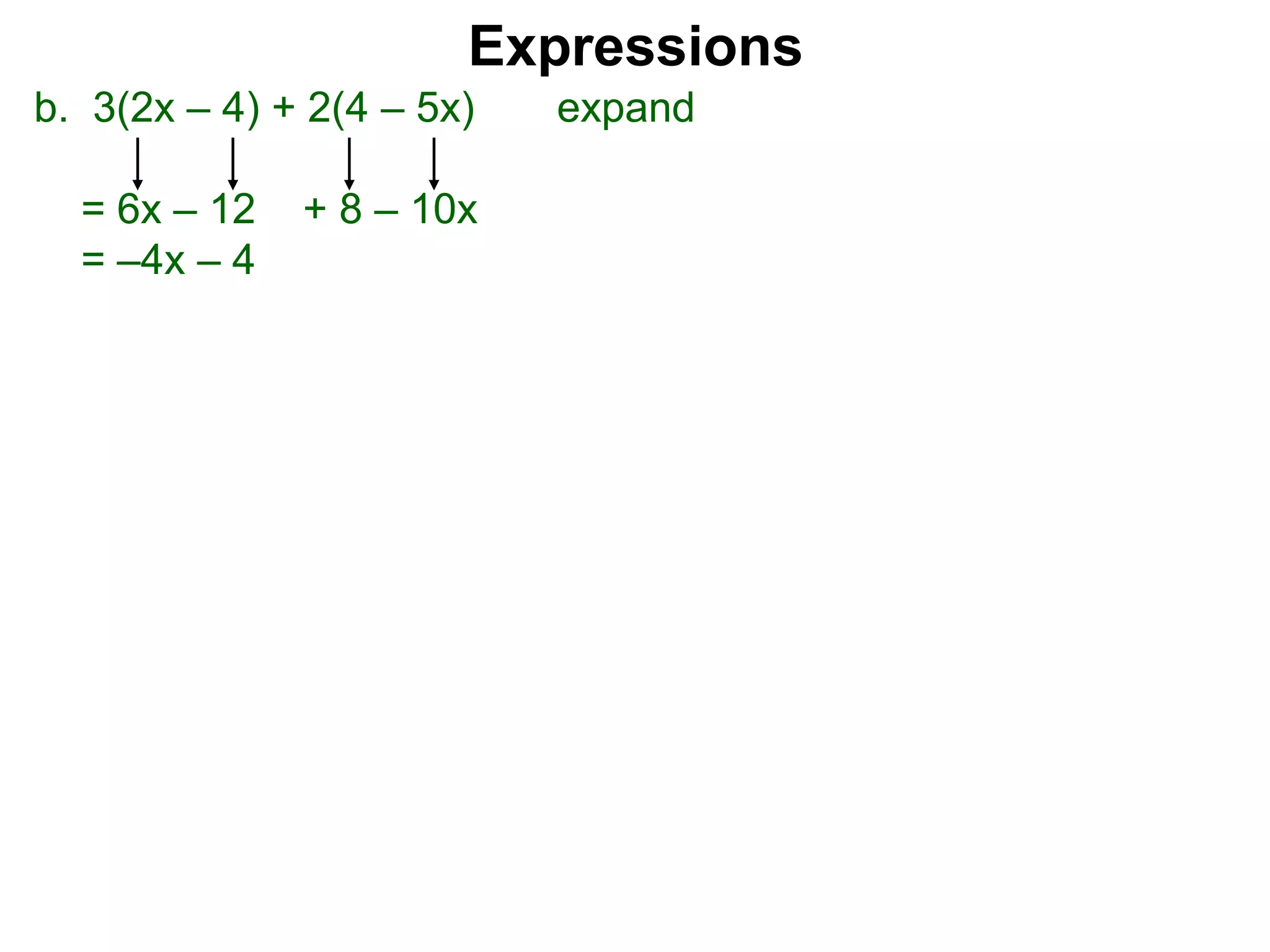
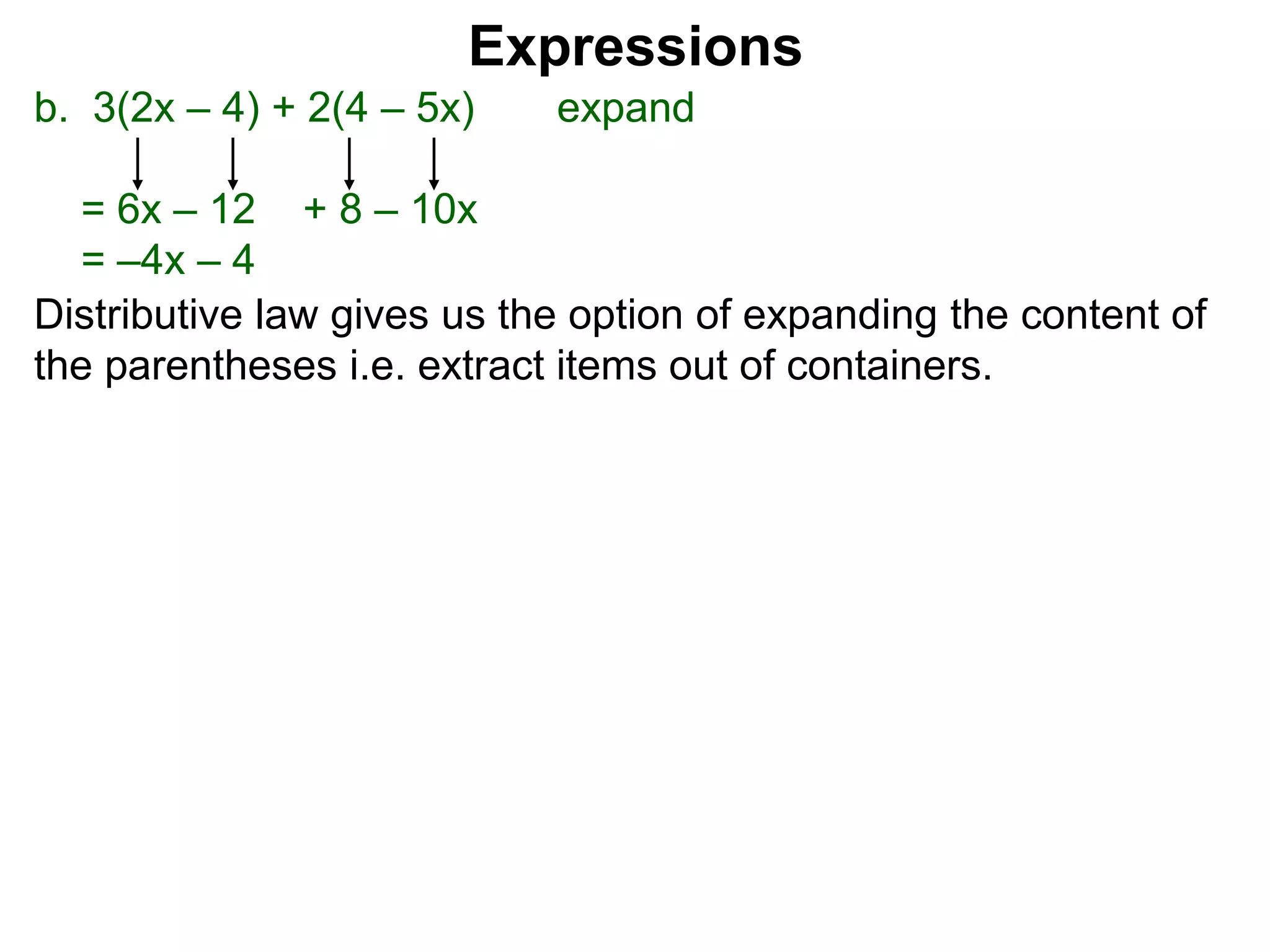
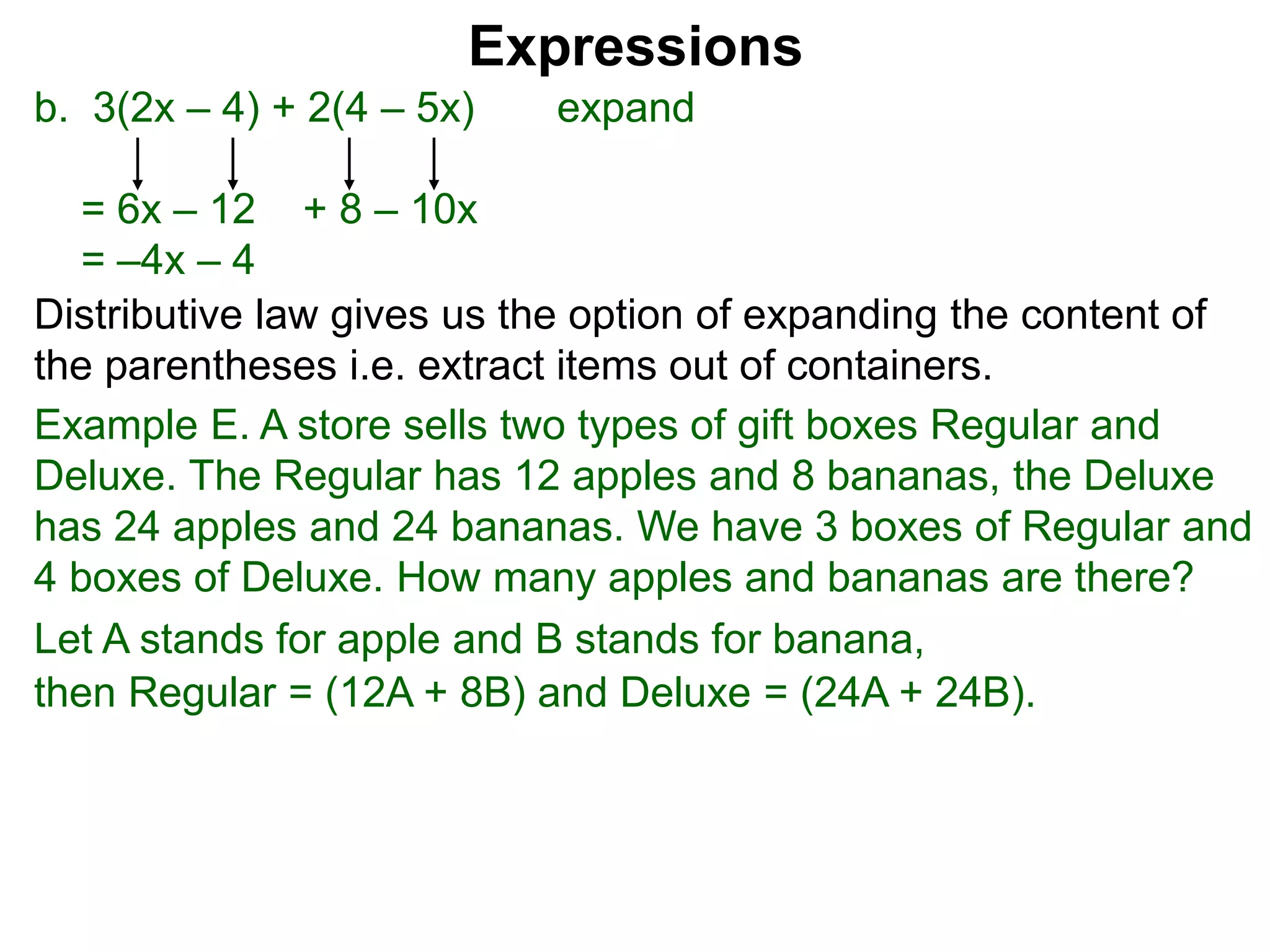
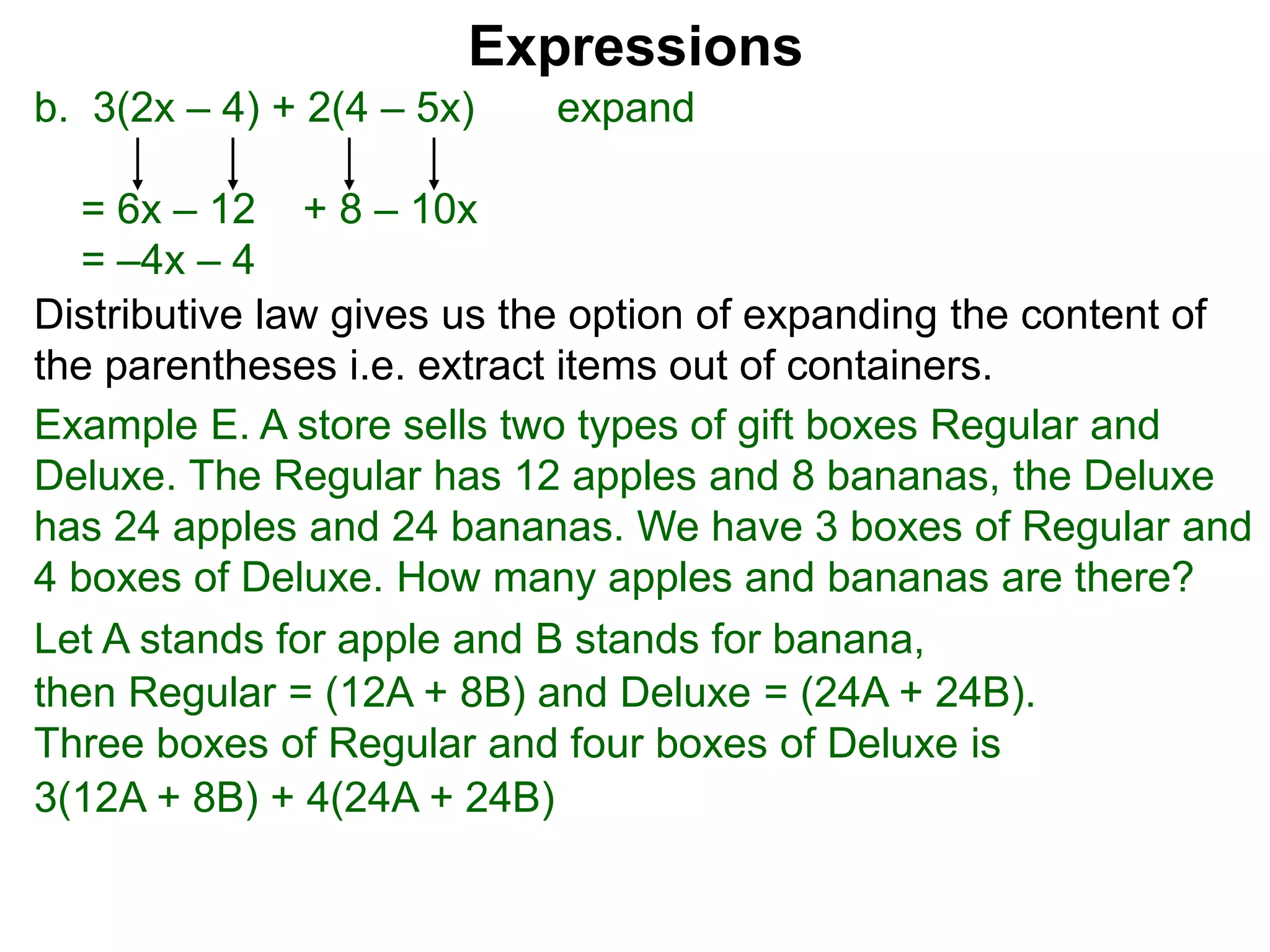
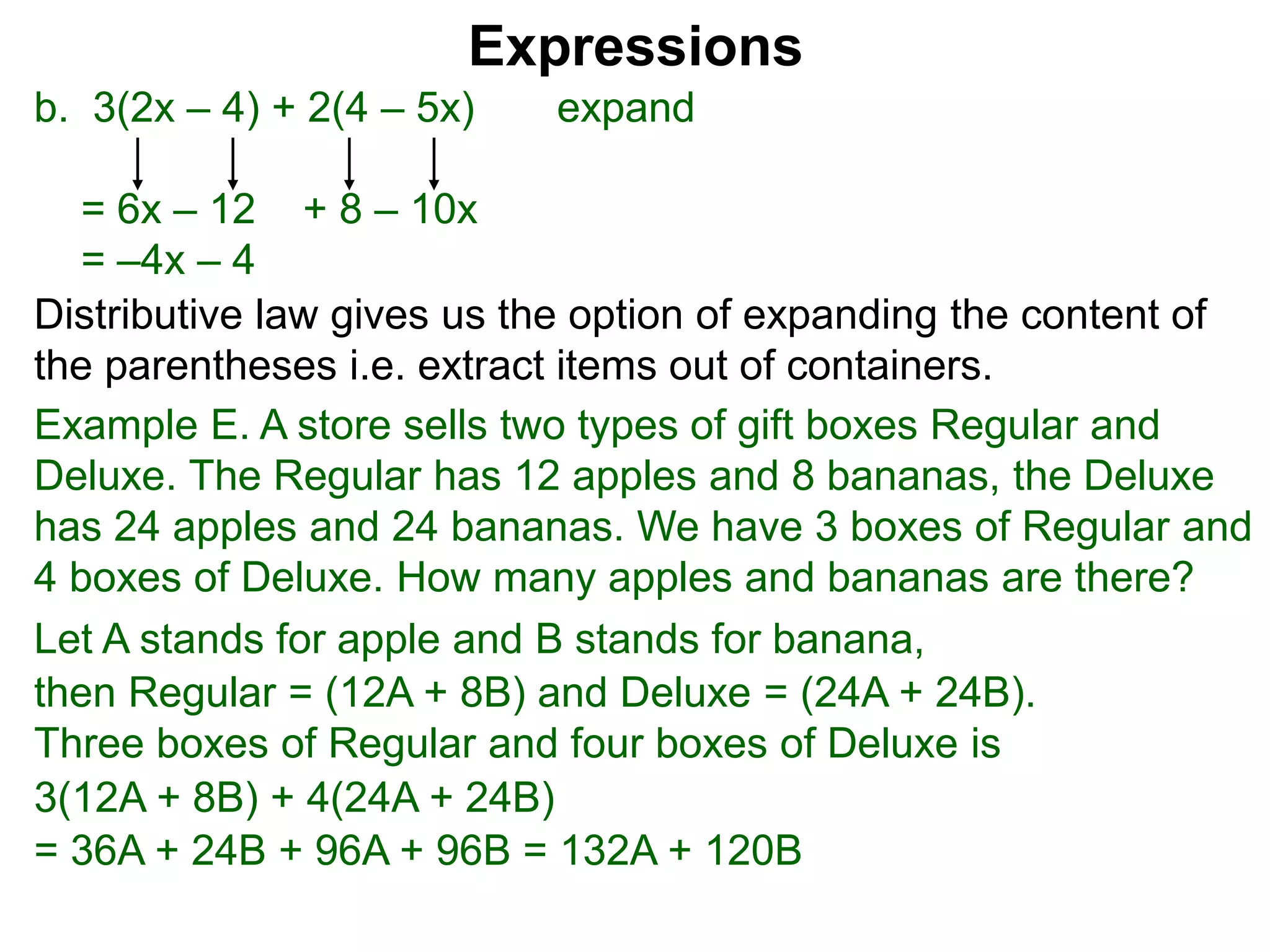
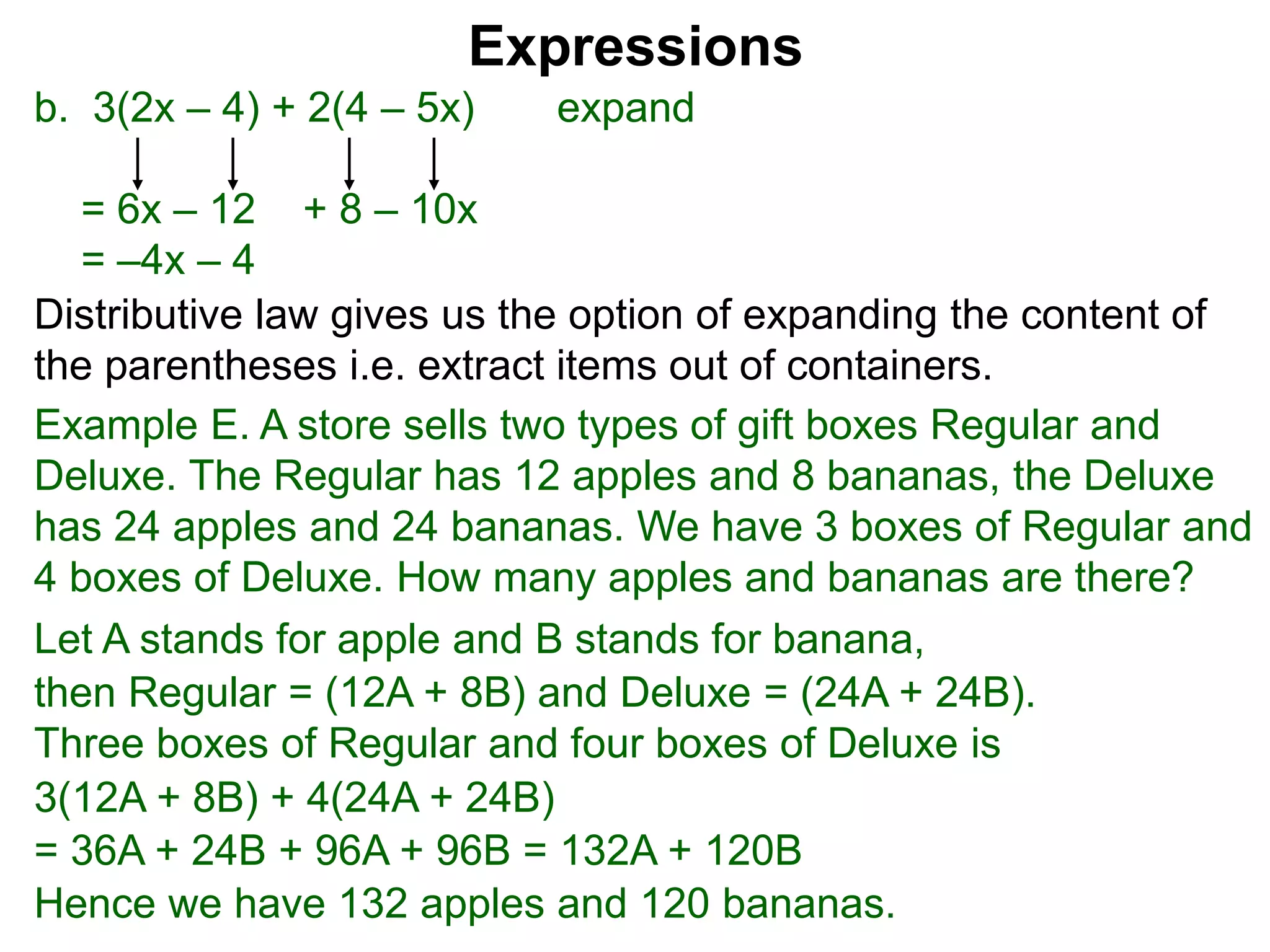
b. 3(2x –4) + 2(4 – 5x) expand
= 6x – 12 + 8 – 10x
= –4x – 4
Expressions
Distributive law gives us the option of expanding the content of
the parentheses i.e. extract items out of containers.
46.
b. 3(2x –4) + 2(4 – 5x) expand
= 6x – 12 + 8 – 10x
= –4x – 4
Expressions
Distributive law gives us the option of expanding the content of
the parentheses i.e. extract items out of containers.
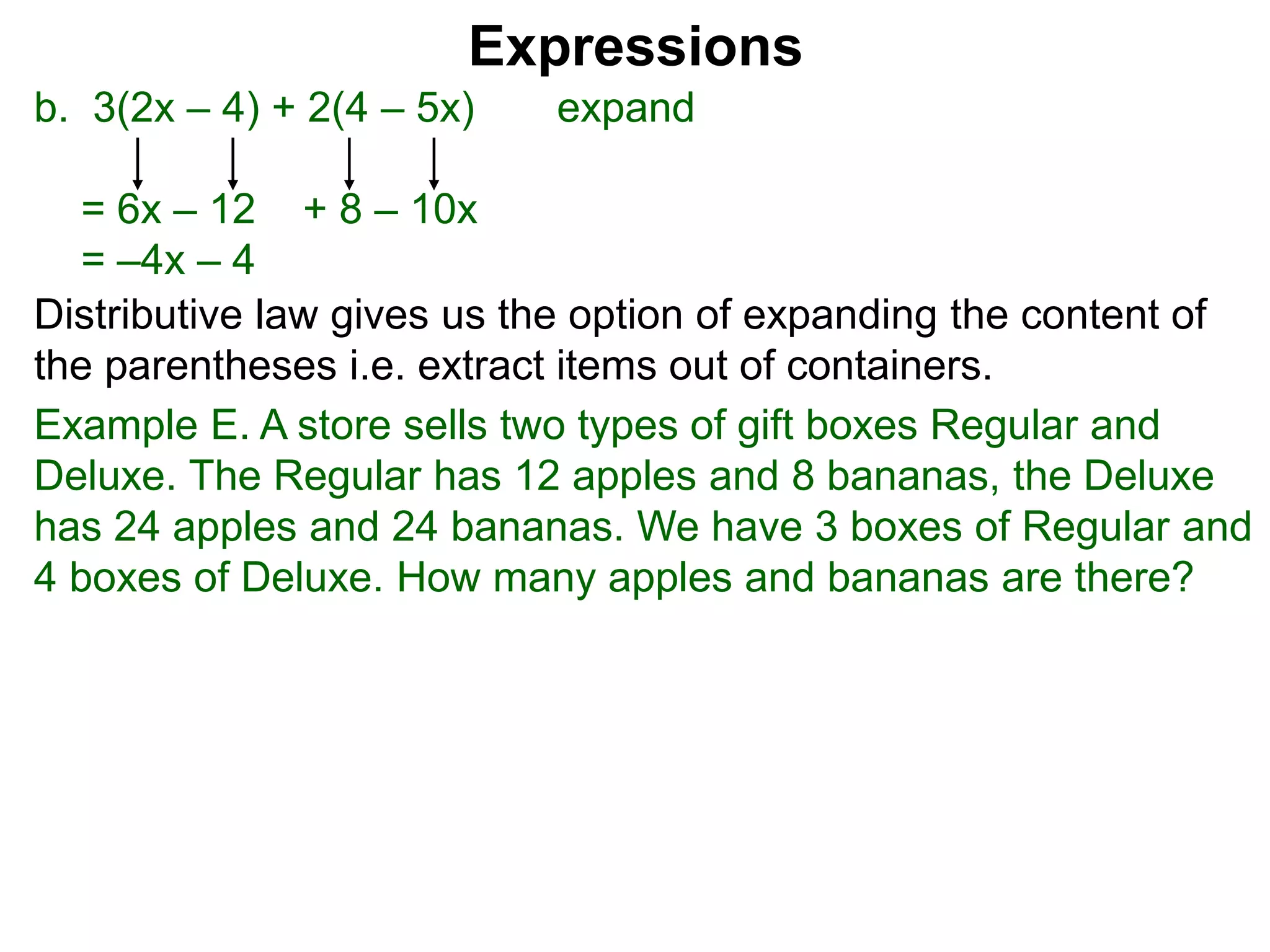
Example E. A store sells two types of gift boxes Regular and
Deluxe. The Regular has 12 apples and 8 bananas, the Deluxe
has 24 apples and 24 bananas. We have 3 boxes of Regular and
4 boxes of Deluxe. How many apples and bananas are there?
47.
b. 3(2x –4) + 2(4 – 5x) expand
= 6x – 12 + 8 – 10x
= –4x – 4
Expressions
Distributive law gives us the option of expanding the content of
the parentheses i.e. extract items out of containers.
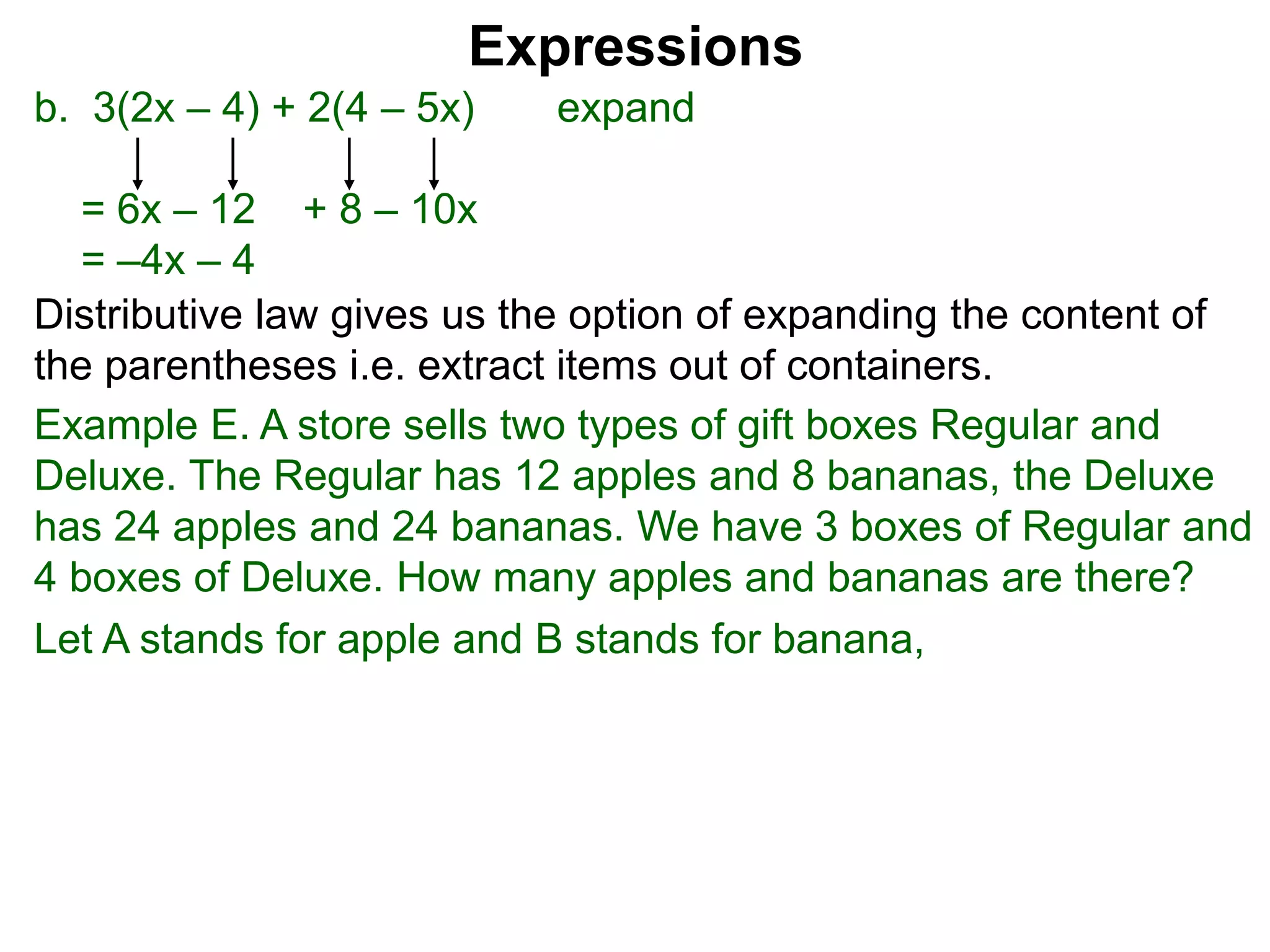
Let A stands for apple and B stands for banana,
Example E. A store sells two types of gift boxes Regular and
Deluxe. The Regular has 12 apples and 8 bananas, the Deluxe
has 24 apples and 24 bananas. We have 3 boxes of Regular and
4 boxes of Deluxe. How many apples and bananas are there?
48.
b. 3(2x –4) + 2(4 – 5x) expand
= 6x – 12 + 8 – 10x
= –4x – 4
Expressions
Distributive law gives us the option of expanding the content of
the parentheses i.e. extract items out of containers.
Let A stands for apple and B stands for banana,
then Regular = (12A + 8B) and Deluxe = (24A + 24B).
Example E. A store sells two types of gift boxes Regular and
Deluxe. The Regular has 12 apples and 8 bananas, the Deluxe
has 24 apples and 24 bananas. We have 3 boxes of Regular and
4 boxes of Deluxe. How many apples and bananas are there?
49.
b. 3(2x –4) + 2(4 – 5x) expand
= 6x – 12 + 8 – 10x
= –4x – 4
Expressions
Distributive law gives us the option of expanding the content of
the parentheses i.e. extract items out of containers.
Let A stands for apple and B stands for banana,
then Regular = (12A + 8B) and Deluxe = (24A + 24B).
Three boxes of Regular and four boxes of Deluxe is
3(12A + 8B) + 4(24A + 24B)
Example E. A store sells two types of gift boxes Regular and
Deluxe. The Regular has 12 apples and 8 bananas, the Deluxe
has 24 apples and 24 bananas. We have 3 boxes of Regular and
4 boxes of Deluxe. How many apples and bananas are there?
50.
b. 3(2x –4) + 2(4 – 5x) expand
= 6x – 12 + 8 – 10x
= –4x – 4
Expressions
Distributive law gives us the option of expanding the content of
the parentheses i.e. extract items out of containers.
Let A stands for apple and B stands for banana,
then Regular = (12A + 8B) and Deluxe = (24A + 24B).
Three boxes of Regular and four boxes of Deluxe is
3(12A + 8B) + 4(24A + 24B)
= 36A + 24B + 96A + 96B = 132A + 120B
Example E. A store sells two types of gift boxes Regular and
Deluxe. The Regular has 12 apples and 8 bananas, the Deluxe
has 24 apples and 24 bananas. We have 3 boxes of Regular and
4 boxes of Deluxe. How many apples and bananas are there?
51.
b. 3(2x –4) + 2(4 – 5x) expand
= 6x – 12 + 8 – 10x
= –4x – 4
Expressions
Distributive law gives us the option of expanding the content of
the parentheses i.e. extract items out of containers.
Let A stands for apple and B stands for banana,
then Regular = (12A + 8B) and Deluxe = (24A + 24B).
Three boxes of Regular and four boxes of Deluxe is
3(12A + 8B) + 4(24A + 24B)
= 36A + 24B + 96A + 96B = 132A + 120B
Hence we have 132 apples and 120 bananas.
Example E. A store sells two types of gift boxes Regular and
Deluxe. The Regular has 12 apples and 8 bananas, the Deluxe
has 24 apples and 24 bananas. We have 3 boxes of Regular and
4 boxes of Deluxe. How many apples and bananas are there?
52.
Expressions
We usually startwith the innermost set of parentheses to
simplify an expression that has multiple layers of parentheses.
53.
Expressions
We usually startwith the innermost set of parentheses to
simplify an expression that has multiple layers of parentheses.
In mathematics, ( )’s, [ ]’s, and { }’s are often used to
distinguish the layers.
54.
Expressions
We usually startwith the innermost set of parentheses to
simplify an expression that has multiple layers of parentheses.
In mathematics, ( )’s, [ ]’s, and { }’s are often used to
distinguish the layers. This can't be the case for calculators or
software where [ ] and { } may have other meanings.
55.
Expressions
We usually startwith the innermost set of parentheses to
simplify an expression that has multiple layers of parentheses.
In mathematics, ( )’s, [ ]’s, and { }’s are often used to
distinguish the layers. This can't be the case for calculators or
software where [ ] and { } may have other meanings.
Always simplify the content of a set of parentheses first before
expanding it.
56.
Expressions
We usually startwith the innermost set of parentheses to
simplify an expression that has multiple layers of parentheses.
In mathematics, ( )’s, [ ]’s, and { }’s are often used to
distinguish the layers. This can't be the case for calculators or
software where [ ] and { } may have other meanings.
Always simplify the content of a set of parentheses first before
expanding it.
Example F. Expand.
–3{–3x – [5 – 2(– 4x – 6)] – 4}
57.
Expressions
We usually startwith the innermost set of parentheses to
simplify an expression that has multiple layers of parentheses.
In mathematics, ( )’s, [ ]’s, and { }’s are often used to
distinguish the layers. This can't be the case for calculators or
software where [ ] and { } may have other meanings.
Always simplify the content of a set of parentheses first before
expanding it.
Example F. Expand.
–3{–3x – [5 – 2(– 4x – 6)] – 4} expand,
58.
Expressions
We usually startwith the innermost set of parentheses to
simplify an expression that has multiple layers of parentheses.
In mathematics, ( )’s, [ ]’s, and { }’s are often used to
distinguish the layers. This can't be the case for calculators or
software where [ ] and { } may have other meanings.
Always simplify the content of a set of parentheses first before
expanding it.
= –3{–3x – [5 + 8x + 12] – 4}
Example F. Expand.
–3{–3x – [5 – 2(– 4x – 6)] – 4} expand,
59.
Expressions
We usually startwith the innermost set of parentheses to
simplify an expression that has multiple layers of parentheses.
In mathematics, ( )’s, [ ]’s, and { }’s are often used to
distinguish the layers. This can't be the case for calculators or
software where [ ] and { } may have other meanings.
Always simplify the content of a set of parentheses first before
expanding it.
= –3{–3x – [5 + 8x + 12] – 4}
Example F. Expand.
–3{–3x – [5 – 2(– 4x – 6)] – 4} expand,
simplify,
60.
Expressions
We usually startwith the innermost set of parentheses to
simplify an expression that has multiple layers of parentheses.
In mathematics, ( )’s, [ ]’s, and { }’s are often used to
distinguish the layers. This can't be the case for calculators or
software where [ ] and { } may have other meanings.
Always simplify the content of a set of parentheses first before
expanding it.
= –3{–3x – [5 + 8x + 12] – 4}
= –3{–3x – [17 + 8x] – 4}
Example F. Expand.
–3{–3x – [5 – 2(– 4x – 6)] – 4} expand,
simplify,
61.
Expressions
We usually startwith the innermost set of parentheses to
simplify an expression that has multiple layers of parentheses.
In mathematics, ( )’s, [ ]’s, and { }’s are often used to
distinguish the layers. This can't be the case for calculators or
software where [ ] and { } may have other meanings.
Always simplify the content of a set of parentheses first before
expanding it.
= –3{–3x – [5 + 8x + 12] – 4}
= –3{–3x – [17 + 8x] – 4}
Example F. Expand.
–3{–3x – [5 – 2(– 4x – 6)] – 4} expand,
simplify,
expand,
62.
Expressions
We usually startwith the innermost set of parentheses to
simplify an expression that has multiple layers of parentheses.
In mathematics, ( )’s, [ ]’s, and { }’s are often used to
distinguish the layers. This can't be the case for calculators or
software where [ ] and { } may have other meanings.
Always simplify the content of a set of parentheses first before
expanding it.
= –3{–3x – [5 + 8x + 12] – 4}
= –3{–3x – [17 + 8x] – 4}
Example F. Expand.
= –3{– 3x – 17 – 8x – 4}
–3{–3x – [5 – 2(– 4x – 6)] – 4} expand,
simplify,
expand,
63.
Expressions
We usually startwith the innermost set of parentheses to
simplify an expression that has multiple layers of parentheses.
In mathematics, ( )’s, [ ]’s, and { }’s are often used to
distinguish the layers. This can't be the case for calculators or
software where [ ] and { } may have other meanings.
Always simplify the content of a set of parentheses first before
expanding it.
= –3{–3x – [5 + 8x + 12] – 4}
= –3{–3x – [17 + 8x] – 4}
Example F. Expand.
= –3{– 3x – 17 – 8x – 4}
–3{–3x – [5 – 2(– 4x – 6)] – 4} expand,
simplify,
expand,
simplify,
64.
Expressions
We usually startwith the innermost set of parentheses to
simplify an expression that has multiple layers of parentheses.
In mathematics, ( )’s, [ ]’s, and { }’s are often used to
distinguish the layers. This can't be the case for calculators or
software where [ ] and { } may have other meanings.
Always simplify the content of a set of parentheses first before
expanding it.
= –3{–3x – [5 + 8x + 12] – 4}
= –3{–3x – [17 + 8x] – 4}
Example F. Expand.
= –3{– 3x – 17 – 8x – 4}
–3{–3x – [5 – 2(– 4x – 6)] – 4} expand,
simplify,
expand,
simplify,
= –3{–11x – 21}
65.
Expressions
We usually startwith the innermost set of parentheses to
simplify an expression that has multiple layers of parentheses.
In mathematics, ( )’s, [ ]’s, and { }’s are often used to
distinguish the layers. This can't be the case for calculators or
software where [ ] and { } may have other meanings.
Always simplify the content of a set of parentheses first before
expanding it.
= –3{–3x – [5 + 8x + 12] – 4}
= –3{–3x – [17 + 8x] – 4}
Example F. Expand.
= –3{– 3x – 17 – 8x – 4}
–3{–3x – [5 – 2(– 4x – 6)] – 4} expand,
simplify,
expand,
simplify,
= –3{–11x – 21} expand,
= 33x + 63
Expressions
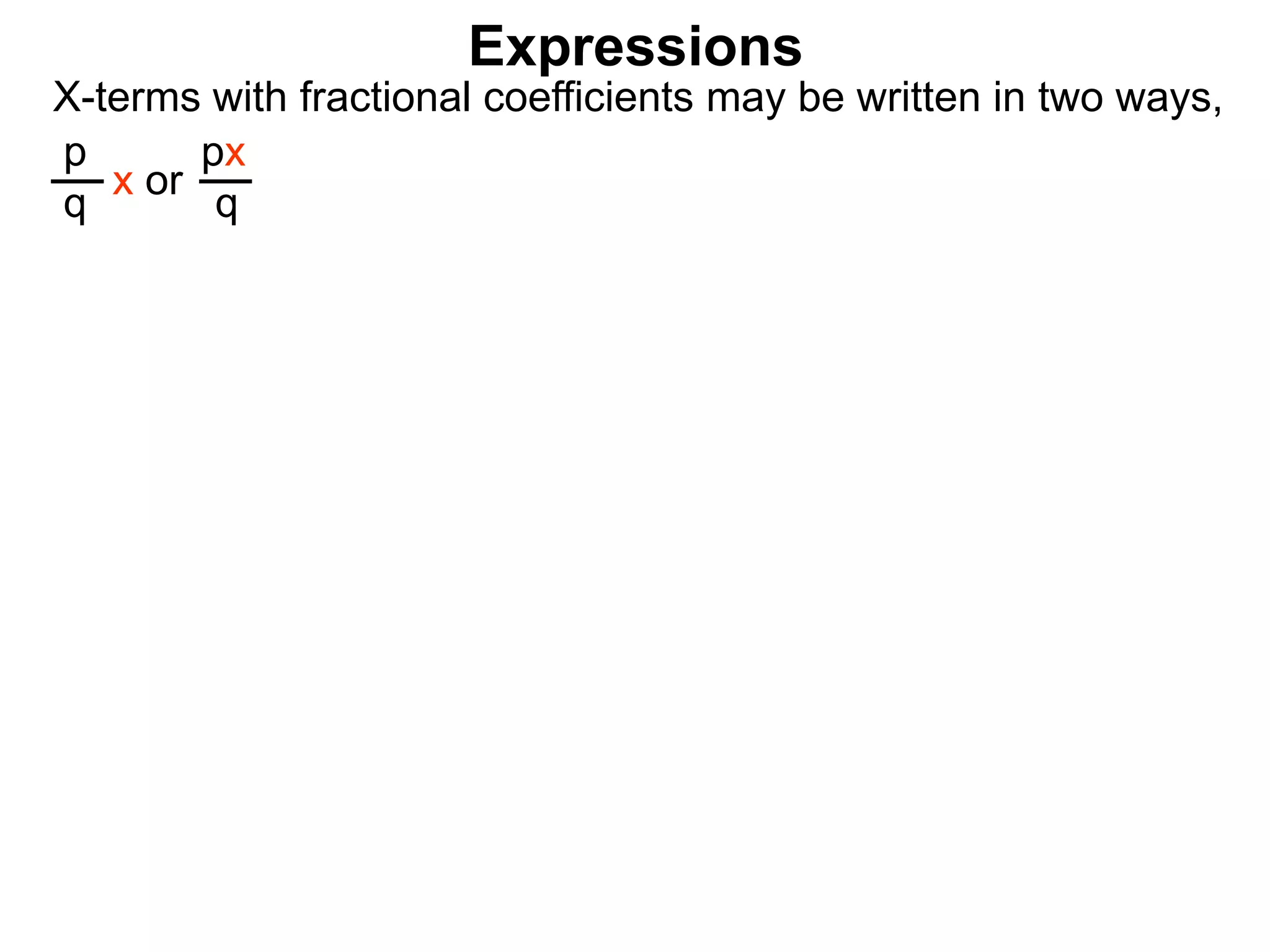
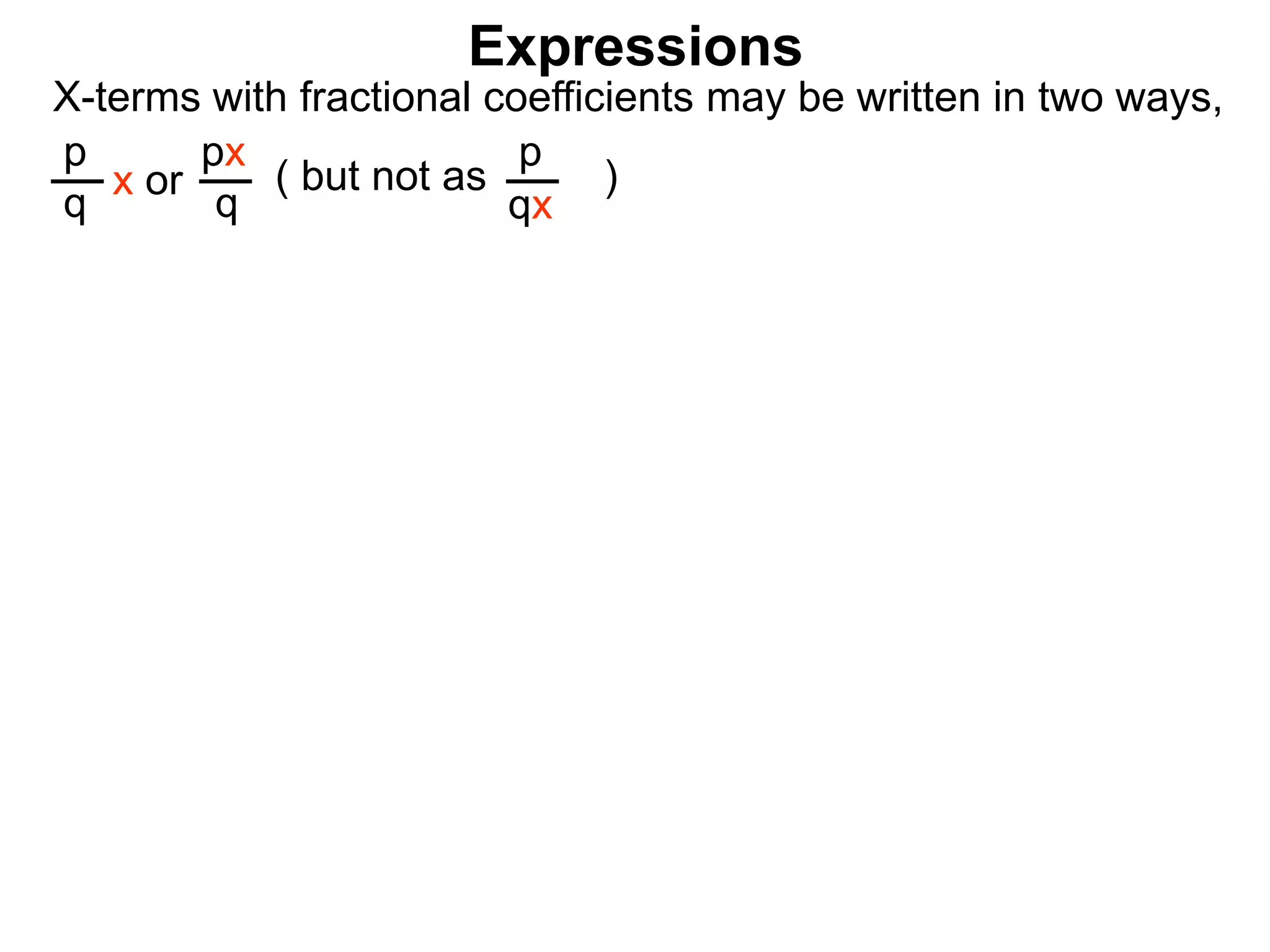
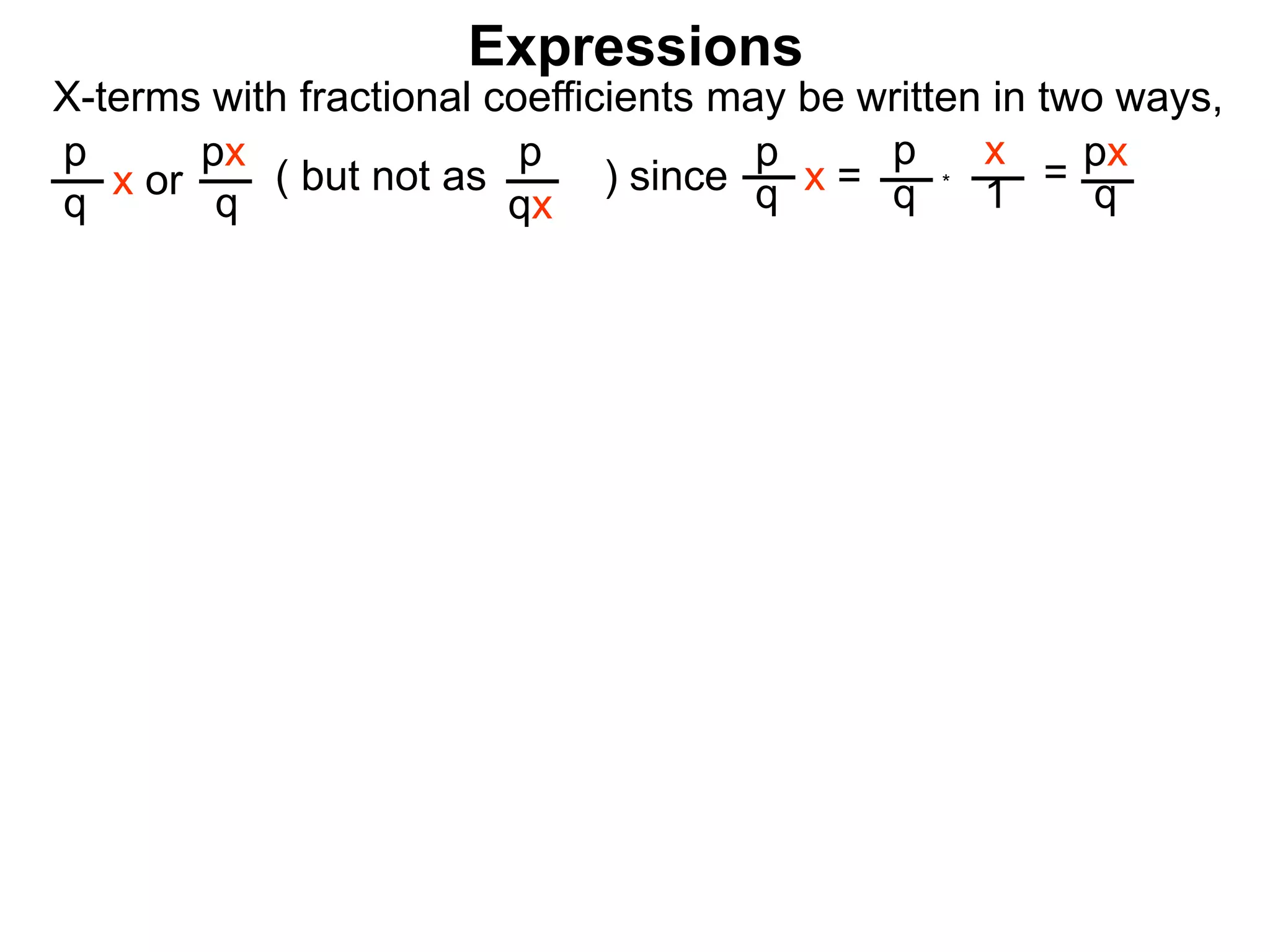
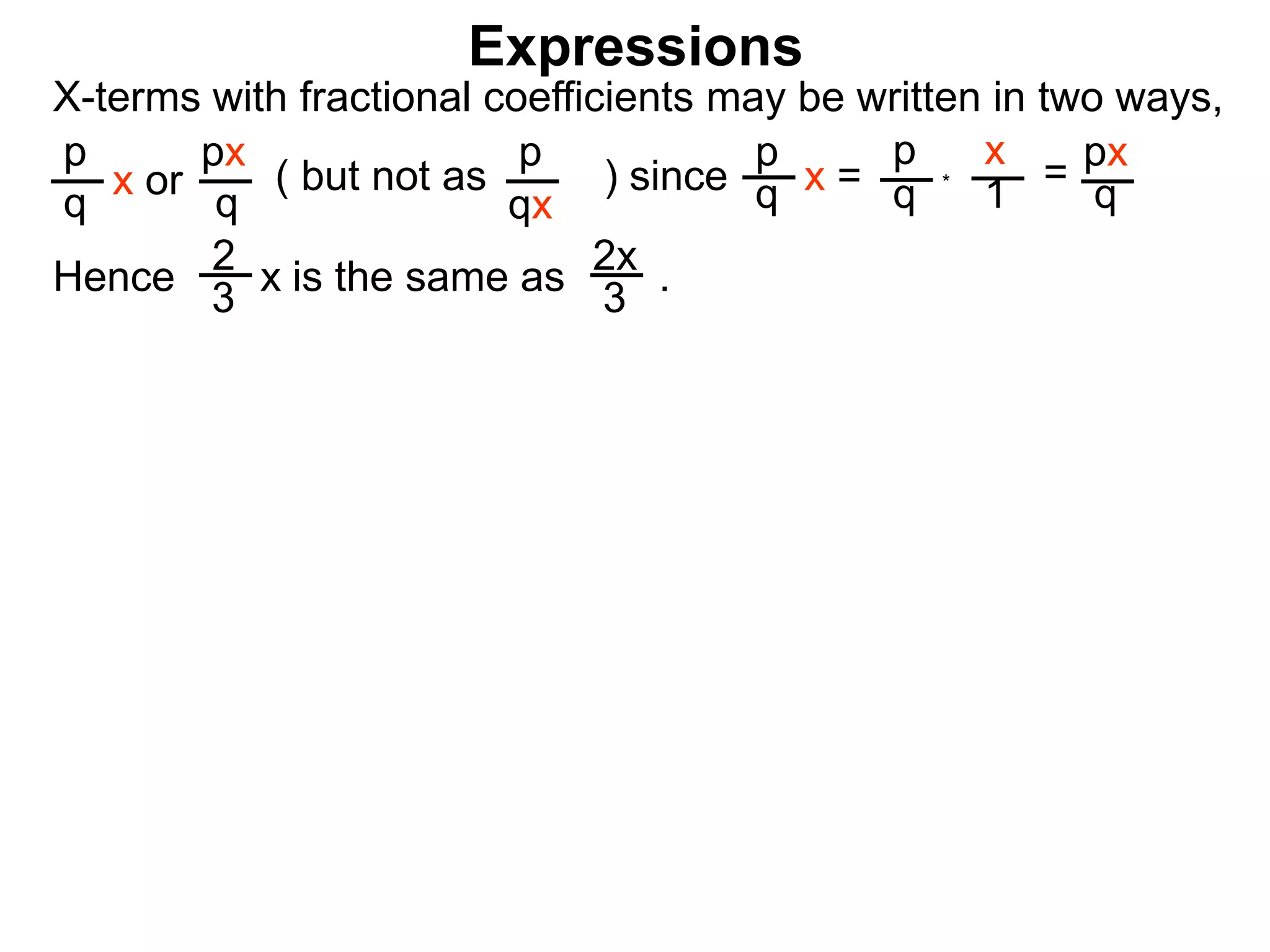
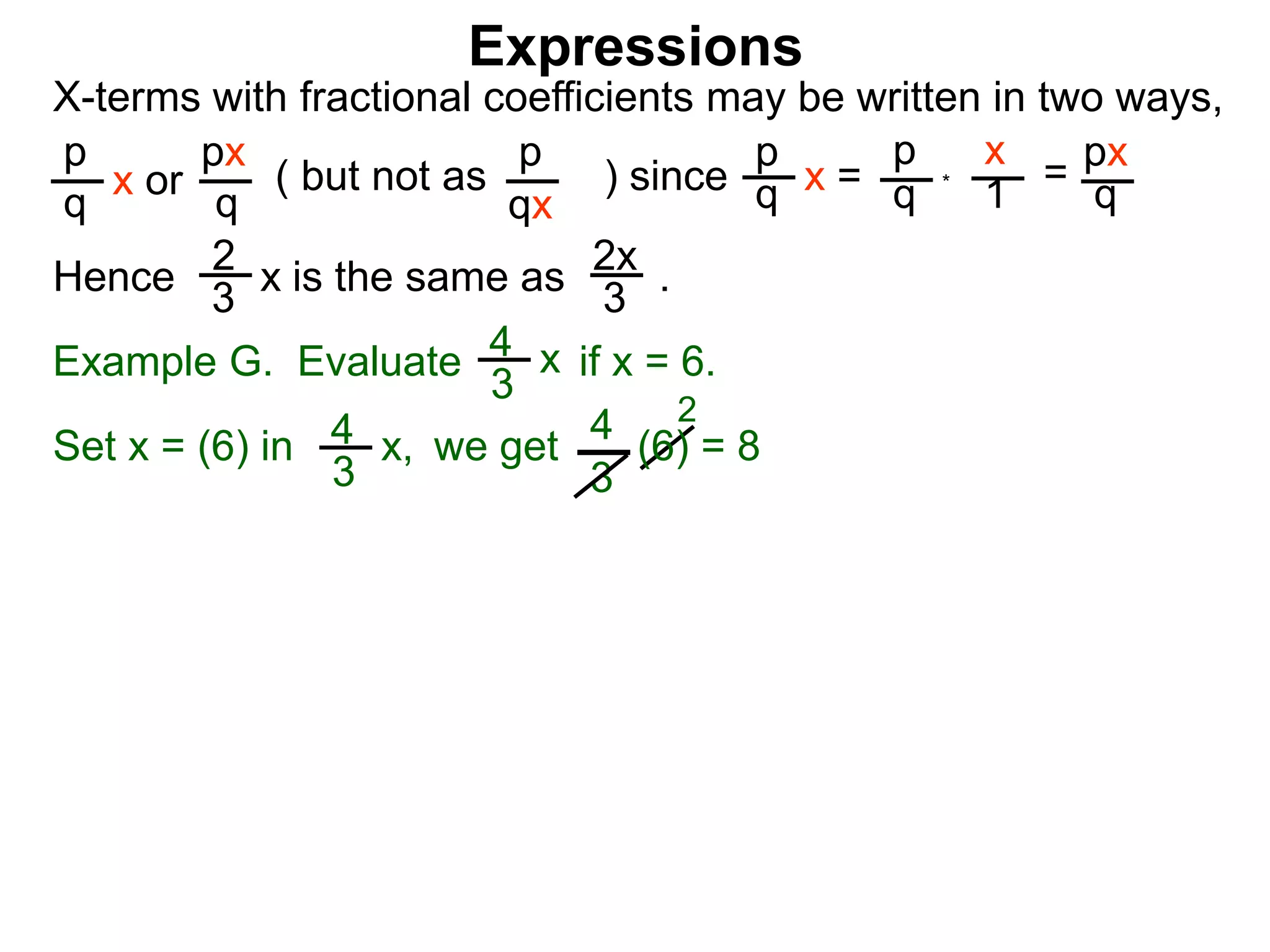
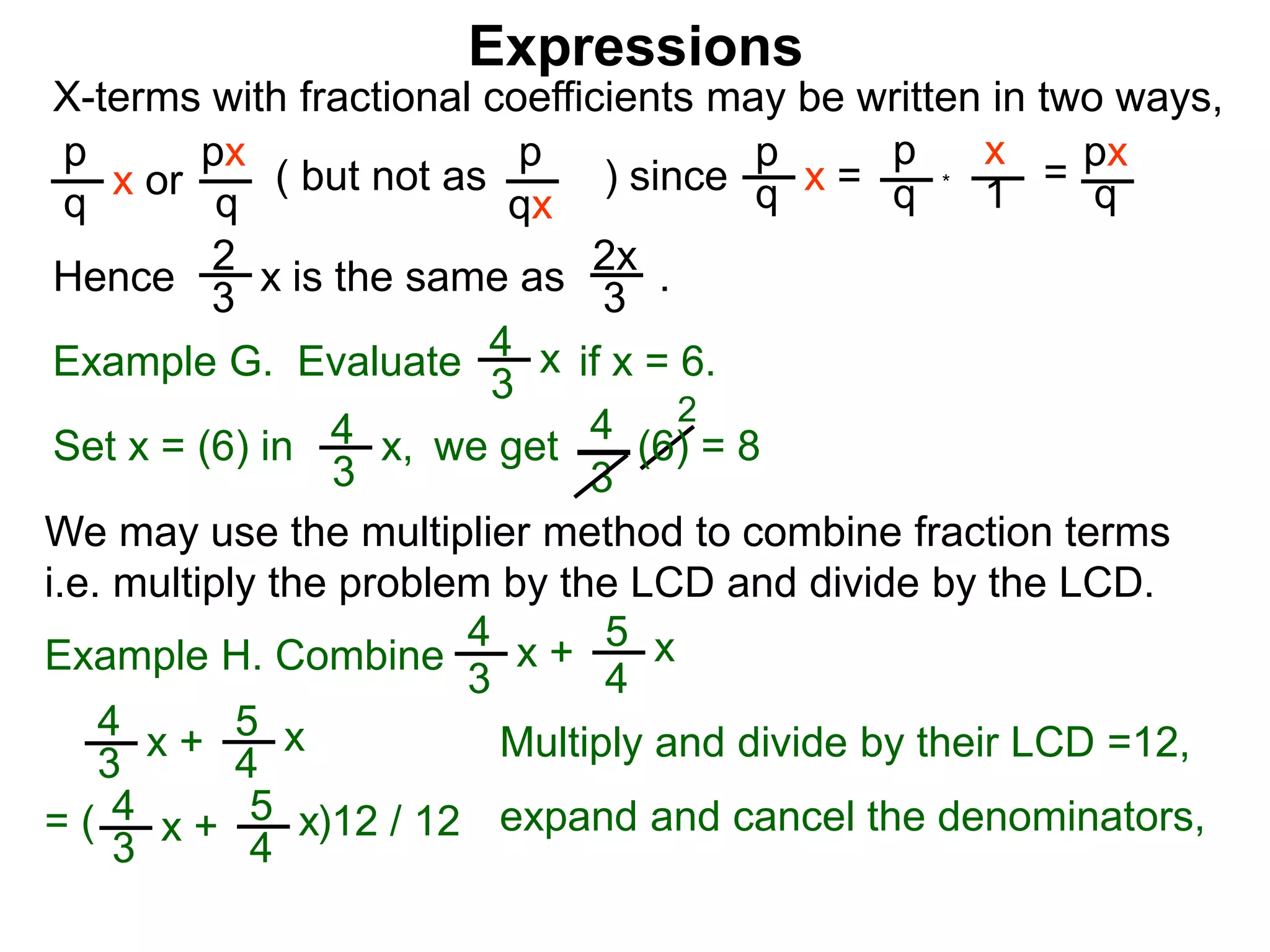
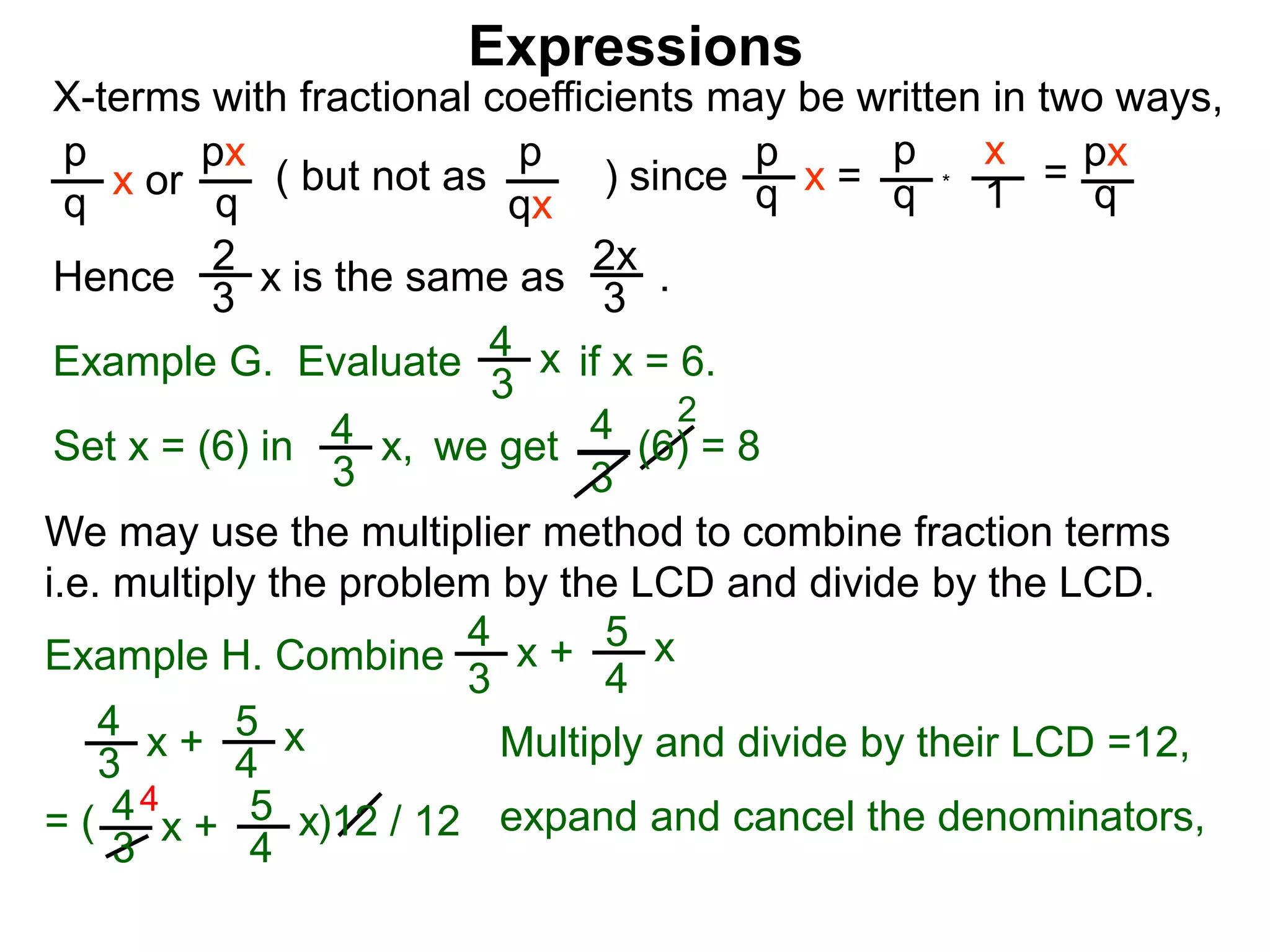
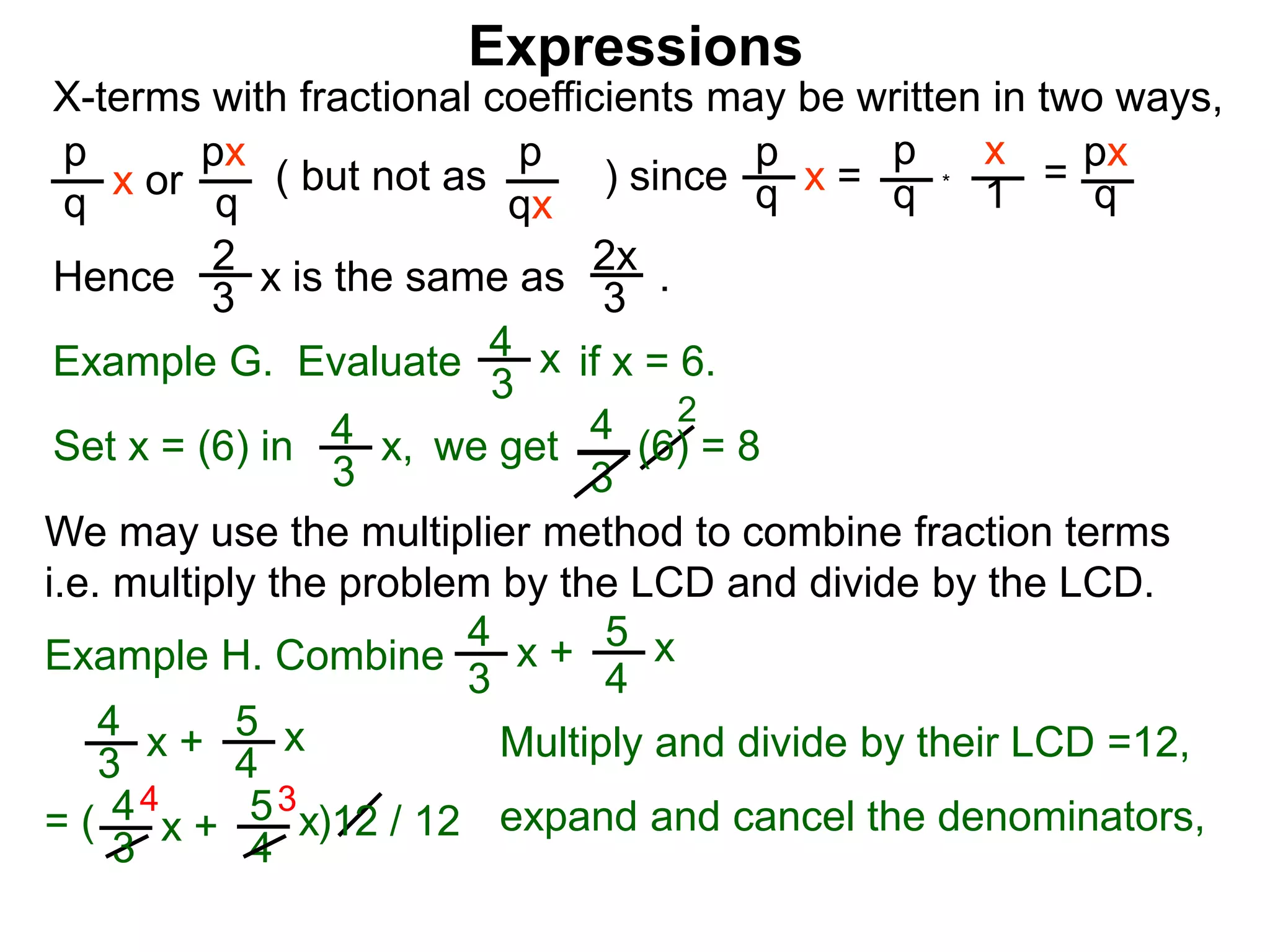
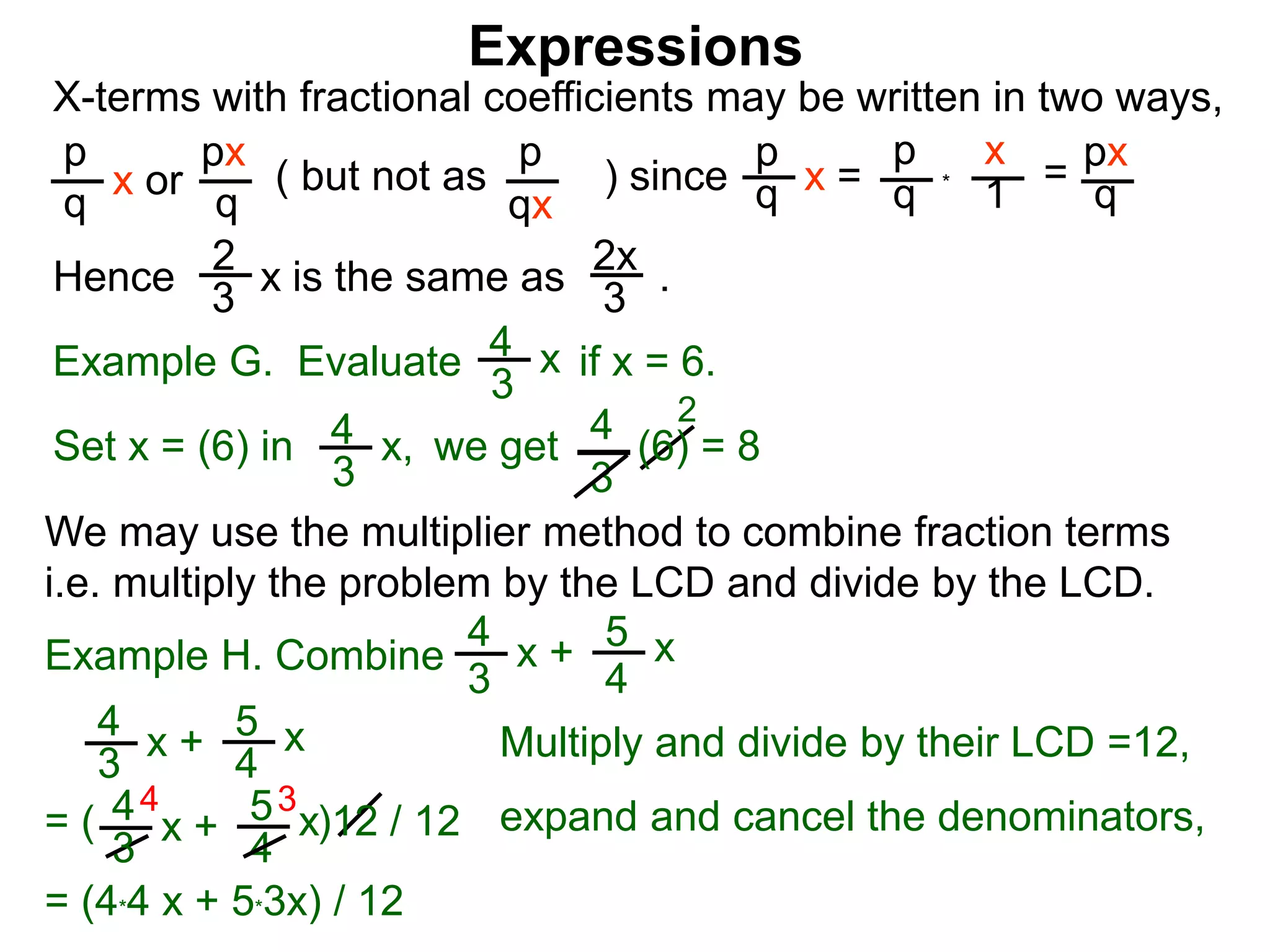
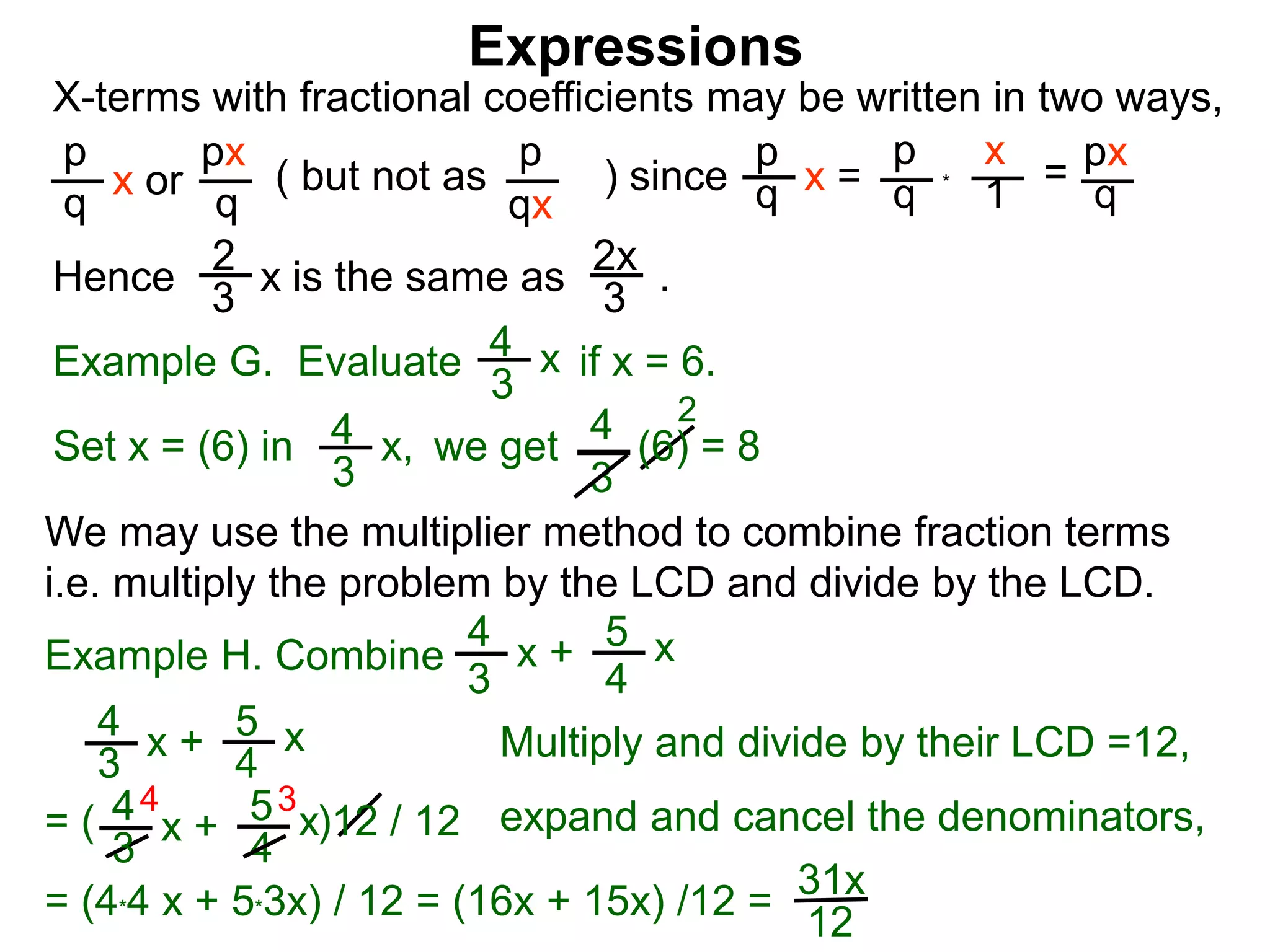
X-terms with fractionalcoefficients may be written in two ways,
p
q
x or
px
q
( but not as ) since
p
qx
p
q x =
p
q
x
1
= px
q
Hence is the same as .2x
3
2
3
x
*
70.
Expressions
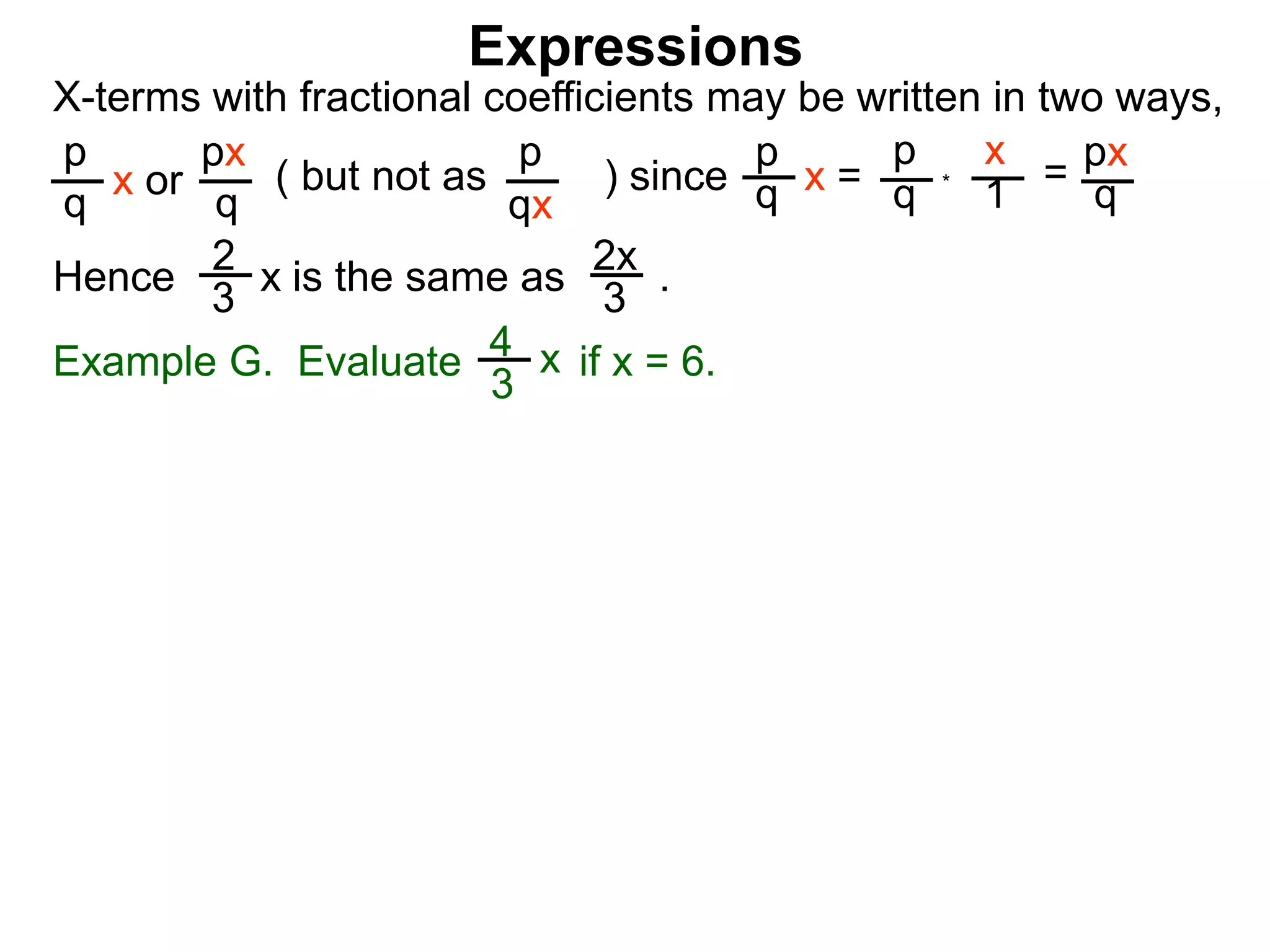
X-terms with fractionalcoefficients may be written in two ways,
p
q
x or
px
q
( but not as ) since
p
qx
p
q x =
p
q
x
1
= px
q
Example G. Evaluate if x = 6.4
3
x
Hence is the same as .2x
3
2
3
x
*
71.
Expressions
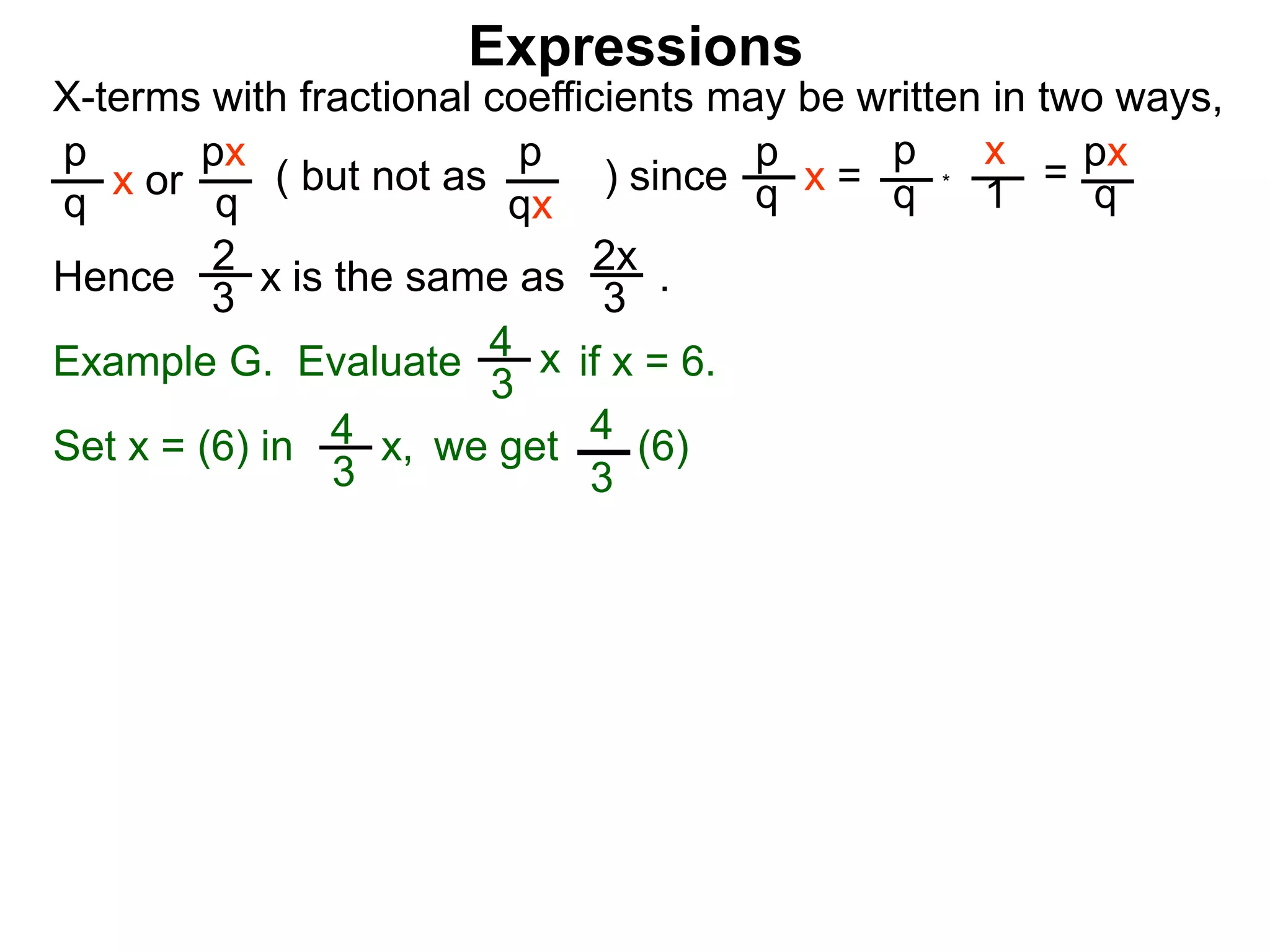
X-terms with fractionalcoefficients may be written in two ways,
p
q
x or
px
q
( but not as ) since
p
qx
p
q x =
p
q
x
1
= px
q
Example G. Evaluate if x = 6.4
3
x
we getSet x = (6) in
4
3
Hence is the same as .2x
3
2
3
x
*
4
3
x, (6)
72.
Expressions
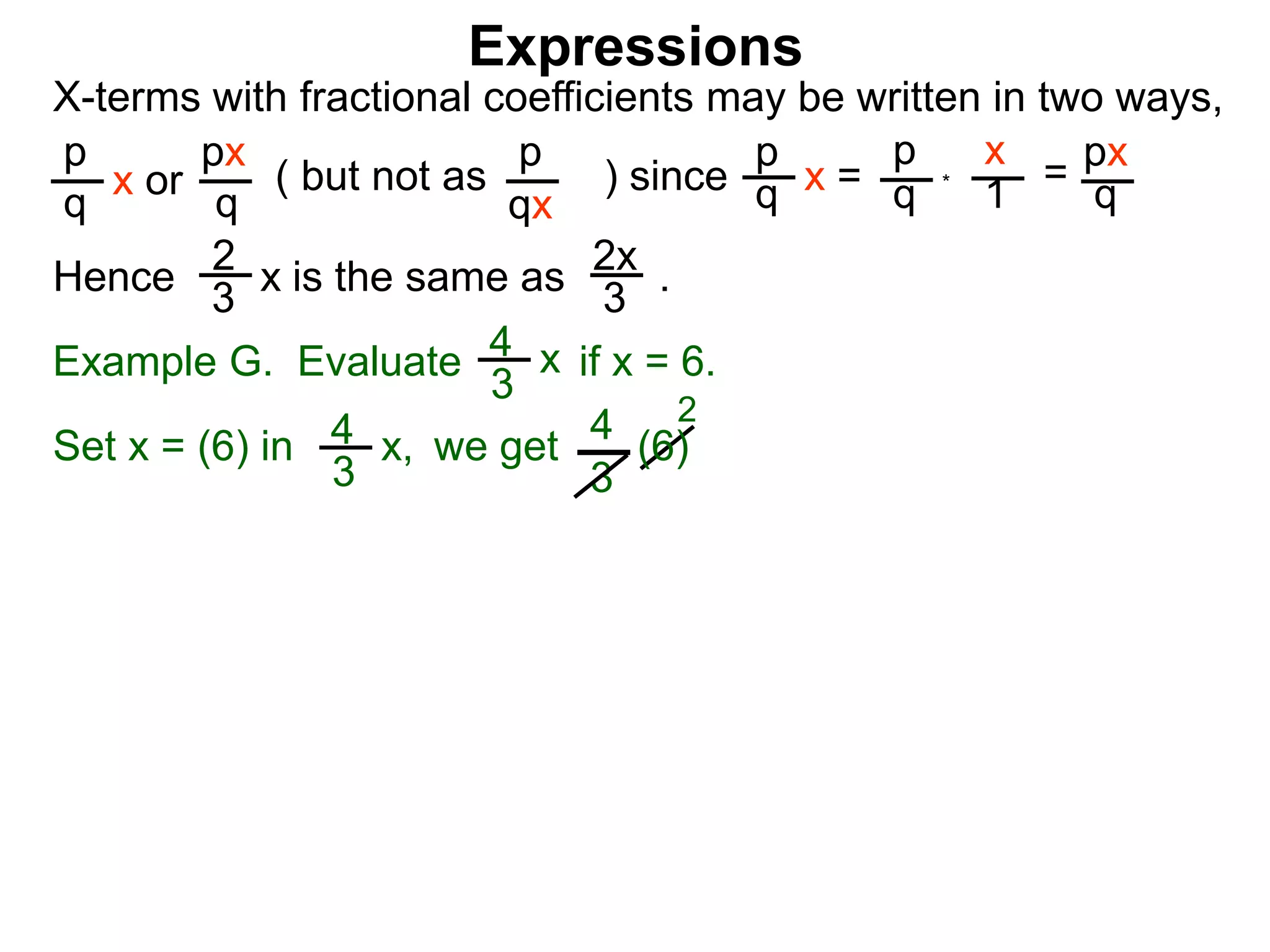
X-terms with fractionalcoefficients may be written in two ways,
p
q
x or
px
q
( but not as ) since
p
qx
p
q x =
p
q
x
1
= px
q
Example G. Evaluate if x = 6.4
3
x
we getSet x = (6) in
4
3
2
Hence is the same as .2x
3
2
3
x
*
4
3
x, (6)
73.
Expressions
X-terms with fractionalcoefficients may be written in two ways,
p
q
x or
px
q
( but not as ) since
p
qx
p
q x =
p
q
x
1
= px
q
Example G. Evaluate if x = 6.4
3
x
we getSet x = (6) in
4
3
2
Hence is the same as .2x
3
2
3
x
*
4
3
x, (6) = 8
74.
Expressions
X-terms with fractionalcoefficients may be written in two ways,
p
q
x or
px
q
( but not as ) since
p
qx
p
q x =
p
q
x
1
= px
q
Example G. Evaluate if x = 6.4
3
x
we getSet x = (6) in
4
3
2
Hence is the same as .2x
3
2
3
x
*
4
3
x, (6) = 8
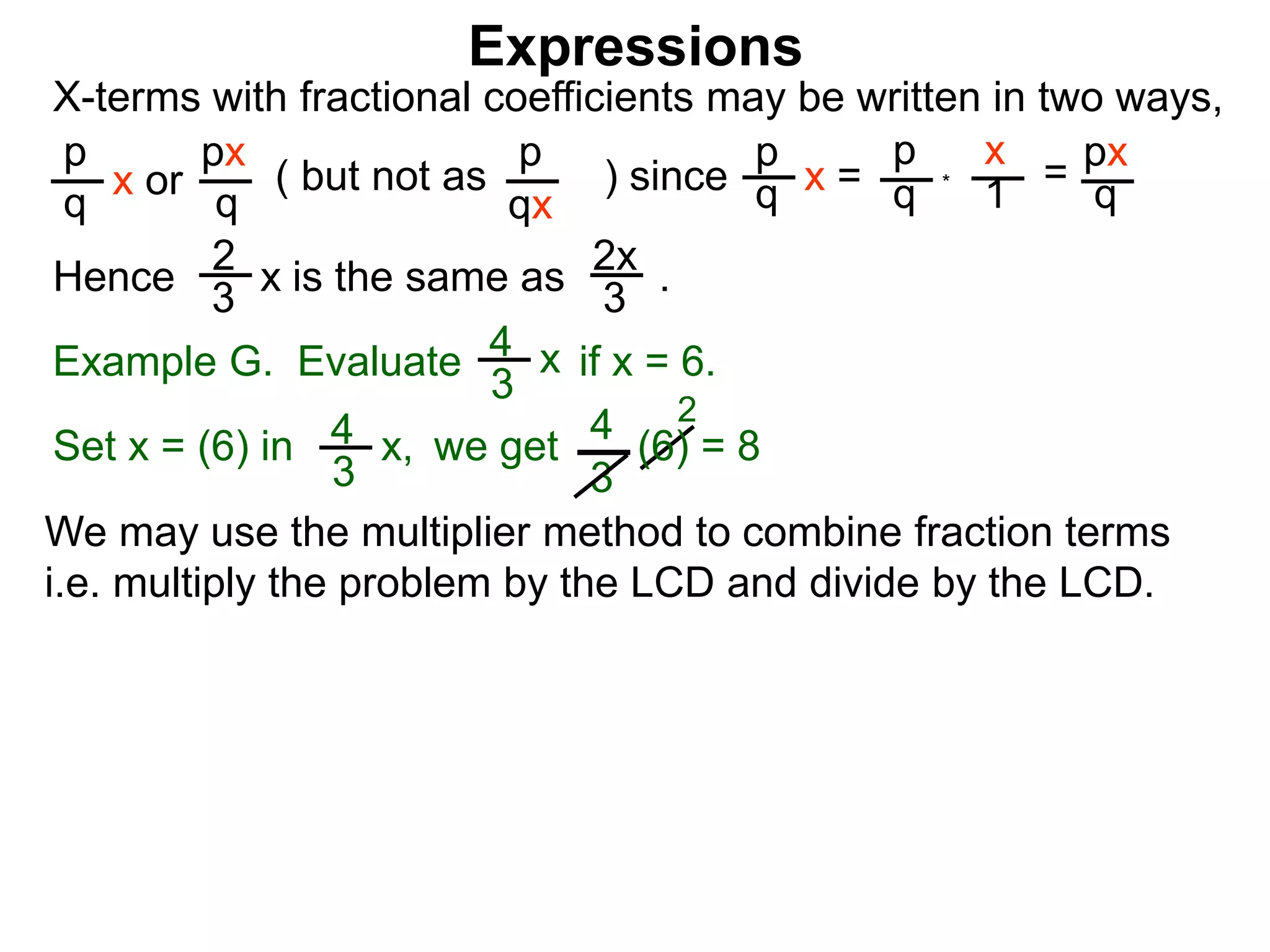
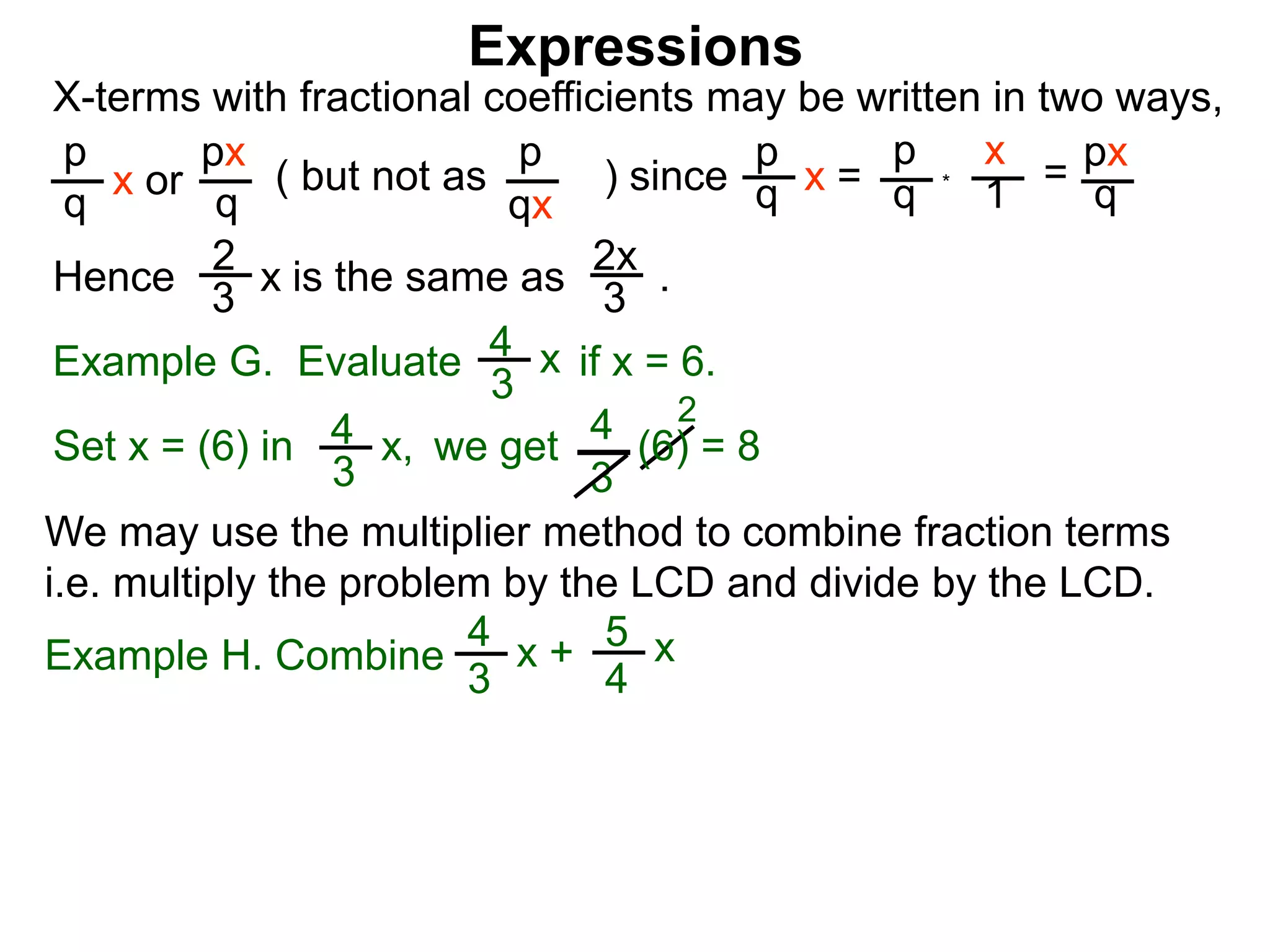
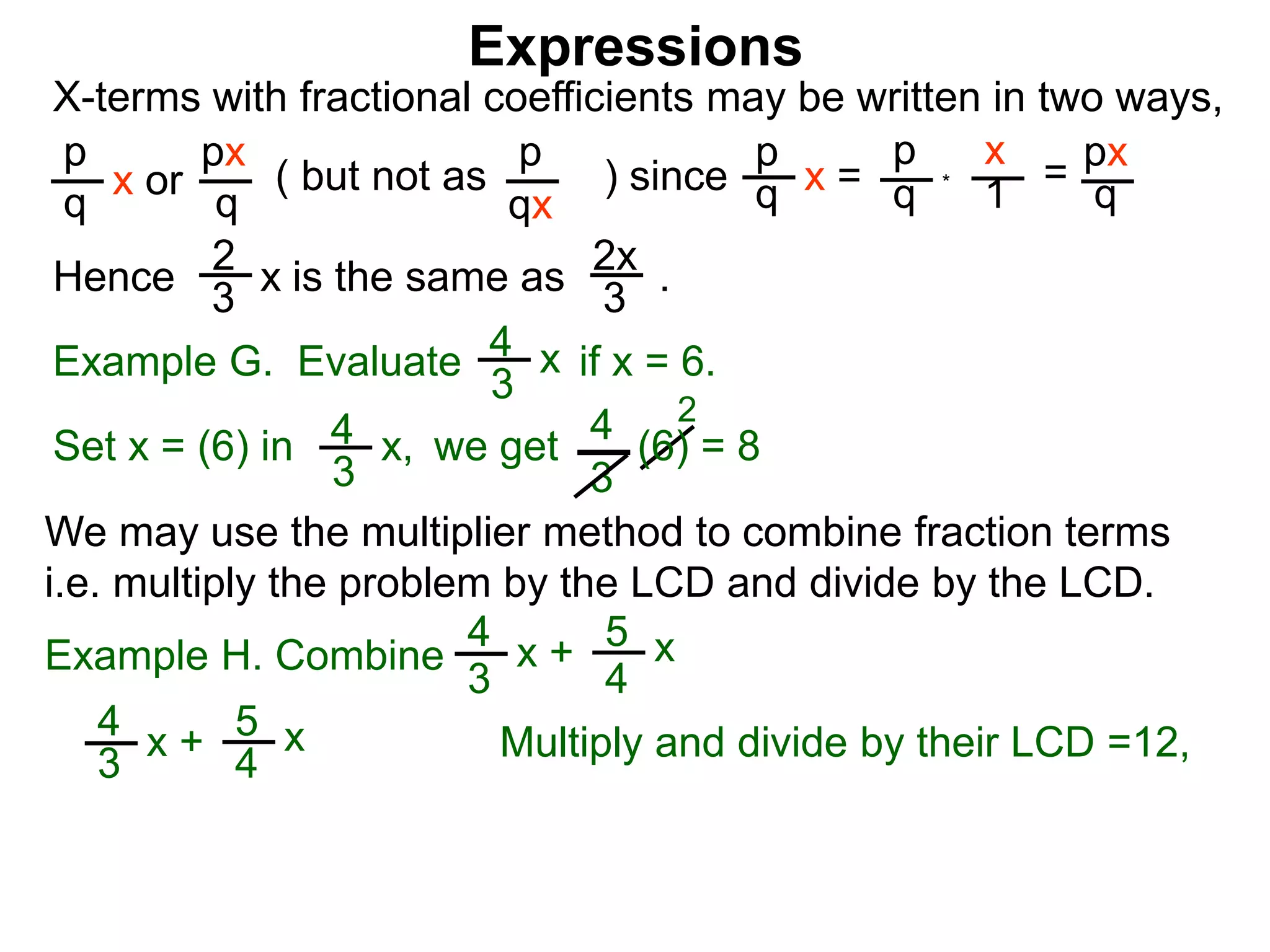
We may use the multiplier method to combine fraction terms
i.e. multiply the problem by the LCD and divide by the LCD.
75.
Expressions
X-terms with fractionalcoefficients may be written in two ways,
p
q
x or
px
q
( but not as ) since
p
qx
p
q x =
p
q
x
1
= px
q
Example G. Evaluate if x = 6.4
3
x
we getSet x = (6) in
4
3
2
Hence is the same as .2x
3
2
3
x
*
4
3
x, (6) = 8
We may use the multiplier method to combine fraction terms
i.e. multiply the problem by the LCD and divide by the LCD.
Example H. Combine
4
3
x + 5
4
x
76.
Expressions
X-terms with fractionalcoefficients may be written in two ways,
p
q
x or
px
q
( but not as ) since
p
qx
p
q x =
p
q
x
1
= px
q
Example G. Evaluate if x = 6.4
3
x
we getSet x = (6) in
4
3
2
Hence is the same as .2x
3
2
3
x
*
4
3
x, (6) = 8
We may use the multiplier method to combine fraction terms
i.e. multiply the problem by the LCD and divide by the LCD.
4
3
x + 5
4
x
Example H. Combine
4
3
x + 5
4
x
Multiply and divide by their LCD =12,
77.
Expressions
X-terms with fractionalcoefficients may be written in two ways,
p
q
x or
px
q
( but not as ) since
p
qx
p
q x =
p
q
x
1
= px
q
Example G. Evaluate if x = 6.4
3
x
we getSet x = (6) in
4
3
2
Hence is the same as .2x
3
2
3
x
*
4
3
x, (6) = 8
We may use the multiplier method to combine fraction terms
i.e. multiply the problem by the LCD and divide by the LCD.
= ( )12 / 12
4
3
x + 5
4
x
4
3
x + 5
4
x
Example H. Combine
4
3
x + 5
4
x
Multiply and divide by their LCD =12,
78.
Expressions
X-terms with fractionalcoefficients may be written in two ways,
p
q
x or
px
q
( but not as ) since
p
qx
p
q x =
p
q
x
1
= px
q
Example G. Evaluate if x = 6.4
3
x
we getSet x = (6) in
4
3
2
Hence is the same as .2x
3
2
3
x
*
4
3
x, (6) = 8
We may use the multiplier method to combine fraction terms
i.e. multiply the problem by the LCD and divide by the LCD.
= ( )12 / 12
4
3
x + 5
4
x
4
3
x + 5
4
x expand and cancel the denominators,
Example H. Combine
4
3
x + 5
4
x
Multiply and divide by their LCD =12,
79.
Expressions
X-terms with fractionalcoefficients may be written in two ways,
p
q
x or
px
q
( but not as ) since
p
qx
p
q x =
p
q
x
1
= px
q
Example G. Evaluate if x = 6.4
3
x
we getSet x = (6) in
4
3
2
Hence is the same as .2x
3
2
3
x
*
4
3
x, (6) = 8
We may use the multiplier method to combine fraction terms
i.e. multiply the problem by the LCD and divide by the LCD.
4
= ( )12 / 12
4
3
x + 5
4
x
4
3
x + 5
4
x expand and cancel the denominators,
Example H. Combine
4
3
x + 5
4
x
Multiply and divide by their LCD =12,
80.
Expressions
X-terms with fractionalcoefficients may be written in two ways,
p
q
x or
px
q
( but not as ) since
p
qx
p
q x =
p
q
x
1
= px
q
Example G. Evaluate if x = 6.4
3
x
we getSet x = (6) in
4
3
2
Hence is the same as .2x
3
2
3
x
*
4
3
x, (6) = 8
We may use the multiplier method to combine fraction terms
i.e. multiply the problem by the LCD and divide by the LCD.
4 3
= ( )12 / 12
4
3
x + 5
4
x
4
3
x + 5
4
x expand and cancel the denominators,
Example H. Combine
4
3
x + 5
4
x
Multiply and divide by their LCD =12,
81.
Expressions
X-terms with fractionalcoefficients may be written in two ways,
p
q
x or
px
q
( but not as ) since
p
qx
p
q x =
p
q
x
1
= px
q
Example G. Evaluate if x = 6.4
3
x
we getSet x = (6) in
4
3
2
Hence is the same as .2x
3
2
3
x
*
4
3
x, (6) = 8
We may use the multiplier method to combine fraction terms
i.e. multiply the problem by the LCD and divide by the LCD.
4 3
= ( )12 / 12
4
3
x + 5
4
x
4
3
x + 5
4
x expand and cancel the denominators,
= (4*4 x + 5*3x) / 12
Example H. Combine
4
3
x + 5
4
x
Multiply and divide by their LCD =12,
82.
Expressions
X-terms with fractionalcoefficients may be written in two ways,
p
q
x or
px
q
( but not as ) since
p
qx
p
q x =
p
q
x
1
= px
q
Example G. Evaluate if x = 6.4
3
x
we getSet x = (6) in
4
3
2
Hence is the same as .2x
3
2
3
x
*
4
3
x, (6) = 8
We may use the multiplier method to combine fraction terms
i.e. multiply the problem by the LCD and divide by the LCD.
31x
12
4 3
= ( )12 / 12
4
3
x + 5
4
x
4
3
x + 5
4
x expand and cancel the denominators,
= (4*4 x + 5*3x) / 12 = (16x + 15x) /12 =
Example H. Combine
4
3
x + 5
4
x
Multiply and divide by their LCD =12,
Expressions
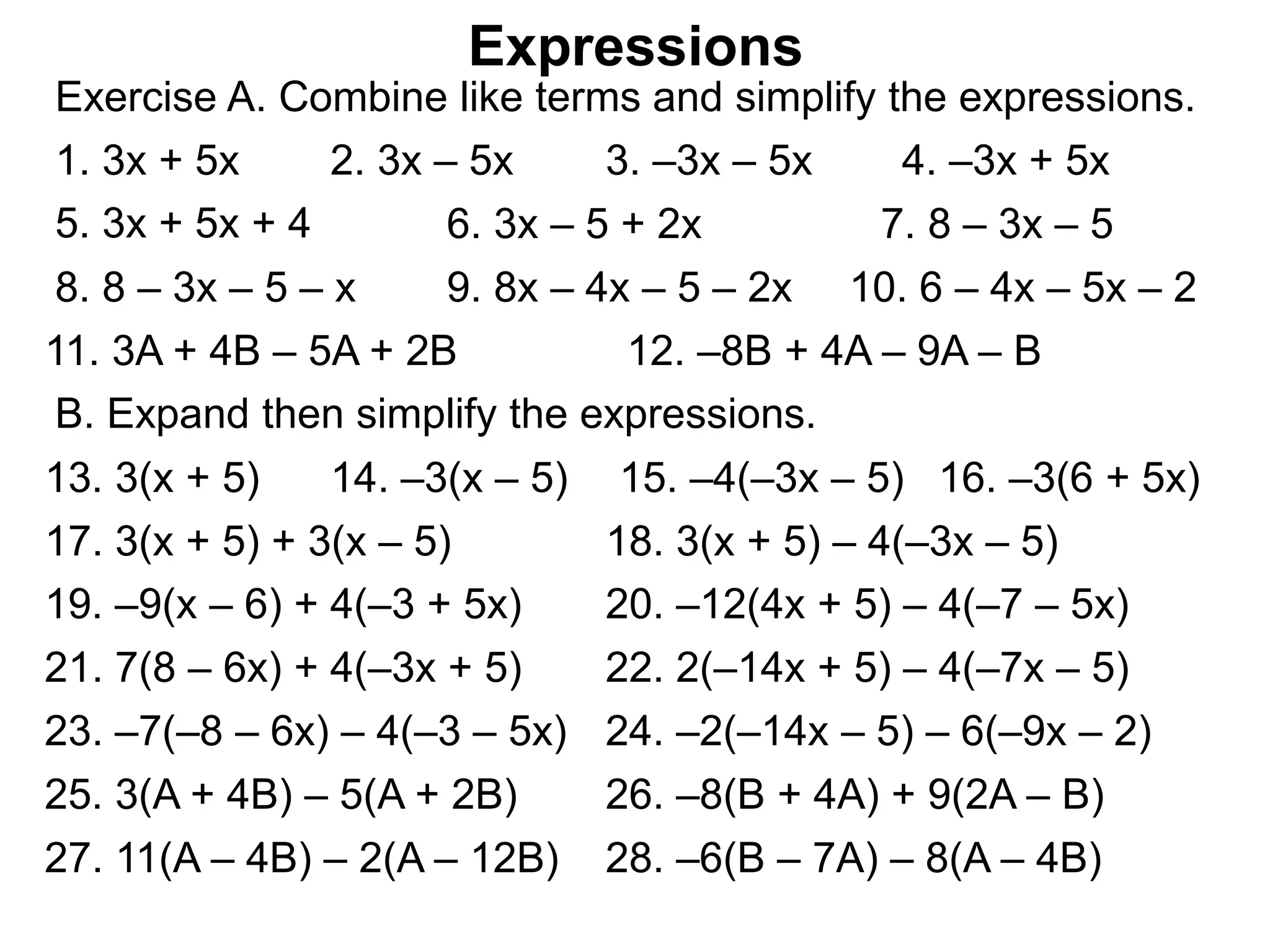
C. Starting fromthe innermost ( ) expand and simplify.
29. x + 2[6 + 4(–3 + 5x)] 30. –5[ x – 4(–7 – 5x)] + 6
31. 8 – 2[4(–3x + 5) + 6x] + x 32. –14x + 5[x – 4(–5x + 15)]
33. –7x + 3{8 – [6(x – 2) –3] – 5x}
34. –3{8 – [6(x – 2) –3] – 5x} – 5[x – 3(–5x + 4)]
35. 4[5(3 – 2x) – 6x] – 3{x – 2[x – 3(–5x + 4)]}
2
3
x + 3
4
x36.
4
3
x – 3
4
x37.
3
8
x – 5
6
x39.5
8
x + 1
6
x38. – –
D. Combine using the LCD-multiplication method
40. Do 36 – 39 by the cross–multiplication method.
85.
Expressions
42. As inexample D with gift boxes Regular and Deluxe, the
Regular contains12 apples and 8 bananas, the Deluxe has 24
apples and 24 bananas. For large orders we may ship them in
crates or freight-containers where a crate contains 100 boxes
Regular and 80 boxes Deluxe and a container holds 150
Regular boxes and 100 Deluxe boxes.
King Kong ordered 4 crates and 5 containers, how many of
each type of fruit does King Kong have?
41. As in example D with gift boxes Regular and Deluxe, the
Regular contains12 apples and 8 bananas, the Deluxe has 24
apples and 24 bananas. Joe has 6 Regular boxes and 8
Deluxe boxes. How many of each type of fruit does he have?
![Expressions
We usually start with the innermost set of parentheses to
simplify an expression that has multiple layers of parentheses.
In mathematics, ( )’s, [ ]’s, and { }’s are often used to
distinguish the layers.](https://image.slidesharecdn.com/2expressionsandlinearexpressions-150719190119-lva1-app6891/75/2-expressions-and-linear-expressions-53-2048.jpg)
![Expressions
We usually start with the innermost set of parentheses to
simplify an expression that has multiple layers of parentheses.
In mathematics, ( )’s, [ ]’s, and { }’s are often used to
distinguish the layers. This can't be the case for calculators or
software where [ ] and { } may have other meanings.](https://image.slidesharecdn.com/2expressionsandlinearexpressions-150719190119-lva1-app6891/75/2-expressions-and-linear-expressions-54-2048.jpg)
![Expressions
We usually start with the innermost set of parentheses to
simplify an expression that has multiple layers of parentheses.
In mathematics, ( )’s, [ ]’s, and { }’s are often used to
distinguish the layers. This can't be the case for calculators or
software where [ ] and { } may have other meanings.
Always simplify the content of a set of parentheses first before
expanding it.](https://image.slidesharecdn.com/2expressionsandlinearexpressions-150719190119-lva1-app6891/75/2-expressions-and-linear-expressions-55-2048.jpg)
![Expressions
We usually start with the innermost set of parentheses to
simplify an expression that has multiple layers of parentheses.
In mathematics, ( )’s, [ ]’s, and { }’s are often used to
distinguish the layers. This can't be the case for calculators or
software where [ ] and { } may have other meanings.
Always simplify the content of a set of parentheses first before
expanding it.
Example F. Expand.
–3{–3x – [5 – 2(– 4x – 6)] – 4}](https://image.slidesharecdn.com/2expressionsandlinearexpressions-150719190119-lva1-app6891/75/2-expressions-and-linear-expressions-56-2048.jpg)
![Expressions
We usually start with the innermost set of parentheses to
simplify an expression that has multiple layers of parentheses.
In mathematics, ( )’s, [ ]’s, and { }’s are often used to
distinguish the layers. This can't be the case for calculators or
software where [ ] and { } may have other meanings.
Always simplify the content of a set of parentheses first before
expanding it.
Example F. Expand.
–3{–3x – [5 – 2(– 4x – 6)] – 4} expand,](https://image.slidesharecdn.com/2expressionsandlinearexpressions-150719190119-lva1-app6891/75/2-expressions-and-linear-expressions-57-2048.jpg)
![Expressions
We usually start with the innermost set of parentheses to
simplify an expression that has multiple layers of parentheses.
In mathematics, ( )’s, [ ]’s, and { }’s are often used to
distinguish the layers. This can't be the case for calculators or
software where [ ] and { } may have other meanings.
Always simplify the content of a set of parentheses first before
expanding it.
= –3{–3x – [5 + 8x + 12] – 4}
Example F. Expand.
–3{–3x – [5 – 2(– 4x – 6)] – 4} expand,](https://image.slidesharecdn.com/2expressionsandlinearexpressions-150719190119-lva1-app6891/75/2-expressions-and-linear-expressions-58-2048.jpg)
![Expressions
We usually start with the innermost set of parentheses to
simplify an expression that has multiple layers of parentheses.
In mathematics, ( )’s, [ ]’s, and { }’s are often used to
distinguish the layers. This can't be the case for calculators or
software where [ ] and { } may have other meanings.
Always simplify the content of a set of parentheses first before
expanding it.
= –3{–3x – [5 + 8x + 12] – 4}
Example F. Expand.
–3{–3x – [5 – 2(– 4x – 6)] – 4} expand,
simplify,](https://image.slidesharecdn.com/2expressionsandlinearexpressions-150719190119-lva1-app6891/75/2-expressions-and-linear-expressions-59-2048.jpg)
![Expressions
We usually start with the innermost set of parentheses to
simplify an expression that has multiple layers of parentheses.
In mathematics, ( )’s, [ ]’s, and { }’s are often used to
distinguish the layers. This can't be the case for calculators or
software where [ ] and { } may have other meanings.
Always simplify the content of a set of parentheses first before
expanding it.
= –3{–3x – [5 + 8x + 12] – 4}
= –3{–3x – [17 + 8x] – 4}
Example F. Expand.
–3{–3x – [5 – 2(– 4x – 6)] – 4} expand,
simplify,](https://image.slidesharecdn.com/2expressionsandlinearexpressions-150719190119-lva1-app6891/75/2-expressions-and-linear-expressions-60-2048.jpg)
![Expressions
We usually start with the innermost set of parentheses to
simplify an expression that has multiple layers of parentheses.
In mathematics, ( )’s, [ ]’s, and { }’s are often used to
distinguish the layers. This can't be the case for calculators or
software where [ ] and { } may have other meanings.
Always simplify the content of a set of parentheses first before
expanding it.
= –3{–3x – [5 + 8x + 12] – 4}
= –3{–3x – [17 + 8x] – 4}
Example F. Expand.
–3{–3x – [5 – 2(– 4x – 6)] – 4} expand,
simplify,
expand,](https://image.slidesharecdn.com/2expressionsandlinearexpressions-150719190119-lva1-app6891/75/2-expressions-and-linear-expressions-61-2048.jpg)
![Expressions
We usually start with the innermost set of parentheses to
simplify an expression that has multiple layers of parentheses.
In mathematics, ( )’s, [ ]’s, and { }’s are often used to
distinguish the layers. This can't be the case for calculators or
software where [ ] and { } may have other meanings.
Always simplify the content of a set of parentheses first before
expanding it.
= –3{–3x – [5 + 8x + 12] – 4}
= –3{–3x – [17 + 8x] – 4}
Example F. Expand.
= –3{– 3x – 17 – 8x – 4}
–3{–3x – [5 – 2(– 4x – 6)] – 4} expand,
simplify,
expand,](https://image.slidesharecdn.com/2expressionsandlinearexpressions-150719190119-lva1-app6891/75/2-expressions-and-linear-expressions-62-2048.jpg)
![Expressions
We usually start with the innermost set of parentheses to
simplify an expression that has multiple layers of parentheses.
In mathematics, ( )’s, [ ]’s, and { }’s are often used to
distinguish the layers. This can't be the case for calculators or
software where [ ] and { } may have other meanings.
Always simplify the content of a set of parentheses first before
expanding it.
= –3{–3x – [5 + 8x + 12] – 4}
= –3{–3x – [17 + 8x] – 4}
Example F. Expand.
= –3{– 3x – 17 – 8x – 4}
–3{–3x – [5 – 2(– 4x – 6)] – 4} expand,
simplify,
expand,
simplify,](https://image.slidesharecdn.com/2expressionsandlinearexpressions-150719190119-lva1-app6891/75/2-expressions-and-linear-expressions-63-2048.jpg)
![Expressions
We usually start with the innermost set of parentheses to
simplify an expression that has multiple layers of parentheses.
In mathematics, ( )’s, [ ]’s, and { }’s are often used to
distinguish the layers. This can't be the case for calculators or
software where [ ] and { } may have other meanings.
Always simplify the content of a set of parentheses first before
expanding it.
= –3{–3x – [5 + 8x + 12] – 4}
= –3{–3x – [17 + 8x] – 4}
Example F. Expand.
= –3{– 3x – 17 – 8x – 4}
–3{–3x – [5 – 2(– 4x – 6)] – 4} expand,
simplify,
expand,
simplify,
= –3{–11x – 21}](https://image.slidesharecdn.com/2expressionsandlinearexpressions-150719190119-lva1-app6891/75/2-expressions-and-linear-expressions-64-2048.jpg)
![Expressions
We usually start with the innermost set of parentheses to
simplify an expression that has multiple layers of parentheses.
In mathematics, ( )’s, [ ]’s, and { }’s are often used to
distinguish the layers. This can't be the case for calculators or
software where [ ] and { } may have other meanings.
Always simplify the content of a set of parentheses first before
expanding it.
= –3{–3x – [5 + 8x + 12] – 4}
= –3{–3x – [17 + 8x] – 4}
Example F. Expand.
= –3{– 3x – 17 – 8x – 4}
–3{–3x – [5 – 2(– 4x – 6)] – 4} expand,
simplify,
expand,
simplify,
= –3{–11x – 21} expand,
= 33x + 63](https://image.slidesharecdn.com/2expressionsandlinearexpressions-150719190119-lva1-app6891/75/2-expressions-and-linear-expressions-65-2048.jpg)
![Expressions
C. Starting from the innermost ( ) expand and simplify.
29. x + 2[6 + 4(–3 + 5x)] 30. –5[ x – 4(–7 – 5x)] + 6
31. 8 – 2[4(–3x + 5) + 6x] + x 32. –14x + 5[x – 4(–5x + 15)]
33. –7x + 3{8 – [6(x – 2) –3] – 5x}
34. –3{8 – [6(x – 2) –3] – 5x} – 5[x – 3(–5x + 4)]
35. 4[5(3 – 2x) – 6x] – 3{x – 2[x – 3(–5x + 4)]}
2
3
x + 3
4
x36.
4
3
x – 3
4
x37.
3
8
x – 5
6
x39.5
8
x + 1
6
x38. – –
D. Combine using the LCD-multiplication method
40. Do 36 – 39 by the cross–multiplication method.](https://image.slidesharecdn.com/2expressionsandlinearexpressions-150719190119-lva1-app6891/75/2-expressions-and-linear-expressions-84-2048.jpg)