Polynomial Expressions
A mathematics expression is a calculation procedure which
is written using numbers, variables, and operation-symbols.
Polynomial Expressions
A mathematics expression is a calculation procedure which
is written using numbers, variables, and operation-symbols.
The purposes of this symbolic-form are clarity and simplicity.
Polynomial Expressions
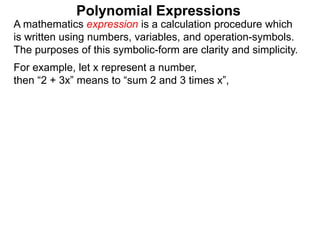
For example, let x represent a number,
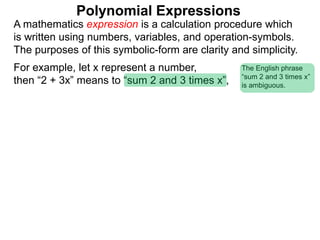
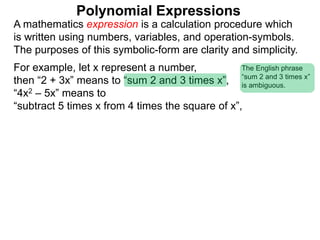
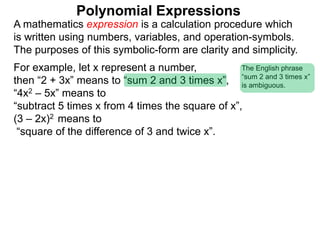
then “2 + 3x” means to “sum 2 and 3 times x”,
A mathematics expression is a calculation procedure which
is written using numbers, variables, and operation-symbols.
The purposes of this symbolic-form are clarity and simplicity.
Polynomial Expressions
For example, let x represent a number,
then “2 + 3x” means to “sum 2 and 3 times x”,
A mathematics expression is a calculation procedure which
is written using numbers, variables, and operation-symbols.
The purposes of this symbolic-form are clarity and simplicity.
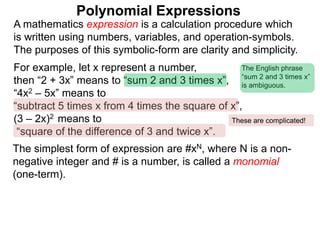
Polynomial Expressions
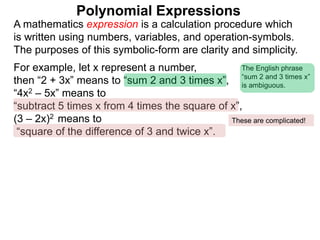
The English phrase
“sum 2 and 3 times x”
is ambiguous.
For example, let x represent a number,
then “2 + 3x” means to “sum 2 and 3 times x”,
“4x2 – 5x” means to
“subtract 5 times x from 4 times the square of x”,
A mathematics expression is a calculation procedure which
is written using numbers, variables, and operation-symbols.
The purposes of this symbolic-form are clarity and simplicity.
Polynomial Expressions
The English phrase
“sum 2 and 3 times x”
is ambiguous.
For example, let x represent a number,
then “2 + 3x” means to “sum 2 and 3 times x”,
“4x2 – 5x” means to
“subtract 5 times x from 4 times the square of x”,
(3 – 2x)2 means to
“square of the difference of 3 and twice x”.
A mathematics expression is a calculation procedure which
is written using numbers, variables, and operation-symbols.
The purposes of this symbolic-form are clarity and simplicity.
Polynomial Expressions
The English phrase
“sum 2 and 3 times x”
is ambiguous.
For example, let x represent a number,
then “2 + 3x” means to “sum 2 and 3 times x”,
“4x2 – 5x” means to
“subtract 5 times x from 4 times the square of x”,
(3 – 2x)2 means to
“square of the difference of 3 and twice x”.
A mathematics expression is a calculation procedure which
is written using numbers, variables, and operation-symbols.
The purposes of this symbolic-form are clarity and simplicity.
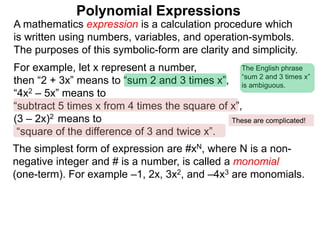
Polynomial Expressions
The English phrase
“sum 2 and 3 times x”
is ambiguous.
These are complicated!
For example, let x represent a number,
then “2 + 3x” means to “sum 2 and 3 times x”,
“4x2 – 5x” means to
“subtract 5 times x from 4 times the square of x”,
(3 – 2x)2 means to
“square of the difference of 3 and twice x”.
A mathematics expression is a calculation procedure which
is written using numbers, variables, and operation-symbols.
The purposes of this symbolic-form are clarity and simplicity.
The simplest form of expression are #xN, where N is a non-
negative integer and # is a number, is called a monomial
(one-term).
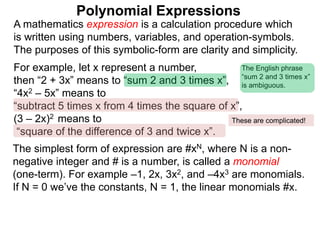
Polynomial Expressions
The English phrase
“sum 2 and 3 times x”
is ambiguous.
These are complicated!
For example, let x represent a number,
then “2 + 3x” means to “sum 2 and 3 times x”,
“4x2 – 5x” means to
“subtract 5 times x from 4 times the square of x”,
(3 – 2x)2 means to
“square of the difference of 3 and twice x”.
A mathematics expression is a calculation procedure which
is written using numbers, variables, and operation-symbols.
The purposes of this symbolic-form are clarity and simplicity.
The simplest form of expression are #xN, where N is a non-
negative integer and # is a number, is called a monomial
(one-term). For example –1, 2x, 3x2, and –4x3 are monomials.
Polynomial Expressions
The English phrase
“sum 2 and 3 times x”
is ambiguous.
These are complicated!
For example, let x represent a number,
then “2 + 3x” means to “sum 2 and 3 times x”,
“4x2 – 5x” means to
“subtract 5 times x from 4 times the square of x”,
(3 – 2x)2 means to
“square of the difference of 3 and twice x”.
A mathematics expression is a calculation procedure which
is written using numbers, variables, and operation-symbols.
The purposes of this symbolic-form are clarity and simplicity.
The simplest form of expression are #xN, where N is a non-
negative integer and # is a number, is called a monomial
(one-term). For example –1, 2x, 3x2, and –4x3 are monomials.
If N = 0 we’ve the constants, N = 1, the linear monomials #x.
Polynomial Expressions
The English phrase
“sum 2 and 3 times x”
is ambiguous.
These are complicated!
For example, let x represent a number,
then “2 + 3x” means to “sum 2 and 3 times x”,
“4x2 – 5x” means to
“subtract 5 times x from 4 times the square of x”,
(3 – 2x)2 means to
“square of the difference of 3 and twice x”.
A mathematics expression is a calculation procedure which
is written using numbers, variables, and operation-symbols.
The purposes of this symbolic-form are clarity and simplicity.
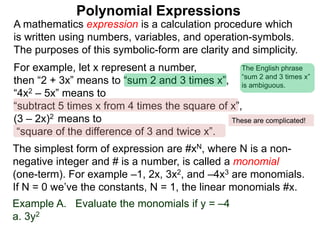
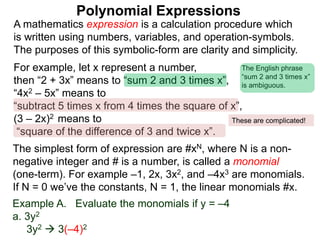
Example A. Evaluate the monomials if y = –4
a. 3y2
The simplest form of expression are #xN, where N is a non-
negative integer and # is a number, is called a monomial
(one-term). For example –1, 2x, 3x2, and –4x3 are monomials.
If N = 0 we’ve the constants, N = 1, the linear monomials #x.
Polynomial Expressions
The English phrase
“sum 2 and 3 times x”
is ambiguous.
These are complicated!
For example, let x represent a number,
then “2 + 3x” means to “sum 2 and 3 times x”,
“4x2 – 5x” means to
“subtract 5 times x from 4 times the square of x”,
(3 – 2x)2 means to
“square of the difference of 3 and twice x”.
A mathematics expression is a calculation procedure which
is written using numbers, variables, and operation-symbols.
The purposes of this symbolic-form are clarity and simplicity.
Example A. Evaluate the monomials if y = –4
a. 3y2
3y2  3(–4)2
The simplest form of expression are #xN, where N is a non-
negative integer and # is a number, is called a monomial
(one-term). For example –1, 2x, 3x2, and –4x3 are monomials.
If N = 0 we’ve the constants, N = 1, the linear monomials #x.
Polynomial Expressions
The English phrase
“sum 2 and 3 times x”
is ambiguous.
These are complicated!
For example, let x represent a number,
then “2 + 3x” means to “sum 2 and 3 times x”,
“4x2 – 5x” means to
“subtract 5 times x from 4 times the square of x”,
(3 – 2x)2 means to
“square of the difference of 3 and twice x”.
A mathematics expression is a calculation procedure which
is written using numbers, variables, and operation-symbols.
The purposes of this symbolic-form are clarity and simplicity.
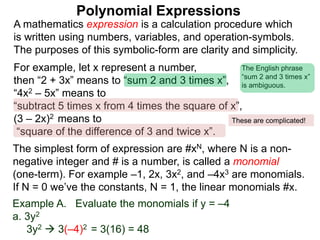
Example A. Evaluate the monomials if y = –4
a. 3y2
3y2  3(–4)2 = 3(16) = 48
The simplest form of expression are #xN, where N is a non-
negative integer and # is a number, is called a monomial
(one-term). For example –1, 2x, 3x2, and –4x3 are monomials.
If N = 0 we’ve the constants, N = 1, the linear monomials #x.
Polynomial Expressions
The English phrase
“sum 2 and 3 times x”
is ambiguous.
These are complicated!
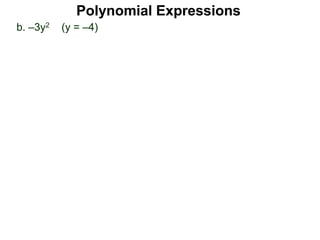
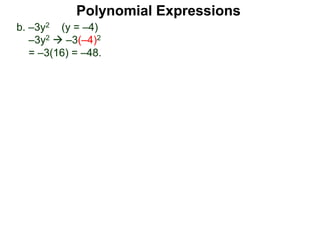
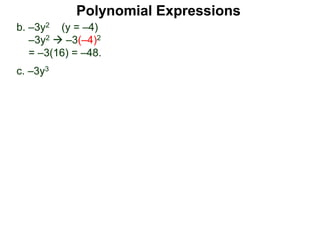
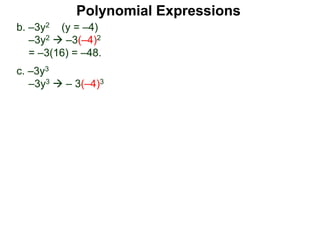
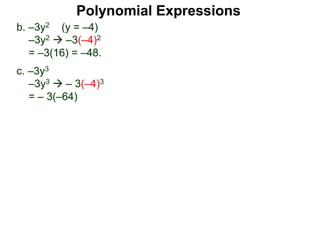
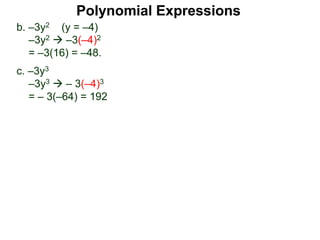
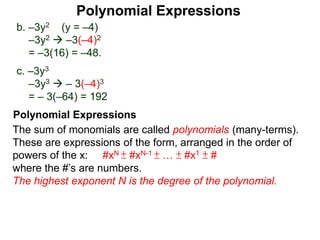
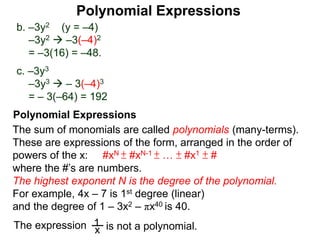
b. –3y2 (y = –4)
Polynomial Expressions
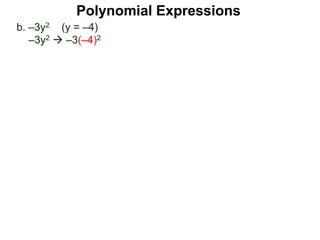
b. –3y2 (y = –4)
–3y2  –3(–4)2
Polynomial Expressions
b. –3y2 (y = –4)
–3y2  –3(–4)2
= –3(16) = –48.
Polynomial Expressions
b. –3y2 (y = –4)
–3y2  –3(–4)2
= –3(16) = –48.
c. –3y3
Polynomial Expressions
b. –3y2 (y = –4)
–3y2  –3(–4)2
= –3(16) = –48.
c. –3y3
–3y3  – 3(–4)3
Polynomial Expressions
b. –3y2 (y = –4)
–3y2  –3(–4)2
= –3(16) = –48.
c. –3y3
–3y3  – 3(–4)3
= – 3(–64)
Polynomial Expressions
b. –3y2 (y = –4)
–3y2  –3(–4)2
= –3(16) = –48.
c. –3y3
–3y3  – 3(–4)3
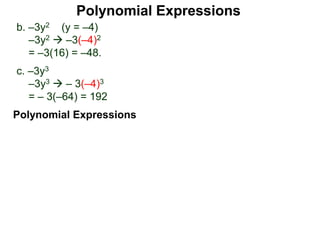
= – 3(–64) = 192
Polynomial Expressions
b. –3y2 (y = –4)
–3y2  –3(–4)2
= –3(16) = –48.
c. –3y3
–3y3  – 3(–4)3
= – 3(–64) = 192
Polynomial Expressions
b. –3y2 (y = –4)
–3y2  –3(–4)2
= –3(16) = –48.
c. –3y3
–3y3  – 3(–4)3
= – 3(–64) = 192
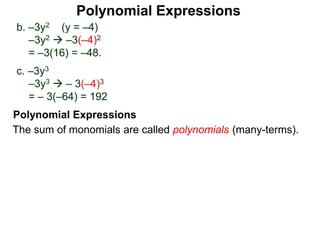
The sum of monomials are called polynomials (many-terms).
Polynomial Expressions
b. –3y2 (y = –4)
–3y2  –3(–4)2
= –3(16) = –48.
c. –3y3
–3y3  – 3(–4)3
= – 3(–64) = 192
The sum of monomials are called polynomials (many-terms).
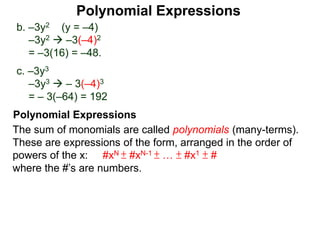
These are expressions of the form, arranged in the order of
powers of the x: #xN ± #xN-1 ± … ± #x1 ± #
where the #’s are numbers.
Polynomial Expressions
b. –3y2 (y = –4)
–3y2  –3(–4)2
= –3(16) = –48.
c. –3y3
–3y3  – 3(–4)3
= – 3(–64) = 192
The sum of monomials are called polynomials (many-terms).
These are expressions of the form, arranged in the order of
powers of the x: #xN ± #xN-1 ± … ± #x1 ± #
where the #’s are numbers.
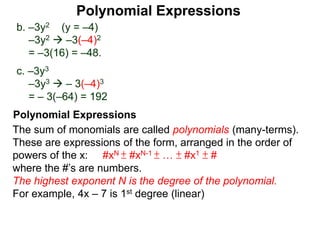
The highest exponent N is the degree of the polynomial.
Polynomial Expressions
b. –3y2 (y = –4)
–3y2  –3(–4)2
= –3(16) = –48.
c. –3y3
–3y3  – 3(–4)3
= – 3(–64) = 192
The sum of monomials are called polynomials (many-terms).
These are expressions of the form, arranged in the order of
powers of the x: #xN ± #xN-1 ± … ± #x1 ± #
where the #’s are numbers.
The highest exponent N is the degree of the polynomial.
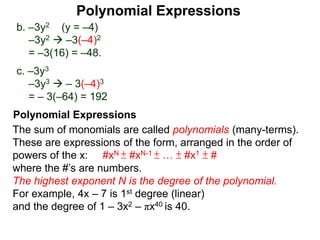
For example, 4x – 7 is 1st degree (linear)
Polynomial Expressions
b. –3y2 (y = –4)
–3y2  –3(–4)2
= –3(16) = –48.
c. –3y3
–3y3  – 3(–4)3
= – 3(–64) = 192
The sum of monomials are called polynomials (many-terms).
These are expressions of the form, arranged in the order of
powers of the x: #xN ± #xN-1 ± … ± #x1 ± #
where the #’s are numbers.
The highest exponent N is the degree of the polynomial.
For example, 4x – 7 is 1st degree (linear)
and the degree of 1 – 3x2 – πx40 is 40.
Polynomial Expressions
b. –3y2 (y = –4)
–3y2  –3(–4)2
= –3(16) = –48.
c. –3y3
–3y3  – 3(–4)3
= – 3(–64) = 192
The sum of monomials are called polynomials (many-terms).
These are expressions of the form, arranged in the order of
powers of the x: #xN ± #xN-1 ± … ± #x1 ± #
where the #’s are numbers.
The highest exponent N is the degree of the polynomial.
For example, 4x – 7 is 1st degree (linear)
and the degree of 1 – 3x2 – πx40 is 40.
x
1 is not a polynomial.The expression
Polynomial Expressions
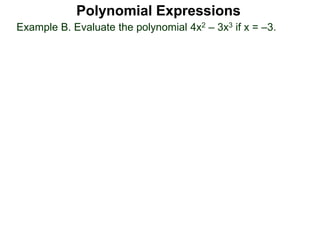
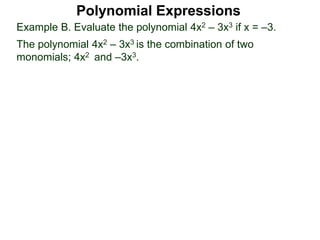
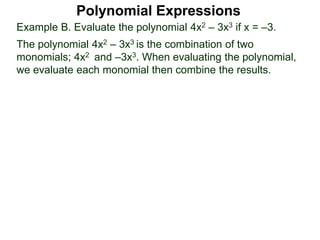
Example B. Evaluate the polynomial 4x2 – 3x3 if x = –3.
Polynomial Expressions
Example B. Evaluate the polynomial 4x2 – 3x3 if x = –3.
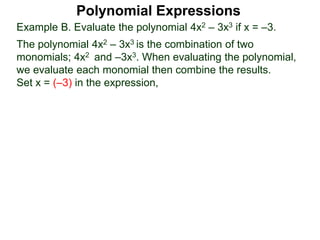
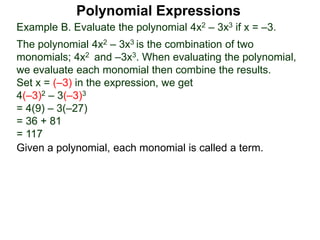
The polynomial 4x2 – 3x3 is the combination of two
monomials; 4x2 and –3x3.
Polynomial Expressions
Example B. Evaluate the polynomial 4x2 – 3x3 if x = –3.
The polynomial 4x2 – 3x3 is the combination of two
monomials; 4x2 and –3x3. When evaluating the polynomial,
we evaluate each monomial then combine the results.
Polynomial Expressions
Example B. Evaluate the polynomial 4x2 – 3x3 if x = –3.
The polynomial 4x2 – 3x3 is the combination of two
monomials; 4x2 and –3x3. When evaluating the polynomial,
we evaluate each monomial then combine the results.
Set x = (–3) in the expression,
Polynomial Expressions
Example B. Evaluate the polynomial 4x2 – 3x3 if x = –3.
The polynomial 4x2 – 3x3 is the combination of two
monomials; 4x2 and –3x3. When evaluating the polynomial,
we evaluate each monomial then combine the results.
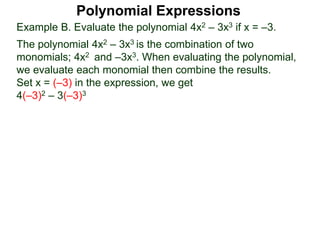
Set x = (–3) in the expression, we get
4(–3)2 – 3(–3)3
Polynomial Expressions
Example B. Evaluate the polynomial 4x2 – 3x3 if x = –3.
The polynomial 4x2 – 3x3 is the combination of two
monomials; 4x2 and –3x3. When evaluating the polynomial,
we evaluate each monomial then combine the results.
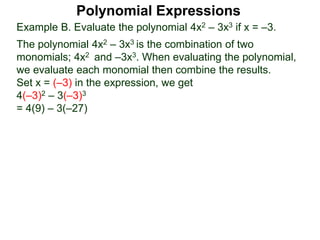
Set x = (–3) in the expression, we get
4(–3)2 – 3(–3)3
= 4(9) – 3(–27)
Polynomial Expressions
Example B. Evaluate the polynomial 4x2 – 3x3 if x = –3.
The polynomial 4x2 – 3x3 is the combination of two
monomials; 4x2 and –3x3. When evaluating the polynomial,
we evaluate each monomial then combine the results.
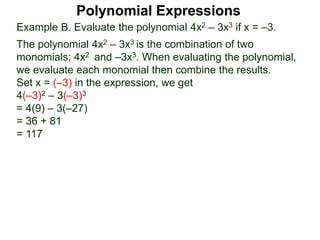
Set x = (–3) in the expression, we get
4(–3)2 – 3(–3)3
= 4(9) – 3(–27)
= 36 + 81
= 117
Polynomial Expressions
Example B. Evaluate the polynomial 4x2 – 3x3 if x = –3.
The polynomial 4x2 – 3x3 is the combination of two
monomials; 4x2 and –3x3. When evaluating the polynomial,
we evaluate each monomial then combine the results.
Set x = (–3) in the expression, we get
4(–3)2 – 3(–3)3
= 4(9) – 3(–27)
= 36 + 81
= 117
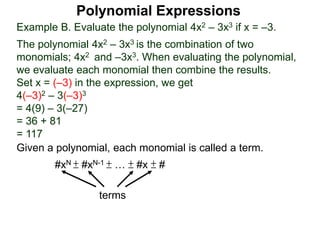
Given a polynomial, each monomial is called a term.
Polynomial Expressions
Example B. Evaluate the polynomial 4x2 – 3x3 if x = –3.
The polynomial 4x2 – 3x3 is the combination of two
monomials; 4x2 and –3x3. When evaluating the polynomial,
we evaluate each monomial then combine the results.
Set x = (–3) in the expression, we get
4(–3)2 – 3(–3)3
= 4(9) – 3(–27)
= 36 + 81
= 117
Given a polynomial, each monomial is called a term.
#xN ± #xN-1 ± … ± #x ± #
terms
Polynomial Expressions
Example B. Evaluate the polynomial 4x2 – 3x3 if x = –3.
The polynomial 4x2 – 3x3 is the combination of two
monomials; 4x2 and –3x3. When evaluating the polynomial,
we evaluate each monomial then combine the results.
Set x = (–3) in the expression, we get
4(–3)2 – 3(–3)3
= 4(9) – 3(–27)
= 36 + 81
= 117
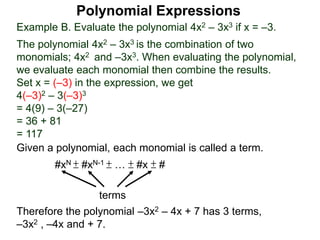
Given a polynomial, each monomial is called a term.
#xN ± #xN-1 ± … ± #x ± #
terms
Therefore the polynomial –3x2 – 4x + 7 has 3 terms,
–3x2 , –4x and + 7.
Polynomial Expressions
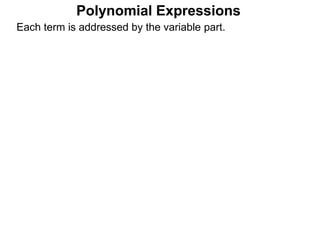
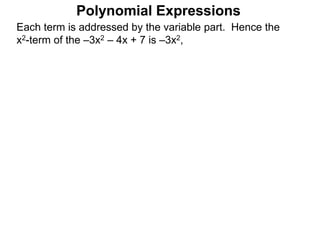
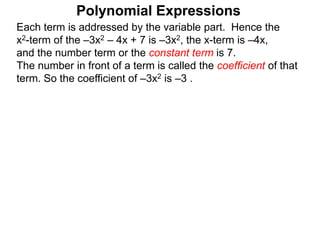
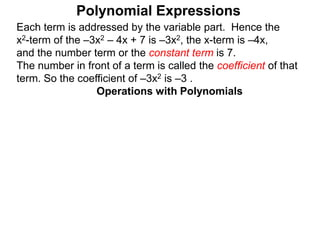
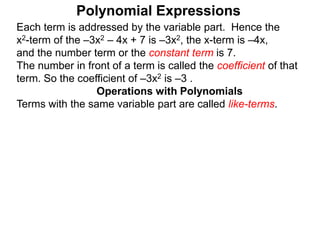
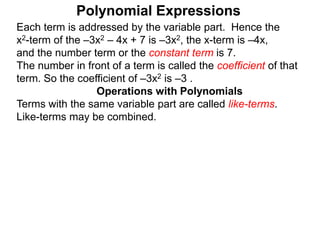
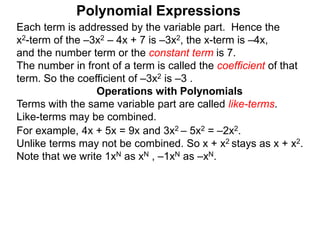
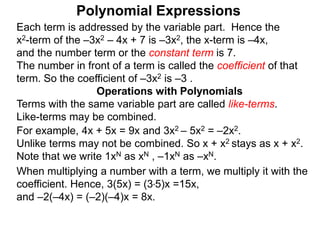
Each term is addressed by the variable part.
Polynomial Expressions
Each term is addressed by the variable part. Hence the
x2-term of the –3x2 – 4x + 7 is –3x2,
Polynomial Expressions
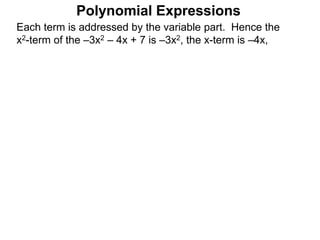
Each term is addressed by the variable part. Hence the
x2-term of the –3x2 – 4x + 7 is –3x2, the x-term is –4x,
Polynomial Expressions
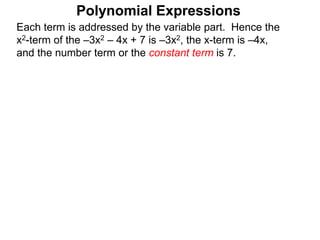
Each term is addressed by the variable part. Hence the
x2-term of the –3x2 – 4x + 7 is –3x2, the x-term is –4x,
and the number term or the constant term is 7.
Polynomial Expressions
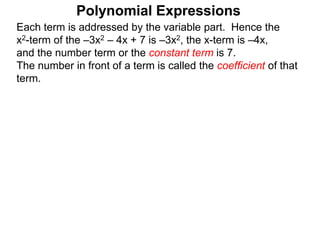
Each term is addressed by the variable part. Hence the
x2-term of the –3x2 – 4x + 7 is –3x2, the x-term is –4x,
and the number term or the constant term is 7.
The number in front of a term is called the coefficient of that
term.
Polynomial Expressions
Each term is addressed by the variable part. Hence the
x2-term of the –3x2 – 4x + 7 is –3x2, the x-term is –4x,
and the number term or the constant term is 7.
The number in front of a term is called the coefficient of that
term. So the coefficient of –3x2 is –3 .
Polynomial Expressions
Each term is addressed by the variable part. Hence the
x2-term of the –3x2 – 4x + 7 is –3x2, the x-term is –4x,
and the number term or the constant term is 7.
The number in front of a term is called the coefficient of that
term. So the coefficient of –3x2 is –3 .
Operations with Polynomials
Polynomial Expressions
Each term is addressed by the variable part. Hence the
x2-term of the –3x2 – 4x + 7 is –3x2, the x-term is –4x,
and the number term or the constant term is 7.
The number in front of a term is called the coefficient of that
term. So the coefficient of –3x2 is –3 .
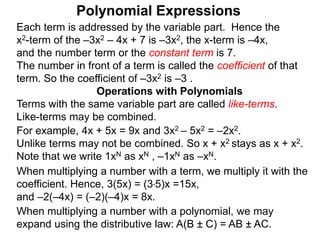
Terms with the same variable part are called like-terms.
Operations with Polynomials
Polynomial Expressions
Each term is addressed by the variable part. Hence the
x2-term of the –3x2 – 4x + 7 is –3x2, the x-term is –4x,
and the number term or the constant term is 7.
The number in front of a term is called the coefficient of that
term. So the coefficient of –3x2 is –3 .
Terms with the same variable part are called like-terms.
Like-terms may be combined.
Operations with Polynomials
Polynomial Expressions
Each term is addressed by the variable part. Hence the
x2-term of the –3x2 – 4x + 7 is –3x2, the x-term is –4x,
and the number term or the constant term is 7.
The number in front of a term is called the coefficient of that
term. So the coefficient of –3x2 is –3 .
Terms with the same variable part are called like-terms.
Like-terms may be combined.
For example, 4x + 5x = 9x
Operations with Polynomials
Polynomial Expressions
Each term is addressed by the variable part. Hence the
x2-term of the –3x2 – 4x + 7 is –3x2, the x-term is –4x,
and the number term or the constant term is 7.
The number in front of a term is called the coefficient of that
term. So the coefficient of –3x2 is –3 .
Terms with the same variable part are called like-terms.
Like-terms may be combined.
For example, 4x + 5x = 9x and 3x2 – 5x2 = –2x2.
Operations with Polynomials
Polynomial Expressions
Each term is addressed by the variable part. Hence the
x2-term of the –3x2 – 4x + 7 is –3x2, the x-term is –4x,
and the number term or the constant term is 7.
The number in front of a term is called the coefficient of that
term. So the coefficient of –3x2 is –3 .
Terms with the same variable part are called like-terms.
Like-terms may be combined.
For example, 4x + 5x = 9x and 3x2 – 5x2 = –2x2.
Unlike terms may not be combined.
Operations with Polynomials
Polynomial Expressions
Each term is addressed by the variable part. Hence the
x2-term of the –3x2 – 4x + 7 is –3x2, the x-term is –4x,
and the number term or the constant term is 7.
The number in front of a term is called the coefficient of that
term. So the coefficient of –3x2 is –3 .
Terms with the same variable part are called like-terms.
Like-terms may be combined.
For example, 4x + 5x = 9x and 3x2 – 5x2 = –2x2.
Unlike terms may not be combined. So x + x2 stays as x + x2.
Operations with Polynomials
Polynomial Expressions
Each term is addressed by the variable part. Hence the
x2-term of the –3x2 – 4x + 7 is –3x2, the x-term is –4x,
and the number term or the constant term is 7.
The number in front of a term is called the coefficient of that
term. So the coefficient of –3x2 is –3 .
Terms with the same variable part are called like-terms.
Like-terms may be combined.
For example, 4x + 5x = 9x and 3x2 – 5x2 = –2x2.
Unlike terms may not be combined. So x + x2 stays as x + x2.
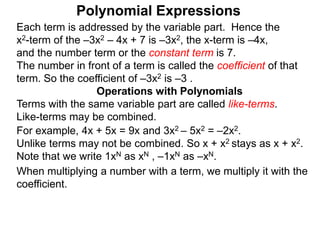
Note that we write 1xN as xN , –1xN as –xN.
Operations with Polynomials
Polynomial Expressions
Each term is addressed by the variable part. Hence the
x2-term of the –3x2 – 4x + 7 is –3x2, the x-term is –4x,
and the number term or the constant term is 7.
The number in front of a term is called the coefficient of that
term. So the coefficient of –3x2 is –3 .
Terms with the same variable part are called like-terms.
Like-terms may be combined.
For example, 4x + 5x = 9x and 3x2 – 5x2 = –2x2.
Unlike terms may not be combined. So x + x2 stays as x + x2.
Note that we write 1xN as xN , –1xN as –xN.
When multiplying a number with a term, we multiply it with the
coefficient.
Operations with Polynomials
Polynomial Expressions
Each term is addressed by the variable part. Hence the
x2-term of the –3x2 – 4x + 7 is –3x2, the x-term is –4x,
and the number term or the constant term is 7.
The number in front of a term is called the coefficient of that
term. So the coefficient of –3x2 is –3 .
Terms with the same variable part are called like-terms.
Like-terms may be combined.
For example, 4x + 5x = 9x and 3x2 – 5x2 = –2x2.
Unlike terms may not be combined. So x + x2 stays as x + x2.
Note that we write 1xN as xN , –1xN as –xN.
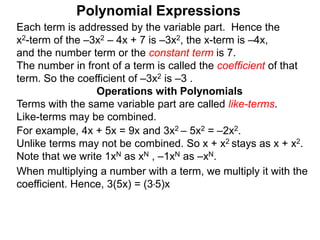
When multiplying a number with a term, we multiply it with the
coefficient. Hence, 3(5x) = (3*5)x
Operations with Polynomials
Polynomial Expressions
Each term is addressed by the variable part. Hence the
x2-term of the –3x2 – 4x + 7 is –3x2, the x-term is –4x,
and the number term or the constant term is 7.
The number in front of a term is called the coefficient of that
term. So the coefficient of –3x2 is –3 .
Terms with the same variable part are called like-terms.
Like-terms may be combined.
For example, 4x + 5x = 9x and 3x2 – 5x2 = –2x2.
Unlike terms may not be combined. So x + x2 stays as x + x2.
Note that we write 1xN as xN , –1xN as –xN.
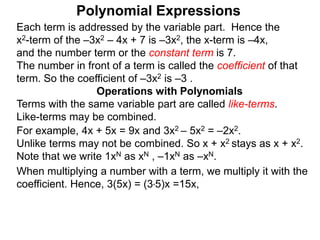
When multiplying a number with a term, we multiply it with the
coefficient. Hence, 3(5x) = (3*5)x =15x,
Operations with Polynomials
Polynomial Expressions
Each term is addressed by the variable part. Hence the
x2-term of the –3x2 – 4x + 7 is –3x2, the x-term is –4x,
and the number term or the constant term is 7.
The number in front of a term is called the coefficient of that
term. So the coefficient of –3x2 is –3 .
Terms with the same variable part are called like-terms.
Like-terms may be combined.
For example, 4x + 5x = 9x and 3x2 – 5x2 = –2x2.
Unlike terms may not be combined. So x + x2 stays as x + x2.
Note that we write 1xN as xN , –1xN as –xN.
When multiplying a number with a term, we multiply it with the
coefficient. Hence, 3(5x) = (3*5)x =15x,
and –2(–4x) = (–2)(–4)x = 8x.
Operations with Polynomials
Polynomial Expressions
Each term is addressed by the variable part. Hence the
x2-term of the –3x2 – 4x + 7 is –3x2, the x-term is –4x,
and the number term or the constant term is 7.
The number in front of a term is called the coefficient of that
term. So the coefficient of –3x2 is –3 .
Terms with the same variable part are called like-terms.
Like-terms may be combined.
For example, 4x + 5x = 9x and 3x2 – 5x2 = –2x2.
Unlike terms may not be combined. So x + x2 stays as x + x2.
Note that we write 1xN as xN , –1xN as –xN.
When multiplying a number with a term, we multiply it with the
coefficient. Hence, 3(5x) = (3*5)x =15x,
and –2(–4x) = (–2)(–4)x = 8x.
Operations with Polynomials
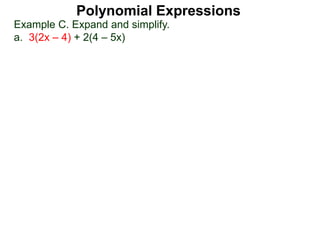
When multiplying a number with a polynomial, we may
expand using the distributive law: A(B ± C) = AB ± AC.
Polynomial Expressions
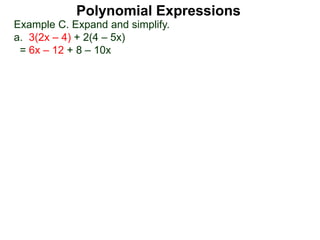
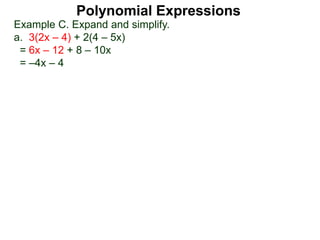
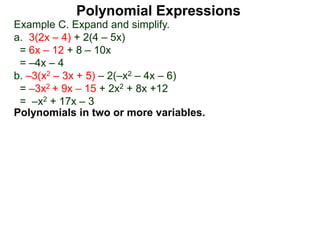
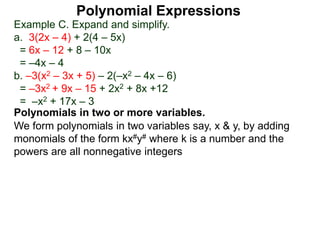
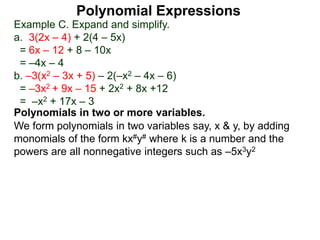
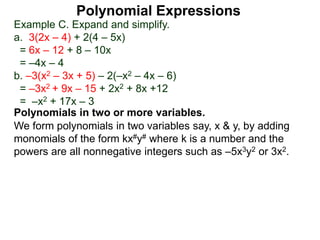
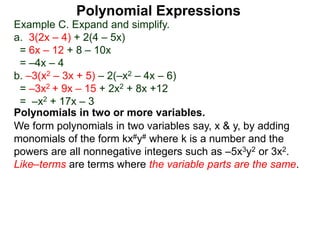
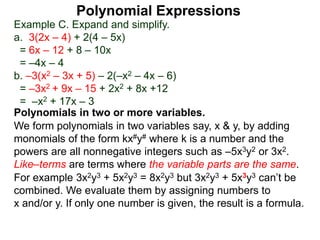
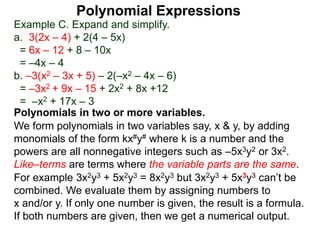
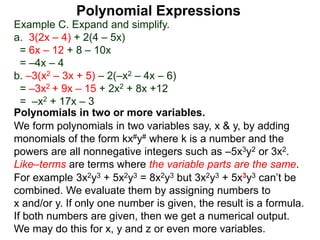
Example C. Expand and simplify.
a. 3(2x – 4) + 2(4 – 5x)
Polynomial Expressions
Example C. Expand and simplify.
a. 3(2x – 4) + 2(4 – 5x)
= 6x – 12 + 8 – 10x
Polynomial Expressions
Example C. Expand and simplify.
a. 3(2x – 4) + 2(4 – 5x)
= 6x – 12 + 8 – 10x
= –4x – 4
Polynomial Expressions
Example C. Expand and simplify.
a. 3(2x – 4) + 2(4 – 5x)
= 6x – 12 + 8 – 10x
= –4x – 4
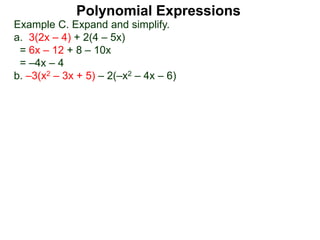
b. –3(x2 – 3x + 5) – 2(–x2 – 4x – 6)
Polynomial Expressions
Example C. Expand and simplify.
a. 3(2x – 4) + 2(4 – 5x)
= 6x – 12 + 8 – 10x
= –4x – 4
b. –3(x2 – 3x + 5) – 2(–x2 – 4x – 6)
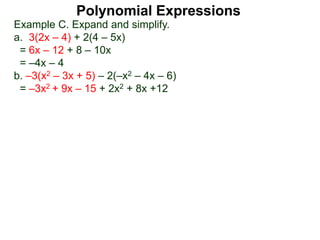
= –3x2 + 9x – 15 + 2x2 + 8x +12
Polynomial Expressions
Example C. Expand and simplify.
a. 3(2x – 4) + 2(4 – 5x)
= 6x – 12 + 8 – 10x
= –4x – 4
b. –3(x2 – 3x + 5) – 2(–x2 – 4x – 6)
= –3x2 + 9x – 15 + 2x2 + 8x +12
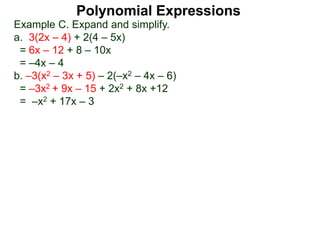
= –x2 + 17x – 3
Polynomial Expressions
Example C. Expand and simplify.
a. 3(2x – 4) + 2(4 – 5x)
= 6x – 12 + 8 – 10x
= –4x – 4
b. –3(x2 – 3x + 5) – 2(–x2 – 4x – 6)
= –3x2 + 9x – 15 + 2x2 + 8x +12
= –x2 + 17x – 3
Polynomials in two or more variables.
Polynomial Expressions
Example C. Expand and simplify.
a. 3(2x – 4) + 2(4 – 5x)
= 6x – 12 + 8 – 10x
= –4x – 4
b. –3(x2 – 3x + 5) – 2(–x2 – 4x – 6)
= –3x2 + 9x – 15 + 2x2 + 8x +12
= –x2 + 17x – 3
Polynomials in two or more variables.
We form polynomials in two variables say, x & y, by adding
monomials of the form kx#y# where k is a number and the
powers are all nonnegative integers
Polynomial Expressions
Example C. Expand and simplify.
a. 3(2x – 4) + 2(4 – 5x)
= 6x – 12 + 8 – 10x
= –4x – 4
b. –3(x2 – 3x + 5) – 2(–x2 – 4x – 6)
= –3x2 + 9x – 15 + 2x2 + 8x +12
= –x2 + 17x – 3
Polynomials in two or more variables.
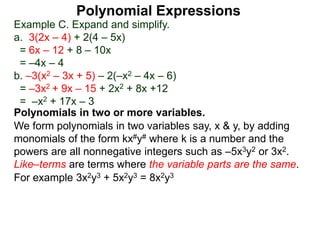
We form polynomials in two variables say, x & y, by adding
monomials of the form kx#y# where k is a number and the
powers are all nonnegative integers such as –5x3y2
Polynomial Expressions
Example C. Expand and simplify.
a. 3(2x – 4) + 2(4 – 5x)
= 6x – 12 + 8 – 10x
= –4x – 4
b. –3(x2 – 3x + 5) – 2(–x2 – 4x – 6)
= –3x2 + 9x – 15 + 2x2 + 8x +12
= –x2 + 17x – 3
Polynomials in two or more variables.
We form polynomials in two variables say, x & y, by adding
monomials of the form kx#y# where k is a number and the
powers are all nonnegative integers such as –5x3y2 or 3x2.
Polynomial Expressions
Example C. Expand and simplify.
a. 3(2x – 4) + 2(4 – 5x)
= 6x – 12 + 8 – 10x
= –4x – 4
b. –3(x2 – 3x + 5) – 2(–x2 – 4x – 6)
= –3x2 + 9x – 15 + 2x2 + 8x +12
= –x2 + 17x – 3
Polynomials in two or more variables.
We form polynomials in two variables say, x & y, by adding
monomials of the form kx#y# where k is a number and the
powers are all nonnegative integers such as –5x3y2 or 3x2.
Like–terms are terms where the variable parts are the same.
Polynomial Expressions
Example C. Expand and simplify.
a. 3(2x – 4) + 2(4 – 5x)
= 6x – 12 + 8 – 10x
= –4x – 4
b. –3(x2 – 3x + 5) – 2(–x2 – 4x – 6)
= –3x2 + 9x – 15 + 2x2 + 8x +12
= –x2 + 17x – 3
Polynomials in two or more variables.
We form polynomials in two variables say, x & y, by adding
monomials of the form kx#y# where k is a number and the
powers are all nonnegative integers such as –5x3y2 or 3x2.
Like–terms are terms where the variable parts are the same.
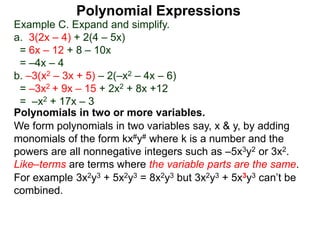
For example 3x2y3 + 5x2y3 = 8x2y3
Polynomial Expressions
Example C. Expand and simplify.
a. 3(2x – 4) + 2(4 – 5x)
= 6x – 12 + 8 – 10x
= –4x – 4
b. –3(x2 – 3x + 5) – 2(–x2 – 4x – 6)
= –3x2 + 9x – 15 + 2x2 + 8x +12
= –x2 + 17x – 3
Polynomials in two or more variables.
We form polynomials in two variables say, x & y, by adding
monomials of the form kx#y# where k is a number and the
powers are all nonnegative integers such as –5x3y2 or 3x2.
Like–terms are terms where the variable parts are the same.
For example 3x2y3 + 5x2y3 = 8x2y3 but 3x2y3 + 5x3y3 can’t be
combined.
Polynomial Expressions
Example C. Expand and simplify.
a. 3(2x – 4) + 2(4 – 5x)
= 6x – 12 + 8 – 10x
= –4x – 4
b. –3(x2 – 3x + 5) – 2(–x2 – 4x – 6)
= –3x2 + 9x – 15 + 2x2 + 8x +12
= –x2 + 17x – 3
Polynomials in two or more variables.
We form polynomials in two variables say, x & y, by adding
monomials of the form kx#y# where k is a number and the
powers are all nonnegative integers such as –5x3y2 or 3x2.
Like–terms are terms where the variable parts are the same.
For example 3x2y3 + 5x2y3 = 8x2y3 but 3x2y3 + 5x3y3 can’t be
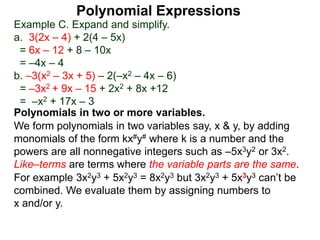
combined. We evaluate them by assigning numbers to
x and/or y.
Polynomial Expressions
Example C. Expand and simplify.
a. 3(2x – 4) + 2(4 – 5x)
= 6x – 12 + 8 – 10x
= –4x – 4
b. –3(x2 – 3x + 5) – 2(–x2 – 4x – 6)
= –3x2 + 9x – 15 + 2x2 + 8x +12
= –x2 + 17x – 3
Polynomials in two or more variables.
We form polynomials in two variables say, x & y, by adding
monomials of the form kx#y# where k is a number and the
powers are all nonnegative integers such as –5x3y2 or 3x2.
Like–terms are terms where the variable parts are the same.
For example 3x2y3 + 5x2y3 = 8x2y3 but 3x2y3 + 5x3y3 can’t be
combined. We evaluate them by assigning numbers to
x and/or y. If only one number is given, the result is a formula.
Polynomial Expressions
Example C. Expand and simplify.
a. 3(2x – 4) + 2(4 – 5x)
= 6x – 12 + 8 – 10x
= –4x – 4
b. –3(x2 – 3x + 5) – 2(–x2 – 4x – 6)
= –3x2 + 9x – 15 + 2x2 + 8x +12
= –x2 + 17x – 3
Polynomials in two or more variables.
We form polynomials in two variables say, x & y, by adding
monomials of the form kx#y# where k is a number and the
powers are all nonnegative integers such as –5x3y2 or 3x2.
Like–terms are terms where the variable parts are the same.
For example 3x2y3 + 5x2y3 = 8x2y3 but 3x2y3 + 5x3y3 can’t be
combined. We evaluate them by assigning numbers to
x and/or y. If only one number is given, the result is a formula.
If both numbers are given, then we get a numerical output.
Polynomial Expressions
Example C. Expand and simplify.
a. 3(2x – 4) + 2(4 – 5x)
= 6x – 12 + 8 – 10x
= –4x – 4
b. –3(x2 – 3x + 5) – 2(–x2 – 4x – 6)
= –3x2 + 9x – 15 + 2x2 + 8x +12
= –x2 + 17x – 3
Polynomials in two or more variables.
We form polynomials in two variables say, x & y, by adding
monomials of the form kx#y# where k is a number and the
powers are all nonnegative integers such as –5x3y2 or 3x2.
Like–terms are terms where the variable parts are the same.
For example 3x2y3 + 5x2y3 = 8x2y3 but 3x2y3 + 5x3y3 can’t be
combined. We evaluate them by assigning numbers to
x and/or y. If only one number is given, the result is a formula.
If both numbers are given, then we get a numerical output.
We may do this for x, y and z or even more variables.
Polynomial Expressions
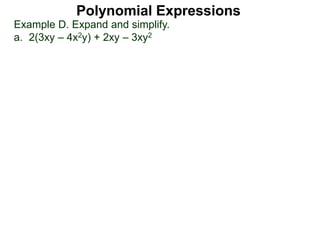
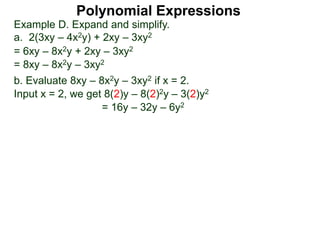
Example D. Expand and simplify.
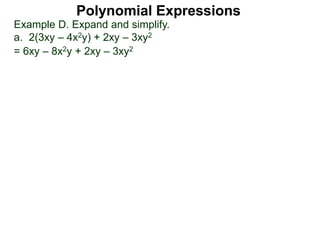
a. 2(3xy – 4x2y) + 2xy – 3xy2
Polynomial Expressions
= 6xy – 8x2y + 2xy – 3xy2
Polynomial Expressions
Example D. Expand and simplify.
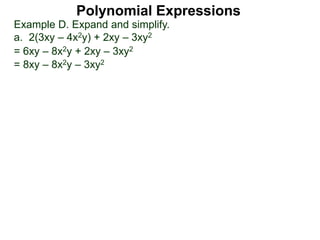
a. 2(3xy – 4x2y) + 2xy – 3xy2
Example D. Expand and simplify.
a. 2(3xy – 4x2y) + 2xy – 3xy2
= 6xy – 8x2y + 2xy – 3xy2
= 8xy – 8x2y – 3xy2
Polynomial Expressions
Example D. Expand and simplify.
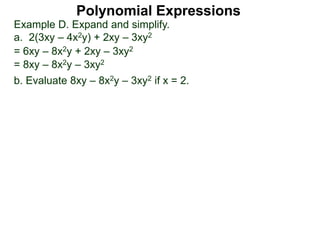
a. 2(3xy – 4x2y) + 2xy – 3xy2
= 6xy – 8x2y + 2xy – 3xy2
= 8xy – 8x2y – 3xy2
b. Evaluate 8xy – 8x2y – 3xy2 if x = 2.
Polynomial Expressions
Example D. Expand and simplify.
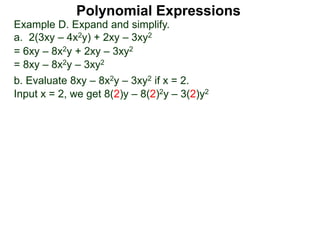
a. 2(3xy – 4x2y) + 2xy – 3xy2
= 6xy – 8x2y + 2xy – 3xy2
= 8xy – 8x2y – 3xy2
b. Evaluate 8xy – 8x2y – 3xy2 if x = 2.
Input x = 2, we get 8(2)y – 8(2)2y – 3(2)y2
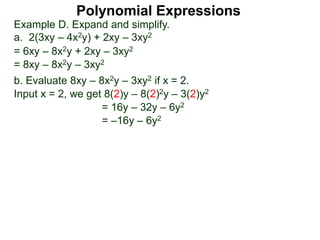
Polynomial Expressions
Example D. Expand and simplify.
a. 2(3xy – 4x2y) + 2xy – 3xy2
= 6xy – 8x2y + 2xy – 3xy2
= 8xy – 8x2y – 3xy2
b. Evaluate 8xy – 8x2y – 3xy2 if x = 2.
Input x = 2, we get 8(2)y – 8(2)2y – 3(2)y2
= 16y – 32y – 6y2
Polynomial Expressions
Example D. Expand and simplify.
a. 2(3xy – 4x2y) + 2xy – 3xy2
= 6xy – 8x2y + 2xy – 3xy2
= 8xy – 8x2y – 3xy2
b. Evaluate 8xy – 8x2y – 3xy2 if x = 2.
Input x = 2, we get 8(2)y – 8(2)2y – 3(2)y2
= 16y – 32y – 6y2
= –16y – 6y2
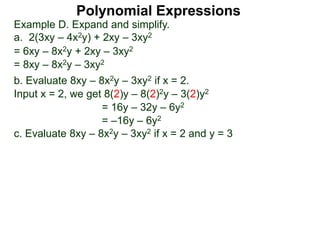
Polynomial Expressions
Example D. Expand and simplify.
a. 2(3xy – 4x2y) + 2xy – 3xy2
= 6xy – 8x2y + 2xy – 3xy2
= 8xy – 8x2y – 3xy2
b. Evaluate 8xy – 8x2y – 3xy2 if x = 2.
Input x = 2, we get 8(2)y – 8(2)2y – 3(2)y2
= 16y – 32y – 6y2
= –16y – 6y2
c. Evaluate 8xy – 8x2y – 3xy2 if x = 2 and y = 3
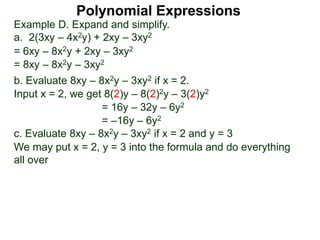
Polynomial Expressions
Example D. Expand and simplify.
a. 2(3xy – 4x2y) + 2xy – 3xy2
= 6xy – 8x2y + 2xy – 3xy2
= 8xy – 8x2y – 3xy2
b. Evaluate 8xy – 8x2y – 3xy2 if x = 2.
Input x = 2, we get 8(2)y – 8(2)2y – 3(2)y2
= 16y – 32y – 6y2
= –16y – 6y2
c. Evaluate 8xy – 8x2y – 3xy2 if x = 2 and y = 3
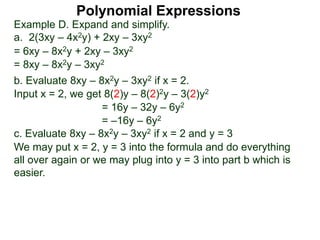
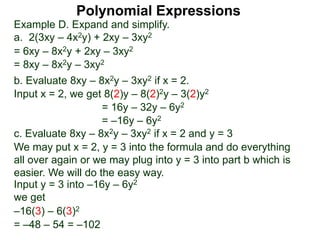
We may put x = 2, y = 3 into the formula and do everything
all over
Polynomial Expressions
Example D. Expand and simplify.
a. 2(3xy – 4x2y) + 2xy – 3xy2
= 6xy – 8x2y + 2xy – 3xy2
= 8xy – 8x2y – 3xy2
b. Evaluate 8xy – 8x2y – 3xy2 if x = 2.
Input x = 2, we get 8(2)y – 8(2)2y – 3(2)y2
= 16y – 32y – 6y2
= –16y – 6y2
c. Evaluate 8xy – 8x2y – 3xy2 if x = 2 and y = 3
We may put x = 2, y = 3 into the formula and do everything
all over again or we may plug into y = 3 into part b which is
easier.
Polynomial Expressions
Example D. Expand and simplify.
a. 2(3xy – 4x2y) + 2xy – 3xy2
= 6xy – 8x2y + 2xy – 3xy2
= 8xy – 8x2y – 3xy2
b. Evaluate 8xy – 8x2y – 3xy2 if x = 2.
Input x = 2, we get 8(2)y – 8(2)2y – 3(2)y2
= 16y – 32y – 6y2
= –16y – 6y2
c. Evaluate 8xy – 8x2y – 3xy2 if x = 2 and y = 3
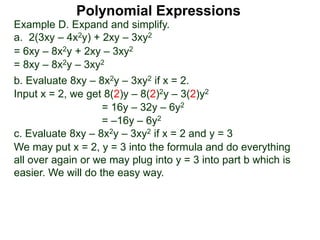
We may put x = 2, y = 3 into the formula and do everything
all over again or we may plug into y = 3 into part b which is
easier. We will do the easy way.
Polynomial Expressions
Example D. Expand and simplify.
a. 2(3xy – 4x2y) + 2xy – 3xy2
= 6xy – 8x2y + 2xy – 3xy2
= 8xy – 8x2y – 3xy2
b. Evaluate 8xy – 8x2y – 3xy2 if x = 2.
Input x = 2, we get 8(2)y – 8(2)2y – 3(2)y2
= 16y – 32y – 6y2
= –16y – 6y2
c. Evaluate 8xy – 8x2y – 3xy2 if x = 2 and y = 3
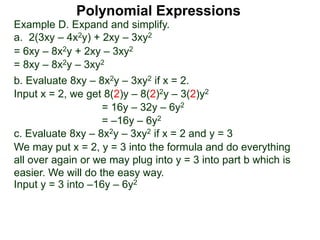
We may put x = 2, y = 3 into the formula and do everything
all over again or we may plug into y = 3 into part b which is
easier. We will do the easy way.
Input y = 3 into –16y – 6y2
Polynomial Expressions
Example D. Expand and simplify.
a. 2(3xy – 4x2y) + 2xy – 3xy2
= 6xy – 8x2y + 2xy – 3xy2
= 8xy – 8x2y – 3xy2
b. Evaluate 8xy – 8x2y – 3xy2 if x = 2.
Input x = 2, we get 8(2)y – 8(2)2y – 3(2)y2
= 16y – 32y – 6y2
= –16y – 6y2
c. Evaluate 8xy – 8x2y – 3xy2 if x = 2 and y = 3
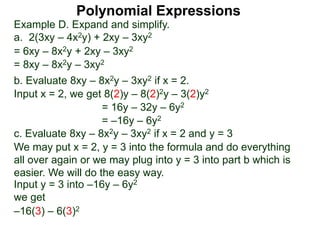
We may put x = 2, y = 3 into the formula and do everything
all over again or we may plug into y = 3 into part b which is
easier. We will do the easy way.
–16(3) – 6(3)2
Input y = 3 into –16y – 6y2
we get
Polynomial Expressions
Example D. Expand and simplify.
a. 2(3xy – 4x2y) + 2xy – 3xy2
= 6xy – 8x2y + 2xy – 3xy2
= 8xy – 8x2y – 3xy2
b. Evaluate 8xy – 8x2y – 3xy2 if x = 2.
Input x = 2, we get 8(2)y – 8(2)2y – 3(2)y2
= 16y – 32y – 6y2
= –16y – 6y2
c. Evaluate 8xy – 8x2y – 3xy2 if x = 2 and y = 3
We may put x = 2, y = 3 into the formula and do everything
all over again or we may plug into y = 3 into part b which is
easier. We will do the easy way.
–16(3) – 6(3)2
Input y = 3 into –16y – 6y2
we get
= –48 – 54 = –102
Polynomial Expressions
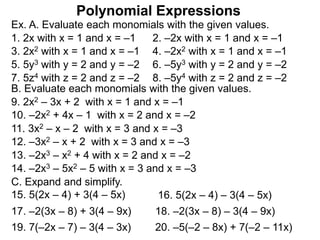
Ex. A. Evaluate each monomials with the given values.
3. 2x2 with x = 1 and x = –1 4. –2x2 with x = 1 and x = –1
5. 5y3 with y = 2 and y = –2 6. –5y3 with y = 2 and y = –2
1. 2x with x = 1 and x = –1 2. –2x with x = 1 and x = –1
7. 5z4 with z = 2 and z = –2 8. –5y4 with z = 2 and z = –2
B. Evaluate each monomials with the given values.
9. 2x2 – 3x + 2 with x = 1 and x = –1
10. –2x2 + 4x – 1 with x = 2 and x = –2
11. 3x2 – x – 2 with x = 3 and x = –3
12. –3x2 – x + 2 with x = 3 and x = –3
13. –2x3 – x2 + 4 with x = 2 and x = –2
14. –2x3 – 5x2 – 5 with x = 3 and x = –3
C. Expand and simplify.
15. 5(2x – 4) + 3(4 – 5x) 16. 5(2x – 4) – 3(4 – 5x)
17. –2(3x – 8) + 3(4 – 9x) 18. –2(3x – 8) – 3(4 – 9x)
19. 7(–2x – 7) – 3(4 – 3x) 20. –5(–2 – 8x) + 7(–2 – 11x)
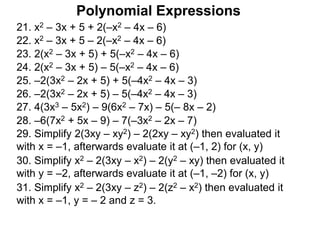
Polynomial Expressions
21. x2 – 3x + 5 + 2(–x2 – 4x – 6)
22. x2 – 3x + 5 – 2(–x2 – 4x – 6)
23. 2(x2 – 3x + 5) + 5(–x2 – 4x – 6)
24. 2(x2 – 3x + 5) – 5(–x2 – 4x – 6)
25. –2(3x2 – 2x + 5) + 5(–4x2 – 4x – 3)
26. –2(3x2 – 2x + 5) – 5(–4x2 – 4x – 3)
27. 4(3x3 – 5x2) – 9(6x2 – 7x) – 5(– 8x – 2)
29. Simplify 2(3xy – xy2) – 2(2xy – xy2) then evaluated it
with x = –1, afterwards evaluate it at (–1, 2) for (x, y)
30. Simplify x2 – 2(3xy – x2) – 2(y2 – xy) then evaluated it
with y = –2, afterwards evaluate it at (–1, –2) for (x, y)
31. Simplify x2 – 2(3xy – z2) – 2(z2 – x2) then evaluated it
with x = –1, y = – 2 and z = 3.
Polynomial Expressions
28. –6(7x2 + 5x – 9) – 7(–3x2 – 2x – 7)

4 3polynomial expressions

  • 1.
  • 2.
    A mathematics expressionis a calculation procedure which is written using numbers, variables, and operation-symbols. Polynomial Expressions
  • 3.
    A mathematics expressionis a calculation procedure which is written using numbers, variables, and operation-symbols. The purposes of this symbolic-form are clarity and simplicity. Polynomial Expressions
  • 4.
    For example, letx represent a number, then “2 + 3x” means to “sum 2 and 3 times x”, A mathematics expression is a calculation procedure which is written using numbers, variables, and operation-symbols. The purposes of this symbolic-form are clarity and simplicity. Polynomial Expressions
  • 5.
    For example, letx represent a number, then “2 + 3x” means to “sum 2 and 3 times x”, A mathematics expression is a calculation procedure which is written using numbers, variables, and operation-symbols. The purposes of this symbolic-form are clarity and simplicity. Polynomial Expressions The English phrase “sum 2 and 3 times x” is ambiguous.
  • 6.
    For example, letx represent a number, then “2 + 3x” means to “sum 2 and 3 times x”, “4x2 – 5x” means to “subtract 5 times x from 4 times the square of x”, A mathematics expression is a calculation procedure which is written using numbers, variables, and operation-symbols. The purposes of this symbolic-form are clarity and simplicity. Polynomial Expressions The English phrase “sum 2 and 3 times x” is ambiguous.
  • 7.
    For example, letx represent a number, then “2 + 3x” means to “sum 2 and 3 times x”, “4x2 – 5x” means to “subtract 5 times x from 4 times the square of x”, (3 – 2x)2 means to “square of the difference of 3 and twice x”. A mathematics expression is a calculation procedure which is written using numbers, variables, and operation-symbols. The purposes of this symbolic-form are clarity and simplicity. Polynomial Expressions The English phrase “sum 2 and 3 times x” is ambiguous.
  • 8.
    For example, letx represent a number, then “2 + 3x” means to “sum 2 and 3 times x”, “4x2 – 5x” means to “subtract 5 times x from 4 times the square of x”, (3 – 2x)2 means to “square of the difference of 3 and twice x”. A mathematics expression is a calculation procedure which is written using numbers, variables, and operation-symbols. The purposes of this symbolic-form are clarity and simplicity. Polynomial Expressions The English phrase “sum 2 and 3 times x” is ambiguous. These are complicated!
  • 9.
    For example, letx represent a number, then “2 + 3x” means to “sum 2 and 3 times x”, “4x2 – 5x” means to “subtract 5 times x from 4 times the square of x”, (3 – 2x)2 means to “square of the difference of 3 and twice x”. A mathematics expression is a calculation procedure which is written using numbers, variables, and operation-symbols. The purposes of this symbolic-form are clarity and simplicity. The simplest form of expression are #xN, where N is a non- negative integer and # is a number, is called a monomial (one-term). Polynomial Expressions The English phrase “sum 2 and 3 times x” is ambiguous. These are complicated!
  • 10.
    For example, letx represent a number, then “2 + 3x” means to “sum 2 and 3 times x”, “4x2 – 5x” means to “subtract 5 times x from 4 times the square of x”, (3 – 2x)2 means to “square of the difference of 3 and twice x”. A mathematics expression is a calculation procedure which is written using numbers, variables, and operation-symbols. The purposes of this symbolic-form are clarity and simplicity. The simplest form of expression are #xN, where N is a non- negative integer and # is a number, is called a monomial (one-term). For example –1, 2x, 3x2, and –4x3 are monomials. Polynomial Expressions The English phrase “sum 2 and 3 times x” is ambiguous. These are complicated!
  • 11.
    For example, letx represent a number, then “2 + 3x” means to “sum 2 and 3 times x”, “4x2 – 5x” means to “subtract 5 times x from 4 times the square of x”, (3 – 2x)2 means to “square of the difference of 3 and twice x”. A mathematics expression is a calculation procedure which is written using numbers, variables, and operation-symbols. The purposes of this symbolic-form are clarity and simplicity. The simplest form of expression are #xN, where N is a non- negative integer and # is a number, is called a monomial (one-term). For example –1, 2x, 3x2, and –4x3 are monomials. If N = 0 we’ve the constants, N = 1, the linear monomials #x. Polynomial Expressions The English phrase “sum 2 and 3 times x” is ambiguous. These are complicated!
  • 12.
    For example, letx represent a number, then “2 + 3x” means to “sum 2 and 3 times x”, “4x2 – 5x” means to “subtract 5 times x from 4 times the square of x”, (3 – 2x)2 means to “square of the difference of 3 and twice x”. A mathematics expression is a calculation procedure which is written using numbers, variables, and operation-symbols. The purposes of this symbolic-form are clarity and simplicity. Example A. Evaluate the monomials if y = –4 a. 3y2 The simplest form of expression are #xN, where N is a non- negative integer and # is a number, is called a monomial (one-term). For example –1, 2x, 3x2, and –4x3 are monomials. If N = 0 we’ve the constants, N = 1, the linear monomials #x. Polynomial Expressions The English phrase “sum 2 and 3 times x” is ambiguous. These are complicated!
  • 13.
    For example, letx represent a number, then “2 + 3x” means to “sum 2 and 3 times x”, “4x2 – 5x” means to “subtract 5 times x from 4 times the square of x”, (3 – 2x)2 means to “square of the difference of 3 and twice x”. A mathematics expression is a calculation procedure which is written using numbers, variables, and operation-symbols. The purposes of this symbolic-form are clarity and simplicity. Example A. Evaluate the monomials if y = –4 a. 3y2 3y2  3(–4)2 The simplest form of expression are #xN, where N is a non- negative integer and # is a number, is called a monomial (one-term). For example –1, 2x, 3x2, and –4x3 are monomials. If N = 0 we’ve the constants, N = 1, the linear monomials #x. Polynomial Expressions The English phrase “sum 2 and 3 times x” is ambiguous. These are complicated!
  • 14.
    For example, letx represent a number, then “2 + 3x” means to “sum 2 and 3 times x”, “4x2 – 5x” means to “subtract 5 times x from 4 times the square of x”, (3 – 2x)2 means to “square of the difference of 3 and twice x”. A mathematics expression is a calculation procedure which is written using numbers, variables, and operation-symbols. The purposes of this symbolic-form are clarity and simplicity. Example A. Evaluate the monomials if y = –4 a. 3y2 3y2  3(–4)2 = 3(16) = 48 The simplest form of expression are #xN, where N is a non- negative integer and # is a number, is called a monomial (one-term). For example –1, 2x, 3x2, and –4x3 are monomials. If N = 0 we’ve the constants, N = 1, the linear monomials #x. Polynomial Expressions The English phrase “sum 2 and 3 times x” is ambiguous. These are complicated!
  • 15.
    b. –3y2 (y= –4) Polynomial Expressions
  • 16.
    b. –3y2 (y= –4) –3y2  –3(–4)2 Polynomial Expressions
  • 17.
    b. –3y2 (y= –4) –3y2  –3(–4)2 = –3(16) = –48. Polynomial Expressions
  • 18.
    b. –3y2 (y= –4) –3y2  –3(–4)2 = –3(16) = –48. c. –3y3 Polynomial Expressions
  • 19.
    b. –3y2 (y= –4) –3y2  –3(–4)2 = –3(16) = –48. c. –3y3 –3y3  – 3(–4)3 Polynomial Expressions
  • 20.
    b. –3y2 (y= –4) –3y2  –3(–4)2 = –3(16) = –48. c. –3y3 –3y3  – 3(–4)3 = – 3(–64) Polynomial Expressions
  • 21.
    b. –3y2 (y= –4) –3y2  –3(–4)2 = –3(16) = –48. c. –3y3 –3y3  – 3(–4)3 = – 3(–64) = 192 Polynomial Expressions
  • 22.
    b. –3y2 (y= –4) –3y2  –3(–4)2 = –3(16) = –48. c. –3y3 –3y3  – 3(–4)3 = – 3(–64) = 192 Polynomial Expressions Polynomial Expressions
  • 23.
    b. –3y2 (y= –4) –3y2  –3(–4)2 = –3(16) = –48. c. –3y3 –3y3  – 3(–4)3 = – 3(–64) = 192 The sum of monomials are called polynomials (many-terms). Polynomial Expressions Polynomial Expressions
  • 24.
    b. –3y2 (y= –4) –3y2  –3(–4)2 = –3(16) = –48. c. –3y3 –3y3  – 3(–4)3 = – 3(–64) = 192 The sum of monomials are called polynomials (many-terms). These are expressions of the form, arranged in the order of powers of the x: #xN ± #xN-1 ± … ± #x1 ± # where the #’s are numbers. Polynomial Expressions Polynomial Expressions
  • 25.
    b. –3y2 (y= –4) –3y2  –3(–4)2 = –3(16) = –48. c. –3y3 –3y3  – 3(–4)3 = – 3(–64) = 192 The sum of monomials are called polynomials (many-terms). These are expressions of the form, arranged in the order of powers of the x: #xN ± #xN-1 ± … ± #x1 ± # where the #’s are numbers. The highest exponent N is the degree of the polynomial. Polynomial Expressions Polynomial Expressions
  • 26.
    b. –3y2 (y= –4) –3y2  –3(–4)2 = –3(16) = –48. c. –3y3 –3y3  – 3(–4)3 = – 3(–64) = 192 The sum of monomials are called polynomials (many-terms). These are expressions of the form, arranged in the order of powers of the x: #xN ± #xN-1 ± … ± #x1 ± # where the #’s are numbers. The highest exponent N is the degree of the polynomial. For example, 4x – 7 is 1st degree (linear) Polynomial Expressions Polynomial Expressions
  • 27.
    b. –3y2 (y= –4) –3y2  –3(–4)2 = –3(16) = –48. c. –3y3 –3y3  – 3(–4)3 = – 3(–64) = 192 The sum of monomials are called polynomials (many-terms). These are expressions of the form, arranged in the order of powers of the x: #xN ± #xN-1 ± … ± #x1 ± # where the #’s are numbers. The highest exponent N is the degree of the polynomial. For example, 4x – 7 is 1st degree (linear) and the degree of 1 – 3x2 – πx40 is 40. Polynomial Expressions Polynomial Expressions
  • 28.
    b. –3y2 (y= –4) –3y2  –3(–4)2 = –3(16) = –48. c. –3y3 –3y3  – 3(–4)3 = – 3(–64) = 192 The sum of monomials are called polynomials (many-terms). These are expressions of the form, arranged in the order of powers of the x: #xN ± #xN-1 ± … ± #x1 ± # where the #’s are numbers. The highest exponent N is the degree of the polynomial. For example, 4x – 7 is 1st degree (linear) and the degree of 1 – 3x2 – πx40 is 40. x 1 is not a polynomial.The expression Polynomial Expressions Polynomial Expressions
  • 29.
    Example B. Evaluatethe polynomial 4x2 – 3x3 if x = –3. Polynomial Expressions
  • 30.
    Example B. Evaluatethe polynomial 4x2 – 3x3 if x = –3. The polynomial 4x2 – 3x3 is the combination of two monomials; 4x2 and –3x3. Polynomial Expressions
  • 31.
    Example B. Evaluatethe polynomial 4x2 – 3x3 if x = –3. The polynomial 4x2 – 3x3 is the combination of two monomials; 4x2 and –3x3. When evaluating the polynomial, we evaluate each monomial then combine the results. Polynomial Expressions
  • 32.
    Example B. Evaluatethe polynomial 4x2 – 3x3 if x = –3. The polynomial 4x2 – 3x3 is the combination of two monomials; 4x2 and –3x3. When evaluating the polynomial, we evaluate each monomial then combine the results. Set x = (–3) in the expression, Polynomial Expressions
  • 33.
    Example B. Evaluatethe polynomial 4x2 – 3x3 if x = –3. The polynomial 4x2 – 3x3 is the combination of two monomials; 4x2 and –3x3. When evaluating the polynomial, we evaluate each monomial then combine the results. Set x = (–3) in the expression, we get 4(–3)2 – 3(–3)3 Polynomial Expressions
  • 34.
    Example B. Evaluatethe polynomial 4x2 – 3x3 if x = –3. The polynomial 4x2 – 3x3 is the combination of two monomials; 4x2 and –3x3. When evaluating the polynomial, we evaluate each monomial then combine the results. Set x = (–3) in the expression, we get 4(–3)2 – 3(–3)3 = 4(9) – 3(–27) Polynomial Expressions
  • 35.
    Example B. Evaluatethe polynomial 4x2 – 3x3 if x = –3. The polynomial 4x2 – 3x3 is the combination of two monomials; 4x2 and –3x3. When evaluating the polynomial, we evaluate each monomial then combine the results. Set x = (–3) in the expression, we get 4(–3)2 – 3(–3)3 = 4(9) – 3(–27) = 36 + 81 = 117 Polynomial Expressions
  • 36.
    Example B. Evaluatethe polynomial 4x2 – 3x3 if x = –3. The polynomial 4x2 – 3x3 is the combination of two monomials; 4x2 and –3x3. When evaluating the polynomial, we evaluate each monomial then combine the results. Set x = (–3) in the expression, we get 4(–3)2 – 3(–3)3 = 4(9) – 3(–27) = 36 + 81 = 117 Given a polynomial, each monomial is called a term. Polynomial Expressions
  • 37.
    Example B. Evaluatethe polynomial 4x2 – 3x3 if x = –3. The polynomial 4x2 – 3x3 is the combination of two monomials; 4x2 and –3x3. When evaluating the polynomial, we evaluate each monomial then combine the results. Set x = (–3) in the expression, we get 4(–3)2 – 3(–3)3 = 4(9) – 3(–27) = 36 + 81 = 117 Given a polynomial, each monomial is called a term. #xN ± #xN-1 ± … ± #x ± # terms Polynomial Expressions
  • 38.
    Example B. Evaluatethe polynomial 4x2 – 3x3 if x = –3. The polynomial 4x2 – 3x3 is the combination of two monomials; 4x2 and –3x3. When evaluating the polynomial, we evaluate each monomial then combine the results. Set x = (–3) in the expression, we get 4(–3)2 – 3(–3)3 = 4(9) – 3(–27) = 36 + 81 = 117 Given a polynomial, each monomial is called a term. #xN ± #xN-1 ± … ± #x ± # terms Therefore the polynomial –3x2 – 4x + 7 has 3 terms, –3x2 , –4x and + 7. Polynomial Expressions
  • 39.
    Each term isaddressed by the variable part. Polynomial Expressions
  • 40.
    Each term isaddressed by the variable part. Hence the x2-term of the –3x2 – 4x + 7 is –3x2, Polynomial Expressions
  • 41.
    Each term isaddressed by the variable part. Hence the x2-term of the –3x2 – 4x + 7 is –3x2, the x-term is –4x, Polynomial Expressions
  • 42.
    Each term isaddressed by the variable part. Hence the x2-term of the –3x2 – 4x + 7 is –3x2, the x-term is –4x, and the number term or the constant term is 7. Polynomial Expressions
  • 43.
    Each term isaddressed by the variable part. Hence the x2-term of the –3x2 – 4x + 7 is –3x2, the x-term is –4x, and the number term or the constant term is 7. The number in front of a term is called the coefficient of that term. Polynomial Expressions
  • 44.
    Each term isaddressed by the variable part. Hence the x2-term of the –3x2 – 4x + 7 is –3x2, the x-term is –4x, and the number term or the constant term is 7. The number in front of a term is called the coefficient of that term. So the coefficient of –3x2 is –3 . Polynomial Expressions
  • 45.
    Each term isaddressed by the variable part. Hence the x2-term of the –3x2 – 4x + 7 is –3x2, the x-term is –4x, and the number term or the constant term is 7. The number in front of a term is called the coefficient of that term. So the coefficient of –3x2 is –3 . Operations with Polynomials Polynomial Expressions
  • 46.
    Each term isaddressed by the variable part. Hence the x2-term of the –3x2 – 4x + 7 is –3x2, the x-term is –4x, and the number term or the constant term is 7. The number in front of a term is called the coefficient of that term. So the coefficient of –3x2 is –3 . Terms with the same variable part are called like-terms. Operations with Polynomials Polynomial Expressions
  • 47.
    Each term isaddressed by the variable part. Hence the x2-term of the –3x2 – 4x + 7 is –3x2, the x-term is –4x, and the number term or the constant term is 7. The number in front of a term is called the coefficient of that term. So the coefficient of –3x2 is –3 . Terms with the same variable part are called like-terms. Like-terms may be combined. Operations with Polynomials Polynomial Expressions
  • 48.
    Each term isaddressed by the variable part. Hence the x2-term of the –3x2 – 4x + 7 is –3x2, the x-term is –4x, and the number term or the constant term is 7. The number in front of a term is called the coefficient of that term. So the coefficient of –3x2 is –3 . Terms with the same variable part are called like-terms. Like-terms may be combined. For example, 4x + 5x = 9x Operations with Polynomials Polynomial Expressions
  • 49.
    Each term isaddressed by the variable part. Hence the x2-term of the –3x2 – 4x + 7 is –3x2, the x-term is –4x, and the number term or the constant term is 7. The number in front of a term is called the coefficient of that term. So the coefficient of –3x2 is –3 . Terms with the same variable part are called like-terms. Like-terms may be combined. For example, 4x + 5x = 9x and 3x2 – 5x2 = –2x2. Operations with Polynomials Polynomial Expressions
  • 50.
    Each term isaddressed by the variable part. Hence the x2-term of the –3x2 – 4x + 7 is –3x2, the x-term is –4x, and the number term or the constant term is 7. The number in front of a term is called the coefficient of that term. So the coefficient of –3x2 is –3 . Terms with the same variable part are called like-terms. Like-terms may be combined. For example, 4x + 5x = 9x and 3x2 – 5x2 = –2x2. Unlike terms may not be combined. Operations with Polynomials Polynomial Expressions
  • 51.
    Each term isaddressed by the variable part. Hence the x2-term of the –3x2 – 4x + 7 is –3x2, the x-term is –4x, and the number term or the constant term is 7. The number in front of a term is called the coefficient of that term. So the coefficient of –3x2 is –3 . Terms with the same variable part are called like-terms. Like-terms may be combined. For example, 4x + 5x = 9x and 3x2 – 5x2 = –2x2. Unlike terms may not be combined. So x + x2 stays as x + x2. Operations with Polynomials Polynomial Expressions
  • 52.
    Each term isaddressed by the variable part. Hence the x2-term of the –3x2 – 4x + 7 is –3x2, the x-term is –4x, and the number term or the constant term is 7. The number in front of a term is called the coefficient of that term. So the coefficient of –3x2 is –3 . Terms with the same variable part are called like-terms. Like-terms may be combined. For example, 4x + 5x = 9x and 3x2 – 5x2 = –2x2. Unlike terms may not be combined. So x + x2 stays as x + x2. Note that we write 1xN as xN , –1xN as –xN. Operations with Polynomials Polynomial Expressions
  • 53.
    Each term isaddressed by the variable part. Hence the x2-term of the –3x2 – 4x + 7 is –3x2, the x-term is –4x, and the number term or the constant term is 7. The number in front of a term is called the coefficient of that term. So the coefficient of –3x2 is –3 . Terms with the same variable part are called like-terms. Like-terms may be combined. For example, 4x + 5x = 9x and 3x2 – 5x2 = –2x2. Unlike terms may not be combined. So x + x2 stays as x + x2. Note that we write 1xN as xN , –1xN as –xN. When multiplying a number with a term, we multiply it with the coefficient. Operations with Polynomials Polynomial Expressions
  • 54.
    Each term isaddressed by the variable part. Hence the x2-term of the –3x2 – 4x + 7 is –3x2, the x-term is –4x, and the number term or the constant term is 7. The number in front of a term is called the coefficient of that term. So the coefficient of –3x2 is –3 . Terms with the same variable part are called like-terms. Like-terms may be combined. For example, 4x + 5x = 9x and 3x2 – 5x2 = –2x2. Unlike terms may not be combined. So x + x2 stays as x + x2. Note that we write 1xN as xN , –1xN as –xN. When multiplying a number with a term, we multiply it with the coefficient. Hence, 3(5x) = (3*5)x Operations with Polynomials Polynomial Expressions
  • 55.
    Each term isaddressed by the variable part. Hence the x2-term of the –3x2 – 4x + 7 is –3x2, the x-term is –4x, and the number term or the constant term is 7. The number in front of a term is called the coefficient of that term. So the coefficient of –3x2 is –3 . Terms with the same variable part are called like-terms. Like-terms may be combined. For example, 4x + 5x = 9x and 3x2 – 5x2 = –2x2. Unlike terms may not be combined. So x + x2 stays as x + x2. Note that we write 1xN as xN , –1xN as –xN. When multiplying a number with a term, we multiply it with the coefficient. Hence, 3(5x) = (3*5)x =15x, Operations with Polynomials Polynomial Expressions
  • 56.
    Each term isaddressed by the variable part. Hence the x2-term of the –3x2 – 4x + 7 is –3x2, the x-term is –4x, and the number term or the constant term is 7. The number in front of a term is called the coefficient of that term. So the coefficient of –3x2 is –3 . Terms with the same variable part are called like-terms. Like-terms may be combined. For example, 4x + 5x = 9x and 3x2 – 5x2 = –2x2. Unlike terms may not be combined. So x + x2 stays as x + x2. Note that we write 1xN as xN , –1xN as –xN. When multiplying a number with a term, we multiply it with the coefficient. Hence, 3(5x) = (3*5)x =15x, and –2(–4x) = (–2)(–4)x = 8x. Operations with Polynomials Polynomial Expressions
  • 57.
    Each term isaddressed by the variable part. Hence the x2-term of the –3x2 – 4x + 7 is –3x2, the x-term is –4x, and the number term or the constant term is 7. The number in front of a term is called the coefficient of that term. So the coefficient of –3x2 is –3 . Terms with the same variable part are called like-terms. Like-terms may be combined. For example, 4x + 5x = 9x and 3x2 – 5x2 = –2x2. Unlike terms may not be combined. So x + x2 stays as x + x2. Note that we write 1xN as xN , –1xN as –xN. When multiplying a number with a term, we multiply it with the coefficient. Hence, 3(5x) = (3*5)x =15x, and –2(–4x) = (–2)(–4)x = 8x. Operations with Polynomials When multiplying a number with a polynomial, we may expand using the distributive law: A(B ± C) = AB ± AC. Polynomial Expressions
  • 58.
    Example C. Expandand simplify. a. 3(2x – 4) + 2(4 – 5x) Polynomial Expressions
  • 59.
    Example C. Expandand simplify. a. 3(2x – 4) + 2(4 – 5x) = 6x – 12 + 8 – 10x Polynomial Expressions
  • 60.
    Example C. Expandand simplify. a. 3(2x – 4) + 2(4 – 5x) = 6x – 12 + 8 – 10x = –4x – 4 Polynomial Expressions
  • 61.
    Example C. Expandand simplify. a. 3(2x – 4) + 2(4 – 5x) = 6x – 12 + 8 – 10x = –4x – 4 b. –3(x2 – 3x + 5) – 2(–x2 – 4x – 6) Polynomial Expressions
  • 62.
    Example C. Expandand simplify. a. 3(2x – 4) + 2(4 – 5x) = 6x – 12 + 8 – 10x = –4x – 4 b. –3(x2 – 3x + 5) – 2(–x2 – 4x – 6) = –3x2 + 9x – 15 + 2x2 + 8x +12 Polynomial Expressions
  • 63.
    Example C. Expandand simplify. a. 3(2x – 4) + 2(4 – 5x) = 6x – 12 + 8 – 10x = –4x – 4 b. –3(x2 – 3x + 5) – 2(–x2 – 4x – 6) = –3x2 + 9x – 15 + 2x2 + 8x +12 = –x2 + 17x – 3 Polynomial Expressions
  • 64.
    Example C. Expandand simplify. a. 3(2x – 4) + 2(4 – 5x) = 6x – 12 + 8 – 10x = –4x – 4 b. –3(x2 – 3x + 5) – 2(–x2 – 4x – 6) = –3x2 + 9x – 15 + 2x2 + 8x +12 = –x2 + 17x – 3 Polynomials in two or more variables. Polynomial Expressions
  • 65.
    Example C. Expandand simplify. a. 3(2x – 4) + 2(4 – 5x) = 6x – 12 + 8 – 10x = –4x – 4 b. –3(x2 – 3x + 5) – 2(–x2 – 4x – 6) = –3x2 + 9x – 15 + 2x2 + 8x +12 = –x2 + 17x – 3 Polynomials in two or more variables. We form polynomials in two variables say, x & y, by adding monomials of the form kx#y# where k is a number and the powers are all nonnegative integers Polynomial Expressions
  • 66.
    Example C. Expandand simplify. a. 3(2x – 4) + 2(4 – 5x) = 6x – 12 + 8 – 10x = –4x – 4 b. –3(x2 – 3x + 5) – 2(–x2 – 4x – 6) = –3x2 + 9x – 15 + 2x2 + 8x +12 = –x2 + 17x – 3 Polynomials in two or more variables. We form polynomials in two variables say, x & y, by adding monomials of the form kx#y# where k is a number and the powers are all nonnegative integers such as –5x3y2 Polynomial Expressions
  • 67.
    Example C. Expandand simplify. a. 3(2x – 4) + 2(4 – 5x) = 6x – 12 + 8 – 10x = –4x – 4 b. –3(x2 – 3x + 5) – 2(–x2 – 4x – 6) = –3x2 + 9x – 15 + 2x2 + 8x +12 = –x2 + 17x – 3 Polynomials in two or more variables. We form polynomials in two variables say, x & y, by adding monomials of the form kx#y# where k is a number and the powers are all nonnegative integers such as –5x3y2 or 3x2. Polynomial Expressions
  • 68.
    Example C. Expandand simplify. a. 3(2x – 4) + 2(4 – 5x) = 6x – 12 + 8 – 10x = –4x – 4 b. –3(x2 – 3x + 5) – 2(–x2 – 4x – 6) = –3x2 + 9x – 15 + 2x2 + 8x +12 = –x2 + 17x – 3 Polynomials in two or more variables. We form polynomials in two variables say, x & y, by adding monomials of the form kx#y# where k is a number and the powers are all nonnegative integers such as –5x3y2 or 3x2. Like–terms are terms where the variable parts are the same. Polynomial Expressions
  • 69.
    Example C. Expandand simplify. a. 3(2x – 4) + 2(4 – 5x) = 6x – 12 + 8 – 10x = –4x – 4 b. –3(x2 – 3x + 5) – 2(–x2 – 4x – 6) = –3x2 + 9x – 15 + 2x2 + 8x +12 = –x2 + 17x – 3 Polynomials in two or more variables. We form polynomials in two variables say, x & y, by adding monomials of the form kx#y# where k is a number and the powers are all nonnegative integers such as –5x3y2 or 3x2. Like–terms are terms where the variable parts are the same. For example 3x2y3 + 5x2y3 = 8x2y3 Polynomial Expressions
  • 70.
    Example C. Expandand simplify. a. 3(2x – 4) + 2(4 – 5x) = 6x – 12 + 8 – 10x = –4x – 4 b. –3(x2 – 3x + 5) – 2(–x2 – 4x – 6) = –3x2 + 9x – 15 + 2x2 + 8x +12 = –x2 + 17x – 3 Polynomials in two or more variables. We form polynomials in two variables say, x & y, by adding monomials of the form kx#y# where k is a number and the powers are all nonnegative integers such as –5x3y2 or 3x2. Like–terms are terms where the variable parts are the same. For example 3x2y3 + 5x2y3 = 8x2y3 but 3x2y3 + 5x3y3 can’t be combined. Polynomial Expressions
  • 71.
    Example C. Expandand simplify. a. 3(2x – 4) + 2(4 – 5x) = 6x – 12 + 8 – 10x = –4x – 4 b. –3(x2 – 3x + 5) – 2(–x2 – 4x – 6) = –3x2 + 9x – 15 + 2x2 + 8x +12 = –x2 + 17x – 3 Polynomials in two or more variables. We form polynomials in two variables say, x & y, by adding monomials of the form kx#y# where k is a number and the powers are all nonnegative integers such as –5x3y2 or 3x2. Like–terms are terms where the variable parts are the same. For example 3x2y3 + 5x2y3 = 8x2y3 but 3x2y3 + 5x3y3 can’t be combined. We evaluate them by assigning numbers to x and/or y. Polynomial Expressions
  • 72.
    Example C. Expandand simplify. a. 3(2x – 4) + 2(4 – 5x) = 6x – 12 + 8 – 10x = –4x – 4 b. –3(x2 – 3x + 5) – 2(–x2 – 4x – 6) = –3x2 + 9x – 15 + 2x2 + 8x +12 = –x2 + 17x – 3 Polynomials in two or more variables. We form polynomials in two variables say, x & y, by adding monomials of the form kx#y# where k is a number and the powers are all nonnegative integers such as –5x3y2 or 3x2. Like–terms are terms where the variable parts are the same. For example 3x2y3 + 5x2y3 = 8x2y3 but 3x2y3 + 5x3y3 can’t be combined. We evaluate them by assigning numbers to x and/or y. If only one number is given, the result is a formula. Polynomial Expressions
  • 73.
    Example C. Expandand simplify. a. 3(2x – 4) + 2(4 – 5x) = 6x – 12 + 8 – 10x = –4x – 4 b. –3(x2 – 3x + 5) – 2(–x2 – 4x – 6) = –3x2 + 9x – 15 + 2x2 + 8x +12 = –x2 + 17x – 3 Polynomials in two or more variables. We form polynomials in two variables say, x & y, by adding monomials of the form kx#y# where k is a number and the powers are all nonnegative integers such as –5x3y2 or 3x2. Like–terms are terms where the variable parts are the same. For example 3x2y3 + 5x2y3 = 8x2y3 but 3x2y3 + 5x3y3 can’t be combined. We evaluate them by assigning numbers to x and/or y. If only one number is given, the result is a formula. If both numbers are given, then we get a numerical output. Polynomial Expressions
  • 74.
    Example C. Expandand simplify. a. 3(2x – 4) + 2(4 – 5x) = 6x – 12 + 8 – 10x = –4x – 4 b. –3(x2 – 3x + 5) – 2(–x2 – 4x – 6) = –3x2 + 9x – 15 + 2x2 + 8x +12 = –x2 + 17x – 3 Polynomials in two or more variables. We form polynomials in two variables say, x & y, by adding monomials of the form kx#y# where k is a number and the powers are all nonnegative integers such as –5x3y2 or 3x2. Like–terms are terms where the variable parts are the same. For example 3x2y3 + 5x2y3 = 8x2y3 but 3x2y3 + 5x3y3 can’t be combined. We evaluate them by assigning numbers to x and/or y. If only one number is given, the result is a formula. If both numbers are given, then we get a numerical output. We may do this for x, y and z or even more variables. Polynomial Expressions
  • 75.
    Example D. Expandand simplify. a. 2(3xy – 4x2y) + 2xy – 3xy2 Polynomial Expressions
  • 76.
    = 6xy –8x2y + 2xy – 3xy2 Polynomial Expressions Example D. Expand and simplify. a. 2(3xy – 4x2y) + 2xy – 3xy2
  • 77.
    Example D. Expandand simplify. a. 2(3xy – 4x2y) + 2xy – 3xy2 = 6xy – 8x2y + 2xy – 3xy2 = 8xy – 8x2y – 3xy2 Polynomial Expressions
  • 78.
    Example D. Expandand simplify. a. 2(3xy – 4x2y) + 2xy – 3xy2 = 6xy – 8x2y + 2xy – 3xy2 = 8xy – 8x2y – 3xy2 b. Evaluate 8xy – 8x2y – 3xy2 if x = 2. Polynomial Expressions
  • 79.
    Example D. Expandand simplify. a. 2(3xy – 4x2y) + 2xy – 3xy2 = 6xy – 8x2y + 2xy – 3xy2 = 8xy – 8x2y – 3xy2 b. Evaluate 8xy – 8x2y – 3xy2 if x = 2. Input x = 2, we get 8(2)y – 8(2)2y – 3(2)y2 Polynomial Expressions
  • 80.
    Example D. Expandand simplify. a. 2(3xy – 4x2y) + 2xy – 3xy2 = 6xy – 8x2y + 2xy – 3xy2 = 8xy – 8x2y – 3xy2 b. Evaluate 8xy – 8x2y – 3xy2 if x = 2. Input x = 2, we get 8(2)y – 8(2)2y – 3(2)y2 = 16y – 32y – 6y2 Polynomial Expressions
  • 81.
    Example D. Expandand simplify. a. 2(3xy – 4x2y) + 2xy – 3xy2 = 6xy – 8x2y + 2xy – 3xy2 = 8xy – 8x2y – 3xy2 b. Evaluate 8xy – 8x2y – 3xy2 if x = 2. Input x = 2, we get 8(2)y – 8(2)2y – 3(2)y2 = 16y – 32y – 6y2 = –16y – 6y2 Polynomial Expressions
  • 82.
    Example D. Expandand simplify. a. 2(3xy – 4x2y) + 2xy – 3xy2 = 6xy – 8x2y + 2xy – 3xy2 = 8xy – 8x2y – 3xy2 b. Evaluate 8xy – 8x2y – 3xy2 if x = 2. Input x = 2, we get 8(2)y – 8(2)2y – 3(2)y2 = 16y – 32y – 6y2 = –16y – 6y2 c. Evaluate 8xy – 8x2y – 3xy2 if x = 2 and y = 3 Polynomial Expressions
  • 83.
    Example D. Expandand simplify. a. 2(3xy – 4x2y) + 2xy – 3xy2 = 6xy – 8x2y + 2xy – 3xy2 = 8xy – 8x2y – 3xy2 b. Evaluate 8xy – 8x2y – 3xy2 if x = 2. Input x = 2, we get 8(2)y – 8(2)2y – 3(2)y2 = 16y – 32y – 6y2 = –16y – 6y2 c. Evaluate 8xy – 8x2y – 3xy2 if x = 2 and y = 3 We may put x = 2, y = 3 into the formula and do everything all over Polynomial Expressions
  • 84.
    Example D. Expandand simplify. a. 2(3xy – 4x2y) + 2xy – 3xy2 = 6xy – 8x2y + 2xy – 3xy2 = 8xy – 8x2y – 3xy2 b. Evaluate 8xy – 8x2y – 3xy2 if x = 2. Input x = 2, we get 8(2)y – 8(2)2y – 3(2)y2 = 16y – 32y – 6y2 = –16y – 6y2 c. Evaluate 8xy – 8x2y – 3xy2 if x = 2 and y = 3 We may put x = 2, y = 3 into the formula and do everything all over again or we may plug into y = 3 into part b which is easier. Polynomial Expressions
  • 85.
    Example D. Expandand simplify. a. 2(3xy – 4x2y) + 2xy – 3xy2 = 6xy – 8x2y + 2xy – 3xy2 = 8xy – 8x2y – 3xy2 b. Evaluate 8xy – 8x2y – 3xy2 if x = 2. Input x = 2, we get 8(2)y – 8(2)2y – 3(2)y2 = 16y – 32y – 6y2 = –16y – 6y2 c. Evaluate 8xy – 8x2y – 3xy2 if x = 2 and y = 3 We may put x = 2, y = 3 into the formula and do everything all over again or we may plug into y = 3 into part b which is easier. We will do the easy way. Polynomial Expressions
  • 86.
    Example D. Expandand simplify. a. 2(3xy – 4x2y) + 2xy – 3xy2 = 6xy – 8x2y + 2xy – 3xy2 = 8xy – 8x2y – 3xy2 b. Evaluate 8xy – 8x2y – 3xy2 if x = 2. Input x = 2, we get 8(2)y – 8(2)2y – 3(2)y2 = 16y – 32y – 6y2 = –16y – 6y2 c. Evaluate 8xy – 8x2y – 3xy2 if x = 2 and y = 3 We may put x = 2, y = 3 into the formula and do everything all over again or we may plug into y = 3 into part b which is easier. We will do the easy way. Input y = 3 into –16y – 6y2 Polynomial Expressions
  • 87.
    Example D. Expandand simplify. a. 2(3xy – 4x2y) + 2xy – 3xy2 = 6xy – 8x2y + 2xy – 3xy2 = 8xy – 8x2y – 3xy2 b. Evaluate 8xy – 8x2y – 3xy2 if x = 2. Input x = 2, we get 8(2)y – 8(2)2y – 3(2)y2 = 16y – 32y – 6y2 = –16y – 6y2 c. Evaluate 8xy – 8x2y – 3xy2 if x = 2 and y = 3 We may put x = 2, y = 3 into the formula and do everything all over again or we may plug into y = 3 into part b which is easier. We will do the easy way. –16(3) – 6(3)2 Input y = 3 into –16y – 6y2 we get Polynomial Expressions
  • 88.
    Example D. Expandand simplify. a. 2(3xy – 4x2y) + 2xy – 3xy2 = 6xy – 8x2y + 2xy – 3xy2 = 8xy – 8x2y – 3xy2 b. Evaluate 8xy – 8x2y – 3xy2 if x = 2. Input x = 2, we get 8(2)y – 8(2)2y – 3(2)y2 = 16y – 32y – 6y2 = –16y – 6y2 c. Evaluate 8xy – 8x2y – 3xy2 if x = 2 and y = 3 We may put x = 2, y = 3 into the formula and do everything all over again or we may plug into y = 3 into part b which is easier. We will do the easy way. –16(3) – 6(3)2 Input y = 3 into –16y – 6y2 we get = –48 – 54 = –102 Polynomial Expressions
  • 89.
    Ex. A. Evaluateeach monomials with the given values. 3. 2x2 with x = 1 and x = –1 4. –2x2 with x = 1 and x = –1 5. 5y3 with y = 2 and y = –2 6. –5y3 with y = 2 and y = –2 1. 2x with x = 1 and x = –1 2. –2x with x = 1 and x = –1 7. 5z4 with z = 2 and z = –2 8. –5y4 with z = 2 and z = –2 B. Evaluate each monomials with the given values. 9. 2x2 – 3x + 2 with x = 1 and x = –1 10. –2x2 + 4x – 1 with x = 2 and x = –2 11. 3x2 – x – 2 with x = 3 and x = –3 12. –3x2 – x + 2 with x = 3 and x = –3 13. –2x3 – x2 + 4 with x = 2 and x = –2 14. –2x3 – 5x2 – 5 with x = 3 and x = –3 C. Expand and simplify. 15. 5(2x – 4) + 3(4 – 5x) 16. 5(2x – 4) – 3(4 – 5x) 17. –2(3x – 8) + 3(4 – 9x) 18. –2(3x – 8) – 3(4 – 9x) 19. 7(–2x – 7) – 3(4 – 3x) 20. –5(–2 – 8x) + 7(–2 – 11x) Polynomial Expressions
  • 90.
    21. x2 –3x + 5 + 2(–x2 – 4x – 6) 22. x2 – 3x + 5 – 2(–x2 – 4x – 6) 23. 2(x2 – 3x + 5) + 5(–x2 – 4x – 6) 24. 2(x2 – 3x + 5) – 5(–x2 – 4x – 6) 25. –2(3x2 – 2x + 5) + 5(–4x2 – 4x – 3) 26. –2(3x2 – 2x + 5) – 5(–4x2 – 4x – 3) 27. 4(3x3 – 5x2) – 9(6x2 – 7x) – 5(– 8x – 2) 29. Simplify 2(3xy – xy2) – 2(2xy – xy2) then evaluated it with x = –1, afterwards evaluate it at (–1, 2) for (x, y) 30. Simplify x2 – 2(3xy – x2) – 2(y2 – xy) then evaluated it with y = –2, afterwards evaluate it at (–1, –2) for (x, y) 31. Simplify x2 – 2(3xy – z2) – 2(z2 – x2) then evaluated it with x = –1, y = – 2 and z = 3. Polynomial Expressions 28. –6(7x2 + 5x – 9) – 7(–3x2 – 2x – 7)