Finding the Zeros of a 
Polynomial Function 
Reynaldo B. Pantino, T2
Objectives 
1.) To determine the zeros of polynomial 
functions of degree greater than 2 by; 
a.) factor theorem 
b.) factoring 
c.) synthetic division 
d.) depressed equations 
2.)To determine the zeros of polynomial 
functions of degree n greater than 2 expressed 
as a product of linear factors.
Recapitulations 
What is remainder theorem? 
What is synthetic division? 
What is factoring? 
What is zero of a function?
Discussions 
UNLOCKING OF DIFFICULTIES 
The zero of a polynomial function P(x) is the 
value of the variable x, which makes 
polynomial function equal to zero or P(x) = 
0.
Discussions 
UNLOCKING OF DIFFICULTIES 
The fundamental Theorem of Algebra states 
that “Every rational polynomial function 
P(x) = 0 of degree n has exactly n zeros”.
Discussions 
UNLOCKING OF DIFFICULTIES 
When a polynomial is expressed as a product 
of linear factors, it is easy to find the zeros 
of the related function considering the 
principle of zero products.
Discussions 
UNLOCKING OF DIFFICULTIES 
The principle of zero product state that, for all 
real numbers a and b, ab = 0 if and only if 
a = 0 or b = 0, or both.
Discussions 
UNLOCKING OF DIFFICULTIES 
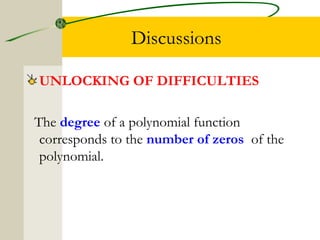
The degree of a polynomial function 
corresponds to the number of zeros of the 
polynomial.
Discussions 
UNLOCKING OF DIFFICULTIES 
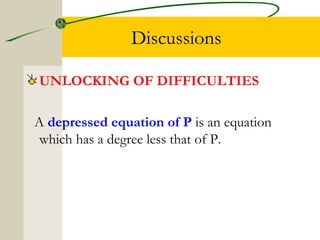
A depressed equation of P is an equation 
which has a degree less that of P.
Discussions 
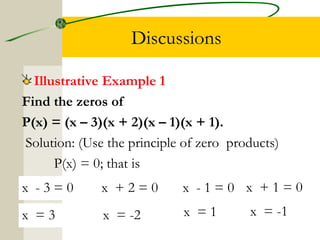
Illustrative Example 1 
Find the zeros of 
P(x) = (x – 3)(x + 2)(x – 1)(x + 1). 
Solution: (Use the principle of zero products) 
P(x) = 0; that is 
x - 3 = 0 x + 2 = 0 x - 1 = 0 x + 1 = 0 
x = 3 x = -2 x = 1 x = -1
Discussions 
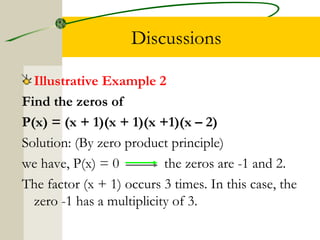
Illustrative Example 2 
Find the zeros of 
P(x) = (x + 1)(x + 1)(x +1)(x – 2) 
Solution: (By zero product principle) 
we have, P(x) = 0 the zeros are -1 and 2. 
The factor (x + 1) occurs 3 times. In this case, the 
zero -1 has a multiplicity of 3.
Discussions 
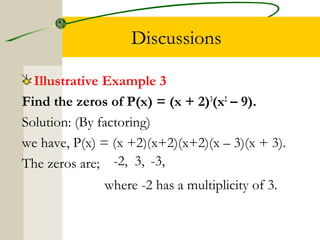
Illustrative Example 3 
Find the zeros of P(x) = (x + 2)3(x2 – 9). 
Solution: (By factoring) 
we have, P(x) = (x +2)(x+2)(x+2)(x – 3)(x + 3). 
The zeros are; 
-2, 3, -3, 
where -2 has a multiplicity of 3.
Discussions 
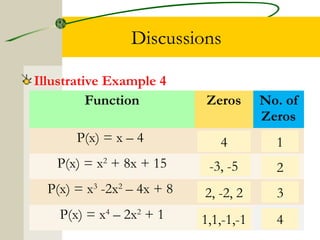
Illustrative Example 4 
Function Zeros No. of 
Zeros 
P(x) = x – 4 
P(x) = x2 + 8x + 15 
P(x) = x3 -2x2 – 4x + 8 
P(x) = x4 – 2x2 + 1 
4 1 
-3, -5 2 
2, -2, 2 3 
1,1,-1,-1 4
Discussions 
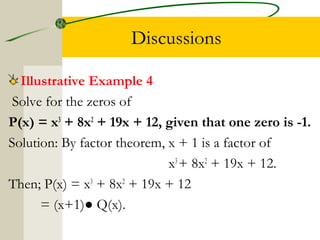
Illustrative Example 4 
Solve for the zeros of 
P(x) = x3 + 8x2 + 19x + 12, given that one zero is -1. 
Solution: By factor theorem, x + 1 is a factor of 
x3 + 8x2 + 19x + 12. 
Then; P(x) = x3 + 8x2 + 19x + 12 
= (x+1)● Q(x).
Discussions 
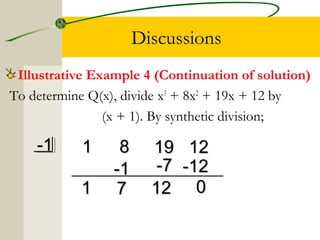
Illustrative Example 4 (Continuation of solution) 
To determine Q(x), divide x3 + 8x2 + 19x + 12 by 
(x + 1). By synthetic division; 
--11 11 88 1199 1122 
11 
--11 
77 
--77 
1122 
--1122 
00
Discussions 
Illustrative Example 4 (Continuation of solution) 
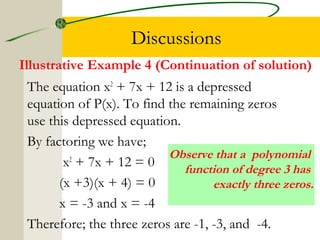
The equation x2 + 7x + 12 is a depressed 
equation of P(x). To find the remaining zeros 
use this depressed equation. 
By factoring we have; 
x2 + 7x + 12 = 0 
(x +3)(x + 4) = 0 
x = -3 and x = -4 
Observe that a polynomial 
function of degree 3 has 
exactly three zeros. 
Therefore; the three zeros are -1, -3, and -4.
Exercises 
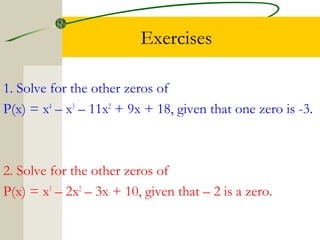
1. Solve for the other zeros of 
P(x) = x4 – x3 – 11x2 + 9x + 18, given that one zero is -3. 
2. Solve for the other zeros of 
P(x) = x3 – 2x2 – 3x + 10, given that – 2 is a zero.
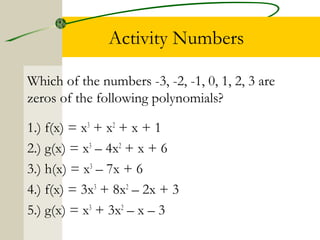
Activity Numbers 
Which of the numbers -3, -2, -1, 0, 1, 2, 3 are 
zeros of the following polynomials? 
1.) f(x) = x3 + x2 + x + 1 
2.) g(x) = x3 – 4x2 + x + 6 
3.) h(x) = x3 – 7x + 6 
4.) f(x) = 3x3 + 8x2 – 2x + 3 
5.) g(x) = x3 + 3x2 – x – 3
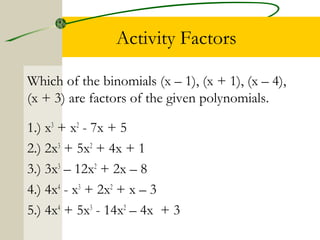
Activity Factors 
Which of the binomials (x – 1), (x + 1), (x – 4), 
(x + 3) are factors of the given polynomials. 
1.) x3 + x2 - 7x + 5 
2.) 2x3 + 5x2 + 4x + 1 
3.) 3x3 – 12x2 + 2x – 8 
4.) 4x4 - x3 + 2x2 + x – 3 
5.) 4x4 + 5x3 - 14x2 – 4x + 3
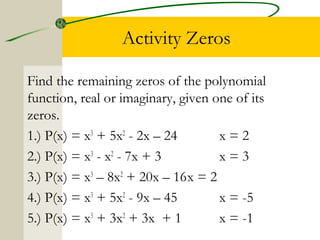
Activity Zeros 
Find the remaining zeros of the polynomial 
function, real or imaginary, given one of its 
zeros. 
1.) P(x) = x3 + 5x2 - 2x – 24 x = 2 
2.) P(x) = x3 - x2 - 7x + 3 x = 3 
3.) P(x) = x3 – 8x2 + 20x – 16x = 2 
4.) P(x) = x3 + 5x2 - 9x – 45 x = -5 
5.) P(x) = x3 + 3x2 + 3x + 1 x = -1
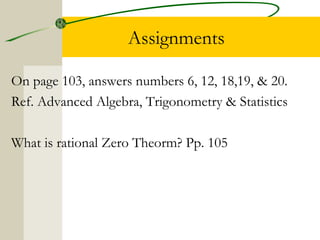
Assignments 
On page 103, answers numbers 6, 12, 18,19, & 20. 
Ref. Advanced Algebra, Trigonometry & Statistics 
What is rational Zero Theorm? Pp. 105

Zeros of p(x)

  • 1.
    Finding the Zerosof a Polynomial Function Reynaldo B. Pantino, T2
  • 2.
    Objectives 1.) Todetermine the zeros of polynomial functions of degree greater than 2 by; a.) factor theorem b.) factoring c.) synthetic division d.) depressed equations 2.)To determine the zeros of polynomial functions of degree n greater than 2 expressed as a product of linear factors.
  • 3.
    Recapitulations What isremainder theorem? What is synthetic division? What is factoring? What is zero of a function?
  • 4.
    Discussions UNLOCKING OFDIFFICULTIES The zero of a polynomial function P(x) is the value of the variable x, which makes polynomial function equal to zero or P(x) = 0.
  • 5.
    Discussions UNLOCKING OFDIFFICULTIES The fundamental Theorem of Algebra states that “Every rational polynomial function P(x) = 0 of degree n has exactly n zeros”.
  • 6.
    Discussions UNLOCKING OFDIFFICULTIES When a polynomial is expressed as a product of linear factors, it is easy to find the zeros of the related function considering the principle of zero products.
  • 7.
    Discussions UNLOCKING OFDIFFICULTIES The principle of zero product state that, for all real numbers a and b, ab = 0 if and only if a = 0 or b = 0, or both.
  • 8.
    Discussions UNLOCKING OFDIFFICULTIES The degree of a polynomial function corresponds to the number of zeros of the polynomial.
  • 9.
    Discussions UNLOCKING OFDIFFICULTIES A depressed equation of P is an equation which has a degree less that of P.
  • 10.
    Discussions Illustrative Example1 Find the zeros of P(x) = (x – 3)(x + 2)(x – 1)(x + 1). Solution: (Use the principle of zero products) P(x) = 0; that is x - 3 = 0 x + 2 = 0 x - 1 = 0 x + 1 = 0 x = 3 x = -2 x = 1 x = -1
  • 11.
    Discussions Illustrative Example2 Find the zeros of P(x) = (x + 1)(x + 1)(x +1)(x – 2) Solution: (By zero product principle) we have, P(x) = 0 the zeros are -1 and 2. The factor (x + 1) occurs 3 times. In this case, the zero -1 has a multiplicity of 3.
  • 12.
    Discussions Illustrative Example3 Find the zeros of P(x) = (x + 2)3(x2 – 9). Solution: (By factoring) we have, P(x) = (x +2)(x+2)(x+2)(x – 3)(x + 3). The zeros are; -2, 3, -3, where -2 has a multiplicity of 3.
  • 13.
    Discussions Illustrative Example4 Function Zeros No. of Zeros P(x) = x – 4 P(x) = x2 + 8x + 15 P(x) = x3 -2x2 – 4x + 8 P(x) = x4 – 2x2 + 1 4 1 -3, -5 2 2, -2, 2 3 1,1,-1,-1 4
  • 14.
    Discussions Illustrative Example4 Solve for the zeros of P(x) = x3 + 8x2 + 19x + 12, given that one zero is -1. Solution: By factor theorem, x + 1 is a factor of x3 + 8x2 + 19x + 12. Then; P(x) = x3 + 8x2 + 19x + 12 = (x+1)● Q(x).
  • 15.
    Discussions Illustrative Example4 (Continuation of solution) To determine Q(x), divide x3 + 8x2 + 19x + 12 by (x + 1). By synthetic division; --11 11 88 1199 1122 11 --11 77 --77 1122 --1122 00
  • 16.
    Discussions Illustrative Example4 (Continuation of solution) The equation x2 + 7x + 12 is a depressed equation of P(x). To find the remaining zeros use this depressed equation. By factoring we have; x2 + 7x + 12 = 0 (x +3)(x + 4) = 0 x = -3 and x = -4 Observe that a polynomial function of degree 3 has exactly three zeros. Therefore; the three zeros are -1, -3, and -4.
  • 17.
    Exercises 1. Solvefor the other zeros of P(x) = x4 – x3 – 11x2 + 9x + 18, given that one zero is -3. 2. Solve for the other zeros of P(x) = x3 – 2x2 – 3x + 10, given that – 2 is a zero.
  • 18.
    Activity Numbers Whichof the numbers -3, -2, -1, 0, 1, 2, 3 are zeros of the following polynomials? 1.) f(x) = x3 + x2 + x + 1 2.) g(x) = x3 – 4x2 + x + 6 3.) h(x) = x3 – 7x + 6 4.) f(x) = 3x3 + 8x2 – 2x + 3 5.) g(x) = x3 + 3x2 – x – 3
  • 19.
    Activity Factors Whichof the binomials (x – 1), (x + 1), (x – 4), (x + 3) are factors of the given polynomials. 1.) x3 + x2 - 7x + 5 2.) 2x3 + 5x2 + 4x + 1 3.) 3x3 – 12x2 + 2x – 8 4.) 4x4 - x3 + 2x2 + x – 3 5.) 4x4 + 5x3 - 14x2 – 4x + 3
  • 20.
    Activity Zeros Findthe remaining zeros of the polynomial function, real or imaginary, given one of its zeros. 1.) P(x) = x3 + 5x2 - 2x – 24 x = 2 2.) P(x) = x3 - x2 - 7x + 3 x = 3 3.) P(x) = x3 – 8x2 + 20x – 16x = 2 4.) P(x) = x3 + 5x2 - 9x – 45 x = -5 5.) P(x) = x3 + 3x2 + 3x + 1 x = -1
  • 21.
    Assignments On page103, answers numbers 6, 12, 18,19, & 20. Ref. Advanced Algebra, Trigonometry & Statistics What is rational Zero Theorm? Pp. 105