Inequalities and Sign Charts
Math 260
Dr. Frank Ma
LA Harbor College
The easiest way to solve a polynomial or rational
inequality is to use the sign–chart.
Inequalities and Sign Charts
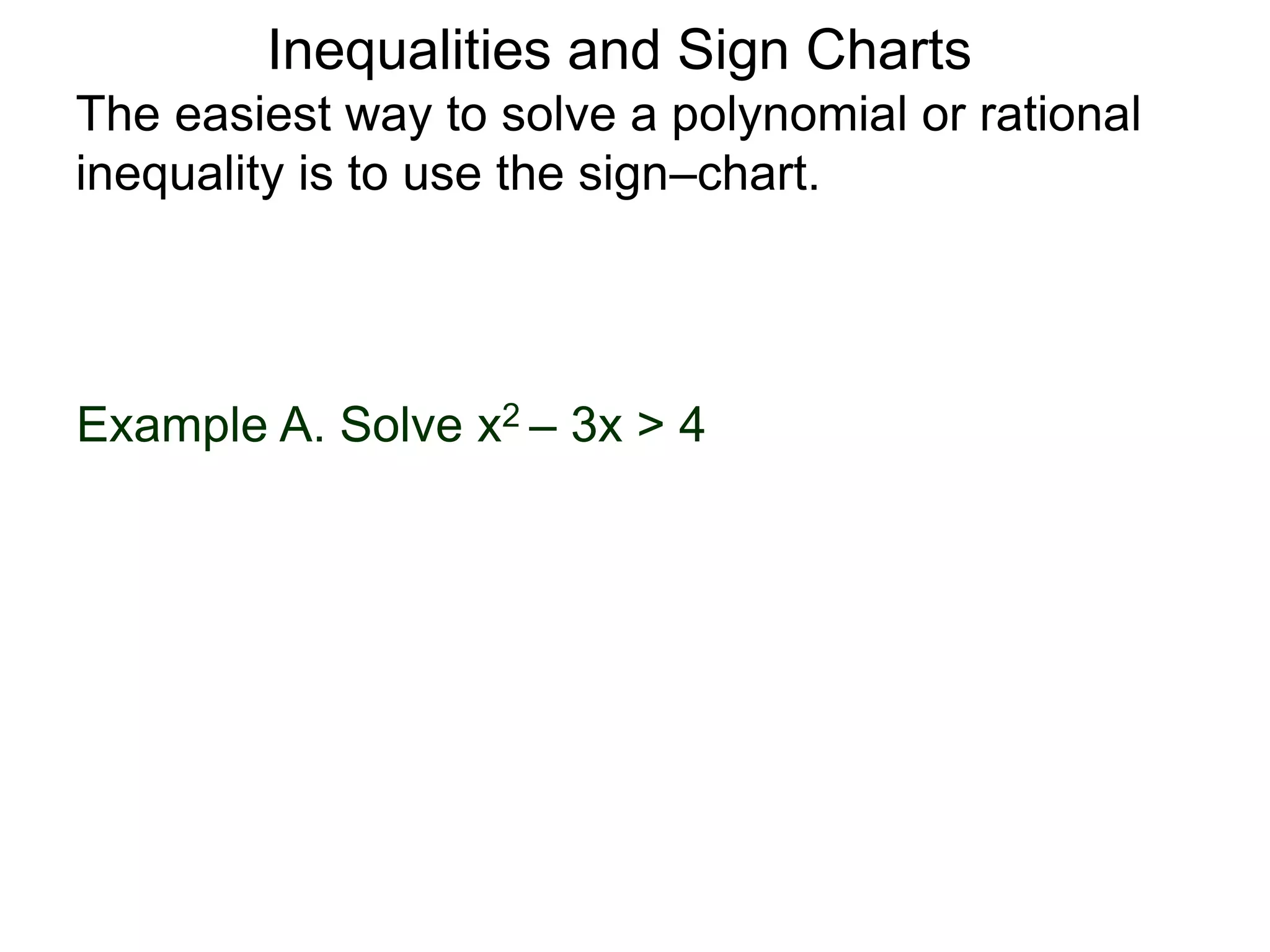
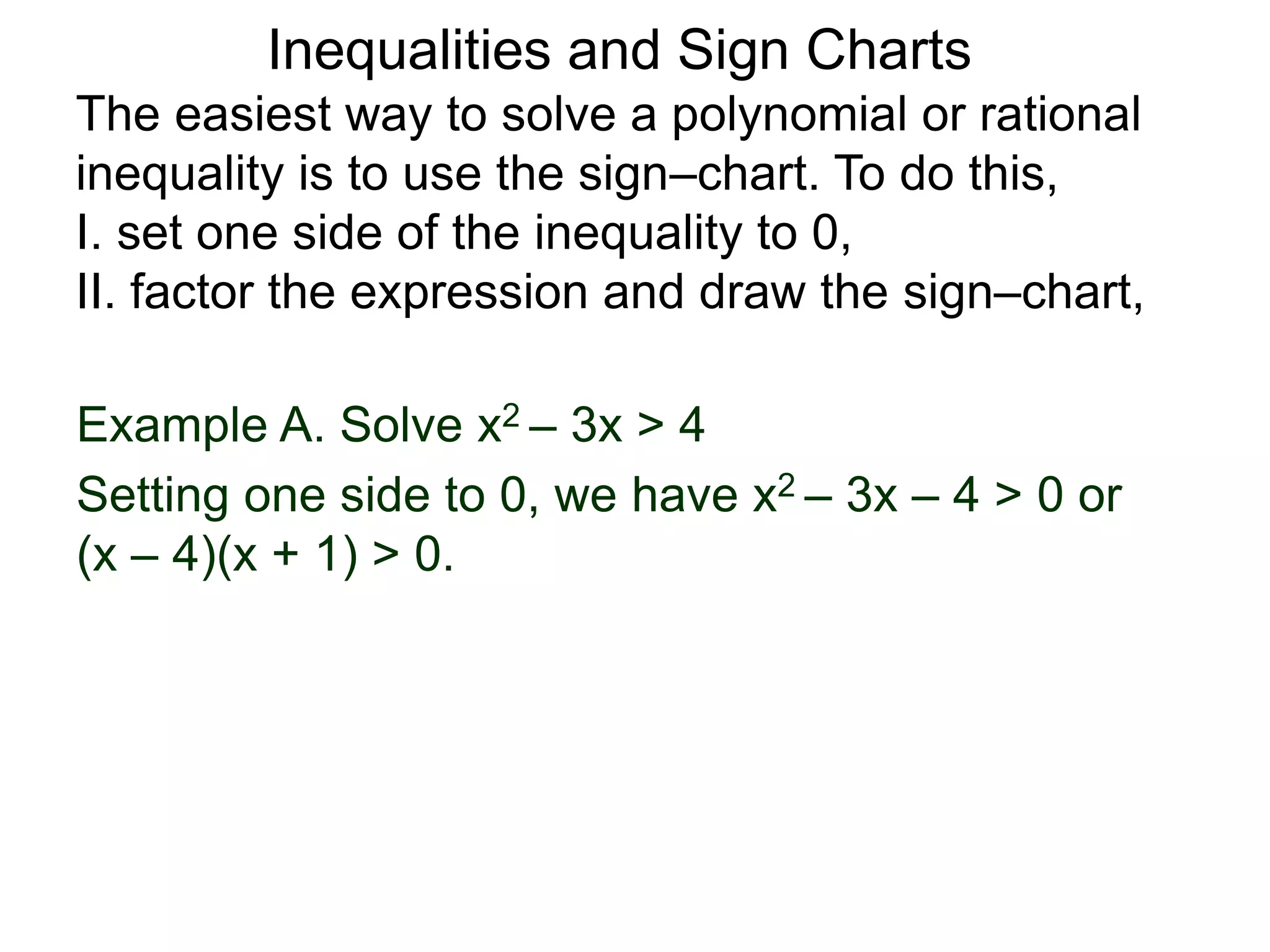
Example A. Solve x2 – 3x > 4
The easiest way to solve a polynomial or rational
inequality is to use the sign–chart.
Inequalities and Sign Charts
Example A. Solve x2 – 3x > 4
The easiest way to solve a polynomial or rational
inequality is to use the sign–chart. To do this,
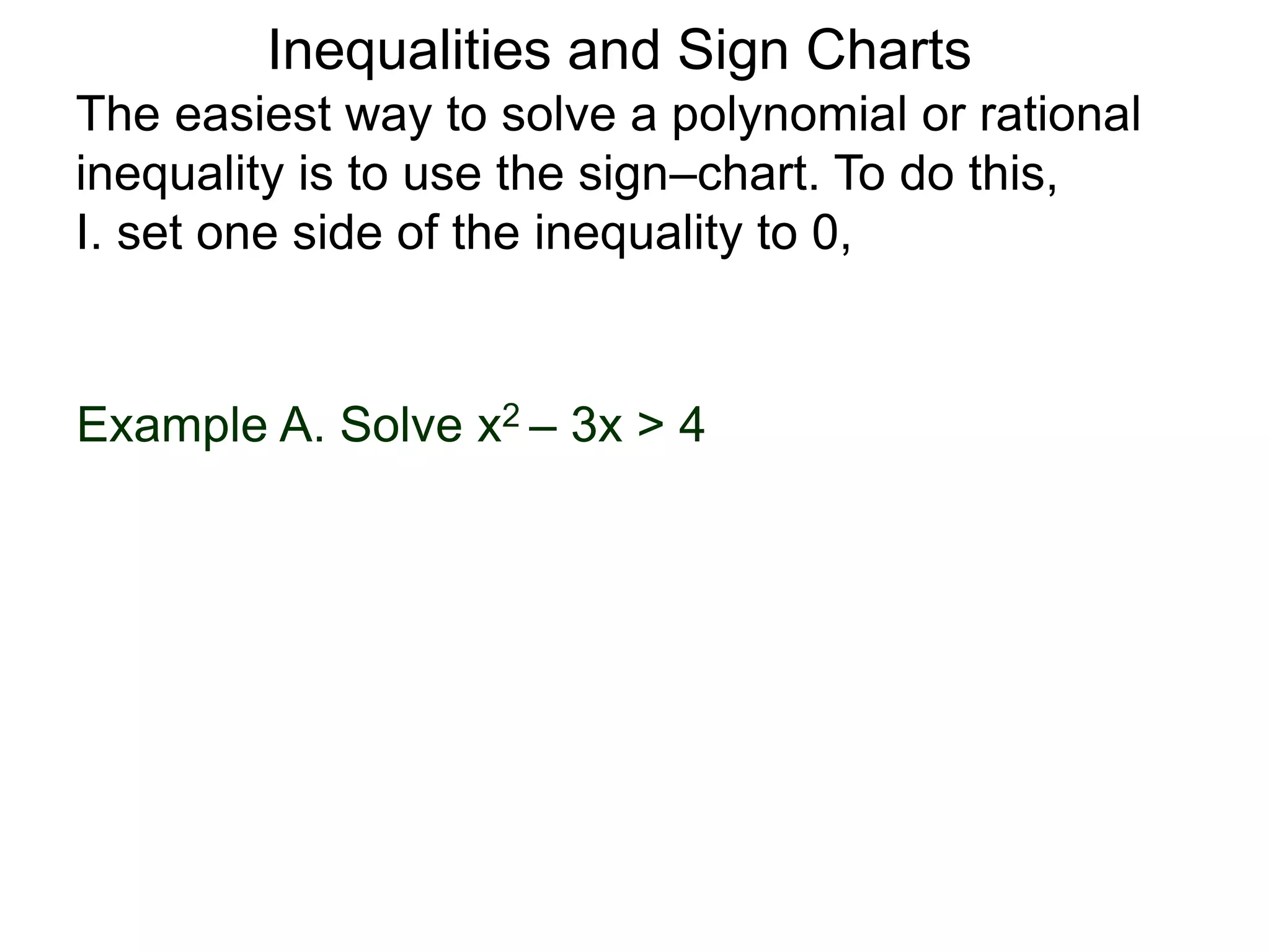
I. set one side of the inequality to 0,
Inequalities and Sign Charts
Example A. Solve x2 – 3x > 4
The easiest way to solve a polynomial or rational
inequality is to use the sign–chart. To do this,
I. set one side of the inequality to 0,
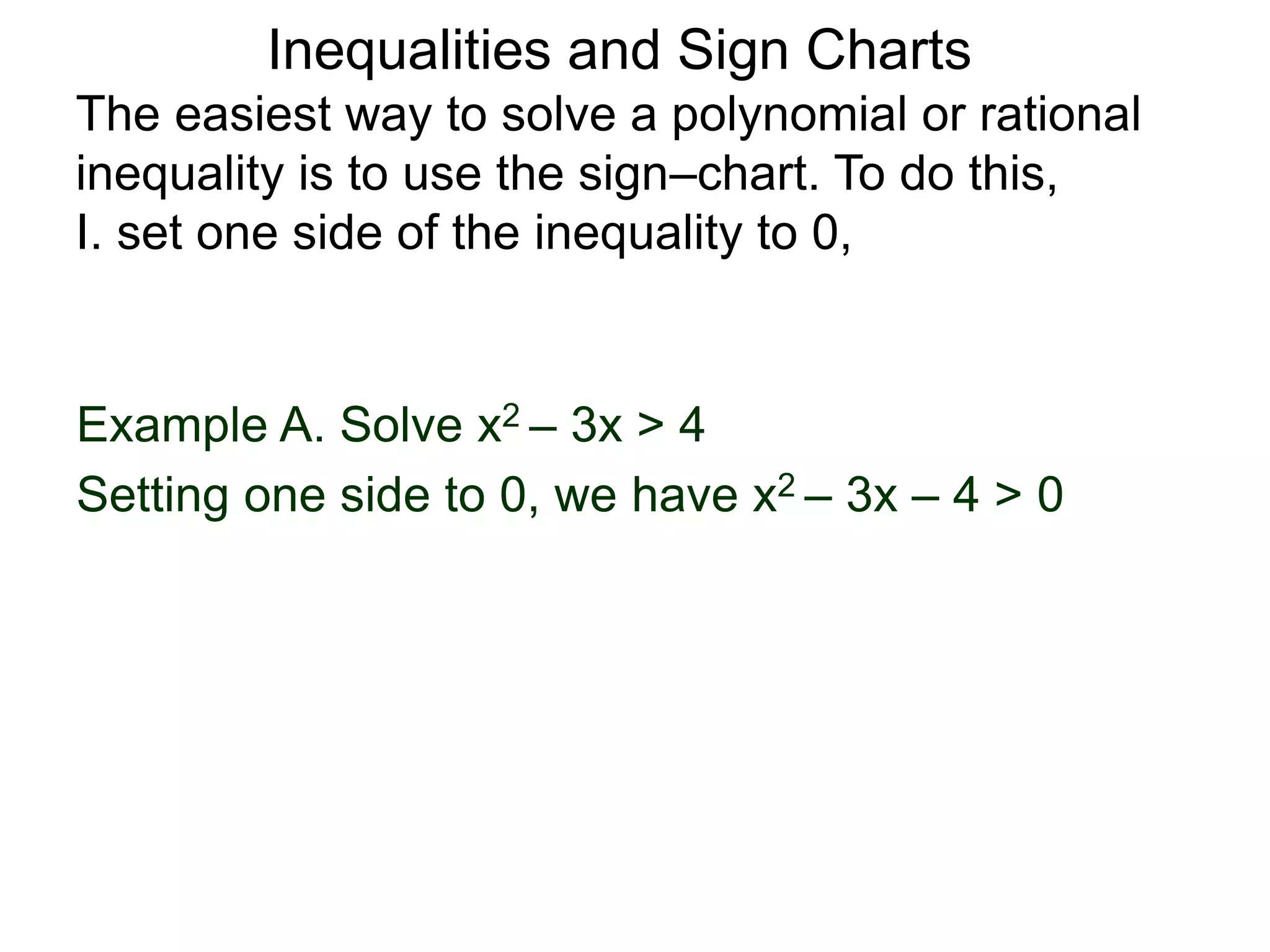
Setting one side to 0, we have x2 – 3x – 4 > 0
Inequalities and Sign Charts
Example A. Solve x2 – 3x > 4
The easiest way to solve a polynomial or rational
inequality is to use the sign–chart. To do this,
I. set one side of the inequality to 0,
II. factor the expression
Setting one side to 0, we have x2 – 3x – 4 > 0
Inequalities and Sign Charts
Example A. Solve x2 – 3x > 4
The easiest way to solve a polynomial or rational
inequality is to use the sign–chart. To do this,
I. set one side of the inequality to 0,
II. factor the expression
Setting one side to 0, we have x2 – 3x – 4 > 0 or
(x – 4)(x + 1) > 0.
Inequalities and Sign Charts
Example A. Solve x2 – 3x > 4
The easiest way to solve a polynomial or rational
inequality is to use the sign–chart. To do this,
I. set one side of the inequality to 0,
II. factor the expression and draw the sign–chart,
Setting one side to 0, we have x2 – 3x – 4 > 0 or
(x – 4)(x + 1) > 0.
Inequalities and Sign Charts
Example A. Solve x2 – 3x > 4
The easiest way to solve a polynomial or rational
inequality is to use the sign–chart. To do this,
I. set one side of the inequality to 0,
II. factor the expression and draw the sign–chart,
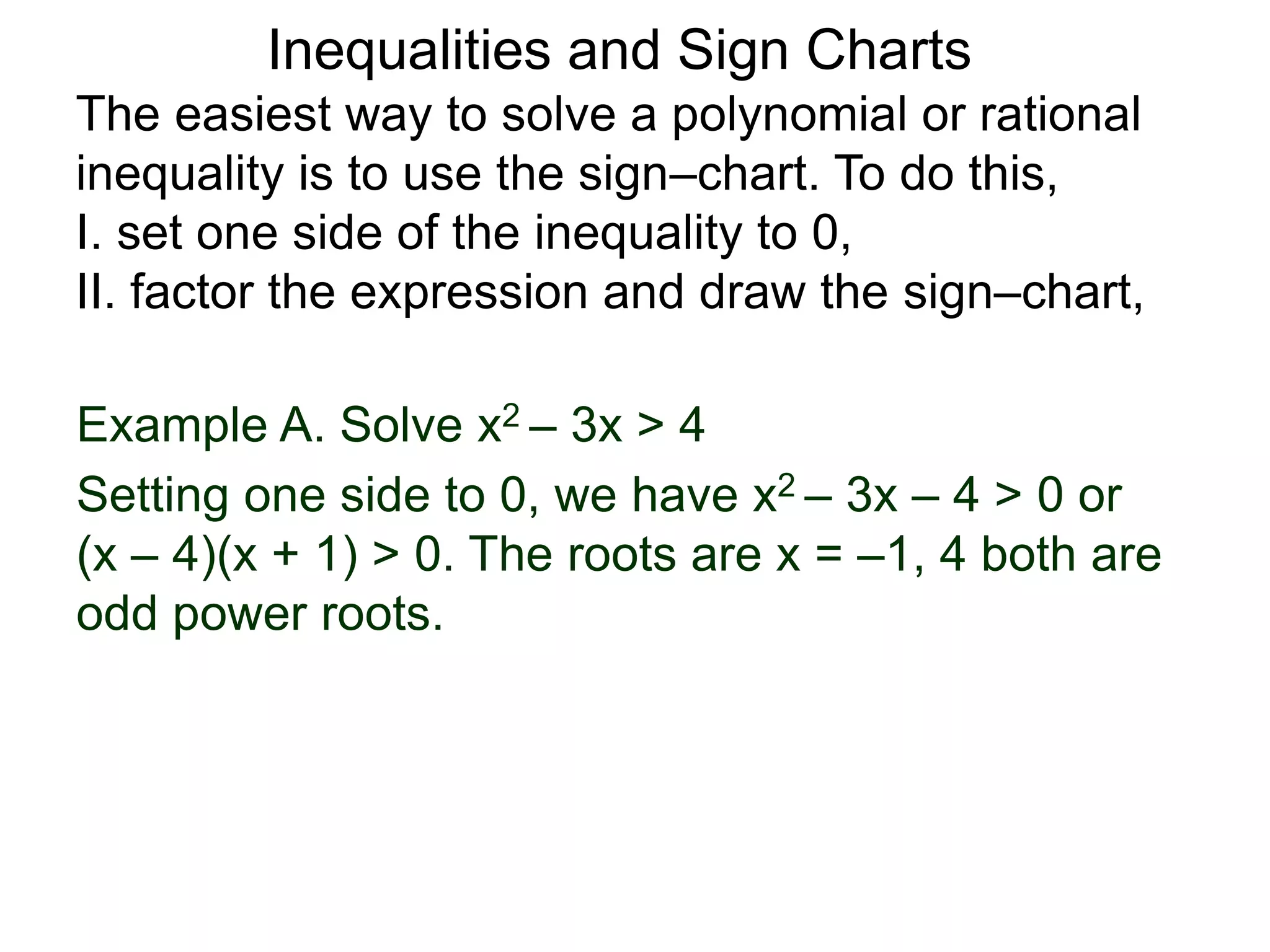
Setting one side to 0, we have x2 – 3x – 4 > 0 or
(x – 4)(x + 1) > 0. The roots are x = –1, 4 both are
odd power roots.
Inequalities and Sign Charts
Example A. Solve x2 – 3x > 4
4 (odd power)
–1 (odd power) 5
The easiest way to solve a polynomial or rational
inequality is to use the sign–chart. To do this,
I. set one side of the inequality to 0,
II. factor the expression and draw the sign–chart,
(x – 4)(x + 1)
+ + + – – – – – – + + + +
Setting one side to 0, we have x2 – 3x – 4 > 0 or
(x – 4)(x + 1) > 0. The roots are x = –1, 4 both are
odd power roots. Sample x = 5, we get +,
completing the signs:
Inequalities and Sign Charts
Example A. Solve x2 – 3x > 4
4 (odd power)
–1 (odd power) 5
The easiest way to solve a polynomial or rational
inequality is to use the sign–chart. To do this,
I. set one side of the inequality to 0,
II. factor the expression and draw the sign–chart,
(x – 4)(x + 1)
+ + + – – – – – – + + + +
Setting one side to 0, we have x2 – 3x – 4 > 0 or
(x – 4)(x + 1) > 0. The roots are x = –1, 4 both are
odd power roots. Sample x = 5, we get +,
completing the signs:
Inequalities and Sign Charts
Example A. Solve x2 – 3x > 4
4 (odd power)
–1 (odd power)
The solutions are the + regions: (–∞, –1) U (4, ∞)
5
4
–1
The easiest way to solve a polynomial or rational
inequality is to use the sign–chart. To do this,
I. set one side of the inequality to 0,
II. factor the expression and draw the sign–chart,
III. read off the answer from the sign chart.
(x – 4)(x + 1)
+ + + – – – – – – + + + +
Setting one side to 0, we have x2 – 3x – 4 > 0 or
(x – 4)(x + 1) > 0. The roots are x = –1, 4 both are
odd power roots. Sample x = 5, we get +,
completing the signs:
Inequalities and Sign Charts
The theorem may be generalized to rational formulas
that are factorable, that is, both the numerator and
the denominator are factorable.
Inequalities and Sign Charts
The theorem may be generalized to rational formulas
that are factorable, that is, both the numerator and
the denominator are factorable.
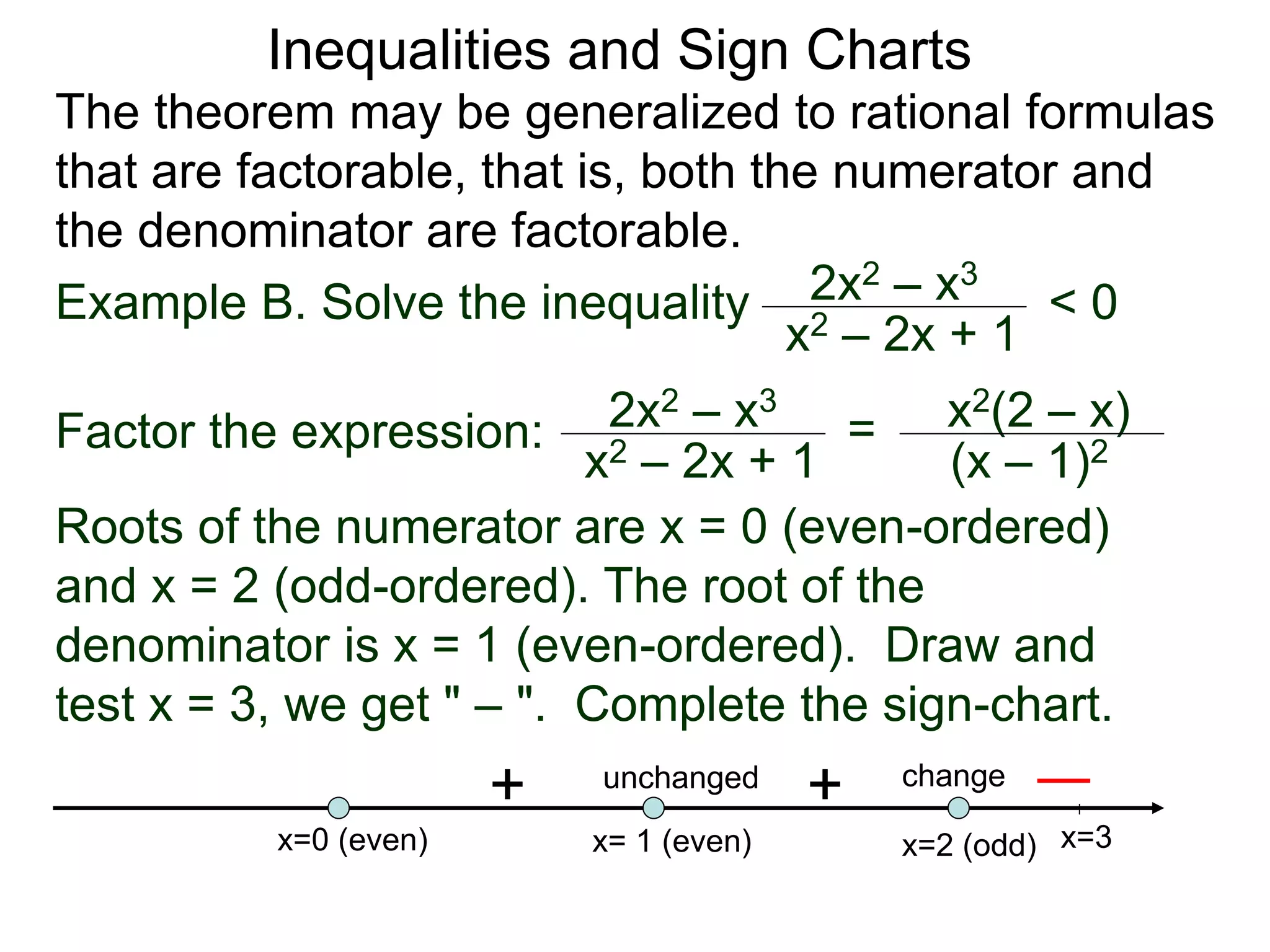
Example B. Solve the inequality 2x2 – x3
x2 – 2x + 1
< 0
Inequalities and Sign Charts
The theorem may be generalized to rational formulas
that are factorable, that is, both the numerator and
the denominator are factorable.
Example B. Solve the inequality 2x2 – x3
x2 – 2x + 1
< 0
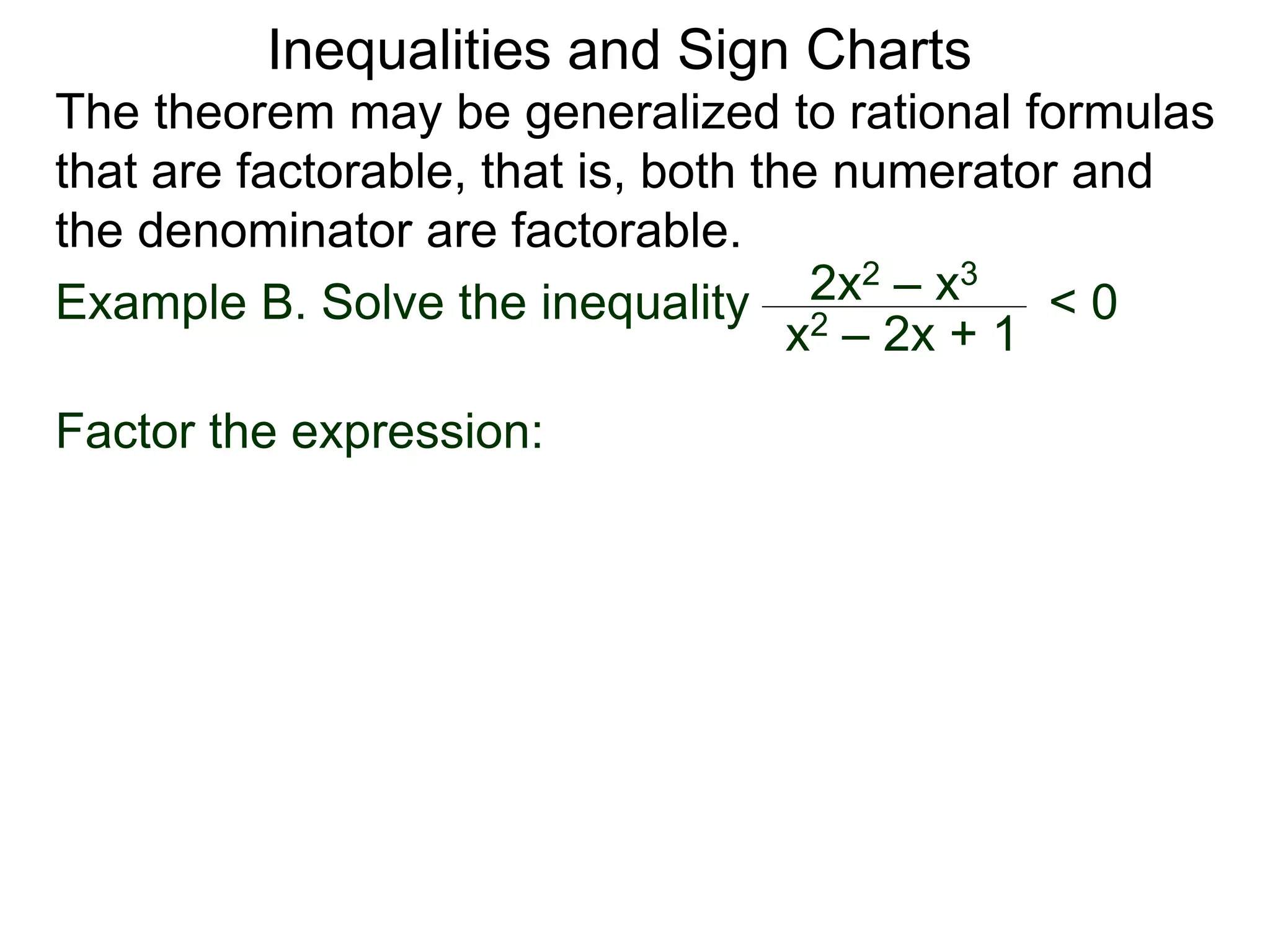
Factor the expression:
Inequalities and Sign Charts
The theorem may be generalized to rational formulas
that are factorable, that is, both the numerator and
the denominator are factorable.
Example B. Solve the inequality 2x2 – x3
x2 – 2x + 1
< 0
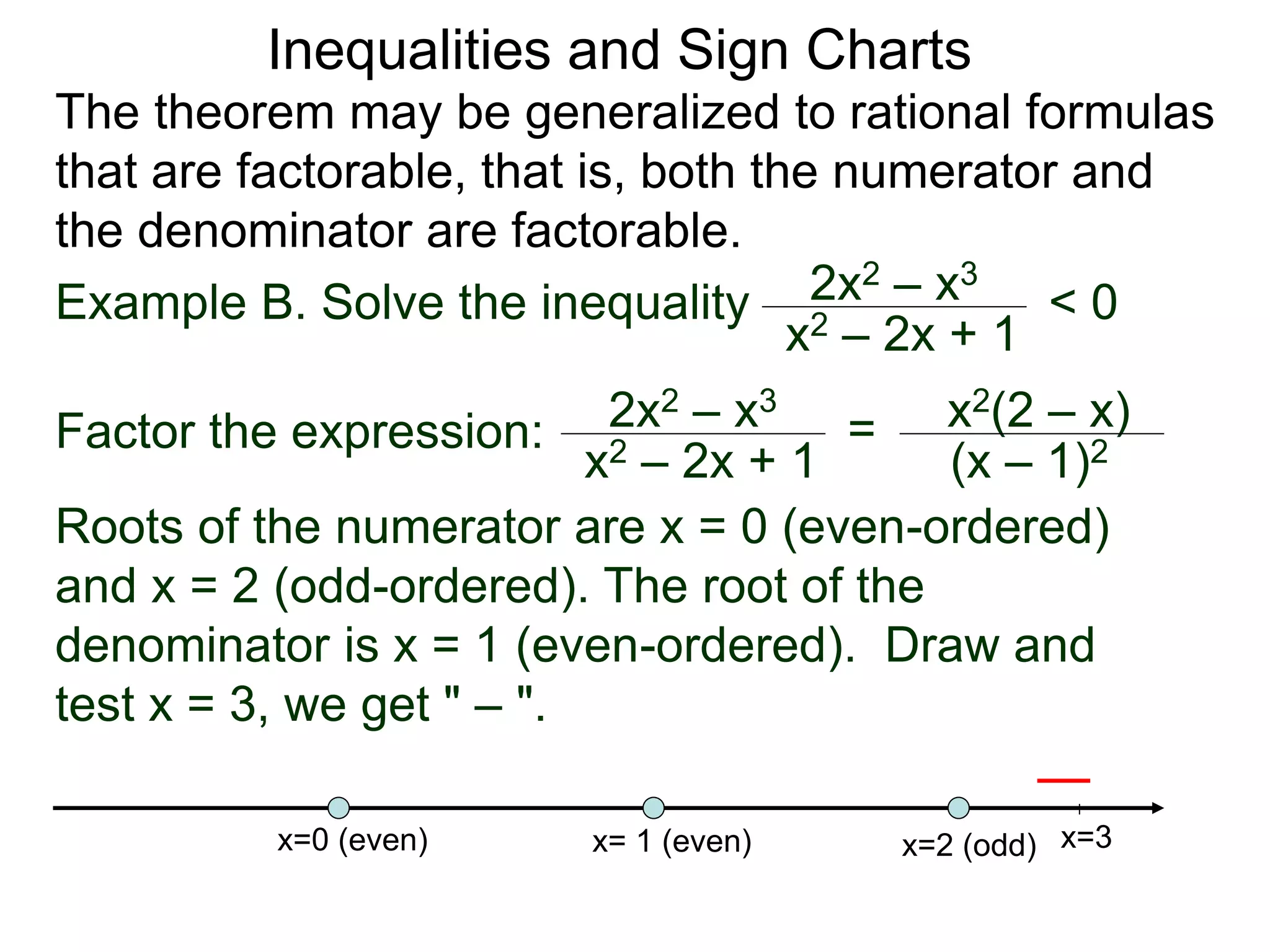
Factor the expression: 2x2 – x3
x2 – 2x + 1
= x2(2 – x)
(x – 1)2
Inequalities and Sign Charts
The theorem may be generalized to rational formulas
that are factorable, that is, both the numerator and
the denominator are factorable.
Example B. Solve the inequality 2x2 – x3
x2 – 2x + 1
< 0
Factor the expression: 2x2 – x3
x2 – 2x + 1
= x2(2 – x)
(x – 1)2
Roots of the numerator are x = 0 (even-ordered)
Inequalities and Sign Charts
The theorem may be generalized to rational formulas
that are factorable, that is, both the numerator and
the denominator are factorable.
Example B. Solve the inequality 2x2 – x3
x2 – 2x + 1
< 0
Factor the expression: 2x2 – x3
x2 – 2x + 1
= x2(2 – x)
(x – 1)2
Roots of the numerator are x = 0 (even-ordered)
and x = 2 (odd-ordered).
Inequalities and Sign Charts
The theorem may be generalized to rational formulas
that are factorable, that is, both the numerator and
the denominator are factorable.
Example B. Solve the inequality 2x2 – x3
x2 – 2x + 1
< 0
Factor the expression: 2x2 – x3
x2 – 2x + 1
= x2(2 – x)
(x – 1)2
Roots of the numerator are x = 0 (even-ordered)
and x = 2 (odd-ordered). The root of the
denominator is x = 1 (even-ordered).
Inequalities and Sign Charts
The theorem may be generalized to rational formulas
that are factorable, that is, both the numerator and
the denominator are factorable.
Example B. Solve the inequality 2x2 – x3
x2 – 2x + 1
< 0
Factor the expression: 2x2 – x3
x2 – 2x + 1
= x2(2 – x)
(x – 1)2
Roots of the numerator are x = 0 (even-ordered)
and x = 2 (odd-ordered). The root of the
denominator is x = 1 (even-ordered). Draw and
test x = 3, we get " – ".
x=0 (even) x=2 (odd)
x= 1 (even) x=3
Inequalities and Sign Charts
The theorem may be generalized to rational formulas
that are factorable, that is, both the numerator and
the denominator are factorable.
Example B. Solve the inequality 2x2 – x3
x2 – 2x + 1
< 0
Factor the expression: 2x2 – x3
x2 – 2x + 1
= x2(2 – x)
(x – 1)2
Roots of the numerator are x = 0 (even-ordered)
and x = 2 (odd-ordered). The root of the
denominator is x = 1 (even-ordered). Draw and
test x = 3, we get " – ". Complete the sign-chart.
x=0 (even) x=2 (odd)
x= 1 (even) x=3
Inequalities and Sign Charts
The theorem may be generalized to rational formulas
that are factorable, that is, both the numerator and
the denominator are factorable.
Example B. Solve the inequality 2x2 – x3
x2 – 2x + 1
< 0
Factor the expression: 2x2 – x3
x2 – 2x + 1
= x2(2 – x)
(x – 1)2
Roots of the numerator are x = 0 (even-ordered)
and x = 2 (odd-ordered). The root of the
denominator is x = 1 (even-ordered). Draw and
test x = 3, we get " – ". Complete the sign-chart.
x=0 (even) x=2 (odd)
x= 1 (even)
+ change
x=3
Inequalities and Sign Charts
The theorem may be generalized to rational formulas
that are factorable, that is, both the numerator and
the denominator are factorable.
Example B. Solve the inequality 2x2 – x3
x2 – 2x + 1
< 0
Factor the expression: 2x2 – x3
x2 – 2x + 1
= x2(2 – x)
(x – 1)2
Roots of the numerator are x = 0 (even-ordered)
and x = 2 (odd-ordered). The root of the
denominator is x = 1 (even-ordered). Draw and
test x = 3, we get " – ". Complete the sign-chart.
x=0 (even) x=2 (odd)
x= 1 (even)
+ change
unchanged
+
x=3
Inequalities and Sign Charts
The theorem may be generalized to rational formulas
that are factorable, that is, both the numerator and
the denominator are factorable.
Example B. Solve the inequality 2x2 – x3
x2 – 2x + 1
< 0
Factor the expression: 2x2 – x3
x2 – 2x + 1
= x2(2 – x)
(x – 1)2
Roots of the numerator are x = 0 (even-ordered)
and x = 2 (odd-ordered). The root of the
denominator is x = 1 (even-ordered). Draw and
test x = 3, we get " – ". Complete the sign-chart.
x=0 (even) x=2 (odd)
x= 1 (even)
+ change
unchanged
unchanged
+
+
x=3
Inequalities and Sign Charts
The theorem may be generalized to rational formulas
that are factorable, that is, both the numerator and
the denominator are factorable.
Example B. Solve the inequality 2x2 – x3
x2 – 2x + 1
< 0
Factor the expression: 2x2 – x3
x2 – 2x + 1
= x2(2 – x)
(x – 1)2
Roots of the numerator are x = 0 (even-ordered)
and x = 2 (odd-ordered). The root of the
denominator is x = 1 (even-ordered). Draw and
test x = 3, we get " – ". Complete the sign-chart.
x=0 (even) x=2 (odd)
x= 1 (even)
+ change
unchanged
unchanged
+
+
Hence the solution is 2 < x.
x=3
Example C. Solve x – 2
2 <
x – 1
3
Inequalities and Sign Charts
Example C. Solve x – 2
2 <
x – 1
3
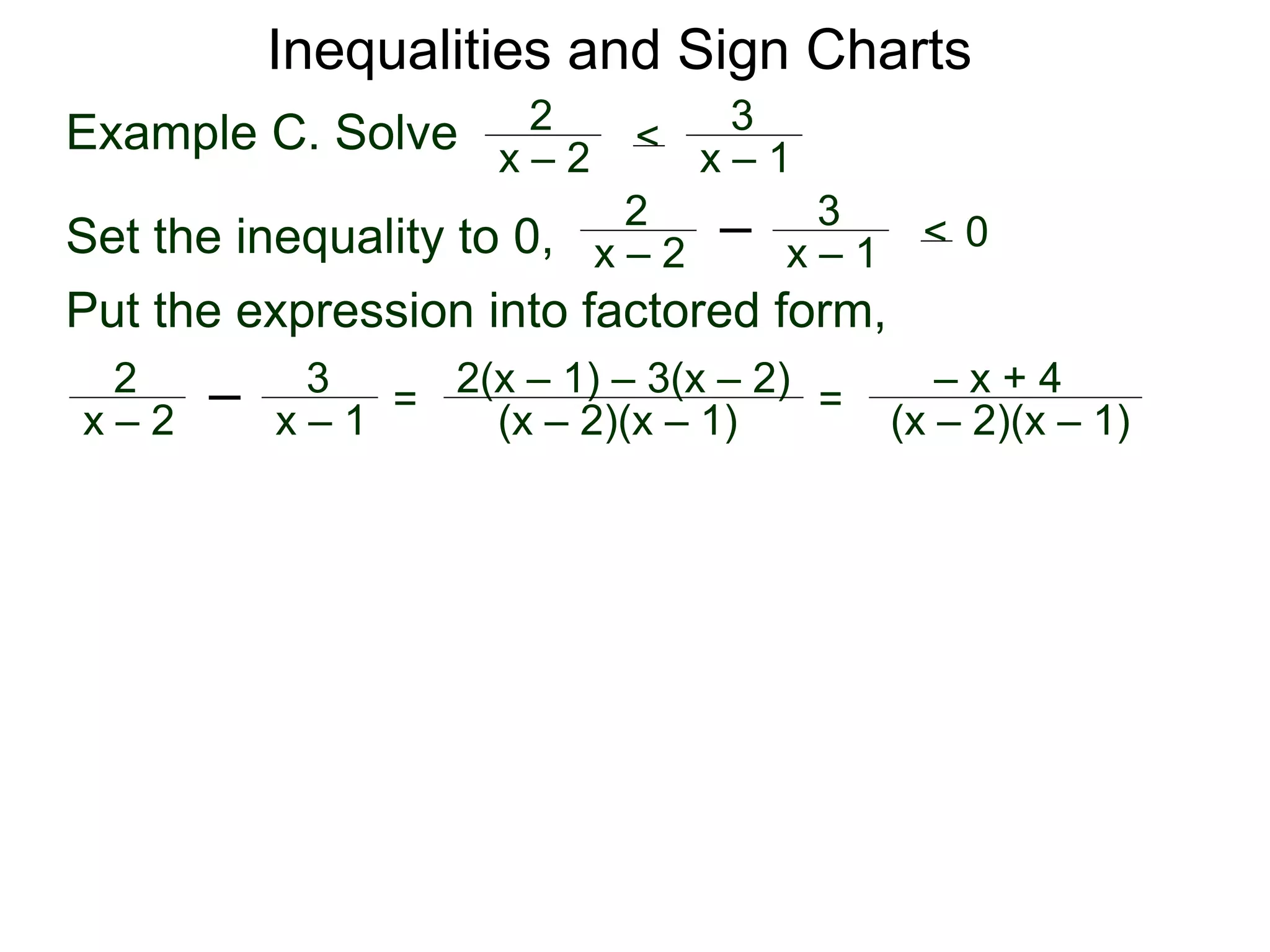
Set the inequality to 0, x – 2
2
x – 1
3
< 0
Inequalities and Sign Charts
Example C. Solve x – 2
2 <
x – 1
3
Set the inequality to 0, x – 2
2
x – 1
3
< 0
Put the expression into factored form,
Inequalities and Sign Charts
Example C. Solve x – 2
2 <
x – 1
3
Set the inequality to 0, x – 2
2
x – 1
3
< 0
Put the expression into factored form,
x – 2
2
x – 1
3
=
(x – 2)(x – 1)
2(x – 1) – 3(x – 2)
Inequalities and Sign Charts
Example C. Solve x – 2
2 <
x – 1
3
Set the inequality to 0, x – 2
2
x – 1
3
< 0
Put the expression into factored form,
x – 2
2
x – 1
3
=
(x – 2)(x – 1)
2(x – 1) – 3(x – 2)
=
(x – 2)(x – 1)
– x + 4
Inequalities and Sign Charts
Example C. Solve x – 2
2 <
x – 1
3
Set the inequality to 0, x – 2
2
x – 1
3
< 0
Put the expression into factored form,
x – 2
2
x – 1
3
=
(x – 2)(x – 1)
2(x – 1) – 3(x – 2)
=
(x – 2)(x – 1)
– x + 4
Hence the inequality is (x – 2)(x – 1)
– x + 4 < 0
Inequalities and Sign Charts
Example C. Solve x – 2
2 <
x – 1
3
Set the inequality to 0, x – 2
2
x – 1
3
< 0
Put the expression into factored form,
x – 2
2
x – 1
3
=
(x – 2)(x – 1)
2(x – 1) – 3(x – 2)
=
(x – 2)(x – 1)
– x + 4
Hence the inequality is (x – 2)(x – 1)
– x + 4 < 0
It has a root at x = 4, it's undefined at x = 1, 2
and all of them are of odd–power.
4
1 2
UDF UDF
(x – 2)(x – 1)
– x + 4
Inequalities and Sign Charts
Example C. Solve x – 2
2 <
x – 1
3
Set the inequality to 0, x – 2
2
x – 1
3
< 0
Put the expression into factored form,
x – 2
2
x – 1
3
=
(x – 2)(x – 1)
2(x – 1) – 3(x – 2)
=
(x – 2)(x – 1)
– x + 4
Hence the inequality is (x – 2)(x – 1)
– x + 4 < 0
It has a root at x = 4, it's undefined at x = 1, 2
and all of them are of odd–power.
Testing x = 5, we get –, so the sign–chart is:
4
1
0 5
+ + + – – + + + + – – – –
2
UDF UDF
(x – 2)(x – 1)
– x + 4
Inequalities and Sign Charts
Example C. Solve x – 2
2 <
x – 1
3
Set the inequality to 0, x – 2
2
x – 1
3
< 0
Put the expression into factored form,
x – 2
2
x – 1
3
=
(x – 2)(x – 1)
2(x – 1) – 3(x – 2)
=
(x – 2)(x – 1)
– x + 4
Hence the inequality is (x – 2)(x – 1)
– x + 4 < 0
It has a root at x = 4, it's undefined at x = 1, 2
and all of them are of odd–power.
Testing x = 5, we get –, so the sign–chart is:
4
1
0 5
+ + + – – + + + + – – – –
2
UDF UDF
(x – 2)(x – 1)
– x + 4
The answer are the shaded intervals or (1, 2) U [4 ∞).
Inequalities and Sign Charts
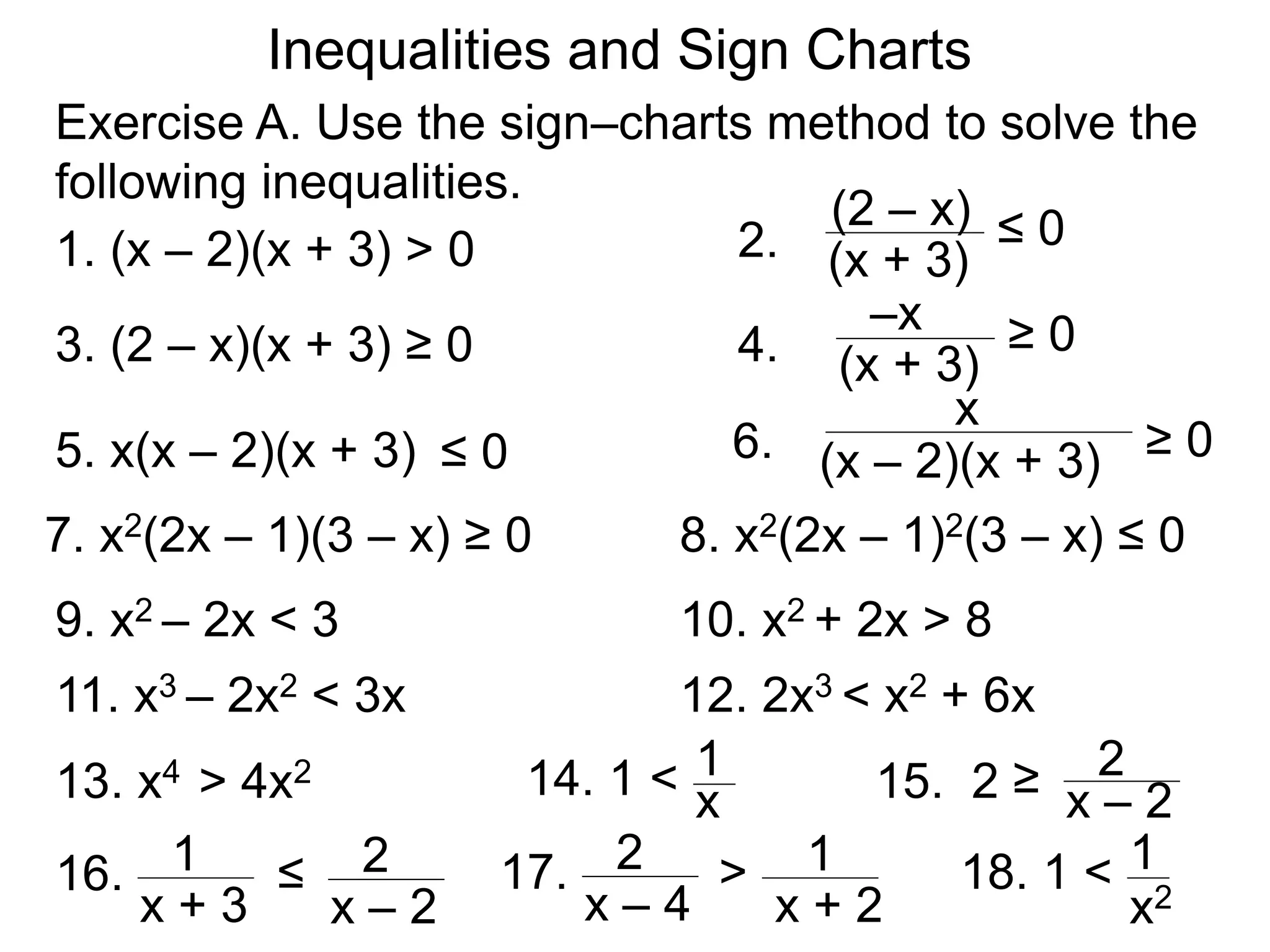
Exercise A. Use the sign–charts method to solve the
following inequalities.
1. (x – 2)(x + 3) > 0
3. (2 – x)(x + 3) ≥ 0
8. x2(2x – 1)2(3 – x) ≤ 0
9. x2 – 2x < 3
14. 1 <
13. x4 > 4x2
(2 – x)
(x + 3)
2.
–x
(x + 3)
4.
7. x2(2x – 1)(3 – x) ≥ 0
1
x 15. 2 2
x – 2
16. 1
x + 3
2
x – 2
17. >
2
x – 4
1
x + 2
5. x(x – 2)(x + 3)
x
(x – 2)(x + 3)
6. ≥ 0
10. x2 + 2x > 8
11. x3 – 2x2 < 3x 12. 2x3 < x2 + 6x
≥
≥ 0
≤ 0
≤ 0
≤ 18. 1 < 1
x2
Inequalities and Sign Charts
B. Solve the inequalities, use the answers from Ex.1.3.
Inequalities and Sign Charts
5. 6. (x – 2)2
x2(x – 6)
x + 6
x(x + 5)2
7.
(1 – x2)3
x2
C. Solve the following inequalities using sign–charts.
1. x2(x + 2) > 0 2. 0 > (x + 2)2(x – 5)3
4. 0 ≤ 2x4 – 8x2
3. x2(x – 4)3 ≤ 0
> 0
≥ 0
≤ 0
8.
x4 – x2
(x + 3)2(6 – x)
≤ 0
D. In order for the formula √R to be defined, the radicand R
must be ≥ 0. Draw the domain of the following formulas.
5. 6.
(x – 2)2
x2(x – 6)
x + 6
x(x + 5)2
7. x2
1. √x2(x + 2) 2. √(x + 2)2(x – 5)3
4. √2x4 – 8x2
3. √ x2(x – 4)3
8. (x + 3)2(6 – x)
x4 – x2
(1 – x2)3
√ √
√ √
Inequalities and Sign Charts
Answers: Exercise A.
1. (–∞, –3) ∪ (2, ∞) 3. [–3, 2] 5. (–∞, –3] ∪ [0, 2]
9. (–1, 3)
7. {0} ∪ [1/2, 3] 11. (–∞, –1) ∪ (0, 3)
13. (–∞, –2) ∪ (2, ∞) 15. (–∞, 2) ∪ [3, ∞)
17. (–8, –2) ∪ (4, ∞)
Exercise B.
1. The statement is not true. No such x exists.
3. (–∞, – 12/5) ∪ (2, ∞)
5. (2, 13/3]
Inequalities and Sign Charts
Exercise C.
3. 𝑥2(𝑥 − 4)3 ≤ 0
1. 𝑥2 𝑥 – 2 > 0
x=0 x=2
+
The solution is (2, ∞)
x=0 x=4
+
The solution is −∞, 4
Inequalities and Sign Charts
5.
𝑥2(𝑥−6)
𝑥+6
> 0
The solution is (−∞, −6) ∪ (6, ∞)
x= – 6 x=6
x= 0
+
+ UDF f=0 f=0
7.
𝑥2
(1−𝑥2)3 ≥ 0
x= – 1 x=1
x= 0
+
UDF f=0 UDF
+
The solution is (−1, 1)
Inequalities and Sign Charts
Exercise D.
1. 𝑥2(𝑥 + 2)
3. 𝑥2(𝑥 − 4)3
x= –2
x=4
x=-6 x=6
x=-1 x=1
5.
𝑥2(𝑥−6)
𝑥+6
7.
𝑥2
(1−𝑥2)3
Inequalities and Sign Charts
x=0
x=0

8 inequalities and sign charts x

  • 1.
    Inequalities and SignCharts Math 260 Dr. Frank Ma LA Harbor College
  • 2.
    The easiest wayto solve a polynomial or rational inequality is to use the sign–chart. Inequalities and Sign Charts
  • 3.
    Example A. Solvex2 – 3x > 4 The easiest way to solve a polynomial or rational inequality is to use the sign–chart. Inequalities and Sign Charts
  • 4.
    Example A. Solvex2 – 3x > 4 The easiest way to solve a polynomial or rational inequality is to use the sign–chart. To do this, I. set one side of the inequality to 0, Inequalities and Sign Charts
  • 5.
    Example A. Solvex2 – 3x > 4 The easiest way to solve a polynomial or rational inequality is to use the sign–chart. To do this, I. set one side of the inequality to 0, Setting one side to 0, we have x2 – 3x – 4 > 0 Inequalities and Sign Charts
  • 6.
    Example A. Solvex2 – 3x > 4 The easiest way to solve a polynomial or rational inequality is to use the sign–chart. To do this, I. set one side of the inequality to 0, II. factor the expression Setting one side to 0, we have x2 – 3x – 4 > 0 Inequalities and Sign Charts
  • 7.
    Example A. Solvex2 – 3x > 4 The easiest way to solve a polynomial or rational inequality is to use the sign–chart. To do this, I. set one side of the inequality to 0, II. factor the expression Setting one side to 0, we have x2 – 3x – 4 > 0 or (x – 4)(x + 1) > 0. Inequalities and Sign Charts
  • 8.
    Example A. Solvex2 – 3x > 4 The easiest way to solve a polynomial or rational inequality is to use the sign–chart. To do this, I. set one side of the inequality to 0, II. factor the expression and draw the sign–chart, Setting one side to 0, we have x2 – 3x – 4 > 0 or (x – 4)(x + 1) > 0. Inequalities and Sign Charts
  • 9.
    Example A. Solvex2 – 3x > 4 The easiest way to solve a polynomial or rational inequality is to use the sign–chart. To do this, I. set one side of the inequality to 0, II. factor the expression and draw the sign–chart, Setting one side to 0, we have x2 – 3x – 4 > 0 or (x – 4)(x + 1) > 0. The roots are x = –1, 4 both are odd power roots. Inequalities and Sign Charts
  • 10.
    Example A. Solvex2 – 3x > 4 4 (odd power) –1 (odd power) 5 The easiest way to solve a polynomial or rational inequality is to use the sign–chart. To do this, I. set one side of the inequality to 0, II. factor the expression and draw the sign–chart, (x – 4)(x + 1) + + + – – – – – – + + + + Setting one side to 0, we have x2 – 3x – 4 > 0 or (x – 4)(x + 1) > 0. The roots are x = –1, 4 both are odd power roots. Sample x = 5, we get +, completing the signs: Inequalities and Sign Charts
  • 11.
    Example A. Solvex2 – 3x > 4 4 (odd power) –1 (odd power) 5 The easiest way to solve a polynomial or rational inequality is to use the sign–chart. To do this, I. set one side of the inequality to 0, II. factor the expression and draw the sign–chart, (x – 4)(x + 1) + + + – – – – – – + + + + Setting one side to 0, we have x2 – 3x – 4 > 0 or (x – 4)(x + 1) > 0. The roots are x = –1, 4 both are odd power roots. Sample x = 5, we get +, completing the signs: Inequalities and Sign Charts
  • 12.
    Example A. Solvex2 – 3x > 4 4 (odd power) –1 (odd power) The solutions are the + regions: (–∞, –1) U (4, ∞) 5 4 –1 The easiest way to solve a polynomial or rational inequality is to use the sign–chart. To do this, I. set one side of the inequality to 0, II. factor the expression and draw the sign–chart, III. read off the answer from the sign chart. (x – 4)(x + 1) + + + – – – – – – + + + + Setting one side to 0, we have x2 – 3x – 4 > 0 or (x – 4)(x + 1) > 0. The roots are x = –1, 4 both are odd power roots. Sample x = 5, we get +, completing the signs: Inequalities and Sign Charts
  • 13.
    The theorem maybe generalized to rational formulas that are factorable, that is, both the numerator and the denominator are factorable. Inequalities and Sign Charts
  • 14.
    Inequalities and SignCharts The theorem may be generalized to rational formulas that are factorable, that is, both the numerator and the denominator are factorable. Example B. Solve the inequality 2x2 – x3 x2 – 2x + 1 < 0
  • 15.
    Inequalities and SignCharts The theorem may be generalized to rational formulas that are factorable, that is, both the numerator and the denominator are factorable. Example B. Solve the inequality 2x2 – x3 x2 – 2x + 1 < 0 Factor the expression:
  • 16.
    Inequalities and SignCharts The theorem may be generalized to rational formulas that are factorable, that is, both the numerator and the denominator are factorable. Example B. Solve the inequality 2x2 – x3 x2 – 2x + 1 < 0 Factor the expression: 2x2 – x3 x2 – 2x + 1 = x2(2 – x) (x – 1)2
  • 17.
    Inequalities and SignCharts The theorem may be generalized to rational formulas that are factorable, that is, both the numerator and the denominator are factorable. Example B. Solve the inequality 2x2 – x3 x2 – 2x + 1 < 0 Factor the expression: 2x2 – x3 x2 – 2x + 1 = x2(2 – x) (x – 1)2 Roots of the numerator are x = 0 (even-ordered)
  • 18.
    Inequalities and SignCharts The theorem may be generalized to rational formulas that are factorable, that is, both the numerator and the denominator are factorable. Example B. Solve the inequality 2x2 – x3 x2 – 2x + 1 < 0 Factor the expression: 2x2 – x3 x2 – 2x + 1 = x2(2 – x) (x – 1)2 Roots of the numerator are x = 0 (even-ordered) and x = 2 (odd-ordered).
  • 19.
    Inequalities and SignCharts The theorem may be generalized to rational formulas that are factorable, that is, both the numerator and the denominator are factorable. Example B. Solve the inequality 2x2 – x3 x2 – 2x + 1 < 0 Factor the expression: 2x2 – x3 x2 – 2x + 1 = x2(2 – x) (x – 1)2 Roots of the numerator are x = 0 (even-ordered) and x = 2 (odd-ordered). The root of the denominator is x = 1 (even-ordered).
  • 20.
    Inequalities and SignCharts The theorem may be generalized to rational formulas that are factorable, that is, both the numerator and the denominator are factorable. Example B. Solve the inequality 2x2 – x3 x2 – 2x + 1 < 0 Factor the expression: 2x2 – x3 x2 – 2x + 1 = x2(2 – x) (x – 1)2 Roots of the numerator are x = 0 (even-ordered) and x = 2 (odd-ordered). The root of the denominator is x = 1 (even-ordered). Draw and test x = 3, we get " – ". x=0 (even) x=2 (odd) x= 1 (even) x=3
  • 21.
    Inequalities and SignCharts The theorem may be generalized to rational formulas that are factorable, that is, both the numerator and the denominator are factorable. Example B. Solve the inequality 2x2 – x3 x2 – 2x + 1 < 0 Factor the expression: 2x2 – x3 x2 – 2x + 1 = x2(2 – x) (x – 1)2 Roots of the numerator are x = 0 (even-ordered) and x = 2 (odd-ordered). The root of the denominator is x = 1 (even-ordered). Draw and test x = 3, we get " – ". Complete the sign-chart. x=0 (even) x=2 (odd) x= 1 (even) x=3
  • 22.
    Inequalities and SignCharts The theorem may be generalized to rational formulas that are factorable, that is, both the numerator and the denominator are factorable. Example B. Solve the inequality 2x2 – x3 x2 – 2x + 1 < 0 Factor the expression: 2x2 – x3 x2 – 2x + 1 = x2(2 – x) (x – 1)2 Roots of the numerator are x = 0 (even-ordered) and x = 2 (odd-ordered). The root of the denominator is x = 1 (even-ordered). Draw and test x = 3, we get " – ". Complete the sign-chart. x=0 (even) x=2 (odd) x= 1 (even) + change x=3
  • 23.
    Inequalities and SignCharts The theorem may be generalized to rational formulas that are factorable, that is, both the numerator and the denominator are factorable. Example B. Solve the inequality 2x2 – x3 x2 – 2x + 1 < 0 Factor the expression: 2x2 – x3 x2 – 2x + 1 = x2(2 – x) (x – 1)2 Roots of the numerator are x = 0 (even-ordered) and x = 2 (odd-ordered). The root of the denominator is x = 1 (even-ordered). Draw and test x = 3, we get " – ". Complete the sign-chart. x=0 (even) x=2 (odd) x= 1 (even) + change unchanged + x=3
  • 24.
    Inequalities and SignCharts The theorem may be generalized to rational formulas that are factorable, that is, both the numerator and the denominator are factorable. Example B. Solve the inequality 2x2 – x3 x2 – 2x + 1 < 0 Factor the expression: 2x2 – x3 x2 – 2x + 1 = x2(2 – x) (x – 1)2 Roots of the numerator are x = 0 (even-ordered) and x = 2 (odd-ordered). The root of the denominator is x = 1 (even-ordered). Draw and test x = 3, we get " – ". Complete the sign-chart. x=0 (even) x=2 (odd) x= 1 (even) + change unchanged unchanged + + x=3
  • 25.
    Inequalities and SignCharts The theorem may be generalized to rational formulas that are factorable, that is, both the numerator and the denominator are factorable. Example B. Solve the inequality 2x2 – x3 x2 – 2x + 1 < 0 Factor the expression: 2x2 – x3 x2 – 2x + 1 = x2(2 – x) (x – 1)2 Roots of the numerator are x = 0 (even-ordered) and x = 2 (odd-ordered). The root of the denominator is x = 1 (even-ordered). Draw and test x = 3, we get " – ". Complete the sign-chart. x=0 (even) x=2 (odd) x= 1 (even) + change unchanged unchanged + + Hence the solution is 2 < x. x=3
  • 26.
    Example C. Solvex – 2 2 < x – 1 3 Inequalities and Sign Charts
  • 27.
    Example C. Solvex – 2 2 < x – 1 3 Set the inequality to 0, x – 2 2 x – 1 3 < 0 Inequalities and Sign Charts
  • 28.
    Example C. Solvex – 2 2 < x – 1 3 Set the inequality to 0, x – 2 2 x – 1 3 < 0 Put the expression into factored form, Inequalities and Sign Charts
  • 29.
    Example C. Solvex – 2 2 < x – 1 3 Set the inequality to 0, x – 2 2 x – 1 3 < 0 Put the expression into factored form, x – 2 2 x – 1 3 = (x – 2)(x – 1) 2(x – 1) – 3(x – 2) Inequalities and Sign Charts
  • 30.
    Example C. Solvex – 2 2 < x – 1 3 Set the inequality to 0, x – 2 2 x – 1 3 < 0 Put the expression into factored form, x – 2 2 x – 1 3 = (x – 2)(x – 1) 2(x – 1) – 3(x – 2) = (x – 2)(x – 1) – x + 4 Inequalities and Sign Charts
  • 31.
    Example C. Solvex – 2 2 < x – 1 3 Set the inequality to 0, x – 2 2 x – 1 3 < 0 Put the expression into factored form, x – 2 2 x – 1 3 = (x – 2)(x – 1) 2(x – 1) – 3(x – 2) = (x – 2)(x – 1) – x + 4 Hence the inequality is (x – 2)(x – 1) – x + 4 < 0 Inequalities and Sign Charts
  • 32.
    Example C. Solvex – 2 2 < x – 1 3 Set the inequality to 0, x – 2 2 x – 1 3 < 0 Put the expression into factored form, x – 2 2 x – 1 3 = (x – 2)(x – 1) 2(x – 1) – 3(x – 2) = (x – 2)(x – 1) – x + 4 Hence the inequality is (x – 2)(x – 1) – x + 4 < 0 It has a root at x = 4, it's undefined at x = 1, 2 and all of them are of odd–power. 4 1 2 UDF UDF (x – 2)(x – 1) – x + 4 Inequalities and Sign Charts
  • 33.
    Example C. Solvex – 2 2 < x – 1 3 Set the inequality to 0, x – 2 2 x – 1 3 < 0 Put the expression into factored form, x – 2 2 x – 1 3 = (x – 2)(x – 1) 2(x – 1) – 3(x – 2) = (x – 2)(x – 1) – x + 4 Hence the inequality is (x – 2)(x – 1) – x + 4 < 0 It has a root at x = 4, it's undefined at x = 1, 2 and all of them are of odd–power. Testing x = 5, we get –, so the sign–chart is: 4 1 0 5 + + + – – + + + + – – – – 2 UDF UDF (x – 2)(x – 1) – x + 4 Inequalities and Sign Charts
  • 34.
    Example C. Solvex – 2 2 < x – 1 3 Set the inequality to 0, x – 2 2 x – 1 3 < 0 Put the expression into factored form, x – 2 2 x – 1 3 = (x – 2)(x – 1) 2(x – 1) – 3(x – 2) = (x – 2)(x – 1) – x + 4 Hence the inequality is (x – 2)(x – 1) – x + 4 < 0 It has a root at x = 4, it's undefined at x = 1, 2 and all of them are of odd–power. Testing x = 5, we get –, so the sign–chart is: 4 1 0 5 + + + – – + + + + – – – – 2 UDF UDF (x – 2)(x – 1) – x + 4 The answer are the shaded intervals or (1, 2) U [4 ∞). Inequalities and Sign Charts
  • 35.
    Exercise A. Usethe sign–charts method to solve the following inequalities. 1. (x – 2)(x + 3) > 0 3. (2 – x)(x + 3) ≥ 0 8. x2(2x – 1)2(3 – x) ≤ 0 9. x2 – 2x < 3 14. 1 < 13. x4 > 4x2 (2 – x) (x + 3) 2. –x (x + 3) 4. 7. x2(2x – 1)(3 – x) ≥ 0 1 x 15. 2 2 x – 2 16. 1 x + 3 2 x – 2 17. > 2 x – 4 1 x + 2 5. x(x – 2)(x + 3) x (x – 2)(x + 3) 6. ≥ 0 10. x2 + 2x > 8 11. x3 – 2x2 < 3x 12. 2x3 < x2 + 6x ≥ ≥ 0 ≤ 0 ≤ 0 ≤ 18. 1 < 1 x2 Inequalities and Sign Charts
  • 36.
    B. Solve theinequalities, use the answers from Ex.1.3. Inequalities and Sign Charts
  • 37.
    5. 6. (x– 2)2 x2(x – 6) x + 6 x(x + 5)2 7. (1 – x2)3 x2 C. Solve the following inequalities using sign–charts. 1. x2(x + 2) > 0 2. 0 > (x + 2)2(x – 5)3 4. 0 ≤ 2x4 – 8x2 3. x2(x – 4)3 ≤ 0 > 0 ≥ 0 ≤ 0 8. x4 – x2 (x + 3)2(6 – x) ≤ 0 D. In order for the formula √R to be defined, the radicand R must be ≥ 0. Draw the domain of the following formulas. 5. 6. (x – 2)2 x2(x – 6) x + 6 x(x + 5)2 7. x2 1. √x2(x + 2) 2. √(x + 2)2(x – 5)3 4. √2x4 – 8x2 3. √ x2(x – 4)3 8. (x + 3)2(6 – x) x4 – x2 (1 – x2)3 √ √ √ √ Inequalities and Sign Charts
  • 38.
    Answers: Exercise A. 1.(–∞, –3) ∪ (2, ∞) 3. [–3, 2] 5. (–∞, –3] ∪ [0, 2] 9. (–1, 3) 7. {0} ∪ [1/2, 3] 11. (–∞, –1) ∪ (0, 3) 13. (–∞, –2) ∪ (2, ∞) 15. (–∞, 2) ∪ [3, ∞) 17. (–8, –2) ∪ (4, ∞) Exercise B. 1. The statement is not true. No such x exists. 3. (–∞, – 12/5) ∪ (2, ∞) 5. (2, 13/3] Inequalities and Sign Charts
  • 39.
    Exercise C. 3. 𝑥2(𝑥− 4)3 ≤ 0 1. 𝑥2 𝑥 – 2 > 0 x=0 x=2 + The solution is (2, ∞) x=0 x=4 + The solution is −∞, 4 Inequalities and Sign Charts
  • 40.
    5. 𝑥2(𝑥−6) 𝑥+6 > 0 The solutionis (−∞, −6) ∪ (6, ∞) x= – 6 x=6 x= 0 + + UDF f=0 f=0 7. 𝑥2 (1−𝑥2)3 ≥ 0 x= – 1 x=1 x= 0 + UDF f=0 UDF + The solution is (−1, 1) Inequalities and Sign Charts
  • 41.
    Exercise D. 1. 𝑥2(𝑥+ 2) 3. 𝑥2(𝑥 − 4)3 x= –2 x=4 x=-6 x=6 x=-1 x=1 5. 𝑥2(𝑥−6) 𝑥+6 7. 𝑥2 (1−𝑥2)3 Inequalities and Sign Charts x=0 x=0