11.4 Factorials and the
Binomial Theorem
Chapter 11 Further Topics in Algebra
Concepts and Objectives
 Factorials and the Binomial Theorem
 Be able to use the definition of factorials to simplify
expressions containing factorials, or to express in
factorial form expressions containing products of
consecutive integers.
 Given a binomial power, expand it as a binomial
series in one step
 Given a binomial power of the form , find term
number k, or find the term which contains br, where k
and r are integers from 0 through n.
 

n
a b
Factorials
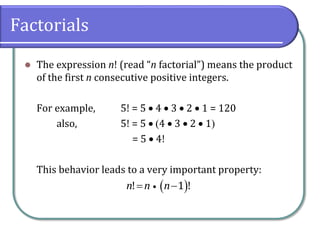
 The expression n! (read “n factorial”) means the product
of the first n consecutive positive integers.
For example, 5! = 5  4  3  2  1 = 120
also, 5! = 5  4  3  2  1
= 5  4!
This behavior leads to a very important property:
 
 
! 1 !
n n n
Factorials (cont.)
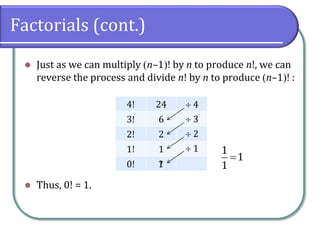
 Just as we can multiply n–1! by n to produce n!, we can
reverse the process and divide n! by n to produce n–1! :
 Thus, 0! = 1.
4! 24
3! 6
2! 2
1! 1
0! 1
?
 1
 2
 3
 4

1
1
1
Factorials (cont.)
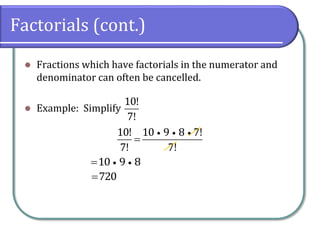
 Fractions which have factorials in the numerator and
denominator can often be cancelled.
 Example: Simplify
10!
7!
Factorials (cont.)
 Fractions which have factorials in the numerator and
denominator can often be cancelled.
 Example: Simplify
10!
7!

10! 10 9 8 7!
7! 7!
10 9 8
720
Factorials (cont.)
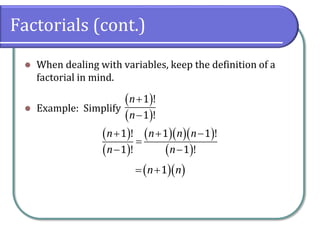
 When dealing with variables, keep the definition of a
factorial in mind.
 Example: Simplify
 
 


1 !
1 !
n
n
Factorials (cont.)
 When dealing with variables, keep the definition of a
factorial in mind.
 Example: Simplify
 
 


1 !
1 !
n
n
 
 
   
 
  

 
1 ! 1 1 !
1 ! 1 !
n n n n
n n
  
 1
n n
Binomial Series
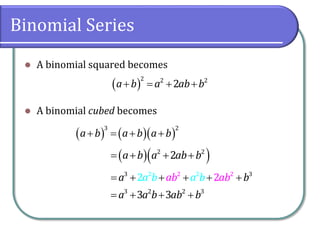
 A binomial squared becomes
 A binomial cubed becomes
 
   
2 2 2
2
a b a ab b
    
   
3 2
a b a b a b
  
   
2 2
2
a b a ab b
     
2 2
3 3
2 2
2 2
a b a b ab
a b b
a
   
3 2 2 3
3 3
a a b ab b
Binomial Series (cont.)
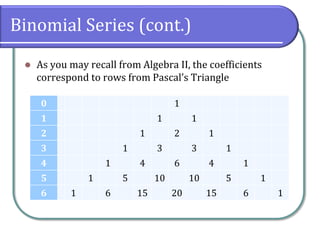
 As you may recall from Algebra II, the coefficients
correspond to rows from Pascal’s Triangle
0 1
1 1 1
2 1 2 1
3 1 3 3 1
4 1 4 6 4 1
5 1 5 10 10 5 1
6 1 6 15 20 15 6 1
Binomial Series (cont.)
 Example: Expand  

5
2 1
x
Binomial Series (cont.)
 Example: Expand
a = 2x and b = 1; the exponents begin and end at 5 (a
goes down while b goes up). Looking at row 5 on the
triangle, our coefficients are 1, 5, 10, 10, 5, 1, so we write
our expression as follows:
(Notice that the exponents apply to the entire term of the
binomial, not just the variable.)
 

5
2 1
x
                  
    
5 4 3 2 2 3 4 5
5 10 1
1 1 1
2 2 2 1
2 1
5 2
0
x x x x x
     
5 4 3 2
32 80 80 40 10 1
x x x x x
    
5 4 3 2 2 3 4 5
5 10 10 5
a a a a a
b b b b b
Binomial Series (cont.)
 Consider the binomial series :
If we multiply the coefficient of a term by a fraction
consisting of the exponent of a over the term number,
we get the coefficient of the next number.
 

7
a b
       
7 6 5 2 4 3 3 4 2 5 6 7
7 21 35 35 21 7
a a b a b a b a b a b ab b
8
7
6
5
4
3
2
1
   
 
   
   
exp. 7
coeff. 1 7,
term # 1
 

 
 
6
7 21,
2
 
 
 
5
21 =35, ...
3
Binomial Series (cont.)
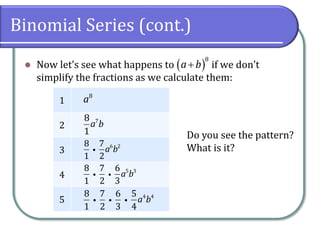
 Now let’s see what happens to if we don’t
simplify the fractions as we calculate them:
 

8
a b
1
2
3
4
5
8
a
7
8
1
a b
6 2
8 7
1 2
a b
5 3
8 7 6
1 2 3
a b
4 4
8 7 6 5
1 2 3 4
a b
Do you see the pattern?
What is it?
Binomial Series (cont.)
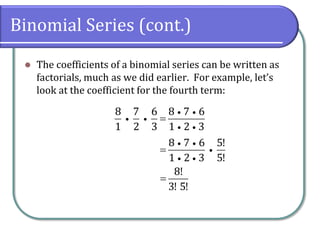
 The coefficients of a binomial series can be written as
factorials, much as we did earlier. For example, let’s
look at the coefficient for the fourth term:

8 7 6 8 7 6
1 2 3 1 2 3

8 7 6 5!
1 2 3 5!

8!
3! 5!
Binomial Series (cont.)
 Looking back at the original expression:
Notice how the numbers in the coefficient expression
are found elsewhere in the expression.
 8 is the value of the exponent to which a + b is
raised.
 5 is the value of a’s exponent and 3 is the value of b’s.
 The exponent of b is always one less than the term
number (4).
 
   
5 3
8 !
... ...
! !
5
3
8
a b a b
Binomial Theorem
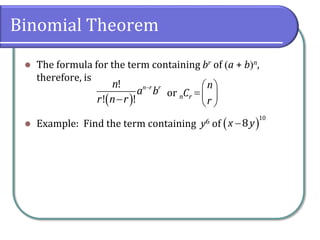
 The formula for the term containing br of a + bn,
therefore, is
or nCr
 Example: Find the term containing y6 of
 


!
! !
n r r
n
a b
r n r
n
r
 
  
 
 10
8
x y

Binomial Theorem (cont.)
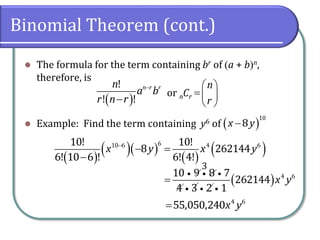
 The formula for the term containing br of a + bn,
therefore, is
or nCr
 Example: Find the term containing y6 of
 


!
! !
n r r
n
a b
r n r
n
r
 
  
 
 10
8
x y

 
  
 
 
6
10 6 4 6
10! 10!
8 262144
6! 10 6 ! 6! 4!
x y x y

 

  4 6
10 9 8 7
262144
4 3 2 1
x y

3
4 6
55,050,240x y

Binomial Theorem (cont.)
 Example: Find the term in which contains f 23.
 

58
e f
Binomial Theorem (cont.)
 Example: Find the term in which contains f 23.
Since n = 58, n – r = 58 – 23 = 35. Therefore the term is
(When dealing with negative terms such as f, recall that
even exponents will produce positive terms and odd
exponents will produce negative terms.)
 

58
e f
 35 23
58!
35! 23!
e f
Binomial Theorem (cont.)
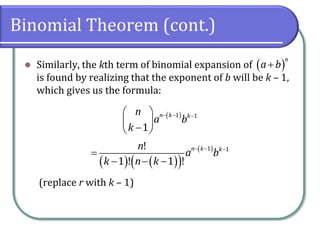
 Similarly, the kth term of binomial expansion of
is found by realizing that the exponent of b will be k – 1,
which gives us the formula:
(replace r with k – 1)
 n
a b

   
 
 
1 1
!
1 ! 1 !
n k k
n
a b
k n k
  

  
 
1 1
1
n k k
n
a b
k
  
 
 

 
Binomial Theorem (cont.)
 Example: Find the 4th term of  12
2c d

Binomial Theorem (cont.)
 Example: Find the 4th term of
n = 12, k = 4, which means that k – 1 = 3
 12
2c d

     
9 3 9 3
12! 10 11 12
2 512
3!9! 1 2 3
c d c d
  
5 4
9 3
112,640c d
 
Binomial Theorem (cont.)
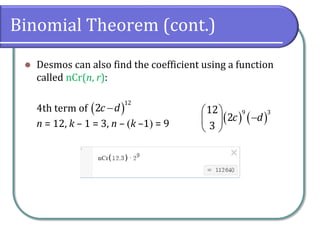
 Desmos can also find the coefficient using a function
called nCr(n, r):
4th term of
n = 12, k – 1 = 3, n – k –1 = 9
 12
2c d

   
9 3
12
2
3
c d
 

 
 
Binomial Theorem Practice
 Example: Expand  

5
2 3
x
Binomial Theorem Practice
 Example: Expand  

5
2 3
x
         
   
   
   
   
5 4 3 2
5! 5!
2 2 3 2 3
1!4! 2!3!
x x x
        
   
     
   
   
2 3 4 5
5! 5!
2 3 2 3 3
3!2! 4!1!
x x
     
5 4 3 2
32 240 720 1080 810 243
x x x x x
Binomial Theorem Practice
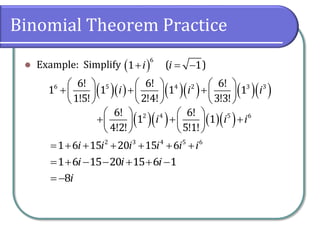
 Example: Simplify ( )
 

6
1 i  1
i
Binomial Theorem Practice
 Example: Simplify ( )
 

6
1 i  1
i
        
     
  
     
     
6 5 4 2 3 3
6! 6! 6!
1 1 1 1
1!5! 2!4! 3!3!
i i i
     
   
  
   
   
2 4 5 6
6! 6!
1 1
4!2! 5!1!
i i i
      
2 3 4 5 6
1 6 15 20 15 6
i i i i i i
      
1 6 15 20 15 6 1
i i i
 8i
Binomial Theorem Practice
 Example: Expand
3
3
2 4
r r
 

 
 
Binomial Theorem Practice
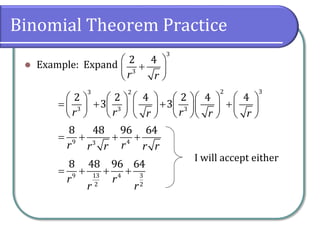
 Example: Expand
3
3
2 4
r r
 

 
 
2 3
3 2
3 3 3
2 2 4 2 4 4
3 3
r r r
r r r
     
     
   
     
     
     
     
9 4
3
8 48 96 64
r r
r r r r
   
13 3
9 4
2 2
8 48 96 64
r r
r r
   
I will accept either
Classwork
 11.4 Assignment (College Algebra)
 Page 1034: 2-20 (even); page 1023: 22-38 (even;
omit 34); page 1015: 50-60 (even), 70, 72
 11.4 Classwork Check
 Quiz 11.3

11.4 The Binomial Theorem

  • 1.
    11.4 Factorials andthe Binomial Theorem Chapter 11 Further Topics in Algebra
  • 2.
    Concepts and Objectives Factorials and the Binomial Theorem  Be able to use the definition of factorials to simplify expressions containing factorials, or to express in factorial form expressions containing products of consecutive integers.  Given a binomial power, expand it as a binomial series in one step  Given a binomial power of the form , find term number k, or find the term which contains br, where k and r are integers from 0 through n.    n a b
  • 3.
    Factorials  The expressionn! (read “n factorial”) means the product of the first n consecutive positive integers. For example, 5! = 5  4  3  2  1 = 120 also, 5! = 5  4  3  2  1 = 5  4! This behavior leads to a very important property:     ! 1 ! n n n
  • 4.
    Factorials (cont.)  Justas we can multiply n–1! by n to produce n!, we can reverse the process and divide n! by n to produce n–1! :  Thus, 0! = 1. 4! 24 3! 6 2! 2 1! 1 0! 1 ?  1  2  3  4  1 1 1
  • 5.
    Factorials (cont.)  Fractionswhich have factorials in the numerator and denominator can often be cancelled.  Example: Simplify 10! 7!
  • 6.
    Factorials (cont.)  Fractionswhich have factorials in the numerator and denominator can often be cancelled.  Example: Simplify 10! 7!  10! 10 9 8 7! 7! 7! 10 9 8 720
  • 7.
    Factorials (cont.)  Whendealing with variables, keep the definition of a factorial in mind.  Example: Simplify       1 ! 1 ! n n
  • 8.
    Factorials (cont.)  Whendealing with variables, keep the definition of a factorial in mind.  Example: Simplify       1 ! 1 ! n n                 1 ! 1 1 ! 1 ! 1 ! n n n n n n     1 n n
  • 9.
    Binomial Series  Abinomial squared becomes  A binomial cubed becomes       2 2 2 2 a b a ab b          3 2 a b a b a b        2 2 2 a b a ab b       2 2 3 3 2 2 2 2 a b a b ab a b b a     3 2 2 3 3 3 a a b ab b
  • 10.
    Binomial Series (cont.) As you may recall from Algebra II, the coefficients correspond to rows from Pascal’s Triangle 0 1 1 1 1 2 1 2 1 3 1 3 3 1 4 1 4 6 4 1 5 1 5 10 10 5 1 6 1 6 15 20 15 6 1
  • 11.
    Binomial Series (cont.) Example: Expand    5 2 1 x
  • 12.
    Binomial Series (cont.) Example: Expand a = 2x and b = 1; the exponents begin and end at 5 (a goes down while b goes up). Looking at row 5 on the triangle, our coefficients are 1, 5, 10, 10, 5, 1, so we write our expression as follows: (Notice that the exponents apply to the entire term of the binomial, not just the variable.)    5 2 1 x                         5 4 3 2 2 3 4 5 5 10 1 1 1 1 2 2 2 1 2 1 5 2 0 x x x x x       5 4 3 2 32 80 80 40 10 1 x x x x x      5 4 3 2 2 3 4 5 5 10 10 5 a a a a a b b b b b
  • 13.
    Binomial Series (cont.) Consider the binomial series : If we multiply the coefficient of a term by a fraction consisting of the exponent of a over the term number, we get the coefficient of the next number.    7 a b         7 6 5 2 4 3 3 4 2 5 6 7 7 21 35 35 21 7 a a b a b a b a b a b ab b 8 7 6 5 4 3 2 1               exp. 7 coeff. 1 7, term # 1        6 7 21, 2       5 21 =35, ... 3
  • 14.
    Binomial Series (cont.) Now let’s see what happens to if we don’t simplify the fractions as we calculate them:    8 a b 1 2 3 4 5 8 a 7 8 1 a b 6 2 8 7 1 2 a b 5 3 8 7 6 1 2 3 a b 4 4 8 7 6 5 1 2 3 4 a b Do you see the pattern? What is it?
  • 15.
    Binomial Series (cont.) The coefficients of a binomial series can be written as factorials, much as we did earlier. For example, let’s look at the coefficient for the fourth term:  8 7 6 8 7 6 1 2 3 1 2 3  8 7 6 5! 1 2 3 5!  8! 3! 5!
  • 16.
    Binomial Series (cont.) Looking back at the original expression: Notice how the numbers in the coefficient expression are found elsewhere in the expression.  8 is the value of the exponent to which a + b is raised.  5 is the value of a’s exponent and 3 is the value of b’s.  The exponent of b is always one less than the term number (4).       5 3 8 ! ... ... ! ! 5 3 8 a b a b
  • 17.
    Binomial Theorem  Theformula for the term containing br of a + bn, therefore, is or nCr  Example: Find the term containing y6 of     ! ! ! n r r n a b r n r n r         10 8 x y 
  • 18.
    Binomial Theorem (cont.) The formula for the term containing br of a + bn, therefore, is or nCr  Example: Find the term containing y6 of     ! ! ! n r r n a b r n r n r         10 8 x y           6 10 6 4 6 10! 10! 8 262144 6! 10 6 ! 6! 4! x y x y       4 6 10 9 8 7 262144 4 3 2 1 x y  3 4 6 55,050,240x y 
  • 19.
    Binomial Theorem (cont.) Example: Find the term in which contains f 23.    58 e f
  • 20.
    Binomial Theorem (cont.) Example: Find the term in which contains f 23. Since n = 58, n – r = 58 – 23 = 35. Therefore the term is (When dealing with negative terms such as f, recall that even exponents will produce positive terms and odd exponents will produce negative terms.)    58 e f  35 23 58! 35! 23! e f
  • 21.
    Binomial Theorem (cont.) Similarly, the kth term of binomial expansion of is found by realizing that the exponent of b will be k – 1, which gives us the formula: (replace r with k – 1)  n a b          1 1 ! 1 ! 1 ! n k k n a b k n k          1 1 1 n k k n a b k          
  • 22.
    Binomial Theorem (cont.) Example: Find the 4th term of  12 2c d 
  • 23.
    Binomial Theorem (cont.) Example: Find the 4th term of n = 12, k = 4, which means that k – 1 = 3  12 2c d        9 3 9 3 12! 10 11 12 2 512 3!9! 1 2 3 c d c d    5 4 9 3 112,640c d  
  • 24.
    Binomial Theorem (cont.) Desmos can also find the coefficient using a function called nCr(n, r): 4th term of n = 12, k – 1 = 3, n – k –1 = 9  12 2c d      9 3 12 2 3 c d       
  • 25.
    Binomial Theorem Practice Example: Expand    5 2 3 x
  • 26.
    Binomial Theorem Practice Example: Expand    5 2 3 x                           5 4 3 2 5! 5! 2 2 3 2 3 1!4! 2!3! x x x                            2 3 4 5 5! 5! 2 3 2 3 3 3!2! 4!1! x x       5 4 3 2 32 240 720 1080 810 243 x x x x x
  • 27.
    Binomial Theorem Practice Example: Simplify ( )    6 1 i  1 i
  • 28.
    Binomial Theorem Practice Example: Simplify ( )    6 1 i  1 i                               6 5 4 2 3 3 6! 6! 6! 1 1 1 1 1!5! 2!4! 3!3! i i i                      2 4 5 6 6! 6! 1 1 4!2! 5!1! i i i        2 3 4 5 6 1 6 15 20 15 6 i i i i i i        1 6 15 20 15 6 1 i i i  8i
  • 29.
    Binomial Theorem Practice Example: Expand 3 3 2 4 r r       
  • 30.
    Binomial Theorem Practice Example: Expand 3 3 2 4 r r        2 3 3 2 3 3 3 2 2 4 2 4 4 3 3 r r r r r r                                         9 4 3 8 48 96 64 r r r r r r     13 3 9 4 2 2 8 48 96 64 r r r r     I will accept either
  • 31.
    Classwork  11.4 Assignment(College Algebra)  Page 1034: 2-20 (even); page 1023: 22-38 (even; omit 34); page 1015: 50-60 (even), 70, 72  11.4 Classwork Check  Quiz 11.3