Flange coupling
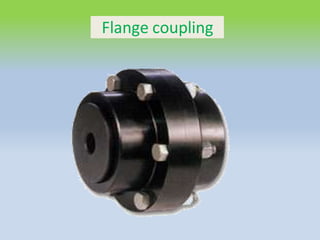
Flange coupling
• A flange coupling usually applies to a coupling having
two separate cast iron flanges.
• Each flange is mounted on the shaft end and keyed to
it.
• The faces are turned up at right angle to the axis of the shaft
• Flange coupling are
• 1. Unprotected type flange coupling
• 2. Protected type flange coupling
• 3. Marine type flange coupling
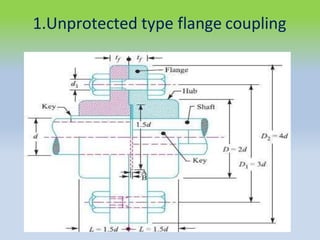
1.Unprotected type flange coupling
• In an unprotected type flange coupling each
shaft is keyed to the boss of a flange with a
counter sunk key and the flanges are coupled
together by means of bolts.
• Generally, three, four or six bolts are used
Design of Unprotected type Flange Coupling
• The usual proportions for an unprotected type cast iron flange
couplings
• d = diameter of the shaft or inner diameter of the hub
• D= Outside diameter of hub D=2d
• Length of hub, L= 1.5d
• Pitch circle diameter of bolts, D1=3d
• Outside diameter of flange,
D2= D1+ ( D1– D) = 2 D1– D= 4d
• Thickness of flange tf =0.5d
• Number of bolts =3, ford upto 40 mm
=4, for d upto 100 mm
=6, for d upto 180 mm
• d =Diameter of shaft or inner diameter of hub,
• τs =Allowable shear stress forshaft,
• D=Outer diameter of hub,
• tf =Thickness of flange
• τc=Allowable shear stress for the flange material
• d 1=Nominal or outside diameter of bolt,
• D1 =Diameter of bolt circle,
• n=Number of bolts,
• τb= Allowable shear stress forbolt
• σ cb,, =Allowable crushing stress forbolt
• τk= Allowable shear stress for key material
• σ ck= keymaterial
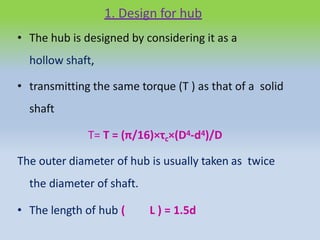
1. Design for hub
• The hub is designed by considering it as a
hollow shaft,
• transmitting the same torque (T ) as that of a solid
shaft
T= T = (π/16)×τc×(D4-d4)/D
The outer diameter of hub is usually taken as twice
the diameter of shaft.
• The length of hub ( L ) = 1.5d
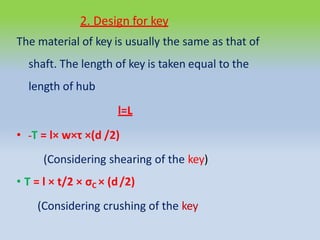
2. Design for key
The material of key is usually the same as that of
shaft. The length of key is taken equal to the
length of hub
l=L
• T = l× w×τ ×(d /2)
(Considering shearing of the key)
• T = l × t/2 × σC × (d/2)
(Considering crushing of the key
3. Design for flange
• T =Circumference of hub × Thickness of flange
× Shear stress of flange × Radius of hub
• T= π D × tf × τc × D/2
T= π × tf × τc × D2/2
The thickness of flange is usually taken as half the
diameter of shaft
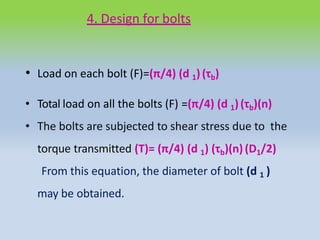
4. Design for bolts
• Load on each bolt (F)=(π/4) (d 1)(τb)
• Total load on all the bolts (F) =(π/4) (d 1)(τb)(n)
• The bolts are subjected to shear stress due to the
torque transmitted (T)= (π/4) (d 1) (τb)(n)(D1/2)
From this equation, the diameter of bolt (d 1 )
may be obtained.
• We know that area resisting crushing of all the
bolts = n× d 1 × tf
• crushing strength of all the bolts
= n× d 1 × tf × σCb
Torque = n× d 1 × tf × σCb × (D1/2)
• From this equation, the induced crushing
stress in the bolts may be checked
Protected type flange coupling
• the protruding bolts and nuts are protected by
flanges on the two halves of the coupling, in
order to avoid danger to the workman
(tp ) =0.25d
The design of unprotective type is same
process of protective type
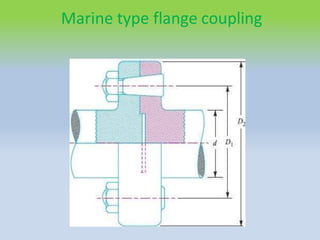
Marine type flange coupling
• In a marine type flange coupling, the flanges are forged
integral with the shafts .
• The flanges are held together by means of tapered
head less bolts.
• numbering from four to twelve depending upon the
diameter of shaft.
• Shaft diameter
• 35 to 55
• 56 to 150
• 151 to 230
• 231 to 390
• Above 390
No. of bolts
4
6
8
10
12
• The other proportions for the marine type
flange coupling
• Thickness of flange =d / 3
• Taper of bolt= 1 in 20 to 1 in 40
• Pitch circle diameter of bolts, D1= 1.6d
• Outside diameter of flange, D2= 2.2d
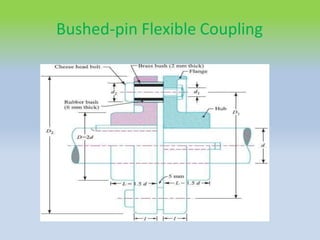
Bushed-pin Flexible Coupling
a modification of the rigid type of flange
coupling.
• The coupling bolts are known as pins. The
rubber or leather bushes are used over the
pins.
• The two halves of the coupling are dissimilar
in construction.
• A clearance of 5 mm is left between the face
of the two halves of the coupling.
• the proportions of the rigid type flange
coupling
• the bearing pressure on the rubber or leather
bushes and it should not exceed 0.5 N/mm2
Pin and bush design
• l=Length of bush in the flange,
• d 2=Diameter of bush,
• pb=Bearing pressure on the bush or pin,
• n=Number of pins,
• D1=Diameter of pitch circle of the pins
Pin and bush design
• bearing load acting on each pin,
• W = pb×d 2×l
• ∴Total bearing load on the bush or pins
• W × n= pb×d 2×l ×n
• torque transmitted by the coupling=
T= W × n × (D1 /2)
T= pb×d 2×l ×n × (D1 /2)
• Direct shear stress due to pure torsion in the
coupling halve
• τ=W/[ (π/4) (d 1 )]
2
• maximum bending moment on the pin
• M =W (l/2 +5mm)
• bending stress
σ= M / Z
= W (l/2 +5mm)/ (π/32) (d 1
3)
• Maximum principal stress
= 1/2[σ +(σ+4τ2 )1/2]
• maximum shear stress on the pin
= 1/2(σ+4τ2 )1/2
• The value of maximum principal stress varies
from 28 to 42 MPa

11 c couplings flange coupling

  • 1.
  • 2.
    Flange coupling • Aflange coupling usually applies to a coupling having two separate cast iron flanges. • Each flange is mounted on the shaft end and keyed to it. • The faces are turned up at right angle to the axis of the shaft • Flange coupling are • 1. Unprotected type flange coupling • 2. Protected type flange coupling • 3. Marine type flange coupling
  • 3.
  • 4.
    • In anunprotected type flange coupling each shaft is keyed to the boss of a flange with a counter sunk key and the flanges are coupled together by means of bolts. • Generally, three, four or six bolts are used
  • 5.
    Design of Unprotectedtype Flange Coupling • The usual proportions for an unprotected type cast iron flange couplings • d = diameter of the shaft or inner diameter of the hub • D= Outside diameter of hub D=2d • Length of hub, L= 1.5d • Pitch circle diameter of bolts, D1=3d • Outside diameter of flange, D2= D1+ ( D1– D) = 2 D1– D= 4d • Thickness of flange tf =0.5d • Number of bolts =3, ford upto 40 mm =4, for d upto 100 mm =6, for d upto 180 mm
  • 6.
    • d =Diameterof shaft or inner diameter of hub, • τs =Allowable shear stress forshaft, • D=Outer diameter of hub, • tf =Thickness of flange • τc=Allowable shear stress for the flange material • d 1=Nominal or outside diameter of bolt, • D1 =Diameter of bolt circle, • n=Number of bolts, • τb= Allowable shear stress forbolt • σ cb,, =Allowable crushing stress forbolt • τk= Allowable shear stress for key material • σ ck= keymaterial
  • 7.
    1. Design forhub • The hub is designed by considering it as a hollow shaft, • transmitting the same torque (T ) as that of a solid shaft T= T = (π/16)×τc×(D4-d4)/D The outer diameter of hub is usually taken as twice the diameter of shaft. • The length of hub ( L ) = 1.5d
  • 8.
    2. Design forkey The material of key is usually the same as that of shaft. The length of key is taken equal to the length of hub l=L • T = l× w×τ ×(d /2) (Considering shearing of the key) • T = l × t/2 × σC × (d/2) (Considering crushing of the key
  • 9.
    3. Design forflange • T =Circumference of hub × Thickness of flange × Shear stress of flange × Radius of hub • T= π D × tf × τc × D/2 T= π × tf × τc × D2/2 The thickness of flange is usually taken as half the diameter of shaft
  • 10.
    4. Design forbolts • Load on each bolt (F)=(π/4) (d 1)(τb) • Total load on all the bolts (F) =(π/4) (d 1)(τb)(n) • The bolts are subjected to shear stress due to the torque transmitted (T)= (π/4) (d 1) (τb)(n)(D1/2) From this equation, the diameter of bolt (d 1 ) may be obtained.
  • 11.
    • We knowthat area resisting crushing of all the bolts = n× d 1 × tf • crushing strength of all the bolts = n× d 1 × tf × σCb Torque = n× d 1 × tf × σCb × (D1/2) • From this equation, the induced crushing stress in the bolts may be checked
  • 12.
  • 13.
  • 14.
    • the protrudingbolts and nuts are protected by flanges on the two halves of the coupling, in order to avoid danger to the workman (tp ) =0.25d The design of unprotective type is same process of protective type
  • 15.
  • 16.
    • In amarine type flange coupling, the flanges are forged integral with the shafts . • The flanges are held together by means of tapered head less bolts. • numbering from four to twelve depending upon the diameter of shaft. • Shaft diameter • 35 to 55 • 56 to 150 • 151 to 230 • 231 to 390 • Above 390 No. of bolts 4 6 8 10 12
  • 17.
    • The otherproportions for the marine type flange coupling • Thickness of flange =d / 3 • Taper of bolt= 1 in 20 to 1 in 40 • Pitch circle diameter of bolts, D1= 1.6d • Outside diameter of flange, D2= 2.2d
  • 18.
  • 19.
    a modification ofthe rigid type of flange coupling. • The coupling bolts are known as pins. The rubber or leather bushes are used over the pins. • The two halves of the coupling are dissimilar in construction. • A clearance of 5 mm is left between the face of the two halves of the coupling.
  • 20.
    • the proportionsof the rigid type flange coupling • the bearing pressure on the rubber or leather bushes and it should not exceed 0.5 N/mm2 Pin and bush design • l=Length of bush in the flange, • d 2=Diameter of bush, • pb=Bearing pressure on the bush or pin, • n=Number of pins, • D1=Diameter of pitch circle of the pins
  • 21.
    Pin and bushdesign • bearing load acting on each pin, • W = pb×d 2×l • ∴Total bearing load on the bush or pins • W × n= pb×d 2×l ×n • torque transmitted by the coupling= T= W × n × (D1 /2) T= pb×d 2×l ×n × (D1 /2)
  • 23.
    • Direct shearstress due to pure torsion in the coupling halve • τ=W/[ (π/4) (d 1 )] 2 • maximum bending moment on the pin • M =W (l/2 +5mm) • bending stress σ= M / Z = W (l/2 +5mm)/ (π/32) (d 1 3)
  • 24.
    • Maximum principalstress = 1/2[σ +(σ+4τ2 )1/2] • maximum shear stress on the pin = 1/2(σ+4τ2 )1/2 • The value of maximum principal stress varies from 28 to 42 MPa