RAJASTHAN TECHNICAL UNIVERSITY KOTA
BTECH 3rd YEAR 5th SEMESTER
BRANCH : MECHANICAL ENGINEERING
SUBJECT : MDP LAB
BATCH : M3
TITLE : DESIGN OF COUPLING ( MUFF & FLANGE )
SUBMITTED BY :
SUBMITTED BY:
R.K BHAMU SIR
Ayush Pal
Rohit Verma
24/910
24/946
Satyam 24/951
Atul Kumawat
Jayesh Jangid
24/909
24/924
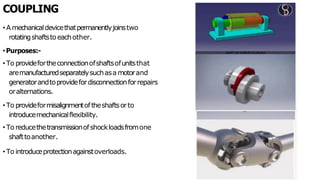
COUPLING
• A mechanicaldevicethatpermanentlyjoinstwo
rotatingshaftstoeachother.
•Purposes:-
• To providefortheconnectionofshaftsofunitsthat
aremanufacturedseparatelysuchasa motorand
generatorandtoprovidefordisconnectionforrepairs
oralternations.
• To provideformisalignmentoftheshaftsorto
introducemechanicalflexibility.
• To reducethetransmissionofshockloadsfromone
shafttoanother.
• To introduceprotectionagainstoverloads.
Functions of Coupling
• Due to sagging problem of shaft, length of continuous shaft is
not kept more than 10 meters
• To join two rotating shafts permanently, Couplings are used.
• Function of coupling is to join shafts permanently.
Applications of Coupling
• Industrial machinery with perfectly aligned shafts
• Line shafting in manufacturing facilities
• Pumps, compressors, and conveyors with rigid mounting
• Applications where vibration damping is not required
Requirements of a Good Shaft Coupling
1
1
/
1
1/
20
2
5 4
• Easy toconnectordisconnect.
• Transmitthefullpowerfromone shafttotheothershaftwithoutlosses.
• Hold theshaftsinperfectalignment.
• Reducethetransmissionof shock loads fromoneshafttoanothershaft.
• No projectingparts
Types of Shafts Couplings
1
1
/
1
1/
20
2
5 5
Rigidcoupling
• connecttwoshaftswhichare perfectlyaligned
1.Sleeveormuffcoupling.
2. Clamporsplit-mufforcompressioncoupling,and
3. Flangecoupling
Flexiblecoupling
• connecttwoshaftshavingbothlateralandangularmisalignment
1.Bushedpintypecoupling,
2. Universalcoupling,and
3. Oldhamcoupling.
The difference betweenrigidandflexiblecouplings
1
1
/
1
1/
20
2
5 6
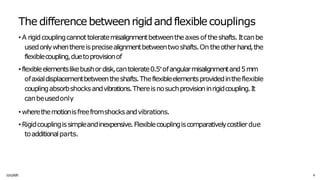
• A rigidcouplingcannottoleratemisalignmentbetweentheaxesof theshafts.Itcanbe
usedonlywhenthereisprecisealignmentbetweentwoshafts.On theotherhand,the
flexiblecoupling,duetoprovisionof
• flexibleelementslikebushordisk,cantolerate0.5°ofangularmisalignmentand5mm
ofaxialdisplacementbetweentheshafts.Theflexibleelementsprovidedintheflexible
couplingabsorbshocksandvibrations.Thereisnosuchprovisioninrigidcoupling.It
canbeusedonly
• wherethemotionisfreefromshocksandvibrations.
• Rigidcouplingissimpleandinexpensive.Flexiblecouplingiscomparativelycostlierdue
toadditionalparts.
A good coupling,rigidor flexible,shouldsatisfy the
following requirements:
1
1
/
1
1/
20
2
5 7
• Thecouplingshouldbecapableoftransmittingtorquefromthedrivingshafttothe
drivenshaft.
• Thecouplingshouldkeepthetwoshaftsinproperalignment.
• Thecouplingshouldbeeasytoassembleanddisassembleforthepurposeofrepairs
andalterations.
• Thefailureofrevolvingboltheads,nuts,keyheadsandotherprojectingpartsmay
causeaccidents.Theyshouldbecoveredbygivingsuitableshapetotheflangesorby
providingguards.
3/17/2021 Vijay Kumar Karma, IET, DAVV, Indore 5
Design of Couplings
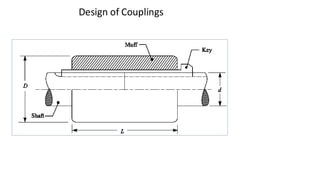
Rigid Couplings - Sleeve or Muff-coupling
It is the simplest type of rigid coupling.
It is made of cast iron.
It consists of a hollow cylinder whose inner diameter is the same as
that of the shaft.
It is fitted over the ends of the two shafts by means of a gib head
key.
The power is transmitted from one shaft to the other shaft by
means of a key and a sleeve.
It is, therefore, necessary that all the elements must be strong
enough to transmit the torque.
Design of Couplings
3/17/2021 Vijay Kumar Karma, IET, DAVV, Indore 6
Design of Couplings
4
3/17/2021 Vijay Kumar Karma, IET, DAVV, Indore 7
3
16
16 D
c 1− k
 D4
 =  D ( )

− d4
 
T = c 


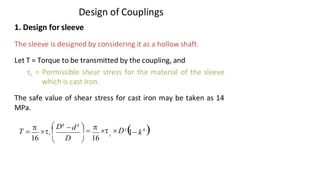
1. Design for sleeve
The sleeve is designed by considering it as a hollow shaft.
Let T = Torque to be transmitted by the coupling, and
τc = Permissible shear stress for the material of the sleeve
which is cast iron.
The safe value of shear stress for cast iron may be taken as 14
MPa.
Design of Couplings
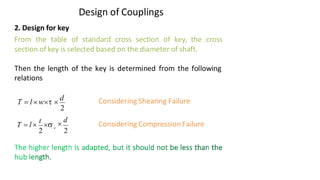
2. Design for key
From the table of standard cross section of key, the cross
section of key is selected based on the diameter of shaft.
Then the length of the key is determined from the following
relations
Considering Shearing Failure
Considering Compression Failure
2
T = l w 
d

d
2
Vijay Kumar Karma, IET, DAVV, Indore 8
2
c
T = l 
t

Design of Couplings
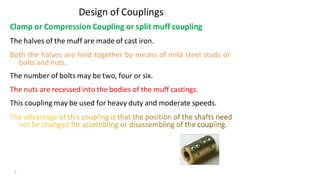
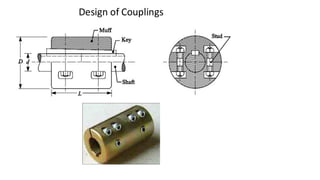
Clamp or Compression Coupling or split muff coupling
The halves of the muff are made of cast iron.
Both the halves are held together by means of mild steel studs or
bolts and nuts.
The number of bolts may be two, four or six.
The nuts are recessed into the bodies of the muff castings.
This coupling may be used for heavy duty and moderate speeds.
3/17/2021 Vijay Kumar Karma, IET, DAVV, Indore 9
Design of Couplings
3/17/2021 Vijay Kumar Karma, IET, DAVV, Indore 10
Design of Couplings
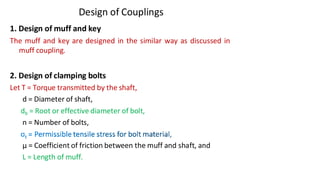
1. Design of muff and key
The muff and key are designed in the similar way as discussed in
muff coupling.
2. Design of clamping bolts
Let T = Torque transmitted by the shaft,
d = Diameter of shaft,
db = Root or effective diameter of bolt,
n = Number of bolts,
μ = Coefficient of friction between the muff and shaft, and
L = Length of muff.
3/17/2021 Vijay Kumar Karma, IET, DAVV, Indore 11
Design of Couplings
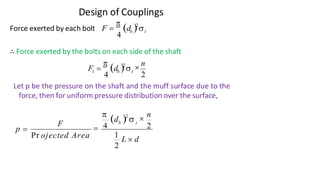
Force exerted by each bolt F =
∴ Force exerted by the bolts on each side of the shaft
Let p be the pressure on the shaft and the muff surface due to the
force, then for uniform pressure distribution over the surface,
t
b
(d )

4
2
 n
Pr ojected Area
F
p =
b t
2
1
L  d
2
= 4
2
(d ) 

 n
2
3/17/2021 Vijay Kumar Karma, IET, DAVV, Indore 12

4
2
1
F = b t
(d )
Design of Couplings
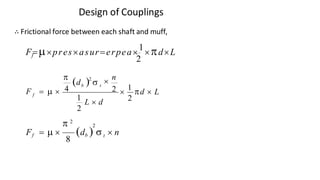
∴ Frictional force between each shaft and muff,
f
2
F=presasur=erpea
1
dL
(d )  n
b t
f


2
2 
1
d  L
F =   4
2
1
L  d
2
t
Vijay Kumar Karma, IET, DAVV, Indore 13
 2
2
Ff =   (db )   n
8
Design of Couplings
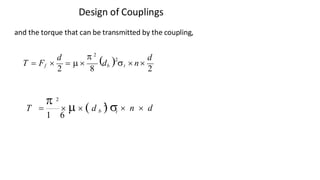
and the torque that can be transmitted by the coupling,
)2 d
d  2
(
T = Ff 
2
=  
8
db t  n 
2
t
3/17/2021 Vijay Kumar Karma, IET, DAVV, Indore 14
 n  d
T =    ( d b ) 
2
 2
1 6
Design of Couplings
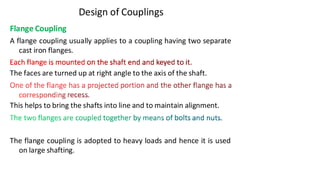
Flange Coupling
A flange coupling usually applies to a coupling having two separate
cast iron flanges.
The faces are turned up at right angle to the axis of the shaft.
This helps to bring the shafts into line and to maintain alignment.
The flange coupling is adopted to heavy loads and hence it is used
on large shafting.
3/17/2021 Vijay Kumar Karma, IET, DAVV, Indore 15
Design of Couplings
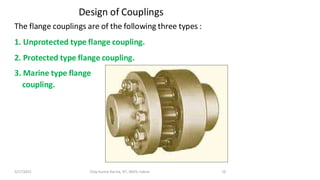
The flange couplings are of the following three types :
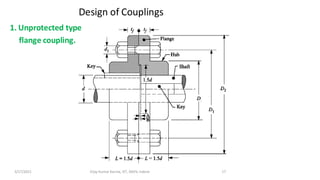
1. Unprotected type flange coupling.
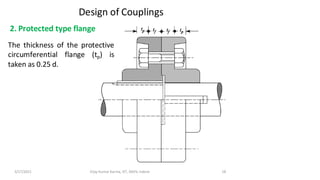
2. Protected type flange coupling.
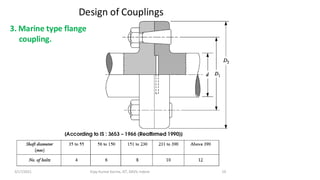
3. Marine type flange
coupling.
3/17/2021 Vijay Kumar Karma, IET, DAVV, Indore 16
Design of Couplings
3/17/2021 Vijay Kumar Karma, IET, DAVV, Indore 17
1. Unprotected type
flange coupling.
Design of Couplings
coupling.
2. Protected type flange
The thickness of the protective
circumferential flange (tp) is
taken as 0.25 d.
3/17/2021 Vijay Kumar Karma, IET, DAVV, Indore 18
Design of Couplings
3. Marine type flange
coupling.
3/17/2021 Vijay Kumar Karma, IET, DAVV, Indore 19
3/17/2021 Vijay Kumar Karma, IET, DAVV, Indore 20
Design of Couplings
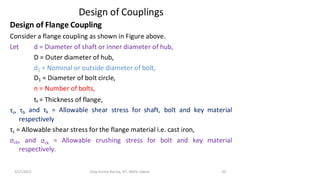
Design of Flange Coupling
Consider a flange coupling as shown in Figure above.
Let
τs, τb
d = Diameter of shaft or inner diameter of hub,
D = Outer diameter of hub,
d1 = Nominal or outside diameter of bolt,
D1 = Diameter of bolt circle,
n = Number of bolts,
tf = Thickness of flange,
and τk = Allowable shear stress for shaft, bolt and key material
respectively
τc = Allowable shear stress for the flange material i.e. cast iron,
σcb, and σck = Allowable crushing stress for bolt and key material
respectively.
Design of Couplings
1. Design for hub
The hub is designed by considering it as a hollow shaft, transmitting
the same torque (T) as that of a solid shaft.
2. Design for key
The key is designed with usual proportions and then checked for
shearing and crushing stresses.
The material of key is usually the same as that of shaft. The length
of key is taken equal to the length of hub
16
3/17/2021 Vijay Kumar Karma, IET, DAVV, Indore 21
16 D
c

 D4
 =   D3
(1−k4
)

− d4
 
T = c 

Design of Couplings
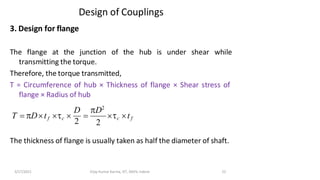
3. Design for flange
The flange at the junction of the hub is under shear while
transmitting the torque.
Therefore, the torque transmitted,
T = Circumference of hub × Thickness of flange × Shear stress of
flange × Radius of hub
The thickness of flange is usually taken as half the diameter of shaft.
c tf
3/17/2021 Vijay Kumar Karma, IET, DAVV, Indore 22
T = Dtf c 
2
=
D D2
2
Design of Couplings
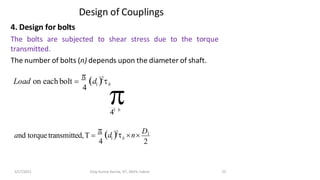
4. Design for bolts
The bolts are subjected to shear stress due to the torque
transmitted.
The number of bolts (n) depends upon the diameter of shaft.
(d ) b
Load on eachbolt = 

4
2
1
2
and torque transmitted,T =
2
1 b
(d ) n
D1

4

3/17/2021 Vijay Kumar Karma, IET, DAVV, Indore 23
41 b
T
L
o
o
a
o
b
t
n
l
=
t
h
(
d
a
l
)
o
a
2
Design of Couplings
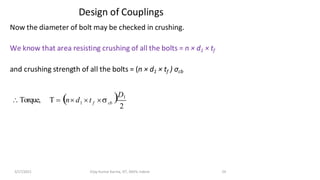
Now the diameter of bolt may be checked in crushing.
We know that area resisting crushing of all the bolts = n × d1 × tf
and crushing strength of all the bolts = (n × d1 × tf ) σcb
T = (n d
2
3/17/2021 Vijay Kumar Karma, IET, DAVV, Indore 24
)D1
Torque, 1 cb
f
t 

Design_of_Coupling.design of machine elements

  • 1.
    RAJASTHAN TECHNICAL UNIVERSITYKOTA BTECH 3rd YEAR 5th SEMESTER BRANCH : MECHANICAL ENGINEERING SUBJECT : MDP LAB BATCH : M3 TITLE : DESIGN OF COUPLING ( MUFF & FLANGE ) SUBMITTED BY : SUBMITTED BY: R.K BHAMU SIR Ayush Pal Rohit Verma 24/910 24/946 Satyam 24/951 Atul Kumawat Jayesh Jangid 24/909 24/924
  • 2.
    COUPLING • A mechanicaldevicethatpermanentlyjoinstwo rotatingshaftstoeachother. •Purposes:- •To providefortheconnectionofshaftsofunitsthat aremanufacturedseparatelysuchasa motorand generatorandtoprovidefordisconnectionforrepairs oralternations. • To provideformisalignmentoftheshaftsorto introducemechanicalflexibility. • To reducethetransmissionofshockloadsfromone shafttoanother. • To introduceprotectionagainstoverloads.
  • 3.
    Functions of Coupling •Due to sagging problem of shaft, length of continuous shaft is not kept more than 10 meters • To join two rotating shafts permanently, Couplings are used. • Function of coupling is to join shafts permanently. Applications of Coupling • Industrial machinery with perfectly aligned shafts • Line shafting in manufacturing facilities • Pumps, compressors, and conveyors with rigid mounting • Applications where vibration damping is not required
  • 4.
    Requirements of aGood Shaft Coupling 1 1 / 1 1/ 20 2 5 4 • Easy toconnectordisconnect. • Transmitthefullpowerfromone shafttotheothershaftwithoutlosses. • Hold theshaftsinperfectalignment. • Reducethetransmissionof shock loads fromoneshafttoanothershaft. • No projectingparts
  • 5.
    Types of ShaftsCouplings 1 1 / 1 1/ 20 2 5 5 Rigidcoupling • connecttwoshaftswhichare perfectlyaligned 1.Sleeveormuffcoupling. 2. Clamporsplit-mufforcompressioncoupling,and 3. Flangecoupling Flexiblecoupling • connecttwoshaftshavingbothlateralandangularmisalignment 1.Bushedpintypecoupling, 2. Universalcoupling,and 3. Oldhamcoupling.
  • 6.
    The difference betweenrigidandflexiblecouplings 1 1 / 1 1/ 20 2 56 • A rigidcouplingcannottoleratemisalignmentbetweentheaxesof theshafts.Itcanbe usedonlywhenthereisprecisealignmentbetweentwoshafts.On theotherhand,the flexiblecoupling,duetoprovisionof • flexibleelementslikebushordisk,cantolerate0.5°ofangularmisalignmentand5mm ofaxialdisplacementbetweentheshafts.Theflexibleelementsprovidedintheflexible couplingabsorbshocksandvibrations.Thereisnosuchprovisioninrigidcoupling.It canbeusedonly • wherethemotionisfreefromshocksandvibrations. • Rigidcouplingissimpleandinexpensive.Flexiblecouplingiscomparativelycostlierdue toadditionalparts.
  • 7.
    A good coupling,rigidorflexible,shouldsatisfy the following requirements: 1 1 / 1 1/ 20 2 5 7 • Thecouplingshouldbecapableoftransmittingtorquefromthedrivingshafttothe drivenshaft. • Thecouplingshouldkeepthetwoshaftsinproperalignment. • Thecouplingshouldbeeasytoassembleanddisassembleforthepurposeofrepairs andalterations. • Thefailureofrevolvingboltheads,nuts,keyheadsandotherprojectingpartsmay causeaccidents.Theyshouldbecoveredbygivingsuitableshapetotheflangesorby providingguards.
  • 8.
    3/17/2021 Vijay KumarKarma, IET, DAVV, Indore 5 Design of Couplings Rigid Couplings - Sleeve or Muff-coupling It is the simplest type of rigid coupling. It is made of cast iron. It consists of a hollow cylinder whose inner diameter is the same as that of the shaft. It is fitted over the ends of the two shafts by means of a gib head key. The power is transmitted from one shaft to the other shaft by means of a key and a sleeve. It is, therefore, necessary that all the elements must be strong enough to transmit the torque.
  • 9.
    Design of Couplings 3/17/2021Vijay Kumar Karma, IET, DAVV, Indore 6
  • 10.
    Design of Couplings 4 3/17/2021Vijay Kumar Karma, IET, DAVV, Indore 7 3 16 16 D c 1− k  D4  =  D ( )  − d4   T = c    1. Design for sleeve The sleeve is designed by considering it as a hollow shaft. Let T = Torque to be transmitted by the coupling, and τc = Permissible shear stress for the material of the sleeve which is cast iron. The safe value of shear stress for cast iron may be taken as 14 MPa.
  • 11.
    Design of Couplings 2.Design for key From the table of standard cross section of key, the cross section of key is selected based on the diameter of shaft. Then the length of the key is determined from the following relations Considering Shearing Failure Considering Compression Failure 2 T = l w  d  d 2 Vijay Kumar Karma, IET, DAVV, Indore 8 2 c T = l  t 
  • 12.
    Design of Couplings Clampor Compression Coupling or split muff coupling The halves of the muff are made of cast iron. Both the halves are held together by means of mild steel studs or bolts and nuts. The number of bolts may be two, four or six. The nuts are recessed into the bodies of the muff castings. This coupling may be used for heavy duty and moderate speeds. 3/17/2021 Vijay Kumar Karma, IET, DAVV, Indore 9
  • 13.
    Design of Couplings 3/17/2021Vijay Kumar Karma, IET, DAVV, Indore 10
  • 14.
    Design of Couplings 1.Design of muff and key The muff and key are designed in the similar way as discussed in muff coupling. 2. Design of clamping bolts Let T = Torque transmitted by the shaft, d = Diameter of shaft, db = Root or effective diameter of bolt, n = Number of bolts, μ = Coefficient of friction between the muff and shaft, and L = Length of muff. 3/17/2021 Vijay Kumar Karma, IET, DAVV, Indore 11
  • 15.
    Design of Couplings Forceexerted by each bolt F = ∴ Force exerted by the bolts on each side of the shaft Let p be the pressure on the shaft and the muff surface due to the force, then for uniform pressure distribution over the surface, t b (d )  4 2  n Pr ojected Area F p = b t 2 1 L  d 2 = 4 2 (d )    n 2 3/17/2021 Vijay Kumar Karma, IET, DAVV, Indore 12  4 2 1 F = b t (d )
  • 16.
    Design of Couplings ∴Frictional force between each shaft and muff, f 2 F=presasur=erpea 1 dL (d )  n b t f   2 2  1 d  L F =   4 2 1 L  d 2 t Vijay Kumar Karma, IET, DAVV, Indore 13  2 2 Ff =   (db )   n 8
  • 17.
    Design of Couplings andthe torque that can be transmitted by the coupling, )2 d d  2 ( T = Ff  2 =   8 db t  n  2 t 3/17/2021 Vijay Kumar Karma, IET, DAVV, Indore 14  n  d T =    ( d b )  2  2 1 6
  • 18.
    Design of Couplings FlangeCoupling A flange coupling usually applies to a coupling having two separate cast iron flanges. The faces are turned up at right angle to the axis of the shaft. This helps to bring the shafts into line and to maintain alignment. The flange coupling is adopted to heavy loads and hence it is used on large shafting. 3/17/2021 Vijay Kumar Karma, IET, DAVV, Indore 15
  • 19.
    Design of Couplings Theflange couplings are of the following three types : 1. Unprotected type flange coupling. 2. Protected type flange coupling. 3. Marine type flange coupling. 3/17/2021 Vijay Kumar Karma, IET, DAVV, Indore 16
  • 20.
    Design of Couplings 3/17/2021Vijay Kumar Karma, IET, DAVV, Indore 17 1. Unprotected type flange coupling.
  • 21.
    Design of Couplings coupling. 2.Protected type flange The thickness of the protective circumferential flange (tp) is taken as 0.25 d. 3/17/2021 Vijay Kumar Karma, IET, DAVV, Indore 18
  • 22.
    Design of Couplings 3.Marine type flange coupling. 3/17/2021 Vijay Kumar Karma, IET, DAVV, Indore 19
  • 23.
    3/17/2021 Vijay KumarKarma, IET, DAVV, Indore 20 Design of Couplings Design of Flange Coupling Consider a flange coupling as shown in Figure above. Let τs, τb d = Diameter of shaft or inner diameter of hub, D = Outer diameter of hub, d1 = Nominal or outside diameter of bolt, D1 = Diameter of bolt circle, n = Number of bolts, tf = Thickness of flange, and τk = Allowable shear stress for shaft, bolt and key material respectively τc = Allowable shear stress for the flange material i.e. cast iron, σcb, and σck = Allowable crushing stress for bolt and key material respectively.
  • 24.
    Design of Couplings 1.Design for hub The hub is designed by considering it as a hollow shaft, transmitting the same torque (T) as that of a solid shaft. 2. Design for key The key is designed with usual proportions and then checked for shearing and crushing stresses. The material of key is usually the same as that of shaft. The length of key is taken equal to the length of hub 16 3/17/2021 Vijay Kumar Karma, IET, DAVV, Indore 21 16 D c   D4  =   D3 (1−k4 )  − d4   T = c  
  • 25.
    Design of Couplings 3.Design for flange The flange at the junction of the hub is under shear while transmitting the torque. Therefore, the torque transmitted, T = Circumference of hub × Thickness of flange × Shear stress of flange × Radius of hub The thickness of flange is usually taken as half the diameter of shaft. c tf 3/17/2021 Vijay Kumar Karma, IET, DAVV, Indore 22 T = Dtf c  2 = D D2 2
  • 26.
    Design of Couplings 4.Design for bolts The bolts are subjected to shear stress due to the torque transmitted. The number of bolts (n) depends upon the diameter of shaft. (d ) b Load on eachbolt =   4 2 1 2 and torque transmitted,T = 2 1 b (d ) n D1  4  3/17/2021 Vijay Kumar Karma, IET, DAVV, Indore 23 41 b T L o o a o b t n l = t h ( d a l ) o a 2
  • 27.
    Design of Couplings Nowthe diameter of bolt may be checked in crushing. We know that area resisting crushing of all the bolts = n × d1 × tf and crushing strength of all the bolts = (n × d1 × tf ) σcb T = (n d 2 3/17/2021 Vijay Kumar Karma, IET, DAVV, Indore 24 )D1 Torque, 1 cb f t 