Design of Machine Element
Ch. 2:- Design of Couplings
Asst. Prof. Nilesh Rana 1
Asst. Prof. Nilesh Rana
Mechanical Dept.
SNPIT&RC, Umrakh.
Asst. Prof. Nilesh Rana 2
Shaft Coupling
• Shafts are usually available up to 7 metres length due
to inconvenience in transport.
• In order to have a greater length, it becomes necessary
to join two or more pieces of the shaft by means of a
coupling.
• Used for
– To provide for the connection of shafts of units such as a
motor and generator.
– To reduce the transmission of shock loads from one shaft
to another.
– To introduce protection against overloads.
Asst. Prof. Nilesh Rana 3
Requirements of a Good Shaft
Coupling
1.
2.
It should be easy to connect or disconnect.
It should transmit the full power from one shaft
to the other shaft without losses.
It should hold the shafts in perfect alignment.
It should reduce the transmission of shock loads
from one shaft to another shaft.
3.
4.
Types of Shafts Couplings
Shaft Coupling
Rigid
Coupling
Clampor split-
muff or
compression
coupling
Sleeve or muff
coupling.
Flange coupling.
Flexible
coupling.
Bushedpin type
coupling
Universal
coupling,
Oldhamcoupling
Asst. Prof. Nilesh Rana 4
Asst. Prof. Nilesh Rana 5
Sleeve or Muff-coupling
• simplest type of rigid coupling.
• made of cast iron.
• consists of a hollow cylinder whose inner diameter is
the same as that of the shaft.
• fitted over the ends of the two shafts by means of a
gib head key.
• The power is transmitted from one shaft to the other
shaft by means of a key and a sleeve.
• It is necessary that all the elements must be strong
enough to transmit the torque.
Sleeve or Muff-coupling
• The usual proportions of a cast iron sleeve
coupling are as follows:-
• Outer diameter of the sleeve, D = 2d + 13 mm
• and length of the sleeve, L = 3.5 d, where d is
the diameter of the shaft.
Asst. Prof. Nilesh Rana 6
• 1. Design for sleeve.
– Let T = Torque to be transmitted by the coupling.
– τc= Permissible shear stress for the material of the
sleeve which is cast rion.
• The safe value of shear stress for cast iron may be
taken as 14 MPa.
• torque transmitted by a hollow section,
• From this expression, the induced shear stress in
the sleeve may be cA
h
sste
. Prc
of.k
Nie
lesd
h R.
ana
Sleeve or Muff-coupling
46
• Design for key:-
– The width and thickness of the coupling key is obtained
from the proportions.
– The length of the coupling key is atleast equal to the length
of the sleeve (i.e. 3.5 d).
– The coupling key is usually made into two parts so that the
length of the key in each shaft,
– After fixing the length of key in each shaft, the induced
shearing and crushing stresses may be checked.
– torque transmitted,
Sleeve or Muff-coupling
Asst. Prof. Nilesh Rana 8
Asst. Prof. Nilesh Rana 9
Asst. Prof. Nilesh Rana 10
Clamp or Compression Coupling
• also known as split muff coupling.
• In this the muff or sleeve is made into two halves and are bolted
together.
• halves of the muff are made of cast iron.
• single key is fitted directly in the keyways of both the shafts.
• One-half of the muff is fixed from below and the other half is placed
from above.
• Both the halves are held together by means of mild steel studs or bolts
and nuts.
• The number of bolts may be two, four or six.
• This coupling may be used for heavy duty and moderate speeds.
• The advantage of this coupling is that the position of the shafts need
not be changed for assembling or disassembling of the coupling.
• Diameter of the muff or sleeve,
– D = 2d + 13 mm
• Length of the muff or sleeve, L = 3.5 d
where d = Diameter of the shaft.
Clamp or Compression Coupling
Asst. Prof. Nilesh Rana 11
• 1. Design of muff and key:-
– The muff and key are designed in the similar way as discussed in muff
coupling.
• 2. Design of clamping bolts:-
• Let
– T = Torque transmited by the shaft,
– d = Diameter of shaft,
– db = Root or effective diameter of bolt,
– n = Number of bolts,
– σt = Permissible tensile stress for bolt material,
– μ = Coefficient of friction between the muff and shaft, and
– L = Length of muff.
• We know that the force exerted by each bolt,
∴ Force exerted by the bolts on each side of the shaft
Clamp or Compression Coupling
Asst. Prof. Nilesh Rana 12
• Let p be the pressure on the shaft and the
muff surface due to the force, then for
uniform pressure distribution over the
surface,
∴ Frictional force between each shaft and muff,
Clamp or Compression Coupling
Asst. Prof. Nilesh Rana 13
• and the torque that can be transmitted by the
coupling,
• From this relation, the root diameter of the
bolt (db) may be evaluated.
• Note: The value of μ may be taken as 0.3.
Clamp or Compression Coupling
Asst. Prof. Nilesh Rana 14
Asst. Prof. Nilesh Rana 15
Flange Coupling
• usually applies to a coupling having two separate cast iron
flanges.
• Each flange is mounted on the shaft end and keyed to it.
• One of the flange has a projected portion and the other
flange has a corresponding recess.
• This helps to bring the shafts into line and to maintain
alignment.
• Two flanges are coupled together by means of bolts and
nuts.
• For adopted to heavy loads
• used on large shafting.
Unprotected type flange coupling.
• each shaft is keyed to the boss of a flange
with a counter sunk key.
• the flanges are coupled together by means
of bolts.
• three, four or six bolts are used.
• The usual proportions for an unprotected
type cast iron flange couplings are:-
• If d is the diameter of the shaft or inner
diameter of the hub, then
• Outside diameter of hub,
D = 2 d
• Length of hub, L = 1.5 d
• Pitch circle diameter of bolts, D1 = 3d
• Outside diameter of flange,
D2 = D1 + (D1 – D) = 2 D1 – D = 4 d
• Thickness of flange, tf = 0.5 d
• Number of bolts = 3, for d upto 40 mm
= 4, for d upto 100 mm
Asst. Prof. Nilesh Rana 16
= 6, for d upto 180 mm
Asst. Prof. Nilesh Rana 17
Protected type flange coupling
• In this coupling, the bolts and
nuts are protected by flanges on
the two halves of the coupling,
in order to avoid danger to the
workman.
• The thickness of the protective
circumferential flange (tp) is
taken as 0.25 d.
• The other proportions of the
coupling are same as for
unprotected type flange
coupling
Asst. Prof. Nilesh Rana 18
Marine type flange coupling
• the flanges are forged integral with the
shafts.
• The flanges are held together by means of
tapered headless bolts, numbering from
four to twelve depending upon the
diameter of shaft.
• Thickness of flange = d / 3
• Taper of bolt = 1 in 20 to 1 in 40
• Pitch circle diameter of bolts, D1 = 1.6 d
• Outside diameter of flange, D2 = 2.2 d
Number of bolts for marine type flange coupling.
[According to IS : 3653 – 1966 (Reaffirmed 1990)]
Asst. Prof. Nilesh Rana 19
Design of Flange Coupling
• Let d = Diameter of shaft or inner diameter of hub,
• D = Outer diameter of hub,
• d1 = Nominal or outside diameter of bolt,
• D1 = Diameter of bolt circle,
• n = Number of bolts,
• tf = Thickness of flange,
• τs, τb and τk = Allowable shear stress for shaft, bolt and key material
respectively
• τc = Allowable shear stress for the flange material i.e. cast iron,
• σcb, and σck = Allowable crushing stress for bolt and key material
respectively.
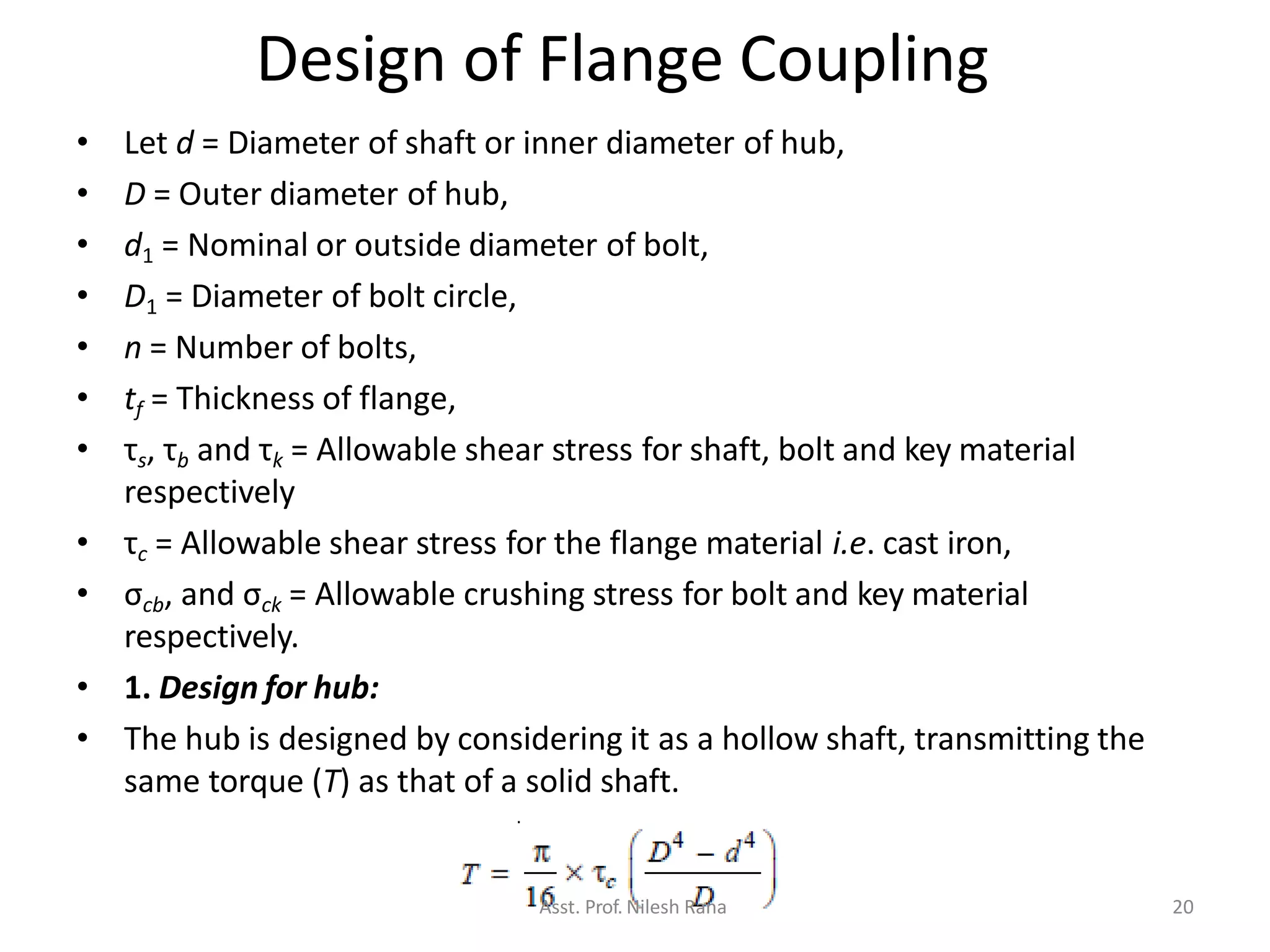
• 1. Design for hub:
• The hub is designed by considering it as a hollow shaft, transmitting the
same torque (T) as that of a solid shaft.
Asst. Prof. Nilesh Rana 20
• The outer diameter of hub is usually taken as twice the diameter of shaft.
• Therefore from the above relation, the induced shearing stress in the hub
may be checked.
• The length of hub (L) is taken as 1.5 d.
2. Design for key:- The key is designed with usual proportions and then
checked for shearing and crushing stresses.
• The length of key is taken equal to the length of hub.
3. Design for flange :-The flange at the junction of the hub is under shear
while transmitting the torque.
torque transmitted:-
Design of Flange Coupling
Asst. Prof. Nilesh Rana 21
• The thickness of flange is usually taken as half the diameter of shaft.
• The number of bolts (n) depends upon the diameter of shaft and the pitch
circle diameter of bolts (D1) is taken as 3 d.
• We know that
• From this equation, the diameter of bolt (d1) may be obtained.
• Now the diameter of bolt may be checked in crushing.
• We know that area resisting crushing of all the bolts= n × d1 × tf
• and crushing strength of all the bolts = (n × d1 × tf ) σcb
• From this equation, the induced crushing stress in the bolts may be
checked.
Design of Flange Coupling
Asst. Prof. Nilesh Rana 60
Asst. Prof. Nilesh Rana 23
Flexible Coupling
• flexible coupling is used to join the abutting
ends of shafts, when they are not in exact
alignment.
• Flexible coupling is used so as to permit an
axial misalignment of the shaft without undue
absorption of the power which the shaft are
transmitting.
Bushed-pin Flexible Coupling
Asst. Prof. Nilesh Rana 24
Asst. Prof. Nilesh Rana 25
• It is a modification of the rigid type of flange coupling.
• The coupling bolts are known as pins.
• The rubber or leather bushes are used over the pins.
• The two halves of the coupling are dissimilar in construction.
• clearance of 5 mm is left between the face of the two halves
of the coupling.
• The main modification is to reduce the bearing pressure on
the rubber or leather bushes and it should not exceed 0.5
N/mm2.
• A clearance of 5 mm is left between the face of the two halves
of the coupling.
• In order to keep the low bearing pressure, the pitch circle
diameter and the pin size is increased.
Bushed-pin Flexible Coupling
• Let l = Length of bush in the flange,
• d2 = Diameter of bush,
• pb = Bearing pressure on the bush or pin,
• n = Number of pins, and
• D1 = Diameter of pitch circle of the pins.
Bushed-pin Flexible Coupling
Asst. Prof. Nilesh Rana 26
Bushed-pin Flexible Coupling
• The threaded portion of the pin in the right hand flange
should be a tapping fit in the coupling hole to avoid bending
stresses.
• The threaded length of the pin should be as small as possible
so that the direct shear stress can be taken by the unthreaded
neck.
• Direct shear stress due to pure torsion in the coupling halves,
Asst. Prof. Nilesh Rana 27
• The bush portion of the pin acts as a cantilever beam of length l. Assuming
a uniform distribution of the load W along the bush, the maximum
bending moment on the pin,
• Since the pin is subjected to bending and shear stresses, therefore the
design must be checked
• either for the maximum principal stress or maximum shear stress by the
following relations :
• The value of maximum princiApsastl.P
sr
o
tf
r.eN
i
sl
e
ss
h
vR
a
an
ra
iesfrom 28 to 42 MPa.
Bushed-pin Flexible Coupling
66
Oldham Coupling
• used to join two shafts which have lateral mis-alignment.
• consists of two flanges A and B with slots and a central
floating part E with two tongues T1 and T2 at right angles.
• The central floating part is held by means of a pin passing
through the flanges.
• T1: fits into the slot of flange A
and allows for ‘to and fro’ relative
motion of the shafts.
• T2: fits into the slot of the flange
B and allows for vertical relative
motion of the parts.
• resultant of these two components of motion will
accommodate lateral misalignment of the shaft as they rotate.
Asst. Prof. Nilesh Rana 29
Asst. Prof. Nilesh Rana 30
Universal (or Hooke’s) Coupling
• used to connect two shafts whose axes intersect at a small angle.
• inclination of the two shafts may be constant, but in actual practice, it
varies when the motion is transmitted from one shaft to another.
• application of the universal or Hooke’s coupling is found in the
transmission from the gear box to the differential or back axle of the
automobiles.
• In such a case, we use two Hooke’s coupling, one at each end of the
propeller shaft, connecting the gear box at one end and the differential
on the other end
• In designing a universal coupling, the shaft diameter and the pin
diameter is obtained as discussed below. The other dimensions of
the coupling are fixed by proportions as shown in Fig.
• Let d = Diameter of shaft,
• dp = Diameter of pin, and
• τ and τ1 = Allowable shear stress for the material of the shaft and
pin respectively.
• From this relation, the diameter of shafts may be determined.
• Since the pin is in double shear, therefore the torque transmitted,
• From this relation, the diameter
of pin may be determined
Universal (or Hooke’s) Coupling
Asst. Prof. Nilesh Rana 31
Universal (or Hooke’s) Coupling
Asst. Prof. Nilesh Rana 32

Machine Design and Industrial Drafting.pptx

  • 1.
    Design of MachineElement Ch. 2:- Design of Couplings Asst. Prof. Nilesh Rana 1 Asst. Prof. Nilesh Rana Mechanical Dept. SNPIT&RC, Umrakh.
  • 2.
    Asst. Prof. NileshRana 2 Shaft Coupling • Shafts are usually available up to 7 metres length due to inconvenience in transport. • In order to have a greater length, it becomes necessary to join two or more pieces of the shaft by means of a coupling. • Used for – To provide for the connection of shafts of units such as a motor and generator. – To reduce the transmission of shock loads from one shaft to another. – To introduce protection against overloads.
  • 3.
    Asst. Prof. NileshRana 3 Requirements of a Good Shaft Coupling 1. 2. It should be easy to connect or disconnect. It should transmit the full power from one shaft to the other shaft without losses. It should hold the shafts in perfect alignment. It should reduce the transmission of shock loads from one shaft to another shaft. 3. 4.
  • 4.
    Types of ShaftsCouplings Shaft Coupling Rigid Coupling Clampor split- muff or compression coupling Sleeve or muff coupling. Flange coupling. Flexible coupling. Bushedpin type coupling Universal coupling, Oldhamcoupling Asst. Prof. Nilesh Rana 4
  • 5.
    Asst. Prof. NileshRana 5 Sleeve or Muff-coupling • simplest type of rigid coupling. • made of cast iron. • consists of a hollow cylinder whose inner diameter is the same as that of the shaft. • fitted over the ends of the two shafts by means of a gib head key. • The power is transmitted from one shaft to the other shaft by means of a key and a sleeve. • It is necessary that all the elements must be strong enough to transmit the torque.
  • 6.
    Sleeve or Muff-coupling •The usual proportions of a cast iron sleeve coupling are as follows:- • Outer diameter of the sleeve, D = 2d + 13 mm • and length of the sleeve, L = 3.5 d, where d is the diameter of the shaft. Asst. Prof. Nilesh Rana 6
  • 7.
    • 1. Designfor sleeve. – Let T = Torque to be transmitted by the coupling. – τc= Permissible shear stress for the material of the sleeve which is cast rion. • The safe value of shear stress for cast iron may be taken as 14 MPa. • torque transmitted by a hollow section, • From this expression, the induced shear stress in the sleeve may be cA h sste . Prc of.k Nie lesd h R. ana Sleeve or Muff-coupling 46
  • 8.
    • Design forkey:- – The width and thickness of the coupling key is obtained from the proportions. – The length of the coupling key is atleast equal to the length of the sleeve (i.e. 3.5 d). – The coupling key is usually made into two parts so that the length of the key in each shaft, – After fixing the length of key in each shaft, the induced shearing and crushing stresses may be checked. – torque transmitted, Sleeve or Muff-coupling Asst. Prof. Nilesh Rana 8
  • 9.
  • 10.
    Asst. Prof. NileshRana 10 Clamp or Compression Coupling • also known as split muff coupling. • In this the muff or sleeve is made into two halves and are bolted together. • halves of the muff are made of cast iron. • single key is fitted directly in the keyways of both the shafts. • One-half of the muff is fixed from below and the other half is placed from above. • Both the halves are held together by means of mild steel studs or bolts and nuts. • The number of bolts may be two, four or six. • This coupling may be used for heavy duty and moderate speeds. • The advantage of this coupling is that the position of the shafts need not be changed for assembling or disassembling of the coupling.
  • 11.
    • Diameter ofthe muff or sleeve, – D = 2d + 13 mm • Length of the muff or sleeve, L = 3.5 d where d = Diameter of the shaft. Clamp or Compression Coupling Asst. Prof. Nilesh Rana 11
  • 12.
    • 1. Designof muff and key:- – The muff and key are designed in the similar way as discussed in muff coupling. • 2. Design of clamping bolts:- • Let – T = Torque transmited by the shaft, – d = Diameter of shaft, – db = Root or effective diameter of bolt, – n = Number of bolts, – σt = Permissible tensile stress for bolt material, – μ = Coefficient of friction between the muff and shaft, and – L = Length of muff. • We know that the force exerted by each bolt, ∴ Force exerted by the bolts on each side of the shaft Clamp or Compression Coupling Asst. Prof. Nilesh Rana 12
  • 13.
    • Let pbe the pressure on the shaft and the muff surface due to the force, then for uniform pressure distribution over the surface, ∴ Frictional force between each shaft and muff, Clamp or Compression Coupling Asst. Prof. Nilesh Rana 13
  • 14.
    • and thetorque that can be transmitted by the coupling, • From this relation, the root diameter of the bolt (db) may be evaluated. • Note: The value of μ may be taken as 0.3. Clamp or Compression Coupling Asst. Prof. Nilesh Rana 14
  • 15.
    Asst. Prof. NileshRana 15 Flange Coupling • usually applies to a coupling having two separate cast iron flanges. • Each flange is mounted on the shaft end and keyed to it. • One of the flange has a projected portion and the other flange has a corresponding recess. • This helps to bring the shafts into line and to maintain alignment. • Two flanges are coupled together by means of bolts and nuts. • For adopted to heavy loads • used on large shafting.
  • 16.
    Unprotected type flangecoupling. • each shaft is keyed to the boss of a flange with a counter sunk key. • the flanges are coupled together by means of bolts. • three, four or six bolts are used. • The usual proportions for an unprotected type cast iron flange couplings are:- • If d is the diameter of the shaft or inner diameter of the hub, then • Outside diameter of hub, D = 2 d • Length of hub, L = 1.5 d • Pitch circle diameter of bolts, D1 = 3d • Outside diameter of flange, D2 = D1 + (D1 – D) = 2 D1 – D = 4 d • Thickness of flange, tf = 0.5 d • Number of bolts = 3, for d upto 40 mm = 4, for d upto 100 mm Asst. Prof. Nilesh Rana 16 = 6, for d upto 180 mm
  • 17.
  • 18.
    Protected type flangecoupling • In this coupling, the bolts and nuts are protected by flanges on the two halves of the coupling, in order to avoid danger to the workman. • The thickness of the protective circumferential flange (tp) is taken as 0.25 d. • The other proportions of the coupling are same as for unprotected type flange coupling Asst. Prof. Nilesh Rana 18
  • 19.
    Marine type flangecoupling • the flanges are forged integral with the shafts. • The flanges are held together by means of tapered headless bolts, numbering from four to twelve depending upon the diameter of shaft. • Thickness of flange = d / 3 • Taper of bolt = 1 in 20 to 1 in 40 • Pitch circle diameter of bolts, D1 = 1.6 d • Outside diameter of flange, D2 = 2.2 d Number of bolts for marine type flange coupling. [According to IS : 3653 – 1966 (Reaffirmed 1990)] Asst. Prof. Nilesh Rana 19
  • 20.
    Design of FlangeCoupling • Let d = Diameter of shaft or inner diameter of hub, • D = Outer diameter of hub, • d1 = Nominal or outside diameter of bolt, • D1 = Diameter of bolt circle, • n = Number of bolts, • tf = Thickness of flange, • τs, τb and τk = Allowable shear stress for shaft, bolt and key material respectively • τc = Allowable shear stress for the flange material i.e. cast iron, • σcb, and σck = Allowable crushing stress for bolt and key material respectively. • 1. Design for hub: • The hub is designed by considering it as a hollow shaft, transmitting the same torque (T) as that of a solid shaft. Asst. Prof. Nilesh Rana 20
  • 21.
    • The outerdiameter of hub is usually taken as twice the diameter of shaft. • Therefore from the above relation, the induced shearing stress in the hub may be checked. • The length of hub (L) is taken as 1.5 d. 2. Design for key:- The key is designed with usual proportions and then checked for shearing and crushing stresses. • The length of key is taken equal to the length of hub. 3. Design for flange :-The flange at the junction of the hub is under shear while transmitting the torque. torque transmitted:- Design of Flange Coupling Asst. Prof. Nilesh Rana 21
  • 22.
    • The thicknessof flange is usually taken as half the diameter of shaft. • The number of bolts (n) depends upon the diameter of shaft and the pitch circle diameter of bolts (D1) is taken as 3 d. • We know that • From this equation, the diameter of bolt (d1) may be obtained. • Now the diameter of bolt may be checked in crushing. • We know that area resisting crushing of all the bolts= n × d1 × tf • and crushing strength of all the bolts = (n × d1 × tf ) σcb • From this equation, the induced crushing stress in the bolts may be checked. Design of Flange Coupling Asst. Prof. Nilesh Rana 60
  • 23.
    Asst. Prof. NileshRana 23 Flexible Coupling • flexible coupling is used to join the abutting ends of shafts, when they are not in exact alignment. • Flexible coupling is used so as to permit an axial misalignment of the shaft without undue absorption of the power which the shaft are transmitting.
  • 24.
  • 25.
    Asst. Prof. NileshRana 25 • It is a modification of the rigid type of flange coupling. • The coupling bolts are known as pins. • The rubber or leather bushes are used over the pins. • The two halves of the coupling are dissimilar in construction. • clearance of 5 mm is left between the face of the two halves of the coupling. • The main modification is to reduce the bearing pressure on the rubber or leather bushes and it should not exceed 0.5 N/mm2. • A clearance of 5 mm is left between the face of the two halves of the coupling. • In order to keep the low bearing pressure, the pitch circle diameter and the pin size is increased. Bushed-pin Flexible Coupling
  • 26.
    • Let l= Length of bush in the flange, • d2 = Diameter of bush, • pb = Bearing pressure on the bush or pin, • n = Number of pins, and • D1 = Diameter of pitch circle of the pins. Bushed-pin Flexible Coupling Asst. Prof. Nilesh Rana 26
  • 27.
    Bushed-pin Flexible Coupling •The threaded portion of the pin in the right hand flange should be a tapping fit in the coupling hole to avoid bending stresses. • The threaded length of the pin should be as small as possible so that the direct shear stress can be taken by the unthreaded neck. • Direct shear stress due to pure torsion in the coupling halves, Asst. Prof. Nilesh Rana 27
  • 28.
    • The bushportion of the pin acts as a cantilever beam of length l. Assuming a uniform distribution of the load W along the bush, the maximum bending moment on the pin, • Since the pin is subjected to bending and shear stresses, therefore the design must be checked • either for the maximum principal stress or maximum shear stress by the following relations : • The value of maximum princiApsastl.P sr o tf r.eN i sl e ss h vR a an ra iesfrom 28 to 42 MPa. Bushed-pin Flexible Coupling 66
  • 29.
    Oldham Coupling • usedto join two shafts which have lateral mis-alignment. • consists of two flanges A and B with slots and a central floating part E with two tongues T1 and T2 at right angles. • The central floating part is held by means of a pin passing through the flanges. • T1: fits into the slot of flange A and allows for ‘to and fro’ relative motion of the shafts. • T2: fits into the slot of the flange B and allows for vertical relative motion of the parts. • resultant of these two components of motion will accommodate lateral misalignment of the shaft as they rotate. Asst. Prof. Nilesh Rana 29
  • 30.
    Asst. Prof. NileshRana 30 Universal (or Hooke’s) Coupling • used to connect two shafts whose axes intersect at a small angle. • inclination of the two shafts may be constant, but in actual practice, it varies when the motion is transmitted from one shaft to another. • application of the universal or Hooke’s coupling is found in the transmission from the gear box to the differential or back axle of the automobiles. • In such a case, we use two Hooke’s coupling, one at each end of the propeller shaft, connecting the gear box at one end and the differential on the other end
  • 31.
    • In designinga universal coupling, the shaft diameter and the pin diameter is obtained as discussed below. The other dimensions of the coupling are fixed by proportions as shown in Fig. • Let d = Diameter of shaft, • dp = Diameter of pin, and • τ and τ1 = Allowable shear stress for the material of the shaft and pin respectively. • From this relation, the diameter of shafts may be determined. • Since the pin is in double shear, therefore the torque transmitted, • From this relation, the diameter of pin may be determined Universal (or Hooke’s) Coupling Asst. Prof. Nilesh Rana 31
  • 32.
    Universal (or Hooke’s)Coupling Asst. Prof. Nilesh Rana 32