SHAFT COUPLINGS – Bushed Pin TypeSHAFT COUPLINGS – Bushed Pin Type
D. Narendra Varma,
Assistant Professor,
Mechanical Engineering Dept.,
Miracle Educational society Group of Institutions.
Classification of Shaft couplings
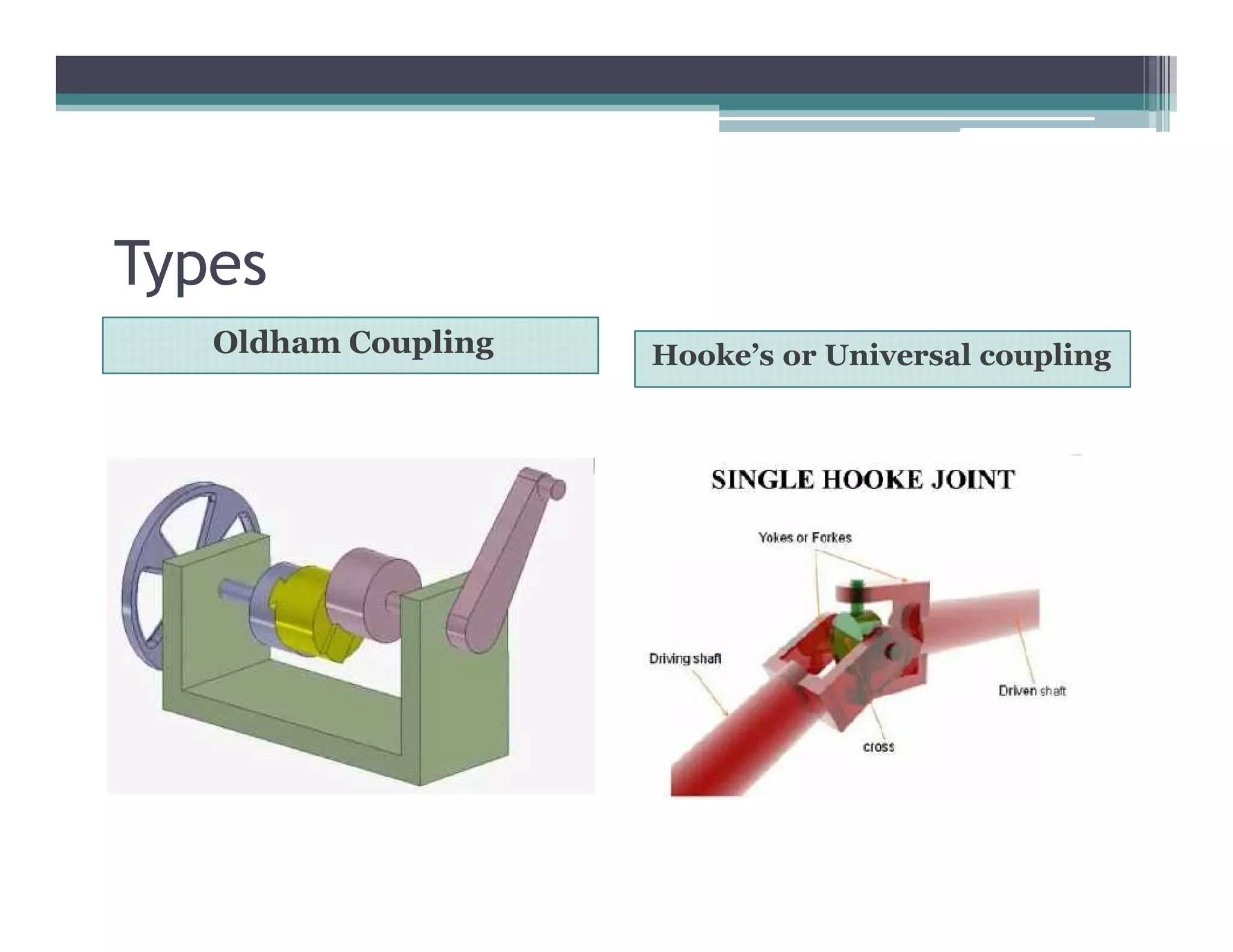
Types
Oldham Coupling Hooke’s or Universal coupling
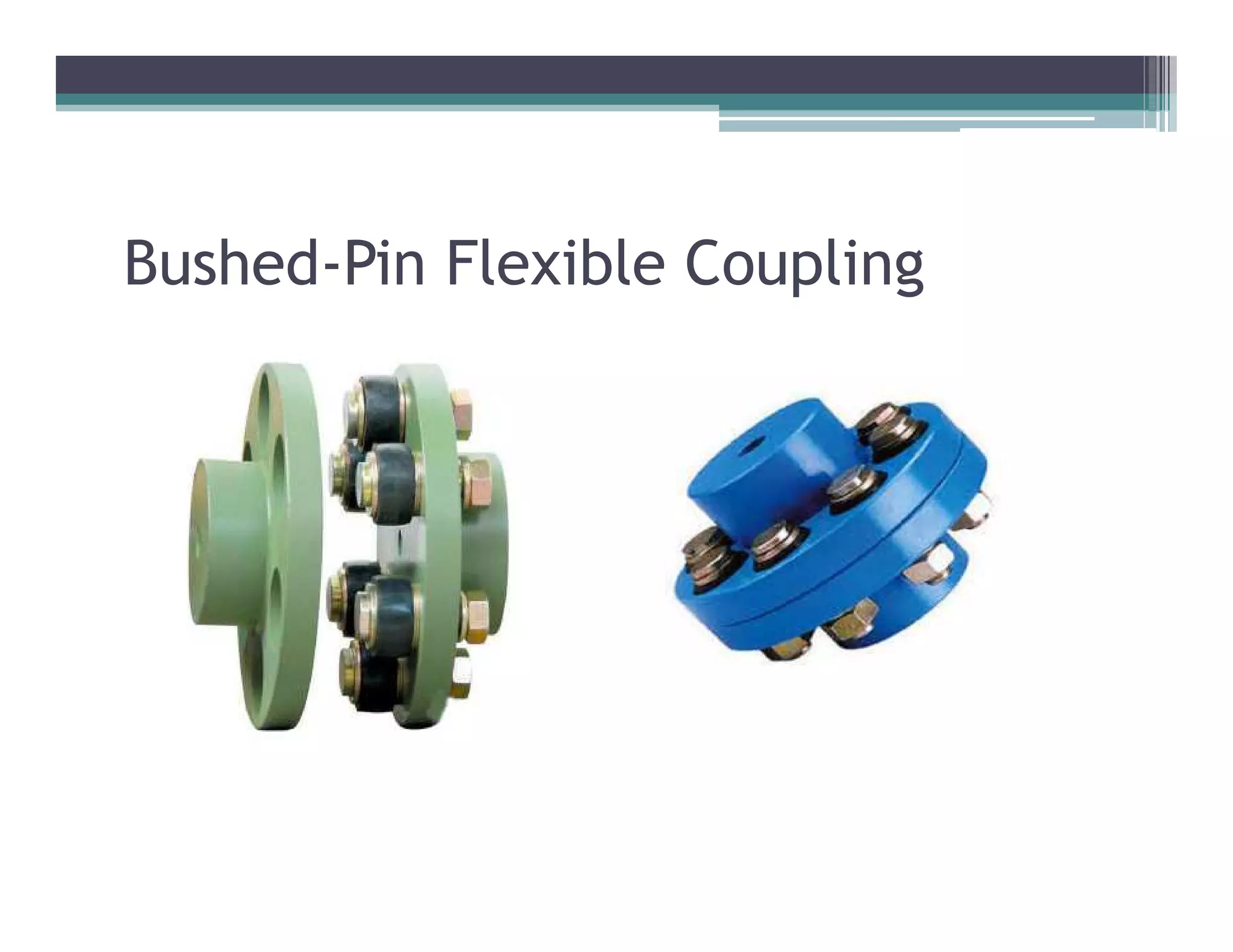
Bushed-Pin Flexible Coupling
Misalignment
• 0.5mm , 1.5o
Reasons
• Deflection of shafts due to lateral
forces
• Error in shaft mounting due to
manufacturing tolerances
• Use of 2 separately manufactured
units such as electric motor & worm
gear box
• Thermal expansion of the parts
• 0.5mm , 1.5o
Reasons
• Deflection of shafts due to lateral
forces
• Error in shaft mounting due to
manufacturing tolerances
• Use of 2 separately manufactured
units such as electric motor & worm
gear box
• Thermal expansion of the parts
Advantages
• Can tolerate misalignments
• Prevents transmission of shock from one shaft to
other and absorbs vibrations
• Can be used for transmitting high torques
• Simple in construction
• Easy to assemble & dismantle
• Easy to design & manufacture
Disadvantages
• Cost is high
• More radial space
• Can tolerate misalignments
• Prevents transmission of shock from one shaft to
other and absorbs vibrations
• Can be used for transmitting high torques
• Simple in construction
• Easy to assemble & dismantle
• Easy to design & manufacture
Disadvantages
• Cost is high
• More radial space
Proportions of Bushed-Pin Flexible
Coupling
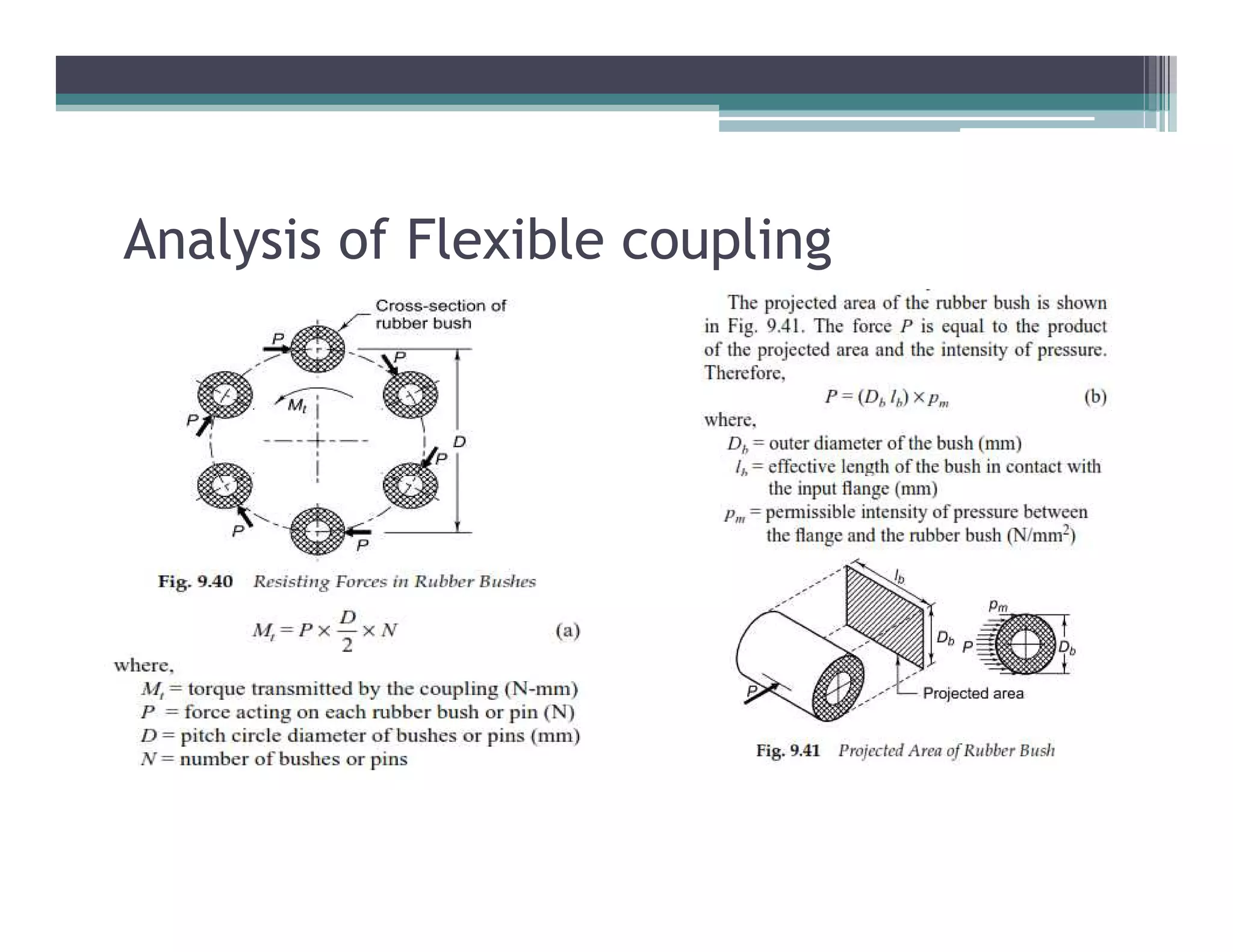
Analysis of Flexible coupling
Features of Flexible bush coupling
• Gap between the flanges for compensating the
misalignment
• Flexible bush coupling either has greater no. of
bolts (or pins) than rigid coupling or has larger
bolt circle diameter.
• Gap between the flanges for compensating the
misalignment
• Flexible bush coupling either has greater no. of
bolts (or pins) than rigid coupling or has larger
bolt circle diameter.
Design Procedure of Flexible coupling
Problem 1
A flexible coupling, illustrated in Fig. 9.39, is used to
transmit 15 kW power at 100 rpm. There are six
pins and their pitch circle diameter is 200 mm. The
effective length of the bush (l), the gap between two
flanges and the length of the pin in contact with the
right hand flange are 35, 5 and 23 mm respectively.
The permissible shear and bending stresses for the
pin are 35 and 152 N/mm2 respectively. Calculate:
(i) pin diameter by shear consideration; and
(ii) pin diameter by bending consideration.
A flexible coupling, illustrated in Fig. 9.39, is used to
transmit 15 kW power at 100 rpm. There are six
pins and their pitch circle diameter is 200 mm. The
effective length of the bush (l), the gap between two
flanges and the length of the pin in contact with the
right hand flange are 35, 5 and 23 mm respectively.
The permissible shear and bending stresses for the
pin are 35 and 152 N/mm2 respectively. Calculate:
(i) pin diameter by shear consideration; and
(ii) pin diameter by bending consideration.
Problem 2
It is required to design a bushed-pin type flexible
coupling to connect the output shaft of an
electric motor to the shaft of a centrifugal
pump. The motor delivers 20 kW power at 720
rpm. The starting torque of the motor can be
assumed to be 150% of the rated torque. Design
the coupling and specify the dimensions of its
components.
It is required to design a bushed-pin type flexible
coupling to connect the output shaft of an
electric motor to the shaft of a centrifugal
pump. The motor delivers 20 kW power at 720
rpm. The starting torque of the motor can be
assumed to be 150% of the rated torque. Design
the coupling and specify the dimensions of its
components.
Key stresses
Shear -73.68 < 100 N/mm2
Compressive 168.41 < 100
N/mm2
References:
1. Machine Design – V.B.Bandari .
2. Machine Design – R.S. Khurmi
3. Design Data hand Book - S MD Jalaludin.
1. Machine Design – V.B.Bandari .
2. Machine Design – R.S. Khurmi
3. Design Data hand Book - S MD Jalaludin.

Bushed pin type flexible coupling

  • 1.
    SHAFT COUPLINGS –Bushed Pin TypeSHAFT COUPLINGS – Bushed Pin Type D. Narendra Varma, Assistant Professor, Mechanical Engineering Dept., Miracle Educational society Group of Institutions.
  • 2.
  • 3.
    Types Oldham Coupling Hooke’sor Universal coupling
  • 4.
  • 5.
    Misalignment • 0.5mm ,1.5o Reasons • Deflection of shafts due to lateral forces • Error in shaft mounting due to manufacturing tolerances • Use of 2 separately manufactured units such as electric motor & worm gear box • Thermal expansion of the parts • 0.5mm , 1.5o Reasons • Deflection of shafts due to lateral forces • Error in shaft mounting due to manufacturing tolerances • Use of 2 separately manufactured units such as electric motor & worm gear box • Thermal expansion of the parts
  • 6.
    Advantages • Can toleratemisalignments • Prevents transmission of shock from one shaft to other and absorbs vibrations • Can be used for transmitting high torques • Simple in construction • Easy to assemble & dismantle • Easy to design & manufacture Disadvantages • Cost is high • More radial space • Can tolerate misalignments • Prevents transmission of shock from one shaft to other and absorbs vibrations • Can be used for transmitting high torques • Simple in construction • Easy to assemble & dismantle • Easy to design & manufacture Disadvantages • Cost is high • More radial space
  • 7.
    Proportions of Bushed-PinFlexible Coupling
  • 8.
  • 10.
    Features of Flexiblebush coupling • Gap between the flanges for compensating the misalignment • Flexible bush coupling either has greater no. of bolts (or pins) than rigid coupling or has larger bolt circle diameter. • Gap between the flanges for compensating the misalignment • Flexible bush coupling either has greater no. of bolts (or pins) than rigid coupling or has larger bolt circle diameter.
  • 11.
    Design Procedure ofFlexible coupling
  • 13.
    Problem 1 A flexiblecoupling, illustrated in Fig. 9.39, is used to transmit 15 kW power at 100 rpm. There are six pins and their pitch circle diameter is 200 mm. The effective length of the bush (l), the gap between two flanges and the length of the pin in contact with the right hand flange are 35, 5 and 23 mm respectively. The permissible shear and bending stresses for the pin are 35 and 152 N/mm2 respectively. Calculate: (i) pin diameter by shear consideration; and (ii) pin diameter by bending consideration. A flexible coupling, illustrated in Fig. 9.39, is used to transmit 15 kW power at 100 rpm. There are six pins and their pitch circle diameter is 200 mm. The effective length of the bush (l), the gap between two flanges and the length of the pin in contact with the right hand flange are 35, 5 and 23 mm respectively. The permissible shear and bending stresses for the pin are 35 and 152 N/mm2 respectively. Calculate: (i) pin diameter by shear consideration; and (ii) pin diameter by bending consideration.
  • 15.
    Problem 2 It isrequired to design a bushed-pin type flexible coupling to connect the output shaft of an electric motor to the shaft of a centrifugal pump. The motor delivers 20 kW power at 720 rpm. The starting torque of the motor can be assumed to be 150% of the rated torque. Design the coupling and specify the dimensions of its components. It is required to design a bushed-pin type flexible coupling to connect the output shaft of an electric motor to the shaft of a centrifugal pump. The motor delivers 20 kW power at 720 rpm. The starting torque of the motor can be assumed to be 150% of the rated torque. Design the coupling and specify the dimensions of its components.
  • 19.
    Key stresses Shear -73.68< 100 N/mm2 Compressive 168.41 < 100 N/mm2
  • 21.
    References: 1. Machine Design– V.B.Bandari . 2. Machine Design – R.S. Khurmi 3. Design Data hand Book - S MD Jalaludin. 1. Machine Design – V.B.Bandari . 2. Machine Design – R.S. Khurmi 3. Design Data hand Book - S MD Jalaludin.