UNIT-1 SPRINGS
Dr. L K Bhagi
Associate Professor
School of Mechanical Engineering
Lovely Professional University
SPRINGS
➢ A spring is basically defined as an ELASTIC BODY
whose function is to deformed when loaded and to
recover its original shape when the load is removed
➢ A spring is a machine member capable of providing
large elastic deformation.
2
Design of Machine Elements II MEC306
(Dr. L K Bhagi)
Objectives of Spring
Following are the objectives of a spring when used as a machine member:
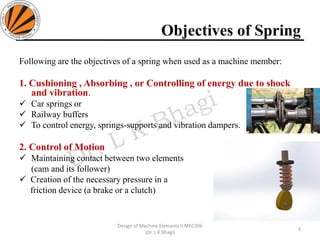
1. Cushioning , Absorbing , or Controlling of energy due to shock
and vibration.
✓ Car springs or
✓ Railway buffers
✓ To control energy, springs-supports and vibration dampers.
2. Control of Motion
✓ Maintaining contact between two elements
(cam and its follower)
✓ Creation of the necessary pressure in a
friction device (a brake or a clutch)
3
Design of Machine Elements II MEC306
(Dr. L K Bhagi)
Objectives of Spring
3. Measuring Forces
Spring balance
4. Storing of Energy
In clocks or Toys
The clock has spiral type of spring which is wound to coil and then
the stored energy helps gradual recoil of the spring when in
operation.
4
Design of Machine Elements II MEC306
(Dr. L K Bhagi)
Before considering the design aspects of springs let’s
have a quick look at the SPRING MATERIALS and
MANUFACTURING METHODS.
Selection of Material for Spring Depends Upon the
Following Factors
✓ The Load acting on the spring
✓ The range of stress through which spring operates.
✓ The limitations of mass and volume of spring.
✓ The environmental conditions in which spring will operate.
6
Design of Machine Elements II MEC306
(Dr. L K Bhagi)
Material of the spring should have
• High fatigue strength
• High ductility
• High resilience and
• It should be creep resistant.
Mainly depends upon the service for which they are used i.e.
• Severe service (automotive engine valve springs)
• Average service or (automobile suspension springs)
• Light service (safety valve springs)
7
Design of Machine Elements II MEC306
(Dr. L K Bhagi)
Four basic varieties of steel wire used in
majority of applications
1. Patented and cold-drawn steel wire(unalloyed)
(0.85-0.95% C)
2. Oil-hardened and tempered spring steel wires
(0.55-0.75% C) (moderate fluctuating stresses) and valve
spring wires (0.60 – 0.75% C) (high magnitude of fluctuating
stresses)
8
Design of Machine Elements II MEC306
(Dr. L K Bhagi)
Four basic varieties of steel wire used in
majority of applications
3. Oil-hardened and tempered steel wires(alloyed)
Chromium-Vanadium steel (0.48-0.53% C 0.8-1.1% Cr 0.15% V)
Chromium-silicon steel (0.51-0.59% C 0.6-0.8% Cr 1.2-1.6% Si)
Used for high stress conditions and at high temperature up to
220 -250oC
4. Stainless steel spring wires (Cr 17-19 % and Ni 8 -10 %)
Good tensile strength, High corrosion resistance and Good heat
resistance
It maintains its strength at temperatures up to 300oC
9
Design of Machine Elements II MEC306
(Dr. L K Bhagi)
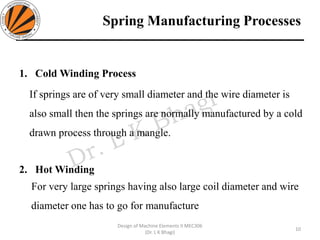
Spring Manufacturing Processes
1. Cold Winding Process
If springs are of very small diameter and the wire diameter is
also small then the springs are normally manufactured by a cold
drawn process through a mangle.
2. Hot Winding
For very large springs having also large coil diameter and wire
diameter one has to go for manufacture
10
Design of Machine Elements II MEC306
(Dr. L K Bhagi)
Spring Manufacturing Processes
3. Heat Treatment
Whether the steel has been coiled hot or cold, the process has
created stress within the material. To relieve stress and allow the
steel to maintain its characteristic resilience, the spring must be
tempered by heat treating it.
4. Grinding
If the design requires for flat ends on the spring, the ends are
ground at this stage of the manufacturing process.
11
Design of Machine Elements II MEC306
(Dr. L K Bhagi)
Spring Manufacturing Processes
3. Shoot Peening
This process strengthens the steel to resist metal fatigue and
cracking during its lifetime of repeated loadings.
4. Coating
To prevent corrosion, the entire surface of the spring is protected
by coating it with another metal such as zinc or chromium.
5. Packaging
12
Design of Machine Elements II MEC306
(Dr. L K Bhagi)
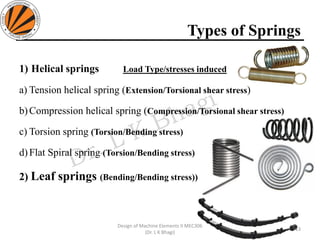
Types of Springs
1) Helical springs Load Type/stresses induced
a) Tension helical spring (Extension/Torsional shear stress)
b)Compression helical spring (Compression/Torsional shear stress)
c) Torsion spring (Torsion/Bending stress)
d)Flat Spiral spring (Torsion/Bending stress)
2) Leaf springs (Bending/Bending stress))
13
Design of Machine Elements II MEC306
(Dr. L K Bhagi)
Types of Springs Helical Springs
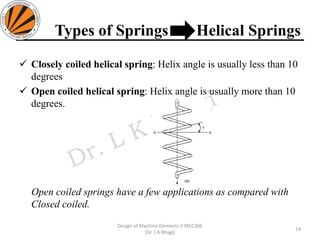
✓ Closely coiled helical spring: Helix angle is usually less than 10
degrees
✓ Open coiled helical spring: Helix angle is usually more than 10
degrees.
Open coiled springs have a few applications as compared with
Closed coiled.
14
Design of Machine Elements II MEC306
(Dr. L K Bhagi)
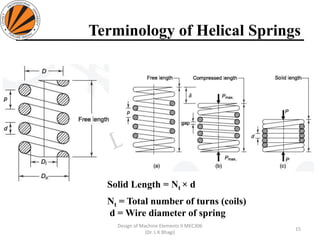
Terminology of Helical Springs
15
Design of Machine Elements II MEC306
(Dr. L K Bhagi)
Solid Length = Nt × d
Nt = Total number of turns (coils)
d = Wire diameter of spring
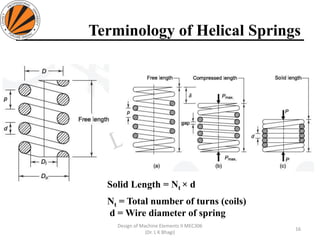
Terminology of Helical Springs
16
Design of Machine Elements II MEC306
(Dr. L K Bhagi)
Solid Length = Nt × d
Nt = Total number of turns (coils)
d = Wire diameter of spring
17
Design of Machine Elements II MEC306
(Dr. L K Bhagi)
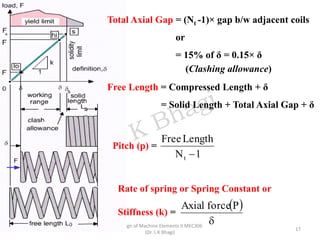
Total Axial Gap = (Nt -1)× gap b/w adjacent coils
or
= 15% of δ = 0.15× δ
(Clashing allowance)
Free Length = Compressed Length + δ
= Solid Length + Total Axial Gap + δ
Pitch (p) =
1N
LengthFree
t −
Rate of spring or Spring Constant or
Stiffness (k) =
( )

PforceAxial
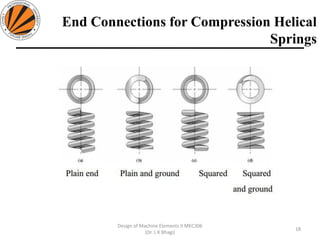
End Connections for Compression Helical
Springs
18
Design of Machine Elements II MEC306
(Dr. L K Bhagi)
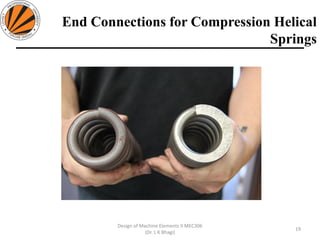
End Connections for Compression Helical
Springs
19
Design of Machine Elements II MEC306
(Dr. L K Bhagi)
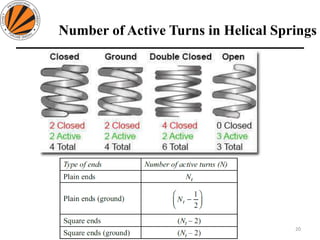
Number of Active Turns in Helical Springs
20
Design of Machine Elements II MEC306
(Dr. L K Bhagi)
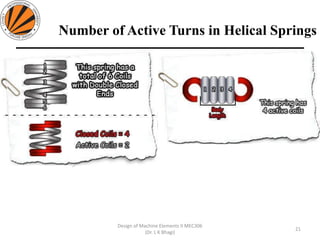
Number of Active Turns in Helical Springs
21
Design of Machine Elements II MEC306
(Dr. L K Bhagi)
22
Design of Machine Elements II MEC306
(Dr. L K Bhagi)
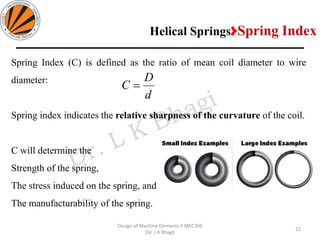
Spring Index (C) is defined as the ratio of mean coil diameter to wire
diameter:
Spring index indicates the relative sharpness of the curvature of the coil.
C will determine the
Strength of the spring,
The stress induced on the spring, and
The manufacturability of the spring.
d
D
C =
Helical Springs>Spring Index
23
Design of Machine Elements II MEC306
(Dr. L K Bhagi)
d
D
C =
Helical Springs>Spring Index
24
Design of Machine Elements II MEC306
(Dr. L K Bhagi)
25
Design of Machine Elements II MEC306
(Dr. L K Bhagi)
Helical Springs>Spring Index
26
Design of Machine Elements II MEC306
(Dr. L K Bhagi)
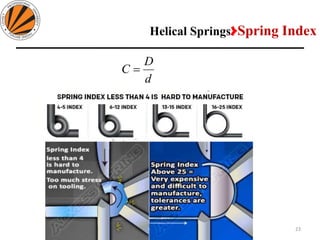
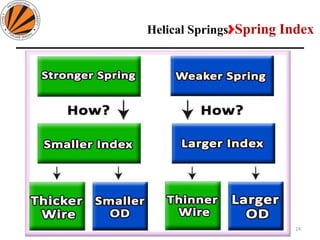
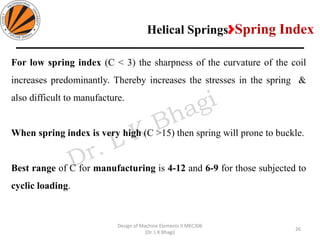
For low spring index (C < 3) the sharpness of the curvature of the coil
increases predominantly. Thereby increases the stresses in the spring &
also difficult to manufacture.
When spring index is very high (C >15) then spring will prone to buckle.
Best range of C for manufacturing is 4-12 and 6-9 for those subjected to
cyclic loading.
Helical Springs>Spring Index
27
Design of Machine Elements II MEC306
(Dr. L K Bhagi)
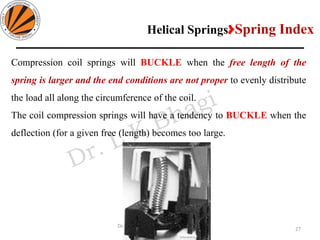
Compression coil springs will BUCKLE when the free length of the
spring is larger and the end conditions are not proper to evenly distribute
the load all along the circumference of the coil.
The coil compression springs will have a tendency to BUCKLE when the
deflection (for a given free (length) becomes too large.
Helical Springs>Spring Index
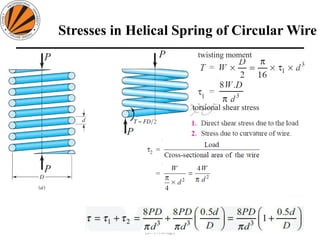
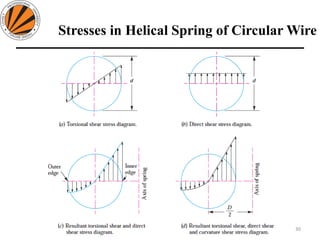
Stresses in Helical Spring of Circular Wire
28
Design of Machine Elements II MEC306
(Dr. L K Bhagi)
torsional shear stress
twisting moment
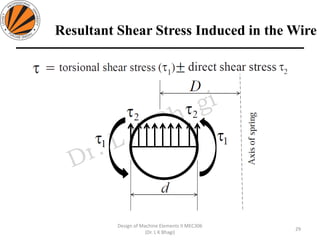
Resultant Shear Stress Induced in the Wire
29
Design of Machine Elements II MEC306
(Dr. L K Bhagi)
Stresses in Helical Spring of Circular Wire
30
Design of Machine Elements II MEC306
(Dr. L K Bhagi)
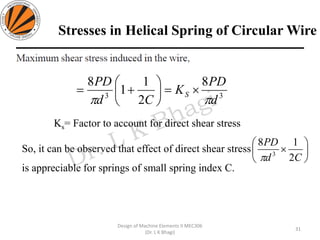
Stresses in Helical Spring of Circular Wire
31
Design of Machine Elements II MEC306
(Dr. L K Bhagi)
33
8
2
1
1
8
d
PD
K
Cd
PD
S

=





+=
Ks= Factor to account for direct shear stress
So, it can be observed that effect of direct shear stress
is appreciable for springs of small spring index C.







Cd
PD
2
18
3

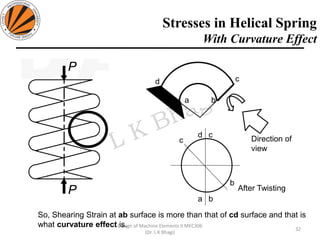
Stresses in Helical Spring
With Curvature Effect
32
Design of Machine Elements II MEC306
(Dr. L K Bhagi)
a b
Direction of
view
d
a b
d c
c
After Twisting
b
c
So, Shearing Strain at ab surface is more than that of cd surface and that is
what curvature effect is.
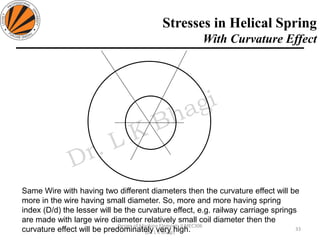
Stresses in Helical Spring
With Curvature Effect
33
Design of Machine Elements II MEC306
(Dr. L K Bhagi)
Same Wire with having two different diameters then the curvature effect will be
more in the wire having small diameter. So, more and more having spring
index (D/d) the lesser will be the curvature effect, e.g. railway carriage springs
are made with large wire diameter relatively small coil diameter then the
curvature effect will be predominately very high.
Stresses in Helical Spring
With Curvature Effect
34
Design of Machine Elements II MEC306
(Dr. L K Bhagi)
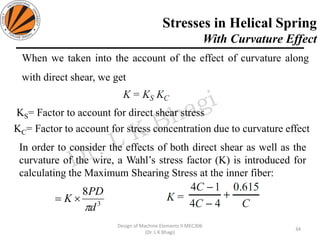
3
8
d
PD
K

=
KS= Factor to account for direct shear stress
KC= Factor to account for stress concentration due to curvature effect
When we taken into the account of the effect of curvature along
with direct shear, we get
In order to consider the effects of both direct shear as well as the
curvature of the wire, a Wahl’s stress factor (K) is introduced for
calculating the Maximum Shearing Stress at the inner fiber:
Deflection of Helical Spring of Circular Wire
35
Design of Machine Elements II MEC306
(Dr. L K Bhagi)
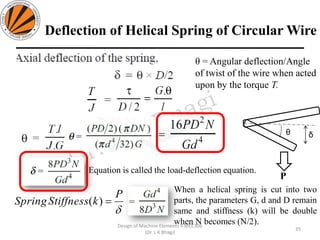
θ = Angular deflection/Angle
of twist of the wire when acted
upon by the torque T.
θ δ
P
Equation is called the load-deflection equation.

P
kStiffnessSpring =)(
When a helical spring is cut into two
parts, the parameters G, d and D remain
same and stiffness (k) will be double
when N becomes (N/2).
Design of Machine Elements II MEC306
(Dr. L K Bhagi)
36
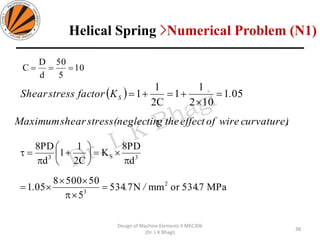
Helical Spring >Numerical Problem (N1)
A compression coil spring made of an alloy steel is having the following
specifications :
Mean diameter of coil = 50 mm ; Wire diameter = 5 mm ; Number of
active coils = 20.
If this spring is subjected to an axial load of 500 N ; calculate the
maximum shear stress (neglect the curvature effect) to which the
spring material is subjected.
37
Design of Machine Elements II MEC306
(Dr. L K Bhagi)
10
5
50
d
D
C ===
( ) 051
102
1
1
C2
1
1 .KfactorstressShear S =

+=+=
38
Design of Machine Elements II MEC306
(Dr. L K Bhagi)
MPa7.534ormmN7534
5
505008
051
d
PD8
K
C2
1
1
d
PD8
2
3
3S3
/.. =


=

=





+

=
,curvature)wireofeffecttheg(neglectinstressshearMaximum
Helical Spring >Numerical Problem (N1)
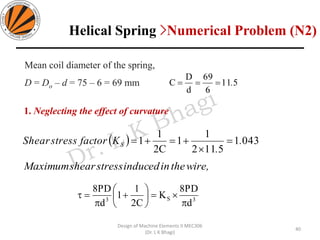
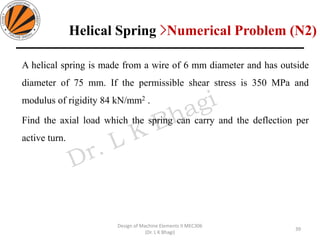
A helical spring is made from a wire of 6 mm diameter and has outside
diameter of 75 mm. If the permissible shear stress is 350 MPa and
modulus of rigidity 84 kN/mm2 .
Find the axial load which the spring can carry and the deflection per
active turn.
39
Design of Machine Elements II MEC306
(Dr. L K Bhagi)
Helical Spring >Numerical Problem (N2)
511
6
69
d
D
C .===
( ) 0431
5112
1
1
C2
1
1 .
.
KfactorstressShear S =

+=+=
40
Design of Machine Elements II MEC306
(Dr. L K Bhagi)
Mean coil diameter of the spring,
D = Do – d = 75 – 6 = 69 mm
1. Neglecting the effect of curvature
wire,theininducedstressshearMaximum
3S3
d
PD8
K
C2
1
1
d
PD8

=





+

=
Helical Spring >Numerical Problem (N2)
41
Design of Machine Elements II MEC306
(Dr. L K Bhagi)
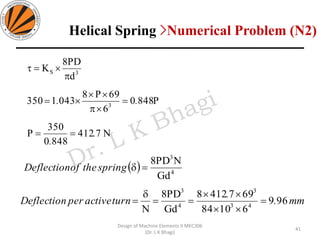
N7412
8480
350
P
P8480
6
69P8
0431350
d
PD8
K
3
3S
.
.
..
==
=


=

=
( ) 4
3
Gd
NPD8
=springtheofDeflection
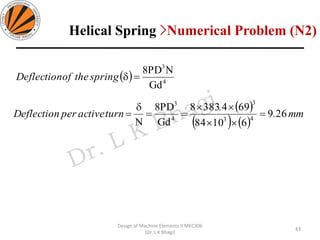
mm.
.
turnactiveperDeflection 969
61084
6974128
Gd
PD8
N 43
3
4
3
=


==

=
Helical Spring >Numerical Problem (N2)
42
Design of Machine Elements II MEC306
(Dr. L K Bhagi)
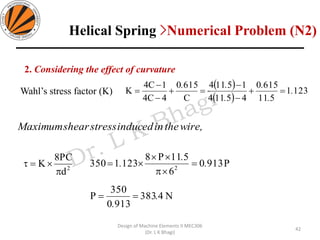
wire,theininducedstressshearMaximum
2
d
PC8
K

=
2. Considering the effect of curvature
( )
( )
1231
511
6150
45114
15114
C
6150
4C4
1C4
K .
.
.
.
..
=+
−
−
=+
−
−
=Wahl’s stress factor (K)
N4383
9130
350
P
P9130
6
511P8
1231350 2
.
.
.
.
.
==
=


=
Helical Spring >Numerical Problem (N2)
43
Design of Machine Elements II MEC306
(Dr. L K Bhagi)
( ) 4
3
Gd
NPD8
=springtheofDeflection
( )
( ) ( )
mm.
.
turnactiveperDeflection 269
61084
6943838
Gd
PD8
N 43
3
4
3
=


==

=
Helical Spring >Numerical Problem (N2)
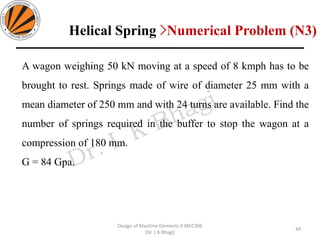
A wagon weighing 50 kN moving at a speed of 8 kmph has to be
brought to rest. Springs made of wire of diameter 25 mm with a
mean diameter of 250 mm and with 24 turns are available. Find the
number of springs required in the buffer to stop the wagon at a
compression of 180 mm.
G = 84 Gpa.
44
Design of Machine Elements II MEC306
(Dr. L K Bhagi)
Helical Spring >Numerical Problem (N3)
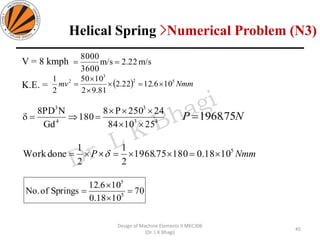
V = 8 kmph
K.E. =
m/s22.2m/s
3600
8000
==
( ) Nmmmv 52
3
2
106.1222.2
81.92
1050
2
1
=


=
43
3
4
3
251084
24250P8
180
Gd
NPD8


== NP 75.1968=
NmmP 5
1018.018075.1968
2
1
2
1
doneWork === 
70
1018.0
106.12
SpringsofNo. 5
5
=


=
45
Design of Machine Elements II MEC306
(Dr. L K Bhagi)
Helical Spring >Numerical Problem (N3)
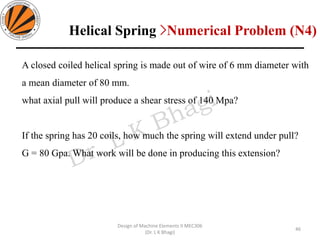
A closed coiled helical spring is made out of wire of 6 mm diameter with
a mean diameter of 80 mm.
what axial pull will produce a shear stress of 140 Mpa?
If the spring has 20 coils, how much the spring will extend under pull?
G = 80 Gpa. What work will be done in producing this extension?
46
Design of Machine Elements II MEC306
(Dr. L K Bhagi)
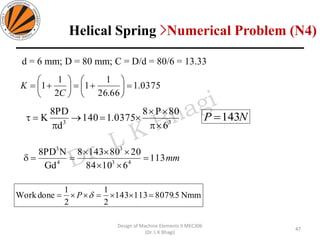
Helical Spring >Numerical Problem (N4)
d = 6 mm; D = 80 mm; C = D/d = 80/6 = 13.33
0375.1
66.26
1
1
2
1
1 =





+=





+=
C
K
33
6
80P8
03751140
d
PD8
K


=→

= . NP 143=
mm113
61084
20801438
Gd
NPD8
43
3
4
3
=


==
Nmm5.8079113143
2
1
2
1
doneWork === P
47
Design of Machine Elements II MEC306
(Dr. L K Bhagi)
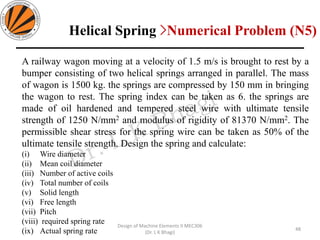
Helical Spring >Numerical Problem (N4)
A railway wagon moving at a velocity of 1.5 m/s is brought to rest by a
bumper consisting of two helical springs arranged in parallel. The mass
of wagon is 1500 kg. the springs are compressed by 150 mm in bringing
the wagon to rest. The spring index can be taken as 6. the springs are
made of oil hardened and tempered steel wire with ultimate tensile
strength of 1250 N/mm2 and modulus of rigidity of 81370 N/mm2. The
permissible shear stress for the spring wire can be taken as 50% of the
ultimate tensile strength. Design the spring and calculate:
(i) Wire diameter
(ii) Mean coil diameter
(iii) Number of active coils
(iv) Total number of coils
(v) Solid length
(vi) Free length
(vii) Pitch
(viii) required spring rate
(ix) Actual spring rate 48
Design of Machine Elements II MEC306
(Dr. L K Bhagi)
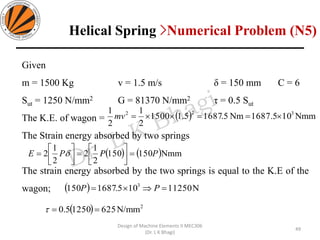
Helical Spring >Numerical Problem (N5)
Given
m = 1500 Kg v = 1.5 m/s δ = 150 mm C = 6
Sut = 1250 N/mm2 G = 81370 N/mm2 τ = 0.5 Sut
The K.E. of wagon =
The Strain energy absorbed by two springs
The strain energy absorbed by the two springs is equal to the K.E of the
wagon;
( ) Nmm101687.5Nm5.16875.11500
2
1
2
1 322
===mv
( ) ( )Nmm150150
2
1
2
2
1
2 PPPE =





=





= 
( ) N11250105.1687150 3
== PP
( ) 2
N/mm62512505.0 ==
49
Design of Machine Elements II MEC306
(Dr. L K Bhagi)
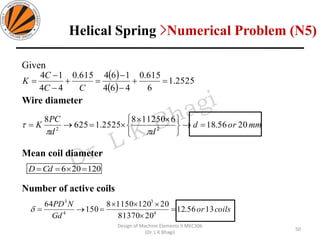
Helical Spring >Numerical Problem (N5)
Given
Wire diameter
Mean coil diameter
Number of active coils
( )
( )
2525.1
6
615.0
464
164615.0
44
14
=+
−
−
=+
−
−
=
CC
C
K
mmord
dd
PC
K 2056.18
6112508
2525.1625
8
22
=→






=→=


120206 ===CdD
coilsor
Gd
NPD
1356.12
2081370
2012011508
150
64
4
3
4
3
=


=→=
50
Design of Machine Elements II MEC306
(Dr. L K Bhagi)
Helical Spring >Numerical Problem (N5)
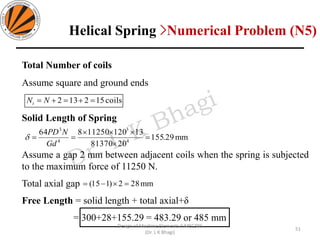
Total Number of coils
Assume square and ground ends
Solid Length of Spring
Assume a gap 2 mm between adjacent coils when the spring is subjected
to the maximum force of 11250 N.
Total axial gap
Free Length = solid length + total axial+δ
= 300+28+155.29 = 483.29 or 485 mm
coils512132 =+=+= NNt
mm29.155
2081370
1312011250864
4
3
4
3
=


==
Gd
NPD

mm282)115( =−=
51
Design of Machine Elements II MEC306
(Dr. L K Bhagi)
Helical Spring >Numerical Problem (N5)
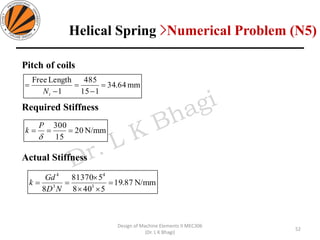
Pitch of coils
Required Stiffness
Actual Stiffness
mm64.34
115
485
1
LengthFree
=
−
=
−
=
tN
N/mm20
15
300
===

P
k
N/mm87.19
5408
581370
8 3
4
3
4
=


==
ND
Gd
k
52
Design of Machine Elements II MEC306
(Dr. L K Bhagi)
Helical Spring >Numerical Problem (N5)
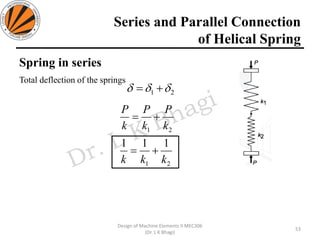
Series and Parallel Connection
of Helical Spring
Spring in series
Total deflection of the springs
21  +=
21
21
111
kkk
k
P
k
P
k
P
+=
+=
53
Design of Machine Elements II MEC306
(Dr. L K Bhagi)
Series and Parallel Connection
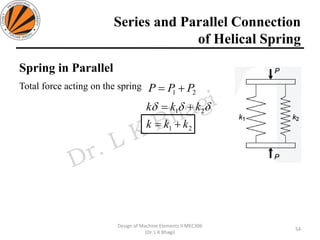
of Helical Spring
Spring in Parallel
Total force acting on the spring
21 PPP +=
21
21
kkk
kkk
+=
+= 
54
Design of Machine Elements II MEC306
(Dr. L K Bhagi)
Design of Helical Springs
Objectives for design
✓ It should have sufficient strength to withstand the external load.
✓ It should have the required load-deflection characteristic.
✓ It should not buckle under the external load.
55
Design of Machine Elements II MEC306
(Dr. L K Bhagi)
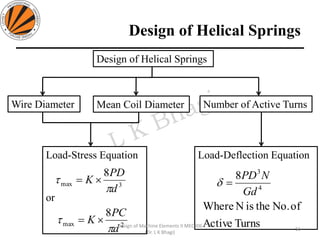
Design of Helical Springs
Number of Active TurnsMean Coil DiameterWire Diameter
Load-Stress Equation
or
3max
8
d
PD
K

 =
2max
8
d
PC
K

 =
Load-Deflection Equation
TurnsActive
ofNo.theisNWhere
8
4
3
Gd
NPD
=
56
Design of Machine Elements II MEC306
(Dr. L K Bhagi)
Design of Helical Springs
Factor of Safety (fos)
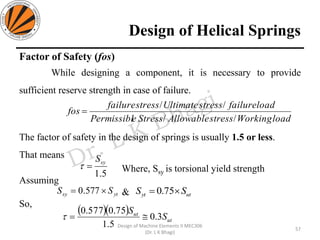
While designing a component, it is necessary to provide
sufficient reserve strength in case of failure.
The factor of safety in the design of springs is usually 1.5 or less.
That means
Where, Ssy is torsional yield strength
Assuming
&
So,
loadWorkingstressAllowableStressePermissibl
loadfailurestressUltimatestressfailure
fos
//
//
=
5.1
syS
=
57
Design of Machine Elements II MEC306
(Dr. L K Bhagi)
ytsy SS = 577.0 utyt SS = 75.0
( )( )
ut
ut
S
S
3.0
5.1
75.0577.0
=
Design of Helical Springs
Factor of Safety (fos)
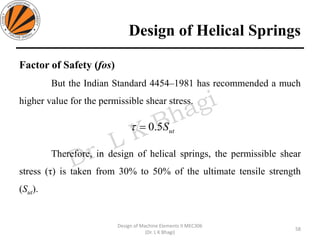
But the Indian Standard 4454–1981 has recommended a much
higher value for the permissible shear stress.
Therefore, in design of helical springs, the permissible shear
stress (τ) is taken from 30% to 50% of the ultimate tensile strength
(Sut).
58
Design of Machine Elements II MEC306
(Dr. L K Bhagi)
utS5.0=
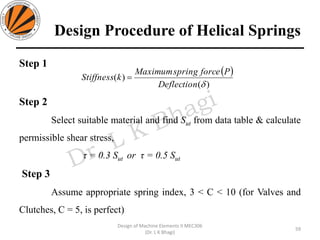
Design Procedure of Helical Springs
Step 1
Step 2
Select suitable material and find Sut from data table & calculate
permissible shear stress,
τ = 0.3 Sut or τ = 0.5 Sut
Step 3
Assume appropriate spring index, 3 < C < 10 (for Valves and
Clutches, C = 5, is perfect)
59
Design of Machine Elements II MEC306
(Dr. L K Bhagi)
( )
)(
)(
Deflection
PforcespringMaximum
kStiffness =
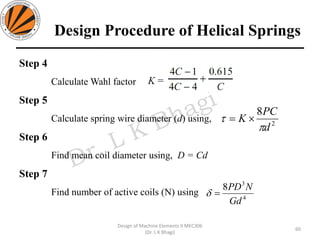
Design Procedure of Helical Springs
Step 4
Calculate Wahl factor
Step 5
Calculate spring wire diameter (d) using,
Step 6
Find mean coil diameter using, D = Cd
Step 7
Find number of active coils (N) using
60
Design of Machine Elements II MEC306
(Dr. L K Bhagi)
2
8
d
PC
K

 =
4
3
8
Gd
NPD
=
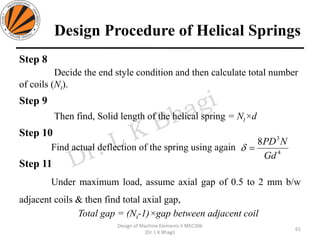
Design Procedure of Helical Springs
Step 8
Decide the end style condition and then calculate total number
of coils (Nt).
Step 9
Then find, Solid length of the helical spring = Nt×d
Step 10
Find actual deflection of the spring using again
Step 11
Under maximum load, assume axial gap of 0.5 to 2 mm b/w
adjacent coils & then find total axial gap,
Total gap = (Nt-1)×gap between adjacent coil
61
Design of Machine Elements II MEC306
(Dr. L K Bhagi)
4
3
8
Gd
NPD
=
Design Procedure of Helical Springs
Step 12
and then calculate, free length= Solid length + total gap+δ
Step 13
Find the pitch (p) of the coil using
Step 14
And Finally calculate rate of spring using
Check to avoid buckling
[Guides not required]
[Guides required]
62
Design of Machine Elements II MEC306
(Dr. L K Bhagi)
ND
Gd
k 3
4
8
=
( )1−
=
tN
lengthFree
p
6.2
diametercoilMean
lengthFree
6.2
diametercoilMean
lengthFree
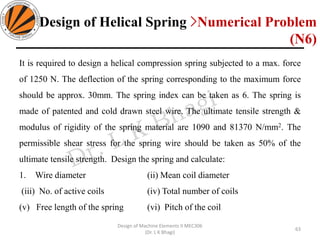
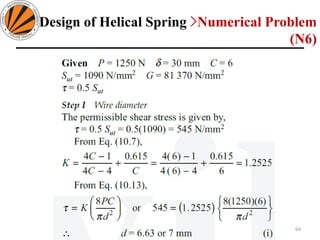
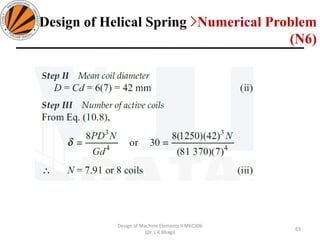
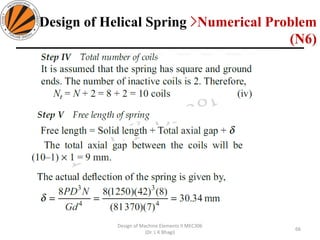
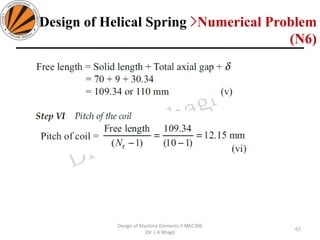
It is required to design a helical compression spring subjected to a max. force
of 1250 N. The deflection of the spring corresponding to the maximum force
should be approx. 30mm. The spring index can be taken as 6. The spring is
made of patented and cold drawn steel wire. The ultimate tensile strength &
modulus of rigidity of the spring material are 1090 and 81370 N/mm2. The
permissible shear stress for the spring wire should be taken as 50% of the
ultimate tensile strength. Design the spring and calculate:
1. Wire diameter (ii) Mean coil diameter
(iii) No. of active coils (iv) Total number of coils
(v) Free length of the spring (vi) Pitch of the coil
63
Design of Machine Elements II MEC306
(Dr. L K Bhagi)
Design of Helical Spring >Numerical Problem
(N6)
64
Design of Machine Elements II MEC306
(Dr. L K Bhagi)
Design of Helical Spring >Numerical Problem
(N6)
65
Design of Machine Elements II MEC306
(Dr. L K Bhagi)
Design of Helical Spring >Numerical Problem
(N6)
66
Design of Machine Elements II MEC306
(Dr. L K Bhagi)
Design of Helical Spring >Numerical Problem
(N6)
67
Design of Machine Elements II MEC306
(Dr. L K Bhagi)
Design of Helical Spring >Numerical Problem
(N6)
68
Design of Machine Elements II MEC306
(Dr. L K Bhagi)
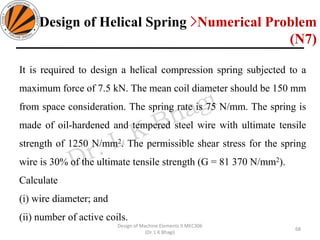
It is required to design a helical compression spring subjected to a
maximum force of 7.5 kN. The mean coil diameter should be 150 mm
from space consideration. The spring rate is 75 N/mm. The spring is
made of oil-hardened and tempered steel wire with ultimate tensile
strength of 1250 N/mm2. The permissible shear stress for the spring
wire is 30% of the ultimate tensile strength (G = 81 370 N/mm2).
Calculate
(i) wire diameter; and
(ii) number of active coils.
Design of Helical Spring >Numerical Problem
(N7)
69
Design of Machine Elements II MEC306
(Dr. L K Bhagi)
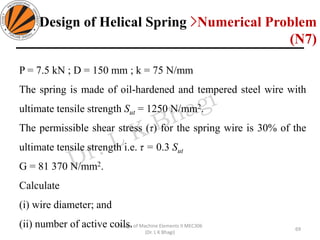
P = 7.5 kN ; D = 150 mm ; k = 75 N/mm
The spring is made of oil-hardened and tempered steel wire with
ultimate tensile strength Sut = 1250 N/mm2.
The permissible shear stress (τ) for the spring wire is 30% of the
ultimate tensile strength i.e. τ = 0.3 Sut
G = 81 370 N/mm2.
Calculate
(i) wire diameter; and
(ii) number of active coils.
Design of Helical Spring >Numerical Problem
(N7)
70
Design of Machine Elements II MEC306
(Dr. L K Bhagi)
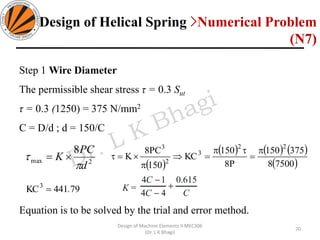
Step 1 Wire Diameter
The permissible shear stress τ = 0.3 Sut
τ = 0.3 (1250) = 375 N/mm2
C = D/d ; d = 150/C
Equation is to be solved by the trial and error method.
2max
8
d
PC
K

 =
( )
( ) ( ) ( )
( )75008
375150
P8
150
KC
150
PC8
K
22
3
2
3

=

=

=
79441KC3
.=
Design of Helical Spring >Numerical Problem
(N7)
71
Design of Machine Elements II MEC306
(Dr. L K Bhagi)
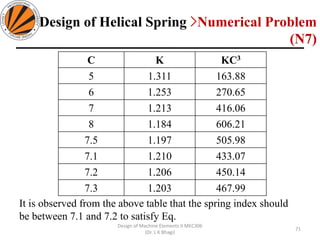
C K KC3
5 1.311 163.88
6 1.253 270.65
7 1.213 416.06
8 1.184 606.21
7.5 1.197 505.98
7.1 1.210 433.07
7.2 1.206 450.14
7.3 1.203 467.99
It is observed from the above table that the spring index should
be between 7.1 and 7.2 to satisfy Eq.
Design of Helical Spring >Numerical Problem
(N7)
72
Design of Machine Elements II MEC306
(Dr. L K Bhagi)
C = 7.2
d = 15/C = 150/7.2 = 20.83 or 21 mm
For Number of active coils
ND8
Gd
k
Gd
NPD8
3
4
4
3
==
( )
( )
coils8or.817
N1508
2181370
ND8
Gd
75 3
4
3
4
=


==
Design of Helical Spring >Numerical Problem
(N7)
Design Against Fluctuating Load
73
Design of Machine Elements II MEC306
(Dr. L K Bhagi)
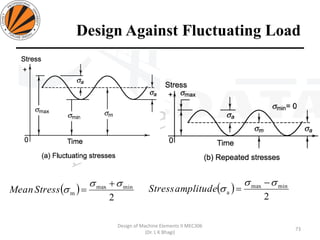
( )
2
minmax
m


+
=StressMean ( )
2
minmax
a


−
=amplitudeStress
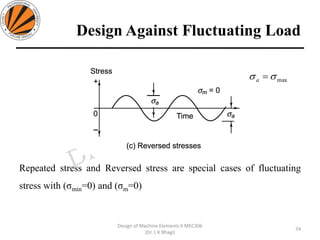
Design Against Fluctuating Load
Repeated stress and Reversed stress are special cases of fluctuating
stress with (σmin=0) and (σm=0)
74
Design of Machine Elements II MEC306
(Dr. L K Bhagi)
max =a
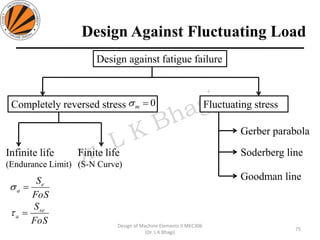
Design against fatigue failure
Fluctuating stress
Infinite life
(Endurance Limit)
75
Design of Machine Elements II MEC306
(Dr. L K Bhagi)
Design Against Fluctuating Load
Finite life
(S-N Curve)
Gerber parabola
Soderberg line
Goodman line
Completely reversed stress 0=m
FoS
Se
a =
FoS
Sse
a =
Design Against Fluctuating Load
76
Design of Machine Elements II MEC306
(Dr. L K Bhagi)
Design Against Fluctuating Load
77
Design of Machine Elements II MEC306
(Dr. L K Bhagi)
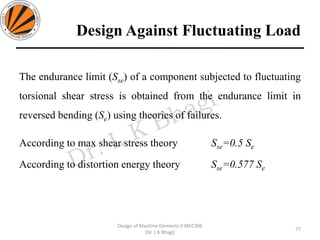
The endurance limit (Sse) of a component subjected to fluctuating
torsional shear stress is obtained from the endurance limit in
reversed bending (Se) using theories of failures.
According to max shear stress theory Sse=0.5 Se
According to distortion energy theory Sse=0.577 Se
Design Against Fluctuating Load
78
Design of Machine Elements II MEC306
(Dr. L K Bhagi)
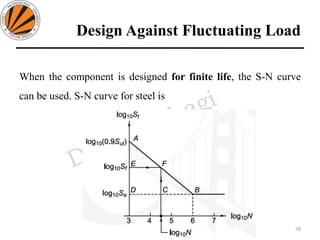
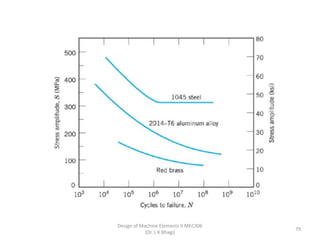
When the component is designed for finite life, the S-N curve
can be used. S-N curve for steel is
Design of Machine Elements II MEC306
(Dr. L K Bhagi)
79
Design Against Fluctuating Load
80
Design of Machine Elements II MEC306
(Dr. L K Bhagi)
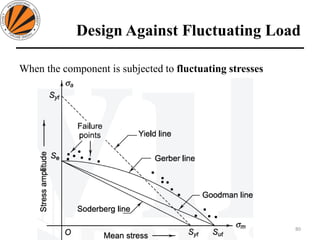
When the component is subjected to fluctuating stresses
Helical Spring Design Against
Fluctuating Load
81
Design of Machine Elements II MEC306
(Dr. L K Bhagi)
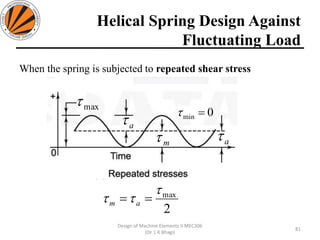
When the spring is subjected to repeated shear stress
max
a
m a
0min =
2
max
 == am
Helical Spring Design Against
Fluctuating Load
82
Design of Machine Elements II MEC306
(Dr. L K Bhagi)
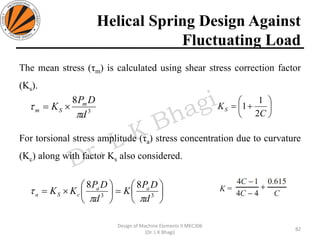
The mean stress (τm) is calculated using shear stress correction factor
(Ks).
For torsional stress amplitude (τa) stress concentration due to curvature
(Kc) along with factor Ks also considered.
3
8
d
DP
K m
Sm

 = 





+=
C
KS
2
1
1






=





= 33
88
d
DP
K
d
DP
KK aa
cSa


Helical Spring Design Against
Fluctuating Load (Soderberg Failure Criterion)
83
Design of Machine Elements II MEC306
(Dr. L K Bhagi)
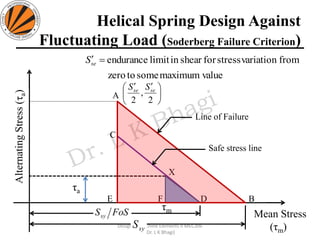
valuemaximumsometozero
fromvariationstressforshearinlimitendurance=seS
AlternatingStress(τa)
Mean Stress
(τm)
A
B
C
DE
τa
τm
F
X





 
2
,
2
sese SS
Line of Failure
Safe stress line
syS
FoSSsy
Helical Spring Design Against
Fluctuating Load (Soderberg Failure Criterion)
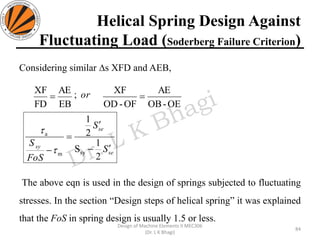
Considering similar ∆s XFD and AEB,
The above eqn is used in the design of springs subjected to fluctuating
stresses. In the section “Design steps of helical spring” it was explained
that the FoS in spring design is usually 1.5 or less.
EB
AE
FD
XF
= or;
OE-OB
AE
OF-OD
XF
=
se
se
sy
S
S
FoS
S
−

=
−
2
1
S
2
1
sym
a


84
Design of Machine Elements II MEC306
(Dr. L K Bhagi)
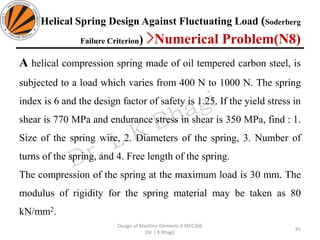
Helical Spring Design Against Fluctuating Load (Soderberg
Failure Criterion) >Numerical Problem(N8)
A helical compression spring made of oil tempered carbon steel, is
subjected to a load which varies from 400 N to 1000 N. The spring
index is 6 and the design factor of safety is 1.25. If the yield stress in
shear is 770 MPa and endurance stress in shear is 350 MPa, find : 1.
Size of the spring wire, 2. Diameters of the spring, 3. Number of
turns of the spring, and 4. Free length of the spring.
The compression of the spring at the maximum load is 30 mm. The
modulus of rigidity for the spring material may be taken as 80
kN/mm2.
85
Design of Machine Elements II MEC306
(Dr. L K Bhagi)
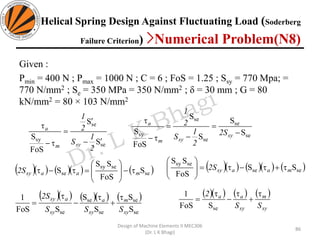
Given :
Pmin = 400 N ; Pmax = 1000 N ; C = 6 ; FoS = 1.25 ; Ssy = 770 Mpa; =
770 N/mm2 ; Se = 350 MPa = 350 N/mm2 ; δ = 30 mm ; G = 80
kN/mm2 = 80 × 103 N/mm2
86
Design of Machine Elements II MEC306
(Dr. L K Bhagi)
se
se
sy
S
S
FoS
S
−

=
−

2
1
S
2
1
sym
a
se
se
se
se
sy S
S
S
S
FoS
S −
=
−
=
−

sy
sym
a
2S
2
1
S
2
1
( )( ) ( )( ) ( )se
sesy
se S
FoS
SS
S maasy2S −







=− ( )( ) ( )( ) ( )sese
sesy
SS
FoS
SS
maasy2S +−=







( )( ) ( )( ) ( )
se
se
se
se
se S
S
S
S
SFoS
1
sy
m
sy
a
sy
asy
SSS
2S 
+

−

=
( )( ) ( ) ( )
sy
m
sy
aa
SS
2 
+

−

=
seSFoS
1
Helical Spring Design Against Fluctuating Load (Soderberg
Failure Criterion) >Numerical Problem(N8)
87
Design of Machine Elements II MEC306
(Dr. L K Bhagi)
3
m
Sm
d
DP8
K

=







= 3
a
a
d
DP8
K
( )( ) ( ) ( )
sy
m
sy
aa
SS
2 
+

−

=
seSFoS
1
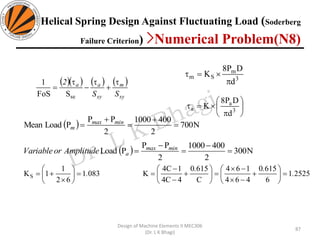
( ) N700
2
4001000
2
PP
PLoadMean =
+
=
+
= minmax
m
( ) N300
2
4001000
2
PP
PLoad =
−
=
−
= minmax
aAmplitudeorVariable
0831
62
1
1KS .=






+= 25251
6
6150
464
164
C
6150
4C4
1C4
K .
..
=





+
−
−
=





+
−
−
=
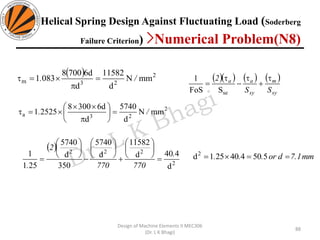
Helical Spring Design Against Fluctuating Load (Soderberg
Failure Criterion) >Numerical Problem(N8)
88
Design of Machine Elements II MEC306
(Dr. L K Bhagi)
( )( ) ( ) ( )
sy
m
sy
aa
SS
2 
+

−

=
seSFoS
1
( )
2
222
d
440d
11582
d
5740
350
d
5740
251
1 .
770770
2
.
=






+






−






=
( ) 2
23m mmN
d
11582
d
d67008
0831 /. =

=
2
23a mmN
d
5740
d
d63008
25251 /. =







=
mm7.1dor... === 550440251d2
Helical Spring Design Against Fluctuating Load (Soderberg
Failure Criterion) >Numerical Problem(N8)
89
Design of Machine Elements II MEC306
(Dr. L K Bhagi)
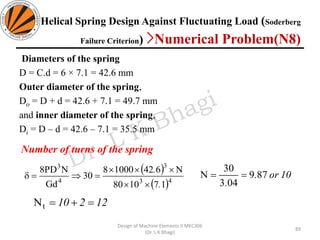
Diameters of the spring
D = C.d = 6 × 7.1 = 42.6 mm
Outer diameter of the spring,
Do = D + d = 42.6 + 7.1 = 49.7 mm
and inner diameter of the spring,
Di = D – d = 42.6 – 7.1 = 35.5 mm
Number of turns of the spring
( )
( )43
3
4
3
171080
N64210008
30
Gd
NPD8
.
.


== 10or.
.
879
043
30
N ==
12210 =+=tN
Helical Spring Design Against Fluctuating Load (Soderberg
Failure Criterion) >Numerical Problem(N8)
90
Design of Machine Elements II MEC306
(Dr. L K Bhagi)
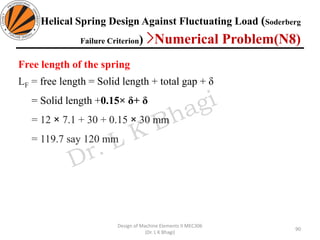
Free length of the spring
LF = free length = Solid length + total gap + δ
= Solid length +0.15× δ+ δ
= 12 × 7.1 + 30 + 0.15 × 30 mm
= 119.7 say 120 mm
Helical Spring Design Against Fluctuating Load (Soderberg
Failure Criterion) >Numerical Problem(N8)
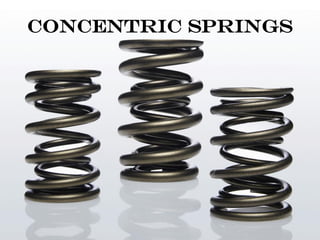
Concentric Springs
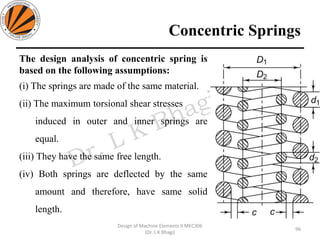
Concentric Springs
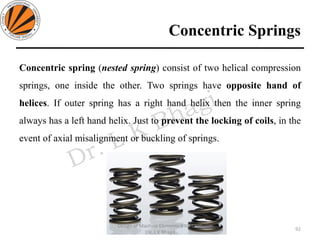
Concentric spring (nested spring) consist of two helical compression
springs, one inside the other. Two springs have opposite hand of
helices. If outer spring has a right hand helix then the inner spring
always has a left hand helix. Just to prevent the locking of coils, in the
event of axial misalignment or buckling of springs.
92
Design of Machine Elements II MEC306
(Dr. L K Bhagi)
Concentric Springs
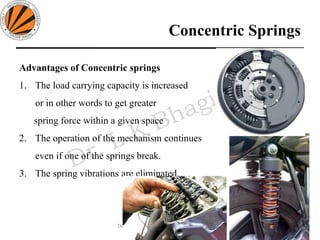
Advantages of Concentric springs
1. The load carrying capacity is increased
or in other words to get greater
spring force within a given space
2. The operation of the mechanism continues
even if one of the springs break.
3. The spring vibrations are eliminated.
93
Design of Machine Elements II MEC306
(Dr. L K Bhagi)
Concentric Springs
In the concentric springs
a) Maximum shear stress developed in the concentric springs is same
for same material and free length
b) Deflection is same for both the springs
c) Solid length of both the springs is same
94
Design of Machine Elements II MEC306
(Dr. L K Bhagi)
Concentric Springs
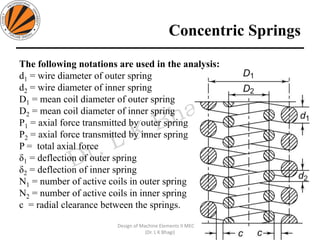
The following notations are used in the analysis:
d1 = wire diameter of outer spring
d2 = wire diameter of inner spring
D1 = mean coil diameter of outer spring
D2 = mean coil diameter of inner spring
P1 = axial force transmitted by outer spring
P2 = axial force transmitted by inner spring
P = total axial force
δ1 = deflection of outer spring
δ2 = deflection of inner spring
N1 = number of active coils in outer spring
N2 = number of active coils in inner spring
c = radial clearance between the springs.
95
Design of Machine Elements II MEC306
(Dr. L K Bhagi)
Concentric Springs
The design analysis of concentric spring is
based on the following assumptions:
(i) The springs are made of the same material.
(ii) The maximum torsional shear stresses
induced in outer and inner springs are
equal.
(iii) They have the same free length.
(iv) Both springs are deflected by the same
amount and therefore, have same solid
length.
96
Design of Machine Elements II MEC306
(Dr. L K Bhagi)
Concentric Springs
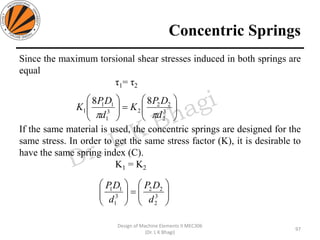
Since the maximum torsional shear stresses induced in both springs are
equal
τ1= τ2
If the same material is used, the concentric springs are designed for the
same stress. In order to get the same stress factor (K), it is desirable to
have the same spring index (C).
K1 = K2
97
Design of Machine Elements II MEC306
(Dr. L K Bhagi)






=





3
2
22
23
1
11
1
88
d
DP
K
d
DP
K







=





3
2
22
3
1
11
d
DP
d
DP
Concentric Springs
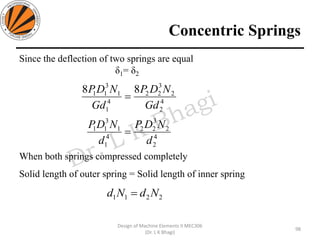
Since the deflection of two springs are equal
δ1= δ2
When both springs compressed completely
Solid length of outer spring = Solid length of inner spring
98
Design of Machine Elements II MEC306
(Dr. L K Bhagi)
4
2
2
3
22
4
1
1
3
11 88
Gd
NDP
Gd
NDP
=
4
2
2
3
22
4
1
1
3
11
d
NDP
d
NDP
=
2211 NdNd =
Concentric Springs
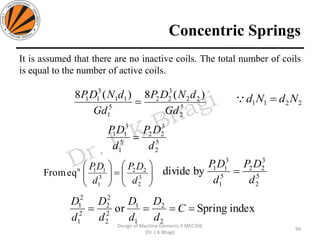
It is assumed that there are no inactive coils. The total number of coils
is equal to the number of active coils.
99
Design of Machine Elements II MEC306
(Dr. L K Bhagi)
5
2
22
3
22
5
1
11
3
11 )(8)(8
Gd
dNDP
Gd
dNDP
=
5
2
3
22
5
1
3
11
d
DP
d
DP
=
2211 NdNd =






=





3
2
22
3
1
11n
eqFrom
d
DP
d
DP
5
2
3
22
5
1
3
11
bydivide
d
DP
d
DP
=
indexSpringor
2
2
1
1
2
2
2
2
2
1
2
1
==== C
d
D
d
D
d
D
d
D
Concentric Springs
Substituting Eqn
in
Then we get
That means the total load shared by each spring is proportional to the
cross-sectional area of the wire.
100
Design of Machine Elements II MEC306
(Dr. L K Bhagi)
indexSpring
2
2
1
1
=== C
d
D
d
D






=





3
2
22
3
1
11
d
DP
d
DP
2
1
2
2
2
1
2
1
2
2
2
1
2
1
2
2
2
2
1
1
a
a
d
d
P
P
d
d
P
P
d
P
d
P
===





=







Concentric Springs
Radial clearance (c) is an important parameter in the design of
concentric springs.
In the design of concentric springs, the diametral clearance (2c) is taken
101
Design of Machine Elements II MEC306
(Dr. L K Bhagi)






+++





++=
22
2
22
1122
21
dd
c
dd
DD
( ) ( )21212 ddDDc +−−=
( ) ( )
22
2121 ddDD
c
+
−
−
=
( ) ( )
2
2 21
21
dd
cddc
−
=−=
Concentric Springs
So,
Substituting
We get
Equations and are used to find out the force
transmitted by each spring.
102
Design of Machine Elements II MEC306
(Dr. L K Bhagi)
( ) ( )
222
212121 ddDDdd +
−
−
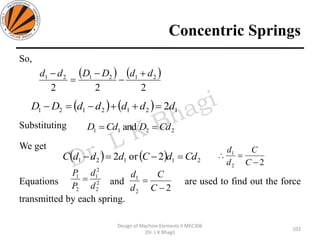
=
−
( ) ( ) 1212121 2dddddDD =++−=−
2211 and CdDCdD ==
( ) ( ) 21121 2or2 CddCdddC =−=−
22
1
−
=
C
C
d
d
2
2
2
1
2
1
d
d
P
P
=
22
1
−
=
C
C
d
d
Optimum Design of Helical Spring
In certain applications springs are designed for specific objective,
✓Minimum Weight
✓Minimum volume or
✓Maximum energy storage capacity
103
Design of Machine Elements II MEC306
(Dr. L K Bhagi)
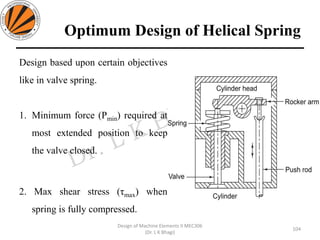
Optimum Design of Helical Spring
Design based upon certain objectives
like in valve spring.
1. Minimum force (Pmin) required at
most extended position to keep
the valve closed.
2. Max shear stress (τmax) when
spring is fully compressed.
104
Design of Machine Elements II MEC306
(Dr. L K Bhagi)
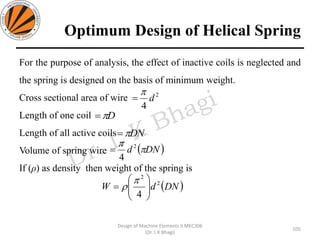
Optimum Design of Helical Spring
For the purpose of analysis, the effect of inactive coils is neglected and
the spring is designed on the basis of minimum weight.
Cross sectional area of wire
Length of one coil
Length of all active coils
Volume of spring wire
If (ρ) as density then weight of the spring is
105
Design of Machine Elements II MEC306
(Dr. L K Bhagi)
2
4
d

=
D=
DN=
( )DNd 
 2
4
=
( )DNdW 2
2
4 





=


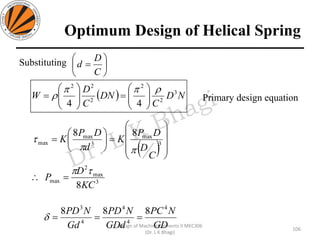
Optimum Design of Helical Spring
Substituting
Primary design equation
106
Design of Machine Elements II MEC306
(Dr. L K Bhagi)
( ) ND
C
DN
C
D
W 3
2
2
2
22
44

 





=





=






=
C
D
d
( ) 









=





= 3
max
3
max
max
88
C
D
DP
K
d
DP
K


3
max
2
max
8KC
D
P

=
GD
NPC
GDd
NPD
Gd
NPD 4
4
4
4
3
888
===
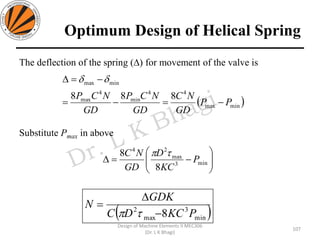
Optimum Design of Helical Spring
The deflection of the spring (∆) for movement of the valve is
Substitute Pmax in above
107
Design of Machine Elements II MEC306
(Dr. L K Bhagi)
( )minmax
44
min
4
max
minmax
888
PP
GD
NC
GD
NCP
GD
NCP
−=−=
−= 






−= min3
max
24
8
8
P
KC
D
GD
NC 
( )min
3
max
2
8 PKCDC
GDK
N
−

=

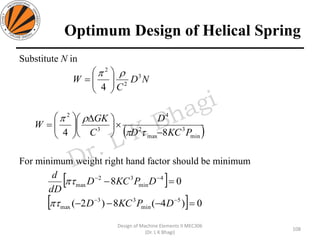
Optimum Design of Helical Spring
Substitute N in
For minimum weight right hand factor should be minimum
108
Design of Machine Elements II MEC306
(Dr. L K Bhagi)
ND
C
W 3
2
2
4







=
( )min
3
max
2
4
3
2
84 PKCD
D
C
GK
W
−





 






=


 
  0)4(8)2(
08
5
min
33
max
4
min
32
max
=−−−
=−
−−
−−
DPKCD
DPKCD
dD
d


Optimum Design of Helical Spring
109
Design of Machine Elements II MEC306
(Dr. L K Bhagi)
)8(2 3
max
2
min
KC
D
P

=
2
max
min
P
P =
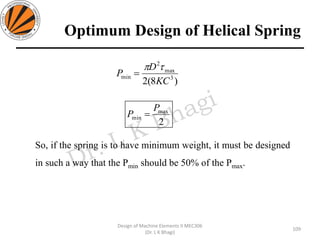
So, if the spring is to have minimum weight, it must be designed
in such a way that the Pmin should be 50% of the Pmax.
Optimum Design of Helical Spring > Numerical
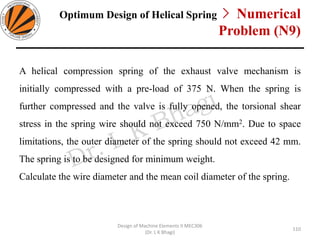
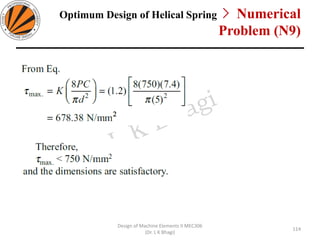
Problem (N9)
A helical compression spring of the exhaust valve mechanism is
initially compressed with a pre-load of 375 N. When the spring is
further compressed and the valve is fully opened, the torsional shear
stress in the spring wire should not exceed 750 N/mm2. Due to space
limitations, the outer diameter of the spring should not exceed 42 mm.
The spring is to be designed for minimum weight.
Calculate the wire diameter and the mean coil diameter of the spring.
Design of Machine Elements II MEC306
(Dr. L K Bhagi)
110
Optimum Design of Helical Spring > Numerical
Problem (N9)
Design of Machine Elements II MEC306
(Dr. L K Bhagi)
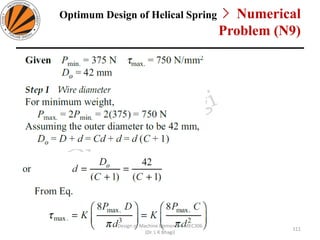
111
Optimum Design of Helical Spring > Numerical
Problem (N9)
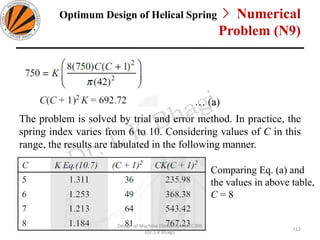
The problem is solved by trial and error method. In practice, the
spring index varies from 6 to 10. Considering values of C in this
range, the results are tabulated in the following manner.
Comparing Eq. (a) and
the values in above table,
C = 8
… (a)
Design of Machine Elements II MEC306
(Dr. L K Bhagi)
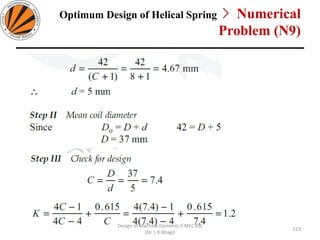
112
Optimum Design of Helical Spring > Numerical
Problem (N9)
Design of Machine Elements II MEC306
(Dr. L K Bhagi)
113
Optimum Design of Helical Spring > Numerical
Problem (N9)
Design of Machine Elements II MEC306
(Dr. L K Bhagi)
114
Helical Torsion Springs
115
Design of Machine Elements II MEC306
(Dr. L K Bhagi)
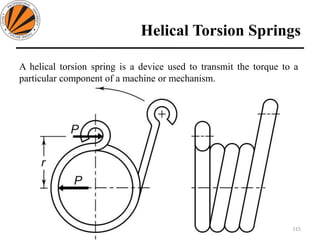
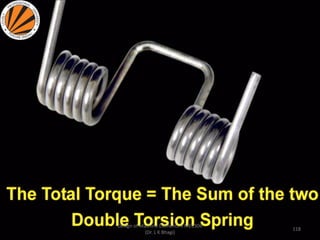
A helical torsion spring is a device used to transmit the torque to a
particular component of a machine or mechanism.
Helical Torsion Springs
116
Design of Machine Elements II MEC306
(Dr. L K Bhagi)
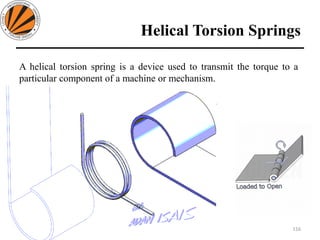
A helical torsion spring is a device used to transmit the torque to a
particular component of a machine or mechanism.
117
Design of Machine Elements II MEC306
(Dr. L K Bhagi)
118
Design of Machine Elements II MEC306
(Dr. L K Bhagi)
Helical Torsion Springs
119
Design of Machine Elements II MEC306
(Dr. L K Bhagi)
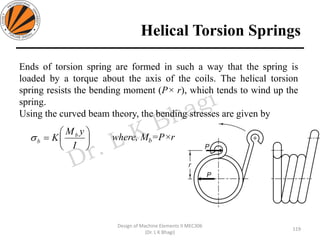
Ends of torsion spring are formed in such a way that the spring is
loaded by a torque about the axis of the coils. The helical torsion
spring resists the bending moment (P× r), which tends to wind up the
spring.
Using the curved beam theory, the bending stresses are given by
where, Mb=P×r





=
I
yM
K b
b
Helical Torsion Springs
120
Design of Machine Elements II MEC306
(Dr. L K Bhagi)
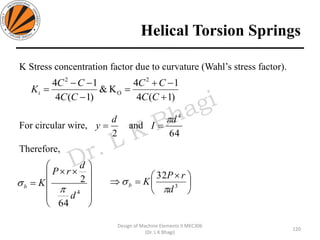
K Stress concentration factor due to curvature (Wahl’s stress factor).
For circular wire, and
Therefore,













=
4
64
2
d
d
rP
Kb

 




 
= 3
32
d
rP
Kb


2
d
y =
64
4
d
I

=
)1(4
14
K&
)1(4
14 2
O
2
+
−+
=
−
−−
=
CC
CC
CC
CC
Ki
Helical Torsion Springs
121
Design of Machine Elements II MEC306
(Dr. L K Bhagi)
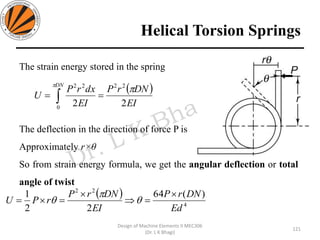
The strain energy stored in the spring
The deflection in the direction of force P is
Approximately r×θ
So from strain energy formula, we get the angular deflection or total
angle of twist
( )
EI
DNrP
EI
dxrP
U
DN
22
22
0
22

== 
( )
4
22
)(64
22
1
Ed
DNrP
EI
DNrP
rPU

=

== 


Helical Torsion Springs
122
Design of Machine Elements II MEC306
(Dr. L K Bhagi)
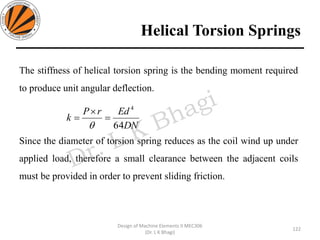
The stiffness of helical torsion spring is the bending moment required
to produce unit angular deflection.
Since the diameter of torsion spring reduces as the coil wind up under
applied load, therefore a small clearance between the adjacent coils
must be provided in order to prevent sliding friction.
DN
EdrP
k
64
4
=

=

Helical Torsion Springs>Numerical Problem (N10)
123
Design of Machine Elements II MEC306
(Dr. L K Bhagi)
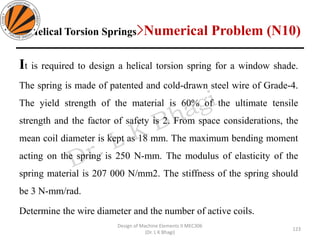
It is required to design a helical torsion spring for a window shade.
The spring is made of patented and cold-drawn steel wire of Grade-4.
The yield strength of the material is 60% of the ultimate tensile
strength and the factor of safety is 2. From space considerations, the
mean coil diameter is kept as 18 mm. The maximum bending moment
acting on the spring is 250 N-mm. The modulus of elasticity of the
spring material is 207 000 N/mm2. The stiffness of the spring should
be 3 N-mm/rad.
Determine the wire diameter and the number of active coils.
124
Design of Machine Elements II MEC306
(Dr. L K Bhagi)
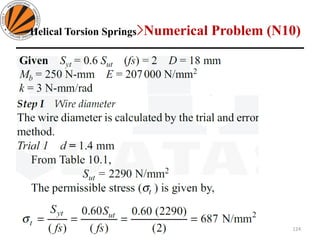
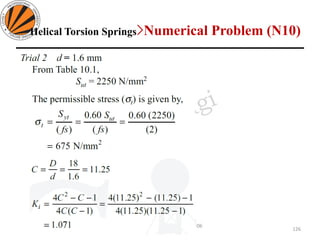
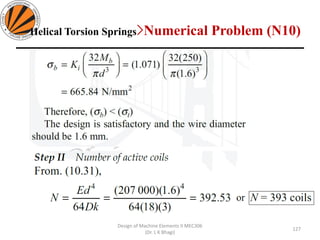
Helical Torsion Springs>Numerical Problem (N10)
125
Design of Machine Elements II MEC306
(Dr. L K Bhagi)
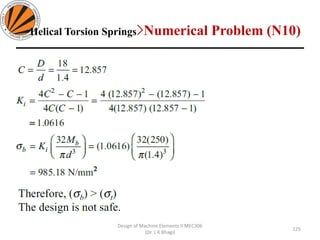
Helical Torsion Springs>Numerical Problem (N10)
126
Design of Machine Elements II MEC306
(Dr. L K Bhagi)
Helical Torsion Springs>Numerical Problem (N10)
127
Design of Machine Elements II MEC306
(Dr. L K Bhagi)
Helical Torsion Springs>Numerical Problem (N10)
Spiral Spring (Flat Spiral Spring)
128
Design of Machine Elements II MEC306
(Dr. L K Bhagi)
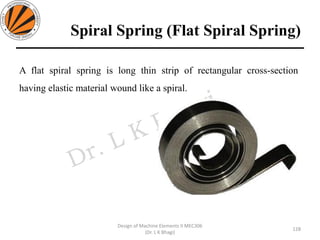
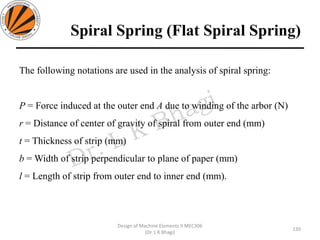
A flat spiral spring is long thin strip of rectangular cross-section
having elastic material wound like a spiral.
Spiral Spring (Flat Spiral Spring)
129
Design of Machine Elements II MEC306
(Dr. L K Bhagi)
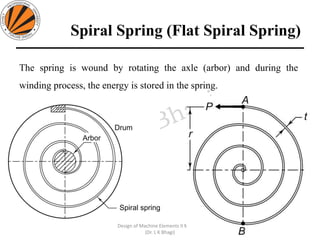
The spring is wound by rotating the axle (arbor) and during the
winding process, the energy is stored in the spring.
Spiral Spring (Flat Spiral Spring)
130
Design of Machine Elements II MEC306
(Dr. L K Bhagi)
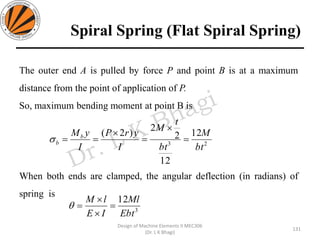
The following notations are used in the analysis of spiral spring:
P = Force induced at the outer end A due to winding of the arbor (N)
r = Distance of center of gravity of spiral from outer end (mm)
t = Thickness of strip (mm)
b = Width of strip perpendicular to plane of paper (mm)
l = Length of strip from outer end to inner end (mm).
Spiral Spring (Flat Spiral Spring)
131
Design of Machine Elements II MEC306
(Dr. L K Bhagi)
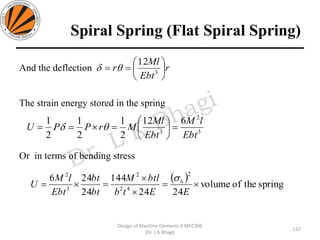
The outer end A is pulled by force P and point B is at a maximum
distance from the point of application of P.
So, maximum bending moment at point B is
When both ends are clamped, the angular deflection (in radians) of
spring is
23
12
12
2
2
)2(
bt
M
bt
t
M
I
yrP
I
yMb
b =

=

==
3
12
Ebt
Ml
IE
lM
=


=
Spiral Spring (Flat Spiral Spring)
132
Design of Machine Elements II MEC306
(Dr. L K Bhagi)
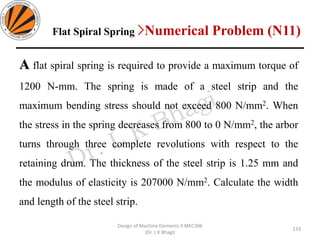
And the deflection
The strain energy stored in the spring
Or in terms of bending stress
r
Ebt
Ml
r 





== 3
12

3
2
3
612
2
1
2
1
2
1
Ebt
lM
Ebt
Ml
MrPPU =





=== 
( ) springtheofvolume
2424
144
24
246
2
42
2
3
2
=


==
EEtb
btlM
bt
bt
Ebt
lM
U b
Flat Spiral Spring >Numerical Problem (N11)
133
Design of Machine Elements II MEC306
(Dr. L K Bhagi)
A flat spiral spring is required to provide a maximum torque of
1200 N-mm. The spring is made of a steel strip and the
maximum bending stress should not exceed 800 N/mm2. When
the stress in the spring decreases from 800 to 0 N/mm2, the arbor
turns through three complete revolutions with respect to the
retaining drum. The thickness of the steel strip is 1.25 mm and
the modulus of elasticity is 207000 N/mm2. Calculate the width
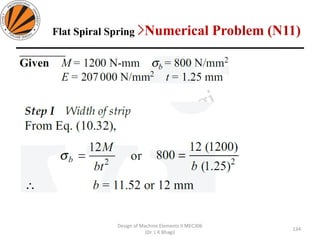
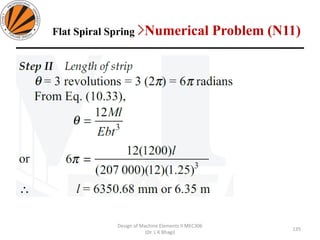
and length of the steel strip.
Flat Spiral Spring >Numerical Problem (N11)
134
Design of Machine Elements II MEC306
(Dr. L K Bhagi)
Flat Spiral Spring >Numerical Problem (N11)
135
Design of Machine Elements II MEC306
(Dr. L K Bhagi)
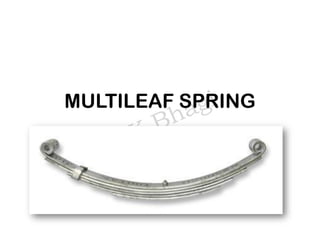
MULTILEAF SPRING
Leaf Springs
137
Design of Machine Elements II MEC306
(Dr. L K Bhagi)
In order to have an idea of working principle of a leaf spring,
let us think of the diving board in a swimming pool. The diving board
is a cantilever with a load, the diver, at its free end. The diver initiates
a to and fro swing of the board at the free end and utilizes the spring
action of the board for jumping.
The diving board basically is a leaf spring.
Leaf Springs
138
Design of Machine Elements II MEC306
(Dr. L K Bhagi)
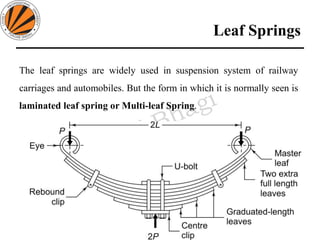
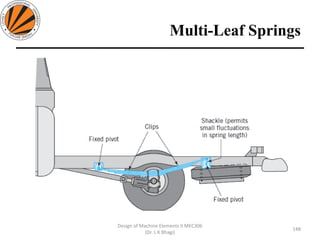
The leaf springs are widely used in suspension system of railway
carriages and automobiles. But the form in which it is normally seen is
laminated leaf spring or Multi-leaf Spring.
Leaf Springs
139
Design of Machine Elements II MEC306
(Dr. L K Bhagi)
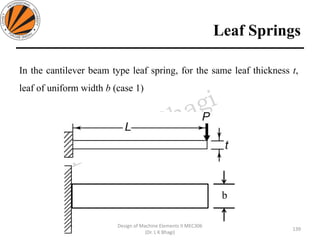
In the cantilever beam type leaf spring, for the same leaf thickness t,
leaf of uniform width b (case 1)
b
Leaf Springs
140
Design of Machine Elements II MEC306
(Dr. L K Bhagi)
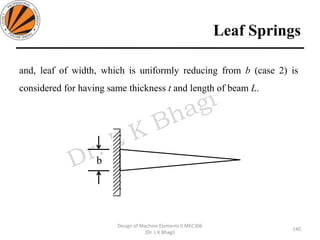
and, leaf of width, which is uniformly reducing from b (case 2) is
considered for having same thickness t and length of beam L.
b
Leaf Springs
141
Design of Machine Elements II MEC306
(Dr. L K Bhagi)
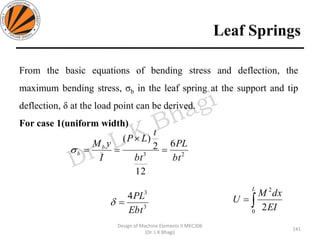
From the basic equations of bending stress and deflection, the
maximum bending stress, σb in the leaf spring at the support and tip
deflection, δ at the load point can be derived.
For case 1(uniform width)
23
6
12
2
)(
bt
PL
bt
t
LP
I
yMb
b =

==
3
3
4
Ebt
PL
= =
L
EI
dxM
U
0
2
2
Leaf Springs
142
Design of Machine Elements II MEC306
(Dr. L K Bhagi)
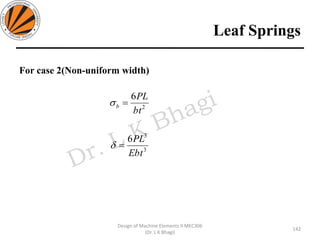
For case 2(Non-uniform width)
2
6
bt
PL
b =
3
3
6
Ebt
PL
=
Leaf Springs
143
Design of Machine Elements II MEC306
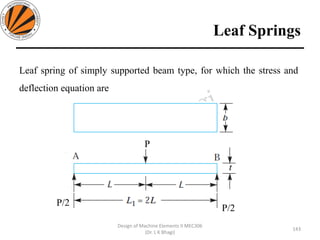
(Dr. L K Bhagi)
Leaf spring of simply supported beam type, for which the stress and
deflection equation are
P
P/2
P/2
Leaf Springs
144
Design of Machine Elements II MEC306
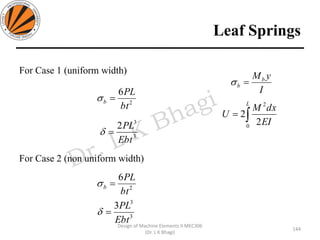
(Dr. L K Bhagi)
For Case 1 (uniform width)
For Case 2 (non uniform width)
2
6
bt
PL
b =
3
3
2
Ebt
PL
=
2
6
bt
PL
b =
3
3
3
Ebt
PL
=
=
L
EI
dxM
U
0
2
2
2
I
yMb
b =
Design of Machine Elements II MEC306
(Dr. L K Bhagi)
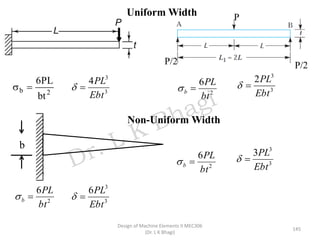
145
2b
bt
PL6
= 3
3
4
Ebt
PL
=
P
P/2 P/2
2
6
bt
PL
b = 3
3
2
Ebt
PL
=
b
2
6
bt
PL
b = 3
3
6
Ebt
PL
=
2
6
bt
PL
b = 3
3
3
Ebt
PL
=
Uniform Width
Non-Uniform Width
Multi-Leaf Springs
146
Design of Machine Elements II MEC306
(Dr. L K Bhagi)
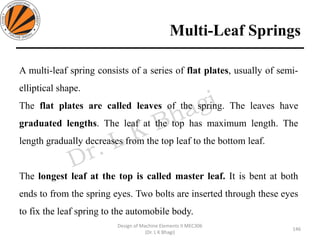
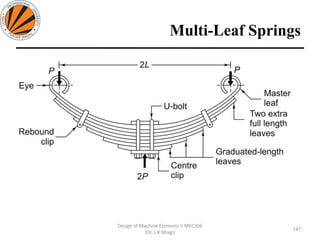
A multi-leaf spring consists of a series of flat plates, usually of semi-
elliptical shape.
The flat plates are called leaves of the spring. The leaves have
graduated lengths. The leaf at the top has maximum length. The
length gradually decreases from the top leaf to the bottom leaf.
The longest leaf at the top is called master leaf. It is bent at both
ends to from the spring eyes. Two bolts are inserted through these eyes
to fix the leaf spring to the automobile body.
Multi-Leaf Springs
147
Design of Machine Elements II MEC306
(Dr. L K Bhagi)
Multi-Leaf Springs
148
Design of Machine Elements II MEC306
(Dr. L K Bhagi)
Multi-Leaf Springs
149
Design of Machine Elements II MEC306
(Dr. L K Bhagi)
The leaves are held together by means of two U-bolts and a center
clip.
Rebound clips are provided to keep the leaves in alignment and
prevent lateral shifting of the leaves during operation.
At the centre, the leaf spring is supported on the axle.
Multi-leaf springs are provided with extra full-length leaves, to
support the transverse shear force.
Multi-Leaf Springs
150
Design of Machine Elements II MEC306
(Dr. L K Bhagi)
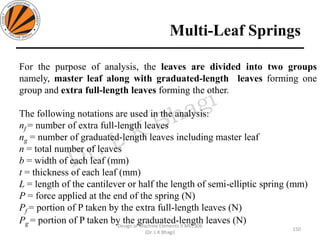
For the purpose of analysis, the leaves are divided into two groups
namely, master leaf along with graduated-length leaves forming one
group and extra full-length leaves forming the other.
The following notations are used in the analysis:
nf = number of extra full-length leaves
ng = number of graduated-length leaves including master leaf
n = total number of leaves
b = width of each leaf (mm)
t = thickness of each leaf (mm)
L = length of the cantilever or half the length of semi-elliptic spring (mm)
P = force applied at the end of the spring (N)
Pf = portion of P taken by the extra full-length leaves (N)
Pg = portion of P taken by the graduated-length leaves (N)
Multi-Leaf Springs
151
Design of Machine Elements II MEC306
(Dr. L K Bhagi)
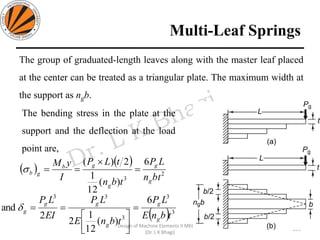
The group of graduated-length leaves along with the master leaf placed
at the center can be treated as a triangular plate. The maximum width at
the support as ngb.
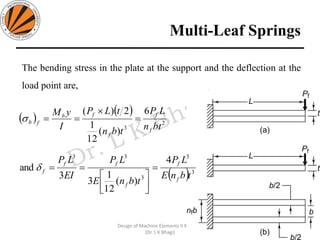
The bending stress in the plate at the
support and the deflection at the load
point are,
( )
( )
2
3
6
)(
12
1
2)(
btn
LP
tbn
tLP
I
yM
g
g
g
gb
gb =

==
( ) 3
3
3
33
6
)(
12
1
2
2
and
tbnE
LP
tbnE
LP
EI
LP
g
g
g
gg
g =




==
Multi-Leaf Springs
152
Design of Machine Elements II MEC306
(Dr. L K Bhagi)
The bending stress in the plate at the support and the deflection at the
load point are,
( )
( )
2
3
6
)(
12
1
2)(
btn
LP
tbn
tLP
I
yM
f
f
f
fb
fb =

==
( ) 3
3
3
33
4
)(
12
1
3
3
and
tbnE
LP
tbnE
LP
EI
LP
f
f
f
ff
f =




==
Multi-Leaf Springs
153
Design of Machine Elements II MEC306
(Dr. L K Bhagi)
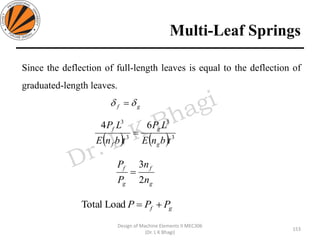
Since the deflection of full-length leaves is equal to the deflection of
graduated-length leaves.
gf  =
( ) ( ) 3
3
3
3
64
tbnE
LP
tbnE
LP
g
g
f
f
=
g
f
g
f
n
n
P
P
2
3
=
gf PPP +=LoadTotal
Multi-Leaf Springs
154
Design of Machine Elements II MEC306
(Dr. L K Bhagi)
( )gf
f
f
nn
Pn
P
23
3
+
=
( )gf
g
g
nn
Pn
P
23
2
+
=
( ) 2
6
btn
LP
f
f
fb = ( ) 2
6
and
btn
LP
g
g
gb =
( )
( ) 2
23
18
So,
btnn
PL
gf
fb
+
= ( )
( ) 2
23
12
and
btnn
PL
gf
gb
+
=
( ) ( )gbfb 
2
3
=
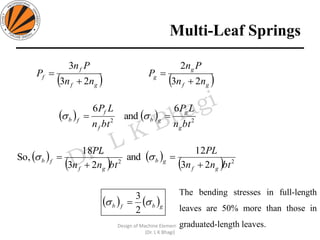
The bending stresses in full-length
leaves are 50% more than those in
graduated-length leaves.
Multi-Leaf Springs
155
Design of Machine Elements II MEC306
(Dr. L K Bhagi)
Et
L
Ebt
PL
3
24
and
2
3
3

 =2
6
bt
PL
b =
( ) ( )fgfg
f
nnEbt
PL
nnbt
PL
Et
L
Et
L
32
12
32
18
3
2
3
2
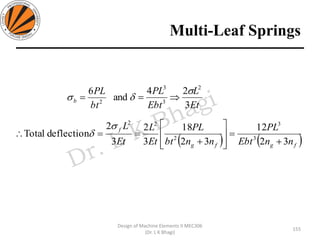
deflectionTotal 3
3
2
22
+
=








+
==


Multi-Leaf Springs
Nipping
156
Design of Machine Elements II MEC306
(Dr. L K Bhagi)
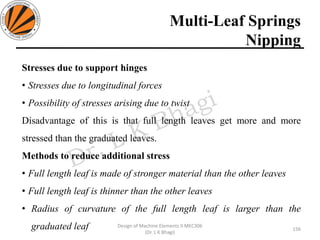
Stresses due to support hinges
• Stresses due to longitudinal forces
• Possibility of stresses arising due to twist
Disadvantage of this is that full length leaves get more and more
stressed than the graduated leaves.
Methods to reduce additional stress
• Full length leaf is made of stronger material than the other leaves
• Full length leaf is thinner than the other leaves
• Radius of curvature of the full length leaf is larger than the
graduated leaf
Multi-Leaf Springs
Nipping
157
Design of Machine Elements II MEC306
(Dr. L K Bhagi)
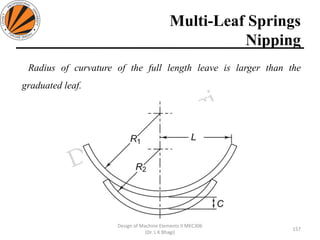
Radius of curvature of the full length leave is larger than the
graduated leaf.
Multi-Leaf Springs
Nipping
158
Design of Machine Elements II MEC306
(Dr. L K Bhagi)
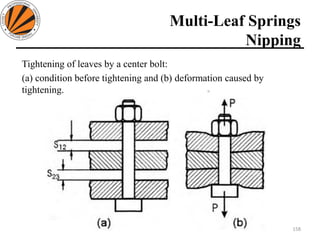
Tightening of leaves by a center bolt:
(a) condition before tightening and (b) deformation caused by
tightening.
Multi-Leaf Springs
Nipping
159
Design of Machine Elements II MEC306
(Dr. L K Bhagi)
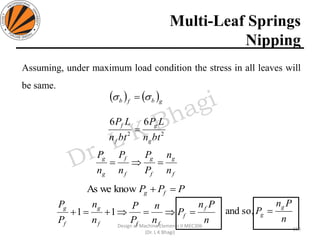
Assuming, under maximum load condition the stress in all leaves will
be same.
22
66
btn
LP
btn
LP
g
g
f
f
=
( ) ( )gbfb  =
f
g
f
g
f
f
g
g
n
n
P
P
n
P
n
P
==
PPP fg =+knowweAs
n
Pn
P
n
n
P
P
n
n
P
P f
f
fff
g
f
g
==+=+ 11
n
Pn
P
g
g =so,and
Multi-Leaf Springs
Nipping
Design of Machine Elements II MEC306
(Dr. L K Bhagi)
Under maximum force, P condition the stress in all leaves will be
same.
fg  
( ) 3
3
4
tbnE
LP
f
f
f =
( ) 3
3
6
tbnE
LP
g
g
g =
( ) ( ) 







−=−=
f
f
g
g
f
f
g
g
n
P
n
P
Ebt
L
tbnE
LP
tbnE
LP
C
23246
3
3
3
3
3
3
fgC  −=
( ) ( ) 





−=−=
n
P
n
P
Ebt
L
tbnE
LP
tbnE
LP
C
f
f
g
g 23246
3
3
3
3
3
3
3
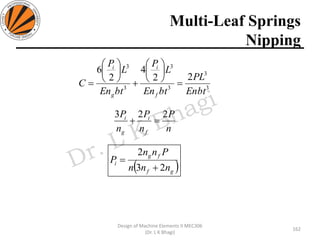
3
2
Enbt
PL
C =
160
Multi-Leaf Springs
Nipping
Design of Machine Elements II MEC306
(Dr. L K Bhagi)
The load on the centre clip bolts i.e. initial preload required to close
the gap C is determined by considering initial deflection of leaves.
Under the action of Preload Pi
( ) ( )ifigC +=
( )
( ) 3
3
2
6
tbnE
L
P
g
i
ig = ( )
( ) 3
3
2
4
tbnE
L
P
f
i
if =
3
3
3
3
3
3
22
4
2
6
Enbt
PL
btEn
L
P
btEn
L
P
C
f
i
g
i
=






+






=
161
Multi-Leaf Springs
Nipping
Design of Machine Elements II MEC306
(Dr. L K Bhagi)
3
3
3
3
3
3
22
4
2
6
Enbt
PL
btEn
L
P
btEn
L
P
C
f
i
g
i
=






+






=
n
P
n
P
n
P
f
i
g
i 223
=+
( )gf
fg
i
nnn
Pnn
P
23
2
+
=
162
Multi-Leaf Springs
Nipping
Design of Machine Elements II MEC306
(Dr. L K Bhagi)
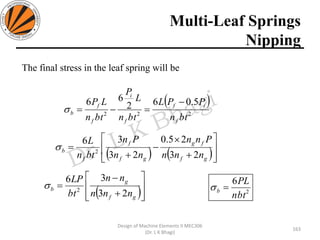
The final stress in the leaf spring will be
( )
222
5.062
66
btn
PPL
btn
L
P
btn
LP
f
if
f
i
f
f
b
−
=−=
( ) ( )







+

−
+
=
gf
fg
gf
f
f
b
nnn
Pnn
nn
Pn
btn
L
23
25.0
23
36
2

( )







+
−
=
gf
g
b
nnn
nn
bt
LP
23
36
2
 2
6
nbt
PL
b =
163
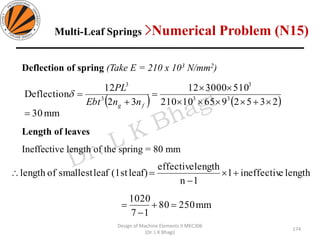
Multi-Leaf Springs >Numerical Problem (N12)
Design of Machine Elements II MEC306
(Dr. L K Bhagi)
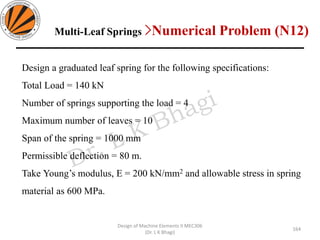
Design a graduated leaf spring for the following specifications:
Total Load = 140 kN
Number of springs supporting the load = 4
Maximum number of leaves = 10
Span of the spring = 1000 mm
Permissible deflection = 80 m.
Take Young’s modulus, E = 200 kN/mm2 and allowable stress in spring
material as 600 MPa.
164
Design of Machine Elements II MEC306
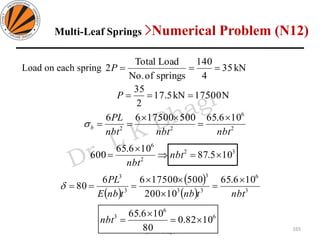
(Dr. L K Bhagi)
Load on each spring kN35
4
140
springsofNo.
LoadTotal
2 ===P
N17500kN17.5
2
35
===P
2
6
22
106.655001750066
nbtnbtnbt
PL
b

=

==
32
2
6
105.87
106.65
600 =

= nbt
nbt
( )
( )
( ) 3
6
33
3
3
3
106.65
10200
5001750066
80
nbttnbtnbE
PL 
=


===
6
6
3
1082.0
80
106.65
=

=nbt
Multi-Leaf Springs >Numerical Problem (N12)
165
Design of Machine Elements II MEC306
(Dr. L K Bhagi)
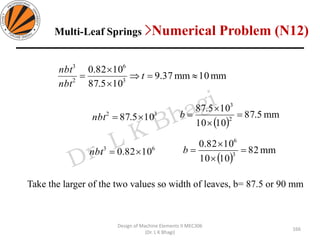
mm10mm37.9
105.87
1082.0
3
6
2
3
=


= t
nbt
nbt
( )
mm5.87
1010
105.87
2
3
=


=b32
105.87 =nbt
63
1082.0 =nbt
( )
mm82
1010
1082.0
3
6
=


=b
Take the larger of the two values so width of leaves, b= 87.5 or 90 mm
Multi-Leaf Springs >Numerical Problem (N12)
166
Design of Machine Elements II MEC306
(Dr. L K Bhagi)
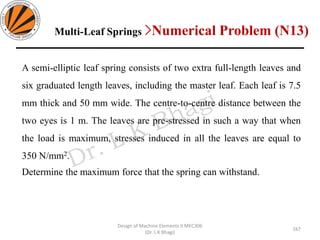
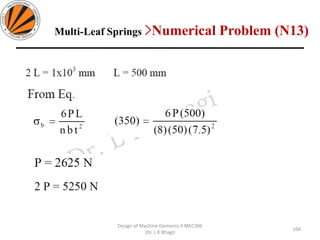
A semi-elliptic leaf spring consists of two extra full-length leaves and
six graduated length leaves, including the master leaf. Each leaf is 7.5
mm thick and 50 mm wide. The centre-to-centre distance between the
two eyes is 1 m. The leaves are pre-stressed in such a way that when
the load is maximum, stresses induced in all the leaves are equal to
350 N/mm2.
Determine the maximum force that the spring can withstand.
Multi-Leaf Springs >Numerical Problem (N13)
167
Design of Machine Elements II MEC306
(Dr. L K Bhagi)
Multi-Leaf Springs >Numerical Problem (N13)
168
Design of Machine Elements II MEC306
(Dr. L K Bhagi)
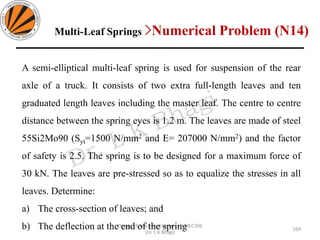
A semi-elliptical multi-leaf spring is used for suspension of the rear
axle of a truck. It consists of two extra full-length leaves and ten
graduated length leaves including the master leaf. The centre to centre
distance between the spring eyes is 1.2 m. The leaves are made of steel
55Si2Mo90 (Syt=1500 N/mm2 and E= 207000 N/mm2) and the factor
of safety is 2.5. The spring is to be designed for a maximum force of
30 kN. The leaves are pre-stressed so as to equalize the stresses in all
leaves. Determine:
a) The cross-section of leaves; and
b) The deflection at the end of the spring
Multi-Leaf Springs >Numerical Problem (N14)
169
Design of Machine Elements II MEC306
(Dr. L K Bhagi)
Cross-section of the leaves
( ) 22
102
600150006
600
6
btnbt
PL
b
+

==
32
mm7500=bt
2
N/mm600
5.2
1500
===
FoS
Syt
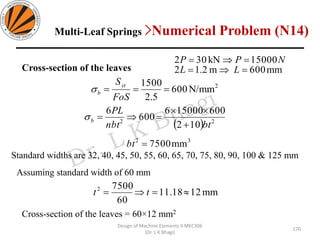
b
mm600m2.12
15000kN302
==
==
LL
NPP
Standard widths are 32, 40, 45, 50, 55, 60, 65, 70, 75, 80, 90, 100 & 125 mm
Assuming standard width of 60 mm
mm1211.18
60
75002
== tt
Cross-section of the leaves = 60×12 mm2
Multi-Leaf Springs >Numerical Problem (N14)
170
Design of Machine Elements II MEC306
(Dr. L K Bhagi)
Deflection at the end of the spring
( ) ( )
mm68.69
231021260207000
6001500012
32
12
Deflection 3
3
3
3
=
+

=
+
=
fg nnEbt
PL

Multi-Leaf Springs >Numerical Problem (N14)
171
Design of Machine Elements II MEC306
(Dr. L K Bhagi)
A semi-elliptical laminated vehicle spring to carry a load of 600 N is to
consists of seven leaves 65 mm wide, two of the leaves extending the full
length of the spring. The spring is to be 1.1 m in length and attached to the
axle by U-bolts 80 mm apart. The bolts hold the central portion of the
springs so rigidly that they may be considered equivalent to a band having
width equal to the distance between the bolts. Inside diameter of eye is 20
mm. Assume a design stress for spring material as 350 MPa. Determine:
1. Thickness of leaves, 2. Deflection of spring, 3. Length of leaves, and 4.
Radius to which leaves should be initially bent.
The standard thickness of leaves are 5, 6, 6.5, 7, 7.5, 8, 9, 10, 11 etc. in
mm
Multi-Leaf Springs >Numerical Problem (N15)
172
Design of Machine Elements II MEC306
(Dr. L K Bhagi)
Thickness of leaves
The effective length(2L) = overall length (span) of the spring (2L1)–
width of band or distance between centres of U-bolts (ineffective length
of spring) (l)
mm102080110022 1 =−=−= lLL mm510
2
1020
==L
527leavesgraduatedofNo. =−=−= fg nnn
( )
( ) ( ) 22
655223
510300018
350
23
18
tbtnn
PL
gf
fb
+

=
+
=
Assuming that the leaves are not initially stressed, the maximum stress
is,
mm97.8 =t
Multi-Leaf Springs >Numerical Problem (N15)
173
Design of Machine Elements II MEC306
(Dr. L K Bhagi)
Deflection of spring (Take E = 210 x 103 N/mm2)
( ) ( )
mm30
235296510210
510300012
32
12
Deflection 33
3
3
3
=
+

=
+
=
fg nnEbt
PL

Length of leaves
Ineffective length of the spring = 80 mm
lengtheineffectiv1
1n
lengtheffective
leaf)(1stleafsmallestoflength +
−
=
mm25080
17
1020
=+
−
=
Multi-Leaf Springs >Numerical Problem (N15)
174
Design of Machine Elements II MEC306
(Dr. L K Bhagi)
mm420802
17
1020
leaf2ndoflength =+
−
=
mm590803
17
1020
leaf3rdoflength =+
−
=
mm760804
17
1020
leaf4thoflength =+
−
=
mm930805
17
1020
leaf5thoflength =+
−
=
leafmasterasactwill
top)(at theleaf7ththeandleaveslengthfullareleaves7th&6thThe
( )
( ) mm128229201100
2td2leafmasteroflength 1
=++=
++=

L
mm1100806
17
1020
leaf6thoflength =+
−
=
Multi-Leaf Springs >Numerical Problem (N15)
175
Design of Machine Elements II MEC306
(Dr. L K Bhagi)
bentinitiallybeshouldleaveswhich thetoRadius
( ) ( ) springtheofcamberasknownalso-2R
2
1  L=
( ) ( ) mm5.505655030-2R30
2
== R
Multi-Leaf Springs >Numerical Problem (N15)
176

Springs - DESIGN OF MACHINE ELEMENTS-II

  • 1.
    UNIT-1 SPRINGS Dr. LK Bhagi Associate Professor School of Mechanical Engineering Lovely Professional University
  • 2.
    SPRINGS ➢ A springis basically defined as an ELASTIC BODY whose function is to deformed when loaded and to recover its original shape when the load is removed ➢ A spring is a machine member capable of providing large elastic deformation. 2 Design of Machine Elements II MEC306 (Dr. L K Bhagi)
  • 3.
    Objectives of Spring Followingare the objectives of a spring when used as a machine member: 1. Cushioning , Absorbing , or Controlling of energy due to shock and vibration. ✓ Car springs or ✓ Railway buffers ✓ To control energy, springs-supports and vibration dampers. 2. Control of Motion ✓ Maintaining contact between two elements (cam and its follower) ✓ Creation of the necessary pressure in a friction device (a brake or a clutch) 3 Design of Machine Elements II MEC306 (Dr. L K Bhagi)
  • 4.
    Objectives of Spring 3.Measuring Forces Spring balance 4. Storing of Energy In clocks or Toys The clock has spiral type of spring which is wound to coil and then the stored energy helps gradual recoil of the spring when in operation. 4 Design of Machine Elements II MEC306 (Dr. L K Bhagi)
  • 5.
    Before considering thedesign aspects of springs let’s have a quick look at the SPRING MATERIALS and MANUFACTURING METHODS.
  • 6.
    Selection of Materialfor Spring Depends Upon the Following Factors ✓ The Load acting on the spring ✓ The range of stress through which spring operates. ✓ The limitations of mass and volume of spring. ✓ The environmental conditions in which spring will operate. 6 Design of Machine Elements II MEC306 (Dr. L K Bhagi)
  • 7.
    Material of thespring should have • High fatigue strength • High ductility • High resilience and • It should be creep resistant. Mainly depends upon the service for which they are used i.e. • Severe service (automotive engine valve springs) • Average service or (automobile suspension springs) • Light service (safety valve springs) 7 Design of Machine Elements II MEC306 (Dr. L K Bhagi)
  • 8.
    Four basic varietiesof steel wire used in majority of applications 1. Patented and cold-drawn steel wire(unalloyed) (0.85-0.95% C) 2. Oil-hardened and tempered spring steel wires (0.55-0.75% C) (moderate fluctuating stresses) and valve spring wires (0.60 – 0.75% C) (high magnitude of fluctuating stresses) 8 Design of Machine Elements II MEC306 (Dr. L K Bhagi)
  • 9.
    Four basic varietiesof steel wire used in majority of applications 3. Oil-hardened and tempered steel wires(alloyed) Chromium-Vanadium steel (0.48-0.53% C 0.8-1.1% Cr 0.15% V) Chromium-silicon steel (0.51-0.59% C 0.6-0.8% Cr 1.2-1.6% Si) Used for high stress conditions and at high temperature up to 220 -250oC 4. Stainless steel spring wires (Cr 17-19 % and Ni 8 -10 %) Good tensile strength, High corrosion resistance and Good heat resistance It maintains its strength at temperatures up to 300oC 9 Design of Machine Elements II MEC306 (Dr. L K Bhagi)
  • 10.
    Spring Manufacturing Processes 1.Cold Winding Process If springs are of very small diameter and the wire diameter is also small then the springs are normally manufactured by a cold drawn process through a mangle. 2. Hot Winding For very large springs having also large coil diameter and wire diameter one has to go for manufacture 10 Design of Machine Elements II MEC306 (Dr. L K Bhagi)
  • 11.
    Spring Manufacturing Processes 3.Heat Treatment Whether the steel has been coiled hot or cold, the process has created stress within the material. To relieve stress and allow the steel to maintain its characteristic resilience, the spring must be tempered by heat treating it. 4. Grinding If the design requires for flat ends on the spring, the ends are ground at this stage of the manufacturing process. 11 Design of Machine Elements II MEC306 (Dr. L K Bhagi)
  • 12.
    Spring Manufacturing Processes 3.Shoot Peening This process strengthens the steel to resist metal fatigue and cracking during its lifetime of repeated loadings. 4. Coating To prevent corrosion, the entire surface of the spring is protected by coating it with another metal such as zinc or chromium. 5. Packaging 12 Design of Machine Elements II MEC306 (Dr. L K Bhagi)
  • 13.
    Types of Springs 1)Helical springs Load Type/stresses induced a) Tension helical spring (Extension/Torsional shear stress) b)Compression helical spring (Compression/Torsional shear stress) c) Torsion spring (Torsion/Bending stress) d)Flat Spiral spring (Torsion/Bending stress) 2) Leaf springs (Bending/Bending stress)) 13 Design of Machine Elements II MEC306 (Dr. L K Bhagi)
  • 14.
    Types of SpringsHelical Springs ✓ Closely coiled helical spring: Helix angle is usually less than 10 degrees ✓ Open coiled helical spring: Helix angle is usually more than 10 degrees. Open coiled springs have a few applications as compared with Closed coiled. 14 Design of Machine Elements II MEC306 (Dr. L K Bhagi)
  • 15.
    Terminology of HelicalSprings 15 Design of Machine Elements II MEC306 (Dr. L K Bhagi) Solid Length = Nt × d Nt = Total number of turns (coils) d = Wire diameter of spring
  • 16.
    Terminology of HelicalSprings 16 Design of Machine Elements II MEC306 (Dr. L K Bhagi) Solid Length = Nt × d Nt = Total number of turns (coils) d = Wire diameter of spring
  • 17.
    17 Design of MachineElements II MEC306 (Dr. L K Bhagi) Total Axial Gap = (Nt -1)× gap b/w adjacent coils or = 15% of δ = 0.15× δ (Clashing allowance) Free Length = Compressed Length + δ = Solid Length + Total Axial Gap + δ Pitch (p) = 1N LengthFree t − Rate of spring or Spring Constant or Stiffness (k) = ( )  PforceAxial
  • 18.
    End Connections forCompression Helical Springs 18 Design of Machine Elements II MEC306 (Dr. L K Bhagi)
  • 19.
    End Connections forCompression Helical Springs 19 Design of Machine Elements II MEC306 (Dr. L K Bhagi)
  • 20.
    Number of ActiveTurns in Helical Springs 20 Design of Machine Elements II MEC306 (Dr. L K Bhagi)
  • 21.
    Number of ActiveTurns in Helical Springs 21 Design of Machine Elements II MEC306 (Dr. L K Bhagi)
  • 22.
    22 Design of MachineElements II MEC306 (Dr. L K Bhagi) Spring Index (C) is defined as the ratio of mean coil diameter to wire diameter: Spring index indicates the relative sharpness of the curvature of the coil. C will determine the Strength of the spring, The stress induced on the spring, and The manufacturability of the spring. d D C = Helical Springs>Spring Index
  • 23.
    Helical Springs>Spring Index 23 Designof Machine Elements II MEC306 (Dr. L K Bhagi) d D C =
  • 24.
    Helical Springs>Spring Index 24 Designof Machine Elements II MEC306 (Dr. L K Bhagi)
  • 25.
    25 Design of MachineElements II MEC306 (Dr. L K Bhagi) Helical Springs>Spring Index
  • 26.
    26 Design of MachineElements II MEC306 (Dr. L K Bhagi) For low spring index (C < 3) the sharpness of the curvature of the coil increases predominantly. Thereby increases the stresses in the spring & also difficult to manufacture. When spring index is very high (C >15) then spring will prone to buckle. Best range of C for manufacturing is 4-12 and 6-9 for those subjected to cyclic loading. Helical Springs>Spring Index
  • 27.
    27 Design of MachineElements II MEC306 (Dr. L K Bhagi) Compression coil springs will BUCKLE when the free length of the spring is larger and the end conditions are not proper to evenly distribute the load all along the circumference of the coil. The coil compression springs will have a tendency to BUCKLE when the deflection (for a given free (length) becomes too large. Helical Springs>Spring Index
  • 28.
    Stresses in HelicalSpring of Circular Wire 28 Design of Machine Elements II MEC306 (Dr. L K Bhagi) torsional shear stress twisting moment
  • 29.
    Resultant Shear StressInduced in the Wire 29 Design of Machine Elements II MEC306 (Dr. L K Bhagi)
  • 30.
    Stresses in HelicalSpring of Circular Wire 30 Design of Machine Elements II MEC306 (Dr. L K Bhagi)
  • 31.
    Stresses in HelicalSpring of Circular Wire 31 Design of Machine Elements II MEC306 (Dr. L K Bhagi) 33 8 2 1 1 8 d PD K Cd PD S  =      += Ks= Factor to account for direct shear stress So, it can be observed that effect of direct shear stress is appreciable for springs of small spring index C.        Cd PD 2 18 3 
  • 32.
    Stresses in HelicalSpring With Curvature Effect 32 Design of Machine Elements II MEC306 (Dr. L K Bhagi) a b Direction of view d a b d c c After Twisting b c So, Shearing Strain at ab surface is more than that of cd surface and that is what curvature effect is.
  • 33.
    Stresses in HelicalSpring With Curvature Effect 33 Design of Machine Elements II MEC306 (Dr. L K Bhagi) Same Wire with having two different diameters then the curvature effect will be more in the wire having small diameter. So, more and more having spring index (D/d) the lesser will be the curvature effect, e.g. railway carriage springs are made with large wire diameter relatively small coil diameter then the curvature effect will be predominately very high.
  • 34.
    Stresses in HelicalSpring With Curvature Effect 34 Design of Machine Elements II MEC306 (Dr. L K Bhagi) 3 8 d PD K  = KS= Factor to account for direct shear stress KC= Factor to account for stress concentration due to curvature effect When we taken into the account of the effect of curvature along with direct shear, we get In order to consider the effects of both direct shear as well as the curvature of the wire, a Wahl’s stress factor (K) is introduced for calculating the Maximum Shearing Stress at the inner fiber:
  • 35.
    Deflection of HelicalSpring of Circular Wire 35 Design of Machine Elements II MEC306 (Dr. L K Bhagi) θ = Angular deflection/Angle of twist of the wire when acted upon by the torque T. θ δ P Equation is called the load-deflection equation.  P kStiffnessSpring =)( When a helical spring is cut into two parts, the parameters G, d and D remain same and stiffness (k) will be double when N becomes (N/2).
  • 36.
    Design of MachineElements II MEC306 (Dr. L K Bhagi) 36
  • 37.
    Helical Spring >NumericalProblem (N1) A compression coil spring made of an alloy steel is having the following specifications : Mean diameter of coil = 50 mm ; Wire diameter = 5 mm ; Number of active coils = 20. If this spring is subjected to an axial load of 500 N ; calculate the maximum shear stress (neglect the curvature effect) to which the spring material is subjected. 37 Design of Machine Elements II MEC306 (Dr. L K Bhagi)
  • 38.
    10 5 50 d D C === ( )051 102 1 1 C2 1 1 .KfactorstressShear S =  +=+= 38 Design of Machine Elements II MEC306 (Dr. L K Bhagi) MPa7.534ormmN7534 5 505008 051 d PD8 K C2 1 1 d PD8 2 3 3S3 /.. =   =  =      +  = ,curvature)wireofeffecttheg(neglectinstressshearMaximum Helical Spring >Numerical Problem (N1)
  • 39.
    A helical springis made from a wire of 6 mm diameter and has outside diameter of 75 mm. If the permissible shear stress is 350 MPa and modulus of rigidity 84 kN/mm2 . Find the axial load which the spring can carry and the deflection per active turn. 39 Design of Machine Elements II MEC306 (Dr. L K Bhagi) Helical Spring >Numerical Problem (N2)
  • 40.
    511 6 69 d D C .=== ( )0431 5112 1 1 C2 1 1 . . KfactorstressShear S =  +=+= 40 Design of Machine Elements II MEC306 (Dr. L K Bhagi) Mean coil diameter of the spring, D = Do – d = 75 – 6 = 69 mm 1. Neglecting the effect of curvature wire,theininducedstressshearMaximum 3S3 d PD8 K C2 1 1 d PD8  =      +  = Helical Spring >Numerical Problem (N2)
  • 41.
    41 Design of MachineElements II MEC306 (Dr. L K Bhagi) N7412 8480 350 P P8480 6 69P8 0431350 d PD8 K 3 3S . . .. == =   =  = ( ) 4 3 Gd NPD8 =springtheofDeflection mm. . turnactiveperDeflection 969 61084 6974128 Gd PD8 N 43 3 4 3 =   ==  = Helical Spring >Numerical Problem (N2)
  • 42.
    42 Design of MachineElements II MEC306 (Dr. L K Bhagi) wire,theininducedstressshearMaximum 2 d PC8 K  = 2. Considering the effect of curvature ( ) ( ) 1231 511 6150 45114 15114 C 6150 4C4 1C4 K . . . . .. =+ − − =+ − − =Wahl’s stress factor (K) N4383 9130 350 P P9130 6 511P8 1231350 2 . . . . . == =   = Helical Spring >Numerical Problem (N2)
  • 43.
    43 Design of MachineElements II MEC306 (Dr. L K Bhagi) ( ) 4 3 Gd NPD8 =springtheofDeflection ( ) ( ) ( ) mm. . turnactiveperDeflection 269 61084 6943838 Gd PD8 N 43 3 4 3 =   ==  = Helical Spring >Numerical Problem (N2)
  • 44.
    A wagon weighing50 kN moving at a speed of 8 kmph has to be brought to rest. Springs made of wire of diameter 25 mm with a mean diameter of 250 mm and with 24 turns are available. Find the number of springs required in the buffer to stop the wagon at a compression of 180 mm. G = 84 Gpa. 44 Design of Machine Elements II MEC306 (Dr. L K Bhagi) Helical Spring >Numerical Problem (N3)
  • 45.
    V = 8kmph K.E. = m/s22.2m/s 3600 8000 == ( ) Nmmmv 52 3 2 106.1222.2 81.92 1050 2 1 =   = 43 3 4 3 251084 24250P8 180 Gd NPD8   == NP 75.1968= NmmP 5 1018.018075.1968 2 1 2 1 doneWork ===  70 1018.0 106.12 SpringsofNo. 5 5 =   = 45 Design of Machine Elements II MEC306 (Dr. L K Bhagi) Helical Spring >Numerical Problem (N3)
  • 46.
    A closed coiledhelical spring is made out of wire of 6 mm diameter with a mean diameter of 80 mm. what axial pull will produce a shear stress of 140 Mpa? If the spring has 20 coils, how much the spring will extend under pull? G = 80 Gpa. What work will be done in producing this extension? 46 Design of Machine Elements II MEC306 (Dr. L K Bhagi) Helical Spring >Numerical Problem (N4)
  • 47.
    d = 6mm; D = 80 mm; C = D/d = 80/6 = 13.33 0375.1 66.26 1 1 2 1 1 =      +=      += C K 33 6 80P8 03751140 d PD8 K   =→  = . NP 143= mm113 61084 20801438 Gd NPD8 43 3 4 3 =   == Nmm5.8079113143 2 1 2 1 doneWork === P 47 Design of Machine Elements II MEC306 (Dr. L K Bhagi) Helical Spring >Numerical Problem (N4)
  • 48.
    A railway wagonmoving at a velocity of 1.5 m/s is brought to rest by a bumper consisting of two helical springs arranged in parallel. The mass of wagon is 1500 kg. the springs are compressed by 150 mm in bringing the wagon to rest. The spring index can be taken as 6. the springs are made of oil hardened and tempered steel wire with ultimate tensile strength of 1250 N/mm2 and modulus of rigidity of 81370 N/mm2. The permissible shear stress for the spring wire can be taken as 50% of the ultimate tensile strength. Design the spring and calculate: (i) Wire diameter (ii) Mean coil diameter (iii) Number of active coils (iv) Total number of coils (v) Solid length (vi) Free length (vii) Pitch (viii) required spring rate (ix) Actual spring rate 48 Design of Machine Elements II MEC306 (Dr. L K Bhagi) Helical Spring >Numerical Problem (N5)
  • 49.
    Given m = 1500Kg v = 1.5 m/s δ = 150 mm C = 6 Sut = 1250 N/mm2 G = 81370 N/mm2 τ = 0.5 Sut The K.E. of wagon = The Strain energy absorbed by two springs The strain energy absorbed by the two springs is equal to the K.E of the wagon; ( ) Nmm101687.5Nm5.16875.11500 2 1 2 1 322 ===mv ( ) ( )Nmm150150 2 1 2 2 1 2 PPPE =      =      =  ( ) N11250105.1687150 3 == PP ( ) 2 N/mm62512505.0 == 49 Design of Machine Elements II MEC306 (Dr. L K Bhagi) Helical Spring >Numerical Problem (N5)
  • 50.
    Given Wire diameter Mean coildiameter Number of active coils ( ) ( ) 2525.1 6 615.0 464 164615.0 44 14 =+ − − =+ − − = CC C K mmord dd PC K 2056.18 6112508 2525.1625 8 22 =→       =→=   120206 ===CdD coilsor Gd NPD 1356.12 2081370 2012011508 150 64 4 3 4 3 =   =→= 50 Design of Machine Elements II MEC306 (Dr. L K Bhagi) Helical Spring >Numerical Problem (N5)
  • 51.
    Total Number ofcoils Assume square and ground ends Solid Length of Spring Assume a gap 2 mm between adjacent coils when the spring is subjected to the maximum force of 11250 N. Total axial gap Free Length = solid length + total axial+δ = 300+28+155.29 = 483.29 or 485 mm coils512132 =+=+= NNt mm29.155 2081370 1312011250864 4 3 4 3 =   == Gd NPD  mm282)115( =−= 51 Design of Machine Elements II MEC306 (Dr. L K Bhagi) Helical Spring >Numerical Problem (N5)
  • 52.
    Pitch of coils RequiredStiffness Actual Stiffness mm64.34 115 485 1 LengthFree = − = − = tN N/mm20 15 300 ===  P k N/mm87.19 5408 581370 8 3 4 3 4 =   == ND Gd k 52 Design of Machine Elements II MEC306 (Dr. L K Bhagi) Helical Spring >Numerical Problem (N5)
  • 53.
    Series and ParallelConnection of Helical Spring Spring in series Total deflection of the springs 21  += 21 21 111 kkk k P k P k P += += 53 Design of Machine Elements II MEC306 (Dr. L K Bhagi)
  • 54.
    Series and ParallelConnection of Helical Spring Spring in Parallel Total force acting on the spring 21 PPP += 21 21 kkk kkk += +=  54 Design of Machine Elements II MEC306 (Dr. L K Bhagi)
  • 55.
    Design of HelicalSprings Objectives for design ✓ It should have sufficient strength to withstand the external load. ✓ It should have the required load-deflection characteristic. ✓ It should not buckle under the external load. 55 Design of Machine Elements II MEC306 (Dr. L K Bhagi)
  • 56.
    Design of HelicalSprings Design of Helical Springs Number of Active TurnsMean Coil DiameterWire Diameter Load-Stress Equation or 3max 8 d PD K   = 2max 8 d PC K   = Load-Deflection Equation TurnsActive ofNo.theisNWhere 8 4 3 Gd NPD = 56 Design of Machine Elements II MEC306 (Dr. L K Bhagi)
  • 57.
    Design of HelicalSprings Factor of Safety (fos) While designing a component, it is necessary to provide sufficient reserve strength in case of failure. The factor of safety in the design of springs is usually 1.5 or less. That means Where, Ssy is torsional yield strength Assuming & So, loadWorkingstressAllowableStressePermissibl loadfailurestressUltimatestressfailure fos // // = 5.1 syS = 57 Design of Machine Elements II MEC306 (Dr. L K Bhagi) ytsy SS = 577.0 utyt SS = 75.0 ( )( ) ut ut S S 3.0 5.1 75.0577.0 =
  • 58.
    Design of HelicalSprings Factor of Safety (fos) But the Indian Standard 4454–1981 has recommended a much higher value for the permissible shear stress. Therefore, in design of helical springs, the permissible shear stress (τ) is taken from 30% to 50% of the ultimate tensile strength (Sut). 58 Design of Machine Elements II MEC306 (Dr. L K Bhagi) utS5.0=
  • 59.
    Design Procedure ofHelical Springs Step 1 Step 2 Select suitable material and find Sut from data table & calculate permissible shear stress, τ = 0.3 Sut or τ = 0.5 Sut Step 3 Assume appropriate spring index, 3 < C < 10 (for Valves and Clutches, C = 5, is perfect) 59 Design of Machine Elements II MEC306 (Dr. L K Bhagi) ( ) )( )( Deflection PforcespringMaximum kStiffness =
  • 60.
    Design Procedure ofHelical Springs Step 4 Calculate Wahl factor Step 5 Calculate spring wire diameter (d) using, Step 6 Find mean coil diameter using, D = Cd Step 7 Find number of active coils (N) using 60 Design of Machine Elements II MEC306 (Dr. L K Bhagi) 2 8 d PC K   = 4 3 8 Gd NPD =
  • 61.
    Design Procedure ofHelical Springs Step 8 Decide the end style condition and then calculate total number of coils (Nt). Step 9 Then find, Solid length of the helical spring = Nt×d Step 10 Find actual deflection of the spring using again Step 11 Under maximum load, assume axial gap of 0.5 to 2 mm b/w adjacent coils & then find total axial gap, Total gap = (Nt-1)×gap between adjacent coil 61 Design of Machine Elements II MEC306 (Dr. L K Bhagi) 4 3 8 Gd NPD =
  • 62.
    Design Procedure ofHelical Springs Step 12 and then calculate, free length= Solid length + total gap+δ Step 13 Find the pitch (p) of the coil using Step 14 And Finally calculate rate of spring using Check to avoid buckling [Guides not required] [Guides required] 62 Design of Machine Elements II MEC306 (Dr. L K Bhagi) ND Gd k 3 4 8 = ( )1− = tN lengthFree p 6.2 diametercoilMean lengthFree 6.2 diametercoilMean lengthFree
  • 63.
    It is requiredto design a helical compression spring subjected to a max. force of 1250 N. The deflection of the spring corresponding to the maximum force should be approx. 30mm. The spring index can be taken as 6. The spring is made of patented and cold drawn steel wire. The ultimate tensile strength & modulus of rigidity of the spring material are 1090 and 81370 N/mm2. The permissible shear stress for the spring wire should be taken as 50% of the ultimate tensile strength. Design the spring and calculate: 1. Wire diameter (ii) Mean coil diameter (iii) No. of active coils (iv) Total number of coils (v) Free length of the spring (vi) Pitch of the coil 63 Design of Machine Elements II MEC306 (Dr. L K Bhagi) Design of Helical Spring >Numerical Problem (N6)
  • 64.
    64 Design of MachineElements II MEC306 (Dr. L K Bhagi) Design of Helical Spring >Numerical Problem (N6)
  • 65.
    65 Design of MachineElements II MEC306 (Dr. L K Bhagi) Design of Helical Spring >Numerical Problem (N6)
  • 66.
    66 Design of MachineElements II MEC306 (Dr. L K Bhagi) Design of Helical Spring >Numerical Problem (N6)
  • 67.
    67 Design of MachineElements II MEC306 (Dr. L K Bhagi) Design of Helical Spring >Numerical Problem (N6)
  • 68.
    68 Design of MachineElements II MEC306 (Dr. L K Bhagi) It is required to design a helical compression spring subjected to a maximum force of 7.5 kN. The mean coil diameter should be 150 mm from space consideration. The spring rate is 75 N/mm. The spring is made of oil-hardened and tempered steel wire with ultimate tensile strength of 1250 N/mm2. The permissible shear stress for the spring wire is 30% of the ultimate tensile strength (G = 81 370 N/mm2). Calculate (i) wire diameter; and (ii) number of active coils. Design of Helical Spring >Numerical Problem (N7)
  • 69.
    69 Design of MachineElements II MEC306 (Dr. L K Bhagi) P = 7.5 kN ; D = 150 mm ; k = 75 N/mm The spring is made of oil-hardened and tempered steel wire with ultimate tensile strength Sut = 1250 N/mm2. The permissible shear stress (τ) for the spring wire is 30% of the ultimate tensile strength i.e. τ = 0.3 Sut G = 81 370 N/mm2. Calculate (i) wire diameter; and (ii) number of active coils. Design of Helical Spring >Numerical Problem (N7)
  • 70.
    70 Design of MachineElements II MEC306 (Dr. L K Bhagi) Step 1 Wire Diameter The permissible shear stress τ = 0.3 Sut τ = 0.3 (1250) = 375 N/mm2 C = D/d ; d = 150/C Equation is to be solved by the trial and error method. 2max 8 d PC K   = ( ) ( ) ( ) ( ) ( )75008 375150 P8 150 KC 150 PC8 K 22 3 2 3  =  =  = 79441KC3 .= Design of Helical Spring >Numerical Problem (N7)
  • 71.
    71 Design of MachineElements II MEC306 (Dr. L K Bhagi) C K KC3 5 1.311 163.88 6 1.253 270.65 7 1.213 416.06 8 1.184 606.21 7.5 1.197 505.98 7.1 1.210 433.07 7.2 1.206 450.14 7.3 1.203 467.99 It is observed from the above table that the spring index should be between 7.1 and 7.2 to satisfy Eq. Design of Helical Spring >Numerical Problem (N7)
  • 72.
    72 Design of MachineElements II MEC306 (Dr. L K Bhagi) C = 7.2 d = 15/C = 150/7.2 = 20.83 or 21 mm For Number of active coils ND8 Gd k Gd NPD8 3 4 4 3 == ( ) ( ) coils8or.817 N1508 2181370 ND8 Gd 75 3 4 3 4 =   == Design of Helical Spring >Numerical Problem (N7)
  • 73.
    Design Against FluctuatingLoad 73 Design of Machine Elements II MEC306 (Dr. L K Bhagi) ( ) 2 minmax m   + =StressMean ( ) 2 minmax a   − =amplitudeStress
  • 74.
    Design Against FluctuatingLoad Repeated stress and Reversed stress are special cases of fluctuating stress with (σmin=0) and (σm=0) 74 Design of Machine Elements II MEC306 (Dr. L K Bhagi) max =a
  • 75.
    Design against fatiguefailure Fluctuating stress Infinite life (Endurance Limit) 75 Design of Machine Elements II MEC306 (Dr. L K Bhagi) Design Against Fluctuating Load Finite life (S-N Curve) Gerber parabola Soderberg line Goodman line Completely reversed stress 0=m FoS Se a = FoS Sse a =
  • 76.
    Design Against FluctuatingLoad 76 Design of Machine Elements II MEC306 (Dr. L K Bhagi)
  • 77.
    Design Against FluctuatingLoad 77 Design of Machine Elements II MEC306 (Dr. L K Bhagi) The endurance limit (Sse) of a component subjected to fluctuating torsional shear stress is obtained from the endurance limit in reversed bending (Se) using theories of failures. According to max shear stress theory Sse=0.5 Se According to distortion energy theory Sse=0.577 Se
  • 78.
    Design Against FluctuatingLoad 78 Design of Machine Elements II MEC306 (Dr. L K Bhagi) When the component is designed for finite life, the S-N curve can be used. S-N curve for steel is
  • 79.
    Design of MachineElements II MEC306 (Dr. L K Bhagi) 79
  • 80.
    Design Against FluctuatingLoad 80 Design of Machine Elements II MEC306 (Dr. L K Bhagi) When the component is subjected to fluctuating stresses
  • 81.
    Helical Spring DesignAgainst Fluctuating Load 81 Design of Machine Elements II MEC306 (Dr. L K Bhagi) When the spring is subjected to repeated shear stress max a m a 0min = 2 max  == am
  • 82.
    Helical Spring DesignAgainst Fluctuating Load 82 Design of Machine Elements II MEC306 (Dr. L K Bhagi) The mean stress (τm) is calculated using shear stress correction factor (Ks). For torsional stress amplitude (τa) stress concentration due to curvature (Kc) along with factor Ks also considered. 3 8 d DP K m Sm   =       += C KS 2 1 1       =      = 33 88 d DP K d DP KK aa cSa  
  • 83.
    Helical Spring DesignAgainst Fluctuating Load (Soderberg Failure Criterion) 83 Design of Machine Elements II MEC306 (Dr. L K Bhagi) valuemaximumsometozero fromvariationstressforshearinlimitendurance=seS AlternatingStress(τa) Mean Stress (τm) A B C DE τa τm F X        2 , 2 sese SS Line of Failure Safe stress line syS FoSSsy
  • 84.
    Helical Spring DesignAgainst Fluctuating Load (Soderberg Failure Criterion) Considering similar ∆s XFD and AEB, The above eqn is used in the design of springs subjected to fluctuating stresses. In the section “Design steps of helical spring” it was explained that the FoS in spring design is usually 1.5 or less. EB AE FD XF = or; OE-OB AE OF-OD XF = se se sy S S FoS S −  = − 2 1 S 2 1 sym a   84 Design of Machine Elements II MEC306 (Dr. L K Bhagi)
  • 85.
    Helical Spring DesignAgainst Fluctuating Load (Soderberg Failure Criterion) >Numerical Problem(N8) A helical compression spring made of oil tempered carbon steel, is subjected to a load which varies from 400 N to 1000 N. The spring index is 6 and the design factor of safety is 1.25. If the yield stress in shear is 770 MPa and endurance stress in shear is 350 MPa, find : 1. Size of the spring wire, 2. Diameters of the spring, 3. Number of turns of the spring, and 4. Free length of the spring. The compression of the spring at the maximum load is 30 mm. The modulus of rigidity for the spring material may be taken as 80 kN/mm2. 85 Design of Machine Elements II MEC306 (Dr. L K Bhagi)
  • 86.
    Given : Pmin =400 N ; Pmax = 1000 N ; C = 6 ; FoS = 1.25 ; Ssy = 770 Mpa; = 770 N/mm2 ; Se = 350 MPa = 350 N/mm2 ; δ = 30 mm ; G = 80 kN/mm2 = 80 × 103 N/mm2 86 Design of Machine Elements II MEC306 (Dr. L K Bhagi) se se sy S S FoS S −  = −  2 1 S 2 1 sym a se se se se sy S S S S FoS S − = − = −  sy sym a 2S 2 1 S 2 1 ( )( ) ( )( ) ( )se sesy se S FoS SS S maasy2S −        =− ( )( ) ( )( ) ( )sese sesy SS FoS SS maasy2S +−=        ( )( ) ( )( ) ( ) se se se se se S S S S SFoS 1 sy m sy a sy asy SSS 2S  +  −  = ( )( ) ( ) ( ) sy m sy aa SS 2  +  −  = seSFoS 1 Helical Spring Design Against Fluctuating Load (Soderberg Failure Criterion) >Numerical Problem(N8)
  • 87.
    87 Design of MachineElements II MEC306 (Dr. L K Bhagi) 3 m Sm d DP8 K  =        = 3 a a d DP8 K ( )( ) ( ) ( ) sy m sy aa SS 2  +  −  = seSFoS 1 ( ) N700 2 4001000 2 PP PLoadMean = + = + = minmax m ( ) N300 2 4001000 2 PP PLoad = − = − = minmax aAmplitudeorVariable 0831 62 1 1KS .=       += 25251 6 6150 464 164 C 6150 4C4 1C4 K . .. =      + − − =      + − − = Helical Spring Design Against Fluctuating Load (Soderberg Failure Criterion) >Numerical Problem(N8)
  • 88.
    88 Design of MachineElements II MEC306 (Dr. L K Bhagi) ( )( ) ( ) ( ) sy m sy aa SS 2  +  −  = seSFoS 1 ( ) 2 222 d 440d 11582 d 5740 350 d 5740 251 1 . 770770 2 . =       +       −       = ( ) 2 23m mmN d 11582 d d67008 0831 /. =  = 2 23a mmN d 5740 d d63008 25251 /. =        = mm7.1dor... === 550440251d2 Helical Spring Design Against Fluctuating Load (Soderberg Failure Criterion) >Numerical Problem(N8)
  • 89.
    89 Design of MachineElements II MEC306 (Dr. L K Bhagi) Diameters of the spring D = C.d = 6 × 7.1 = 42.6 mm Outer diameter of the spring, Do = D + d = 42.6 + 7.1 = 49.7 mm and inner diameter of the spring, Di = D – d = 42.6 – 7.1 = 35.5 mm Number of turns of the spring ( ) ( )43 3 4 3 171080 N64210008 30 Gd NPD8 . .   == 10or. . 879 043 30 N == 12210 =+=tN Helical Spring Design Against Fluctuating Load (Soderberg Failure Criterion) >Numerical Problem(N8)
  • 90.
    90 Design of MachineElements II MEC306 (Dr. L K Bhagi) Free length of the spring LF = free length = Solid length + total gap + δ = Solid length +0.15× δ+ δ = 12 × 7.1 + 30 + 0.15 × 30 mm = 119.7 say 120 mm Helical Spring Design Against Fluctuating Load (Soderberg Failure Criterion) >Numerical Problem(N8)
  • 91.
  • 92.
    Concentric Springs Concentric spring(nested spring) consist of two helical compression springs, one inside the other. Two springs have opposite hand of helices. If outer spring has a right hand helix then the inner spring always has a left hand helix. Just to prevent the locking of coils, in the event of axial misalignment or buckling of springs. 92 Design of Machine Elements II MEC306 (Dr. L K Bhagi)
  • 93.
    Concentric Springs Advantages ofConcentric springs 1. The load carrying capacity is increased or in other words to get greater spring force within a given space 2. The operation of the mechanism continues even if one of the springs break. 3. The spring vibrations are eliminated. 93 Design of Machine Elements II MEC306 (Dr. L K Bhagi)
  • 94.
    Concentric Springs In theconcentric springs a) Maximum shear stress developed in the concentric springs is same for same material and free length b) Deflection is same for both the springs c) Solid length of both the springs is same 94 Design of Machine Elements II MEC306 (Dr. L K Bhagi)
  • 95.
    Concentric Springs The followingnotations are used in the analysis: d1 = wire diameter of outer spring d2 = wire diameter of inner spring D1 = mean coil diameter of outer spring D2 = mean coil diameter of inner spring P1 = axial force transmitted by outer spring P2 = axial force transmitted by inner spring P = total axial force δ1 = deflection of outer spring δ2 = deflection of inner spring N1 = number of active coils in outer spring N2 = number of active coils in inner spring c = radial clearance between the springs. 95 Design of Machine Elements II MEC306 (Dr. L K Bhagi)
  • 96.
    Concentric Springs The designanalysis of concentric spring is based on the following assumptions: (i) The springs are made of the same material. (ii) The maximum torsional shear stresses induced in outer and inner springs are equal. (iii) They have the same free length. (iv) Both springs are deflected by the same amount and therefore, have same solid length. 96 Design of Machine Elements II MEC306 (Dr. L K Bhagi)
  • 97.
    Concentric Springs Since themaximum torsional shear stresses induced in both springs are equal τ1= τ2 If the same material is used, the concentric springs are designed for the same stress. In order to get the same stress factor (K), it is desirable to have the same spring index (C). K1 = K2 97 Design of Machine Elements II MEC306 (Dr. L K Bhagi)       =      3 2 22 23 1 11 1 88 d DP K d DP K        =      3 2 22 3 1 11 d DP d DP
  • 98.
    Concentric Springs Since thedeflection of two springs are equal δ1= δ2 When both springs compressed completely Solid length of outer spring = Solid length of inner spring 98 Design of Machine Elements II MEC306 (Dr. L K Bhagi) 4 2 2 3 22 4 1 1 3 11 88 Gd NDP Gd NDP = 4 2 2 3 22 4 1 1 3 11 d NDP d NDP = 2211 NdNd =
  • 99.
    Concentric Springs It isassumed that there are no inactive coils. The total number of coils is equal to the number of active coils. 99 Design of Machine Elements II MEC306 (Dr. L K Bhagi) 5 2 22 3 22 5 1 11 3 11 )(8)(8 Gd dNDP Gd dNDP = 5 2 3 22 5 1 3 11 d DP d DP = 2211 NdNd =       =      3 2 22 3 1 11n eqFrom d DP d DP 5 2 3 22 5 1 3 11 bydivide d DP d DP = indexSpringor 2 2 1 1 2 2 2 2 2 1 2 1 ==== C d D d D d D d D
  • 100.
    Concentric Springs Substituting Eqn in Thenwe get That means the total load shared by each spring is proportional to the cross-sectional area of the wire. 100 Design of Machine Elements II MEC306 (Dr. L K Bhagi) indexSpring 2 2 1 1 === C d D d D       =      3 2 22 3 1 11 d DP d DP 2 1 2 2 2 1 2 1 2 2 2 1 2 1 2 2 2 2 1 1 a a d d P P d d P P d P d P ===      =       
  • 101.
    Concentric Springs Radial clearance(c) is an important parameter in the design of concentric springs. In the design of concentric springs, the diametral clearance (2c) is taken 101 Design of Machine Elements II MEC306 (Dr. L K Bhagi)       +++      ++= 22 2 22 1122 21 dd c dd DD ( ) ( )21212 ddDDc +−−= ( ) ( ) 22 2121 ddDD c + − − = ( ) ( ) 2 2 21 21 dd cddc − =−=
  • 102.
    Concentric Springs So, Substituting We get Equationsand are used to find out the force transmitted by each spring. 102 Design of Machine Elements II MEC306 (Dr. L K Bhagi) ( ) ( ) 222 212121 ddDDdd + − − = − ( ) ( ) 1212121 2dddddDD =++−=− 2211 and CdDCdD == ( ) ( ) 21121 2or2 CddCdddC =−=− 22 1 − = C C d d 2 2 2 1 2 1 d d P P = 22 1 − = C C d d
  • 103.
    Optimum Design ofHelical Spring In certain applications springs are designed for specific objective, ✓Minimum Weight ✓Minimum volume or ✓Maximum energy storage capacity 103 Design of Machine Elements II MEC306 (Dr. L K Bhagi)
  • 104.
    Optimum Design ofHelical Spring Design based upon certain objectives like in valve spring. 1. Minimum force (Pmin) required at most extended position to keep the valve closed. 2. Max shear stress (τmax) when spring is fully compressed. 104 Design of Machine Elements II MEC306 (Dr. L K Bhagi)
  • 105.
    Optimum Design ofHelical Spring For the purpose of analysis, the effect of inactive coils is neglected and the spring is designed on the basis of minimum weight. Cross sectional area of wire Length of one coil Length of all active coils Volume of spring wire If (ρ) as density then weight of the spring is 105 Design of Machine Elements II MEC306 (Dr. L K Bhagi) 2 4 d  = D= DN= ( )DNd   2 4 = ( )DNdW 2 2 4       =  
  • 106.
    Optimum Design ofHelical Spring Substituting Primary design equation 106 Design of Machine Elements II MEC306 (Dr. L K Bhagi) ( ) ND C DN C D W 3 2 2 2 22 44         =      =       = C D d ( )           =      = 3 max 3 max max 88 C D DP K d DP K   3 max 2 max 8KC D P  = GD NPC GDd NPD Gd NPD 4 4 4 4 3 888 ===
  • 107.
    Optimum Design ofHelical Spring The deflection of the spring (∆) for movement of the valve is Substitute Pmax in above 107 Design of Machine Elements II MEC306 (Dr. L K Bhagi) ( )minmax 44 min 4 max minmax 888 PP GD NC GD NCP GD NCP −=−= −=        −= min3 max 24 8 8 P KC D GD NC  ( )min 3 max 2 8 PKCDC GDK N −  = 
  • 108.
    Optimum Design ofHelical Spring Substitute N in For minimum weight right hand factor should be minimum 108 Design of Machine Elements II MEC306 (Dr. L K Bhagi) ND C W 3 2 2 4        = ( )min 3 max 2 4 3 2 84 PKCD D C GK W −              =       0)4(8)2( 08 5 min 33 max 4 min 32 max =−−− =− −− −− DPKCD DPKCD dD d  
  • 109.
    Optimum Design ofHelical Spring 109 Design of Machine Elements II MEC306 (Dr. L K Bhagi) )8(2 3 max 2 min KC D P  = 2 max min P P = So, if the spring is to have minimum weight, it must be designed in such a way that the Pmin should be 50% of the Pmax.
  • 110.
    Optimum Design ofHelical Spring > Numerical Problem (N9) A helical compression spring of the exhaust valve mechanism is initially compressed with a pre-load of 375 N. When the spring is further compressed and the valve is fully opened, the torsional shear stress in the spring wire should not exceed 750 N/mm2. Due to space limitations, the outer diameter of the spring should not exceed 42 mm. The spring is to be designed for minimum weight. Calculate the wire diameter and the mean coil diameter of the spring. Design of Machine Elements II MEC306 (Dr. L K Bhagi) 110
  • 111.
    Optimum Design ofHelical Spring > Numerical Problem (N9) Design of Machine Elements II MEC306 (Dr. L K Bhagi) 111
  • 112.
    Optimum Design ofHelical Spring > Numerical Problem (N9) The problem is solved by trial and error method. In practice, the spring index varies from 6 to 10. Considering values of C in this range, the results are tabulated in the following manner. Comparing Eq. (a) and the values in above table, C = 8 … (a) Design of Machine Elements II MEC306 (Dr. L K Bhagi) 112
  • 113.
    Optimum Design ofHelical Spring > Numerical Problem (N9) Design of Machine Elements II MEC306 (Dr. L K Bhagi) 113
  • 114.
    Optimum Design ofHelical Spring > Numerical Problem (N9) Design of Machine Elements II MEC306 (Dr. L K Bhagi) 114
  • 115.
    Helical Torsion Springs 115 Designof Machine Elements II MEC306 (Dr. L K Bhagi) A helical torsion spring is a device used to transmit the torque to a particular component of a machine or mechanism.
  • 116.
    Helical Torsion Springs 116 Designof Machine Elements II MEC306 (Dr. L K Bhagi) A helical torsion spring is a device used to transmit the torque to a particular component of a machine or mechanism.
  • 117.
    117 Design of MachineElements II MEC306 (Dr. L K Bhagi)
  • 118.
    118 Design of MachineElements II MEC306 (Dr. L K Bhagi)
  • 119.
    Helical Torsion Springs 119 Designof Machine Elements II MEC306 (Dr. L K Bhagi) Ends of torsion spring are formed in such a way that the spring is loaded by a torque about the axis of the coils. The helical torsion spring resists the bending moment (P× r), which tends to wind up the spring. Using the curved beam theory, the bending stresses are given by where, Mb=P×r      = I yM K b b
  • 120.
    Helical Torsion Springs 120 Designof Machine Elements II MEC306 (Dr. L K Bhagi) K Stress concentration factor due to curvature (Wahl’s stress factor). For circular wire, and Therefore,              = 4 64 2 d d rP Kb          = 3 32 d rP Kb   2 d y = 64 4 d I  = )1(4 14 K& )1(4 14 2 O 2 + −+ = − −− = CC CC CC CC Ki
  • 121.
    Helical Torsion Springs 121 Designof Machine Elements II MEC306 (Dr. L K Bhagi) The strain energy stored in the spring The deflection in the direction of force P is Approximately r×θ So from strain energy formula, we get the angular deflection or total angle of twist ( ) EI DNrP EI dxrP U DN 22 22 0 22  ==  ( ) 4 22 )(64 22 1 Ed DNrP EI DNrP rPU  =  ==   
  • 122.
    Helical Torsion Springs 122 Designof Machine Elements II MEC306 (Dr. L K Bhagi) The stiffness of helical torsion spring is the bending moment required to produce unit angular deflection. Since the diameter of torsion spring reduces as the coil wind up under applied load, therefore a small clearance between the adjacent coils must be provided in order to prevent sliding friction. DN EdrP k 64 4 =  = 
  • 123.
    Helical Torsion Springs>NumericalProblem (N10) 123 Design of Machine Elements II MEC306 (Dr. L K Bhagi) It is required to design a helical torsion spring for a window shade. The spring is made of patented and cold-drawn steel wire of Grade-4. The yield strength of the material is 60% of the ultimate tensile strength and the factor of safety is 2. From space considerations, the mean coil diameter is kept as 18 mm. The maximum bending moment acting on the spring is 250 N-mm. The modulus of elasticity of the spring material is 207 000 N/mm2. The stiffness of the spring should be 3 N-mm/rad. Determine the wire diameter and the number of active coils.
  • 124.
    124 Design of MachineElements II MEC306 (Dr. L K Bhagi) Helical Torsion Springs>Numerical Problem (N10)
  • 125.
    125 Design of MachineElements II MEC306 (Dr. L K Bhagi) Helical Torsion Springs>Numerical Problem (N10)
  • 126.
    126 Design of MachineElements II MEC306 (Dr. L K Bhagi) Helical Torsion Springs>Numerical Problem (N10)
  • 127.
    127 Design of MachineElements II MEC306 (Dr. L K Bhagi) Helical Torsion Springs>Numerical Problem (N10)
  • 128.
    Spiral Spring (FlatSpiral Spring) 128 Design of Machine Elements II MEC306 (Dr. L K Bhagi) A flat spiral spring is long thin strip of rectangular cross-section having elastic material wound like a spiral.
  • 129.
    Spiral Spring (FlatSpiral Spring) 129 Design of Machine Elements II MEC306 (Dr. L K Bhagi) The spring is wound by rotating the axle (arbor) and during the winding process, the energy is stored in the spring.
  • 130.
    Spiral Spring (FlatSpiral Spring) 130 Design of Machine Elements II MEC306 (Dr. L K Bhagi) The following notations are used in the analysis of spiral spring: P = Force induced at the outer end A due to winding of the arbor (N) r = Distance of center of gravity of spiral from outer end (mm) t = Thickness of strip (mm) b = Width of strip perpendicular to plane of paper (mm) l = Length of strip from outer end to inner end (mm).
  • 131.
    Spiral Spring (FlatSpiral Spring) 131 Design of Machine Elements II MEC306 (Dr. L K Bhagi) The outer end A is pulled by force P and point B is at a maximum distance from the point of application of P. So, maximum bending moment at point B is When both ends are clamped, the angular deflection (in radians) of spring is 23 12 12 2 2 )2( bt M bt t M I yrP I yMb b =  =  == 3 12 Ebt Ml IE lM =   =
  • 132.
    Spiral Spring (FlatSpiral Spring) 132 Design of Machine Elements II MEC306 (Dr. L K Bhagi) And the deflection The strain energy stored in the spring Or in terms of bending stress r Ebt Ml r       == 3 12  3 2 3 612 2 1 2 1 2 1 Ebt lM Ebt Ml MrPPU =      ===  ( ) springtheofvolume 2424 144 24 246 2 42 2 3 2 =   == EEtb btlM bt bt Ebt lM U b
  • 133.
    Flat Spiral Spring>Numerical Problem (N11) 133 Design of Machine Elements II MEC306 (Dr. L K Bhagi) A flat spiral spring is required to provide a maximum torque of 1200 N-mm. The spring is made of a steel strip and the maximum bending stress should not exceed 800 N/mm2. When the stress in the spring decreases from 800 to 0 N/mm2, the arbor turns through three complete revolutions with respect to the retaining drum. The thickness of the steel strip is 1.25 mm and the modulus of elasticity is 207000 N/mm2. Calculate the width and length of the steel strip.
  • 134.
    Flat Spiral Spring>Numerical Problem (N11) 134 Design of Machine Elements II MEC306 (Dr. L K Bhagi)
  • 135.
    Flat Spiral Spring>Numerical Problem (N11) 135 Design of Machine Elements II MEC306 (Dr. L K Bhagi)
  • 136.
  • 137.
    Leaf Springs 137 Design ofMachine Elements II MEC306 (Dr. L K Bhagi) In order to have an idea of working principle of a leaf spring, let us think of the diving board in a swimming pool. The diving board is a cantilever with a load, the diver, at its free end. The diver initiates a to and fro swing of the board at the free end and utilizes the spring action of the board for jumping. The diving board basically is a leaf spring.
  • 138.
    Leaf Springs 138 Design ofMachine Elements II MEC306 (Dr. L K Bhagi) The leaf springs are widely used in suspension system of railway carriages and automobiles. But the form in which it is normally seen is laminated leaf spring or Multi-leaf Spring.
  • 139.
    Leaf Springs 139 Design ofMachine Elements II MEC306 (Dr. L K Bhagi) In the cantilever beam type leaf spring, for the same leaf thickness t, leaf of uniform width b (case 1) b
  • 140.
    Leaf Springs 140 Design ofMachine Elements II MEC306 (Dr. L K Bhagi) and, leaf of width, which is uniformly reducing from b (case 2) is considered for having same thickness t and length of beam L. b
  • 141.
    Leaf Springs 141 Design ofMachine Elements II MEC306 (Dr. L K Bhagi) From the basic equations of bending stress and deflection, the maximum bending stress, σb in the leaf spring at the support and tip deflection, δ at the load point can be derived. For case 1(uniform width) 23 6 12 2 )( bt PL bt t LP I yMb b =  == 3 3 4 Ebt PL = = L EI dxM U 0 2 2
  • 142.
    Leaf Springs 142 Design ofMachine Elements II MEC306 (Dr. L K Bhagi) For case 2(Non-uniform width) 2 6 bt PL b = 3 3 6 Ebt PL =
  • 143.
    Leaf Springs 143 Design ofMachine Elements II MEC306 (Dr. L K Bhagi) Leaf spring of simply supported beam type, for which the stress and deflection equation are P P/2 P/2
  • 144.
    Leaf Springs 144 Design ofMachine Elements II MEC306 (Dr. L K Bhagi) For Case 1 (uniform width) For Case 2 (non uniform width) 2 6 bt PL b = 3 3 2 Ebt PL = 2 6 bt PL b = 3 3 3 Ebt PL = = L EI dxM U 0 2 2 2 I yMb b =
  • 145.
    Design of MachineElements II MEC306 (Dr. L K Bhagi) 145 2b bt PL6 = 3 3 4 Ebt PL = P P/2 P/2 2 6 bt PL b = 3 3 2 Ebt PL = b 2 6 bt PL b = 3 3 6 Ebt PL = 2 6 bt PL b = 3 3 3 Ebt PL = Uniform Width Non-Uniform Width
  • 146.
    Multi-Leaf Springs 146 Design ofMachine Elements II MEC306 (Dr. L K Bhagi) A multi-leaf spring consists of a series of flat plates, usually of semi- elliptical shape. The flat plates are called leaves of the spring. The leaves have graduated lengths. The leaf at the top has maximum length. The length gradually decreases from the top leaf to the bottom leaf. The longest leaf at the top is called master leaf. It is bent at both ends to from the spring eyes. Two bolts are inserted through these eyes to fix the leaf spring to the automobile body.
  • 147.
    Multi-Leaf Springs 147 Design ofMachine Elements II MEC306 (Dr. L K Bhagi)
  • 148.
    Multi-Leaf Springs 148 Design ofMachine Elements II MEC306 (Dr. L K Bhagi)
  • 149.
    Multi-Leaf Springs 149 Design ofMachine Elements II MEC306 (Dr. L K Bhagi) The leaves are held together by means of two U-bolts and a center clip. Rebound clips are provided to keep the leaves in alignment and prevent lateral shifting of the leaves during operation. At the centre, the leaf spring is supported on the axle. Multi-leaf springs are provided with extra full-length leaves, to support the transverse shear force.
  • 150.
    Multi-Leaf Springs 150 Design ofMachine Elements II MEC306 (Dr. L K Bhagi) For the purpose of analysis, the leaves are divided into two groups namely, master leaf along with graduated-length leaves forming one group and extra full-length leaves forming the other. The following notations are used in the analysis: nf = number of extra full-length leaves ng = number of graduated-length leaves including master leaf n = total number of leaves b = width of each leaf (mm) t = thickness of each leaf (mm) L = length of the cantilever or half the length of semi-elliptic spring (mm) P = force applied at the end of the spring (N) Pf = portion of P taken by the extra full-length leaves (N) Pg = portion of P taken by the graduated-length leaves (N)
  • 151.
    Multi-Leaf Springs 151 Design ofMachine Elements II MEC306 (Dr. L K Bhagi) The group of graduated-length leaves along with the master leaf placed at the center can be treated as a triangular plate. The maximum width at the support as ngb. The bending stress in the plate at the support and the deflection at the load point are, ( ) ( ) 2 3 6 )( 12 1 2)( btn LP tbn tLP I yM g g g gb gb =  == ( ) 3 3 3 33 6 )( 12 1 2 2 and tbnE LP tbnE LP EI LP g g g gg g =     ==
  • 152.
    Multi-Leaf Springs 152 Design ofMachine Elements II MEC306 (Dr. L K Bhagi) The bending stress in the plate at the support and the deflection at the load point are, ( ) ( ) 2 3 6 )( 12 1 2)( btn LP tbn tLP I yM f f f fb fb =  == ( ) 3 3 3 33 4 )( 12 1 3 3 and tbnE LP tbnE LP EI LP f f f ff f =     ==
  • 153.
    Multi-Leaf Springs 153 Design ofMachine Elements II MEC306 (Dr. L K Bhagi) Since the deflection of full-length leaves is equal to the deflection of graduated-length leaves. gf  = ( ) ( ) 3 3 3 3 64 tbnE LP tbnE LP g g f f = g f g f n n P P 2 3 = gf PPP +=LoadTotal
  • 154.
    Multi-Leaf Springs 154 Design ofMachine Elements II MEC306 (Dr. L K Bhagi) ( )gf f f nn Pn P 23 3 + = ( )gf g g nn Pn P 23 2 + = ( ) 2 6 btn LP f f fb = ( ) 2 6 and btn LP g g gb = ( ) ( ) 2 23 18 So, btnn PL gf fb + = ( ) ( ) 2 23 12 and btnn PL gf gb + = ( ) ( )gbfb  2 3 = The bending stresses in full-length leaves are 50% more than those in graduated-length leaves.
  • 155.
    Multi-Leaf Springs 155 Design ofMachine Elements II MEC306 (Dr. L K Bhagi) Et L Ebt PL 3 24 and 2 3 3   =2 6 bt PL b = ( ) ( )fgfg f nnEbt PL nnbt PL Et L Et L 32 12 32 18 3 2 3 2 deflectionTotal 3 3 2 22 + =         + ==  
  • 156.
    Multi-Leaf Springs Nipping 156 Design ofMachine Elements II MEC306 (Dr. L K Bhagi) Stresses due to support hinges • Stresses due to longitudinal forces • Possibility of stresses arising due to twist Disadvantage of this is that full length leaves get more and more stressed than the graduated leaves. Methods to reduce additional stress • Full length leaf is made of stronger material than the other leaves • Full length leaf is thinner than the other leaves • Radius of curvature of the full length leaf is larger than the graduated leaf
  • 157.
    Multi-Leaf Springs Nipping 157 Design ofMachine Elements II MEC306 (Dr. L K Bhagi) Radius of curvature of the full length leave is larger than the graduated leaf.
  • 158.
    Multi-Leaf Springs Nipping 158 Design ofMachine Elements II MEC306 (Dr. L K Bhagi) Tightening of leaves by a center bolt: (a) condition before tightening and (b) deformation caused by tightening.
  • 159.
    Multi-Leaf Springs Nipping 159 Design ofMachine Elements II MEC306 (Dr. L K Bhagi) Assuming, under maximum load condition the stress in all leaves will be same. 22 66 btn LP btn LP g g f f = ( ) ( )gbfb  = f g f g f f g g n n P P n P n P == PPP fg =+knowweAs n Pn P n n P P n n P P f f fff g f g ==+=+ 11 n Pn P g g =so,and
  • 160.
    Multi-Leaf Springs Nipping Design ofMachine Elements II MEC306 (Dr. L K Bhagi) Under maximum force, P condition the stress in all leaves will be same. fg   ( ) 3 3 4 tbnE LP f f f = ( ) 3 3 6 tbnE LP g g g = ( ) ( )         −=−= f f g g f f g g n P n P Ebt L tbnE LP tbnE LP C 23246 3 3 3 3 3 3 fgC  −= ( ) ( )       −=−= n P n P Ebt L tbnE LP tbnE LP C f f g g 23246 3 3 3 3 3 3 3 3 2 Enbt PL C = 160
  • 161.
    Multi-Leaf Springs Nipping Design ofMachine Elements II MEC306 (Dr. L K Bhagi) The load on the centre clip bolts i.e. initial preload required to close the gap C is determined by considering initial deflection of leaves. Under the action of Preload Pi ( ) ( )ifigC += ( ) ( ) 3 3 2 6 tbnE L P g i ig = ( ) ( ) 3 3 2 4 tbnE L P f i if = 3 3 3 3 3 3 22 4 2 6 Enbt PL btEn L P btEn L P C f i g i =       +       = 161
  • 162.
    Multi-Leaf Springs Nipping Design ofMachine Elements II MEC306 (Dr. L K Bhagi) 3 3 3 3 3 3 22 4 2 6 Enbt PL btEn L P btEn L P C f i g i =       +       = n P n P n P f i g i 223 =+ ( )gf fg i nnn Pnn P 23 2 + = 162
  • 163.
    Multi-Leaf Springs Nipping Design ofMachine Elements II MEC306 (Dr. L K Bhagi) The final stress in the leaf spring will be ( ) 222 5.062 66 btn PPL btn L P btn LP f if f i f f b − =−= ( ) ( )        +  − + = gf fg gf f f b nnn Pnn nn Pn btn L 23 25.0 23 36 2  ( )        + − = gf g b nnn nn bt LP 23 36 2  2 6 nbt PL b = 163
  • 164.
    Multi-Leaf Springs >NumericalProblem (N12) Design of Machine Elements II MEC306 (Dr. L K Bhagi) Design a graduated leaf spring for the following specifications: Total Load = 140 kN Number of springs supporting the load = 4 Maximum number of leaves = 10 Span of the spring = 1000 mm Permissible deflection = 80 m. Take Young’s modulus, E = 200 kN/mm2 and allowable stress in spring material as 600 MPa. 164
  • 165.
    Design of MachineElements II MEC306 (Dr. L K Bhagi) Load on each spring kN35 4 140 springsofNo. LoadTotal 2 ===P N17500kN17.5 2 35 ===P 2 6 22 106.655001750066 nbtnbtnbt PL b  =  == 32 2 6 105.87 106.65 600 =  = nbt nbt ( ) ( ) ( ) 3 6 33 3 3 3 106.65 10200 5001750066 80 nbttnbtnbE PL  =   === 6 6 3 1082.0 80 106.65 =  =nbt Multi-Leaf Springs >Numerical Problem (N12) 165
  • 166.
    Design of MachineElements II MEC306 (Dr. L K Bhagi) mm10mm37.9 105.87 1082.0 3 6 2 3 =   = t nbt nbt ( ) mm5.87 1010 105.87 2 3 =   =b32 105.87 =nbt 63 1082.0 =nbt ( ) mm82 1010 1082.0 3 6 =   =b Take the larger of the two values so width of leaves, b= 87.5 or 90 mm Multi-Leaf Springs >Numerical Problem (N12) 166
  • 167.
    Design of MachineElements II MEC306 (Dr. L K Bhagi) A semi-elliptic leaf spring consists of two extra full-length leaves and six graduated length leaves, including the master leaf. Each leaf is 7.5 mm thick and 50 mm wide. The centre-to-centre distance between the two eyes is 1 m. The leaves are pre-stressed in such a way that when the load is maximum, stresses induced in all the leaves are equal to 350 N/mm2. Determine the maximum force that the spring can withstand. Multi-Leaf Springs >Numerical Problem (N13) 167
  • 168.
    Design of MachineElements II MEC306 (Dr. L K Bhagi) Multi-Leaf Springs >Numerical Problem (N13) 168
  • 169.
    Design of MachineElements II MEC306 (Dr. L K Bhagi) A semi-elliptical multi-leaf spring is used for suspension of the rear axle of a truck. It consists of two extra full-length leaves and ten graduated length leaves including the master leaf. The centre to centre distance between the spring eyes is 1.2 m. The leaves are made of steel 55Si2Mo90 (Syt=1500 N/mm2 and E= 207000 N/mm2) and the factor of safety is 2.5. The spring is to be designed for a maximum force of 30 kN. The leaves are pre-stressed so as to equalize the stresses in all leaves. Determine: a) The cross-section of leaves; and b) The deflection at the end of the spring Multi-Leaf Springs >Numerical Problem (N14) 169
  • 170.
    Design of MachineElements II MEC306 (Dr. L K Bhagi) Cross-section of the leaves ( ) 22 102 600150006 600 6 btnbt PL b +  == 32 mm7500=bt 2 N/mm600 5.2 1500 === FoS Syt b mm600m2.12 15000kN302 == == LL NPP Standard widths are 32, 40, 45, 50, 55, 60, 65, 70, 75, 80, 90, 100 & 125 mm Assuming standard width of 60 mm mm1211.18 60 75002 == tt Cross-section of the leaves = 60×12 mm2 Multi-Leaf Springs >Numerical Problem (N14) 170
  • 171.
    Design of MachineElements II MEC306 (Dr. L K Bhagi) Deflection at the end of the spring ( ) ( ) mm68.69 231021260207000 6001500012 32 12 Deflection 3 3 3 3 = +  = + = fg nnEbt PL  Multi-Leaf Springs >Numerical Problem (N14) 171
  • 172.
    Design of MachineElements II MEC306 (Dr. L K Bhagi) A semi-elliptical laminated vehicle spring to carry a load of 600 N is to consists of seven leaves 65 mm wide, two of the leaves extending the full length of the spring. The spring is to be 1.1 m in length and attached to the axle by U-bolts 80 mm apart. The bolts hold the central portion of the springs so rigidly that they may be considered equivalent to a band having width equal to the distance between the bolts. Inside diameter of eye is 20 mm. Assume a design stress for spring material as 350 MPa. Determine: 1. Thickness of leaves, 2. Deflection of spring, 3. Length of leaves, and 4. Radius to which leaves should be initially bent. The standard thickness of leaves are 5, 6, 6.5, 7, 7.5, 8, 9, 10, 11 etc. in mm Multi-Leaf Springs >Numerical Problem (N15) 172
  • 173.
    Design of MachineElements II MEC306 (Dr. L K Bhagi) Thickness of leaves The effective length(2L) = overall length (span) of the spring (2L1)– width of band or distance between centres of U-bolts (ineffective length of spring) (l) mm102080110022 1 =−=−= lLL mm510 2 1020 ==L 527leavesgraduatedofNo. =−=−= fg nnn ( ) ( ) ( ) 22 655223 510300018 350 23 18 tbtnn PL gf fb +  = + = Assuming that the leaves are not initially stressed, the maximum stress is, mm97.8 =t Multi-Leaf Springs >Numerical Problem (N15) 173
  • 174.
    Design of MachineElements II MEC306 (Dr. L K Bhagi) Deflection of spring (Take E = 210 x 103 N/mm2) ( ) ( ) mm30 235296510210 510300012 32 12 Deflection 33 3 3 3 = +  = + = fg nnEbt PL  Length of leaves Ineffective length of the spring = 80 mm lengtheineffectiv1 1n lengtheffective leaf)(1stleafsmallestoflength + − = mm25080 17 1020 =+ − = Multi-Leaf Springs >Numerical Problem (N15) 174
  • 175.
    Design of MachineElements II MEC306 (Dr. L K Bhagi) mm420802 17 1020 leaf2ndoflength =+ − = mm590803 17 1020 leaf3rdoflength =+ − = mm760804 17 1020 leaf4thoflength =+ − = mm930805 17 1020 leaf5thoflength =+ − = leafmasterasactwill top)(at theleaf7ththeandleaveslengthfullareleaves7th&6thThe ( ) ( ) mm128229201100 2td2leafmasteroflength 1 =++= ++=  L mm1100806 17 1020 leaf6thoflength =+ − = Multi-Leaf Springs >Numerical Problem (N15) 175
  • 176.
    Design of MachineElements II MEC306 (Dr. L K Bhagi) bentinitiallybeshouldleaveswhich thetoRadius ( ) ( ) springtheofcamberasknownalso-2R 2 1  L= ( ) ( ) mm5.505655030-2R30 2 == R Multi-Leaf Springs >Numerical Problem (N15) 176