Design & Construction of a Flanged Coupling
A report submitted to the department of Mechanical Engineering , Khulna University of
Engineering & Technology in partial fulfillment of the requirements for the
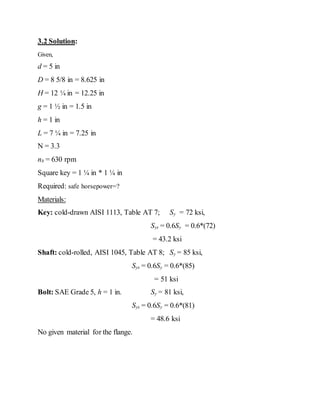
“Course of ME-3118”
Supervised by:-
Engr. Md. Rasedul Islam,
Lecturer,
Khulna University of
Engineering & Technology
Submitted by:-
Arafat Rahman Tanim
Roll No.: 1205011
Md Anamul Hasan
Roll No.: 1205012
Sabrina Islam
Roll No.: 1205013
Md Faidid Ahasan
Roll No.: 1205014
Ullash Dey
Roll No.: 1205015
June-2015
Department of Mechanical Engineering
Khulna University of Engineering & Technology
Khulna-9203, Bangladesh
At first thanks to almighty for giving the capability and helping the authors to complete this project
work successfully.
The authors would like to express their sincere gratitude to their supervisor Md. Rasedul Islam,
Lecturer, Department of Mechanical Engineering, KUET, for his proper guidance, inspiration,
suggestion and all kind of supports in performing and completing the dissertation work in time.
Moreover his consultation and discussion were very fruitful to carry out this work. All the advices
that have been given by him related to this project were so motivational and enthusiastic to the
authors. In addition, his willingness to discuss about any problems of project increased the interest
among the authors to fulfill this project.
They want to express their sincere gratitude Prof. Dr. Nawsher Ali Moral, Head, Department of
Mechanical Engineering, KUET, who tolerated our short comings, showed his patience in our all
kind of activities relevant to research works and made us confident enough in the research field.
“The Authors”
ACKNOWLEDGEMENT
ABSTRACT
Coupling is one kind of mechanical device which is used to connect two shafts together at their
ends for the purpose of transmitting power.
The primary purpose of couplings is to join two pieces of rotating equipment while permitting
some degree of misalignment or end movement or both.
A rigid coupling is a unit of hardware used to join two shafts within a motor or mechanical system.
It may be used to connect two separate systems, such as a motor and a generator, or to repair a
connection within a single system. A rigid coupling may also be added between shafts to reduce
shock and wear at the point where the shafts meet.
Flanged coupling is a type of rigid coupling in which two co-linear shafts are connected by the
flanges. The coupling enables torque transmission between the shafts & prevents relative rotation
between them.
In the project work a flanged coupling was made by local material available & the analysis of
various stresses & safety factor was also performed.
The outcome of analysis is there’s no danger of failure by pure shear, even if a fatigue strength
reduction factor is included, but this same section may have severe & undefinable bending stresses
on it if the flanges are imperfectly aligned, and they surely will be. The bolts bending was neglected
since they were too small compared to the result outcome.
Finally, the computed factor of safety of the flanges suggest that it would withstand repeated
bending if the misalignment is small.
TABLE OF CONTENTS
Pages
Acknowledgement I
Abstract II
Table of Contents III
List of Figures V
List of Tables VI
Nomenclature VII
1.1 Introduction 1
1.2 Objectives 3
2.1 Historical Background 4
2.2 Safety Factor 4
2.3 Importance of Safety Factor 5
2.4 Shear stress & Compression Stress 5
2.5 Unit of Safety Factor 6
2.6 Units of Stress 6
2.7 Description 7
2.8 Function 7
2.9 Advantages & Disadvantages 8
2.10 Drawbacks 8
3.1 Introduction 9
3.2 Problem 10
3.3 Solution 11
3.4 Dimensions 13
3.5 Solidworks Design & Keyshot Renderings 14
3.6 Material 15
3.7 Key Feature of the Design 15
3.8 Selection 15
CHAPTER-1:
INTRODUCTION
CHAPTER-2: LITERATURE
REVIEW
CHAPTER-3: DESIGN
CHAPTER-4: CONSTRUCTION
4.1 Machines & Apparatus Required 16
4.2 Machining Processes 16
4.3 Methodology 18
4.4 Final Project
18
CHAPTER-5: CONCLUSION
5.1 Result & Discussion 19
5.2 Conclusion 19
REFERENCES 20
LIST OF FIGURES
Figure Title Page
Figure 1.1 Muff Coupling 1
Figure 1.2 Types of misalignments in shafts 2
Figure 1.3 A typical flange coupling 2
Figure 1.4 Application of Flanged Coupling 2
Figure 2.1 Single Shear 5
Figure 2.2 Double Shear 6
Figure 2.3 Compressive stress 6
Figure 2.4 Key 7
Figure 2.5 Keyway & Keyseat in flange & shaft 7
Figure 3.1 Dimension Reference 10
Figure 3.2 Flange 1 (Male Part) Dimension in (mm) 13
Figure 3.3 Flange 2 (Female Part) Dimension in (mm) 13
Figure 3.4 SolidWorks Design of Flanged Coupling 14
Figure 3.5 Facing 16
Figure 3.6 Turning 17
Figure 3.7 Boring 17
Figure 3.8 Chamfering 17
Figure 3.9 Drilling 18
Figure 3.10 Final Project 18
LIST OF TABLES
Table Title Page
Table 2.1 Advantages & Disadvantages of Flanged Coupling 8
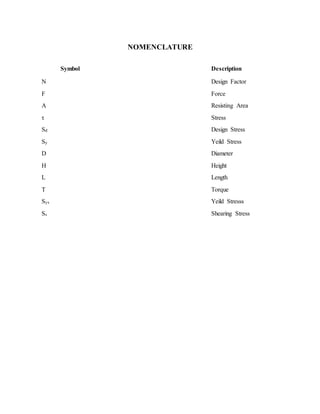
NOMENCLATURE
Symbol Description
N Design Factor
F Force
A Resisting Area
τ Stress
Sd Design Stress
Sy Yeild Stress
D Diameter
H Height
L Length
T Torque
Sys Yeild Stresss
Ss Shearing Stress
CHAPTER 1
 INTRODUCTION
 OBJECTIVES
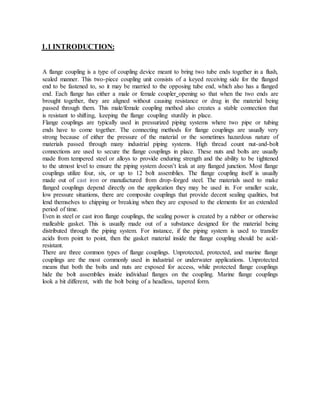
A flange coupling is a type of coupling device meant to bring two tube ends together in a flush,
sealed manner. This two-piece coupling unit consists of a keyed receiving side for the flanged
end to be fastened to, so it may be married to the opposing tube end, which also has a flanged
end. Each flange has either a male or female coupler opening so that when the two ends are
brought together, they are aligned without causing resistance or drag in the material being
passed through them. This male/female coupling method also creates a stable connection that
is resistant to shifting, keeping the flange coupling sturdily in place.
Flange couplings are typically used in pressurized piping systems where two pipe or tubing
ends have to come together. The connecting methods for flange couplings are usually very
strong because of either the pressure of the material or the sometimes hazardous nature of
materials passed through many industrial piping systems. High thread count nut-and-bolt
connections are used to secure the flange couplings in place. These nuts and bolts are usually
made from tempered steel or alloys to provide enduring strength and the ability to be tightened
to the utmost level to ensure the piping system doesn’t leak at any flanged junction. Most flange
couplings utilize four, six, or up to 12 bolt assemblies. The flange coupling itself is usually
made out of cast iron or manufactured from drop-forged steel. The materials used to make
flanged couplings depend directly on the application they may be used in. For smaller scale,
low pressure situations, there are composite couplings that provide decent sealing qualities, but
lend themselves to chipping or breaking when they are exposed to the elements for an extended
period of time.
Even in steel or cast iron flange couplings, the sealing power is created by a rubber or otherwise
malleable gasket. This is usually made out of a substance designed for the material being
distributed through the piping system. For instance, if the piping system is used to transfer
acids from point to point, then the gasket material inside the flange coupling should be acid-
resistant.
There are three common types of flange couplings. Unprotected, protected, and marine flange
couplings are the most commonly used in industrial or underwater applications. Unprotected
means that both the bolts and nuts are exposed for access, while protected flange couplings
hide the bolt assemblies inside individual flanges on the coupling. Marine flange couplings
look a bit different, with the bolt being of a headless, tapered form.
1.1 INTRODUCTION:
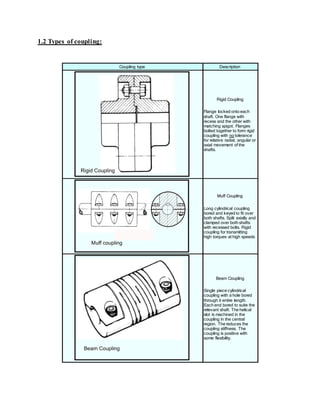
1.2 Types of coupling:
Coupling type Description
Rigid Coupling
Flange locked onto each
shaft. One flange with
recess and the other with
matching spigot. Flanges
bolted together to form rigid
coupling with no tolerance
for relative radial, angular or
axial movement of the
shafts.
Muff Coupling
Long cylindrical coupling
bored and keyed to fit over
both shafts. Split axially and
clamped over both shafts
with recessed bolts. Rigid
coupling for transmitting
high torques at high speeds
Beam Coupling
Single piece cylindrical
coupling with a hole bored
through it entire length.
Each end bored to suite the
relevant shaft. The helical
slot is machined in the
coupling in the central
region. The reduces the
coupling stiffness. The
coupling is positive with
some flexibility.
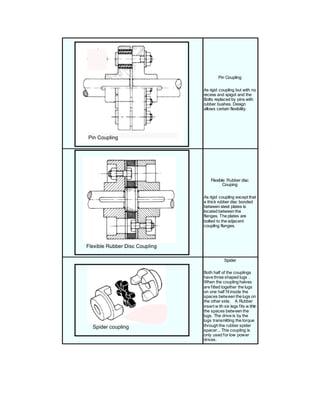
Pin Coupling
As rigid coupling but with no
recess and spigot and the
Bolts replaced by pins with
rubber bushes. Design
allows certain flexibility.
Flexible Rubber disc
Couping
As rigid coupling except that
a thick rubber disc bonded
between steel plates is
located between the
flanges. The plates are
bolted to the adjacent
coupling flanges.
Spider
Both half of the couplings
have three shaped lugs .
When the coupling halves
are fitted together the lugs
on one half fit inside the
spaces between the lugs on
the other side. A Rubber
insert w ith six legs fits w ithin
the spaces between the
lugs. The drive is by the
lugs transmitting the torque
through the rubber spider
spacer... This coupling is
only used for low power
drives.
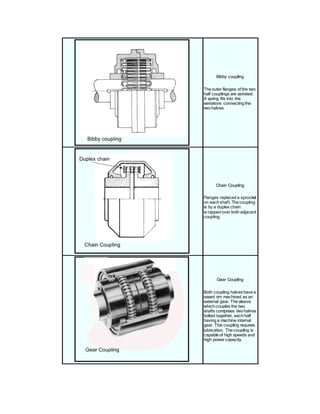
Bibby coupling
The outer flanges of the two
half couplings are serrated.
A spring fits into the
serrations connecting the
two halves.
Chain Coupling
Flanges replaced a sprocket
on each shaft. The coupling
is by a duplex chain
w rapped over both adjacent
coupling.
Gear Coupling
Both coupling halveshave a
raised rim machined as an
external gear. The sleeve
which couples the two
shafts comprises two halves
bolted together, each half
having a machine internal
gear. This coupling requires
lubrication. The coupling is
capable of high speeds and
high power capacity.
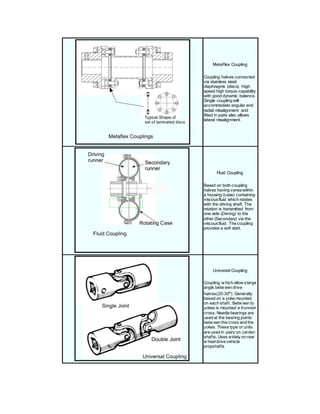
MetaFlex Coupling
Coupling halves connected
via stainless steel
diaphragms (discs). High
speed high torque capability
with good dynamic balance.
Single coupling will
accommodate angular and
radial misalignment and
fitted in pairs also allows
lateral misalignment.
Fluid Coupling
Based on both coupling
halves having vaneswithin
a housing (case) containing
viscousfluid which rotates
with the driving shaft. The
rotation is transmitted from
one side (Driving) to the
other (Secondary) via the
viscousfluid. The coupling
provides a soft start.
Universal Coupling
Coupling w hich allow slarge
angle betw een drive
halves(20-30o). Generally
based on a yoke mounted
on each shaft . Betw een to
yokes is mounted a trunnion
cross. Needle bearings are
used at the bearing points
betw een the cross and the
yokes. These type or units
are used in pairs on carden
shafts. Uses widely on rear
w heeldrive vehicle
propshafts
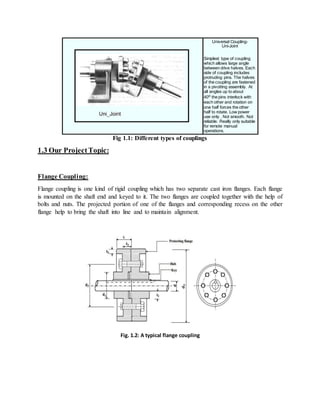
Universal Coupling-
Uni-Joint
Simplest type of coupling
which allows large angle
between drive halves. Each
side of coupling includes
protruding pins. The halves
of the coupling are fastened
in a pivotting assembly. At
all angles up to about
40o the pins interlock with
each other and rotation on
one half forces the other
half to rotate. Low power
use only . Not smooth. Not
reliable. Really only suitable
for remote manual
operations.
Fig 1.1: Different types of couplings
1.3 Our ProjectTopic:
Flange Coupling:
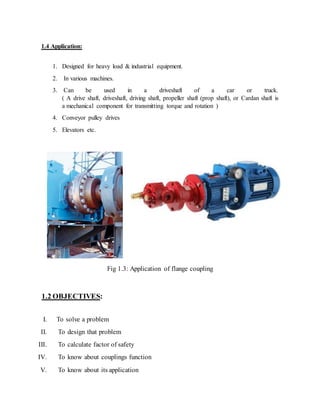
Flange coupling is one kind of rigid coupling which has two separate cast iron flanges. Each flange
is mounted on the shaft end and keyed to it. The two flanges are coupled together with the help of
bolts and nuts. The projected portion of one of the flanges and corresponding recess on the other
flange help to bring the shaft into line and to maintain alignment.
Fig. 1.2: A typical flange coupling
1.2 OBJECTIVES:
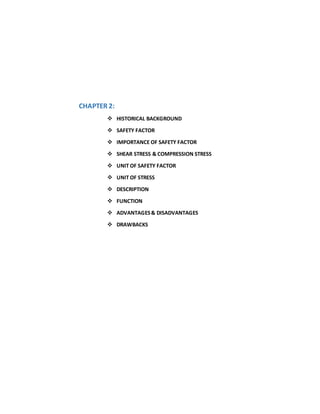
Fig 1.3: Application of flange coupling
I. To solve a problem
II. To design that problem
III. To calculate factor of safety
IV. To know about couplings function
V. To know about its application
1.4 Application:
1. Designed for heavy load & industrial equipment.
2. In various machines.
3. Can be used in a driveshaft of a car or truck.
( A drive shaft, driveshaft, driving shaft, propeller shaft (prop shaft), or Cardan shaft is
a mechanical component for transmitting torque and rotation )
4. Conveyor pulley drives
5. Elevators etc.
CHAPTER 2:
 HISTORICAL BACKGROUND
 SAFETY FACTOR
 IMPORTANCE OF SAFETY FACTOR
 SHEAR STRESS & COMPRESSION STRESS
 UNIT OF SAFETY FACTOR
 UNIT OF STRESS
 DESCRIPTION
 FUNCTION
 ADVANTAGES& DISADVANTAGES
 DRAWBACKS
2.1 Historical Background:
In 1545, Italian mathematician Girolamo Cardano theorized that the principal of gimbals could
be used to transmit rotary motion through an angled connection, which was developed into the
Cardan Shaft, which was said to deliver a smoother ride, along with being more efficient and
less prone to breakdowns because the shaft was always at a 90 degree angle to the axle. This
new concept was actually first seen in 1548 on the carriage of the Holy Roman Emperor
Charles the 5th.
Then in 1676, Robert Hooke revisited Cardano’s idea and used it to make an instrument that
would allow for a safer way to study the sun. This new instrument used a new type of joint that
allowed for twisting motion in one shaft to be passed on to another, no matter how the two
shafts were oriented. It would take another 240 years for Clarence W. Spicer to come along
and apply this idea to the automotive and industrial industries. Spicer received a patent for the
universal joint in 1903 and demonstrated his new patent in a self-designed car, which did not
have a troublesome chain & sprocket nor did it have chain and geared adaptions. Spicer would
then begin manufacturing in 1904.
Human invented the transformation of energy. Soon they learnt to transfer it using shaft. But
in many cases they were unable to transfer power by shafts due to misalignment, length of the
shaft & its bending property. So they tried hard & invented the way of transmitting power by
shafts in all possible situations. The mechanical joint they invented was named coupling.
2.4 Shear stress &Compressionstress:
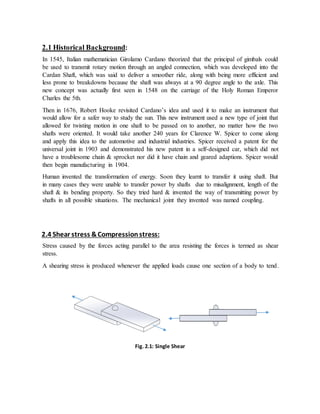
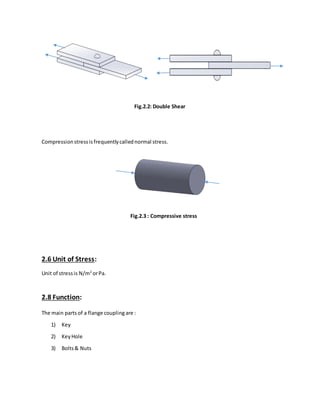
:::::::::stress:Stress caused by the forces acting parallel to the area resisting the forces is termed as shear
stress.
A shearing stress is produced whenever the applied loads cause one section of a body to tend.
.to slide past its adjacent section.
Fig. 2.1: Single Shear
Fig.2.2: Double Shear
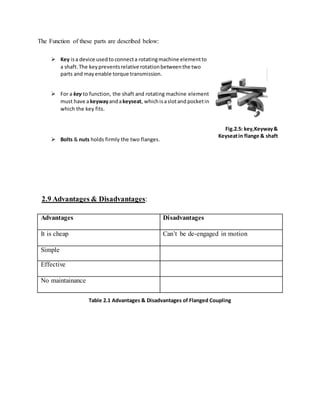
Compressionstressisfrequentlycallednormal stress.
Fig.2.3 : Compressive stress
2.6 Unit of Stress:
Unit of stressis N/m2
orPa.
2.8 Function:
The main parts of a flange coupling are :
1) Key
2) KeyHole
3) Bolts& Nuts
The Function of these parts are described below:
Advantages Disadvantages
It is cheap Can’t be de-engaged in motion
Simple
Effective
No maintainance
 Key isa device usedto connecta rotatingmachine elementto
a shaft.The keypreventsrelative rotationbetweenthe two
parts and mayenable torque transmission.
 For a key to function, the shaft and rotating machine element
must have akeywayandakeyseat, whichisaslotand pocketin
which the key fits.
 Bolts & nuts holds firmly the two flanges.
Fig.2.5: key,Keyway&
Keyseatin flange & shaft
2.9 Advantages & Disadvantages:
Table 2.1 Advantages & Disadvantages of Flanged Coupling
CHAPTER 3
 INTRODUCTION
 PROBLEM
 SOLUTION
 OUR DESIGNED DIMENSION
 SOLIDWORK DESIGN & KEYSHOT RENDERINGS
 MATERIAL
 KEY FEATURES OF THE DESIGN
 SELECTION
3.1 Problem:
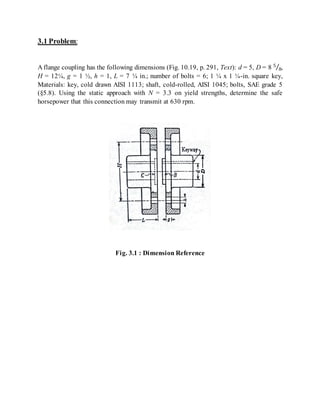
A flange coupling has the following dimensions (Fig. 10.19, p. 291, Text): d = 5, D = 8 5
8⁄ ,
H = 12¼, g = 1 ½, h = 1, L = 7 ¼ in.; number of bolts = 6; 1 ¼ x 1 ¼-in. square key,
Materials: key, cold drawn AISI 1113; shaft, cold-rolled, AISI 1045; bolts, SAE grade 5
(§5.8). Using the static approach with N = 3.3 on yield strengths, determine the safe
horsepower that this connection may transmit at 630 rpm.
Fig. 3.1 : Dimension Reference
3.2 Solution:
Given,
d = 5 in
D = 8 5/8 in = 8.625 in
H = 12 ¼ in = 12.25 in
g = 1 ½ in = 1.5 in
h = 1 in
L = 7 ¼ in = 7.25 in
N = 3.3
nb = 630 rpm
Square key = 1 ¼ in * 1 ¼ in
Required: safe horsepower=?
Materials:
Key: cold-drawn AISI 1113, Table AT 7; Sy = 72 ksi,
Sys = 0.6Sy = 0.6*(72)
= 43.2 ksi
Shaft: cold-rolled, AISI 1045, Table AT 8; Sy = 85 ksi,
Sys = 0.6Sy = 0.6*(85)
= 51 ksi
Bolt: SAE Grade 5, h = 1 in. Sy = 81 ksi,
Sys = 0.6Sy = 0.6*(81)
= 48.6 ksi
No given material for the flange.
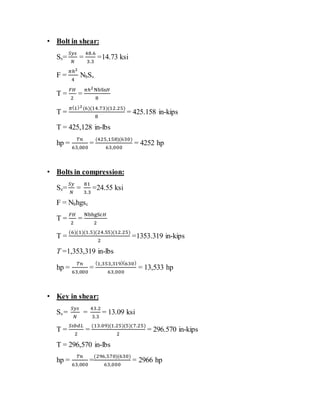
• Bolt in shear:
Ss=
𝑆𝑦𝑠
𝑁
=
48.6
3.3
=14.73 ksi
F =
𝜋ℎ2
4
NbSs
T =
𝐹𝐻
2
=
𝜋ℎ2NbSs𝐻
8
T =
𝜋(1)2(6)(14.73)(12.25)
8
= 425.158 in-kips
T = 425,128 in-lbs
hp =
𝑇𝑛
63,000
=
(425,158)(630)
63,000
= 4252 hp
• Bolts in compression:
Ss=
𝑆𝑦
𝑁
=
81
3.3
=24.55 ksi
F = Nbhgsc
T =
𝐹𝐻
2
=
NbhgSc𝐻
2
T =
(6)(1)(1.5)(24.55)(12.25)
2
=1353.319 in-kips
T =1,353,319 in-lbs
hp =
𝑇𝑛
63,000
=
(1,353,319)(630)
63,000
= 13,533 hp
• Key in shear:
Ss =
𝑆𝑦𝑠
𝑁
=
43.2
3.3
= 13.09 ksi
T =
𝑆𝑠𝑏𝑑𝐿
2
=
(13.09)(1.25)(5)(7.25)
2
= 296.570 in-kips
T = 296,570 in-lbs
hp =
𝑇𝑛
63,000
=
(296,570)(630)
63,000
= 2966 hp
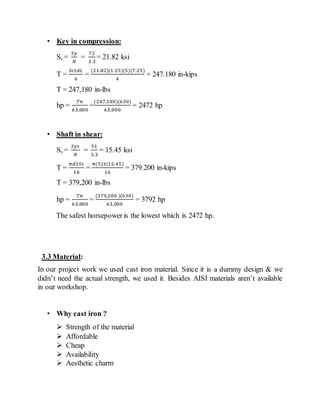
• Key in compression:
Sc =
𝑆𝑦
𝑁
=
72
3.3
= 21.82 ksi
T =
𝑆𝑐𝑡𝑑𝐿
4
=
(21.82)(1.25)(5)(7.25)
4
= 247.180 in-kips
T = 247,180 in-lbs
hp =
𝑇𝑛
63,000
=
(247,180)(630)
63,000
= 2472 hp
• Shaft in shear:
Sc =
𝑆𝑦𝑠
𝑁
=
51
3.3
= 15.45 ksi
T =
𝜋𝑑3𝑆𝑠
16
=
π(5)3(15.45)
16
= 379.200 in-kips
T = 379,200 in-lbs
hp =
𝑇𝑛
63,000
=
(379,200 )(630)
63,000
= 3792 hp
The safest horsepoweris the lowest which is 2472 hp.
In our project work we used cast iron material. Since it is a dummy design & we
didn’t need the actual strength, we used it. Besides AISI materials aren’t available
in our workshop.
• Why cast iron ?
 Strength of the material
 Affordable
 Cheap
 Availability
 Aesthetic charm
3.3 Material:
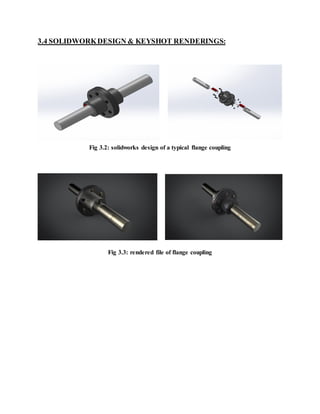
3.4 SOLIDWORKDESIGN & KEYSHOT RENDERINGS:
Fig 3.2: solidworks design of a typical flange coupling
Fig 3.3: rendered file of flange coupling
3.5 Dimension of our project:
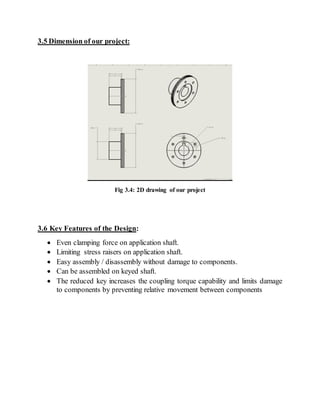
Fig 3.4: 2D drawing of our project
3.6 Key Features of the Design:
 Even clamping force on application shaft.
 Limiting stress raisers on application shaft.
 Easy assembly / disassembly without damage to components.
 Can be assembled on keyed shaft.
 The reduced key increases the coupling torque capability and limits damage
to components by preventing relative movement between components
CHAPTER 4
 Machines & Apparatus Required
 Machining Processes
 Methodology
 Final Project
4.1 Machines & Apparatus Required:
The following machines were required in performing the machining processes-
1. Lathe Machine
2. Drilling Machine
3. Die & Taps
4. Grinding Machine
4.2 Machining Processes:
i. Facing:
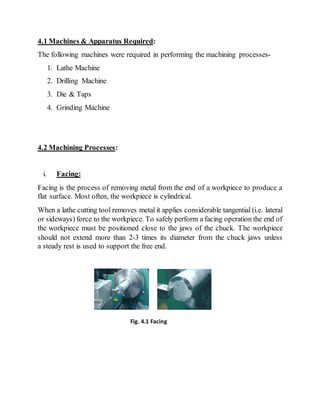
Facing is the process of removing metal from the end of a workpiece to produce a
flat surface. Most often, the workpiece is cylindrical.
When a lathe cutting tool removes metal it applies considerable tangential (i.e. lateral
or sideways) force to the workpiece. To safely perform a facing operation the end of
the workpiece must be positioned close to the jaws of the chuck. The workpiece
should not extend more than 2-3 times its diameter from the chuck jaws unless
a steady rest is used to support the free end.
Fig. 4.1 Facing
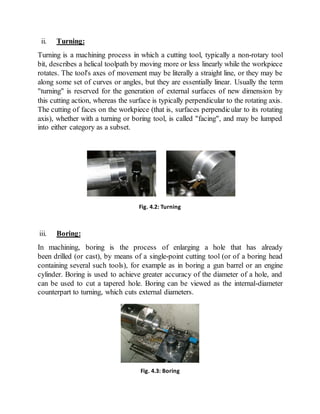
ii. Turning:
Turning is a machining process in which a cutting tool, typically a non-rotary tool
bit, describes a helical toolpath by moving more or less linearly while the workpiece
rotates. The tool's axes of movement may be literally a straight line, or they may be
along some set of curves or angles, but they are essentially linear. Usually the term
"turning" is reserved for the generation of external surfaces of new dimension by
this cutting action, whereas the surface is typically perpendicular to the rotating axis.
The cutting of faces on the workpiece (that is, surfaces perpendicular to its rotating
axis), whether with a turning or boring tool, is called "facing", and may be lumped
into either category as a subset.
iii. Boring:
In machining, boring is the process of enlarging a hole that has already
been drilled (or cast), by means of a single-point cutting tool (or of a boring head
containing several such tools), for example as in boring a gun barrel or an engine
cylinder. Boring is used to achieve greater accuracy of the diameter of a hole, and
can be used to cut a tapered hole. Boring can be viewed as the internal-diameter
counterpart to turning, which cuts external diameters.
Fig. 4.2: Turning
Fig. 4.3: Boring
iv. Chamfering:
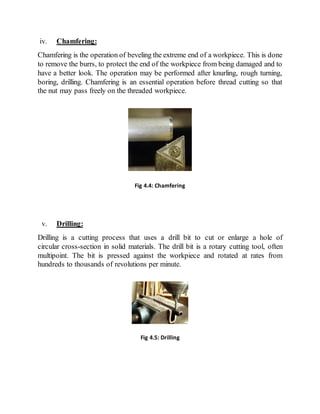
Chamfering is the operation of beveling the extreme end of a workpiece. This is done
to remove the burrs, to protect the end of the workpiece from being damaged and to
have a better look. The operation may be performed after knurling, rough turning,
boring, drilling. Chamfering is an essential operation before thread cutting so that
the nut may pass freely on the threaded workpiece.
v. Drilling:
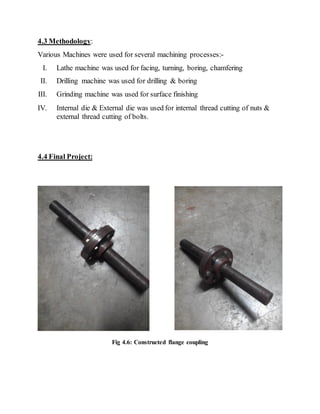
Drilling is a cutting process that uses a drill bit to cut or enlarge a hole of
circular cross-section in solid materials. The drill bit is a rotary cutting tool, often
multipoint. The bit is pressed against the workpiece and rotated at rates from
hundreds to thousands of revolutions per minute.
Fig 4.4: Chamfering
Fig 4.5: Drilling
4.3 Methodology:
Various Machines were used for several machining processes:-
I. Lathe machine was used for facing, turning, boring, chamfering
II. Drilling machine was used for drilling & boring
III. Grinding machine was used for surface finishing
IV. Internal die & External die was used for internal thread cutting of nuts &
external thread cutting of bolts.
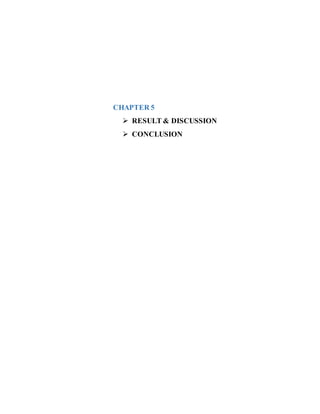
4.4 Final Project:
Fig 4.6: Constructed flange coupling
CHAPTER 5
 RESULT & DISCUSSION
 CONCLUSION
An important criteria of constructing a flange coupling is to maintain the shafts in proper
alignment. If the shafts cannot be set in perfect alignment and if the loading induces relatively high
stresses fatigue failure occurs. If the flanges are nearer to the bearings, the smaller will be the
deflection of the shaft at the point and the smaller the stresses included in the flanges by this
deflection. So the design will be safe from failure. The whole process of the constructing the
coupling was observed. Moreover the difference between flange coupling and other couplings
were studied. Finally the objectives were tried to be fulfilled as perfect as possible. Moreover the
result of analysis was there’s no danger of failure by pure shear, even if a fatigue strength reduction
factor is included, but this same section may have severe & undefinable bending stresses on it if
the flanges are imperfectly aligned, and they surely will be. The bolts bending was neglected since
they were too small compared to the result outcome.
By performing this project we had learnt the design of a flanged coupling, analysis of a flanged
coupling, calculating safety factor of it & the safe arrangement of it. Moreover its application in
our practical life were also known. In future it will be helpful for us to choose the right coupling
among various types of couplings.
5.1 Result &Discussion:
5.2 Conclusion:
References:
[1] FAIRES VIRGIL MORING, “DESIGN OF MACHINE ELEMENTS”, 4th edition, The
Macmillan Company, New York/Collier-Macmillan Limited, London
[2] Jain R.K., “ Production Technology”, 16th edition, 2-B, Nath Market, Nai Sarak, Delhi-
110006
[3] Mechanical Design Data Manual Chapter 15
[4] https://www.google.com.bd/webhp?sourceid=chrome-instant&ion=1&espv=2&ie=UTF-
8#q=historical+background+of+flange+coupling
[5] http://www.wisegeek.com/what-is-a-flange-coupling.htm
[6] http://www.roymech.co.uk/Useful_Tables/Drive/Drive_Couplings.html

Report on Flange Cupling

  • 1.
    Design & Constructionof a Flanged Coupling A report submitted to the department of Mechanical Engineering , Khulna University of Engineering & Technology in partial fulfillment of the requirements for the “Course of ME-3118” Supervised by:- Engr. Md. Rasedul Islam, Lecturer, Khulna University of Engineering & Technology Submitted by:- Arafat Rahman Tanim Roll No.: 1205011 Md Anamul Hasan Roll No.: 1205012 Sabrina Islam Roll No.: 1205013 Md Faidid Ahasan Roll No.: 1205014 Ullash Dey Roll No.: 1205015 June-2015 Department of Mechanical Engineering Khulna University of Engineering & Technology Khulna-9203, Bangladesh
  • 2.
    At first thanksto almighty for giving the capability and helping the authors to complete this project work successfully. The authors would like to express their sincere gratitude to their supervisor Md. Rasedul Islam, Lecturer, Department of Mechanical Engineering, KUET, for his proper guidance, inspiration, suggestion and all kind of supports in performing and completing the dissertation work in time. Moreover his consultation and discussion were very fruitful to carry out this work. All the advices that have been given by him related to this project were so motivational and enthusiastic to the authors. In addition, his willingness to discuss about any problems of project increased the interest among the authors to fulfill this project. They want to express their sincere gratitude Prof. Dr. Nawsher Ali Moral, Head, Department of Mechanical Engineering, KUET, who tolerated our short comings, showed his patience in our all kind of activities relevant to research works and made us confident enough in the research field. “The Authors” ACKNOWLEDGEMENT
  • 3.
    ABSTRACT Coupling is onekind of mechanical device which is used to connect two shafts together at their ends for the purpose of transmitting power. The primary purpose of couplings is to join two pieces of rotating equipment while permitting some degree of misalignment or end movement or both. A rigid coupling is a unit of hardware used to join two shafts within a motor or mechanical system. It may be used to connect two separate systems, such as a motor and a generator, or to repair a connection within a single system. A rigid coupling may also be added between shafts to reduce shock and wear at the point where the shafts meet. Flanged coupling is a type of rigid coupling in which two co-linear shafts are connected by the flanges. The coupling enables torque transmission between the shafts & prevents relative rotation between them. In the project work a flanged coupling was made by local material available & the analysis of various stresses & safety factor was also performed. The outcome of analysis is there’s no danger of failure by pure shear, even if a fatigue strength reduction factor is included, but this same section may have severe & undefinable bending stresses on it if the flanges are imperfectly aligned, and they surely will be. The bolts bending was neglected since they were too small compared to the result outcome. Finally, the computed factor of safety of the flanges suggest that it would withstand repeated bending if the misalignment is small.
  • 4.
    TABLE OF CONTENTS Pages AcknowledgementI Abstract II Table of Contents III List of Figures V List of Tables VI Nomenclature VII 1.1 Introduction 1 1.2 Objectives 3 2.1 Historical Background 4 2.2 Safety Factor 4 2.3 Importance of Safety Factor 5 2.4 Shear stress & Compression Stress 5 2.5 Unit of Safety Factor 6 2.6 Units of Stress 6 2.7 Description 7 2.8 Function 7 2.9 Advantages & Disadvantages 8 2.10 Drawbacks 8 3.1 Introduction 9 3.2 Problem 10 3.3 Solution 11 3.4 Dimensions 13 3.5 Solidworks Design & Keyshot Renderings 14 3.6 Material 15 3.7 Key Feature of the Design 15 3.8 Selection 15 CHAPTER-1: INTRODUCTION CHAPTER-2: LITERATURE REVIEW CHAPTER-3: DESIGN
  • 5.
    CHAPTER-4: CONSTRUCTION 4.1 Machines& Apparatus Required 16 4.2 Machining Processes 16 4.3 Methodology 18 4.4 Final Project 18 CHAPTER-5: CONCLUSION 5.1 Result & Discussion 19 5.2 Conclusion 19 REFERENCES 20
  • 6.
    LIST OF FIGURES FigureTitle Page Figure 1.1 Muff Coupling 1 Figure 1.2 Types of misalignments in shafts 2 Figure 1.3 A typical flange coupling 2 Figure 1.4 Application of Flanged Coupling 2 Figure 2.1 Single Shear 5 Figure 2.2 Double Shear 6 Figure 2.3 Compressive stress 6 Figure 2.4 Key 7 Figure 2.5 Keyway & Keyseat in flange & shaft 7 Figure 3.1 Dimension Reference 10 Figure 3.2 Flange 1 (Male Part) Dimension in (mm) 13 Figure 3.3 Flange 2 (Female Part) Dimension in (mm) 13 Figure 3.4 SolidWorks Design of Flanged Coupling 14 Figure 3.5 Facing 16 Figure 3.6 Turning 17 Figure 3.7 Boring 17 Figure 3.8 Chamfering 17 Figure 3.9 Drilling 18 Figure 3.10 Final Project 18
  • 7.
    LIST OF TABLES TableTitle Page Table 2.1 Advantages & Disadvantages of Flanged Coupling 8
  • 8.
    NOMENCLATURE Symbol Description N DesignFactor F Force A Resisting Area τ Stress Sd Design Stress Sy Yeild Stress D Diameter H Height L Length T Torque Sys Yeild Stresss Ss Shearing Stress
  • 9.
  • 10.
    A flange couplingis a type of coupling device meant to bring two tube ends together in a flush, sealed manner. This two-piece coupling unit consists of a keyed receiving side for the flanged end to be fastened to, so it may be married to the opposing tube end, which also has a flanged end. Each flange has either a male or female coupler opening so that when the two ends are brought together, they are aligned without causing resistance or drag in the material being passed through them. This male/female coupling method also creates a stable connection that is resistant to shifting, keeping the flange coupling sturdily in place. Flange couplings are typically used in pressurized piping systems where two pipe or tubing ends have to come together. The connecting methods for flange couplings are usually very strong because of either the pressure of the material or the sometimes hazardous nature of materials passed through many industrial piping systems. High thread count nut-and-bolt connections are used to secure the flange couplings in place. These nuts and bolts are usually made from tempered steel or alloys to provide enduring strength and the ability to be tightened to the utmost level to ensure the piping system doesn’t leak at any flanged junction. Most flange couplings utilize four, six, or up to 12 bolt assemblies. The flange coupling itself is usually made out of cast iron or manufactured from drop-forged steel. The materials used to make flanged couplings depend directly on the application they may be used in. For smaller scale, low pressure situations, there are composite couplings that provide decent sealing qualities, but lend themselves to chipping or breaking when they are exposed to the elements for an extended period of time. Even in steel or cast iron flange couplings, the sealing power is created by a rubber or otherwise malleable gasket. This is usually made out of a substance designed for the material being distributed through the piping system. For instance, if the piping system is used to transfer acids from point to point, then the gasket material inside the flange coupling should be acid- resistant. There are three common types of flange couplings. Unprotected, protected, and marine flange couplings are the most commonly used in industrial or underwater applications. Unprotected means that both the bolts and nuts are exposed for access, while protected flange couplings hide the bolt assemblies inside individual flanges on the coupling. Marine flange couplings look a bit different, with the bolt being of a headless, tapered form. 1.1 INTRODUCTION:
  • 11.
    1.2 Types ofcoupling: Coupling type Description Rigid Coupling Flange locked onto each shaft. One flange with recess and the other with matching spigot. Flanges bolted together to form rigid coupling with no tolerance for relative radial, angular or axial movement of the shafts. Muff Coupling Long cylindrical coupling bored and keyed to fit over both shafts. Split axially and clamped over both shafts with recessed bolts. Rigid coupling for transmitting high torques at high speeds Beam Coupling Single piece cylindrical coupling with a hole bored through it entire length. Each end bored to suite the relevant shaft. The helical slot is machined in the coupling in the central region. The reduces the coupling stiffness. The coupling is positive with some flexibility.
  • 12.
    Pin Coupling As rigidcoupling but with no recess and spigot and the Bolts replaced by pins with rubber bushes. Design allows certain flexibility. Flexible Rubber disc Couping As rigid coupling except that a thick rubber disc bonded between steel plates is located between the flanges. The plates are bolted to the adjacent coupling flanges. Spider Both half of the couplings have three shaped lugs . When the coupling halves are fitted together the lugs on one half fit inside the spaces between the lugs on the other side. A Rubber insert w ith six legs fits w ithin the spaces between the lugs. The drive is by the lugs transmitting the torque through the rubber spider spacer... This coupling is only used for low power drives.
  • 13.
    Bibby coupling The outerflanges of the two half couplings are serrated. A spring fits into the serrations connecting the two halves. Chain Coupling Flanges replaced a sprocket on each shaft. The coupling is by a duplex chain w rapped over both adjacent coupling. Gear Coupling Both coupling halveshave a raised rim machined as an external gear. The sleeve which couples the two shafts comprises two halves bolted together, each half having a machine internal gear. This coupling requires lubrication. The coupling is capable of high speeds and high power capacity.
  • 14.
    MetaFlex Coupling Coupling halvesconnected via stainless steel diaphragms (discs). High speed high torque capability with good dynamic balance. Single coupling will accommodate angular and radial misalignment and fitted in pairs also allows lateral misalignment. Fluid Coupling Based on both coupling halves having vaneswithin a housing (case) containing viscousfluid which rotates with the driving shaft. The rotation is transmitted from one side (Driving) to the other (Secondary) via the viscousfluid. The coupling provides a soft start. Universal Coupling Coupling w hich allow slarge angle betw een drive halves(20-30o). Generally based on a yoke mounted on each shaft . Betw een to yokes is mounted a trunnion cross. Needle bearings are used at the bearing points betw een the cross and the yokes. These type or units are used in pairs on carden shafts. Uses widely on rear w heeldrive vehicle propshafts
  • 15.
    Universal Coupling- Uni-Joint Simplest typeof coupling which allows large angle between drive halves. Each side of coupling includes protruding pins. The halves of the coupling are fastened in a pivotting assembly. At all angles up to about 40o the pins interlock with each other and rotation on one half forces the other half to rotate. Low power use only . Not smooth. Not reliable. Really only suitable for remote manual operations. Fig 1.1: Different types of couplings 1.3 Our ProjectTopic: Flange Coupling: Flange coupling is one kind of rigid coupling which has two separate cast iron flanges. Each flange is mounted on the shaft end and keyed to it. The two flanges are coupled together with the help of bolts and nuts. The projected portion of one of the flanges and corresponding recess on the other flange help to bring the shaft into line and to maintain alignment. Fig. 1.2: A typical flange coupling
  • 16.
    1.2 OBJECTIVES: Fig 1.3:Application of flange coupling I. To solve a problem II. To design that problem III. To calculate factor of safety IV. To know about couplings function V. To know about its application 1.4 Application: 1. Designed for heavy load & industrial equipment. 2. In various machines. 3. Can be used in a driveshaft of a car or truck. ( A drive shaft, driveshaft, driving shaft, propeller shaft (prop shaft), or Cardan shaft is a mechanical component for transmitting torque and rotation ) 4. Conveyor pulley drives 5. Elevators etc.
  • 17.
    CHAPTER 2:  HISTORICALBACKGROUND  SAFETY FACTOR  IMPORTANCE OF SAFETY FACTOR  SHEAR STRESS & COMPRESSION STRESS  UNIT OF SAFETY FACTOR  UNIT OF STRESS  DESCRIPTION  FUNCTION  ADVANTAGES& DISADVANTAGES  DRAWBACKS
  • 18.
    2.1 Historical Background: In1545, Italian mathematician Girolamo Cardano theorized that the principal of gimbals could be used to transmit rotary motion through an angled connection, which was developed into the Cardan Shaft, which was said to deliver a smoother ride, along with being more efficient and less prone to breakdowns because the shaft was always at a 90 degree angle to the axle. This new concept was actually first seen in 1548 on the carriage of the Holy Roman Emperor Charles the 5th. Then in 1676, Robert Hooke revisited Cardano’s idea and used it to make an instrument that would allow for a safer way to study the sun. This new instrument used a new type of joint that allowed for twisting motion in one shaft to be passed on to another, no matter how the two shafts were oriented. It would take another 240 years for Clarence W. Spicer to come along and apply this idea to the automotive and industrial industries. Spicer received a patent for the universal joint in 1903 and demonstrated his new patent in a self-designed car, which did not have a troublesome chain & sprocket nor did it have chain and geared adaptions. Spicer would then begin manufacturing in 1904. Human invented the transformation of energy. Soon they learnt to transfer it using shaft. But in many cases they were unable to transfer power by shafts due to misalignment, length of the shaft & its bending property. So they tried hard & invented the way of transmitting power by shafts in all possible situations. The mechanical joint they invented was named coupling. 2.4 Shear stress &Compressionstress: :::::::::stress:Stress caused by the forces acting parallel to the area resisting the forces is termed as shear stress. A shearing stress is produced whenever the applied loads cause one section of a body to tend. .to slide past its adjacent section. Fig. 2.1: Single Shear
  • 19.
    Fig.2.2: Double Shear Compressionstressisfrequentlycallednormalstress. Fig.2.3 : Compressive stress 2.6 Unit of Stress: Unit of stressis N/m2 orPa. 2.8 Function: The main parts of a flange coupling are : 1) Key 2) KeyHole 3) Bolts& Nuts
  • 20.
    The Function ofthese parts are described below: Advantages Disadvantages It is cheap Can’t be de-engaged in motion Simple Effective No maintainance  Key isa device usedto connecta rotatingmachine elementto a shaft.The keypreventsrelative rotationbetweenthe two parts and mayenable torque transmission.  For a key to function, the shaft and rotating machine element must have akeywayandakeyseat, whichisaslotand pocketin which the key fits.  Bolts & nuts holds firmly the two flanges. Fig.2.5: key,Keyway& Keyseatin flange & shaft 2.9 Advantages & Disadvantages: Table 2.1 Advantages & Disadvantages of Flanged Coupling
  • 21.
    CHAPTER 3  INTRODUCTION PROBLEM  SOLUTION  OUR DESIGNED DIMENSION  SOLIDWORK DESIGN & KEYSHOT RENDERINGS  MATERIAL  KEY FEATURES OF THE DESIGN  SELECTION
  • 22.
    3.1 Problem: A flangecoupling has the following dimensions (Fig. 10.19, p. 291, Text): d = 5, D = 8 5 8⁄ , H = 12¼, g = 1 ½, h = 1, L = 7 ¼ in.; number of bolts = 6; 1 ¼ x 1 ¼-in. square key, Materials: key, cold drawn AISI 1113; shaft, cold-rolled, AISI 1045; bolts, SAE grade 5 (§5.8). Using the static approach with N = 3.3 on yield strengths, determine the safe horsepower that this connection may transmit at 630 rpm. Fig. 3.1 : Dimension Reference
  • 23.
    3.2 Solution: Given, d =5 in D = 8 5/8 in = 8.625 in H = 12 ¼ in = 12.25 in g = 1 ½ in = 1.5 in h = 1 in L = 7 ¼ in = 7.25 in N = 3.3 nb = 630 rpm Square key = 1 ¼ in * 1 ¼ in Required: safe horsepower=? Materials: Key: cold-drawn AISI 1113, Table AT 7; Sy = 72 ksi, Sys = 0.6Sy = 0.6*(72) = 43.2 ksi Shaft: cold-rolled, AISI 1045, Table AT 8; Sy = 85 ksi, Sys = 0.6Sy = 0.6*(85) = 51 ksi Bolt: SAE Grade 5, h = 1 in. Sy = 81 ksi, Sys = 0.6Sy = 0.6*(81) = 48.6 ksi No given material for the flange.
  • 24.
    • Bolt inshear: Ss= 𝑆𝑦𝑠 𝑁 = 48.6 3.3 =14.73 ksi F = 𝜋ℎ2 4 NbSs T = 𝐹𝐻 2 = 𝜋ℎ2NbSs𝐻 8 T = 𝜋(1)2(6)(14.73)(12.25) 8 = 425.158 in-kips T = 425,128 in-lbs hp = 𝑇𝑛 63,000 = (425,158)(630) 63,000 = 4252 hp • Bolts in compression: Ss= 𝑆𝑦 𝑁 = 81 3.3 =24.55 ksi F = Nbhgsc T = 𝐹𝐻 2 = NbhgSc𝐻 2 T = (6)(1)(1.5)(24.55)(12.25) 2 =1353.319 in-kips T =1,353,319 in-lbs hp = 𝑇𝑛 63,000 = (1,353,319)(630) 63,000 = 13,533 hp • Key in shear: Ss = 𝑆𝑦𝑠 𝑁 = 43.2 3.3 = 13.09 ksi T = 𝑆𝑠𝑏𝑑𝐿 2 = (13.09)(1.25)(5)(7.25) 2 = 296.570 in-kips T = 296,570 in-lbs hp = 𝑇𝑛 63,000 = (296,570)(630) 63,000 = 2966 hp
  • 25.
    • Key incompression: Sc = 𝑆𝑦 𝑁 = 72 3.3 = 21.82 ksi T = 𝑆𝑐𝑡𝑑𝐿 4 = (21.82)(1.25)(5)(7.25) 4 = 247.180 in-kips T = 247,180 in-lbs hp = 𝑇𝑛 63,000 = (247,180)(630) 63,000 = 2472 hp • Shaft in shear: Sc = 𝑆𝑦𝑠 𝑁 = 51 3.3 = 15.45 ksi T = 𝜋𝑑3𝑆𝑠 16 = π(5)3(15.45) 16 = 379.200 in-kips T = 379,200 in-lbs hp = 𝑇𝑛 63,000 = (379,200 )(630) 63,000 = 3792 hp The safest horsepoweris the lowest which is 2472 hp. In our project work we used cast iron material. Since it is a dummy design & we didn’t need the actual strength, we used it. Besides AISI materials aren’t available in our workshop. • Why cast iron ?  Strength of the material  Affordable  Cheap  Availability  Aesthetic charm 3.3 Material:
  • 26.
    3.4 SOLIDWORKDESIGN &KEYSHOT RENDERINGS: Fig 3.2: solidworks design of a typical flange coupling Fig 3.3: rendered file of flange coupling
  • 27.
    3.5 Dimension ofour project: Fig 3.4: 2D drawing of our project 3.6 Key Features of the Design:  Even clamping force on application shaft.  Limiting stress raisers on application shaft.  Easy assembly / disassembly without damage to components.  Can be assembled on keyed shaft.  The reduced key increases the coupling torque capability and limits damage to components by preventing relative movement between components
  • 28.
    CHAPTER 4  Machines& Apparatus Required  Machining Processes  Methodology  Final Project
  • 29.
    4.1 Machines &Apparatus Required: The following machines were required in performing the machining processes- 1. Lathe Machine 2. Drilling Machine 3. Die & Taps 4. Grinding Machine 4.2 Machining Processes: i. Facing: Facing is the process of removing metal from the end of a workpiece to produce a flat surface. Most often, the workpiece is cylindrical. When a lathe cutting tool removes metal it applies considerable tangential (i.e. lateral or sideways) force to the workpiece. To safely perform a facing operation the end of the workpiece must be positioned close to the jaws of the chuck. The workpiece should not extend more than 2-3 times its diameter from the chuck jaws unless a steady rest is used to support the free end. Fig. 4.1 Facing
  • 30.
    ii. Turning: Turning isa machining process in which a cutting tool, typically a non-rotary tool bit, describes a helical toolpath by moving more or less linearly while the workpiece rotates. The tool's axes of movement may be literally a straight line, or they may be along some set of curves or angles, but they are essentially linear. Usually the term "turning" is reserved for the generation of external surfaces of new dimension by this cutting action, whereas the surface is typically perpendicular to the rotating axis. The cutting of faces on the workpiece (that is, surfaces perpendicular to its rotating axis), whether with a turning or boring tool, is called "facing", and may be lumped into either category as a subset. iii. Boring: In machining, boring is the process of enlarging a hole that has already been drilled (or cast), by means of a single-point cutting tool (or of a boring head containing several such tools), for example as in boring a gun barrel or an engine cylinder. Boring is used to achieve greater accuracy of the diameter of a hole, and can be used to cut a tapered hole. Boring can be viewed as the internal-diameter counterpart to turning, which cuts external diameters. Fig. 4.2: Turning Fig. 4.3: Boring
  • 31.
    iv. Chamfering: Chamfering isthe operation of beveling the extreme end of a workpiece. This is done to remove the burrs, to protect the end of the workpiece from being damaged and to have a better look. The operation may be performed after knurling, rough turning, boring, drilling. Chamfering is an essential operation before thread cutting so that the nut may pass freely on the threaded workpiece. v. Drilling: Drilling is a cutting process that uses a drill bit to cut or enlarge a hole of circular cross-section in solid materials. The drill bit is a rotary cutting tool, often multipoint. The bit is pressed against the workpiece and rotated at rates from hundreds to thousands of revolutions per minute. Fig 4.4: Chamfering Fig 4.5: Drilling
  • 32.
    4.3 Methodology: Various Machineswere used for several machining processes:- I. Lathe machine was used for facing, turning, boring, chamfering II. Drilling machine was used for drilling & boring III. Grinding machine was used for surface finishing IV. Internal die & External die was used for internal thread cutting of nuts & external thread cutting of bolts. 4.4 Final Project: Fig 4.6: Constructed flange coupling
  • 33.
    CHAPTER 5  RESULT& DISCUSSION  CONCLUSION
  • 34.
    An important criteriaof constructing a flange coupling is to maintain the shafts in proper alignment. If the shafts cannot be set in perfect alignment and if the loading induces relatively high stresses fatigue failure occurs. If the flanges are nearer to the bearings, the smaller will be the deflection of the shaft at the point and the smaller the stresses included in the flanges by this deflection. So the design will be safe from failure. The whole process of the constructing the coupling was observed. Moreover the difference between flange coupling and other couplings were studied. Finally the objectives were tried to be fulfilled as perfect as possible. Moreover the result of analysis was there’s no danger of failure by pure shear, even if a fatigue strength reduction factor is included, but this same section may have severe & undefinable bending stresses on it if the flanges are imperfectly aligned, and they surely will be. The bolts bending was neglected since they were too small compared to the result outcome. By performing this project we had learnt the design of a flanged coupling, analysis of a flanged coupling, calculating safety factor of it & the safe arrangement of it. Moreover its application in our practical life were also known. In future it will be helpful for us to choose the right coupling among various types of couplings. 5.1 Result &Discussion: 5.2 Conclusion:
  • 35.
    References: [1] FAIRES VIRGILMORING, “DESIGN OF MACHINE ELEMENTS”, 4th edition, The Macmillan Company, New York/Collier-Macmillan Limited, London [2] Jain R.K., “ Production Technology”, 16th edition, 2-B, Nath Market, Nai Sarak, Delhi- 110006 [3] Mechanical Design Data Manual Chapter 15 [4] https://www.google.com.bd/webhp?sourceid=chrome-instant&ion=1&espv=2&ie=UTF- 8#q=historical+background+of+flange+coupling [5] http://www.wisegeek.com/what-is-a-flange-coupling.htm [6] http://www.roymech.co.uk/Useful_Tables/Drive/Drive_Couplings.html