Subject : Machine Design and Industrial
Drafting (2141907)
Topic : Power Screw
Prepared By :
Vikram Singh _ (150990119045)
Vivek Singh _ (150990119046)
Vivek Srivastav _ (150990119047)
Dhavalsinh Sunva _ (150990119048)
Swapnil Kumar Singh _ (150990119049)
Guided By :
Mr. Rudraduttasinh
Parmar and Mr. Jatin Parmar
Branch :
Mechanical Engineering
Introduction
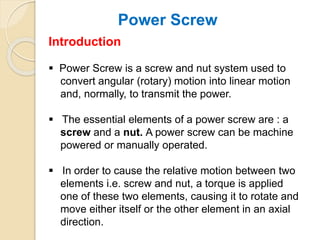
 Power Screw is a screw and nut system used to
convert angular (rotary) motion into linear motion
and, normally, to transmit the power.
 The essential elements of a power screw are : a
screw and a nut. A power screw can be machine
powered or manually operated.
 In order to cause the relative motion between two
elements i.e. screw and nut, a torque is applied
one of these two elements, causing it to rotate and
move either itself or the other element in an axial
direction.
Power Screw
 Advantages of Power Screw :
(1) The power screws can be used for converting
the angular (rotary) motion into linear motion.
(2) The power screws have high efficiency, and
hence, are used for transmitting the power.
 Limitations of Power Screw :
(1) The strength of power threads is lower
than the V-threads.
 Applications of Power Screws :
(1) The applications of power screws are : lead
screws of machine tools, screw jacks, C-clamps,
mechanical presses, tensile testing machines and
vices, etc.
TERMINOLOGY OF POWER SCREW
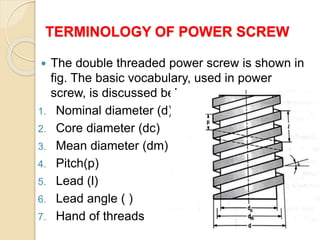
 The double threaded power screw is shown in
fig. The basic vocabulary, used in power
screw, is discussed below:
1. Nominal diameter (d)
2. Core diameter (dc)
3. Mean diameter (dm)
4. Pitch(p)
5. Lead (l)
6. Lead angle ( )
7. Hand of threads
 1. Nominal Diameter (d) :
 It is the largest diameter of an external or
 internal thread. The screw is specified by this
diameter.
 It is also known as outer diameter or major
diameter.
 2. Core Diameter (dc) :
 It is the smallest diameter of an external or
internal thread.
 It is also known as inner diameter or root
diameter.
 3. Mean Diameter (dm):
 It is the average of the nominal diameter and
the core diameter.
 It is also known as pitch diameter.
4. Pitch (p):
It is the distance from any point on the thread to the
corresponding point on the adjacent thread, measured parallel to
the axis.
Pitch, p =
5.lead(l):
It is the distance which a screw advances axially in one
rotation of the nut. It may also be defined as the distance
between two corresponding points on the same helix.
Lead = number of starts x pitch
Where = number of starts
p = pitch
For a single start screw, lead is equal to the pitch; for a double
start screw, lead is twice the pitch; for a triple start screw, lead is
thrice the pitch and so on.
tl N p
tN
6. Lead Angle :
It is an angle made by a helix or a thread with a plane
perpendicular to an axis of screw. The lead angle, A of a
thread is given by,
tan
m
l
d



( )
7.Hand of Threads :
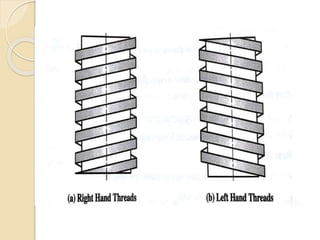
Fig. shows the difference between right hand threads and left
hand threads.
When the axis of screw is vertical, if the thread slopes upward
from left to right. it is known as right hand thread; whereas if the
thread slopes upward from right to left, it is known as left hand
thread.
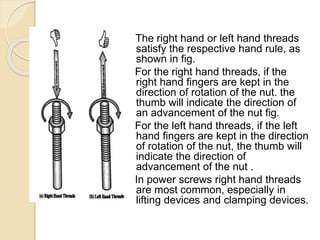
The right hand or left hand threads
satisfy the respective hand rule, as
shown in fig.
For the right hand threads, if the
right hand fingers are kept in the
direction of rotation of the nut. the
thumb will indicate the direction of
an advancement of the nut fig.
For the left hand threads, if the left
hand fingers are kept in the direction
of rotation of the nut, the thumb will
indicate the direction of
advancement of the nut .
In power screws right hand threads
are most common, especially in
lifting devices and clamping devices.
FORMS OF THREADS
 1.SQUARE THREADS
 2.ACME THREADS
 3.TRAPEZOIDAL THREADS
 4.BUTTRESS THREADS
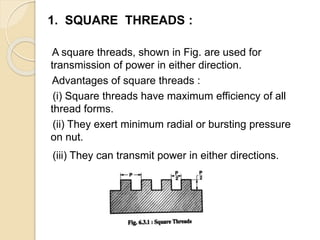
1. SQUARE THREADS :
A square threads, shown in Fig. are used for
transmission of power in either direction.
Advantages of square threads :
(i) Square threads have maximum efficiency of all
thread forms.
(ii) They exert minimum radial or bursting pressure
on nut.
(iii) They can transmit power in either directions.
 Limitations of square threads :
 (i) Strength of the square threads is lowest of all
the thread forms.
 (ii) These threads cannot be used conveniently
with split nut because :
(a) wear compensation is not possible, and
(b) engagement and disengagement is difficult.
 Applications of square threads :
The square threads are used in screw jacks,
mechanical presses and clamping devices.
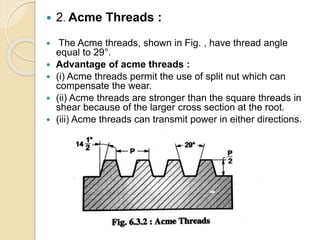
 2. Acme Threads :
 The Acme threads, shown in Fig. , have thread angle
equal to 29°.
 Advantage of acme threads :
 (i) Acme threads permit the use of split nut which can
compensate the wear.
 (ii) Acme threads are stronger than the square threads in
shear because of the larger cross section at the root.
 (iii) Acme threads can transmit power in either directions.
 Limitations of acme threads :
 (i) Because of the slope given to the sides, the
efficiency of acme threads is lower than that of
square threads.
 (ii) The slope on the sides introduces some bursting
pressure on the nut.
 Application of acme threads :
 Acme threads are used for lead screws of machine
tools, bench vices, etc.
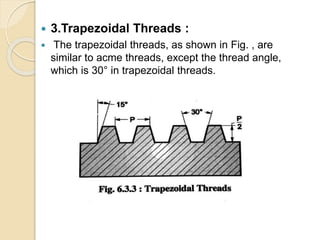
 3.Trapezoidal Threads :
 The trapezoidal threads, as shown in Fig. , are
similar to acme threads, except the thread angle,
which is 30° in trapezoidal threads.
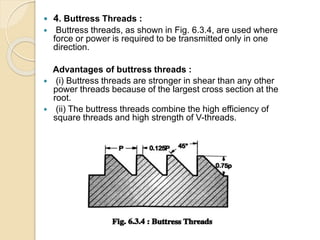
 4. Buttress Threads :
 Buttress threads, as shown in Fig. 6.3.4, are used where
force or power is required to be transmitted only in one
direction.
Advantages of buttress threads :
 (i) Buttress threads are stronger in shear than any other
power threads because of the largest cross section at the
root.
 (ii) The buttress threads combine the high efficiency of
square threads and high strength of V-threads.
 Limitations of buttress threads :
 (i) Buttress threads are used to transmit power in only
one direction.
 (ii) These treads are difficult to manufacture.

 Applications of buttress threads:
 These threads are used in vices and screw jacks
where force is to be applied only in one direction.
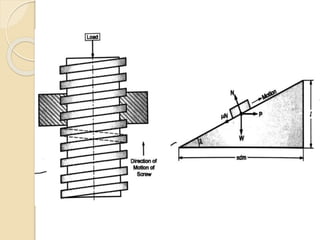
Torque required to raise the load against
thread friction :
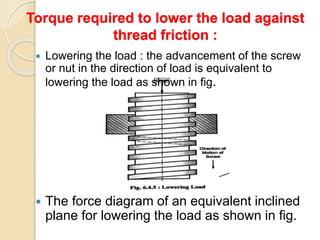
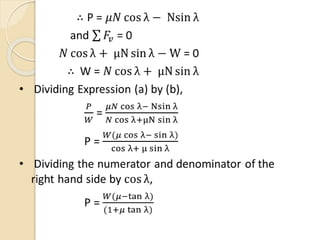
Torque required to lower the load against
thread friction :
 Lowering the load : the advancement of the screw
or nut in the direction of load is equivalent to
lowering the load as shown in fig.
 The force diagram of an equivalent inclined
plane for lowering the load as shown in fig.
 Screw efficiency of square screw
threads :
Self-Locking and Over-Hauling Screws :
Self-Locking Screw :
 In Equation , if , the
torque
required to lower the load will be positive.
Such a
screw is known as self-locking screw.
 For self-locking screw, friction angle is greater
than
lead angle and torque required to lower the
load
will be always positive.
i.e.
 
' 'tT
' '
' '
' 'tT
 
tan tan  tan 
m
l
d



tan( )
2
m
t
Wd
T   
Over-hauling Screw :
 In equation , if , the
torque required to lower the load will be negative
i.e.
the load will start moving downward without the
application of any torque, causing the screw to
rotate.
Such a screw is known as over-hauling screw.
 
 For over-hauling screw, friction angle is less
than
or equal to lead angle and torque required to
lower the load will be zero or negative.
' '
' '
tan( )
2
m
t
Wd
T   
Power screw (machine design & industrial drafting )

Power screw (machine design & industrial drafting )

  • 1.
    Subject : MachineDesign and Industrial Drafting (2141907) Topic : Power Screw Prepared By : Vikram Singh _ (150990119045) Vivek Singh _ (150990119046) Vivek Srivastav _ (150990119047) Dhavalsinh Sunva _ (150990119048) Swapnil Kumar Singh _ (150990119049) Guided By : Mr. Rudraduttasinh Parmar and Mr. Jatin Parmar Branch : Mechanical Engineering
  • 2.
    Introduction  Power Screwis a screw and nut system used to convert angular (rotary) motion into linear motion and, normally, to transmit the power.  The essential elements of a power screw are : a screw and a nut. A power screw can be machine powered or manually operated.  In order to cause the relative motion between two elements i.e. screw and nut, a torque is applied one of these two elements, causing it to rotate and move either itself or the other element in an axial direction. Power Screw
  • 3.
     Advantages ofPower Screw : (1) The power screws can be used for converting the angular (rotary) motion into linear motion. (2) The power screws have high efficiency, and hence, are used for transmitting the power.  Limitations of Power Screw : (1) The strength of power threads is lower than the V-threads.  Applications of Power Screws : (1) The applications of power screws are : lead screws of machine tools, screw jacks, C-clamps, mechanical presses, tensile testing machines and vices, etc.
  • 4.
    TERMINOLOGY OF POWERSCREW  The double threaded power screw is shown in fig. The basic vocabulary, used in power screw, is discussed below: 1. Nominal diameter (d) 2. Core diameter (dc) 3. Mean diameter (dm) 4. Pitch(p) 5. Lead (l) 6. Lead angle ( ) 7. Hand of threads
  • 5.
     1. NominalDiameter (d) :  It is the largest diameter of an external or  internal thread. The screw is specified by this diameter.  It is also known as outer diameter or major diameter.  2. Core Diameter (dc) :  It is the smallest diameter of an external or internal thread.  It is also known as inner diameter or root diameter.  3. Mean Diameter (dm):  It is the average of the nominal diameter and the core diameter.  It is also known as pitch diameter.
  • 6.
    4. Pitch (p): Itis the distance from any point on the thread to the corresponding point on the adjacent thread, measured parallel to the axis. Pitch, p = 5.lead(l): It is the distance which a screw advances axially in one rotation of the nut. It may also be defined as the distance between two corresponding points on the same helix. Lead = number of starts x pitch Where = number of starts p = pitch For a single start screw, lead is equal to the pitch; for a double start screw, lead is twice the pitch; for a triple start screw, lead is thrice the pitch and so on. tl N p tN
  • 7.
    6. Lead Angle: It is an angle made by a helix or a thread with a plane perpendicular to an axis of screw. The lead angle, A of a thread is given by, tan m l d    ( ) 7.Hand of Threads : Fig. shows the difference between right hand threads and left hand threads. When the axis of screw is vertical, if the thread slopes upward from left to right. it is known as right hand thread; whereas if the thread slopes upward from right to left, it is known as left hand thread.
  • 9.
    The right handor left hand threads satisfy the respective hand rule, as shown in fig. For the right hand threads, if the right hand fingers are kept in the direction of rotation of the nut. the thumb will indicate the direction of an advancement of the nut fig. For the left hand threads, if the left hand fingers are kept in the direction of rotation of the nut, the thumb will indicate the direction of advancement of the nut . In power screws right hand threads are most common, especially in lifting devices and clamping devices.
  • 10.
    FORMS OF THREADS 1.SQUARE THREADS  2.ACME THREADS  3.TRAPEZOIDAL THREADS  4.BUTTRESS THREADS
  • 11.
    1. SQUARE THREADS: A square threads, shown in Fig. are used for transmission of power in either direction. Advantages of square threads : (i) Square threads have maximum efficiency of all thread forms. (ii) They exert minimum radial or bursting pressure on nut. (iii) They can transmit power in either directions.
  • 12.
     Limitations ofsquare threads :  (i) Strength of the square threads is lowest of all the thread forms.  (ii) These threads cannot be used conveniently with split nut because : (a) wear compensation is not possible, and (b) engagement and disengagement is difficult.  Applications of square threads : The square threads are used in screw jacks, mechanical presses and clamping devices.
  • 13.
     2. AcmeThreads :  The Acme threads, shown in Fig. , have thread angle equal to 29°.  Advantage of acme threads :  (i) Acme threads permit the use of split nut which can compensate the wear.  (ii) Acme threads are stronger than the square threads in shear because of the larger cross section at the root.  (iii) Acme threads can transmit power in either directions.
  • 14.
     Limitations ofacme threads :  (i) Because of the slope given to the sides, the efficiency of acme threads is lower than that of square threads.  (ii) The slope on the sides introduces some bursting pressure on the nut.  Application of acme threads :  Acme threads are used for lead screws of machine tools, bench vices, etc.
  • 15.
     3.Trapezoidal Threads:  The trapezoidal threads, as shown in Fig. , are similar to acme threads, except the thread angle, which is 30° in trapezoidal threads.
  • 16.
     4. ButtressThreads :  Buttress threads, as shown in Fig. 6.3.4, are used where force or power is required to be transmitted only in one direction. Advantages of buttress threads :  (i) Buttress threads are stronger in shear than any other power threads because of the largest cross section at the root.  (ii) The buttress threads combine the high efficiency of square threads and high strength of V-threads.
  • 17.
     Limitations ofbuttress threads :  (i) Buttress threads are used to transmit power in only one direction.  (ii) These treads are difficult to manufacture.   Applications of buttress threads:  These threads are used in vices and screw jacks where force is to be applied only in one direction.
  • 18.
    Torque required toraise the load against thread friction :
  • 23.
    Torque required tolower the load against thread friction :  Lowering the load : the advancement of the screw or nut in the direction of load is equivalent to lowering the load as shown in fig.  The force diagram of an equivalent inclined plane for lowering the load as shown in fig.
  • 27.
     Screw efficiencyof square screw threads :
  • 30.
    Self-Locking and Over-HaulingScrews : Self-Locking Screw :  In Equation , if , the torque required to lower the load will be positive. Such a screw is known as self-locking screw.  For self-locking screw, friction angle is greater than lead angle and torque required to lower the load will be always positive. i.e.   ' 'tT ' ' ' ' ' 'tT   tan tan  tan  m l d    tan( ) 2 m t Wd T   
  • 31.
    Over-hauling Screw : In equation , if , the torque required to lower the load will be negative i.e. the load will start moving downward without the application of any torque, causing the screw to rotate. Such a screw is known as over-hauling screw.    For over-hauling screw, friction angle is less than or equal to lead angle and torque required to lower the load will be zero or negative. ' ' ' ' tan( ) 2 m t Wd T   