This document summarizes a research paper on chaos in small-world networks. It presents a nonlinear small-world network model to investigate the effects of nonlinear interaction, time delay, and recovery on small-world network dynamics. Both numerical simulations and analytical analysis show that the network response can become chaotic when the network scale exceeds a critical length scale. However, the network may behave regularly at smaller scales. The addition of negative feedback through site recovery is also shown to control chaos in the network response.
![arXiv:1003.4940v1 [cond-mat.dis-nn] 25 Mar 2010
Chaos in Small-World Networks
Xin-She Yang
Department of Applied Mathematics and Department of Fuel and Energy,
University of Leeds, LEEDS LS2 9JT, UK
Abstract
A nonlinear small-world network model has been presented to investigate the effect of non-linear
interaction and time delay on the dynamic properties of small-world networks. Both
numerical simulations and analytical analysis for networks with time delay and nonlinear inter-action
show chaotic features in the system response when nonlinear interaction is strong enough
or the length scale is large enough. In addition, the small-world system may behave very differ-ently
on different scales. Time-delay parameter also has a very strong effect on properties such
as the critical length and response time of small-world networks.
PACS numbers: 05.10.-a, 05.40.-a, 05.45.Gg, 05.45.-a
Citation detail: X. S. Yang, Chaos in small-world networks, Phys. Rev. E 63, 046206 (2001).
1 Introduction
Since the pioneer work of Watts and Strogatz [1] on small-world networks, there arise a lot of
interesting research on the theory and application of small-world networks [2-7]. The properties
of complicated networks such as internet servers, power grids, forest fires and disordered porous
media are mainly determined by the way of connections between the vertices or occupied sites.
One limiting case is the regular network with a high degree of local clustering and a large average
distance, while the other limiting case is the random network with negligible local clustering and
small average distance. The small-world network is a special class of networks with a high degree of
local clustering as well as a small average distance. Such small-world phenomenon can be obtained
by adding randomly only a small fraction of the connections, and some common networks such as
power grids, film stars networks and neural networks behaves like small-world networks [2-9].
The dynamic features such as spreading and reponse of the network have also been investigated
in recent studies [2,3] by using shortest paths in system with sparse long-range connections in the
frame work of small-world models. A simple time-stepping rule has been used to similuate the the
spreading of some influence such as a forest fire, an infectious disease or a particle in percolating
media. The influence propagates from the infected site to all uninfected sites connected to it via a
link at each time step, whenever a long-range connection or shortcut is met, the influence is newly
activated at the other end of the shortcut so as to simulate long-range sparkling effect such as the
infect site (e.g., a person with influenza) suddenly travels to a new place, or a portable computer
with virus that start to connect to the network a new site. These phenomena have been sucessfully
studied by Newman and Watts model [2] and Moukarzel [3]. Their models are linear model in the
sense that the governing equation is linear and the response is immediate as there is no time delay
in their models.
However, in reality, a spark or an infection can not start a new fire spot or new infection im-mediately,
it usually takes some time , called ignition time or waiting time, to start a new fire
or infection. In addition, a fraction of infected site shall recover after a futher time of T to nor-mality.
Thus the existing models are no longer be able to predict the response in the networks or
systems with time delay. Furthermore, the nonlinear effect such as the competition factor as in
1](https://image.slidesharecdn.com/1003-141003111028-phpapp01/85/Chaos-in-Small-World-Networks-1-320.jpg)
![arXiv:1003.4940v1 [cond-mat.dis-nn] 25 Mar 2010
Chaos in Small-World Networks
Xin-She Yang
Department of Applied Mathematics and Department of Fuel and Energy,
University of Leeds, LEEDS LS2 9JT, UK
Abstract
A nonlinear small-world network model has been presented to investigate the effect of non-linear
interaction and time delay on the dynamic properties of small-world networks. Both
numerical simulations and analytical analysis for networks with time delay and nonlinear inter-action
show chaotic features in the system response when nonlinear interaction is strong enough
or the length scale is large enough. In addition, the small-world system may behave very differ-ently
on different scales. Time-delay parameter also has a very strong effect on properties such
as the critical length and response time of small-world networks.
PACS numbers: 05.10.-a, 05.40.-a, 05.45.Gg, 05.45.-a
Citation detail: X. S. Yang, Chaos in small-world networks, Phys. Rev. E 63, 046206 (2001).
1 Introduction
Since the pioneer work of Watts and Strogatz [1] on small-world networks, there arise a lot of
interesting research on the theory and application of small-world networks [2-7]. The properties
of complicated networks such as internet servers, power grids, forest fires and disordered porous
media are mainly determined by the way of connections between the vertices or occupied sites.
One limiting case is the regular network with a high degree of local clustering and a large average
distance, while the other limiting case is the random network with negligible local clustering and
small average distance. The small-world network is a special class of networks with a high degree of
local clustering as well as a small average distance. Such small-world phenomenon can be obtained
by adding randomly only a small fraction of the connections, and some common networks such as
power grids, film stars networks and neural networks behaves like small-world networks [2-9].
The dynamic features such as spreading and reponse of the network have also been investigated
in recent studies [2,3] by using shortest paths in system with sparse long-range connections in the
frame work of small-world models. A simple time-stepping rule has been used to similuate the the
spreading of some influence such as a forest fire, an infectious disease or a particle in percolating
media. The influence propagates from the infected site to all uninfected sites connected to it via a
link at each time step, whenever a long-range connection or shortcut is met, the influence is newly
activated at the other end of the shortcut so as to simulate long-range sparkling effect such as the
infect site (e.g., a person with influenza) suddenly travels to a new place, or a portable computer
with virus that start to connect to the network a new site. These phenomena have been sucessfully
studied by Newman and Watts model [2] and Moukarzel [3]. Their models are linear model in the
sense that the governing equation is linear and the response is immediate as there is no time delay
in their models.
However, in reality, a spark or an infection can not start a new fire spot or new infection im-mediately,
it usually takes some time , called ignition time or waiting time, to start a new fire
or infection. In addition, a fraction of infected site shall recover after a futher time of T to nor-mality.
Thus the existing models are no longer be able to predict the response in the networks or
systems with time delay. Furthermore, the nonlinear effect such as the competition factor as in
1](https://image.slidesharecdn.com/1003-141003111028-phpapp01/75/Chaos-in-Small-World-Networks-1-2048.jpg)
![the population dynamics, congestion feature such as the traffic jam in internet communication and
road networks, and the frictional or viscous effect in the interaction of the vertices. When consid-ering
these nonlinear effects, the resulting small-world network model is generally no longer linear.
Therefore, a nonlinear model is yet to be formulated.
The main aim of this paper to present a more general nonlinear model for the small-world
networks by extending the existing Newman-Watts[2] and Moukarzel [3] models to investigate the
effects of time-delay, site recovery and the nonlinear interaction due to competition and congestion.
The new model will generally lead to a nonlinear difference differential equation, whose solution
is usually very difficult to obtain if it is not impossible. Thus the numerical simulation becomes
essential [1]. However, we will take the analytical analysis as far as possible and compare with
the results from numerical simulations. The characteristic chaos of the network dynamics is then
studied by reducing the governing equation into a logistic equation. The control of the chaos is also
investigated by introducing the negative feedback with time delay to the small-world networks.
2 Nonlinear Model for Small-World Networks
To investigate the nonlinear effect of time delay on the properties of a small-world network, we
now consider a randomly connected network on a d-dimensional lattice [1,2] (with d = 1, 2, ...), and
overlapping on the network are a number of long-range shortcuts randomly connecting some vertices,
and the fraction of the long-range shortcuts or probability p is relative small p 1. Now assuming
an influence or a pollutant particle spreads with a constant velocity u = 1 in all directions and a
newly infected site in the other end of a shortcut will start but with a time delay . Following
the method by Newman and watts[2] and Moukarzel [3], the total influenced volume V (t) comes
from three contributions: one is the influenced volume with Rt
td−1d dt where t is time and d is a
0 shape factor, the other contribution is 2pV (t − − ) for a hypersphere started at time . These
two components have used studied earlier [2,3] although without the time delay parameter. Now we
add the third component due to nonlinear interaction such as friction, slow down due to congestion
as in the case of internet network and road traffic jam and lack of other resource as lack of oxygen
for the fire spark to start a new fire. By assuming this nonlinear effect as −μV 2(t − − ) where
μ 1 is a measure of nonlinear interaction. By using a continuum approach to the network, then
V (t) satisfies the following equation with time delay
V (t) = d Z t
0
d−1[1 + −dV (t − − ) − μV 2(t − − )]d, (1)
where d = 1, 2, ... and d is shape factor of a hypersphere in d-dimensions. The Newman-Watts
length scale [2] can be conveniently defined as
=
2
(pkd)1/d
, (2)
where k = const being some fixed range. By proper rescaling t
= t(d−d(d − 1)!)1/d, = (d−d(d − 1)!)1/d. (3)
and rewriting (1) in the rescaled form
V (t) =
d
Z
(d − 1)! 0
( − )d−1[1 + −dV ( − ) − μV 2( − )]d, (4)
we have a time-delay equation, after differentiating the equation d times
dnV
dn = d + V ( − ) − μdV 2( − ), (5)
which is a nonlinear delay differential equation, whose explicit solutions is not always possible. In
addition, the nonlinear term and time delay can have strong effect on the behaviour of the dynamic
properties of the small-world networks.
2](https://image.slidesharecdn.com/1003-141003111028-phpapp01/85/Chaos-in-Small-World-Networks-2-320.jpg)
![3 Chaos in Small-World Networks
From the theory of dynamical systems, it is expected that the dynamic features can be shown
more clearly by using the representation in Poincare plane [10], which usually transform a nonlinear
differential equation into a nonlinear iterated map or logistic equation. Now we write equation (5)
in a difference form and take d = to get a logistic equation. In order to focus on the main
characteristics of the dynamics, for simplicity, we can take = 1 in 1-D (or d = 1), and we then
have
Vn+1 = + 2Vn − μV 2
n , (6)
where Vn+1 = V () and Vn = V ( − 1). By changing variables
vn+1 =
(2 + 2Aμ)
μ
(Vn+1 + A), vn =
(2 + 2Aμ)
μ
(Vn + A), A = p1 + 4μ2 − 1
2μ
, (7)
we can rewrite equation (6) as
vn+1 = vn(1 − vn), = (p1 + 4μ2 + 1), (8)
which is a standard form of well-known logistic equation [10]. Since the parameter range of for
period doubling and chaos is known, we have
μ2 =
( − 1)2 − 1
4
. (9)
The system becomes chaotic as is bigger than 3.5699 but usually below 4.0, so the chaos
begin at
= r1.401
μ
, (10)
For less than 0 3.0, the system approach to a fixed point, that is
0 = r0.75
μ
, (11)
For a fixed μ, when 0 , then , the system is in a period doubling cascade. When
, the system is chaotic. Clearly, as μ ! 0, ! 1. The system behavior depends on the
lengthscale of small-world networks. The system may looks like chaotic on a large scale greater than
the critical length scale and the same system may be well regular on the even smaller scale. So
the system behaves differently on different scales.
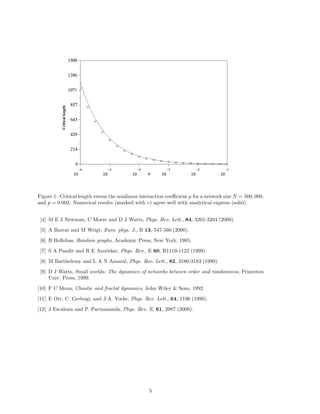
To check the analytical results, we also simulated the scenario by using the numeric method [1,2]
for a network size N = 500, 000, p = 0.002 and k = 2 on a 1-D lattice. Different values of the
nonlinear interaction coefficient μ are used and the related critical length when the system of
small-world networks becomes chaotic. Figure 1 shows for different values of μ. The solid curve
is the analytical results (10) and the points (marked with ) are numerical simulations. The good
agreement verifies the analysis. However, as the typical length increases, the difference between
these two curves becomes larger because the governing equation is main for infinite size network. So
the difference is expected due to the finite size of the network used in the simulations.
4 Feedback and Chaos Control of Small-World Networks
The occurrance of the chaos feature in small-world networks is due to the nonlinear interaction term
and time delay. This chaotic feature can be controlled by adding a negative feedback term [11,12].
In reality, the influence such as a signal or an influence (e.g.. influenza) only last a certain period of
time T , then some of the influenced sites recover to normality. From the small-world model equation
(1), we see that this add an extra term](https://image.slidesharecdn.com/1003-141003111028-phpapp01/85/Chaos-in-Small-World-Networks-3-320.jpg)