Bat Algorithm for Topology Optimization
                  in Microelectronic Applications

            Xin-She Yang, Mehmet Karamanoglu and Simon Fong


                              @ FGCT2012


Yang,Karamanoglu,Fong (NPL)    Bat Algorithm           @ FGCT2012   1 / 14
Introduction   Topology/Shape Design


Topology/Shape Design
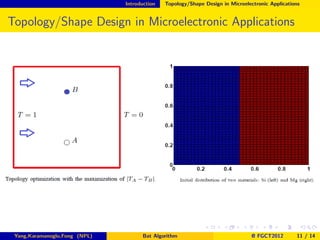
Given a geometry (say, a rectangle), how to distribute two different
materials, with thermal conductivities K1 and K2 , respectively, so as to
meet a specific design problem for heat transfer applications?
To maximize |TA − TB |?


 Yang,Karamanoglu,Fong (NPL)         Bat Algorithm                    @ FGCT2012   2 / 14
Introduction   Should we use different methods for different problems?


Should we use different methods for different problems?


Changing the landscape:
Space mapping, surrogate, trust-region, dimension reduction ...
 Yang,Karamanoglu,Fong (NPL)         Bat Algorithm                              @ FGCT2012        3 / 14
Introduction   Bat Algorithm, Developed by Xin-She Yang (in 2010)


Bat Algorithm, Developed by Xin-She Yang (in 2010)


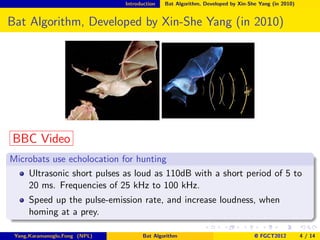
BBC Video
Microbats use echolocation for hunting
    Ultrasonic short pulses as loud as 110dB with a short period of 5 to
    20 ms. Frequencies of 25 kHz to 100 kHz.
      Speed up the pulse-emission rate, and increase loudness, when
      homing at a prey.

 Yang,Karamanoglu,Fong (NPL)         Bat Algorithm                              @ FGCT2012         4 / 14
Introduction   Bat Algorithm (Yang 2010)


Bat Algorithm (Yang 2010)

Acoustics of bat echolocation
                             v
                        λ = ∼ 2 mm to 14 mm.
                             f
Rules used in the bat algorithm:

                        fi = fmin + (fmax − fmin )β,          β ∈ [0, 1],

                     vt+1 = vit + (xt − x∗ )fi ,
                      i             i                    xt+1 = xt + vt .
                                                          i      i    i


 Yang,Karamanoglu,Fong (NPL)             Bat Algorithm                        @ FGCT2012   5 / 14
Introduction   Bat Algorithm (Yang 2010)


Bat Algorithm (Yang 2010)

Acoustics of bat echolocation
                             v
                        λ = ∼ 2 mm to 14 mm.
                             f
Rules used in the bat algorithm:

                        fi = fmin + (fmax − fmin )β,          β ∈ [0, 1],

                     vt+1 = vit + (xt − x∗ )fi ,
                      i             i                    xt+1 = xt + vt .
                                                          i      i    i

Variations of Loudness and Pulse Rate
                               At+1 ← αAt ,
                                i       i           α ∈ (0, 1],
                               rit+1 = ri0 [1 − exp(−γt)].


 Yang,Karamanoglu,Fong (NPL)             Bat Algorithm                        @ FGCT2012   5 / 14
Introduction   Advantages


Advantages


Dynamic exploration and exploitation
    Simple to implement, and it searches for optimality using frequency
    tuning.
      Initially, BA focuses on more explorative moves, and then switch to
      more exploitation when optimality is approaching.
      Balance between exploration and exploitation is not static, it is
      dynamic!


 Yang,Karamanoglu,Fong (NPL)         Bat Algorithm             @ FGCT2012   6 / 14
Introduction   Variants and Applications


Variants and Applications


      Continuous optimization
      Binary bat algorithm for image processing and classifications
      Spam filtering
      Training neural networks
      Multobjective bat algorithm
      Clustering ...


 Yang,Karamanoglu,Fong (NPL)         Bat Algorithm                        @ FGCT2012   7 / 14
Introduction   Speed Reducer/Gear Box Design


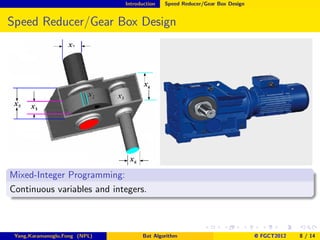
Speed Reducer/Gear Box Design


Mixed-Integer Programming:
Continuous variables and integers.


 Yang,Karamanoglu,Fong (NPL)         Bat Algorithm                            @ FGCT2012   8 / 14
Introduction

                                                  2         2
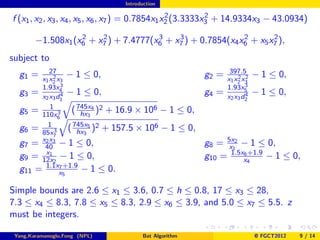
f (x1 , x2 , x3 , x4 , x5 , x6 , x7 ) = 0.7854x1 x2 (3.3333x3 + 14.9334x3 − 43.0934)
                   2    2             3    3                2       2
        −1.508x1 (x6 + x7 ) + 7.4777(x6 + x7 ) + 0.7854(x4 x6 + x5 x7 ),
subject to
          27                                                  397.5
  g1 =     2
       x1 x2 x3
                 − 1 ≤ 0,                             g2 =       2 2
                                                             x1 x2 x3
                                                                        − 1 ≤ 0,
       1.93x   3                                             1.93x5 3
  g3 = x x d44 − 1 ≤ 0,                               g4 =          4
                                                             x2 x3 d2
                                                                        − 1 ≤ 0,
        2 3 1

  g5 = 110x 3 ( 745x4 )2 + 16.9 × 10⁶ − 1 ≤ 0,
          1
                     hx3
             6
         1        745x5 2
  g6 = 85x 3 ( hx3 ) + 157.5 × 10⁶ − 1 ≤ 0,
           7
  g7 = x403 − 1 ≤ 0,
        2x
                                                      g8 = 5x12 − 1 ≤ 0,
                                                           x
        x1
  g9 = 12x2 − 1 ≤ 0,                                  g10 = 1.5xx4
                                                                6 +1.9
                                                                       − 1 ≤ 0,
  g11 = 1.1xx57 +1.9
                     − 1 ≤ 0.

Simple bounds are 2.6 ≤ x1 ≤ 3.6, 0.7 ≤ h ≤ 0.8, 17 ≤ x3 ≤ 28,
7.3 ≤ x4 ≤ 8.3, 7.8 ≤ x5 ≤ 8.3, 2.9 ≤ x6 ≤ 3.9, and 5.0 ≤ x7 ≤ 5.5. z
must be integers.

 Yang,Karamanoglu,Fong (NPL)          Bat Algorithm                     @ FGCT2012   9 / 14
Introduction


The best solution obtained by BA is

                               fmin = 2993.7495888,

with
              x∗ = (3.5, 0.7, 17, 7.3, 7.8, 3.34446445, 5.285350625),
which is better than the solution in the literature (Cagnina et al., 2008)

                                f∗ = 2996.348165.


 Yang,Karamanoglu,Fong (NPL)          Bat Algorithm              @ FGCT2012   10 / 14
Introduction   Topology/Shape Design in Microelectronic Applications


Topology/Shape Design in Microelectronic Applications


 Yang,Karamanoglu,Fong (NPL)         Bat Algorithm                              @ FGCT2012       11 / 14
Introduction   Optimal Topology


Optimal Topology
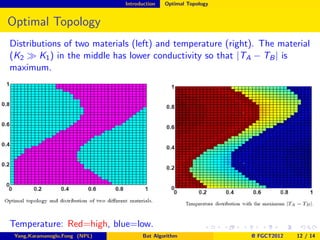
Distributions of two materials (left) and temperature (right). The material
(K2     K1 ) in the middle has lower conductivity so that |TA − TB | is
maximum.


Temperature: Red=high, blue=low.
 Yang,Karamanoglu,Fong (NPL)         Bat Algorithm               @ FGCT2012   12 / 14
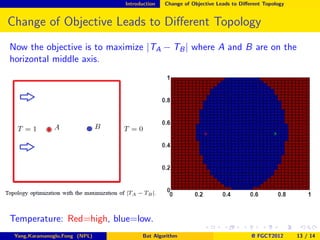
Introduction   Change of Objective Leads to Different Topology


Change of Objective Leads to Different Topology
Now the objective is to maximize |TA − TB | where A and B are on the
horizontal middle axis.


Temperature: Red=high, blue=low.
 Yang,Karamanoglu,Fong (NPL)         Bat Algorithm                             @ FGCT2012      13 / 14
Introduction   Bibliography


Bibliography
      A. Evgrafov, K. Maute, R. G. Yang and M. L. Dunn, Topology optimization
      for nano-scale heat transfer, Int. J. Num. Methods in Engrg., 77 (2),
      285-300 (2009).
      X. S. Yang, A New Metaheuristic Bat-Inspired Algorithm, in: Nature
      Inspired Cooperative Strategies for Optimization (NISCO 2010) (Eds. J. R.
      Gonzalez et al.), Studies in Computational Intelligence, Springer Berlin, 284,
      Springer, 65-74 (2010).
      X. S. Yang, bat algorithm for multi-objective optimisation, Int. J.
      Bio-Inspired Computation, Vol. 3, 267-274 (2011).
      X. S. Yang, Engineering Optimization: An Introduction With Metaheuristic
      Applications, John Wiley and Sons, USA, (2010).
      V. V. Zhirnov, R. K. Cavin, J. A. Hutchby, G. I. Bourianoff, Limits to binary
      logic switch scaling - a gedanken model, Proc. of the IEEE, 91(11),
      1934-1939 (2003).

Thank you very much :)
 Yang,Karamanoglu,Fong (NPL)          Bat Algorithm                @ FGCT2012   14 / 14

Bat algorithm for Topology Optimization in Microelectronic Applications

  • 1.
    Bat Algorithm forTopology Optimization in Microelectronic Applications Xin-She Yang, Mehmet Karamanoglu and Simon Fong @ FGCT2012 Yang,Karamanoglu,Fong (NPL) Bat Algorithm @ FGCT2012 1 / 14
  • 2.
    Introduction Topology/Shape Design Topology/Shape Design Given a geometry (say, a rectangle), how to distribute two different materials, with thermal conductivities K1 and K2 , respectively, so as to meet a specific design problem for heat transfer applications? To maximize |TA − TB |? Yang,Karamanoglu,Fong (NPL) Bat Algorithm @ FGCT2012 2 / 14
  • 3.
    Introduction Should we use different methods for different problems? Should we use different methods for different problems? Changing the landscape: Space mapping, surrogate, trust-region, dimension reduction ... Yang,Karamanoglu,Fong (NPL) Bat Algorithm @ FGCT2012 3 / 14
  • 4.
    Introduction Bat Algorithm, Developed by Xin-She Yang (in 2010) Bat Algorithm, Developed by Xin-She Yang (in 2010) BBC Video Microbats use echolocation for hunting Ultrasonic short pulses as loud as 110dB with a short period of 5 to 20 ms. Frequencies of 25 kHz to 100 kHz. Speed up the pulse-emission rate, and increase loudness, when homing at a prey. Yang,Karamanoglu,Fong (NPL) Bat Algorithm @ FGCT2012 4 / 14
  • 5.
    Introduction Bat Algorithm (Yang 2010) Bat Algorithm (Yang 2010) Acoustics of bat echolocation v λ = ∼ 2 mm to 14 mm. f Rules used in the bat algorithm: fi = fmin + (fmax − fmin )β, β ∈ [0, 1], vt+1 = vit + (xt − x∗ )fi , i i xt+1 = xt + vt . i i i Yang,Karamanoglu,Fong (NPL) Bat Algorithm @ FGCT2012 5 / 14
  • 6.
    Introduction Bat Algorithm (Yang 2010) Bat Algorithm (Yang 2010) Acoustics of bat echolocation v λ = ∼ 2 mm to 14 mm. f Rules used in the bat algorithm: fi = fmin + (fmax − fmin )β, β ∈ [0, 1], vt+1 = vit + (xt − x∗ )fi , i i xt+1 = xt + vt . i i i Variations of Loudness and Pulse Rate At+1 ← αAt , i i α ∈ (0, 1], rit+1 = ri0 [1 − exp(−γt)]. Yang,Karamanoglu,Fong (NPL) Bat Algorithm @ FGCT2012 5 / 14
  • 7.
    Introduction Advantages Advantages Dynamic exploration and exploitation Simple to implement, and it searches for optimality using frequency tuning. Initially, BA focuses on more explorative moves, and then switch to more exploitation when optimality is approaching. Balance between exploration and exploitation is not static, it is dynamic! Yang,Karamanoglu,Fong (NPL) Bat Algorithm @ FGCT2012 6 / 14
  • 8.
    Introduction Variants and Applications Variants and Applications Continuous optimization Binary bat algorithm for image processing and classifications Spam filtering Training neural networks Multobjective bat algorithm Clustering ... Yang,Karamanoglu,Fong (NPL) Bat Algorithm @ FGCT2012 7 / 14
  • 9.
    Introduction Speed Reducer/Gear Box Design Speed Reducer/Gear Box Design Mixed-Integer Programming: Continuous variables and integers. Yang,Karamanoglu,Fong (NPL) Bat Algorithm @ FGCT2012 8 / 14
  • 10.
    Introduction 2 2 f (x1 , x2 , x3 , x4 , x5 , x6 , x7 ) = 0.7854x1 x2 (3.3333x3 + 14.9334x3 − 43.0934) 2 2 3 3 2 2 −1.508x1 (x6 + x7 ) + 7.4777(x6 + x7 ) + 0.7854(x4 x6 + x5 x7 ), subject to 27 397.5 g1 = 2 x1 x2 x3 − 1 ≤ 0, g2 = 2 2 x1 x2 x3 − 1 ≤ 0, 1.93x 3 1.93x5 3 g3 = x x d44 − 1 ≤ 0, g4 = 4 x2 x3 d2 − 1 ≤ 0, 2 3 1 g5 = 110x 3 ( 745x4 )2 + 16.9 × 10⁶ − 1 ≤ 0, 1 hx3 6 1 745x5 2 g6 = 85x 3 ( hx3 ) + 157.5 × 10⁶ − 1 ≤ 0, 7 g7 = x403 − 1 ≤ 0, 2x g8 = 5x12 − 1 ≤ 0, x x1 g9 = 12x2 − 1 ≤ 0, g10 = 1.5xx4 6 +1.9 − 1 ≤ 0, g11 = 1.1xx57 +1.9 − 1 ≤ 0. Simple bounds are 2.6 ≤ x1 ≤ 3.6, 0.7 ≤ h ≤ 0.8, 17 ≤ x3 ≤ 28, 7.3 ≤ x4 ≤ 8.3, 7.8 ≤ x5 ≤ 8.3, 2.9 ≤ x6 ≤ 3.9, and 5.0 ≤ x7 ≤ 5.5. z must be integers. Yang,Karamanoglu,Fong (NPL) Bat Algorithm @ FGCT2012 9 / 14
  • 11.
    Introduction The best solutionobtained by BA is fmin = 2993.7495888, with x∗ = (3.5, 0.7, 17, 7.3, 7.8, 3.34446445, 5.285350625), which is better than the solution in the literature (Cagnina et al., 2008) f∗ = 2996.348165. Yang,Karamanoglu,Fong (NPL) Bat Algorithm @ FGCT2012 10 / 14
  • 12.
    Introduction Topology/Shape Design in Microelectronic Applications Topology/Shape Design in Microelectronic Applications Yang,Karamanoglu,Fong (NPL) Bat Algorithm @ FGCT2012 11 / 14
  • 13.
    Introduction Optimal Topology Optimal Topology Distributions of two materials (left) and temperature (right). The material (K2 K1 ) in the middle has lower conductivity so that |TA − TB | is maximum. Temperature: Red=high, blue=low. Yang,Karamanoglu,Fong (NPL) Bat Algorithm @ FGCT2012 12 / 14
  • 14.
    Introduction Change of Objective Leads to Different Topology Change of Objective Leads to Different Topology Now the objective is to maximize |TA − TB | where A and B are on the horizontal middle axis. Temperature: Red=high, blue=low. Yang,Karamanoglu,Fong (NPL) Bat Algorithm @ FGCT2012 13 / 14
  • 15.
    Introduction Bibliography Bibliography A. Evgrafov, K. Maute, R. G. Yang and M. L. Dunn, Topology optimization for nano-scale heat transfer, Int. J. Num. Methods in Engrg., 77 (2), 285-300 (2009). X. S. Yang, A New Metaheuristic Bat-Inspired Algorithm, in: Nature Inspired Cooperative Strategies for Optimization (NISCO 2010) (Eds. J. R. Gonzalez et al.), Studies in Computational Intelligence, Springer Berlin, 284, Springer, 65-74 (2010). X. S. Yang, bat algorithm for multi-objective optimisation, Int. J. Bio-Inspired Computation, Vol. 3, 267-274 (2011). X. S. Yang, Engineering Optimization: An Introduction With Metaheuristic Applications, John Wiley and Sons, USA, (2010). V. V. Zhirnov, R. K. Cavin, J. A. Hutchby, G. I. Bourianoff, Limits to binary logic switch scaling - a gedanken model, Proc. of the IEEE, 91(11), 1934-1939 (2003). Thank you very much :) Yang,Karamanoglu,Fong (NPL) Bat Algorithm @ FGCT2012 14 / 14