32 
Biology-Derived 
Algorithms in 
Engineering 
Optimization 
CHAPMAN: “C4754_C032” — 2005/5/6 — 23:44 — page 585 — #1 
Xin-She Yang 
32.1 Introduction. . . . . . . . . . . . . . . . . . . . . . . . . . . . . . . . . . . . . . . . . . . . . . 32-585 
32.2 Biology-Derived Algorithms . . . . . . . . . . . . . . . . . . . . . . . . . . . . 32-586 
Genetic Algorithms • Photosynthetic Algorithms • Neural 
Networks • Cellular Automata • Optimization 
32.3 Engineering Optimization and Applications . . . . . . . . . . 32-590 
Function and Multilevel Optimizations • Shape Design and 
Optimization • Finite Element Inverse Analysis • Inverse 
IVBV Optimization 
References . . . . . . . . . . . . . . . . . . . . . . . . . . . . . . . . . . . . . . . . . . . . . . . . . . . . . . . 32-595 
32.1 Introduction 
Biology-derived algorithms are an important part of computational sciences, which are essential to many 
scientific disciplines and engineering applications. Many computational methods are derived from or 
based on the analogy to natural evolution and biological activities, and these biologically inspired compu-tations 
include genetic algorithms, neural networks, cellular automata, and other algorithms. However, a 
substantial amount of computations today are still using conventional methods such as finite difference, 
finite element, and finite volume methods. New algorithms are often developed in the form of a hybrid 
combination of biology-derived algorithms and conventional methods, and this is especially true in the 
field of engineering optimizations. Engineering problems with optimization objectives are often difficult 
and time consuming, and the application of nature or biology-inspired algorithms in combination with 
the conventional optimization methods has been very successful in the last several decades. 
There are five paradigms of nature-inspired evolutionary computations: genetic algorithms, evolution-ary 
programming, evolutionary strategies, genetic programming, and classifier systems (Holland, 1975; 
Goldberg, 1989; Mitchell, 1996; Flake, 1998). Genetic algorithm (GA), developed by John Holland and 
his collaborators in the 1960s and 1970s, is a model or abstraction of biological evolution, which includes 
the following operators: crossover, mutation, inversion, and selection. This is done by the representation 
within a computer of a population of individuals corresponding to chromosomes in terms of a set of 
character strings, and the individuals in the population then evolve through the crossover and mutation 
32-585
32-586 Handbook of Bioinspired Algorithms and Applications 
of the string from parents, and the selection or survival according to their fitness. Evolutionary pro-gramming 
(EP), first developed by Lawrence J. Fogel in 1960, is a stochastic optimization strategy similar 
to GAs. But it differs from GAs in that there is no constraint on the representation of solutions in EP 
and the representation often follows the problem. In addition, the EPs do not attempt to model genetic 
operations closely in the sense that the crossover operation is not used in EPs. The mutation operation 
simply changes aspects of the solution according to a statistical distribution, such asmultivariate Gaussian 
perturbations, instead of bit-flopping, which is often done in GAs. As the global optimum is approached, 
the rate of mutation is often reduced. Evolutionary strategies (ESs) were conceived by Ingo Rechenberg 
and Hans-Paul Schwefel in 1963, later joined by Peter Bienert, to solve technical optimization problems. 
Although they were developed independently of one another, both ESs and EPs have many similarities in 
implementations. Typically, they both operate on real-values to solve real-valued function optimization 
in contrast with the encoding in Gas. Multivariate Gaussian mutation with zero mean are used for each 
parent population and appropriate selection criteria are used to determine which solution to keep or 
remove. However, EPs often use stochastic selection via a tournament and the selection eliminates those 
solutions with the least wins, while the ESs use deterministic selection criterion that removes the worst 
solutions directly based on the evaluations of certain functions (Heitkotter and Beasley, 2000). In addition, 
recombination is possible in an ES as it is an abstraction of evolution at the level of individual behavior 
in contrast to the abstraction of evolution at the level of reproductive populations and no recombination 
mechanisms in EPs. 
CHAPMAN: “C4754_C032” — 2005/5/6 — 23:44 — page 586 — #2 
AQ: Please check if 
the insertion of 
(1992) here is ok. 
The aforementioned three areas have themost impact in the development of evolutionary computations, 
and, in fact, evolutionary computation has been chosen as the general term that encompasses all these 
areas and some new areas. In recent years, two more paradigms in evolutionary computation have 
attracted substantial attention: Genetic programming and classifier systems. Genetic programming (GP) 
was introduced in the early 1990s by John Koza (1992), and it extends GAs using parse trees to represent 
functions and programs. The programs in the population consist of elements from the function sets, 
rather than fixed-length character strings, selected appropriately to be the solutions to the problems. 
The crossover operation is done through randomly selected subtrees in the individuals according to their 
fitness; the mutation operator is not used in GP. On the other hand, a classifier system (CFS), another 
invention by JohnHolland, is an adaptive systemthat combinesmany methods of adaptationwith learning 
and evolution. Such hybrid systems can adapt behaviors toward a changing environment by using GAs 
with adding capacities such as memory, recursion, or iterations. In fact, we can essentially consider the 
CFSs as general-purpose computing machines that are modified by both environmental feedback and the 
AQ: Holland, 1996, 
is not listed in the 
References. Is it 
1995 as in the list? 
underlying GAs (Holland, 1975, 1996; Flake, 1998). 
Biology-derived algorithms are applicable to a wide variety of optimization problems. For example, 
optimization functions can have discrete, continuous, or even mixed parameters without any a priori 
assumptions about their continuity and differentiability. Thus, evolutionary algorithms are particularly 
suitable for parameter search and optimization problems. In addition, they are easy for parallel implement-ation. 
However, evolutionary algorithms are usually computationally intensive, and there is no absolute 
guarantee for the quality of the global optimizations. Besides, the tuning of the parameters can be very 
difficult for any given algorithms. Furthermore, there are many evolutionary algorithms with different 
suitabilities and the best choice of a particular algorithm depends on the type and characteristics of the 
problems concerned. However, great progress has been made in the last several decades in the application 
of evolutionary algorithms in engineering optimizations. In this chapter, we will focus on some of the 
important areas of the application of GAs in engineering optimizations. 
32.2 Biology-Derived Algorithms 
There are many biology-derived algorithms that are popular in evolutionary computations. For engin-eering 
applications in particular, four types of algorithms are very useful and hence relevant. They are 
GAs, photosynthetic algorithms (PAs), neural networks, and cellular automata. We will briefly discuss
Biology-Derived Algorithms in Engineering Optimization 32-587 
these algorithms in this section, and we will focus on the application of GAs and PAs in engineering 
optimizations in Section 32.3. 
32.2.1 Genetic Algorithms 
The essence of GAs involves the encoding of an optimization function as arrays of bits or character 
strings to represent the chromosomes, the manipulation operations of strings by genetic operators, and 
the selection according to their fitness to find a solution to the problem concerned. This is often done 
by the following procedure: (1) encoding of the objectives or optimization functions; (2) defining a 
fitness function or selection criterion; (3) creating a population of individuals; (4) evolution cycle or 
iterations by evaluating the fitness of all the individuals in the population, creating a new population by 
performing crossover, mutation, and inversion, fitness-proportionate reproduction, etc., and replacing 
the old population and iterating using the new population; (5) decoding the results to obtain the solution 
to the problem. 
One iteration of creating new populations is called a generation. Fixed-length character strings are used 
in most GAs during each generation although there is substantial research on variable-length string and 
coding structures. The coding of objective functions is usually in the form of binary arrays or real-valued 
arrays in adaptive GAs. For simplicity, we use the binary string for coding for describing genetic operators. 
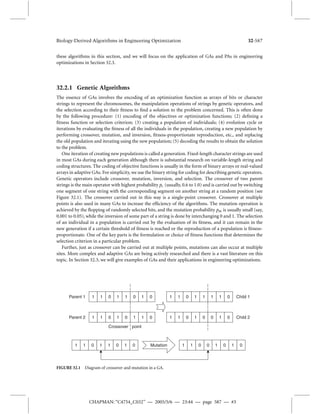
Genetic operators include crossover, mutation, inversion, and selection. The crossover of two parent 
strings is themain operator with highest probability pc (usually, 0.6 to 1.0) and is carried out by switching 
one segment of one string with the corresponding segment on another string at a random position (see 
Figure 32.1). The crossover carried out in this way is a single-point crossover. Crossover at multiple 
points is also used in many GAs to increase the efficiency of the algorithms. The mutation operation is 
achieved by the flopping of randomly selected bits, and the mutation probability pm is usually small (say, 
0.001 to 0.05), while the inversion of some part of a string is done by interchanging 0 and 1. The selection 
of an individual in a population is carried out by the evaluation of its fitness, and it can remain in the 
new generation if a certain threshold of fitness is reached or the reproduction of a population is fitness-proportionate. 
One of the key parts is the formulation or choice of fitness functions that determines the 
selection criterion in a particular problem. 
Further, just as crossover can be carried out at multiple points, mutations can also occur at multiple 
sites. More complex and adaptive GAs are being actively researched and there is a vast literature on this 
topic. In Section 32.3, we will give examples of GAs and their applications in engineering optimizations. 
1 1 0 1 1 0 1 0 
1 1 0 1 1 0 1 0 1 1 0 0 1 0 1 0 
CHAPMAN: “C4754_C032” — 2005/5/6 — 23:44 — page 587 — #3 
Parent 1 
1 1 0 1 0 1 1 0 
1 1 0 1 1 1 1 0 
Parent 2 1 1 0 1 0 0 1 0 
Child 1 
Child 2 
Mutation 
Crossover point 
FIGURE 32.1 Diagram of crossover and mutation in a GA.
32-588 Handbook of Bioinspired Algorithms and Applications 
32.2.2 Photosynthetic Algorithms 
The PA was first introduced by Murase (2000) to optimize the parameter estimation in finite element 
Benson–Calvin 
cycle 
Photorespiration 
Fitness 
evaluation 
CHAPMAN: “C4754_C032” — 2005/5/6 — 23:44 — page 588 — #4 
AQ:Murose is 
changed to Murase 
as per the Reference 
list. Trust this is OK. 
inverse analysis. The PAis a good example of biology-derived algorithms in the sense that its computational 
procedure corresponds well to the real photosynthesis process in green plants. Photosynthesis uses water 
and CO2 to produce glucose and oxygen when there is light and in the presence of chloroplasts. The 
overall reaction 
6CO2 + 12H2O 
light and green plants 
−−−−−−−−−−−−−−− C6H12O6 + 6O2 + 6H2O 
is just a simple version of a complicated process. Other factors, such as temperature, concentration of CO2, 
water content, etc., being equal, the reaction efficiency depends largely on light intensity. The important 
part of photosynthetic reactions is the dark reactions that consist of a biological process including two 
cycles: the Benson–Calvin cycle and photorespiration cycle. The balance between these two cycles can be 
considered as a natural optimization procedure that maximizes the efficiency of sugar production under 
the continuous variations of light energy input (Murase, 2000). 
Murase’s PA uses the rules governing the conversion of carbon molecules in the Benson–Calvin cycle 
(with a product or feedback from DHAP ) and photorespiration reactions. The product DHAP serves 
AQ: Please provide 
expansion for 
DHAP. 
as the knowledge strings of the algorithm and optimization is reached when the quality or the fitness of 
the products no longer improves. An interesting feature of such algorithms is that the stimulation is a 
function of light intensity that is randomly changing and affects the rate of photorespiration. The ratio of 
O2 to CO2 concentration determines the ratio of the Benson–Calvin and photorespiration cycles. A PA 
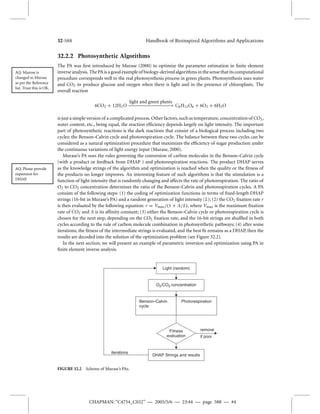
consists of the following steps: (1) the coding of optimization functions in terms of fixed-length DHAP 
strings (16-bit inMurase’s PA) and a random generation of light intensity (L); (2) the CO2 fixation rate r 
is then evaluated by the following equation: r = Vmax/(1 + A/L), where Vmax is the maximum fixation 
rate of CO2 and A is its affinity constant; (3) either the Benson–Calvin cycle or photorespiration cycle is 
chosen for the next step, depending on the CO2 fixation rate, and the 16-bit strings are shuffled in both 
cycles according to the rule of carbon molecule combination in photosynthetic pathways; (4) after some 
iterations, the fitness of the intermediate strings is evaluated, and the best fit remains as a DHAP, then the 
results are decoded into the solution of the optimization problem (see Figure 32.2). 
In the next section, we will present an example of parametric inversion and optimization using PA in 
finite element inverse analysis. 
Light (random) 
O2/CO2 concentration 
DHAP Strings and results 
remove 
if poor 
iterations 
FIGURE 32.2 Scheme of Murase’s PAs.
Biology-Derived Algorithms in Engineering Optimization 32-589 
Inputs Hidden layer Outputs 
i ui (t +1) 
− 
u1(t ) 
wi1 
wi2 
u2(t ) 
FIGURE 32.3 Diagram of a McCulloch–Pitts neuron (left) and neural networks (right). 
32.2.3 Neural Networks 
Neural networks, and the associated machine-learning algorithms, is one more type of biology-inspired 
algorithms, which uses a network of interconnected neurons with the intention of imitating the neural 
activities in human brains. These neurons have high interconnectivity and feedback, and their connectiv-ity 
can be weakened or enhanced during the learning process. The simplest model for neurons is the 
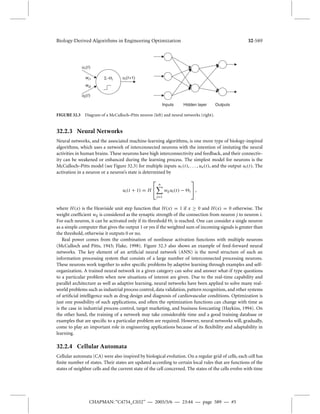
McCulloch–Pitts model (see Figure 32.3) for multiple inputs u1(t ), . . . , un(t ), and the output ui (t ). The 
activation in a neuron or a neuron’s state is determined by 
ui (t + 1) = H 
n 
j 
=1 
wijui (t ) − i 
 
, 
where H(x) is the Heaviside unit step function that H(x) = 1 if x  0 and H(x) = 0 otherwise. The 
weight coefficient wij is considered as the synaptic strength of the connection from neuron j to neuron i. 
For each neuron, it can be activated only if its threshold i is reached. One can consider a single neuron 
as a simple computer that gives the output 1 or yes if the weighted sumof incoming signals is greater than 
the threshold, otherwise it outputs 0 or no. 
Real power comes from the combination of nonlinear activation functions with multiple neurons 
(McCulloch and Pitts, 1943; Flake, 1998). Figure 32.3 also shows an example of feed-forward neural 
networks. The key element of an artificial neural network (ANN) is the novel structure of such an 
information processing system that consists of a large number of interconnected processing neurons. 
These neurons work together to solve specific problems by adaptive learning through examples and self-organization. 
A trained neural network in a given category can solve and answer what-if type questions 
to a particular problem when new situations of interest are given. Due to the real-time capability and 
parallel architecture as well as adaptive learning, neural networks have been applied to solve many real-world 
problems such as industrial process control, data validation, pattern recognition, and other systems 
of artificial intelligence such as drug design and diagnosis of cardiovascular conditions. Optimization is 
just one possibility of such applications, and often the optimization functions can change with time as 
is the case in industrial process control, target marketing, and business forecasting (Haykins, 1994). On 
the other hand, the training of a network may take considerable time and a good training database or 
examples that are specific to a particular problem are required. However, neural networks will, gradually, 
come to play an important role in engineering applications because of its flexibility and adaptability in 
learning. 
32.2.4 Cellular Automata 
Cellular automata (CA) were also inspired by biological evolution. On a regular grid of cells, each cell has 
finite number of states. Their states are updated according to certain local rules that are functions of the 
states of neighbor cells and the current state of the cell concerned. The states of the cells evolve with time 
CHAPMAN: “C4754_C032” — 2005/5/6 — 23:44 — page 589 — #5
32-590 Handbook of Bioinspired Algorithms and Applications 
in a discrete manner, and complex characteristics can be observed and studied. For more details on this 
topic, readers can refer to Chapters 1 and 22 in this handbook. 
There is some similarity between finite state CA and conventional numerical methods such as finite 
difference methods. If one considers the finite different method as real-valued CA, and the real-values are 
always converted to finite discrete values due to the round-off in the implementation on a computer, then 
there is no substantial difference between a finite difference method and a finite state CA. 
However, CA are easier to parallelize andmore numerically stable. In addition, finite difference schemes 
are based on differential equations and it is sometimes straightforward to formulate a CA from the 
corresponding partial differential equations via appropriate finite differencing procedure; however, it is 
usually very difficult to conversely obtain a differential equation for a given CA (see Chapter 22 in this 
handbook). 
An optimization problemcan be solved using CA if the objective functions can be coded to be associated 
with the states of the CA and the parameters are properly associated with automaton rules. This is an 
area under active research. One of the advantages of CA is that it can simulate many processes such as 
reaction–diffusion, fluid flow, phase transition, percolation, waves, and biological evolution. Artificial 
intelligence also uses CA intensively. 
32.2.5 Optimization 
Many problems in engineering and other disciplines involve optimizations that depend on a number of 
parameters, and the choice of these parameters affects the performance or objectives of the system con-cerned. 
The optimization target is often measured in terms of objective or fitness functions in qualitative 
models. Engineering design and testing often require an iteration process with parameter adjustment. 
Optimization functions are generally formulated as: 
Optimize: f (x), 
Subject to: gi (x)  0, i = 1, 2, . . . ,N; hj (x) = 0, j = 1, 2, . . . ,M. 
where x = (x1, x2, . . . , xn), x  (parameter space). 
Optimization can be expressed either as maximization or more often as minimization (Deb, 2000). As 
parameter variations are usually very large, systematic adaptive searching or optimization procedures are 
required. In the past several decades, researchers have developedmany optimization algorithms. Examples 
of conventionalmethods are hill climbing, gradientmethods, randomwalk, simulated annealing, heuristic 
methods, etc. Examples of evolutionary or biology-inspired algorithms are GAs, photosynthetic methods, 
neural network, and many others. 
The methods used to solve a particular problem depend largely on the type and characteristics of 
the optimization problem itself. There is no universal method that works for all problems, and there is 
generally no guarantee to find the optimal solution in global optimizations. In general, we can emphasize 
on the best estimate or suboptimal solutions under the given conditions. Knowledge about the particular 
problem concerned is always helpful to make the appropriate choice of the best or most efficient methods 
for the optimization procedure. In this chapter, however, we focus mainly on biology-inspired algorithms 
and their applications in engineering optimizations. 
32.3 Engineering Optimization and Applications 
Biology-derived algorithms such as GAs and PAs have many applications in engineering optimizations. 
However, as wementioned earlier, the choice ofmethods for optimization in a particular problemdepends 
on the nature of the problem and the quality of solutions concerned. We will now discuss optimization 
problems and related issues in various engineering applications. 
CHAPMAN: “C4754_C032” — 2005/5/6 — 23:44 — page 590 — #6
Biology-Derived Algorithms in Engineering Optimization 32-591 
32.3.1 Function and Multilevel Optimizations 
For optimization of a function using GAs, one way is to use the simplest GA with a fitness function: 
F = A − y with A being the large constant and y = f (x), thus the objective is to maximize the fitness 
Best estimate = 0.046346 
0 100 200 300 400 500 600 
log[f(x)] 
Best estimate = 0.23486 
0 100 200 300 400 500 600 
CHAPMAN: “C4754_C032” — 2005/5/6 — 23:44 — page 591 — #7 
AQ: Please check 
the change of 
f (x) to f (x) 
function and subsequently minimize the objective function f (x). However, there are many different ways 
of defining a fitness function. For example, we can use the individual fitness assignment relative to the 
whole population 
F(xi ) = 
f (xi ) 
N 
i=1 f (xi ) 
, 
where xi is the phenotypic value of individual i, and N is the population size. For the generalized 
De Jong’s (1975) test function 
f (x) = 
n 
i 
=1 
x2, |x| 	 r ,  = 1, 2, . . . ,m, 
where  is a positive integer and r is the half-length of the domain. This function has a minimum of 
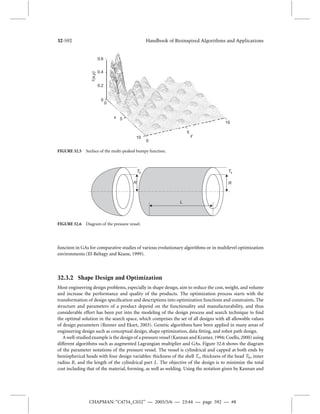
f (x) = 0 at x = 0. For the values of  = 3, r = 256, and n = 40, the results of optimization of this test 
function are shown in Figure 32.4 using GAs. 
The function we just discussed is relatively simple in the sense that it is single-peaked. In reality, many 
functions are multi-peaked and the optimization is thus multileveled. Keane (1995) studied the following 
bumby function in a multi-peaked and multileveled optimization problem 
f (x, y) = 
sin2(x − y) sin2(x + y) 
x2 + y2 
, 0  x, y  10. 
The optimization problem is to find (x, y) starting (5, 5) to maximize the function f (x, y) subject to: 
x +y 	 15 and xy  3/4. In this problem, optimization is difficult because it is nearly symmetrical about 
x = y, and while the peaks occur in pairs one is bigger than the other. In addition, the true maximum 
is f (1.593, 0.471) = 0.365, which is defined by a constraint boundary. Figure 32.5 shows the surface 
variation of the multi-peaked bumpy function. 
Although the properties of this bumpy function make it difficult for most optimizers and algorithms, 
GAs and other evolutionary algorithms performwell for this function and it has been widely used as a test 
6 
5 
4 
3 
2 
1 
0 
log[f(x)] 
–1 
–2 
Generation (t) 
6 
5 
4 
3 
2 
1 
0 
–1 
Generation (t) 
FIGURE 32.4 Function optimization using GAs. Two runs will give slightly different results due to the stochastic 
nature of GAs, but they produce better estimates: f (x)  0 as the generation increases.
32-592 Handbook of Bioinspired Algorithms and Applications 
0.6 
0.4 
0.2 
0 
0 
5 
10 
0 
5 
y 
x 
10 
f (x,y) 
FIGURE 32.5 Surface of the multi-peaked bumpy function. 
R 
Th 
Ts 
R 
L 
FIGURE 32.6 Diagram of the pressure vessel. 
function in GAs for comparative studies of various evolutionary algorithms or in multilevel optimization 
environments (El-Beltagy and Keane, 1999). 
32.3.2 Shape Design and Optimization 
Most engineering design problems, especially in shape design, aim to reduce the cost, weight, and volume 
and increase the performance and quality of the products. The optimization process starts with the 
transformation of design specification and descriptions into optimization functions and constraints. The 
structure and parameters of a product depend on the functionality and manufacturability, and thus 
considerable effort has been put into the modeling of the design process and search technique to find 
the optimal solution in the search space, which comprises the set of all designs with all allowable values 
of design parameters (Renner and Ekart, 2003). Genetic algorithms have been applied in many areas of 
engineering design such as conceptual design, shape optimization, data fitting, and robot path design. 
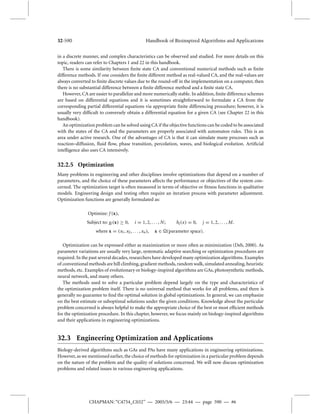
A well-studied example is the design of a pressure vessel (Kannan and Kramer, 1994; Coello, 2000) using 
different algorithms such as augmented Lagrangian multiplier and GAs. Figure 32.6 shows the diagram 
of the parameter notations of the pressure vessel. The vessel is cylindrical and capped at both ends by 
hemispherical heads with four design variables: thickness of the shell Ts, thickness of the head Th, inner 
radius R, and the length of the cylindrical part L. The objective of the design is to minimize the total 
cost including that of the material, forming, as well as welding. Using the notation given by Kannan and 
CHAPMAN: “C4754_C032” — 2005/5/6 — 23:44 — page 592 — #8
Biology-Derived Algorithms in Engineering Optimization 32-593 
Kramer, the optimization problem can be expressed as: 
Minimize: f (x) = 0.6224x1x2x3 + 1.7781x2x2 
3 + 3.1611x2 
1 x4 + 19.84x2 
1 x3. 
x = (x1, x2, x3, x4)T = (Ts, Th, R, L)T, 
Subject to: g1(x) = −x1 + 0.0193x3 	 0, g2(x) = −x2 + 0.00954x3 	 0, 
g3(x) = −	x2 
3 x4 − 4	x3 
3 /3 + 1296000 	 0, g4(x) = x4 − 240 	 0. 
The values for x1, x2 should be considered as integer multiples of 0.0625. Using the same constraints as 
given in Coello (2000), the variables are in the ranges: 1 	 x1, x2 	 99, 10.0000 	 x3. x4 	 100.0000 
(with a four-decimal precision). By coding the GAs with a population of 44-bit strings for each indi-vidual 
(4-bits for x1 · x2; 18-bits for x3 · x4), similar to that by Wu and Chow (1994), we can solve 
the optimization problem for the pressure vessel. After several runs, the best solution obtained is 
x = (1.125, 0.625, 58.2906, 43.6926) with f (x) = 7197.9912$, which is compared with the results 
x = (1.125, 0.625, 28.291, 43.690) and f (x) = 7198.0428$ obtained by Kannan and Kramer (1994). 
32.3.3 Finite Element Inverse Analysis 
The usage and efficiency ofMurase’s PA described in Section 32.3.4 can be demonstrated in the application 
of finite element inverse analysis. Finite element analysis (FEA) in structural engineering is forward 
modeling as the aims are to calculate the displacements at various positions for given loading conditions 
and material properties such as Young’s modulus (E) and Poisson’s ratio (
). This forward FEA is widely 
used in engineering design and applications. Sometimes, inverse problems need to be solved. For a given 
structure with known loading conditions andmeasured displacement, the objective is to find or invert the 
material properties E and 
, which may be required for testing new materials and design optimizations. It 
is well known that inverse problems are usually very difficult, and this is especially true for finite element 
inverse analysis. 
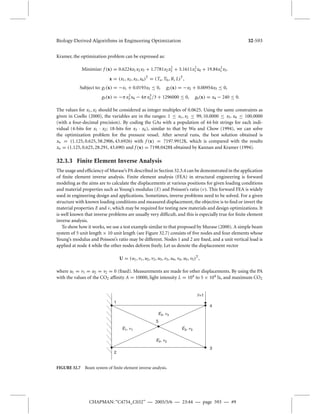
To show how it works, we use a test example similar to that proposed byMurase (2000). A simple beam 
system of 5 unit length × 10 unit length (see Figure 32.7) consists of five nodes and four elements whose 
Young’s modulus and Poisson’s ratio may be different. Nodes 1 and 2 are fixed, and a unit vertical load is 
applied at node 4 while the other nodes deform freely. Let us denote the displacement vector 
U = (u1, v1, u2, v2, u3, v3, u4, v4, u5, v5)T, 
where u1 = v1 = u2 = v2 = 0 (fixed). Measurements are made for other displacements. By using the PA 
with the values of the CO2 affinity A = 10000, light intensity L = 104 to 5 × 10⁴ lx, and maximum CO2 
1 
2 
4 
3 
E4, n4 
5 
f =1 
E1, n E3, n3 1 
E2, n2 
FIGURE 32.7 Beam system of finite element inverse analysis. 
CHAPMAN: “C4754_C032” — 2005/5/6 — 23:44 — page 593 — #9
32-594 Handbook of Bioinspired Algorithms and Applications 
fixation speed Vmax = 30, each of eight elastic modulus (Ei , 
i )(i = 1, 2, 3, 4) is coded as a 16-bit DHAP 
molecule string. For a target vector 
Y = (E1, 
1, E2, 
2, E3, 
3, E4, 
4) = (600, 0.25, 400, 0.35, 450, 0.30, 350, 0.32), 
and measured displacements U = (0, 0, 0, 0,−0.0066,−0.0246, 0.0828,−0.2606, 0.0002,−0.0110), the 
best estimates after 500 iterations from the optimization by the PA are Y = (580, 0.24, 400, 0.31, 
460, 0.29, 346, 0.26). 
32.3.4 Inverse Initial-Value, Boundary-Value Problem Optimization 
Inverse initial-value, boundary-value problem (IVBV) is an optimization paradigm in which GAs have 
been used successfully (Karr et al., 2000). Some conventional algorithms for solving such search optim-izations 
are the trial-and-error iteration methods that usually start with a guessed solution, and the 
substitution into the partial differential equations and associated boundary conditions to calculate the 
errors between predicted values andmeasured or known values at various locations, then the new guessed 
or improved solutions are obtained by corrections according to the errors. The aim is to minimize the 
difference or errors, and the procedure stops once the given precision or tolerance criterion is satisfied. In 
this way, the inverse problem is actually transformed into an optimization problem. 
We now use the heat equation and inverse procedure discussed by Karr et al. (2000) as an example to 
illustrate the IVBV optimization. On a square plate of unit dimensions, the diffusivity (x, y) varies with 
locations (x, y). The heat equation and its boundary conditions can be written as:
u
t = 
 · [(x, y)
u], 0  x, y  1, t  0, 
u(x, y, 0) = 1, u(x, 0, t ) = u(x, 1, t ) = u(0, y, t ) = u(1, y, t ) = 0. 
The domain is discretized as an N × N grid, and the measurements of values at (xi , yj , tn), (i, j = 
1, 2, . . . ,N; n = 1, 2, 3). The data set consists of the measured value at N2 points at three different times 
t1, t2, t3. The objective is to inverse or estimate the N2 diffusivity values at the N2 distinct locations. The 
Karr’s error metrics are defined as 
i=1N 
j=1 
i=1N 
j=1 
CHAPMAN: “C4754_C032” — 2005/5/6 — 23:44 — page 594 — #10 
Eu = A 
N 
j=1 
umeasured 
i,j − u 
computed 
i,j  
N 
i=1N 
umeasured 
i,j  
, E = A 
N 
j=1 
known 
i,j −  
predicted 
i,j  
N 
i=1N 
known 
i,j  
, 
where A = 100 is just a constant. 
The floating-point GA proposed by Karr et al. for the inverse IVBV optimization can be summarized 
as the following procedure: (1) Generate randomly a population containing N solutions to the IVBV 
problem; the potential solutions are represented in a vector due to the variation of diffusivity  with 
locations; (2) The errormetric is computed for each of the potential solution vectors; (3) N new potential 
solution vectors are generated by genetic operators such as crossover and mutations in GAs. Selection of 
solutions depends on the required quality of the solutions with the aim to minimize the error metric and 
thereby remove solutions with large errors; (4) the iteration continues until the best acceptable solution 
is found. 
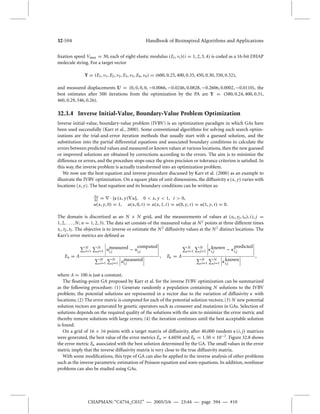
On a grid of 16 × 16 points with a target matrix of diffusivity, after 40,000 random (i, j) matrices 
were generated, the best value of the error metrics Eu = 4.6050 and E = 1.50×10⁻². Figure 32.8 shows 
the error metric E associated with the best solution determined by the GA. The small values in the error 
metric imply that the inverse diffusivity matrix is very close to the true diffusivity matrix. 
With some modifications, this type of GA can also be applied to the inverse analysis of other problems 
such as the inverse parametric estimation of Poisson equation and wave equations. In addition, nonlinear 
problems can also be studied using GAs.

Biology-Derived Algorithms in Engineering Optimization

  • 1.
    32 Biology-Derived Algorithmsin Engineering Optimization CHAPMAN: “C4754_C032” — 2005/5/6 — 23:44 — page 585 — #1 Xin-She Yang 32.1 Introduction. . . . . . . . . . . . . . . . . . . . . . . . . . . . . . . . . . . . . . . . . . . . . . 32-585 32.2 Biology-Derived Algorithms . . . . . . . . . . . . . . . . . . . . . . . . . . . . 32-586 Genetic Algorithms • Photosynthetic Algorithms • Neural Networks • Cellular Automata • Optimization 32.3 Engineering Optimization and Applications . . . . . . . . . . 32-590 Function and Multilevel Optimizations • Shape Design and Optimization • Finite Element Inverse Analysis • Inverse IVBV Optimization References . . . . . . . . . . . . . . . . . . . . . . . . . . . . . . . . . . . . . . . . . . . . . . . . . . . . . . . 32-595 32.1 Introduction Biology-derived algorithms are an important part of computational sciences, which are essential to many scientific disciplines and engineering applications. Many computational methods are derived from or based on the analogy to natural evolution and biological activities, and these biologically inspired compu-tations include genetic algorithms, neural networks, cellular automata, and other algorithms. However, a substantial amount of computations today are still using conventional methods such as finite difference, finite element, and finite volume methods. New algorithms are often developed in the form of a hybrid combination of biology-derived algorithms and conventional methods, and this is especially true in the field of engineering optimizations. Engineering problems with optimization objectives are often difficult and time consuming, and the application of nature or biology-inspired algorithms in combination with the conventional optimization methods has been very successful in the last several decades. There are five paradigms of nature-inspired evolutionary computations: genetic algorithms, evolution-ary programming, evolutionary strategies, genetic programming, and classifier systems (Holland, 1975; Goldberg, 1989; Mitchell, 1996; Flake, 1998). Genetic algorithm (GA), developed by John Holland and his collaborators in the 1960s and 1970s, is a model or abstraction of biological evolution, which includes the following operators: crossover, mutation, inversion, and selection. This is done by the representation within a computer of a population of individuals corresponding to chromosomes in terms of a set of character strings, and the individuals in the population then evolve through the crossover and mutation 32-585
  • 2.
    32-586 Handbook ofBioinspired Algorithms and Applications of the string from parents, and the selection or survival according to their fitness. Evolutionary pro-gramming (EP), first developed by Lawrence J. Fogel in 1960, is a stochastic optimization strategy similar to GAs. But it differs from GAs in that there is no constraint on the representation of solutions in EP and the representation often follows the problem. In addition, the EPs do not attempt to model genetic operations closely in the sense that the crossover operation is not used in EPs. The mutation operation simply changes aspects of the solution according to a statistical distribution, such asmultivariate Gaussian perturbations, instead of bit-flopping, which is often done in GAs. As the global optimum is approached, the rate of mutation is often reduced. Evolutionary strategies (ESs) were conceived by Ingo Rechenberg and Hans-Paul Schwefel in 1963, later joined by Peter Bienert, to solve technical optimization problems. Although they were developed independently of one another, both ESs and EPs have many similarities in implementations. Typically, they both operate on real-values to solve real-valued function optimization in contrast with the encoding in Gas. Multivariate Gaussian mutation with zero mean are used for each parent population and appropriate selection criteria are used to determine which solution to keep or remove. However, EPs often use stochastic selection via a tournament and the selection eliminates those solutions with the least wins, while the ESs use deterministic selection criterion that removes the worst solutions directly based on the evaluations of certain functions (Heitkotter and Beasley, 2000). In addition, recombination is possible in an ES as it is an abstraction of evolution at the level of individual behavior in contrast to the abstraction of evolution at the level of reproductive populations and no recombination mechanisms in EPs. CHAPMAN: “C4754_C032” — 2005/5/6 — 23:44 — page 586 — #2 AQ: Please check if the insertion of (1992) here is ok. The aforementioned three areas have themost impact in the development of evolutionary computations, and, in fact, evolutionary computation has been chosen as the general term that encompasses all these areas and some new areas. In recent years, two more paradigms in evolutionary computation have attracted substantial attention: Genetic programming and classifier systems. Genetic programming (GP) was introduced in the early 1990s by John Koza (1992), and it extends GAs using parse trees to represent functions and programs. The programs in the population consist of elements from the function sets, rather than fixed-length character strings, selected appropriately to be the solutions to the problems. The crossover operation is done through randomly selected subtrees in the individuals according to their fitness; the mutation operator is not used in GP. On the other hand, a classifier system (CFS), another invention by JohnHolland, is an adaptive systemthat combinesmany methods of adaptationwith learning and evolution. Such hybrid systems can adapt behaviors toward a changing environment by using GAs with adding capacities such as memory, recursion, or iterations. In fact, we can essentially consider the CFSs as general-purpose computing machines that are modified by both environmental feedback and the AQ: Holland, 1996, is not listed in the References. Is it 1995 as in the list? underlying GAs (Holland, 1975, 1996; Flake, 1998). Biology-derived algorithms are applicable to a wide variety of optimization problems. For example, optimization functions can have discrete, continuous, or even mixed parameters without any a priori assumptions about their continuity and differentiability. Thus, evolutionary algorithms are particularly suitable for parameter search and optimization problems. In addition, they are easy for parallel implement-ation. However, evolutionary algorithms are usually computationally intensive, and there is no absolute guarantee for the quality of the global optimizations. Besides, the tuning of the parameters can be very difficult for any given algorithms. Furthermore, there are many evolutionary algorithms with different suitabilities and the best choice of a particular algorithm depends on the type and characteristics of the problems concerned. However, great progress has been made in the last several decades in the application of evolutionary algorithms in engineering optimizations. In this chapter, we will focus on some of the important areas of the application of GAs in engineering optimizations. 32.2 Biology-Derived Algorithms There are many biology-derived algorithms that are popular in evolutionary computations. For engin-eering applications in particular, four types of algorithms are very useful and hence relevant. They are GAs, photosynthetic algorithms (PAs), neural networks, and cellular automata. We will briefly discuss
  • 3.
    Biology-Derived Algorithms inEngineering Optimization 32-587 these algorithms in this section, and we will focus on the application of GAs and PAs in engineering optimizations in Section 32.3. 32.2.1 Genetic Algorithms The essence of GAs involves the encoding of an optimization function as arrays of bits or character strings to represent the chromosomes, the manipulation operations of strings by genetic operators, and the selection according to their fitness to find a solution to the problem concerned. This is often done by the following procedure: (1) encoding of the objectives or optimization functions; (2) defining a fitness function or selection criterion; (3) creating a population of individuals; (4) evolution cycle or iterations by evaluating the fitness of all the individuals in the population, creating a new population by performing crossover, mutation, and inversion, fitness-proportionate reproduction, etc., and replacing the old population and iterating using the new population; (5) decoding the results to obtain the solution to the problem. One iteration of creating new populations is called a generation. Fixed-length character strings are used in most GAs during each generation although there is substantial research on variable-length string and coding structures. The coding of objective functions is usually in the form of binary arrays or real-valued arrays in adaptive GAs. For simplicity, we use the binary string for coding for describing genetic operators. Genetic operators include crossover, mutation, inversion, and selection. The crossover of two parent strings is themain operator with highest probability pc (usually, 0.6 to 1.0) and is carried out by switching one segment of one string with the corresponding segment on another string at a random position (see Figure 32.1). The crossover carried out in this way is a single-point crossover. Crossover at multiple points is also used in many GAs to increase the efficiency of the algorithms. The mutation operation is achieved by the flopping of randomly selected bits, and the mutation probability pm is usually small (say, 0.001 to 0.05), while the inversion of some part of a string is done by interchanging 0 and 1. The selection of an individual in a population is carried out by the evaluation of its fitness, and it can remain in the new generation if a certain threshold of fitness is reached or the reproduction of a population is fitness-proportionate. One of the key parts is the formulation or choice of fitness functions that determines the selection criterion in a particular problem. Further, just as crossover can be carried out at multiple points, mutations can also occur at multiple sites. More complex and adaptive GAs are being actively researched and there is a vast literature on this topic. In Section 32.3, we will give examples of GAs and their applications in engineering optimizations. 1 1 0 1 1 0 1 0 1 1 0 1 1 0 1 0 1 1 0 0 1 0 1 0 CHAPMAN: “C4754_C032” — 2005/5/6 — 23:44 — page 587 — #3 Parent 1 1 1 0 1 0 1 1 0 1 1 0 1 1 1 1 0 Parent 2 1 1 0 1 0 0 1 0 Child 1 Child 2 Mutation Crossover point FIGURE 32.1 Diagram of crossover and mutation in a GA.
  • 4.
    32-588 Handbook ofBioinspired Algorithms and Applications 32.2.2 Photosynthetic Algorithms The PA was first introduced by Murase (2000) to optimize the parameter estimation in finite element Benson–Calvin cycle Photorespiration Fitness evaluation CHAPMAN: “C4754_C032” — 2005/5/6 — 23:44 — page 588 — #4 AQ:Murose is changed to Murase as per the Reference list. Trust this is OK. inverse analysis. The PAis a good example of biology-derived algorithms in the sense that its computational procedure corresponds well to the real photosynthesis process in green plants. Photosynthesis uses water and CO2 to produce glucose and oxygen when there is light and in the presence of chloroplasts. The overall reaction 6CO2 + 12H2O light and green plants −−−−−−−−−−−−−−− C6H12O6 + 6O2 + 6H2O is just a simple version of a complicated process. Other factors, such as temperature, concentration of CO2, water content, etc., being equal, the reaction efficiency depends largely on light intensity. The important part of photosynthetic reactions is the dark reactions that consist of a biological process including two cycles: the Benson–Calvin cycle and photorespiration cycle. The balance between these two cycles can be considered as a natural optimization procedure that maximizes the efficiency of sugar production under the continuous variations of light energy input (Murase, 2000). Murase’s PA uses the rules governing the conversion of carbon molecules in the Benson–Calvin cycle (with a product or feedback from DHAP ) and photorespiration reactions. The product DHAP serves AQ: Please provide expansion for DHAP. as the knowledge strings of the algorithm and optimization is reached when the quality or the fitness of the products no longer improves. An interesting feature of such algorithms is that the stimulation is a function of light intensity that is randomly changing and affects the rate of photorespiration. The ratio of O2 to CO2 concentration determines the ratio of the Benson–Calvin and photorespiration cycles. A PA consists of the following steps: (1) the coding of optimization functions in terms of fixed-length DHAP strings (16-bit inMurase’s PA) and a random generation of light intensity (L); (2) the CO2 fixation rate r is then evaluated by the following equation: r = Vmax/(1 + A/L), where Vmax is the maximum fixation rate of CO2 and A is its affinity constant; (3) either the Benson–Calvin cycle or photorespiration cycle is chosen for the next step, depending on the CO2 fixation rate, and the 16-bit strings are shuffled in both cycles according to the rule of carbon molecule combination in photosynthetic pathways; (4) after some iterations, the fitness of the intermediate strings is evaluated, and the best fit remains as a DHAP, then the results are decoded into the solution of the optimization problem (see Figure 32.2). In the next section, we will present an example of parametric inversion and optimization using PA in finite element inverse analysis. Light (random) O2/CO2 concentration DHAP Strings and results remove if poor iterations FIGURE 32.2 Scheme of Murase’s PAs.
  • 5.
    Biology-Derived Algorithms inEngineering Optimization 32-589 Inputs Hidden layer Outputs i ui (t +1) − u1(t ) wi1 wi2 u2(t ) FIGURE 32.3 Diagram of a McCulloch–Pitts neuron (left) and neural networks (right). 32.2.3 Neural Networks Neural networks, and the associated machine-learning algorithms, is one more type of biology-inspired algorithms, which uses a network of interconnected neurons with the intention of imitating the neural activities in human brains. These neurons have high interconnectivity and feedback, and their connectiv-ity can be weakened or enhanced during the learning process. The simplest model for neurons is the McCulloch–Pitts model (see Figure 32.3) for multiple inputs u1(t ), . . . , un(t ), and the output ui (t ). The activation in a neuron or a neuron’s state is determined by ui (t + 1) = H n j =1 wijui (t ) − i , where H(x) is the Heaviside unit step function that H(x) = 1 if x 0 and H(x) = 0 otherwise. The weight coefficient wij is considered as the synaptic strength of the connection from neuron j to neuron i. For each neuron, it can be activated only if its threshold i is reached. One can consider a single neuron as a simple computer that gives the output 1 or yes if the weighted sumof incoming signals is greater than the threshold, otherwise it outputs 0 or no. Real power comes from the combination of nonlinear activation functions with multiple neurons (McCulloch and Pitts, 1943; Flake, 1998). Figure 32.3 also shows an example of feed-forward neural networks. The key element of an artificial neural network (ANN) is the novel structure of such an information processing system that consists of a large number of interconnected processing neurons. These neurons work together to solve specific problems by adaptive learning through examples and self-organization. A trained neural network in a given category can solve and answer what-if type questions to a particular problem when new situations of interest are given. Due to the real-time capability and parallel architecture as well as adaptive learning, neural networks have been applied to solve many real-world problems such as industrial process control, data validation, pattern recognition, and other systems of artificial intelligence such as drug design and diagnosis of cardiovascular conditions. Optimization is just one possibility of such applications, and often the optimization functions can change with time as is the case in industrial process control, target marketing, and business forecasting (Haykins, 1994). On the other hand, the training of a network may take considerable time and a good training database or examples that are specific to a particular problem are required. However, neural networks will, gradually, come to play an important role in engineering applications because of its flexibility and adaptability in learning. 32.2.4 Cellular Automata Cellular automata (CA) were also inspired by biological evolution. On a regular grid of cells, each cell has finite number of states. Their states are updated according to certain local rules that are functions of the states of neighbor cells and the current state of the cell concerned. The states of the cells evolve with time CHAPMAN: “C4754_C032” — 2005/5/6 — 23:44 — page 589 — #5
  • 6.
    32-590 Handbook ofBioinspired Algorithms and Applications in a discrete manner, and complex characteristics can be observed and studied. For more details on this topic, readers can refer to Chapters 1 and 22 in this handbook. There is some similarity between finite state CA and conventional numerical methods such as finite difference methods. If one considers the finite different method as real-valued CA, and the real-values are always converted to finite discrete values due to the round-off in the implementation on a computer, then there is no substantial difference between a finite difference method and a finite state CA. However, CA are easier to parallelize andmore numerically stable. In addition, finite difference schemes are based on differential equations and it is sometimes straightforward to formulate a CA from the corresponding partial differential equations via appropriate finite differencing procedure; however, it is usually very difficult to conversely obtain a differential equation for a given CA (see Chapter 22 in this handbook). An optimization problemcan be solved using CA if the objective functions can be coded to be associated with the states of the CA and the parameters are properly associated with automaton rules. This is an area under active research. One of the advantages of CA is that it can simulate many processes such as reaction–diffusion, fluid flow, phase transition, percolation, waves, and biological evolution. Artificial intelligence also uses CA intensively. 32.2.5 Optimization Many problems in engineering and other disciplines involve optimizations that depend on a number of parameters, and the choice of these parameters affects the performance or objectives of the system con-cerned. The optimization target is often measured in terms of objective or fitness functions in qualitative models. Engineering design and testing often require an iteration process with parameter adjustment. Optimization functions are generally formulated as: Optimize: f (x), Subject to: gi (x) 0, i = 1, 2, . . . ,N; hj (x) = 0, j = 1, 2, . . . ,M. where x = (x1, x2, . . . , xn), x (parameter space). Optimization can be expressed either as maximization or more often as minimization (Deb, 2000). As parameter variations are usually very large, systematic adaptive searching or optimization procedures are required. In the past several decades, researchers have developedmany optimization algorithms. Examples of conventionalmethods are hill climbing, gradientmethods, randomwalk, simulated annealing, heuristic methods, etc. Examples of evolutionary or biology-inspired algorithms are GAs, photosynthetic methods, neural network, and many others. The methods used to solve a particular problem depend largely on the type and characteristics of the optimization problem itself. There is no universal method that works for all problems, and there is generally no guarantee to find the optimal solution in global optimizations. In general, we can emphasize on the best estimate or suboptimal solutions under the given conditions. Knowledge about the particular problem concerned is always helpful to make the appropriate choice of the best or most efficient methods for the optimization procedure. In this chapter, however, we focus mainly on biology-inspired algorithms and their applications in engineering optimizations. 32.3 Engineering Optimization and Applications Biology-derived algorithms such as GAs and PAs have many applications in engineering optimizations. However, as wementioned earlier, the choice ofmethods for optimization in a particular problemdepends on the nature of the problem and the quality of solutions concerned. We will now discuss optimization problems and related issues in various engineering applications. CHAPMAN: “C4754_C032” — 2005/5/6 — 23:44 — page 590 — #6
  • 7.
    Biology-Derived Algorithms inEngineering Optimization 32-591 32.3.1 Function and Multilevel Optimizations For optimization of a function using GAs, one way is to use the simplest GA with a fitness function: F = A − y with A being the large constant and y = f (x), thus the objective is to maximize the fitness Best estimate = 0.046346 0 100 200 300 400 500 600 log[f(x)] Best estimate = 0.23486 0 100 200 300 400 500 600 CHAPMAN: “C4754_C032” — 2005/5/6 — 23:44 — page 591 — #7 AQ: Please check the change of f (x) to f (x) function and subsequently minimize the objective function f (x). However, there are many different ways of defining a fitness function. For example, we can use the individual fitness assignment relative to the whole population F(xi ) = f (xi ) N i=1 f (xi ) , where xi is the phenotypic value of individual i, and N is the population size. For the generalized De Jong’s (1975) test function f (x) = n i =1 x2, |x| r , = 1, 2, . . . ,m, where is a positive integer and r is the half-length of the domain. This function has a minimum of f (x) = 0 at x = 0. For the values of = 3, r = 256, and n = 40, the results of optimization of this test function are shown in Figure 32.4 using GAs. The function we just discussed is relatively simple in the sense that it is single-peaked. In reality, many functions are multi-peaked and the optimization is thus multileveled. Keane (1995) studied the following bumby function in a multi-peaked and multileveled optimization problem f (x, y) = sin2(x − y) sin2(x + y) x2 + y2 , 0 x, y 10. The optimization problem is to find (x, y) starting (5, 5) to maximize the function f (x, y) subject to: x +y 15 and xy 3/4. In this problem, optimization is difficult because it is nearly symmetrical about x = y, and while the peaks occur in pairs one is bigger than the other. In addition, the true maximum is f (1.593, 0.471) = 0.365, which is defined by a constraint boundary. Figure 32.5 shows the surface variation of the multi-peaked bumpy function. Although the properties of this bumpy function make it difficult for most optimizers and algorithms, GAs and other evolutionary algorithms performwell for this function and it has been widely used as a test 6 5 4 3 2 1 0 log[f(x)] –1 –2 Generation (t) 6 5 4 3 2 1 0 –1 Generation (t) FIGURE 32.4 Function optimization using GAs. Two runs will give slightly different results due to the stochastic nature of GAs, but they produce better estimates: f (x) 0 as the generation increases.
  • 8.
    32-592 Handbook ofBioinspired Algorithms and Applications 0.6 0.4 0.2 0 0 5 10 0 5 y x 10 f (x,y) FIGURE 32.5 Surface of the multi-peaked bumpy function. R Th Ts R L FIGURE 32.6 Diagram of the pressure vessel. function in GAs for comparative studies of various evolutionary algorithms or in multilevel optimization environments (El-Beltagy and Keane, 1999). 32.3.2 Shape Design and Optimization Most engineering design problems, especially in shape design, aim to reduce the cost, weight, and volume and increase the performance and quality of the products. The optimization process starts with the transformation of design specification and descriptions into optimization functions and constraints. The structure and parameters of a product depend on the functionality and manufacturability, and thus considerable effort has been put into the modeling of the design process and search technique to find the optimal solution in the search space, which comprises the set of all designs with all allowable values of design parameters (Renner and Ekart, 2003). Genetic algorithms have been applied in many areas of engineering design such as conceptual design, shape optimization, data fitting, and robot path design. A well-studied example is the design of a pressure vessel (Kannan and Kramer, 1994; Coello, 2000) using different algorithms such as augmented Lagrangian multiplier and GAs. Figure 32.6 shows the diagram of the parameter notations of the pressure vessel. The vessel is cylindrical and capped at both ends by hemispherical heads with four design variables: thickness of the shell Ts, thickness of the head Th, inner radius R, and the length of the cylindrical part L. The objective of the design is to minimize the total cost including that of the material, forming, as well as welding. Using the notation given by Kannan and CHAPMAN: “C4754_C032” — 2005/5/6 — 23:44 — page 592 — #8
  • 9.
    Biology-Derived Algorithms inEngineering Optimization 32-593 Kramer, the optimization problem can be expressed as: Minimize: f (x) = 0.6224x1x2x3 + 1.7781x2x2 3 + 3.1611x2 1 x4 + 19.84x2 1 x3. x = (x1, x2, x3, x4)T = (Ts, Th, R, L)T, Subject to: g1(x) = −x1 + 0.0193x3 0, g2(x) = −x2 + 0.00954x3 0, g3(x) = − x2 3 x4 − 4 x3 3 /3 + 1296000 0, g4(x) = x4 − 240 0. The values for x1, x2 should be considered as integer multiples of 0.0625. Using the same constraints as given in Coello (2000), the variables are in the ranges: 1 x1, x2 99, 10.0000 x3. x4 100.0000 (with a four-decimal precision). By coding the GAs with a population of 44-bit strings for each indi-vidual (4-bits for x1 · x2; 18-bits for x3 · x4), similar to that by Wu and Chow (1994), we can solve the optimization problem for the pressure vessel. After several runs, the best solution obtained is x = (1.125, 0.625, 58.2906, 43.6926) with f (x) = 7197.9912$, which is compared with the results x = (1.125, 0.625, 28.291, 43.690) and f (x) = 7198.0428$ obtained by Kannan and Kramer (1994). 32.3.3 Finite Element Inverse Analysis The usage and efficiency ofMurase’s PA described in Section 32.3.4 can be demonstrated in the application of finite element inverse analysis. Finite element analysis (FEA) in structural engineering is forward modeling as the aims are to calculate the displacements at various positions for given loading conditions and material properties such as Young’s modulus (E) and Poisson’s ratio ( ). This forward FEA is widely used in engineering design and applications. Sometimes, inverse problems need to be solved. For a given structure with known loading conditions andmeasured displacement, the objective is to find or invert the material properties E and , which may be required for testing new materials and design optimizations. It is well known that inverse problems are usually very difficult, and this is especially true for finite element inverse analysis. To show how it works, we use a test example similar to that proposed byMurase (2000). A simple beam system of 5 unit length × 10 unit length (see Figure 32.7) consists of five nodes and four elements whose Young’s modulus and Poisson’s ratio may be different. Nodes 1 and 2 are fixed, and a unit vertical load is applied at node 4 while the other nodes deform freely. Let us denote the displacement vector U = (u1, v1, u2, v2, u3, v3, u4, v4, u5, v5)T, where u1 = v1 = u2 = v2 = 0 (fixed). Measurements are made for other displacements. By using the PA with the values of the CO2 affinity A = 10000, light intensity L = 104 to 5 × 10⁴ lx, and maximum CO2 1 2 4 3 E4, n4 5 f =1 E1, n E3, n3 1 E2, n2 FIGURE 32.7 Beam system of finite element inverse analysis. CHAPMAN: “C4754_C032” — 2005/5/6 — 23:44 — page 593 — #9
  • 10.
    32-594 Handbook ofBioinspired Algorithms and Applications fixation speed Vmax = 30, each of eight elastic modulus (Ei , i )(i = 1, 2, 3, 4) is coded as a 16-bit DHAP molecule string. For a target vector Y = (E1, 1, E2, 2, E3, 3, E4, 4) = (600, 0.25, 400, 0.35, 450, 0.30, 350, 0.32), and measured displacements U = (0, 0, 0, 0,−0.0066,−0.0246, 0.0828,−0.2606, 0.0002,−0.0110), the best estimates after 500 iterations from the optimization by the PA are Y = (580, 0.24, 400, 0.31, 460, 0.29, 346, 0.26). 32.3.4 Inverse Initial-Value, Boundary-Value Problem Optimization Inverse initial-value, boundary-value problem (IVBV) is an optimization paradigm in which GAs have been used successfully (Karr et al., 2000). Some conventional algorithms for solving such search optim-izations are the trial-and-error iteration methods that usually start with a guessed solution, and the substitution into the partial differential equations and associated boundary conditions to calculate the errors between predicted values andmeasured or known values at various locations, then the new guessed or improved solutions are obtained by corrections according to the errors. The aim is to minimize the difference or errors, and the procedure stops once the given precision or tolerance criterion is satisfied. In this way, the inverse problem is actually transformed into an optimization problem. We now use the heat equation and inverse procedure discussed by Karr et al. (2000) as an example to illustrate the IVBV optimization. On a square plate of unit dimensions, the diffusivity (x, y) varies with locations (x, y). The heat equation and its boundary conditions can be written as:
  • 11.
  • 12.
    t = · [(x, y) u], 0 x, y 1, t 0, u(x, y, 0) = 1, u(x, 0, t ) = u(x, 1, t ) = u(0, y, t ) = u(1, y, t ) = 0. The domain is discretized as an N × N grid, and the measurements of values at (xi , yj , tn), (i, j = 1, 2, . . . ,N; n = 1, 2, 3). The data set consists of the measured value at N2 points at three different times t1, t2, t3. The objective is to inverse or estimate the N2 diffusivity values at the N2 distinct locations. The Karr’s error metrics are defined as i=1N j=1 i=1N j=1 CHAPMAN: “C4754_C032” — 2005/5/6 — 23:44 — page 594 — #10 Eu = A N j=1 umeasured i,j − u computed i,j N i=1N umeasured i,j , E = A N j=1 known i,j − predicted i,j N i=1N known i,j , where A = 100 is just a constant. The floating-point GA proposed by Karr et al. for the inverse IVBV optimization can be summarized as the following procedure: (1) Generate randomly a population containing N solutions to the IVBV problem; the potential solutions are represented in a vector due to the variation of diffusivity with locations; (2) The errormetric is computed for each of the potential solution vectors; (3) N new potential solution vectors are generated by genetic operators such as crossover and mutations in GAs. Selection of solutions depends on the required quality of the solutions with the aim to minimize the error metric and thereby remove solutions with large errors; (4) the iteration continues until the best acceptable solution is found. On a grid of 16 × 16 points with a target matrix of diffusivity, after 40,000 random (i, j) matrices were generated, the best value of the error metrics Eu = 4.6050 and E = 1.50×10⁻². Figure 32.8 shows the error metric E associated with the best solution determined by the GA. The small values in the error metric imply that the inverse diffusivity matrix is very close to the true diffusivity matrix. With some modifications, this type of GA can also be applied to the inverse analysis of other problems such as the inverse parametric estimation of Poisson equation and wave equations. In addition, nonlinear problems can also be studied using GAs.