arXiv:1105.3668v1 [math.OC] 18 May 2011 
Review of Metaheuristics and Generalized Evolutionary 
Walk Algorithm 
Xin-She Yang 
Mathematics and Scientific Computing 
National Physical Laboratory, Teddington, TW11 0LW, UK 
Abstract 
Metaheuristic algorithms are often nature-inspired, and they are becoming very pow-erful 
in solving global optimization problems. More than a dozen of major metaheuristic 
algorithms have been developed over the last three decades, and there exist even more 
variants and hybrid of metaheuristics. This paper intends to provide an overview of 
nature-inspired metaheuristic algorithms, from a brief history to their applications. We 
try to analyze the main components of these algorithms and how and why they works. 
Then, we intend to provide a unified view of metaheuristics by proposing a generalized 
evolutionary walk algorithm (GEWA). Finally, we discuss some of the important open 
questions. 
Keywords: Algorithms; ant colony optimization; cuckoo search; differential evo-lution; 
firefly algorithm; harmony search; genetic algorithm; metaheuristic; simulated 
annealing; particle swarm optimisation. 
Reference to this paper should be made as follows: 
Xin-She Yang (2011) ‘Review of metaheuristics and generalized evolutionary walk al-gorithm’, 
Int. J. Bio-Inspired Computation, Vol. 3, No. 2, pp. 77-84 (2011).
1 Introduction 
Nature-inspired metaheuristic algorithms are becoming increasingly popular in optimisation 
and applications over the last three decades. There are many reasons for this popularity 
and success, and one of the main reasons is that these algorithms have been developed by 
mimicking the most successful processes in nature, including biological systems, and physical 
and chemical processes. For most algorithms, we know their fundamental components, how 
exactly they interact to achieve efficiency still remains partly a mystery, which inspires 
more active studies. Convergence analysis of a few algorithms such as the particle swarm 
optimisation shows some insight, but in general mathematical analysis of metaheuristic 
algorithms remains unsolved and still an ongoing active research topic. 
The solution of an optimisation problem requires the choice and the correct use of the 
right algorithm. The choice of an algorithm largely depends on the type of the optimisation 
problem at hand. For large-scale nonlinear global optimisation problems, there is no agreed 
guideline for how to choose and what to choose. In fact, we are not even sure whether an 
efficient algorithm exists, which is especially true for NP-hard problems, and most real-world 
problem often are NP-hard indeed. 
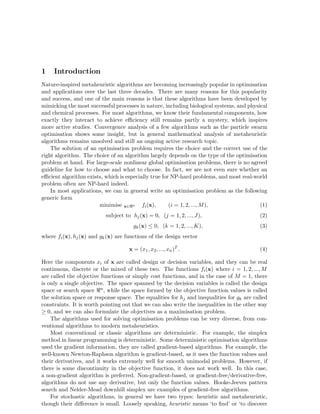
In most applications, we can in general write an optimisation problem as the following 
generic form 
minimise x∈ℜn fi(x), (i = 1, 2, ...,M), (1) 
subject to hj(x) = 0, (j = 1, 2, ..., J), (2) 
gk(x) ≤ 0, (k = 1, 2, ...,K), (3) 
where fi(x), hj (x) and gk(x) are functions of the design vector 
x = (x1, x2, ..., xn)T . (4) 
Here the components xi of x are called design or decision variables, and they can be real 
continuous, discrete or the mixed of these two. The functions fi(x) where i = 1, 2, ...,M 
are called the objective functions or simply cost functions, and in the case of M = 1, there 
is only a single objective. The space spanned by the decision variables is called the design 
space or search space ℜn, while the space formed by the objective function values is called 
the solution space or response space. The equalities for hj and inequalities for gk are called 
constraints. It is worth pointing out that we can also write the inequalities in the other way 
≥ 0, and we can also formulate the objectives as a maximisation problem. 
The algorithms used for solving optimisation problems can be very diverse, from con-ventional 
algorithms to modern metaheuristics. 
Most conventional or classic algorithms are deterministic. For example, the simplex 
method in linear programming is deterministic. Some deterministic optimisation algorithms 
used the gradient information, they are called gradient-based algorithms. For example, the 
well-known Newton-Raphson algorithm is gradient-based, as it uses the function values and 
their derivatives, and it works extremely well for smooth unimodal problems. However, if 
there is some discontinuity in the objective function, it does not work well. In this case, 
a non-gradient algorithm is preferred. Non-gradient-based, or gradient-free/derivative-free, 
algorithms do not use any derivative, but only the function values. Hooke-Jeeves pattern 
search and Nelder-Mead downhill simplex are examples of gradient-free algorithms. 
For stochastic algorithms, in general we have two types: heuristic and metaheuristic, 
though their difference is small. Loosely speaking, heuristic means ‘to find’ or ‘to discover
by trial and error’. Quality solutions to a tough optimisation problem can be found in a 
reasonable amount of time, but there is no guarantee that optimal solutions are reached. It 
hopes that these algorithms work most of the time, but not necessarily all the time. This is 
good when we do not necessarily want the best solutions but rather good solutions which 
are easily reachable. 
2 Metaheuristics 
In metaheuristic algorithms, meta- means ‘beyond’ or ‘higher level’, and they generally 
perform better than simple heuristics. All metaheuristic algorithms use certain tradeoff of 
local search and global exploration. Variety of solutions are often realized via randomisa-tion. 
Despite the popularity of metaheuristics, there is no agreed definition of heuristics 
and metaheuristics in the literature. Some researchers use ‘heuristics’ and ‘metaheuristics’ 
interchangeably. However, the recent trend tends to name all stochastic algorithms with 
randomisation and global exploration as metaheuristic. In this review, we will also follow 
this convention. 
Randomisation provides a good way to move away from local search to the search on 
the global scale. Therefore, almost all metaheuristic algorithms intend to be suitable for 
global optimisation. 
Metaheuristics can be an efficient way to produce acceptable solutions by trial and error 
to a complex problem in a reasonably practical time. The complexity of the problem of 
interest makes it impossible to search every possible solution or combination, the aim is 
to find good feasible solution in an acceptable timescale. There is no guarantee that the 
best solutions can be found, and we even do not know whether an algorithm will work and 
why if it does work. The idea is to have an efficient but practical algorithm that will work 
most the time and is able to produce good quality solutions. Among the found quality 
solutions, it is expected some of them are nearly optimal, though there is no guarantee for 
such optimality. 
The main components of any metaheuristic algorithms are: intensification and diversi-fication, 
or exploitation and exploration (Blum and Roli 2003). Diversification means to 
generate diverse solutions so as to explore the search space on the global scale, while in-tensification 
means to focus on the search in a local region by exploiting the information 
that a current good solution is found in this region. This is in combination with with the 
selection of the best solutions. 
The selection of the best ensures that the solutions will converge to the optimality. On 
the other hand, the diversification via randomisation avoids the solutions being trapped at 
local optima, while increases the diversity of the solutions. The good combination of these 
two major components will usually ensure that the global optimality is achievable. 
Metaheuristic algorithms can be classified in many ways. One way is to classify them 
as: population-based and trajectory-based. For example, genetic algorithms are population-based 
as they use a set of strings, so is the particle swarm optimisation (PSO) which uses 
multiple agents or particles (Kennedy and Eberhart 1995). On the other hand, simulated 
annealing uses a single agent or solution which moves through the design space or search 
space in a piecewise style (Kirkpatrick et al. 1983).
3 Overview of Metaheuristics 
Throughout history, especially at the early periods of human history, the main approach 
to problem-solving has always been heuristic or metaheuristic – by trial and error. Many 
important discoveries were done by ‘thinking outside the box’, and often by accident; that 
is heuristics. Archimedes’s Eureka moment was a heuristic triumph. In fact, our daily 
learning experience (at least as a child) is dominantly heuristic. 
Despite its ubiquitous nature, metaheuristics as a scientific method to problem solving 
is indeed a modern phenomenon, though it is difficult to pinpoint when the metaheuristic 
method was first used. Alan Turing was probably the first to use heuristic algorithms for 
code-breaking during the Second World War (Copeland 2004). Turing called his search 
method heuristic search, as it could be expected it worked most of time, but there was no 
guarantee to find the correct solution, but it was a tremendous success. 
The 1960s and 1970s were the two important decades for the development of evolution-ary 
algorithms. First, John Holland and his collaborators at the University of Michigan 
developed the genetic algorithms in 1960s and 1970s (Holland 1975). As early as 1962, 
Holland studied the adaptive system and was the first to use crossover and recombination 
manipulations for modeling such system. His seminal book summarizing the development 
of genetic algorithms was published in 1975. In the same year, De Jong finished his impor-tant 
dissertation showing the potential and power of genetic algorithms for a wide range of 
objective functions, either noisy, multimodal or even discontinuous (De Jong 1975). 
Briefly speaking, a genetic algorithm (GA) is a search method based on the abstraction 
of Darwinian evolution and natural selection of biological systems and representing them in 
the mathematical operators: crossover or recombination, mutation, fitness, and selection of 
the fittest. Ever since, genetic algorithms have become so successful in solving a wide range 
of optimisation problems, there have several thousands of research articles and hundreds of 
books written. Some statistics show that a vast majority of Fortune 500 companies are now 
using them routinely to solve tough combinatorial optimisation problems such as planning, 
data-fitting, and scheduling. 
During the about same period in the 1960s, Ingo Rechenberg and Hans-Paul Schwefel 
both then at the Technical University of Berlin developed a search technique for solving 
optimisation problem in aerospace engineering, called evolutionary strategy, in 1963. Later, 
Peter Bienert joined them and began to construct an automatic experimenter using simple 
rules of mutation and selection. There was no crossover in this technique, only mutation was 
used to produce an offspring and an improved solution was kept at each generation. This 
was essentially a simple trajectory-style hill-climbing algorithm with randomisation. As 
early as 1960, Lawrence J. Fogel intended to use simulated evolution as a learning process 
as a tool to study artificial intelligence. Then, in 1966, L. J. Fogel, together A. J. Owen and 
M. J. Walsh, developed the evolutionary programming technique by representing solutions 
as finite-state machines and randomly mutating one of these machines (Fogel et al. 1966). 
The above innovative ideas and methods have evolved into a much wider discipline, called 
evolutionary algorithms and/or evolutionary computation. 
A loosely related topic is the development of the support vector machine which is a 
classification technique dated back to the earlier work by V. Vapnik in 1963 on linear 
classifiers, and the nonlinear classification with kernel techniques were developed by V. 
Vapnik and his collaborators in the 1990s (Vapnik 1995, Vapnik et al. 1997). 
A brief history of heuristics till 1960s in the context of combinatorial optimisation was 
reviewed by Schrijver (2005). One of the first books on heuristics was published by Judea
(1984). A very simplified, informal history can be found from the wikipedia article on 
metaheuristic (Wikipedia 2010). 
The two decades of 1980s and 1990s were the most exciting time for metaheuristic 
algorithms. The next big step is the development of simulated annealing (SA) in 1983, an 
optimisation technique, pioneered by S. Kirkpatrick, C. D. Gellat and M. P. Vecchi, inspired 
by the annealing process of metals. It is a trajectory-based search algorithm starting with 
an initial guess solution at a high temperature, and gradually cooling down the system 
(Kirkpatrick et al. 1983). A move or new solution is accepted if it is better; otherwise, it 
is accepted with a probability, which makes it possible for the system to escape any local 
optima. It is then expected that if the system is cooled down slowly enough, the global 
optimal solution can be reached. 
Most metaheuristic do not explicitly use memory, except the selection of the best solu-tions. 
The actual first usage of memory in modern metaheuristics is probably due to Fred 
Glover’s Tabu search in 1986, though his seminal book on Tabu search was published later 
in 1997 (Glover and Luguna 1997). 
Interestingly, an even-higher level algorithm, namely, the memetic algorithm, proposed 
by P. Moscato in 1989, is a multi-generation, co-evolution and self-generation algorithm 
(Moscato 1989), and it can be considered as a hyper-heuristic algorithm, rather than meta-heuristic. 
At the beginning of the 1990s, Marco Dorigo finished his PhD thesis on optimisation 
and natural algorithms (Dorigo 1992), in which he described his innovative work on ant 
colony optimisation (ACO). This search technique was inspired by the swarm intelligence 
of social ants using pheromone as a chemical messenger. Then, in 1992, John R. Koza of 
Stanford University published a treatise on genetic programming which laid the foundation 
of a whole new area of machine learning, revolutionizing computer programming (Koza 
1992). As early as in 1988, Koza applied his first patent on genetic programming. The 
basic idea is to use the genetic principle to breed computer programs so as to gradually 
produce the best programs for a given type of problem. 
Another interesting algorithm is the so-called artificial immune system, inspired by the 
characteristics of the immune system of mammals to use memory and learning as a novel 
approach to problem solving. The idea was proposed by Farmer et al. in 1986 (Farmer et 
al. 1986), with important work on immune networks by Bersini and Varela in 1990 (Bersini 
and Varela 1990). It is an adaptive system with high potential. There are many variants 
developed over the last two decades, including the clonal selection algorithm, negative 
selection algorithm, immune networks and others. 
Slightly later in 1995, another significant progress is the development of the particle 
swarm optimisation (PSO) by American social psychologist James Kennedy, and engineer 
Russell C. Eberhart (Kennedy and Eberhart 1995). Loosely speaking, PSO is an optimisa-tion 
algorithm inspired by swarm intelligence of fish and birds and by even human behavior. 
The multiple agents, called particles, swarm around the search space starting from some 
initial random guess. The swarm communicates the current best and shares the global best 
so as to focus on the quality solutions. 
Since the development of PSO, there have been more than about 20 different variants of 
particle swarm optimisation techniques, and have been applied to almost all areas of tough 
optimisation problem. A variant typically extends PSO by varying some aspects of the 
particle swarm or introducing new functionality, for example, new variants were developed 
by introducing velocity variations (Cui and Zeng 2005, Cui and Cai 2009). There is some 
strong evidence that PSO is better than traditional search algorithms and even better than
genetic algorithms for many types of problems, though this is far from conclusive. 
Around the same time in 1996 and later 1997, R. Storn and K. Price developed their 
vector-based evolutionary algorithm, called differential evolution (DE), and this algorithm 
proves more efficient than genetic algorithms in many applications (Storn and Price 1997). 
Another interesting method is the cross-entropy method developed by Rubinstein in 
1997. It is a generalized Monte Carlo method, based on the rare event simulations. This 
algorithm consists of two phases: generation of random samples and update of the param-eters. 
Here the aim is to minimise the cross entropy (Rubinstein 1997). 
In celebrating this series of success, a significant event is the publication of the ‘no free 
lunch theorems’ for optimisation in 1997 by D. H. Wolpert and W. G. Macready, which sent 
out a shock way to the optimisation community (Wolpert and Macready 1997). Researchers 
have been always trying to find better algorithms, or even universally robust algorithms, 
for optimisation, especially for tough NP-hard optimisation problems. However, these the-orems 
state that if algorithm A performs better than algorithm B for some optimisation 
functions, then B will outperform A for other functions. That is to say, if averaged over 
all possible function space, both algorithms A and B will perform on average equally well. 
Alternatively, there is no universally better algorithms exist. That is disappointing, right? 
Then, people realized that we do not need the average over all possible functions for a given 
optimisation problem. What we want is to find the best solutions, which has nothing to do 
with average over all possible function space. In addition, we can accept the fact that there 
is no universal or magical tool, but we do know from our experience that some algorithms 
indeed outperform others for given types of optimisation problems. So the research now 
focuses on finding the best and most efficient algorithm(s) for a given problem. The ob-jective 
is to design better algorithms for most types of problems, not for all the problems. 
Therefore, the search is still on. 
At the turn of the 21st century, things became even more exciting. First, Zong Woo 
Geem et al. in 2001 developed the harmony search (HS) algorithm (Geem et al. 2001), which 
has been widely applied in solving various optimisation problems such as water distribution, 
transport modelling and scheduling. This is almost immediately followed by the develop-ment 
of another algorithm, called the bacterial foraging optimisation by K. M. Passino in 
around 2002, inspired by the social foraging behaviour of bacteria such as Escherichia coli 
(Passino 2002). 
In 2004, S. Nakrani and C. Tovey proposed the honey bee algorithm and its application 
for optimizing Internet hosting centers (Nakrani and Trovey 2004), which followed by the 
development of a novel bee algorithm by D. T. Pham et al. in 2005 (Pham et al. 2005) 
and the artificial bee colony (ABC) by D. Karaboga in 2005 (Karaboga 2005). In the same 
year, a glowworm algorithm was developed for the detection of multiple source locations 
applied to collective robots (Krishnanand and Ghose 2005). Later in 2006, a honey-bees 
mating optimisation algorithm was developed by Haddad et al. (2006). 
In 2008, Mucherino and Seref proposed monkey search, based on the foraging behaviour 
of monkeys (Mucherino and Seref 2008). In the same year, the author of this article devel-oped 
the firefly algorithm (FA) (Yang 2008, Yang 2009, Yang 2010a). Quite a few research 
articles on the firefly algorithm then followed, and this algorithm has attracted a wide range 
of interests. In 2009, Xin-She Yang at Cambridge University, UK, and Suash Deb at Raman 
College of Engineering, India, introduced an efficient cuckoo search (CS) algorithm (Yang 
and Deb 2009, Yang and Deb 2010a), and it has been demonstrated that CS is far more ef-fective 
than most existing metaheuristic algorithms including particle swarm optimisation. 
In 2010, I developed a bat-inspired algorithm for continuous optimisation (Yang 2010b),
and its efficiency is quite promising. At about the same, Yang and Deb also proposed the 
eagle strategy as a two-stage optimisation strategy (Yang and Deb 2010b). 
4 Characteristics of Metaheuristics 
The efficiency of metaheuristic algorithms can be attributed to the fact that they imitate 
the best features in nature, especially the selection of the fittest in biological systems which 
have evolved by natural selection over millions of years. 
Two important characteristics of metaheuristics are: intensification and diversification 
(Blum and Roli 2003). Intensification intends to search locally and more intensively, while 
diversification makes sure the algorithm explores the search space globally (hopefully also 
efficiently). 
Furthermore, intensification is also called exploitation, as it typically searches around the 
current best solutions and selects the best candidates or solutions. Similarly, diversification 
is also called exploration, as it strives to explore the search space more efficiently, often by 
large-scale randomisation. 
The fine balance between these two components is very important to the overall efficiency 
and performance of an algorithm. Too little exploration and too much exploitation could 
cause the system to be trapped in local optima, which makes it very difficult or even 
impossible to find the global optimum. On the other hand, if too much exploration but too 
little exploitation, it may be difficult for the system to converge and thus slows down the 
overall search performance. The proper balance itself is an optimisation problem, and one 
of the main tasks of designing new algorithms is to find a certain balance concerning this 
optimality and/or tradeoff. 
Obviously, simple exploitation and exploration are not enough. During the search, we 
have to use a proper mechanism or criterion to select the best solutions. The most common 
criterion is to use the Survival of the Fittest, that is to keep updating the current best found 
so far. In addition, certain elitism is often used, and this is to ensure the best or fittest 
solutions are not lost, and should be passed onto the next generations. 
5 Importance of Randomisation 
There are many ways of carrying out intensification and diversification. In fact, each algo-rithm 
and its variants use different ways of achieving the balance of between exploration 
and exploitation. 
By analyzing all the metaheuristic algorithms, we can categorically say that the way 
to achieve exploration or diversification is mainly by certain randomisation in combination 
with a deterministic procedure. This ensures that the newly generated solutions distribute 
as diversely as possible in the feasible search space. One of simplest and yet most commonly 
used randomisation techniques is to use 
xnew = L + (U − L) ∗ ǫu, (5) 
where L and U are the lower bound and upper bound, respectively. ǫu is a uniformly 
distributed random variable in [0,1]. This is often used in many algorithms such as harmony 
search, particle swarm optimisation and firefly algorithm. It is worth pointing that the use 
of a uniform distribution is not the only way to achieve randomisation. In fact, random 
walks such as L´evy flights on a global scale are more efficient.
A more elaborate way to obtain diversification is to use mutation and crossover. Muta-tion 
makes sure new solutions are as far/different as possible, from their parents or existing 
solutions; while crossover limits the degree of over diversification, as new solutions are 
generated by swapping parts of the existing solutions. 
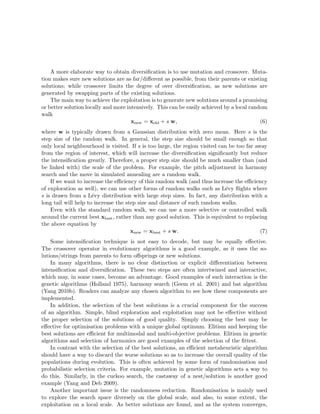
The main way to achieve the exploitation is to generate new solutions around a promising 
or better solution locally and more intensively. This can be easily achieved by a local random 
walk 
xnew = xold + s w, (6) 
where w is typically drawn from a Gaussian distribution with zero mean. Here s is the 
step size of the random walk. In general, the step size should be small enough so that 
only local neighbourhood is visited. If s is too large, the region visited can be too far away 
from the region of interest, which will increase the diversification significantly but reduce 
the intensification greatly. Therefore, a proper step size should be much smaller than (and 
be linked with) the scale of the problem. For example, the pitch adjustment in harmony 
search and the move in simulated annealing are a random walk. 
If we want to increase the efficiency of this random walk (and thus increase the efficiency 
of exploration as well), we can use other forms of random walks such as L´evy flights where 
s is drawn from a L´evy distribution with large step sizes. In fact, any distribution with a 
long tail will help to increase the step size and distance of such random walks. 
Even with the standard random walk, we can use a more selective or controlled walk 
around the current best xbest, rather than any good solution. This is equivalent to replacing 
the above equation by 
xnew = xbest + s w. (7) 
Some intensification technique is not easy to decode, but may be equally effective. 
The crossover operator in evolutionary algorithms is a good example, as it uses the so-lutions/ 
strings from parents to form offsprings or new solutions. 
In many algorithms, there is no clear distinction or explicit differentiation between 
intensification and diversification. These two steps are often intertwined and interactive, 
which may, in some cases, become an advantage. Good examples of such interaction is the 
genetic algorithms (Holland 1975), harmony search (Geem et al. 2001) and bat algorithm 
(Yang 2010b). Readers can analyze any chosen algorithm to see how these components are 
implemented. 
In addition, the selection of the best solutions is a crucial component for the success 
of an algorithm. Simple, blind exploration and exploitation may not be effective without 
the proper selection of the solutions of good quality. Simply choosing the best may be 
effective for optimisation problems with a unique global optimum. Elitism and keeping the 
best solutions are efficient for multimodal and multi-objective problems. Elitism in genetic 
algorithms and selection of harmonics are good examples of the selection of the fittest. 
In contrast with the selection of the best solutions, an efficient metaheuristic algorithm 
should have a way to discard the worse solutions so as to increase the overall quality of the 
populations during evolution. This is often achieved by some form of randomisation and 
probabilistic selection criteria. For example, mutation in genetic algorithms acts a way to 
do this. Similarly, in the cuckoo search, the castaway of a nest/solution is another good 
example (Yang and Deb 2009). 
Another important issue is the randomness reduction. Randomisation is mainly used 
to explore the search space diversely on the global scale, and also, to some extent, the 
exploitation on a local scale. As better solutions are found, and as the system converges,
the degree of randomness should be reduced; otherwise, it will slow down the convergence. 
For example, in particle swarm optimisation, randomness is automatically reduced as the 
particles swarm together (Kennedy and Eberhart 1995), this is because the distance between 
each particle and the current global best is becoming smaller and smaller. 
In other algorithms, randomness is not reduced and but controlled and selected. For 
example, the mutation rate is usually small so as to limit the randomness, while in simulated 
annealing, the randomness during iterations may remain the same, but the solutions or 
moves are selected and acceptance probability becomes smaller. 
Finally, from the implementation point of view, the actual implementation does vary, 
even though the pseudo code should give a good guide and should not in principle lead 
to ambiguity. However, in practice, the actual way of implementing the algorithm does 
affect the performance to some degree. Therefore, validation and testing of any algorithm 
implementation are important (Talbi 2009). 
6 The Generalized Evolutionary Walk Algorithm (GEWA) 
From the above discussion of all the major components and their characteristics, we realized 
that a good combination of local search and global search with a proper selection mechanism 
should produce a good metaheuristic algorithm, whatever the name it may be called. 
In principle, the global search should be carried out more frequently at the initial stage 
of the search or iterations. Once a number of good quality solutions are found, exploration 
should be sparse on the global scale, but frequent enough so as to escape any local trap 
if necessary. On the other hand, the local search should be carried out as efficient as 
possible, so a good local search method should be used. The proper balance of these two is 
paramount. 
Using these basic components, we can now design a new, generic, metaheuristic algo-rithm 
for optimisation, we can call it the Generalized Evolutional Walk Algorithm (GEWA). 
Evolutionary walk is a random walk, but with a biased selection towards optimality. This 
is a generalized framework for global optimisation. 
There are three major components in our proposed algorithm: 1) global exploration by 
randomisation, 2) intensive local search by random walk, and 3) the selection of the best 
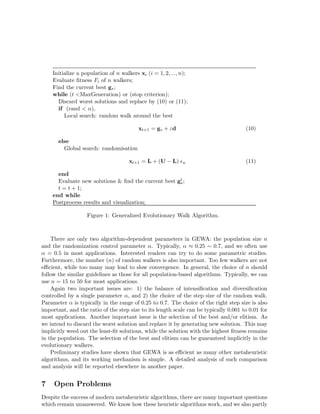
with some elitism. The pseudo code of GEWA is shown in Fig. 1. The random walk should 
be carried out around the current global best g∗ so as to exploit the system information 
such as the current best more effectively. We have 
xt+1 = g∗ + w, (8) 
and 
w = εd, (9) 
where ε is drawn from a Gaussian distribution or normal distribution N(0, σ2), and d is the 
step length vector which should be related to the actual scales of independent variables. 
For simplicity, we can take σ = 1. 
The randomisation step can be achieved by 
xt+1 = L + (U − L)ǫu, (12) 
where ǫu is drawn from a uniform distribution Unif[0,1]. U and L are the upper and lower 
bound vectors, respectively.
Initialize a population of n walkers xi (i = 1, 2, ..., n); 
Evaluate fitness Fi of n walkers; 
Find the current best g∗; 
while (t <MaxGeneration) or (stop criterion); 
Discard worst solutions and replace by (10) or (11); 
if (rand < α), 
Local search: random walk around the best 
xt+1 = g∗ + εd (10) 
else 
Global search: randomisation 
xt+1 = L + (U − L) ǫu (11) 
end 
Evaluate new solutions & find the current best gt∗ 
; 
t = t + 1; 
end while 
Postprocess results and visualization; 
Figure 1: Generalized Evolutionary Walk Algorithm. 
There are only two algorithm-dependent parameters in GEWA: the population size n 
and the randomization control parameter α. Typically, α ≈ 0.25 ∼ 0.7, and we often use 
α = 0.5 in most applications. Interested readers can try to do some parametric studies. 
Furthermore, the number (n) of random walkers is also important. Too few walkers are not 
efficient, while too many may lead to slow convergence. In general, the choice of n should 
follow the similar guidelines as those for all population-based algorithms. Typically, we can 
use n = 15 to 50 for most applications. 
Again two important issues are: 1) the balance of intensification and diversification 
controlled by a single parameter α, and 2) the choice of the step size of the random walk. 
Parameter α is typically in the range of 0.25 to 0.7. The choice of the right step size is also 
important, and the ratio of the step size to its length scale can be typically 0.001 to 0.01 for 
most applications. Another important issue is the selection of the best and/or elitism. As 
we intend to discard the worst solution and replace it by generating new solution. This may 
implicitly weed out the least-fit solutions, while the solution with the highest fitness remains 
in the population. The selection of the best and elitism can be guaranteed implicitly in the 
evolutionary walkers. 
Preliminary studies have shown that GEWA is as efficient as many other metaheuristic 
algorithms, and its working mechanism is simple. A detailed analysis of such comparison 
and analysis will be reported elsewhere in another paper. 
7 Open Problems 
Despite the success of modern metaheuristic algorithms, there are many important questions 
which remain unanswered. We know how these heuristic algorithms work, and we also partly
understand why these algorithms work. However, it is difficult to analyze mathematically 
why these algorithms are so successful. In fact, these are unresolved open problems. 
Apart from the mathematical analysis on simulated annealing and particle swarm op-timisation, 
convergence of all other algorithms has not been proved mathematically, at 
least up to now. Any mathematical analysis will thus provide important insight into these 
algorithms. It will also be valuable for providing new directions for further important 
modifications on these algorithms or even pointing out innovative ways of developing new 
algorithms. 
In addition, it is still only partly understood why different components of heuristics 
and metaheuristics interact in a coherent and balanced way so that they produce efficient 
algorithms which converge under the given conditions. For example, why does a balanced 
combination of randomisation and a deterministic component lead to a much more efficient 
algorithm (than a purely deterministic and/or a purely random algorithm)? How to measure 
or test if a balance is reached? How to prove that the use of memory can significantly 
increase the search efficiency of an algorithm? Under what conditions? 
From the well-known No-Free-Lunch theorems (Wolpert and Macready 1997), we know 
that they have been proved for single objective optimisation, but they remain unproved 
for multiobjective optimisation. If they are proved to be true (or not) for multiobjective 
optimisation, what are the implications for algorithm development? 
Furthermore, there is no agreed measure for comparing performance of different algo-rithms, 
thought the absolute objective value and the number of functional evaluations are 
two widely used measures. An attempt to provide a general framework was given by Shi-lane 
et al. (2008). However, a formal theoretical analysis is yet to be developed. If you 
are looking for some research topics, either for yourself or for your research students, these 
could form important topics for further research. 
Another interesting question that people often ask me is “to be inspired or not to be 
inspired”? Nature has evolved over billions of years, she has found almost perfect solutions 
to every problem she has met. Almost all the not-so-good solutions have been discarded via 
natural selection. The optimal solutions seem (often after a huge number of generations) to 
appear at the evolutionarilly stable equilibrium, even though we may not understand how 
the perfect solutions are reached. When we try to solve human problems, why not try to 
be inspired by the nature’s success? The simple answer to the question ‘To be inspired or 
not to be inspired?’ is ‘why not?’. If we do not have good solutions at hand, it is always a 
good idea to learn from nature. 
Nature provides almost unlimited ways for problem-solving. If we can observe carefully, 
we are surely inspired to develop more powerful and efficient new generation algorithms. 
Intelligence is a product of biological evolution in nature. Ultimately some intelligent algo-rithms 
(or systems) may appear in the future, so that they can evolve and optimally adapt 
to solve NP-hard optimisation problems efficiently and intelligently. 
In addition, a current trend is to use simplified metaheuristic algorithms to deal with 
complex optimisation problems. Possibly, there is a need to develop more complex meta-heuristic 
algorithms which can truly mimic the exact working mechanism of some natural or 
biological systems, leading to more powerful next generation, self-regulating, self-evolving, 
and truly intelligent metaheuristics.
References 
[1] Bersini, H. and Varela, F. J. (1990) ‘Hints for adaptive problem solving gleaned from 
immune networks’, Parellel Problem Solving from Nature, PPSW1, Dortmund, FRG. 
[2] Blum, C. and Roli, A. (2003) ‘Metaheuristics in combinatorial optimisation: 
Overview and conceptural comparision’, ACM Comput. Surv., Vol. 35, 268-308. 
[3] Copeland, B. J. (2004) The Essential Turing, Oxford University Press. 
[4] Cui, Z. H., and Zeng, J. C. (2005) ‘A modified particle swarm optimisation predicted 
by velocity’, GECCO 2005, pp. 277–278. 
[5] Cui, Z. H., and Cai, X. J. (2009) ‘Integral particle swarm optimisation with dispersed 
accelerator information’, Fundam. Inform., Vol. 95, 427–447. 
[6] De Jong, K. (1975) Analysis of the Behaviour of a Class of Genetic Adaptive Systems, 
PhD thesis, University of Michigan, Ann Anbor. 
[7] Dorigo, M. (1992) Optimisation, Learning and Natural Algorithms, PhD thesis, Po-litecnico 
di Milano, Italy. 
[8] Farmer, J.D., Packard, N. and Perelson, A. (1986) ‘The immune system, adaptation 
and machine learning’, Physica D, 2, 187-204. 
[9] Fogel, L. J., Owens, A. J., and Walsh, M. J. (1966) Artificial Intelligence Through 
Simulated Evolution, Wiley. 
[10] Geem, Z.W., Kim J. K., and Loganathan, G. V. (2001) ‘A new heuristic optimisation: 
Harmony search’, Simulation, Vol. 76(2), 60-68. 
[11] Glover, F. and Laguna, M. (1997) Tabu Search, Kluwer Academic Publishers, Boston. 
[12] Haddad, O. B., Afshar, A., Mario, M. A., (2006) ‘Honey-bees mating optimisation 
(HBMO) algorithm: a new heuristic approach for water resources optimisation’, Wa-ter 
Resources Management, Vol. 20, 661680 
[13] Holland, J. (1975) Adaptation in Natural and Artificial systems, University of Michi-gan 
Press, Ann Anbor. 
[14] Judea, P. (1984) Heuristics, Addison-Wesley. 
[15] Karaboga, D. (2005) ‘An idea based on honey bee swarm for numerical optimisation’, 
Technical Report, Erciyes University. 
[16] Kennedy, J. and Eberhart, R. (1995) ‘Particle swarm optimisation’, in: Proc. of the 
IEEE Int. Conf. on Neural Networks, Piscataway, NJ, pp. 1942-1948. 
[17] Kirkpatrick, S., Gellat, C. D., and Vecchi, M. P. (1983) ‘Optimisation by simulated 
annealing’, Science, 220, 671-680. 
[18] Koza, J. R. (1992) Genetic Programming: One the Programming of Computers by 
Means of Natural Selection, MIT Press.
[19] Krishnanand, K. N. and D. Ghose D. (2005) ‘Detection of multiple source locations 
using a glowworm metaphor with applications to collective robotics’, IEEE Swarm 
Intelligence Symposium, Pasadena, California, USA, pp. 8491. 
[20] Metaheuristic (2010) the wikipedia article from 
http://en.wikipedia.org/wiki/Metaheuristic 
[21] Moscato, P. (1989) On Evolution, Search, Optimisation, Genetic Algorithms and 
Martial Arts: Towards Memetic Algorithms. Caltech Concurrent Computation Pro-gram 
(report 826). 
[22] Mucherino, A. and Seref, O. (2008). ‘Modelling and solving real-life global optimi-sation 
problems with metaheuristic methods’, in: Advances in Modeling Agricultural 
Systems, Springer Optimisation and Its Applications Series Vol. 25 (Eds Papajorgji 
P. J. and Pardolos P. M.), pp. 403-420. 
[23] Nakrani S. and C. Tovey, C. (2004) ‘On honey bees and dynamic server allocation in 
Internet hostubg centers’, Adaptive Behavior, Vol. 12, 223-240. 
[24] Passino, K. M. (2002) ‘Biomimicry of bacterial foraging for distributed optimisation 
and control’, IEEE Control System Magazine, pp. 52-67. 
[25] Pham, D. T., Ghanbarzadeh, A., Koc, E., Otri, S., Rahim S. and Zaidi, M. (2005) 
‘The bees algorithm’, Technical Note, Manufacturing Engineering Center, Cardiff 
University. 
[26] Rubinstein, R.Y. (1997) ‘Optimisation of Computer simulation Models with Rare 
Events’, European Journal of Operations Research, 99, 89-112. 
[27] Schrijver, A. (2005) ‘On the history of combinatorial optimisation (till 1960)’, in: 
Handbook of Discrete Optimisation (Eds K. Aardal, G. L. Nemhauser, R. Weisman-tel), 
Elsevier, Amsterdam, pp.1-68. 
[28] Shilane, D., Martikainen, J., Dudoit, S., Ovaska, S. J. (2008) ‘A general framework 
for statistical performance comparison of evolutionary computation algorithms’, In-formation 
Sciences, Vol. 178, 2870-2879. 
[29] Storn, R. and Price, K. (1997) ‘Differential evolution - a simple and efficient heuristic 
for global optimisation over continuous spaces’, Journal of Global Optimisation, Vol. 
11, 341-359. 
[30] Talbi, E. G. (2009) Metahueristics: From Design to Implementation, Wiley. 
[31] Vapnik, V. (1995) The Nature of Statistical Learning Theory, Springer-Verlag, New 
York. 
[32] Vapnik, V., Golowich, S., Smola, A. (1997) ‘Support vector method for function 
approxiation, regression estimation, and signal processing’, in: Advances in Neural 
Information Processing System 9 (Eds. M. Mozer, M. Jordan and T. Petsche), MIT 
Press, Cambridge MA, USA. 
[33] Wolpert, D. H. and Macready, W. G. (1997) ‘No free lunch theorems for optimisation’, 
IEEE Transaction on Evolutionary Computation, Vol. 1, 67-82.
[34] Yang, X. S. (2008) Nature-Inspired Metaheuristic Algorithms, Luniver Press. 
[35] Yang, X. S. (2009) ‘Firefly algorithms for multimodal optimisation’, Proc. 5th Sympo-sium 
on Stochastic Algorithms, Foundations and Applications, SAGA 2009, Eds. O. 
Watanabe and T. Zeugmann, Lecture Notes in Computer Science, Vol. 5792, 169-178. 
[36] Yang, X. S. and Deb, S. (2009) ‘Cuckoo search via L´evy flights’, in: Proc. of World 
Congress on Nature & Biologically Inspired Computing (NaBic 2009), IEEE Publica-tions, 
USA, pp. 210-214. 
[37] Yang, X. S. (2010a) ‘Firefly algorithm, stochastic test functions and design optimi-sation’, 
Int. J. Bio-Inspired Computation, 2, 78–84. 
[38] Yang, X. S. (2010b) ‘A new metaheuristic bat-inspired algorithm’, in: Nature Inspired 
Cooperative Strategies for Optimization (NICSO 2010) (Eds. J. R. Gonzalez et al.), 
Springer, SCI Vol. 284, 65-74. 
[39] Yang X. S. and Deb, S. (2010a) ‘Engineering optimisation by cuckoo search’, Int. J. 
Math. Modelling & Num. Optimisation, Vol. 1, 330-343. 
[40] Yang, X. S. and Deb, S. (2010b) ‘Eagle strategy using L´evy walk and firefly algo-rithms 
for stochastic optimisation’, in: Nature Inspired Cooperative Strategies for 
Optimization (NICSO 2010) (Eds. J. R. Gonzalez et al.), Springer, SCI Vol. 284, 
101-111.

Review of Metaheuristics and Generalized Evolutionary Walk Algorithm

  • 1.
    arXiv:1105.3668v1 [math.OC] 18May 2011 Review of Metaheuristics and Generalized Evolutionary Walk Algorithm Xin-She Yang Mathematics and Scientific Computing National Physical Laboratory, Teddington, TW11 0LW, UK Abstract Metaheuristic algorithms are often nature-inspired, and they are becoming very pow-erful in solving global optimization problems. More than a dozen of major metaheuristic algorithms have been developed over the last three decades, and there exist even more variants and hybrid of metaheuristics. This paper intends to provide an overview of nature-inspired metaheuristic algorithms, from a brief history to their applications. We try to analyze the main components of these algorithms and how and why they works. Then, we intend to provide a unified view of metaheuristics by proposing a generalized evolutionary walk algorithm (GEWA). Finally, we discuss some of the important open questions. Keywords: Algorithms; ant colony optimization; cuckoo search; differential evo-lution; firefly algorithm; harmony search; genetic algorithm; metaheuristic; simulated annealing; particle swarm optimisation. Reference to this paper should be made as follows: Xin-She Yang (2011) ‘Review of metaheuristics and generalized evolutionary walk al-gorithm’, Int. J. Bio-Inspired Computation, Vol. 3, No. 2, pp. 77-84 (2011).
  • 2.
    1 Introduction Nature-inspiredmetaheuristic algorithms are becoming increasingly popular in optimisation and applications over the last three decades. There are many reasons for this popularity and success, and one of the main reasons is that these algorithms have been developed by mimicking the most successful processes in nature, including biological systems, and physical and chemical processes. For most algorithms, we know their fundamental components, how exactly they interact to achieve efficiency still remains partly a mystery, which inspires more active studies. Convergence analysis of a few algorithms such as the particle swarm optimisation shows some insight, but in general mathematical analysis of metaheuristic algorithms remains unsolved and still an ongoing active research topic. The solution of an optimisation problem requires the choice and the correct use of the right algorithm. The choice of an algorithm largely depends on the type of the optimisation problem at hand. For large-scale nonlinear global optimisation problems, there is no agreed guideline for how to choose and what to choose. In fact, we are not even sure whether an efficient algorithm exists, which is especially true for NP-hard problems, and most real-world problem often are NP-hard indeed. In most applications, we can in general write an optimisation problem as the following generic form minimise x∈ℜn fi(x), (i = 1, 2, ...,M), (1) subject to hj(x) = 0, (j = 1, 2, ..., J), (2) gk(x) ≤ 0, (k = 1, 2, ...,K), (3) where fi(x), hj (x) and gk(x) are functions of the design vector x = (x1, x2, ..., xn)T . (4) Here the components xi of x are called design or decision variables, and they can be real continuous, discrete or the mixed of these two. The functions fi(x) where i = 1, 2, ...,M are called the objective functions or simply cost functions, and in the case of M = 1, there is only a single objective. The space spanned by the decision variables is called the design space or search space ℜn, while the space formed by the objective function values is called the solution space or response space. The equalities for hj and inequalities for gk are called constraints. It is worth pointing out that we can also write the inequalities in the other way ≥ 0, and we can also formulate the objectives as a maximisation problem. The algorithms used for solving optimisation problems can be very diverse, from con-ventional algorithms to modern metaheuristics. Most conventional or classic algorithms are deterministic. For example, the simplex method in linear programming is deterministic. Some deterministic optimisation algorithms used the gradient information, they are called gradient-based algorithms. For example, the well-known Newton-Raphson algorithm is gradient-based, as it uses the function values and their derivatives, and it works extremely well for smooth unimodal problems. However, if there is some discontinuity in the objective function, it does not work well. In this case, a non-gradient algorithm is preferred. Non-gradient-based, or gradient-free/derivative-free, algorithms do not use any derivative, but only the function values. Hooke-Jeeves pattern search and Nelder-Mead downhill simplex are examples of gradient-free algorithms. For stochastic algorithms, in general we have two types: heuristic and metaheuristic, though their difference is small. Loosely speaking, heuristic means ‘to find’ or ‘to discover
  • 3.
    by trial anderror’. Quality solutions to a tough optimisation problem can be found in a reasonable amount of time, but there is no guarantee that optimal solutions are reached. It hopes that these algorithms work most of the time, but not necessarily all the time. This is good when we do not necessarily want the best solutions but rather good solutions which are easily reachable. 2 Metaheuristics In metaheuristic algorithms, meta- means ‘beyond’ or ‘higher level’, and they generally perform better than simple heuristics. All metaheuristic algorithms use certain tradeoff of local search and global exploration. Variety of solutions are often realized via randomisa-tion. Despite the popularity of metaheuristics, there is no agreed definition of heuristics and metaheuristics in the literature. Some researchers use ‘heuristics’ and ‘metaheuristics’ interchangeably. However, the recent trend tends to name all stochastic algorithms with randomisation and global exploration as metaheuristic. In this review, we will also follow this convention. Randomisation provides a good way to move away from local search to the search on the global scale. Therefore, almost all metaheuristic algorithms intend to be suitable for global optimisation. Metaheuristics can be an efficient way to produce acceptable solutions by trial and error to a complex problem in a reasonably practical time. The complexity of the problem of interest makes it impossible to search every possible solution or combination, the aim is to find good feasible solution in an acceptable timescale. There is no guarantee that the best solutions can be found, and we even do not know whether an algorithm will work and why if it does work. The idea is to have an efficient but practical algorithm that will work most the time and is able to produce good quality solutions. Among the found quality solutions, it is expected some of them are nearly optimal, though there is no guarantee for such optimality. The main components of any metaheuristic algorithms are: intensification and diversi-fication, or exploitation and exploration (Blum and Roli 2003). Diversification means to generate diverse solutions so as to explore the search space on the global scale, while in-tensification means to focus on the search in a local region by exploiting the information that a current good solution is found in this region. This is in combination with with the selection of the best solutions. The selection of the best ensures that the solutions will converge to the optimality. On the other hand, the diversification via randomisation avoids the solutions being trapped at local optima, while increases the diversity of the solutions. The good combination of these two major components will usually ensure that the global optimality is achievable. Metaheuristic algorithms can be classified in many ways. One way is to classify them as: population-based and trajectory-based. For example, genetic algorithms are population-based as they use a set of strings, so is the particle swarm optimisation (PSO) which uses multiple agents or particles (Kennedy and Eberhart 1995). On the other hand, simulated annealing uses a single agent or solution which moves through the design space or search space in a piecewise style (Kirkpatrick et al. 1983).
  • 4.
    3 Overview ofMetaheuristics Throughout history, especially at the early periods of human history, the main approach to problem-solving has always been heuristic or metaheuristic – by trial and error. Many important discoveries were done by ‘thinking outside the box’, and often by accident; that is heuristics. Archimedes’s Eureka moment was a heuristic triumph. In fact, our daily learning experience (at least as a child) is dominantly heuristic. Despite its ubiquitous nature, metaheuristics as a scientific method to problem solving is indeed a modern phenomenon, though it is difficult to pinpoint when the metaheuristic method was first used. Alan Turing was probably the first to use heuristic algorithms for code-breaking during the Second World War (Copeland 2004). Turing called his search method heuristic search, as it could be expected it worked most of time, but there was no guarantee to find the correct solution, but it was a tremendous success. The 1960s and 1970s were the two important decades for the development of evolution-ary algorithms. First, John Holland and his collaborators at the University of Michigan developed the genetic algorithms in 1960s and 1970s (Holland 1975). As early as 1962, Holland studied the adaptive system and was the first to use crossover and recombination manipulations for modeling such system. His seminal book summarizing the development of genetic algorithms was published in 1975. In the same year, De Jong finished his impor-tant dissertation showing the potential and power of genetic algorithms for a wide range of objective functions, either noisy, multimodal or even discontinuous (De Jong 1975). Briefly speaking, a genetic algorithm (GA) is a search method based on the abstraction of Darwinian evolution and natural selection of biological systems and representing them in the mathematical operators: crossover or recombination, mutation, fitness, and selection of the fittest. Ever since, genetic algorithms have become so successful in solving a wide range of optimisation problems, there have several thousands of research articles and hundreds of books written. Some statistics show that a vast majority of Fortune 500 companies are now using them routinely to solve tough combinatorial optimisation problems such as planning, data-fitting, and scheduling. During the about same period in the 1960s, Ingo Rechenberg and Hans-Paul Schwefel both then at the Technical University of Berlin developed a search technique for solving optimisation problem in aerospace engineering, called evolutionary strategy, in 1963. Later, Peter Bienert joined them and began to construct an automatic experimenter using simple rules of mutation and selection. There was no crossover in this technique, only mutation was used to produce an offspring and an improved solution was kept at each generation. This was essentially a simple trajectory-style hill-climbing algorithm with randomisation. As early as 1960, Lawrence J. Fogel intended to use simulated evolution as a learning process as a tool to study artificial intelligence. Then, in 1966, L. J. Fogel, together A. J. Owen and M. J. Walsh, developed the evolutionary programming technique by representing solutions as finite-state machines and randomly mutating one of these machines (Fogel et al. 1966). The above innovative ideas and methods have evolved into a much wider discipline, called evolutionary algorithms and/or evolutionary computation. A loosely related topic is the development of the support vector machine which is a classification technique dated back to the earlier work by V. Vapnik in 1963 on linear classifiers, and the nonlinear classification with kernel techniques were developed by V. Vapnik and his collaborators in the 1990s (Vapnik 1995, Vapnik et al. 1997). A brief history of heuristics till 1960s in the context of combinatorial optimisation was reviewed by Schrijver (2005). One of the first books on heuristics was published by Judea
  • 5.
    (1984). A verysimplified, informal history can be found from the wikipedia article on metaheuristic (Wikipedia 2010). The two decades of 1980s and 1990s were the most exciting time for metaheuristic algorithms. The next big step is the development of simulated annealing (SA) in 1983, an optimisation technique, pioneered by S. Kirkpatrick, C. D. Gellat and M. P. Vecchi, inspired by the annealing process of metals. It is a trajectory-based search algorithm starting with an initial guess solution at a high temperature, and gradually cooling down the system (Kirkpatrick et al. 1983). A move or new solution is accepted if it is better; otherwise, it is accepted with a probability, which makes it possible for the system to escape any local optima. It is then expected that if the system is cooled down slowly enough, the global optimal solution can be reached. Most metaheuristic do not explicitly use memory, except the selection of the best solu-tions. The actual first usage of memory in modern metaheuristics is probably due to Fred Glover’s Tabu search in 1986, though his seminal book on Tabu search was published later in 1997 (Glover and Luguna 1997). Interestingly, an even-higher level algorithm, namely, the memetic algorithm, proposed by P. Moscato in 1989, is a multi-generation, co-evolution and self-generation algorithm (Moscato 1989), and it can be considered as a hyper-heuristic algorithm, rather than meta-heuristic. At the beginning of the 1990s, Marco Dorigo finished his PhD thesis on optimisation and natural algorithms (Dorigo 1992), in which he described his innovative work on ant colony optimisation (ACO). This search technique was inspired by the swarm intelligence of social ants using pheromone as a chemical messenger. Then, in 1992, John R. Koza of Stanford University published a treatise on genetic programming which laid the foundation of a whole new area of machine learning, revolutionizing computer programming (Koza 1992). As early as in 1988, Koza applied his first patent on genetic programming. The basic idea is to use the genetic principle to breed computer programs so as to gradually produce the best programs for a given type of problem. Another interesting algorithm is the so-called artificial immune system, inspired by the characteristics of the immune system of mammals to use memory and learning as a novel approach to problem solving. The idea was proposed by Farmer et al. in 1986 (Farmer et al. 1986), with important work on immune networks by Bersini and Varela in 1990 (Bersini and Varela 1990). It is an adaptive system with high potential. There are many variants developed over the last two decades, including the clonal selection algorithm, negative selection algorithm, immune networks and others. Slightly later in 1995, another significant progress is the development of the particle swarm optimisation (PSO) by American social psychologist James Kennedy, and engineer Russell C. Eberhart (Kennedy and Eberhart 1995). Loosely speaking, PSO is an optimisa-tion algorithm inspired by swarm intelligence of fish and birds and by even human behavior. The multiple agents, called particles, swarm around the search space starting from some initial random guess. The swarm communicates the current best and shares the global best so as to focus on the quality solutions. Since the development of PSO, there have been more than about 20 different variants of particle swarm optimisation techniques, and have been applied to almost all areas of tough optimisation problem. A variant typically extends PSO by varying some aspects of the particle swarm or introducing new functionality, for example, new variants were developed by introducing velocity variations (Cui and Zeng 2005, Cui and Cai 2009). There is some strong evidence that PSO is better than traditional search algorithms and even better than
  • 6.
    genetic algorithms formany types of problems, though this is far from conclusive. Around the same time in 1996 and later 1997, R. Storn and K. Price developed their vector-based evolutionary algorithm, called differential evolution (DE), and this algorithm proves more efficient than genetic algorithms in many applications (Storn and Price 1997). Another interesting method is the cross-entropy method developed by Rubinstein in 1997. It is a generalized Monte Carlo method, based on the rare event simulations. This algorithm consists of two phases: generation of random samples and update of the param-eters. Here the aim is to minimise the cross entropy (Rubinstein 1997). In celebrating this series of success, a significant event is the publication of the ‘no free lunch theorems’ for optimisation in 1997 by D. H. Wolpert and W. G. Macready, which sent out a shock way to the optimisation community (Wolpert and Macready 1997). Researchers have been always trying to find better algorithms, or even universally robust algorithms, for optimisation, especially for tough NP-hard optimisation problems. However, these the-orems state that if algorithm A performs better than algorithm B for some optimisation functions, then B will outperform A for other functions. That is to say, if averaged over all possible function space, both algorithms A and B will perform on average equally well. Alternatively, there is no universally better algorithms exist. That is disappointing, right? Then, people realized that we do not need the average over all possible functions for a given optimisation problem. What we want is to find the best solutions, which has nothing to do with average over all possible function space. In addition, we can accept the fact that there is no universal or magical tool, but we do know from our experience that some algorithms indeed outperform others for given types of optimisation problems. So the research now focuses on finding the best and most efficient algorithm(s) for a given problem. The ob-jective is to design better algorithms for most types of problems, not for all the problems. Therefore, the search is still on. At the turn of the 21st century, things became even more exciting. First, Zong Woo Geem et al. in 2001 developed the harmony search (HS) algorithm (Geem et al. 2001), which has been widely applied in solving various optimisation problems such as water distribution, transport modelling and scheduling. This is almost immediately followed by the develop-ment of another algorithm, called the bacterial foraging optimisation by K. M. Passino in around 2002, inspired by the social foraging behaviour of bacteria such as Escherichia coli (Passino 2002). In 2004, S. Nakrani and C. Tovey proposed the honey bee algorithm and its application for optimizing Internet hosting centers (Nakrani and Trovey 2004), which followed by the development of a novel bee algorithm by D. T. Pham et al. in 2005 (Pham et al. 2005) and the artificial bee colony (ABC) by D. Karaboga in 2005 (Karaboga 2005). In the same year, a glowworm algorithm was developed for the detection of multiple source locations applied to collective robots (Krishnanand and Ghose 2005). Later in 2006, a honey-bees mating optimisation algorithm was developed by Haddad et al. (2006). In 2008, Mucherino and Seref proposed monkey search, based on the foraging behaviour of monkeys (Mucherino and Seref 2008). In the same year, the author of this article devel-oped the firefly algorithm (FA) (Yang 2008, Yang 2009, Yang 2010a). Quite a few research articles on the firefly algorithm then followed, and this algorithm has attracted a wide range of interests. In 2009, Xin-She Yang at Cambridge University, UK, and Suash Deb at Raman College of Engineering, India, introduced an efficient cuckoo search (CS) algorithm (Yang and Deb 2009, Yang and Deb 2010a), and it has been demonstrated that CS is far more ef-fective than most existing metaheuristic algorithms including particle swarm optimisation. In 2010, I developed a bat-inspired algorithm for continuous optimisation (Yang 2010b),
  • 7.
    and its efficiencyis quite promising. At about the same, Yang and Deb also proposed the eagle strategy as a two-stage optimisation strategy (Yang and Deb 2010b). 4 Characteristics of Metaheuristics The efficiency of metaheuristic algorithms can be attributed to the fact that they imitate the best features in nature, especially the selection of the fittest in biological systems which have evolved by natural selection over millions of years. Two important characteristics of metaheuristics are: intensification and diversification (Blum and Roli 2003). Intensification intends to search locally and more intensively, while diversification makes sure the algorithm explores the search space globally (hopefully also efficiently). Furthermore, intensification is also called exploitation, as it typically searches around the current best solutions and selects the best candidates or solutions. Similarly, diversification is also called exploration, as it strives to explore the search space more efficiently, often by large-scale randomisation. The fine balance between these two components is very important to the overall efficiency and performance of an algorithm. Too little exploration and too much exploitation could cause the system to be trapped in local optima, which makes it very difficult or even impossible to find the global optimum. On the other hand, if too much exploration but too little exploitation, it may be difficult for the system to converge and thus slows down the overall search performance. The proper balance itself is an optimisation problem, and one of the main tasks of designing new algorithms is to find a certain balance concerning this optimality and/or tradeoff. Obviously, simple exploitation and exploration are not enough. During the search, we have to use a proper mechanism or criterion to select the best solutions. The most common criterion is to use the Survival of the Fittest, that is to keep updating the current best found so far. In addition, certain elitism is often used, and this is to ensure the best or fittest solutions are not lost, and should be passed onto the next generations. 5 Importance of Randomisation There are many ways of carrying out intensification and diversification. In fact, each algo-rithm and its variants use different ways of achieving the balance of between exploration and exploitation. By analyzing all the metaheuristic algorithms, we can categorically say that the way to achieve exploration or diversification is mainly by certain randomisation in combination with a deterministic procedure. This ensures that the newly generated solutions distribute as diversely as possible in the feasible search space. One of simplest and yet most commonly used randomisation techniques is to use xnew = L + (U − L) ∗ ǫu, (5) where L and U are the lower bound and upper bound, respectively. ǫu is a uniformly distributed random variable in [0,1]. This is often used in many algorithms such as harmony search, particle swarm optimisation and firefly algorithm. It is worth pointing that the use of a uniform distribution is not the only way to achieve randomisation. In fact, random walks such as L´evy flights on a global scale are more efficient.
  • 8.
    A more elaborateway to obtain diversification is to use mutation and crossover. Muta-tion makes sure new solutions are as far/different as possible, from their parents or existing solutions; while crossover limits the degree of over diversification, as new solutions are generated by swapping parts of the existing solutions. The main way to achieve the exploitation is to generate new solutions around a promising or better solution locally and more intensively. This can be easily achieved by a local random walk xnew = xold + s w, (6) where w is typically drawn from a Gaussian distribution with zero mean. Here s is the step size of the random walk. In general, the step size should be small enough so that only local neighbourhood is visited. If s is too large, the region visited can be too far away from the region of interest, which will increase the diversification significantly but reduce the intensification greatly. Therefore, a proper step size should be much smaller than (and be linked with) the scale of the problem. For example, the pitch adjustment in harmony search and the move in simulated annealing are a random walk. If we want to increase the efficiency of this random walk (and thus increase the efficiency of exploration as well), we can use other forms of random walks such as L´evy flights where s is drawn from a L´evy distribution with large step sizes. In fact, any distribution with a long tail will help to increase the step size and distance of such random walks. Even with the standard random walk, we can use a more selective or controlled walk around the current best xbest, rather than any good solution. This is equivalent to replacing the above equation by xnew = xbest + s w. (7) Some intensification technique is not easy to decode, but may be equally effective. The crossover operator in evolutionary algorithms is a good example, as it uses the so-lutions/ strings from parents to form offsprings or new solutions. In many algorithms, there is no clear distinction or explicit differentiation between intensification and diversification. These two steps are often intertwined and interactive, which may, in some cases, become an advantage. Good examples of such interaction is the genetic algorithms (Holland 1975), harmony search (Geem et al. 2001) and bat algorithm (Yang 2010b). Readers can analyze any chosen algorithm to see how these components are implemented. In addition, the selection of the best solutions is a crucial component for the success of an algorithm. Simple, blind exploration and exploitation may not be effective without the proper selection of the solutions of good quality. Simply choosing the best may be effective for optimisation problems with a unique global optimum. Elitism and keeping the best solutions are efficient for multimodal and multi-objective problems. Elitism in genetic algorithms and selection of harmonics are good examples of the selection of the fittest. In contrast with the selection of the best solutions, an efficient metaheuristic algorithm should have a way to discard the worse solutions so as to increase the overall quality of the populations during evolution. This is often achieved by some form of randomisation and probabilistic selection criteria. For example, mutation in genetic algorithms acts a way to do this. Similarly, in the cuckoo search, the castaway of a nest/solution is another good example (Yang and Deb 2009). Another important issue is the randomness reduction. Randomisation is mainly used to explore the search space diversely on the global scale, and also, to some extent, the exploitation on a local scale. As better solutions are found, and as the system converges,
  • 9.
    the degree ofrandomness should be reduced; otherwise, it will slow down the convergence. For example, in particle swarm optimisation, randomness is automatically reduced as the particles swarm together (Kennedy and Eberhart 1995), this is because the distance between each particle and the current global best is becoming smaller and smaller. In other algorithms, randomness is not reduced and but controlled and selected. For example, the mutation rate is usually small so as to limit the randomness, while in simulated annealing, the randomness during iterations may remain the same, but the solutions or moves are selected and acceptance probability becomes smaller. Finally, from the implementation point of view, the actual implementation does vary, even though the pseudo code should give a good guide and should not in principle lead to ambiguity. However, in practice, the actual way of implementing the algorithm does affect the performance to some degree. Therefore, validation and testing of any algorithm implementation are important (Talbi 2009). 6 The Generalized Evolutionary Walk Algorithm (GEWA) From the above discussion of all the major components and their characteristics, we realized that a good combination of local search and global search with a proper selection mechanism should produce a good metaheuristic algorithm, whatever the name it may be called. In principle, the global search should be carried out more frequently at the initial stage of the search or iterations. Once a number of good quality solutions are found, exploration should be sparse on the global scale, but frequent enough so as to escape any local trap if necessary. On the other hand, the local search should be carried out as efficient as possible, so a good local search method should be used. The proper balance of these two is paramount. Using these basic components, we can now design a new, generic, metaheuristic algo-rithm for optimisation, we can call it the Generalized Evolutional Walk Algorithm (GEWA). Evolutionary walk is a random walk, but with a biased selection towards optimality. This is a generalized framework for global optimisation. There are three major components in our proposed algorithm: 1) global exploration by randomisation, 2) intensive local search by random walk, and 3) the selection of the best with some elitism. The pseudo code of GEWA is shown in Fig. 1. The random walk should be carried out around the current global best g∗ so as to exploit the system information such as the current best more effectively. We have xt+1 = g∗ + w, (8) and w = εd, (9) where ε is drawn from a Gaussian distribution or normal distribution N(0, σ2), and d is the step length vector which should be related to the actual scales of independent variables. For simplicity, we can take σ = 1. The randomisation step can be achieved by xt+1 = L + (U − L)ǫu, (12) where ǫu is drawn from a uniform distribution Unif[0,1]. U and L are the upper and lower bound vectors, respectively.
  • 10.
    Initialize a populationof n walkers xi (i = 1, 2, ..., n); Evaluate fitness Fi of n walkers; Find the current best g∗; while (t <MaxGeneration) or (stop criterion); Discard worst solutions and replace by (10) or (11); if (rand < α), Local search: random walk around the best xt+1 = g∗ + εd (10) else Global search: randomisation xt+1 = L + (U − L) ǫu (11) end Evaluate new solutions & find the current best gt∗ ; t = t + 1; end while Postprocess results and visualization; Figure 1: Generalized Evolutionary Walk Algorithm. There are only two algorithm-dependent parameters in GEWA: the population size n and the randomization control parameter α. Typically, α ≈ 0.25 ∼ 0.7, and we often use α = 0.5 in most applications. Interested readers can try to do some parametric studies. Furthermore, the number (n) of random walkers is also important. Too few walkers are not efficient, while too many may lead to slow convergence. In general, the choice of n should follow the similar guidelines as those for all population-based algorithms. Typically, we can use n = 15 to 50 for most applications. Again two important issues are: 1) the balance of intensification and diversification controlled by a single parameter α, and 2) the choice of the step size of the random walk. Parameter α is typically in the range of 0.25 to 0.7. The choice of the right step size is also important, and the ratio of the step size to its length scale can be typically 0.001 to 0.01 for most applications. Another important issue is the selection of the best and/or elitism. As we intend to discard the worst solution and replace it by generating new solution. This may implicitly weed out the least-fit solutions, while the solution with the highest fitness remains in the population. The selection of the best and elitism can be guaranteed implicitly in the evolutionary walkers. Preliminary studies have shown that GEWA is as efficient as many other metaheuristic algorithms, and its working mechanism is simple. A detailed analysis of such comparison and analysis will be reported elsewhere in another paper. 7 Open Problems Despite the success of modern metaheuristic algorithms, there are many important questions which remain unanswered. We know how these heuristic algorithms work, and we also partly
  • 11.
    understand why thesealgorithms work. However, it is difficult to analyze mathematically why these algorithms are so successful. In fact, these are unresolved open problems. Apart from the mathematical analysis on simulated annealing and particle swarm op-timisation, convergence of all other algorithms has not been proved mathematically, at least up to now. Any mathematical analysis will thus provide important insight into these algorithms. It will also be valuable for providing new directions for further important modifications on these algorithms or even pointing out innovative ways of developing new algorithms. In addition, it is still only partly understood why different components of heuristics and metaheuristics interact in a coherent and balanced way so that they produce efficient algorithms which converge under the given conditions. For example, why does a balanced combination of randomisation and a deterministic component lead to a much more efficient algorithm (than a purely deterministic and/or a purely random algorithm)? How to measure or test if a balance is reached? How to prove that the use of memory can significantly increase the search efficiency of an algorithm? Under what conditions? From the well-known No-Free-Lunch theorems (Wolpert and Macready 1997), we know that they have been proved for single objective optimisation, but they remain unproved for multiobjective optimisation. If they are proved to be true (or not) for multiobjective optimisation, what are the implications for algorithm development? Furthermore, there is no agreed measure for comparing performance of different algo-rithms, thought the absolute objective value and the number of functional evaluations are two widely used measures. An attempt to provide a general framework was given by Shi-lane et al. (2008). However, a formal theoretical analysis is yet to be developed. If you are looking for some research topics, either for yourself or for your research students, these could form important topics for further research. Another interesting question that people often ask me is “to be inspired or not to be inspired”? Nature has evolved over billions of years, she has found almost perfect solutions to every problem she has met. Almost all the not-so-good solutions have been discarded via natural selection. The optimal solutions seem (often after a huge number of generations) to appear at the evolutionarilly stable equilibrium, even though we may not understand how the perfect solutions are reached. When we try to solve human problems, why not try to be inspired by the nature’s success? The simple answer to the question ‘To be inspired or not to be inspired?’ is ‘why not?’. If we do not have good solutions at hand, it is always a good idea to learn from nature. Nature provides almost unlimited ways for problem-solving. If we can observe carefully, we are surely inspired to develop more powerful and efficient new generation algorithms. Intelligence is a product of biological evolution in nature. Ultimately some intelligent algo-rithms (or systems) may appear in the future, so that they can evolve and optimally adapt to solve NP-hard optimisation problems efficiently and intelligently. In addition, a current trend is to use simplified metaheuristic algorithms to deal with complex optimisation problems. Possibly, there is a need to develop more complex meta-heuristic algorithms which can truly mimic the exact working mechanism of some natural or biological systems, leading to more powerful next generation, self-regulating, self-evolving, and truly intelligent metaheuristics.
  • 12.
    References [1] Bersini,H. and Varela, F. J. (1990) ‘Hints for adaptive problem solving gleaned from immune networks’, Parellel Problem Solving from Nature, PPSW1, Dortmund, FRG. [2] Blum, C. and Roli, A. (2003) ‘Metaheuristics in combinatorial optimisation: Overview and conceptural comparision’, ACM Comput. Surv., Vol. 35, 268-308. [3] Copeland, B. J. (2004) The Essential Turing, Oxford University Press. [4] Cui, Z. H., and Zeng, J. C. (2005) ‘A modified particle swarm optimisation predicted by velocity’, GECCO 2005, pp. 277–278. [5] Cui, Z. H., and Cai, X. J. (2009) ‘Integral particle swarm optimisation with dispersed accelerator information’, Fundam. Inform., Vol. 95, 427–447. [6] De Jong, K. (1975) Analysis of the Behaviour of a Class of Genetic Adaptive Systems, PhD thesis, University of Michigan, Ann Anbor. [7] Dorigo, M. (1992) Optimisation, Learning and Natural Algorithms, PhD thesis, Po-litecnico di Milano, Italy. [8] Farmer, J.D., Packard, N. and Perelson, A. (1986) ‘The immune system, adaptation and machine learning’, Physica D, 2, 187-204. [9] Fogel, L. J., Owens, A. J., and Walsh, M. J. (1966) Artificial Intelligence Through Simulated Evolution, Wiley. [10] Geem, Z.W., Kim J. K., and Loganathan, G. V. (2001) ‘A new heuristic optimisation: Harmony search’, Simulation, Vol. 76(2), 60-68. [11] Glover, F. and Laguna, M. (1997) Tabu Search, Kluwer Academic Publishers, Boston. [12] Haddad, O. B., Afshar, A., Mario, M. A., (2006) ‘Honey-bees mating optimisation (HBMO) algorithm: a new heuristic approach for water resources optimisation’, Wa-ter Resources Management, Vol. 20, 661680 [13] Holland, J. (1975) Adaptation in Natural and Artificial systems, University of Michi-gan Press, Ann Anbor. [14] Judea, P. (1984) Heuristics, Addison-Wesley. [15] Karaboga, D. (2005) ‘An idea based on honey bee swarm for numerical optimisation’, Technical Report, Erciyes University. [16] Kennedy, J. and Eberhart, R. (1995) ‘Particle swarm optimisation’, in: Proc. of the IEEE Int. Conf. on Neural Networks, Piscataway, NJ, pp. 1942-1948. [17] Kirkpatrick, S., Gellat, C. D., and Vecchi, M. P. (1983) ‘Optimisation by simulated annealing’, Science, 220, 671-680. [18] Koza, J. R. (1992) Genetic Programming: One the Programming of Computers by Means of Natural Selection, MIT Press.
  • 13.
    [19] Krishnanand, K.N. and D. Ghose D. (2005) ‘Detection of multiple source locations using a glowworm metaphor with applications to collective robotics’, IEEE Swarm Intelligence Symposium, Pasadena, California, USA, pp. 8491. [20] Metaheuristic (2010) the wikipedia article from http://en.wikipedia.org/wiki/Metaheuristic [21] Moscato, P. (1989) On Evolution, Search, Optimisation, Genetic Algorithms and Martial Arts: Towards Memetic Algorithms. Caltech Concurrent Computation Pro-gram (report 826). [22] Mucherino, A. and Seref, O. (2008). ‘Modelling and solving real-life global optimi-sation problems with metaheuristic methods’, in: Advances in Modeling Agricultural Systems, Springer Optimisation and Its Applications Series Vol. 25 (Eds Papajorgji P. J. and Pardolos P. M.), pp. 403-420. [23] Nakrani S. and C. Tovey, C. (2004) ‘On honey bees and dynamic server allocation in Internet hostubg centers’, Adaptive Behavior, Vol. 12, 223-240. [24] Passino, K. M. (2002) ‘Biomimicry of bacterial foraging for distributed optimisation and control’, IEEE Control System Magazine, pp. 52-67. [25] Pham, D. T., Ghanbarzadeh, A., Koc, E., Otri, S., Rahim S. and Zaidi, M. (2005) ‘The bees algorithm’, Technical Note, Manufacturing Engineering Center, Cardiff University. [26] Rubinstein, R.Y. (1997) ‘Optimisation of Computer simulation Models with Rare Events’, European Journal of Operations Research, 99, 89-112. [27] Schrijver, A. (2005) ‘On the history of combinatorial optimisation (till 1960)’, in: Handbook of Discrete Optimisation (Eds K. Aardal, G. L. Nemhauser, R. Weisman-tel), Elsevier, Amsterdam, pp.1-68. [28] Shilane, D., Martikainen, J., Dudoit, S., Ovaska, S. J. (2008) ‘A general framework for statistical performance comparison of evolutionary computation algorithms’, In-formation Sciences, Vol. 178, 2870-2879. [29] Storn, R. and Price, K. (1997) ‘Differential evolution - a simple and efficient heuristic for global optimisation over continuous spaces’, Journal of Global Optimisation, Vol. 11, 341-359. [30] Talbi, E. G. (2009) Metahueristics: From Design to Implementation, Wiley. [31] Vapnik, V. (1995) The Nature of Statistical Learning Theory, Springer-Verlag, New York. [32] Vapnik, V., Golowich, S., Smola, A. (1997) ‘Support vector method for function approxiation, regression estimation, and signal processing’, in: Advances in Neural Information Processing System 9 (Eds. M. Mozer, M. Jordan and T. Petsche), MIT Press, Cambridge MA, USA. [33] Wolpert, D. H. and Macready, W. G. (1997) ‘No free lunch theorems for optimisation’, IEEE Transaction on Evolutionary Computation, Vol. 1, 67-82.
  • 14.
    [34] Yang, X.S. (2008) Nature-Inspired Metaheuristic Algorithms, Luniver Press. [35] Yang, X. S. (2009) ‘Firefly algorithms for multimodal optimisation’, Proc. 5th Sympo-sium on Stochastic Algorithms, Foundations and Applications, SAGA 2009, Eds. O. Watanabe and T. Zeugmann, Lecture Notes in Computer Science, Vol. 5792, 169-178. [36] Yang, X. S. and Deb, S. (2009) ‘Cuckoo search via L´evy flights’, in: Proc. of World Congress on Nature & Biologically Inspired Computing (NaBic 2009), IEEE Publica-tions, USA, pp. 210-214. [37] Yang, X. S. (2010a) ‘Firefly algorithm, stochastic test functions and design optimi-sation’, Int. J. Bio-Inspired Computation, 2, 78–84. [38] Yang, X. S. (2010b) ‘A new metaheuristic bat-inspired algorithm’, in: Nature Inspired Cooperative Strategies for Optimization (NICSO 2010) (Eds. J. R. Gonzalez et al.), Springer, SCI Vol. 284, 65-74. [39] Yang X. S. and Deb, S. (2010a) ‘Engineering optimisation by cuckoo search’, Int. J. Math. Modelling & Num. Optimisation, Vol. 1, 330-343. [40] Yang, X. S. and Deb, S. (2010b) ‘Eagle strategy using L´evy walk and firefly algo-rithms for stochastic optimisation’, in: Nature Inspired Cooperative Strategies for Optimization (NICSO 2010) (Eds. J. R. Gonzalez et al.), Springer, SCI Vol. 284, 101-111.