


helpdesk@construction-productivity.co.uk
htt://www.construction-productivity.co.uk
PROJECTPROJECT
MANAGEMENTMANAGEMENT
SUCCESS FACTORSSUCCESS FACTORS
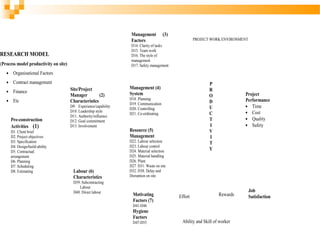
RESEARCH MODEL
(Process model productivity on site)
• Organisational Factors
• Contract management
• Finance
• Etc
PROJECT WORK ENVIRONMENT
Pre-construction
Activities (1)
D1. Client brief
D2. Project objectives
D3. Specification
D4. Design/build-ability
D5. Contractual
arrangement
D6. Planning
D7. Scheduling
D8. Estimating
Site/Project
Manager (2)
Characteristics
D9. Experience/capability
D10. Leadership style
D11. Authority/influence
D12. Goal commitment
D13. Involvement
Labour (6)
Characteristics
D39. Subcontracting
Labour
D40. Direct labour
Management (3)
Factors
D14. Clarity of tasks
D15. Team work
D16. The style of
management
D17. Safety management
Management (4)
System
D18. Planning
D19. Communication
D20. Controlling
D21. Co-ordinating
Resource (5)
Management
D22. Labour selection
D23. Labour control
D24. Material selection
D25. Material handling
D26. Plant
D27. D31. Waste on site
D32. D38. Delay and
Disruption on site
Motivating
Factors (7)
D41-D46
Hygiene
Factors
D47-D55
P
R
O
D
U
C
T
I
V
I
T
Y
Project
Performance
• Time
• Cost
• Quality
• Safety
Job
SatisfactionEffort Rewards
Ability and Skill of worker
PROJECT MANGEMENTPROJECT MANGEMENT
SUCCESS FACTORSSUCCESS FACTORS
The Project Management Institute
defines
project management as:
‘the application of knowledge, skills,
tools,
and techniques to project activities to
meet project requirements’ .
PROJECT MANGEMENTPROJECT MANGEMENT
SUCCESS FACTORSSUCCESS FACTORS
 Project management is about a leadership.
 The ideal project managers are good
leaders.
 It is a about managing resources with the
main goal of completing the project with:
 a high quality
 on time
 within budget
PROJECT MANGEMENTPROJECT MANGEMENT
SUCCESS FACTORSSUCCESS FACTORS
 with minimum accident on site
 Full customer satisfaction
 Full client satisfaction
 Full corporation amongst all involved
(supply chain)
 The project management’s success is
about having the power to produce good
results.
PROJECT MANGEMENTPROJECT MANGEMENT
SUCCESS FACTORSSUCCESS FACTORS
 It is about the management team effectively
fulfilling their responsibilities.
 To bring the project to a successful completion.
 A successful project manager is one who can
envision the entire project from start to finish.
 To keep pace with business and new innovative
ideas.
 Project management team need to make their
management practices more flexible.
PROJECT MANGEMENTPROJECT MANGEMENT
SUCCESS FACTORSSUCCESS FACTORS
 Management team success is influenced
by several factors such as:
 education
 training and experience
Help project Managers to develop their
knowledge and skill.
PROJECT MANGEMENTPROJECT MANGEMENT
SUCCESS FACTORSSUCCESS FACTORS
 Project Manager’s familiarity with their
working environment and team members.
 This determines a project manager’s
approach in dealing with the activities on
site.
 The project manager’s managerial
behaviour is also influenced by company
rules and regulations.
PROJECT MANGEMENTPROJECT MANGEMENT
SUCCESS FACTORSSUCCESS FACTORS
There is a strong positive relationship and
association between:
 the style of management
 and its effectiveness
 The most effective managers tend to be
both task and people orientated.
PROJECT MANGEMENTPROJECT MANGEMENT
SUCCESS FACTORSSUCCESS FACTORS
 Traditional project management
methodologies are sometimes too
bureaucratic.
 The formal documentation
 The processes involved in traditional
project management can slow down the
project.
 New technology has overcome this hurdle.
PROJECT MANGEMENTPROJECT MANGEMENT
SUCCESS FACTORSSUCCESS FACTORS
 Technology is consciously improving to
meet the changing needs of users.
 Also, project management techniques
are changing with time.
 Communication on site and at the head
office are changing fast.
PROJECT MANGEMENTPROJECT MANGEMENT
SUCCESS FACTORSSUCCESS FACTORS
 Project success is about:
1. the use of the right processes
2. by the right people
3. at all time.
 Financial Management and Schedule
Management are two important key factors to a
successful project.
 Another success factor is providing good and
accurate information for all the project
participant.
PROJECT MANGEMENTPROJECT MANGEMENT
SUCCESS FACTORSSUCCESS FACTORS
 Other important factors for project
success are:
1. Follow-up
2. Simplicity
3. Measurement
4. Seeks facts
5. Verifies results.
PROJECT MANGEMENTPROJECT MANGEMENT
SUCCESS FACTORSSUCCESS FACTORS
 One of the most important activity of project managers is
planning.
 Ongoing planning
 Work with a Sense of Urgency
Planning must be;
 detailed
 organised
 team participation
 Changes to original plan must be kept to minimum.
 Changes require planning, re-planning.
 This will reduce productivity.
PROJECT MANGEMENTPROJECT MANGEMENT
SUCCESS FACTORSSUCCESS FACTORS
 detailed
 organised
 team participation
 Changes to original plan must be kept to
minimum.
 Changes require planning, re-planning.
 This will reduce productivity.
PROJECT MANGEMENTPROJECT MANGEMENT
SUCCESS FACTORSSUCCESS FACTORS
CRITICAL SUCCESS FACTORS FOR PROJECTS
 Client participation.
 Organizational culture supports project
management.
 Have a Formal Process to Define Project Vision.
 Business need linked to vision.
 Match changes to project vision.
PROJECT MANGEMENTPROJECT MANGEMENT
SUCCESS FACTORSSUCCESS FACTORS
 Complete deliverables step-by-step
 Work on each item step-by-step
 Get process reviews and approval
 Maintain a sense of direction
PROJECT MANGEMENTPROJECT MANGEMENT
SUCCESS FACTORSSUCCESS FACTORS
Risk Management
 Assign a CDM co-ordinator who will be
responsible for detecting potential project
issues.
 Someone who is both critical and
practical.
 All team members should not hesitate to
report concerns or challenges.
PROJECT MANGEMENTPROJECT MANGEMENT
SUCCESS FACTORSSUCCESS FACTORS
Open Communication
 Communication is vital in all aspects of
project management.
 Follow the policy of open communication.
 Encourage all members to voice opinions
and concerns.
 This cuts through waiting games.
 significantly reduces the risk of mistakes, it
will save time and money.
PROJECT MANGEMENTPROJECT MANGEMENT
SUCCESS FACTORSSUCCESS FACTORS
There are different communication
instruments, such as:
 Contracts;
 Specifications;
 Reports;
 Manuals;
 Schedules;
 Calculations;
PROJECT MANGEMENTPROJECT MANGEMENT
SUCCESS FACTORSSUCCESS FACTORS
 Drawings;
 computer files;
 disks, print-outs;
 photographs;
 agenda’s and minutes of meetings.
 The management of documentation and
communication used in a project is also used by
a number of subcontractors’
 The storage and retrieval thereof for further use.
PROJECT MANGEMENTPROJECT MANGEMENT
SUCCESS FACTORSSUCCESS FACTORS
STANDARDISATION OF COMMUNICATION
 The main purpose of standardisation is to
develop a specific level of conformity.
 This process of standardisation has certain
advantages for the management of a project
such as:
 Less different documents;
 Revised drawings overtake the other drawings;
 Records are easy to handle.
PROJECT MANGEMENTPROJECT MANGEMENT
SUCCESS FACTORSSUCCESS FACTORS
COMMUNICATION PLAN
 Communication planning brings the
project together.
 The project manager and head office staff
are at the heart of the project’s information
and control system.
 It is the project manager’s responsibility to
develop the project organisation structure.
 Develop the project’s communication plan
and lines of communication.
PROJECT MANGEMENTPROJECT MANGEMENT
SUCCESS FACTORSSUCCESS FACTORS
Therefore so far success factors can be
summarised as :
 Full senior management levels of
commitment to the project
 Project funding
 A well written specification
PROJECT MANGEMENTPROJECT MANGEMENT
SUCCESS FACTORSSUCCESS FACTORS
 Careful development of a comprehensive
project plan that incorporates:
1. sufficient time
2. cost for unforeseen difficulties.
3. Potential difficulties as they arise
PROJECT MANGEMENTPROJECT MANGEMENT
SUCCESS FACTORSSUCCESS FACTORS
 A critical assessment of the risks involved
in the project.
 The ability of the project team to manage
those risks.
 The development of appropriate
contingency plans.
 Must be employed should the project run
into problems.
PROJECT MANGEMENT SUCCESS FACTORSPROJECT MANGEMENT SUCCESS FACTORS
The four dimensions of project success (Shenhar et al., 1997)
Atkinson’s model of measuring project success (Atkinson,
1999)
PROJECT MANGEMENTPROJECT MANGEMENT
SUCCESS FACTORSSUCCESS FACTORS
Micro and Macro Viewpoints of Project Success (Lim and Mohamed,
1999)
Success Dimension and Measures (Sadeh et al., 2000)
PROJECT MANGEMENTPROJECT MANGEMENT
SUCCESS FACTORSSUCCESS FACTORS
 Key Performance Indicators (KPIs)
 The purpose of the Key Performance Indicators
(KPIs) is to measure organisational performance
throughout the construction industry (KPI
Working Group, 2000).
 Collin (2002) advocates that the process of
developing KPIs involved the consideration of
the following factors:
 KPIs are general indicators of performance that
focus on critical aspects of outputs or outcomes.
PROJECT MANGEMENTPROJECT MANGEMENT
SUCCESS FACTORSSUCCESS FACTORS
 KPI is the measure of a process that is
critical to the success of an organisation.
 The construction industry KPIs allow the
benchmarking of the organisation against
industry standard data published by the
DTI and Constructing Excellence.
PROJECT MANGEMENTPROJECT MANGEMENT
SUCCESS FACTORSSUCCESS FACTORS
 Key Performance Indicators (KPIs) can be used
to measure construction productivity.
 Companies implementing KPI systems, must
also consider Rethinking Construction Agenda in
their plan.
 There are a wide number of different types of
measures that are supported by Constructing
Excellence, with the three main heading being: -
PROJECT MANGEMENTPROJECT MANGEMENT
SUCCESS FACTORSSUCCESS FACTORS
 Economic KPIs – Considers issues concerning
the financial performance of an organisation and
how their projects perform.
 Social KPIs – considers issues concerning how
companies manage their people and their
interaction with external social issues.
 Environmental KPIs – Considers issues
concerning the environmental performance of
projects and organisations in a wider
environmental context.
100 Project Management-Success Factor

100 Project Management-Success Factor

  • 1.
  • 2.
    RESEARCH MODEL (Process modelproductivity on site) • Organisational Factors • Contract management • Finance • Etc PROJECT WORK ENVIRONMENT Pre-construction Activities (1) D1. Client brief D2. Project objectives D3. Specification D4. Design/build-ability D5. Contractual arrangement D6. Planning D7. Scheduling D8. Estimating Site/Project Manager (2) Characteristics D9. Experience/capability D10. Leadership style D11. Authority/influence D12. Goal commitment D13. Involvement Labour (6) Characteristics D39. Subcontracting Labour D40. Direct labour Management (3) Factors D14. Clarity of tasks D15. Team work D16. The style of management D17. Safety management Management (4) System D18. Planning D19. Communication D20. Controlling D21. Co-ordinating Resource (5) Management D22. Labour selection D23. Labour control D24. Material selection D25. Material handling D26. Plant D27. D31. Waste on site D32. D38. Delay and Disruption on site Motivating Factors (7) D41-D46 Hygiene Factors D47-D55 P R O D U C T I V I T Y Project Performance • Time • Cost • Quality • Safety Job SatisfactionEffort Rewards Ability and Skill of worker
  • 3.
    PROJECT MANGEMENTPROJECT MANGEMENT SUCCESSFACTORSSUCCESS FACTORS The Project Management Institute defines project management as: ‘the application of knowledge, skills, tools, and techniques to project activities to meet project requirements’ .
  • 4.
    PROJECT MANGEMENTPROJECT MANGEMENT SUCCESSFACTORSSUCCESS FACTORS  Project management is about a leadership.  The ideal project managers are good leaders.  It is a about managing resources with the main goal of completing the project with:  a high quality  on time  within budget
  • 5.
    PROJECT MANGEMENTPROJECT MANGEMENT SUCCESSFACTORSSUCCESS FACTORS  with minimum accident on site  Full customer satisfaction  Full client satisfaction  Full corporation amongst all involved (supply chain)  The project management’s success is about having the power to produce good results.
  • 6.
    PROJECT MANGEMENTPROJECT MANGEMENT SUCCESSFACTORSSUCCESS FACTORS  It is about the management team effectively fulfilling their responsibilities.  To bring the project to a successful completion.  A successful project manager is one who can envision the entire project from start to finish.  To keep pace with business and new innovative ideas.  Project management team need to make their management practices more flexible.
  • 7.
    PROJECT MANGEMENTPROJECT MANGEMENT SUCCESSFACTORSSUCCESS FACTORS  Management team success is influenced by several factors such as:  education  training and experience Help project Managers to develop their knowledge and skill.
  • 8.
    PROJECT MANGEMENTPROJECT MANGEMENT SUCCESSFACTORSSUCCESS FACTORS  Project Manager’s familiarity with their working environment and team members.  This determines a project manager’s approach in dealing with the activities on site.  The project manager’s managerial behaviour is also influenced by company rules and regulations.
  • 9.
    PROJECT MANGEMENTPROJECT MANGEMENT SUCCESSFACTORSSUCCESS FACTORS There is a strong positive relationship and association between:  the style of management  and its effectiveness  The most effective managers tend to be both task and people orientated.
  • 10.
    PROJECT MANGEMENTPROJECT MANGEMENT SUCCESSFACTORSSUCCESS FACTORS  Traditional project management methodologies are sometimes too bureaucratic.  The formal documentation  The processes involved in traditional project management can slow down the project.  New technology has overcome this hurdle.
  • 11.
    PROJECT MANGEMENTPROJECT MANGEMENT SUCCESSFACTORSSUCCESS FACTORS  Technology is consciously improving to meet the changing needs of users.  Also, project management techniques are changing with time.  Communication on site and at the head office are changing fast.
  • 12.
    PROJECT MANGEMENTPROJECT MANGEMENT SUCCESSFACTORSSUCCESS FACTORS  Project success is about: 1. the use of the right processes 2. by the right people 3. at all time.  Financial Management and Schedule Management are two important key factors to a successful project.  Another success factor is providing good and accurate information for all the project participant.
  • 13.
    PROJECT MANGEMENTPROJECT MANGEMENT SUCCESSFACTORSSUCCESS FACTORS  Other important factors for project success are: 1. Follow-up 2. Simplicity 3. Measurement 4. Seeks facts 5. Verifies results.
  • 14.
    PROJECT MANGEMENTPROJECT MANGEMENT SUCCESSFACTORSSUCCESS FACTORS  One of the most important activity of project managers is planning.  Ongoing planning  Work with a Sense of Urgency Planning must be;  detailed  organised  team participation  Changes to original plan must be kept to minimum.  Changes require planning, re-planning.  This will reduce productivity.
  • 15.
    PROJECT MANGEMENTPROJECT MANGEMENT SUCCESSFACTORSSUCCESS FACTORS  detailed  organised  team participation  Changes to original plan must be kept to minimum.  Changes require planning, re-planning.  This will reduce productivity.
  • 16.
    PROJECT MANGEMENTPROJECT MANGEMENT SUCCESSFACTORSSUCCESS FACTORS CRITICAL SUCCESS FACTORS FOR PROJECTS  Client participation.  Organizational culture supports project management.  Have a Formal Process to Define Project Vision.  Business need linked to vision.  Match changes to project vision.
  • 17.
    PROJECT MANGEMENTPROJECT MANGEMENT SUCCESSFACTORSSUCCESS FACTORS  Complete deliverables step-by-step  Work on each item step-by-step  Get process reviews and approval  Maintain a sense of direction
  • 18.
    PROJECT MANGEMENTPROJECT MANGEMENT SUCCESSFACTORSSUCCESS FACTORS Risk Management  Assign a CDM co-ordinator who will be responsible for detecting potential project issues.  Someone who is both critical and practical.  All team members should not hesitate to report concerns or challenges.
  • 19.
    PROJECT MANGEMENTPROJECT MANGEMENT SUCCESSFACTORSSUCCESS FACTORS Open Communication  Communication is vital in all aspects of project management.  Follow the policy of open communication.  Encourage all members to voice opinions and concerns.  This cuts through waiting games.  significantly reduces the risk of mistakes, it will save time and money.
  • 20.
    PROJECT MANGEMENTPROJECT MANGEMENT SUCCESSFACTORSSUCCESS FACTORS There are different communication instruments, such as:  Contracts;  Specifications;  Reports;  Manuals;  Schedules;  Calculations;
  • 21.
    PROJECT MANGEMENTPROJECT MANGEMENT SUCCESSFACTORSSUCCESS FACTORS  Drawings;  computer files;  disks, print-outs;  photographs;  agenda’s and minutes of meetings.  The management of documentation and communication used in a project is also used by a number of subcontractors’  The storage and retrieval thereof for further use.
  • 22.
    PROJECT MANGEMENTPROJECT MANGEMENT SUCCESSFACTORSSUCCESS FACTORS STANDARDISATION OF COMMUNICATION  The main purpose of standardisation is to develop a specific level of conformity.  This process of standardisation has certain advantages for the management of a project such as:  Less different documents;  Revised drawings overtake the other drawings;  Records are easy to handle.
  • 23.
    PROJECT MANGEMENTPROJECT MANGEMENT SUCCESSFACTORSSUCCESS FACTORS COMMUNICATION PLAN  Communication planning brings the project together.  The project manager and head office staff are at the heart of the project’s information and control system.  It is the project manager’s responsibility to develop the project organisation structure.  Develop the project’s communication plan and lines of communication.
  • 24.
    PROJECT MANGEMENTPROJECT MANGEMENT SUCCESSFACTORSSUCCESS FACTORS Therefore so far success factors can be summarised as :  Full senior management levels of commitment to the project  Project funding  A well written specification
  • 25.
    PROJECT MANGEMENTPROJECT MANGEMENT SUCCESSFACTORSSUCCESS FACTORS  Careful development of a comprehensive project plan that incorporates: 1. sufficient time 2. cost for unforeseen difficulties. 3. Potential difficulties as they arise
  • 26.
    PROJECT MANGEMENTPROJECT MANGEMENT SUCCESSFACTORSSUCCESS FACTORS  A critical assessment of the risks involved in the project.  The ability of the project team to manage those risks.  The development of appropriate contingency plans.  Must be employed should the project run into problems.
  • 27.
    PROJECT MANGEMENT SUCCESSFACTORSPROJECT MANGEMENT SUCCESS FACTORS The four dimensions of project success (Shenhar et al., 1997)
  • 28.
    Atkinson’s model ofmeasuring project success (Atkinson, 1999)
  • 29.
    PROJECT MANGEMENTPROJECT MANGEMENT SUCCESSFACTORSSUCCESS FACTORS Micro and Macro Viewpoints of Project Success (Lim and Mohamed, 1999)
  • 30.
    Success Dimension andMeasures (Sadeh et al., 2000)
  • 31.
    PROJECT MANGEMENTPROJECT MANGEMENT SUCCESSFACTORSSUCCESS FACTORS  Key Performance Indicators (KPIs)  The purpose of the Key Performance Indicators (KPIs) is to measure organisational performance throughout the construction industry (KPI Working Group, 2000).  Collin (2002) advocates that the process of developing KPIs involved the consideration of the following factors:  KPIs are general indicators of performance that focus on critical aspects of outputs or outcomes.
  • 32.
    PROJECT MANGEMENTPROJECT MANGEMENT SUCCESSFACTORSSUCCESS FACTORS  KPI is the measure of a process that is critical to the success of an organisation.  The construction industry KPIs allow the benchmarking of the organisation against industry standard data published by the DTI and Constructing Excellence.
  • 33.
    PROJECT MANGEMENTPROJECT MANGEMENT SUCCESSFACTORSSUCCESS FACTORS  Key Performance Indicators (KPIs) can be used to measure construction productivity.  Companies implementing KPI systems, must also consider Rethinking Construction Agenda in their plan.  There are a wide number of different types of measures that are supported by Constructing Excellence, with the three main heading being: -
  • 34.
    PROJECT MANGEMENTPROJECT MANGEMENT SUCCESSFACTORSSUCCESS FACTORS  Economic KPIs – Considers issues concerning the financial performance of an organisation and how their projects perform.  Social KPIs – considers issues concerning how companies manage their people and their interaction with external social issues.  Environmental KPIs – Considers issues concerning the environmental performance of projects and organisations in a wider environmental context.