PROJECT RISK MANAGEMENT
INTRODUCTION TO PROJECT RISKS
 Risk is a function of the uniqueness of a project and the
experience of the project team.
 When activities are routine or have been performed
many times before, managers can anticipate the range
of potential outcomes and manipulate the system design
and project plan to achieve the desired outcomes.
 However, when the work is unique or the team is
inexperienced the potential outcomes are less certain,
making it difficult to anticipate problems or know how to
avoid them.
 Even routine projects have risks, because outcomes
may be influenced by factors that are new and
emerging, or beyond anyone’s control.
INTRODUCTION TO PROJECT RISKS
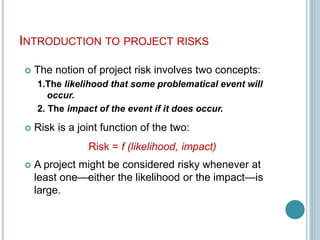
 The notion of project risk involves two concepts:
1.The likelihood that some problematical event will
occur.
2. The impact of the event if it does occur.
 Risk is a joint function of the two:
Risk = f (likelihood, impact)
 A project might be considered risky whenever at
least one—either the likelihood or the impact—is
large.
PROJECT RISKS MANAGEMENT PROCESS
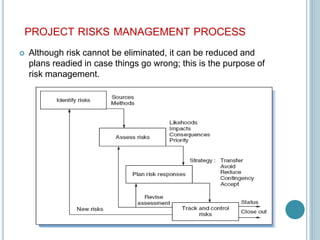
 Although risk cannot be eliminated, it can be reduced and
plans readied in case things go wrong; this is the purpose of
risk management.
 There are two types of risk: business risk, which is
gains or losses from a financial point of view; and
pure risks ,which only has a down side. Both types
of risks must be assessed and managed.
 Risk identification happens early on the project to
allot time for risk response planning.
 Risk identification also happens throughout the
project.
 The project manager, the project team, customers,
and other stakeholders are involved in the process.
 There are several methods to risk identification,
though interviews and the Delphi Technique are two
of the most common approaches.
TECHNICAL, QUALITY, OR PERFORMANCE
RISKS
 Technical, quality, or performance risks
 Technical risks are associated with new, unproven,
or complex technology being used on the project.
 Changes to the technology during the project
implementation can also be a risk.
 Quality risks are the levels set for expectations of
impractical quality and performance.
 Changes to industry standards during the project
can also be lumped into this category of risks.
PROJECT MANAGEMENT RISKS
 Project management risks
 These risks deal with faults in the management of
the project: unsuccessful allocation of time,
resources, and scheduling; unacceptable work
results (low-quality work); and lousy project
management as a whole.
ORGANIZATIONAL RISKS
 Organizational risks
 The performing organization can contribute to the
project’s risks through: unreasonable cost, time,
and scope expectations; poor project prioritization;
inadequate funding or the disruption of funding; the
competition with other projects for internal
resources.
EXTERNAL RISKS
 External risks
 These risks are outside of the project but directly
affect it: legal issues, labor issues, a shift in project
priorities, and weather. “Force majeure” risks can
be scary and usually call for disaster recovery
rather than project management. These are risks
caused by earthquakes, tornados, floods, civil
unrest, and other disasters.
FOUR RISK RESPONSES
■ Avoidance
 The project plan is altered to avoid the identified risk.
■ Mitigation
 Effort is made to reduce the probability, impact, or both of
an identified risk in the project before the risk event
occurs.
■ Transference
 The risk is assigned to a third party, usually for a fee.
The risk still exists, but the responsibility is deflected to
the third party.
■ Acceptance
 The risks are seen as nominal so they are accepted.
Risks, regardless of size, that have no other recourse
TRANSFERENCE
 Avoidance is simply avoiding the risk. This can be
accomplished many different ways and generally
happens early in the project when any change will result
in fewer consequences than later in the project plan.
 Examples of avoidance include
■ Changing the project plan to eliminate the risk.
■ Clarifying project requirements to avoid discrepancies.
■ Hiring additional project team members that have
experience with the technology that the project deals
with.
■ Using a proven methodology rather than a new
approach
TRANSFERENCE
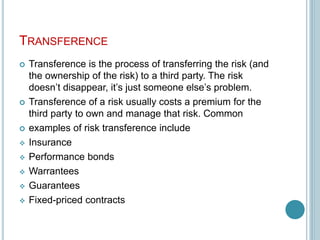
 Transference is the process of transferring the risk (and
the ownership of the risk) to a third party. The risk
doesn’t disappear, it’s just someone else’s problem.
 Transference of a risk usually costs a premium for the
third party to own and manage that risk. Common
 examples of risk transference include
 Insurance
 Performance bonds
 Warrantees
 Guarantees
 Fixed-priced contracts
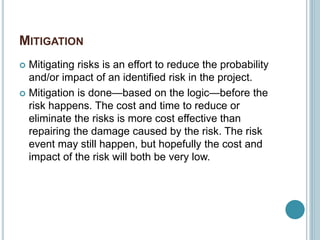
MITIGATION
 Mitigating risks is an effort to reduce the probability
and/or impact of an identified risk in the project.
 Mitigation is done—based on the logic—before the
risk happens. The cost and time to reduce or
eliminate the risks is more cost effective than
repairing the damage caused by the risk. The risk
event may still happen, but hopefully the cost and
impact of the risk will both be very low.
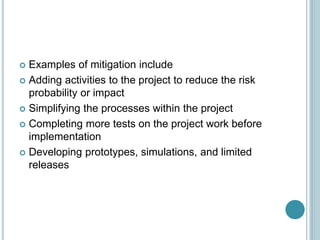
 Examples of mitigation include
 Adding activities to the project to reduce the risk
probability or impact
 Simplifying the processes within the project
 Completing more tests on the project work before
implementation
 Developing prototypes, simulations, and limited
releases
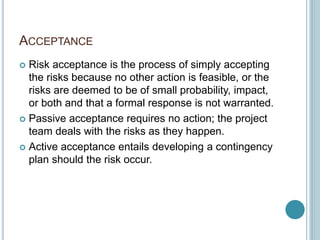
ACCEPTANCE
 Risk acceptance is the process of simply accepting
the risks because no other action is feasible, or the
risks are deemed to be of small probability, impact,
or both and that a formal response is not warranted.
 Passive acceptance requires no action; the project
team deals with the risks as they happen.
 Active acceptance entails developing a contingency
plan should the risk occur.
 Preparing for Risk Response
 To successfully prepare for risk response, the project manager, project team, and
 appropriate stakeholders will rely on several inputs—many of which stem from
 qualitative and quantitative risk analysis—such as:
 ■ The risk management plan
 ■ A list of prioritized risks
 ■ Risk ranking
 ■ A prioritized list of quantified risk
 ■ A probabilistic analysis of the project
 ■ The probability of the project meeting the cost and schedule goals
 ■ The list of potential responses decided upon when risks were first identified
 ■ Any risk owners that have been identified
 ■ A listing of common cause risks to address multiple risks with an achievable
 solution
 ■ Trends from qualitative and quantitative analysis

Project risk management

  • 1.
  • 2.
    INTRODUCTION TO PROJECTRISKS  Risk is a function of the uniqueness of a project and the experience of the project team.  When activities are routine or have been performed many times before, managers can anticipate the range of potential outcomes and manipulate the system design and project plan to achieve the desired outcomes.  However, when the work is unique or the team is inexperienced the potential outcomes are less certain, making it difficult to anticipate problems or know how to avoid them.  Even routine projects have risks, because outcomes may be influenced by factors that are new and emerging, or beyond anyone’s control.
  • 3.
    INTRODUCTION TO PROJECTRISKS  The notion of project risk involves two concepts: 1.The likelihood that some problematical event will occur. 2. The impact of the event if it does occur.  Risk is a joint function of the two: Risk = f (likelihood, impact)  A project might be considered risky whenever at least one—either the likelihood or the impact—is large.
  • 4.
    PROJECT RISKS MANAGEMENTPROCESS  Although risk cannot be eliminated, it can be reduced and plans readied in case things go wrong; this is the purpose of risk management.
  • 5.
     There aretwo types of risk: business risk, which is gains or losses from a financial point of view; and pure risks ,which only has a down side. Both types of risks must be assessed and managed.
  • 6.
     Risk identificationhappens early on the project to allot time for risk response planning.  Risk identification also happens throughout the project.  The project manager, the project team, customers, and other stakeholders are involved in the process.  There are several methods to risk identification, though interviews and the Delphi Technique are two of the most common approaches.
  • 7.
    TECHNICAL, QUALITY, ORPERFORMANCE RISKS  Technical, quality, or performance risks  Technical risks are associated with new, unproven, or complex technology being used on the project.  Changes to the technology during the project implementation can also be a risk.  Quality risks are the levels set for expectations of impractical quality and performance.  Changes to industry standards during the project can also be lumped into this category of risks.
  • 8.
    PROJECT MANAGEMENT RISKS Project management risks  These risks deal with faults in the management of the project: unsuccessful allocation of time, resources, and scheduling; unacceptable work results (low-quality work); and lousy project management as a whole.
  • 9.
    ORGANIZATIONAL RISKS  Organizationalrisks  The performing organization can contribute to the project’s risks through: unreasonable cost, time, and scope expectations; poor project prioritization; inadequate funding or the disruption of funding; the competition with other projects for internal resources.
  • 10.
    EXTERNAL RISKS  Externalrisks  These risks are outside of the project but directly affect it: legal issues, labor issues, a shift in project priorities, and weather. “Force majeure” risks can be scary and usually call for disaster recovery rather than project management. These are risks caused by earthquakes, tornados, floods, civil unrest, and other disasters.
  • 11.
    FOUR RISK RESPONSES ■Avoidance  The project plan is altered to avoid the identified risk. ■ Mitigation  Effort is made to reduce the probability, impact, or both of an identified risk in the project before the risk event occurs. ■ Transference  The risk is assigned to a third party, usually for a fee. The risk still exists, but the responsibility is deflected to the third party. ■ Acceptance  The risks are seen as nominal so they are accepted. Risks, regardless of size, that have no other recourse
  • 12.
    TRANSFERENCE  Avoidance issimply avoiding the risk. This can be accomplished many different ways and generally happens early in the project when any change will result in fewer consequences than later in the project plan.  Examples of avoidance include ■ Changing the project plan to eliminate the risk. ■ Clarifying project requirements to avoid discrepancies. ■ Hiring additional project team members that have experience with the technology that the project deals with. ■ Using a proven methodology rather than a new approach
  • 13.
    TRANSFERENCE  Transference isthe process of transferring the risk (and the ownership of the risk) to a third party. The risk doesn’t disappear, it’s just someone else’s problem.  Transference of a risk usually costs a premium for the third party to own and manage that risk. Common  examples of risk transference include  Insurance  Performance bonds  Warrantees  Guarantees  Fixed-priced contracts
  • 14.
    MITIGATION  Mitigating risksis an effort to reduce the probability and/or impact of an identified risk in the project.  Mitigation is done—based on the logic—before the risk happens. The cost and time to reduce or eliminate the risks is more cost effective than repairing the damage caused by the risk. The risk event may still happen, but hopefully the cost and impact of the risk will both be very low.
  • 15.
     Examples ofmitigation include  Adding activities to the project to reduce the risk probability or impact  Simplifying the processes within the project  Completing more tests on the project work before implementation  Developing prototypes, simulations, and limited releases
  • 16.
    ACCEPTANCE  Risk acceptanceis the process of simply accepting the risks because no other action is feasible, or the risks are deemed to be of small probability, impact, or both and that a formal response is not warranted.  Passive acceptance requires no action; the project team deals with the risks as they happen.  Active acceptance entails developing a contingency plan should the risk occur.
  • 17.
     Preparing forRisk Response  To successfully prepare for risk response, the project manager, project team, and  appropriate stakeholders will rely on several inputs—many of which stem from  qualitative and quantitative risk analysis—such as:  ■ The risk management plan  ■ A list of prioritized risks  ■ Risk ranking  ■ A prioritized list of quantified risk  ■ A probabilistic analysis of the project  ■ The probability of the project meeting the cost and schedule goals  ■ The list of potential responses decided upon when risks were first identified  ■ Any risk owners that have been identified  ■ A listing of common cause risks to address multiple risks with an achievable  solution  ■ Trends from qualitative and quantitative analysis