Chapter 1:Chapter 1:
Introduction to Project ManagementIntroduction to Project Management
Information TechnologyInformation Technology
Project Management,Project Management,
Fifth EditionFifth Edition
Information Technology Project Management, Fifth Edition, Copyright 2007
Learning Objectives
 Understand the growing need for better project
management, especially for information technology
projects
 Explain what a project is, provide examples of
information technology projects, list various attributes
of projects, and describe the triple constraint of
projects
 Describe project management and discuss key
elements of the project management framework,
including project stakeholders, the project
management knowledge areas, common tools and
techniques, and project success
2
Information Technology Project Management, Fifth Edition, Copyright 2007
Learning Objectives (continued)
 Discuss the relationship between project, program,
and portfolio management and the contributions
they each make to enterprise success
 Understand the role of the project manager by
describing what project managers do, what skills
they need, and what the career field is like for
information technology project managers
 Describe the project management profession,
including its history, the role of professional
organizations like the Project Management Institute,
the importance of certification and ethics, and the
advancement of project management software
3
Information Technology Project Management, Fifth Edition, Copyright 2007
Introduction
Many organizations today have a new or renewed
interest in project management
Computer hardware, software, networks, and the
use of interdisciplinary and global work teams
have radically changed the work environment
The U.S. spends $2.3 trillion on projects every
year, or one-quarter of its gross domestic product,
and the world as a whole spends nearly $10 trillion
of its $40.7 gross product on projects of all kinds
4
Information Technology Project Management, Fifth Edition, Copyright 2007
Project Management Statistics
Worldwide IT spending totaled more than $1.8
trillion in 2005, a 6 percent increase from 2004,
and spending is projected to grow 8 percent in
2006 and 4 percent in 2007
In 2005, the total compensation for the average
senior project manager was $99,183 per year in
the United States, $94,646 in Australia, and
$106,374 in the United Kingdom
The number of people earning their Project
Management Professional (PMP) certification
increased by more than 70 percent from 2004 to
2005, with more than 200,000 PMPs worldwide by
the end of August, 2006
5
Information Technology Project Management, Fifth Edition, Copyright 2007
Motivation for Studying Information
Technology (IT) Project Management
IT Projects have a terrible track record, as
described in the “What Went Wrong?” section
A 1995 Standish Group study (CHAOS) found that
only 16.2% of IT projects were successful in
meeting scope, time, and cost goals
Over 31% of IT projects were canceled before
completion, costing over $81 billion in the U.S.
alone
6
Information Technology Project Management, Fifth Edition, Copyright 2007
Advantages of Using Formal
Project Management
Better control of financial, physical, and human
resources
Improved customer relations
Shorter development times
Lower costs
Higher quality and increased reliability
Higher profit margins
Improved productivity
Better internal coordination
Higher worker morale (less stress)
7
Information Technology Project Management, Fifth Edition, Copyright 2007
What Is a Project?
A project is “a temporary endeavor undertaken
to create a unique product, service, or result”
(PMBOK® Guide, Third Edition, 2004, p. 5)
Operations is work done to sustain the
business
Projects end when their objectives have been
reached or the project has been terminated
Projects can be large or small and take a short
or long time to complete
8
Information Technology Project Management, Fifth Edition, Copyright 2007
Examples of IT Projects
A help desk or technical worker replaces ten
laptops for a small department
A small software development team adds a new
feature to an internal software application for the
finance department
A college campus upgrades its technology
infrastructure to provide wireless Internet access
across the whole campus
A cross-functional task force in a company
decides what Voice-over-Internet-Protocol
(VoIP) system to purchase and how it will be
implemented9
Information Technology Project Management, Fifth Edition, Copyright 2007
Top Ten Technology Projects in
2006
VoIP
Outsourcing
Data networking
Customer
relationship
management
Collaboration
Supply chain
management
Desktop upgrades
Application
performance
management
Business analytics
Compliance tracking
10
Information Technology Project Management, Fifth Edition, Copyright 2007
Media Snapshot: Where IT Matters
In 2006, Baseline Magazine published “Where
I.T. Matters: How 10 Technologies Transformed
10 Industries” as a retort to Nicholas Carr’s ideas
(author of “IT Doesn’t Matter”)
VoIP has transformed the telecommunications industry
and broadband Internet access
Global Positioning Systems (GPS) has changed the
farming industry
Digital supply chain has changed the entertainment
industry’s distribution system
11
Information Technology Project Management, Fifth Edition, Copyright 2007
Project Attributes
A project:
Has a unique purpose
Is temporary
Is developed using progressive elaboration
Requires resources, often from various areas
Should have a primary customer or sponsor
The project sponsor usually provides the direction and funding
for the project
Involves uncertainty
12
Information Technology Project Management, Fifth Edition, Copyright 2007
Project and Program Managers
Project managers work with project sponsors, a
project team, and other people involved in a
project to meet project goals
Program: group of related projects managed in a
coordinated way to obtain benefits and control
not available from managing them individually
(PMBOK® Guide, Third Edition, 2004, p. 16)
Program managers oversee programs and often
act as bosses for project managers
13
Information Technology Project Management, Fifth Edition, Copyright 2007
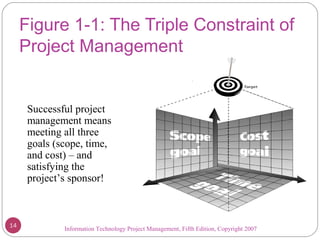
Figure 1-1: The Triple Constraint of
Project Management
Successful project
management means
meeting all three
goals (scope, time,
and cost) – and
satisfying the
project’s sponsor!
14
Information Technology Project Management, Fifth Edition, Copyright 2007
What is Project Management?
Project management is “the application of
knowledge, skills, tools and techniques to
project activities to meet project requirements”
(PMBOK® Guide, Third Edition, 2004, p. 8)
Project managers strive to meet the triple
constraint by balancing project scope, time,
and cost goals
15
Information Technology Project Management, Fifth Edition, Copyright 2007
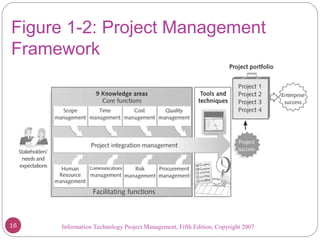
Figure 1-2: Project Management
Framework
16
Information Technology Project Management, Fifth Edition, Copyright 2007
Project Stakeholders
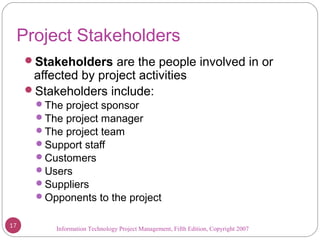
Stakeholders are the people involved in or
affected by project activities
Stakeholders include:
The project sponsor
The project manager
The project team
Support staff
Customers
Users
Suppliers
Opponents to the project
17
Information Technology Project Management, Fifth Edition, Copyright 2007
Nine Project Management
Knowledge Areas
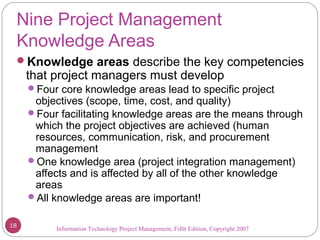
Knowledge areas describe the key competencies
that project managers must develop
Four core knowledge areas lead to specific project
objectives (scope, time, cost, and quality)
Four facilitating knowledge areas are the means through
which the project objectives are achieved (human
resources, communication, risk, and procurement
management
One knowledge area (project integration management)
affects and is affected by all of the other knowledge
areas
All knowledge areas are important!
18
Information Technology Project Management, Fifth Edition, Copyright 2007
Project Management Tools and
Techniques
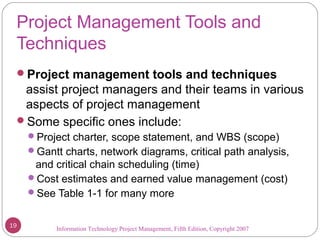
Project management tools and techniques
assist project managers and their teams in various
aspects of project management
Some specific ones include:
Project charter, scope statement, and WBS (scope)
Gantt charts, network diagrams, critical path analysis,
and critical chain scheduling (time)
Cost estimates and earned value management (cost)
See Table 1-1 for many more
19
Information Technology Project Management, Fifth Edition, Copyright 2007
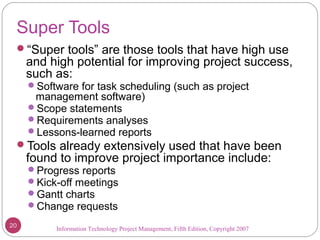
Super Tools
“Super tools” are those tools that have high use
and high potential for improving project success,
such as:
Software for task scheduling (such as project
management software)
Scope statements
Requirements analyses
Lessons-learned reports
Tools already extensively used that have been
found to improve project importance include:
Progress reports
Kick-off meetings
Gantt charts
Change requests
20
Information Technology Project Management, Fifth Edition, Copyright 2007
What Went Right? Improved
Project Performance
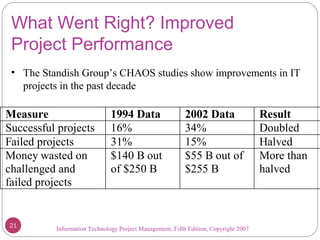
• The Standish Group’s CHAOS studies show improvements in IT
projects in the past decade
Measure 1994 Data 2002 Data Result
Successful projects 16% 34% Doubled
Failed projects 31% 15% Halved
Money wasted on
challenged and
failed projects
$140 B out
of $250 B
$55 B out of
$255 B
More than
halved
21
Information Technology Project Management, Fifth Edition, Copyright 2007
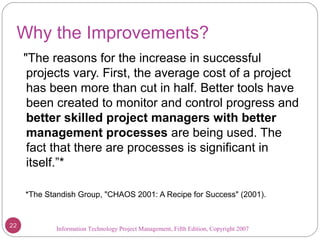
Why the Improvements?
"The reasons for the increase in successful
projects vary. First, the average cost of a project
has been more than cut in half. Better tools have
been created to monitor and control progress and
better skilled project managers with better
management processes are being used. The
fact that there are processes is significant in
itself.”*
*The Standish Group, "CHAOS 2001: A Recipe for Success" (2001).
22
Information Technology Project Management, Fifth Edition, Copyright 2007
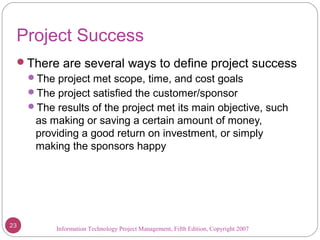
Project Success
There are several ways to define project success
The project met scope, time, and cost goals
The project satisfied the customer/sponsor
The results of the project met its main objective, such
as making or saving a certain amount of money,
providing a good return on investment, or simply
making the sponsors happy
23
Information Technology Project Management, Fifth Edition, Copyright 2007
Table 1-2: What Helps Projects Succeed?*
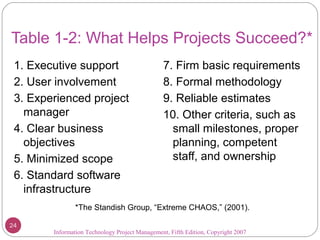
1. Executive support
2. User involvement
3. Experienced project
manager
4. Clear business
objectives
5. Minimized scope
6. Standard software
infrastructure
7. Firm basic requirements
8. Formal methodology
9. Reliable estimates
10. Other criteria, such as
small milestones, proper
planning, competent
staff, and ownership
*The Standish Group, “Extreme CHAOS,” (2001).
24
Information Technology Project Management, Fifth Edition, Copyright 2007
What the Winners Do
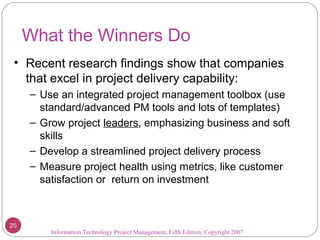
• Recent research findings show that companies
that excel in project delivery capability:
– Use an integrated project management toolbox (use
standard/advanced PM tools and lots of templates)
– Grow project leaders, emphasizing business and soft
skills
– Develop a streamlined project delivery process
– Measure project health using metrics, like customer
satisfaction or return on investment
25
Information Technology Project Management, Fifth Edition, Copyright 2007
Program and Project Portfolio
Management
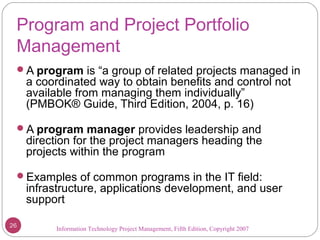
A program is “a group of related projects managed in
a coordinated way to obtain benefits and control not
available from managing them individually”
(PMBOK® Guide, Third Edition, 2004, p. 16)
A program manager provides leadership and
direction for the project managers heading the
projects within the program
Examples of common programs in the IT field:
infrastructure, applications development, and user
support
26
Information Technology Project Management, Fifth Edition, Copyright 2007
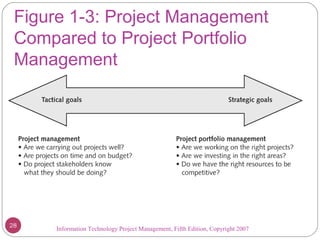
Project Portfolio Management
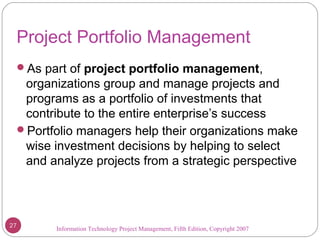
As part of project portfolio management,
organizations group and manage projects and
programs as a portfolio of investments that
contribute to the entire enterprise’s success
Portfolio managers help their organizations make
wise investment decisions by helping to select
and analyze projects from a strategic perspective
27
Information Technology Project Management, Fifth Edition, Copyright 2007
Figure 1-3: Project Management
Compared to Project Portfolio
Management
28
Information Technology Project Management, Fifth Edition, Copyright 2007
Best Practice
A best practice is “an optimal way recognized by industry
to achieve a stated goal or objective”*
Robert Butrick suggests that organizations need to follow
basic principles of project management, including these
two mentioned earlier in this chapter
Make sure your projects are driven by your strategy; be able
to demonstrate how each project you undertake fits your
business strategy, and screen out unwanted projects as soon
as possible
Engage your stakeholders; ignoring stakeholders often leads
to project failure
Be sure to engage stakeholders at all stages of a project, and
encourage teamwork and commitment at all times
*Project Management Institute, Inc., Organizational Project Management Maturity Model
(OPM3) Knowledge Foundation (2003), p. 13.
29
Information Technology Project Management, Fifth Edition, Copyright 2007
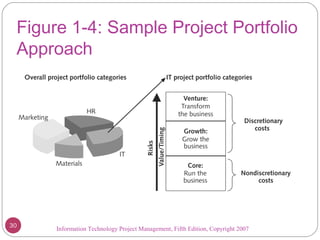
Figure 1-4: Sample Project Portfolio
Approach
30
Information Technology Project Management, Fifth Edition, Copyright 2007
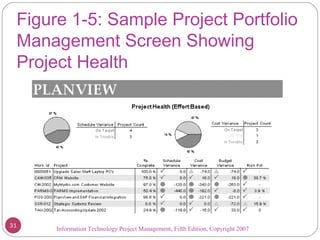
Figure 1-5: Sample Project Portfolio
Management Screen Showing
Project Health
31
Information Technology Project Management, Fifth Edition, Copyright 2007
Suggested Skills for Project
Managers
Project managers need a wide variety of skills
They should:
Be comfortable with change
Understand the organizations they work in and with
Be able to lead teams to accomplish project goals
32
Information Technology Project Management, Fifth Edition, Copyright 2007
The Role of the Project Manager
Job descriptions vary, but most include
responsibilities like planning, scheduling,
coordinating, and working with people to achieve
project goals
Remember that 97% of successful projects were
led by experienced project managers, who can
often help influence success factors
33
Information Technology Project Management, Fifth Edition, Copyright 2007
Suggested Skills for Project Managers
The Project Management Body of Knowledge
Application area knowledge, standards, and
regulations
Project environment knowledge
General management knowledge and skills
Soft skills or human relations skills
34
Information Technology Project Management, Fifth Edition, Copyright 2007
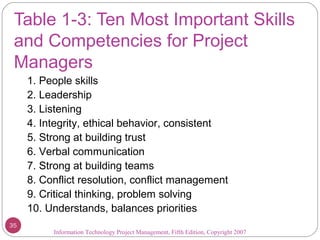
Table 1-3: Ten Most Important Skills
and Competencies for Project
Managers
1. People skills
2. Leadership
3. Listening
4. Integrity, ethical behavior, consistent
5. Strong at building trust
6. Verbal communication
7. Strong at building teams
8. Conflict resolution, conflict management
9. Critical thinking, problem solving
10. Understands, balances priorities
35
Information Technology Project Management, Fifth Edition, Copyright 2007
Different Skills Needed in Different
Situations
Large projects: leadership, relevant prior
experience, planning, people skills, verbal
communication, and team-building skills are most
important
High uncertainty projects: risk management,
expectation management, leadership, people
skills, and planning skills are most important
Very novel projects: leadership, people skills,
having vision and goals, self-confidence,
expectations management, and listening skills
are most important
36
Information Technology Project Management, Fifth Edition, Copyright 2007
Importance of Leadership Skills
Effective project managers provide leadership by
example
A leader focuses on long-term goals and big-
picture objectives while inspiring people to reach
those goals
A manager deals with the day-to-day details of
meeting specific goals
Project managers often take on the role of both
leader and manager
37
Information Technology Project Management, Fifth Edition, Copyright 2007
Careers for IT Project Managers
In a 2006 survey by CIO.com, IT executives
ranked project/program management the skills
that would be the most in demand in the next two
to five years
38
Information Technology Project Management, Fifth Edition, Copyright 2007
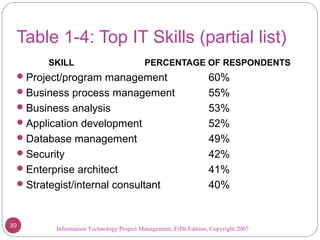
Table 1-4: Top IT Skills (partial list)
SKILL PERCENTAGE OF RESPONDENTS
Project/program management 60%
Business process management 55%
Business analysis 53%
Application development 52%
Database management 49%
Security 42%
Enterprise architect 41%
Strategist/internal consultant 40%
39
Information Technology Project Management, Fifth Edition, Copyright 2007
The Project Management Profession
The profession of project management is growing
at a very rapid pace
It is helpful to understand the history of the field,
the role of professional societies like the Project
Management Institute, and the growth in project
management software
40
Information Technology Project Management, Fifth Edition, Copyright 2007
History of Project Management
Some people argue that building the Egyptian
pyramids was a project, as was building the
Great Wall of China
Most people consider the Manhattan Project to
be the first project to use “modern” project
management
This three-year, $2 billion (in 1946 dollars)
project had a separate project manager and a
technical manager
41
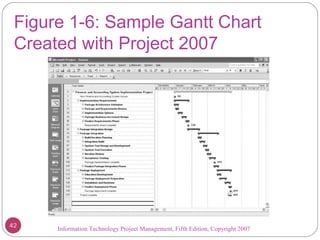
Figure 1-6: Sample Gantt Chart
Created with Project 2007
42
Information Technology Project Management, Fifth Edition, Copyright 2007
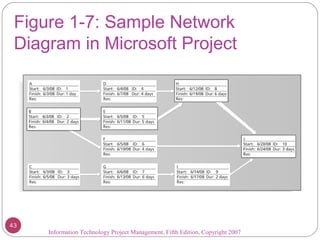
Figure 1-7: Sample Network
Diagram in Microsoft Project
43
Information Technology Project Management, Fifth Edition, Copyright 2007
The Project Management Institute
The Project Management Institute (PMI) is an
international professional society for project
managers founded in 1969
PMI has continued to attract and retain members,
reporting 225,432 members worldwide by
12/31/06
There are specific interest groups in many areas
like engineering, financial services, health care,
IT, etc.
Project management research and certification
programs continue to grow
44
Information Technology Project Management, Fifth Edition, Copyright 2007
Project Management Certification
PMI provides certification as a Project
Management Professional (PMP)
A PMP has documented sufficient project
experience, has agreed to follow a code of ethics,
and has passed the PMP exam
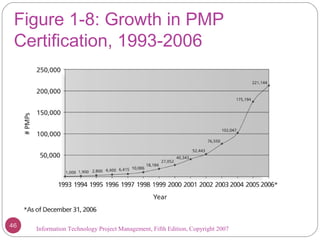
The number of people earning PMP certification
is increasing quickly
PMI and other organizations are offering new
certification programs (see Appendix B)
45
Figure 1-8: Growth in PMP
Certification, 1993-2006
46
Information Technology Project Management, Fifth Edition, Copyright 2007
Ethics in Project Management
Ethics, loosely defined, is a set of principles that
guide our decision making based on personal
values of what is “right” and “wrong”
Project managers often face ethical dilemmas
In order to earn PMP certification, applicants
must agree to PMI’s Code of Ethics and
Professional Conduct
Several questions on the PMP exam are related
to professional responsibility, including ethics
47
Information Technology Project Management, Fifth Edition, Copyright 2007
Project Management Software
There are hundreds of different products to assist
in performing project management
Three main categories of tools
Low-end tools: handle single or smaller projects well,
cost under $200 per user
Midrange tools: handle multiple projects and users, cost
$200-600 per user, Project 2007 most popular
High-end tools: also called enterprise project
management software, often licensed on a per-user
basis, like VPMi Enterprise Online (www.vcsonline.com);
see front cover for trial version information
See the Project Management Center Web site or
Top Ten Reviews for links to many companies that
provide project management software
48
Information Technology Project Management, Fifth Edition, Copyright 2007
Chapter Summary
A project is a temporary endeavor undertaken to
create a unique product, service, or result
Project management is the application of knowledge,
skills, tools, and techniques to project activities to
meet project requirements
A program is a group of related projects managed in
a coordinated way; project portfolio management
involves organizing and managing projects and
programs as a portfolio of investments
Project managers play a key role in helping projects
and organizations succeed
The project management profession continues to
grow and mature
49

Introduction to project management

  • 1.
    Chapter 1:Chapter 1: Introductionto Project ManagementIntroduction to Project Management Information TechnologyInformation Technology Project Management,Project Management, Fifth EditionFifth Edition
  • 2.
    Information Technology ProjectManagement, Fifth Edition, Copyright 2007 Learning Objectives  Understand the growing need for better project management, especially for information technology projects  Explain what a project is, provide examples of information technology projects, list various attributes of projects, and describe the triple constraint of projects  Describe project management and discuss key elements of the project management framework, including project stakeholders, the project management knowledge areas, common tools and techniques, and project success 2
  • 3.
    Information Technology ProjectManagement, Fifth Edition, Copyright 2007 Learning Objectives (continued)  Discuss the relationship between project, program, and portfolio management and the contributions they each make to enterprise success  Understand the role of the project manager by describing what project managers do, what skills they need, and what the career field is like for information technology project managers  Describe the project management profession, including its history, the role of professional organizations like the Project Management Institute, the importance of certification and ethics, and the advancement of project management software 3
  • 4.
    Information Technology ProjectManagement, Fifth Edition, Copyright 2007 Introduction Many organizations today have a new or renewed interest in project management Computer hardware, software, networks, and the use of interdisciplinary and global work teams have radically changed the work environment The U.S. spends $2.3 trillion on projects every year, or one-quarter of its gross domestic product, and the world as a whole spends nearly $10 trillion of its $40.7 gross product on projects of all kinds 4
  • 5.
    Information Technology ProjectManagement, Fifth Edition, Copyright 2007 Project Management Statistics Worldwide IT spending totaled more than $1.8 trillion in 2005, a 6 percent increase from 2004, and spending is projected to grow 8 percent in 2006 and 4 percent in 2007 In 2005, the total compensation for the average senior project manager was $99,183 per year in the United States, $94,646 in Australia, and $106,374 in the United Kingdom The number of people earning their Project Management Professional (PMP) certification increased by more than 70 percent from 2004 to 2005, with more than 200,000 PMPs worldwide by the end of August, 2006 5
  • 6.
    Information Technology ProjectManagement, Fifth Edition, Copyright 2007 Motivation for Studying Information Technology (IT) Project Management IT Projects have a terrible track record, as described in the “What Went Wrong?” section A 1995 Standish Group study (CHAOS) found that only 16.2% of IT projects were successful in meeting scope, time, and cost goals Over 31% of IT projects were canceled before completion, costing over $81 billion in the U.S. alone 6
  • 7.
    Information Technology ProjectManagement, Fifth Edition, Copyright 2007 Advantages of Using Formal Project Management Better control of financial, physical, and human resources Improved customer relations Shorter development times Lower costs Higher quality and increased reliability Higher profit margins Improved productivity Better internal coordination Higher worker morale (less stress) 7
  • 8.
    Information Technology ProjectManagement, Fifth Edition, Copyright 2007 What Is a Project? A project is “a temporary endeavor undertaken to create a unique product, service, or result” (PMBOK® Guide, Third Edition, 2004, p. 5) Operations is work done to sustain the business Projects end when their objectives have been reached or the project has been terminated Projects can be large or small and take a short or long time to complete 8
  • 9.
    Information Technology ProjectManagement, Fifth Edition, Copyright 2007 Examples of IT Projects A help desk or technical worker replaces ten laptops for a small department A small software development team adds a new feature to an internal software application for the finance department A college campus upgrades its technology infrastructure to provide wireless Internet access across the whole campus A cross-functional task force in a company decides what Voice-over-Internet-Protocol (VoIP) system to purchase and how it will be implemented9
  • 10.
    Information Technology ProjectManagement, Fifth Edition, Copyright 2007 Top Ten Technology Projects in 2006 VoIP Outsourcing Data networking Customer relationship management Collaboration Supply chain management Desktop upgrades Application performance management Business analytics Compliance tracking 10
  • 11.
    Information Technology ProjectManagement, Fifth Edition, Copyright 2007 Media Snapshot: Where IT Matters In 2006, Baseline Magazine published “Where I.T. Matters: How 10 Technologies Transformed 10 Industries” as a retort to Nicholas Carr’s ideas (author of “IT Doesn’t Matter”) VoIP has transformed the telecommunications industry and broadband Internet access Global Positioning Systems (GPS) has changed the farming industry Digital supply chain has changed the entertainment industry’s distribution system 11
  • 12.
    Information Technology ProjectManagement, Fifth Edition, Copyright 2007 Project Attributes A project: Has a unique purpose Is temporary Is developed using progressive elaboration Requires resources, often from various areas Should have a primary customer or sponsor The project sponsor usually provides the direction and funding for the project Involves uncertainty 12
  • 13.
    Information Technology ProjectManagement, Fifth Edition, Copyright 2007 Project and Program Managers Project managers work with project sponsors, a project team, and other people involved in a project to meet project goals Program: group of related projects managed in a coordinated way to obtain benefits and control not available from managing them individually (PMBOK® Guide, Third Edition, 2004, p. 16) Program managers oversee programs and often act as bosses for project managers 13
  • 14.
    Information Technology ProjectManagement, Fifth Edition, Copyright 2007 Figure 1-1: The Triple Constraint of Project Management Successful project management means meeting all three goals (scope, time, and cost) – and satisfying the project’s sponsor! 14
  • 15.
    Information Technology ProjectManagement, Fifth Edition, Copyright 2007 What is Project Management? Project management is “the application of knowledge, skills, tools and techniques to project activities to meet project requirements” (PMBOK® Guide, Third Edition, 2004, p. 8) Project managers strive to meet the triple constraint by balancing project scope, time, and cost goals 15
  • 16.
    Information Technology ProjectManagement, Fifth Edition, Copyright 2007 Figure 1-2: Project Management Framework 16
  • 17.
    Information Technology ProjectManagement, Fifth Edition, Copyright 2007 Project Stakeholders Stakeholders are the people involved in or affected by project activities Stakeholders include: The project sponsor The project manager The project team Support staff Customers Users Suppliers Opponents to the project 17
  • 18.
    Information Technology ProjectManagement, Fifth Edition, Copyright 2007 Nine Project Management Knowledge Areas Knowledge areas describe the key competencies that project managers must develop Four core knowledge areas lead to specific project objectives (scope, time, cost, and quality) Four facilitating knowledge areas are the means through which the project objectives are achieved (human resources, communication, risk, and procurement management One knowledge area (project integration management) affects and is affected by all of the other knowledge areas All knowledge areas are important! 18
  • 19.
    Information Technology ProjectManagement, Fifth Edition, Copyright 2007 Project Management Tools and Techniques Project management tools and techniques assist project managers and their teams in various aspects of project management Some specific ones include: Project charter, scope statement, and WBS (scope) Gantt charts, network diagrams, critical path analysis, and critical chain scheduling (time) Cost estimates and earned value management (cost) See Table 1-1 for many more 19
  • 20.
    Information Technology ProjectManagement, Fifth Edition, Copyright 2007 Super Tools “Super tools” are those tools that have high use and high potential for improving project success, such as: Software for task scheduling (such as project management software) Scope statements Requirements analyses Lessons-learned reports Tools already extensively used that have been found to improve project importance include: Progress reports Kick-off meetings Gantt charts Change requests 20
  • 21.
    Information Technology ProjectManagement, Fifth Edition, Copyright 2007 What Went Right? Improved Project Performance • The Standish Group’s CHAOS studies show improvements in IT projects in the past decade Measure 1994 Data 2002 Data Result Successful projects 16% 34% Doubled Failed projects 31% 15% Halved Money wasted on challenged and failed projects $140 B out of $250 B $55 B out of $255 B More than halved 21
  • 22.
    Information Technology ProjectManagement, Fifth Edition, Copyright 2007 Why the Improvements? "The reasons for the increase in successful projects vary. First, the average cost of a project has been more than cut in half. Better tools have been created to monitor and control progress and better skilled project managers with better management processes are being used. The fact that there are processes is significant in itself.”* *The Standish Group, "CHAOS 2001: A Recipe for Success" (2001). 22
  • 23.
    Information Technology ProjectManagement, Fifth Edition, Copyright 2007 Project Success There are several ways to define project success The project met scope, time, and cost goals The project satisfied the customer/sponsor The results of the project met its main objective, such as making or saving a certain amount of money, providing a good return on investment, or simply making the sponsors happy 23
  • 24.
    Information Technology ProjectManagement, Fifth Edition, Copyright 2007 Table 1-2: What Helps Projects Succeed?* 1. Executive support 2. User involvement 3. Experienced project manager 4. Clear business objectives 5. Minimized scope 6. Standard software infrastructure 7. Firm basic requirements 8. Formal methodology 9. Reliable estimates 10. Other criteria, such as small milestones, proper planning, competent staff, and ownership *The Standish Group, “Extreme CHAOS,” (2001). 24
  • 25.
    Information Technology ProjectManagement, Fifth Edition, Copyright 2007 What the Winners Do • Recent research findings show that companies that excel in project delivery capability: – Use an integrated project management toolbox (use standard/advanced PM tools and lots of templates) – Grow project leaders, emphasizing business and soft skills – Develop a streamlined project delivery process – Measure project health using metrics, like customer satisfaction or return on investment 25
  • 26.
    Information Technology ProjectManagement, Fifth Edition, Copyright 2007 Program and Project Portfolio Management A program is “a group of related projects managed in a coordinated way to obtain benefits and control not available from managing them individually” (PMBOK® Guide, Third Edition, 2004, p. 16) A program manager provides leadership and direction for the project managers heading the projects within the program Examples of common programs in the IT field: infrastructure, applications development, and user support 26
  • 27.
    Information Technology ProjectManagement, Fifth Edition, Copyright 2007 Project Portfolio Management As part of project portfolio management, organizations group and manage projects and programs as a portfolio of investments that contribute to the entire enterprise’s success Portfolio managers help their organizations make wise investment decisions by helping to select and analyze projects from a strategic perspective 27
  • 28.
    Information Technology ProjectManagement, Fifth Edition, Copyright 2007 Figure 1-3: Project Management Compared to Project Portfolio Management 28
  • 29.
    Information Technology ProjectManagement, Fifth Edition, Copyright 2007 Best Practice A best practice is “an optimal way recognized by industry to achieve a stated goal or objective”* Robert Butrick suggests that organizations need to follow basic principles of project management, including these two mentioned earlier in this chapter Make sure your projects are driven by your strategy; be able to demonstrate how each project you undertake fits your business strategy, and screen out unwanted projects as soon as possible Engage your stakeholders; ignoring stakeholders often leads to project failure Be sure to engage stakeholders at all stages of a project, and encourage teamwork and commitment at all times *Project Management Institute, Inc., Organizational Project Management Maturity Model (OPM3) Knowledge Foundation (2003), p. 13. 29
  • 30.
    Information Technology ProjectManagement, Fifth Edition, Copyright 2007 Figure 1-4: Sample Project Portfolio Approach 30
  • 31.
    Information Technology ProjectManagement, Fifth Edition, Copyright 2007 Figure 1-5: Sample Project Portfolio Management Screen Showing Project Health 31
  • 32.
    Information Technology ProjectManagement, Fifth Edition, Copyright 2007 Suggested Skills for Project Managers Project managers need a wide variety of skills They should: Be comfortable with change Understand the organizations they work in and with Be able to lead teams to accomplish project goals 32
  • 33.
    Information Technology ProjectManagement, Fifth Edition, Copyright 2007 The Role of the Project Manager Job descriptions vary, but most include responsibilities like planning, scheduling, coordinating, and working with people to achieve project goals Remember that 97% of successful projects were led by experienced project managers, who can often help influence success factors 33
  • 34.
    Information Technology ProjectManagement, Fifth Edition, Copyright 2007 Suggested Skills for Project Managers The Project Management Body of Knowledge Application area knowledge, standards, and regulations Project environment knowledge General management knowledge and skills Soft skills or human relations skills 34
  • 35.
    Information Technology ProjectManagement, Fifth Edition, Copyright 2007 Table 1-3: Ten Most Important Skills and Competencies for Project Managers 1. People skills 2. Leadership 3. Listening 4. Integrity, ethical behavior, consistent 5. Strong at building trust 6. Verbal communication 7. Strong at building teams 8. Conflict resolution, conflict management 9. Critical thinking, problem solving 10. Understands, balances priorities 35
  • 36.
    Information Technology ProjectManagement, Fifth Edition, Copyright 2007 Different Skills Needed in Different Situations Large projects: leadership, relevant prior experience, planning, people skills, verbal communication, and team-building skills are most important High uncertainty projects: risk management, expectation management, leadership, people skills, and planning skills are most important Very novel projects: leadership, people skills, having vision and goals, self-confidence, expectations management, and listening skills are most important 36
  • 37.
    Information Technology ProjectManagement, Fifth Edition, Copyright 2007 Importance of Leadership Skills Effective project managers provide leadership by example A leader focuses on long-term goals and big- picture objectives while inspiring people to reach those goals A manager deals with the day-to-day details of meeting specific goals Project managers often take on the role of both leader and manager 37
  • 38.
    Information Technology ProjectManagement, Fifth Edition, Copyright 2007 Careers for IT Project Managers In a 2006 survey by CIO.com, IT executives ranked project/program management the skills that would be the most in demand in the next two to five years 38
  • 39.
    Information Technology ProjectManagement, Fifth Edition, Copyright 2007 Table 1-4: Top IT Skills (partial list) SKILL PERCENTAGE OF RESPONDENTS Project/program management 60% Business process management 55% Business analysis 53% Application development 52% Database management 49% Security 42% Enterprise architect 41% Strategist/internal consultant 40% 39
  • 40.
    Information Technology ProjectManagement, Fifth Edition, Copyright 2007 The Project Management Profession The profession of project management is growing at a very rapid pace It is helpful to understand the history of the field, the role of professional societies like the Project Management Institute, and the growth in project management software 40
  • 41.
    Information Technology ProjectManagement, Fifth Edition, Copyright 2007 History of Project Management Some people argue that building the Egyptian pyramids was a project, as was building the Great Wall of China Most people consider the Manhattan Project to be the first project to use “modern” project management This three-year, $2 billion (in 1946 dollars) project had a separate project manager and a technical manager 41
  • 42.
    Figure 1-6: SampleGantt Chart Created with Project 2007 42 Information Technology Project Management, Fifth Edition, Copyright 2007
  • 43.
    Information Technology ProjectManagement, Fifth Edition, Copyright 2007 Figure 1-7: Sample Network Diagram in Microsoft Project 43
  • 44.
    Information Technology ProjectManagement, Fifth Edition, Copyright 2007 The Project Management Institute The Project Management Institute (PMI) is an international professional society for project managers founded in 1969 PMI has continued to attract and retain members, reporting 225,432 members worldwide by 12/31/06 There are specific interest groups in many areas like engineering, financial services, health care, IT, etc. Project management research and certification programs continue to grow 44
  • 45.
    Information Technology ProjectManagement, Fifth Edition, Copyright 2007 Project Management Certification PMI provides certification as a Project Management Professional (PMP) A PMP has documented sufficient project experience, has agreed to follow a code of ethics, and has passed the PMP exam The number of people earning PMP certification is increasing quickly PMI and other organizations are offering new certification programs (see Appendix B) 45
  • 46.
    Figure 1-8: Growthin PMP Certification, 1993-2006 46 Information Technology Project Management, Fifth Edition, Copyright 2007
  • 47.
    Information Technology ProjectManagement, Fifth Edition, Copyright 2007 Ethics in Project Management Ethics, loosely defined, is a set of principles that guide our decision making based on personal values of what is “right” and “wrong” Project managers often face ethical dilemmas In order to earn PMP certification, applicants must agree to PMI’s Code of Ethics and Professional Conduct Several questions on the PMP exam are related to professional responsibility, including ethics 47
  • 48.
    Information Technology ProjectManagement, Fifth Edition, Copyright 2007 Project Management Software There are hundreds of different products to assist in performing project management Three main categories of tools Low-end tools: handle single or smaller projects well, cost under $200 per user Midrange tools: handle multiple projects and users, cost $200-600 per user, Project 2007 most popular High-end tools: also called enterprise project management software, often licensed on a per-user basis, like VPMi Enterprise Online (www.vcsonline.com); see front cover for trial version information See the Project Management Center Web site or Top Ten Reviews for links to many companies that provide project management software 48
  • 49.
    Information Technology ProjectManagement, Fifth Edition, Copyright 2007 Chapter Summary A project is a temporary endeavor undertaken to create a unique product, service, or result Project management is the application of knowledge, skills, tools, and techniques to project activities to meet project requirements A program is a group of related projects managed in a coordinated way; project portfolio management involves organizing and managing projects and programs as a portfolio of investments Project managers play a key role in helping projects and organizations succeed The project management profession continues to grow and mature 49