MEANING OF PROJECT
Projectis a scientifically right man, for the right work,
at the right time. The project is a work plan devised to
achieve a specific objective within a certain set time
frame. It can be considered as a proposal involving
capital investment for the purpose of developing
facilities to provide goods and services.
A project is a blueprint for action-oriented activities of
an organization. A project reflects the plan for actions
put in a sequential manner. Like a movie film it is
rejectionoriented process. The project has beginning,
middle and an end.
3.
FEATURES OF APROJECT (PROJECT CHARACTERISTICS)
• Every project is unique in nature.
• A project has a fixed set of objectives(goals) to achieve.
• Once the objectives have been achieved, the project comes to an end.
• Have a specific time frame for completion with a definite start and finish.
• Requires set of resources.
• Every project has risk and uncertainty associated with it.
• Project is developed by a dedicated team of work force.
• Project has a life cycle reflected by growth, maturity and decline.
• Change is an inherent feature in any project throughout it’s life.
• Project is based on systematic procedure and it is difficult to learn fully the
end results at any stage.
4.
TYPES OF PROJECTS
Projectsare categorized in terms of their need and speed of
implementation as
follows:
• Normal Projects
• Adequate time is allowed for implementation.
• All the phases in a project can take their normal time, as
measured previously.
• Minimum requirement of capital cost.
• No sacrifice in terms of quality.
5.
TYPES OF PROJECTS
•Crash Projects
• Requires additional costs to gain time.
• Maximum overlapping of phases is encouraged.
Simultaneous work, by subcontracting is preferred.
• Disaster Projects
• These are projects, undertaken, due to unexpected nature’s
calamities or fury like floods results in rehabilitation of
dwelling houses for affected people. Anything needed to
gain time is allowed in these projects. Round the clock work
is done at the construction site. Capital cost will go up very
high. Project time will get drastically reduced.
6.
BENEFITS OF PROJECT
MANAGEMENT
ProjectManagement helps to avail the following benefits:
• Meet the business objectives.
• Satisfy stakeholder expectations.
• Be more predictable.
• Increase the chances of success.
• Deliver the right products at the right time.
• Resolve problems and issues.
• Respond to risks in a timely manner.
• Optimize the use of organizational resources.
• Manage constraints (e.g., scope, quality, schedule, costs,
resources).
7.
OBSTACLES IN PROJECT
MANAGEMENT
Toenjoy the various benefits of project management given
above following
obstacles should be overcome carefully.
• Project complexities.
• Execution of customer’s special requirement might result
in time delay.
• Co-ordination with many agencies.
• Organisation restructuring is a typical task.
• Project risks.
• Statutory changes.
• Changes in technology needs highly qualified team.
• Forward planning and pricing.
8.
PROJECT MANAGER
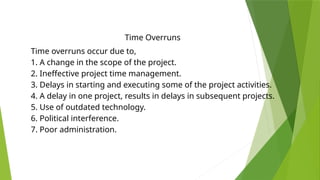
• ProjectManager is a pivot where the entire team performs its activities.
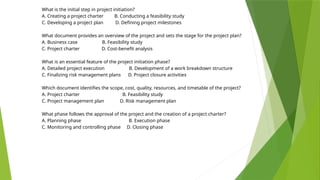
• Project Manager is a person who has the overall control of the project
and responsible for its execution and performance.
• Project Manager is thoroughly involved in planning the work and
monitoring,directing and leading the participants and seeks to reach the
project goal in time-cost-quality puzzle.
• The Project Manager is either a specialist or a person having
predominantly technical background with sufficient experience,
exposure expertise on multifaceted, multi-dimensional and multi-
disciplinary projects.
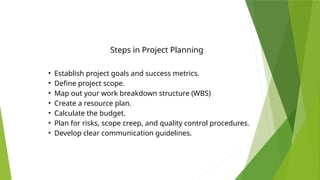
• A project manager is always found learning the newest facts from
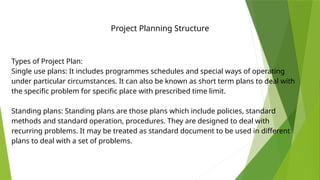
external world around him.
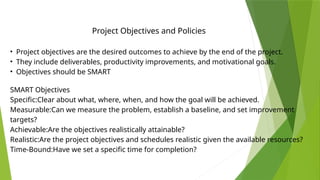
9.
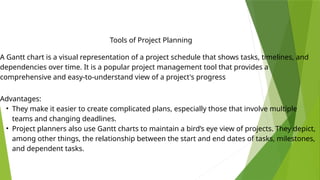
PROJECT CONSULTANTS
A projectconsultant, seen as a walking encyclopedia, is a valuable asset for
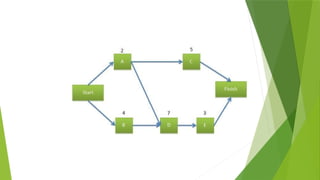
any organization. They offer crucial guidance and direction throughout the
project, from its planning stages to completion and even post-evaluation.
Consultants, available in various capacities, become an integral part of the
project management team, contributing their expertise on a contractual
basis.
10.
PROJECT CONSULTANTS
Need onConsultants arises:
• When a project with new technology is undertaken.
• When the in-house consultant is incapable of meeting the requirement
of the project.
• When there is no in-house facility available in the organisation.
• When the project is executed based on imported technology.
• To avail the advantages of expertise available with the outside
consultants.
11.
PROJECT CONSULTANTS
Types ofconsultants,
In-house Consultants:
• Work internally for the organization.
• Permanent staff members.
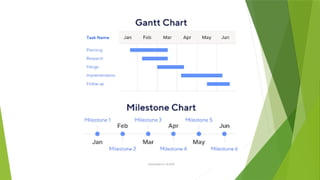
• Deep understanding of company culture.
Outside Consultants:
• External individuals or firms.
• Hired on a project or contractual basis.
• Bring external expertise and perspective.
12.
PROJECT CONSULTANTS
Local Consultants:
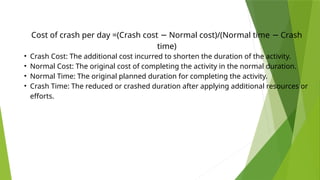
•Operate within the same region.
• Familiar with local regulations and culture.
• Simplifies communication and coordination.
Foreign Consultants:
• From outside the home country.
• Bring international perspectives.
• May face challenges due to cultural differences.
13.
WHAT IS OPERATION?
•Operation is an ongoing work effort.
• The objective of an ongoing operation is to sustain the
project.
• It is repetitive. Once objective is reached adopt a new set
of objectives and continue the work.
14.
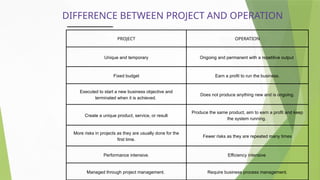
PROJECT OPERATION
Unique andtemporary Ongoing and permanent with a repetitive output
Fixed budget Earn a profit to run the business.
Executed to start a new business objective and
terminated when it is achieved.
Does not produce anything new and is ongoing.
Create a unique product, service, or result
Produce the same product, aim to earn a profit and keep
the system running.
More risks in projects as they are usually done for the
first time.
Fewer risks as they are repeated many times
Performance intensive. Efficiency intensive
Managed through project management. Require business process management.
DIFFERENCE BETWEEN PROJECT AND OPERATION
15.
WHAT IS PROCESSIN PROJECT MANAGEMENT
AND PROCESS GROUPS?
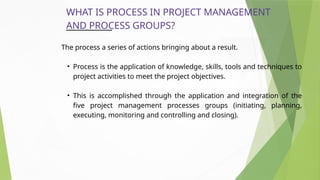
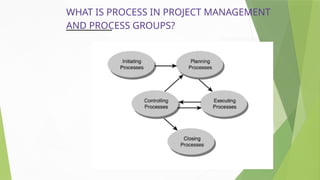
The process a series of actions bringing about a result.
• Process is the application of knowledge, skills, tools and techniques to
project activities to meet the project objectives.
• This is accomplished through the application and integration of the
five project management processes groups (initiating, planning,
executing, monitoring and controlling and closing).
16.
WHAT IS PROCESSIN PROJECT MANAGEMENT
AND PROCESS GROUPS?
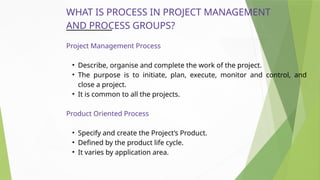
Project Management Process
• Describe, organise and complete the work of the project.
• The purpose is to initiate, plan, execute, monitor and control, and
close a project.
• It is common to all the projects.
Product Oriented Process
• Specify and create the Project’s Product.
• Defined by the product life cycle.
• It varies by application area.
17.
WHAT IS PROCESSIN PROJECT MANAGEMENT
AND PROCESS GROUPS?
Process groups
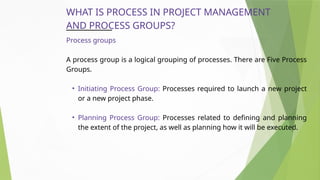
A process group is a logical grouping of processes. There are Five Process
Groups.
• Initiating Process Group: Processes required to launch a new project
or a new project phase.
• Planning Process Group: Processes related to defining and planning
the extent of the project, as well as planning how it will be executed.
18.
WHAT IS PROCESSIN PROJECT MANAGEMENT
AND PROCESS GROUPS?
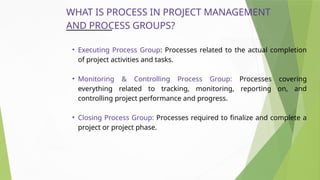
• Executing Process Group: Processes related to the actual completion
of project activities and tasks.
• Monitoring & Controlling Process Group: Processes covering
everything related to tracking, monitoring, reporting on, and
controlling project performance and progress.
• Closing Process Group: Processes required to finalize and complete a
project or project phase.
PROJECT OBJECTIVES VS.PROJECT SCOPE
Project Objectives
• Refers to a detailed description of the expected/desired outcome of
the project.
• Ex: Build a new website.
Project Scope
• Refers to the amount of effort required to complete a project.
• Ex: Build the website using ASP & NET products and Flash media.
21.
DIFFERENCE BETWEEN PRODUCTSCOPE
AND PROJECT SCOPE
Product Scope
• The features and functions that characterise a product/ Service/ result.
• Completion of the product scope is measured against product
requirements.
Project Scope
• The work that must be done to achieve Product Scope.
• Completion of the project scope is measured against The Project
management plan.
22.
What is adefining characteristic of every project?
A) Unlimited resources B) Uniqueness
C) Undefined objectives D) Continuous operation
How is the end of a project typically determined?
A) When all resources are exhausted B) When objectives are achieved
C) When a new project begins D) When risks are minimized
What is an inherent feature of any project throughout its life?
A) Predictability B) Stability
C) Change D) Consistency
What characterizes Crash Projects?
A) No additional costs allowed B) Minimal overlapping of phases
C) Maximum overlapping of phases, encouraging simultaneous work
D) Extensive use of internal resources
What is a benefit of Project Management according to the provided information?
A) Increasing capital costs B) Reducing stakeholder expectations
C) Balancing constraints on the project D) Decreasing the chances of project success
23.
What is abenefit of Project Management according to the provided information?
A) Increasing capital costs B) Reducing stakeholder expectations
C) Balancing constraints on the project D) Decreasing the chances of project success
What role does the Project Manager play in the project team?
A) Peripheral observer B) Central pivot
C) External consultant D) Technical specialist
What is the primary responsibility of the Project Manager?
A) Conducting individual tasks B) Overseeing project execution and performance
C) Monitoring external world events D) Providing technical expertise
What kind of background is suitable for a Project Manager?
A) Limited technical experience B) Solely managerial experience
C) Predominantly technical background with experience
D) No technical or managerial expertise
How is a Project Manager described in terms of learning and staying updated?
A) Limited exposure to new facts B) Constantly learning newest facts from the external world
C) Ignoring external world developments D) Focusing only on internal team dynamics
24.
When might anorganization seek the assistance of consultants with new technology?
A) When in-house consultants are capable B) When the project is budget-friendly
C) When there is no new technology involved
D) When a project with new technology is undertaken
What distinguishes Outside Consultants?
A) Deep understanding of company culture B) Bring external expertise and perspective
C) Familiar with local regulations and culture D) Work internally for the organization
What is a potential challenge for Foreign Consultants?
A) Extensive knowledge of local regulations B) Familiarity with company culture
C) International perspectives D) Cultural differences
What is the primary objective of an ongoing operation?
A) Achieving a one-time goal B) Sustaining the project
C) Adopting new objectives D) Completing project activities
How is the repetitiveness of an ongoing operation characterized?
A) Continuation without adopting new objective
B) Completion of the project after reaching the objective
C) Repetition with the same set of objectives
D) Adoption of new objectives once the objective is reached
25.
What is theprimary characteristic of an ongoing operation?
A) One-time objective B) Repetitive work effort
C) Random actions D) Completion after reaching the objective
What is the focus of the Initiating Process Group?
A) Defining and planning the extent of the project B) Launching new projects or project phases
C) Organizing and completing project work D) Specifying and creating the project's product
Which of the following is NOT one of the project management process groups mentioned in the information?
A) Initiating B) Closing
C) Concluding D) Executing
What is the main focus of Product Oriented Process?
A) Organizing and completing project work B) Specifying and creating the project's product
C) Defining and planning the extent of the project D) Initiating new project phases
How is the Product Oriented Process defined in relation to the product life cycle?
A) It varies by application area B) It is common to all projects
C) It involves launching new projects D) It completes project work
• Project Administrationfocuses on two objectives. One is relieving the project team from
the burden of project management's administrative responsibilities.
• The second objective is achieving schedule control.
• It views project management as a process control system. Once plans are ready and the
project is executing, a feedback loop is provided in the form of clear, easy to understand
status reports.
Essentials of Project Administration
28.
A project teamplays the vital role of designing and implementing a project. A project
team consists of a specific group of individuals. The following are different types of a
project teams. 1. Initial project team.
2. Core project team.
3. Full project team.
4. Project advisors.
5. Project stakeholders.
6. Process facilitators
Project team
29.
Initial Project Team:
Role:Conception and planning of the project.
Members: Individuals responsible for the project's initiation and planning.
Key Responsibilities: Idea conception, planning, and execution. Project manager
coordinates activities.
Core Project Team:
Role: Designing and managing the project.
Members: A small group, typically 3 to 8 people.
Key Responsibilities: Ultimate responsibility for project design and management.
Includes sponsor, client leader, expert, and internal auditor.
30.
Full Project Team:
Role:Involvement in designing, implementing, monitoring, and controlling the project.
Members: Complete group involved in various aspects of the project.
Key Responsibilities: Comprehensive involvement in project activities. Includes managers, stakeholders,
researchers, and key implementers.
Project Advisors:
Role: Providing honest feedback and counseling.
Members: Not part of the project team but trusted for advice.
Key Responsibilities: Offering feedback and counseling, anchoring the cause of the project.
31.
Project Stakeholders:
Role: Individuals,groups, or institutions with a special interest in the project.
Members: Those who have a stake in the project's outcomes.
Key Responsibilities: Contributing input, providing resources, and supporting the project.
Project Facilitators:
Role: Assisting the project team through the planning process.
Members: Individuals with good facilitation skills.
Key Responsibilities: Helping the team navigate the planning process by understanding key elements and
facilitating effective communication.
32.
• Project designis the first stage in the execution of the project.
• Project design is concerned with developing project scheduling techniques and
implementation of the project.
• It includes finding of location, construction of buildings, procuring plant and
machinery and finally execution the project.
Project design
33.
1. It givesa comprehensive idea about the entire project.
2. It is a diagrammatic representation of the work plan designed to execute the project.
3. The various activities of the project are explained in sequence to highlight the various phases
of the project.
4. It helps entrepreneurs in coordinating project activities.
5. It serves as an effective tool of planning and implementation of a project.
6. It helps managers to plan the project economically.
Significance of Project design
34.
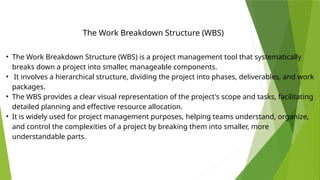
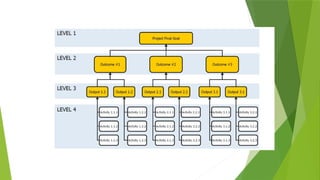
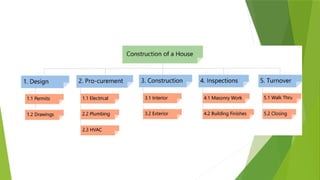
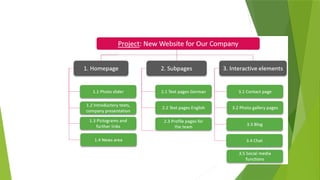
• The WorkBreakdown Structure (WBS) is a project management tool that systematically
breaks down a project into smaller, manageable components.
• It involves a hierarchical structure, dividing the project into phases, deliverables, and work
packages.
• The WBS provides a clear visual representation of the project's scope and tasks, facilitating
detailed planning and effective resource allocation.
• It is widely used for project management purposes, helping teams understand, organize,
and control the complexities of a project by breaking them into smaller, more
understandable parts.
The Work Breakdown Structure (WBS)
38.
• A ProjectExecution Plan is much more than a chart showing timescales. It is a document
describing how, when and by whom a specific target or set of targets is to be achieved.
• These targets will include the project's products, timescales, costs, quality and benefits.
• The plan serves as the main communication vehicle to ensure that everyone is aware and
knowledgeable of project objectives and how they will be accomplished.
Project Execution Plan (PEP)
39.
Contracting Plan:
The initialstep in project execution planning.
Objective: Outsource areas where the owner's company lacks expertise for self-regulating
systems.
Considerations: Type of contract, reimbursement approach, contract conditions, and
payment terms must be examined.
Work Packaging Plan:
Definition: Work packages are groups of related tasks within a project.
Role: They are considered sub-projects within the larger project.
Significance: Work packages are the smallest units when creating the Work Breakdown
Structure (WBS).
Project execution plan includes four sub-plans
40.
Organization Plan:
Purpose: Essentiallya "to-do" list for an organization.
Contents: Outlines plans for work, programs, and organizational growth over time.
Details: Specifies tasks, responsible parties, and timelines for completion.
Systems and Procedure Plan:
Emphasis: Importance on routine systems and procedures for seamless day-to-day operations.
Sub-Systems: Identifies at least seven routine sub-systems of project management.
Implementation: Appropriate procedures for these sub-systems are designed at the project's
outset.
41.
• A ProjectProcedural Manual (PPM) is a document that outlines the step-by-step procedures
and guidelines to be followed during the various stages of a project.
• It serves as a reference tool for project team members, stakeholders, and other relevant
parties involved in project execution.
A Project Procedural Manual (PPM)
42.
• The ProjectDiary is a summation of all of the daily activities on a project.
• This diary should be written so that it will represent the status of the project each calendar
day to anyone reviewing it in future years.
• They are essential in recording their insights and experiences during a project's planning
and implementation as these insights are important to collect and reflect upon in order to
improve the way future projects are run
Project Diary
43.
• The ProjectExecution System consists of the processes performed to complete the work
defined in the project management plan to satisfy the project specifications.
• The successful execution and administration of project requires,
direction ,communication, co-ordination, organisation and control all at the same time
but in varying proportion.
Project Execution System
44.
• Clarifying Vision:Setting a clear vision for the project, defining its purpose, and
communicating overarching goals.
• Leadership: Providing strong and visionary leadership to inspire and guide the project
team.
• Decision-Making: Making critical decisions that align with the project's objectives and
overall strategy.
• Importance: Sets the course and purpose, ensuring everyone is aligned with the project
objectives.
Project Direction
45.
• Information Flow:Establishing effective communication channels for sharing project
updates, changes, and important information.
• Stakeholder Engagement: Engaging with stakeholders, understanding their needs, and
addressing concerns.
• Feedback Mechanisms: Implementing feedback mechanisms to enhance communication
and gather insights.
• Importance: Enhances transparency, resolves issues promptly, and keeps all involved
parties well-informed.
Communication in a Project
46.
• Team Collaboration:Fostering a collaborative team environment, encouraging open
communication, and promoting teamwork.
• Task Synchronization: Ensuring that different project activities and team members are
working together cohesively.
• Conflict Resolution: Addressing conflicts promptly to maintain a harmonious working
environment.
• Importance: Ensures collaboration, minimizes conflicts, and maximizes efficiency in
achieving project goals.
Project Co-ordination
47.
• Definition: Thecomprehensive process of defining project goals, objectives, scope, and
requirements before initiating the project.
• Importance: Provides a solid foundation for project success by ensuring a clear
understanding of what needs to be achieved.
• Strategy: Conduct a thorough feasibility study, engage key stakeholders, and perform risk
assessments to identify potential challenges early in the project.
Adequate Formulation:
48.
• Definition: Theestablishment of a clear structure within the project team, defining roles,
responsibilities, and reporting relationships.
• Importance: Ensures efficient coordination, communication, and accountability within
the project team.
• Strategy: Clearly define roles and responsibilities, encourage open communication, and
establish a collaborative culture.
Sound Project Organisation:
49.
• Definition: Theprocess of developing a detailed project plan that outlines tasks, timelines,
resources, and potential risks.
• Importance: Provides a roadmap for project execution, minimizing uncertainties and
guiding the team.
• Strategy: Utilize appropriate project management methodologies (e.g., Agile, Waterfall),
break down the project into manageable phases, and establish clear milestones.
Proper Implementation Planning
50.
• Definition: Proactivesteps and preparations taken before the actual implementation phase
to address potential challenges.
• Importance: Positions the project for success by anticipating and mitigating potential
issues in advance.
• Strategy: Identify and address potential roadblocks early in the planning phase, establish
contingency plans, and conduct scenario planning.
Advance Action
51.
• Definition: Ensuringthat financial resources are accessible when needed throughout the
project lifecycle.
• Importance: Prevents disruptions and ensures that the project stays on schedule by having
the necessary funds available.
• Strategy: Develop a robust budgeting process with clear milestones for fund
disbursement, and engage with finance and procurement teams for timely approvals.
Timely Availability of Funds:
52.
• Definition: Theongoing process of tracking and assessing project progress against the
established plan.
• Importance: Provides real-time insights, enabling timely corrective actions and ensuring the
project stays on track.
• Strategy: Implement a project management information system (PMIS) for real-time
tracking, define key performance indicators (KPIs), and regularly review them during project
meetings.
Effective Monitoring:
53.
Who is responsiblefor the conception and planning of the project?
A) Core Project Team B) Project Facilitators
C) Initial Project Team D) Project Advisors
What is the primary role of the Core Project Team?
A) Idea conception B) Designing and managing the project
C) Providing honest feedback D) Assisting the project team through planning
Who are Project Stakeholders?
A) Individuals responsible for initiation B) Members of the Core Project Team
C) Those with a special interest in the project's outcomes
D) Individuals with good facilitation skills
What is the primary focus of project design?
A) Project execution B) Finding a location
C) Developing project scheduling techniques D) Construction of buildings
What does project design provide for entrepreneurs?
A) A sequence of project activities B) Comprehensive idea about the entire project
C) Diagrammatic representation of work plan D) Location analysis for the project
54.
Why is projectdesign considered essential for managers?
A) To identify project areas B) To locate potential entrepreneurs
C) To plan the project economically D) To secure project funding
What is the primary purpose of the Work Breakdown Structure (WBS)?
A) Breakdown project barriers B) Facilitate resource allocation
C) Visual representation of project scope and tasks
D) Establish project timelines
How does the Work Breakdown Structure (WBS) organize a project?
A) Chronologically B) Alphabetically
C) Hierarchically D) Geographically
What does the project Execution Plan describe?
A) Project barriers B) Timescales and costs
C) Alphabetical listing of tasks D) Hierarchical structure of the team
What is the significance of a project Execution Plan?
A) Breaking down project budgets
B) Providing a visual representation of tasks
C) Describing how, when, and by whom project targets will be achieved
D) Establishing project timelines
55.
What must beexamined when creating a Contracting Plan?
A) Work packages B) Organizational growth plans
C) Payment terms D) Implementation procedures
What is the significance of work packages in project management?
A) They determine organizational growth plans
B) They create the Work Breakdown Structure (WBS)
C) They are the smallest units in the WBS
D) They establish reimbursement approaches
What is the purpose of the Organization Plan?
A) To create work packages B) To outsource areas lacking expertise
C) Essentially a "to-do" list for an organization D) To design implementation procedures
What does the Project Diary aim to represent?
A) Step-by-step procedures B) Daily activities on a project
C) Insights and experiences during a project D) Project specifications
Why are insights and experiences recorded in a Project Diary important?
A) To outline project visions B) To serve as a reference tool
C) To improve future project execution D) To define project purposes
56.
What is crucialfor the successful execution and administration of a project?
A) Daily project activitie B) Clarifying vision
C) Summarizing project insight D) Setting project goals
Why is leadership considered important in project management?
A) To summarize daily project activities
B) To make critical decisions aligning with project objectives
C) To record project insights for future improvements
D) To outline project visions
What is the primary importance of Task Synchronization in project management?
A) Ensures collaboration B) Promotes teamwork
C) Minimizes conflicts D) Maximizes efficiency in achieving project goals
How does Conflict Resolution contribute to project success?
A) Encourages open communication B) Promotes teamwork
C) Addresses conflicts promptly D) Fosters a collaborative team environment
How does Pre-Implementation Planning contribute to project success?
A) Engages key stakeholders B) Promotes teamwork
C) Addresses potential challenges in advance D) Ensures financial resources accessibility
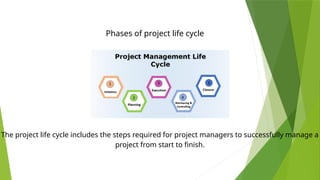
Phases of projectlife cycle
The project life cycle includes the steps required for project managers to successfully manage a
project from start to finish.
59.
Project Initiation
• Thisis the start of the project for the project manager, who is responsible for defining the
project at a high level.
• This usually begins with a business case, feasibility study, cost-benefit analysis and other
types of research to determine whether the project is feasible and should or shouldn’t be
undertaken. Stakeholders provide input.
• If the project is approved, then a project charter is created, which provides an overview of
the project and sets up the stage for your project plan.
60.
Project Charter:
Create aProject Charter that outlines the project's vision, objectives, and goals.
Scope and Deliverables:
Identify the high-level scope and the specific products or services the project will provide.
Key project management steps for initiating a project:
61.
Feasibility Study:Conduct aFeasibility Study to understand the primary problem
and explore possible solutions.
Cost Estimation and Business Case:
Estimate the overall project cost and develop a Business Case outlining costs
and benefits.
Stakeholder Identification:
Identify stakeholders – those impacted by the project – understand their needs,
and how the project affects them.
62.
• This iswhere the project plan is created, and all involved in the project will follow it. This
phase begins by setting SMART (specific, measurable, attainable, realistic, timely) goals.
• The scope of the project is defined and a project management plan is created, identifying
cost, quality, resources and a timetable.
• Some of the features of this phase include a scope statement, setting of milestones,
communication, risk management plans and a work breakdown structure
Project planning
63.
1. Create aProject Plan – Identify the phases, activities, constraints and schedule
and create a project timeline with a Work Breakdown Schedule and Gantt chart.
2. Create a Financial Plan – Create a project budget and cost estimate and a plan
to meet the maximum cost, complete with allocations across resources and
departments.
3. Create a Resource Plan – Build a great team, recruit and schedule the resources
and materials needed to deliver the project.
4. Create a Quality Plan – Set project quality targets and measures.
Key project management steps for planning a project:
64.
5. Create aRisk Plan – Identify the possible risks, assumptions, issues and
dependencies, assign an owner, and develop a mitigation plan for how to
avoid/overcome them.
6. Create an Acceptance Plan – Assign criteria for what constitutes ‘done’ and
‘delivered’.
7. Create a Communication Plan – List your stakeholders, and plan the frequency
of communication between stakeholders.
8. Create a Procurement Plan – Find any 3rd party suppliers required and agree
terms.
65.
• Now beginsthe part of the project that most people think of as the project: executing the
tasks, deliverables and milestones defined in the project scope.
• Some tasks that make up this phase include developing the team and assigning resources
using key performance indicators, executing the project plan, procurement management,
and tracking and monitoring progress.
• If needed, you can set status meetings and revise the schedule and plan.,
Project Execution
66.
Key project managementsteps for executing a project:
Team Leadership:
Inspire the team with a clear vision for success and empower them to achieve it.
Creating Tasks:
Clearly define tasks and establish criteria for successful completion
Task Briefing:
• Ensure the team understands their responsibilities and deadlines for each task.
67.
Client Management:
Collaborate withthe client to ensure that project deliverables meet their expectations.
Communications:
Keep the team and relevant stakeholders informed and updated through effective and
timely communication channels.
68.
Monitoring and controlling
•The project monitoring and controlling phase consists of setting up controls and key
performance metrics to measure the effectiveness of the project execution.
• The monitoring and controlling project phase is very important to make sure the execution
goes as planned in terms of schedule, scope, and budget baselines.
69.
Project Closure
• Projectclosure is the last phase of a project. It’s when the project manager verifies that
the client, stakeholder or customer has accepted the project deliverables. If the project
or product is ongoing after the project, then maintenance must be set up.
• The project manager will also review the entire project before closing it, rating
performance and comparing that to the baseline. The project team will be part of this
process, offering their observations and feedback, which is collected in a lesson’s
learned document. This guides future projects.
70.
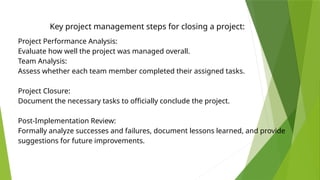
Key project managementsteps for closing a project:
Project Performance Analysis:
Evaluate how well the project was managed overall.
Team Analysis:
Assess whether each team member completed their assigned tasks.
Project Closure:
Document the necessary tasks to officially conclude the project.
Post-Implementation Review:
Formally analyze successes and failures, document lessons learned, and provide
suggestions for future improvements.
71.
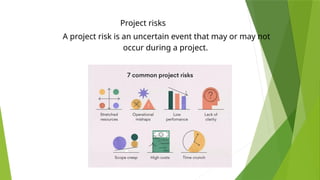
Project risks
A projectrisk is an uncertain event that may or may not
occur during a project.
72.
• Project risks:Project risks are potential events or circumstances that can have adverse
effects on the successful completion of a project. These risks can arise at any stage of the
project life cycle and may impact various aspects such as scope, schedule, budget,
performance, and overall project objectives.
Scope Creep:
• One of the primary challenges in project management is scope creep, where project
objectives expand beyond initial definitions. To mitigate this risk, it is crucial to establish
and communicate clear project parameters from the outset. Regular updates and progress
check-ins with stakeholders help maintain alignment and prevent unauthorized changes to
project requirements.
73.
• Low Performance:
Lowperformance risk arises when a project fails to meet initial expectations. Identifying
potential performance risks early on is key to prevention. Utilizing project management
software for real-time monitoring and fostering open communication within the team
can help address issues promptly, ensuring that performance aligns with project goals
• Stretched Resources:
Resource risk emerges when there are insufficient resources (time, skills, money, tools)
to complete a project. Mitigating this risk involves creating a comprehensive resource
allocation plan early in the planning process. This plan optimizes resource utilization,
maximizing impact and supporting overall project goals.
74.
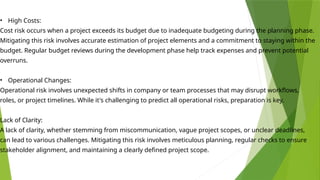
• High Costs:
Costrisk occurs when a project exceeds its budget due to inadequate budgeting during the planning phase.
Mitigating this risk involves accurate estimation of project elements and a commitment to staying within the
budget. Regular budget reviews during the development phase help track expenses and prevent potential
overruns.
• Operational Changes:
Operational risk involves unexpected shifts in company or team processes that may disrupt workflows,
roles, or project timelines. While it's challenging to predict all operational risks, preparation is key.
Lack of Clarity:
A lack of clarity, whether stemming from miscommunication, vague project scopes, or unclear deadlines,
can lead to various challenges. Mitigating this risk involves meticulous planning, regular checks to ensure
stakeholder alignment, and maintaining a clearly defined project scope.
75.
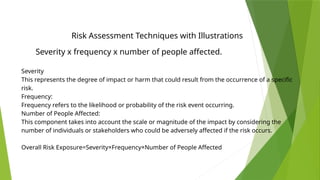
Risk Assessment Techniqueswith Illustrations
Severity x frequency x number of people affected.
Severity
This represents the degree of impact or harm that could result from the occurrence of a specific
risk.
Frequency:
Frequency refers to the likelihood or probability of the risk event occurring.
Number of People Affected:
This component takes into account the scale or magnitude of the impact by considering the
number of individuals or stakeholders who could be adversely affected if the risk occurs.
Overall Risk Exposure=Severity×Frequency×Number of People Affected
76.
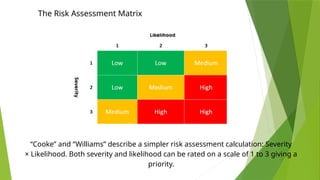
The Risk AssessmentMatrix
“Cooke” and “Williams” describe a simpler risk assessment calculation: Severity
× Likelihood. Both severity and likelihood can be rated on a scale of 1 to 3 giving a
priority.
77.
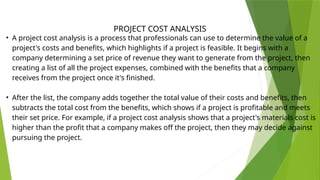
PROJECT COST ANALYSIS
•A project cost analysis is a process that professionals can use to determine the value of a
project's costs and benefits, which highlights if a project is feasible. It begins with a
company determining a set price of revenue they want to generate from the project, then
creating a list of all the project expenses, combined with the benefits that a company
receives from the project once it's finished.
• After the list, the company adds together the total value of their costs and benefits, then
subtracts the total cost from the benefits, which shows if a project is profitable and meets
their set price. For example, if a project cost analysis shows that a project's materials cost is
higher than the profit that a company makes off the project, then they may decide against
pursuing the project.
78.
Estimating Time andCost Overrun Risks
• Time and cost overruns are common challenges in project management,
especially for complex and large projects.
• Managing these risks effectively is crucial to ensure successful project completion
79.
Reasons for ProjectCost Overruns
• Project cost overruns, where actual expenditures exceed the budgeted or
estimated costs, can result from various factors.
• Understanding these reasons is crucial for effective project management and risk
mitigation
80.
Time Overruns
Time overrunsoccur due to,
1. A change in the scope of the project.
2. Ineffective project time management.
3. Delays in starting and executing some of the project activities.
4. A delay in one project, results in delays in subsequent projects.
5. Use of outdated technology.
6. Political interference.
7. Poor administration.
81.
What is theinitial step in project initiation?
A. Creating a project charter B. Conducting a feasibility study
C. Developing a project plan D. Defining project milestones
What document provides an overview of the project and sets the stage for the project plan?
A. Business case B. Feasibility study
C. Project charter D. Cost-benefit analysis
What is an essential feature of the project initiation phase?
A. Detailed project execution B. Development of a work breakdown structure
C. Finalizing risk management plans D. Project closure activities
Which document identifies the scope, cost, quality, resources, and timetable of the project?
A. Project charter B. Feasibility study
C. Project management plan D. Risk management plan
What phase follows the approval of the project and the creation of a project charter?
A. Planning phase B. Execution phase
C. Monitoring and controlling phase D. Closing phase
82.
What is thepurpose of creating a Work Breakdown Schedule (WBS) and Gantt chart in project planning?
A. To identify risks B. To schedule team meetings
C. To track project progress D. To outline project goals
What does the Financial Plan in project planning primarily include?
A. Project timeline B. Work Breakdown Schedule
C. Project budget and cost estimate D. Risk mitigation plan
What does the Quality Plan in project planning aim to establish?
A. Project timeline B. Stakeholder list
C. Quality targets and measures D. Procurement plan
What is the primary focus of the Communication Plan in project planning?
A. Identifying risks B. Listing stakeholders
C. Creating a project timeline D. Setting quality targets
What is the purpose of the Procurement Plan in project planning?
A. Identifying risks B. Listing stakeholders
C. Creating a project budget D. Finding and agreeing with third-party suppliers
83.
What is theprimary focus of the project execution phase?
A. Creating project plans B. Developing the team and assigning resources
C. Setting quality targets D. Identifying risks
What is a key aspect of developing the team in the execution phase?
A. Creating a project timeline B. Assigning resources using key performance indicators
C. Setting quality targets D. Identifying project risks
How can progress be tracked and monitored during the execution phase?
A. Conducting status meetings B. Creating a project charter
C. Developing the team D. Setting quality targets
What is the purpose of setting status meetings during the execution phase?
A. Developing the team B. Identifying project risks
C. Collaborating with the client D. Keeping the team and stakeholders informed and updated
What is the role of Client Management in the execution phase?
A. Creating a project timeline B. Setting quality targets
C. Collaborating with the client to ensure project deliverables meet expectations
D. Conducting status meetings
84.
What is theprimary purpose of the project closure phase?
A. Developing the team B. Verifying client acceptance of project deliverables
C. Setting project goals D. Identifying risks
When is maintenance typically set up in the project closure phase?
A. Before project verification B. During project execution
C. If the project or product is ongoing after project closure D. After project initiation
What does the project manager verify during the closure phase?
A. Team development B. Client acceptance of project deliverables
C. Project goals D. Project risks
Who provides observations and feedback during the project closure process?
A. Stakeholders only B. Project team only
C. Project manager only D. Both the project team and stakeholders
What can lack of clarity in a project lead to?
A. Successful project outcomes B. Clear project scopes
C. Various challenges D. Miscommunication and vague project deadlines
• Project planningis a crucial part of project management focused on creating a detailed plan
that outlines the steps and resources necessary to achieve the project's objectives, including
identifying the project's scope, establishing a timeline, assigning tasks and resources, and
budgeting for the project.
Project planning
87.
The project planninghelps in streamlining the process of the Project. Planning helps in the
smooth running of the project as every aspect of the project is taken into consideration, and
the required solution. The Project plan consists of three related parts.
1. Scope
2. Schedule
3. Cost
Nature of a project
88.
One of theobjectives of project planning is to completely define all the work required so
that it will be readily identifiable to each project participant.
There are four basic reasons for project planning.
1. To eliminate or reduce uncertainty.
2. To improve efficiency of the operation.
3. To obtain a better understanding of the objectives.
4. To provide a basis for monitoring and controlling the work
Need for Project Planning
89.
1. It shouldprovide a basis for organising the work on the project and allocating
responsibilities to individuals.
2. It is a means of communication and coordination between all those involved in the
project.
3. It inspires the people to look ahead.
4. It induces a sense of urgency and time consciousness.
5. It establishes the basis for monitoring and control.
Functions of the Project Planning
90.
• Establish projectgoals and success metrics.
• Define project scope.
• Map out your work breakdown structure (WBS)
• Create a resource plan.
• Calculate the budget.
• Plan for risks, scope creep, and quality control procedures.
• Develop clear communication guidelines.
Steps in Project Planning
91.
Project Planning Structure
Typesof Project Plan:
Single use plans: It includes programmes schedules and special ways of operating
under particular circumstances. It can also be known as short term plans to deal with
the specific problem for specific place with prescribed time limit.
Standing plans: Standing plans are those plans which include policies, standard
methods and standard operation, procedures. They are designed to deal with
recurring problems. It may be treated as standard document to be used in different
plans to deal with a set of problems.
92.
• Project objectivesare the desired outcomes to achieve by the end of the project.
• They include deliverables, productivity improvements, and motivational goals.
• Objectives should be SMART
Project Objectives and Policies
SMART Objectives
Specific:Clear about what, where, when, and how the goal will be achieved.
Measurable:Can we measure the problem, establish a baseline, and set improvement
targets?
Achievable:Are the objectives realistically attainable?
Realistic:Are the project objectives and schedules realistic given the available resources?
Time-Bound:Have we set a specific time for completion?
93.
A Gantt chartis a visual representation of a project schedule that shows tasks, timelines, and
dependencies over time. It is a popular project management tool that provides a
comprehensive and easy-to-understand view of a project's progress
Tools of Project Planning
Advantages:
• They make it easier to create complicated plans, especially those that involve multiple
teams and changing deadlines.
• Project planners also use Gantt charts to maintain a bird’s eye view of projects. They depict,
among other things, the relationship between the start and end dates of tasks, milestones,
and dependent tasks.
95.
Network technique isa technique for planning, scheduling and controlling the progress of
projects.
Network structure refers to a general system, network, or pattern of relationships that can
be derived from the observable behavior of animate and inanimate actors or objects in a
given population.
97.
Time estimates inproject management involve predicting the duration required to
complete various project activities.
Time estimates
Types of Time Estimates:
a. Optimistic Time (TO):
• The minimum time an activity might take under favorable conditions.
b. Most Likely Time (TM):
• The best estimate of the time required under normal working conditions.
c. Pessimistic Time (TP):
• The maximum time an activity might take under adverse conditions.
98.
Project scheduling isa critical aspect of the project control system, determining when and how
much work is to be accomplished.
It involves the systematic arrangement of project activities in a timeline to achieve project goals
efficiently.
Effective project scheduling leads to success of project, reduced cost, and increased customer
satisfaction
Project Scheduling
99.
Time Monitoring Efforts
Timemonitoring efforts in project management involve the systematic
tracking and management of project timelines to ensure that activities are
progressing according to the schedule.
Advantages:
• Tracking time helps team members drive up their productivity and get work done faster
than they’d normally take
• It also helps you identify activities that are not a good use of your time.
100.
1. Early StartSchedule:
The early start schedule involves scheduling non-critical activities to start as early as possible within t
constraints of their dependencies.
Resources are allocated promptly to start non-critical tasks.
Advantages:
Maximizes resource utilization by initiating activities as soon as possible.
Minimizes idle time between critical and non-critical activities.
2.Late Start Schedule:
The late start schedule involves scheduling non-critical activities to start as late as possible
while still meeting the project completion deadline.
Resources may be allocated closer to the actual start date of non-critical tasks.
Advantages:
Provides flexibility in resource allocation by delaying the start of non-critical activities.
Minimizes resource usage during periods of low demand.
101.
It is acrucial aspect of project management. Efficiently aligning project activities with the
availability of resources, particularly human resources, helps ensure optimal utilization,
prevent bottlenecks, and maintain a smooth workflow
It is a critical aspect of project management, especially in scenarios where financial resources
are allocated periodically or based on project milestones
Scheduling to match the availability of manpower
Scheduling to match the release of funds
102.
Uncertainties and Changes:
Real-lifeprojects face uncertainties, changes in requirements, and external factors,
challenging the accuracy of initial scheduling.
Resource Constraints:
Limited availability of skilled resources or equipment can lead to delays and
compromises in project timelines.
Complex Dependencies:
Interdependencies among tasks create complexity, making accurate sequencing and
scheduling challenging.
Budgetary Limitations:
Financial constraints may impact resource allocation and affect the ability to adhere to
the planned project schedule.
Problems in scheduling Real-Life projects
103.
Project Monitoring andImplementation
Project monitoring involves the systematic tracking and surveillance of
project activities, performance, and progress to ensure they align with the
project plan.
Situation Analysis is a process that helps you identify opportunities and challenges, both
internal and external, to your organization, service, or product
Situation Analysis and Problem Definition
104.
Generating Structures andStrategies
• Generating structures and strategies involves creating plans and
organizing systems to achieve specific goals.
• It's like coming up with a game plan and designing the framework to
make those plans work.
105.
Implementation in projectmanagement is the phase where plans are put into action. It involve
carrying out the planned activities, deploying resources, and executing tasks to achieve the
project's objectives.
What is Project Evaluation?
Implementation
Project evaluation is the process of measuring the success of a project, program or
portfolio.
This is done by gathering data about the project and using an evaluation method that
allows evaluators to find performance improvement opportunities.
106.
Why is ProjectEvaluation Important?
• Tracks team performance: Keep records of past evaluations to track progress over
a series of projects.
• Highlights the areas that need improvement: Noticing trends and patterns leads to
an understanding of how the team can improve
107.
What are theChallenges in Monitoring and Evaluation?
1.Getting the commitment to do it.
2. Establishing base lines at the beginning of the project; Identifying realistic,
quantitative and qualitative indicators.
3. Finding the time to do it and sticking to it.
4. Getting feedback from your stakeholers.
5. Reporting back to your stakeholders
108.
What is theprimary focus of project planning?
a) Execution b) Cost
c) Scope d) Monitoring
What is the purpose of creating a project plan?
a) To eliminate uncertainty b) To improve efficiency
c) To understand project objectives d) All of the above
Which component of the project plan outlines the sequence of activities?
a) Scope b) Schedule
c) Cost d) Timeline
Why is project planning essential?
a) To increase uncertainty b) To reduce efficiency
c) To complicate operations d) To streamline the project process
What does project planning do to inspire people to look ahead?
a) Creates uncertainty b) Encourages backward thinking
c) Provides a clear vision of project objectives d) None of the above
109.
What are thetwo types of project plans mentioned?
a) Short-term and long-term plans b) Single use plans and standing plans
c) Specific and general plans d) Ineffective and effective plans
What does the term SMART stand for in SMART Objectives?
a) Specific, Measurable, Achievable, Realistic, Timely
b) Specific, Magnificent, Advanced, Resourceful, Timely
c) Simple, Memorable, Accessible, Relevant, Timely
d) Significant, Meaningful, Appropriate, Reliable, Timely
What is a Gantt chart primarily used for in project management?
a) Budgeting b) Team building
c) Schedule visualization d) Resource allocation
1What is the purpose of time estimates in project management?
a) Predicting weather conditions b) Predicting the stock market
c) Predicting the duration required to complete project activities
d) Predicting team member availability
What does Optimistic Time (TO) represent in time estimates?
a) Best estimate under normal conditions b) Minimum time under favorable conditions
c) Maximum time under adverse conditions d) Average time under expected conditions
110.
What does MostLikely Time (TM) represent in time estimates?
a) Best estimate under normal conditions
b) Minimum time under favorable conditions
c) Maximum time under adverse conditions
d) Average time under expected conditions
What is one of the outcomes of effective project scheduling?
a) Increased project complexity b) Higher project costs
c) Reduced project success d) Increased customer satisfaction
What is the purpose of time monitoring efforts in project management?
a) Allocating resources b) Determining project goals
c) Systematic arrangement of project activities in a timeline
d) Tracking and managing project timelines
What is the primary focus of the early start schedule in project management?
a) Starting critical activities early b) Starting non-critical activities early
c) Minimizing resource utilization d) Maximizing idle time
In the early start schedule, when are resources allocated to start non-critical tasks?
a) As late as possible b) Closer to the actual start date
c) Promptly and as early as possible d) During critical activities
111.
What is acommon challenge faced by real-life projects that affects initial scheduling accuracy?
a) Limited resource availability b) Stable requirements
c) External factors d) Budget overruns
How can uncertainties impact project scheduling in real-life projects?
a) Improve scheduling accuracy b) Facilitate resource allocation
c) Challenge the accuracy of initial scheduling d) Minimize interdependencies
What is a result of complex dependencies among tasks in a project?
a) Simplifies project sequencing b) Accelerates resource allocation
c) Challenges accurate scheduling d) Reduces interdependencies
1What is the primary purpose of project evaluation?
a) Budget allocation b) Performance measurement
c) Stakeholder satisfaction d) Resource management
What does project evaluation help in tracking over a series of projects?
a) Budget adherence b) Team performance
c) Stakeholder expectations d) Project scope
Project controls areprocesses for gathering and analyzing project data to keep costs
and schedules on track.
Observing Work in Progress:
Project control involves actively monitoring and observing the ongoing work within
the project.
Ensuring Plan Adherence:
Project control ensures that the actual progress aligns with the established project
plan.
Purposes of the project control
114.
Understanding Basic Problems:
Projectcontrol aims to identify and comprehend any fundamental issues or
challenges encountered during the project.
Taking Appropriate Action:
When discrepencies or issues are identified through project control, it is crucial to
take prompt and appropriate actions.
115.
Problems of ProjectControl
Characteristics of Ultra-Mega Projects:
Complexities: Ultra-mega projects often involve intricate structures, technologies, and
processes, leading to inherent complexities.
People Problems:
Lack of Experience and Training: Project managers lacking the necessary experience
and training may struggle to effectively control projects.
Poor Control and Information System:
Delay in Reporting Performance: If there are delays in reporting project performance, it
becomes challenging to make timely decisions and adjustments.
116.
• A Ganttchart is a project management tool that illustrates work completed over
a period of time in relation to the time planned for the work.
• A Gantt chart can include the start and end dates of tasks, milestones,
dependencies between tasks, assignees, and more.
117.
• A milestonechart is a horizontal chart that marks the most important steps of your
project. Each milestone your team achieves brings you closer to completing the
project.
• Besides keeping your team motivated, a milestone chart is also a great way to show
project stakeholders how your project is progressing
119.
The Critical PathMethod (CPM) is a vital project management tool that represents
the most extended sequence of tasks that must be accomplished to ensure the
completion of the entire project.
Objectives:
• Identify Critical Activities: CPM aims to identify the critical activities in a project,
which directly impact the project's duration.
• Determine Project Duration: It helps in determining the minimum time required to
complete the entire project.
• Sequence of Activities: CPM establishes the sequence of activities, ensuring a
logical order for project execution.
• Resource Planning: It aids in resource allocation by highlighting activities critical to
project timelines.
.
CPM
120.
Advantages:
• Visualization: Providesa visual representation of project activities, dependencies, and
critical paths.
• Efficient Resource Allocation: Helps in efficiently allocating resources by focusing on
critical tasks.
• Project Control: Facilitates effective project control and management by identifying key
milestones and potential delays.
• Risk Management: Allows for better risk management by highlighting activities with
potential impacts on project timelines.
• Time and Cost Estimation: Assists in accurate time and cost estimation for each project
activity.
121.
Construction of aNetwork
• A network is defined by a collection of nodes (vertices), and links (edges) between pairs of
nodes.
• Nodes in large scale brain networks usually represent brain regions, while links represent
anatomical, functional, or effective connections, depending on the dataset.
122.
Network Technique inProject Scheduling
1.To prepare the network diagram, considerable planning, analysis and in-depth
evaluation of the whole project are needed, which in turn help in better
execution of the project.
3. Network techniques can serve as indicators of bottle necks and potential trouble
spots and this helps in handling of pitfalls, so that the project will progress as
per original plans.
4. Network diagram illustrates the coordination required among several project
teams.
5. Network diagram helps in identifying critical paths and thereby helps diversion
of resources to them so that they are not lagging behind schedule.
6. Network techniques help in resource allocation.
7. Network techniques help in cost control.
123.
• Crashing ofnetworks is the phenomenon of reducing the overall duration of the project.
• The crashing of networks is carried out by deploying more resources to one or more
activities.
• Deploying more resources is based on the cost slope of a particular activity in the project
network.
Crashing Project Duration through Network
124.
Cost of crashper day =(Crash cost Normal cost)/(Normal time Crash
− −
time)
• Crash Cost: The additional cost incurred to shorten the duration of the activity.
• Normal Cost: The original cost of completing the activity in the normal duration.
• Normal Time: The original planned duration for completing the activity.
• Crash Time: The reduced or crashed duration after applying additional resources or
efforts.
125.
Project Review
• Theprimary goal of the project review is to assess the overall performance of the
project, identify areas for improvement, and learn from the project experience.
• A project review can mean both a meeting with the project team to assess the status of
a current project or a review at the end of a project.
126.
Various phases ofProject Review:
It is the first stage in the project review process.
The initial review of a project is of two types:
1.Control of Project in Progress:
• Ensure that the project is proceeding according to the planned schedule, budget, and
objectives during its implementation phase.
• Helps prevent cost overruns, schedule delays, and deviations from the project's original
objectives. Enables timely corrective actions.
2. Post Audit:
• Conduct an audit of the project after its completion to compare actual performance with
planned performance.
• Provides a comprehensive understanding of the project's overall success, enabling
organizations to learn from experiences and improve future project management
practices.
127.
Performance Evaluation
The performanceevaluation is done periodically to measure the performance of
the project.
Performance Evaluation Metrics:
1.Economic Rate of Return (ERR):
Definition:
ERR is a metric that compares a project's economic benefits to its costs. It provides a single
metric derived from a cost-benefit analysis, indicating how well a project's benefits stack up
against its costs.
Calculation:
ERR= Present Value of Costs/Present Value of Benefits
128.
2.Book Rate ofReturn (BRR):
Definition:
BRR is a rate of return calculated based on accounting earnings. It measures the ratio of book
income to book value.
Calculation:
BRR=Book Value/Book Income
129.
Abandonment Analysis
• Abandonmentanalysis is the process of evaluating the potential abandonment of a project
before its initially planned duration.
• This analysis considers the possibility of discontinuing a project earlier than anticipated,
impacting the overall decision-making process.
130.
Objectives of ProjectAudit in Short:
Awareness Creation:
Create awareness among project staff about potential problems in project completion,
ensuring quality, planned volume, and cost competitiveness.
Status Clarification:
Provide a clear and current picture of the project's actual status at different intervals.
Quality Problem Identification:
Promptly identify factors that might cause product quality problems.
Time and Cost Overrun Identification:
Promptly identify factors leading to time and/or cost overruns.
131.
Problem Spotting andSuggestions:
Timely spot problems associated with project execution and provide suggestions for
overcoming them.
Information Base Creation:
Enable the creation of a robust information base for accurate project estimation and
costing.
Standards and Systems Establishment:
Assist in establishing appropriate standards, systems, and recommending suitable
work techniques.
Training Needs Identification:
Identify specific training needs related to project tasks.
132.
Functions of ProjectAuditor
Plan and Manage Audits:
Function: Plan and manage audit projects according to established standards.
Oversee Auditing:
Function: Supervise audits in operational, financial, and compliance areas.
Analyze Control Inefficiencies:
Function: Analyze root causes of control inefficiencies and suggest corrective actions.
133.
Status Confirmation:
Function: Measure,confirm, investigate, and report project status to reduce uncertainties.
Provide Advice and Recommendations:
Function: Offer advice and make recommendations for improvement.
Evaluate Contract Baselines:
Function: Evaluate contract baselines and provide judgment on their adequacy.
Document Maintenance:
Function: Maintain documents related to audit work to derive conclusions.
134.
Project Audit Programme
Theproject audit programme involves the identification and analysis of the set
of contractual documents
Steps in Project Audit Programme
Preliminary Examination:
Initial look at how the project is organized, administered, keeps records, controls, plans,
and works.
Preparing Project Statements:
Create statements describing the project's current and future status.
Detailed Work List:
Provide a detailed list of completed work compared to the project's performance
baseline.
135.
Recording Costs:
Document thecosts incurred by the project team for performing the work.
Comparison of Contractual Obligations:
Compare how well the project team fulfills contractual obligations against
commitments
.
Quality Evaluation:
Evaluate the quality of work performed by the project team.
Recording Observed Facts:
Document observed facts related to project planning, organization, and staffing.
136.
Difficulties in EstablishingAudit Purpose and Scope
1. Clarifying Project State:
The purpose of the project audit is to clarify the project's condition for project
management. It's part of ensuring quality. However, auditors may face difficulties
due to incorrect or outdated information.
2. Misleading Information:
Auditors might be misled by inaccurate documentation or wrong information. To
overcome this, they need a system of cross-verification and checks to ensure
accuracy.
137.
3. Resource MismatchReporting:
Auditors must report resource mismatches and their implications for the project.
This requires thorough analysis and communication.
4. Identifying Baseline Contract:
Difficulties may arise in identifying the baseline contract or work statement,
especially if work is based on verbal agreements without proper documentation.
5. Absence of Specifications:
The absence of deliverable specifications in the contract baseline and inadequacies
in delivery procedures or acceptance criteria can be problematic. Auditors need to
address such ambiguities.
138.
Digital Technology Trendsin Project Management
Collaboration Tools:
Apps that help team members work together.
Example: Platforms like Slack or Microsoft Teams.
Cloud-Based Solutions:
Storing project info online for easy access.
Example: Google Drive or Microsoft 365.
AI and Automation:
Smart tech doing repetitive tasks.
Example: Chatbots or automated reporting.
139.
Data Analytics:
Using datato make smart project decisions.
Example: Tools analyzing project performance.
Mobile Project Management:
Managing projects on the go using mobile apps.
Example: Project management apps on smartphones.
Virtual Collaboration:
Working together even if not in the same place.
Example: Virtual meetings or collaborative VR tools.
Internet of Things (IoT):
Devices connected for real-time project data.
Example: Sensors tracking equipment status.
140.
Cloud technology, iot,ar ,vr applications in project management, smart cities
Cloud Technology in Project Management
Cloud technology means storing and accessing project information and tools over
the internet instead of on your computer's hard drive.
How does it help in Project Management?
Access Anywhere: You can check and work on your project from any device with an
internet connection.
Collaboration: Team members can work together on documents in real-time,
improving collaboration.
141.
IoT in ProjectManagement (Easy Words):
IoT (Internet of Things) involves everyday objects connected to the internet, like
sensors on machines.
How does it help in Project Management?
Real-Time Monitoring: IoT devices can track equipment status, providing real-time
data on project progress.
Predictive Maintenance: Sensors can predict when machinery needs maintenance,
preventing breakdowns.
142.
AR (Augmented Reality)and VR (Virtual Reality) in Project Management (Easy Words):
AR: Enhances the real world with digital information.
VR: Creates a whole new, immersive digital environment.
How do they help in Project Management?
Visualization: AR and VR allow you to see project models in 3D, helping in better
understanding and decision-making.
Training: VR can simulate project scenarios for training purposes.
143.
What does projectcontrol aim to ensure regarding the project plan?
A) Creating a new plan B) Adhering to the established plan
C) Modifying the plan frequently D) Ignoring the project plan
What is a common characteristic of ultra-mega projects according to the information provided?
A) Simple structures and technologies B) Inherent complexities
C) Lack of people problems D) Delayed reporting of performance
What is the Critical Path Method (CPM) primarily focused on in project management?
A) Resource allocation B) Visual representation of project activities
C) Cost estimation D) Task completion sequence
What advantage does CPM provide in terms of resource allocation?
A) Allocating resources randomly B) Efficiently allocating resources by focusing on critical tasks
C) Ignoring resource allocation D) Allocating resources equally to all tasks
In what areas does CPM assist according to the provided information?
A) Random resource allocation B) Accurate time and cost estimation
C) Ignoring project activities D) Unstructured project visualization
144.
How is anetwork defined in the context of project management?
A) A collection of resources B) A set of tools
C) Nodes and links between pairs of nodes D) A series of tasks
What do nodes typically represent in large-scale brain networks?
A) Brain activities B) Brain regions
C) Brain resources D) Brain tasks
What is the phenomenon of reducing the overall duration of a project referred to as?
A) Crashing of nodes B) Network failure
C) Crashing of networks D) Project collapse
What is the primary goal of a project review?
A) Initiating a new project B) Assessing overall project performance
C) Conducting audits D) Implementing corrective actions
When can a project review take place according to the information provided?
A) Only during project initiation B) Only at the end of a project
C) Both during a project and at the end of a project D) Only during project completion
•
145.
What is thefirst stage in the project review process?
A) Post-audit B) Control of Project in Progress
C) Conducting corrective actions D) Project initiation
What is the purpose of the Control of Project in Progress type of review?
A) Initiating corrective actions B) Assessing overall success
C) Preventing cost overruns, delays, and deviations D) Conducting post-audits
What does ERR stand for in the context of performance evaluation metrics?
A) Efficient Rate of Return B) Economic Rate of Return
C) Effective Rate of Return D) External Rate of Return
How is ERR calculated according to the information provided?
A) Present Value of Benefits / Present Value of Costs
B) Present Value of Costs / Present Value of Benefits
C) Book Value / Book Income
D) Book Income / Book Value
What is the Book Rate of Return (BRR) based on?
A) Economic benefits B) Accounting earnings
C) Present value D) Cost-benefit analysis
146.
How is BRRcalculated according to the information provided?
A) Present Value of Benefits / Present Value of Costs B) Present Value of Costs / Present Value of Benefits
C) Book Value / Book Income D) Book Income / Book Value
What is the purpose of the "Preliminary Examination" step in a project audit program?
A) Create statements describing project status B) Provide a detailed list of completed work
C) Analyze root causes of control inefficiencies
D) Initial look at how the project is organized, administered, keeps records, controls, plans, and works
What is the purpose of "Preparing Project Statements" in a project audit program?
A) Create statements describing project status B) Provide a detailed list of completed work
C) Analyze root causes of control inefficiencies D) Initial look at how the project is organized
•
What is the primary purpose of the project audit in project management?
A) Establishing resource mismatches B) Identifying baseline contracts
C) Clarifying the project's condition for project management D) Analyzing control inefficiencies
What difficulty may auditors face in clarifying the project state during an audit?
A) Lack of cross-verification B) Incorrect or outdated information
C) Resource mismatch reporting D) Misleading information