Basic tips & tricks for
        working with RNA
Based on Frequently Asked Questions raised by scientists
tip #1    Inactivate endogenous RNases
tip #2    Proper sample storage conditions
tip #3    Thorough sample homogenization
tip #4    Optimal RNA isolation
tip #5    Eliminate contaminating gDNA
tip #6    Exposure to environmental RNases
tip #7    Assess RNA quality
tip #8    Storage of RNA
tip #9    Integrate into workflow
tip #10   Experimental design
tip #1


         Inactivate endogenous RNases
tip #1

         Inactivate endogenous RNases

         - Should be done immediately upon sample harvesting:

                   Homogenize samples in a chaotrope-based cell lysis solution such
         as TRIzol®. This will effectively inhibit RNase activity while disrupting cells
         and cell components during sample homogenization.

                  Flash-freeze samples in liquid nitrogen / dry-ice alcohol bath.
         Tissue pieces must be small enough to freeze immediately upon immersion.

                   Place samples in RNAlater® Tissue Collection & RNA Stabilization
         Solution. This aqueous, nontoxic reagent stabilizes and protects cellular
         RNA in intact, unfrozen tissue and cell samples. Tissue samples must be in
         thin pieces (≤0.5 cm thick) to allow the solution to quickly permeate before
         RNases destroy the RNA.
tip #2


         Proper sample storage conditions
tip #2

         Proper sample storage conditions

         -Flash-frozen sample must be stored at –80°C, even brief thawing prior to
         homogenization/lysis can result in RNA degradation and loss.

         -Flash-frozen tissue should be ground/pulverized at cryogenic
         temperatures prior to homogenization in a lysis solution .

         -RNAlater® Solution offers great flexibility for storage. Cells or tissues can
         be harvested and stored at:
                            room temperature for up to 1 week
                  4°C for up to 1 month
                  long term at –20°C
tip #3


         Thorough sample homogenization
tip #3

         Thorough sample homogenization

         -Homogenization methods should be tailored to the specific cell/tissue type:

                     Most cultured cells can be homogenized by vortexing in lysis
         solution.

                  Animal/plant tissues, yeast, and bacteria require more rigorous
         disruption, such as a rotor-stator homogenizer or a French Press.

                   Lysis of single-celled organisms is often aided by the addition of
         hydrolytic enzymes specific for cell wall components to achieve maximum
         recovery of RNA.
tip #4


         Optimal RNA isolation
tip #4

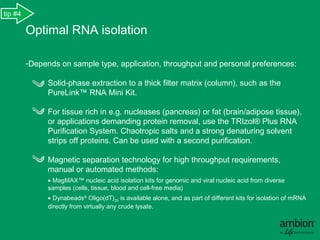
         Optimal RNA isolation

         -Depends on sample type, application, throughput and personal preferences:

               Solid-phase extraction to a thick filter matrix (column), such as the
               PureLink™ RNA Mini Kit.  

               For tissue rich in e.g. nucleases (pancreas) or fat (brain/adipose tissue),
               or applications demanding protein removal, use the TRIzol® Plus RNA
               Purification System. Chaotropic salts and a strong denaturing solvent
               strips off proteins. Can be used with a second purification.

               Magnetic separation technology for high throughput requirements,
               manual or automated methods:
               • MagMAX™ nucleic acid isolation kits for genomic and viral nucleic acid from diverse
               samples (cells, tissue, blood and cell-free media).
               • Dynabeads® Oligo(dT)25 is available alone, and as part of different kits for isolation of mRNA
               directly from virtually any crude lysate.
tip #5


         Eliminate contaminating gDNA
tip #5

         Eliminate contaminating gDNA

         -RNA for use in PCR, real-time PCR or array hybridizations should be treated
         with DNase, as the DNA can interfere with the RNA signal.
         -RNA from DNA-rich tissue (e.g. spleen) should also be treated with DNase .
         -PureLink™ DNase Set (lyophilized RNase-free DNase) removes DNA from
         RNA purified using PureLink™ RNA kits. Optimized for on-column digestion of
         DNA using PureLink™ protocols.
         -Ambion®’s Turbo DNase-free kit™ removes DNA in just 5 minutes.
tip #6


         Exposure to environmental RNases
tip #6

         Exposure to environmental RNases

         -Ensure no RNases are introduced into RNA preparations once they are no
         longer protected by the strong protein denaturants used for extraction.


         -RNases are found almost everywhere!


         -Any item that may come into contact with the RNA must be RNase-free:
              Decontaminate all surfaces (e.g. pipettes, bench-tops, glassware, and
              gel equipment) with a surface decontamination solution such as
              RNaseZap® or RNaseZap® Wipes.
              Change gloves frequently.
              Always use RNase-free tips, tubes, and solutions.
tip #7


         Assess RNA quality
tip #7

         Assess RNA quality

         -UV absorbance readings will measure anything that absorbs at 260 nm (incl.
         DNA, protein, degraded nucleic acids, and free nucleotides).
         -Qubit® 2.0 Fluorometer uses fluorescent dyes to quantitate, and can
         distinguish between RNA and the different contaminants . This generates
         more accurate and precise results across a lower concentration range.
         -Electrophoretic analysis of total RNA to assess the rRNAs. The relative area
         of the large subunit (23-28S, depending on species) to the small subunit (16-
         18S) is a good indication, as the larger rRNA will degrade faster.
         -E-Gel® EX gels for RNA sample integrity analysis.
         -For total RNA samples analyzed on an Agilent 2100 Bioanalyzer, the
         software can be used to determine the RIN value (RNA Integrity Number) on
         a scale of 1-10, where 10 is ideal .
         -For fractionated RNA samples (e.g. poly(A)+ RNA), the type of sample must
         be considered, and often functional tests must be used (e.g. Northern blots or
         qRT-PCR). qRT-PCR will often work fine with partially degraded samples .
tip #8


         Storage of RNA
tip #8

         Storage of RNA

         -For short-term storage, RNA should be stored at –20°C.
         -For long-term storage, RNA should be stored at –80°C .
         -Although RNA resuspended in water or buffer can be stored at –80°C, RNA
         is most stable in an Ammonium Acetate /ethanol precipitation mixture kept at
         –80°C .
         -Aliquot your RNA into several tubes to prevent RNA damage from successive
         freeze-thaw events and to prevent accidental RNase contamination.
tip #9


         Integrate into workflow
tip #9

         Integrate into workflow

         -Regardless of the quantity and quality of RNA obtained, the downstream
         results can be critically impacted by the specific reagents used.
         -Life Technologies offers the best-in-class, validated reverse transcriptase
         enzymes and reagents for real-time PCR.
         -By using SuperScript® VILO™ cDNA Synthesis Kit with high quality isolated
         RNA, your real-time PCR data will be the best it can be.
tip #10


          Experimental design
tip #10

          Experimental design


          -Always consider the overall experimental design to ensure validity.
          -Run ≥3 biological replicates with technical replicates of the analytical
          process.  Can be reduced if the biological specimens are in an ordered series
          (e.g. dosing levels or time points), where statistical vigor can be obtained by
          the modeling of the response .
          -Carefully matched controls provide a baseline that may change between
          experiments, providing a more robust output, and helping to differentiate noise
          from the interesting data.
Learn more at
lifetechnologies.com/ambion

10 tips for working with RNA

  • 1.
    Basic tips &tricks for working with RNA Based on Frequently Asked Questions raised by scientists
  • 2.
    tip #1 Inactivate endogenous RNases tip #2 Proper sample storage conditions tip #3 Thorough sample homogenization tip #4 Optimal RNA isolation tip #5 Eliminate contaminating gDNA tip #6 Exposure to environmental RNases tip #7 Assess RNA quality tip #8 Storage of RNA tip #9 Integrate into workflow tip #10 Experimental design
  • 3.
    tip #1 Inactivate endogenous RNases
  • 4.
    tip #1 Inactivate endogenous RNases - Should be done immediately upon sample harvesting: Homogenize samples in a chaotrope-based cell lysis solution such as TRIzol®. This will effectively inhibit RNase activity while disrupting cells and cell components during sample homogenization. Flash-freeze samples in liquid nitrogen / dry-ice alcohol bath. Tissue pieces must be small enough to freeze immediately upon immersion. Place samples in RNAlater® Tissue Collection & RNA Stabilization Solution. This aqueous, nontoxic reagent stabilizes and protects cellular RNA in intact, unfrozen tissue and cell samples. Tissue samples must be in thin pieces (≤0.5 cm thick) to allow the solution to quickly permeate before RNases destroy the RNA.
  • 5.
    tip #2 Proper sample storage conditions
  • 6.
    tip #2 Proper sample storage conditions -Flash-frozen sample must be stored at –80°C, even brief thawing prior to homogenization/lysis can result in RNA degradation and loss. -Flash-frozen tissue should be ground/pulverized at cryogenic temperatures prior to homogenization in a lysis solution . -RNAlater® Solution offers great flexibility for storage. Cells or tissues can be harvested and stored at: room temperature for up to 1 week 4°C for up to 1 month long term at –20°C
  • 7.
    tip #3 Thorough sample homogenization
  • 8.
    tip #3 Thorough sample homogenization -Homogenization methods should be tailored to the specific cell/tissue type: Most cultured cells can be homogenized by vortexing in lysis solution. Animal/plant tissues, yeast, and bacteria require more rigorous disruption, such as a rotor-stator homogenizer or a French Press. Lysis of single-celled organisms is often aided by the addition of hydrolytic enzymes specific for cell wall components to achieve maximum recovery of RNA.
  • 9.
    tip #4 Optimal RNA isolation
  • 10.
    tip #4 Optimal RNA isolation -Depends on sample type, application, throughput and personal preferences: Solid-phase extraction to a thick filter matrix (column), such as the PureLink™ RNA Mini Kit.   For tissue rich in e.g. nucleases (pancreas) or fat (brain/adipose tissue), or applications demanding protein removal, use the TRIzol® Plus RNA Purification System. Chaotropic salts and a strong denaturing solvent strips off proteins. Can be used with a second purification. Magnetic separation technology for high throughput requirements, manual or automated methods: • MagMAX™ nucleic acid isolation kits for genomic and viral nucleic acid from diverse samples (cells, tissue, blood and cell-free media). • Dynabeads® Oligo(dT)25 is available alone, and as part of different kits for isolation of mRNA directly from virtually any crude lysate.
  • 11.
    tip #5 Eliminate contaminating gDNA
  • 12.
    tip #5 Eliminate contaminating gDNA -RNA for use in PCR, real-time PCR or array hybridizations should be treated with DNase, as the DNA can interfere with the RNA signal. -RNA from DNA-rich tissue (e.g. spleen) should also be treated with DNase . -PureLink™ DNase Set (lyophilized RNase-free DNase) removes DNA from RNA purified using PureLink™ RNA kits. Optimized for on-column digestion of DNA using PureLink™ protocols. -Ambion®’s Turbo DNase-free kit™ removes DNA in just 5 minutes.
  • 13.
    tip #6 Exposure to environmental RNases
  • 14.
    tip #6 Exposure to environmental RNases -Ensure no RNases are introduced into RNA preparations once they are no longer protected by the strong protein denaturants used for extraction. -RNases are found almost everywhere! -Any item that may come into contact with the RNA must be RNase-free: Decontaminate all surfaces (e.g. pipettes, bench-tops, glassware, and gel equipment) with a surface decontamination solution such as RNaseZap® or RNaseZap® Wipes. Change gloves frequently. Always use RNase-free tips, tubes, and solutions.
  • 15.
    tip #7 Assess RNA quality
  • 16.
    tip #7 Assess RNA quality -UV absorbance readings will measure anything that absorbs at 260 nm (incl. DNA, protein, degraded nucleic acids, and free nucleotides). -Qubit® 2.0 Fluorometer uses fluorescent dyes to quantitate, and can distinguish between RNA and the different contaminants . This generates more accurate and precise results across a lower concentration range. -Electrophoretic analysis of total RNA to assess the rRNAs. The relative area of the large subunit (23-28S, depending on species) to the small subunit (16- 18S) is a good indication, as the larger rRNA will degrade faster. -E-Gel® EX gels for RNA sample integrity analysis. -For total RNA samples analyzed on an Agilent 2100 Bioanalyzer, the software can be used to determine the RIN value (RNA Integrity Number) on a scale of 1-10, where 10 is ideal . -For fractionated RNA samples (e.g. poly(A)+ RNA), the type of sample must be considered, and often functional tests must be used (e.g. Northern blots or qRT-PCR). qRT-PCR will often work fine with partially degraded samples .
  • 17.
    tip #8 Storage of RNA
  • 18.
    tip #8 Storage of RNA -For short-term storage, RNA should be stored at –20°C. -For long-term storage, RNA should be stored at –80°C . -Although RNA resuspended in water or buffer can be stored at –80°C, RNA is most stable in an Ammonium Acetate /ethanol precipitation mixture kept at –80°C . -Aliquot your RNA into several tubes to prevent RNA damage from successive freeze-thaw events and to prevent accidental RNase contamination.
  • 19.
    tip #9 Integrate into workflow
  • 20.
    tip #9 Integrate into workflow -Regardless of the quantity and quality of RNA obtained, the downstream results can be critically impacted by the specific reagents used. -Life Technologies offers the best-in-class, validated reverse transcriptase enzymes and reagents for real-time PCR. -By using SuperScript® VILO™ cDNA Synthesis Kit with high quality isolated RNA, your real-time PCR data will be the best it can be.
  • 21.
    tip #10 Experimental design
  • 22.
    tip #10 Experimental design -Always consider the overall experimental design to ensure validity. -Run ≥3 biological replicates with technical replicates of the analytical process.  Can be reduced if the biological specimens are in an ordered series (e.g. dosing levels or time points), where statistical vigor can be obtained by the modeling of the response . -Carefully matched controls provide a baseline that may change between experiments, providing a more robust output, and helping to differentiate noise from the interesting data.
  • 23.