ANALYTICAL
TECHNIQUES OF
MOLECULAR
BIOLOGY AND RDT
DNA ISOLATION AND
PURIFICATION
EXTRACTION OF DNA FORM EUKARYOTIC
AND PROKARYOTIC SAMPLE
DNA extraction is required for a variety of molecular biology applications.
01. Organic extraction
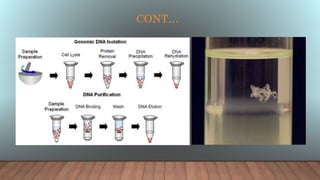
i. Cell lysis can be done using non-ionic detergent (sodium dodecyl sulfate) and
Ethylene diamine tetra acetic acid (EDTA).
ii. Protease ( Proteinase K) treatment is then used to denature proteins.
iii. Removal of cell debris by centrifugation
iv. Organic solvents such as chloroform, phenol, or a mixture of phenol and
chloroform (phenol/chloroform/isoamyl alcohol ratio is 25:24:1) are used for
denaturation and precipitation of proteins from nucleic acid solution.
v. Denatured proteins are removed by centrifugation and wash steps
vi. RNAse treatment is done for the removal of unwanted RNA.
vii. Precipitation with ice-cold ethanol is performed for concentrating DNA.
CONT….
Nucleic acid precipitate is formed, when there is moderate concentration of
monovalent cations (salt). This precipitate can be recovered by centrifugation and
is redissolved in TE buffer or double-distilled water.
Minicolumn purification
Other methods include silica-based technology (DNA absorbs to silica
beads/particles at a specific pH in presence of specific salts), magnetic separation
(DNA binds reversibly to magnetic beads, which are coated with DNA-binding
antibody), anion exchange technology, salting out, and caesium chloride density
gradients.
The quality and yield of DNA are assessed by spectrophotometry or by gel
electrophoresis. Spectrophotometry involves estimation of the DNA concentration
by measuring the amount of light absorbed by the sample at specific
wavelengths. Absorption peak for nucleic acids is at ~260 nm. The A260/A280 ratio
is ~1.8 for dsDNA. A ration of less than 1.7 indicates protein contamination.
CONT…
RNA ISOLATION AND
PURIFICATION
TRIZOL METHOD
• Total RNA is isolated and separated from DNA and protein after extraction with a
solution called as Trizol. Trizol is an acidic solution containing guanidinium
thiocyanate (GITC), phenol and chloroform. GITC irreversibly denatures proteins and
RNAses. RNase enzymes can be inactivated by including diethyl pyrrocarbonate
(DEPC).
Materials Required for RNA Isolation
• Bacterial culture
• Trizol
• Chloroform
• Isopropanol solution
• TAE buffer
• 70% ethanol
CONT…
1. Clean the workstation (pipettor shaft, benchtop) with a surface decontamination solution that destroys RNases.
2. Chill the microcentrifuge to 4 ºC.
3. Homogenization fresh tissue or cell culture:
4. Fresh tissue is preferable for optimal RNA isolation. Alternatively, tissue should be submerged in RNA
stabilization reagent immediately after dissection and stored at –80 °C.
5. Add 1 ml Trizol reagent per 100 mg fresh tissue, mince on ice using sterile scalpels, and homogenize with a
sterile pellet pestle probe.
6. In case of cell cultures, they should be processed immediately after removal from the incubator.
7. Either centrifuge cells grown in suspension at 300 x g for 5 min at RT (15-25 ºC) and discard supernatant or
remove the culture medium from cells grown in monolayer.
8. Add 1 ml Trizol reagent per 1 × 10⁷ cells to cell pellets or directly to the culture dish or flask for cells grown in
monolayer. Resuspend the lysate with a sterile, disposable 1-ml pipette tip.
9. Transfer the tissue or cell lysate to a 2-ml siliconized low-retention tube.
10.Pass sample through sterile, disposable 21 g needle 10 times. In doing so, high-molecular weight cellular
components (DNA) are fragmented, thus minimizing their presence in the aqueous phase.
11.Let homogenate sit at RT (15-25 ºC) for 5 min for complete dissociation of nucleoprotein complexes.
CONT…
12. Let homogenate sit at RT (15-25 ºC) for 3 min.
13. Centrifuge at 12,000 x g for 15 min at 4°C. After centrifugation, heat the centrifuge to room temperature
(15–25°C).
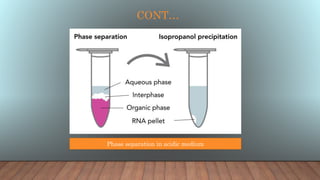
14. Transfer upper aqueous phase (600 ul) to new 1.5 ml RNase-free tube.
15. Proceed to alcohol precipitation.
16. Precipitate the RNA from the aqueous phase by mixing with isopropyl alcohol. Use 0.5 ml of isopropyl
alcohol per 1 ml of TRIZOL Reagent used for the initial homogenization.
17. Incubate samples at 15 to 30oC for 10 minutes and centrifuge at not more than 12,000 x g for 10 minutes
at 2 to 4oC.
18. Remove the supernatant completely. Wash the RNA pellet once with 75% ethanol, adding at least 1 ml of
75% ethanol per 1 ml of TRIZOL Reagent used for the initial homogenization.
19. Mix the samples by vertexing and centrifuge at no more than 7,500 x g for 5 minutes at 2 to 8°C. Repeat.
20. Air-dry or vacuum dry RNA pellet for 5-10 minutes.
21. Dissolve RNA in DEPC-treated water by passing solution a few times through a pipette tip.
22. Subject to spectrophotometric analysis to determine sample concentration and purity.
CONT…
Phase separation in acidic medium
M-RNA ISOLATION PRECAUTIONS
• Working with RNA is more demanding due to both the chemical instability of
RNA and because of the ubiquitous presence of RNases. Further, unlike
DNases which require metal ions for activity, RNases have no requirement for
metal ion co-factors and can maintain activity even after prolonged boiling or
autoclaving.
• Tips for Maintaining an RNase-free Environment
• When working with RNA, wear gloves at all times.
• Use sterile, disposable plasticware whenever possible.
• Electrophoresis tanks for RNA analysis can be cleaned by wiping them with a
solution of SDS (1%), rinsing with water, then rinsing with absolute ethanol,
and finally soaking them in 3% H2O2 for 10 minutes. Rinse tanks with DEPC
(diethyl pyrocarbonate)-treated and autoclaved water before use.
• Treat glassware and plasticware with RNase-inactivating agents. Glassware
should be baked at +180°C for at least 4 hours.
CONT…
• Soak plasticware (2 hours, +37°C) in 0.1 M NaOH/1 mM EDTA (or absolute
ethanol with 1% SDS), rinsed with DEPC or DMPC (dimethyl pyrocarbonate)
treated water and heated to +100°C for 15 minutes in an autoclave.
• To treat water with DEPC (or DMPC, dimethyl pyrocarbonate, a less toxic
alternative to DEPC that can be used in the same manner as DEPC), first
incubate it with DEPC (2 hours, +37°C) and then autoclave it to hydrolyze any
unreacted DEPC.
• Whenever possible, purchase reagents that are free of RNases. Be sure to
separate reagents used for RNA work from "general use reagents" in the
laboratory.
• Autoclaving without DEPC/DMPC treatment is insufficient for inactivating
RNases.
• Although DNA is relatively stable at elevated temperatures (+100°C), most RNA
is not (except for short RNA probes, which are stable for 10 minutes at +100°C).
Therefore, avoid high temperatures (above +65°C) since these affect the integrity
of the RNA. Instead, to melt out secondary structures, heat RNA to +65°C for 15
minutes in the presence of denaturing buffers.

DNA and RNA Isolation

  • 1.
  • 2.
  • 3.
    EXTRACTION OF DNAFORM EUKARYOTIC AND PROKARYOTIC SAMPLE DNA extraction is required for a variety of molecular biology applications. 01. Organic extraction i. Cell lysis can be done using non-ionic detergent (sodium dodecyl sulfate) and Ethylene diamine tetra acetic acid (EDTA). ii. Protease ( Proteinase K) treatment is then used to denature proteins. iii. Removal of cell debris by centrifugation iv. Organic solvents such as chloroform, phenol, or a mixture of phenol and chloroform (phenol/chloroform/isoamyl alcohol ratio is 25:24:1) are used for denaturation and precipitation of proteins from nucleic acid solution. v. Denatured proteins are removed by centrifugation and wash steps vi. RNAse treatment is done for the removal of unwanted RNA. vii. Precipitation with ice-cold ethanol is performed for concentrating DNA.
  • 4.
    CONT…. Nucleic acid precipitateis formed, when there is moderate concentration of monovalent cations (salt). This precipitate can be recovered by centrifugation and is redissolved in TE buffer or double-distilled water. Minicolumn purification Other methods include silica-based technology (DNA absorbs to silica beads/particles at a specific pH in presence of specific salts), magnetic separation (DNA binds reversibly to magnetic beads, which are coated with DNA-binding antibody), anion exchange technology, salting out, and caesium chloride density gradients. The quality and yield of DNA are assessed by spectrophotometry or by gel electrophoresis. Spectrophotometry involves estimation of the DNA concentration by measuring the amount of light absorbed by the sample at specific wavelengths. Absorption peak for nucleic acids is at ~260 nm. The A260/A280 ratio is ~1.8 for dsDNA. A ration of less than 1.7 indicates protein contamination.
  • 5.
  • 6.
  • 7.
    TRIZOL METHOD • TotalRNA is isolated and separated from DNA and protein after extraction with a solution called as Trizol. Trizol is an acidic solution containing guanidinium thiocyanate (GITC), phenol and chloroform. GITC irreversibly denatures proteins and RNAses. RNase enzymes can be inactivated by including diethyl pyrrocarbonate (DEPC). Materials Required for RNA Isolation • Bacterial culture • Trizol • Chloroform • Isopropanol solution • TAE buffer • 70% ethanol
  • 8.
    CONT… 1. Clean theworkstation (pipettor shaft, benchtop) with a surface decontamination solution that destroys RNases. 2. Chill the microcentrifuge to 4 ºC. 3. Homogenization fresh tissue or cell culture: 4. Fresh tissue is preferable for optimal RNA isolation. Alternatively, tissue should be submerged in RNA stabilization reagent immediately after dissection and stored at –80 °C. 5. Add 1 ml Trizol reagent per 100 mg fresh tissue, mince on ice using sterile scalpels, and homogenize with a sterile pellet pestle probe. 6. In case of cell cultures, they should be processed immediately after removal from the incubator. 7. Either centrifuge cells grown in suspension at 300 x g for 5 min at RT (15-25 ºC) and discard supernatant or remove the culture medium from cells grown in monolayer. 8. Add 1 ml Trizol reagent per 1 × 10⁷ cells to cell pellets or directly to the culture dish or flask for cells grown in monolayer. Resuspend the lysate with a sterile, disposable 1-ml pipette tip. 9. Transfer the tissue or cell lysate to a 2-ml siliconized low-retention tube. 10.Pass sample through sterile, disposable 21 g needle 10 times. In doing so, high-molecular weight cellular components (DNA) are fragmented, thus minimizing their presence in the aqueous phase. 11.Let homogenate sit at RT (15-25 ºC) for 5 min for complete dissociation of nucleoprotein complexes.
  • 9.
    CONT… 12. Let homogenatesit at RT (15-25 ºC) for 3 min. 13. Centrifuge at 12,000 x g for 15 min at 4°C. After centrifugation, heat the centrifuge to room temperature (15–25°C). 14. Transfer upper aqueous phase (600 ul) to new 1.5 ml RNase-free tube. 15. Proceed to alcohol precipitation. 16. Precipitate the RNA from the aqueous phase by mixing with isopropyl alcohol. Use 0.5 ml of isopropyl alcohol per 1 ml of TRIZOL Reagent used for the initial homogenization. 17. Incubate samples at 15 to 30oC for 10 minutes and centrifuge at not more than 12,000 x g for 10 minutes at 2 to 4oC. 18. Remove the supernatant completely. Wash the RNA pellet once with 75% ethanol, adding at least 1 ml of 75% ethanol per 1 ml of TRIZOL Reagent used for the initial homogenization. 19. Mix the samples by vertexing and centrifuge at no more than 7,500 x g for 5 minutes at 2 to 8°C. Repeat. 20. Air-dry or vacuum dry RNA pellet for 5-10 minutes. 21. Dissolve RNA in DEPC-treated water by passing solution a few times through a pipette tip. 22. Subject to spectrophotometric analysis to determine sample concentration and purity.
  • 10.
  • 11.
    M-RNA ISOLATION PRECAUTIONS •Working with RNA is more demanding due to both the chemical instability of RNA and because of the ubiquitous presence of RNases. Further, unlike DNases which require metal ions for activity, RNases have no requirement for metal ion co-factors and can maintain activity even after prolonged boiling or autoclaving. • Tips for Maintaining an RNase-free Environment • When working with RNA, wear gloves at all times. • Use sterile, disposable plasticware whenever possible. • Electrophoresis tanks for RNA analysis can be cleaned by wiping them with a solution of SDS (1%), rinsing with water, then rinsing with absolute ethanol, and finally soaking them in 3% H2O2 for 10 minutes. Rinse tanks with DEPC (diethyl pyrocarbonate)-treated and autoclaved water before use. • Treat glassware and plasticware with RNase-inactivating agents. Glassware should be baked at +180°C for at least 4 hours.
  • 12.
    CONT… • Soak plasticware(2 hours, +37°C) in 0.1 M NaOH/1 mM EDTA (or absolute ethanol with 1% SDS), rinsed with DEPC or DMPC (dimethyl pyrocarbonate) treated water and heated to +100°C for 15 minutes in an autoclave. • To treat water with DEPC (or DMPC, dimethyl pyrocarbonate, a less toxic alternative to DEPC that can be used in the same manner as DEPC), first incubate it with DEPC (2 hours, +37°C) and then autoclave it to hydrolyze any unreacted DEPC. • Whenever possible, purchase reagents that are free of RNases. Be sure to separate reagents used for RNA work from "general use reagents" in the laboratory. • Autoclaving without DEPC/DMPC treatment is insufficient for inactivating RNases. • Although DNA is relatively stable at elevated temperatures (+100°C), most RNA is not (except for short RNA probes, which are stable for 10 minutes at +100°C). Therefore, avoid high temperatures (above +65°C) since these affect the integrity of the RNA. Instead, to melt out secondary structures, heat RNA to +65°C for 15 minutes in the presence of denaturing buffers.